




Abstract
Despite the major breakthrough for lesbian, gay, bisexual, and transgender (LGBT) activists on marriage equality, the fight against employment discrimination remains elusive. Whether one is protected from discrimination in employment on the basis of sexual orientation or gender identity depends on where one lives and is contingent on a patchwork of state and local policies. In this article, we investigate the adoption of state nondiscrimination laws that are inclusive of sexual orientation between 1980 and 2009. Findings from our event history analysis of policy adoption contribute to the study of social movements and LGBT politics in three ways. First, and consistent with social movement theory, we find countermovement opposition to gay rights as well as pro-LGBT political opportunities to be critical. Second, we find organization and opportunity to fluctuate in importance over time, underscoring the need for historically informed analyses that seriously consider when key actors should matter for social movement outcomes. Third, we produce new state-level estimates of public opinion of nondiscrimination laws. We show that while very high levels of public support are common for states that adopt nondiscrimination laws, they are not enough on their own, particularly in the face of opposition.
The rapid turnaround and legalization of same sex marriage in the United States, while remarkable, has not been accompanied by a similar expansion of rights in other areas. As the Human Rights Campaign (HRC) and other advocacy groups describe, a couple can now get married in the morning but remain at risk of being fired from their jobs by noon (HRC 2016). Workplace discrimination policy as outlined in the Civil Rights Act offers no protections for sexual orientation or gender identity. Attempts to address this in Congress with the introduction of the Employment Nondiscrimination Act and, more recently, with the Equality Act have stalled. Instead, whether one is protected against employment discrimination on the basis of sexual orientation or gender identity is determined by a patchwork of state and local policies that have been percolating since the 1970s.
This article seeks to understand the timing and spread of state nondiscrimination policies. In particular, we ask how lesbian, gay, bisexual, and transgender (LGBT) activists, their opponents, and the changing landscape of party politics impact policy adoption across states and over time between 1980 and 2009. The laws are important for a number of reasons. Research suggests that sexual and gender minorities experience significant inequality at work. In national probability samples, between 21 percent and 27 percent of LGBT respondents report having experienced harassment, job loss, or unfair treatment at work (Pew Research Center 2013). 1 Audit studies provide additional evidence of workplace disadvantage. For example, resumes indicating sexual orientation indirectly through participation in an LGBT organization were significantly less likely to receive callbacks than the resumes that noted participation in a similarly political, but non-LGBT-specific, organization (Mishel 2016; Tilcsik 2011). There is also some evidence that gay men (and to a lesser extent lesbians) experience a wage penalty (Baumle and Poston 2011). Civil rights protection, at the local and state level, has the potential to address this inequality. Employers in geographical areas with antidiscrimination protection were less likely to discriminate against gay applicants than employers in areas without equivalent protection (Tilcsik 2011). Similarly, the wage gap between gay and heterosexual men was smaller in states with employment protection (Baumle and Poston 2011). Therefore, it is important to understand the conditions under which state laws granting employment protection for sexual (and gender) minorities are passed.
Beyond the implications of these laws for the day-to-day experiences of LGBT people, an examination of nondiscrimination policies also helps to address several important theoretical questions within the social movement literature. The relative lack of progress on nondiscrimination protection is somewhat surprising due to the high level of public support for these protections. Historically, there has been much more public support for equal rights in employment than for many of the LGBT movement’s other goals, including marriage equality. For example, national polls have consistently shown majority support for general employment protections for gays and lesbians dating to the 1970s, reaching 75 percent support by the mid-1990s (Yang 1999). This is in stark contrast to national public support for marriage equality, which did not reach 50 percent until 2013 (Pew Research Center 2013). Yet, only 22 states have laws providing discrimination protection in employment based on sexual orientation and/or gender identity; therefore, these laws provide a unique case to empirically examine the role of public opinion, movement activism, and political conditions in the achievement (and failure) of desired movement policy outcomes.
While there are a few studies, primarily in political science, that examine state-level variations in employment protection that include sexual orientation, our study differs in several important ways. First, none of the existing studies are longitudinal examinations of the passage of employment laws at the state level. Instead, they examine conditions associated with presence and absence of state laws at one point in time (e.g., Lax and Phillips 2009a) or they examine factors other than state-level laws, such as the passage of local laws, the proportion of the population covered by local laws, or legislator votes on federal employment bills (Haider-Markel 1999; Haider-Markel and Meier 1996; Negro, Perretti, and Carroll 2013). Therefore, existing studies are unable to draw conclusions about the factors associated with the passage of state-level employment laws prohibiting discrimination based on sexual orientation. In addition, our study includes measures of state-level organizational mobilization in support of, and opposition to, LGBT rights. In contrast, most existing employment studies capture only mobilization against employment protection (e.g., Lax and Phillips 2009a) or use measures that capture participation in national movement organizations rather than mobilization within the state (e.g., Haider-Markel and Meier 1996). Finally, we generate novel state-level estimates of public support for equal employment laws inclusive of sexual orientation, a factor missing in many social movement analyses of state-level LGBT policy (e.g., Kane 2007; Soule 2004). We find considerable and rising public support across all states, averaging more than 80 percent by the 2000s. Yet, this across-the-board upswing in support does not impact which states adopt laws independent of political opportunities and countermovement presence.
Activism against Employment Discrimination
There is a long history of LGBT activism around civil rights, particularly in employment. As early as 1961, the Washington, D.C., chapter of the Mattachine Society was founded with a specific focus on the exclusionary employment practices of the federal government. Broad federal legislation prohibiting discrimination was first attempted in 1974. Over time, federal attempts to prohibit discrimination based on sexual orientation narrowed to focus specifically on employment, with the eventual development of the Employment Nondiscrimination Act (ENDA) in 1994. Versions of the ENDA were introduced into committee numerous times over the last 20 years, but were only voted on by a chamber of the U.S. Congress three times—in 1996, 2007, and 2013. While the ENDA passed the House in 2007 and the Senate in 2013, it failed to be voted on by the other house both times (HRC 2016). Today, broader civil rights protection is being attempted via the Equality Act. Introduced almost immediately after the Obergefell v. Hodges decision granted marriage equality, the Equality Act prohibits discrimination based on sexual orientation and gender identity in employment, as well as other arenas including public education, juries, and public accommodations (HRC 2016).
While the United States continues to lack federal employment protection that includes sexual orientation or gender identity, there have been a scattering of local and state laws passed since as far back as the 1970s. The first local civil rights law granting employment protection based on sexual orientation was passed in East Lansing, Michigan, in 1972 (Button, Rienzo, and Wald 1997; Negro et al. 2013), while Wisconsin, the first state to grant employment protection in both private and public employment, did so 10 years later in 1982 (Eskridge 1999). These gains at the state and local levels were met with resistance, inspiring a robust countermovement that sought to overturn existing ordinances and pass new laws banning “special rights” to gays and lesbians, including protections against workplace discrimination (Gallagher and Bull 1996; Stone 2012). This opposition continues today.
State legislative activity for equal employment in the states picked up considerably in the 1990s and 2000s and then waned somewhat in the 2010s as action in the states and courts shifted to marriage equality. Today, 22 states have employment protections based on sexual orientation and/or gender identity, with most of the remaining states having at least one local ordinance (HRC 2016). 2 A recent study estimated that 39 percent of the gay and transgender population lives in states that prohibit discrimination on the basis sexual orientation and gender identity (Hunt 2012). While recent rulings by the Equal Employment Opportunity Commission (EEOC) support the extension of the Civil Rights Act to cover sexual orientation and gender identity, Congress has not moved on the issue (Carpenter 2015).
As mentioned earlier, the inability to pass federal employment protection is somewhat puzzling in that, historically, there has been much more public support for equal rights in employment than for many of the LGBT movement’s other goals, including marriage equality. In fact, a 2011 survey found that 90 percent of Americans thought that gender identity and sexual orientation were already protected under federal law (Hunt 2012). While studies have found public opinion to be central for the advancement of many LGBT-related policies (see Lax and Phillips 2009a; Lewis and Oh 2008; Mooney 1999), none have assessed how differences in public support influence the adoption of nondiscrimination laws across states and over time, or how support matters in relation to social movement and countermovement pressure. This omission is particularly important given that scholarship often assumes that movement goals are achieved by either shifting public opinion to their favor or by creating enough pressure on elites to overcome public resistance to their goals (Burstein 2003; Lax and Phillips 2009a). Neither appears to be the case here. Therefore, the relative lack of progress on nondiscrimination laws, a movement goal with widespread public support, requires a more nuanced theoretical and empirical approach.
The Role of Social Movement Organizations and Political Opportunities
While social movement researchers increasingly incorporate public opinion in their modeling (Burstein 2014; Soule and Olzak 2004), movement organization and the landscape of political opportunities remain the key foci of literature. Research shows that social movement organizations (SMO) are often at the forefront of agenda setting and getting their issues into political discourse in the first place (Soule and King 2006). Whether through persuasion, disruptive protest, or the dynamics of influence more common to interest groups—for example, providing electoral support in exchange for backing on a particular issue—research across a diverse array of movements and levels of government suggest SMOs often matter for policy adoption as well (Amenta et al. 2010; Dixon 2010; McCammon 2012; Steil and Vasi 2014).
Both prior work on nondiscrimination policies as well as research on other types of state-level gay rights related policies (e.g., marriage bans) find that the presence of LGBT movements and broader liberal coalitions (Haider-Markel and Meier 1996; Soule 2004; Wald, Button, and Rienzo 1996), as well as more general LGBT commercial organizations (Button et al. 1997; Negro et al. 2013), matter for the likelihood and timing of policy adoption. For example, local communities with more gay bars and gay-oriented business are more likely to have, and pass, employment discrimination protections that include sexual orientation (Negro et al. 2013; Wald et al. 1996). While commercial organizations are not traditionally defined as movement organizations, scholars argue that these venues are spaces in which the networks and resources needed to mobilize can be generated and gathered, particularly for the LGBT community (Kane 2010; Negro et al. 2013; Wald et al. 1996).
Social movements that experience at least some success, particularly influencing the public agenda and public policy, are likely to draw countermovement activism. This is partly because social movements create a policy window for institutional action, providing opportunities for others to act (Meyer and Staggenborg 1996). Countermovement actors are, thus, drawn to the same sets of policy venues and often rely on a similar range of insider and outsider tactics to sway policymakers and otherwise to thwart movement agendas (Rohlinger 2015). There has been a long history of opposition to nondiscrimination laws starting with the Save Our Children Campaign in Dade County, Florida, which developed in response to the passage of a county level ordinance prohibiting discrimination based on “affectional or sexual preference” in 1977 (Clendinen and Nagourney 1999:295; Fetner 2008). Countermovement activism, or at minimum a large presence of Evangelical Christians who are traditionally opposed to gay rights, has been found to reduce the likelihood of the existence, and passage, of local employment protections (Wald et al. 1996), as well as other types of state-level gay rights policies such as sodomy laws and marriage bans (Kane 2003; Lax and Phillips 2009a; Soule 2004).
The political opportunity tradition, instead, demonstrates the importance of external support, including like-minded allies in government, ties to political parties, and points of access or leverage within states (McAdam 1999; Meyer 2004). Movements, it is argued, are among the weaker players in the political field and often need a lot to go right to succeed. Political opportunities are typically seen as new openings in an otherwise limiting political structure, usually the presence of sympathetic political officials, which increase the likelihood of mobilization and ultimately success in the political arena. Amenta’s (2006) political mediation variant goes further and posits that movements seeking policy change will only be successful in the presence of like-minded state actors.
In the United States, members of the Democratic Party, particularly outside of the South, have been much more supportive of gay rights policies than Republicans, including in their support for antidiscrimination protection. For example, Wisconsin’s civil rights law, the first statewide nondiscrimination law passed in the United States, was sponsored by Democrats “. . . from safe legislative seats” (Haider-Markel and Meier 2003:674). Democrats were also responsible for introducing the federal bills that would have granted protection in employment for gays and lesbians—including the initial attempts to modify existing civil rights laws, as well as various versions of the ENDA. Studies of other gay rights policies in a variety of legislative arenas also document the importance of having Democratic political allies and a more liberal public generally (e.g., Haider-Markel and Meier 2003; Kane 2003, 2007).
Scholars also find that policy decisions build upon one another so that those adopted at one point in time influence subsequent policy decisions (Haider-Markel and Meier 1996; Skocpol 1992; Smith 2008). Miriam Smith (2008), in her comparison of LGBT rights in Canada and the United States, argues that one of the reasons why Canada adopted gay rights policies, including civil rights protection, much earlier than the United States was that initial policy successes in Canada set the nation on a trajectory of expanding LGBT rights so that it became increasingly dissimilar to the United States over time. For example, Canada decriminalized consensual sexual relationships in 1969, much earlier than the United States, which did not achieve national decriminalization until 2003. This initial policy divergence laid the groundwork for Canada granting other rights to gays and lesbians by removing a key justification for denying rights to the LGBT community that remained in the United States.
Taken together, this work suggests that the adoption of nondiscrimination laws will be shaped in important ways by the patterning of LGBT and countermovement SMOs, Democratic Party strength, and prior movement successes across states. Yet, the influence of organization and opportunities is unlikely to be static over time. McAdam’s (1999) seminal statement on political opportunities, for example, saw them as small openings, or sometimes fleeting windows for activists to take advantage of. Moreover, if the support of allies in government wanes or fails to materialize, activists may engage in “venue shopping” between various levels of government to find a more favorable environment (Baumgartner and Jones 1993; Pralle 2003). The closure of opportunities at one level can spur action at another. These accounts suggest a fluid system with many moving parts that are beyond the control of social movements, one in which both organization and opportunity may fluctuate in importance over time.
Two historical developments suggest that the factors associated with the passage of nondiscrimination laws at the state level are likely to vary during the time period under study. First, and most generally, there is evidence that the Democratic Party has become increasingly supportive of LGBT rights over our time period due to increasing LGBT interest group and individual activism within the party, resulting in both the election of legislators supportive of LGBT rights policy and shifts in existing legislators’ stances from opposition to support (Karol 2012). Over the same period, the Republican Party became increasingly influenced by conservative religious organizations so that the parties’ stance on LGBT rights, among other issues, became increasingly divergent (Coffey 2011). Therefore, the importance of political elites in explaining the timing and passage of nondiscrimination laws may shift over time as the two political parties become increasingly different from one another in their views and stances on LGBT rights.
Second, nondiscrimination policy became a much more publicly contested issue in the mid-1990s. Supporters were finally able to bring the ENDA to a vote in Congress in 1996 by tying it to the Defense of Marriage Act (DOMA). In an attempt to undermine DOMA, LGBT rights activists, and sympathetic legislators in both houses, proposed to amend DOMA to include employment protections based on sexual orientation, essentially derailing support for both. In a compromise, Senate leaders agreed to bring both DOMA and ENDA to a vote as separate bills (Eskridge and Foster 1998; Lewis and Edelson 2000). Brought to the floor on the same day, DOMA passed, while the ENDA failed by one vote (50 to 49). 3 After this point, action again picked up in the states.
The passage of DOMA, and simultaneous failure of the ENDA, raised the visibility of both the LGBT movement and its opponents. Haider-Markel and Meier (2003) argue that earlier attempts to pass state laws were actually most successful when “. . . key players were able to prevent the issue from becoming salient to the broader public” (p. 675). This would no longer be possible after DOMA and the failed ENDA Senate vote; the inclusion of sexual orientation in state protections would no longer be able to be framed as a relatively small, noncontroversial, nonpartisan issue. We believe that the increasing attention to LGBT rights in the mid-1990s, both in support and opposition, should amplify the importance of social movement organization and political allies for the passage of nondiscrimination laws.
State-level laws prohibiting discrimination in employment based on sexual orientation provide an interesting puzzle. While political science research emphasizes the role of public opinion in explaining the development of LGBT rights policy, there is more public support for employment protection than many other goals of the LGBT movement, although with relatively less policy success. We, thus, turn to social movement research, which emphasizes the role of activism and the larger political context, in addition to public opinion, to better identify the role each plays in the passage of nondiscrimination laws. Here, we consider how organization and opportunity may fluctuate in importance over time.
Data and Analytic Strategy
Dependent Variable and Estimation Technique
We employ a discrete time event history analysis of the adoption of nondiscrimination laws across states and over time between 1980 and 2009. Early adopters of nondiscrimination laws often included only sexual orientation as a protected category and later revised their statutes to include gender identity. States adopting laws in the mid-2000s typically included both. We measure the first time a state adopted a nondiscrimination law, whether inclusive of sexual orientation only or both sexual orientation and gender identity. The data are organized in state-year format and the dependent variable is a dichotomous indicator of whether or not a state adopted a nondiscrimination law in a given year.
Table 1 displays the 21 states that adopted nondiscrimination laws during this period. Wisconsin was the first state to adopt such a law in 1982. While the ENDA’s predecessor was first introduced in Congress in 1974 and local nondiscrimination ordinances were first introduced in this decade, we know of no statewide efforts prior to the 1980s. We, therefore, begin the risk set in 1980, meaning that states first became “at risk” of adopting a nondiscrimination law during this period. We end in 2009 because some of our key variables are not available after this point.
The Adoption of State Nondiscrimination Laws, 1982–2009.
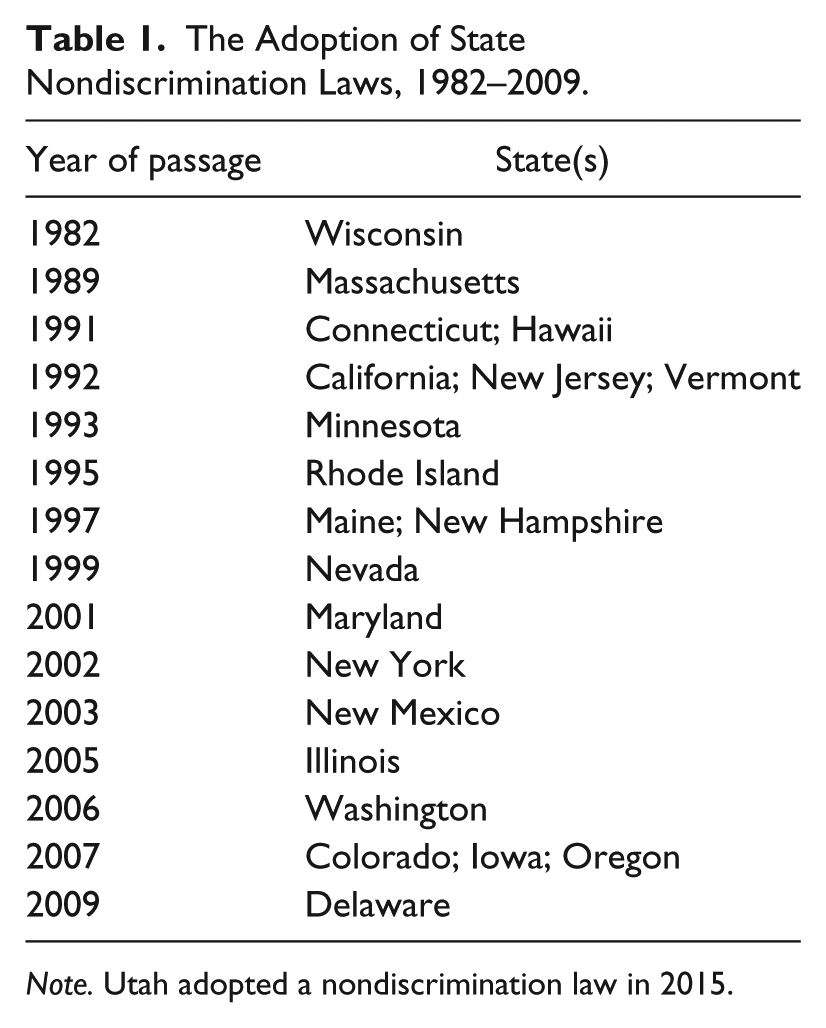
Note. Utah adopted a nondiscrimination law in 2015.
The dependent variable is scored “1” if a given state in a given year adopted a nondiscrimination law, after which point these states are dropped from the analysis as they are no longer at risk of adopting their first nondiscrimination law. Discrete time methods then assess the probability of an event (law) occurring in a given state in a given year provided that it has not already occurred. In the analysis that follows, the discrete time models are estimated as a logistic regression using Stata, version 13. We use robust standard errors clustered by state.
Discrete time methods are appropriate for several reasons. First, the event of interest, whether a state adopts a nondiscrimination law, can only occur in discrete (annual) time-units. The measurement of time here is relatively inexact and, thus, not appropriate for a continuous time approach. Second, the data set contains a number of “ties” because several states passed a law in the same year, which discrete time methods are particularly adept at handling. Third, this approach easily incorporates time-varying explanatory variables (Box-Steffensmeier and Jones 2004).
Explanatory Variables
The explanatory variables for this analysis come from various published and archival sources, all of which are described in Table 2. Unless otherwise noted, all data are annual, state-level measures. To assess movement organization, we draw on data from the Gayellow Pages, a national guide to the lesbian and gay community published almost annually since the 1970s. We use Kane’s (2003) state-level coding of the number of gay and lesbian social movement organizations listed in the Gayellow Pages per 1,000,000 adults, updated with the help of Parris and Scheuerman (2015), through the end of our time series. The SMO measure is defined broadly to include political organizations as well as less explicitly political groups, such as student, senior, and general pride organizations to better reflect the diversity of LGBT activist organizations (Button et al. 1997). We include a similar standardized measure of bars to capture the general size and connectedness of the LGBT community. Histories of the LGBT movement have stressed the importance of social outlets, particularly bars, in bringing lesbians and gays together as a community (Armstrong 2002). Bars measures the number of listings in the Gayellow Pages under “Bars, Restaurants, and Discos” per 1,000,000 adults (see Kane 2010 for more information on the Gayellow Pages measures).
Variables, Sources, and Descriptive Statistics.
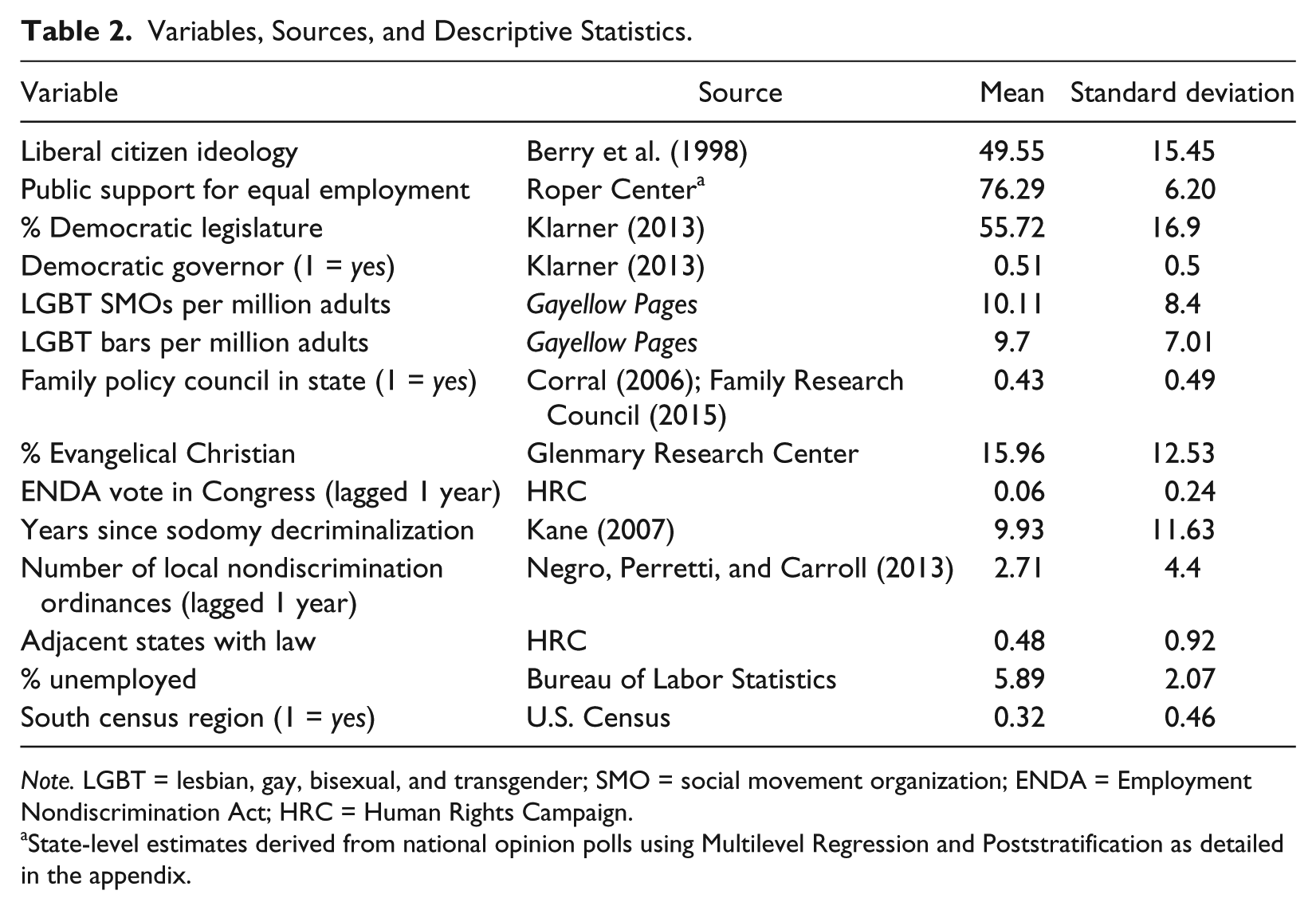
Note. LGBT = lesbian, gay, bisexual, and transgender; SMO = social movement organization; ENDA = Employment Nondiscrimination Act; HRC = Human Rights Campaign.
State-level estimates derived from national opinion polls using Multilevel Regression and Poststratification as detailed in the appendix.
For countermovement organization, we account for the presence of a Family Policy Council (FPC) in the state, a leading force working against gay rights during our time period. FPCs are independent state-level organizations that promote social conservative causes by “serving as a voice for the family and assisting advocates for family ideals who aim to recapture the moral and intellectual high ground in the public arena” (Focus on the Family 2007). As these organizations have been active opponents of the LGBT movement and its policy goals, several previous studies on LGBT activism and policy have used the existence of a state FPC as a measure of countermovement mobilization (Crockett and Kane 2012; Scheitle and Hahn 2011; Soule 2004). This measure is scored “1” beginning in the year of the organization’s founding in a given state and for each of the years after. While our FPC measure cannot capture the size or strength of the organization, we also include an important constituency that has often opposed campaigns for gay rights in the percentage of Evangelical Christians in a state (Fetner 2008; Haider-Markel and Meier 1996; Lax and Phillips 2009a). This measure is from the Glenmary Research Center and the Association of Statisticians of American Religious Bodies (ASARB; Bradley et al. 1992; Jones et al. 2002; Quinn et al. 1982).
We include political opportunities that should favor liberal policies more generally and LGBT policies in particular. There are no annual public opinion data by state on nondiscrimination policies over the full period, although national surveys have shown significant public support for equal employment legislation that includes sexual orientation. We address this limitation in two ways. First, we include a “policy mood” indicator in Berry et al.’s (1998) updated citizen ideology scores. This annual measure uses interest group rankings of the ideological positions of state representatives as well as their challenger’s in the preceding election and weights them by within-district vote margins to gauge citizen sentiment. The aggregate state score is on a liberal-conservative continuum that assigns the highest scores to the most liberal states.
Second, we use Multilevel Regression and Poststratification (MRP) to generate new state-level estimates of public support for equal employment laws from national polls (see Lax and Phillips 2009a, 2009b). Using MRP, we first estimate a multilevel model predicting support for equal employment among survey respondents as a function of demographic (age, race, gender, religion, and education) and geographic (state and region) predictors. In other words, state-level estimates are produced as a function of both demographic and state-specific effects. We then weight these estimates by the percentage of each demographic type in the actual state population using Census data. We describe this procedure in greater detail and provide a table showing the estimates in the appendix. We produce two sets of state-level public support scores pertaining to the 1989–1998 and the 1999–2009 periods. 4 On average, states show quite high levels of support, with 76 percent in favor of equal employment. Because we do not have the requisite opinion data to construct state-level estimates for the earliest years of our sample, we omit the 1980–1988 period in the regression models that include the opinion scores. We present additional evidence on the range of opinion and where states adopting nondiscrimination laws fall in the results section.
We include both the presence of a Democratic governor and the percentage of Democrats in the state legislature to capture states with more liberal elected officials, which should be more likely to adopt nondiscrimination laws. 5 To assess how favorable state political environments are to LGBT issues in particular, we include the number of years since sodomy decriminalization. This should be positively associated with the adoption of nondiscrimination laws by capturing the early adopters of more favorable state policies and the removal of an important barrier to the passage of civil rights laws, the de facto criminalization of homosexuality (Kane 2007). We also assess whether a record of successful mobilization at the local level impacts policy adoption in a given state. We use an annual count of the number of local nondiscrimination ordinances in the state to measure local mobilization (Negro et al. 2013). Because local successes may provide momentum for larger statewide campaigns, we lag this measure one year. While a strong record of local mobilization should generally favor the adoption of statewide policy, it also may reflect the strategic choices of activists in progressive enclaves of otherwise more conservative and less receptive states.
Given the history of the struggle for equal employment, national changes should be influential. We include dummy variables for the years ENDA came to a vote in a chamber of Congress and failed to become law during our time period (1996 and 2007). Failures at the national level should reinforce the importance of state activity. We lag this measure one year. More generally, we expect political allies and social movement actors to matter more during the latter years of the sample when nondiscrimination laws became increasingly public. To assess this possibility, we conduct a series of interactions between political actors and year.
Finally, all of our models control for the number of adjacent states with a nondiscrimination law, the percentage unemployed in the state, whether a state is in the South census region, and a linear time variable for year.
Results
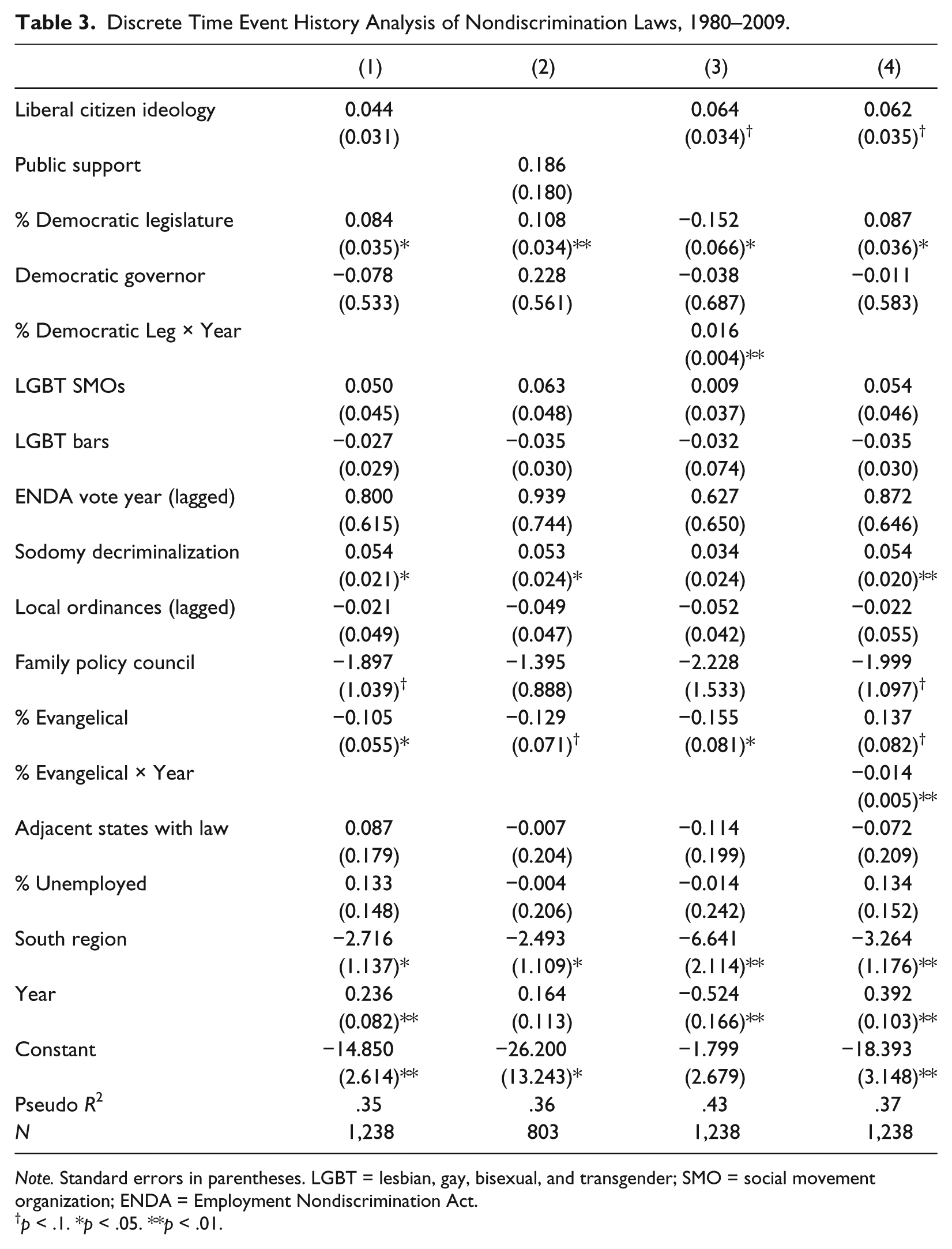
Table 3 presents results from our discrete time event history analysis of nondiscrimination laws. We present logit coefficients and standard errors in parentheses. Model 1 covers the entire 1980–2009 period and includes the Liberal Citizen Ideology policy mood indicator but not our public opinion measure. The findings provide mixed support for insights from the social movement literature on organization. Organization matters, but only for the opposition. The number of LGBT SMOs has no association with the adoption of nondiscrimination laws. Visibility of the LGBT community as indicated by the number of bars also has no effect. While studies examining local nondiscrimination ordinances (Negro et al. 2013; Wald et al. 1996) have found LGBT organization and visibility to be influential, we find no support when it comes to state policy. By contrast, the presence of an FPC in a state is negatively associated with the adoption of nondiscrimination laws and is marginally significant at p < .1, while the coefficient for the percentage of Evangelical Christians in a state is negative and statistically significant (p < .05). 6
Discrete Time Event History Analysis of Nondiscrimination Laws, 1980–2009.
Note. Standard errors in parentheses. LGBT = lesbian, gay, bisexual, and transgender; SMO = social movement organization; ENDA = Employment Nondiscrimination Act.
p < .1. *p < .05. **p < .01.
General political opportunities as well as those more specific to the LGBT movement are influential. First, and as expected, Democratic allies matter. The coefficient for the percentage of Democratic legislators in a state is statistically significant and positively associated with the adoption of nondiscrimination laws. Liberal citizen ideology is positive in direction but does not reach statistical significance, and the presence of a Democratic governor has no effect. Considering the LGBT-specific opportunities, the number of years since sodomy decriminalization is positively associated with the adoption of nondiscrimination policies while the number of local nondiscrimination ordinances has no effect. While we expected increased activity in the years following ENDA votes in Congress, there is no significant difference between these moments and any other year. Among the controls, Southern states are less likely to pass nondiscrimination laws, and the coefficient for the linear time variable is positive and statistically significant.
Prior research on gay rights policies finds public opinion to be critical (Lewis and Oh 2008). Unfortunately, there is a lack of reliable state-level public opinion data. We follow Lax and Phillips (2009a) and overcome this deficit by using Multilevel Regression and Poststratification (MRP) to generate novel state-level estimates of support for equal employment from national polls (see the appendix). We include our measure of public support for equal employment in Model 2 instead of our less precise policy mood indicator in liberal citizen ideology. Due to data availability, the model omits the years before 1989, reducing our number of state-year observations from 1,238 to 803. The coefficient for public opinion is positive but does not reach statistical significance. 7 As we describe in the following section, “Public Opinion and Nondiscrimination Policy,” this does not suggest to us that public support is inconsequential. Rather, it cannot explain why some states adopted laws earlier versus later independent of social movement organizational and political contexts—a point we follow up on below.
Whether using a policy mood indicator over the entire sample period or our public opinion measure in the truncated sample, political opportunities in the percentage of Democratic legislators and prior LGBT policy victories and, to a lesser extent, opposition to LGBT policy goals in the percentage of Evangelical Christians in a state, all have independent and significant effects on the adoption of nondiscrimination laws.
Given the history of the struggle for equal employment, we expected the influence of organization and opportunity to be uneven over time. Specifically, setbacks in Congress in the 1990s moved state nondiscrimination policy from an often small and noncontroversial issue to a much more public and partisan one. In this charged context, we expected SMOs and political allies to matter more. To assess this possibility, we conducted a series of interactions between political actors and our linear time variable. We report the significant findings in Models 3 and 4. For these models, we include our liberal citizen ideology indicator instead of public opinion and make use of the entire period. Model 3 presents the interaction between time and the percentage of Democratic legislators, which is positive and significant. The presence of Democratic allies means more in the latter years of our sample. Whereas a few states with a Republican majority passed nondiscrimination laws in the early and mid-1990s (New Jersey and New Hampshire), none did so without significant Democratic support after 1997.
Model 4 presents the interaction between time and the percentage of Evangelical Christians in a state. The effect is negative and increasingly so over time. Whereas the Evangelical Christian population becomes more influential over time, LGBT SMOs have no effect on policy adoption across the entire period no matter what specification. 8
Figure 1 provides a more intuitive interpretation of the shifting landscape of political allies as well as opposition to gay rights as reported in Models 3 and 4 of Table 3. We plot the average marginal effects for the percentage of Democrats in state legislatures and the percentage of Evangelical Christians in state populations on the probability of passage of nondiscrimination laws over time. Into the early 1990s, neither had much of an effect on passage. By the late 1990s, however, the effects of Democratic allies and the share of the population typically opposed to gay rights in Evangelical Christians are increasing in effect size and significance and moving in different directions. These patterns are consistent with research on the mainstreaming of LGBT rights in state Democratic Parties over our period and heightened party polarization in the states more generally (Coffey 2011; Karol 2012).
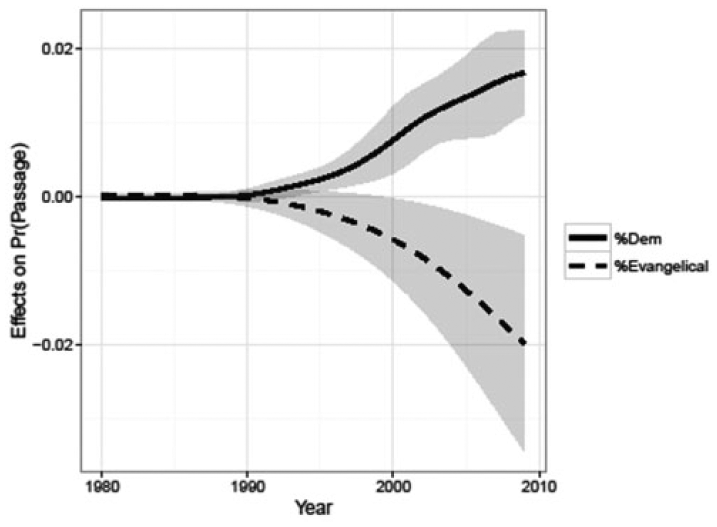
Average marginal effects of percentage of Democratic legislators and the percentage of Evangelical Christians on the probability of passing a nondiscrimination law, 1980–2009.
Public Opinion and Nondiscrimination Policy
In our discrete time event history analysis, we do not find public support for equal employment to matter for policy adoption independent of state political and social movement organizational contexts. 9 But this alone tells us little about the nature of public support for equal employment and where states that adopt these policies fall. In Figure 2, we provide more detail on the relationship between opinion and state nondiscrimination policy in two boxplots. The opinion scores were derived using MRP with data from national polls (see the appendix). The first period in the boxplot relies on polls from 1989, 1994, and 1996 (N = 3,046). Our second period uses data from three polls conducted in 1999 and 2004 (N = 3,674). We plot the scores of all states in both periods and highlight those states that adopted a nondiscrimination law in each period by their abbreviations. The thick horizontal line for each period is the median score. Wisconsin is not highlighted because they adopted a law in 1982, prior to the beginning of our state opinion estimates.
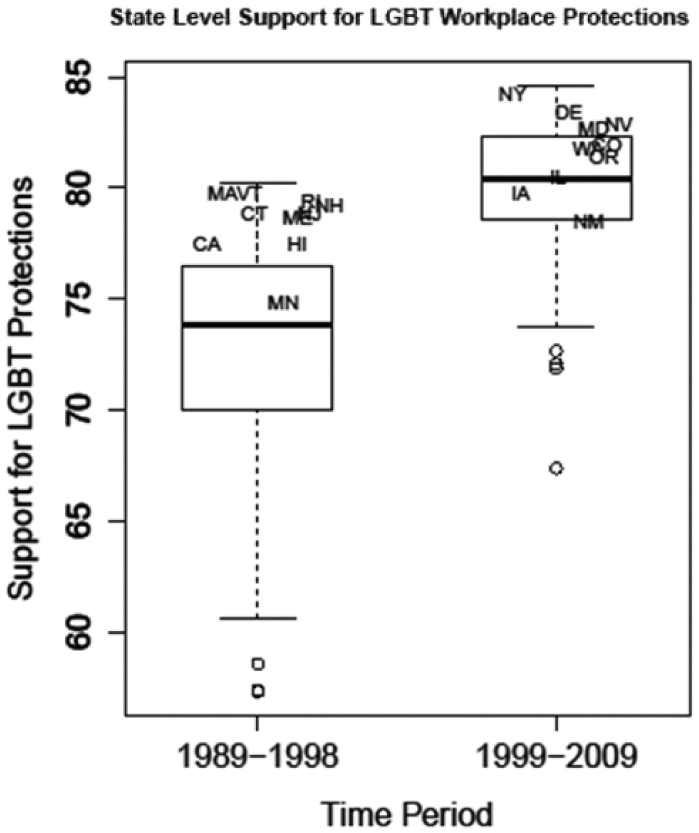
Boxplots showing the distribution of public support for employment nondiscrimination laws over two time periods.
Two things stand out immediately from the boxplots in Figure 2. First, support for equal employment is quite high, particularly among states that adopt such laws. For the 1989 to 1998 period, the median level of support was 74 percent, ranging from a low of 57 percent in Alabama and Utah to a high of 80 percent in Massachusetts, New York, and Vermont. Among adopters, support varied within a much narrower range, between 75 percent and 80 percent. Second, there is an across-the-board increase between the two periods. The median level of support for the 1999–2009 period is 80 percent, with adopters during these years ranging from 79 percent to 84 percent. Notably, all states shift upward, including those that adopted nondiscrimination policies early on (e.g., Massachusetts and Vermont) as well as those that never did (e.g., Alabama).
These patterns coupled with the regression results suggest to us that while very high public support is common for states that adopt nondiscrimination laws, it is not enough, particularly in the face of opposition. Our findings are consistent with Lax and Phillips’s (2009a) cross-sectional analysis of public opinion and policy responsiveness across a host of LGBT-related policies. They find less congruence between state employment law and public opinion than for public opinion and most other policies (e.g., adoption, hate crimes, marriage, and civil unions). Large majorities in favor of equal employment have been the norm since the 1990s, but most states have not responded by passing nondiscrimination laws. Instead, party politics and opposition to gay rights have increasingly influenced the patterning and timing of nondiscrimination policies in the states.
Discussion and Conclusion
Whether one is legally protected against discrimination in employment on the basis of sexual orientation or gender identity is determined by a patchwork of state and local policies. Research suggests these laws make a positive difference in the work lives of sexual and gender minorities (Baumle and Poston 2011; Tilcsik 2011). Yet, we know little about the conditions under which state laws granting employment protection for sexual and gender minorities are passed and if LGBT movement actors matter in this process. Nondiscrimination laws pose an important puzzle for social scientists. While political science research emphasizes the role of public opinion in explaining the development of LGBT rights policies (Lax and Phillips 2009a), there is more public support for employment protection than many other goals of the LGBT movement, although with relatively less policy success.
This article contributes to our understanding of the adoption of nondiscrimination laws and the politics of social movements more generally in three ways. First, and consistent with social movement theory, we show that organization and political opportunity are critical, independent of public opinion. Notably, organization only appears meaningful for the opposition. The effect of the percentage of Evangelical Christians in a state is consistently negative and decreases the likelihood of policy adoption, whereas LGBT SMOs have no effect. Political opportunities likewise influence the adoption of nondiscrimination laws. The share of Democrats in state legislatures increases the likelihood of policy adoption as do previous gains in state-level LGBT rights. The more years since the repeal or invalidation of the state sodomy law, which essentially criminalized homosexuality, the more likely employment protection is to be granted.
Second, we find that the factors contributing to the passage of nondiscrimination policy change over time; specifically, the role of opposition and political allies become increasingly important as the years progress. Into the early 1990s, neither the percentage of Democratic legislators nor the share of Evangelical Christians in state populations had much of an effect on the passage of new protections. By the late 1990s, however, the influence of both increased, with Democratic allies becoming increasingly important in explaining which states passed laws, and the Evangelical population playing a larger role in which states did not. We attribute these shifts to two key changes in the larger political environment. Party politics became increasingly polarized, as Democrats became more supportive of LGBT rights and the Republican Party became more influenced by conservative religious groups opposed to the LGBT movement. LGBT rights also gained national visibility in the mid-1990s with the passage of DOMA and the failure of the ENDA, which helped to make the inclusion of sexual orientation and gender identity into state employment protections a highly contested, partisan policy, rather than a gradual expansion of employment protections. Therefore, while political opportunities and opposition to LGBT rights are critical for the passage of nondiscrimination laws, their importance is not static. Our argument and findings underscore the need for historically informed analyses that think seriously about when organization and opportunity should matter.
Third, we generate new state-level public opinion estimates of support for nondiscrimination laws. We demonstrate how public opinion in support of nondiscrimination laws has been, and continues to be, very high, and states that passed new protections averaged public support at or above 75 percent. Yet, our results indicate that while very high public support is common for states that adopt nondiscrimination laws, it is not enough. Public opinion research argues that movements and interest groups can subvert public opinion by pressuring lawmakers into passing unpopular legislation (Burstein 2003). In our case, the opposite appears to be true; well-organized opposition has been able to subvert the passage of policy supported by a substantial majority of the public.
Unlike other early legal goals of the LGBT movement, such as sodomy decriminalization, employment protection has a long history of being specifically targeted by opponents. Indeed, the start of an active, coordinated countermovement resisting LGBT rights came in response to the passage of a local nondiscrimination ordinance in Dade County, Florida. The opposition then spread nationwide, challenging local laws in cities as varied as Eugene, Oregon and Wichita, Kansas, and included an attempt to legalize discrimination based on sexual orientation in California by banning gays and lesbians from teaching (Button et al. 1997; Fetner 2008). Whereas nationwide recognition of marriage quality and sodomy decriminalization were achieved through Supreme Court decisions, nondiscrimination laws have been fought out in legislative venues for several decades (Kane 2010). The recent position of the EEOC that existing sex discrimination provisions of the Civil Rights Act also apply to sexual orientation and gender identity may eventually force the issue if challenged in court. In the absence of federal law, the existing patchwork of employment protections is clearly limited as standards and capacity for enforcement vary across states and municipalities.
We acknowledge that the passage of discrimination protection is only an initial step to addressing workplace inequality based on sexual orientation and/or gender identity. The laws must be used to address workplace inequality. Future research should probe the role of movements and countermovements in the implementation of state nondiscrimination policies. Understanding if and/or how movements influence the likelihood of individuals to use this legal mechanism to fight discrimination will enhance our understanding of the relationship between mobilization and inequality more generally.
Footnotes
Appendix
Multilevel Regression and Poststratification (MRP) is a method to generate state-level (or other subnational unit) opinion estimates from national polls. It is distinct from disaggregation, and overcomes many of the sampling biases inherent therein, by modeling individual survey responses as a function of both demographic and geographic predictors and by partially pooling respondents across states. See Lax and Phillips (2009b) for a discussion of MRP and its performance relative to disaggregation.
We follow Kastellec, Lax, and Phillips’s (2014) protocol for MRP using R. We first identified national polls available for download during our time period that included questions about equal employment for gays and lesbians. The polls, six total, were conducted or contracted by CNN/Time Magazine, Gallup, Los Angeles Times, and Princeton Survey Research Associates. With slight variations, the survey questions about equal employment asked the following: “Do you think homosexuals should or should not have equal rights in terms of job opportunities?” After merging individual poll data sets within two time ranges (1989–1996, N = 3,046; 1999–2004, N = 3,674), we estimated multilevel models of individual support for equal employment for each period using the glmer mixed effects logistic regression package in R. Individual support was modeled as a function of demographics (age, race, gender, and education of a respondent) and geography (state and region). We then weighted (or poststratified) the estimates by the percentage of each demographic type in the actual state population. For this step, we used the IPUMS 5 percent microdata samples from 1990 (for period 1) and 2000 (for period 2). For comparison, state support for equal employment is correlated with liberal citizen ideology at .53 over the two periods.
Acknowledgements
We are grateful to Alison Adams and Dan Tope for their helpful comments on an earlier draft, to Christie Parris and Heather L. Scheuerman for sharing updated Gayellow Pages data, and to Giacomo Negro for providing the data on local ordinances.
Declaration of Conflicting Interests
The author(s) declared no potential conflicts of interest with respect to the research, authorship, and/or publication of this article.
Funding
The author(s) received no financial support for the research, authorship, and/or publication of this article.