




Abstract
As a set of criminal justice policies and practices, the “war on drugs” is a contested social issue linked to specific racial meanings and structures and political logics. As the legitimacy and value of the “war on drugs” has increasingly become a topic of public discussion, how such debates are shaped by both media communication and contemporary racial discourses warrants rigorous sociological analysis. In this article, we use a content analysis of newspaper manuscripts and online comments on “war on drugs” news stories to examine (1) the racial discourse within mass media agenda-setting and framing and (2) patterns of discursive identity construction in the context of digital and mass-mediated social commentary. Our findings show how “racial silence,” implicit and explicit racial discourse, and identity construction via racialized subject-positions assist to rationalize and legitimate racial inequality. We also outline the theoretical implications of these findings and avenues of future research.
Keywords
An epistemology of ignorance speaks through silence.
Introduction
Depictions and discussions of the “War on Drugs” (hereafter, WOD) saturate American media. In the “post-racial” era, the phrase serves as a vehicle for racialized claims and has become a lightning rod of legal, policy, and social analysis (cf. Beckett, Nyrop, and Pfingst 2006; Dvorak 1999; Human Rights Watch 2008). Moreover, how social actors read and position themselves in relation to the WOD signals a constellation of attitudes on race and criminal justice (cf. Bobo and Thompson 2006; Garland and Bumphus 2012). While previous scholarship has charted the origins and sociopolitical functions of the WOD and how actors’ attitudes correlate with the politicized nature of the phrase, we know much less about, first, the empirical construction and variation of the WOD as a contested and racialized media term, and second, how audiences discursively construct a sense of self in relation to this mediated concept.
Within the overall acceleration and racialization of criminal justice practices (Petit and Western 2004; Wacquant 2010), American drug prohibition laws and enforcement practices often reflect racialized moral panics and efforts to marginalize non-white racial groups. In the Jim Crow South, politicians and media invoked the demonic imagery of the “negro cocaine fiend” to justify drug prohibition as a tool for postbellum re-disenfranchisement (Cohen 2006; Dvorak 1999). In the 1960s, the state deployed drug laws and “tough on crime” policies as a form of social control against progressive social movements, including the Civil Rights Movement (Haney López 2007). In the 1980s, racially biased sentencing guidelines, and the rearticulation of racialized discourses of moral panic around the “crack epidemic,” further augmented and racialized drug penalties and the prison population (Dvorak 1999; Haney López 2007). American drug law enforcement continues to disproportionately incarcerate African American and Hispanic men (Beckett, et al. 2006).
In contrast to the overtly racialized discourses that historically undergird drug prohibition, contemporary politico-legal discourses frame criminal justice policies and practices as ostensibly race-neutral (Brewer and Heitzeg 2008; Haney López 2007). Many scholars, however, interpret this language as a form of “subtle” (Meertens and Pettigrew 1997), “symbolic” (McConahay and Hough 1976), “laissez-faire” (Bobo, Kluegel, and Smith 1997), or “color-blind” (Bonilla-Silva 2014) racism in the post–Civil Rights era (after 1965).
Despite shifts toward supposed “nonracial” framing in state and society, cultural production institutions—such as mass media—generate symbolic and discursive connections between race and crime and normalize racialized criminal justice practices (Robinson 2000). For racially isolated whites and those lacking contact with criminalized groups, media are a primary source of information about social others (Cheliotis 2010; Entman and Rojecki 2001). Such correlations have consequences. For example, Garland and Bumphus (2012) found that perceptions that drug users and distributors are primarily black or Hispanic led to greater support for punitive drug policies.
Previous research suggests political discourse around the WOD forms a sense of social and personal identity but focuses on elite actors (e.g. Grayson 2004; Valenzuela 2012; Weimer 2003). However, as drug laws change in response to public demand, the policies and practices of the WOD have become a topic of public debate. How mass media and prevailing racial discourses and logics shape these debates warrants further sociological analysis.
This article makes three key empirical and theoretical contributions. First, the rise of mass-mediated debates on drug and crime policy begs for the discovery of how racial ideologies and discourses influence these debates in a “post-racial” era. Second, how the WOD is debated in digital contexts has received sparse attention. And third, how racial identities are formed in virtual, online situations marked by the absence of the “politics of the skin” (Fanon 1967) is ripe for sociological analysis. While recent research has explored the relationship between racial identity formation and contested racial issues, how such relationships vary in relation to news media framing and agenda-setting in the context of interactive computer mediated communication remains relatively underexplored (cf. Hughey 2012b; Hughey and Daniels 2013; Daniels 2013; Kettery and Laster 2014 as notable exceptions).
We analyze news media and online comments to examine how racial ideologies are employed in mass-mediated debates over the WOD and how news media framing and agenda-setting in the context of interactive computer mediated communication constrain and enable racial identity construction. This study thereby connects the enactment of the WOD as a mode of structural racism to three streams of research: (1) media framing and agenda-setting, (2) the features of racialized media debates, and (3) connections between racial ideology, media discourse, and identity construction.
The “War On Drugs”: Mass Media, Debate, and Identity Construction
Media Framing and Agenda-setting: Resonance and Reflection
Two umbrella approaches—reflection and resonance—dominate the sociology of media. Reflection theory posits that the production of media texts denotes a strong relationship between the text and dominant social values, practices, and ideologies. Hence, a media text developed in a given era and society reflects that society’s values and beliefs (cf. Griswold 2002). Drawing from Marxist and functionalist paradigms, cultural objects (like newspapers) are bearers of meaning that mirror social reality. Thus, the “true” meaning of a cultural object lies in the social structures and patterns it reflects.
Alternatively, more Weberian approaches emphasize how cultural objects respond to, or resonate with, dominant social meanings and established demographics and interest groups. Two major subfields within this paradigm have developed. First, scholars in the “agenda-setting” tradition focus on the media’s ability to shape what the public understands as important. Two basic assumptions underlie agenda-setting research: (1) the press and the media do not reflect reality but rather filter it and (2) media concentration on a certain issues leads the public to perceive those issues as more important (cf. McCombs, Shaw, and Weaver 1997; Rogers and Dearing 1988; Rogers, Hart, and Dearing 1997).
Second, framing theory—hailing from Goffman’s (1974) dramaturgical sociology—concentrates on how the media organizes and presents social reality. Frames not only communicate what to think about (agenda-setting), but also how to think about events and issues (cf. Deetz, Tracy, and Simpson 2000; Fairhurst and Star 1996; Smetko and Valkenburg 2000).
These perspectives together emphasize how media narratives are shaped by the systems within which they are created, distributed, evaluated, and preserved (Peterson and Anand 2004). Newspapers are designed to resonate with particular issues and demographics in larger society. Schudson (1989) contended that what “is ‘resonant’ is not a matter of how ‘culture’ connects to individual ‘interests’ but a matter of how culture connects to interests that are themselves constituted in a cultural frame” (p. 169). Media forms must hold an “aura” of resonance that is neither a private relation between cultural object and individual nor a social relation between cultural object and audience. 1 Rather, media such as newspapers and magazines exhibit a “public and cultural relation among object, tradition, and audience” (Schudson 1989:170) that resonates with select audiences’ understandings of, in this case, drugs, crime, and race.
Given the digital transformation of newspaper readership (Rowlands 2013) and the continued racial segregation of newspaper marketing and readership (Daniels 2013), online media consumption and participation remains deeply racialized. How media framing and agenda-setting influence how racial subjects form and rearticulate their racial identity is thus prescient.
Mass-mediated Debates over the WOD
Claims making—a central aspect of racial politics and the labeling of phenomena as problematic—occurs within a space of unequal entrée to, and uses of, mass media (Becker 1963; Daniels 2013; Doane 2006). Mass media content is often oriented toward white audiences, and mass media corporations are primarily run and owned by whites (Entman and Rojecki 2001; Robinson 2000). Due to implicit rules and norms set in place by media organizations’ structures and relationships with other institutions, the institutional practices of mass media entail forms of agenda-setting and frame debates about social issues such as drugs, law, and crime in ways that often correspond with dominant racial meanings (Beckett 1994).
In an age wherein racial inequality is often rationalized through superficially “nonracist” frames in the dominant discourse (Bonilla-Silva 2014), there is often “racial silence” within not only supportive commentary but also critiques of the WOD. Trade books such as Sullum’s (2004) Saying Yes: In Defense of Drug Use and organizations such as Marijuana Policy Project and National Organization for the Reform of Marijuana Laws (NORML ;Hart 2013) argue against the WOD yet omit its role in reproducing racial inequality. 2 Furthermore, television news reporting on drug policy is packed with jokes and moral panics rather than analysis of its racial implications (Trujillo 2012).
As these examples illustrate, both sides of the WOD debate are frequently articulated through frames that fixate on ostensibly nonracial components or justify racialized outcomes. Given aversions to claims of racism (Bonilla-Silva 2014; Doane 2006; van Dijk 1992) and racialized representations of crime (Robinson 2000), the omission of racial justice claims in mass-mediated discussions of policy issues may be deployed for resonance with the racial meanings held by audiences. Furthermore, this phenomenon reflects important dynamics between racial ideology, mass media discourse, and how individuals define themselves and others through articulating their views on contested social issues such as the WOD.
Racial Ideology, Media Discourse, and Identity Construction
Racial ideology, one of the most influential conceptualizations of racism in contemporary sociology, describes a set of ideas that either challenge or justify racial inequality. Within racialized social systems such as American society, racial categories structure social and material conditions (Bonilla-Silva 2014). Lewis (2004) thus explained, “Racial ideologies are always produced and rearticulated in relation to material circumstances” (p. 636). Color blind racial ideology is the set of ideas used by the majority of Americans (most often whites) to justify the persistence of racial inequality in response to the stigmatization of overt racism and the rise of concepts such as equal opportunity (Bonilla-Silva 2014).
Racial ideologies are manifest in “racial discourse” or linguistic modes of articulating racial issues (Doane 2006). Racial discourse helps to not only rationalize and justify social structures, but it enables the formation of racial identities that occupy those structures. Media discourse interpellates (cf. Althusser 1971) racial selves and racial others. Especially with the proliferation of Web 2.0 technologies, audiences now “speak back” to media content. But as Hughey and Daniels (2013) pointed out, “not much research examines the new digital saga of racial and racist discourse in, and in response to, online news formats” (p. 334). It is, therefore, pertinent to ask how racial identities are established and maintained—similar to what Doering (2014) called a “battleground of identity”—through implicitly and explicitly racialized media events and processes, like the debate over the WOD.
Mead (1934) was perhaps the first social theorist who argued that language serves as a way of coherently organizing experiences via reference to “the self.” Later, Goffman (1967) emphasized that processes of identity construction largely occur via discourse. Research from this dramaturgical-linguist perspective suggest contexts in which people interact, speak, and (re)form a sense of self as a process of rationalizing their speech dependent on either their desires or normative interactions. For instance, Howard (2000) described identities as “strategic social constructions created through interaction, with social and material consequences” and argued that “people actively produce identity through their talk” (pp. 371–72). Although this perspective reveals identity as discursively constructed, it suggests functionalist or rational-actor conceptions of agency and interaction in which identity construction is merely the outcome of strategic communication.
Recent research on identity has also incorporated insights from the work of Michel Foucault on the relationship between power and truth-claims within discourse. For instance, Hall (1997) observed that, discourses “construct subject-positions, from which alone they make sense” (p. 56). We can therefore understand identity as not merely constructed through language but more specifically as the product of identification with particular “subject-positions” within discourses (Hall 1996) such that “a person inevitably sees the world from the vantage point of that position and in terms of the particular images, metaphors, story lines and concepts which are made relevant within the particular discursive practice in which they are positioned” (Davies and Harré 1990:46). Blending these perspectives, we approach discursive identity construction as simultaneously shaped by ideological/discursive contexts and the ways in which social actors deploy various forms of discourse for communicative and social ends.
Discourse within the mass-mediated debate on the WOD does not just describe “blacks” or “whites” as engaging in unequal practices of “law-abiding”—what might be called “media bias”—but labors to naturalize the existence of, and unequal treatment between, racialized bodies by concealing the racial character of the WOD. Media discourse also mutually constrains and enables meaning making of “self” and “others” (the construction of identity) in relation to real exigencies of social inequality. 3
Data and Method
This study uses a “reflexive and highly interactive” (Altheide and Schneider 2013:26) mode of content analysis to understand patterns of social groups’ meaning making over the WOD within media documents (Altheide and Schneider 2013:24). We bring together two distinct datasets (newspaper manuscripts and online comments) to analyze the relationship between racialized discourse and identity construction within WOD media debates. These datasets enable us to analyze (1) variation within the meaning of the media concept of “WOD” and (2) audience formation of discursive selves in relation to news media. Together, our analysis reveals sociologically important dynamics regarding media resonance and subject positioning.
Media Conceptualization of the WOD
The first dataset concerns media discourse on the WOD. We used Lexis Nexis News database to produce 997 newspaper manuscripts containing the phrase “War on Drugs.” To analyze only national, regional, and local U.S. newspaper discourse on the WOD, this initial population was culled to 394 manuscripts by removing non-U.S. newspapers and duplicate manuscripts. The dataset derives from 121 total newspapers (see Table 1) and contains 173 op-eds, 154 journalistic articles, and 68 letters to the editor. This variation enables us to tap into “the widest range of relevant messages within our sample” (Altheide and Schneider 2013:55). Given that discursive forms can influence claim-making practices, we approached all the manuscripts in our population as “subjective” social facts—contra the ideal of “objective” reportage—as the basis for coding (cf. Possamai et al. 2013) to capture the overall variation of the media discourse as it appeared in the dataset, inclusive of the perspectives of “experts,” lay-interviewees, and all other sources whether summarized or directly quoted. 4
Newspapers.

As media digitization is available beginning in the early 1980s, the manuscripts within this dataset span just over three decades (1983–2014). The dataset provides access to a wide range of material including coverage of militaristic drug enforcement and the so-called “crack epidemic” and post–civil rights racial discourse (cf. Haney López 2007). The dataset is affected by rates of digitization thereby skewing toward more recent dates and the exclusion of nondigitized newspapers and non-print sources. While variations in time and form present some limitations on population-level generalization, we are more focused on analyses of the construction of the categories involved (Luker 2008:48); specifically, the internal variation within the media concept of the WOD. Moreover, our inclusive dataset avoids the methodological biases inherent in a narrower sample based on more specific criteria (cf. Altheide and Schneider 2013:55; Luker 2008:103).
Identity Construction in Relation to the WOD
The second dataset concerns discursive identity construction in relation to mediated discussion of the WOD. This dataset stems from popular online news source comment sections. Due to lack of access to the audiences of our newspaper manuscripts, we used theoretically informed purposive sampling (cf. Altheide and Schneider 2013:25, 55; Luker 2008:104). We identified the top 15 influential news sources in 2014 (cf. eBizMBA 2014). 5 Our time frame for searching was from 2009 to 2014. We were limited in our ability to collect online comments because news sites have adopted “a variety of strategies to deal with offensive comments, including turning ‘comments off,’ not archiving comments, and adopting aggressive comment moderation policies” (Hughey and Daniels 2013:332) Nevertheless, we searched these sources for the term “War on Drugs,” and pulled 24 articles via the search engine’s “sort by relevance” feature and by reaching theoretical saturation. This convenience sample included only those from U.S. sources that contained variously racialized critiques of the WOD and possessed more than 20 comments. 6 Upon aggregating the comments from these stories, we constructed a database of 3,145 unique comments. 7
Coding and Analysis
A three-tier qualitative analysis of the data was implemented. First, the newspaper articles and comments were inductively examined to identify “sensitizing concepts” (Blumer 1954). Second, we applied a deductively generated framework based on the sociological literature on race and the WOD. This approach consists of reflexive movement between concept development, data coding, data analysis, and interpretation. Hence, we did not seek to create a new theory relating to the study of race, media, and the WOD, but we sought instead “to check and supplement as well as supplant prior theoretical claims” (Altheide and Schneider 2013:26).
We approach the variables at play not as “static and inflexible” but as categories that are “allowed and expected to emerge throughout the study” (Altheide and Schneider 2013:26).
Third, we organized our deductively based and inductively refined steps into a coding scheme of (1) first-level “frames,” (2) second-level “themes,” and (3) third-level “discourse” (Altheide and Schneider 2013). Frames were operationalized as “very broad thematic emphases or definitions” that provide “the focus, a parameter or boundary, for discussing a particular event” (Altheide and Schneider 2013:52). Themes were operationalized as subframes or “the recurring typical theses” (Altheide and Schneider 2013:53) that show the variation within a frame. Discourses were operationalized as claim-making strategies or “the parameters of relevant meaning . . . use[d] to talk about things” (Altheide and Schneider 2013:53). Many of these elements are intimately linked so that, in instances in which the narratives used more than one code at a time, each was acknowledged to capture their overlapping nature (each scored a 1 to create overlapping categories; 0 = no, 1 = yes).
For newspaper manuscripts, each paragraph served as the unit of analysis. There was a total frequency distribution of four frames comprised of seven themes (681 instances) and 315 discourse instances. This resulted in a total of 996 codes drawn from 394 manuscripts for an average of 2.52 codes per article (see Table 2). Because different media forms are differently constrained in ways that may influence our findings, we also analyzed the newspaper data for relationships between variance in frames and themes and variation over decades, manuscript types (op-ed, journalistic, or letter to the editor), and newspaper types (high vs. low circulation). 8
Frames and Themes in Newspaper Articles.
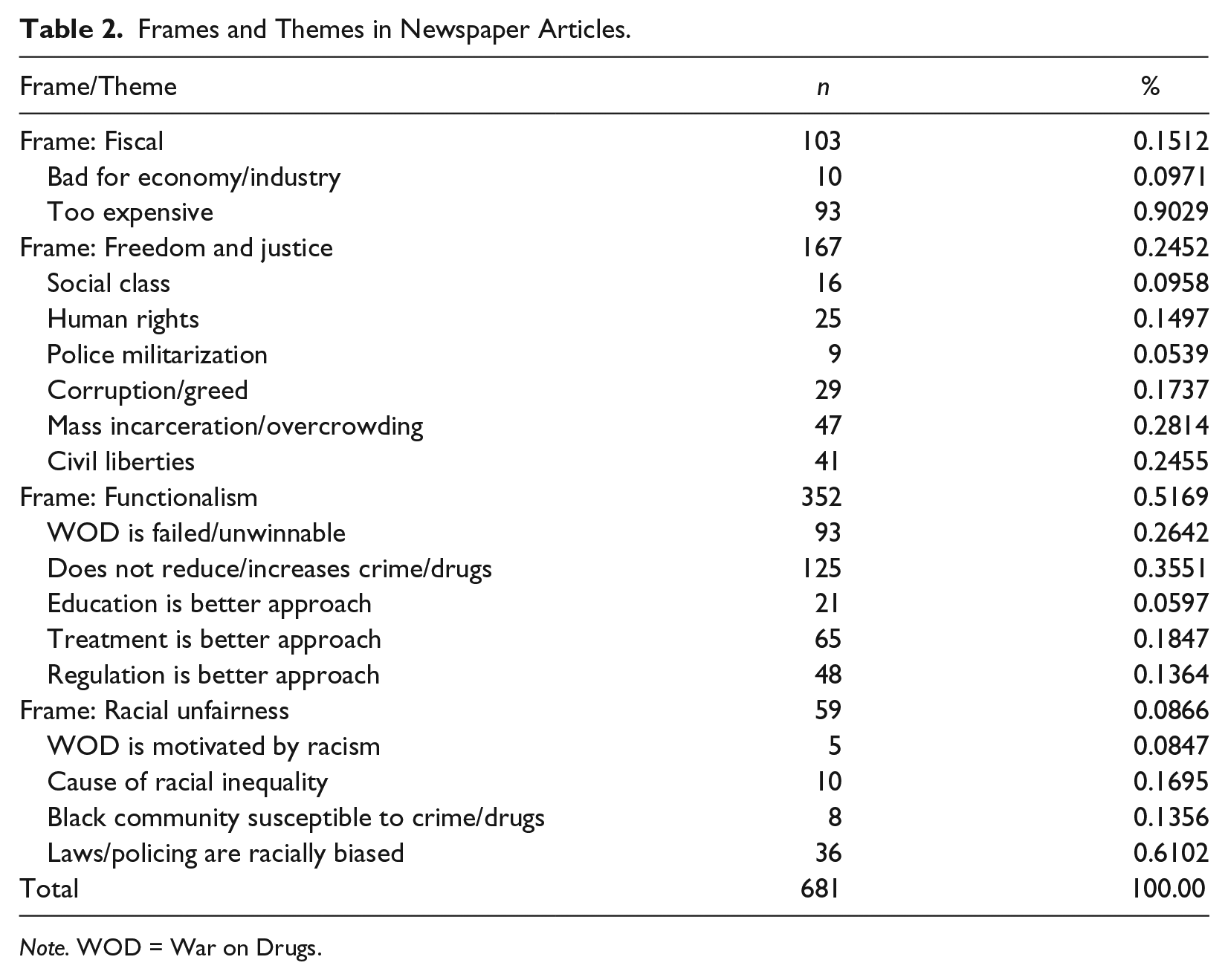
Note. WOD = War on Drugs.
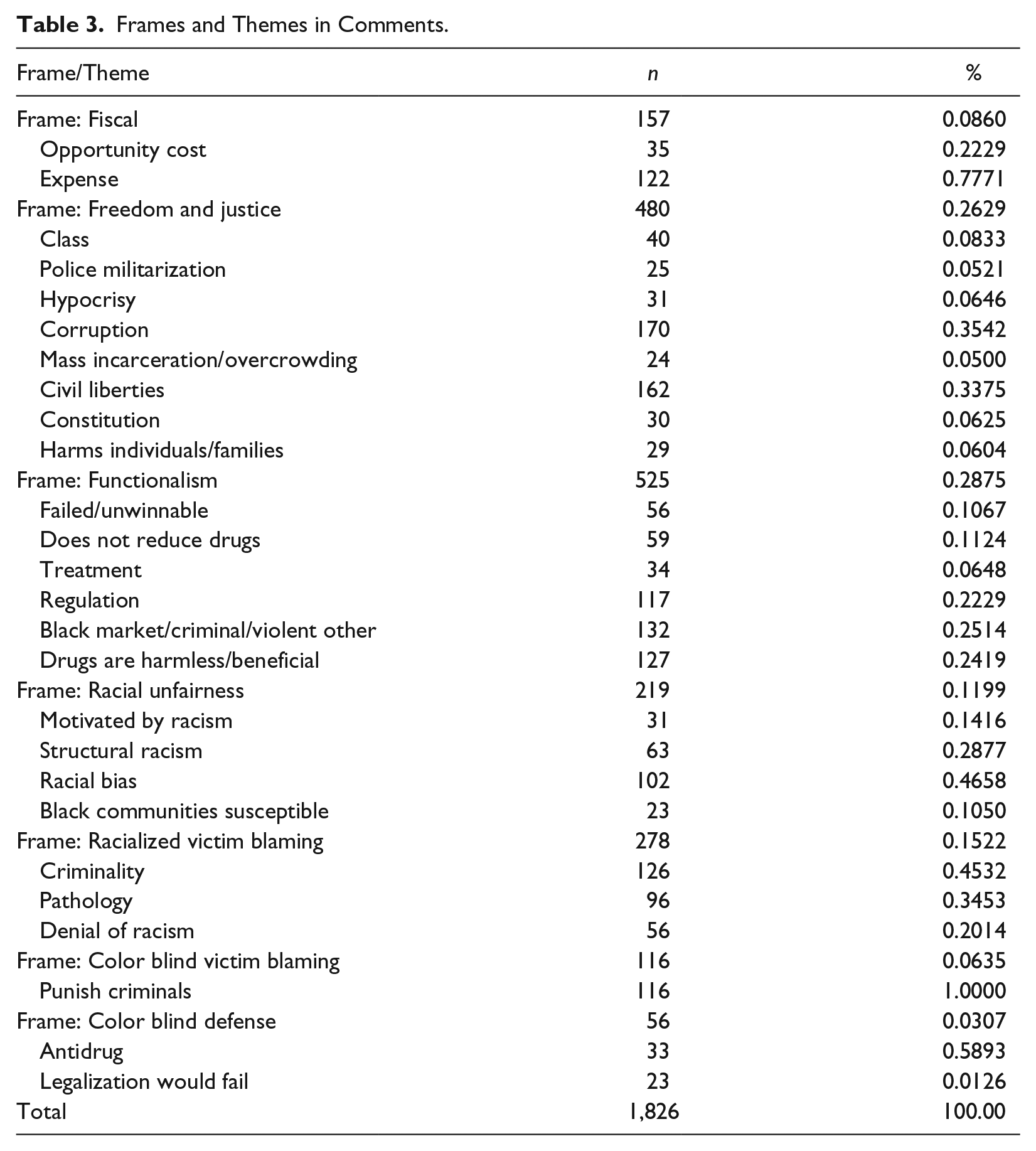
For comments, the unit of analysis was each comment. There was a total frequency distribution of six frames comprised of 26 themes (862 instances), and 1,474 discourse instances. This resulted in a total of 2,336 codes drawn from 3,145 comments for an average of .74 codes per comment (see Table 3). 9
Frames and Themes in Comments.
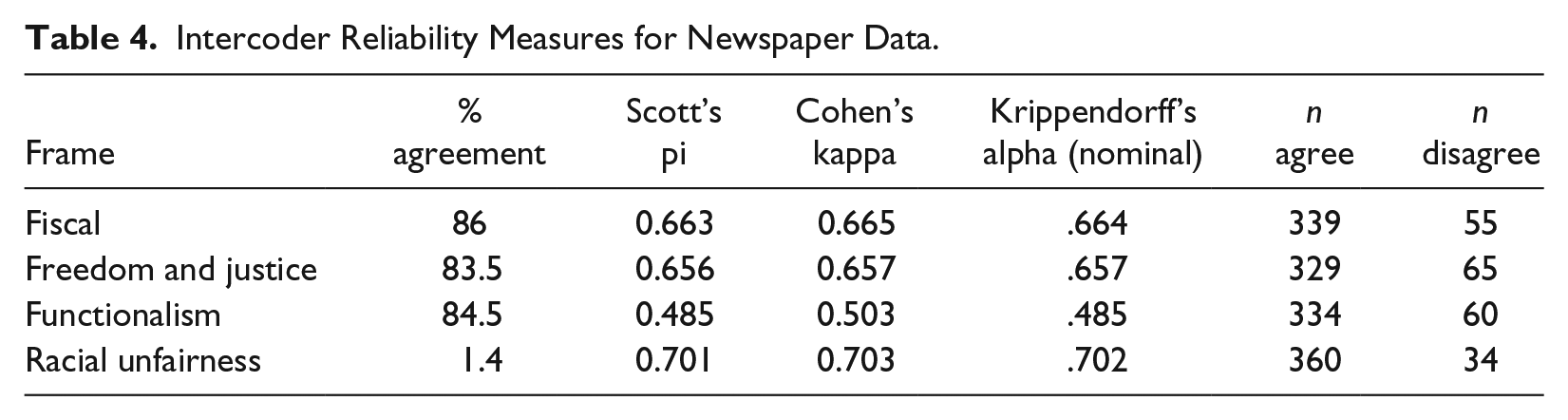
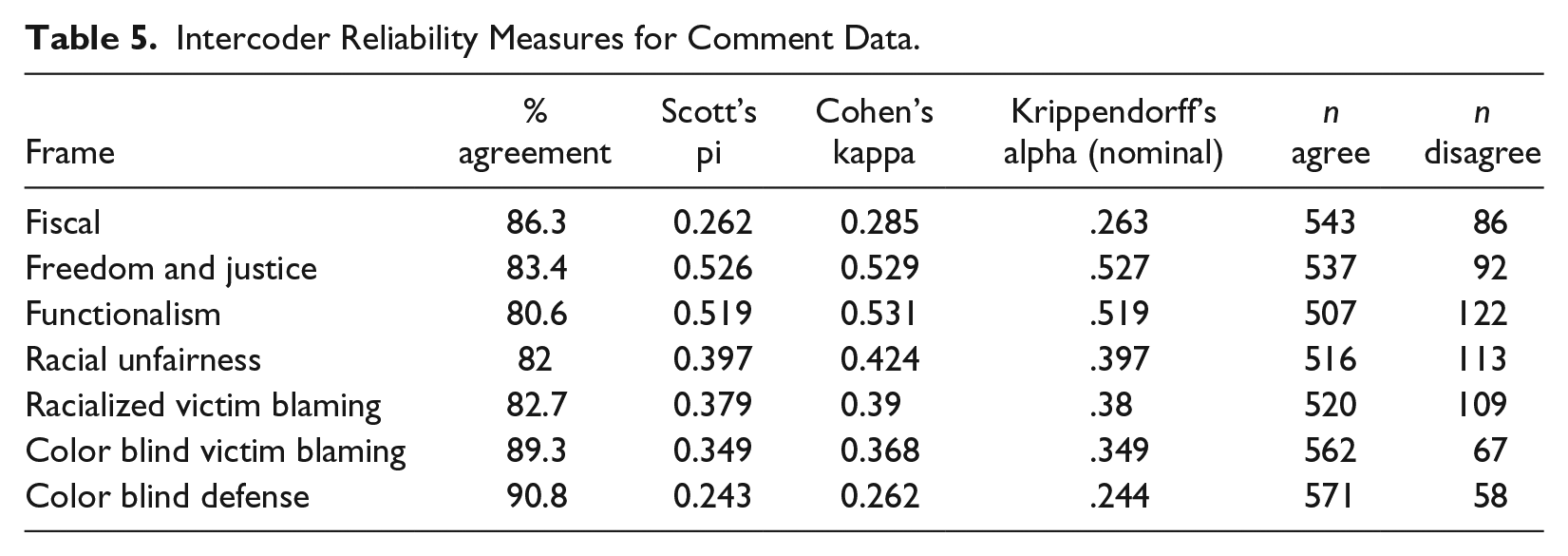
An independent research assistant and one of the authors also conducted intercoder reliability measures on both datasets to ensure soundness in coding. For the newspaper data, we ran tests on the entire dataset (N = 394), which indicated robust agreement and reliability (ranging from 83.5 to 91.4 % see Table 4). For the comments data, we ran tests on every fifth case (20 % n = 629), which also indicated robust agreement and reliability (ranging from 80.6 to 90.8 % see Table 5).
Intercoder Reliability Measures for Newspaper Data.
Intercoder Reliability Measures for Comment Data.
Findings
“Racial Silence” in Newspaper Discourse: The Deficient Resonance of Race
Our examination of newspaper discourse on the WOD suggests the features of the general discursive strategies used to debate its legitimacy. We found only minor variations in the overall distributions of frames and themes across all decades, high- and low-circulation newspapers, and op-eds, journalistic articles, and letters to the editor. This overall lack of variation signals extant and robust ideological agreement regarding the publicly understood cultural contours of the WOD as they are articulated within U.S. print newspapers. For instance, claims critical of the WOD on grounds of racial unfairness constituted the least common frame across all the decades and manuscript and newspaper types in our dataset, indicating “racial silence” in this context. Exemplifying the lack of resonance carried by racial claims, one author, while critical of the WOD, admonished an op-ed for framing the WOD as a mode of structural racism:
Pitts was fine up to the point where he decided to pull out the race card. I have to disagree with him when he says that “the war on drugs has been, in effect, a war on black men.” Please, let’s stop having one group of people or another blaming others for misfortunes they have largely brought upon themselves. It is important for the young people of all races to stay in school, get a job and resist the gang life. In my view, people should learn to live their own lives without blaming everyone else for their circumstance. (“Letters to the Editor,” Herald News, 2011)
Other frames used to critique the WOD within our newspaper dataset involved its fiscal soundness, nonracial concerns about freedom and justice, and functionalist logic. Below, we extrapolate these frames in terms of the themes and discursive strategies that undergird them as they appeared in our samples of newspaper manuscripts and online comments. We then examine the themes and discursive strategies within claims involving race and racism.
The Fiscal Frame
The first frame that emerged in our analysis of newspaper manuscripts involves a purely fiscal rationale. The construction of the WOD as a financial issue, rather than an issue of social justice, enabled appeals to fiscal conservatism. The first theme within this frame involves the financial solvency of the WOD, routinely accompanied by statistics such as “with the cost approaching $1.3 trillion, don’t you think it’s time we stop shoveling huge piles of cash into this bottomless pit of insanity called the war on drugs” (“Our Insane War on Drugs,” Intelligencer/New Era, 2012). Second was a theme articulating that the WOD costs the U.S. economy in terms of potential profits via legalization and productive labor lost through incarceration.
In online comments, the fiscal frame was also articulated through themes of missed economic opportunity costs through taxation of legal drug markets rather than black markets with unscrupulous and dangerous criminals. One commenter asked, “Why are we missing the opportunity to tax this and bring in much needed revenue to the states and federal government?” (2012). Commenters also argued the WOD constitutes a waste of taxpayer money. One commenter argued that it is “Time for ‘conservatives’ to think about just how ‘conservative’ it is to support a huge government spending program called the ‘war on drugs’” (October 20, 2014).
The Freedom and Justice Frame
The second frame in newspaper discourse focused on nonracial issues of freedom and justice. For instance, class inequality, human rights violations, and police militarization were cited to condemn the WOD. Furthermore, many arguments critiqued political corruption and the prison-industrial complex with one article noting how the WOD “has certainly served powerful interests in our society” (“Two Cents: The ‘War on Drugs’ Is Really a War on You,” Deeming Headlight, 2011). Mass incarceration and overcrowding comprised another theme with articles decrying “the single greatest cause of the prison population growth has been the war on drugs” (“Wyo. Pot Laws Harm Many,” Wyoming Tribune Eagle, 2014). Civil liberties constituted a final theme as exemplified by an article stating, “the government should not be allowed to regulate the choices people make with their own bodies” (“Taking a Stand Against the War on Drugs,” Moscow-Pullman Daily News, 2012).
In our online comment data, many commenters argued the WOD is the result of corruption and benefits a vast prison-industrial complex, including private prisons, judges, prison unions, police, politicians, “big pharma,” Wall Street, corporations, and even drug cartels. One commenter argued “law enforcement . . . is a tool to protect special interests and hence . . . you guessed it . . . to maximize profits” (April 8, 2013). Another theme included claims that the WOD violates civil liberties constructing an in-group of “free citizens” and an out-group of the government. In addition, claims were made that the WOD violates states’ rights and the constitution, causes prison overcrowding, class inequality, police militarization, harm to individuals and families, and that WOD supporters are morally hypocritical.
The Functionalist Frame
The third and most common frame within our dataset across manuscript types, newspaper types, and decades, functionalism, argued that the WOD has failed in its manifest function of instilling law and order and reducing drug problems. One theme included general proclamations that the WOD is lost or unwinnable as one author satirically argued, “if World War II had been as unsuccessful as the War on Drugs we would all be speaking German right now and ‘heiling’ somebody” (“Holder Is Correct in Stopping Low-level Drug Cases,” The Free Lance-Star, 2013). Another common theme within the functionalist frame argued the WOD does not solve issues of drugs and crime and even “enriches criminals and terrorists . . . [as] drugs grow ever cheaper and more potent” (“Will He Cross the Reefer Rubicon,” Providence Journal, 2009). This theme constructed racialized and criminalized others (e.g., thugs, terrorists, gangs, and Mexican cartels). Alternatives were also routinely offered, including treatment, regulation, and education.
The functionalist frame in comment discourse consisted of several themes including vindicating drug use as beneficial or not harmful with one commenter comically stating, “the only thing anyone is going to attack on pot is a hot dog” (April 9, 2013) and claims that it would be more functional to legalize and regulate drugs. A major theme within this frame in our dataset involved decrying the latent dysfunctionality of nourishing a criminal underworld. Central to this theme are covertly racialized discourses of moral panic and danger around a variety of threatening imagery and potent racial tropes including “thugs,” “gangs,” “Muslim terrorists,” “Mexican drug lords,” and “illegals” often constructed as potential “invaders” from dark and stigmatized spaces. Other less common themes within the functionalist frame include general claims that the WOD is a failure, that it does not actually achieve its ostensive goal of reducing drug use and availability, and that treatment would be a more functional alternative.
The Racial Unfairness Frame
The least common frame in our newspaper dataset, throughout each decade, manuscript type, and newspaper type, was racial unfairness. One theme involved demonstrable bias in criminal justice system outcomes related to the WOD, including statistics such as that blacks are “sent to prison on drug charges at a rate 21 times greater than whites” in Virginia (“Report: War on Drugs Sends Blacks to Prison at 13 Times Rate of Whites,” The Washington Post, 2000). Such claims were routinely truncated rather than fully elucidated and sandwiched between nonracial critiques. Another theme included claims that black communities are more susceptible to drug crime with one article stating “that inner-city drug dealers tend to congregate on the street, not indoors as in more affluent suburbs where the bulk of illegal substances is actually consumed” (“How Our War on Drugs Shattered the Cities,” The Washington Post, 1992). A theme that the WOD causes racial inequality also appeared including claims that blacks are “the most likely to be jailed for drug crimes and to suffer the disruption of families and communities that comes with it” (“Please End America’s Most Wasteful War,” The Herald-Sun, 2011). Finally, a theme argued that the WOD is sustained by racism as one article argued the WOD “appealed to those “silent majority” voters who . . . feared militant urban blacks with whom they associated drug use” (“White Flag on Drugs,” Bangor Daily News, 2010).
The frame of racial unfairness in comments included themes of racial bias, that the WOD is motivated by racism, that the black community is susceptible to drug crime, and that the WOD is a mode of structural racism. In contrast to our newspaper sample, many claims involved notions of white privilege and black disadvantage from a position of identification as black or sentiment of racial empathy. One commenter wrote,
Whites don’t understand getting arrested for nothing beacause [sic] it simply doesn’t happen to them. I’m a black university student nerd, who wouldn’t commit any sort of crime, but I get questioned and cuffed way before my white or asian [sic] friends. (October 5, 2013)
Another argued,
For one group of people, this is pure hyperbole while for another group of people this is a harsh reality. “Race-baiters” are not the problem. It’s being naive that hinders us from becoming a post-racial society. (October 5, 2013)
Another theme within this frame less present in newspaper discourse was that the WOD is/was motivated by racism. As one commenter puts it, “prisons are the new plantations” (October 8, 2013). Another argued that the WOD “was designed to do exactly what it did, incarcerate as many black males as possible” (April 8, 2013). A third theme suggested that black communities are more susceptible to drug crime.
Identity Construction in Comment Section Discourse: Us versus Them
Our analysis of comments on articles on the WOD in online news sites reveals the role of racialized symbolic boundaries (cf. Lamont 2000; Hughey 2012a). Various schematic distinctions of essentialized differences between racial groups were used to continually reconstruct identities within the WOD debate. In particular, racialized imagery of security and threat that constitute such distinctions permeated justifications for both dismantling and preserving the WOD. One commenter argued if the WOD was ended,
Gangs would be out of business, little street corner punks would be out of business, courts would be freed up to prosecute “real” crime and prison costs would be less than what we are paying now to house these drug prisoners. (April 8, 2013)
Another commenter, in arguing why the WOD must continue, argued,
Dealers are violent criminals by nature. They arent otherwise innocent people. They dont care who overdoses and dies on their crack. Their business is the reason that domestic terrorist street gangs infest our city centers. (April 8, 2013)
Moreover, while discourse within our analysis of newspaper content overlapped in many ways with online comments, unique and overtly racial frames emerged within comments both criticizing and defending the WOD.
Victim Blaming in Online Comments
Two unique frames within comments either defending the WOD or legitimating its social and racial implications have particular importance for identity construction processes by positioning either the black community or hypothetical drug criminals as de facto culpable. The first theme within this frame involved the connection of blackness and criminality. Responding to claims of racial bias resulting in racialized mass incarceration, one commenter wrote, “Lots of Black People Sell’n Dope, Lots of Black People In Prison” (April 8, 2013). Within this theme, the perceived criminality of blackness is drawn out in comparison with the perceived innocence of whiteness as articulated in one commenters contention that
. . . white kids are not more likely to become drug users. . . . That is the liberal media pushing their jungle fever pitch on the public. . . . There is a reason why 50% of the prison is blacks. (April 8, 2013)
Another comment posed the following racialized hypotheticals: “How many white kids you know selling drugs out front of a liquor store? How many white kids are smuggling drugs across the border?” (July 24, 2013). The overlapping of the dual binaries of innocence/criminality and whiteness/blackness was embedded in the logic used to construct white racial identities and black racial ascriptions. Reflecting the complete merging of these binaries, one commenter simply juxtaposed criminality to whiteness:
Criminals tend not to understand the concept of delayed gratification and look for easy money. I get a kick out of people who make fun of white people because we’re boring or stiff and take school seriously, go to college and take that seriously, have two parents raising kids, obey the law, know the law, etc. (October 5, 2013)
A second theme drew a broader connection between blackness and dysfunctionality often accompanied by decontextualized statistics. One commenter contended racial inequalities in criminal justice outcomes, rather than being related to the racialized WOD, are actually a product of
the 70% illegitimacy rate in the black community, the lower high school and college graduation rates which happen to tie into being born into poverty to single mothers who then live on public benefits. These irresponsible, single teen mothers, living on welfare, food stamps, Medicaid, and Section 8 set a terrible example for these poor, innocent children. Children learn from their environment and these girls and deadbeat fathers don’t set a proper moral example, they don’t promote the importance of education as a means of escape from poverty, and they don’t promote a strong work ethic because most of the single mothers and sperm donors don’t work themselves. (October 4, 2013)
Claims within this theme constructed blackness as not only culturally or familially dysfunctional and but as marked by dysfunctional behavior. One commenter argues, “It ain’t the color of your skin, it’s your actions that whites are bigoted and prejudiced against” (October 29, 2014).
Comments also admitted that racism exists while still maintaining fundamental black dysfunctionality and criminality as the primary cause of racial inequality thus obfuscating the connection between structural racism and inequality. According to one commenter,
Racism exists but it’s not always the go-to reason, particularly in a society that for the past 50 years has gone above and beyond not only to attempt to equalize the races, but also to make concessions, excuses, special classes, and in some cases lower standards for minorities. I’m suggesting that culture within the race, not the race itself, is the real culprit. (October 5, 2013)
Another claimed,
Only a fool would say that blacks in general aren’t born into challenging situations and that urban life is equal to suburban life. . . . However, no one is FORCED to live a life of crime, it is a choice. (October 4, 2013)
Similarly, a third theme within this frame involved not simply minimizing the effect of structural racism on the outcome of racial inequality (cf. Bonilla-Silva 2014) but the complete denial of its existence such that claims from “liberals” or “blacks” about structural racism were rejected. One commenter argued, “maybe if the first word out of your mouth wasn’t racism all the time that could be a starting point but blacks have been brainwashed to yell racism to everything” (October 4, 2013). Within this theme were also contentions about the fairness and impartiality of the criminal justice system:
Cops and state attorneys have to prove cases, not simply say this guy is guilty because he is black. (April 8, 2013) I don’t think the cop said to his partner hey theirs [sic] a black guy put him in jail? (October 5, 2013)
Victim blaming was also present in ostensibly nonracial comments as evidenced by the phrase “do the crime, do the time” within comments in response to calls for empathy toward those harmed by the WOD. Once again, liberals were seen as invalid claim makers as one commenter claimed, “Nobody is ever held accountable for their bad behavior in liberal fantasy land” (April 8, 2013). Such claims also routinely relied on notions of free will and responsibility:
If people get stopped and frisked or pulled over, give them no reason to arrest you. If people obey the law, they won’t end up in prison. (October 5, 2013) It doesn’t matter how you FEEL or that you like drugs, they broke the law and have been placed where they belong. They should never get out. (April 8, 2013)
Embedded within these claims are logics of abstract liberalism and individualism that sever connections between social forces and individual circumstances (cf. Bonilla-Silva 2014). A final theme included punitive animus and extreme hatred as seen in commenters who wished to “make jail harder.” This theme even contained comments that called for the death of drug users and drug dealers: “kill em . . . kill every drug addict stupid enough to do the stuff” (April 8, 2013). The construction of individuals and groups as immoral and dysfunctional are thus important discursive strategies used to naturalize racialized criminal justice practices within mass-mediated debates.
Discussion
Our analysis of newspaper manuscripts and online comments gestures toward dynamics of “racial silence” and identity construction via racial discourse within the debate on the WOD. The concept of “racial silence” helps build upon previous works that have uncovered discursive dynamics such as “strategic avoidance” (Doane 2003) or “evasion” (Steinberg 2007) in discussions of racial issues. For example, critics of the WOD often seek to dismantle an essentially racialized system of policies and practices solely because it constitutes wasteful government spending or fails to reduce drug use and crime with little concern for its racial implications. They thereby articulate and identify subject-positions within that discourse as either moral or immoral social characters that then serve as rationales for that dismantling.
We argue that there exists an economy of resonance within public discourse that devalues overt racial claims, particularly in a contemporary era in which racial color blindness is idealized (cf. Bonilla-Silva 2014). In response, “racial silence,” or the discursive omission of racial and particularly racial justice claims, allows claims to resonate with audiences who hold either “racial apathy” (Forman 2006) or, albeit rare, more overt racial animus. Responses to racial justice critiques of the WOD thus contained logics similar to the frames of color blind racial ideology (especially abstract liberalism, cultural racism, and minimization of racism; cf. Bonilla-Silva 2014).
Ostensibly nonracial frames were accompanied by implicit racial discourse as demonstrated by “racialized code words” (Hurwitz and Peffley 2005) in online comments critical of the WOD (e.g., “crack babies,” “welfare recipients,” “little street corner punks”). Alongside this general implication of pathology, racialized imagery of threat frequent in both datasets (e.g., “terrorists,” “cartels,” “thugs,” “street gangs”) allowed the proponents of both sides of the debate to link the function or dysfunction of the WOD to the protection of the white-dominated racial order from “outsiders” and insinuate people of color as undeserving or menacing. 10 These tactics reflect a diffusion of implicitly racialized elite political discourses (cf. Haney López 2014; Mendelberg 2001; Hughey and Parks 2014) to nonelites that enable claim makers to construct racialized subject-positions while maintaining “racial silence".
The debate over the WOD within print and digital media presents a site of identity construction through subject-positions within discourses articulated about this contested issue and its racial politics. Discourses that empower actors “to define someone else, to make ‘their’ identity in the shadow of ‘ours’” (Matheson 2005:142) and demarcate legitimate claims serve as important mechanisms for the construction of racial identities. In both newspapers and online comments, claims about the legitimacy of claim makers (i.e., “liberals,” “conservatives,” “blacks,” “whites”) helped individuals construct in-/out-group distinctions and position their own sense of self in relation. As the invocations of both racial and political signifiers suggest, this discourse extends beyond racial group boundaries to reflect deeply political contestations, akin to what Hochschild (1999) called “cultural warfare,” over constructions of the very meaning of whiteness and blackness.
In the context of “old media,” Entman and Rojecki (2001) cautioned that the consumption of hegemonic representations of whiteness, implicit racial meanings, and racialized omissions “may work against the development of greater interracial empathy and trust” (p. 57). However, within interactive digital media, identity construction in relation to mass media content takes place not through simple consumption but in the articulation of responses and personal positions on a particular narrative (cf. Hughey 2012b; Love and Hughey 2014). By positioning people of color (rather than racial inequality) as inherently problematic, media discourse containing “racial silence” and implicit racial discourse enables whites to draw racialized symbolic boundaries (cf. Lamont 2000). These boundaries serve as buffers from racial empathy in the face of evidence that links the WOD to structural racism.
The simultaneous identification of the racial self and ascription of the racial other through media discourse enables racial identity construction linked to “moral qua racial boundaries” (Lamont 2000) and a “sense of group position” (Blumer 1958). Thus, within comment section discourse, whiteness was routinely contrasted with blackness. This binary was then mapped on to a binary of essentialist values such as innocence/criminality. In response to evidence of racialized mass incarceration, commenters constructed white racial identities as morally superior through reinterpretation of racially disparate criminalization as both natural and legitimate. The lacking resonance of racial justice critiques and the proliferation of implicit racial discourse for and against the WOD thus reflect how claims interact with idealized constructions of whiteness (cf. Hughey 2012a) among audiences.
Interactive media also provides space for the discursive construction of counter-hegemonic identities through subject-positions that emanate from or empathetically embrace people of color. Articulations of blackness as innocent or unfairly victimized, and whiteness as either ignorant of or unconcerned with structural racism, served as some of the most striking examples of counternarratives. However, such claims routinely lack resonance with dominant racial meanings, thereby presenting a significant challenge for those desiring to bring critical experiences and issues to light. The production of media discourse on the WOD and audience identity construction thus constitutes a cyclical process that rationalizes and legitimates racial inequality.
These dynamics within the WOD debate in print and digital media show that racial ideology does not just provide rationalizing “frames” (cf. Bonilla-Silva 2014) but also logics and discourses that actors within the racialized social system can employ to form and articulate a sense of self. Future sociological research within the color blind racism paradigm should thus take seriously the importance of identity construction as a mechanism of racialized social reproduction (cf. Hall 1996; Hughey and Byrd 2013). Further research examining the prevalence of “racial silence” and identity construction via subject-positions within racial discourse in a myriad of contexts is thereby warranted.
Footnotes
Acknowledgements
The authors thank Social Currents co-editors Toni Calasanti and Vincent J. Rosigno and the anonymous reviewers for their feedback and support.
Declaration of Conflicting Interests
The author(s) declared no potential conflicts of interest with respect to the research, authorship, and/or publication of this article.
Funding
The author(s) received no financial support for the research, authorship, and/or publication of this article.