




Abstract
Research has done a fine job in noting the utility of mass incarceration for social control and the creation of quiescence, especially in the face of economic precariousness and growing wealth inequalities. Some of this scholarship also posits a profit-centered motive, activated through the growth of for-profit prison corporations or forced prison labor. I build on this work in this article but extend the emphasis on profit by suggesting that incarceration also acts as a locus for the coercion of demand and consumption. In postindustrial economies characterized by chronic crises of demand, mass incarceration compels minimally market-attached residents to participate in the market in the capacity in which they are most required—as consumers. I construct estimates of the increase in national aggregate demand associated with incarceration and find it to be equivalent to the addition of a small country of consumers to the national economy.
Mass incarceration is the defining civil rights issue of our time. With approximately 1 percent of U.S. adults currently incarcerated, another 2 percent under the supervision of various departments of correction, and 9 percent of working-age Americans marked as felons due to their history of imprisonment, the criminal justice system has grown to levels never experienced in this, or any, nation in world history (Glaze and Kaeble 2014). This trend is particularly pronounced for African Americans. The racial disparity in incarceration has more than doubled since 1880 (Muller 2012), and more than 4 percent of all black men in the United States are currently living in its carceral institutions (Glaze 2011). As Alexander (2012) pointed out, there are more African American men under the supervision of criminal justice agencies today than were enslaved in the United States in 1850.
In this article, I suggest that we must broaden critical reflection and theoretical consideration of the question “To what end?” Although dominant emphases surrounding the imprisonment of African Americans as a method of contemporary social control or as an extension of historical racial discrimination are incredibly important, I contend that the economic importance of prisoners as coerced consumers is a largely unexplored yet surely warranted site of sociological inquiry. Indeed, centering attention on the role of late capitalism’s market imperatives in the creation of penal policy has the potential to transform the way scholars understand mass incarceration.
Theorizing the Carceral State
The sociological literature has clearly established the utility of systemic criminalization in rendering fractious populations quiescent (Beckett and Western 2001; Davis 2007; Fording 2001; Phillips and Deckard 2015; Wacquant 2009). The welfare state was arguably developed to facilitate the redistribution of the minimum amount of wealth necessary to avoid rebellion (Esping-Andersen 2013; Hicks 1999). Its very presence has in fact had extensive effects in the labor market (Esping-Andersen 2013; Piven and Cloward 1993; Polanyi 1944). Welfare raises the effective minimum wage by setting a floor at the social benefit rate and decreases the dependence of the poor on wage labor, meaning poor relief costs money beyond the actual dollars redistributed (Piven and Cloward 1993).
When redistribution through social programs is reduced, investment in repression must increase to maintain order (Fording 2001). Wacquant (2009, 2010) has argued that executing this repression through the carceral arm of the state is the biopolitical reality of neoliberalism. Indeed, prison budgets now exceed education budgets (Giroux 2003; Wald and Losen 2003), more is spent locking away the mentally ill than treating those suffering (Torrey et al. 2010), and there is a demonstrated trade-off between spending on imprisonment and traditional social services (Beckett and Western 2001). Western and Beckett (1999) noted that contemporary rates of imprisonment minimize competition for low-skill work by reducing the size of the historically fractious unemployed (Piven and Cloward 1993) while also lowering the need to provide social services for the jobless. Wacquant (2010) noted that as imprisonment ramped up and expenditures on social programs were cut, “the construction of prisons [effectively became] the nation’s main housing program for the urban poor” (p. 12). Mass incarceration then may be understood as the preferred method of social spending in late capitalism.
Intrinsic to the political economy of the carceral state is the movement of young, poor men of color from their homes in economically stagnant central cities to prisons in economically stagnant rural areas (Hooks et al. 2004). Both poor men of color in the inner cities and the rural poor are arguably superfluous to the global economy. Yet by keeping the latter employed as guards of the former, the state effectively monetizes otherwise economically valueless segments of the population (R. W. Gilmore 2006). R. W. Gilmore (2006) presented this as a trade-off in which, in keeping with the U.S. history of racial domination, lower-class communities of color are sacrificed to better economic realities for their white counterparts. Hooks et al. (2004) argued that despite this widespread perception, there is no demonstrable economic growth in rural counties resulting from prison growth. In either formulation, whites who would otherwise be unemployed provide labor, whereas a much larger number of African Americans are coerced to provide demand for that labor.
Beyond offering employment within the prison industrial complex to those who otherwise might be unemployed, forced labor among prisoners has likewise emerged as a key focus (Collins and Mayer 2010; Thompson 2012; Weiss 2001). Given the evolution of labor coercion in the United States beginning in slavery, through sharecropping, and to Jim Crow methods of legal coercion, images of disproportionately African American prisoners forced to work prison plantations are compelling in their historical parallelism (Alexander 2012). In the current system, however, leased prison labor is both atypical of the experience of incarceration and expensive when compared with prevailing wages for low-skill labor (Weiss 2001; Zatz 2008). Former systems of bondage worked to subjugate black bodies to compel market participation in the capacity it was most historically useful—as laborers (Alexander 2012; Harvey 2011). Such subjugation certainly continues. As I argue below, however, it seems to have been extended and also takes an alternative form—specifically, compelling prisoners’ market participation as coerced consumers.
Growth in Production yet Shortages of Demand
My argument regarding coerced consumption relies on the recognition that major crisis of late capitalism is not a lack of labor but rather a lack of demand (Bems, Johnson, and Yi 2010; Harvey 2011). Whereas earlier periods in the world economy were characterized by a lack of sufficient production to meet the demands of a growing population, requiring the coercion of labor from captive populations, post-Fordist economies are typified by overabundance (Grosfoguel 2000; Lavoie and Stockhammer 2013). With a global production chain and ever-improving industrial technologies, the economy’s ability to produce far exceeds the collective need for goods and services—leading to inadequate aggregate demand or underconsumption (Gordon, Weisskopf, and Bowles 1996). Existing research attests to the ways in which this phenomenon has contributed to recessions in the postwar period, most recently in the chronic credit crises that result from attempts to spur demand from relatively impoverished consumers (Lavoie and Stockhammer 2013; Lissowska 2014).
Figure 1 demonstrates the relationship between aggregate production and aggregate demand as the costs of production decrease in response to technological innovation and the unregulated global labor market. As the costs of production go down, aggregate production increases. When it is inexpensive to make things, many things are made. But an intrinsic part of production costs are the costs of wages, and the reduction of production costs is dependent on the reduction of wage expenditures. The decreased production costs that result in an increase in total production also reduce workers’ consumption as their disposable income levels fall.
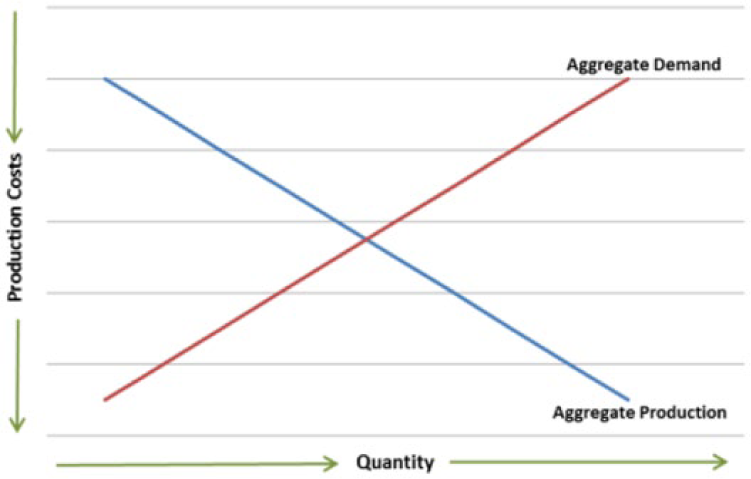
Aggregate production and demand at varying levels of production costs.
Figure 2 illustrates a hypothetical reduction in production costs, with levels going from C1 to C2. At level C1, there is a significant shortage in production, whereas at lower-cost position C2, there is a shortage of demand. As production costs decrease, there are more goods and services in the economy. Yet with stagnant or decreasing wages, demand cannot increase. This reality puts the economy in a protracted crisis of demand, with the market seeking consumers who do not require wages that would increase production costs.
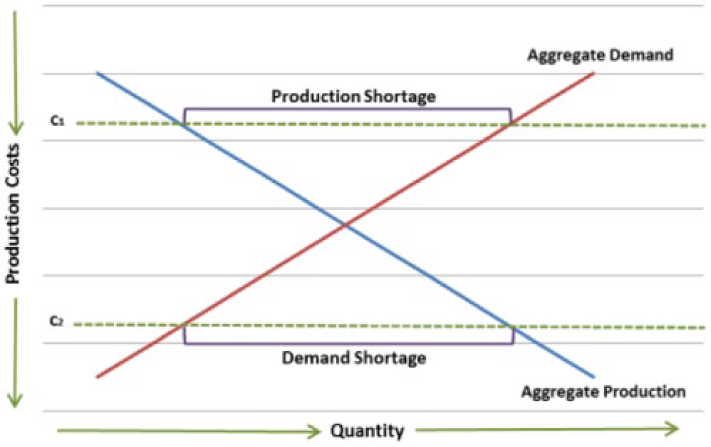
Shift from shortage of production to shortage of demand.
Bodies in Service of the Market
Polanyi (1944) brought to light the ways in which markets can work for societies and societies can work for markets. The degree to which the market has become disembedded from all facets of society in late capitalism is contentious, but the idea that markets work marginalized communities rather than work for them is well theorized (Cangiani 2011; Champlin and Knoedler 2004; Krippner and Alvarez 2007). A significant literature, for instance, establishes the ways in which members of marginalized communities are made to create market value for the dominant class (Balibar and Wallerstein 1991; Deckard and Heslin 2016; Vera and Feagin 2007).
During the crises of production that defined the European colonial settlements of early capitalism, Africans and others were enslaved to increase production (Fieldhouse 1999; Wallerstein and Hopkins 1980) at a given cost while only negligibly increasing consumption (Blackburn 1988; Tuck and Yang 2012). Postemancipation, Jim Crow laws worked to coerce labor from African Americans in the South while keeping them impoverished (Alexander 2012). Work by Muller (2012) demonstrates that during the period of overtly coerced labor, rates of African American incarceration, like their white counterparts, were low. Literature on the contemporary criminalization of unemployment through vagrancy laws and the extensive use of convict leasing systems suggests that when imprisonment did occur, it was used as a method of putting prisoners to work (K. Gilmore 2000; Lichtenstein 1996).
Figure 3 demonstrates the role of coerced labor in closing the production shortage of high production cost, pre-Fordist economies. At C1, the production shortage is designated with the solid line P1. The addition of coerced laborers to the production process shifts the production curve, reflecting the production of a larger amount of goods and services at a given cost. This reduces the shortage to the level denoted by P2, reducing downward pressure on consumption by the dominant classes.
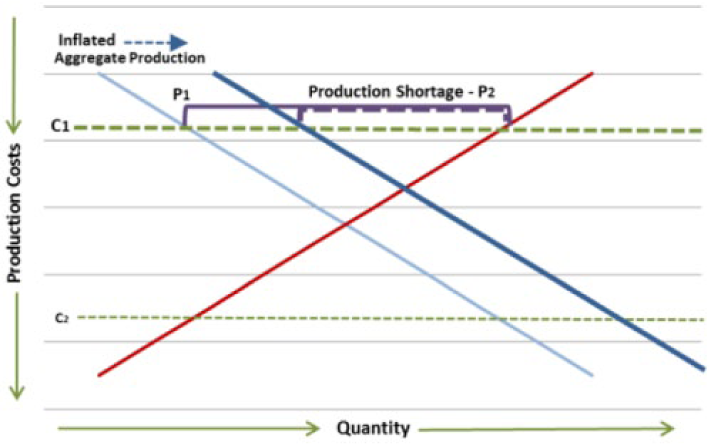
Shifting the production curve with coerced labor.
Changes in agricultural technology in the areas in which African Americans historically predominated eventually meant of course that fewer laborers were needed—something that, along with overt racial oppression via Jim Crow, pushed outward migration from the Southeast to the industrialized North (Tolnay 2003). Technological improvements in the manufacturing sector, increasingly populated by African American workers, spurred production while putting further downward pressure on the demand for labor (Wilson 1997). In the nation as a whole, the role that marginalized bodies would play in the market economy changed as the production of more goods was less important than coercing their consumption.
Mass Incarceration and the Coercion of Consumption
As African American industrial and agricultural labor was rendered superfluous to the national economy, methods of incorporating poor and marginalized citizens were implemented to both include them in the national community and commodify them in the national market (Esping-Andersen 2013). Means-tested cash assistance programs work not only to relieve poverty but also to increase aggregate consumption by putting money in the pockets of low-income nationals to be spent on consumer goods (Danziger, Haveman, and Plotnick 1981). This increase comes with a price to industry, however—that is, an increase in welfare generosity puts upward pressure on wages (Piven and Cloward 1993). Although aggregate demand grows in tandem with the increase in income going to the poor in a generous welfare state, employers must also offer higher wages to induce entry-level workers to work, raising the costs of production. So although this solution works to close the demand shortage, there is a significant reduction of the profits employers generate from that demand. Ideologically driven pushes since 1980 to deregulate labor markets and force the poor to work have made welfare retrenchment the political reality—decreasing the costs of production while increasing profit margins but worsening the crisis of demand by effectively reducing the consumption of the poor.
Concurrently, incarceration rates for young men of color with little education from low-income neighborhoods have risen dramatically (Western and Pettit 2010). Of all African American men, one in three can expect to be imprisoned in their lifetime (Bonczar 2003). Although the poor have historically been overrepresented in the criminal justice system, the overall increase in incarceration combined with the rise in racial disparities in the criminal justice system has created a reality in which 68 percent of African American men who have not completed high school will be imprisoned for at least one year (Western and Pettit 2010). Although a variety of crimes will land these men in prison, they share the commonality that they are the lowest wage earners in the U.S. labor market who are destined to earn and spend the least.
Race and poverty are of course deeply interwoven in the United States, making policies that punish poor people easily conflated with policies that target African Americans. Although disentangling these intersecting phenomena is beyond the focus of this article, it is nevertheless important to note the class demographics of the current incarcerated population. Prisoners are disproportionately undereducated, with approximately 70 percent of all incarcerated men lacking a high school degree (Western and Pettit 2010). They are also disproportionately unmarried (Laub, Nagin, and Sampson 1998), are from single- and no-parent households (Macmillan, McMorris, and Kruttschnitt 2004) in low-income neighborhoods (Clear 2007), and were unemployed before being incarcerated (Raphael and Winter-Ebmer 2001). This implies that in the community, Americans currently incarcerated would earn and consume significantly less than their nonincarcerated counterparts—a fact current research bears out (Rabuy and Kopf 2015). It also suggests that with the average annual cost to incarcerate an inmate hovering above $30,000 a year (Henrichson and Delaney 2012), poor Americans demand more when they are incarcerated than when they are free.
It is my contention that the rapid escalation of government expenditure in carcerality creates an increase in aggregate demand. Spending in prisons has benefits to aggregate demand that these other types of spending lack. Indeed, it is compulsory, dependable and efficient, and without the wage inflationary consequences that previous forms of public expenditure on the impoverished created. Figure 4 demonstrates what an increase to aggregate demand through the prison system does conceptually to the overall balance of production and demand.
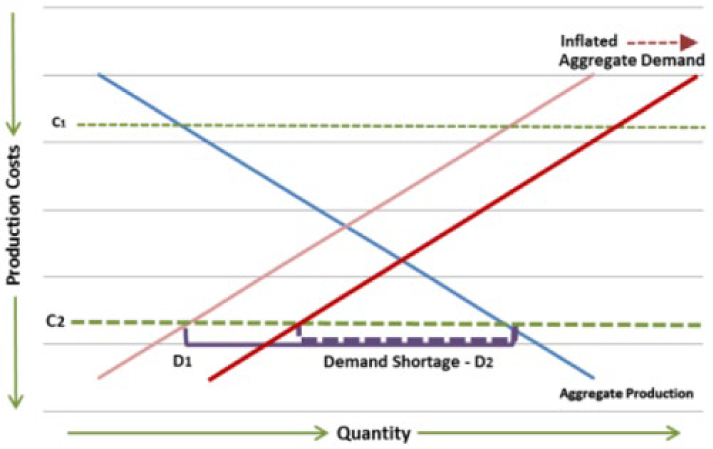
Shifting the consumption curve with mass incarceration.
At C2 production cost levels, incarceration shifts the demand curve, conceptually reducing the shortage of demand from D1 to D2—and bringing the market closer to equilibrium. As incarceration levels continue to increase, and with them aggregate demand, equilibrium can be reached without a reduction in production levels or costs.
Estimating the Increase in Aggregate Demand
Building on my theoretical argument regarding the interconnection of mass incarceration and underconsumption, I estimate below the effect of incarcerating the 2,227,500 Americans under criminal justice supervision in 2013 (Glaze and Kaeble 2014) on aggregate demand. Formula 1 indicates the relationship between the incarceration rate and changes in aggregate consumption.

where AD denotes aggregate demand and ΔAD denotes the change in aggregate demand resulting from incarceration, IPt denotes the inmate population at some time “t,”
Exact formulations of the shift in the demand are beyond the scope of my analyses, but I do calculate limited estimates regarding the scale of changes in aggregate consumption that can be attributed to carceral policies. Here, I use estimates for the most recent year in which all data are reliably available, 2013. I draw inmate populations from Bureau of Justice Statistics (Glaze and Kaeble 2014), combining state and federal numbers. To compile the mean annual cost to incarcerate, I use individual state and federal mean costs per inmate in 2013 dollars (Henrichson and Delaney 2012), weighted for total inmate population (Glaze and Kaeble 2014), to create a composite mean annual cost. 1 Preincarceration income is from the Survey of Inmates in State and Federal Correctional Facilities, and covers inmates incarcerated in 2004, the most recent year for which data are available (U.S. Department of Justice 2016), building on work done by Rabuy and Kopf (2015). Mean income figures are weighted for gender differences in preincarceration incomes and converted to 2013 dollars for consistency. Income includes reported income from wages, child support and alimony, transfer payments, welfare cash assistance programs, charity, Social Security, and illegal activities. 2 These consumption proxies do not include individual use of collective goods with fixed costs, such as roads and libraries. Formula 2 uses these best estimates of the data described in Formula 1.
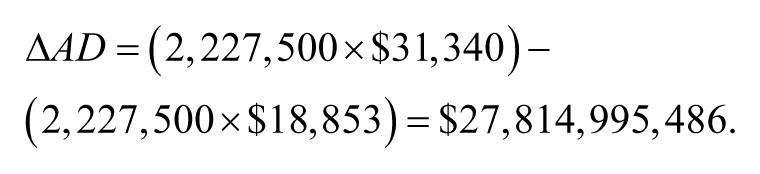
This calculation yields an estimated increase in aggregate demand of a quantity greater than the aggregate demand of 70 sovereign nations and comparable with that of Nicaragua, Brunei (The World Bank 2015), or the state of Vermont (Bureau of Economic Analysis 2015). The prison archipelago appears to be increasing consumption as much as the addition of an entire small country would in bars, chains, and guards. All of the consumption is coerced, and most of it from the descendants of Americans whose labor was systematically compelled during crises of production that ended little more than a generation ago.
Discussion
The extent to which mass incarceration creates an important consumer base for economies in crises of demand is an important, even if often overlooked, site of scholarly inquiry. In the United States, the benefits of increased carcerality have radiated out through the economy from what was once a small center. Today, however, this nexus is almost impossible to ignore, as noted recently in The Atlantic: What was once a niche business for a handful of companies has become a multibillion-dollar industry . . . The prison-industrial complex now includes some of the nation’s largest architecture and construction firms, Wall Street investment banks that handle prison bond issues and invest in private prisons, plumbing-supply companies, food-service companies, health-care companies, companies that sell everything from bullet-resistant security cameras to padded cells . . . (Schlosser 1998)
The Justice Department is moving away from the use of private prisons (Zapotesky and Harlan 2016), which encompass only 7 percent of the prison beds in the United States (Hallett 2006). Investments in private prisons represent only a small portion of the total financial assets dependent on incarceration and one dwarfed not only by the importance of industries mentioned by The Atlantic but also by the continued fiscal health of industries that are seemingly unrelated to corrections.
Although there are examples of collusion between political elites and private prison interests in the setting of particular criminal policies (Schlosser 1998), it would be difficult to establish that elite policy manipulations have intentionally created the larger carceral regime. There is a demonstrated relationship between incarceration and the business cycle, however. Even before the Second World War, Rusche and Kirchheimer ([1939] 2009) argued that incarceration rates increased during recessionary periods. Scholars have since used empirical evidence to move theory forward (Arvanites and Defina 2006; Jacobs and Helms 1996; Matthews 2009). Although current interrogations of this relationships center on an increase of crime during economic downturns or a need for the reduction of surplus labor in times of high unemployment, the formulation set out in this essay suggests that the need to increase demand during recessions may propel the coercion of consumption through increased incarceration.
Conclusions
The U.S. incarceration rate began to grow exponentially in 1976 (The Sentencing Project 2011), and there are currently 716 inmates per 100,000 residents—the highest rate of incarceration in the world. The advent of the “million-dollar block”—that is, inner-city blocks where incarcerated residents consume more than a million dollars a year in public funds (Columbia University Spatial Information Design Lab n.d.)—demands interrogation of the economic impetus for this hyperincarceration. Prior research has established well the utility of mass incarceration as a tool for social control, especially in the face of growing inequalities, and the ways in which state legitimacy somehow endures. Much of this work, however, has overlooked the perhaps increasingly economic foundation and financial impetus of mass incarceration in the late capitalist economy.
As I have argued in this article, contemporary incarceration not only serves to render powerless a potentially restive portion of the population. Rather, it also acts as a locus for the coercion of consumption. In postindustrial economies characterized by crises of demand, mass incarceration can be understood as compelling minimally market-attached residents to participate in the market in the capacity in which they are most required—not as laborers but as consumers. This should be viewed as an extension of historical practices that put marginalized bodies to work for market imperatives. It is my hope that future sociological scholarship will both further conceptualize and empirically examine the weighty implications of these phenomena—implications for societies and their investments, and implications for the groups most directly and clearly affected.
Footnotes
Acknowledgements
The author gratefully acknowledges the assistance of Irene Browne, Joel David, Alison Heslin, and Oliver Cowart, as well as the support of Emory University’s Laney Graduate School and the Emory Sociology Department.
Declaration of Conflicting Interests
The author(s) declared no potential conflicts of interest with respect to the research, authorship, and/or publication of this article.
Funding
The author(s) received no financial support for the research, authorship, and/or publication of this article.