




Abstract
This article introduces the concepts of contested knowledge and spillover to aid in understanding the relation between the controversy over evolution and related ideas and uncontested science knowledge. Contested knowledge exists wherever truth claims from multiple spheres of knowledge authority overlap, large or small. Spillover is a process of (1) a rejection of the authority of knowledge elites from an opposed knowledge sphere, and (2) devaluation of the set of heuristics for evidence tied to specific knowledges (contested and uncontested), a process that has wide-reaching implications. Using four waves of data from the General Social Survey (GSS; 2006–2012), I find evidence that conservative Protestant affiliation is associated with reduced knowledge of the physical and life sciences. This bivariate association is fully mediated, primarily through the rejection of mainstream scientific accounts of evolution. Findings also suggest that conservative Protestant affiliation increases the likelihood of that rejection. I argue that positions within this contested knowledge area spill over to other, uncontested forms of scientific knowledge. Results are validated using the 2014 wave of the GSS.
Introduction
More than 90 years after the Scopes Trial, roughly one third or more of U.S. adults still respond that humans evolving from earlier life forms is false (Newport 2012). To say that evolution is a contested issue in the United States is something of an understatement. Most talk about this contested area of knowledge from the time of Scopes to the present frame it as a conflict between science and religion. There has been some recent sociological work addressing the conflict narrative in the overlap of science and religion in general terms (Ecklund 2010; Evans and Evans 2008), as well as work that addresses specific areas of contestation (Evans 2011; Johnson, Scheitle, and Ecklund 2015; Sherkat 2011). These works typically partition contested and uncontested knowledge in a variety of ways, and ultimately treat contested and uncontested knowledge as separate, if loosely related, problems. Other recent work uses a person-oriented (rather than knowledge-oriented) perspective (O’Brien and Noy 2015). Both approaches miss an opportunity to explain the mechanisms underlying the relationships between contested and uncontested knowledge. What if the contested areas are the key to understanding how much (or how little) uncontested knowledge persons hold?
I argue in this article that contested knowledge areas structure the nature of the intersections between spheres of knowledge authority, large or small. Moreover, I argue that positions within a contested knowledge area can lead to a negative assessment of the opposed sphere spilling over into uncontested areas of knowledge. Put simply, accepted knowledge in uncontested areas must be wrong by association. In many ways, competing truth claims are inevitable in a diverse society. However, they are not without consequence, as the recent resurgence of the measles and mumps, the proliferation of fracking, and a congress paralyzed on gun legislation in the United States demonstrate.
A better understanding of contested knowledge and spillover effects is important for three reasons. First, if key contested forms of knowledge are not treated as analytically distinct from uncontested forms of knowledge, researchers may mistakenly conclude that some groups (for example, Catholics or mainline Protestants) have lower levels of uncontested science knowledge. Second, when a religious sphere is involved, spillover is a powerful mechanism of secularization (Chaves 1994). Unlike many accounts of secularization, however, spillover is bidirectional. That is, spillover can result in devaluing particular religious knowledge and valuing scientific knowledge (a secularizing effect), or it may result in devaluing mainstream scientific knowledge and valuing particular religious knowledge (a de-secularization effect). Third, the mechanism of spillover is not constrained to conflicts between forms of science and conservative Protestant religion, but is applicable anywhere spheres of knowledge authority and competing truth claims intersect (large or small), such as rival movement organizations (Tarrow, Tilly, and McAdam 2001), political ideologies, or other science controversies, such as climate change and vaccine effectiveness.
In this article, I examine the relation between a contested science knowledge area (evolution and related ideas) and uncontested knowledge in general science. Furthermore, I examine whether people who identify as conservative Protestant may be more likely to reject both contested and uncontested forms of science knowledge. I then show evidence that strong positions in a contested knowledge area can be associated with higher or lower levels of uncontested knowledge, which I call spillover, which I argue is a general process of which secularization is a special case. Furthermore, I argue that failure to account for spillover effects can muddy analyses that explain indirect group effects on uncontested knowledge (such as that of conservative Protestant affiliation and science knowledge).
Sociological Approaches to Contested Knowledge
A variety of theoretical approaches that relate to contested knowledge exist in sociology and other social sciences, although they seldom use the term: habitus and field (Bourdieu 1984), symbolic universes (Berger and Luckmann 1967), master frames (Benford and Snow 2000; Gamson et al. 1992), cognitive schemas (D’Andrade 1995; DiMaggio 1997), paradigms (Kuhn 1962), closure (Collins 1983), motivated reasoning (Kahan 2012), and, more concretely, the media effects literature (Nisbet et al. 2002). Sociologists and historians of knowledge historically have pointed out both the plurality and the contextual nature of specific knowledges (Burke 2000; Foucault 1995; Mannheim 1936; Merton 1968), but only rarely have they treated contested areas of knowledge.
Knowledge and Spheres of Knowledge Authority
Knowledge, for most persons, is made up of a combination of firsthand experiential data and secondhand received knowledge, typically from knowledge elites. These elites have such status for reasons specific to the particular sphere of knowledge—in mainstream science, for example, they might be research professors, published scientists, administrators of large government research agencies (such as the National Science Foundation [NSF] or National Institutes of Health [NIH]), or, at a more local level, high school science teachers. In conservative Protestantism, they may be lay clergy, pastors, or others. These legitimating spheres are what I term Spheres of Knowledge Authority. There is also a close resemblance to Hunter’s (1992) Moral Authorities, although many would disagree with the assertion that mainstream science is best represented as a moral authority. However, the question of what is moral is quite similar to the question of what is true.
Examples of spheres of knowledge authority include both mainstream science and conservative Protestant religious beliefs, as well as contemporary political conservatism in the United States (Perrin, Roos, and Gauchat 2014). Accepted truths within a sphere need not necessarily be logically consistent, although such inconsistencies may pose a problem for particular spheres (e.g., mainstream science), depending on the accepted rules for assessing evidence for truth claims within the sphere. Spheres of knowledge authority may also be held as more or less legitimate by different groups over time, such as the declining trust placed in science by political conservatives in the United States (Gauchat 2012). Furthermore, spheres need not rise to the level of an epistemic system. The set of accepted truths around which a particular social movement orients its specific goals functions as a sphere (Gamson and Modigliani 1989), albeit a smaller, more focused sphere than science writ large or conservative Protestantism.
Uncontested Knowledge
Each sphere has a set of accepted truths that are communicated or supported by their knowledge elites, along with a set of tools for evaluating evidence as it relates to those truth claims. In mainstream science, the ideals of replicability, falsification, and parsimony undergird most of the accepted truths. If one doubts, for example, the received knowledge from elites that the boiling point of water is lower at high elevations than at sea level, the sphere of mainstream science provides a set of rules for generating firsthand data on the subject, such as experimentation and hypothesis testing. Similarly, in the sphere of conservative Protestant belief, doubt about a particular accepted truth, such as the benevolence of the Creator, may be addressed by a set of tools specific to that sphere, such as prayer, introspection, and faith in a divine plan.
Contested Knowledge
When more than one set of heuristics for judging the accuracy, legitimacy, and value of certain knowledges applies, I argue that this area of knowledge is contested. Not all contested knowledges remain so indefinitely—heliocentrism was once a very controversial set of ideas, yet is now considered part of the mainstream in astronomy. Similarly, the link between smoking and cancer was once contested (Oreskes and Conway 2011). Other knowledges are uncontested: that the center of the Earth is very hot is part of a set of ideas that is uncontroversial in the present day. A fact that many misunderstand is not necessarily an example of contested knowledge. In the case of the cause of the seasons on Earth, it is the angle of light rather than change in distance from the Sun that causes seasons. This fact is not contested, it is merely obscure.
For many adults, “what they know” is as much about their concept of self as it is about their acquisition and recall of specific knowledge (Giddens 1991). Because of this, the negative effect the rejection of mainstream science explanations for origins may have on uncontested forms of science knowledge can be considered as a form of boundary work (Gieryn 1983; Lamont 1992) or identity work (Snow and Anderson 1987). In this case, the judgment is which forms and sources of knowledge are legitimate and which are not. If the chief source of legitimacy for one set of fact-based science knowledge is the same as that for a rejected set of knowledge, then the authority and veracity of that knowledge is suspect. Thus, the negative influence that rejecting mainstream science explanations for origins may have on uncontested knowledge is not simply one of lack of understanding, but is instead spillover from the work of demarcating what is and is not legitimate knowledge. Individuals allied with either sphere live in a “world of meanings” (Mannheim 1993:405), however, within a contested knowledge area, those meanings are wholly incommensurate.
Spillover
When multiple sets of truth claims intersect, it may not be obvious to an outsider which of the competing set of rules, values, and relationships is the most applicable. However, in cases of hotly contested knowledge, we are few of us true outsiders. And, those that hold a position in a contested knowledge area (the acceptance or rejection of evolution, for example) also implicitly hold the position that the opposed sphere is incorrect in this area. If one accepts the theory of evolution and related ideas, they likely also consider creationism and intelligent design to be incorrect attempts to explain the problem of human origins. Negative spillover is when this assessment of the legitimacy or veracity of the opposed sphere’s explanation in a contested area is also applied to the uncontested knowledge from the opposed sphere. Thus, spillover results in adherents to one set of truth claims in a contested knowledge area devaluing or rejecting uncontested knowledge from the opposed sphere in the contested area. This spillover can be found in work such as The God Delusion (Dawkins 2006), where Richard Dawkins argues the falseness of religion based on scientific standards for knowledge (neglecting that some questions are likely unanswerable by science).
Negative spillover of contested knowledge has two primary mechanisms: (1) rejection of the knowledge authority of elites from an opposed sphere, which applies to uncontested as well as contested knowledge, and (2) rejection of the standards and rules for evaluating evidence for truth claims from the opposed sphere. Evidence for negative spillover effects in the current case would be an association between the rejection of evolution and related ideas and reduced uncontested forms of science knowledge. To identify this type of association, a measure for positions within a contested knowledge area is required. Particular positions within the contested area of origins are described in more detail in a later subsection, but first, I will describe the NSF-sponsored science literacy scale present in recent waves of the General Social Survey (GSS).
Measuring Science Knowledge
Scholars of science point out that it is difficult to disentangle the methods of science, the practitioners of those methods, and the product of those methods (Gieryn 1999; Moore 2008); here, I focus solely on the product of those methods. Following Roos (Roos 2014:798), I define science knowledge as “the knowledge required to read and understand the science section or science-focused articles of a newspaper or news website, such as npr.org or cnn.com, allowing for topical areas of [specialization].” This definition is similar to the two-dimensional definition proposed by Miller (2004). Previous analyses (Roos 2014) have shown that topical subject area dimensions, namely, physical and life sciences, underlie the NSF science knowledge scale and have a markedly better fit to the data than Miller’s proposed structure.
Past work on disparities in science knowledge has focused on sex, age, college science instruction, number of children present in the home, educational attainment, and “informal learning,” or a measure of the use of “informal science education resources” as predictors (Miller 2004:288–89), and more recent work has begun to look at religion (Evans 2011; Johnson et al. 2015; Sherkat 2011). The rate at which respondents give “correct” answers to the basic science facts items found in the GSS has been relatively stable in the U.S. population since the late 1980s, save for a steady increase in rate of correct answers about antibiotics since 1988 and about DNA since 1997 (Miller 2004; National Science Board 2014). However, the Big Bang and evolution questions have been regarded as controversial (Bhattacharjee 2011), and I argue they are measures of an additional dimension, described below.
Contested Science Knowledge (CSKe)
Positions within the contested science knowledge area of evolution and related ideas (henceforth, CSKe—the subscripted e indicates that this is a specific type of contested science knowledge) occupy a continuum ranging from the acceptance to rejection of evolution and related ideas. A low level of CSKe entails the rejection of mainstream scientific explanations of human evolution and related ideas—the beginnings of the universe, the first spark of life, and the variation of life over the millennia since. At the other end of the continuum, a high level of CSKe entails the acceptance of these ideas. These ideas are closely related to the geological concept of uniformitarianism 1 or geological gradualism. For those that reject mainstream scientific explanations for human origins, the concept of humans evolving from earlier life forms is false, despite those low in CSKe being aware of the concept and further being aware that most scientists hold evolution and related ideas in high regard. By association, other ideas related to geological gradualism, such as continental drift or even the Big Bang, are also considered false.
A low CSKe perspective is not necessarily isomorphic with conservative Protestantism. Individuals who would not be typically placed in the conservative Protestant category may also hold low CSKe strongly (Guhin 2016)—in the 2006–2012 waves of the GSS, this includes some Catholics, members of other Protestant traditions, and others. CSKe is a construct representing acceptance or rejection of specific truth claims about the world, and as such, the dimension does not map perfectly onto categories such as religious denomination.
Specific Research Questions
The first set of questions to be tested in this article comes from recent research on the intersection of science and religion in the general public. Certain conservative forms of Protestantism devalue knowledge associated with the scientific sphere or associated with secular, institutionalized education generally and alternate sources of knowledge authority specifically (Darnell and Sherkat 1997; Ecklund 2010; Sherkat 2011). Because religion is learned at the youngest ages, those raised in those conservative traditions may be less likely to have interest in or to seek out scientific knowledge. In addition, the public (and academic) perception remains that science is epistemologically incompatible with Western religions (Ecklund 2010; Ellison and Musick 1995), and, therefore, those inculcated into religion at an early age may find science knowledge to conflict with other, accepted forms of knowledge.
However, based on the analytical distinction between contested and uncontested knowledge discussed above, we may expect affiliation with conservative Protestant religious traditions to have no significant effect on science knowledge once high or low CSKe is accounted for. In noncontested areas of science, there are unlikely to be competing truth claims between the science and religious spheres (Ecklund 2010; Evans 2011; Evans and Evans 2008). In addition, because any negative effect that holding low CSKe strongly might have on other forms of science knowledge that would be independent of the religious tradition a person was raised into, it is unlikely that even the more conservative Protestant religious traditions would have a significant effect on uncontested science knowledge, particularly once educational attainment is also controlled for (Beyerlein 2004; Evans and Evans 2008). These arguments lead to the following question:
A closely related set of arguments holds for high or low CSKe. Based on the arguments above, we might expect conservative Protestant religious traditions to lead to rejecting mainstream scientific accounts of evolution. If evolution (and related ideas) is a contested area of knowledge, then individuals, layperson and expert alike, must navigate the competing truth claims about the world. Identifying with conservative Protestant religious traditions may serve to “anchor” the religious truth claim in minds, making them more likely to hold decreased CSKe, even net of educational attainment. The set of meanings by which scientific knowledge is legitimated conflicts with those by which religious knowledge is legitimated within the contested knowledge area. Primacy of the religious sphere may predispose one to reject scientific explanations of human origins (or to reject evolution and related ideas). These arguments lead to the following question:
As individuals negotiate the specifics regarding their religious identity and the related forms of legitimate knowledge, there may be some spillover effect on other, uncontested forms of knowledge when there is a contested knowledge area, as in the case of origins. In these cases, individuals may wish to state clearly what they are not: if they are not the sort of person who agrees with mainstream science accounts of evolution, for example, then other things that mainstream science claims to be true are suspect as they police the boundary (Gieryn 1983; Lamont 1992; Snow and Anderson 1987). In this case, it is not that persons who reject evolution are not aware of uncontested forms of science knowledge so much that they reject contested knowledge so strongly that they reject some uncontested knowledge, too. These arguments about spillover lead to the following question:
Previous work has identified the association between science knowledge and educational variables such as college science course work (Miller, Pardo, and Niwa 1997), and, indeed, much of the information about which the knowledge items are based is college level or prerequisite to college level. Given the finding that certain conservative forms of religion can negatively impact educational attainment (Beyerlein 2004; Darnell and Sherkat 1997), educational attainment and college science course work may be indirect pathways for a negative association between conservative Protestantism and uncontested science knowledge. This leads to the following question:
Data and Method
This article uses cross-sectional data from the GSS, a nationally representative sample of U.S. adults, and as such can be used to make inferences about the U.S. adult population at large (Smith et al. 2010). The indicators for CSKe are present in the 2006, 2008, 2010, and 2012 waves of the GSS, and this makes the GSS the ideal choice for these analyses. The GSS began in 1972 with representative samples of the United States yearly or bi-yearly since. The GSS consists of a core of demographic and social variables with various topical modules added. The GSS is an ideal source of data for this project because of the inclusion of both the indicators for CSKe and a variety of other religiosity items. Due to the split-ballot design of the GSS since 1993 (Smith et al. 2010), the NSF literacy scale was only administered to roughly half of GSS respondents in each wave.
Cases where all NSF scale items were missing were dropped from analysis, yielding a sample of 5,292 for survey years 2006–2012; and casewise deletion due to missing values in exogenous variables (mostly due to the split-ballot design of the GSS) yielded a final pooled sample of 4,861. As a result of the GSS design, NSF science indicators for waves 2006, 2008, 2010, and 2012 were only administered to 1,864, 1,496, 939, and 1,002 participants, respectively, and, thus, earlier waves make up a correspondingly larger proportion of the pooled sample. In addition, alternately worded versions of the evolution and Big Bang items were administered to roughly half of the NSF scale subsample in survey year 2012, further reducing covariance coverage for those items for the 2012 subsample. Discussion of missing data handling strategies may be found in the online appendix.
Measurement Error
Many variables of sociological interest are inherently difficult to measure, and CSKe is no exception. For abstract variables such as these, it may be impossible to design measures without error. One of the strengths of the structural equation modeling (SEM) approach is the use of latent variable techniques (Bollen 1989; Kline 2011). These can combine responses from multiple indicators of a latent variable to address the problem of measurement error, and in cases where such error is random and nonsystematic (that is, true error rather than bias), latent variable techniques can yield measures free of error. Three latent outcome variables are described below. Latent variable indicators were coded as dichotomous with the mainstream science correct answer as 1 and the false answer or don’t know as 0. It should be noted that a false answer for conservative Protestants has a different meaning in this context than simply not knowing the scientifically correct answer, that is, that they might “know” but disagree. Versions of the measurement and full model were estimated with don’t know as an intermediary category (thus, treating manifest variables as ordinal and polytomous), with results quite similar to those presented here.
Outcome Variables
CSKe is measured by the responses to three questions about human evolution, whether or not the universe began with an explosion, and whether or not the continents move (see the online appendix for the full item wording and detail on the measurement model, as well as Roos [2014] for greater detail on the measurement model). R-squares for these indicators from a Confirmatory Factor Analysis (CFA) range from .457 to .709. When measured by these items, CSKe has a Hancock and Mueller’s (Hancock and Mueller 2001) H index for reliability of .800, and Bollen’s (1980) reliability of .764. See Tables A2 and A3 in the online appendix for factor loadings and R2, and detail on reliability indices.
PFact or Physical sciences fact–based knowledge is measured by the responses to questions about how hot the Earth’s core is, whether or not continents move (this item loads on both CSKe and PFact), whether the Earth moves around the Sun or the Sun around the Earth, whether an electron is larger or smaller than an atom, if all radioactivity is manmade, and if lasers are made up of compressed sound waves. PFact indicators had CFA R-squares that ranged from .305 to .456, a Hancock and Mueller’s H index for reliability of .775, and Bollen’s reliability of .776.
LSFact or Life sciences fact–based knowledge is measured by the responses to two questions about parents’ transmitting a genetic illness to their offspring, experimental design for a drug trial, how antibiotics affect viruses, and whether the genetic material to determine sex comes from an individual’s biological father or mother. LSFact indicators had CFA R2 that ranged from .101 2 to .451, Hancock and Mueller’s H index for reliability of .697, and Bollen’s reliability of .783. A CFA of the three latent outcome variables recreating Roos’s (2014) model was estimated on the pooled sample; see Table 1 for descriptive statistics for indicator variables.
Descriptive Statistics for Knowledge Indicators.
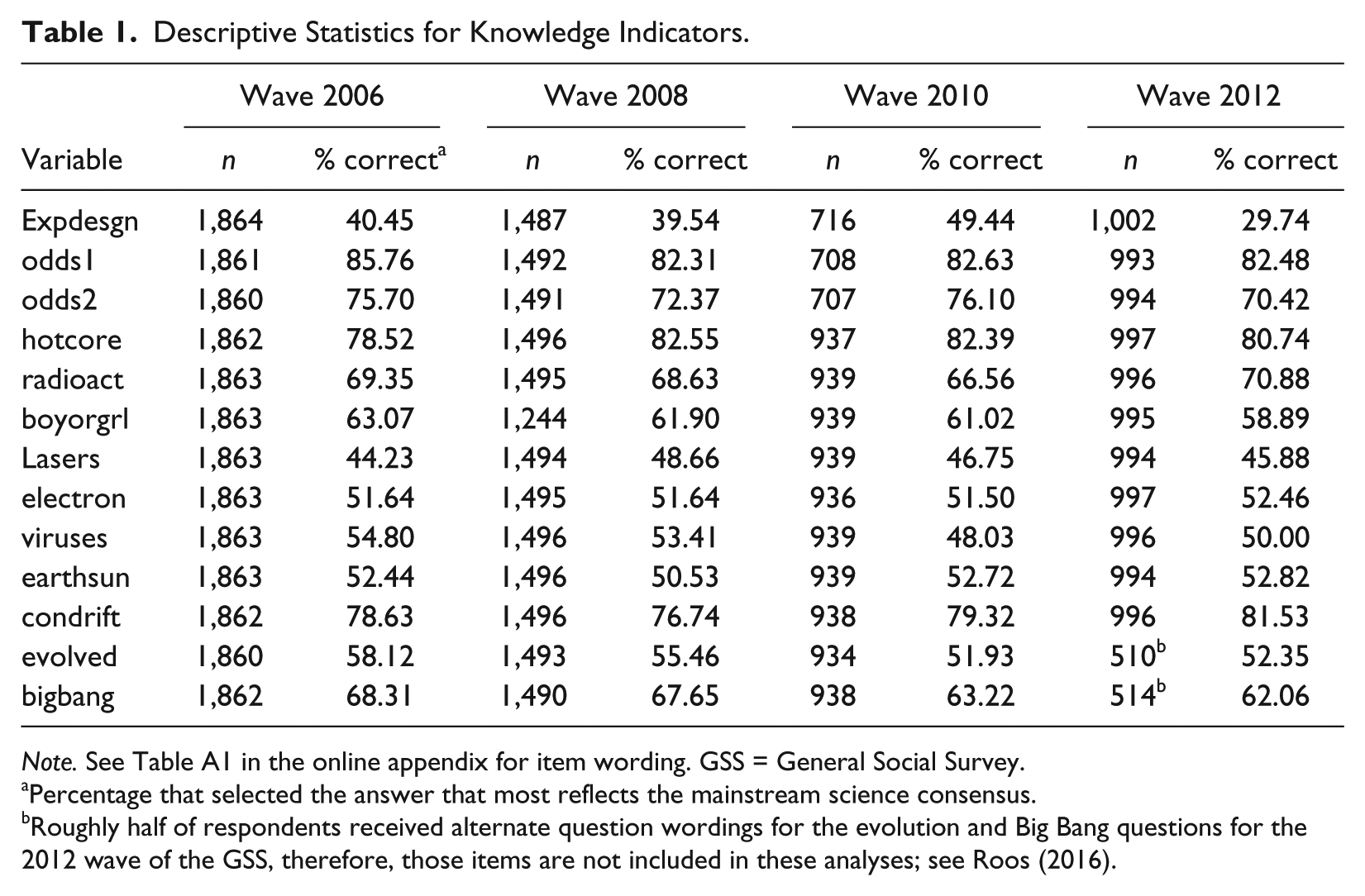
Note. See Table A1 in the online appendix for item wording. GSS = General Social Survey.
Percentage that selected the answer that most reflects the mainstream science consensus.
Roughly half of respondents received alternate question wordings for the evolution and Big Bang questions for the 2012 wave of the GSS, therefore, those items are not included in these analyses; see Roos (2016).
Intervening Variables
Intervening variables in the full model, or variables placed between exogenous control variables and outcome variables, are education in years and number of college science courses taken. This is done, in part, to allow for the examination of mediation effects (Baron and Kenny 1986; Bollen 1989). Respondent education is represented by a variable constructed from a series of questions about the respondent’s education, and is measured in years. Jon Miller et al. (1997) found that number of college science courses taken was a significant predictor of science knowledge, and here, number of college science courses taken is created by combining the responses to the questions “Have you ever taken any college-level science courses?” (response categories were yes, no, and don’t know) and “How many college-level science courses have you taken?” (responses ranged from 1 to 90) from the GSS, recoding the second variable to be 0 rather than missing when respondents indicate that they have not taken any college-level science courses from the first item. The combined item ranges from 0 to 90, with a mean of 2.66, median of 0, and a skewness of 5.25, and this was concatenated to a 10 category ordinal variable for ease of analysis and interpretation, as few respondents reported more than nine science courses taken. The new ordinal variable for number of college science courses taken has a median of 0, mean of 1.78, and a skewness of 1.69, and it is treated as a continuous variable. 3 Full descriptives may be found in Table 2.
Descriptive Statistics for Explanatory Variables by General Social Survey Wave.
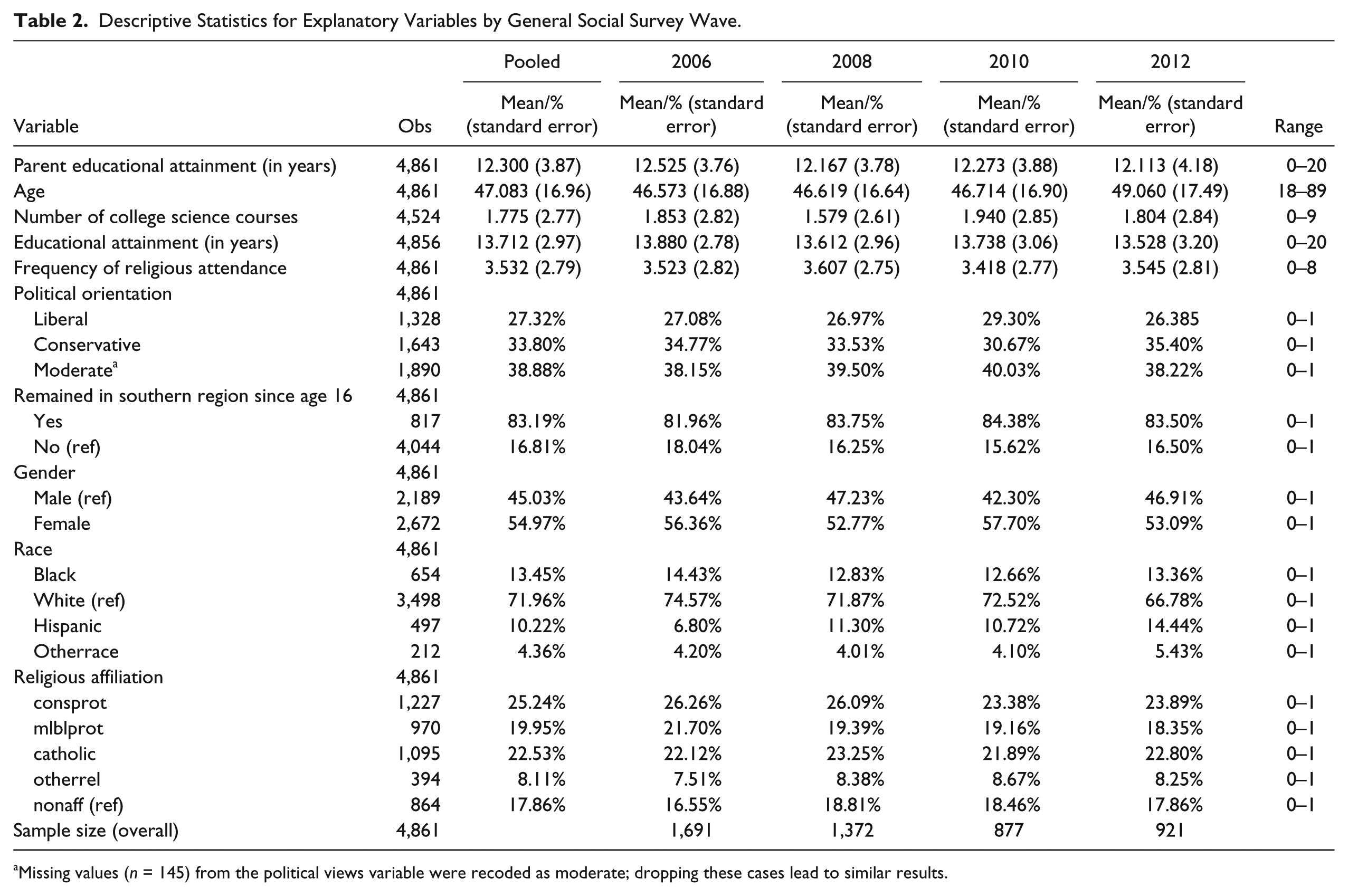
Missing values (n = 145) from the political views variable were recoded as moderate; dropping these cases lead to similar results.
Exogenous Variables
Exogenous (or external) variables in the full model include religious tradition, years of parent’s education, age, race, and frequency of religious attendance. Infrequent attenders may be less like frequent attending members of various religious traditions (Evans 2011), inclusion of frequency of religious attendance as an exogenous variable serves in part to control for this effect. Religious attendance is measured by the response to the question “How often do you attend religious services?” from the GSS, with response categories ranging from 0 = never to 8 = several times a week. Respondents whose parents have high levels of educational attainment (represented here by mother’s or father’s educational attainment, whichever is largest) are much more likely to finish high school and attend college themselves, and including parent education as an exogenous variable in the full model controls for this effect. Race is represented by dummy variables for black non-Hispanic, white non-Hispanic, Other race non-Hispanic, and Hispanic, with white non-Hispanic as the reference group. Religious tradition is represented by a slightly modified version of the RELTRAD coding scheme (Steensland et al. 2000; Woodberry et al. 2012), with dummy variables for the following traditions: Conservative Protestant, Mainline Protestant, Catholic, Other religion (including Jewish), with no affiliation as the reference category (17.86% of the sample report no affiliation). In part to deal with collinearity issues with the black Protestant dummy variable and the black race dummy variable, the black Protestant group was split and reallocated to the conservative and mainline Protestant groups, according to the coding used by Ellison, Musick, and Holden (2011). 4 Versions of the full model were estimated with the traditional RELTRAD groups, with similar results. I have included measures of Southern residence (coded as remained in the South since age 16 and not moved out-of-state), as well as political orientation (Evans 2011; O’Brien and Noy 2015; Sherkat 2011). Rather than include the Likert-type scale item for political views from the GSS, I have generated two dummy variables for Liberal and Conservative orientation: with persons who gave responses ranging from slightly liberal to extremely liberal coded as liberal and persons that gave responses ranging from slightly conservative to extremely conservative as conservative, with persons who responded as moderate as the reference group. This better captures the curvilinear relationship between political orientation and science knowledge. In addition, any participants missing on the polviews variable in the GSS were coded as moderate (n = 145 in pooled sample). Models were fit excluding these cases with similar results to those presented here. Descriptive statistics may be found in Table 2.
Bivariate Relationships
In a bivariate analysis with these data (not reported here), conservative Protestants had more than half a standard deviation lower physical sciences knowledge (−.524) and more than a sixth of a standard deviation lower life sciences knowledge (−.184), relative to unaffiliated persons.
Full Structural Models
The next step is to estimate the full structural model. PFact and LSFact are both partially explained by CSKe, educational variables, and controls; CSKe by educational variables and controls; and educational variables in turn by controls (see the Online Appendix Figure A2 for a path diagram.) This model places CSKe in the position of an intervening variable rather than an ultimate outcome, which is a necessary analytical step to test whether or not spillover from contested knowledge areas may affect uncontested knowledge areas.
One of the strengths of SEMs is a variety of measures of model fit (see the online appendix for a description of specific fit indices) and path specific significance tests to assess how well a given model fits the data. However, even a good fit is not proof of a valid model—there can always be other models the researcher is not aware of that fit as well (Hershberger 2006) or even better. It is for this reason that any arguments about the influence of variables supported by SEMs must be well grounded in theory, just as is the case with simpler forms of linear regression.
Direction of Effects
Some readers may wonder at the direction of the paths specified in the full model; in particular, they may wonder whether CSKe influences educational attainment and number of college science courses or whether uncontested forms of science knowledge (physical and life sciences) influence CSKe, rather than the reverse. In the first case, as mean age of the GSS sample is 47 (SD = 17), the majority of respondents have their educational trajectories, and thus paths of influence from educational variables to CSKe make more sense because of temporal ordering. 5 In the second case, the direction of influence is specified from CSKe to uncontested forms of science knowledge for two reasons: it is not immediately clear what the mechanism would be for uncontested forms of science knowledge to influence CSKe directly, as it is difficult to imagine a process by which uncontested knowledge in the physical and life sciences is increased in a way that does not also touch on the subject area of evolution and related ideas (and, thus, both CSKe and uncontested knowledge would have a common cause, rather than a direct effect from uncontested knowledge on CSKe).
Model Fit
Tables 3 and 4 present estimates from the full model. A more detailed description of goodness of fit statistics used may be found in the online appendix, and a combination of available fit statistics were used to interpret fit for all models, rather than any individual statistic. This model has excellent fit, and the explained variance of the two dimensions of uncontested science knowledge is high (R2 of .620 and .573), as is the explained variance of CSKe (R2 of .415).
Parameter Estimates from Full Structural Model (Latent Variables).
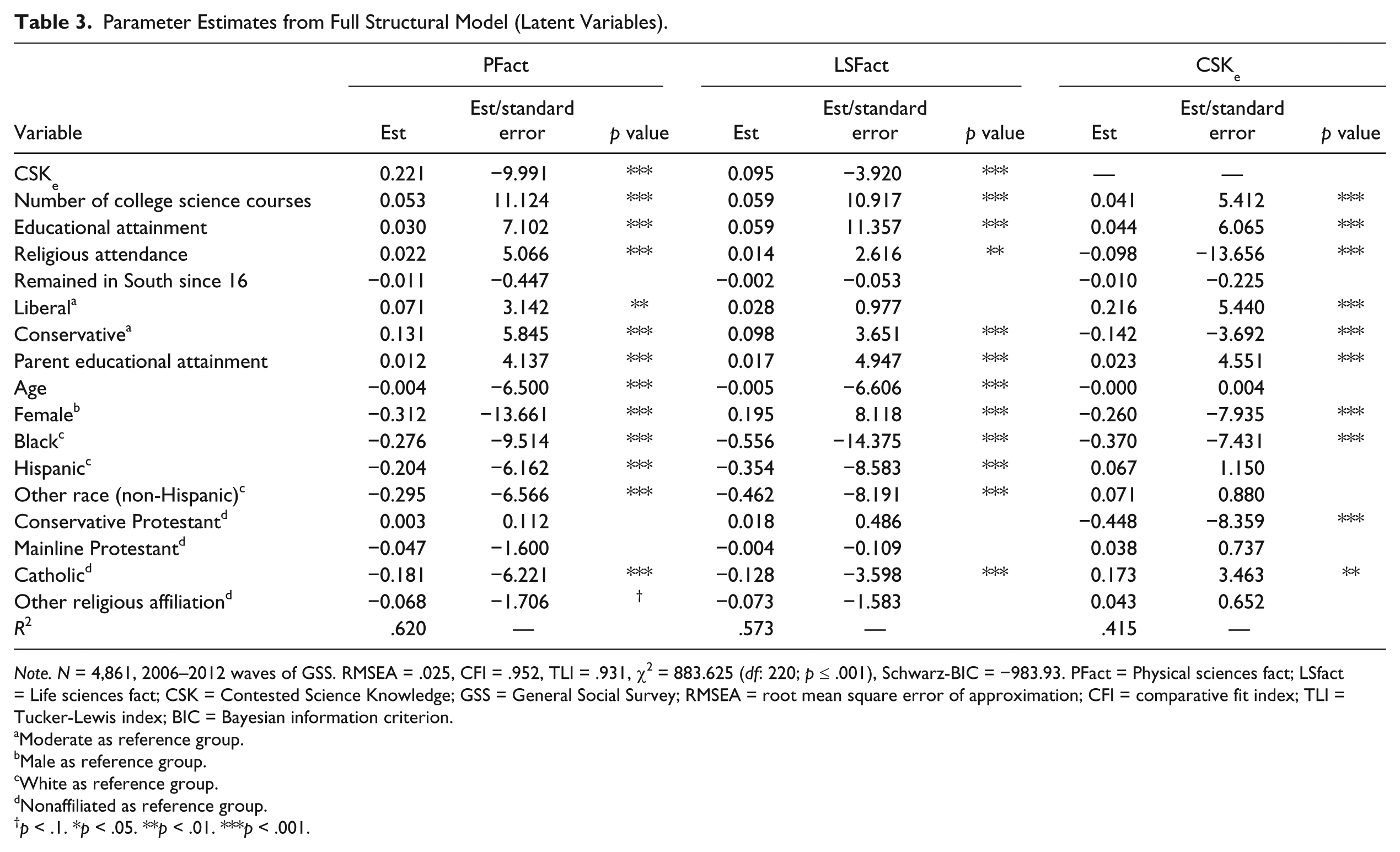
Note. N = 4,861, 2006–2012 waves of GSS. RMSEA = .025, CFI = .952, TLI = .931, χ2 = 883.625 (df: 220; p ≤ .001), Schwarz-BIC = −983.93. PFact = Physical sciences fact; LSfact = Life sciences fact; CSK = Contested Science Knowledge; GSS = General Social Survey; RMSEA = root mean square error of approximation; CFI = comparative fit index; TLI = Tucker-Lewis index; BIC = Bayesian information criterion.
Moderate as reference group.
Male as reference group.
White as reference group.
Nonaffiliated as reference group.
p < .1. *p < .05. **p < .01. ***p < .001.
Parameter Estimates from Full Structural Model (Other Intervening Variables).
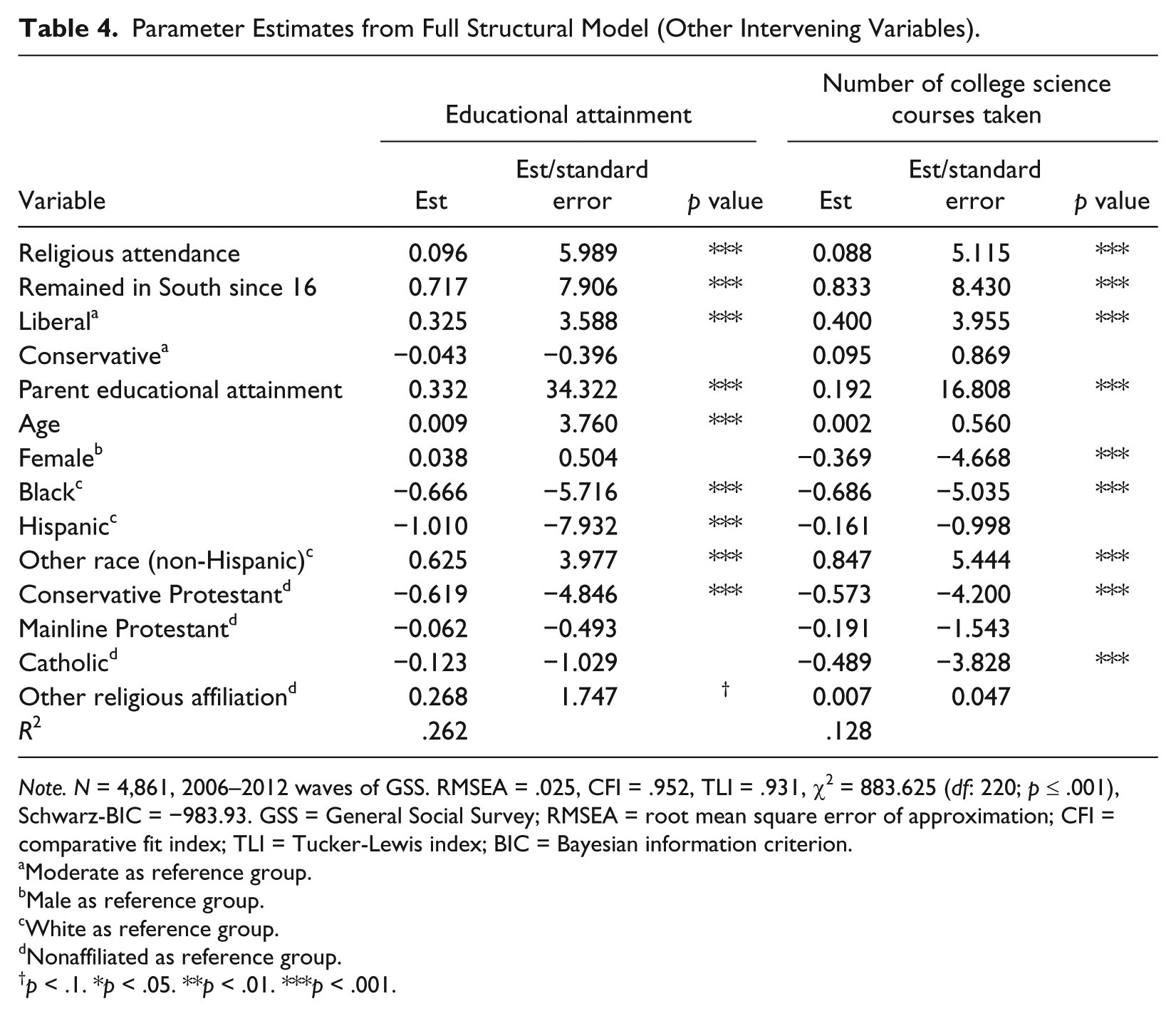
Note. N = 4,861, 2006–2012 waves of GSS. RMSEA = .025, CFI = .952, TLI = .931, χ2 = 883.625 (df: 220; p ≤ .001), Schwarz-BIC = −983.93. GSS = General Social Survey; RMSEA = root mean square error of approximation; CFI = comparative fit index; TLI = Tucker-Lewis index; BIC = Bayesian information criterion.
Moderate as reference group.
Male as reference group.
White as reference group.
Nonaffiliated as reference group.
p < .1. *p < .05. **p < .01. ***p < .001.
Coefficients
CSKe has a durable, positive effect on both physical and life sciences knowledge, net of other endogenous intervening variables and all exogenous controls. A standard deviation increase in RSO is associated with around a .14 standard deviation increase in life sciences and around a .36 standard deviation increase in physical sciences knowledge, both net of other covariates, including education.
Conservative Protestant affiliation has no direct effect on uncontested science knowledge; it is fully mediated in this model. This finding contrasts with Sherkat’s (2011) findings and is in line with analyses performed by Evans (2011). Conservative Protestant and Catholic 6 also both have a negative effect on total number of college science courses taken (Table 4), when compared with nonaffiliated respondents (both are worth roughly half a science course fewer, and recall that the mean number of science courses taken was roughly 1.8).
Relative to nonaffiliated persons, conservative Protestant affiliation has a significant, negative direct effect on CSKe—that is, conservative Protestants are less likely to accept evolution net of other variables. This effect is roughly comparable in size with 10 fewer years of education or 11 fewer college-level science courses. Catholic affiliation has a positive effect on CSKe relative to nonaffiliated respondents, which is in line with findings from both Sherkat (2011) and Evans (2011), and means Catholics are more likely than even unaffiliated persons to accept evolution.
Indirect Effects
Table 5 presents the direct and indirect effects of religious tradition on physical and life sciences knowledge from the full model. Indirect effects are the influence an exogenous variable has that is mediated by intervening variables; the total effect is the sum of the direct and indirect effects.
Total (Direct and Indirect) Effects of Religious Tradition Variables on Science Knowledge from the Full Model.
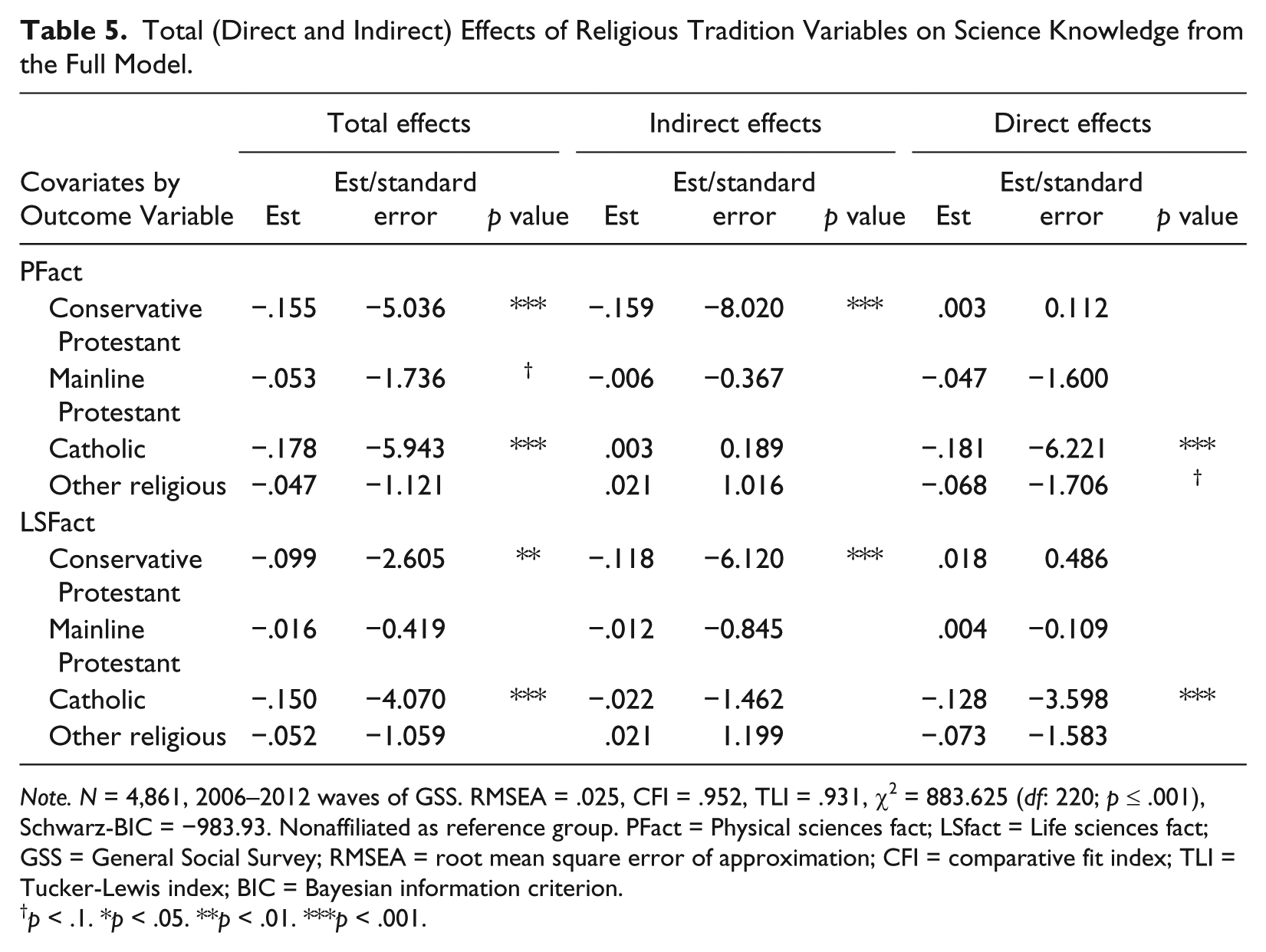
Note. N = 4,861, 2006–2012 waves of GSS. RMSEA = .025, CFI = .952, TLI = .931, χ2 = 883.625 (df: 220; p ≤ .001), Schwarz-BIC = −983.93. Nonaffiliated as reference group. PFact = Physical sciences fact; LSfact = Life sciences fact; GSS = General Social Survey; RMSEA = root mean square error of approximation; CFI = comparative fit index; TLI = Tucker-Lewis index; BIC = Bayesian information criterion.
p < .1. *p < .05. **p < .01. ***p < .001.
The total effect for Conservative Protestant on physical sciences knowledge is negative (−.155) and significant. Despite the insignificant direct effect coefficient, this significant total effect (direct + indirect) suggests a persistent overall negative effect of affiliation with conservative Protestant denominations that has been mostly mediated by CSKe—which is expected given the bivariate analysis described above.
In the case of PFact, the indirect path through CSKe is three to four times larger in size than the path through either educational attainment or number of college science courses taken and generates the bulk of the indirect effect (−.099 for CSKe, −.019 for educational attainment, −.030 for number of college science courses taken). This suggests that CSKe (and not educational attainment or college-level science course work) is the prime mediator between conservative Protestant affiliation and uncontested physical science knowledge (see Figures 1 and 2 for a visual representation of path specific effects). In models omitting CSKe, a negative direct effect from conservative Protestant affiliation and PFact remained. In the case of LSFact, all three paths are similar in size (−.036 for the indirect path through educational attainment, −.034 for the path through college science course work, and −.043 for the path through CSKe).
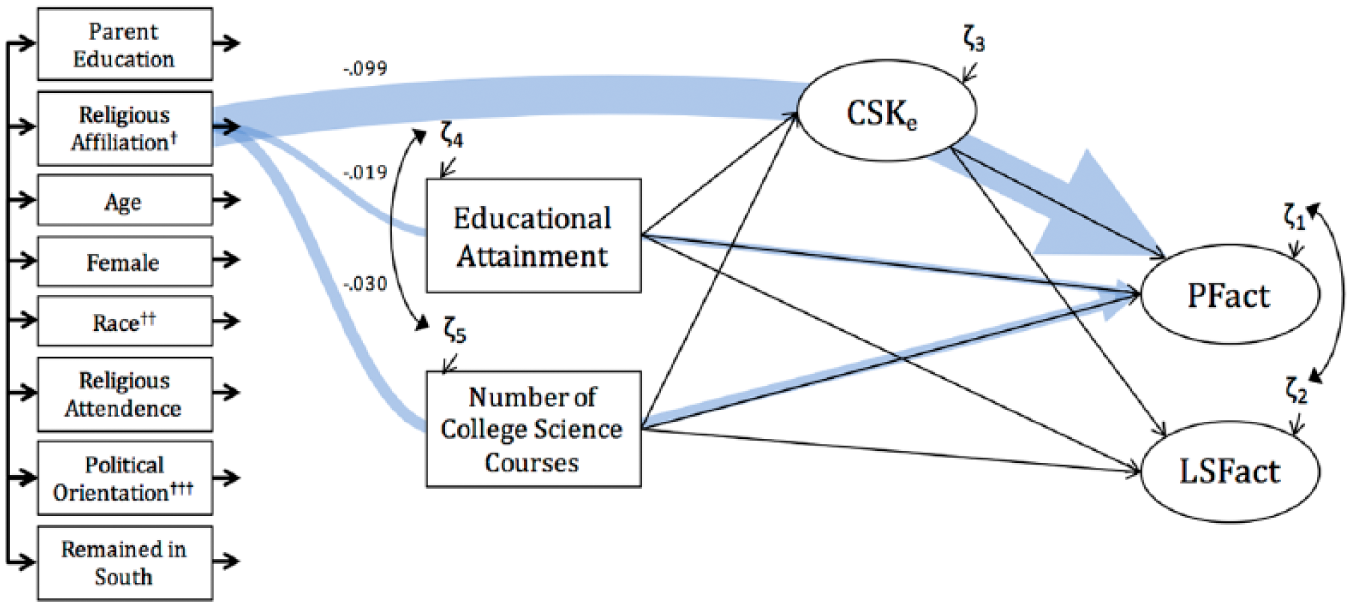
Indirect effect of conservative Protestant (CP) affiliation on physical sciences knowledge, through CSKe, educational attainment, and college science course work.
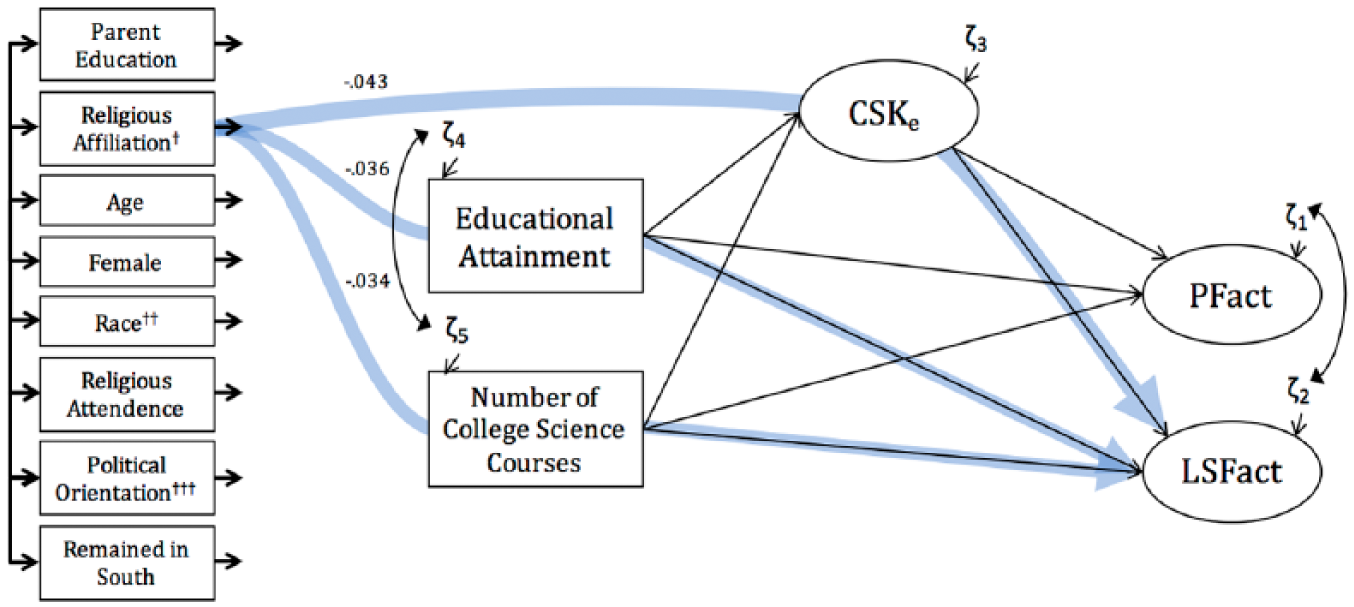
Indirect effect of conservative Protestant affiliation on life sciences knowledge, through CSKe, educational attainment, and college science course work.
Furthermore, the indirect paths from educational attainment and number of college science courses taken through CSKe have very small effect sizes. This means that the indirect influence of conservative Protestant affiliation on uncontested science knowledge through CSKe is independent of smaller indirect effects through educational attainment and science course work. Figures 1 and 2 present the significant indirect paths and their coefficients with shaded arrows, each relative to the size of the effect. In versions of the full model with educational variables omitted, a similar pattern exists, with the conservative Protestant effect on uncontested science knowledge being fully mediated by CSKe.
2014 GSS Validation Sample
As a validation check, full model is estimated on the 2014 wave of the GSS (that is, the 2014 wave is not pooled with the 2006–2012 waves, but run separately). The full model has excellent fit on the 2014 data (n = 1,150, root mean square error of approximation [RMSEA] = .027, comparative fit index [CFI] = .939, Tucker-Lewis index [TLI] = .913, χ2 = 407.521 (df: 220; p ≤ .001), Schwarz-Bayesian information criterion [BIC] = −1,142.93), with the same overall pattern of coefficients. The full model was finalized before estimating with the 2014 sample.
Discussion
Research Question 1
Based on the full model, I find no evidence that conservative Protestants have lower levels of uncontested science knowledge than others, once CSKe is accounted for. Conservative Protestants have lower levels than all other affiliation groups in a bivariate comparison, and this remains as an indirect effect in the full model. In both the case of physical and life sciences, this effect is fully mediated.
Research Question 4
Conservative Protestant’s lower levels of uncontested knowledge relative to other groups is fully mediated by educational attainment, number of college science courses taken, and CSKe. In the case of physical sciences knowledge, the bulk of this mediation effect is by CSKe, and omitting it results in only partial mediation. In the case of LSFact, mediation is more roughly shared between CSKe and educational variables.
It is difficult to parse this educational mediation effect in cross-sectional data, and two opposed mechanisms may be at work: first, conservative Protestants are less likely to reach greater levels of educational attainment, 7 and, thus, know less general science. The second potential mechanism is where greater levels of educational attainment and college science course work effectively “secularize” the contested knowledge area for those respondents. Following Chaves’s (1994) definition of secularization as declining religious authority, a mechanism that results in individuals accepting the rules for assessing legitimate knowledge from the scientific rather than conservative Protestant religious sphere is, therefore, a secularizing effect.
The indirect effect through CSKe may be interpreted more simply. For both physical and life sciences knowledge, the indirect path through CSKe is larger than either that through educational attainment or through college science course work. Furthermore, the specific paths of conservative Protestantism influencing science knowledge through CSKe are independent of educational paths, suggesting a different mechanism. In addition, in models omitting educational variables, CSKe still fully mediates the effect of conservative Protestant affiliation on both forms of uncontested science knowledge. Those high in CSKe have higher levels of general, uncontested science knowledge, and those low in CSKe have lower levels of uncontested science knowledge, net of education and other covariates. This suggests that while education is important, a strong position in the contested knowledge area has a much stronger influence on uncontested science knowledge than does education in the case of physical sciences, and a roughly similar effect in the case of life sciences.
Research Question 2
The results shown in Table 3 demonstrate evidence for a strong effect of conservative Protestant affiliation on CSKe, even allowing for the mediating effects of educational attainment and college science course work. Conservative Protestants are far more likely to reject evolution and related ideas than nonaffiliated persons.
Research Question 3
CSKe has a direct positive effect on both forms of uncontested science knowledge, net of relevant controls—those with low levels of CSKe have a lower level of uncontested science knowledge. This effect represents negative spillover, or a rejection of the rules for assessing legitimate knowledge from an opposed sphere outside a contested knowledge area as well as inside it. Simultaneously, a strong position in a contested area may result in a greater acceptance of the rules for assessing evidence from the allied sphere (positive spillover). If claims science makes on legitimacy in the area of origins are valid/invalid, then what science claims in other areas (gravity, radiation, thermodynamics, medicine) may be just as valid/invalid.
The results above suggest two critical findings of this article. First, that strong positions of acceptance or rejection in the area of evolution influence uncontested science knowledge, net of education and other factors (including religious affiliation). Second, the influence of conservative Protestant affiliation on uncontested science knowledge is indirect, flowing primarily through the rejection of evolution. The direct positive influence from CSKe to both physical and life sciences knowledge points to a relationship between controversial, contested knowledge areas and uncontested knowledge. I argue this spillover is a key mechanism underlying secularization (and de-secularization) processes.
Spillover and Contested Knowledge
The chief difference between the models I have estimated here and those that came before is that I have integrated contested knowledge (CSKe) into the explanatory model, rather than modeling it separately. Evans (2011) showed that the questions about human evolution and the Big Bang are religiously charged and might bias results if included in either of the science dimensions he models. Furthermore, as Roos (2014) demonstrated, those two items are indicators of dimension that is at least partially religious in nature, and I argue here that this dimension is central to understanding the relationship between conservative Protestant affiliation and uncontested science knowledge, and in a sense is more important than conservative Protestant affiliation for explaining disparities in uncontested science knowledge. By including CSKe and allowing for mediation effects, I found evidence supporting the argument that spillover is a key mechanism by which conservative Protestants tend to report lower levels of science knowledge (Sherkat 2011).
Thus, I argue that the introduction of the concepts of contested knowledge and spillover offers a mechanism for how the indirect influence of conservative Protestantism on uncontested science knowledge works. This is important because although many conservative Protestants reject evolution, not all do—and both conceptual and empirical models should reflect that. Rejection of evolution and related ideas is also a key part of the general negative relation between conservative Protestantism and uncontested forms of science knowledge. However, not all rejecters of evolution and related ideas are conservative Protestants, and an explanation that includes those individuals is ultimately more satisfying than one that divides people purely on religious affiliation, even when religious affiliation is considered a marker of identity.
Spillover in cases of contested knowledge is likely to be partially the result of boundary work. Those individuals who have the strongest positions in a knowledge area may be the most motivated to draw a hard demarcation line between knowledge they “accept” and knowledge they reject. Thus, while it is likely that most in the United States are familiar enough with evolution and related ideas to know that mainstream science holds that humans evolved from earlier forms, they indicate “false” or “don’t know” on this (and related) indicators not due to lack of knowledge, but to a particular form of boundary policing. I argue they are signaling that they are not the sort of people who agree with mainstream science on these issues, rather than merely failing to recall the fact. And, as the results show, this boundary work is not restricted to conservative Protestants, but rather any rejecter of evolution and related ideas, and by extension, any holder of extreme positions in a contested knowledge area. It is also possible that the relationship between contested and uncontested science knowledge shown here is due to generalized ignorance—that is, that some persons tend to overall know less science (and other things), and those individuals also tend not to have high CSKe. I cannot rule out this explanation with these data. However, if this is the case, then a new question arises: why do those with generalized ignorance disproportionally self-report as conservative Protestant? And why is this effect largely independent of education and college science course work? More data are needed to accurately assess the familiarity with contested areas (such as CSKe) to test the generalized ignorance hypothesis. The results presented here are consistent with the spillover explanation.
Two potential processes by which spillover might take place are (1) the devaluing of the standards for assessing evidence for truth claims in an opposed sphere, and (2) weakening of the knowledge authority of elites from the opposed sphere. When applied to the case of greater acceptance of human evolution spilling over to a reduction in the acceptance of truth claims from the conservative Protestant religious sphere, spillover effects are secularizing effects. When applied to the case of rejection of human evolution (and related ideas), spilling over to a reduction in uncontested science knowledge, spillover effects are de-secularizing effects. Thus, I argue that secularization as put by Chaves (Chaves 1994)—a decline in religious authority—can be conceived as a special case of spillover effects, with respect to authority over domains of knowledge (see Evans 2013). However, the scope of spillover is more broad than secularization (or de-secularization), and spillover effects may be detected where master frames compete (Benford and Snow 2000; Gamson et al. 1992) or anywhere multiple truth claims overlap.
Conclusion
This article introduces the concepts of contested knowledge and spillover in part to aid in understanding of a hotly contested area of knowledge. Contested knowledge areas such as evolution (and related ideas) where there are competing truth claims—each with separate means for assessing legitimate knowledge—generate spillover effects. These spillover effects lead to those that favor one explanation over another holding reduced levels of uncontested knowledge from the opposed sphere. In this article, I argue that to better understand the complex relationships between contested and uncontested areas of knowledge, it is important to build conceptual and empirical models that allow for spillover. In the particular case used in this article, an analytic focus on the contested knowledge area of evolution helps tease apart conflicting accounts about the effects of conservative Protestantism and science knowledge (Evans 2011; Sherkat 2011), and furthermore provides a key mechanism to help explain these effects.
The analyses presented in this article make use of cross-sectional data, and thus strong causal arguments are not supported. While the models presented (as well as sensitivity and validation analyses) support the chief claims in this article—namely, that conservative Protestant affiliation is indirectly associated with reduced science knowledge, and that a strong rejection of evolution and related ideas is further related to reduced science knowledge—longitudinal data are required to tease apart any causal relationships between these constructs. Temporally ordered data would allow for scholars to control for earlier levels of contested and uncontested knowledge, as well as to trace the indirect influences of early life variables. In addition, better measures of the home environment during childhood and adolescence (religiosity, educational quality, and performance) would both allow for tests of stronger causal claims as well as enable the examination of spillover effects at work. Measures such as these would allow scholars to identify common life course pathways that contribute to particular patterns of spillover. Future work should make use of longitudinal data of this nature.
In sum, the concepts of contested knowledge and spillover may aid in understanding other areas of contestation than those discussed in this article. Any topic or issue where there are multiple, legitimate claims to truth may exhibit spillover effects similar to the case of evolution (and related ideas) described here. These include conflict areas not directly tied to specific forms of religious belief, such as vaccine effectiveness (Dixon and Clarke 2013) or climate change (Kahan et al. 2012; McCright and Dunlap 2011). In both cases, the rival truth claims arise from political spheres of knowledge authority rather than religious ones. What climate change and vaccine “skeptics” hold in common is a lack of trust in elite-supported truth claims from the scientific sphere.
I hope the ideas of contested knowledge and spillover as presented in this article will also be helpful in examining conflict issues not specifically linked to mainstream science, such as reproductive rights, lesbian, gay, bisexual, transexual, queer (LGBTQ) rights, or any of a host of social and policy issues related to moral values where alternate ways of framing a debate call on different ideals to explain the importance of an issue. This framework will be particularly useful in cases where expert, authoritative knowledge is relied upon in assessing the legitimacy of one or more truth claims in conflict. Whether the truth claims are tied to the natural world, moral values, or other social facts, identification of the spheres of knowledge authority that overlap will point to likely types of spillover that result from the resulting contested knowledge area.
Footnotes
Declaration of Conflicting Interests
The author(s) declared no potential conflicts of interest with respect to the research, authorship, and/or publication of this article.
Funding
The author(s) received no financial support for the research, authorship, and/or publication of this article.
Supplemental Material
Supplementary material for this article is available online.
Notes
References
Supplementary Material
Please find the following supplemental material available below.
For Open Access articles published under a Creative Commons License, all supplemental material carries the same license as the article it is associated with.
For non-Open Access articles published, all supplemental material carries a non-exclusive license, and permission requests for re-use of supplemental material or any part of supplemental material shall be sent directly to the copyright owner as specified in the copyright notice associated with the article.
