



Abstract
Fights are common at many U.S. residential universities and colleges and often seen as “normal” by students who witness them. This study explores the normalization of college fighting by using a situational learning approach that highlights definitions as learned and shared within a drinking context. Exploratory analysis of survey data finds that nine in 10 fights at college occur when at least one participant is intoxicated, and more than half of fights take place at drinking hot spots (e.g., bars, parties). Fights that occur at drinking hot spots are also twice as likely to be seen as normal (e.g., ordinary, harmless) by students who witness them, even after controlling for the seriousness of the fight (as measured by injury, number, and gender of fighters). Students who drink are four times as likely as nondrinkers to normalize fights. Yet, fights are no more likely to be normalized when fighters or witnesses are intoxicated, suggesting expectations related to intoxication and the drinking context may have a greater impact on definitions than alcohol itself. We conclude with a discussion of the theoretical and practical relevance of situational learning in future research on fighting and violence more broadly.
Introduction
Despite relatively low incidence of serious violence perpetrated by students at U.S. universities and colleges, physical altercations between two or more students (i.e., fights) are rather common at many large residential schools (Flowers 2009; Sperber 2000; Weiss 2013a). According to recent studies, more than half of the students who attend such schools witness fights, and one-third witness three or more fights (Weiss 2013a; Weiss and Dilks 2016; Woods, Weiss, and Boyd 2018). Witnessing fights is especially prevalent among students who drink alcohol or participate in a “party subculture” characterized by extreme drinking and other risky behavior (Weiss 2013a). For many of these students, fighting, like drinking itself, is an expected and even “normal” part of college life.
Based on survey data from a population of undergraduate students at a large residential university with a discernible party subculture, the current study explores the normalization of college fighting. We use the term normalization to refer to the interpretation of a particular behavior (in this case, fighting) as acceptable or ordinary under certain circumstances, even as the same behavior might be viewed as unacceptable or deviant elsewhere. Normalization, we argue, is both situational (i.e., dependent on the specificities of context, particularly place) and learned as part of one’s socialization and social interactions. Normalization is also expected within certain contexts. Using a situational learning perspective, this study highlights the shared expectations, especially as related to the party subculture, that normalize and ultimately enable fighting and other situated violence to endure and even thrive at college and beyond.
Background
A Situational Learning Perspective of Violence
Among the many theoretical perspectives that attempt to explain violent behavior, one of the more popular approaches within social science is social learning. Social learning theories, as exemplified in criminology’s differential association and differential reinforcement (Burgess and Akers 1966; Shinew and Parry 2005; Akers 1998), argue that people learn violent behavior and the attitudes favorable toward it from the persons and groups with whom they associate most frequently (e.g., family, peers). As such, attitudes and perceptions of behaviors are learned and reinforced based, in part, on how others respond to behavior, an interactive process that takes into account the standpoint of others (Sandstrom, Martin, and Fine 2006). An acceptance of violence, for example, is more likely to occur among persons who interact regularly within groups who view violence as acceptable.
While social learning theories are helpful for identifying groups’ influences on attitudes toward behavior, they tend to downplay the variability of interpretation based on situation. A situational perspective emphasizes the fluidity of definitions, meaning that the same behavior can be condemned, tolerated, or even admired by the same group of people based on where it takes place, and the norms or codes that regulate behavior at different places (Anderson 1999; Copes, Hochstetler, and Forsyth 2013; Ross and Nisbett 2011; Topalli 2005; Wilkinson 2007). This approach is especially useful for understanding why persons who might otherwise condemn violent behavior accept and even expect it in certain contexts, such as at sporting events (Bloom and Smith 1996; Roberts and Benjamin 2000), or at bars (Copes et al. 2013; Weiss 2013a; Woods et al. 2018). From a situational approach, it is the unique norms and expectations within such contexts that define violence as more acceptable, even to those who are not violent themselves.
A situational learning approach acknowledges that violence and its definitions are both learned and situational, meaning that learning is often tied to the distinct cultural norms and expectations of the situation. College fighting, for example, is a form of situated violence in the sense that it disproportionately takes place within drinking contexts such as at bars (Weiss 2013a; Woods et al. 2018) where behavior may be viewed very differently based on expectations related to alcohol and intoxication.
Expectations of Alcohol and Intoxication
Studies of college crime indicate a strong association between violence and alcohol (Cowley 2014; Felson and Burchfield 2004; Mustaine and Tewksbury 2007; Weiss 2013a; Weiss and Dilks 2015, 2016). Most explanations for this association focus on the disinhibiting effects of alcohol. For instance, studies suggest that alcohol lowers inhibitions, increases impulsivity and aggression, and reduces one’s ability to interpret others’ actions calmly and rationally (Felson and Burchfield 2004; Harford, Wechsler, and Muthen 2003). Studies also suggest that alcohol can act as a distraction that reduces drinkers’ ability to recognize danger, protect themselves against harm, or discern when others are in danger and in need of help (Becker and Tinkler 2015; Burn 2009; Mustaine and Tewksbury 2007; Pugh et al. 2016).
While alcohol may certainly contribute to violence, it may be the shared expectations of intoxication rather than alcohol itself that better explains the association between violence and alcohol at college. For example, it is “common wisdom” among college students that excessive drinking increases reckless, irresponsible, and aggressive behavior among those who drink. These shared expectations may act as a self-fulfilling prophecy that increases fighting, and aggression more broadly, by providing students with the language (rationalizations) necessary to reduce their culpability, such as by blaming fighting on alcohol (Becker and Tinkler 2015; Burn 2009; Pugh et al. 2016; Vander Ven 2011; Weiss 2013a). Excuses that blame outside forces such as drunkenness for bad behavior provide a socially sanctioned cover from judgment, and allow persons accused of wrongdoing to mitigate negative consequences (Copes et al. 2013; Gusfield 1996; Scott and Lyman 1968). At college, these rationalizations may also embolden students to fight, knowing in advance that their peers, often drunk themselves, will look the other way.
Excuses, and other techniques of neutralization (Sykes and Matza 1957) that redefine behavior as less deviant, also enable persons who witness violence to minimize the seriousness of the behavior. For instance, denying the severity of injury (or viewing a victim as deserving) can help reduce one’s discomfort while watching persons hurting one another. In the case of fighting, it can also justify doing nothing to help deter or break up a fight, and provide a rationale for continuing to associate with persons who fight. Moreover, as harmless events require no action to be taken, neutralization may have particular utility for students who participate in the party subculture. By downplaying the harms that occur while drinking, students are able to continue to engage in their risky drinking routines.
Indeed, neutralization is essential for students who participate in a party subculture where violence and other collateral harms from excessive drinking often coexist (Weiss 2013a; Weiss and Dilks 2015). As such, neutralization techniques are “taught” as part of the socialization process that indoctrinates students into the party subculture (Allen and Jacques 2013; Cowley 2014; Weiss 2013a). Within peer-based drinking groups, students learn how to drink “successfully” (e.g., how to drink midweek and still do well in class, how to avoid underage drinking citations) and how to rationalize (normalize) the negative effects of intoxication, including minimizing the harms experienced or witnessed (Durkin, Wolfe, and Clark 2005; Mustaine and Tewksbury 2007; Vander Ven 2011; Weiss and Dilks 2015, 2016). Thus, rationalizations that normalize fights may be reinforced and even expected among students who drink as part of a learning process.
Expectations at Drinking Hot Spots
Rationalizations, or at least an indifference toward violent behavior, are also expected at drinking hot spots, such as at bars, parties, and even sporting events where large amounts of alcohol are consumed (Brennan 2016; Copes et al. 2013; Weiss 2013a; Weiss and Dilks 2016; Wells, Graham, and Tremblay 2007). From a routine activities perspective (Cohen and Felson 1979; Tewksbury and Mustaine 2003; Weiss and Dilks 2016), high incidence of crime is more likely to occur in hot spots due to a convergence of motivated offenders, vulnerable targets, and an absence of capable guardians willing to help (see Pridemore and Grubesic 2013; Robinson and Roh 2007; Turanovic and Pratt 2014). Drinking hot spots exacerbate the potential for such a convergence due in part to the presence of alcohol. Recall that alcohol can have disinhibiting and distracting effects, thereby increasing offender aggression, target vulnerability, and “incapable” guardianship.
But high crime incidence in drinking hot spots may also be due to the expectations of crime and other deviance within such settings. For instance, many bars and clubs thrive and survive based on their reputations for providing a “party atmosphere” with relaxed rules and lax social control. These establishments attract customers by promoting themselves as “time-outs” from conventional standards of behavior (Brennan 2016; Buddie and Parks 2003; Gusfield 1996; Pridemore and Grubesic 2013; Wells et al. 2007). An “anything goes” mantra further increases the likelihood of unconventional behavior. Patrons who frequent these establishments know this in advance, and therefore accept and even expect nonnormative behavior inside.
Patrons also tend to accept that there will be minimal sanctions or repercussions for those who act in nonnormative ways. Indeed, a norm within many drinking hot spots is to “mind-your-own-business,” an ethic exemplified in the marketing slogan for Las Vegas—what happens in Vegas, stays in Vegas. Patrons of drinking hot spots are expected to look the other way when witnessing deviant behavior, to not care, or at least to feign an indifference toward it. In turn, a shared indifference is integral to the drinking hot spot, ensuring a loyal patronage by minimizing dissent and complaints (including calls to police). Enforcing such norms ensures patrons’ privacy and protects them from censure. It also protects establishments from outside scrutiny, interference, and legal repercussions (Brennan 2016; Buddie and Parks 2003; Pridemore and Grubesic 2013; Turanovic and Pratt 2014). And in doing so, indifference enables the perpetuation of fighting and other deviant behaviors that take place inside.
Gendered Expectations
Expectations related to gender may also shape perceptions of violence. For instance, studies have found that men are more likely than women to engage in violent behavior, to enjoy watching fictional violence, and to view some violence as an acceptable means for resolving conflict (Allen and Jacques 2013; Kavanaugh 2013; Lowe et al. 2012; Pugh et al. 2016; Woods et al. 2018). Gender differences in perceptions may not be too surprising considering that men are exposed to more violence and to messages normalizing it, first as boys playing aggressive games and sports, and then as teens and young adults participating in male peer groups where toughness and aggression are often respected and rewarded (Kimmel 2008; Lowe et al. 2012). In comparison, girls do not typically play as aggressively as boys, nor are they typically rewarded for physical aggression by their female peer groups. (For notable exceptions, see Chesney-Lind and Pasko 2004; Ness 2004.) Moreover, women are often taught that violence is not an appropriate (feminine) response to conflict (Ness 2004; Weiss 2009; Weiss, Addington, and Nolan 2018).
In addition to socialization and associations with male peer groups, men at college are also more likely to participate in drinking groups and the party subculture. Although both men and women drink alcohol at college, men are more likely than women to engage in risky drinking, including drinking more days per week, consuming larger quantities of alcohol, and going out more frequently to bars and other drinking hot spots (Vander Ven 2011; Wechsler and Nelson 2008; Weiss 2013a). This means that men who drink may be more likely to normalize violence based on their interactions with male peers, and with drinking groups that endorse risk and the rationales that normalize it.
Finally, it is important to note that expectations of “normal fights” may themselves be gendered, as fights are typically assumed to involve two men of equal strengths (Woods et al. 2018). For instance, fights between a man and woman may be seen as more serious than a fight between two men (or two women) based on assumptions that men are stronger and naturally able to fight, whereas women are smaller and assumed incapable of defending themselves (Lowe et al. 2012; Ness 2004; Weiss et al. 2018). Likewise, fights with multiple fighters against one, and those that result in severe injury, are more likely to be viewed as “unfair,” and no longer seen as acceptable violence (Brennan 2016; Copes et al. 2013; Lowe et al. 2012; Weiss et al. 2018; Woods et al. 2018). Thus, even as men may be more accepting of fights in general, deviations from the normal fight may delimit perceptions, even among men.
Method
The overall objective of the current study is to provide theoretical insight regarding fighting and its normalization. Findings are meant to serve as a starting point for future empirical research on fighting and other situated violence by providing a framework—a situational learning approach—that examines the impact of expectations specifically related to alcohol, drinking hot spots, and gender on perceptions of fighting.
The study uses data from a self-administered online survey questionnaire distributed in 2013 to a random sample of 2,000 undergraduates at a large public, residential, sports-oriented university in the mid-Atlantic region of the United States. After receiving Internal Review Board approval, the survey was distributed to students via their e-mail addresses provided by the University’s Office of Records. The invitation e-mail informed students that the survey was voluntary and would take them approximately 15 minutes to complete, and that they could skip questions for which they were not comfortable and quit at any time. Students who chose to participate in the survey did so by clicking on a link in an e-mail that connected them to SurveyMonkey, a secure web-based survey program. Of the 2,000 students who received e-mail invitations, 644 completed the survey, a 32 percent response rate. Although this rate is lower than ideal, it is comparable with many online surveys among college students that commonly have response rates ranging from 11 percent to 35 percent, especially when no incentive is provided (see Cook, Heath, and Thompson 2000).
The main purpose of the survey was to learn more about student fighting at college. The questionnaire defined fighting as “physical altercations between two or more persons, typically involving hitting, shoving, or kicking with the intent to harm or defend.” Respondents were asked to answer questions regarding fights they witnessed “while at college,” and to include only fights that took place on or near campus. Respondents who witnessed fights were also asked how many fights they witnessed, and were then asked to describe in more detail a witnessed fight. In the case of multiple fights, respondents were asked to describe the most serious fight witnessed. Given this instruction, findings may overrepresent physical altercations with more serious injury.
Also note that our sample excluded students who fight. This exclusion was the result of a skip pattern meant to reduce the time burden on students who had both participated in fights and witnessed them. Student who answered yes to having fought while at college (n = 114) were automatically “skipped” to another section to answer questions on motivations for fighting. Because witnesses and fighters were asked different sets of questions about fighting, this skip pattern excluded fighters from our tests. This also means that our results may underestimate normalization, our main outcome variable, based on the assumption that students who fight themselves may be more accepting of the fights they witness.
An additional 79 cases were excluded from the sample due to missing information related to fighting questions. The final sample used for analysis contained 451 cases. The mean age of students in the sample is 20.9; 93 percent of the sample are white and 98 percent are non-Latino (see Table 1). The sample also includes similar proportions of underclassmen (freshmen, sophomores) and upperclassmen (juniors, seniors). Each of these demographic patterns is comparable with the university’s undergraduate population in 2013, according to the school’s Web site that year. Yet, our sample contains 59 percent women and 41 percent men, a pattern that significantly differs from the university’s population (51 percent women, 49 percent men). This skewed gender distribution is largely the result of excluding fighter participants who are disproportionately men (75 percent of fighters are men). Note, however, that a descriptive bivariate comparison of other key demographic variables between fighters and nonfighters shows no other significant differences of concern.
Sample Descriptives (N = 451).
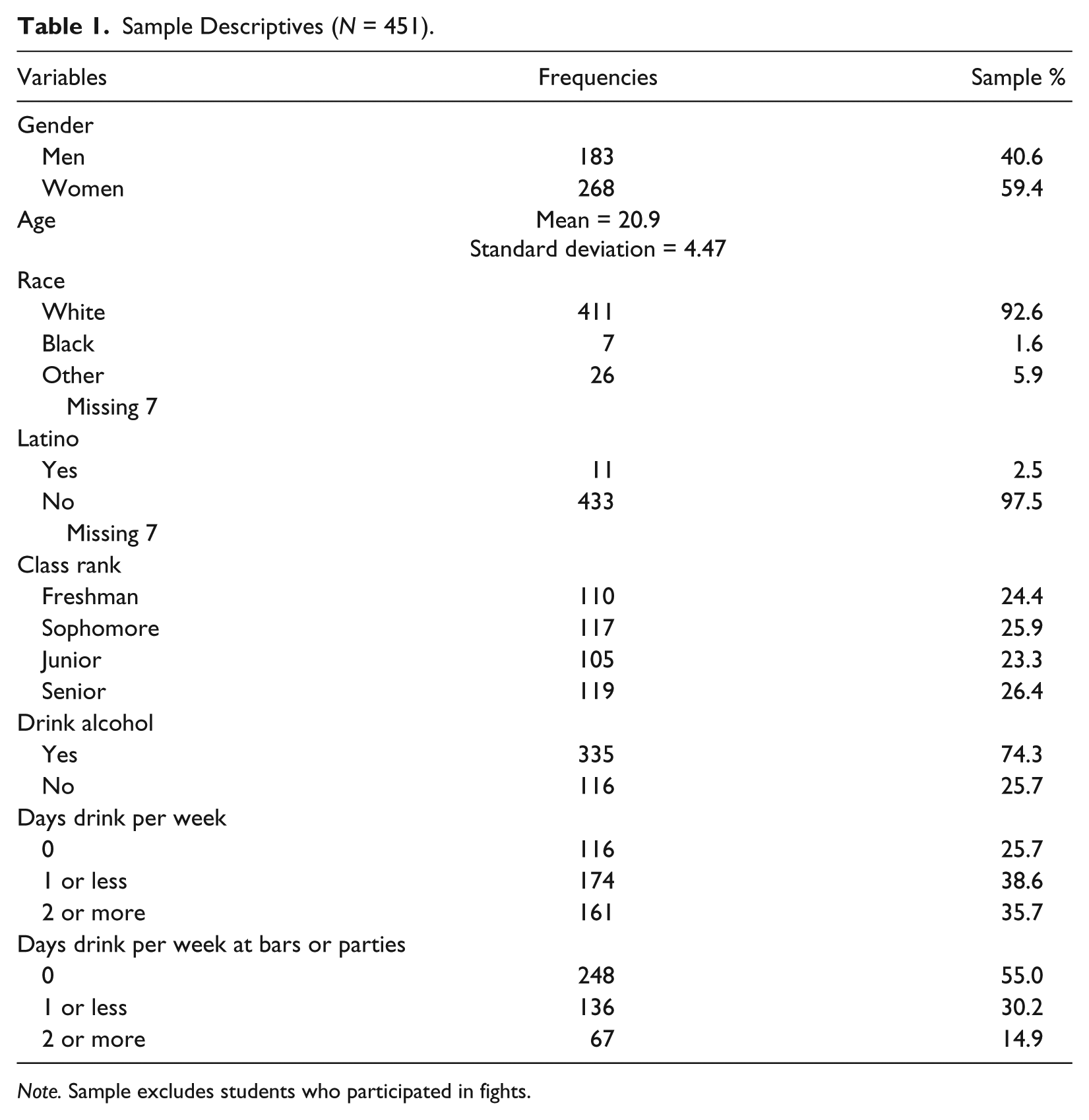
Note. Sample excludes students who participated in fights.
Finally, based on a series of additional survey questions that asked students about their drinking routines, 74 percent of students in our sample drink alcohol, 36 percent drink two or more days in a typical week, 45 percent drink at bars or parties (drinking hot spots), and 15 percent go out to drinking hot spots two or more days in a typical week. These statistics are consistent with findings from a larger sample used in a prior study of drinking routines among this same student population (see Weiss 2013a). Still, it is important to note that fighters, excluded from our sample for analysis, drink alcohol more frequently (95 percent drink, 46 percent drink two or more days per week, and 48 percent go out to drinking hot spots two or more days per week). This means that our sample may underrepresent the “hardcore partiers” who may be more likely to witness fights and to normalize them (see Weiss 2013a).
Variables
Normalization of fights
Our primary outcome variable for analysis comes from a survey question that asked respondents to “sum up” the most serious fight they witnessed. Closed-ended responses included the following: it was no big deal, just another night at [college], it scared me, it was fun to watch, I now avoid places where students drink, and other. A dichotomous variable was created to compare normalization responses (it was no big deal and just another night at [college]) with all other (nonnormalization) responses. Note that respondents were able to check multiple responses; therefore, nonnormalization responses excluded anyone who also checked a normalization response.
Brief quotes from an open-ended question that asked respondents to “describe the most serious fight” they witnessed were included in our “Findings” section to provide illustrative examples of normalization in students’ own words. A process for selecting such quotes began by identifying all respondents who checked a normalization response in the closed-ended question that asked students to sum up a fight witnessed (n = 155). We then read through students’ descriptive responses of the fight for examples of normalization that could provide detail and context to our quantitative findings. We were particularly interested in phrases that inferred rationalizations that denied or minimized harm (e.g., “it was no big deal”; “no-one got hurt”). In addition, using a “bottom up” or grounded theory approach based on patterns observed in the data (Urquhart 2013), we flagged responses that inferred social (situational) learning to highlight some of the ways in which normalization is shaped by peer responses and shared expectations.
Alcohol-related variables
Five alcohol-related variables are used in our analysis. The first two variables—whether fighters were intoxicated (or appeared to be intoxicated) and whether witnesses were intoxicated at the time of a fight—are used primarily to test alcohol’s role as an excuse (to mitigate responsibility of fighters) or as a distraction (to inhibit recognition of harm). A third variable—whether fights took place at drinking hot spots, specifically bars or parties—tests the importance of place; in this case, the setting where alcohol is consumed. Note that we include home football games as a drinking hot spot in our descriptive analysis, as students consume a sizable amount of alcohol before, during, or immediately after these sporting events (Sperber 2000; Vander Ven 2011; Weiss 2013a). However, given that the frequency of attendance at sporting events is limited by the number of games scheduled in a semester, we do not include them as drinking hot spots for multivariate analysis.
Two additional alcohol-related variables were included as indicators of participation in drinking groups and the party subculture more broadly. First, we look at whether or not students drink alcohol while at college. In our descriptive analysis, we also look at how frequently students drink per week, but use only a dichotomous drink/not drink variable in multivariate analysis after bivariate tests showed no statistically significant differences in perceptions of fights by number of days students drink. Our final alcohol-related variable looks at how many days students go out to drinking hot spots (coded as two or more days per week, and one or less days per week). Researchers who study the nighttime economy suggest that persons who frequent bars or clubs become immune or desensitized to the deviant behaviors they see inside (Brennan 2016; Wells et al. 2007). Thus, this variable was used to test whether frequency at drinking hot spots increased normalization due to greater exposure to deviance or expected risk.
Witness gender
Prior research suggests that men are more likely to view violence as acceptable based on their socialization (e.g., raised playing or watching violent video games and aggressive sports) and associations with male peer groups who often encourage aggressive behavior (Kimmel 2008; Lowe et al. 2012). Men at college are also more likely to participate in the party subculture, which itself may act as a socializing agent for normalizing fights and other risky behavior. Thus, we include witness gender (specifically, male witness) as a predictor variable.
Seriousness (control) variables
Given that research suggests an inverse relationship between the seriousness of violence and its acceptance as normal (Copes et al. 2013; Lowe et al. 2012; Weiss, Addington, and Nolan 2018), we include three control variables found in prior studies to predict seriousness: injury, number of participants, and gender of fighters. For injury, we use a dichotomous variable that compares serious injury (wounds, stitches, broken bones, loss of consciousness, some medical attention required) with minor (cuts, bruises, but no medical attention required) and no injury, combined. Note, that only 10 cases of fights involved weapons. Therefore, we excluded weapon use from multivariate analysis.
Number of fighters (recoded as two vs. three or more) is used as a second seriousness variable, based on the assumption that multiple-person fights are seen as more unpredictable, dangerous, or “unfair,” especially when multiple persons gang up against one (Lowe et al. 2012; Weiss et al. 2018; Woods et al. 2018).
Finally, we include fighters’ gender, based on research that suggests that physical altercations between a man and woman are seen as more serious than between two men (i.e., “normal fights”) or two women (Lowe et al. 2012; Ness 2004; Weiss et al. 2018). However, as our sample contained only 15 cases of fights with both women and men, and only eight cases of fights between women, we created a dichotomous variable that compared male fighters with nonmale fighters.
Analytical Procedures and Research Propositions
Our analysis begins with a descriptive overview of fights witnessed at college, including whether fighters or witnesses were intoxicated, when and where fights took place, and other selected details about the context and seriousness of fights. We then look at witness definitions of fights, specifically highlighting normalization responses.
Finally, we examine the roles of alcohol and gender as predictors of normalization, using three (stepwise) logistic regression models that control for seriousness factors (e.g., serious injury, number of fighters, and gender of fighters). We specifically test four propositions based on shared expectations related to intoxication, drinking hot spots, and gender. Model 1 includes intoxication of fighters and witnesses to test whether expectations of drunkenness increase normalization as an excuse or distraction. Model 2 adds drinking hot spots to test whether place where fighting occurs, and the expectations within, increase normalization. Model 3 adds witness drinking and how frequently students go out to bars or parties to test whether students who participate in the party subculture at college are more likely to normalize fights. This model also adds gender to test whether men are more likely than women to normalize fights (as a result of social learning). The four models together are designed to highlight the situations and expectations most likely to contribute to the normalization of fighting at college.
Findings
Description of Witnessed Fights
More than half (56 percent) of students in our sample who had themselves never participated in a fight witnessed at least one fight while at college, with 45 percent witnessing two or more fights, and 35 percent more than three fights (see Table 2). The number of witnessed fights increases for students who drink alcohol. Specifically, 68 percent of students who drink alcohol, and 76 percent who drink more than two days per week, have witnessed a fight. Moreover, 76 percent of students who spend more than two days per week at bars or parties have witnessed at least one fight, with more than half of these students witnessing three or more fights.
Witnessed Fights Descriptives.
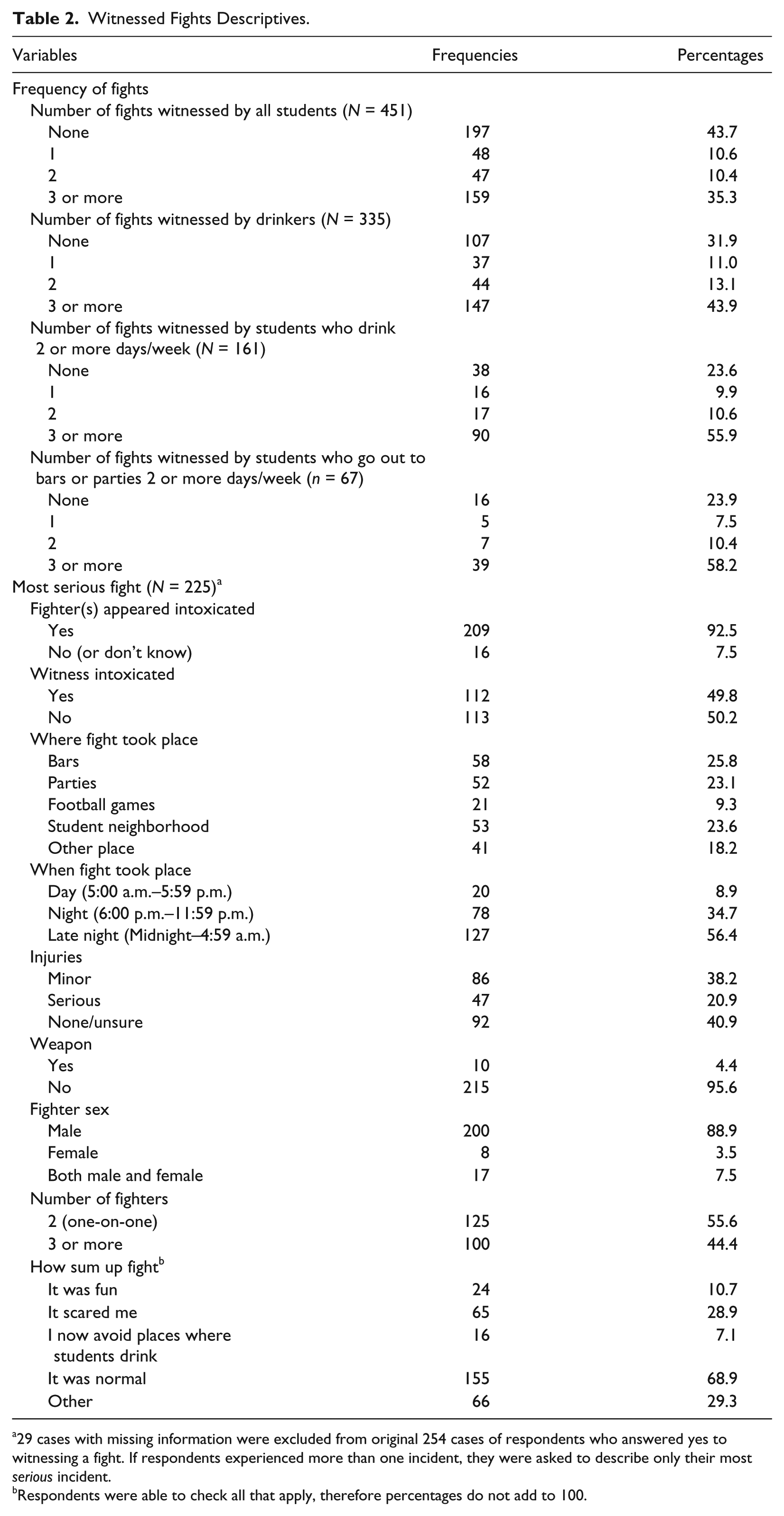
29 cases with missing information were excluded from original 254 cases of respondents who answered yes to witnessing a fight. If respondents experienced more than one incident, they were asked to describe only their most serious incident.
Respondents were able to check all that apply, therefore percentages do not add to 100.
The vast majority of fights (93 percent) involve at least one intoxicated fighter, and half of all witnesses were themselves intoxicated at the time of a fight. More than half of all students who witness fights do so at drinking hot spots, specifically 26 percent at bars, 23 percent at parties, and 9 percent at football games. Another 24 percent of fights are witnessed in neighborhoods near bars and where most large student “house parties” take place. Only 9 percent of fights are witnessed during the day, with many of these incidents corresponding to fights witnessed at home football games played in the afternoon.
More than half of all fights witnessed (58 percent) resulted in injury, with 21 percent resulting in serious injury. Yet, weapons were used in only 4 percent of fights. The vast majority of fights involved two or more men (89 percent); 4 percent of fights involved two or more women, and 8 percent involved both men and women. Just over half of all fights (56 percent) involved two fighters, whereas 44 percent involved three or more fighters.
Definitions of Witnessed Fights
Based on closed-ended survey responses that asked students how they would “sum up” the most serious fight they witnessed, just over one in 10 students (11 percent) indicated the fight was “fun to watch.” Almost one-third of students (29 percent) said that the fight scared them in some way, and a small minority of students (4 percent) answered that they now avoid places where students drink alcohol. Just less than a third of students (29 percent) described their fights in “other” ways which, according to open-ended responses (from a follow-up question that asked them to “please specify” their other responses), included embarrassment (e.g., “I was embarrassed that adults could fight over such stupid stuff”) and resentment of fights as disruptive (e.g., “the cops were called and shut down the party”; “the whole area was closed off for hours”).
A majority (69 percent) of students who witnessed fights at college summed up their (most serious) fight as normal. A closer look at the open-ended responses from students’ descriptions of fights suggests two themes related to these normalizing definitions. A first theme pertained to the ordinariness of fights (e.g., “it wouldn’t be a Saturday night without a fight at [that bar]”; “[the fight] was easily forgotten,” “it was just another fight”). Several students who identified fights as ordinary did so by referencing alcohol. For instance, a female student said “It was just an ordinary fight between two drunks”; another female student said “Fights happen . . . it’s just what drunks do.” Some students, both male and female, also referenced gender (e.g., “dudes fight all the time, I am no longer surprised”; “it was just two dudes fighting”). And some students referenced both alcohol and gender, as exemplified in the following response from a male student: “It was just two drunk guys fighting. Guys get drunk, they fight. That’s just what happens here.”
A second observed theme from students’ open-ended responses referred to an absence of injury. For instance, a male student stated, “There was no harm done so I didn’t think much of it.” Another male student said, “It was over too quickly for anyone to get seriously hurt.” And a female student who summed up a fight she witnessed as “no big deal” appeared to do so by comparing it with other more serious fights she had witnessed elsewhere (“I’ve seen far worse”). Interestingly, some of the students who normalized fights referred to relatively serious injuries in their detailed responses. For example, a male student who described a fight where “one of the guys was bleeding pretty bad” insisted it “was not as bad as it looked,” and justified this assessment by noting that “No police or ambulances were called.”
Also interesting to note was that more than 10 students (12 percent) who normalized fights also indicated in their closed-ended responses that they were scared in some way by the fight. A closer look at students’ open-ended descriptions of these fights suggest that students may normalize fights as part of a learning process. For instance, a female student who initially said she was “shook up” by a multiperson fight seemed to reassess its seriousness after observing her friends’ indifference (“When it was over, it was like nothing happened. It didn’t seem like anyone else really cared . . . I guess it wasn’t so bad”). A male student suggested that students “get used to fights” and explained that fights were predictable at the local bars where “people get drunk and fight . . . It is what you expect there.” Expecting fights at local bars and getting used to them may be consequences of situational learning.
Predicting Normalization of Witnessed Fights
Four propositions regarding the expectations of alcohol and gender’s influence on normalization were tested in three binary logistic regression models (see Table 3). All three models controlled for serious injury, number of fighters, and gender of fighters. Model 1 tested whether intoxication of fighters or intoxication of witnesses increases normalization of fights. Results show that neither intoxication variable is statistically significant. In fact, seriousness of injury is the only factor that is statistically significant in predicting normalization in this model. Serious injury decreases the odds that fights will be normalized (odds ratio [OR] = 0.46).
ORs for Normalizing Fights (N = 225).
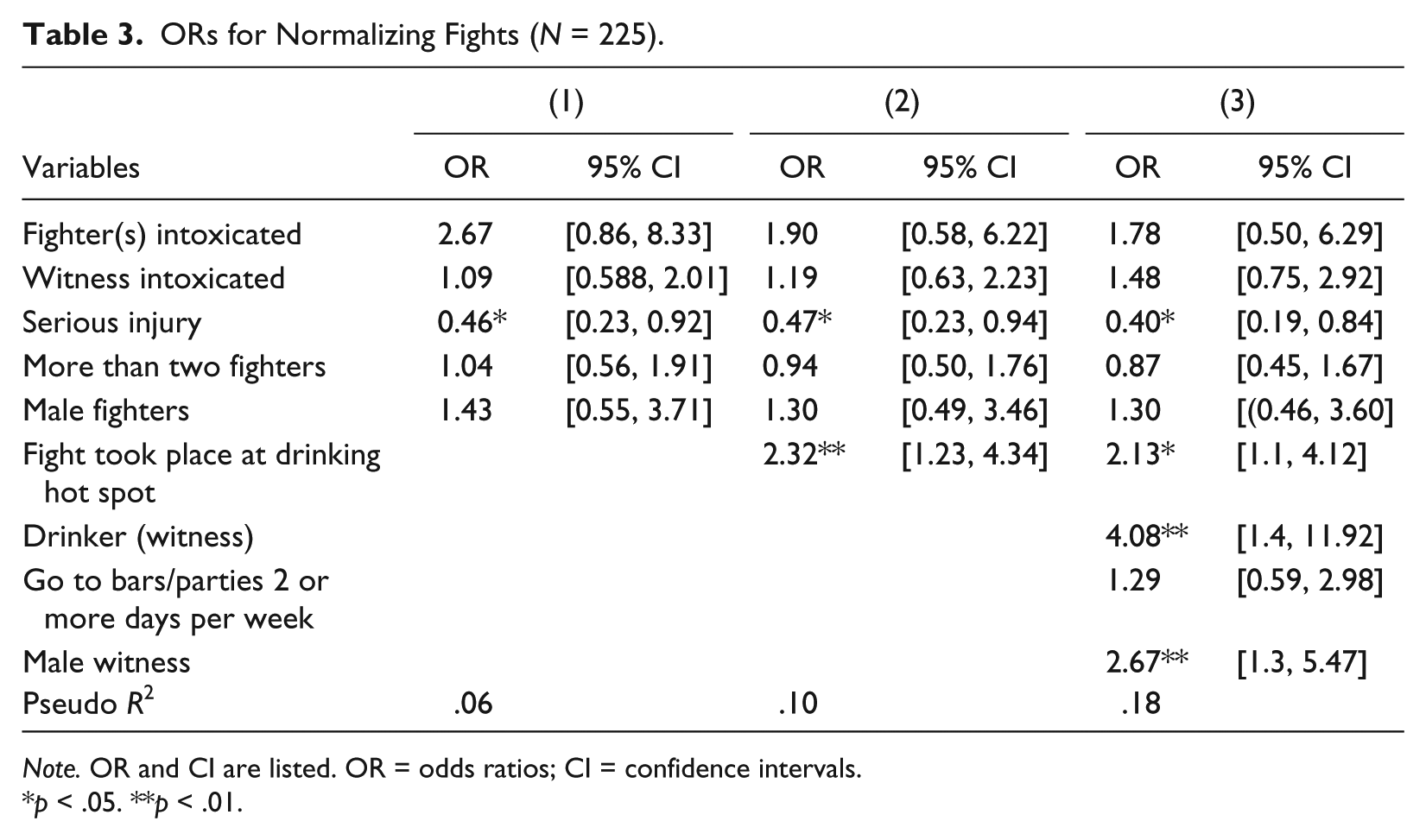
Note. OR and CI are listed. OR = odds ratios; CI = confidence intervals.
p < .05. **p < .01.
Model 2 introduces drinking hot spots (bars and parties) to test whether place where fights occur increases normalization of fighting. This model shows the odds of normalization more than double for fights that take place at drinking hot spots (OR = 2.32).
Model 3 introduces two drinking variables to test the influence of participation in the party subculture at college, as measured by drinking alcohol and frequency of going out to bars/parties. The model also tests for gender. From this model, we see that drinkers are four times more likely than nondrinkers to normalize fights (OR = 4.08). Results also show that men are more than twice as likely as women to normalize fights (2.67). Frequency of drinking at bars or parties, however, is not statistically significant.
Discussion
Consistent with prior research that indicates that fighting at college is a common event (Weiss 2013a; Woods et al. 2018), the current study finds that more than half of the students in a sample of undergraduate college students witnessed at least one fight, with 45 percent witnessing two or more fights. The study’s findings also support an association between fighting and alcohol consumption. At least two-third of students who drink alcohol witness a fight, with 57 percent of these students witnessing multiple fights. Nine in 10 student fights occur when at least one person is intoxicated, and more than half of these fights take place at drinking hot spots (e.g., bars, parties, football games) where large amounts of alcohol are consumed.
Alcohol not only increases the likelihood of witnessing fights, but it also contributes to the normalization of fighting, at least in some contexts. For instance, findings show that students are twice as likely to normalize fights that take place at bars or parties, even after controlling for seriousness of injury and number and gender of fighters. Findings also show that students who drink alcohol at college are more likely than nondrinkers to define fights as normal. In fact, drinkers in our sample are four times as likely as nondrinkers to normalize fights.
Our study also finds that men are more than twice as likely as women to normalize fights, supporting the influences of social learning. As prior studies suggest, men spend more time among other men who encourage and reward aggression (Kimmel 2008; Weiss et al. 2018), and therefore are more likely than women to accept aggression as normal. At college, men are also more likely than women to drink alcohol and participate in the party subculture where risk and the rationalizations to minimize it are shared and expected (Durkin et al. 2005; Vander Ven 2011; Weiss 2013a). Thus, normalization may be a consequence of the shared expectations from both male peer groups and their drinking groups.
However, not all of our propositions were supported by the data. For instance, intoxication of fighters did not increase normalization, nor did intoxication of witnesses. Although nonsignificant findings may be due to the small numbers of nonintoxication fights analyzed (only 16 fights involved one or more sober fighters), nonsignificance may also suggest that normalization depends less on whether fighters or witnesses are drunk, as it does on the expectations that fights happen whenever students drink. In other words, expectations among students, particularly those who drink, may have a greater impact on perceptions of fighting than alcohol itself.
Another proposition that was not supported by the data was that the more time spent at bars or parties, the more likely students would be to normalize fights. In this case, nonsignificant findings may suggest that the amount of exposure to fights, as measured by amount of time spent at hot spots, may be less important than the expectation that “fights happen” in places where students drink. In other words, students who expect to see deviant behavior when they go out to drinking hot spots may be less shocked or alarmed when they see fights, irrespective of how much time they spend there.
No matter the reason, normalization is a common response to fighting at college. More than two-thirds of our sample referred to the fights they witnessed as normal. A reading of students’ own descriptions suggests that many students view fights as ordinary, based on expectations related to alcohol (“It’s just what drunks do”) and gender (“It’s just what guys do”). Many students also minimize the harms of fights they witness, even those with actual harms. In fact, more than half of the fights in our survey resulted in physical injury (21 percent serious injury). Yet, 40 percent of the cases with injury were considered normal. These findings may suggest that students normalize fights as a neutralization technique that enables them to reassess their perceptions to better match the responses and expectations of their peers and the party subculture.
Peer influence may also explain why almost half of the students who were scared by a fight also defined the fight as normal. Similar to the concept of pluralistic ignorance used in the bystander literature to describe onlookers’ reluctance to intervene when no one else appears outraged or bothered (see Coker et al. 2011; Prentice and Miller 1993), students at college may change or temper their definitions when it appears that no one else seems concerned. Barring serious injury (the only control variable that significantly increases the odds of normalization), students may normalize fights, not because they see them as harmless, but because they are expected to deny their harms.
Normalization, as both a rationale that denies harms and as a response reinforced by peers, presents a challenge for institutions where fighting persists. Reduction of a social problem requires, at the very least, an acknowledgment that a behavior is harmful and not normal (Best 2013). Outrage, condemnation, and formal complaints by those impacted are necessary for mobilized action. Normalization impedes such action by promoting indifference. Worse, it silences witnesses who might want to speak out to complain. Among audiences where doing nothing is the norm, doing something may be seen as disloyal or even deviant itself (Weiss 2013b). Thus, normalization cultivates a shared indifference that justifies nonintervention, emboldens offenders, and ultimately perpetuates bad behavior.
In these ways, normalization is more than an interpretive response; it has real consequences that warrants further investigations, both empirical and theoretical. Few theoretical perspectives, including social learning, fully showcase the importance of definitions or the variability of those definitions for studies of violent behavior. A situational learning perspective, as proposed in this article, is a particularly helpful framework for studying situated violence such as fighting that varies in regard to how it is interpreted by situation and audience. Identifying the situational factors and the shared expectations that predict normalization would contribute to a more comprehensive understanding of violence at college and beyond.
Identifying the expectations and rationalizations that normalize violence would also help colleges to implement more practical solutions for reducing fighting at college. Effective safety programs need to address the cultural dimensions of fighting that include the shared expectations related to intoxication and gender, and the rationalizations that excuse offenders and deny harms. Programs will also need to address the social dimensions of normalization that encourage shared indifference and a mind-your-own-business ethic. The reduction of fighting requires that witnesses be emboldened to speak out, countering the expectations of indifference and silence. If definitions that rationalize intoxication and fighting are learned and reinforced by one’s peers, they can be unlearned as part of the same learning process. Until fights are defined as unacceptable and not normal by all audiences, including drinkers and men, and seen as real violence in all contexts, even at bars and other drinking hot spots, college fighting will continue to be dismissed as ordinary and harmless events, or “just what drunk guys do.”
Limitations and Future Research Directions
This study provides preliminary data to support a situational learning perspective of fighting and its normalization. Further research is necessary for a more comprehensive examination of the nuances of definitions and the situational factors that cultivate normalization beyond the selected variables we use in our study’s models. For instance, additional indicators of participation in a party subculture, including amount of alcohol consumed, frequency of drinking, and other drug use, would better capture the multiple dimensions of students’ “party” routines. Participation in other social groups, such as fraternities or athletic teams, could also be added to models as predictors of additional group influences. Predictive models might also include more demographic variables, such as age, race, and ethnicity of both witnesses and fighters, as well as additional situational factors such as time and day of fight.
Future studies using larger samples from multiple schools with more diverse student populations are also necessary for greater generalizability of findings. More diverse data would also allow for comparisons by types of schools, such as public versus private, sports versus nonsports-oriented, and so on. A multiyear collection of data could also help to explore longitudinal trends at colleges related to intoxication and violence. A larger sample size would also improve the analytical strength of tests, as well as enable the inclusion of interaction terms (e.g., witness gender by fighter gender, drinking by gender, injury by gender).
Future samples should also include students who themselves participate in fights. Recall that our sample excluded fighters from analysis due to a skip pattern. Fighters may represent a unique subgroup for perceptions of violence, as such persons may be more likely to interpret other people’s fights as normal. Fighters are also disproportionately men who participate in the party subculture. Given the strong associations between men, drinking, and violence, normalization may be more likely among fighters. Thus, a closer exploration of fighters as a group, and as compared with nonfighters, warrants further investigation.
Finally, more qualitatively designed methods, including additional open-ended questions in surveys, interviews, and focus groups, could provide more detailed analyses of how witnesses define fighting and why they consider certain fights normal. Talking to students face-to-face would especially allow for deeper insight regarding expectations of alcohol, drinking hot spots and gender, and how such expectations contribute to the normalization of fighting.
Conclusion
This study examined student fighting and its normalization by using a situational learning approach that highlighted witness definitions of fights. A situational learning perspective incorporates an understanding of definitions as learned and situational, based especially on shared expectations. This approach is especially helpful for explaining why college students who might otherwise condemn violence often normalize fighting at college. Findings from our study provide preliminary support for the proposition that fighting persists at college due, in part, to situated expectations related to intoxication, drinking hot spots, and gender that, together, normalize fighting and encourage an indifference toward it. A shared indifference, reinforced especially among drinkers, perpetuates fighting as a normal part of college life. Further investigations of how violence is defined, and how definitions are learned, shared, and expected by certain audiences, will contribute to a more comprehensive understanding of college fighting, and violent behavior more broadly.
Footnotes
Declaration of Conflicting Interests
The author(s) declared no potential conflicts of interest with respect to the research, authorship, and/or publication of this article.
Funding
The author(s) received no financial support for the research, authorship, and/or publication of this article.