




Abstract
This article discusses improvements made to the methodology of the Housing and Urban Development (HUD) point-in-time (PIT) homeless census. HUD’s PIT results are presented to Congress as official data for policy consideration. Yet, PIT methodology focuses on visible street homeless individuals and those in shelters while neglecting the “marginally housed” or less visible homeless who live in automobiles or temporarily stay with friends and extended family. Being a hidden population, the marginally housed has been a traditionally difficult population to study. We replicated HUD’s PIT count but additionally targeted the marginally housed to improve traditional methods of counting the homeless. We improve the PIT count in two ways: (1) by extensively training counters, and (2) by using the personal networks of hundreds of counters to seek out the marginally housed. Student researchers from a local university located 333 more homeless individuals than the local PIT, of which 153 were marginally housed. We do not claim this to be an exhaustive count of all the marginally housed in the region, but it is an initial step in developing methodologies to include this hidden population when calculating the total homeless population. This approach can also improve traditional homeless counts in other cities.
Keywords
The History of Counting the Homeless
Homelessness has been studied for over a hundred years, including the early work of Robert Park at Chicago’s Bug Square (Anderson 1923; Gowan 2010). Yet counting the nationwide homeless population has only been a policy priority in recent decades (Duneier 1999; Koegel, Burnam, and Morton 1996). Mitch Snyder, a homelessness advocate in the 1980s, estimated that there were over three million homeless people in the United States on any given night (Horowitz 1989). He claimed that the American public would not care about homelessness unless such a large national figure was provided. Snyder successfully sparked a nationwide interest in counting homeless populations (Shields 2001), which influenced policy makers to start asking: How many homeless individuals are on the streets and why? Counting everyone who experiences homelessness is challenging because the population is stigmatized, hidden, and hard-to-reach (Dunne, Prendergast and Telford 2002; Salganik, Matthew, and Heckathorn 2004).
Since Snyder’s advocacy work, the Housing and Urban Development’s (HUD) annual Point in Time (PIT) count continues to be the most utilized method of estimating homeless populations across the nation. In the next section, we provide an overview of how researchers have made strides to make methodological improvements, such as including homeless populations outside of institutional contexts (i.e., beyond the purview of jail or homeless shelters). This study makes some methodological innovations to improve counts by including populations omitted by official counts.
Enumerating the Homeless by HUD
A national count called “S-night” was implemented by HUD for the first time in 1984. S-night focused on counting people sleeping in the streets and public places at night (Shlay and Rossi 1992). One HUD census in 1990 included everyone in bus stations, parks, and “unusual” spaces at night without asking any questions (Jenks 1995). Currently, all cities receiving HUD funding must conduct shelter and street PIT counts annually (Williams 2011). The “street count” surveys people not staying at shelters who are visibly sleeping in streets and public places. Yet some homeless people are often overlooked by blending in, while those who are housed but have a disheveled appearance may be mistakenly approached to be counted (Hopper et al. 2008). The “shelter count” includes homeless subpopulations served by shelters, soup kitchens, and halfway houses. The information gathered in HUD’s PIT count is reported to Congress and the U.S. Census Bureau for population estimates and public policy development in relation to homeless services, poverty, and urban planning (Henry et al. 2015; Jackson 2007).
Nonprofits serving the homeless that receive HUD funds are mandated to help to conduct the PIT counts. However, some of these nonprofits may add bias to the survey because they cater to their agency’s own population while overlooking others. As Williams (2011) writes: The process of counting the homeless is also politically important because the outcome can affect numerous groups and programs . . . Results potentially impact the kinds of programs available to homeless people and the advocacy efforts of service providers. Thus, the cycle of counting only the specific types of homeless that sustain funding for providers continues the fixation on those homeless subtypes. (p. 3)
Williams (2011) draws attention to the fundamental conflict of interest in a methodology that uses volunteers from the very agencies that stand to benefit from HUD’s PIT. For example, an organization focused on serving addicted homeless people will likely oversample this population on the day of the count while neglecting other homeless populations that are less visible to them. Surveyors gravitate towards people who are extravagant and visible, omitting those who may be homeless but do not fit stereotypical perceptions. Common stereotypes influence our understanding of homelessness (Snow et al. 1986), including that of many volunteer PIT surveyors. Many homeless individuals also reported to us that they avoid social services and answering PIT surveys on the day of the count.
PIT shortcomings are well known among researchers and the social service industry (Koegel, Burnam, and Morton 1996; Susser, Conover, and Struening 1990). Even HUD itself warns against aggregating local PIT results to create national totals (Hewitt 1996; Williams 2011). For example, in 2015, HUD counted 564,708 homeless individuals, of whom 69% were sheltered and 31% were unsheltered. Compared with 579,488 in the previous year, officials argued, “Homelessness among individuals declined by less than 1 percent (or 1,767) between 2014 and 2015” (HUD, 2015:1). Yet, important questions remain: Were there fewer homeless individuals overall, or were there less homeless found by surveyors? Is this a real change in the homeless population or is it just the result of counting errors?
Informative qualitative studies (Edin and Shaefer 2016; Ehrenreich 2010; Liebow 1993) also comment on the difficulty of knowing the actual size of this invisible population partly because individuals and families often experience homelessness intermittently. Counting the homeless is a daunting task for various reasons (Koegel, Burnam, and Morton 1996). Some scholars find that fully enumerating the homeless is actually impossible because (1) many homeless people are not visible (Wright and Devine 1995); (2) there are inconsistent definitions of what constitutes “homelessness” (Lee, Tyler, and Wright 2010; Susser, Conover and Struening 1990); (3) homeless individuals are difficult to locate given their transient lifestyle, moving constantly move within cities and between cities (Lee, Tyler, and Wright 2010); and (4) individuals can change housing status from one night to the next (e.g., renting month-to-month, staying in motels, on someone else’s couch, and then on the streets). Rossi and Wright (1987) draws attention to an understudied population, which he refers to as “the precariously (or marginally) homed persons with tenuous or very temporary claims to a more or less conventional dwelling” (p.21). This situation is consistent with official definitions of homelessness (National Alliance to End Homelessness, 2009). HUD’s definition at the time of this study included those individuals doubling up and marginally housed as officially homeless (National Alliance to End Homelessness, 2009). By not looking for the marginally housed during PIT counts, HUD is currently failing on its institutional mission and congressional responsibility to count all homeless individuals.
Peter Rossi (1991) and Christopher Jenks (1995) were pioneers in using U.S. census data to estimate homelessness. They argued that homelessness is an issue of extreme poverty, yet most literature on homelessness has focused on homeless individuals who are institutionalized in hospitals, shelters, or housing programs (Fischer et al. 1986; Folsom et al. 2005, Hopper et al. 1997; Shlay and Rossi 1992). Many argue that measuring just the institutionalized homeless does not provide an accurate depiction of the larger, and mostly hidden, homeless population (Bogard, 2001; Snow, Anderson, and Koegel 2002; Snow, Baker, and Anderson 1988; Snow et al. 1986).
Conducting research within institutional settings can be problematic due to the power dynamics between service providers and their homeless clients. Research overrepresents interpretations by authority figures, social service workers, advocates, and local officials (Bachrach 1984; Huey, Fthenos, and Hryniewicz 2012; Salkow and Fichter 2003; Snow, Anderson, and Koegel 2002; Snow, Baker, and Anderson 1988). Other researchers have focused on states’ efforts to implement services that merely manage the visibility of urban homelessness (Willse 2015) or control them through geographic confinement (Stuart 2011, 2016). Although information on homeless individuals who are already institutionalized is important, quantitative academic research on homeless individuals who are not institutionalized is rare. This is an important lacuna since ethnographic work shows that many homeless do not like staying in shelters or accessing services labeled for the homeless (Anderson 1923; Snow and Anderson 1993; Castañeda et al. 2014), so focusing on those seeking services undercounts homeless populations.
Furthermore, HUD’s PIT counts focus on people who sleep in the streets and are addicts or mentally ill, and undercounts homeless students and people who hold jobs but are marginally housed. Researching only visible and institutionalized homelessness also underestimates homeless spells among the recently evicted (Desmond 2016) who might not fit traditional stereotypes of homelessness. Traditional methods often reproduce the idea that homeless individuals are lazy, addicts, or mentally ill. Focusing on personal problems distracts from structural causes.
Despite abundant ethnographic data (Bogard, 2001; Snow, Anderson, and Koegel 2002) and various meta-analyses (Lee et al. 2010; Shlay and Rossi 1992), policy makers and even some homeless service providers struggle to accept findings that move beyond homeless stereotypes. HUD numbers remain the most widely referenced data enumerating the homeless (Williams 2011; Lee et al. 2010) because they occur routinely on an annual basis across major cities of the United States. Yet, previous literature persistently calls for methodological improvements. This article documents our original efforts to include the marginally housed individuals that are often neglected by official counts.
Methods
This study was a modified replication of HUD’s PIT homeless count in El Paso, Texas, conducted by the El Paso Coalition for the Homeless on January 24, 2013. Individuals who appeared homeless by sleeping under a bridge or in a park but who did not complete a survey were counted. Their appearance and location were recorded to avoid double counting, as typically done in PITs. HUD prevents duplication by asking respondents the last four digits of their social security number; instead, we asked: “What city were you raised in?” and “What is the name of the street you were raised on?” Our one-page survey (see Online Supplement) used the same questions as HUD, except for two questions, to avoid duplication, and two questions concerning mental health. A few methodological improvements were introduced. HUD relies on volunteers in each city who are typically trained for an hour, or less. We trained students enrolled in a research methods class for two months and assigned academic readings to reduce sampling biases. HUD currently does not attempt to measure the marginally housed population. But we specifically targeted the marginally housed respondents living temporarily with friends or family. Local students were able to include personal contacts in the study fitting the homeless definition according to the HEARTH Act (National Alliance to End Homelessness, 2009), which includes those who were “doubled up” on their couch or staying with a friend.
Undergraduate students enrolled in a Research Methods course at a university in El Paso, Texas, were trained in scientific research and data collection techniques. They underwent training in preparation for this research project (see Appendix, Table 1). In addition to textbook readings on sociological methods (Neuman 2011; Stoecker 2013), students read books on homelessness (Comar 2011; Gowan 2010; Wasserman and Clair 2010). HUD surveys do not go through IRB and volunteers do not receive human subjects training. The university’s Institutional Review Board (IRB) approved the project, and all surveyors successfully completed the National Institute of Health’s (NIH) human subjects training.
Our count was conducted on February 28, 2013, between 4:00 AM and 10:00 PM. About 100 surveyors collected quantitative data. As in HUD’s PIT, interviewers were assigned specific geographic areas of the city to survey the homeless population, walking block-by-block to interview anyone they met on the streets who identified as homeless or lacked stable housing. Like HUD, areas were prioritized based on previous encounters with homeless individuals and exploratory trips around the city.
Data collectors were mainly longtime residents of El Paso, and around 80% were bilingual Hispanic. They were encouraged to survey people they knew who met homeless criteria according to the HEARTH Act (National Alliance to End Homelessness, 2009) or those who lacked a permanent residence. Beyond typical homeless spaces, we put special attention on surveying homeless people in heavily Spanish-speaking neighborhoods and day labor/agricultural worker sites. We also focused on homeless immigrant and undocumented populations that are often undercounted. Many students already had contact with individuals experiencing marginal or precarious housing who were doubled-up with friends or reported living temporarily with extended family. These respondents were categorized in a variable called “marginally housed.” Our “homeless” variable was constructed to include respondents living in traditional homeless settings, such as parks, under bridges, cars, and on the streets, as well as respondents sleeping on couches, floors, and in motels.
Comparison to Official PIT
Typical PIT counts of local homeless populations combine the sum of those who report sleeping on the street the night prior to the street count and the sum of those reported by the local homeless services to have slept in shelters. If a respondent surveyed on the street reports having slept in a shelter the previous night, they are not counted in the street category, as they are already included in the shelter count. The sum is then used by local homeless services to apply for federal financial grants through HUD’s designated homeless assistance programs. Since previous attempts to enumerate the homelessness have left the marginally housed unaddressed, we addressed these biases with our research by comparing our results to the reports found online of the PIT count conducted by the El Paso Coalition for the Homeless on January 24 of the same year (Figures 1 and 2). Some respondents may not have been in town at the time of the previous PIT and vice versa. However, our study was conducted only 35 days later, which aids to the reliability of our study. The official HUD count found 182 “unsheltered” persons, while institutionalized settings such as emergency and transitional shelters and permanent supported housing services reported 1,172 persons, including “individuals” and “persons in families.” Therefore, the official homeless count for El Paso was 1,354 (PIT 2013). Our study focused on noninstitutionalized settings. We have three respondent categories: sheltered, unsheltered, and marginally housed. We did not request reports from shelters because the official PIT count captures this population through reports from shelters themselves.
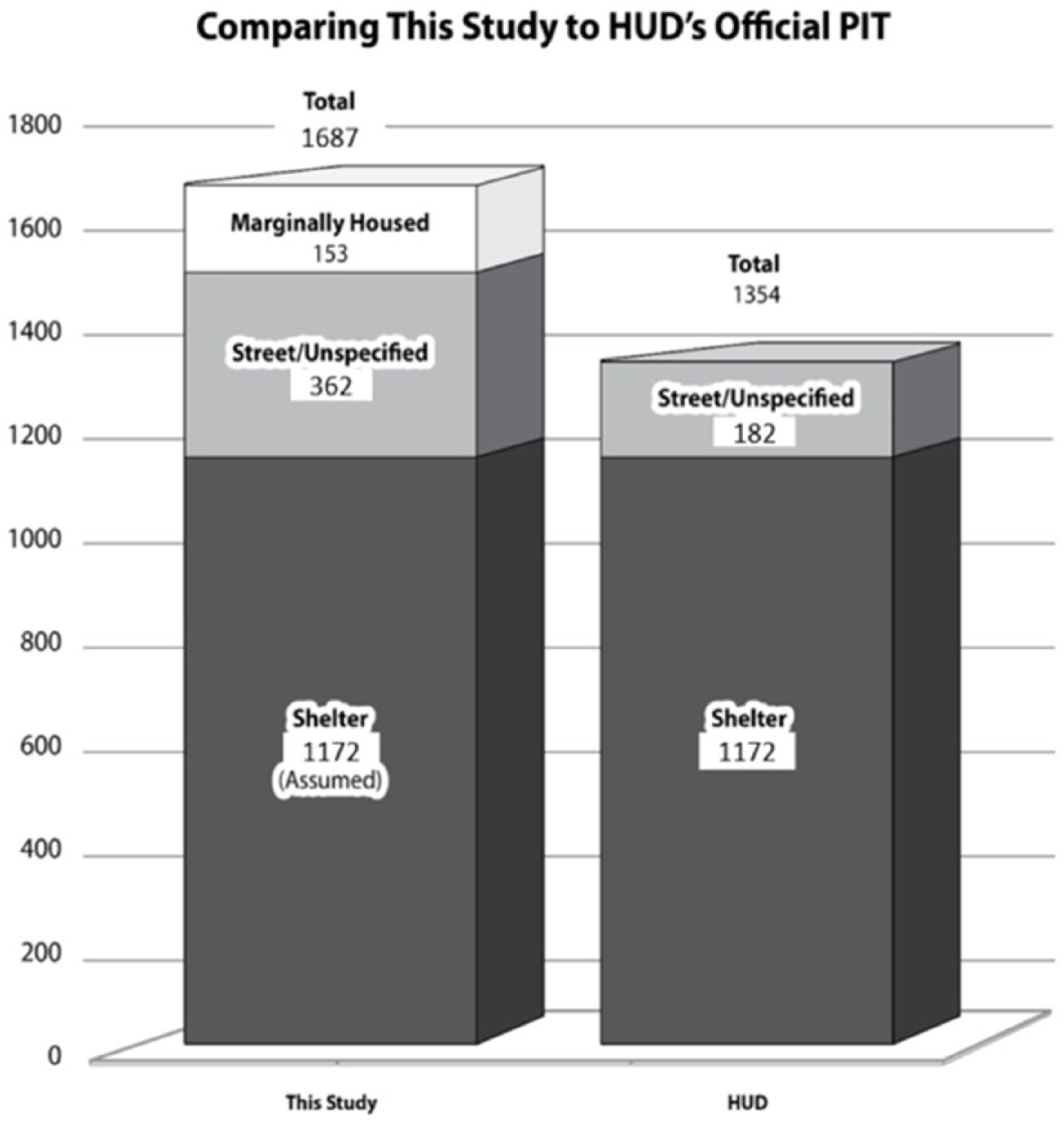
Homeless populations in El Paso, Texas, in 2013.

Shelter type by ethnicity.
Results
We counted 678 people sleeping the previous night on the streets or in unspecified locations other than a shelter or other institution. There were 65 homeless individuals who were counted but not included in this number because they were not surveyed due to being unapproachable, asleep, or declined participation. Additionally, 163 respondents reported sleeping in a shelter the night before who were removed from the data. There were also six that were unclear as to where they slept the previous night leaving 515 total street homeless, of which 153 were “marginally housed” who reported sleeping in cars or on extended family/friends’ couches or floors. There were 362 who slept on the “street” or “unspecified,” compared with HUD’s official number of 182. This means that even when the marginally housed are omitted, we still found more unsheltered homeless people. Adding the 1,172 sheltered population from the city’s PIT to our 362 street respondents provides us with 1,534. Additionally, including our marginally housed individuals provides an even better understanding of the local total homeless population of 1,687.
We also ran cross-tabulations of our original data by ethnicity to compare the homeless and marginally housed among Hispanic versus non-Hispanic populations in El Paso. As figure 2 shows, there were some important differences by ethnicity. For example, the marginally housed tend to be more heavily Hispanic than those sleeping in the streets (these authors). Demographic breakdowns and an overall report on the city survey was not published by the local homeless coalition that year. Despite multiple requests, we could not access the data. Therefore, we can only compare the total count. The PIT is a census (universal population count) not a sample therefore there is no need to weight by ethnicity.
Demographics
There were many more homeless men than women, and 40.9% of respondents were over fifty years old (Figures 3 and 4). A majority of respondents (66.5%) described themselves as being Hispanic, a percentage lower than that of the general Hispanic population of El Paso (80.7%) (these authors). Respondents were somewhat evenly divided between having been raised in the El Paso region (36.3%), other areas of the United States (29.2%), and abroad (34.5%), mostly in Mexico. A majority of respondents (61.3%) reported having lived in El Paso for over five years.

Demographics.
Reported Reasons for Homelessness
Among a long list of options, job-related factors were reported as the primary cause of their homeless situation by 42.3% of respondents, including loss of a job (20.7%), an inability to get a job (21.6%), or had trouble maintaining a job specifically due to medical, mental, or miscellaneous reasons (2.9%). A third (33%) reported having a present earned income, 19.5% were agricultural workers, and 9.1% reported being unable to afford housing despite being employed. Many reported needing services to get a job (41.1%).

Reported reasons for homelessness.
Those who have been homeless for longer than one year, or who have been homeless four or more times in the last three years, are considered by HUD to be “chronically homeless,” and are specifically targeted by several programs (HUD 2007). A variable including these two criteria was created to categorize respondents as chronically homeless. A large percentage of respondents (78.1%) fell into this category. The highest proportions point to systemic indicators such as lack of stable employment. Additionally, 33% reported having earned income after becoming homeless. This means that many of these individuals either had a job and lost it or were still working after they became homeless. These findings are consistent with research suggesting that over half of those in poverty are “working poor” or hold at least one job (Newman 2009; Theodore 2000). Additionally, two meta-analyses show access to housing and the job market as major causes of homelessness (Lee et al. 2010; Shlay and Rossi 1992). Our research suggests what we are calling the “working homeless.” Employment includes informal and formal employment (Snow et al. 1996). Sampling the marginally housed allowed us to find more homeless people who work for income. Future research and homeless policy should focus on employment as a structural determinant of housing insecurity rather than individual pathologies.
Future research should also consider how much the marginally housed is composed of Hispanic subpopulations. Finding homeless Hispanics on the streets was facilitated by conducting surveys in English and Spanish and canvassing in heavily Hispanic neighborhoods, as well as locations heavily frequented by Hispanics such as day labor and agricultural-worker sites. The methodology we utilized resulted in a more complete count than the local HUD counts. We believe this to be a standard shortcoming of HUD PIT counts across the United States. We wish to contribute to PIT methodologies and academic literature on housing-insecurity by considering the marginally housed and Hispanic populations.
Conclusion
We designed a modified point-in-time census methodology with the goal of capturing the general homeless population of El Paso, while focusing on capturing more of the marginally housed who are extremely difficult to find. In one example, Hopper et al. (2008) used novel “plant-capture” and “post-count” survey methods to count the homeless by planting individuals to potentially be surveyed to estimate those homeless who were unseen. They found that surveyors missed counting 29% of homeless individuals who were in plain sight because they did not fit stereotypical appearances, while volunteer surveyors also neglected 31% to 41% of the homeless who were in spaces that were not visible to the public. Therefore, we instructed surveyors to approach people who they knew were “marginally housed.” Using a large pool of surveyors who were embedded in the local community, we found 153 marginally housed individuals. We do not claim this to be an exhaustive count of all the marginally housed in the region, but it is an initial step in developing methodologies to count this hidden population among the larger homeless population. Similar methods could be used in other cities to better grasp minority and marginally housed populations.
Overall, this article shows the importance of replicating homeless counts using slightly modified methodologies. Local student populations and network sampling (Heckathorn and Cameron 2017; Salganik and Heckathorn 2004) could be used in any city to count some of the marginally housed and more youth with uncertain housing situations. We also found that including students provided a feasible and excellent hands-on project for courses on research methods in social work and the social sciences in universities and community colleges with large percentages of local students embedded in the region. The use of local student populations enrolled in research classes to collaborate with local homeless coalitions to carry out homeless census is replicable elsewhere and has been done in the past (Hatchett 2004, Lin et al. 2017; Pierangeli and Lenhart 2018). Adding an emphasis on the marginally housed produced a better count of the homeless population in El Paso. The marginally housed are an invisible population while local students will only be able to locate those in that condition which are a few degrees of separation in their networks, counting at least them is important a homeless census. After these exercises are repeated for a number of years and locations, we can discover typical characteristics of the marginally housed and add relevant questions to general household surveys (these authors), to create samples that may help to estimate the general marginally housed population. These sampling considerations would further improve PIT counts and provide better data for HUD to fulfill its mandate to count all homeless people residing in the United States.
Supplemental Material
OnlineSupplement – Supplemental material for Improving Homeless Point-In-Time Counts: Uncovering the Marginally Housed
Supplemental material, OnlineSupplement for Improving Homeless Point-In-Time Counts: Uncovering the Marginally Housed by Curtis Smith and Ernesto Castañeda-Tinoco in Social Currents
Footnotes
Appendix
El Paso Homeless Point in Time Survey- English.
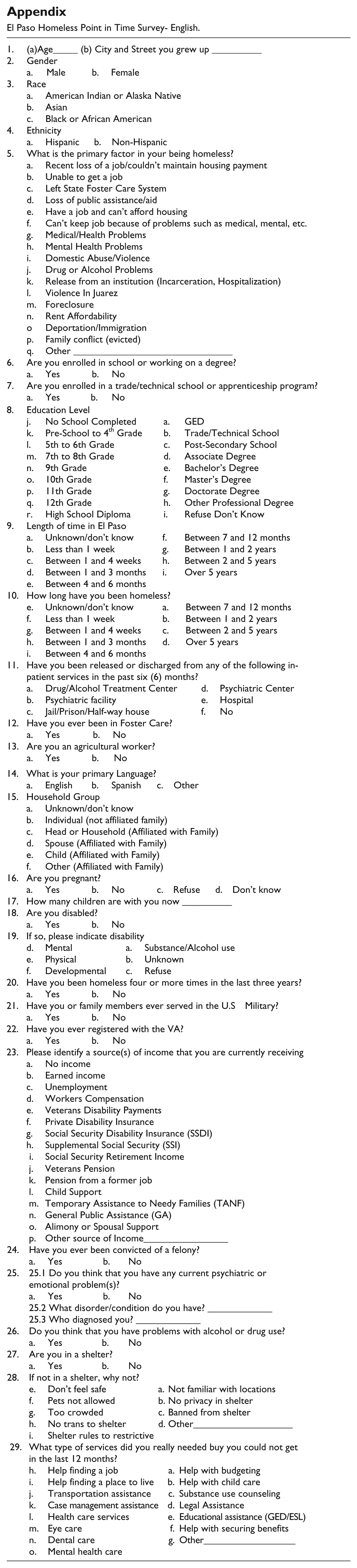
| 1. (a)Age_____ (b) City and Street you grew up __________ 2. Gender a. Male b. Female 3. Race a. American Indian or Alaska Native b. Asian c. Black or African American 4. Ethnicity a. Hispanic b. Non-Hispanic 5. What is the primary factor in your being homeless? a. Recent loss of a job/couldn’t maintain housing payment b. Unable to get a job c. Left State Foster Care System d. Loss of public assistance/aid e. Have a job and can’t afford housing f. Can’t keep job because of problems such as medical, mental, etc. g. Medical/Health Problems h. Mental Health Problems i. Domestic Abuse/Violence j. Drug or Alcohol Problems k. Release from an institution (Incarceration, Hospitalization) l. Violence In Juarez m. Foreclosure n. Rent Affordability o Deportation/Immigration p. Family conflict (evicted) q. Other ________________________________ 6. Are you enrolled in school or working on a degree? a. Yes b. No 7. Are you enrolled in a trade/technical school or apprenticeship program? a. Yes b. No 8. Education Level j. No School Completed a. GED k. Pre-School to 4th Grade b. Trade/Technical School l. 5th to 6th Grade c. Post-Secondary School m. 7th to 8th Grade d. Associate Degree n. 9th Grade e. Bachelor’s Degree o. 10th Grade f. Master’s Degree p. 11th Grade g. Doctorate Degree q. 12th Grade h. Other Professional Degree r. High School Diploma i. Refuse Don’t Know 9. Length of time in El Paso a. Unknown/don’t know f. Between 7 and 12 months b. Less than 1 week g. Between 1 and 2 years c. Between 1 and 4 weeks h. Between 2 and 5 years d. Between 1 and 3 months i. Over 5 years e. Between 4 and 6 months 10. How long have you been homeless? e. Unknown/don’t know a. Between 7 and 12 months f. Less than 1 week b. Between 1 and 2 years g. Between 1 and 4 weeks c. Between 2 and 5 years h. Between 1 and 3 months d. Over 5 years i. Between 4 and 6 months 11. Have you been released or discharged from any of the following in-patient services in the past six (6) months? a. Drug/Alcohol Treatment Center d. Psychiatric Center b. Psychiatric facility e. Hospital c. Jail/Prison/Half-way house f. No 12. Have you ever been in Foster Care? a. Yes b. No 13. Are you an agricultural worker? a. Yes b. No 14. What is your primary Language? a. English b. Spanish c. Other 15. Household Group a. Unknown/don’t know b. Individual (not affiliated family) c. Head or Household (Affiliated with Family) d. Spouse (Affiliated with Family) e. Child (Affiliated with Family) f. Other (Affiliated with Family) 16. Are you pregnant? a. Yes b. No c. Refuse d. Don’t know 17. How many children are with you now __________ 18. Are you disabled? a. Yes b. No 19. If so, please indicate disability d. Mental a. Substance/Alcohol use e. Physical b. Unknown f. Developmental c. Refuse 20. Have you been homeless four or more times in the last three years? a. Yes b. No 21. Have you or family members ever served in the U.S Military? a. Yes b. No 22. Have you ever registered with the VA? a. Yes b. No 23. Please identify a source(s) of income that you are currently receiving a. No income b. Earned income c. Unemployment d. Workers Compensation e. Veterans Disability Payments f. Private Disability Insurance g. Social Security Disability Insurance (SSDI) h. Supplemental Social Security (SSI) i. Social Security Retirement Income j. Veterans Pension k. Pension from a former job l. Child Support m. Temporary Assistance to Needy Families (TANF) n. General Public Assistance (GA) o. Alimony or Spousal Support p. Other source of Income_________________ 24. Have you ever been convicted of a felony? a. Yes b. No 25. 25.1 Do you think that you have any current psychiatric or emotional problem(s)? a. Yes b. No 25.2 What disorder/condition do you have? _____________ 25.3 Who diagnosed you? _____________ 26. Do you think that you have problems with alcohol or drug use? a. Yes b. No 27. Are you in a shelter? a. Yes b. No 28. If not in a shelter, why not? e. Don’t feel safe a. Not familiar with locations f. Pets not allowed b. No privacy in shelter g. Too crowded c. Banned from shelter h. No trans to shelter d. Other____________________ i. Shelter rules to restrictive 29. What type of services did you really needed buy you could not get in the last 12 months? h. Help finding a job a. Help with budgeting i. Help finding a place to live b. Help with child care j. Transportation assistance c. Substance use counseling k. Case management assistance d. Legal Assistance l. Health care services e. Educational assistance (GED/ESL) m. Eye care f. Help with securing benefits n. Dental care g. Other___________________ o. Mental health care |
Acknowledgements
The authors would like to send special thanks to Angela Aidala, Leon Anderson, Michael Bader, Kevin Beck, Maura Fennelly, Rene Flores, Kim Hopper, Deanna Kerrigan, Jonathan Klassen, Samuel R. Lucas, Hilary Silver, and David Snow provided helpful feedback on paper as well as the many anonymous reviewers who provided feedback and ask for clarifications that made the paper stronger. We must also thank the many students who helped with the count, surveys, and data entry.
Declaration of Conflicting Interests
The author(s) declared no potential conflicts of interest with respect to the research, authorship, and/or publication of this article.
Funding
The author(s) received no financial support for the research, authorship, and/or publication of this article.

Supplemental Material
Supplemental material for this article is available online.
References
Supplementary Material
Please find the following supplemental material available below.
For Open Access articles published under a Creative Commons License, all supplemental material carries the same license as the article it is associated with.
For non-Open Access articles published, all supplemental material carries a non-exclusive license, and permission requests for re-use of supplemental material or any part of supplemental material shall be sent directly to the copyright owner as specified in the copyright notice associated with the article.
