




Abstract
Women typically report greater concern for the environment, including climate change, than men. The eco-mom theory—the belief that women have greater environmental concern than men because mothers primarily care about the health and safety of their children, while fathers primarily care about the economic support of their household—is often proffered as an explanation for this difference. Researchers who have previously tested the eco-mom theory have narrowly operationalized parenthood; we are skeptical of this theory and believe it needs additional testing. We look at fertility in relation to concern for climate change using the 2010 General Social Survey. Modeling parenthood like previous studies, we find no differences in concern for climate change between women who have children and those who do not. Modeling fertility, we find that having more children is associated with less concern for climate change for women but not men. Additionally, we find no gender difference in concern for climate change for those with many children, but these findings are complicated by education. Overall, we refute the eco-mom theory and call for new climate change survey data that better capture gender roles and identity as well as more qualitative inquiries into public concern for climate change.
Women are on the front lines of environmental justice movements, and their activism is frequently tied to their roles as mothers and grandmothers (Bell 2013; Culley and Angelique 2003; Hunter 2011; Logsdon-Conradsen and Allred 2010). In ethnographic studies of environmental activism, women’s caretaking roles are emphasized as they express concerns about localized pollution and the health and well-being of their families. For example, Bell and Braun (2010) find that women use motherhood as a justification for their engagement in environmental justice issues regarding coal mining in Appalachia.
Researchers who analyze public opinion data measuring concern for climate change typically report that women express greater concern than men (e.g., Davidson and Freudenburg 1996; McCright et al. 2016; Stern, Dietz, and Kalof 1993). Those who attempt to explain these gender differences often use the motherhood narrative from the front lines of environmental justice movements in their explanations (e.g., Logsdon-Conradsen and Allred 2010). That is, they employ social roles theory and, specifically, the eco-mom theory 1 that states that women have higher levels of environmental concern than men because they are mothers. However, the motherhood narrative in environmental justice—a narrative that is predominately focused on health—typically translates poorly into an explanation for women’s greater concern for climate change, since local environmental activism is distinct from global environmental concern, including concern for climate change. We also contend that using parenthood (having a child or not) rather than fertility (number of children) to test the eco-mom theory as others have done (Blocker and Eckberg 1997; McCright 2010; Xiao and McCright 2012) does not capture the gender role differences assumed to be at the heart of the eco-mom theory. The purpose of our work is to examine the role of fertility in explaining gender differences in concern for climate change.
Using the 2010 General Social Survey (GSS), we test models examining the eco-mom theory that look at parenthood as well as more nuanced models that examine fertility and how these factors may or may not explain gender differences in concern for climate change. Our models take into account the complicating effects of labor force participation and education on these relationships, as fertility, work, and education are closely linked (Boyd 1994; Finlay and Lee 2018; Musick et al. 2009; Nitsche and Brückner 2018). Our findings call into question how the eco-mom theory has been operationalized to explain gender differences in concern for climate change and suggest that environmental scholars need to develop better theoretical and statistical models to explain gender differences in climate change concern. Specifically, we argue that environmental concern scholars need to look more closely at gender identity and traditional family orientations as they design messages about the critical importance of reversing climate change.
The Eco-Mom Theory
A commonly proffered theory about why women express greater concern for the environment than men in public opinion polls is social roles theory (Davidson and Haan 2012; McCright 2010). Social roles theory suggests that women and men have different attitudes because they occupy different social spaces; women are active in the home and engage in mothering activities while men spend most of their time at work, outside of the home and away from their children (Greenbaum 1995). Because of these role differences, women are concerned about the quality of their environment as it affects the health and safety of their children and families. By contrast, men are concerned about the economy, which is often (and erroneously) considered incommensurate with concern about the environment (Davidson and Freudenburg 1996; Greenbaum 1995). The eco-mom theory, which focuses specifically on women as mothers as it relates to their elevated concern for the environment, is a subset of social roles theory.
In 1996, Davidson and Freudenburg published a seminal piece that summarized existing literature on the demographic predictors of environmental concern and made general conclusions about the current state of knowledge (at that time) regarding gender as a predictor of concern. They established that women tend to express greater levels of concern for the environment than men. Specifically, they found that women are more concerned about the environment than men when the risk involves health or safety (see Brody 1984). They also found that the results of studies testing men’s parental roles produced varied results; however, studies up to that time examining women’s parental roles found that mothers exhibited a greater concern for environmental risk than both fathers and women without children (see Blocker and Eckberg 1989). Davidson and Freudenburg (1996) invoked the eco-mom 2 theory to explain these modest but consistent findings.
We contend that if men’s and women’s different concerns for the environment are explained by mothering, then the eco-mom effect should be particularly salient with regard to concern for the effects of global climate change. Unlike other environmental concerns such as industrial pollution that is specific to geographic locales, the impact of climate change is more ubiquitous, although the impacts are often unequally distributed across communities (Harlan et al. 2015). Additionally, the impacts will accumulate over time, so the negative consequences will be most severe for children and grandchildren. If environmental concern is intrinsically linked to motherhood, what could motivate environmental concern more than a phenomenon that will have a limited impact on a woman, but will have a profound effect on her children and grandchildren?
Three studies have tested aspects of the eco-mom theory as it relates to environmental concern. Blocker and Eckberg (1997) used data from the 1993 GSS to test family roles on levels of environmental concern and found little evidence to suggest that family roles influence women’s environmental perspectives. In fact, they found that women who report being homemakers expressed lower levels of environmental concern than women in the labor force. They also found no differences in levels of environmental concern between men and women who have children under the age of six in the house and those who do not. Instead, Blocker and Eckberg (1997) suggest that family roles operate through other variables such as political orientation, social status, and religion. Contemporary scholarship (see McCright et al. 2016) has explored these additional variables, yet gender differences in environmental concern remain unexplained.
More recently, Xiao and McCright (2012) and McCright (2010) looked at social roles theory, including the role of parenting, as an explanation for gender differences in concern for climate change and found no effect. Parenthood, as well as parenthood and gender interaction terms, were non-significant in models predicting levels of concern for climate change. These authors reject social roles theory as an explanation of gender differences in concern for climate change. However, the models they use are limited for fully testing the eco-mom theory, because they measured parenting dichotomously as either having a child living in the home or not, such that one could be a parent and be categorized as “no” on this parenthood variable. If the act of being a mother makes you more environmentally concerned, concerns for your children do not end when your children leave home.
There are several obvious problems with social roles theory, particularly as it has been operationalized in environmental concerns studies. First, gendered social roles in the United States are continually evolving; women increasingly occupy economic spaces, and men are becoming more engaged fathers (Chesley 2011). The eco-mom theory reduces women and feminine identity to motherhood which then minimizes the other roles and identities women occupy (Gillespie 2003). Second, being a mom might actually reduce one’s biographic availability to participate in environmental social movements. Xiao and McCright (2014) looked at the social roles of women (i.e. caretaking roles) as possible barriers to participation in public environmental behaviors. They found that being a parent of a young child and living with another adult reduces women’s (but not men’s) participation in public environmental behaviors. Third, the eco-mom theory is propelled by research narratives about mothers on the front lines of environmental justice, which is conceptually distinct from women expressing general environmental concern, as we discuss in the following section.
However, despite our skepticism about the eco-mom theory, we are not completely convinced that parenthood is unrelated to concern for climate change; we believe it more likely operates through fertility (number of children) rather than parenthood (presence of at least one child), as it is the former that is strongly linked to gender roles. Researchers have long established that gender roles are intrinsically linked to how many children a couple has (Rindfuss and Brewster 1996; Rindfuss, Brewster, and Kavee 1996; Van de Kaa 1987). Some of these role differences are explained by women’s education—a factor directly linked to concern for climate change (McCright et al. 2016)—and labor force participation, but these factors do not explain all fertility differences. Fertility also likely reflects difficult to measure gender role differences such as the household division of labor and women’s empowerment (Mills 2010; Rindfuss and Brewster 1996). Thus, to better test the eco-mom theory as an explanation of gender differences in environmental concern, an exploration of fertility and parents’ relationship to environmental concern is required.
Women, Motherhood, and Environmental Justice
In 2015, LeeAnne Walters helped to discover a lead-contaminated tap water crisis in Flint, Michigan after her tap water changed color and she later saw changes in her children’s health. Her story is similar to other concerned mothers and grandmothers fighting for their children against environmental toxins in their communities (see Bell 2013; Culley and Angelique 2003; Hunter 2011; Logsdon-Conradsen and Allred 2010). These stories create powerful narratives that evoke the impression of a fierce mama bear protecting her cub. As Kaplan (1997) explained, Lois Gibbs and other mothers protesting pollution in the Love Canal neighborhood in New York began to understand their power as mothers when they “learned that presenting themselves as outraged mothers—identities they really assumed—made them interesting to the news media and hard for government officials to attack” (p. 28).
Similarly, many activists on the front lines of environmental justice movements highlight health concerns (Culley and Angelique 2003) or moral and ethical concerns (Price and Maples 2018) instead of framing their movements as environmental. Some of these framing decisions are strategic, others might stem from the social location of the activists (Krauss 1993), since marginalized communities are disproportionally exposed to environmental hazards (Harlan et al. 2015). For example, Price and Maples (2018) describe an African American community in Ohio fighting against hydraulic fracking underneath a historic African American cemetery; however, they are not using environmental frames but relying instead on a moral and ethical discourse and community beautification efforts. Furthermore, deliberately minimizing environmentalism and using other frames such as health or motherhood might be an effective social movement strategy, as Bell (2013) explains: Protest activities that mothers undertake on behalf of their children are often viewed apolitically and simply as extensions of a mother’s role to protect, clothe, shelter, and feed her children. Framing women’s activism as a result of mothering “instincts,” rather than a conscious decision, affords women a level of cultural protection and legitimation for their protest activities. (pp. 170–71)
In addition, the environmental justice literature has noted that women and children might disproportionately experience environmental harm. For example, Carson (1962) famously noted that embryos and infants receive small doses of toxic chemicals transferred to them through the womb and breast-milk. At Love Canal, toxic exposure resulted in high rates of miscarriages and births to low weight and deformed children (Kaplan 1997). As women disproportionately experience these health effects and the care work associated with sick children, it provides motivation for environmental activism and a claim to expert knowledge and authority over their experiences (Brown and Ferguson 1995; Kaplan 1997). As Brown and Ferguson (1995) note, the negative impact of pollutants on women’s reproductive health has been a pillar of women’s environmental activism, as “problems in women’s own reproductive lives—miscarriages, still births, and birth defects—are often among the women’s first clues to toxic health effects” (p. 162). Brown and Ferguson (1995) highlight the impact of toxic pollution on women by arguing that “The centrality of women’s power as the creators of human life is thus injured.”
Yet, it is important to distinguish between local environmental activism and general (or global) environmentalism for three reasons. First, local environmental activism tends to be organized around specific environmental problems (often industrial pollution that threatens the health and well-being of local community members), whereas environmentalism is far-reaching, acknowledges anthropogenic climate change, and is concerned about protecting and sustaining ecosystems so that all human and non-human species can thrive (Shwom et al. 2015). Second, those fighting environmental injustice in their communities tend to be working-class and/or people of color, yet mainstream environmentalism has historically lacked diversity and attracts members who are white and relatively wealthy (see Jones 1998, 2002). Third, health risks from localized pollution are often contextualized as urgent; however, risks posed by climate change are not typically considered urgent and are often minimized due to a disconnection between cause and effect (Dunlap and Brulle 2015).
Furthermore, as several scholars of environmental justice and gender note, “social movement analyses of mother activism must not essentialize motherhood as a static and universal variable, but instead must situate it within relevant political and cultural conditions” (Shriver, Adams, and Einwohner 2013:271; also see Krauss 1993). Some women may be politically, socially, or culturally attracted to the eco-mom identity (Stets and Biga 2003). However, as Neuhouser (1995) notes, working-class women have few options for positive, activist identities outside of motherhood, and so motherhood might be used as an organizing identity by default. It is for reasons such as these that we explore how many children someone has rather than whether they have a child, since fertility reflects “relevant political and cultural conditions” (Neuhouser 1995) and women’s gender roles and identity (Mills 2010).
Fertility and Environmental Concern
Researchers have employed survey data to test the eco-mom theory by using an indicator of whether or not a respondent is a parent (or has a child living at home) to predict environmental concern. They found evidence for the eco-mom theory in older studies (Blocker and Eckberg 1989; Davidson and Freudenburg 1996) but not recently (McCright 2010; Xiao and McCright 2012). However, it appears that researchers have inadvertently conflated environmentalism and environmental justice activism when employing the eco-mom argument in the environmental concern literature. The work on environmental justice activism shows that motherhood is a powerful narrative (Bell 2013; Culley and Angelique 2003; Hunter 2011; Logsdon-Conradsen and Allred 2010), as women tap into their motherhood identity to fight against environmental hazards in their communities. However, when the eco-mom theory is employed in explaining gender differences in environmental concern, then motherhood (vs. not) becomes a proxy for motherhood identity and gender roles. Contemporary researchers find no support for the eco-mom theory, perhaps because they are using a bad proxy. At the same time, to the extent that parenting is a proxy for motherhood identity and gender roles, as the previous models testing the eco-mom theory would suggest, it makes more sense to examine fertility, rather than a dichotomous measure of parenthood, to capture gender role differences.
Demographers have long demonstrated that nations’ fertility rates reflect the position of women in a society (Becker 1981; McDonald 2000; Presser 1997), and women’s individual fertility often reflects gender roles (Cooke 2004; Mills 2010). 3 To date, most of the work linking gender roles to fertility examines how increased education and labor force participation has induced women to have fewer children. However, education and labor force participation only explain a portion of differences in the number of children women bear, and researchers generally believe that the unexplained differences in fertility probably reflect unmeasured gender role differences such as social and political empowerment and the household division of labor; lower fertility is typically associated with more egalitarian gender roles (Mills 2010).
So, although the eco-mom theory has been employed (unsuccessfully of late) to attempt to explain why women care more about climate change than men, it is possible that women who have more children will express less concern about climate change than women with fewer children. A simple explanation is that women who care deeply about the environment may consciously limit their fertility. Ray (2011) notes, “The average American mother is the quintessential environmental sinner for two reasons: she consumes and she reproduces. And, if human consumption and reproduction are the two greatest threats to planetary health, then mothers are a danger to the earth” (p. 81). Thus, it might be expected that women who are concerned about the environment (or by extension their identities as environmentalists) might choose not to have biological children, or to have fewer children, to keep reproduction at or below replacement levels. It is important to note that Ray’s (2011) environmental sinner scenario is also applicable to fathers as participants in reproduction and consumption. Yet, women are more visible in their roles as reproducers and consumers. For this reason, corporations and marketing firms have actively participated in the construction and proliferation of the eco-mom persona by pushing environmentally friendly products to keep mothers consuming without guilt (Atkinson 2014).
Unfortunately, available data that allow for a generalizable exploration of gender differences in environmental concern (including concern for climate change) do not allow researchers to closely examine gender roles or identities in explaining these differences. For example, the GSS sometimes measures concern for the environment, sometimes measures gender roles, and sometimes measures masculinity and femininity, but never in the same survey. However, we believe that we can come closer than previous researchers to understanding how role differences operate in explaining gender differences in concern for climate change by looking at fertility, rather than parenthood.
Our study examines three questions. First, are there differences in concern about global climate change between women with children and those without, as the eco-mom theory would suggest, and does labor force participation mediate those differences? Second, do men and women express different levels of concern for climate change, on average, when fertility is taken into account? Third, to what extend does education complicate the role of fertility differences in explaining differences in men’s and women’s environmental concern?
Because we are interested in fertility, our models are shaped by labor force participation and education, since these two factors have long been noted as the biggest predictors of fertility differences (Mills 2010; Rindfuss and Brewster 1996). Women with higher levels of education tend to have fewer children than other women (see Monte and Ellis 2014), and women who work full-time tend to have fewer children than those who do not. Education is also correlated with environmental concern; many studies show a positive association between the two factors: those with higher levels of education tend to have slightly greater levels of environmental concern than those with lower levels of education (Cleary and Rhead 2013; Franzen and Meyer 2010; Jones and Dunlap 1992; McCright et al. 2016; Van Liere and Dunlap 1980).
Data, Methods, and Hypotheses
Data for this study are taken from the GSS 2010 Environment III questionnaire, a nationally representative study of Americans’ attitudes. The GSS is frequently used by environmental concern scholars (see Jones 1998; Jones and Carter 1994; Jones and Dunlap 1992; Xiao and McCright 2014) as it provides a representative national snapshot of environmental concern.
Our dependent variable is a standardized scale (z score) measuring respondents’ concern about the effects of climate change. The scale combines responses from five questions preceded with the prompt: Scientists predict that global warming
4
may soon have big effects on the Polar Regions. I will describe some of these possible effects and, for each one, please say whether it would bother you a great deal, some, a little, or not at all if it actually happened.
The five statements are as follows: (1) “Arctic penguins may be threatened”; (2) “Sea level may rise by more than 20 feet, flooding coastal areas”; (3) “By 2020, polar bears may become extinct”; (4) “Inuit and other native peoples may no longer be able to follow their traditional way of life”; and (5) “The northern ice cap may completely melt.” Each item was reverse coded so that larger numbers indicated greater concern, and the reliability estimate is α = .88.
Our first research question is whether there are differences in concern about climate change between women with children and those without, as the eco-mom theory would suggest, and if labor force participation mediates those differences. The first part of our research question is mostly a check against previous studies, although we used a broader conceptualization of parenthood (whether someone is a parent or not, instead of whether someone has a child at home, as used by Blocker and Eckberg [1997], McCright [2010], and Xiao and McCright [2012]). Thus, we hypothesize:
To test these hypotheses, we use a subset of the GSS limited only to women respondents. For H1, we measure whether a respondent has children (coded 1 for one or more child) or not (coded 0). For H2, we measure whether the respondent has children and is not in the full-time labor force (coded 1) or otherwise (coded 1). We refer to those in the 1 category as stay-at-home moms, but we acknowledge that we have no way of knowing how women who are not working full-time spend their time, and children could be living away from the home.
Given that the eco-mom theory is based on the salience of traditional gender roles, and given that fertility has long been linked to gender roles (see Mills 2010), having more children should impact women’s concern for climate change. Environmentally concerned men are likely to have fewer children, but their concern may not reflect gender roles associated with fertility, so the relationship between fertility and concern for climate change will be less strong. We hypothesize:
To test this hypothesis, we create multiplicative interaction terms combining the gender of the respondent (1 = men; 0 = women) and a continuous measure of the number of children a respondent has (which can include 0). Number of children is derived from a direct question, top-coded at 8. We do not know if the children are biological, adopted, or step-children, and we do not believe this matters. We also do not know the ages of the children or whether they live at home. In our analyses, we mean center the number of children so that 0 represents the average number of children (around 2). We also test slope differences and predictive margins.
Our third research question is whether our findings are complicated by education. Education has been linked to concern for the environment (Cleary and Rhead 2013; Franzen and Meyer 2010), especially concern for global climate change (Lee et al. 2015). Additionally, fertility patterns are different among those with different levels of education (Monte and Ellis 2014). Overall, we expect that, if there is a gender role effect reflected in fertility, it will be shown more dramatically when those with different levels of education are modeled separately. If the eco-mom theory reflects reality, we expect that men and women with lower levels of education will show an eco-mom effect more strongly. We hypothesize:
To test this, we split our sample and replicate the tests of H3 examining the moderating effect of number of children on gender as it predicts concern for global climate change. Our educational dividing point assumes that those with 12 years of education or less completed their education with, at most, a high school diploma. We compared those with less than average education versus average or greater education and we did not get substantially different results.
In all our models, we control for factors that are shown to predict environmental concern. These controls include age in years ranging from 18 to 64, mean centered (Dietz, Fitzgerald, and Shwom 2005; Jones and Dunlap 1992); race measured as the respondent is white (= 1) or not (= 0; Jones 1998, 2002; Jones and Carter 1994; Mohai and Bryant 1998); self-reported class status measured as reporting lower and working-class status (= 1) or not (= 0; Finucane et al. 2000; Van Liere and Dunlap 1980); whether (= 1) or not (= 0) the respondent is a Republican (Dunlap and McCright 2008); whether (= 1) or not (= 0) the respondent was living in an urban area at age 16 (Jones et al. 2003); whether (= 1) or not (= 0) the respondent is currently married (Blocker and Eckberg 1997); whether (= 1) or not (= 0) the respondent is affiliated with a fundamentalist Christian church (Blocker and Eckberg 1997; Dunlap and McCright 2008; Hamilton 2011; see Price 2011 for classifications); and the frequency by which the respondent attends religious services (Deemer and Lobao 2011).
All models tested in our analyses were examined to ensure that they met Gauss-Markov assumptions. We were especially concerned about the possibility of multicollinearity, given that education, labor force participation, and fertility might be highly correlated. Tests of tolerance yielded variance inflation factors of no greater than 1.51, well below levels of concern for multicollinearity (cf. Chatterjee and Hadi 2006).
Our descriptive statistics are shown in Table 1. To aid readers, we report an unstandardized measure of concern for climate change, although we use a standardized measure (mean = 0; standard deviation = 1) in our analyses. Table 1 also shows uncentered measures of number of children, years of education completed, age, and religious service attendance, although these measures are mean centered (mean = 0) in our analyses to make the interaction results easier to interpret.
Descriptive Statistics.

Note. Descriptive statistics are for uncentered variables; the dependent variable is standardized in the regression models. Means or proportions shown (standard errors in parentheses).
Table 1 reveals that, overall, reported concern for the effects of climate change are generally high, with all samples reporting a mean of greater than 3 on a scale of 1 to 4. About 78 percent of the women in the sample have children, while about 48 percent are stay-at-home moms. GSS respondents’ average number of children is 1.89, but this varies by educational level. It is notable that while 42 percent of respondents are men, 74 percent of all respondents work full-time. Table 1 does not report the percent of full-time workers in the women-only models, because including this indicator would distort the error terms associated with our stay-at-home mom variable. However, 38 percent of the women with children in our sample reported working full-time.
Results
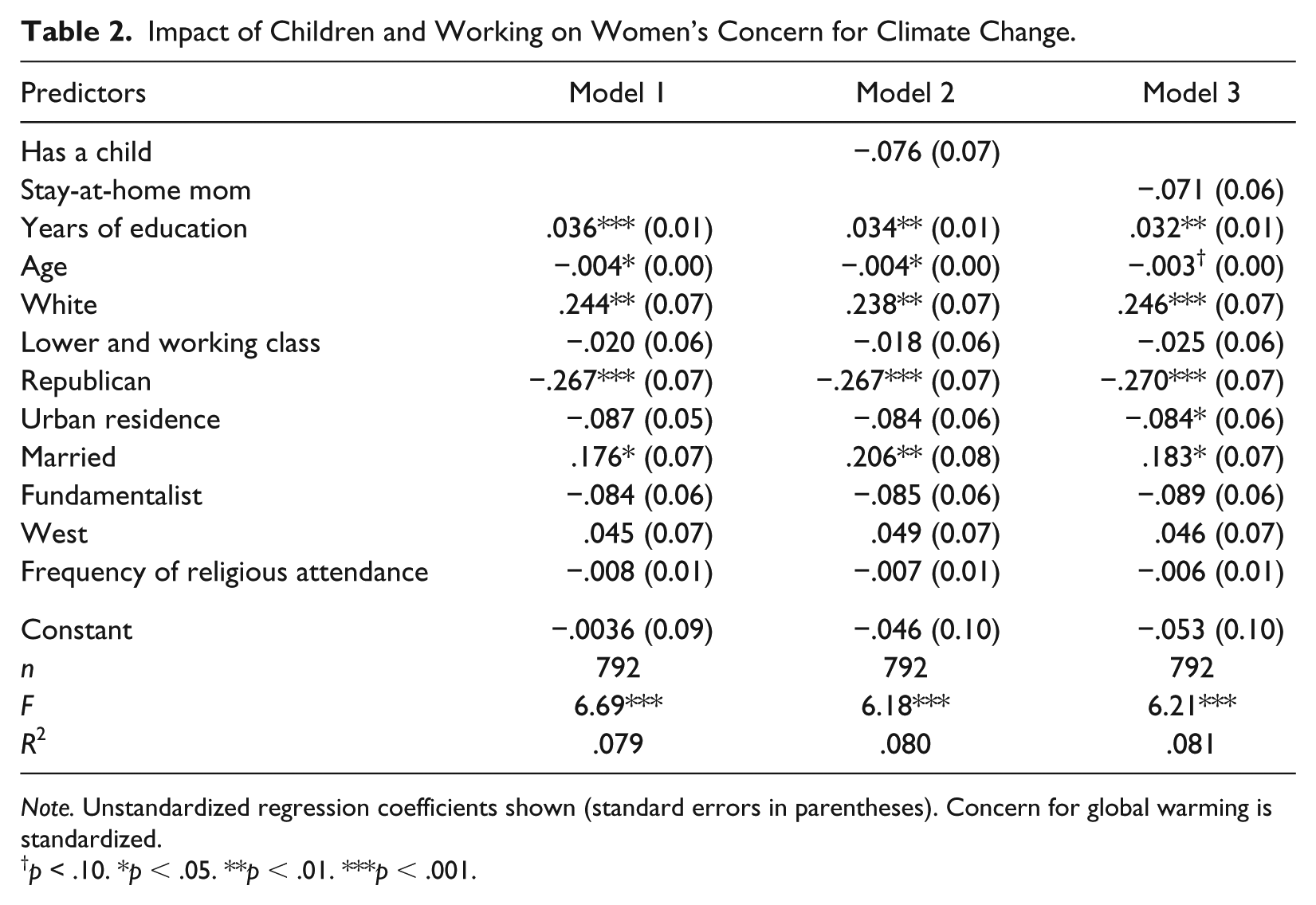
Table 2 shows the results of ordinary least squares (OLS) regression models of women’s concerns about climate change. Model 1 is the control-only model which provides a baseline, and the results are consistent with other studies of environmental concern (Davidson and Freudenburg 1996; Dunlap and McCright 2008; Jones and Dunlap 1992). Education, being married, and whiteness are positively associated with concern for climate change, while age and being a Republican are negatively associated. Model 2 compares women with children with women without children; the results provide no evidence for a difference in concern for climate change. Thus, the model provides no support for the eco-mom theory, similar to findings by McCright (2010) and Xiao and McCright (2012).
Impact of Children and Working on Women’s Concern for Climate Change.
Note. Unstandardized regression coefficients shown (standard errors in parentheses). Concern for global warming is standardized.
p < .10. *p < .05. **p < .01. ***p < .001.
In Model 3, we compare women who work full-time (with and without children) with those who have children and do not work full-time. Model 3 shows that (potential) stay-at-home mothers have concern for global climate change not significantly different from those in the reference category. This model also fails to support the eco-mom theory. We have no evidence to support our first and second hypotheses.
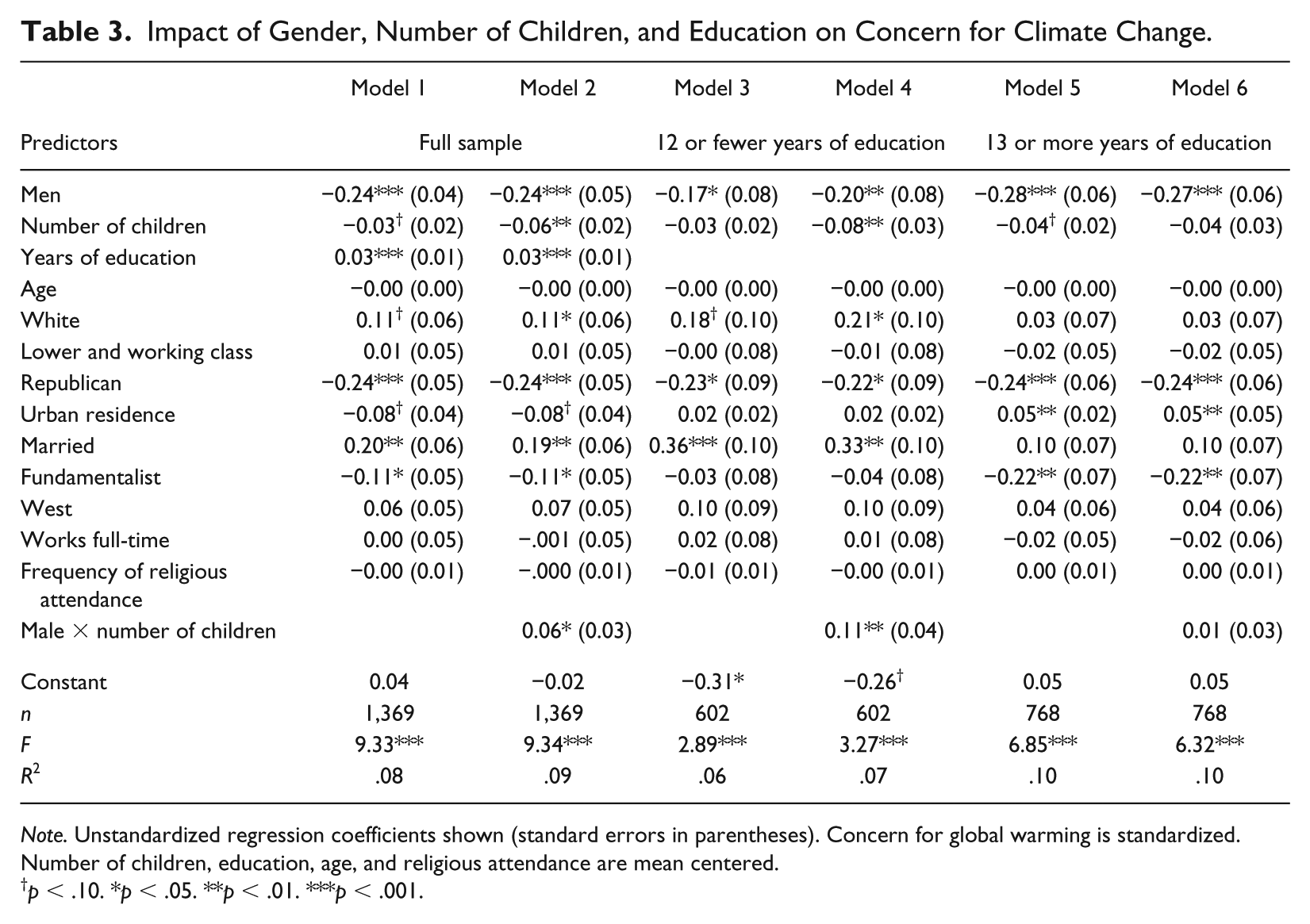
Table 3 shows results for the full sample, which includes men and a control for working full time. Models 1 and 2 test the link between fertility and concern for climate change. Model 1 examines the impact of gender, number of children, and educational attainment on environmental concern. As expected, the men in the sample demonstrated less concern about the environment than women (p < .001), and respondents with more education had, on average, greater concern (p < .001). Number of children was only marginally significant (p < .10) and negative.
Impact of Gender, Number of Children, and Education on Concern for Climate Change.
Note. Unstandardized regression coefficients shown (standard errors in parentheses). Concern for global warming is standardized. Number of children, education, age, and religious attendance are mean centered.
p < .10. *p < .05. **p < .01. ***p < .001.
Model 2 offers a test of H3: is the negative relationship between fertility and concern for climate change stronger for women than for men? It is worthwhile to test this question, even in the presence of no significant main effect in Model 1, because the crossing of gender slopes will suppress a main effect, making it appear non-significant. In Model 2, we examine the interaction of gender and number of children. The findings show that gender significantly moderates the impact of number of children on concern for climate change (p < .05) with women’s concern decreasing precipitously (slope = −.06) and men’s concern appearing to increase slightly (slope = .006) as the number of children increases. The slope modeling the relationship between number of children and concern for climate change is negative and significant for women (p < .01), suggesting that traditional social roles associated with having more children are associated with less concern for climate change (or those with more environmental concern limit fertility). At the same time, the slope modeling the relationship between fertility and climate change for men is not significantly different from zero (p = .77). In sum, the slope predicting fertility and climate change concern is steeper for women than men, supporting H3, but the men’s slope is flat.
We test average marginal effects to see if the slopes for men and women are different at different numbers of children. These findings are visually represented in Figure 1. The confidence intervals (shown as the shaded areas) around predicted points on the slope increase at higher numbers of children, so slope differences after more than three children are non-significant, and the cross-over (the effect that is suppressing a significant main effect in Model 1) occurs at four children. In other words, men’s and women’s average concern about global climate change is significantly different when neither have children (p < .001), with childless men having less concern than women. However, we cannot assert with 95 percent certainty that the slope for men and the slope for women are different at four or more children. Hence, the slopes are different for men and women with children only when they have fewer than four.
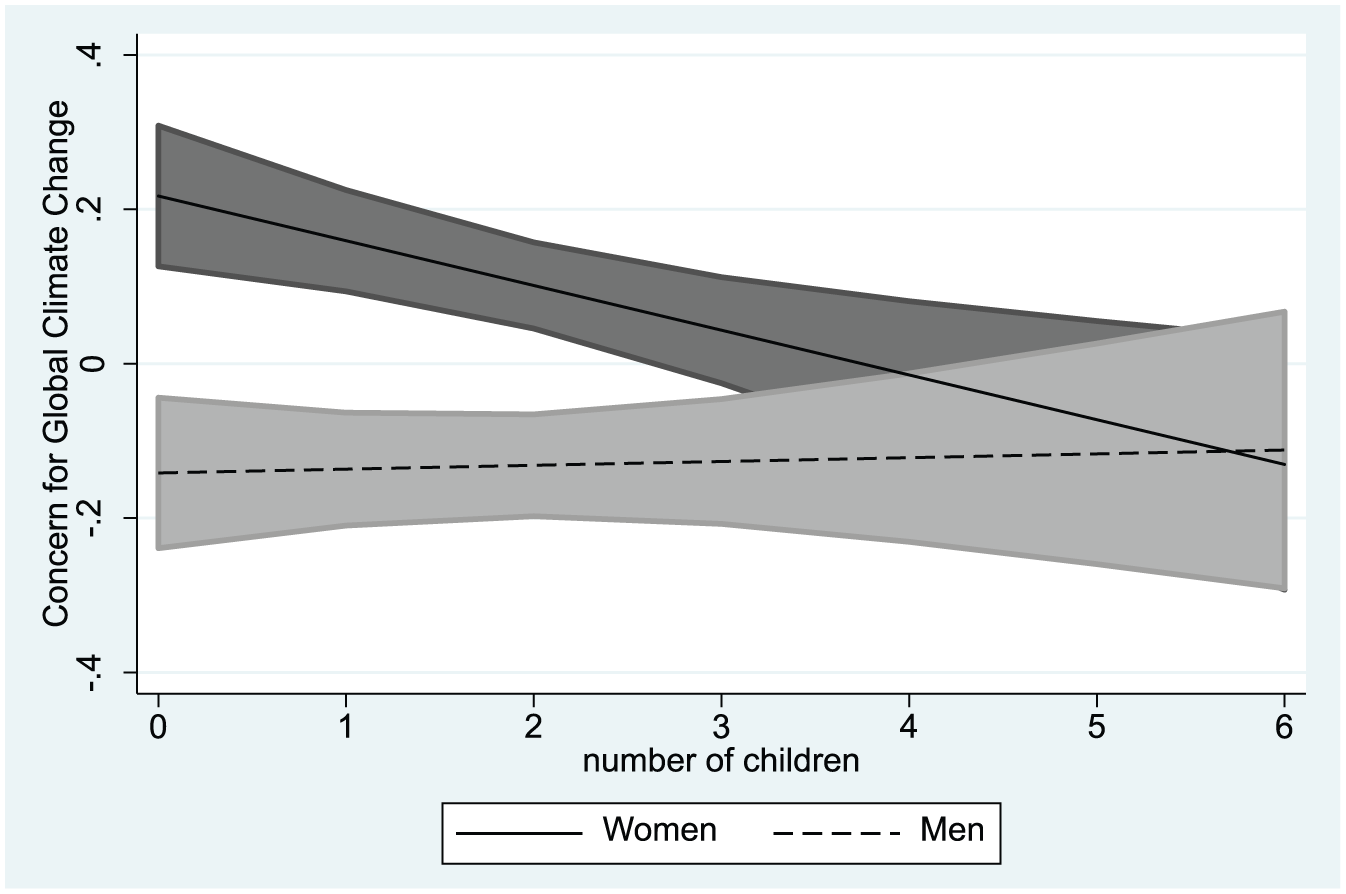
Effects of gender and number of children on concern for global warming with 95 percent confidence interval, full model.
Models 3–6 address our third research question: does education complicate parental roles as an explanation for differences in men’s and women’s environmental concern? Models 3 and 4 are for those with 12 or fewer years of completed education, and Models 5 and 6 are those who have 13 or more years of education. In Model 3, men report less concern about the effects of climate change, on average, than women (p < .05), but the number of children a respondent has is not significantly associated with concerns for climate change.
In Model 4, gender significantly moderates the impact of fertility on concern for climate change (p < .01). Again, the significant interaction in the presence of a non-significant main effect indicates a cross-over, which is shown in Figure 2. Figure 2 shows that women’s concern decreases with additional children (slope = −.08; p < .01), but the slope for men (slope = .033) is not significant. Figure 2 also shows that the slopes are significantly different for men and women for those having zero (p < .001) to two (p < .05) children. For those with three or more children, we cannot assert that adding another child is associated with different concern in the high fertility population.

Effects of gender and number of children on concern for global warming with 95 percent confidence interval, respondents with 12 or fewer years of education.
Model 5 shows that, for respondents who have completed more than 12 years of education, women demonstrate higher levels of concern about the impact of climate change, on average, than men (p < .001), and that number of children is marginally significant, with additional children corresponding to lower levels of concern (p < .10). However, unlike with the other models, we see no significant difference in the slopes estimating the relationship between number of children and environmental concern for men and women. That is, for the more educated, if there is a relationship between fertility and concern for climate change, the impact is the same for men and women.
Discussion
According to the eco-mom theory, women are more environmentally concerned than men because they are mothers. We find no support for this; if motherhood explains gender differences in environmental concern, by extension, women without children should be less concerned about climate change than those with children. They are not.
Our results are consistent with Xiao and McCright (2012) and McCright (2010) despite the fact that we operationalized motherhood more broadly to reflect the fact that mothers’ concerns for the health and safety of their children does not end when children become adults and leave home. Even with our broader definition, we find no evidence to support the idea that women are motivated to care about global climate change because they have children, as the eco-mom theory asserts. We examined this further by separating working mothers from those that we call stay-at-home mothers, and we found no differences there, either, although our indicators are imperfect. Essentially, we find no evidence that women’s concern for global climate change can be explained by the idea that motherhood conveys a greater propensity toward environmentalism. Certainly, motherhood is linked to environmental justice activism, but environmentalism and environmental justice activism are conceptually different, so observations gleaned from studying one concept does not necessarily apply to the other.
That being said, the eco-mom theory derives from social roles theory, and the social roles of men and women (such as time spent in housework) differ. These differences may be better reflected in fertility rather than a dichotomous measure of parenthood. Our findings regarding fertility are complex. In the aggregate, we do not find evidence of a relationship between fertility and concern for climate change, but that is because the relationship between these variables is different for men and women, and the crossing of the slopes suppresses an observation of the effect unless a gender-moderating variable is added.
Men’s concern for climate change does not vary, regardless of the number of children they have. Thus, to the extent that men are concerned about global climate change, that concern does not appear to be motivated by their role as fathers. Women do demonstrate a relationship between concern for global climate change and number of children, and that relationship is negative. Although we can reasonably assume that those concerned about climate change may limit their fertility, this relationship should not produce gender differences. A more reasonable explanation for our finding is that having more children represents greater salience of traditional gender roles for women. In other words, having children (and more of them) potentially changes gender roles for women more than for men, and these roles are reflected in women’s declining concern for climate change.
It is interesting to note that men’s and women’s concern for climate change is not different for those having more than three children for the whole sample and more than two children for the subsample of those with less than a college education. This may suggest that those with many children—regardless of gender—are different from those who have fewer children, and those (unmeasured) differences are reflected in different concerns for climate change. A possible explanation for this is traditional gender role orientations associated with conservatism. People with above average fertility (two children is average in the United States; Monte and Ellis 2014) may be more traditional; certainly, those who hold conservative values tend to deny anthropogenic climate change (Goemmine 2012). Other researchers (Dunlap and McCright 2008; Hamilton 2011; Jones and Dunlap 1992) have shown that fundamentalist Christians and Republicans tend to have lower average environmental concern. However, we control for Republican Party affiliation, fundamentalist Christian religious values, and frequency of religious attendance in our models. Thus, there may be other dimensions of conservatism that environmental scholars have yet to identify in their models.
Another implication of our findings is related to the fact that women who have zero to two children have greater concern for global climate change (although average concern is lower with the addition of each child) than men with equal parity. Given the many studies that find women expressing more environmental concern than men, we wonder how much that effect, overall, is driven by those with few or no children. In the United States, about 14 percent of women never have children, while 22 percent have one child, and 41 percent have two (Livingston 2015). Given that more than three quarters of women have replacement or below fertility, gender differences in environmental concern documented in cross-sectional survey data may be capturing the environmentalist orientations of relatively lower fertility women relative to lower fertility men.
For relatively more educated respondents, however, women have more concern about global climate change than men and neither the main effect nor the interaction with fertility is significant. We cannot add to the scientific knowledge about gender differences in environmental concern with respect to this group, but we find no evidence that parenthood—either being a parent of having more children—is related to concern for climate change for the relatively well educated.
Conclusion
Climate change is arguably the most pressing environmental issue facing modern society, and climate scientists are urging Americans to act now to avoid calamity in the future (Dunlap and Brulle 2015). Yet efforts to enact the kinds of policies and behavioral changes that will make a real difference are stymied by those in power who deny anthropomorphic climate change or are unconcerned about the impact. Now is the critical time to determine which Americans are unconcerned about climate change and to forge messages that will breach the barriers that create this lack of concern.
Although not our intention, our findings provide more insight into the role of conservatism in depressing concern for climate change. Political ideology has been well-documented as the strongest predictor of environmental concern (Dunlap and McCright 2008; Dunlap, Xiao, and McCright 2001), but the fact that our models show relatively lower levels of concern for climate change among those with larger families even when political party, religious ideology, and religiosity are controlled, suggests that unmeasured traditional family orientations associated with conservatism may also be depressing climate change concern. From a policy standpoint, this suggests that efforts to garner more support for ways to ameliorate climate change may require changing the narrative so that protecting the environment is shaped as a traditional orientation. This may be already happening slowly with the creation of conservative think tanks like the Niskanen Center pushing for climate change policy and some right-leaning politicians publicly admitting that climate change is a real threat, such as Representative Michael McCaul (R-TX), Senator Lisa Murkowski (R-AK), Senator Lamar Alexander (R-TN), and Governor Ron DeSantis (R-FL).
Our findings that women report greater concern for global climate change than men echo scores of previous studies of environmental concern (see Davidson and Freudenburg 1996; McCright 2010; McCright et al. 2016; Stern et al. 1993; Xiao and McCright 2012). However, when looking at a popular explanation for this difference—the eco-mom theory—we find no support for the notion that motherhood, in and of itself, explains women’s higher levels of concern, even when using a measure of parenthood that is more encompassing than previous studies. Yet, when examining fertility, we find that the number of children a parent has is associated with decreased concern for global climate change for women (but not for men) and that the relationship between climate change concerns and fertility is evident for those with more normative fertility (zero to three children). This suggests the possibility that unmeasured gender role differences that explain fertility are likely driving gender differences in environmental concern. In sum, parenting may be associated with climate change concern, but that association is more complicated than the eco-mom theory suggests.
The eco-mom theory relies heavily on a largely fictitious notion of men as breadwinners and women as homemakers. Although the mothering narrative provides a compelling and sanctioned way for women to participate in environmental justice activism (Bell and Braun 2010), it is problematic to reduce women’s concern for global climate change to motherhood status. But if motherhood does not hold up as an explanation for women’s greater concern for climate change than men’s in public opinion polls, then what might account for these gender differences? Research on gender differences in environmentalism has overwhelming been focused on why women express greater concern for the environment than men. Instead, what if we ask the question differently: why aren’t men expressing the same level of concern for the environment as women? What if we more carefully scrutinize men and masculinity?
Previous studies find that conservative white men express less concern for climate change than other demographic groups (Finucane et al. 2000; McCright and Dunlap 2013). This raises interesting questions about how masculinity is expressed among non-conservative and/or non-white men as it relates to concern for climate change. Exploring the limitations of dominant masculine paradigms (and the possibilities of alternative masculine identities) as explanations of gender differences in environmental concern is crucial to solving our environmental problems.
Masculinity has not been well explored in the literature on public opinions of climate change. Bell and Braun (2010) and Bell and York (2010) use qualitative research to speak to the role of hegemonic masculinity in shaping ideologies and limiting the involvement of men in environmental activism. These authors make a valuable contribution to the literature on gender and localized environmental activism, but these findings may have limited application to general concerns about climate change. We need more ethnographic work that explores gender differences in environmental concern. Indeed, our findings stress that environmental activism and concern are conceptually distinct.
Our findings also stress the need for survey data that capture gender role differences, gender identities, and concern for the environment. We need more than a dichotomous measure of gender to fully understand the important differences in concern for climate change. The GSS has, in some waves, provided some measures of femininity and masculinity, but not in the same surveys as their environment waves; at minimum, these variables should be included in the next wave of surveys on environmental concern. Overall, surveys that capture climate change concern should include measures of hegemonic masculinity, as well. Of course, some may argue that our findings suggest that environmental concern should not be measured with survey data at all. We contend that studies like ours underscore how survey data can be problematic; not only do typical gender measures obscure role differences, but we also see that findings of average gender differences in concern are largely influenced by lower fertility people who constitute the largest group of Americans. However, researchers must acknowledge that different types of methods provide distinct information, and we should seek a breadth of knowledge in order to tackle important issues such as ameliorating the impacts of climate change. Thus, we do not call for an end to collecting and analyzing survey data to study environmental concern; we simply call for more caution and better measures.
Footnotes
Declaration of Conflicting Interests
The author(s) declared no potential conflicts of interest with respect to the research, authorship, and/or publication of this article.
Funding
The author(s) received no financial support for the research, authorship, and/or publication of this article.
