



Abstract
Immigration has been the focus of much contention in the United States in recent years. Indeed, concerns persist with regard to how the foreign-born will adapt and integrate into U.S. society and core institutions, including the economy and labor market. Despite the considerable insights of prior research, however, our understanding of contemporary racial/ethnic stratification remains limited, especially in terms of how race/ethnicity and sex intersect with immigrant status. Using pooled 2012–2016 American Community Survey data, we investigate wage differences and near-poverty status by race/ethnicity, sex, and nativity (among full-time, full-year workers) in five dynamic majority-minority U.S. labor markets and high-volume immigrant destinations (Atlanta, Chicago, Houston, Los Angeles, and New York City). Findings demonstrate that assimilative and human capital attributes matter. Yet our analyses reveal discernible group-level inequalities suggestive of depressed mobility, blocked opportunity, and race/ethnic- and sex-based hierarchy—patterns that highlight the embedded character of assimilation and economic outcomes within contexts of constraint. We find significant inter- and intragroup variation in these regards—particularly for near-poverty. We discuss our findings in light of their empirical and theoretical implications toward understanding minority group incorporation and economic inequality.
As the U.S. foreign-born population nears 44 million, questions concerning how the foreign-born will adjust and fare within the social, economic, and political milieu of U.S. society abound (López and Radford 2017). In this regard, the labor market has received particular attention as both an arena of central interest and conflict (see, for example, Gomberg-Muñoz 2012; Pais 2013; Wallace and Figueroa 2012). Scholarship in this area commonly assesses dynamics linked to immigrant incorporation (Alba and Nee 2003; Nee and Sanders 2001; Zeng and Xie 2004) as well as race/ethnic-based hierarchy and oppression (Borch and Corra 2010; Borjas, Grogger, and Hanson 2010; Portes and Rumbaut 2001; Waters 1999). Such work highlights the role of adaptive behaviors, human and social capital, prejudice, and structural constraints in shaping economic integration and mobility prospects among immigrant and racial/ethnic minority groups.
Although offering important insights, findings from these studies are quite variable (Stewart and Dixon 2010) and suggest unique assimilative pathways and group-specific stratification processes (Alba and Nee 2003; Bohon 2001; Portes and Rumbaut 2001; Read and Cohen 2007; Toussaint-Comeau 2006; Waldinger 1996; see also Kmec 2003; Sakamoto and Xie 2006). This picture, especially in regard to economic hierarchy and hardship, is further complicated in two key respects. First, prior research frequently pools diverse groups into more general categories (e.g., Hispanic and Asian), suppressing potential heterogeneity in both process and outcome among varied ethnic groups and nationalities (Haller, Portes, and Lynch 2011; Sullivan and Ziegert 2008; Takei and Sakamoto 2011). Second, immigrant women seldom receive more than cursory attention—though they consistently comprise about 50 percent of the U.S. foreign-born population (Fry 2006; López and Radford 2017).
Building upon assimilation and stratification literatures, we address these shortcomings by taking into account multiple axes of inequality to demonstrate the complex and often divergent economic experiences of foreign- and native-born men and women in the labor market. Drawing on pooled 2012–2016 American Community Survey (ACS) data, our analyses center on full-time, full-year workers in Atlanta, Chicago, Houston, Los Angeles, and New York City. We focus on these five sites because they are among the most racially/ethnically diverse major metropolitan areas in the country. Moreover, they represent majority-minority contexts, high-volume immigrant destinations, and provide a useful cross-section of U.S. regions (Frey 2011a, 2011b; López and Bialik 2017; Singer 2013). Our analyses, in turn, consider three groups from each of three leading migrant sending regions (East Asia: Chinese, Filipino, Korean; Central America: Mexican, Guatemalan, Salvadoran; the Caribbean: Puerto Rican, Dominican, Jamaican), as well as non-Hispanic whites and non-Hispanic blacks. Specifically, we assess how wage disparities and poverty status vary by race/ethnicity and nativity, and we add to the literature by simultaneously investigating how economic assimilation, group-level mobility, and inequality vary by sex. In this article, we thus examine both intergroup and intragroup variation in economic returns and outcomes at the intersection of race/ethnicity, immigrant status, and sex.
Background
Adaptive Behaviors and Immigrant Assimilation
Assimilation-centered perspectives provide a useful framework for considering immigrant labor market incorporation and racial/ethnic stratification. 1 Classic approaches—developed relative to the experiences of late nineteenth and early twentieth century European ethnics in the United States—suggest minority group adaptation to mainstream values and conduct promotes positive socioeconomic integration and mobility through expanded access to core institutions, opportunities, and returns (Gordon 1964; Park and Burgess 1921). That is, by adopting the culture and acquiring knowledge of the host society, as well as shedding qualities associated with the old world (native language, dress, customs, etc.), minority groups gain greater access to and benefit from integration into the labor market and economy (Chiswick 1978; Lieberson 1980). Behaviors that do not align or are not reconciled with prevailing sociocultural expectations, however, can impede mobility and even elicit exclusion from numerous social, economic, and institutional arenas (Child 1943; Neidert and Farley 1985; Warner and Srole 1945).
Within this traditional framework, assimilation prioritizes host society culture, credentials, and related experiences. For example, persons fluent in English or acquiring U.S. citizenship—two hallmarks of assimilative behavior—typically reap advantages in the labor market and economy relative to non-English speakers and noncitizens (Alba and Nee 2003; Jasso and Rosenzweig 1990; Painter and Qian 2016). Human capital acquisition, particularly education, is often considered alongside such arguments and highlighted as a means to socioeconomic mobility. In this regard, schooling is viewed as a crucial mechanism for reducing immigrant and minority inequality (Iceland and Wilkes 2006; Sakamoto and Xie 2006; see also Kingston et al. 2003).
In contrast to this more traditional view, recent scholarship centered on contemporary immigrant waves suggests assimilative pathways are as complex and diverse as the racial/ethnic groups involved (Portes and Rumbaut 2001; Sullivan and Ziegert 2008; Takei and Sakamoto 2011). Many Asian immigrants, for instance, enter the United States possessing advanced education credentials and professional skills, while Hispanics disproportionately arrive as unauthorized workers and refugees with limited education and few resources (Cohen, Zach, and Chiswick 1997; Ryan and Bauman 2016).
Recognizing social, cultural, and economic variations linked to place of origin, context of arrival, and other factors, it should come as little surprise that assimilative tendencies diverge across groups. Recent research has been explicit in this regard, asserting that assimilation into core institutions and mainstream society is, at times, neither likely nor desirable for immigrant and minority groups (Gibson 1988; Portes and Zhou 1993; Zhou and Bankston 1998). Instead, immigrants and minorities may integrate into different parts of society, following potentially distinct pathways that bolster or mitigate social and economic mobility. In particular, Portes and colleagues specify that assimilative processes are segmented and unfold within contexts of varying background attributes, resources, and socio-structural constraints (Haller et al. 2011; Portes and Rumbaut 2006; Portes and Zhou 1993; Zhou 1997). Such differences, of course, can foster distinct economic outcomes for new immigrant groups as well as already established racial minorities, including African Americans (Bean et al. 2009; Hao 2007; Lieberson 1980; Sakamoto, Woo, and Kim 2010; Waters 1999; see also Restifo, Roscigno, and Qian 2013).
Racial/Ethnic Hierarchy and Sex Stratification
Segmented assimilation approaches suggest racial/ethnic-based discrimination plays a decisive role in shaping immigrant and minority group employment experiences and returns. This dovetails with more explicit labor market stratification research that highlights group-level power dynamics and links racial/ethnic discrimination to persistent labor market inequalities and economic subordination (e.g., Greenman and Xie 2008; Huffman and Cohen 2004; Kmec 2003; Kornrich 2009; McCall 2001; Oliver and Shapiro 2006; Pager 2003; Pager, Bonikowski, and Western 2009; Roscigno 2007).
Both literatures underscore the salience of race/ethnicity, while also exposing a status hierarchy in which whites are consistently advantaged (e.g., in terms of wages, wealth, job placement, and poverty status). Reflecting this hierarchy, Asian employment opportunities and returns commonly resemble those of their white counterparts, while Hispanics and blacks face systematic and often more severe disadvantage (Kmec 2003; Painter and Qian 2016; Stewart and Dixon 2010; see also Bonilla-Silva 2004; Hao 2007; Masouk and Junn 2013). Evidence of such racial/ethnic ranking in the United States offers key insight into understanding immigrant and minority group experiences and outcomes. Nonetheless, given the diversity of racial/ethnic groups present in many labor market settings, caution is necessary when assessing dynamics and drawing conclusions concerning different groups—a point obscured to some degree when broad pan-ethnic (e.g., Asian and Hispanic) classification schemes are used (see DiPietro and Bursik 2012).
Toussaint-Comeau’s (2006) analysis of occupational assimilation, for example, indicated that returns to education are lower for Mexican and Cuban immigrants than for Puerto Rican immigrants and U.S.-born Hispanics. Moreover, this study demonstrated the disparate rates at which specific Hispanic-origin immigrant groups achieve socioeconomic parity with non-Hispanic whites. Sullivan and Ziegert (2008) highlighted the importance of ethnic origin as well. Focusing exclusively on Hispanic-origin immigrants, they found higher poverty rates among Mexicans, Dominicans, and Puerto Ricans compared with Cubans, Guatemalans, and Salvadorans. They also concluded that the predictive power of key demographic and human capital characteristics (e.g., English fluency, citizenship, and education) on poverty differ meaningfully by group. Studies centered on Asian-origin ethnics similarly reveal group-specific variation in economic returns and outcomes (Oh and Min 2011; Sakamoto and Xie 2006; Takei and Sakamoto 2011). Noticeably, though, these and most related works fail to consider Asian-origin ethnics in conjunction with Hispanic-origin ethnics (and vice versa). This is particularly true of poverty research, as few studies examine Asian poverty in the United States. 2
No less important, and embedded within U.S. racial/ethnic relations and hierarchical arrangements, is sex. Assimilation-centered perspectives, however, have generally been silent in this regard, and immigration research seldom considers sex-based socioeconomic variations and disparities in substantive depth across multiple racial/ethnic groups (for some exceptions, see De Jong and Madamba 2001; Farley and Alba 2002; Read and Cohen 2007). Segmented assimilation theory suffers a similar fate in that gendered patterns of adaptation and mobility typically receive only nominal attention. 3 This is unfortunate given that women comprise a substantial share of the U.S. workforce, and many immigrant women migrate with the explicit aim of participating in the labor market and formal economy (Blau et al. 2003; Kanaiaupuni 2000).
To the extent that scholars have rigorously explored how sex intersects with race/ethnicity, assimilative dynamics, and labor market outcomes, findings from this relatively small literature highlight the advantaged position of whites and men as well as the persistent barriers that confront and challenge racial/ethnic minorities and women (see also Avalos 1996; Greenman and Xie 2008). It also underscores the diversity of inter- and intragroup experiences found at a crossroads of immigrant status (Borch and Corra 2010; Lee 2013; Read and Cohen 2007; Stone et al. 2006). Such research is consistent with intersectional frameworks and approaches that emphasize the multidimensional character of inequality and mobility (Browne and Misra 2003; Collins 1990; McCall 2005). Even so, work of this sort rarely focuses on race/ethnic, nativity, and sex axes simultaneously; instead, prioritizing race/ethnic-nativity or race/ethnic-sex pairings.
Research Questions and Metropolitan Areas
Building upon assimilation and stratification literatures, this article seeks to advance our understanding of economic inequality at the intersection of race/ethnicity, immigrant status, and sex. Based on prior research, three initial predictions emerge. First, assimilative attributes and human capital (i.e., educational attainment and work experience) will bolster economic returns. Next, controlling for cultural and human capital, men and U.S. natives will fare better than women and the foreign-born, respectively. Finally, given prevailing U.S. racial/ethnic relations and status hierarchies, whites will be positioned at the top of economic arrangements, followed by Asians, with Hispanics and blacks decidedly and most strikingly disadvantaged.
Taken a step further, such racial/ethnic “ranking” as just noted informs and extends potential corollaries for sorting out segmented assimilation and group-level mobility processes. For instance, one might expect to find evidence of downward economic mobility among Hispanic and black ethnics, but not Asians. In addition, one might expect to find evidence of downward mobility among men, but not women—given men routinely face a more severe race penalty in the labor market (see, for example, Borch and Corra 2010; Greenman and Xie 2008). What remains less clear, however, is (1) how such predictions may vary relative to more precise racial/ethnic group designations and sex, (2) how race/ethnicity and immigrant status intersect with sex to shape patterns of group inequality and mobility, and (3) what divergent outcomes signify relative to contemporary assimilation and stratification.
To address these questions, we focus our attention on Atlanta, Chicago, Houston, Los Angeles, and New York City. These major U.S. labor markets represent five diverse majority-minority metropolitan contexts. Specifically, Chicago, Houston, Los Angeles, and New York are all among the top 10 U.S. metropolitan areas with the largest black, Hispanic, and Asian populations. Meanwhile, Atlanta has the largest metropolitan black and Asian populations in the South, and its expanding Hispanic population is among the 20 largest in the country (Frey 2011a, 2011b Hoeffel et al. 2012). Chicago, Houston, Los Angeles, and New York also represent four long-standing immigrant destinations with highly diverse native- and foreign-born populations, while Atlanta represents one of the nation’s newly emerging and rapidly growing immigrant gateways (López and Bialik 2017; Singer 2013). Together, these sites reflect important and dynamic local labor markets where people live and work, contain sizable immigrant and minority populations permitting sufficient sample size to compare multiple racial/ethnic groups by nativity and sex, and offer a cross-section of U.S. regions (i.e., Midwest, Northeast, South, Southwest, and West). This is ideal for investigating group-specific labor market experiences and associated economic assimilation, mobility, and inequality processes.
Research Design and Method
Data
We analyze pooled data from the 2012–2016 ACS, a 5-in-100 random sample of the U.S. population accessed through the Integrated Public Use Microdata Series (IPUMS; Ruggles et al. 2018). These data provide extensive information on U.S. residents, contain sufficient cases to systematically analyze diverse racial/ethnic and immigrant groups in multiple labor markets, and are quite useful for studying assimilation and mobility (see, for example, Brown, Van Hook, and Glick 2008; Qian, Glick, and Batson 2012). The sample is weighted, and individual-level sample weights are applied to obtain representative estimates. We restrict our sample and analyses to persons age 25 to 55 residing in the metropolitan areas comprising Atlanta, Chicago, Houston, Los Angeles, and New York City. We focus on individuals in this age range as these are the prime years of workforce participation.
We also restrict the sample to full-time, full-year workers (i.e., persons who worked a minimum 35 hours per week for 48 weeks the previous 12 months). In doing so, we explicitly investigate potential inequalities among those actively and consistently engaged in the labor market. Although differences in labor participation exist by race/ethnicity, nativity, and sex, full-time, full-year workers represent individuals fully integrated into the labor market. Thus, our analyses and any inequalities revealed speak to systematic disadvantages among those that have obtained a regular place in the workforce and that we might otherwise assume are competing on a level playing field.
We consider 11 racial/ethnic groups in this study. Groups included within and across all locales are non-Hispanic whites, non-Hispanic blacks, and persons of Chinese, Filipino, Korean, Mexican, Guatemalan, Salvadoran, Puerto Rican, Dominican, and Jamaican origin. 4 Whites and blacks provide crucial benchmarks for studying labor market returns and economic outcomes given both the legacy and durability of U.S. racial/ethnic antagonisms, colorism, and institutionalized racism. The remaining groups, in turn, provide a diverse mix of racial/ethnic minority populations and represent the three largest groups (for locations we investigate) from each of three leading migrant sending regions: East Asia, Central America, and the Caribbean (López, Ruiz, and Patten 2017). 5
Notably, the Mexican-origin population represents the largest immigrant/minority group in the country today, while the Chinese-origin population is often perceived as a “model minority” in terms of assimilative success and economic achievement. Specific consideration of Filipino, Korean, Guatemalan, Salvadoran, Puerto Rican, Dominican, and Jamaican ethnics correspondingly provides important added leverage for disentangling assimilative dynamics and patterns of inequality—offering potential insight lost in analyses centered on just a few groups or employing aggregate pan-ethnic classification schemes. 6 Together, these groups represent key immigrant/minority populations and global regions with a significant presence in many major U.S. metropolitan labor markets and the United States in general (Flores 2017; López et al. 2017).
Dependent Variables
Our outcomes of interest are hourly wages and near-poverty. These measures are useful for assessing labor market inequalities, economic well-being, and the prospects for social mobility. We calculate hourly wages by dividing annual earnings (inflation adjusted) by the product of number of weeks worked and usual hours worked per week. 7 Consistent with prior research, persons earning less than $1/hour are dropped from the sample and analyses, and persons earning $250+/hour are top coded at $250 to reduce the effects of outliers (see Huffman and Cohen 2004; McCall 2001; Stewart and Dixon 2010). We log hourly wages in our analytic models to address the right skew of the data.
Near-Poverty is a dichotomous measure defined here as persons with family income less than 150 percent of the federal poverty threshold (1 = in near-poverty; 0 = otherwise). We set this baseline because it more realistically captures and reflects financial hardship and relative privation among gainfully employed full-time workers. 8 Federal poverty guidelines factor in family size and dependent children, and IPUMS assigns a single poverty score (specified as a percentage of the official federal poverty line) to all members of a family unit in the ACS (Ruggles et al. 2018). Given our use of individual-level data, we take within-cluster correlation among family members into account in our analytic models (see Adelman and Tsao 2016). Table 1 presents descriptive statistics for dependent and independent variables by race/ethnicity and sex.
Descriptive Statistics for Full-time, Full-year Workers by Race/Ethnicity and Sex, ACS 2012–2016.

Note. ACS = American Community Survey.
Independent Variables
Key explanatory measures for modeling wages and poverty include race/ethnicity, nativity, and sex. For each racial/ethnic group considered, we distinguish between persons born abroad and those born in the United States. 9 Patterns of advantage and disadvantage among and between the foreign-born and U.S.-born can shed light on group-specific incorporation and lend insight toward better understanding U.S. racial/ethnic experiences and labor market processes. Recognizing the diverse challenges confronting men and women in the economy, we also consider each racial/ethnic group by sex.
In addition to considering race/ethnicity, immigrant status, and sex, our analyses include several common indicators of assimilation and human capital: U.S. citizenship, English language proficiency, and education (Alba and Nee 2003; Jasso and Rosenzweig 1990; McCall 2001). 10 U.S. citizenship is captured with dichotomous measures for U.S.-born citizen, naturalized citizen, and noncitizen. 11 English language proficiency is coded 1 if a respondent speaks English well and 0 if not. Education is measured through a set of binary indicators for less than high school, high school diploma (or equivalent), some college, bachelor’s degree, and postgraduate degree. 12
We also introduce measures of work experience, employment sector, and occupation when modeling wages and poverty. Such measures are commonly associated with labor market returns and earnings outcomes (McCall 2000, 2001). Work experience is calculated as age minus years of schooling minus six (see Borch and Corra 2010; Greenman and Xie 2008). 13 We include a squared term for work experience as the effect may be nonlinear. Employment sector is captured using dichotomous measures for public sector, private sector, and self-employed. A series of binary indicators is constructed and accounts for the 23 occupational categories identified by the U.S. Census Bureau (excluding extractive industries and military service; see Stewart and Dixon 2010).
Finally, we include statistical controls for marital status, household family membership, and number of own children in the household—three factors strongly associated with social capital and economic status (Nee and Sanders 2001; Sullivan and Ziegert 2008; Tolnay 2004). Marital status is dichotomous, coded 1 if an individual is married and 0 if never married, widowed, separated, or divorced. Household family membership is coded 1 if a respondent lives in a household with extended family members and 0 otherwise. 14 Number of own children is a continuous measure that reflects the number of biological, step, and/or adopted children living with a respondent. As a final precaution, we include a dichotomous measure for each city (Atlanta, Chicago, Houston, Los Angeles, and New York) to control for local labor market context.
Analytic Strategy
Our analyses proceed in several stages. First, we use ordinary least squares (OLS) regression to estimate racial/ethnic- and sex-specific differences in log wages (Table 2). Model 1 serves as a baseline for examining potential wage gaps and group hierarchies, holding occupation type and city constant. Models 2 and 3, in turn, introduce key background and employment characteristics, including nativity, citizenship, education, and work experience. Finally, Model 4 introduces family and household statistical controls. Comparison of Models 1 through 4 highlights the extent to which assimilative and human capital attributes may offset or sustain racial/ethnic- and sex-based inequalities.
OLS Regression of Logged Hourly Wages on Race/Ethnicity, Sex, and Background Attributes for Full-time, Full-year Workers, ACS 2012–2016.
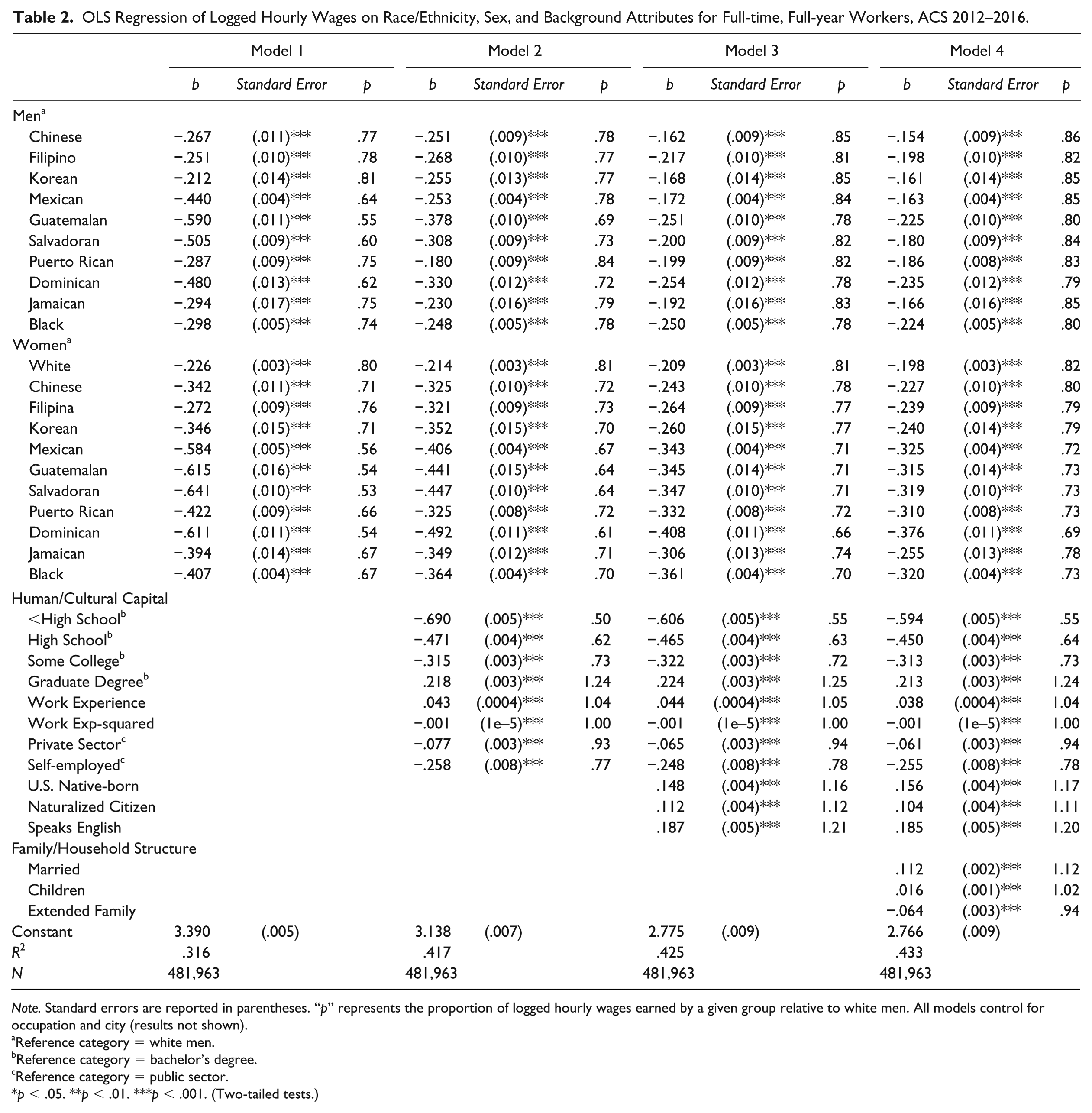
Note. Standard errors are reported in parentheses. “p” represents the proportion of logged hourly wages earned by a given group relative to white men. All models control for occupation and city (results not shown).
Reference category = white men.
Reference category = bachelor’s degree.
Reference category = public sector.
p < .05. **p < .01. ***p < .001. (Two-tailed tests.)
Next, we distinguish racial/ethnic groups by nativity to explore potential wage disparities between the foreign-born and their U.S.-born counterparts (Table 3). Here, we generate separate regression models for men and women. We also report interaction effect estimates by group and sex (t for M-W) based on a single pooled model employing the full analytic sample. 15 This strategy allows us to explore intersections of race/ethnicity, immigrant status, and sex on economic outcomes by (1) assessing the impact of both race/ethnicity and nativity (as well as other predictors) on earnings, and (2) directly comparing associations for men and women. This is especially important for investigating segmented assimilation because distinct patterns and effects suggest potentially unique incorporation and stratification processes. Consistent with the modeling sequencing and strategies just outlined, we offer parallel analyses—using logistic regression—to investigate near-poverty outcomes (Tables 4 and 5, respectively).
OLS Regression of Logged Hourly Wages on Race/Ethnicity and Background Attributes by Sex for Full-time, Full-year Workers (with Race/Ethnic-by-sex Interactions), ACS 2012–2016.
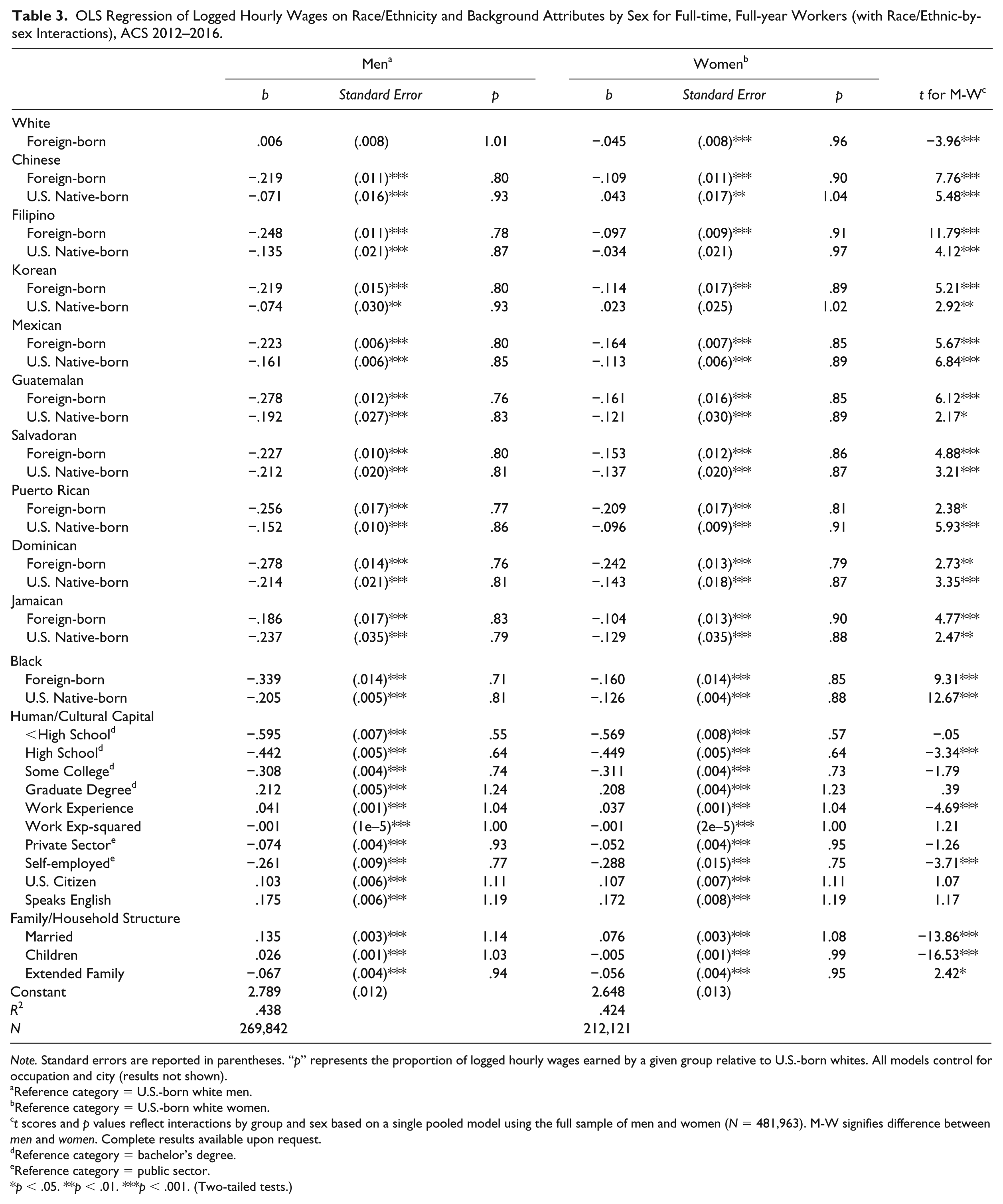
Note. Standard errors are reported in parentheses. “p” represents the proportion of logged hourly wages earned by a given group relative to U.S.-born whites. All models control for occupation and city (results not shown).
Reference category = U.S.-born white men.
Reference category = U.S.-born white women.
t scores and p values reflect interactions by group and sex based on a single pooled model using the full sample of men and women (N = 481,963). M-W signifies difference between men and women. Complete results available upon request.
Reference category = bachelor’s degree.
Reference category = public sector.
p < .05. **p < .01. ***p < .001. (Two-tailed tests.)
Logistic Regression of Near-poverty on Race/Ethnicity, Sex, and Background Attributes for Full-time, Full-year Workers, ACS 2012–2016 (Odds Ratios Reported).

Note. Robust standard errors are reported in parentheses. All models control for occupation and city (results not shown).
Reference category = white men.
Reference category = bachelor’s degree.
Reference category = public sector.
p < .05. **p < .01. ***p < .001. (Two-tailed tests.)
Logistic Regression of Near-poverty on Race/Ethnicity and Background Attributes by Sex for Full-time, Full-year Workers (with Race/Ethnic-by-sex Interactions), ACS 2012–2016.

Note. Robust standard errors are reported in parentheses. All models control for occupation and city (results not shown).
Reference category = U.S.-born white men.
Reference category = U.S.-born white women.
z scores and p values reflect interactions by group and sex based on a single pooled model using the full sample of men and women (N = 481,963). M-W signifies difference between men and women. Complete results available upon request.
Reference category = bachelor’s degree.
Reference category = public sector.
p < .05. **p < .01. ***p < .001. (Two-tailed tests.)
Descriptive Findings
Table 1 presents median hourly wages and the share of persons with family income falling below 150 percent of the federal poverty line by race/ethnicity and sex for full-time, year-round workers in Atlanta, Chicago, Houston, Los Angeles, and New York. Among men employed full-time, median hourly earnings range from $12.41 (Guatemalan men) to $31.86 (white men). 16 Asian men’s earnings trail white men’s but exceed those of Hispanic and black men. We also find important group differences within broader pan-ethnic designations (i.e., Asian and Hispanic) and regional origins (i.e., East Asia, Central America, and Caribbean). Korean men, for example, earn $2.01 more per hour than Filipino men, while Puerto Rican men earn $4.56 more than their Dominican peers.
Among women employed full-time, median hourly wages vary from $12.25 (Salvadoran women) to $28.18 (Filipina women). Similar to men, Asian women exhibit higher earnings than most, Central American women’s earnings are among the lowest, and we find considerable variation in Hispanic and Caribbean group returns. Asian women’s median hourly earnings, however, approach and even surpass those of white women. Comparison also reveals important within-group differences by sex. Here, the gender wage gap ranges from .80 for white full-time workers to 1.11 for Filipino ethnics. 17 For most racial/ethnic groups, women earn less than men.
Table 1 highlights variation in near-poverty status within and across racial/ethnic groups as well. Among men, the proportion of family incomes falling below 150 percent of the poverty threshold ranges from 2 percent for whites to 26 percent for Guatemalan males. In general, a higher percentage of Hispanic men are working poor compared with other groups, which is not surprising given their lower earnings. Somewhat more unexpected, a higher percentage of Chinese men are impoverished compared with Puerto Rican, Jamaican, and black men despite higher earnings. The share of female full-time workers with family incomes that fall below 150 percent of the poverty line ranges from 3 percent for whites to 23 percent for Dominican women. Similar to men, a higher percentage of Hispanic women are working poor compared with other groups. In contrast, however, Chinese, Puerto Rican, Jamaican, and black women display comparable poverty rates.
Several within-group gender differences in near-poverty status stand out as well. In particular, a larger share of Mexican and Guatemalan men are working poor than Mexican and Guatemalan women, while Dominican and black women are 1.5 to 2 times more likely than Dominican and black men to be impoverished. Such differences may reflect variations in family structure among diverse racial/ethnic groups.
Regression Results
Tables 2 through 5 report regression results estimating the economic well-being (hourly wages and near-poverty status) of full-time, year-round workers. Tables 2 and 4 show regression results incorporating race/ethnicity and sex (Model 1), human capital and employment characteristics (Model 2), cultural capital characteristics (Model 3), and measures reflecting family and household structure (Model 4). All models include statistical controls for occupation and metropolitan area (see Stewart and Dixon 2010). These models highlight important differences in economic well-being, pointing to race/ethnic- and gender-based hierarchies. Tables 3 and 5 report regression estimates stratified by sex, with an emphasis on intersections by race/ethnicity, sex, and nativity. These latter models suggest inter- and intragroup differences in economic assimilation and racial/ethnic inequality among men and women—differences that speak directly to both segmented assimilation dynamics and complex group hierarchies.
Hourly Wages
Table 2 reports coefficients from OLS models predicting log hourly wages. For a more intuitive discussion of earnings, log wages are converted to proportions (p). 18 Each value of p represents the proportion of average hourly wages earned by a given group relative to white men (reference category).
Model 1 provides a baseline for examining race/ethnic-sex disparities and indicates that each group of full-time workers earns significantly less than white men. Hourly wages range from 55 percent for Guatemalan men to 81 percent for Korean men, and from 53 percent for Salvadoran women to 80 percent for white women (relative to white men). Noticeably, with the exception of Korean men, minority men and women also earn less than white women. Consistent with expectations, Model 1 thus demonstrates an earnings hierarchy wherein whites are most advantaged, and Hispanics and blacks generally suffer the greatest deficits. We also find substantial race/ethnic wage differentials within most pan-ethnic and regional origin groupings. Among men and women, respectively, variation is most pronounced among Hispanic- and Caribbean-origin ethnics—although Central American women’s wages are quite similar.
The introduction of education and employment attributes in Model 2 significantly reduces the wage gap for Hispanic and black full-time workers. Several groups in this instance reach wage parity with Asian men and women. For example, Mexican men’s earnings increase to 78 percent, while Puerto Rican women’s earnings increase to 72 percent. In contrast, Asian ethnic wage estimates do not improve from Model 1 to Model 2. Such findings are instructive. On one hand, human capital differences among Hispanic and black men and women explain part of the wage gap with white men. On the other hand, disparities between Asian ethnics and white men are not attributable to education or experience.
Model 3 incorporates cultural capital measures, including nativity, citizenship status, and English language proficiency. Here, group-specific wage disparities are reduced considerably for most men and women. 19 A majority of minority men’s earnings exceed 80 percent, and nearly all women’s earnings exceed 70 percent (relative to white men). Our results suggest in this regard that cultural capital (or lack thereof) may sustain racial/ethnic and sex-based inequalities and act as a barrier to better paying jobs for full-time, full-year workers. This point, which aligns with traditional assimilation arguments, is further corroborated by positive coefficients for U.S. nativity, citizenship, and English language ability. Still, the hourly earnings of each race/ethnic-sex group remain markedly depressed compared with white men even after controlling for such factors.
Model 4, which introduces family and household measures, yields similar results. We find persistent wage gaps and a degree of variation across race/ethnic-sex groups, with minority men earning 14 to 21 percent less than white men and women earning 18 to 31 percent less. Group-specific wage disparities cluster somewhat by sex (among minority men and among all women) and suggest distinct race-based wage hierarchies. Among men, the earnings of full-time workers appear stratified along a white-nonwhite binary—a binary that underscores the fundamental impact of race on minority men’s experiences. Among women, white earnings are instead followed closely by Asian ethnics, while Hispanic and black earnings generally lag behind—a pattern evocative of multitiered characterizations of racial inequality (see Bonilla-Silva 2004; Masouk and Junn 2013) that lends partial support to our prediction concerning hierarchical economic arrangements.
Table 3 reports coefficients and proportions from OLS models predicting the log hourly earnings of men and women employed full-time by race/ethnicity and immigrant status as well as interaction effects by group and sex (t for M-W). All models presented include our full-set of explanatory measures and statistical controls. U.S.-born white men and U.S.-born white women serve as reference groups in models estimated for men and women, respectively. U.S.-born white men serve as the reference in the pooled model specifying interactions.
Table 3 suggests divergent segmented assimilation pathways in the labor market. For example, the relative hourly wages of foreign-born Chinese (80 percent) and Korean (80 percent) men are largely comparable with those of foreign-born Hispanic and Caribbean (76 to 83 percent) men. Wages among Chinese American and Korean American men, however, outstrip those of all other U.S.-born minority men employed full-time. We also find that U.S.-born Salvadoran and Jamaican men do not fare better than their co-ethnic immigrant peers. This contrasts with most groups that exhibit higher earnings among the U.S.-born—higher earnings suggestive of positive economic incorporation and mobility. Strikingly, no single group reaches parity with white men (U.S.- or foreign-born), and, with the exception of Chinese American and Korean American men, group-specific earnings among U.S.- and foreign-born minority men more closely approximate African American earnings.
This basic pattern is similar for women, but women’s earnings differ from men’s in meaningful ways. Specifically, minority women’s hourly earnings are higher relative to U.S.-born white women (79 to 104 percent) than their male counterparts’ earnings relative to U.S.-born white men (71 to 93 percent). Asian American women stand out, in particular, as their earnings match or exceed those of white women. In addition, comparison of specific racial/ethnic group coefficients and their interactions suggest race/ethnicity (distinguished by immigrant status) has a larger effect on minority men’s wages than women’s. Greater wage parity among women, however, reflects the fact that U.S.-born white women earn significantly less than U.S.-born white men, and women’s earnings are generally more compressed. Estimates also show foreign-born white women earn less than U.S.-born white women and suggest foreign-born status has a greater impact on white women’s wages than white men’s. Such findings support and expand upon segmented assimilation approaches to highlight diverse incorporation pathways and gendered racial/ethnic group experiences (Sullivan and Ziegert 2008; Valdez 2006; Waters 2001).
Near-poverty Status
Table 4 reports odds ratios from logistic regression models predicting family income levels that fall below 150 percent of the federal poverty line. Model 1 denotes variation in near-poverty status by race/ethnicity and suggests that full-time employed men and women from each racial/ethnic group are more likely to be working poor than white men. The odds of being near-poor range from 1.47 for Filipino men to 7.45 for Guatemalan men, and from 1.30 for white women to 9.53 for Dominican women (relative to white men). Asian- and Caribbean-origin ethnics, in particular, demonstrate considerable variation. Interestingly, Puerto Rican, Jamaican, and black men have much smaller odds of near-poverty than most other minority men, but Puerto Rican, Jamaican, and black women are twice as likely as their male counterparts to be impoverished.
Model 2 takes into account human capital and employment characteristics. The introduction of these measures reduces the odds of near-poverty relative to white men for most race/ethnic-sex groups. The most dramatic drop is seen among Mexican, Guatemalan, and Salvadoran full-time workers, although men and women in these groups remain three to four times more likely than white males to experience such financial hardship. Consistent with Model 1, the odds of Puerto Rican, Jamaican, and black women being near-poor—albeit reduced—remain roughly double that of Puerto Rican, Jamaican, and black men. Findings in Model 2 speak to the salience of education and work experience, but also the persistence of disadvantages among diverse groups of persons employed full-time.
Next, we introduce nativity, citizenship status, and English language proficiency in Model 3. Among Filipino ethnics and Jamaican men, the odds of being near-poor no longer differ significantly from white males. Inclusion of these measures also reduces the relative odds of near-poverty for Chinese, Korean, Mexican, Guatemalan, Salvadoran, and Dominican ethnics by one third to one half. Such patterning offers some support for traditional assimilation arguments. We find little evidence in this instance, however, of a clear race/ethnic- or sex-based hierarchy (as predicted or found for hourly earnings). Model 4 adds family and household controls. Although the addition of these measures has little practical effect on near-poverty status for most groups, our estimates capture and highlight complex race/ethnic-sex variations. The odds of Chinese ethnics being near-poor are higher in this model than in Model 3, while Hispanic and black women display reduced ratios. For these women, economic disadvantage may be driven, in part, by differences in family structure and living arrangements.
Finally, Table 5 reports odds ratios from logistic regression models estimating near-poverty status for male and female full-time workers by race/ethnicity and immigrant status, including interaction effects by group and sex (z for M-W). Filipino American men exhibit the lowest odds of near-poverty among U.S.-born minority men, and foreign-born white and Jamaican men display the lowest odds among immigrants. Foreign-born Chinese, Puerto Rican, and black men, in contrast, are acutely disadvantaged. Consistent with traditional assimilation expectations of cross-generational advancement and upward mobility (see Alba and Nee 2003), we find that among several groups of minority men, the likelihood of being near-poor is reduced from foreign-born to U.S.-born generations. Nevertheless, suggestive of segmented mobility and incorporation pathways, odds ratios for Dominican men are comparable, while U.S.-born Jamaican and Salvadoran men are at greater risk of financial hardship than their immigrant co-ethnics.
Similar to results for men, the odds of being impoverished drop for several groups of women from immigrant to U.S.-born generations. In addition, U.S.-born Chinese, Filipina, Korean, and Guatemalan women reach statistical parity with U.S.-born white women employed full-time. Jamaican American and Salvadoran American women, however, appear just as vulnerable as the foreign-born. Once again, our findings suggest positive economic incorporation and group mobility for some women, but not for others.
Table 5 also reveals group-specific sex differences in the odds of near-poverty. Unlike results for hourly wages (see Table 3), however, racial/ethnic-sex interactions are not significant for all groups. Particularly noteworthy here, findings suggest significant differences between Central American-origin men and women. Race/ethnicity, in this instance, has a larger relative effect on the economic standing of foreign-born Mexican men and foreign- and U.S.-born Guatemalan and Salvadoran men compared with women. This may reflect the fact that Central American-origin men in our sample are less likely to live with a spouse or extended family than their female counterparts. Estimates suggest the reverse among U.S.-born blacks and foreign-born Dominican and Jamaican ethnics, likely reflecting the link between single female-headed households and poverty.
Discussion and Conclusions
In this article, we sought to systematically examine how race/ethnicity, sex, and nativity intersect to shape patterns of labor market inequality and economic well-being among full-time, full-year workers, and to highlight the implications of these intersections for minority group incorporation, mobility, and stratification. Our analyses, in turn—which center on Atlanta, Chicago, Houston, Los Angeles, and New York City, five dynamic majority-minority labor markets and important immigrant destinations—speak to and expand upon previous work and related lines of inquiry in key respects.
Prior research emphasizes human capital (e.g., education and work experience) and assimilative attributes (e.g., citizenship and language proficiency) as important determinants of labor market returns and economic outcomes as they may signal a person’s employability to potential employers and expand the scope of job opportunities (see, for example, Alba and Nee 2003; Lieberson 1980; Painter and Qian 2016). Findings from our analyses are consistent with this point and align with our initial prediction. Indeed, the introduction of human and cultural capital measures substantially reduces most wage gaps between white men and all other race/ethnic-sex groups considered (see Table 2)—particularly among Central American- and Dominican-origin ethnics.
Yet our results also lend support to segmented assimilation frameworks (see, for example, Portes and Rumbaut 2006; Haller et al. 2011; Zhou 1997) in that they suggest differential mobility prospects among full-time employed minority men and women—that is, men and women who have an established, steady presence in the workforce. Specifically, although most U.S.-born race/ethnic-sex groups in our sample exhibit higher earnings than their co-ethnic immigrant peers, Salvadoran and Jamaican men and women do not (see Table 3). Our analyses offer several caveats in this regard. First, comparing foreign- and U.S.-born co-ethnics, we only find evidence of depressed and potential downward wage mobility among Hispanic and Caribbean groups, not Asians. Second, general patterns of group-level wage mobility (or immobility) among foreign- and U.S.-born co-ethnics largely parallel one another for male and female co-ethnics.
Our analyses go further still to tease out wage differentials and hierarchies suggestive of systematic race/ethnic- and gender-based prejudice and discrimination. Recent research suggests a shift toward multitiered characterizations of U.S. race/ethnic relations wherein many Asian groups are incorporated into the social-economic mainstream but Hispanics and blacks are frequently blocked (see Bonilla-Silva 2004; Hao 2007; Masouk and Junn 2013). We find only conditional support, however, of such a hierarchy in which whites are located at the top, followed closely by Asians, with Hispanics and blacks at the bottom. Among men, we find a pronounced white-nonwhite wage gap. This, along with estimates demonstrating a stronger race/ethnic effect on men’s wages, speaks to the unique impact of race (and white privilege) on minority men’s workforce experiences and returns. In contrast, Asian women appear to traverse racial/ethnic boundaries to some extent to obtain more equitable earnings outcomes suggestive of honorary white status—an advantaged status relative to Hispanics and blacks. Even so, Asian women’s earnings fall short of their male counterparts, a pattern found among all women in our sample.
In addition, results denote that African American men have wages comparable with, if not higher than, foreign-born minority men. Yet, U.S.-born ethnics achieve parity with and at times exceed African American men’s earnings. In the context of sites we investigate, this suggests that any initial advantage native-born black men may have in the labor market (relative to foreign-born minorities) dissipates when competing against native-born groups. We find similar results—which speak to both assimilative and prejudicial labor dynamics—among full-time employed women. Our analyses thus reveal complex patterns of inequality among those gainfully employed and engaged in the workforce and highlight the need to simultaneously investigate race/ethnicity, sex, and nativity.
Our assessment of near-poverty status taps into another important dimension of economic well-being. These findings (see Tables 4 and 5) largely corroborate the conclusions we draw regarding human capital and assimilative attributes from wage data and offer further evidence suggestive of segmented assimilation among full-time workers. In this latter regard, our confidence is bolstered by the fact that both financial outcomes we consider suggest depressed group mobility among Hispanic- and Caribbean-origin ethnics—particularly, Salvadoran and Jamaican men and women.
Near-poverty ratios also show extensive inter- and intragroup heterogeneity. Our findings, in this instance, are not discernably clustered by race, global region, or sex, and only Caribbean-origin women are consistently at greater risk of being impoverished than their male counterparts (see Table 4). Only when we distinguish each group by nativity do we see potential racial/ethnic economic tiering where estimates for U.S.-born Asian men and women in the workforce more closely resemble those of whites than most other minorities (see Table 5). Foreign-born Asian ethnics (i.e., Chinese and Korean men and women), however, are just as likely (if not more) to be near-poor than many foreign-born Hispanic and Caribbean groups. Remarkably, few studies of U.S. poverty focus on Asians, and even fewer consider Asian outcomes alongside Hispanics and blacks. Our analyses thus underscore the utility of intersectional approaches for disentangling assimilation pathways and stratification processes within and between diverse groups of men and women as well as the need for research investigating Asian poverty.
There are, of course, limitations to this study that warrant acknowledgment. First, we use cross-sectional data and can therefore only show associations between our covariates and outcomes. Unfortunately, longitudinal data are rare for analyses of immigration and labor market inequality, especially in terms of containing sufficient cases from multiple groups and in-depth information from multiple locations. Still, we are able to highlight important differences across race/ethnicity, sex, and nativity—though the labor markets we examine are not necessarily representative of the United States as a whole. Second, the data do not provide information on the generational status of persons born in the United States. As a result, a more precise distinction cannot be drawn between respondents born in the United States to foreign-born parents and those born in the United States to parents whose family has resided in the country for multiple generations. We are nonetheless able to leverage nativity to explore assimilative dynamics, group-level economic mobility, and differences between foreign- and U.S.-born co-ethnic men and women. Finally, the data do not directly account for racial/ethnic- and sex-based prejudice or discrimination. Qualitative research can help fill gaps in this vein as inferences from our analyses are only suggestive of such forces.
Given our careful attention to race/ethnicity, sex, and nativity, this article contributes to assimilation and stratification literatures as well as intersectional frameworks. Our analyses (1) call attention to important differences in group-level economic incorporation, mobility, and inequality in five key U.S. metropolitan labor markets with diverse racial/ethnic and foreign-born populations; (2) highlight the fundamental role of race, sex, and nativity as loci of stratification among full-time workers; and (3) point to the need for intersectional approaches (and theorizing) in assimilation, labor market, and, more generally, sociological research. To be sure, future research can benefit from continued consideration of how dynamic status hierarchies converge to impact immigrant and minority men’s and women’s opportunities and experiences—opportunities and experiences that extend beyond the labor market and economy to include education, family formation, housing, and political participation, among other challenges. Such scholarship is crucial given the racialization of “new” immigrants and current surge in nativism, as well as the persistence of racial/ethnic- and sex-based discrimination found across U.S. society and in core institutions.
Footnotes
Acknowledgements
We thank the Social Currents editors and anonymous reviewers for their thoughtful feedback and valuable suggestions on earlier drafts of this article.
Authors’ Note
An earlier version of this manuscript was presented at the 2015 Meetings of the American Sociological Association, Chicago, Illinois, and Southern Sociological Society, New Orleans, Louisiana.
Laryssa Mykyta is now affiliated with the U. S. Census Bureau, Washington, DC, USA. The views expressed are those of the authors and are not those of the U. S. Census Bureau. Any errors or omissions are the sole responsibility of the authors.
Declaration of Conflicting Interests
The author(s) declared no potential conflicts of interest with respect to the research, authorship, and/or publication of this article.
Funding
The author(s) received no financial support for the research, authorship, and/or publication of this article.