



Abstract
The United States experienced a period of rapid higher education expansion between the mid-1940s and mid-1970s. Although this expansion likely improved the health of people able to take advantage of new education opportunities, expansion may have also intensified health inequalities between college-educated and non-college-educated people (1) through the compositional change in the relative (dis)advantage of these groups, (2) through the displacement of non-college-educated people in a more competitive post-expansion labor market, and (3) by increasing health returns to a college degree. Our analyses, rooted in a counterfactual perspective, draw on data from the Health and Retirement Study that spans birth cohorts who came of age before and after the period of expansion, allowing us to differentiate people who earned a degree because of expansion but would not otherwise (conditional-earners) from people who would or would not have earned a degree regardless of expansion (always-earners and never-earners, respectively). Comparing changes in the health of these three groups before and after education expansion permits us to individually evaluate how compositional change, displacement, and increasing returns to education exacerbated health inequalities. Our findings suggest that education expansion improved the health of conditional-earners and magnified health inequalities through the mechanism of displacement.
Keywords
Introduction
A broad body of work has established a link between education and health in which higher levels of education are associated with better health outcomes (Hummer and Hernandez 2013; Lynch 2003; Ross and Wu 1995). This holds across multiple measures of health, including self-rated health (SRH; Lynch 2003, 2006), cardiovascular health (Kavanagh et al. 2010; Lawrence et al. 2018; Liu et al. 2011, 2013; Schafer, Wilkinson, and Ferraro 2013), limitations with activities of daily living (ADL; Schoeni et al. 2005), psychological well-being (Ross and Mirowsky 2006), obesity (Hoffmann et al. 2017), health behaviors (Lawrence 2017), and mortality (Meara, Richards, and Cutler 2008; Schafer et al. 2013), among other measures. Several mechanisms have been proposed and tested to account for this link. These range from greater financial resources and better working conditions that come with higher levels of education that can be used to support health, to knowledge of health-promoting behaviors and broader psychosocial resources available to those with more education, and to the beneficial social connections formed with others engaged in healthier lifestyles (Link and Phelan 1995, 2010; Ross and Wu 1995; Schieman and Plickert 2008).
The ability to translate education into these various types of resources and their use to support health has the potential to evolve over time. Past research, guided by Fundamental Cause Theory, has posited that education-health disparities grow over time as increasing knowledge about the prevention and treatment of diseases make the deployment of flexible resources more effective (Link and Phelan 2010; Masters, Link, and Phelan 2015). Several studies document that the relationship between education and health has grown stronger over the last 60 years in the United States with an increasing gradient observed for more recent cohorts (Hummer and Hernandez 2013; Lynch 2003; Masters, Hummer, and Powers 2012; Montez et al. 2011; Pappas et al. 1993).
In this article, which draws on data from the Health and Retirement Study (HRS), we employ an analysis centered on the expansion of higher education to shed additional light on the changing education-health gradient over time and estimate the effect expansion has on the health of people most likely to take advantage of the new opportunities for higher education. Our analysis is based on identifying two cohorts: a pre-expansion cohort of people born in years such that they turned 18 years old just prior to a period of rapid expansion in higher education in the United States and a post-expansion cohort of people born in years such that they turned 18 in years just following a period of rapid expansion. Within each cohort, we use statistical models and simulation methods to distinguish three groups of people and compare their health outcomes within and across the two cohorts. The first two groups are people theoretically unaffected by the expansion of higher education—that is, people who would earn a degree in either the pre- or post-expansion period (always-earners) and people who would not earn a degree in either period (never-earners). The third group consists of people who are able to take advantage of the new opportunities for higher education that came with expansion—that is, people who would theoretically not earn a degree in the pre-expansion period but would earn a degree in the post-expansion period (conditional-earners).
Past studies that have examined the effects of education expansion on education-health disparities have identified three mechanisms through which expansion may exacerbate inequalities: compositional change, displacement, and increasing returns to education. Comparing health outcomes for the three “earner” groups within and across the two cohorts allows us to estimate the individual effect sizes of these three mechanisms. Specifically, comparing outcomes of conditional-earners and never-earners in the pre-expansion cohort estimates the effect of compositional change, comparing outcomes of never-earners in the pre- and post-expansion cohorts estimates the effect of displacement, and comparing outcomes of always-earners in the pre- and post-expansion cohorts estimates increasing returns to education. Moreover, comparing the health of pre- and post-expansion conditional-earners estimates the effect of education expansion for people most likely to take advantage of new educational opportunities. Our analyses reveal two main findings. First, post-expansion conditional-earners report better health than pre-expansion conditional-earners, which suggests that education expansion provides health benefits for people most likely to take advantage of new educational opportunities. Second, post-expansion never-earners report worse health than pre-expansion never-earners. This finding lends support for displacement as the mechanism through which expansion intensifies health disparities. Overall, we find that expansion benefits conditional-earners’ health while also strengthening disparities between more and less educated people. We address policy implications for these simultaneous positive and negative consequences of expansion in the discussion.
Higher Education Expansion in the United States
The second half of the twentieth century saw an expansion of higher education in the United States and across the globe (Schofer and Meyer 2005). Between 1945 and 1975, college and university enrollment in the United States increased by approximately 6.5-fold (National Center for Education Statistics [NCES] 1993, 2015). This increase in enrollment, driven in part by a series of federal acts including the GI Bill of 1944, the National Defense Education Act of 1958, and the Higher Education Act of 1965 (Mumper et al. 2011; Palmadessa 2017), occurred in stages. In the initial stage of expansion, enrollment doubled between 1945 and 1961. In the second stage, roughly 1961 to 1975, enrollment increased by 170 percent. Following this rapid period of expansion, enrollment in colleges and universities continued to increase but at a much slower rate of about 25 percent between 1975 and 1995 (NCES 2015). Taking into account increases in the overall population, the percentage of 18- to 24-year-olds enrolled in college increased from 10.0 percent in 1945 to 23.6 percent in 1961 and 40.3 percent in 1975 (NCES 1993).
The expansion of higher education between 1945 and 1975 reduced barriers to higher education and provided opportunities for a larger segment of the population to pursue a college degree. This reduction in barriers allowed many people in the post-expansion period to earn a degree who would not have had the opportunity to do so had they been born earlier. Due to the well-documented beneficial effects of education on health, the expansion of higher education likely led to overall improvements in population health primarily driven by improvements in the health of conditional-earners. At the same time, the expansion of higher education has necessarily altered the composition of people with and without college degrees in the population regarding early life resources. As we discuss below, this change comes with the possibility of exacerbating education-based health disparities.
The Widening Education-Health Gradient
Socioeconomic disparities in mortality were strong at the beginning of the 1900s and diminished through the middle of the century as the leading causes of death transitioned from infectious diseases to chronic and degenerative ones. Educational differences in health started to grow throughout the second half of the 1900s as more knowledge and technologies useful for preventing and treating chronic diseases emerged (Christenson and Johnson 1995; Lynch 2003; Masters et al. 2012). Researchers have documented growing educational disparities in mortality since the 1960s (Masters et al. 2012; Meara et al. 2008; Montez et al. 2011; Pappas et al. 1993; see Hummer and Hernandez 2013 for a review). Educational disparities in SRH (Hu et al. 2016; Lynch 2003), obesity (Hoffmann et al. 2017), and older adults’ limitations with ADL (Schoeni et al. 2005) have also increased over time.
Researchers have attributed these growing disparities to improved health for the most educated groups and diminishing health or stagnation among the least educated (Everett, Rehkopf, and Rogers 2013; Meara et al. 2008; Montez et al. 2019). Moreover, growth in education-mortality disparities have been greatest among more preventable causes of death like heart disease and lung cancer (Masters et al. 2012, 2015; Willson 2009). Life span variation is smaller for more educated groups and has decreased over time for the most educated (Sasson 2016). Education-health disparities are present early in adulthood (Lawrence et al. 2018) and increase with age (Lynch 2003; Mirowsky and Ross 2005; Ross and Wu 1996). Disparities are wider in the United States than in Europe (Leopold 2018; Mackenbach et al. 2018). Overall, previous studies show that education-health disparities are intensifying and especially pronounced in the United States.
Theoretical Background and Hypotheses
Figure 1, adapted from a recent study by Östergren et al. (2017), provides a conceptual representation of how the expansion of higher education itself might lead to a widening of the education-health gradient. In this model we illustrate health as a function of labor market conditions (one particular mechanism linking education and health), attainment of a college degree, and early life determinants (e.g., parent education and socioeconomic resources). In addition, we illustrate the effects of early life determinants on educational attainment and the effects of educational attainment on labor market conditions.

Conceptual Model for Mechanisms Linking Education Expansion and Changing Health Inequalities.
The expansion of higher education has the potential to exacerbate education-based health inequalities through three mechanisms. The first mechanism, labeled compositional change, stems from the fact that as higher education expands, the people who remain without a college degree are a relatively more disadvantaged or negatively selected group than prior to expansion (Hendi 2015; Östergren et al. 2017). To the extent that the factors that enable people to pursue higher education are themselves independently related to health, then the simple compositional change that comes with expansion will result in widening health inequalities. The second mechanism, labeled displacement, captures the possibility that an increase in higher education may shift the relative advantage (or disadvantage) of having a college degree (or not having a degree) on the labor market. An increasing proportion of college graduates in the labor market may push people without degrees to lower paying jobs or out of the labor market altogether (Delaruelle, Buffel, and Bracke 2015; Östergren et al. 2017). This represents one form of increasing health disparities to the extent that income and other features of work are related to health. Finally, Figure 1 also illustrates the possibility, labeled increasing returns, that the expansion of higher education may also influence mechanisms linking education and health other than those related to the labor market. For instance, increasing the proportion of degree earners in a context may also increase the beneficial social ties college-educated people have, which, in turn, increases the health benefits of a college degree.
Connection with Three Groups Related to Expansion
The conceptual model depicted in Figure 1 allows us to outline several hypotheses related to the three theoretical groups—never-earners, conditional-earners, and always-earners—discussed above.
First, we have the straightforward hypothesis that conditional-earners in the post-expansion cohort will have better health on average than conditional-earners in the pre-expansion cohort because conditional-earners in the post-expansion period have additional human capital in the form of a college degree (Becker 1993). This hypothesis stems from the larger body of evidence linking higher education to a wide range of health benefits (Hummer and Hernandez 2013; Ross and Wu 1995) and from prior findings that education expansion increases earnings for people able to take advantage of new education opportunities (Choi 2015).
Second, an implication of the compositional change mechanism is that the conditional-earners in the pre-expansion cohort will have better health on average than the never-earners in the pre-expansion cohort. This follows from the likelihood that the conditional-earners in the pre-expansion cohort are in a relatively advantaged social position as compared with the never-earners due to the fact that had they been born in the post-expansion cohort they would have earned a college degree. In other words, if the social resources that would allow them to pursue higher education when more opportunities are available in the post-expansion context are themselves related to health, then we would expect to see differences in average levels of health between the two groups in the pre-expansion period even though neither earned college degrees.
Third, an implication of the displacement mechanism or the more general increasing returns mechanism is that we would expect the post-expansion never-earners to have worse health on average than the pre-expansion never-earners and the post-expansion always-earners to have better health on average than the pre-expansion always-earners. For both groups, the pre- and post-expansion cohorts either have or do not have a college degree, respectively, for the always-earners and never-earners. Thus, any differences are due to changes in the health-related returns to education. This could be either increasing disadvantage for people without a college degree (i.e., the health returns to a high school degree, for example, diminish) or increasing advantage for people with a college degree (i.e., the health returns to a college degree strengthen).
Finally, our analytic framework also allows us to explore the relative magnitude of the human capital effect of attaining a college degree on health with the increasing returns to higher education. Given that conditional-earners in the post-expansion cohort have a college degree and the conditional-earners in the pre-expansion cohort do not, the difference in the average health across the two groups reflects a combination of the human capital effect and the increasing returns to higher education. By contrast, the difference in average health across pre- and post-expansion always-earners just reflects the increasing returns to higher education because both have a college degree. Taking the difference between the two—the pre- and post-expansion conditional-earners and the pre- and post-expansion always-earners—allows us to isolate the human capital effect on health of attaining a degree. We expect that the proportion of the education-health gradient based on improvements in human capital will be greater than the proportion due to increasing returns to education. This expectation derives from the well-documented “main” effect of education on health.
Data and Measures
Data
Data for this project come from 13 waves covering the years 1992 through 2016 of the HRS. The HRS is a nationally representative biennial panel study of adults aged 51 and over. Variables for this analysis were extracted from the publicly available Tracker file, the RAND HRS Longitudinal File 2016, and Core Data Sets A and B. The HRS is a good source of data for this study because it includes (1) relatively large samples of people from the cohorts of interest, (2) a broad array of background measures to predict college completion, and (3) two general measures of physical health.
The analysis sample consists of HRS respondents born between the years of 1916–1920 and 1957–1961 that correspond with coming of age in the five years prior to the expansion of higher education and the five years following the expansion of higher education (1945–1975). A small number of cases missing data for college completion or our health outcomes were dropped (N = 383). In addition, 29 cases missing race were dropped. Remaining missing data in the predictors of college completion were addressed using Stata’s implementation of multiple imputation via chained equations to construct five complete datasets (StataCorp 2019). Our final analysis sample consists of 2,467 pre-expansion respondents and 4,189 post-expansion respondents for a total of 6,656 respondents.
Measures
This article analyzed HRS respondents born in two separate cohorts: a pre-expansion cohort and a post-expansion cohort. The pre-expansion cohort comprises respondents born between 1916 and 1920. When education expansion began in 1945, members of this first cohort ranged in age from 25 to 29, just past the traditional college attendance ages of 18 to 24 (NCES 1993). Members of the post-expansion cohort were born between 1957 and 1961, and reached adulthood starting in 1975.
The analysis involves two health outcomes: SRH and difficulty with ADL at the first available wave when respondents entered the survey. 1 The HRS asks respondents to rate their health on a 5-point scale, ranging from “poor” to “excellent.” We constructed an indicator for respondents who reported “very good” or “excellent” health. Dichotomous measures of SRH are frequently used (Zajacova and Dowd 2011), and analyses that use dichotomous measures yield similar results to analyses that use other operationalizations (Manor, Matthews, and Power 2000). Since Wave 2, the HRS asks respondents to rate their level of difficulty with five ADLs: bathing, eating, dressing, getting in or out of bed, and walking. We constructed an indicator for reporting no difficulty with any of these five activities. 2 Both SRH (Idler and Benyamini 1997; Jylhä 2009) and ADL limitations (Stineman et al. 2012) are important indicators of physical health and known to be strong predictors of mortality.
In combination with cohort membership, our focal independent variable is a measure of whether respondents are never-, conditional-, or always-earners. These are theoretical categories involving counterfactuals (i.e., we cannot simultaneously observe a respondent belonging to both the pre- and post-expansion cohorts) and thus not directly observable in our data. As detailed below, we rely on propensity score models predicting attaining a four-year degree or higher in each cohort to distinguish never-, conditional-, and always-earners.
We include three broad categories of covariates that may be associated with educational attainment and physical health in our propensity score models predicting college completion. The first category includes measures of socioeconomic resources in adolescence. In this category, we have mother’s and father’s years of schooling, a subjective assessment of family income from birth to age 16 (1 = poor, 2 = about average, and 3 = pretty well off financially), an indicator for whether the respondent’s father was unemployed for several months or more before the respondent turned 16, and the portion of time the respondent’s mother worked outside the home while the respondent was growing up (0 = not at all, 1 = some of the time, 2 = all of the time). The second category includes measures of respondent’s health or health exposures in adolescence. In this category, we have a retrospective report of SRH, an indicator for whether respondents missed a month or more of school before age 16 due to illness, and indicators for whether the respondent smoked or at least one of their parents smoked during adolescence. Research suggests that retrospective reports of childhood health conditions are valid and correlate with adult health outcomes (Blackwell, Hayward, and Crimmins 2001; Smith 2009; Vuolo et al. 2014). The third category includes other sociodemographic measures related to college completion and health. In this category, we have sex, race/ethnicity (white, black or African American, and other), age at their first HRS wave, whether the respondent was foreign-born, whether the respondent grew up in a rural area, whether the respondent lived with their grandparents in childhood, the number of siblings, and whether the respondent served in the military.
Method
Our analysis proceeds in three steps. In the first step, we fit propensity score models for attaining a four-year degree or higher level of education in the pre- and post-expansion cohorts separately. To construct the counterfactuals, we use the estimates from the propensity score model based on the pre-expansion cohort to generate predicted probabilities of college completion for the members of the post-expansion cohort and vice versa for the members of the pre-expansion cohort.
In the second step, we assign respondents to never-earner, conditional-earner, and always-earner groups as follows (see Figure 2 for an illustration). Beginning with the pre-expansion cohort, we assume that any respondents who earned a four-year degree or higher in this cohort would have also done so in the post-expansion cohort when there were more opportunities for doing so, and thus these respondents are coded as always-earners. 3 Among the pre-expansion cohort respondents, we need to distinguish the conditional-earners from the never-earners among those who did not attain a four-year degree. To do so, we randomly determine whether the members of the pre-expansion cohort would have attained a college degree post-expansion using the predicted probabilities of college completion calculated based on the post-expansion cohort propensity score model. Those randomly determined to have attained a degree are coded as conditional-earners and those randomly determined not to have attained a degree are coded as never-earners. The logic of this process is that the respondents in the pre-expansion cohort who did not earn a degree but have a relatively high predicted probability of earning a degree in the post-expansion context will be more likely to be assigned as conditional-earners. We use the same approach in reverse among the post-expansion cohort respondents. For this group, we assume the people who did not earn a four-year degree would not have earned in the pre-expansion context and are thus assigned as never-earners. For the respondents who did earn a four-year degree or higher in the post-expansion cohort, we distinguish the always-earners from the conditional-earners based on the same random process outlined above.

Observed and Assigned Earner Status.
For the third step of the analysis, we fit a regression model specified as follows:

where i indexes cases, h is one of our health outcomes, CE is an indicator for conditional-earners, AE is an indicator for always-earners, C is an indicator for the post-expansion cohort, and
As our second step involves random assignment of cases to never-, conditional-, or always-earner status as outlined above, we embed Steps 2 and 3 in a simulation involving 500 repetitions. In our results, we report the average distribution of never-, conditional-, and always-earners across the 500 repetitions. In addition, we report average estimates from the regression models and standard errors that incorporate within- and between-simulation uncertainty using an approach equivalent to calculating standard errors with multiple imputed data.
All of the analyses were conducted in Stata, and code for replication and extension is maintained at https://github.com/sbauldry/heeh.
Results
Table 1 reports means or proportions by cohort and degree status for all of the covariates. We see that, as expected, a larger proportion of respondents reported earning a four-year degree or higher in the post-expansion cohort than in the pre-expansion cohort (0.24 vs. 0.11). We also see a clear bivariate difference in the health outcomes for respondents with and without four-year degrees in both cohorts. Respondents with a four-year degree are substantially more likely to report very good or excellent SRH and to report no ADL limitations relative to respondents who did not attain a four-year degree. Finally, we note substantial differences across the three categories of covariates for respondents who did and did not complete college, and furthermore some of these differences vary across the pre- and post-expansion cohorts.
Covariate Means or Proportions by Cohort and College Degree; N = 6,656.
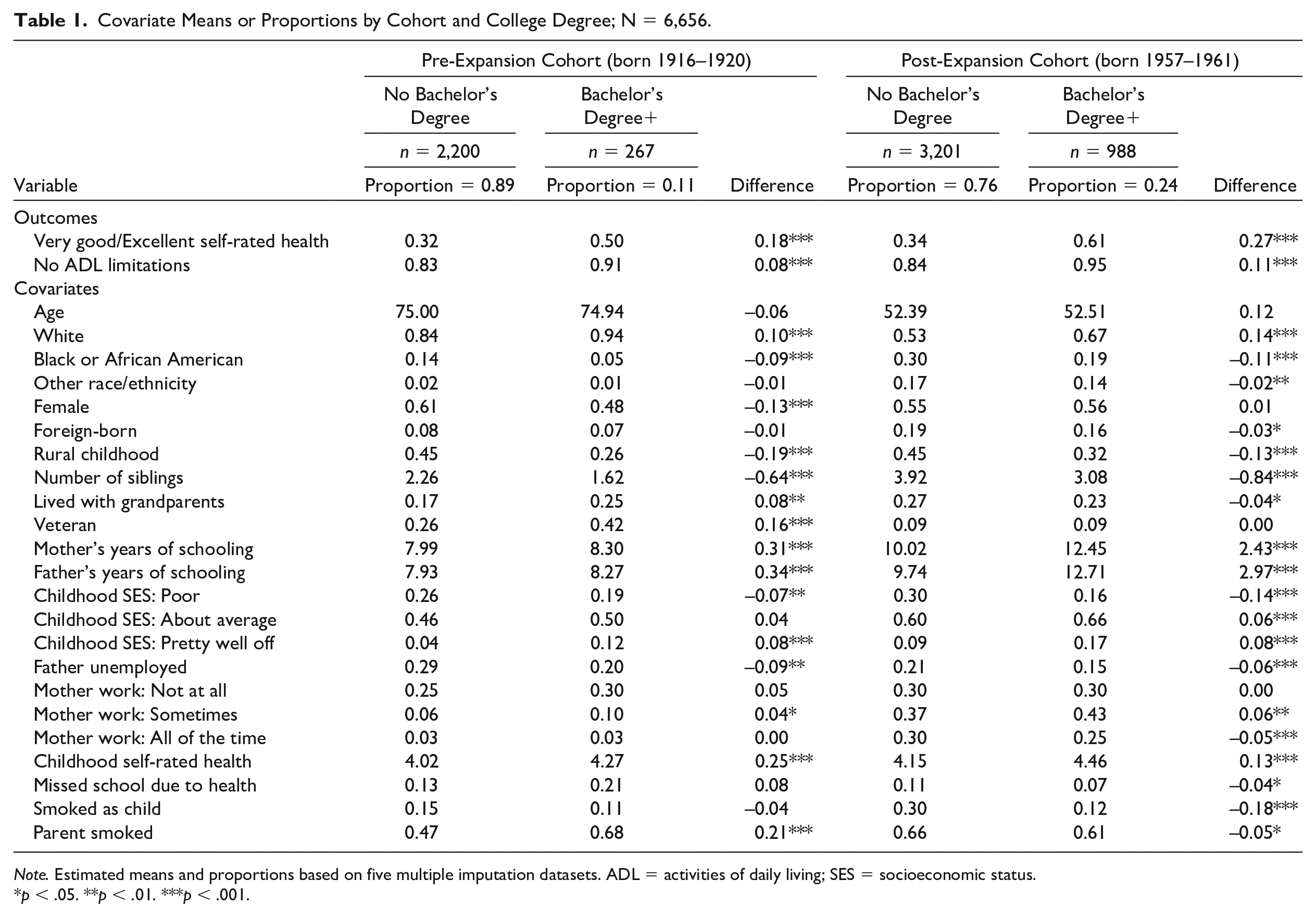
Note. Estimated means and proportions based on five multiple imputation datasets. ADL = activities of daily living; SES = socioeconomic status.
p < .05. **p < .01. ***p < .001.
Figure 3 illustrates the average distributions of never-, conditional-, and always-earners across the 500 simulations (see Table A1 in the appendix for estimates from our propensity score models for the pre- and post-expansion cohorts). We see that overall the estimated proportion of never-, conditional-, and always-earners is relatively stable across the pre- and post-expansion cohorts. In the pre-expansion cohort, we find on average about 0.71 represent never-earners, 0.18 conditional-earners, and 0.11 always-earners. In other words, of the 2,200 pre-expansion cohort respondents who did not complete a four-year degree or higher, we estimate around 1,748 would not have earned a four-year degree or higher in the post-expansion context while around 452 would have earned a four-year degree in the post-expansion context. We see a similar pattern among the post-expansion cohort in which we find on average about 0.76 represent never-earners, 0.12 conditional-earners, and 0.12 always-earners. For this cohort, we estimate that around 501 of the 988 respondents who attained a four-year degree or higher would not have done so in the pre-expansion context.

Average Distribution of AE, CE, and NE Across the 500 Simulations.
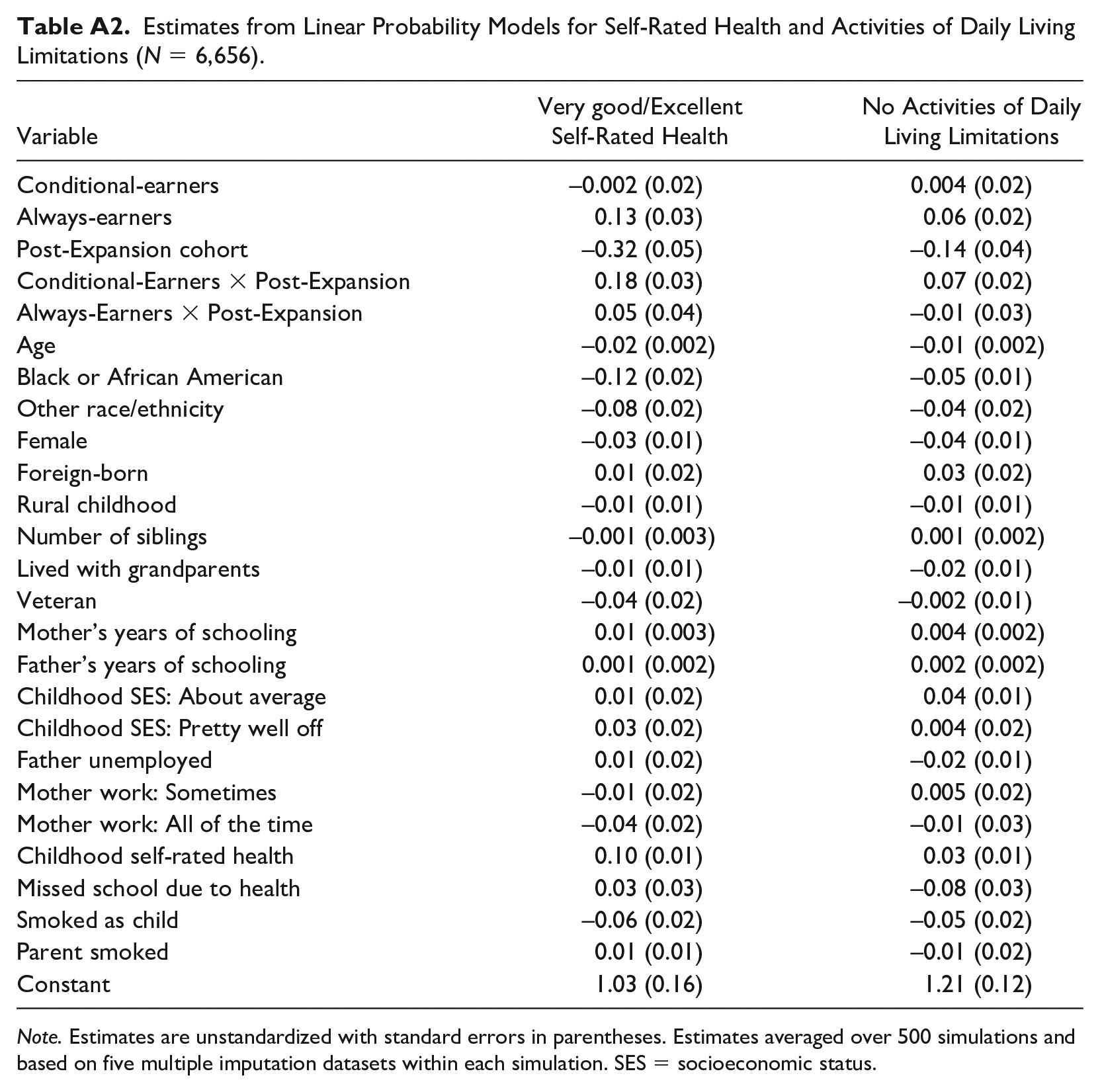
Figure 4 illustrates key estimates from the regression models for very good or excellent SRH and no ADL limitations (see Table A2 in the appendix for all estimates from our regression models). Beginning with our first hypothesis, for both SRH and ADL limitations, we find that post-expansion conditional-earners report better health on average than pre-expansion conditional-earners. In particular, conditional-earners in the post-expansion have a 0.18 higher probability of reporting very good or excellent SRH and a 0.07 higher probability of reporting no ADL limitations than conditional-earners in the pre-expansion (SRH,

Key Estimates from Regression Model.
Our second hypothesis concerned whether conditional-earners in the pre-expansion cohort reported better health on average than never-earners in the pre-expansion cohort. We find no evidence of this for SRH or for ADL limitations (SRH,
Our third hypothesis is broken into two parts. The first part predicted that the average health among never-earners will be better in the pre-expansion than in the post-expansion cohort, and the second part predicted that the average health among always-earners will be better in the post-expansion than in the pre-expansion cohort. Given our model specification, the estimate for the post-expansion cohort captures the difference between the never-earners in the pre- and post-expansion cohorts. We find strong negative effects for both SRH and ADL limitations. In particular, never-earners in the post-expansion have a 0.32 lower probability of reporting very good or excellent SRH and a 0.14 lower probability of reporting no ADL limitations than their counterparts in the pre-expansion (SRH,
Finally, our fourth hypothesis concerns the relative strength of the human capital effect and the increasing returns We calculated the difference between estimates for post-expansion conditional-earners and post-expansion always-earners (see bottom row of Figure 4). For both SRH and ADL limitations, we find a positive difference (i.e., SRH,
Sensitivity Analyses
The analyses reported above represent averages over various demographic groups that have different access to education, receive different returns to education, and may have been differentially affected by the expansion of higher education (Elo and Preston 1996; Everett et al. 2013; Farmer and Ferraro 2015; Holmes and Zajacova 2014; Kimbro et al. 2008; Montez et al. 2011; Rogers et al. 2010; Ross and Mirowsky 2006; Zajacova and Hummer 2009). In particular, we average over gender and racial/ethnic groups. As a sensitivity analysis, we stratified our analysis by gender (women and men) and by race/ethnicity (whites and African Americans), and checked whether the patterns reported above replicated within each subgroup of the population. For very good or excellent SRH, we find the same pattern of results for women and men and for whites. Among black or African American respondents, we observed a similar estimate for the post-expansion conditional-earners but did not find a positive effect for always-earners in the pre-expansion cohort. For no ADL limitations, we find the same pattern of results for women and whites. We saw a similar pattern of results for men, but with greater uncertainty in the estimates. As with SRH, we find a similar pattern among blacks or African Americans for the conditional-earners, albeit also with greater uncertainty, but not among the always-earners.
Overall, our sensitivity analyses suggest that the findings are not sensitive to gender but are more muted among blacks or African Americans than whites. This is perhaps not surprising given the significant role that race plays in the education process, particularly over the time period covered by our analysis. In addition, we had insufficient sample sizes to consider any other racial/ethnic groups. Further study of race/ethnicity and the expansion of educational opportunities is needed.
Discussion
In this study, we estimated the effect of higher education expansion in the United States between 1945 and 1975 on (1) inequalities in health between people with and without degrees, and (2) the health of people able to take advantage of the new higher education opportunities expansion provided. Although previous papers (Delaruelle et al. 2015; Hendi 2015; Östergren et al. 2017) have explored the role of expansion in changing health inequalities, our study is the first to disentangle the effects of compositional change and displacement. We do this by utilizing a counterfactual approach and information on respondents’ early life factors that allow us to identify and compare health outcomes of (1) always-earners, who would earn a college degree in both the pre- and post-expansion period; (2) never-earners, who would not earn a degree in either the pre- or post-expansion period; and (3) conditional-earners, who would theoretically not earn a degree in the pre-expansion period but would earn a degree in the post-expansion period. Our results suggest that displacement, rather than compositional change or increasing returns, is the mechanism through which education expansion exacerbates health inequalities and that expansion improves health outcomes of people able to take advantage of new education opportunities.
Drawing on literature establishing a link between education and health (Becker 1993; Hummer and Hernandez 2013; Lynch 2003; Ross and Wu 1995), we hypothesized that conditional-earners in the post-expansion cohort would report better health than pre-expansion conditional-earners. Our result that post-expansion conditional-earners reported better health than their pre-expansion counterparts suggests that expansion is beneficial to people able to take advantage of the education opportunities it provides. This is consistent with literature showing increased earnings for people who complete a degree because of expansion (Choi 2015). Next, we assessed expansion’s compositional effect by comparing the health of conditional- and never-earners in the pre-expansion cohort. Our finding that these groups had similar health outcomes does not support the mechanism of compositional change, which implies that expansion increases educational disparities in health by providing higher education opportunities to only the healthiest people who would not earn a degree in the pre-expansion period. Third, we assessed the effects of displacement and increasing returns, respectively, by comparing the health outcomes of pre- and post-expansion never-earners and always-earners. Our finding that never-earners in the post-expansion cohort reported worse health than never-earners in the pre-expansion cohort supports the displacement mechanism, whereas our finding that always-earners’ health did not vary across cohorts does not provide support for the increasing returns mechanism. Finally, we compared the relative magnitude of the human capital effect and the increasing returns effect, and found that the “main effect” of education on health accounts for a greater proportion of conditional-earners’ health improvements than the increasing health-related returns to higher education.
In addition to contributing to literature on the changing education-health gradient by identifying displacement as a process through which inequalities intensify, our findings contribute to literature on variation in the effects of education on health. Previous studies have demonstrated that the effects of education on health vary based on individual-level characteristics like gender (Elo and Preston 1996; Rogers et al. 2010; Ross, Masters, and Hummer 2012; Ross and Mirowsky 2006), race (Farmer and Ferraro 2005; Holmes and Zajacova 2014; Kimbro et al. 2008; Reynolds and Ross 1998), early life socioeconomic status (Andersson and Vaughan 2017; Bauldry 2014, 2015; Ross and Mirowsky 2011; Schafer et al. 2013), and sexual orientation (Zhang, Solazzo and, Gorman 2020). Our findings suggest that the effects of education on health can also vary by societal factors like the proportion of adults who earn a college degree at a particular point in history. Future research should consider other societal factors that potentially impact education inequalities in health.
Despite these contributions, our study is not without limitations. First, although we use a rich set of predictors of college attainment to help identify always-earner, conditional-earner, and never-earner status, it is likely that we do not account for all potential confounders of the education-health gradient (e.g., educational aspirations and high school academic performance) and thus overestimate the human capital and related effects. Second, we are unable to separate higher education expansion from other changes in the education system or societal forces that might also have an impact on overall population health or health inequalities (e.g., advances in medical technologies). Future studies should explore the effect of college expansion on health and health inequalities in other countries and across other time periods. Third, our data allow for limited exploration of how education expansion differentially impacted various racial groups. Our sensitivity analyses included only two racial categories due to a limited number of respondents who were not white or black or African American. Future studies should utilize datasets with a more racially diverse sample.
Our findings reveal that while education expansion does improve the health of people able to take advantage of new higher education opportunities, it also exacerbates health inequalities between people with and without college degrees by adversely affecting the health of the latter group through displacement. This finding has two important implications for policy. First, considering the large proportion of nondegree earners in our post-expansion sample (approximately 76 percent), expansion efforts should strive to create new higher education opportunities for the greatest proportion of people possible. Second, policymakers should seek to counteract negative health effects of displacement on people without a college degree through policies designed to mitigate the increasing disadvantages associated with lower levels of education.
Footnotes
Appendix
Estimates from Linear Probability Models for Self-Rated Health and Activities of Daily Living Limitations (N = 6,656).
| Variable | Very good/Excellent Self-Rated Health | No Activities of Daily Living Limitations |
|---|---|---|
| Conditional-earners | –0.002 (0.02) | 0.004 (0.02) |
| Always-earners | 0.13 (0.03) | 0.06 (0.02) |
| Post-Expansion cohort | –0.32 (0.05) | –0.14 (0.04) |
| Conditional-Earners × Post-Expansion | 0.18 (0.03) | 0.07 (0.02) |
| Always-Earners × Post-Expansion | 0.05 (0.04) | –0.01 (0.03) |
| Age | –0.02 (0.002) | –0.01 (0.002) |
| Black or African American | –0.12 (0.02) | –0.05 (0.01) |
| Other race/ethnicity | –0.08 (0.02) | –0.04 (0.02) |
| Female | –0.03 (0.01) | –0.04 (0.01) |
| Foreign-born | 0.01 (0.02) | 0.03 (0.02) |
| Rural childhood | –0.01 (0.01) | –0.01 (0.01) |
| Number of siblings | –0.001 (0.003) | 0.001 (0.002) |
| Lived with grandparents | –0.01 (0.01) | –0.02 (0.01) |
| Veteran | –0.04 (0.02) | –0.002 (0.01) |
| Mother’s years of schooling | 0.01 (0.003) | 0.004 (0.002) |
| Father’s years of schooling | 0.001 (0.002) | 0.002 (0.002) |
| Childhood SES: About average | 0.01 (0.02) | 0.04 (0.01) |
| Childhood SES: Pretty well off | 0.03 (0.02) | 0.004 (0.02) |
| Father unemployed | 0.01 (0.02) | –0.02 (0.01) |
| Mother work: Sometimes | –0.01 (0.02) | 0.005 (0.02) |
| Mother work: All of the time | –0.04 (0.02) | –0.01 (0.03) |
| Childhood self-rated health | 0.10 (0.01) | 0.03 (0.01) |
| Missed school due to health | 0.03 (0.03) | –0.08 (0.03) |
| Smoked as child | –0.06 (0.02) | –0.05 (0.02) |
| Parent smoked | 0.01 (0.01) | –0.01 (0.02) |
| Constant | 1.03 (0.16) | 1.21 (0.12) |
Note. Estimates are unstandardized with standard errors in parentheses. Estimates averaged over 500 simulations and based on five multiple imputation datasets within each simulation. SES = socioeconomic status.
Declaration of Conflicting Interests
The author(s) declared no potential conflicts of interest with respect to the research, authorship, and/or publication of this article.
Funding
The author(s) received no financial support for the research, authorship, and/or publication of this article.