




Abstract
In this short article, we provide an update and extension of Thomas C. Wilson’s study, “Whites’ Opposition to Affirmative Action: Rejection of Group-based Preferences as well as Rejection of Blacks.” Wilson drew on data from the 1996 General Social Survey (GSS) to revisit a long-standing debate in the racial attitudes literature concerning whether anti-black prejudice (e.g., “new racism”) or ostensibly race-neutral opposition to group-based policies generally (i.e., “principled objections”) is the primary determinant of whites’ opposition to affirmative action in the form of “preferential hiring and promotion for blacks.” We analyze data from the 2000–2018 GSS to replicate and extend key aspects of Wilson’s work. As in the prior study, we find mixed support for the new racism and principled objections perspectives, providing an important update on white Americans’ beliefs about affirmative action for the twenty-first century.
Introduction
In this short article, we provide an update and extension of Wilson’s (2006) study, “Whites’ Opposition to Affirmative Action: Rejection of Group-based Preferences as well as Rejection of Blacks.” Wilson drew on data from the 1996 General Social Survey (GSS) to revisit a long-standing debate in the racial attitudes literature concerning whether anti-black sentiment (e.g., “new racism”) or ostensibly race-neutral opposition to group-based policies generally (i.e., “principled objections”) is the primary determinant of whites’ opposition to affirmative action in the form of “preferential hiring and promotion for blacks.” Wilson observed support for both the new racism and principled objections perspectives, although the former was more directly tested than the latter—a feature of his study we seek to improve on in the current investigation.
Wilson (2006) lamented that his study was based on “data from a single year” and that “the sample is regrettably small (N = 325 men and 405 women)” (p. 116). Since 1996, there have been numerous additional waves of the GSS that include the same key measures of attitudes toward preferential hiring and promotion of blacks and women, alongside a battery of other attitudes toward race, gender, and social policy needed to replicate and extend Wilson’s research. In this study, we use data from the 2000–2018 GSS to update Wilson’s important test of the new racism and principled objections arguments regarding whites’ opposition to affirmative action.
We also extend Wilson’s analyses by employing additional measures of (ostensibly) nonracial principles and values, as well as additional policy views, to shed new light on the key perspectives under examination. Additionally, we utilize improved measures of race and ethnicity (mirroring 2000 Census measures) offered by the GSS for the 2000–2018 time span, thereby enabling a more direct focus on the attitudes of non-Hispanic whites in the current investigation (more on this below). In so doing, we add important new information to our knowledge of whites’ levels of support for affirmative action policies targeting blacks and women, as well as to our understanding of the determinants of whites’ opposition to the preferential treatment of blacks in hiring and promotion.
Understanding Whites’ Racial Policy Views
Research suggests that White Americans generally oppose policies seen to represent “preferential treatment” for African Americans in education and the workplace (Bobo et al. 2012; Krysan 2000; 2011; Moberg, Krysan, and Christianson 2019; Wilson 2006). A key analytical puzzle in understanding such opposition resides in the fact that, as an attitude object, an affirmative action policy contains two referents: a target group (e.g., blacks) and the policy itself—irrespective of target group (Krysan 2000). Thus, the key task of researchers involves attempting to tease out whether whites’ opposition to affirmative action is primarily a function of anti-black prejudice, a rejection of group-based preferences in general, or a mix of these factors (Sears, Sidanius, and Bobo 2000; Wilson 2006).
Research on the role of anti-black sentiment suggests that whites’ opposition to affirmative action is more firmly rooted in “new” rather than “old-fashioned” racism. As Wilson (2006) noted, “it has little to do with traditional prejudice expressed by stereotyping, the assumption of biological inferiority, and by supporting segregation and discrimination” (p. 111). It does, however, appear to be firmly linked to forms of contemporary anti-black prejudice variously termed “symbolic racism” (Rabinowitz et al. 2009; Sears 1988; Tesler and Sears 2010; Zigerell 2015), “modern racism” (McConahay 1986), “racial resentment” (Kinder and Sanders 1996; Knuckey and Kim 2015; Wetts and Willer 2018), “color-blind racism” (Bonilla-Silva 2006), and “laissez faire racism” (Bobo, Kluegel, and Smith 1997; Denis 2015)—all of which focus on blacks’ supposed cultural (e.g., lack of motivation), rather than biological (e.g., lack of ability), shortcomings, in explaining blacks’ continued disadvantage in American society.
At the same time, other studies show that ostensibly nonracial ideological principles, beliefs, and values—involving the rejection of group-preferences generally—also underlie whites’ opposition to affirmative action (Sears et al. 2000; Wilson 2006). Krysan (2000) identified political ideology (liberalism/conservatism), views on the appropriate role of government, individualism, egalitarianism, and fairness/justice principles (e.g., meritocracy) as examples of such “nonracial values, principles, and politics” shown to shape racial policy attitudes. 1 Proponents of this perspective agree that anti-black prejudice exists, but hold that it is not a major determinant of whites’ opposition to programs such as affirmative action. Rather, such opposition is believed to stem from other values and principles that underlie opposition to government intervention generally (regardless of its target). 2
Wilson’s (2006) analytical goal was to “more directly test the role of general rejection of preferences, by focusing on the relationship between whites’ opposition to race-based preferences and their views on an apparently race-neutral but otherwise identical policy providing gender-based preferences” (p. 112). To carry out this test, Wilson (2006) used data from the 1996 GSS, which contains two items tapping attitudes toward race- and gender-preferences, respectively. Importantly, these two items have identical wording with the exception of the target group (see Table 1). As such, Wilson argues that we can conclude that whites’ opposition to race-based preferences is based on the rejection of group-based preferences generally, to the extent that three conditions are met:
Whites’ attitudes toward race- and gender-preferences are related. This is clearly demonstrated in Wilson’s analysis (and is replicated here) showing strong opposition to both types of affirmative action programs.
The relationship between these two policy types persists when we control for other attitudes toward blacks, women, and policies that do not explicitly involve “preferences.” The logic here, and the key to understanding Wilson’s innovative research design, is that views of preference policies can reflect evaluations of both the policy itself and the target group (Krysan 2000). Thus, an association between the two could reflect a tendency to evaluate blacks and women similarly. However, by statistically controlling for other attitudes toward each of the two target groups, one can reasonably conclude that any residual correlation between the two policy views is rooted in a similar evaluation of the policies irrespective of target group. 3 The conclusion that whites’ views are rooted in a generalized attitude toward group-preferences per se is further bolstered if the main association persists when controlling for views on social policies not involving preferences.
The relationship is observed among white men and white women. The logic here is any tendency among white men to evaluate the preference-based policies similarly may be the result of self-interest, as neither policy benefits their group directly. The same cannot be said of white women—thus, observation of the same tendency among white women is the critical test and lends further support to the view that whites’ opposition to group-preferences is based on a general view of such policies, irrespective of target group or self-interest.
Following this logic, Wilson (2006) found support for both the principled objections and new racism perspectives in his analyses of 1996 GSS data. He first demonstrates whites’ clear opposition to preferences targeting both blacks and women. Specifically, in the 1996 GSS, 92 percent of white men and 87 percent of white women “opposed” or “strongly opposed” race-based preferences. Opposition to gender-preferences was only slightly lower, with 83 percent of white men and 78 percent of white women “opposing” or “strongly opposing” such policy.
Non-Hispanic Whites’ Opposition to Preferential Hiring and Promotion of Blacks and of Women by Gender (General Social Surveys, 2000–2018).

Some people say that because of past discrimination, (blacks/women) should be given preferences in hiring and promotion. Others say that such preference in hiring and promotion of (blacks/women) is wrong because it discriminates against (whites/men). What do you think? Are you for or against preferential hiring and promotion of (blacks/women)?
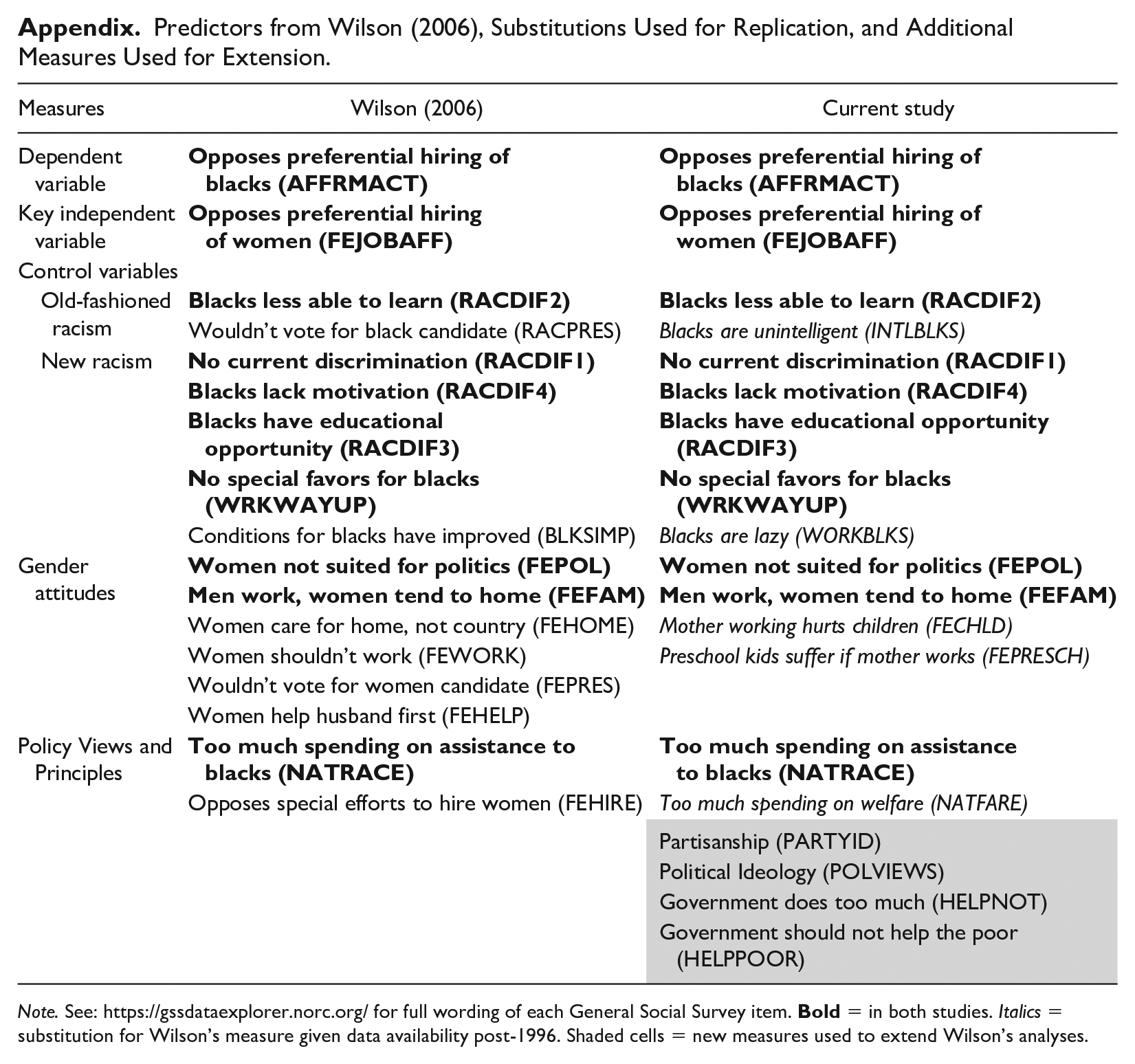
Next, Wilson used regression analysis to examine the determinants of opposition to race-based preferences. Specifically, Wilson regressed opposition to preferences for blacks on opposition to preferences for women and a set of controls. These controls included two indicators of old-fashioned racism (blacks have less ability to learn; reluctance to vote for a black presidential candidate), five indicators of new racism (discrimination does not underlie black disadvantage; blacks lack motivation; blacks do not lack educational chances; conditions for blacks have improved; and blacks do not deserve any “special favors”), six gender attitudes (women should care for the home first; women are unsuited emotionally for politics; wives should not work outside the home; men should work while women tend the home; rejection of a female presidential candidate; and women should help their husbands’ careers first), and two items tapping more general policy attitudes not involving preferences (the belief we are spending too much on assistance to blacks; opposition to special efforts to hire women). A complete listing of these GSS items can be found in the appendix to this article.
Wilson observed that opposition to gender-based preferences significantly and positively predicts opposition to race-based preferences, even when controlling for the other race, gender, and policy attitudes. In addition, new racism measures (but not old-fashioned racism or gender attitudes) also significantly and positively predict opposition to preferences for blacks. 4 While the effects were somewhat stronger among men than among women (suggesting the continued possibility of a self-interest dynamic among men), the fact that the overall patterns of association described above hold for both genders bolsters Wilson’s conclusion that opposition to race-preferences is, at least in part, “based on rejection of group-based preferences generally, independent not only of the other attitudes included in the analysis, but independent also of self-interest or group-interest” (p. 116). It is important to note that the evidence Wilson cites in support of the principled objections perspective is indirect: it rests on the residual correlation between gender- and race-preferences after controlling for the other variables in his regression models. As such, some caution is warranted regarding the degree of confidence we place in the relative explanatory power of the new racism versus principled objections viewpoints based on Wilson’s, and the current, analyses (more on this below).
The Present Study: An Update and Extension of Wilson (2006)
In the present study, we replicate (as closely as is possible) and extend Wilson’s analyses drawing on 10 newer waves of GSS data spanning the first two decades of the current century (2000–2018) (T. W. Smith et al. 2019). Doing so allows us to update Wilson’s estimates of overall levels of support for race- and gender-based preferences, and—more importantly—to see if his conclusions regarding the determinants of opposition to race-preferences persist in data drawn from the past two decades. Such information carries important implications for our understanding of whites’ racial politics and the role of racial attitudes in the twenty-first century workplace (R. A. Smith and Hunt 2020).
Combining multiple waves of the GSS in a pooled cross-sectional analysis allows us to overcome Wilson’s (2006) reliance on a single survey year and a relatively small sample size. Specifically, rather than a few hundred respondents, the GSS surveys between 2000 and 2018 contain several thousand non-Hispanic white respondents with data on the key outcome (race-preferences) and exposure (gender-preferences) from Wilson’s study (see Table 1). In addition, drawing on data from the 1996 GSS, Wilson was limited to the GSS variable RACE in identifying white respondents. In contrast, we leverage information from newer GSS measures of race and Hispanic ethnicity (modeled after 2000 Census questions). Specifically, we selected respondents who identify as white on the GSS variable RACECEN1 and who reported that they were not Hispanic based on the GSS variable HISPANIC. Since persons of color (including Hispanics) tend to be more sympathetic to race-targeted policies such as affirmative action, it is important to focus specifically on non-Hispanic whites in replicating and extending Wilson’s study. 5
In addition to Wilson’s key outcome (opposition to race-based preferences) and exposure (opposition to gender-based preferences), eight of the other 15 predictors Wilson used are available across the 2000–2018 time span we use. In place of Wilson’s other predictors, we made theoretically informed substitutions taking care to populate each of the key blocks of control variables: old-fashioned racism, new racism, gender attitudes, and other policy attitudes. In addition, we examine several additional principle and policy measures (see the appendix for details) to extend Wilson’s analyses for the twenty-first century. The additional (non-preference based) policy views we examine are (1) the belief we are spending too much on welfare programs, (2) opposition to federal spending generally, and (3) opposition to federal spending on behalf of the poor. We also introduce two measures of (ostensibly) nonracial principles and politics: political partisanship (seven-point scale ranging from strong Democrat to strong Republican) and political ideology (seven-point scale ranging from extremely liberal to extremely conservative)—two measures used widely in the literature on racial policy attitudes (Krysan 2000; Sears et al. 1997).
The appendix of the current study summarizes (1) the set of variables Wilson used that are included in the current study, (2) substitutions we made based on data availability, and (3) the additional measures we use to extend the earlier analysis. Following Wilson, we include controls for age, education, household income, and Southern residence in our regression models. 6 In addition, because of our pooled cross-sectional design, we also include a control for year of survey (GSS variable YEAR) in the reported regressions. 7 Following National Opinion Research Center’s (NORC) recommendations, we use the WTSSALL weighting variable in our analyses to correct for the “non-respondent subsampling design” introduced in 2004 (T. W. Smith et al. 2019). Finally, following Wilson, we recoded predictors (where needed) so that higher values consistently represent unfavorable attitudes toward blacks, gender inegalitarian stances, and politically conservative policy views.
To summarize, our pooled cross-sectional analyses using the 2000–2018 GSS offers several improvements over Wilson’s (2006) seminal study. These include substantially larger sample sizes, the ability to isolate non-Hispanic white respondents, and the availability of the key measures required to replicate Wilson’s analyses. In addition, where some of Wilson’s control variables were unavailable in the twenty-first century data, the GSS allows for theoretically informed substitution across Wilson’s key categories of predictors. These strengths, alongside our incorporation of several additional measures of policy support and nonracial principles and politics, allows for an important update of whites’ public opinion on race- and gender-based affirmative action, and a new and more robust test of the principled objections and new racism perspectives, controlling for self- and group-interest.
Results
Table 1 replicates Wilson’s initial analyses for the GSS years 2000–2018, using non-Hispanic white respondents. As with the earlier study, we see strong opposition to both race- and gender-based preferences, among both white men and white women. Specifically, 88 percent of white men and just under 87 percent of white women either oppose or strongly oppose race-preferences, while just under 80 percent of white men and nearly 75 percent of white women oppose or strongly oppose gender-preferences. While these represent slight reductions from 1996 levels, opposition clearly remains quite high in the first part of the current century. Having established that whites’ opposition to both gender- and race-preferences has remained robust, our attention turns to the regression analyses designed to examine the principled objections and new racism explanations of attitudes toward race-preferences.
Tables 2 and 3 report the results of three regression models (listwise deletion of cases) run among white men and white women, respectively. In each table, the first model represents a replication of Wilson’s (2006) model, and contains the gender-preferences item (our primary exposure), the old- and new racism measures, the other gender attitudes, and two policy views. 8 Following this baseline model, we present two additional models to provide a more robust test of the principled objections explanation of whites’ opposition to affirmative action. Model 2 adds in the two nonracial principles measures: political partisanship and political ideology. Model 3 adds two additional policy views: the libertarian viewpoint that the Federal Government “does too much” in general, and opposition to Federal assistance to the poor. Sample size is smaller for Model 3 than the prior models because the final two policy views were included in fewer waves of the GSS between 2000 and 2018 than the other variables we use.
Ordinary Least Squares Estimates of Opposition to Race-based Preferences in Hiring and Promotion (Non-Hispanic White Men, General Social Surveys, 2000–2018).

Note. Standardized coefficients reported. These models also control for age, education, family income, region of residence, and year of survey.
p < .05. **p < .01. ***p < .001 (two-tailed tests).
Ordinary Least Squares Estimates of Opposition to Race-based Preferences in Hiring and Promotion (Non-Hispanic White Women, General Social Surveys, 2000–2018).
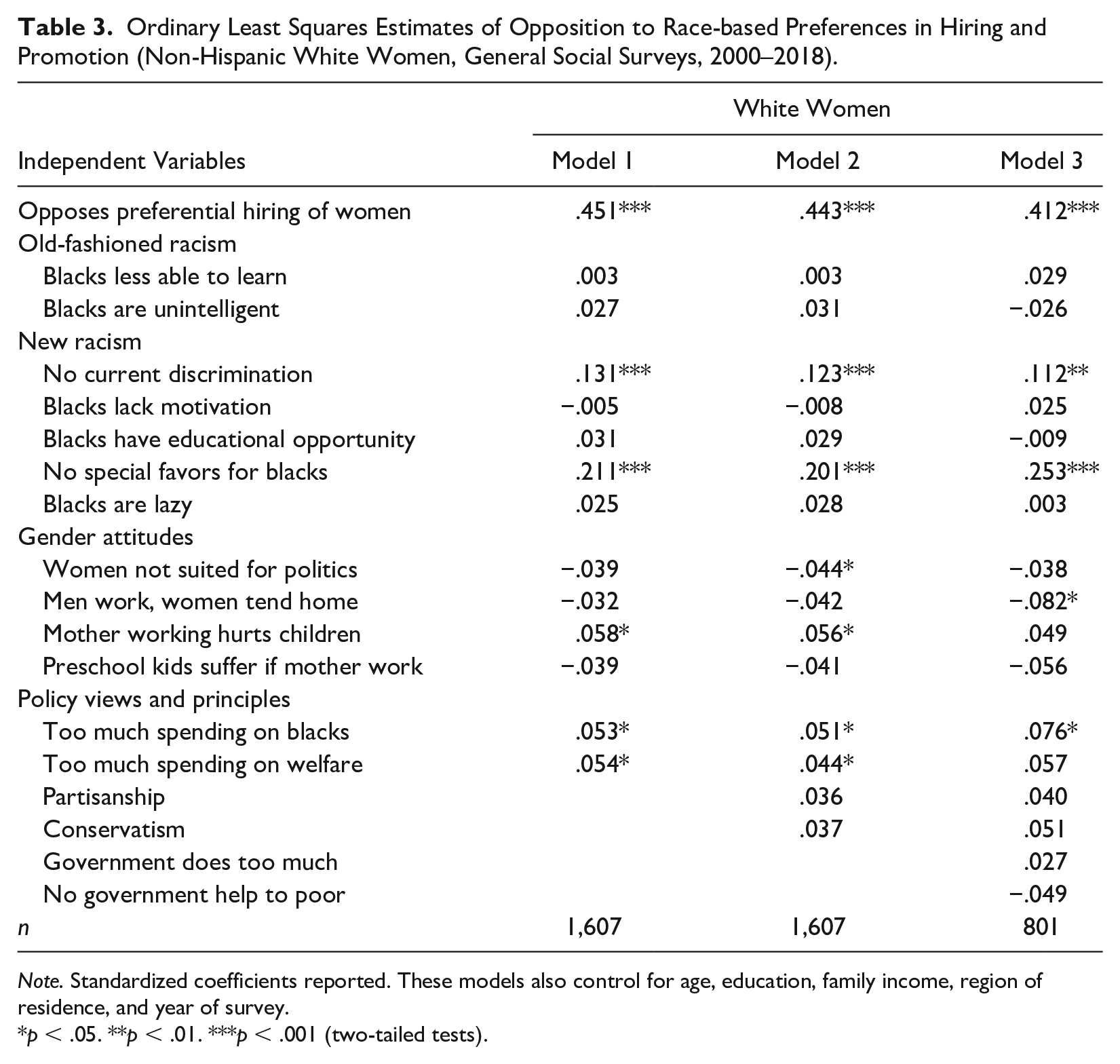
Note. Standardized coefficients reported. These models also control for age, education, family income, region of residence, and year of survey.
p < .05. **p < .01. ***p < .001 (two-tailed tests).
In Table 2, Model 1 shows that, as in Wilson’s study, opposition to gender-preferences is a potent predictor of opposition to race-preferences among white men (B = .399, p < .001). This model also replicates key findings from Wilson: old-fashioned racism predictors do not significantly shape attitudes toward race-preferences but selected new racism predictors do. However, whereas in Wilson’s study only the “no special favors” symbolic racism item was a statistically significant predictor, in the current analyses, both that item and the belief that racial discrimination does not underlie black disadvantage, significantly shape opposition to race-preferences. As in Wilson’s study, none of the gender attitudes significantly affects the outcome in our regression model replicating his efforts. However, unlike in Wilson’s study, the view that the United States is spending too much on assistance to blacks is a significant predictor of opposition to race-preferences (B = .069, p < .01). All told, our initial findings using the 2000–2018 GSS resonate with Wilson’s conclusion that opposition to race-preferences is motivated by both a rejection of blacks and rejection of group-based preferences generally. 9
Model 2 shows that neither political partisanship nor political ideology register significant effects on opposition to race-preferences, nor do these additional controls attenuate any of the Model 1 effects, including the focal correlation between gender- and race-preferences. Model 3, which introduces the final two policy views, tells a similar story. Neither of these additional policy views affects whites’ opposition to race-preferences, nor substantially attenuates the effects of the key predictors’ prior models. Thus, if a generalized and (ostensibly) race-neutral opposition to group-preferences underlies the persistent correlation between views of gender- and race-based preferences, it is apparently not attributable to political partisanship, ideology, or a preference for limited government. Finally, Model 3 suggests that white males who see blacks as less intelligent, and who believe that children are better off with non-working mothers, are more opposed to race-based affirmative action. These effects are limited to our final model (with a more limited sample) but are worth noting given the absence of any effects of old-fashioned racism or gender traditionalism in Wilson’s study.
Table 3 reports the results of the same three regression models run among white women—the key constituency for testing the perspectives under examination without the potential confounding factor of self-interest that exists for white males (Wilson 2006). As with Wilson’s original study, the results we observe for white women are very similar to those seen among white men. Model 1 shows that opposition to gender-preferences has a significant effect on race-preferences (B = .451, p < .001), which is not explained away by the other controls. Furthermore, among the various racial attitude predictors, the key factors are in the new racism category. As with white men, the belief that discrimination does not underlie racial inequality and belief that blacks deserve “no special favors” both significantly and positively predict opposition to race-preferences across the three models in Table 3. Finally, as with white men, the view that the government is spending too much on assistance to blacks consistently and significantly predicts opposition to race-preferences among white women.
Table 3 also shows that none of the new principle or policy views we examine significantly affects opposition to race-preferences, with one exception: opposition to spending on welfare predicts opposition to race-based preferences among white women in two of the three models. Table 3 also reveals some effects of the gender attitudes among white women, although they are small and inconsistent both in direction and in their presence/absence across the three models. Thus, the primary story remains clear: as seen among white men, for white women, the key predictors of opposition to race-based preferences are (1) opposition to gender-based preferences and (2) two of the new racism measures (no current discrimination and no special favors).
Discussion and Conclusion
This article reports the results of an update and extension of Wilson’s (2006) examination of the sources of whites’ opposition to affirmative action in the form of preferences for blacks in the areas of hiring and promotion. Our findings largely replicate Wilson’s in showing mixed support for the new racism and principled objections perspectives, although some caution is warranted given our inability to comprehensively assess either of these theoretical perspectives using the available data. Results among white men and women were generally similar (as in Wilson’s study), bolstering the argument that opposition to group-preferences is a key explanatory factor in understanding whites’ opposition to affirmative action. At the same time, we also see clear support for new racism arguments: both the denial of racial discrimination and the view that blacks should not expect “special favors” in seeking to overcome societal disadvantage significantly underlie whites’ opposition to affirmative action.
Given Wilson’s reliance on indirect evidence for the principled objections perspective, we present a more robust test of this viewpoint by incorporating measures of political partisanship, ideology, and support for limited government into our models. None of these additional measures registered noteworthy effects on opposition to race-preferences. Nor did they meaningfully attenuate the association between gender- and race-preferences that provides the basis for Wilson’s conclusion that opposition to race-targeting is rooted, in part, in (ostensibly) race-neutral opposition to group-preferences in general. While our analysis of 2000–2018 GSS data still supports Wilson’s basic argument, we are able to show that any principled basis for opposition to race-based preferences likely resides in nonracial principles we were unable to model, including abstract individualism, egalitarianism, and fairness/justice beliefs (e.g., meritocracy). Future research should address this possibility.
Several of the shortcomings of Wilson’s study persist in our own. As he noted, the GSS does not include a full set of “symbolic racism” items (Sears 1988), nor a complete set of any other new racism scales (e.g., racial resentment). Future work should seek to model these processes with a more complete set of such predictors. Also, as with Wilson’s study, we are unable to rule out the possible role of implicit attitudes and/or other unconscious processes that “are virtually impossible to measure in survey research and must be addressed instead by using experimental designs” (Wilson 2006:116). We also note the possibility of social desirability bias as a limitation to survey-based approaches to understanding racial policy attitudes (see, for example, Bonilla-Silva 2006). Finally, regarding our outcomes, as Wilson (2006) noted, the GSS only allows for modeling of race- and gender-preferences in the area of employment. A complete test of the perspectives under examination would benefit from measures of opposition to group-preferences in the educational arena (e.g., admissions) and possibly other societal realms.
While we were unable to provide a perfect replication of Wilson’s (2006) study owing to data limitations in the GSS from 2000 to the present, we were able to use identical versions of his outcome variable (race-preferences), his primary exposure (gender-preferences), and eight other predictors distributed across key categories. In addition, we used theoretically relevant substitutions for his other predictors, incorporated additional measures of policy views and nonracial principles/values, and refined the measurement of race/ethnicity using twenty-first century updates in the GSS. Our resulting pooled cross-sectional analysis has produced an important and statistically robust update to our knowledge regarding non-Hispanic white Americans’ beliefs about race-based (and gender-based) affirmative action in the twenty-first century.
Footnotes
Declaration of Conflicting Interests
The author(s) declared no potential conflicts of interest with respect to the research, authorship, and/or publication of this article.
Funding
The author(s) received no financial support for the research, authorship, and/or publication of this article.

Notes
Appendix
Predictors from Wilson (2006), Substitutions Used for Replication, and Additional Measures Used for Extension.
| Measures | Wilson (2006) | Current study |
|---|---|---|
| Dependent variable |
|
|
| Key independent variable |
|
|
| Control variables | ||
| Old-fashioned racism | (RACDIF2) |
(RACDIF2) |
| Wouldn’t vote for black candidate (RACPRES) | Blacks are unintelligent (INTLBLKS) |
|
| New racism | (RACDIF1) |
(RACDIF1) |
(RACDIF4) |
(RACDIF4) |
|
|
|
|
|
|
|
|
|
| Conditions for blacks have improved (BLKSIMP) | Blacks are lazy (WORKBLKS) |
|
| Gender attitudes | (FEPOL) |
(FEPOL) |
(FEFAM) |
|
|
| Women care for home, not country (FEHOME) | Mother working hurts children (FECHLD) |
|
| Women shouldn’t work (FEWORK) |
Preschool kids suffer if mother works (FEPRESCH) | |
| Wouldn’t vote for women candidate (FEPRES) | ||
| Women help husband first |
||
| Policy Views and Principles |
|
|
| Opposes special efforts to hire women (FEHIRE) | Too much spending on welfare (NATFARE) | |
| Partisanship |
||
| Political Ideology |
||
| Government does too much |
||
| Government should not help the poor (HELPPOOR) | ||
Note. See: https://gssdataexplorer.norc.org/ for full wording of each General Social Survey item.