



Abstract
Social capital theory offers a compelling explanation as to why people are committed to making resources available to others outside of formal institutions. In this article, we build on social capital theory to explain how actors overcome two practical problems endemic to these resource transfers. We present Viviana Zelizer’s relational work theory as a complimentary framework which accounts for when an individual may act on commitments to offer resources and which commitments to act upon when they are in conflict. Drawing on our empirical work on almsgiving to social outcasts and resource transfers at mourning ceremonies in Azerbaijan, we describe how people identify and ascribe their relationships to others by relying on available cultural conventions to mark economic transactions and other media as appropriate or inappropriate. By conceptualizing social capital in this way, we also obtain a process-tracing methodology useful for social researchers and for community activists to generate ideas on how to expand social capital in their own or others’ communities.
Introduction
Under what circumstances do people give resources to non-kin? Social capital theory, which posits that social connections have material value, offers a compelling account as to why these transfers might take place outside of self-interested market exchange. While there are certainly points of contention within this literature, broadly social capital theorists agree that trust facilitates transfers, and when trust is absent, normative commitments may achieve the same ends (Bourdieu 1985; Coleman 1988; Portes 1998, 2010; Putnam 2000). For example, people may give money to a neighbor in need because they trust them to repay or they may give simply because that is the proper thing to do, even if they distrust the neighbor.
Yet, social scientists routinely observe social capital in low trust communities—such as strangers giving alms to stigmatized outcasts, or near-strangers providing financial and emotional support for bereaved families. Consider the Republic of Azerbaijan, which like many post-Soviet societies (Mishler and Rose 2009; Sapsford and Abbott 2006) is in a region epitomized by generalized distrust (Hasanov 2009; Pearce, Barta, and Fesenmaier 2015). In the 2011–2012 wave of the World Values Survey, only 15% of Azerbaijani respondents perceived “most people can be trusted,” which is extremely low. To provide context to this measure, “high trust” countries such as the Netherlands and Sweden have around 60% of people responding in the affirmative, while “low trust” countries such as the United States have just 34%—a figure so low that Putnam (2000) considered it concerning. In our fieldwork in Azerbaijan, as accurately predicted by social capital theories, we find social capital largely confined to extended kin-networks where trust could be cultivated and grounded in instrumental expectations of intergenerational and intertemporal reciprocity. And yet, despite low generalized trust, we also observed the systematic transfer of resources outside of such extended kin-networks, including in instances of interpersonal distrust and where expectations of reciprocity were either unimaginable or extremely unlikely. Why would someone help strangers or remote kin under circumstances so distrustful that reciprocity is inconceivable?
In this article, we build on social capital theory to provide a complimentary interpretation for why people provide resources to one another in the absence of trust or clear norms. Drawing on original fieldwork, this article demonstrates the enduring problems of when and which: (1) when an individual may act to offer resources and (2) which commitments to act upon when those commitments are in conflict. We describe how Viviana Zelizer’s (2005, 2012) relational work analysis provides both a theory and a methodology for addressing these two problems. Specifically, by conceptualizing social capital as a byproduct of relational work, we can enrich the social capital literature by explaining how and why actors are able to access resources and why alters are motivated to provide them. We demonstrate this theory with two theoretically informed ethnographies. First, we reconsider almsgiving, an example of social capital suggested by Alejandro Portes (1998: 7), and then apply the framework to mourning ceremonies, another paradigmatic situation in the literature. Not only does this reexamination of social capital theory permit us to better understand the empirical puzzles of which and when, but it moves applied sociologists forward by reconceptualizing community development work as relational work, with important implications for activists working in places and social situations characterized by low trust.
Portes’ Four Sources of Social Capital
Adopting Portes’ (2010: 27, see also 1998; Portes and Sensenbrenner 1993) definition, social capital is “the ability to gain access to resources by virtue of membership in networks or larger social structures.” An actor possesses social capital when others are motivated to provide that actor with resources on concessionary terms (Portes 1998: 7). This understanding of social capital is inclusive of Putnam (2000: 16), Bourdieu (1985: 248), and Coleman (1988: S98). Portes identifies four motivations for providing resources to others: reciprocity exchanges, enforceable trust, childhood social norms, and bounded solidarity.
The first two motivations are instrumental—as means to pursue another end. In
The two remaining sources are characterized by non-instrumental consummatory motivations (Portes 1998: 7)—as an end in itself.
In our empirical analysis, we argue that instrumental explanations of extra-familial resource transfer are particularly weak in Azerbaijan, where trust of reciprocity is low. Consummatory motivations, in contrast, do offer potential explanations. Norms and bounded solidarity provided explanations for why someone may offer resources; however, actors also encounter two additional empirical problems. The problem of
Our fieldwork and our interpretation of relational work theory (Zelizer 2005, 2012) finds that execution and adjudication are prosaic events for agents as they consider offering resources to those in need. Therefore, we cannot explain generosity to strangers or other altruistic behaviors in a distrustful environment solely with reference to the internalization of norms from childhood, religion, or social struggles. By empirically wrestling with this issue, we discovered that relational work theory provides a process for making sense of how social capital emerges not only from norms, but from all four motivations that Portes (1998, 2010) had identified.
Relational Work Theory as the Complementary Inverse to Social Capital Theory
Social capital theorists define their subject as contingent access to resources from social connections. Relational work theorists (e.g., Bandelj 2012, 2015, 2020; Block 2012; Rossman 2014; Wherry 2012; Zelizer 2005, 2012) approach in the opposite direction—defining as their subject the work involved in creating, maintaining, and dissolving social ties and noting the resources (“media”) exchanged as a byproduct of this relational work. This article’s central argument is that these two theories are complementary to one another in a fashion not previously recognized.
Zelizer’s (2005, 2012) theory of relational work is situated within Weber’s interpretive economic sociology (Swedberg 2007). For both Weber and Zelizer, all relationships—including economic, intimate, and intimately economic relationships—are infused with meaning by social actors. “For Zelizer, this meaning includes the understandings of what kind of symbols, practices, and media of exchange is appropriate for different kinds of relationships” (Bandelj 2012: 176). Zelizer terms this a relational package (see Figure 1). Zelizer defines as relational work the efforts people exert to create, maintain, differentiate, or terminate their social relationships with one another: For each meaningfully distinct category of social relations, people erect a boundary, mark the boundary by means of names and practices, establish a set of distinctive understandings and practices that operate within that boundary, designate certain sorts of economic transactions as appropriate for the relation, bar other transactions as inappropriate, and adopt certain media for reckoning and facilitating economic transactions within the relation (2005, 32). Relational package.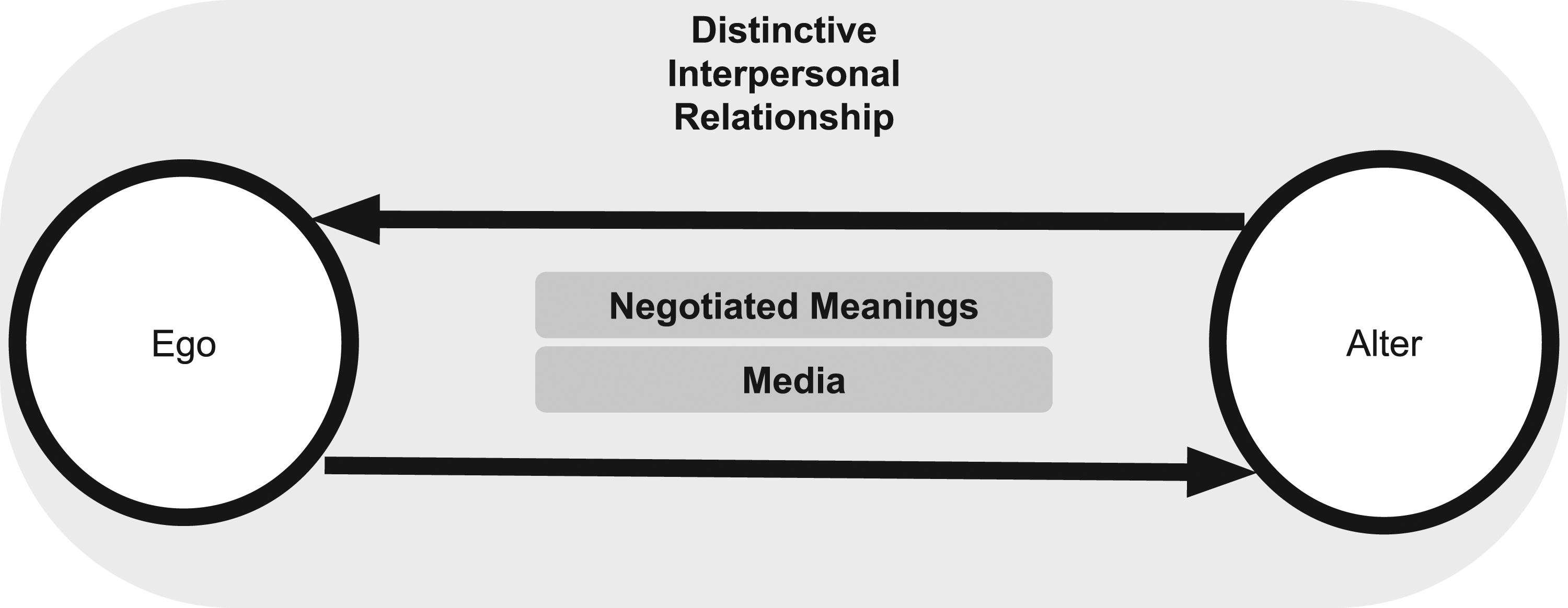
When actors exchange resources, they do so as a byproduct of their relational work; they do so to provide meaning to their relationship, to shape the understandings and practices of that relationship, and to erect boundaries around who is inside or outside of the relationship.
Relational work does not occur in a social vacuum; parties conduct relational work within cultural templates. To understand why and under what circumstances actors give media to others (or conversely, why actors have access to others’ media), relational work theory suggests that actors use this media to define and accomplish social relationships, always within the adaptable templates of relational packages. Adjudicating between competing norms and deciding when it is appropriate to execute on normative commitments is fundamentally intertwined with the kind of relationship the parties are attempting to create, maintain, or dissolve. Such relational work can be both instrumental and consummatory, as well as scripted and unscripted (Bandelj 2015: 236; Block 2012: 137), and therefore provides a broader framework within which to situate social capital (Emirbayer 1997).
For example, in Purchase of Intimacy, Zelizer (2005: 56) asks us to consider “persons X and Y [who] call each other ‘sweetheart,’ engage in transfers of information, advice, gifts, financial aid, and occasional sex, using the telephone, Internet, and money as their media.” However, “sweetheart” is only one of many possible social categories in which “men and women differentiate among relations involving the fact or possibility of sexual intimacy” (2005: 57). Other categories include dates, hook-ups, fiancés, escorts and clients, prostitutes and johns, or actors in a pornographic film. In relational work theory, the relationship’s category is often not self-evident; it requires continuous effort by the parties to reaffirm, negotiate, alter, or dissolve. To do so, both parties attempt to match symbols, practices, and media of exchange that are appropriate for the relationship. For example, people use economic transactions and media to mark their relationship as “sweethearts” rather than similar, adjacent categories such as “dating” or “a hook up.” Such relational work is materially consequential. Zelizer (2005: 57) notes that “all of these relations include distinctive economic transactions determining who pays, how, when, for what, at what time, how much, how often, for how long.”
We can understand relational work theory as the complementary inverse of social capital theory. Social capital theory investigates the circumstances under which an actor has access to resources from a social network. For example, under what circumstances do people have social support from their sexual partners? Relational work theory investigates the effort people exert in clarifying, maintaining, and ending relationships, as well as the potentially valuable media that may be exchanged as a byproduct of that relational work (Chen and Roscoe 2017; Stivers and Berman 2020; Wherry et al. 2019). For example, as men and women negotiate with one another whether they are sweethearts, hookup, or dates, valuable resources may be given or blocked as a byproduct of this effort.
In the following analysis, we begin by reconsidering Portes’ example of almsgiving (1998: 7). In our case of giving alms to socially stigmatized beggars in Azerbaijan, norms offer a partial explanation as to why someone may give, but we must go beyond norms to understand when to act on a commitment (execution) and which commitments to act on (adjudication). We then introduce relational work theory and reconsider almsgiving in Azerbaijan as a culturally specific “relational package” appropriable by a pariah ethnic minority as a source of social capital. Next, we consider an institution that provides material support following a death in the family, which the social capital literature commonly interprets as resulting from bounded solidarity. In the case of yas mourning ceremonies in Azerbaijan, potential attendees must nevertheless work through the empirical problems of execution and adjudication. By conceptualizing the yas mourning ceremony as an adaptable, culturally specific relational package that potentially generates resources, we are able to offer a parsimonious explanation for the instance of social capital.
Data and Methods
This article is derived from a broader research project on forms of social support in Azerbaijan. The first author conducted multi-method ethnographic fieldwork over 1 year in four communities in Azerbaijan (Stoltz 2014). He completed twenty in-depth, semi-structured ethnographic interviews, multiple discussions with 10 key informants, three focus groups, and participant-observation. We also consulted secondary data from the Azerbaijan State Statistical Committee, Caucasus Research Resource Center, World Bank, and various news sources.
The interviews included four households in a rural town, mostly Georgian; three in a mountain town, predominantly Avar, and six in a regional center, mostly Azeri. The semi-structured interviews drew on Spradley (1979) and focused on “what people do when bad things happen.” Additionally, focus groups aided in cross-checking findings, reassuring proper translations of key ideas and offered “folk models” to interpret emerging themes (Morgan 1996). In interviews and discussions, participants discussed many forms of social support (formal and informal). The authors specifically coded instances in which resources were transferred in the absence of trust.
Azerbaijan is a troubled region, and therefore it is tempting (i.e., theoretically overdetermined) to explain instances of social capital as derived from bounded solidarity—the non-instrumental support strangers may provide one another who are facing a common adverse environment. Although bounded solidarity may be a common feature of socially disordered times and places, this does not imply that disconfirming cases are entirely non-existent. As a theoretical sampling strategy (Small 2009b), we therefore conducted research on almsgiving to pariah groups—a social institution that is interpreted by both participants and scholars as not plausibly explained by bounded solidarity. To explore the generalizability of our findings, we then extended our theoretical sampling to mourning ceremonies, an established example of social capital.
Case I: Almsgiving
In Azerbaijan, despite strong distrust of beggars and moral ambiguity surrounding almsgiving, very often people do give. Consonant with a region of low generalized trust, in Azerbaijan only 17% said they “made a contribution to charity in the last six months,” and less than a third donated “for religious purposes.” However, 75% gave money to a beggar in the last 6 months (Caucasus Research Resource Center 2012). At the time of fieldwork, beggars typically belonged to a large ethnic minority, the Qarachi 1 , who most deemed dishonest and undeserving. Nonetheless, a large portion of people do give when encountering the begging Qarachi.
For Portes, almsgiving is a paradigmatic example of social capital originating in norms internalized during childhood. He explains that people “give alms to charity… because they feel an obligation to behave in this manner… [S]uch behaviors… are then appropriable by others as resources” (1998: 7). Below, we briefly describe the cultural conventions surrounding begging in northwest Azerbaijan and emphasize that the Qarachi receive alms despite generalized and interpersonal distrust of the Qarachi by almsgivers. Next, we outline the ways Portes’ four sources of social capital offer partial explanations for the Qarachi’s social capital which must address the empirical problems of adjudication and execution. We then argue that the Qarachi’s social capital can be more fully understood as a byproduct of relational work between almsgivers and supplicants.
Almsgiving and Portes’ Four Sources of Social Capital
Nearly every day of the week, in a regional center in northwestern Azerbaijan, beggars and money changers are a common sight in the short space between the open-air market and central bus station. The first author encountered the beggars periodically throughout his weekly routine either shopping in the market or traveling by bus. On four occasions, he systematically observed their supplications and interactions with pedestrians at the market, and on three occasions at the bus station. There were 9 to 11 beggars that traveled from a remote region nearby to the larger transportation hubs via bus on most days of the week. All were women save for two young boys that occasionally accompanied the group. Most encountered and interpreted them as Qarachi, an ethnic category associated with dilenchi (beggar), but distinct from “forced” beggars such as shikest (disabled), or dervishlar (mendicants). Homelessness in Azerbaijan is a rare sight, and most informants believe the Qarachi do have homes. Despite this, it is widely assumed that this ethnic group chooses to incorporate begging into their lifestyle.
On one overcast afternoon, a middle-aged woman held out her hand toward no one in particular and chanted, “God bless you,” or “You are beautiful and kind, may God keep you that way.” Many people pass and many give. The woman repeats God’s blessings, almost to the point of rhythmic chanting, in unison with the surrounding moneychangers. A bus unloads a group of 10 women from a nearby village; they descend on the shopping center, each giving a few coins to the begging Qarachi women while chatting amongst themselves. That day many people offered, handing coins pinched between two fingers into the palm of the Qarachi woman. Never making eye contact, she replies “Allah qorusun” (May God protect).
Few participants believe these beggars can be trusted. The Qarachi are considered even less trustworthy, and their very destitution is questioned. Most interviewees described them as potential thieves, liars, poor parents, or otherwise deviant. It was common for participants to describe the actions of Qarachi as a thinly veiled charade. For instance: You do not know why they [the Qarachi] are collecting the money… for example they might be doing it as a business. But with [other] poor people, you are giving money and you know they are poor and need something to eat. (Shelale)
Another informant (Ramash) claimed, “They [Qarachi] have much money, and only try to seem poor,” he added “everyone knows this about them.” Most participants consider this transaction with skepticism but, often quoting the duty of Muslims, believe there is a moral imperative to help the needy. However, there was much uncertainty as to whether the Qarachi were needy and whether almsgiving helped them. When informants were asked why they had given to beggars, typical responses included, “I felt bad,” “God had been good to me, I should be good to others,” “these are tough times for everyone,” and “it is our duty to help the needy.” Importantly for our argument, many interviewees who said they gave also thoroughly questioned the trustworthiness and neediness of the recipient.
Drawing on Portes’ framework, what is the origin of this social capital? Almsgiving patently cannot be a case of interpersonal or intergenerational Before he died, my father brought a bag of flour to a poor family... Leaving it inside the gate, he returned without saying anything. My mother asked him where he went, where he brought the flour, and he did not say. That person never knew who gave them flour. (Arshad)
Similarly, in a focus group, one young Azeri woman stated (with the other participants in agreement): You must ask your heart… give from your heart… It means you must believe it wholly: you must not give with ill-intentions; you must not show off; you must not give because you are pressured; you must not give because people are critical of you, and you must not give because you want people to think you are a good person. You must give and forget. (Kamila)
As they understand it, donors should delight in the presentation of an opportunity to give from the heart. The Qarachi offer such an opportunity, however problematic.
This case is also poorly explained by
The remaining source in Portes’ framework is
Below we argue that the extra-familial social capital materializing in almsgiving arises as a byproduct of relational work conducted in culturally specific relational packages. Such an explanation does not supplant, but rather complements Portes’ argument by addressing adjudication and execution. Participants engage in relational work to attempt to reconcile conflicting moral commitments, personal histories, and various categories of membership, in order to form viable “relational packages.” When the media within relational packages is materially valuable, social capital theorists would recognize this as a resource transfer—and all such transfers take place within the context of relational work.
Almsgiving as Relational Work
The opportunity to conduct relational work takes place as a “performance circuit” between pedestrians and supplicants (Wherry 2012). To propose eligibility, beggars engage in an appropriate drama, displaying the suitable mix of scripts and cultural know-how to create a sense of despair. Observations of beggars in the streets of London and Bristol also rings true for northwestern Azerbaijan: “The speech of beggars to passers-by seldom consists in agonized cries, screams, and wails but is characteristically a chant or recitative prayer” (Dean 1999, 128). Considerable effort is involved in walking this fine line—violating the stranger’s expectations of civil inattention, but only offering an arms-length tie in its place.
Beggars and passers-by (attempt to) maintain the expectations of the situation through relational work and construct culturally viable “relational packages” involving coins as media, thereby effecting a transfer of resources. Participants form a connection with relevant and meaningful categories (beggar and almsgiver) which invokes an appropriate transaction of coins (sedege vermek).
The beggar’s social capital is restricted by these locally available relational packages. The pedestrian may harbor many resources, most of which are not made available by the relation with a beggar in the context of the performance circuit. In Azerbaijan, the resource is a few coins, and is symbolically packaged as “sedege,” discussed in the Quran. Importantly, sedege is voluntary, as opposed to zakat. Zakat is an obligatory annual tithe accompanied by a strict set of rules. There is no set amount or schedule for giving sedege, and it is reserved for moments where the giver is emotionally moved. Participants believe being a good person means aiding the needy, but in the case of sedege it is also important that one do so voluntarily and with sincerity.
When describing their motivations to give, participants police the meaning of the transaction. Although the offering is almost always a small amount, participants associate this with the generosity that sedege connotes. Furthermore, when discussing the reasons Azerbaijanis gave alms, participants refer to the importance of ureyindan vermek, or “giving from your heart.” With just moments to decide, the pedestrian must solve this moral dilemma. In fact, spending too much energy deliberating over whether to offer sedege would challenge the very commitment to give from the heart.
Relational work theory emphasizes that producing a “relational package” involves matching the media exchanged and the relation attempting to be enacted. Naturally, mismatches occur. Although the beggar invites a relation with two possible roles for the pedestrian, this relation is not always shared. The pedestrian may misunderstand or even challenge the invitation by attempting to create a new relation. For instance, while discussing almsgiving with an informant (Tural) and his friends, one of these friends (an early thirties man) stated he gave once, but only because she was (in English) “a smoking-hot miss.” This narrative joined the deviance of the Qarachi woman with the deviance of a prostitute. While the Qarachi woman was trying to accomplish the beggar-almsgiving relation, the man was giving coins to recast the transient relationship into another kind of category. Rather than giving sedege, he was paying for a fantasized sexual performance.
In order to trace the process by which donors adjudicate between competing norms of giving from the heart and giving with sincerity, and when to execute on the normative commitment to help the needy, the analyst must account for the kinds of relations interactors are attempting to accomplish. In our argument, beggars have social capital insofar as they gain resources by virtue of accomplishing specific social relations. The valuable media obtained by the beggar in the course of relational work is delimited by the relational package being enacted. Next, we generalize our intervention to a more familiar case of social capital: the giving of resources to a bereaving family.
Case II: Mourning Ceremonies
Burial societies, mourning ceremonies, and other funerary institutions illustrate social capital because resources flow toward the bereaving family and the dead by virtue of social relations (Dercon et al. 2006; Kuehnast and Dudwick 2004: 72–74; Narayan-Parker and Pritchett, 1999; Ngwenya, 2003). For example, in South Africa, Verhoef finds that local burial societies persist because people “rely heavily on the social capital of the organization to facilitate [their] complex funeral needs” (Verhoef 2008: 59–60). Collective funeral arrangements are such a well-established form of social capital that participating in them is often included in questionnaires intended to measure social capital (e.g., Grootaert 2004).
What makes the Azerbaijani mourning ceremony (yas) a compelling case for theoretical investigation is that contrary to the social capital literature’s expectations, it is not premised on interpersonal or generalized trust. Consequently, as we detail below, Portes’ instrumental sources of social capital poorly describe the yas, leaving the consummatory sources which, as we have argued, confront the empirical problems of adjudication and execution.
The Yas and Portes’ Four Sources of Social Capital
Large, multi-day mourning ceremonies are widespread in the Caucasus (cf Altman 1983, 56). In Azerbaijan, a person’s passing is honored by days of mourning, involving four or five yas ceremonies over the course of 40 to 52 days. Each ceremony can be attended by several hundred people. Altogether, 500–1000 people attend and offer respect (hormet elenmek). The bereaving family anticipates providing an appropriate meal (ehsan) for all attendees. Hosting is obligatory and creates a substantial economic burden for the family. Participants estimated that food costs range from 2 to 4 months’ salary (cf Bayramova 2001; Philomena 2011). Despite social pressure to keep funerals modest, providing the proper meal is difficult for most. In a culture where being hospitable (qonaqperver) is highly valued, this is a household project comparable in expense and importance to wedding ceremonies.
To offset this economic burden, some attendees donate food or cookware, but attending usually involves donating cash—5 to 20 manat (US$6–25) is typical. Generally, one person—acting as a de facto representative of a family, workplace, or other group—offers the money. The amount offered corresponds to each member of the group, but also the nature of the relationship between the group, the bereaving, and the recently departed.
Attending a yas, and its expected cash transfer, is a ubiquitous experience for Azerbaijanis. A typical household anticipates attending up to a dozen yas in a year, and nearly every interviewee has borrowed money from other people in order to offer it at a yas. Furthermore, people attend yas that are not only geographically distant, sometimes traveling many hours across rough roads, but also socially distant, on occasion for people they have never before met.
We find the case of the yas theoretically interesting as people give even in the absence of both generalized and interpersonal trust. For many, the obligation does correspond with intimacy and trust toward the deceased and bereaving. However, because the yas brings together an expansive network of many hundreds of people, it is unlikely that all attendees will have had such a relationship. In the very different cultural context of South Africa, Bähre makes a similar argument against romanticized views of social support by describing neighbors attending the funeral of a reviled person. Although “respect and disgrace were intermingled at the wake” (2007: 45), many people attended and even gave money, albeit only a little. Bähre’s example, and our data, support the argument that access to social capital is not contingent on preexisting goodwill or trust. In such cases, the moral obligation to help the grieving is potentially at odds with the equally important commitment to sincerity (ureyindan)—a strain which interviewees overtly adjudicate.
From participant observation, interviews, and focus groups, we have induced two explanations for why informants felt compelled to overcome their disfavor or great geographical distance to attend a yas, despite the culturally available justification for not attending due to ureyindan.
First, the deceased and bereaving families are perceived as morally-in-need, and therefore requiring assistance, regardless of personal qualities. As one interviewee (Arshad) describes: “It doesn't matter if [he/she] lives good or bad; [he/she] is poor or rich. It’s necessary. It’s law. It’s people’s law, not state law. It’s unwritten.” Another interviewee (Hasad) makes a similar point: “It doesn’t matter who died, if [his/her] family is rich or not.” The bereaving family is also morally-in-need, which means bereaving households’ wealth, record of reciprocating, and trustworthiness are not considered viable reasons to avoid offering condolences or giving money. “In general,” another interviewee (Arshad) stated, “we feel indebted to the family who has lost someone. We feel we owe them… it is necessary to give.” While some participants stated that other people might avoid a yas, all emphasized that they would attend a yas regardless of their feelings unless they could offer a legitimate excuse. However, it is noteworthy that most participants struggled to offer even a hypothetical situation in which they would not attend a yas.
Secondly, a funeral is understood as a time when people set aside past transgressions. When asked if people would still attend a yas when they did not trust the deceased, Shalale explained: Yes, some people still go. It depends… what was the connection (elege) with that person. For instance, if you were close (yakin) before, you will still go. But, if you really do not like them … you have a lot of hate, you won’t go.
After consulting her mother, she elaborated that if harboring feelings of distrust toward the deceased, “[attending] would mean, ‘I forgive you, may God forgive you’ or [they] might say ‘I have paid my debt, as God has instructed.’” This accounting narrative allows people to participate in a yas while reconciling their feelings of distrust or even hate for the deceased. Bähre (2007, 48) offers a similar sentiment from a speech at a wake in South Africa: “Even if you have fights or other problems, this is the time to put that aside because you are confronted with a funeral.”
In sum, our participants often wrestled with adjudicating between the competing moral commitments between the desire to attend a yas with sincerity and the often conflicted or weak social ties they felt to the dead and the bereaving. Having observed such conflicted motivations, it appears that interpersonal trust is not a precondition for attending a yas and offering money. Moreover, this case of social capital is poorly explained by Portes’ four ideal-typical sources.
Recall that Portes identifies two sources of social capital that are instrumental. On one hand, it is important to stress that participants deny an explicit instrumental motivation in attending a yas. Nevertheless,
However, two strongly inferred social facts rule against these instrumental interpretations. First, the people who choose to attend a yas do not comprise a closed network conducive to reciprocity exchanges or enforceable trust (Coleman 1988). Participants were willing to attend yas that were socially and/or geographically distant, so that the possibility of reciprocity is unrealistic. For example, participants traveled several hours to attend the yas of secondary and post-secondary schoolmates whom they had not spoken with for years, workmates from past jobs, former friends, or even friends-of-friends who have few or no connections with others in their household or community.
Even more damaging to this interpretation is that (with the partial exception of shaming behaviors) defectors are not sanctioned—informants willingly attend the yas of defectors. For example, when Raghima was asked if he would go to the yas of someone who he did not expect to reciprocate, he responded without hesitation, “Yes, of course.” Although people discussed others avoiding a yas, all interviewees agreed they would still attend a defector’s yas. Participants’ narratives accounting for attending the yas of defectors echoed the belief discussed earlier that all bereaving families are morally-in-need. As one interviewee (Ruslan) explained, “We don't separate people from each other. We help all.” In sum, participants understood the concept of defectors and reciprocity, but they nevertheless felt obliged to give to defectors.
Portes also identifies two sources arising from consummatory motivations, in which people “feel an obligation to behave in this manner.” The first is an
In the case of the yas, explicit deliberation was frequently present because one cannot attend every funeral of which one is made aware, and thus must decide when one is obligated. We observed one Azerbaijani family wrestling with this decision. The matriarch of the family used her age and health, the distance and the fact that the deceased was only related by marriage to justify avoiding. Although adamant that she did not want to attend, she suggested her daughter go instead. The daughter protested, stating that the bereaving household was “medeniyyetsiz” (uncivilized), a common insult. She attempted to strengthen her case by inferring that this yas would be ostentatious, which, she argued, went against the Quran—which highlights the problem of adjudicating between different values. The daughter went regardless with cash and food, making the journey from the regional center to a town an arduous hour away, on rough roads in cramped mini-buses.
The problem of adjudication is particularly grave in explanations relying on bounded solidarity. In
Specifically, Azerbaijanis can justify attending or avoiding a yas by emphasizing or obscuring one’s common family, ethnicity, friendship or a shared region. As one would expect in a region with low generalized trust, kinship is Azerbaijanis’ most salient identity in bounded solidarity. Kin ties are also central in narratives of justification for attending a yas; so much so, that close friends are very often considered fictive kin (Ebaugh and Curry 2000). The elasticity of kinship boundaries applies similarly to other group identities that can be emphasized or submerged as participants consider whether to attend a yas. For example, depending on which lineage people acknowledge at a given moment, individuals activate multiple ethnicities. Another, perhaps even more important signifier of solidarity is place identities. Azerbaijan is well-known for the importance of “yerlibazlik” or regionalism (Altstadt 2003: 11; Bolukbasi 2011: 7; Heyat 2005: 185), which can be expanded and contracted depending on the situation.
Therefore, we find that reciprocity exchange, enforceable trust, norms, and bounded solidarity offer either poor or partial explanations for the social capital at the yas. Given the economic importance of the yas as a risk-diversifying and resource-redistributing institution in Azerbaijan, as well as the ubiquity of such mourning ceremonies in societies worldwide, it is important to offer a more complete explanation for these instances of resource transfer. We propose that relational work parsimoniously explains this paradigmatic form of social capital.
The Social Capital From a Yas Is a Byproduct of Relational Work
At the yas, family and visitors offer a variety of media—prayers, lamentations, flowers, food, cash and labor—all in the act of giving condolences (bashsaghlighi vermek) and offering respect (hormet elenmek). In addition to the specifications of viable resources, participants also “designate[d] certain sorts of economic transactions as appropriate for the relation” (Zelizer 2012: 142). For instance, when giving cash Azerbaijanis do not use the verb “to give” (vermek) because it is perceived as rude in this context. Instead, they use “to put” (qoymaq), an obscuring word that emphasizes that the gift is “put” at a location rather than “given” to a person. Sometimes people will use the even more obscuring, “to be caused to write money (at a yas)” (pul yazdirmaq). These linguistically mark the boundaries of the transaction, as money is passively directed toward the yas, rather than actively directed by a person. The boundaries of this transaction, and the media involved in giving condolences, aid in defining the relation between the dead, bereaving and those who “put” money. Moreover, it is through the reproduction of these transactions and the accomplishment of the various relations that the yas as an institution is itself reproduced.
Another central aspect of relational work are the practices and understandings facilitating the transfer of media, while marking the distinctiveness of the relations involved. At each yas, a male friend or relative sets up a special table near but out of the way of arriving guests. Typically, a patriarch stands in line to “put” money on behalf of the household. Cash is put in a jar that is wrapped in a bag to obscure the amount. The friend or relative carefully records in a small paperback notebook the full name of the patriarch and the amount given. However, depending on the nature of the relationship between male attendees and the deceased or the bereaving household, another male member may represent the household and “put” the money, in which case the name of the patriarch is recorded alongside the name of the giver. In addition to household representatives, additional household men may join the line and “put” additional funds. Furthermore, workplaces will often hold a collection, where the closest or the most available person (often a man) attends and brings the collection.
As is common in relational work, “putting” is gendered. Interviewees noted that most women will give a smaller amount of 5 or 10 manat. Contrary to the somewhat removed manner that men “put” money in the jar away from the bereaving men, women put money from their own hands directly into the palms of the bereaving women. An informant (Shelale) described the exchange as typically obscured by another action, such as hugging or kissing. Moreover, the banknotes are often rolled up, and rather than bringing the exchange to eye level, it is kept low, near the hip. Here, it would be socially inappropriate for the recipient to visibly count the money, in stark contrast to the money “put” by men, counted and recorded in the notebook.
The money “put” by women is never recorded, unless a woman joins the men’s line leading to the special table. In the men’s line, recording the names and numbers is important to link the amount put to a concrete social relation. As an older interviewee stated (Hasad), without the notebook “that person whom we help…maybe he will see that 100 manat [from the poor man] and that 10 manat [from the rich man], maybe he will assume the 100 manat is from the rich man.” Interviewees were uncomfortable when it was suggested that people might use the notebook to hold others accountable; this response was surprising as people frequently joked comfortably about others doing so at wedding parties.
Relational work also involves “bar[ing] other transactions as inappropriate” (Zelizer 2012: 142). We have already mentioned one such prohibition—the cash put is not understood or discussed as a gift (heddiye) but described as a form of help (komek) to cover the expenses of the yas. Additionally, it is disreputable to use the money to purchase alcohol. Participants also strongly felt that funerals should be modest, despite rumors of flamboyant yas elsewhere. For example, in some regions, participants stated funeral tables should not have Fanta or Coca-Cola or expensive foods, only tea and a humble meal, and only one serving per guest. In some regions, conspicuous displays of crying are a resource gifted by attendees to demarcate their relationship to the deceased. However, in the northwestern regions, several interviewees recounted rumors of families paying for “professional criers.” Participants referred to such lavish displays paid by bereaving families with strong disgust. “We mourn for the dead (oluler) and they mourn for the debt (borj)” one informant (Raghima) noted.
When there is a mismatch between the relationship and the media, as it relates to the relational package being enacted, it challenges the character of the relationship between the giver and receiver. For instance, if someone “puts” more than expected, the recipients will be compelled to ask why. Using intermediaries if necessary, the participants may attempt to clarify the relation to make sense of the transaction and media. That is, they search for or construct an account. In some cases, as offered by an informant (Shelale), the donor might be offering it “prosto komek uchun” (just for help), with no implied obligations. In other cases, a more elaborate story may be required to explain the misaligned transaction and neutralize the transgression. If the transaction and media is misaligned to the assumed relation, the participants must engage in explicit relational work to clarify relations and come to a viable understanding.
To recap, everyone who chooses whether to attend (or are expected to attend) a yas are engaged in relational work with the deceased and the bereaving. There are a variety of media that they can exchange to affirm their relationships: conspicuous crying, prayers, cookware, flowers, food, or currency. By choosing to attend, and by surreptitiously “putting” rolled money in the palms of bereaving woman, or publicly “putting” counted cash into a jar and having the amount registered in a notebook, attendees are clarifying and maintaining their gendered relationships with the dead and the living; the media exchanged is simply a byproduct, albeit a valuable byproduct. Regardless of the unique content of individual relationships, such content must be reconciled with the culturally specific relational package made available by the yas as a social institution.
Discussion
A fundamental question in social capital research is to explain how actors can access social capital and why alters are motivated to provide it. Generally, explanations rely on interpersonal or generalized trust which facilitates the expectation of future reciprocity. In the absence of trust, researchers generally use norm-based explanations. All such explanations, we argue, encounter two empirical problems facing potential benefactors: the problem of adjudication (deciding between competing normative commitments of whether to give) and the problem of execution (when to act on such normative commitments). As we explored potential benefactors’ worldviews in our ethnographic research, we discovered an unanticipated relationship between social capital and relational work theory: social capital is a byproduct of peoples’ ongoing relational work that is conducted within adaptable, culturally specific relational packages.
Specifically, all relationships require relational work, and media is constantly circulated so that actors and alters can clarify to one another the meaning of their relationship (Zelizer 2012). When this media is valuable, it becomes understood by social capital theorists as a “resource” derived from social ties. Portes’ (1998, 2010) four motivations to give resources to others is an explanation of why people offer resources, while relational work provides a complementary explanation as to when individuals act on a specific commitment to give and decide which commitment to act upon when they are in conflict. People exchange media in the course of clarifying the meaning of their relationship to one another, accessing and potentially adapting culturally specific relational packages to do so. For example, by giving a few coins as media, almsgivers emphasized that the recipient is a beggar (dilenchi), that the coins are sedege (a form of tithing), and that the donors are sincere and correct in giving sedege. Coins are given, but only as a byproduct of alters shaping their identities, alters ascribing actors’ identities, and demonstrating through practice the relationship between the two. While the cultural specificity of this adaptable, culturally specific relational package may appear exotic for readers unfamiliar with Azerbaijan, relational packages are as ubiquitous as relationships.
This has several implications for social theory as well as for applied sociologists in community development. First, in contrast to conventional social capital theory that often equates social capital with trust or altruistic civic-mindedness (e.g., Putnam 2000), an important implication of our theory is that we should expect to find social capital even in distrustful or disordered environments where both personal and generalized trust are absent. This is because relational work is universal while trust is not. Even in locations unlike our fieldsite (e.g., within high-trust social contexts or where instrumental motivations to provide help are more prevalent) we propose that social capital theorists would benefit from tracing the relational work of interactors to understand why an individual may act on commitments to offer resources and which commitments to act upon when they are in conflict.
Secondly, our empirical research suggests a process-tracing methodology by which social researchers and community activists can search for and identify actual or potential sources of social capital. This methodology involves considering the following questions:
Lastly, by conducting a process-tracing of social capital, applied scholars and community activists can readily obtain actionable strategies to promote social capital. For example, advocates for the Qarachi could look for variation in sedege practices beneficial for the Qarachi, and then promote, discuss, and attempt to transform this local cultural template. Activists’ public discussions and experimentation could lead to transformed relational packages, such as promoting alternative (and more valuable) media than coins, such as sending airtime minutes via cell phone and other digital currencies (e.g., Kusimba 2021; c.f. Maurer 2012). Third parties could be recruited in these efforts, such as digital currency companies promoting their products by offering sedege apps on smartphones, or local governments emphasizing the neediness of dilenchi by providing central and culturally appropriate locations for beggars to congregate. Such examples are merely intended to illustrate the ease with which such cultural analysis could be conducted, and the expansive possibilities of human agency to transform relational packages.
Conventional social capital theory, in contrast, is typically ill suited for such applied analysis and inhibits strategies for expanding a community’s social capital. For example, drawing on Portes (1998, 2010), one could observe social capital in an ethnic enclave and infer it was created by enforceable trust or bounded solidarity. But how does one promote bounded solidarity or enforceable trust in a community? As Small (2009a) has argued, the practical implications of social capital theory is often reduced to encouraging shy people to make friends and form networks of reciprocity. While we appreciate Small’s intervention in this literature in which he argues that organizational environments (such as childcare centers) may do much of the hard work of creating and maintaining such social ties, our research reminds us that this understanding of social capital remains too limiting. Our two very common cases of social capital occur outside of both organizations and kinship networks.
While social capital theory and its numerous applications in policy research have focused on the resources that arise from social connections, relational work theory has focused on the other end—the work involved in creating, maintaining, and dissolving social ties, while noting that such efforts always involve the giving of “resources” as a byproduct of these efforts. By reconceptualizing social capital as a byproduct of relational work, we obtain a process-tracing methodology useful for community activists to generate ideas on how to expand social capital in their own or others’ communities.
We also discover an unanticipated gain for relational work theorists. In the conclusion of her relational work “manifesto,” Viviana Zelizer (2012: 165) asked, “[C]an a relational work agenda translate into policy, and if so, how?” In her extensive review of this literature, Bandelj (2020: 267) concludes that “researchers have yet to make strides in this direction, but to stay relevant, not only for the discipline but for society, this is the path forward.” This article’s process-tracing methodology—derived directly from Zelizer (2012)—represents one such policy-oriented methodology.
Footnotes
Author’s Note
Earlier drafts of this article benefited from insightful comments by Nina Bandelj, Frank Beck, Omar lizardo, Marshall Taylor, and Michael Wood, as well as the guidance of Martha Crowley and three anonymous reviewers. A special thank you to Rahim Kongulov and Konul Alizadeh. Previous versions of this paper were presented at the American Sociological Association Annual Meeting and the XIX ISA World Congress of Sociology.
Declaration of Conflicting Interests
The author(s) declared no potential conflicts of interest with respect to the research, authorship, and/or publication of this article.
Funding
The author(s) received no financial support for the research, authorship, and/or publication of this article.
