




Abstract

Jackson, Aubrey L. and Kenney, Alexis M. 2020. The Sociopolitical Context of Abortion Bill Authorship in Texas. Social Currents. Advance online publication. doi:10.1177/2329496520950789
The authors regret that there are the following errors in the above referenced article which have been corrected now:
1- Bill authorship also shows that attempts at legislative reform can be popular even if the proposed bills rarely are enacted. Approximately 60% of Texas legislators serving between 1993 and 2015 signed on as authors for at least one restrictive abortion bill, with an average of 43% authoring a restrictive abortion bill in a given legislative session.3
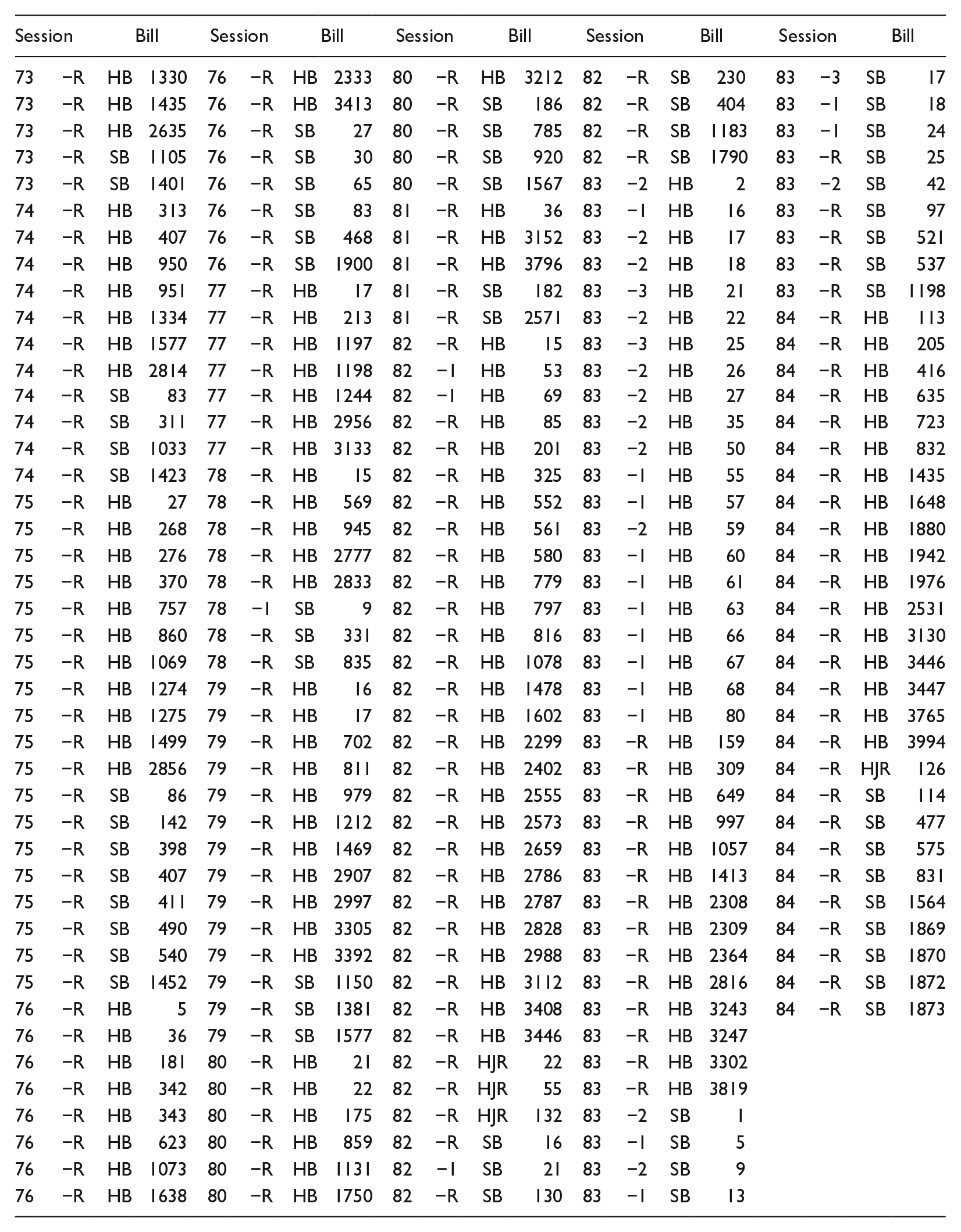
2- The dependent variable is the count of bills that restrict abortion that a legislator signed on as a primary, joint, or coauthor during a given panel. To identify relevant bills, we used the search function through the Texas Legislative Reference Library’s website to create a roster of bills for which the “Subject” is “abortion.” This search identified 251 bills. We reviewed the text of each of these bills to confirm that it pertains to the act of abortion, to funding for abortions, or otherwise concerns abortion seekers, providers, or facilities. We excluded two bills that did not meet these criteria. We also excluded 41 progressive bills that propose improved access to or the deregulation of abortion. Our dependent measure refers to authorship of the remaining 208 restrictive abortion bills (listed in Appendix). On average, a legislator authored 1.98 restrictive abortion bills per panel with a standard deviation of 3.89.
3- Table 2 presents the coefficients and robust standard errors from our multivariate models. Below we discuss the results using incidence rate ratios (IRRs), which allow for standardized comparisons of effects and do not vary by the specific values of other covariates in the model as do predicted counts (Hilbe 2011). Model 1 includes all covariates measuring individual characteristics, legislative and constituent context variables, and yearly fixed effects. As predicted, we find that women and Democrats are expected to author fewer restrictive abortion bills per panel by factors of .71 and .10, respectively. Tenure in the legislature and house membership also are negatively associated with the outcome. Turning to legislative context variables, we find that the number of total bills filed and of abortion bills filed each is positively associated with restrictive abortion bill authorship. Contrary to expectations, however, we fail to find that the outcome is significantly associated with percent Republican or with percent women in the legislature. But supporting power resources hypotheses, women’s relative employment and percent Hispanic each is negatively associated with the outcome. In contrast, the poverty rate is positively associated with the outcome, which supports a minority threat account. Finally, population density is negatively associated with restrictive abortion bill authorship as expected. None of the other variables in this model is significantly associated with the outcome.
4- In Model 2 we assess whether the association between percent women in the legislature and restrictive abortion bill authorship is nonlinear by testing a quadratic specification of this measure. The coefficient on the squared term is not significant, and a test of the coefficients on the linear and squared terms fails to show that they are jointly significant at the p<.05 level. Thus, we do not find support for a curvilinear association between women’s political representation and restrictive abortion bill authorship.
5- Nonetheless, Model 2 results reveal that one standard deviation increases in the percentage of employed persons who are women, in the log of percent Hispanic, and in population density are associated with decreases in the expected authorship count per panel by factors of .86, .61, and .76, respectively. In contrast, a one standard deviation increase in the log of the household poverty rate is associated an increase in the expected authorship count per panel by a factor of 1.23. Supplemental analyses fail to detect significant quadratic effects of women’s relative employment, the poverty rate, percent Black, or percent Hispanic on the outcome (results available upon request). Finally, in Model 2 total bills filed now reaches only marginal statistical significance (p<.10) but all the other substantive findings from Model 1 persist.
6- We find that the negative coefficient on percent Black reaches statistical significance only when population density is excluded from the model, and that the coefficient on the poverty rate no long is statistically significant when percent Hispanic is excluded from the model. These effects thus are sensitive to multicollinearity and must be interpreted with caution.
7- If Democrats and Republicans respond differently to key aspects of their legislative and constituent contexts, then the model specification should account for this moderation even if the coefficients on the un-interacted terms are not statistically significant (Fox 1997; Jaccard, Turrisi, and Jaccard 2003). Models 3 through 6 build off of Model 2 and include interactions between Democratic identification and the following contextual variables, respectively: women’s relative employment, percent Black, percent Hispanic, and population density. Significant coefficients on all four interaction terms suggest moderation. Specifically, the models show that Republicans’ authorship does not vary according to women’s relative employment, percent Black, or population density. In contrast, Democrats’ restrictive abortion bill authorship is significantly and negatively associated with each of these measures. And although the results reveal that percent Hispanic is negatively associated with restrictive abortion bill authorship for both Republicans and Democrats, this association is stronger for Democrats. One standard deviation increases in women’s relative employment, percent Black, percent Hispanic, and population density are associated with decreases in Democrats’ expected authorship count per panel by factors of .63, .52, .48, and .23, respectively. And a one standard deviation increase in percent Hispanic is associated with a decrease in Republicans’ expected authorship count per panel by a factor of .75. The results from these moderation models also reveal that Republicans author significantly and substantially more abortion bills across the observed range of percent Black and population density, and all but the very lowest levels of women’s relative employment (<41%) and percent Hispanic (ln. % Hispanic<1.5). As women’s relative employment, percent Black, percent Hispanic, and population density increase from .5 standard deviations below to .5 standard deviations above their means, the IRRs for identifying as a Democrat (versus Republican) change from .11 to .07, .15 to .07, .12 to .07, and .15 to .03, respectively. Thus, changes in Democrats’ behavior contributes to a growing partisan divide as women’s relative employment, percent Black, percent Hispanic, and population density increase. Finally, in these models total bills filed again becomes significantly associated with the outcome, but statistical significance reaches only the p<.10 level on the coefficients on female sex in Model 6, women’s relative employment in Model 6, and the poverty rate in Models 4 and 6. All the other findings from Model 2 persist.
8- We also tested for additional moderation by partisan identification in models otherwise equivalent to Model 2 (results available upon request). We found a significant coefficient on the interaction between Democratic identification and percent voting for a Republican president, but the slope of the association between percent voting Republican and the outcome is not significantly different from zero at the p<.05 level for legislators of either party. We also fail to find significant moderation of percent Republicans in the legislature, percent women in the legislature, and the poverty rate by individual partisanship. Finally, the substantive findings from Models 3 through 6 persist whether or not we include the squared term on percent women in the legislature.
9- In this study we uncovered the individual and contextual factors informing Texas lawmakers’ support for pro-life interests by way of bill authorship. The results from our multilevel analysis reveal that between 1993 and 2015, gender, economic, racial, and ethnic minority politics play an important role in determining legislators’ receptivity to pro-life interests, especially among Democrats. We proposed competing hypotheses regarding the influence of minority resources and restrictive abortion bill authorship. The results show limited support for minority threat hypotheses that predicted increased endorsements of restrictions on legal abortions in an effort to counter growing minority power (Akee et al. 2019; Blalock 1967; Fagan and Talkington 2014; Jones and Kavanaugh 2011; Lublin 2007; Luker 1985; Paxton et al. 2007). Specifically, we find that higher poverty rates among constituents are associated with increased support for abortion restrictions, but this association is sensitive to multicollinearity in the models. In contrast, the results largely support power resources hypotheses, which predicted that legislators would be discouraged from authoring restrictive abortion bills when minorities control more economic or political resources (Blumberg 1984; Korpi 1974, 1985; Orloff 1993). We find that women’s socioeconomic resources relative to men’s and the representation of Blacks and Hispanics among constituents are associated with decreased support for abortion restrictions. Population density—which captures the more socially progressive interests of urban versus rural constituents (Lublin 2007; Scala and Johnson 2017)—also is inversely associated with support for restrictions on legal abortions. Moreover, the results show that the protective influences of women’s socioeconomic power, percent Black, and population density affect the authorship behavior of Democrats but not of Republicans, who tend to author considerably more restrictive abortion bills. Additionally, the results reveal that although both Republicans and Democrats are discouraged from authoring restrictive abortion bills as more of their constituents comprise Hispanics, this effect is stronger for Democrats. This suggests that over the past two decades in Texas, Democrats have been swayed relatively more by minority and progressive interests, and that this receptivity has contributed to growing partisan polarization over the abortion issue. Future research could examine whether similar patterns are evident in other jurisdictions or for other social issues.
10- In addition to illuminating the dynamic relationship between partisanship and abortion legislation, our study also contributes to scholarship showing that advances in women’s representation in the public sphere and their control of economic resources discourage legislative action that jeopardizes their progressive interests. Although our results do not detect a significant influence of women’s political representation after controlling for overall trends in total and abortion bill activity in the legislature, it remains to be seen whether this changes as women achieve more equal representation with men; as of 2020, women occupied at least 50% of legislative seats in only one US state (Nevada), and across all states, women occupy only 29.1% of seats in state legislatures (Center for American Women and Politics 2020). Our results also reveal that the political resources of other marginalized groups—namely, racial and ethnic minorities—as well as the progressive leanings of more urban residents matter in determining legislative attention to abortion. This highlights the multifaceted nature of abortion politics and the importance of considering the many stakeholders in the legal status of abortions especially as the country overall becomes more racially and ethnically diverse and demographic trends favor suburban residence over rural and urban communities (Bialik 2018).
11- ENDNOTES
1 During our sampled time period, only 41 out of 249 bills related to abortion liberalized access, each with between 1 and 11 authors, totaling to only 34 unique legislators. We therefore focus on the more numerous restrictive abortion bills.
2 Only 4% of the restrictive abortion bills proposed in Texas during our sampled time period were enacted.
3 Bills proposed in the Texas legislature often list several authors. Restrictive abortion bills in our sample have between 1 and 91 authors, with an average of 12.45.
12- Figure 1 is omitted/deleted.
13- Table 2 has been corrected as shown below:
Table 2. Updated Two-Level Negative Binomial Regressions of Restrictive Abortion Bill Authorship with Random Intercepts for Individuals, Yearly Fixed Effects, and Robust Standard Errors (N=2,237 panels, N=509 individuals).
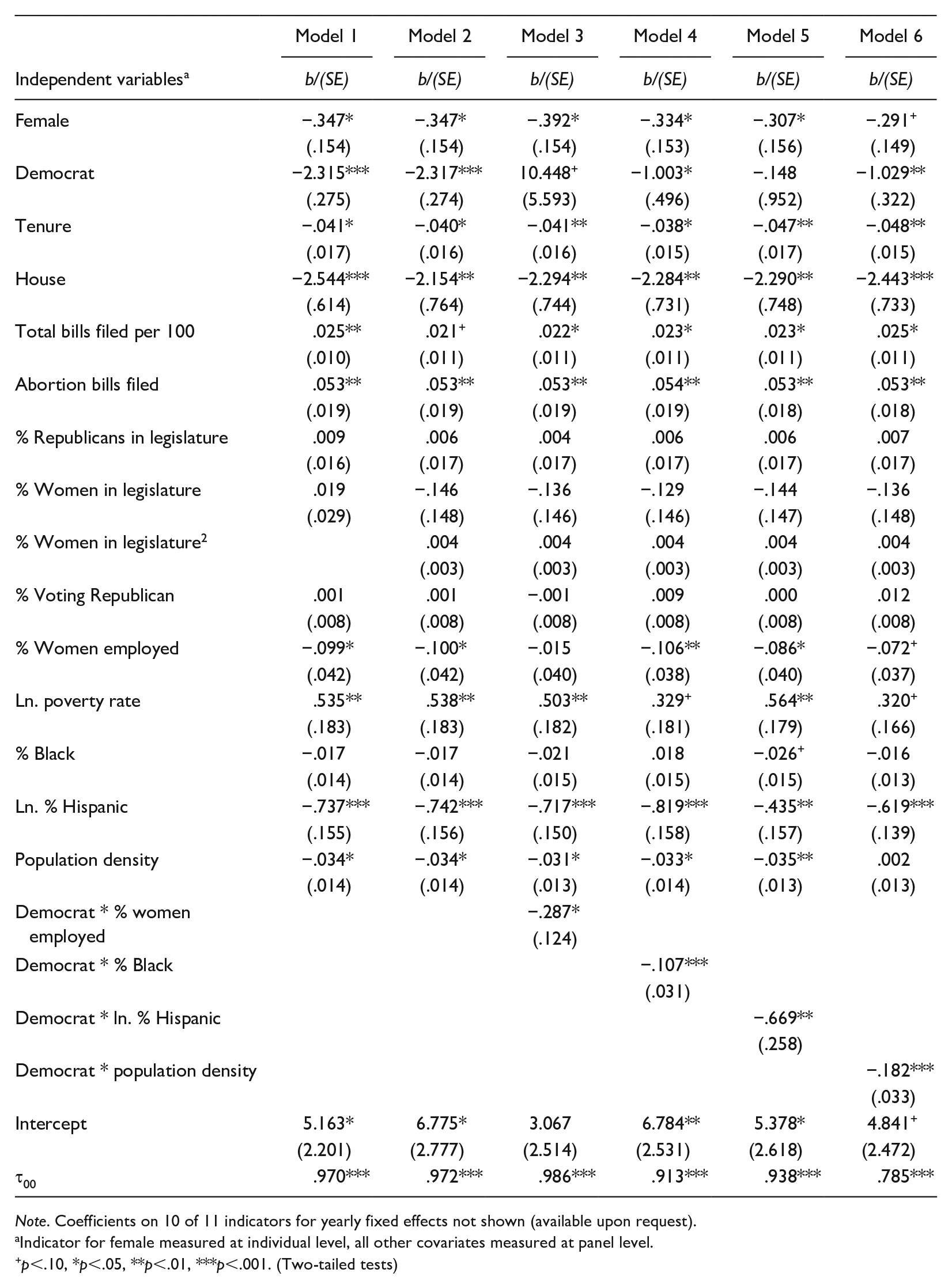
Note. Coefficients on 10 of 11 indicators for yearly fixed effects not shown (available upon request).
Indicator for female measured at individual level, all other covariates measured at panel level.
p<.10, *p<.05, **p<.01, ***p<.001. (Two-tailed tests)
14- Appendix has been corrected as shown below:
Appendix. Restrictive Abortion Bills Proposed in the Texas Legislature 1993-2015 (N=208).
The online version of the article has been corrected.