




Abstract
Workers in female-dominated occupations earn less, on average, than workers in comparable male-dominated occupations. To explain the gendered occupational wage disparity, com pensating differentials theory focuses on women’s preferences and asserts that women cluster in occupations that pay less in exchange for family-friendly job amenities. On the other hand, the devaluation perspective argues these wage discrepancies are the result of the cultural devaluation of women’s work that leads to both lower wages and a lower likelihood of having job amenities. Using data from the 2017–2018 American Time Use Survey Leave Module, I examine whether workers in female-dominated occupations are indeed more likely to have access to family-friendly job amenities. I focus on workers’ access to three contemporary family-friendly job amenities: paid leave, remote work, and flexible scheduling. I find that workers in female-dominated jobs are no more likely to have access to family-friendly job amenities than workers in male-dominated jobs. Additionally, family-friendly job amenities are associated with higher wages, not the lower wages as compensating differentials posits. These findings suggest that compensating differentials theory cannot explain the clustering of women in lower-paying occupations.
Despite significant progress in reducing gender inequality in the workforce, men and women still cluster in different jobs. Occupational segregation is so prevalent that only six percent of women work in male-dominated occupations (Hegewisch and Hartmann 2014). The high level of gendered occupational segregation is a leading factor in the persistent gender wage gap. Female-dominated occupations pay less, on average, than comparable male-dominated occupations (Cotter et al. 1997; England 2005; Hegewisch and Hartmann 2014). In fact, occupational segregation may explain as much as 49% of the gender pay gap (Blau and Kahn 2007). As a result, understanding the forces driving occupational sex segregation and the gender wage gap that flows from it is central for identifying strategies to reduce gender inequality.
Although the lower relative pay of female-dominated occupations is well-documented, the cause of gendered occupational wage disparities remains contested. On the one hand, compensating differentials theory assumes that women have preference for jobs that allow them to better balance their work and family responsibilities and are willing to give up higher pay for jobs that offer family-friendly job amenities (Daw and Hardie 2012; Filer 1989; Killingsworth 1985). Women’s assumed preferences are thought to result in women clustering in occupations that pay lower wages in exchange family-friendly job amenities. On the other hand, the devaluation perspective argues the lower relative pay of female-dominated occupations cannot be boiled down to women’s preferences (England 2005). Instead, the devaluation perspective argues that female-dominated occupations pay less because cultural biases lead to the devaluation of women’s work.
To examine whether it is indeed the case that the lower pay of female-dominated occupations can be explained by access to family-friendly job amenities, prior work has largely focused on the relationship between occupational segregation and flexible scheduling. The results of these studies have been mixed, with some finding that female representation in an occupation is positively associated with flexibility (Davis and Kalleberg 2006; Goodstein 1994; Lowen and Sicilian 2009; Osterman 1995), while others have found no relationship between occupational gender composition and flexibility (Glass 1990; Glass and Camarigg 1992; Glauber 2011). Because of a lack of nationally representative data on employer-provided benefits, this work has generally relied on a few data sources that capture benefit availability in the late 1990s and early 2000s. Since then, access to flexible scheduling has increased greatly, from 27 to 58% (Beers 2000; Woods 2020). Additionally, flexibility is not the only family-friendly job amenity that could be relevant. In particular, paid family leave and the ability to work remotely have gained attention as important job amenities to help workers balance the demands of work and family. As demand for and access to these job amenities increase, it is important to understand the relationship between family-friendly job amenities, occupational segregation, and the gender wage gap. Further, understanding the relationship between working from home and the wage gap is especially pertinent in the wake of the COVID-19 pandemic as many employers are expected to add permanent opportunities to work from home.
This study tests compensating differentials theory using recent data and contemporary forms of family-friendly job amenities. In doing so, it contributes to the ongoing discussion about the lower pay of female-dominated occupations. Using data from the 2017–2018 American Time Use Survey (ATUS) Leave Module, I examine the relationship between job amenities, earnings, and occupational gender composition. I extend previous work by analyzing access to paid family leave and remote work and using new data on flextime to test whether workers in female-dominated occupations are more likely to have access to these job amenities than workers in integrated or male-dominated occupations.
Competing Theories on Job Amenities, the Gender Wage, and Occupational Segregation
The microeconomic theory of compensating differentials is used to explain both the clustering of men and women in different occupations as well as the lower average pay of female-dominated occupations. Compensating differentials theory asserts that using wages alone to measure labor market inequality does not adequately account for tradeoffs workers make between wages and other job amenities (Daw and Hardie 2012). Instead, the total compensation of a job is thought to be made up of both monetary and nonmonetary forms of compensation. To explain the lower average pay of female-dominated occupations, this perspective assumes that women prefer jobs that allow them to balance their family responsibilities with paid work. As a result, compensating differentials theory suggests that women cluster in occupations that provide family-friendly job amenities in exchange for lower wages (Filer 1989; Killingsworth 1985).
Although supply-side theories such as compensating differentials favor explanations of the gender wage gap and occupational segregation that focus on the choices and preferences of women, devaluation theory shifts the focus from women’s choices to gendered beliefs about the value of women’s work. Devaluation theory holds that cultural biases lead to the devaluation of activities associated with women. As a result, occupations with a high concentration of women pay less because the work is done by women. Scholars who draw on devaluation theory point to a large body of research that finds that as the proportion of female workers in an occupation increases, wages decrease, even after controlling for human capital and occupational factors (Cohen and Huffman 2003; England 2005; England, Allison, and Wu 2007; England, Reid, and Kilbourne 1996; Jacobs and Steinberg 1990; Perales 2013). The devaluation perspective highlights that without national standards for employer-provided benefits and amenities, family-friendly job amenities are distributed unevenly across the workforce. The devaluation of women’s work may mean that workers in occupations with a high concentration of women are less likely to have family-friendly job amenities in addition to being paid lower wages. If this is the case, then the lack of family-friendly job amenities is an additional disadvantage incurred by workers in female-dominated occupations.
Contemporary Family-Friendly Job Amenities
A number of past studies have tested the idea the gender wage gap and the clustering of women in lower paying occupations can be explained in part by women’s preferences for jobs that allow them to more easily balance work and family. These studies examine the relationship between family-friendly job amenities and wages and/or occupational segregation. Prior work has largely focused on flextime as a family-friendly job amenity (Gariety and Shaffer 2001; Glauber 2011; Lowen and Sicilian 2009; McCrate 2005). In this study, I focus on three contemporary family-friendly job amenities: flexible scheduling, remote work, and paid family leave.
The findings of prior research examining whether women cluster in occupations that offer more flexible scheduling have been mixed. Some studies have found that the likelihood a worker will have flexibility increases with the proportion of women in the occupation (Davis and Kalleberg 2006; Goodstein 1994; Lowen and Sicilian 2009; Osterman 1995). However, others have found no evidence of such a relationship. In fact, some studies have found that female concentration is actually negatively associated with schedule flexibility (Glass 1990; Glass and Camarigg 1992; Glauber 2011). Finally, regardless of the occupation, McCrate (2005) found that female workers do not have more access to flexible schedules than male workers.
There is weak empirical support for the idea that gender wage gap is in part the result of the priority women place on flexibility. Studies have consistently found that flexibility is actually associated with higher wages, for both women and men (Gariety and Shaffer 2001; Glauber 2011; Lowen and Sicilian 2009; McCrate 2005). Further, at the firm-level, firms that offer flexibility do not pay less, suggesting individual firms do not use such policies to make up for lower wages (Glass 1990). Other studies have focused on the motherhood wage penalty, comparing non-mothers to mothers, who ostensibly have stronger desires to have access to flexibility. However, flexibility has not been found to account for any portion of the motherhood wage penalty and even for mothers, flexibility is associated with higher, not lower, wages (Fuller and Hirsh 2018; Glauber 2012; Yu and Kuo 2017).
Although flexibility has received the most attention in prior research, paid family leave is another important family-friendly job amenity. Having access to paid family leave allows workers to take time off of work to care for their family members without losing pay or having to arrange for another caretaker to fill in while they are at work. Paid leave has increasingly gained the attention of legislators, the media, and the public as a necessary policy for work-family balance. In the absence of a federal paid family and medical leave policy, it is up to individual employers to provide this family-friendly job amenity. The inconsistency of the provision of paid leave makes it a particularly useful family-friendly job amenity to look at because it increases the likelihood that employers and employees view it as a special amenity rather than a right.
Paid leave may function differently than flexibility in terms of the relationship between wages and occupational segregation due to a number of pertinent differences between the two family-friendly job amenities. Employers who offer flexibility in work schedule do not incur any direct costs or lost productivity. Presumably, the same amount of work is getting done for the same price, just at a different time. Paid leave, however, involves paying employees for time they are not working, which may mean it operates as a compensating differential.
Finally, the ability to work from home is an especially pertinent family-friendly job amenity. Remote work can be understood as family-friendly when it is done as a replacement for in-person work, not as an extension of the work day leading to long hours. As a replacement for in-person work, whether permanent or periodic, remote work may allow workers to more effectively balance work and family demands by eliminating commute times, offering some flexibility in hours, and giving workers the ability to complete domestic tasks and caregiving throughout the day. Like flexible schedules, allowing employees to work from home has minimal, if any, cost for employers. Prior work on the relationship between remote work and wages finds that working from home instead of the office is associated with higher earnings, with no penalty for women or men who work from home (Glass and Noonan 2016). Understanding the effect of remote work on wages and occupational segregation is especially important in the wake of the Covid-19 pandemic as remote work is expected to be much more common long term, even after it is safe to return to in-person work (Bartik, et al. 2020).
Data and Methods
Sample
I use the 2017–18 Leave Module of the American Time Use Survey (ATUS) to analyze the relationship between the gender wage gap and family-friendly job amenities. The ATUS is conducted by the U.S. Census and sponsored by the Bureau of Labor Statistics. The nationally representative sample is randomly selected from members of households that have completed their final Current Population Survey (CPS) interview. One household member over 15 years of age is randomly selected to complete the ATUS time-diary interview. The 2017–18 Leave Module was administered to a subset of ATUS respondents, asking them about their access to and use of paid and unpaid leave. To be eligible for the Leave Module, ATUS respondents had to be in the labor force and could not be self-employed. There are 10,121 Leave Module respondents. Following prior research (Levanon, England, and Allison 2009; Perales 2013), I restrict the sample to adults who are working age (18–64 year old) and currently employed, leaving 8601 respondents. To ensure that each model draws on the same respondents, I dropped respondents with missing data for any of the five different models. The results were not sensitive to this change. The remaining sample consists of 8096 respondents.
Dependent Variables
Family-Friendly Job Amenities
I examine the three different family-friendly job amenities: paid family leave, flextime, and remote work. Flextime represents workers ability to vary or make changes to the times they begin and end work. Respondents who indicated that they could vary their start and stop time were coded as 1 while those who could not were coded as 0. I also examine respondents’ use of work from home policies. Specifically, I examine the ability to work from home as a replacement for in-person work rather than the ability to bring work home in addition to regular in-person work hours, because the latter is more an indicator of intense work demands than family-friendliness (Glass and Noonan 2016). Unlike the other flextime and paid family leave, which measure access, this variable measure’s actual use of remote work. Respondents who indicated that there are days when they only work at home were coded 1. In sensitivity tests, the results did not change when the specification was limited to those who worked from home at least once a week. As a result, all respondents who indicated they ever worked from home for a full day were included. Those who indicated there were no days when they only work at home were coded 0. Paid family leave captures workers who have access to paid leave to care for a family member, including the birth or adoption of a child, childcare, eldercare, and caring for an ill family member. Respondents who indicated that they could receive paid leave for any of those reasons are coded as 1; those who could not receive paid leave for any of those reasons are coded as 0. These variables for job amenities rely on employees’ knowledge of their benefits.
Prior research indicates that there is often a gap between employee knowledge and emplo yer provision of benefits, with employees lacking knowledge of benefits that employers have made available to them (Prottas et al. 2007). In the absence of matched employer data, for the purposes of this study, measuring employee knowledge of benefits remains valuable because awareness of a job amenity is necessary for the job amenities to drive the clustering of women into certain occupations as compensating differentials theory proposes.
Earnings
The natural log of weekly earnings is used to measure earnings due to the skewed distribution of earnings. Using logged earnings allows me to discuss regression coefficients as percent changes in earnings for a one-unit change in the independent variable. For instance, multiplied by 100 to reflect percent change, the coefficient on “female-dominated” indicates how much more or less workers in female-dominated occupations earn in terms of percentage, compared to workers in male-dominated occupations and allows for a comparison of the gap between these occupational groups. Usual weekly earnings in dollars were recorded at the time of the ATUS interview for respondents who changed jobs or employers since the final CPS interview. For the respondents whose employment had not changed, the ATUS documents the earnings information reported in the final CPS interview. I use weekly rather than hourly earnings to minimize estimation errors for salaried workers (Glass and Noonan 2016; Morgan and Arthur 2005). Additionally, using hourly earnings reduces the impact of the real gap in pay between men and women due to the longer hours offered in predominately male occupations (Lips 2013).
Independent Variables
Percent Female
The first dependent variable analyzed is the percentage of female workers in three-digit Census occupation codes using data from the 2017 and 2018 CPS. The percent female for each occupation from the CPS was then merged with the ATUS data. Percent female represents the percent of workers in the individual’s occupation.
Individual Characteristics
Individual-level controls include sex, race, citizenship status, marital status, and the presence of children under 18 years old in the household. To isolate the effects of gender, I use a female dummy variable coded as 1 for female, 0 for male. I measure race with a categorical variable representing identification as white, Black, American Indian/Native Alaskan Asian American, Native Hawaiian/Pacific Islander, or multiple races. The reference category is identification as White. Hispanic ethnicity is measured through a dummy variable where 1 equals Hispanic and 0 equals not Hispanic. To ensure that the effects of race and ethnicity are not actually the result of citizenship, I include a dummy variable indicating the effect of being a U.S. citizen. Marital status is measured by a dummy variable, coded 1 for married and 0 for unmarried. Because family responsibilities, especially those related to child care, are thought to be the main reason why women opt to take larger portions of their total wages in the form of job amenities, I include a dummy variable for parental status. Respondents who have at least one of their own children under 18 years of age in the household are coded 1 for “Parent” and those who do not have a child of their own in the household are 0. Age is measured continuously from 18 to 64 years old.
Human Capital
To isolate the relationship between family-friendly job amenities, occupational segregation, and wages, human capital factors that might influence occupation and wages need to be controlled. I measure educational attainment categorically with dummy variables for a high school degree or less, some college, and bachelor’s degree or higher. In the multivariate analysis, having some college is the reference category. I include a measure for full-time work to account for differences in benefit availability between full- and part-time workers. Working 35 h or more a week is coded 1 for full-time, while working fewer than 35 h a week is coded 0. In cases in which respondents answered that their hours vary weekly (N = 201), I use the number of hours they reported working in the previous week. Including these respondents using the previous week’s hours worked instead of excluding them from the analysis does not change the results.
Analysis
Descriptive statistics for all variables are presented in Table 1. The means are presented for the full sample, by gender, and by occupational gender composition. To show the means by occupational gender composition, I use three categories: female-dominated occupations (75% or higher female), gender integrated occupations (between 25% and 75% female) and male-dominated occupations (more than 75% male). Using alternative cut-offs did not meaningfully change the patterns of the descriptive statistics. To examine the relationship between family-friendly job amenities and occupational gender composition, I estimate three separate logistic regressions to predict the probability that an individual has access to paid family leave, remote work, and flextime (Table 2). I ran the models stepwise with variables added by gender, percent female, human capital, and controls. However, because the addition of new variables did not lead to meaningful changes in the coefficients, only the final model is presented here. I also performed a number of robustness checks. As a robustness check (not shown), I repeated the analysis using a 3-category variable for occupational gender composition comprised of female-dominated, gender integrated, and male-dominated categories instead of the variable instead of percent female. The results showed that occupational gender segregation has a linear relationship with all three family-friendly job amenities, indicating that measuring occupational gender composition with a variable for percent female is an appropriate measure.
Means of Variables for the Full Sample, by Sex, and by Percent Female in Occupation.
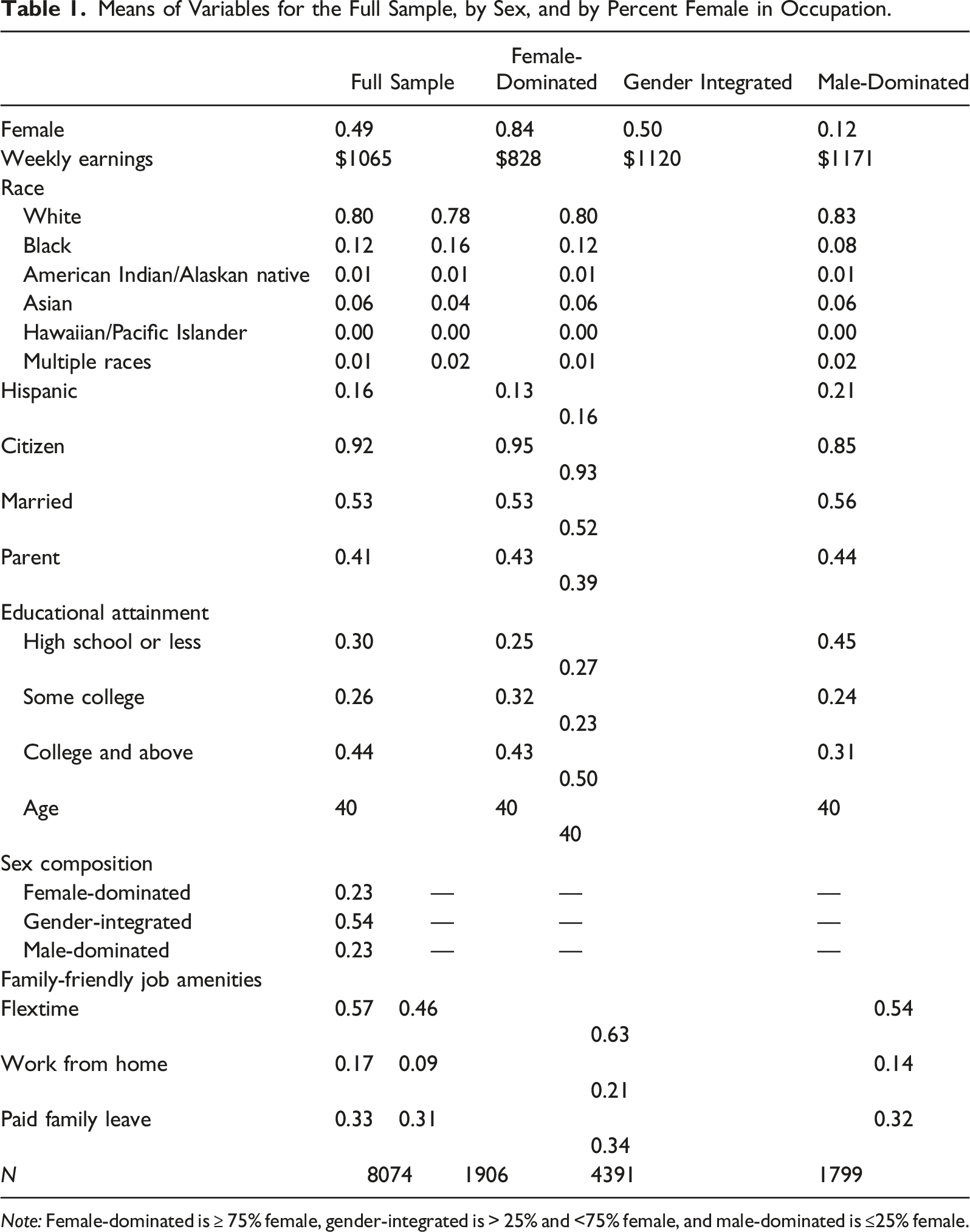
Note: Female-dominated is ≥ 75% female, gender-integrated is > 25% and <75% female, and male-dominated is ≤25% female.
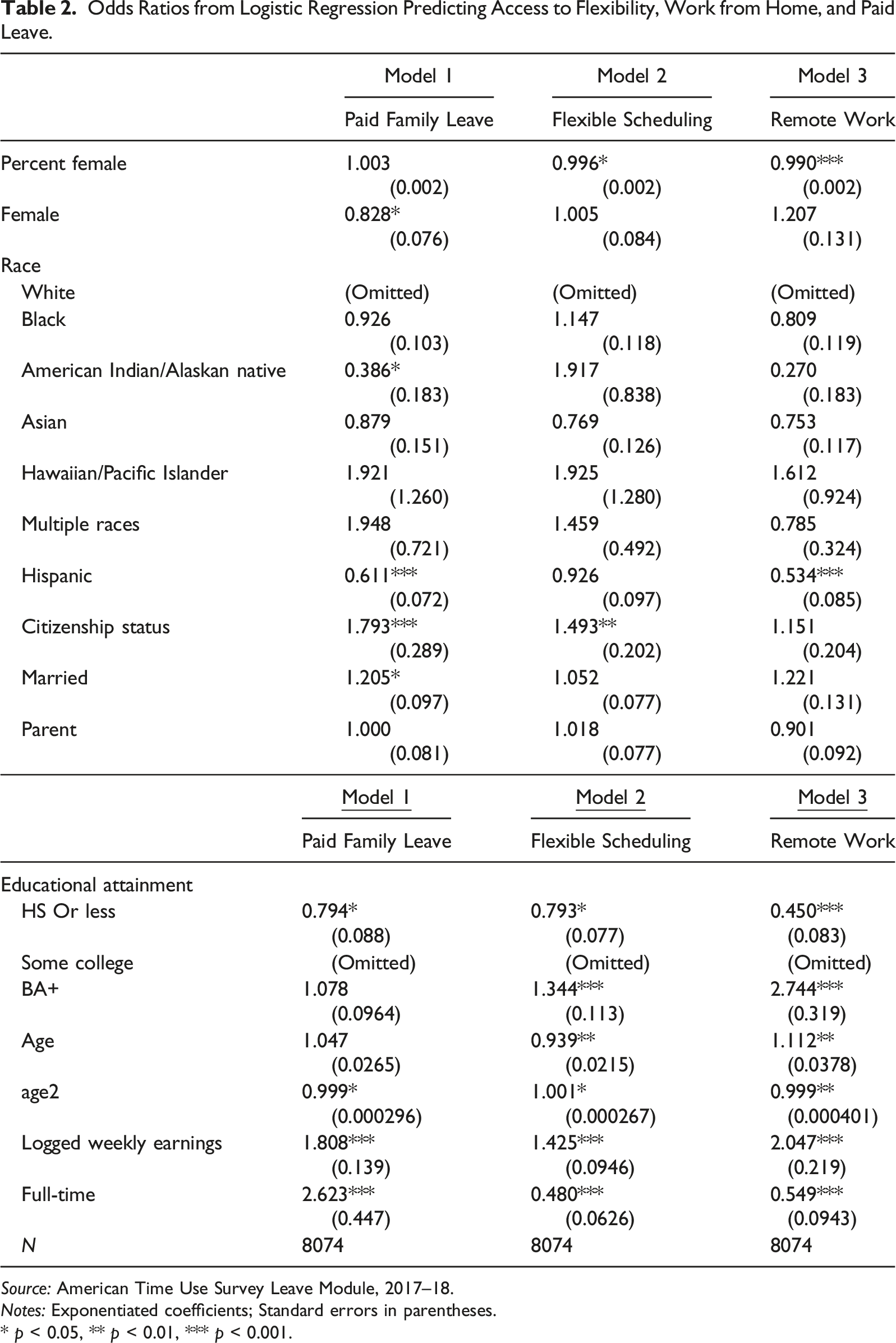
Odds Ratios from Logistic Regression Predicting Access to Flexibility, Work from Home, and Paid Leave.
Source: American Time Use Survey Leave Module, 2017–18.
Notes: Exponentiated coefficients; Standard errors in parentheses.
p < 0.05, ** p < 0.01, *** p < 0.001.
Results
Descriptives
Table 1 shows that access to family-friendly job amenities varies by occupational gender composition. These descriptive statistics, presented by female-dominated, gender integrated, and male-dominate occupations as discussed above, show that access to family-friendly job amenities is the least common in female-dominated occupations. Although 63% of workers in gender integrated jobs and 54% of workers in male-dominated job have flextime, only 46% of workers in female-dominated jobs have flexibility in their schedules. Similarly, whereas 21% of those in gender-integrated jobs and 14% of those in male-dominated job can work from home for a full day, only 9% of those in female-dominated jobs can do the same. Paid family leave has the smallest distribution, with 34% of workers in gender-integrated jobs compared to 32% in male-dominated and 31% in female-dominated jobs having paid family leave.
Predicting Access to Family-Friendly Job Amenities
Table 2 shows the results from three logistic regression models predicting access to flexible scheduling, remote work, and paid family leave. Overall, the results of these models provide support for devaluation theory, which suggests that workers in occupations with a larger share of female workers will be less likely to have access to family-friendly job amenities. Model 1 shows that the likelihood of having flexible scheduling decreases as the female representation in an occupation increases. Table 2 presents the results as odds ratios. The odds ratio for flexible scheduling and for remote work is 0.99. In other words, for every percentage point increase in the percent female in an occupation there is a 1% ((1–0.99)/1) decrease in the odds of flexible scheduling or remote work. Although the decreased odds may seem small for a single percentage point increase in percent female, when the odds of having flexible scheduling or remote work are considered for workers in female-dominated compared to male-dominated occupations, the significance becomes clearer. For instance, all else equal, the odds of flexible scheduling or remote work for a worker in an occupation that is 80% female are 50% lower than the odds for a worker in an occupation that is only 30% female. There is no significant difference in the likelihood a worker has paid family leave-based percent female in an occupation.
Figure 1 presents the above findings using predicted probabilities, illustrating the likelihood of having flexible scheduling and working remotely by percent female in the occupation. As shown in Figure 1, workers in occupations with a greater percentage of female workers were less likely to have both flexible scheduling and the ability to work remotely. For instance, the predicted probability that a worker in an occupation that is 80 females has flextime is 0.54, whereas the predicted probability of having flextime in occupations that are 30% female is 0.59.
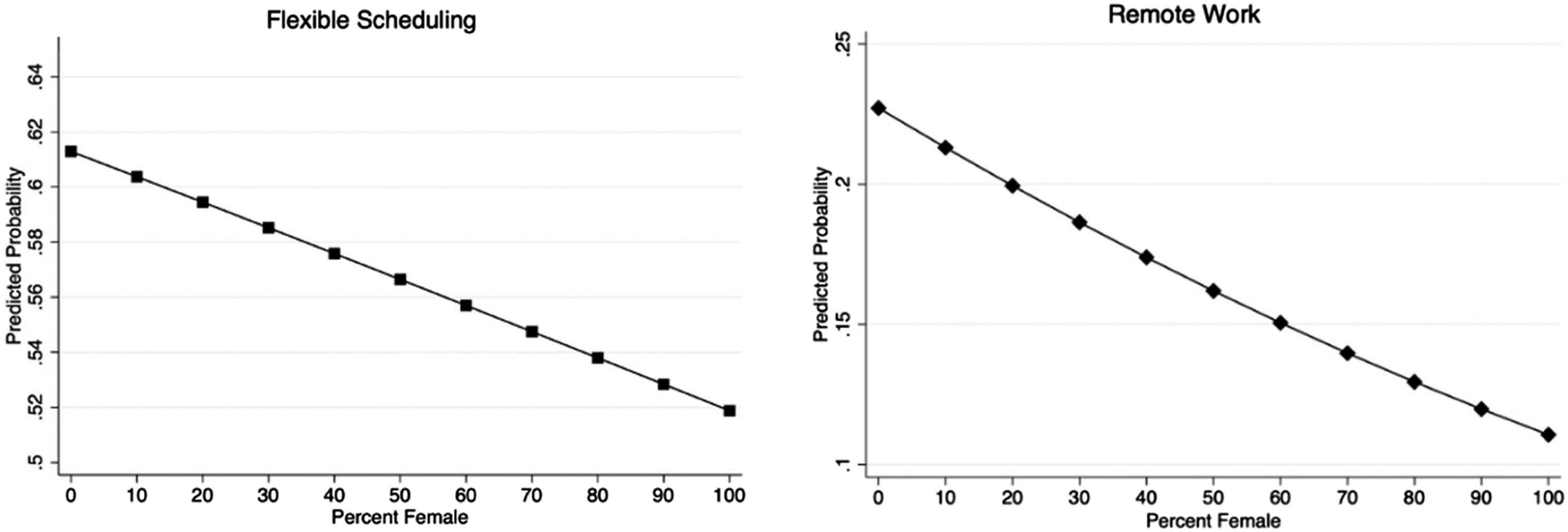
Predicted probabilities of family-friendly job amentities by precent female within an occupation.
Beyond occupational gender composition, an individual’s gender is not associated with flexible scheduling or remote work, net of controls. However, female workers are significantly less likely to have paid family leave than male workers regardless of occupational gender composition. The odds that a female worker has paid leave are 0.83 of the odds that of a male worker. Put differently, the odds are 17% ((1–0.83)/1) lower for female workers than male workers.
Table 2 shows that higher earnings are associated with a significantly higher odds of having paid family leave, flexible scheduling, and the ability to work remotely. A number of additional control variables, both individual and occupational, are associated with the various family-friendly job amenities. American Indian/Alaskan Native workers are less likely to have paid family leave than White workers. The odds of Hispanic workers having paid family leave or the ability to work remotely are significantly less than for non-Hispanic workers. Citizenship is also associated with access to family-friendly job amenities. Citizens are more likely to have the ability to flex their schedules and to have paid family leave. Workers with markers of labor market power are more likely to have access to job amenities as well. Higher levels of educational attainment are associated with a higher likelihood of having flextime and working remotely. Although the odds of a full-time workers having access to paid family leave are 2.62 times the odds of a part-time worker, full-time workers are less likely to have schedule flexibility and to be able to work from home.
Discussion
Ongoing occupational segregation plays a large role in the gender wage gap, with female-dominated occupations paying less, on average, than male-dominated occupations (Blau and Kahn 2007; Hegewisch and Hartmann 2014). Although the relationship between wages and occupational gender composition is well established, there are competing theories about why this is the case. On the one hand, compensating differentials theory suggests that women’s preference for job amenities that allow them to better balance work and family leads to women clustering in occupations that pay less in exchange for family-friendly job amenities. On the other hand, devaluation theory argues that the lower relative pay of female-dominated occupations cannot be explained by women’s preferences. Instead, devaluation theory posits that the devaluation of women’s work leads to lower levels of compensation. In the current study, I test these theories by examining the relationship between occupational segregation, wages, and three contemporary family-friendly job amenities—flextime, remote work, and paid family leave—and find no evidence that compensating differentials is at play.
The findings suggest that compensating differentials theory cannot explain the clustering of women in lower-paying occupations. Specifically, I find that workers in occupations with a higher percent of female workers are no more likely to have access to paid family leave, flextime, or to have worked from home than workers in male-dominated jobs, which shows that women do not cluster in occupations with family-friendly job amenities. Instead, workers in female-dominated jobs are significantly less likely to have flexibility in scheduling and to work from home. Additionally, while paid family leave is not associated with occupational gender composition, female workers are less likely to have it than male workers. Further, while compensating differentials theory posits that workers will trade wages for family-friendly job amenities, all three job amenities measured in this study were associated with higher, not lower, wages. Because this analysis uses data that are cross-sectional and has limited variables on productivity and occupational characteristics, the finding regarding the positive association between wages and access to job amenities cannot not provide conclusive evidence that jobs with family-friendly amenities do not in fact pay less when compared across equivalent skill and experience levels. However, the positive association between job amenities and wages found in the current study is consistent with prior cross-sectional studies with more robust measures of productivity and occupational characteristics (Gariety and Shaffer 2001; McCrate 2005) as well as studies using longitudinal data (Glauber 2011; Lower and Sicilian 2009), providing support for the findings presented herein.
As a result, this study finds no evidence in support of compensating differentials theory as the clustering of women into certain occupations cannot be explained by a preference for occupations with family-friendly job amenities. Rather, in line with the devaluation hypothesis, occupations with more female workers are less family-friendly by two important measures, suggesting an additional disadvantage of working in female-dominated occupations.
This study is an important update to understandings of the relationship between occupational gender composition, family-friendly job amenities, and wages. Prior research has found conflicting associations between access to flexibility and the concentration of female workers in an occupation. Although some prior studies have found that female concentration in an occupation is associated with a greater likelihood of having flexible scheduling (Davis and Kalleberg 2006; Goodstein 1994; Lowen and Sicilian 2009; Osterman 1995), my findings offer support for the studies that find that female concentration is associated with a lower likelihood of having flexibility (Glass 1990; Glass and Camarigg 1992; Glauber 2011). Additionally, this same pattern holds for remote work, a contemporary family-friendly job amenity that is especially relevant in the wake of the Covid-19 pandemic, and while female concentration is not associated with paid family leave at the occupational level, female workers are less likely to have this amenity.
There are limitations to the present study. Because the data are cross-sectional, employment history, which is an important aspect of human capital in predicting compensation, is not measured. Another potential limitation is that this study relies on employee-level data rather than employer data. Workers’ reported access to family-friendly job amenities might differ from employer provisions. For example, workers may think they have access to paid leave when they do not actually, and vice versa. In particular, workers who have not used family or parental leave may be least likely to have an accurate understanding of their benefits. However, given that prior research suggests that female employees are more likely than male employees to be aware of employer-provided benefits (Prottas et al. 2007), if anything the results presented here underrepresent the actual gap in employer benefits. An additional limitation is that the measures of occupational sex composition are based on national level data using three-digit occupational categories. It is possible that the relationship between sex composition and access to job amenities exists at the local or firm-level but not the national or occupational level, which prior research has found is case for monetary compensation ( Tomaskovic-Devey and Skaggs 2002). For instance, women might not initially choose their occupations based on their expected family responsibilities, but later may choose to work for employers that offer family-friendly job amenities once they are closer to having children.
Despite these limitations, the findings reported here provide important insights about occupational segregation, wages, and job amenities. Compensating differentials theory has proved to be a persistent popular explanation for gendered labor market patterns, despite the fact that the evidence supporting this perspective has been mixed at best. The persistence of this perspective is significant because compensating differentials are often used to justify the wage gap between male- and female-dominated occupations. However, the current study finds no evidence that the lower wages of female-dominated occupations are explained by women clustering in occupations that allow them to trade wages for family-friendly job amenities. Instead, workers in female-dominated occupations are less likely to have these amenities, suggesting that job amenities are yet another facet of the devaluation of women’s work.
Footnotes
Declaration of Conflicting Interests
The author(s) declared no potential conflicts of interest with respect to the research, authorship, and/or publication of this article.
Funding
The author(s) received no financial support for the research, authorship, and/or publication of this article.
Author Biography
Miriam Barcus is an Assistant Professor of Sociology at SUNY Cortland. Her research examines gender, work, and family and policies that seek to address inequalities in those realms.