




Abstract
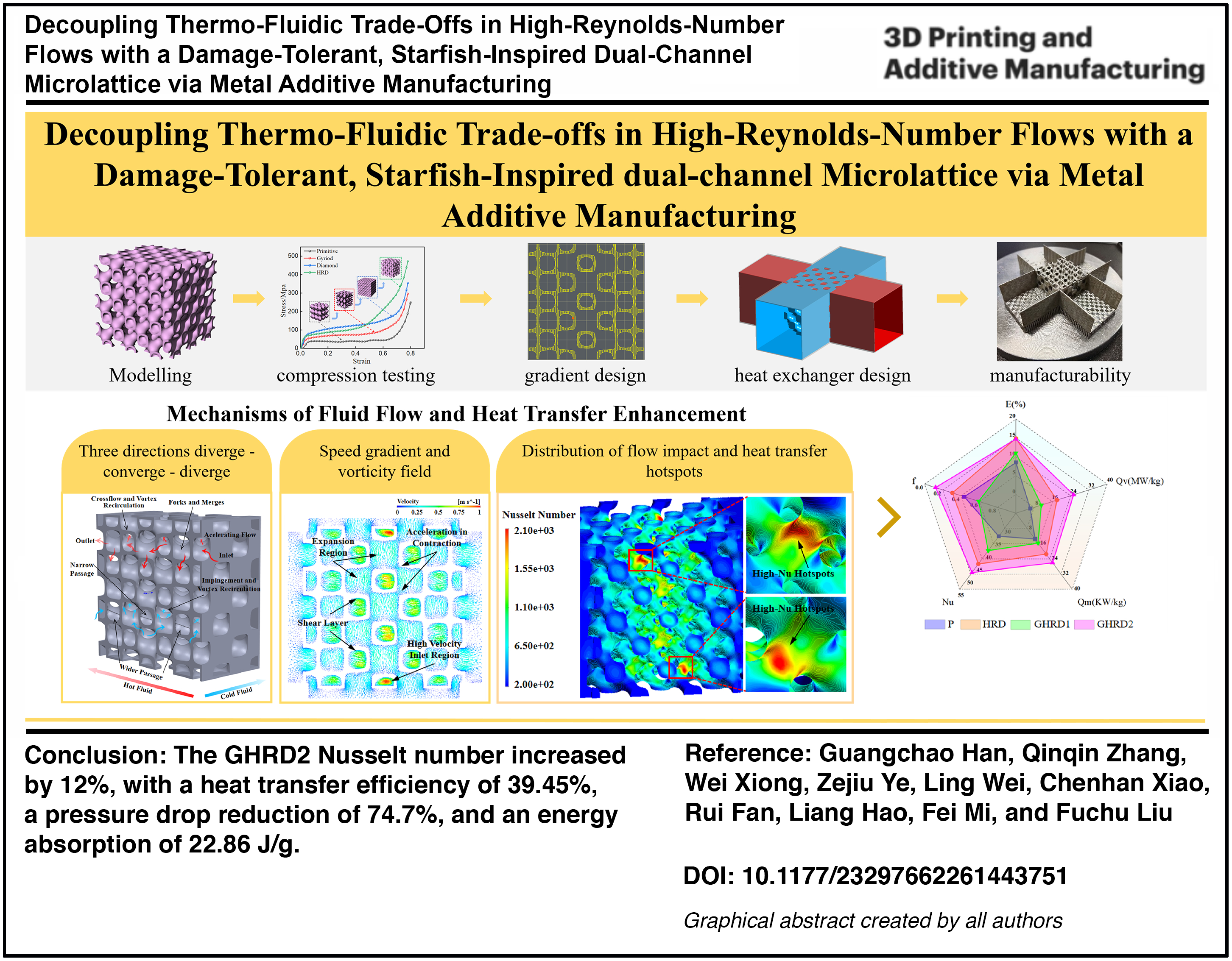
Advanced thermal management systems in high-Reynolds-number regimes face a fundamental trade-off: enhancing convective heat transfer invariably incurs prohibitive pressure drops. To address this scaling crisis, we introduce a proof-of-concept, bio-inspired design paradigm translating the damage-tolerance principles of the starfish skeletal microlattice into a fluid impedance-matching layer. Fabricated via laser powder bed fusion, a dual-channel heat exchanger featuring a continuous converging-diverging porosity gradient was investigated. Rigorous numerical simulations and conducted physical experiments validate its fundamental performance decoupling. Compared to a uniform baseline at Reynolds number 2000, this bio-inspired structure achieves a 74.7% pressure drop reduction while increasing the Nusselt number by 12%. Crucially, an anti-gradient control group catastrophically failed mechanically and fluidically, proving that precise impedance alignment—not arbitrary aperiodicity—drives this decoupling. The superior performance is governed by an enhanced scaling law (
Introduction
The performance demands for thermal management solutions in frontier technology sectors—ranging from next-generation aerospace propulsion systems and directed energy weapons to high-performance computing data centers and electric vehicle batteries—are becoming increasingly stringent. A common physical thread connects these applications: the imperative to dissipate extreme heat fluxes within highly compact volumes.1–4 This necessitates high coolant mass flow rates, pushing the internal fluid dynamics into inertia-dominated flow regimes, characterized by high Reynolds numbers (
The thermo-fluidic “scaling crisis” in high-flux management
However, the promise of TPMS is severely constrained by a fundamental physical principle: any effort to enhance convective heat transfer by increasing geometric complexity invariably leads to a sharp escalation in fluid pressure drop. This relationship is particularly punitive in inertia-dominated regimes, where pressure drop often scales with the square of the fluid velocity. We define this intractable trade-off as the “thermo-fluidic scaling crisis”: the very mechanism used to enhance heat transfer—inducing fluidic disturbances—simultaneously causes a prohibitive, non-linear increase in pumping power costs, effectively negating system efficiency.
Bio-inspiration: From mechanical damage tolerance to fluid impedance matching
To overcome this bottleneck, a paradigm shift beyond simple geometric optimization is required. The introduction of functional gradients has been demonstrated as a universal strategy for managing physical fields in engineering materials. 6 Nature is a master of this strategy; for instance, bamboo and bone utilize gradients to optimize mechanical response. 7 Here, we extend this concept to fluid dynamics by invoking the principle of “impedance matching.” We hypothesize that a bio-inspired, continuous porosity gradient can act as a fluid impedance matching layer, fundamentally altering adverse scaling laws.
The skeletal system of the knobby starfish (Protoreaster nodosus) offers a remarkable biological exemplar. 8 As shown in Figure 1 and Table 1, the starfish skeleton is a multi-scale hierarchical metamaterial analogous to the Diamond (D-type) TPMS. 21 Critically, its exceptional damage tolerance originates from an “intentional disruption” of periodicity—controlled porosity gradients—which establishes a non-uniform stiffness field to manage stress concentrations. 16 Similarly, organisms like the deep-sea glass sponge (Euplectella aspergillum) employ hierarchical lattices to optimize fluid mixing. 22 The central idea of this research is the systematic abstraction and cross-domain translation of these principles: using controlled geometric gradients to spatially modulate the fluid pressure field (Table 1), thereby achieving a globally optimal thermo-fluidic response.9–12
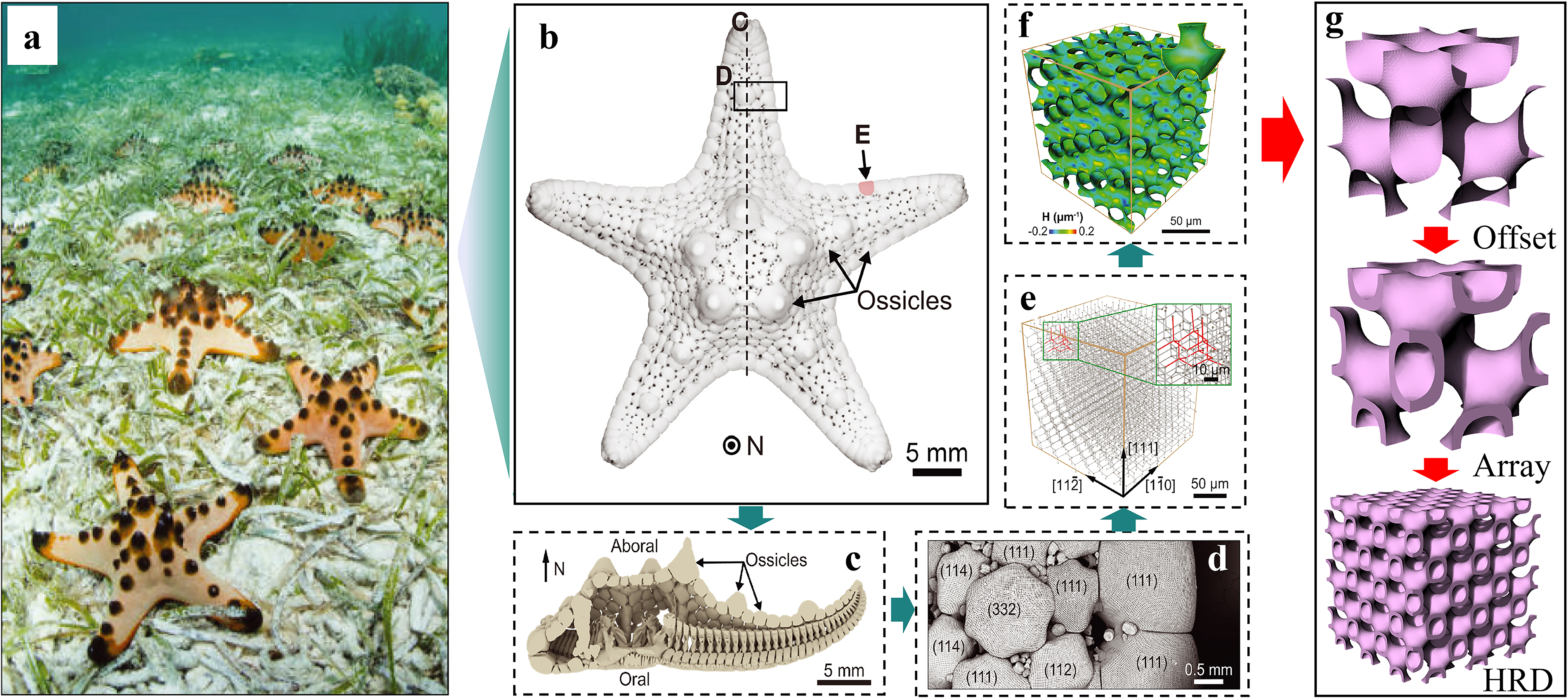
Bio-inspired design of the Hollow-Rod Diamond TPMS structure, inspired by the skeleton of the Protoreaster nodosus starfish.
Bio-Inspired Principle Mapping from P. nodosus to the Bio-Inspired Graded Hollow-Rod Diamond Heat Exchanger

TPMS, triply periodic minimal surface.
Research gap and specific objectives
Although recent studies have explored graded TPMS structures, they largely focus on single- or dual-objective enhancements. For instance, Oh et al.10,13 realized heat exchange gains but with coupled resistance increases, while Al-Ketan et al.23,24 reduced pressure drop at the cost of heat transfer rates. Even highly effective designs like those by Chen et al. 11 suggest limits in high-Reynolds-number regimes, and conventional benchmarks like Pin-Fin arrays and Shell-and-Tube configurations encounter significant penalties in inertia-dominated flows.25,26 Furthermore, while research on mechanical gradients (Feng et al., 19 Chen et al. 27 ) and thermal gradients (Wang et al., 20 Gao et al. 28 ) has shown promise, a comprehensive approach that couples mechanical integrity with thermo-fluidic performance decoupling is still elusive. As detailed in Table 2, achieving simultaneous optimization of competing metrics remains a complex challenge. (It should be explicitly noted that the performance metrics reported in Table 2, such as Nusselt number enhancement and pressure-drop change, are calculated as relative percentage variations compared with each cited study’s own uniform baseline structure. This normalized comparative approach ensures an objective evaluation of the performance decoupling capability intrinsic to each specific gradient strategy, regardless of their underlying topological differences).
Benchmarking Analysis of State-of-the-Art Graded TPMS Heat Exchangers
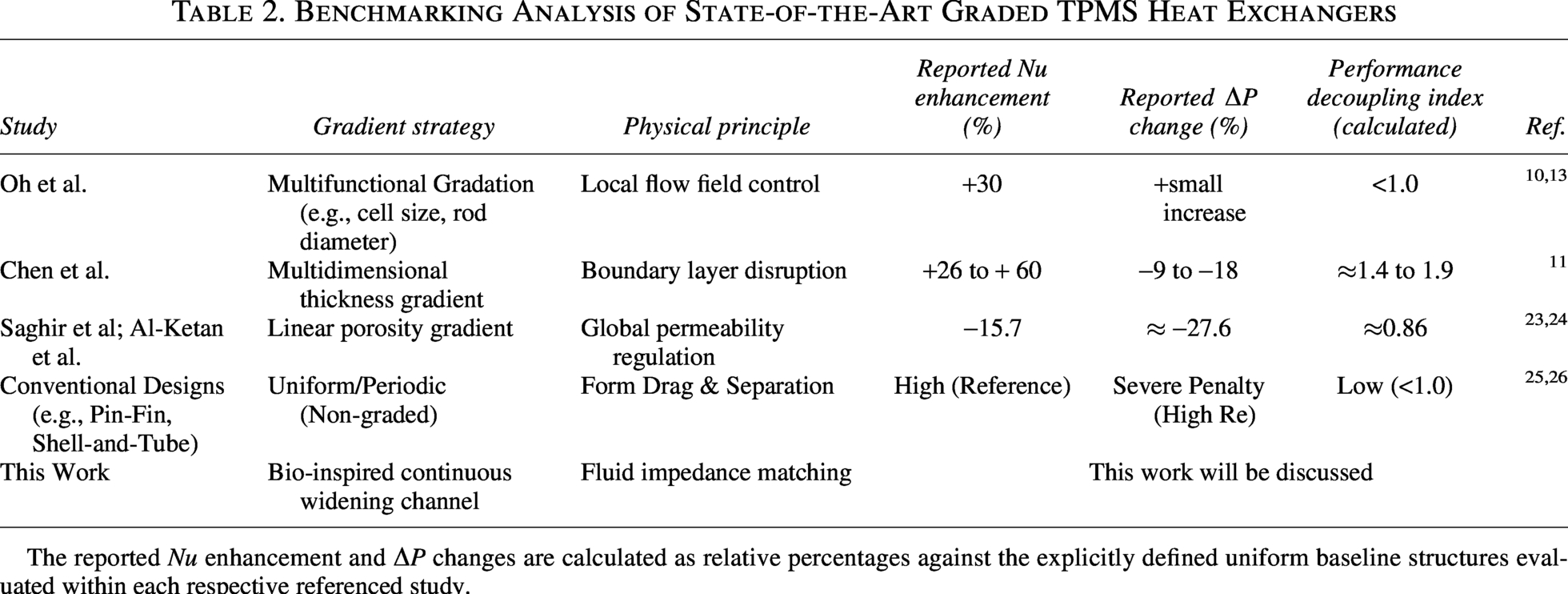
The reported Nu enhancement and
Therefore, rather than conducting a conventional, exhaustive parametric optimization to seek a single mathematical optimum for specific boundary conditions, the primary objective of this study is to establish a fundamental “proof-of-concept” (PoC) that employs a bio-inspired gradient strategy to break this “scaling crisis.” Specifically, we translate the biomechanical damage-tolerance principle of the starfish into a thermo-fluidic “impedance matching layer” within a D-type TPMS architecture. By deliberately comparing the bio-inspired converging-diverging gradient (Graded Hollow-Rod Diamond [GHRD]2) with an opposing diverging-converging control group (GHRD1), we seek to rigorously isolate the directionality of the physical mechanism and quantitatively analyze the consequent alteration of the Nusselt-Reynolds (Nu-Re) scaling laws. Ultimately, the results of the conducted study explicitly demonstrate that the proposed bio-inspired design fundamentally decouples the conventional trade-off: under high-Reynolds-number conditions (Re ≈ 2000), the GHRD2 structure simultaneously achieves a 74.7% reduction in pressure drop and a 12% increase in the Nusselt number compared with the uniform baseline, while exhibiting a superior specific energy absorption of 22.86 J/g.
Materials and Methods
This section details the comprehensive methodology employed to translate a design principle from the biological realm into a physically realizable and rigorously evaluated engineering component. The research workflow adheres to a systematic scientific paradigm, encompassing three core stages: (1) parametric design and modeling of TPMS structures based on the bio-inspired gradient concept; (2) high-fidelity specimen fabrication using metal additive manufacturing, accompanied by corresponding physicochemical characterization; and (3) systematic evaluation and validation of the designed structures’ multi-physics performance (mechanical, thermal, and fluid dynamics) through a coupled approach of numerical simulation and physical experimentation. 29
Parametric design of bio-inspired graded Dual-Channel TPMS structures
Implicit function definition and Dual-Channel structure construction
The D-type TPMS was selected as the foundational topology for this study (Fig. 2). This topology is not an arbitrary computer-aided design (CAD) model but a zero-potential surface defined in three-dimensional space by a precise implicit function.
30
Its standardized level-set approximation equation is given as:


Schematic of the parametric modeling and Additive Manufacturing preparation workflow for TPMS structures, from minimal surface generation and surface offsetting to STL export and pre-processing. STL, stereolithography.
where 

Alongside the uniform wall thickness
The selection of the Diamond topology is predicated on its extensively validated mechanical advantages. Compared to other common TPMS topologies such as the Gyroid, Diamond structures typically exhibit higher specific stiffness, compressive strength, and more uniform stress distribution at equivalent relative densities, making them an ideal base structure for load-bearing applications. 12 This choice establishes a solid foundation for the structural integrity of the heat exchanger from the initial design phase, reflecting a multi-objective design philosophy that considers not only thermal efficiency but also mechanical robustness—a critical requirement for components in integrated engineering systems.
To meet the application requirements of a dual-fluid heat exchanger, which necessitates two completely isolated and interpenetrating fluid channels, the standard sheet-based TPMS was topologically modified. By performing a bidirectional offset on the base TPMS surface (
Mathematical implementation of the continuous bio-inspired gradient
The core innovation of this research lies in the introduction of a continuous functional gradient inspired by the skeletal system of the knobby starfish (Protoreaster nodosus). The starfish skeleton utilizes a porosity gradient to optimize stress field distribution, thereby achieving remarkable damage tolerance. This biomechanical principle—optimizing physical field management through structural gradients—was abstracted and translated across domains. A continuous gradient in channel diameter was applied along the flow direction (defined as the z-axis) of the HRD structure, with the objective of achieving spatial optimization of the thermo-fluidic physical fields.
To systematically validate the influence of the gradient direction on performance and to provide robust support for the central scientific hypothesis—that a specific gradient direction is key to performance decoupling—two graded variants and a uniform control group were designed (Fig. 3): 33
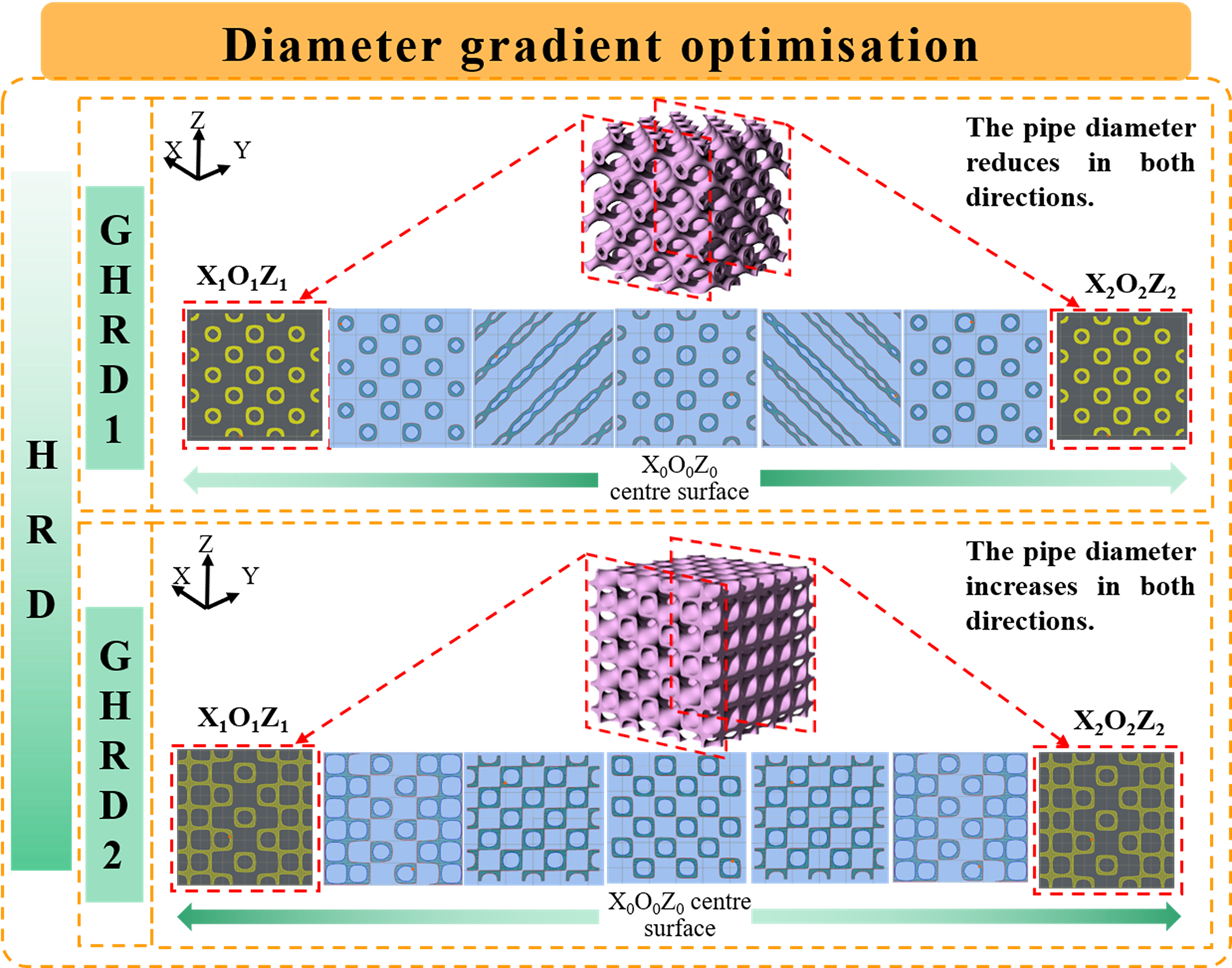
Cross-sectional comparison of the two graded porosity variants, GHRD1 and GHRD2. The images illustrate the distinct gradient profiles along the main flow direction: GHRD1 features a channel that narrows from the center towards the outlet (diverging-converging), while the bio-inspired GHRD2 features a channel that widens from the center towards the outlet (converging-diverging). GHRD, Graded Hollow-Rod Diamond.
The continuous structural gradient was mathematically implemented by applying a linear modulation to the internal channel diameter, 
It should be explicitly noted that while standard uniform topologies (such as the Primitive, Gyroid, and solid Diamond) were evaluated for basic mechanical benchmarking in subsequent sections, the thermo-fluidic evaluations were strictly confined to the uniform HRD and its graded variants (GHRD1 and GHRD2). The primary objective of this investigation is not to execute an exhaustive topological screening, but rather to rigorously validate the hypothesized “gradient-based fluid impedance matching” principle. By selecting the dual-channel HRD as the singular baseline and restricting the comparative analysis exclusively to its graded counterparts, this study successfully implements a strict control-variable approach. This methodology eliminates morphological confounding factors, thereby meticulously isolating and quantifying the direct thermo-fluidic contributions of the applied gradient directionality.
High-fidelity parametric modeling workflow
All TPMS structures were designed using the parametric modeling platform Rhinoceros 3D and its visual programming plugin Grasshopper, ensuring precise control over all geometric variables and enabling efficient design iterations. During the modeling of the graded regions, Subdivision (Sub-D 35 ) modeling techniques were specifically employed. This choice was critical, as simple geometric lofting or linear transitions can easily produce discontinuous curvature (G1 discontinuity) or sharp corners at the junctions between unit cells. In additive manufacturing, these geometric defects become physical stress concentration points, which can lead to premature structural failure under mechanical loading, particularly under fatigue conditions. Sub-D modeling generates smooth surfaces with high-order continuity (G2 continuity) using a minimal number of control points, ensuring a seamless transition in the graded channels.This approach not only mitigates potential stress concentration issues at the design stage, enhancing the mechanical reliability of the structure, but also provides high-quality geometric inputs for subsequent Finite Element Analysis and Computational Fluid Dynamics simulations, thereby improving computational accuracy.
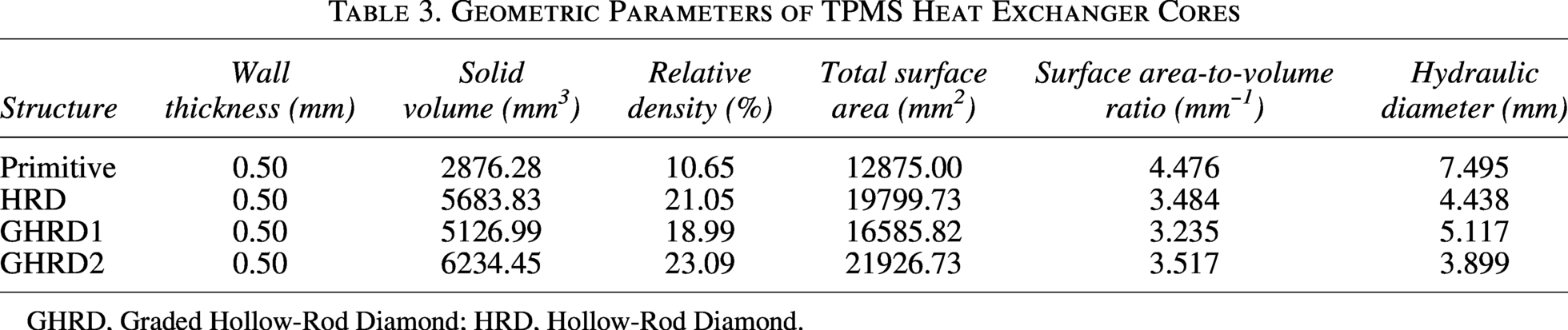
Upon completion of the modeling, all geometric models were exported as high-resolution Stereolithography (STL) mesh files. Subsequently, the professional additive manufacturing pre-processing software Materialise Magics was utilized for final STL file preparation, which included automatic repair of mesh defects, generation of necessary support structures for overhanging features, and slicing of the models according to the selected process parameters to generate build files directly usable by the Laser Powder Bed Fusion equipment. After printing, all specimens underwent a standard post-processing workflow. This included separation from the build plate via wire electrical discharge machining (EDM), the manual removal of external support structures connecting the printed parts to the build plate, and sandblasting to improve surface quality. Notably, the inherent self-supporting nature of the D-type TPMS topology allowed the complex internal fluid channels to be printed entirely without internal support structures, effectively bypassing the practically impossible task of internal support removal. Table 3 details the geometric parameters of the four heat exchanger core structures investigated in this study. It should be explicitly noted that these geometric data correspond strictly to the macroscopic representative volume element (RVE) utilized for the thermo-fluidic computational fluid dynamics (CFD) simulations, which consists of a 3 × 3 × 3 unit cell array with a bounding volume of 27,000 mm³.
Geometric Parameters of TPMS Heat Exchanger Cores
GHRD, Graded Hollow-Rod Diamond; HRD, Hollow-Rod Diamond.
Additive manufacturing and physicochemical characterization
Laser powder bed fusion process
All TPMS specimens were fabricated using an FF-M4OC Laser Powder Bed Fusion (LPBF) system. The material used was 316 L stainless steel powder with a particle size distribution of 15–53 µm. 316 L stainless steel was selected for its excellent corrosion resistance, favorable mechanical properties, and mature processability in LPBF.
36
To obtain high-quality as-built parts, an optimized set of core process parameters was determined through preliminary process development experiments (Supplementary Data) and was kept consistent for the fabrication of all specimens: laser power (
The selection of these parameters was not arbitrary.
38
The corresponding Volumetric Energy Density (
Specimen preparation and quality assessment
Two categories of specimens were prepared to meet specific testing requirements. Crucially, while both computational and physical testing domains employ a topologically identical
A series of quality assessments was conducted to verify the effectiveness of the employed LPBF process parameters. Metallographic analysis revealed that the densification of the as-built parts exceeded 98.9%, indicating that internal metallurgical defects were effectively controlled. The microhardness, measured with a Vickers hardness tester, was approximately HV230. This value is significantly higher than that of conventionally annealed 316 L stainless steel (approx. HV185), a typical phenomenon resulting from the extreme non-equilibrium rapid solidification inherent to the LPBF process, where localized cooling rates typically reach
Multi-physics performance evaluation
Mechanical response: Quasi-static compression experiments
To obtain the macroscopic mechanical performance parameters of the TPMS structures, uniaxial quasi-static compression tests were performed on the cubic specimens composed of
Mechanical response: Finite element analysis
To gain a deeper understanding of the internal stress distribution, deformation modes, and failure mechanisms of the different TPMS structures under compressive loading, numerical simulations of the quasi-static compression process were performed using the commercial finite element software Abaqus/CAE.
Thermo-fluidic response: Conjugate heat transfer CFD simulation
Given the significant challenges associated with experimentally measuring the complex three-dimensional flow and temperature fields within the heat exchangers, this study primarily employed a well-validated CFD approach to perform high-fidelity numerical simulations of the thermo-hydraulic performance in the ANSYS Fluent software environment (Fig. 4). Table 4 summarizes the thermophysical properties of the fluid and solid materials used in the simulations and experiments.
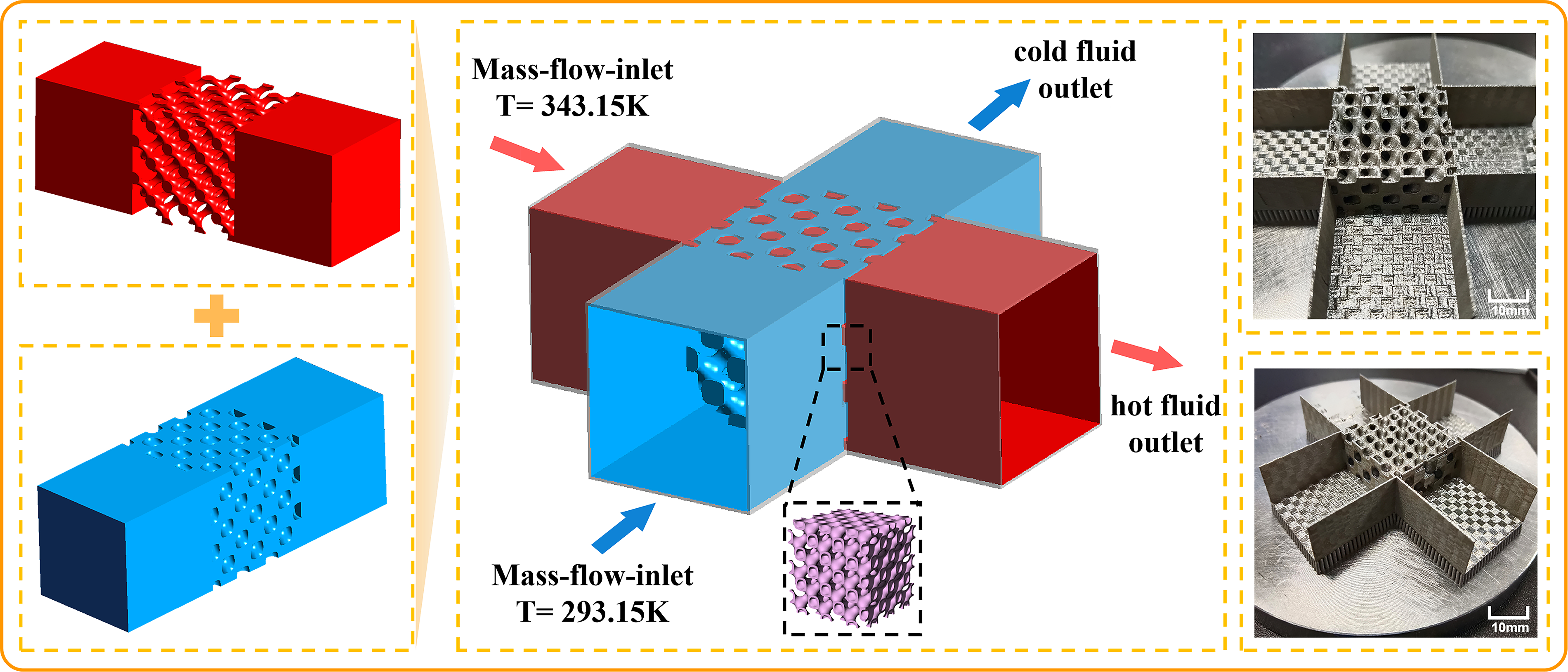
3D visualization and 3D printing of the TPMS heat exchanger.
Thermophysical Properties of Materials

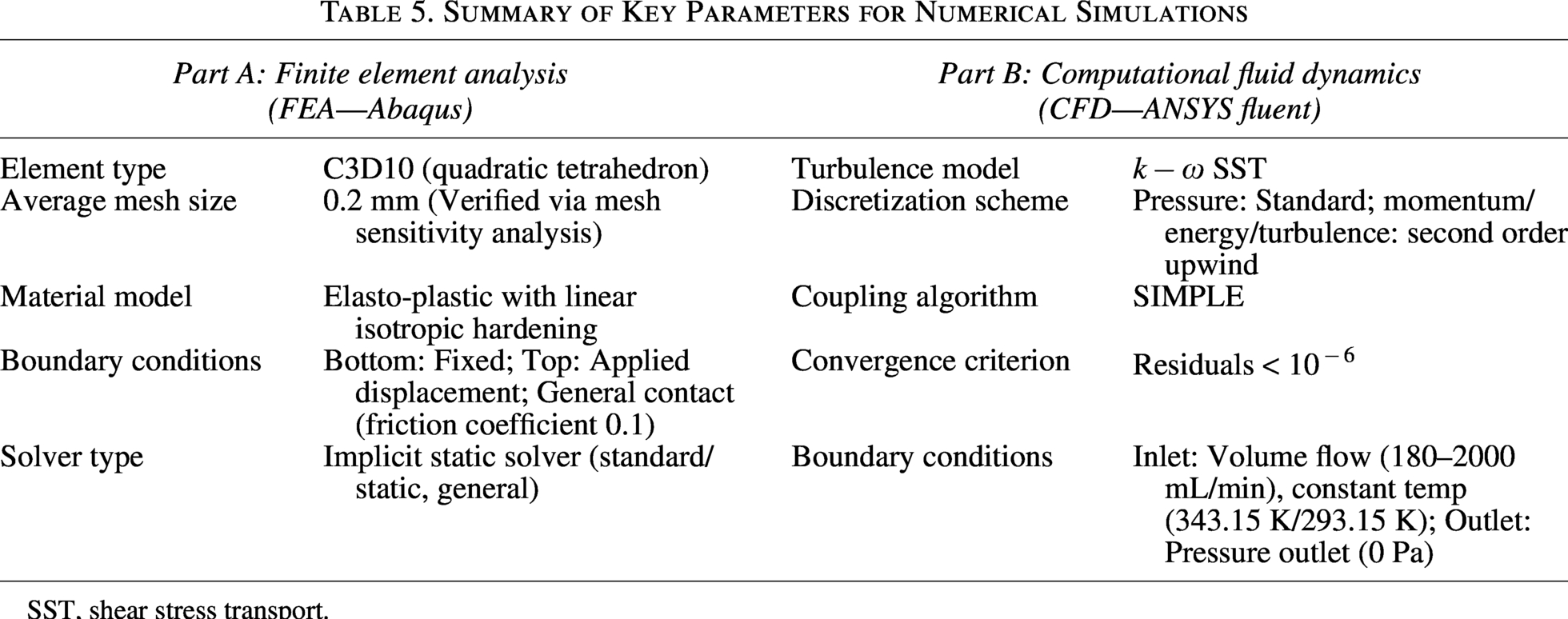
For a quick reference to the core settings of the numerical simulations conducted in this study, Table 5 provides a systematic summary of the key parameters for the FEA and CFD analyses.
Summary of Key Parameters for Numerical Simulations
SST, shear stress transport.
Definition of performance evaluation metrics
To quantitatively compare and evaluate the performance of the different TPMS structures, a series of key performance indicators was defined. The calculation formulas for these metrics are based on standard theories of thermo-hydraulics and solid mechanics. This suite of indicators was chosen to provide a comprehensive multi-physics performance profile, directly reflecting the trade-offs between heat transfer, fluid resistance, and mechanical integrity.

Results and Discussion
This section provides a systematic analysis of the multi-physics performance of the bio-inspired graded dual-channel TPMS heat exchanger. The subsection “Mechanical performance and damage tolerance of the bio-inspired graded structure” evaluates the mechanical performance to validate the study’s core biological analogy—the gradient-based damage tolerance mechanism derived from the starfish skeleton—and its successful replication in an engineered structure. Building upon this critical mechanical foundation, the subsection “Thermo-hydraulic performance and synergistic heat transfer-pressure drop optimization” demonstrates the breakthrough application of this design principle in the domain of thermo-fluid dynamics, showing its ability to fundamentally decouple the inherent conflict between heat transfer enhancement and pressure drop suppression. Subsequently, the subsection “Physical mechanism of synergistic performance optimization” deconstructs the physical mechanisms behind this performance decoupling and introduces new performance metrics to quantify its superiority. Finally, the subsection “Advanced nature and universality of the bio-inspired gradient design paradigm” situates the contributions of this research within a broader academic and engineering context, arguing for its novelty and potential as a universal “physical field management” design paradigm.
Mechanical performance and damage tolerance of the bio-inspired graded structure
The theoretical cornerstone of this research is the cross-domain translation of the gradient design principle used to manage mechanical stress fields in the skeleton of the knobby starfish to the regulation of thermo-fluidic fields. Therefore, before evaluating its thermal performance, the primary task is to validate this core biomechanical analogy. This section, through a coupled approach of quasi-static compression experiments and FEA, demonstrates that the designed GHRD2 graded structure, like its biological archetype, achieves exceptional damage tolerance by modulating its internal stress distribution.
Progressive collapse and enhanced energy absorption characteristics
Figure 5 presents the nominal stress–strain curves for the different TPMS structures under quasi-static compression. All curves exhibit the three characteristic stages typical of porous materials: an initial linear elastic region, a prolonged plateau of nearly constant stress, and a final stage of rapidly increasing stress as the pores collapse and the material densifies. 52

Comparison of energy absorption efficiency and compressive stress–strain curves for different TPMS structures:
Quantitative data, summarized in Table 6, indicate that the GHRD2 structure demonstrates the optimal energy absorption capacity, with a SEA of 22.86 J/g. Because the evaluated TPMS topologies maintain a constant wall thickness of 0.5 mm to strictly isolate the effects of the topological geometries, the introduction of the bio-inspired gradient inevitably alters the global mass distribution. This results in slightly different overall relative densities among the variants (e.g., 21.05% for the uniform HRD baseline vs. 23.09% for the GHRD2 variant, as shown in Table 3). Directly comparing their absolute total energy absorption would disproportionately favor structurally heavier designs. Therefore, utilizing SEA—which mathematically normalizes the absorbed energy by the structure’s effective mass—is a scientific imperative. It provides an impartial and objective metric to evaluate the intrinsic mechanical efficiency and damage tolerance uniquely endowed by the architectural topology itself. Compared to the uniform baselines, this normalized SEA value represents an authentic performance increase of 3.6% and 5.8% over the HRD structure (22.07 J/g) and the solid Diamond structure (21.61 J/g), respectively. However, focusing solely on the modest increase in SEA overlooks the more profound contribution of the gradient design to mechanical performance. In many safety-critical engineering applications, the stability and predictability of the energy absorption process—the structure’s “damage tolerance”—are of even greater importance than the total energy absorbed. Under compressive loads, uniform periodic lattices are prone to strain localization within a single weak layer or along specific crystallographic directions (typically 45°), forming shear bands that, once initiated, propagate rapidly and lead to sudden, catastrophic global instability. This failure mode is uncontrollable and is actively avoided in engineering design.
Compressive Performance Parameters of Different TPMS Structures
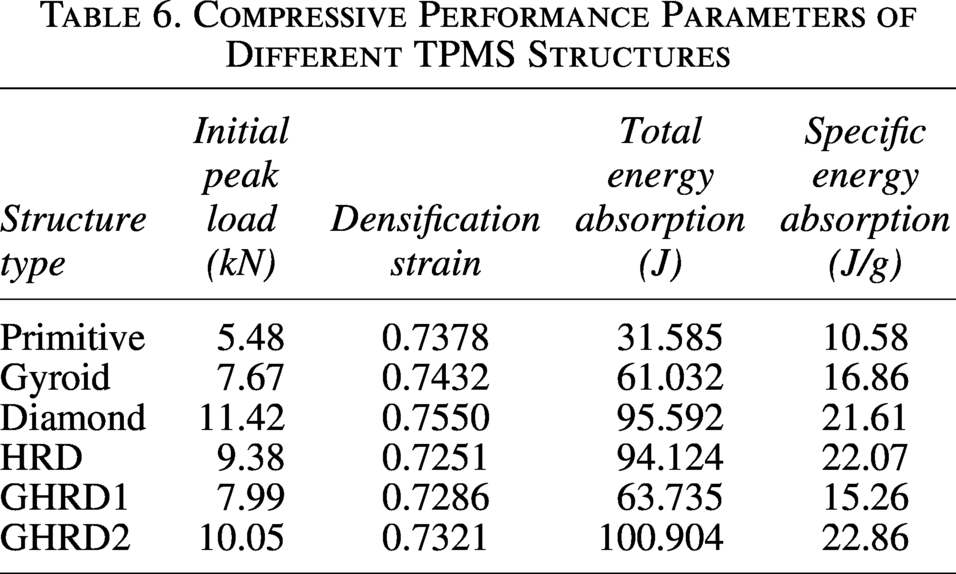
Notably, the counter-gradient structure (GHRD1)—incorporated specifically as a negative control group—exhibited a markedly deficient mechanical response. Despite employing the identical TPMS foundational topology as the uniform HRD and the bio-inspired GHRD2, GHRD1 yielded an initial peak load of merely 7.99 kN, while its SEA plummeted to 15.26 J/g. This performance is not only vastly inferior to the bio-inspired GHRD2 (22.86 J/g) but also underperforms the uniform Gyroid baseline (16.86 J/g). These findings compellingly illustrate that the arbitrary introduction of a geometric porosity gradient does not inherently yield mechanical benefits. Rather, an improperly aligned gradient inadvertently introduces severe structural vulnerabilities, precipitating a collapse in global load-bearing efficacy. Conversely, this stark contrast rigorously underscores the profound efficacy of the bio-inspired stiffness-matching strategy employed in GHRD2 for optimizing structural resilience and maximizing material utilization.
The stress–strain curve of the GHRD2 structure (Fig. 6) reveals a fundamentally different failure mechanism compared with uniform structures. While the ultimate densification strains are comparable across all tested topologies, the dynamic progression of failure is entirely distinct. Uniform stretch-dominated lattices (such as the standard HRD and Diamond) typically fail via a sudden, catastrophic global diagonal shear band, causing an abrupt loss of load-bearing capacity. In marked contrast, the intentional porosity gradient in GHRD2 forces a controlled, progressive, layer-by-layer collapse, effectively transforming the failure from an unpredictable ‘catastrophic event’ into a stable ‘energy-absorbing process.’ Consequently, in contrast to the unstable fluctuations of the Primitive structure in the plateau region and the abrupt stress increase of the Diamond structure during densification, the GHRD2 curve exhibits a smoother transition into the plateau region, with significantly smaller stress fluctuations and a longer strain duration throughout this phase. 53 These distinct quantitative features of the curve—namely the smoother transition, diminished stress amplitude fluctuations, and extended plateau strain range—are the direct macroscopic manifestations of its superior damage tolerance, the micro-mechanical origins of which are detailed in the following section.
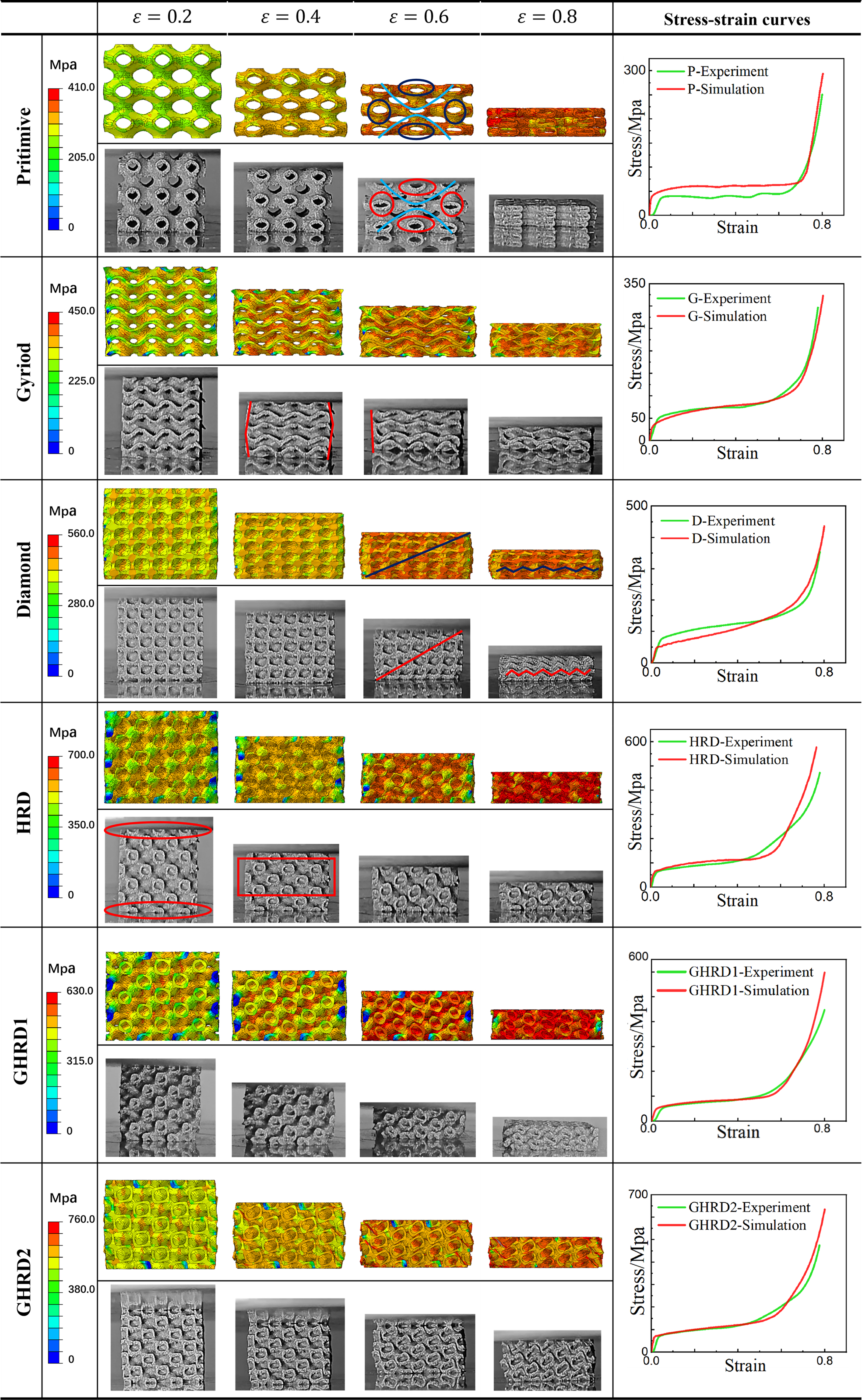
Comparison of deformation modes and compressive stress–strain curves for different TPMS structures. The finite element analysis (FEA) contour plots display the von Mises equivalent stress to visualize localized yielding and stress concentrations. All structures exhibit classic three-stage compression behavior (elastic, plateau, densification). The stress plateau of GHRD2 is slightly higher than that of Hollow-Rod Diamond (HRD), and its Specific Energy Absorption (SEA) is the highest (Note: The 45° dashed lines denote typical global shear bands indicating catastrophic failure, while the wavy lines highlight the progressive layer-by-layer collapse. The circled and rectangular regions indicate localized stress concentrations and plastic hinge formations).
Micro-mechanical origins of damage tolerance
By combining experimental observations with finite element simulations (Fig. 6, which explicitly displays the von Mises equivalent stress to effectively predict yielding and visualize internal stress concentrations), it is possible to gain deep insight into the internal stress distribution and failure evolution of different TPMS structures under compression, thereby revealing the fundamental reason for the high damage tolerance of the GHRD2 gradient design.
The deformation kinematics of GHRD1 further elucidate the micromechanical origins of its structural deficit. As depicted in Figure 6, the FEA results perfectly corroborate the experimental observations, revealing severe stress localization disproportionately concentrated within the low-density strata of the structure. During the initial stages of compression, these mechanically compliant “soft” layers undergo premature and catastrophic plastic buckling prior to the full engagement of the higher-density, load-bearing core. This uncoordinated deformation mode manifests macroscopically as a pronounced concavity in its stress–strain curve during the plateau phase. In stark contrast, the GHRD2 structure exhibits an ideal, progressive, layer-by-layer failure progression. The corresponding simulation contours clearly demonstrate the uniform transmission and effective dissipation of stress throughout its strategically graded architecture, thereby maximizing its global energy absorption efficiency.
As shown in Figure 6, the various uniform TPMS topologies exhibited distinct failure modes. 32 The Primitive structure’s failure was characterized by localized plastic buckling, initiating at the outer layers and culminating in the formation of a distinct ‘X-shaped’ shear band at approximately 45°, leading to a layer-by-layer collapse. The Gyroid structure, owing to its more uniform geometry, demonstrated a more simultaneous collapse across its layers, which delayed the onset of global instability. In contrast, after yielding, stress in the uniform Diamond structure rapidly concentrates and forms a 45° diagonal shear band that traverses the entire structure. This is a typical failure mode for stretch-dominated lattices; once the shear band forms, the structure becomes unstable along this plane, leading to a sharp drop in load-bearing capacity. 54 While this behavior aligns well with predictions from Mohr-Coulomb failure theory, its sudden nature is highly undesirable in engineering applications.
In stark contrast, the failure mode of the GHRD2 structure clearly demonstrates the efficacy of its bio-inspired design. The porosity gradient along the flow direction (z-axis), with the lowest porosity in the central region and the highest at the periphery, intentionally introduces aperiodicity. This creates a non-uniform stiffness field that fundamentally disrupts the conditions for synchronous failure. During the initial stages of compression (strain ≈ 20%), stress first concentrates in the mechanically “softest,” most porous peripheral regions. This area undergoes plastic yielding and cell collapse first, acting as a sacrificial “energy-absorbing buffer” that dissipates a large amount of the initial impact energy. As compression continues (strain ≈ 40–60%), the load is smoothly redistributed and transferred to the stiffer, less porous central regions. These regions continue to provide structural support, effectively delaying the onset of full densification.
This orderly, layer-by-layer failure progression from “soft” to “hard” regions is a direct functional mimicry and replication of the damage tolerance mechanism of the knobby starfish skeleton. In nature, such gradient designs are widely used to smooth mechanical property transitions between different tissues, thereby avoiding stress concentrations and achieving exceptional toughness. The GHRD2 structure in this study successfully translates this biological survival strategy into a controllable and efficient energy dissipation mechanism through engineering means. It actively guides the failure path, intelligently transforming concentrated stresses that could lead to catastrophic fracture into a controlled, progressive, and ductile collapse. 55
In summary, the results of the mechanical performance evaluation provide strong evidence that the core biological analogy of this study is valid. The principle of “optimizing physical field (stress field) management through geometric gradients,” abstracted from the starfish skeleton, can indeed be successfully translated and accurately reproduced in an engineered structure to achieve its intended mechanical behavior. With this solid theoretical and experimental foundation established, the subsequent sections will demonstrate that this validated, universal principle can also yield significant performance enhancements in a completely new physical domain: thermo-fluid dynamics.
Thermo-hydraulic performance and synergistic heat transfer-pressure drop optimization
Having validated the mechanical efficacy of the bio-inspired gradient design, this section focuses on the central objective of the article: evaluating the performance of this strategy in resolving the inherent trade-off between heat transfer and pressure drop, particularly as flow conditions become more demanding. Through high-fidelity Computational Fluid Dynamics (CFD) simulations, it is systematically revealed how the GHRD2 structure achieves superior performance by fundamentally altering thermo-fluidic scaling behavior.
Internal flow dynamics: Vortex generation and boundary layer disruption
To understand the performance differences between the various TPMS topologies at a mechanistic level, the internal temperature fields (Fig. 7) and three-dimensional streamlines (Fig. 8) of the heat exchangers were first visualized and analyzed.
Internal temperature distribution in different TPMS heat exchangers (HX) at steady state: Schematic of 3D streamlines inside TPMS heat exchangers, illustrating flow bifurcation and counter-current shear effects. Subplots: 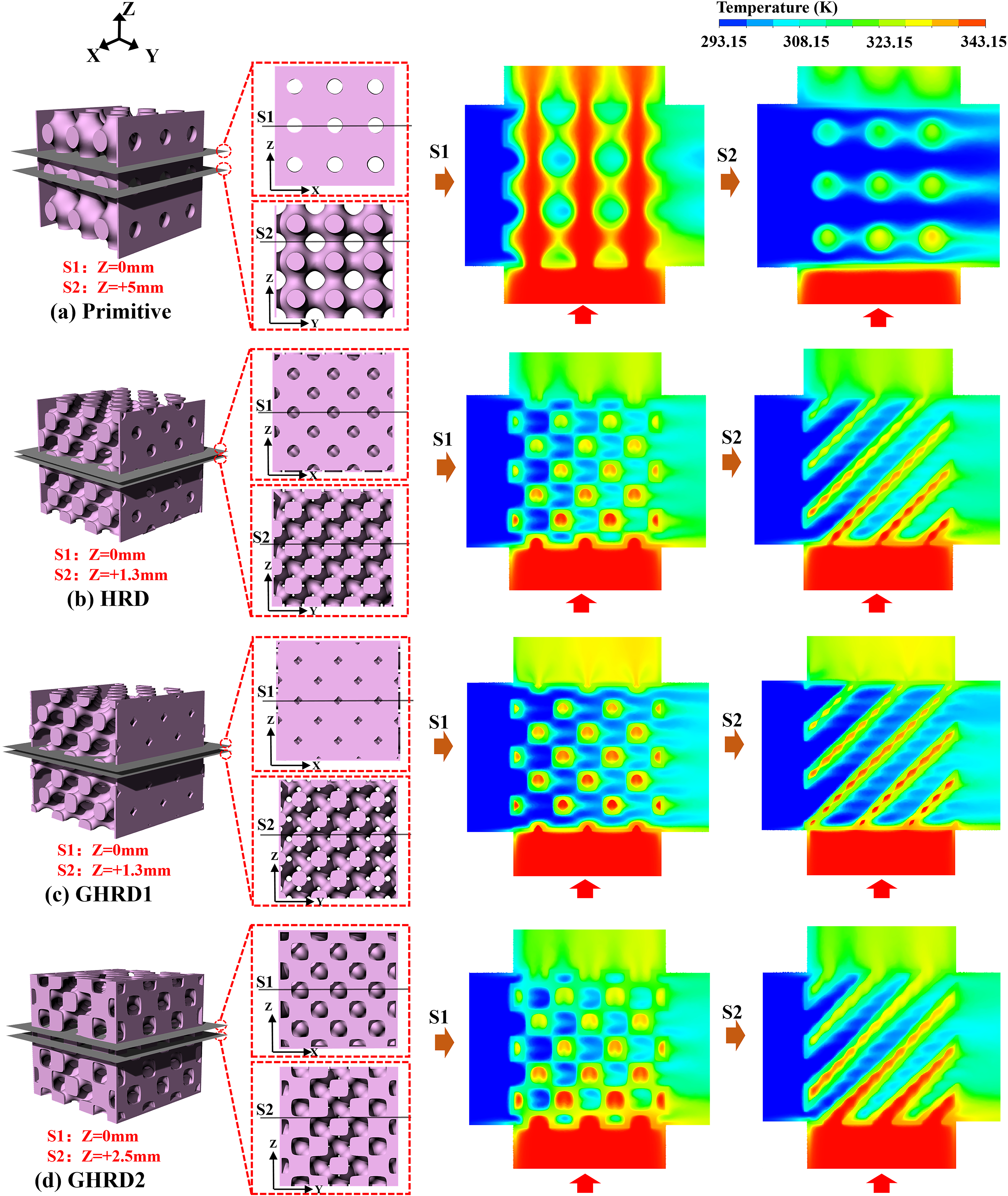

As shown in Figure 7, the temperature field of the Primitive structure exhibits clear stratification. The cold and hot fluids flow along nearly parallel, straight channels, with heat exchange limited to conduction and convection at the channel walls. The lack of effective transverse mixing leads to low heat exchange efficiency. In contrast, the complex curved surfaces of the HRD, GHRD1, and GHRD2 structures force vigorous internal fluid mixing. The cold and hot fluids are intricately interwoven in space, creating a large and efficient heat exchange interface that significantly enhances the overall heat transfer potential.
The 3D streamline plots (Fig. 8a–d) further elucidate the underlying fluid dynamic mechanisms. In the HRD structure, the fluid is forced along tortuous channels, constantly undergoing splitting, merging, and turning (Fig. 8b–d). This complex flow path induces strong secondary flows (e.g., Dean vortices), which effectively disrupt and refresh the thermal boundary layer at the solid-fluid interface, thereby enhancing convective heat transfer (Fig. 8e and f). 56
The GHRD2 structure elevates this mechanism to a new level. Its graded channel design, which is narrow at the inlet and widens towards the outlet, synergistically optimizes the thermo-fluidic processes in two key regions:
In stark contrast is the GHRD1 structure, which serves as a definitive scientific counter-example. By employing an anti-bio-inspired “diverging-converging” channel profile, its expanding inlet severely decelerates the incoming fluid, thereby failing to capitalize on the region with the highest initial thermal driving force. Conversely, the sharp channel contraction at the outlet induces severe aerodynamic choking, generating immense flow resistance while simultaneously suppressing effective macroscopic fluid mixing. Consequently, this unfavorable aerodynamic behavior results in a markedly low Performance Decoupling Index of merely 0.45. This explicitly confirms that the arbitrary introduction of a geometric gradient does not inherently guarantee performance enhancements; rather, the geometry must be directionally matched to the fluid’s pressure recovery requirements. It provides robust evidence that the superior performance of GHRD2 originates directly from the precise, bio-inspired alignment of its fluid impedance-matching gradient. 57
Quantitative assessment: Decoupling heat transfer and pressure drop
Having revealed the internal mechanisms, a series of standardized thermo-hydraulic performance indicators were used to conduct a rigorous quantitative evaluation of the different designs. Figure 9a–f systematically presents the comprehensive performance curves of each structure across a range of Reynolds numbers (

Comprehensive performance curves for Primitive, HRD, GHRD1, and GHRD2 heat exchangers at different Reynolds numbers (
Heat Transfer Performance
Before analyzing the dimensionless
Fluid Resistance Performance
The relationship between the Fanning friction factor (
The pressure contour plots (Fig. 10) provide a direct visualization of this effect under high-inertia conditions. At a flow rate of 1800 mL/min (
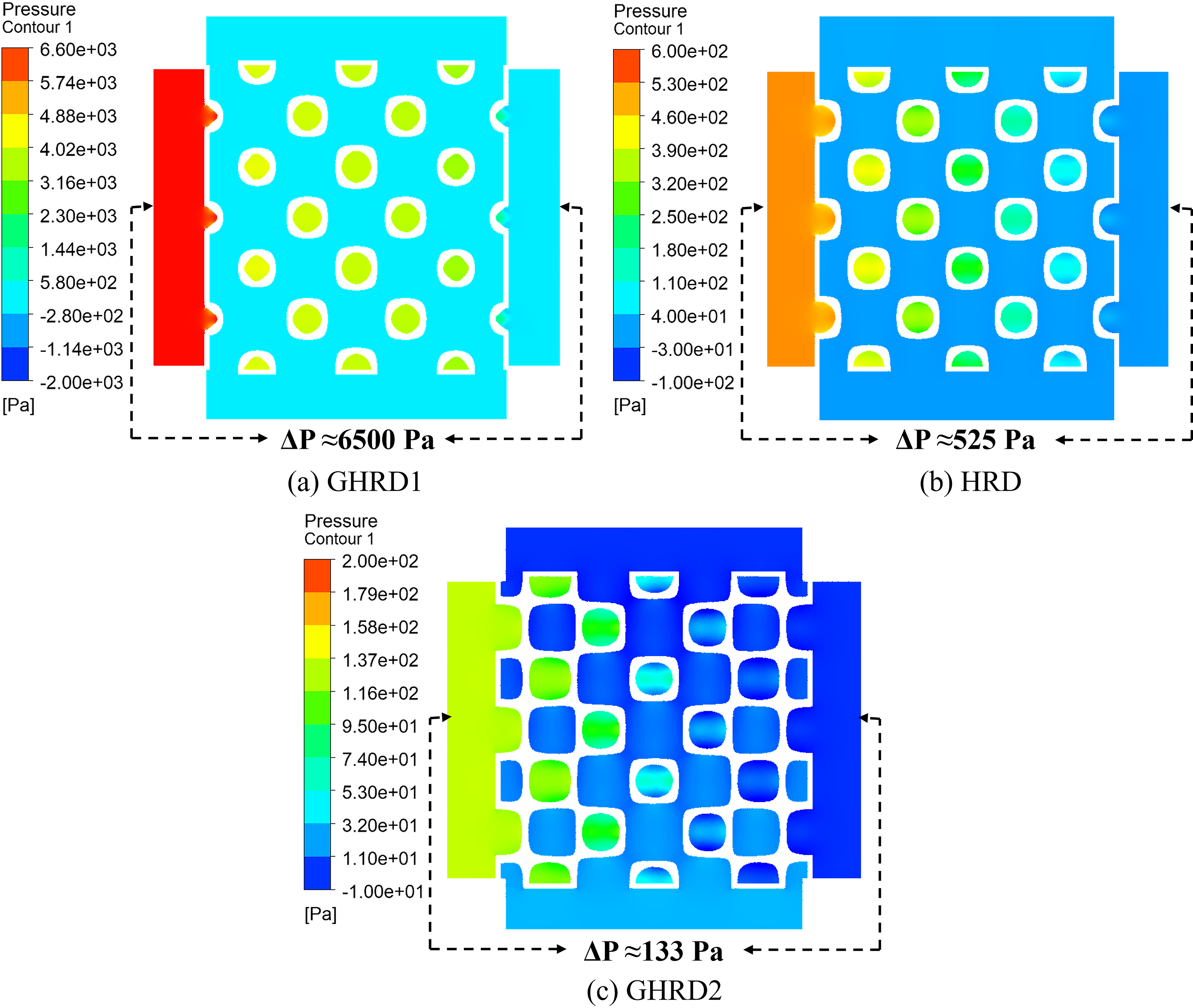
Pressure contour comparison for HRD, GHRD1, and GHRD2 heat exchangers at an inlet flow rate of 1800 mL/min:
Comprehensive Performance
To provide a more holistic evaluation of multi-objective performance, Figure 11 uses radar charts to present a normalized comparison of key performance indicators for each structure under both low-

Key performance indicators (Heat transfer efficiency
Under both low and high
Experimental validation of thermo-hydraulic performance
To corroborate the numerical predictions and rigorously assess the performance of the proposed structures under realistic operational conditions, a customized dual-loop convective heat transfer experimental facility was engineered, as illustrated in Figure 12. The setup features a power and fluid circulation unit (Fig. 12a) coupled with a thermostatic control and data acquisition panel (Fig. 12b) to maintain highly stable, steady-state inlet boundary conditions. The LPBF-fabricated test specimens were instrumented with high-precision PT100 temperature sensors and differential pressure transmitters at both the inlet and outlet plenums (Fig. 12c). This configuration enabled the precise measurement of thermo-hydraulic metrics across a broad volumetric flow rate spectrum of 120–1800 mL/min.
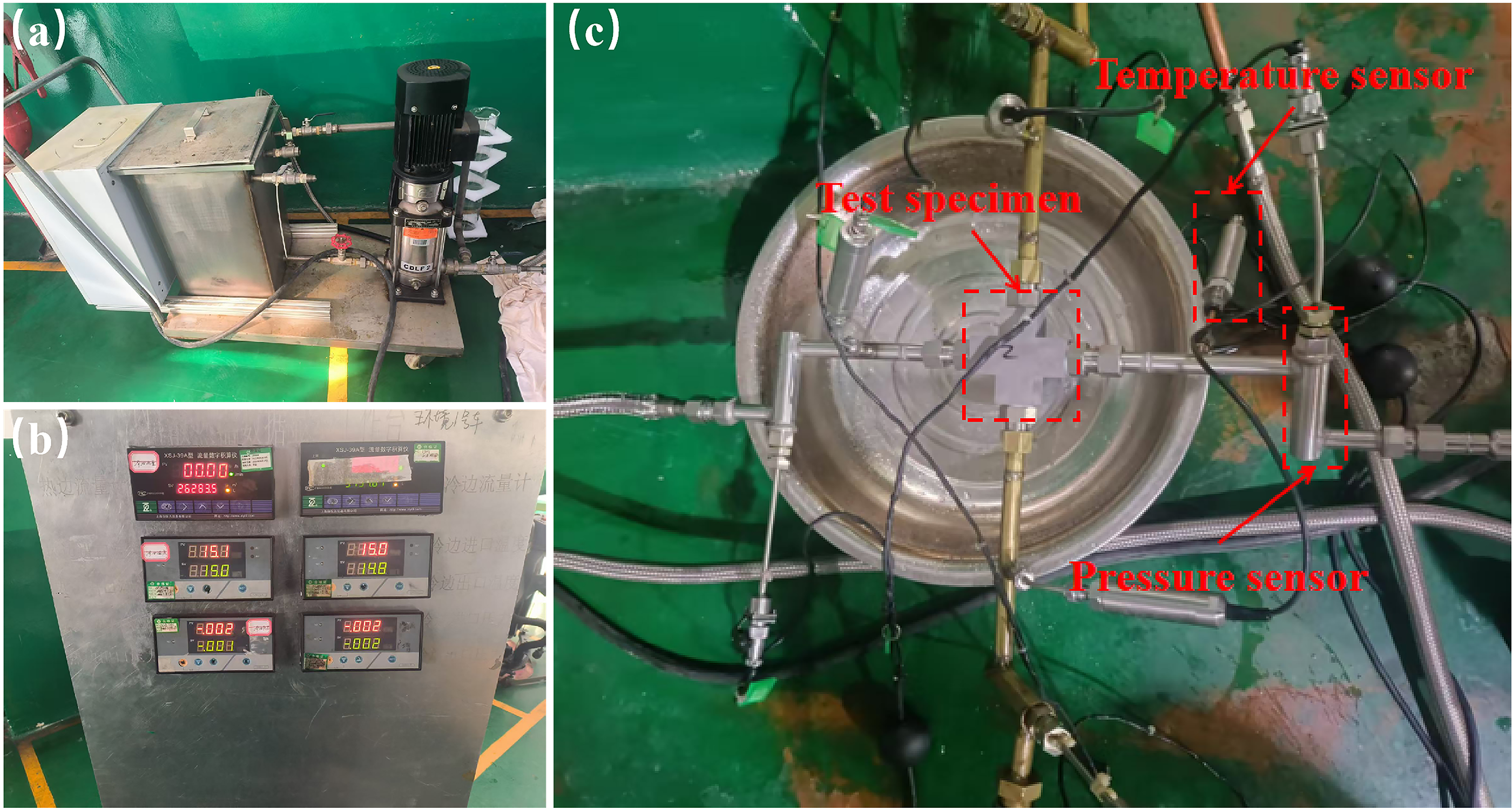
Photographic view of the experimental setup for convective heat transfer. Subplots:
The empirical results, consolidated in Figure 13, reveal that the performance characteristics of the evaluated topologies diverge substantially as the flow enters the high-inertia regime (V > 1400 mL/min). As elucidated in Figure 13a and b, the disparity in thermal response widens progressively with increasing fluid inertia. For both the anti-gradient GHRD1 and the uniform HRD, the hot-side outlet temperatures exhibit a continuous upward trajectory. This behavior strictly conforms to classical convective heat transfer paradigms, wherein a diminished fluid residence time inherently restricts the total enthalpy exchange capability per unit mass.

Experimental thermo-hydraulic performance of different TPMS structures. Subplots:
Remarkably, the bio-inspired GHRD2 structure displays a highly advantageous, non-monotonic thermal response that defies this conventional limitation. When the volumetric flow rate surpasses 1400 mL/min, the hot-side outlet temperature of GHRD2 deviates from the anticipated rising trend, registering a slight anomalous decline. Concurrently, this is matched by a sustained increase in the cold-side outlet temperature, indicative of enhanced heat absorption. This counter-intuitive anomaly provides hard physical evidence that, within this high-inertia regime, the amplification of the convective heat transfer coefficient (
Furthermore, the flow resistance characteristics charted in Figure 13d unambiguously underscore the critical hydraulic advantage of the bio-inspired gradient strategy. Driven by severe aerodynamic flow-choking effects inherent to its converging outlet geometry, the pressure drop of the GHRD1 structure experiences an exponential surge, peaking at an excessive 14.80 kPa at 1800 mL/min. In stark contrast, the GHRD2 structure sustains an exceptional hydraulic efficiency under identical conditions, generating a mere 1.45 kPa of flow resistance. This equates to a staggering 90% reduction relative to the GHRD1 counter-example and a 73% reduction compared with the uniform HRD baseline (5.40 kPa).
Ultimately, these empirical findings conclusively confirm that the functionally diverging-channel design of GHRD2 effectively circumvents the prohibitive pressure penalty traditionally coupled with heat transfer augmentation. By strategically aligning the structural porosity gradient with the direction of momentum flux—thereby achieving precise fluid impedance matching—GHRD2 successfully orchestrates the simultaneous optimization of amplified thermal efficiency and substantially minimized flow resistance. This provides robust, real-world validation for the “thermo-fluidic performance decoupling” hypothesis initially established through numerical modeling.
Physical mechanism of synergistic performance optimization
The preceding results clearly demonstrate a performance breakthrough that amplifies as inertial forces become more dominant. This section delves into the underlying physical principles, leading with a quantitative analysis of the thermo-fluidic scaling laws to reveal the fundamental reason why the GHRD2 design breaks the conventional performance trade-off.
Altered Nu-Re scaling laws: Quantitative evidence of performance decoupling
To mathematically quantify the performance advantages of GHRD2, the CFD data was analyzed to establish empirical correlations between the Nusselt number and Reynolds number, in the form of 

This result carries profound physical significance. The exponent
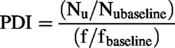
To directly quantify the degree of “performance decoupling,” a non-dimensional metric is defined—the Performance Decoupling Index (PDI):
Comprehensive Performance Comparison and the Performance Decoupling Index at High Reynolds Number (
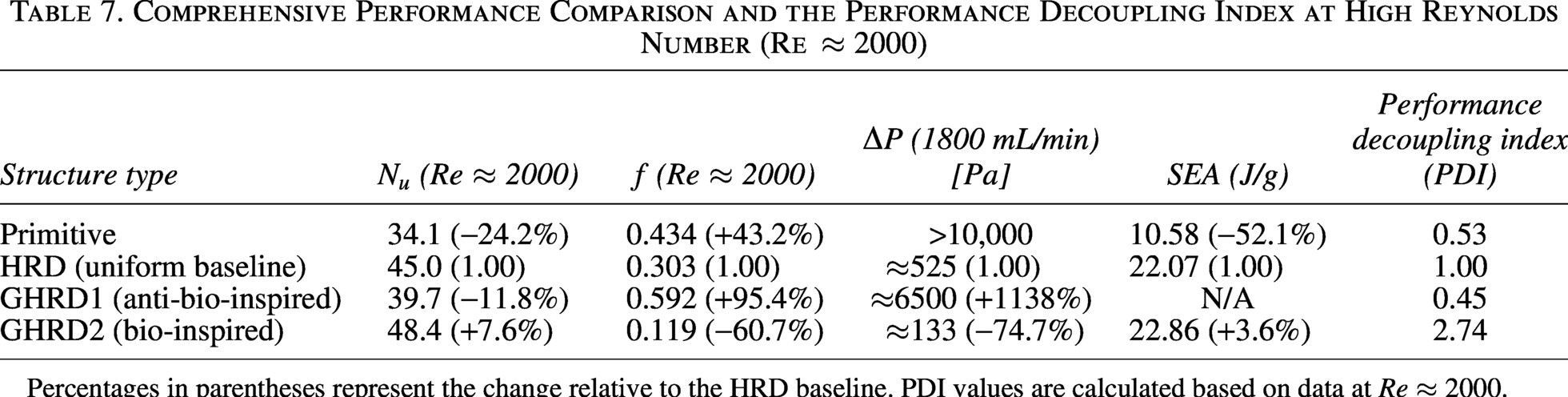
Percentages in parentheses represent the change relative to the HRD baseline. PDI values are calculated based on data at
The physical principle: Functional spatial separation and fluid impedance matching
The GHRD2 design achieves this favorable scaling through a core idea that can be termed “Functional Spatial Separation,” which is particularly effective in high-inertia flows. It creates a non-uniform, locally optimized thermo-hydraulic performance field, allocating specific functional optimizations to the spatial locations where they are most needed:
Inlet/Core Region—Maximizing Heat Transfer: In the inlet and core regions where the temperature difference ( Inlet and Outlet Region—Minimizing Pressure Drop: In the outlet region, where
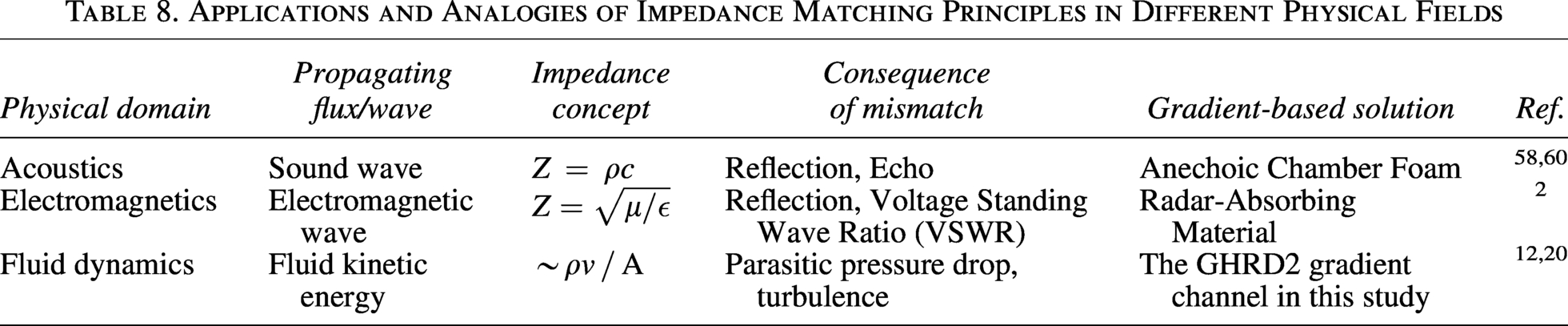
This strategy can be rigorously interpreted from a fundamental physics perspective as an innovative application of the “impedance matching” principle to fluid dynamics. Traditional designs with abrupt area changes present a severe impedance mismatch to the flow, causing significant reflection of incident kinetic energy, which manifests as chaotic turbulence and irreversible pressure loss. The GHRD2’s continuous gradient acts as a ‘fluid impedance’ matching layer. It smoothly transitions the high-inertia fluid from the low-impedance state (low velocity, large diameter) in the manifold to the high-impedance state (high velocity, small diameter) in the core, and then back to a low-impedance state at the outlet. This minimizes energy-dissipating “reflections,” allowing the fluid to traverse the heat exchange core with minimal parasitic loss. This is directly analogous to the use of graded materials in acoustics to create anechoic chambers or in electromagnetics for stealth applications, where impedance gradients are engineered to guide wave energy smoothly across interfaces.
Advanced nature and universality of the bio-inspired gradient design paradigm
Beyond proposing a high-performance heat exchanger, this section aims to benchmark the bio-inspired concept against conventional technologies and envision its broader application potential. Rather than proposing an unconditionally optimal geometry derived from exhaustive algorithmic parameter sweeps, the actual scientific contribution of this study lies in the experimental and numerical validation of a principle-driven design paradigm. We demonstrate the practical feasibility of applying the “fluid impedance matching” principle to complex thermo-fluidic systems. The GHRD2 heat exchanger serves as a proof-of-concept demonstrating that the propagation of fluid kinetic fluxes across geometric interfaces can be effectively managed by introducing continuous structural gradients, thereby mitigating irreversible chaotic kinetic energy loss at the entrance and exit regions.
The GHRD2 heat exchanger in this study essentially represents a creative application of this ‘impedance matching’ principle to the field of fluid dynamics.22,58 Its gradually expanding channels can be viewed as a ‘fluid impedance’ gradient matching layer. Traditional designs with abrupt area changes are analogous to mismatched acoustic interfaces, causing significant reflection of incident wave energy. 59 In the fluidic context, this ‘reflection’ is the chaotic dissipation of kinetic energy into turbulence and pressure loss. The GHRD2’s continuous gradient smoothly transitions the fluid from the high-impedance state (high velocity, small diameter) in the core to the low-impedance state (low velocity, large diameter) at the outlet, allowing the fluid to ‘enter’ and ‘exit’ the heat exchange core with minimal energy loss. This interpretation reframes the pressure drop reduction from a simple consequence of the Hagen-Poiseuille law to a successful application of a fundamental wave-medium interaction principle.
This work can be rigorously classified within the framework of functionally graded materials (FGMs). The GHRD2 is not merely a graded geometry but an FGM engineered for coupled thermo-fluidic transport. The porosity gradient creates a continuous variation in the effective medium properties governing momentum transport (permeability) and thermal transport (effective conductivity and convective surface area). Our results demonstrate that this FGM is engineered to be ‘transparent’ to momentum flux in the outlet region (minimizing pressure drop) while being highly ‘interactive’ with thermal flux in the inlet/core region (maximizing heat transfer). This serves as a proof-of-concept that the established principles of FGM design for controlling acoustic or elastic waves can be successfully translated to manage the complex, coupled transport phenomena in high-performance thermal systems.
It is instructive to contrast our bio-inspired, principle-driven design paradigm with prevailing computational approaches such as topology optimization (TO). While TO is a powerful tool for generating high-performance, free-form geometries, the resulting designs can often be physically unintuitive, representing a single optimal solution to a specific set of boundary conditions. Our approach, in contrast, yields a design based on an understandable and generalizable physical principle—fluid impedance matching. This not only provides a solution but also generates fundamental design knowledge that is transferable to other thermal management challenges (Table 8). This work suggests that integrating deep physical insights, often abstracted from elegant biological solutions, offers a powerful and complementary pathway to purely algorithmic design, leading to solutions that are not only optimal but also elegantly simple and physically interpretable.
Applications and Analogies of Impedance Matching Principles in Different Physical Fields
The conformal heat exchanger design shown in Figure 14. further illustrates the immense engineering application potential of this design paradigm. By conformally integrating the GHRD2 structure with complex curved surfaces and fabricating it monolithically using additive manufacturing, customized and highly efficient thermal management solutions can be provided for components with irregular shapes and compact volumes in fields such as aerospace and high-performance computing. 13 Experimental results indicate that this gradient design is equally effective in complex real-world configurations, achieving a significant reduction in pressure drop on both fluid sides with only a minimal sacrifice in heat exchange efficiency (approx. 1%), effectively resolving issues of localized high pressure and heat accumulation.

Example application of a conformal heat exchanger with a same-side inlet/outlet configuration. (The GHRD2 structure replaces the traditional tube side, achieving separated flow paths for cold and hot fluids):
In conclusion, this research, through a biological inspiration from a starfish, not only solves a long-standing engineering problem but, more importantly, reveals and validates a universal design principle that spans multiple fields, including mechanics, thermodynamics, acoustics, and electromagnetics. This opens a new and promising pathway for the development of a new generation of multifunctional metamaterials capable of synergistic multi-physics performance optimization, enabled by additive manufacturing technology. 61
Manufacturing constraints and operational outlook
While this study successfully establishes a proof-of-concept for decoupling thermo-fluidic trade-offs via bio-inspired gradients, the transition from laboratory-scale validation to industrial application is inherently bound by methodological limitations and operational constraints. First, from a design perspective, this work focuses strictly on validating the underlying physical mechanism rather than conducting an exhaustive multi-parameter optimization. Geometric variables—such as the exact mathematical polynomial of the gradient profile—remain open for future systematic optimization using advanced computational algorithms.
Furthermore, industrial scalability relies heavily on the manufacturability of complex TPMS architectures via LPBF. On a positive note, the bio-inspired converging-diverging channel geometry of GHRD2 inherently mitigates a major additive manufacturing bottleneck: depowdering. Unlike uniform dense lattices, where trapped powder is notoriously difficult to evacuate, the diverging, nozzle-like channels naturally facilitate the physical flushing out of unmelted powder post-build. Conversely, a critical operational limitation lies in the surface quality. The as-built surface roughness is typical of LPBF components (
Conclusion
This study demonstrates a bio-inspired design paradigm, enabled by Laser Powder Bed Fusion, that overcomes a fundamental scaling limitation in high-Reynolds-number thermal management. The proposed GHRD2 structure translates a physical field management principle from biomechanics to resolve the critical performance trade-off in compact heat exchangers. The main conclusions are as follows:
Fundamental decoupling of thermo-fluidic performance was achieved. In the inertia-dominated regime (Re ≈ 2000), the proposed bio-inspired graded structure (GHRD2) exhibited a highly favorable combination of properties. Compared to its uniform counterpart, it achieved a 74.7% reduction in pressure drop while simultaneously increasing the Nusselt number by 12%. This result confirms that the design overcomes the conventional bottleneck where enhanced heat transfer necessitates a severe fluid resistance penalty. A superior thermo-fluidic scaling law was identified to guide engineering design. The performance advantage of the graded structure dynamically amplifies with increasing fluid inertia. Quantitative analysis established that its Nusselt number scales with the Reynolds number to the power of 0.52 ( The core physical mechanism for decoupling the performance trade-off was elucidated through a proof-of-concept approach. By comparing opposing gradient profiles, it was demonstrated that the superior performance is not a mere coincidental byproduct of geometrical aperiodicity, but stems specifically from the proper directional alignment of the structural gradient. Operating as a “fluid impedance matching layer,” the GHRD2 geometry accelerates the fluid to enhance core convection while simultaneously acting as a flow diffuser to enable efficient pressure recovery at the outlet. The efficacy of a principle-driven, cross-domain design paradigm was successfully validated. Rather than offering a single algorithmically optimized component, this study confirms that a unified bio-inspired strategy can synergistically manage physical fields. Alongside its thermo-fluidic advantages, the structure replicates the damage-tolerance mechanism of its biological archetype, achieving a progressive, energy-absorbing collapse mode with a Specific Energy Absorption of 22.86 J/g. This lays a robust theoretical groundwork for future algorithm-driven multifunctional metamaterial designs.
Authors’ Contributions
G.H.: Writing—review and editing, writing—original draft, methodology, investigation, formal analysis, data curation, conceptualization, funding acquisition. Q.Z.: Writing—review and editing, writing—original draft, software, methodology, investigation, formal analysis, data curation, conceptualization. W.X.: Writing—review and editing, validation, project administration, funding acquisition, conceptualization. Z.Y.: Writing—review and editing, methodology, data curation. L.W.: Writing—review and editing, validation, resources. C.X.: Writing—review and editing, methodology, data curation. R.F.: Writing—review and editing, methodology, data curation. L.H.: Supervision, funding acquisition. F.M.: Funding acquisition, conceptualization. F.L.: Supervision, funding acquisition.
Footnotes
Author Disclosure Statement
No competing financial interests exist.
Funding Information
This work was financially supported by the National Key Research and Development Program (
Supplemental Material
References
Supplementary Material
Please find the following supplemental material available below.
For Open Access articles published under a Creative Commons License, all supplemental material carries the same license as the article it is associated with.
For non-Open Access articles published, all supplemental material carries a non-exclusive license, and permission requests for re-use of supplemental material or any part of supplemental material shall be sent directly to the copyright owner as specified in the copyright notice associated with the article.
