




Abstract
Executive Summary
The US Department of State (DOS) reports that as of November 2018, nearly 3.7 million persons had been found by US Citizenship and Immigration Services (USCIS) to have a close family relationship to a US citizen or lawful permanent resident (LPR) that qualified them for a visa, but were on “the waiting list in the various numerically-limited immigrant categories” (DOS 2018). These backlogs in family-based “preference” (numerically capped) categories represent one of the most egregious examples of the dysfunction of the US immigration system. They consign family members of US citizens and LPRs that potentially qualify for a visa and that avail themselves of US legal procedures to years of insecurity, frustration, and (often) separation from their families.
Often criticized in the public sphere for jumping the visa queue, it would be more accurate to say that this population, in large part, comprises the queue. While they wait for their visa priority date to become current, those without immigration status are subject to removal. In addition, most cannot adjust to LPR status in the United States, but must leave the country for consular processing and, when they do, face three- or 10-year bars on readmission, depending on the duration of their unlawful presence in the United States. This population will also be negatively affected by the Department of Homeland Security’s (DHS) proposed rule to expand the public charge ground of inadmissibility (Kerwin, Warren, and Nicholson 2018). In addition, persons languishing in backlogs enjoy few prospects in the short term for executive or legislative relief, given political gridlock over immigration reform and the Trump administration’s support for reduced family-based immigration.
In this paper, the Center for Migration Studies (CMS) offers estimates and a profile based on 2017 American Community Survey (ACS) data of a strongly correlated population to the 3.7 million persons in family-based visa backlogs: i.e., the 1.55 million US residents potentially eligible for a visa in a family-based preference category based on a qualifying relationship to a household member. CMS data represents only part of the population in family-based backlogs. In particular, it captures only a small percentage of the 4th preference, brothers and sisters of US citizens.
1
However, everybody in CMS’s data could be petitioned for, if they have not been already. Among this population’s ties and contributions to the United States, the paper finds that: Fifty-nine percent has lived in the United States for 10 years or more, including 23 percent for at least 20 years. Nearly one million US-born children under age 21 live in these households, as well as 111,600 US-born adults (aged 21 and over) who have undocumented parents. 449,500 arrived in the United States at age 15 or younger. 139,100 qualify for the DREAM Act based their age at entry, continuous residence, and graduation from high school or receipt of a GED. Seventy-two percent aged 16 and older are in the labor force, and more than two-thirds (68 percent) are employed; these rates exceed those of the overall US population. Two-thirds of those aged 18 or older have at least a high school diploma or its equivalent, including 25 percent with a bachelor’s degree or higher, and 295,100 aged three and older are enrolled in school. The median income of their households is $63,000, slightly above the US median. More than two-thirds (68 percent) have health insurance, including 51 percent with private health insurance. Nearly one-third (32 percent) live in mortgaged homes, and 12 percent in homes owned free and clear.
The paper provides several recommendations to reduce family-based backlogs. In particular, it proposes that Congress pass and the President sign into law legislation to legalize intending family-based immigrants who have been mired in backlogs for two years or more. In addition, this legislation should define the spouses and minor unmarried children of LPRs as immediate relatives (not subject to numerical limits), not count the derivative family members of the principal beneficiary against per country and annual quotas, and raise per country caps. The administration should also re-use the visas of legal immigrants who emigrate each year, particularly those who formally abandon LPR status. This practice would reduce backlogs without increasing visa numbers.
Congress should also pass legislation to advance the entry date for eligibility for “registry,” an existing feature of US immigration law designed to legalize long-term residents. In particular, the legislation should move forward the registry cutoff date on an automatic basis to provide a pathway to status for noncitizens who have lived continuously in the United States for at least 15 years, have good moral character, and are not inadmissible on security and other grounds. In fact, Congress advanced the registry date on a regular basis during most of the 20th century, but has not updated this date, which now stands at January 1, 1972, for 33 years.
The Integrity of the Family: Why a Family-Based Immigration Program
The right to the preservation, protection, and integrity of the family is a core human right. Article 16(3) of the Universal Declaration of Human Rights, 2 and Article 23(1) of the International Covenant on Civil and Political Rights both recognize that the “family is the natural and fundamental group unit of society and is entitled to protection by society and the State.” 3 In the United States, strong families have long been treated as a policy panacea for goals as diverse as educational achievement, increased longevity, and reduced criminality. Families also represent a source of laborers and entrepreneurs, an (understudied) economic unit, a safety net, and a key contributor to immigrant integration (Gubernskaya and Dreby 2017). The family also remains the social institution — however constituted — that most persons care about and depend upon more than all others.
Since passage of the Immigration and Nationality Act of 1965, 4 family unity has been a guiding principle of US immigration law and policy. In his signing statement for the Immigration Act of 1990, 5 for example, President George H.W. Bush praised the Act for supporting “the family as the essential unit of society” and maintaining the nation’s “historic commitment to family reunification by increasing the number of immigrant visas allocated on the basis of family ties” (Bush 1990).
In 2017, 46 percent of all immigrants (permanent residents) obtained their status as “immediate relatives” — i.e., spouses of US citizens, unmarried children under age 21 of US citizens, and parents of US citizens who are at least age 21 years old (DHS 2018, Table 7). Another 21 percent obtained their LPR status through one of the family “preference” categories, which cover the: unmarried sons and daughters of US citizens (1st preference); spouses and minor children of LPRs (2A preference) and unmarried adult sons and daughters of LPRs (2B preference); married sons and daughters of US citizens (3rd preference); and brothers and sisters of US citizens (4th preference) (ibid.).
While this system is often maligned for leading to “chain migration,” only select nuclear family members of US citizens and LPRs qualify for visas, and US citizen minors cannot petition for their parents. In addition, caps by preference category and nationality make the immigration of family members an attenuated process and, for some, an impossibility.
Immigrant families have been under sustained pressure by US immigration laws and policies, particularly since 1996 (Kerwin 2018). The Trump administration has intensified this pressure by failing to establish meaningful enforcement priorities and by instituting border enforcement tactics that tear children from parents and seek to consign families to indefinite detention (Kerwin, Alulema, and Nicholson 2018). Moreover, while the legal immigration system prioritizes family-based immigration, backlogs incentivize illegal entry, relegate intending immigrants to long-term undocumented status, and prolong the insecurity of their mixed-status US families. Many intending immigrants opt to live with family but without status in the United States, rather than to live abroad and apart from their family members for years.
The Senate-passed Border Security, Economic Opportunity, and Immigration Modernization Act of 2013 would have defined “immediate family” to include the spouses and minor children of LPRs. 6 However, the heavily family-based US legal immigration system has mostly come under attack in recent years. Immigration reform bills have sought to limit family-based immigration by defining “immediate relatives” to exclude the parents of US citizens, by eliminating the 2B, 3rd, and 4th preference categories, and by restricting family-based immigration to the spouses and minor children of US citizens and LPRs. The Trump administration supports the latter position (White House 2017). In addition, persons in family-based visa backlogs have not been included in recent bills that would legalize particular populations, including persons at risk of losing Temporary Protected Status (TPS) and potential DREAM Act beneficiaries. 7
As for executive discretion, the Obama administration’s Deferred Action for Parents of Americans and Lawful Permanent Residents (DAPA) program would have provided temporary protection from deportation to the parents of US citizens and LPRs. 8 However, court challenges prevented the program’s implementation and the Trump administration subsequently rescinded this program. At least in the short term, persons in family-based backlogs can expect little in the way of legislative or executive relief.
Family-Based Visa Backlogs: Causes and Size
There is no numerical limit on the number of visas granted each year to the “immediate relatives” of US citizens. However, as of November 1, 2018, nearly 3.7 million intending immigrants languished in waiting lists for family-based visa preference categories, including: 261,704 in the 1st preference; 145,861 in the 2A preference; 324,231 in 2B preference; 689,924 in 3rd preference; and 2,249,722 in the 4th preference (DOS 2018).
These numbers do not include family-based immigrants waiting to adjust to LPR status in the United States. The in-country adjustment procedure is available primarily to persons who enter the United States legally (were inspected and admitted or paroled) and who are classified as immediate relatives, but it is also available to diminishing numbers of those who illegally crossed US borders and have visa priority dates of April 30, 2001 or earlier (Kerwin, Meissner, and McHugh 2011, 11-12).
Backlogs in family-based visa categories result from the interplay between numerical limits for all family-based preference categories (226,000) and each preference category, per country limits, existing backlogs, and ongoing demand (Wheeler 2019). Thus, backlogs are longest in oversubscribed preference categories for countries with the highest demand for visas. Each month, the US Department of State’s (DOS) Visa Bulletin reports on “current” visa priority dates — i.e., the date when USCIS deems the visa petition filed — by preference category and nationality.
The listing of a current visa priority date that is 10 years in the past, however, does not mean that a visa petition filed today will become current in 10 years. The priority dates in the Visa Bulletin do not necessarily advance steadily month-by-month because the actual demand can exceed the anticipated supply; some months the dates do not advance and some months they actually move backwards. 9 The Visa Bulletin for May 2019, for example, lists the visa priority date for Mexican nationals in the F2B category (unmarried sons and daughters age 21 or older of LPRs) as February 15, 1998 (DOS 2019). Yet due to the modest number of visas available each year in this category (26,260 in fiscal year [FY] 2019) (DOS 2018), the large number of pending F2B visas from applicants from Mexico (139,673) (ibid.), and the small number of F2B visas available each year to Mexican nationals (due to per country caps), petitions approved by USCIS today for Mexican nationals may not be current for a farcical 60 or 70 years. 10 In such cases, the system strongly incentivizes illegal migration.
Estimates and Profiles US Residents Potentially Eligible for an Immigrant Visa Based on a Family Relationship to a US Citizen or LPR in Their Household
Notwithstanding the lack of a numerical limit on visas for the immediate relatives of US citizens, this group still faces barriers to securing visas, including the prohibitively high cost (for many) of application and attorney’s fees, fear of coming forward, the inability of most to adjust to LPR status in the United States, and bars on re-entry based on unlawful presence after they leave the country for “consular processing” (to secure a visa). However, immediate relatives still have a clearer and faster path to a visa than persons in preference categories. For this reason, the paper focuses on intending immigrants who are potentially eligible for a visa in a preference category.
The paper’s proxy for intending immigrants in family preference backlogs is undocumented residents living in households with a US citizen or LPR family member who could petition for them. To profile this population, CMS derived detailed estimates 11 of the undocumented population in 2017 from data collected in the Census Bureau’s American Community Survey. In the households that had one or more undocumented resident(s), it then examined household relationships to determine whether any household member would be eligible to petition for a family-based visa for the undocumented household member. Finally, it used information derived from these households to compile the array of social and economic information presented below.
This group does not correspond in all aspects to persons in family-based preference categories. On one hand, this population does not include persons who have a US citizen or LPR family member who could petition for them, but who do not live with them. One would expect, for example, that only a small percentage of persons that might qualify for a visa in the 4th preference category would be living with their US citizen adult brothers or sisters. And, in fact, CMS’s estimates produce a very small number of household members in this category, compared to the number in the 4th preference backlog.
On the other hand, CMS’s estimates include undocumented persons who have a family relationship that would potentially qualify them for a visa, but whose US citizen or LPR family members have not petitioned for them. Of particular interest, CMS’s estimates of household members who correspond to the 2A category and, to a lesser extent, the 2B category exceed the actual backlog numbers in these categories. This suggests that a significant number of LPRs who could petition for a spouse or minor child have not done so. In addition, CMS’s estimates include a modest (but unknown) percentage of persons who can adjust status in the United States. As stated, DOS does not count these persons in its backlog statistics.
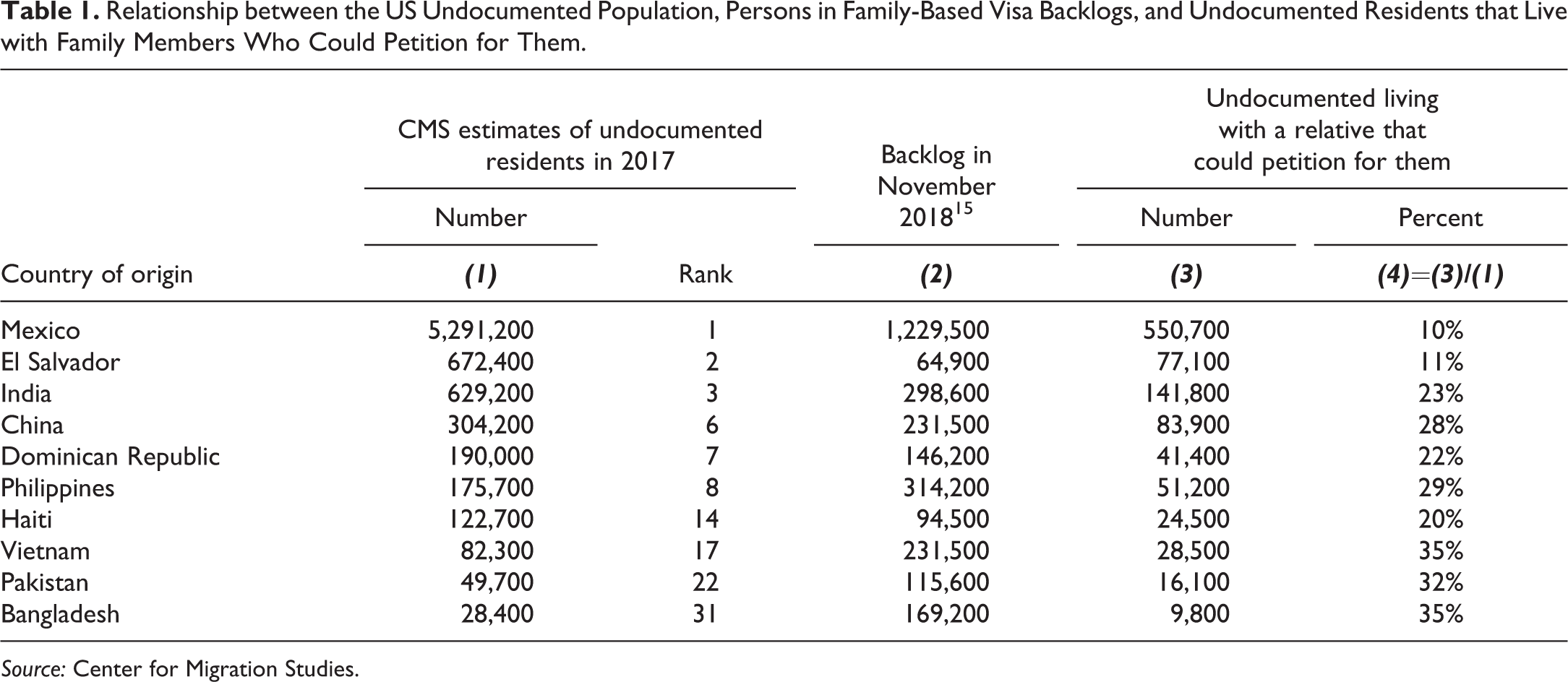
Despite these differences, the information shown in Table 1 shows a close correlation 12 between the US undocumented population, the total backlog, and undocumented persons who could be petitioned for by a household member. The strong statistical relationship between the backlog (column 2) and the potential visa beneficiaries (column 3) indicates that substantial numbers of those shown in column 3 are likely to be part of the backlog. Thus, the social and economic statistics shown here likely reflect the characteristics of a sizeable proportion of the backlogged population.
Relationship between the US Undocumented Population, Persons in Family-Based Visa Backlogs, and Undocumented Residents that Live with Family Members Who Could Petition for Them.
Source: Center for Migration Studies.
Our proxy for persons in family-based visa backlogs — undocumented household members of US citizens and LPR family members who could petition for them — has strong and longstanding ties to the United States. In particular, the paper finds that 1.55 million undocumented US residents live in 1.1 million households with a US citizen or LPR family member who could or has already petitioned for them. Fifty-nine percent of this population has lived in the United States for 10 years or more, including 23 percent for at least 20 years.
This population enjoys close family ties in the United States. By family relationship, group members could fall within the following preference categories: 25,400 are the unmarried sons or daughters age 21 or older of a US citizen (1st preference); 842,700 are the spouses of LPRs (2A preference); 362,100 are the unmarried children of LPRs (2B preference); 24,700 are the married sons and daughters of a US citizens (3rd preference); and 293,400 are the brothers and sisters of US citizens at least age 21 (4th preference).
This population is widely dispersed, but most live in California (405,000), Texas (202,600), New York (135,100), Florida (120,600), New Jersey (84,700), Illinois (62,400), Georgia (40,700), Virginia (40,200), Washington (35,100), and Arizona (34,700).
Nearly one million (993,200) US-born children under age 21 live in these households, as well as 111,600 US born adults (aged 21 and over) with undocumented parents. 449,500 arrived in the United States at age 15 or before. An estimated 139,100 would qualify for the DREAM Act based their age of entry, continuous residence, and graduation from high school or receipt of a GED.
The population works at high rates. Seventy-two percent aged 16 and older are in the labor force, compared to 63.2 percent of the overall US population (US Census Bureau 2018). More than two-thirds (68 percent) are employed, compared to 59.5 percent of the overall US population (ibid.). This group is also self-employed at slightly higher rates than the overall US population, 7.5 percent compared to 6 percent. The top five industries in which this population works are construction, restaurant and other food services, computer systems design and related services, services to buildings and dwellings, and landscaping services. In addition, 236,000 work in skilled occupations, including computer and mathematical occupations (56,800), management occupations (37,100), healthcare support occupations (21,000), architectural and engineering occupations (16,900), educational occupations (16,800), arts, sports, and entertainment occupations (13,100), and as business operations specialists (12,800). Sixty-seven percent of those aged 18 or older have at least a high school diploma or its equivalent, including 25 percent with a bachelor’s degree or higher, and 295,100 aged 3 and older are enrolled in school.
The median income of these households is $63,000, slightly above the US median household income of $61,400 in 2017 (Fontenot, Semega, and Kollar 2018, 4). More than two-thirds of this population (68 percent) has health insurance, including 51 percent with private health insurance. Nearly one-third (32 percent) lives in mortgaged homes, and 12 percent in homes owned free and clear. Sixty-six percent speak English well or very well.
Recommendations
This paper recommends that Congress pass and the President sign into law legislation that provides a path to permanent residence to persons in long-term backlogs (defined as two years or more). To significantly reduce backlogs, this legislation should increase per country caps, expand the availability of family-based visas in oversubscribed preference categories, and not count the derivative family members of the principal beneficiary against per country and annual quotas.
It should also reissue the visas of legal immigrants who emigrate each year. The number of LPRs who apply to rescind their LPR status each quarter is modest (USCIS 2019). In the first quarter of FY 2019, for example, USCIS processed 3,886 Record of Abandonment of Lawful Permanent Resident (I-407) forms (ibid.). However, Census data reveal that far larger numbers of legal noncitizens emigrate each year (Kerwin and Warren 2017, 318-19). Reissuing visas that have been formally abandoned and, if possible to track, those of LPRs who have emigrated without filing an I-407 would reduce backlogs without increasing family-based visa quotas.
The legislation should also advance the cutoff date for the US registry program, 13 which provides LPR status to US residents with good moral character who arrived prior to a statutorily set entry date, and who are not inadmissible on security or other grounds or ineligible for citizenship (Kerwin and Warren 2017, 322-23). The registry cutoff date, which is now January 1, 1972, has not been moved forward since the Immigration Reform and Control Act of 1986. 14 This makes registry a dead letter, available only to US undocumented residents of 47 years or more. The proposed legislation should automatically advance this date in order to provide US residents of at least 15 years with a path to LPR status. Such a provision would ensure that persons in long-term visa backlogs — many of which extend well beyond 15 years — would have another way to secure status.
Of particular concern in our analysis is the high number of spouses and unmarried children of LPRs — 84 percent of our total. Thus, we strongly endorse past proposals to reclassify the spouses and minor children of LPRs as “immediate family” members, not subject to numerical limits. These measures will ensure that the extensive backlogs which exemplify the broken US immigration system do not recur. As such, they will help to restore credibility to the US immigration system, and (most importantly) to strengthen US families.
Footnotes
Author Note
The authors would like to thank Charles Wheeler for his expert review, comments, and edits to this paper. They would also like to thank Mike Nicholson for his valuable assistance, technical expertise, and advice.
Declaration of Conflicting Interests
The author(s) declared no potential conflicts of interest with respect to the research, authorship, and/or publication of this article.
Funding
The author(s) received no financial support for the research, authorship, and/or publication of this article.