




Abstract
Executive Summary
This article uses a multidisciplinary approach — analyzing historical sources, refugee and asylum admissions data, legislative provisions, and public opinion data — to track the rise and fall of the US asylum and refugee policy. It shows that there has always been a political struggle between people who advocate for a generous refugee and asylum system and those who oppose it. Today, the flexible system of protecting refugees and asylees, established in 1980, is giving way to policies that weaponize them.
It offers a historical analysis of US refugee and asylum policies, as well as xenophobic and nativist attitudes toward refugees. It places Trump administration refugee policies in three categories: those that abandon longstanding US legal principles and policies, most notably non-refoulement and due process; those that block the entry of refugees and asylees; and those that criminalize foreign nationals who attempt to seek asylum in the United States.
The article concludes with an analysis of public opinion research to square the growing public support for refugees and asylees shown in polling data with the subgroup popularity of Donald Trump’s harsh xenophobic rhetoric and policies. These seemingly contradictory trends are consistent with research on right-wing populism. It argues that the restoration of generous humanitarian policies requires robust civic engagement and steadfast legislative efforts.
Introduction
The United States has long romanticized its welcoming of the refugee alongside a persistent strain of xenophobia. The Puritans who settled the Massachusetts Bay Colony were seeking religious freedom for themselves, but were intolerant of those who held other religious beliefs. Quaker William Penn encouraged religious freedom as he promoted the settlement of Pennsylvania; however, the diversity of Germans and Scots who migrated there faced a backlash from the English settlers, who argued that they could not become “anglified.” Nativism also prevailed in the first half of the twentieth century, shutting the door on refugees. In sum, the tensions between the aspiration to welcome asylees and refugees and the nativist fears of foreigners of different religions, nationalities, and races have characterized the United States since its founding.
What distinguishes Donald Trump’s anti-immigrant stance today from the past is that no successful or aspiring president had ever made opposition to the admission of refugees and asylees a centerpiece of their platform. Indeed, most national political leaders have always embraced the symbolism of the Statue of Liberty in their campaign rhetoric. President Trump, in contrast, has stoked this xenophobic strain in the American psyche. In particular, his pledge to build a wall between the United States and Mexico and his efforts to ban Muslims from entering the United States became staples of his campaign stump speeches. 1
The Trump narrative plays on the perception that US asylum and refugee policy lacks effective national security and public safety components. Ignoring or unaware of the biometric background checks and extensive national security screenings conducted on all potential refugees, Trump asserts that terrorists are coming to the United States as refugees. He also characterizes youth arriving from Central America as gang members who murder our daughters, despite research that shows most Central American youth are fleeing gang violence when they seek asylum in the United States. Trump has weaponized refugees and asylees as if we were at war with humanitarian migrants. It is not evidence-based policy aimed at addressing documented problems in US asylum policy; rather, it is an emotionally charged agenda designed to trigger the fear and hatred of foreigners that Erika Lee discusses in her history of American xenophobia (Trump 2018; Lee 2019).
The links between the xenophobia that pushed immigration restrictions of the early twentieth century and the right-wing populism that fuels President Trump today become clear as the article unfolds. It also becomes apparent that the Trump administration is taking policy tools envisioned two decades ago to be used during migration crises and contorting them into permanent practices.
US Asylum and Refugee Law Takes Shape
As the nineteenth century drew to a close and the twentieth century opened, immigration to the United States soared. Many of these immigrants were minority peoples fleeing the control of empires (e.g., British, Austro-Hungarian, Ottoman, and Russian), and a fair portion arguably were forced migrants. Nativists in the United States rose up in opposition to these immigrants, fueled by perceptions that people from Eastern and Southern Europe were genetically inferior and posed a threat to the American way of life. Among both elite and working-class people, Jews were particularly vilified for their religion and stereotyped as having greedy business practices. Nativists were able to build on economic concerns that immigrants had a deleterious impact on wages. As Claudia Goldin wrote, “[F]alling real wages for lower-skilled workers after 1910, and the negative impact of the foreign born on the wages of even skilled workers may have eventually clinched the vote for restriction” (Goldin 1994, 224–225). The economic rationale for racialized nativism had already succeeded with laws restricting Chinese immigration, most notably the Chinese Exclusion Act of 1882 (Young 2017, 218).
Lest anyone assume the right-wing nativists were limited to uneducated masses driven by ignorance and fear of economic competition, the role that elite businessmen and intellectuals played in promoting eugenics during the early twentieth century was substantial. 2 None was more influential than patrician eugenicist Madison Grant, whose 1916 book The Passing of the Great Race detailing a hierarchy of European races was widely reprinted. With his Princeton doctorate and position as director of the Eugenics Record Office, Harry Laughlin brought the pseudoscience of eugenics to Congress. Laughlin testified that, according to his exhaustive data analysis of foreign-born inmates in public institutions, Italians were 57 percent more likely to be insane, Romanians were 41 percent more likely to be criminal, and Serbians were six times as likely to be inadequate in any category (Lee 2019; Okrent 2019).
By the time four years of global warfare in World War I ended in 1918, more than 12 million people were refugees, and nativists warned of a specter of mass asylum from war-ravaged Europe. The nativists’ agenda reached fruition in a set of immigration laws enacted in 1921 and 1924. These laws specified the categories of people who would be eligible to immigrate, established national origins quotas that barred immigrants from Asia, and restricted annual immigrant admissions from other countries to 2 percent of the number of people from that country who resided in the United States in the 1890 Census. Echoing the views of Grant and Laughlin, the national origins quota system’s demographic basis for allocating visas heavily favored Northern and Western European countries. A provision in the 1917 Immigration Act that exempted people fleeing religious persecution from the grounds for exclusions was dropped when the law was revised in the 1920s. Additional efforts to add a refugee provision to the 1921 Act that would have exempted persons fleeing political or racial persecution failed. It is not surprising that legal scholar Deborah Anker wrote, “It is possible, in fact, to characterize the 1924 Act as our first antirefugee act” (Anker 1990, 76).
During the 1930s, thousands of people sought to escape the fascist governments of Europe. The United States did admit more than 100,000 refugees from Nazi Germany by channeling them through the restrictive quota laws, but failed to rescue thousands of Jews who were attempting to flee the fate of the concentration camps. The United States turned away the ship SS St. Louis that was transporting more than 900 European Jews in 1939 because the quotas had been met. Bill Ong Hing aptly stated, “Initial reaction to evidence of genocide in Europe was denial” (Hing 2004, 234–235).
The mood changed after the war, and liberal reformers grew confident. The United States and its allies defeated fascism in 1945 and emerged from World War II even stronger. The United States gave European nations $13 billion in economic development aid through the Marshall Plan. Many of these reformers hoped that the moment had come to enact a refugee resettlement program and to reform immigration law generally.
With estimates of 175 million displaced persons after World War II, the Select House Committee on Postwar Immigration recommended in 1945 “that the right of asylum be made an explicit part of United States immigration policy,” and evoked the “old and strong tradition in the United States that this country will provide asylum to victims of political, racial, or religious persecution.” President Harry Truman stretched his executive authority to require consular officials to reallocate visas that had been unused by the national origins quota law to displaced persons. His December 1945 directive “to reduce human suffering” made about 39,000 visas available to natives of Central Europe. Mindful of the anti-Semitism that was imbedded in the State Department, Truman instructed that “visas should be distributed fairly among persons of all faiths, creeds and nationalities” (Truman 1945; US House of Representatives 1945).
As the push to pass the Displaced Persons Act intensified in 1947, a stunning 72 percent of those surveyed opposed admitting 100,000 European refugees. Most in Congress were wedded to retaining race-based national origins as a basis of immigrant admissions, including refugee admissions. More precisely, the admissions of displaced persons were “mortgaged” against 50 percent of their home countries’ quotas so that displaced persons replaced half of incoming legal permanent residents (LPRs) from their home countries. The LPRs pushed to the end of the queue were overwhelmingly family members of US citizens. Truman objected to the provision funneling refugees through the quotas in the Displaced Persons Act. When he reluctantly signed it, he stated, “The bad points of the bill are numerous. Together they form a pattern of discrimination and intolerance wholly inconsistent with the American sense of justice. The bill discriminates in callous fashion against displaced persons of the Jewish faith” (Suppl. Appendix; Roper 1947; Truman 1948).
There had been no groundswell for increased immigration generally when the war ended. Many Americans feared a return to the high unemployment of the Great Depression of the 1930s. Nonetheless, a robust economy emerged after the war. By 1948, support for admitting refugees had risen to 40 percent of those surveyed, up from 18 percent the previous year who supported admitting refugees displaced after World War II (Suppl. Appendix; NORC 1948).
In the postwar period, various liberal senators and congressmen sought to include comprehensive refugee provisions in the immigration reform bills during the debate over codification of the Immigration and Nationality Act of 1952 (INA). The 1952 Act added a provision authorizing the attorney general to withhold the deportation of a foreign national who would be subject to physical persecution but did not include full refugee protections. Pro-refugee legislators were held in check by a small group of legislators with nativist attitudes who held key positions of power in the US Congress. The most significant were Senator Pat McCarran (D-NV), who chaired the committee with jurisdiction over immigration law during most of these years, and Senator Styles Bridges (R-NH), who served as senate minority leader and president pro tempore of the Senate in the 1950s. While Senator Joseph McCarthy earned the most notoriety in the anticommunist “Red Scare” period, Senators McCarran and Bridges were arguably much more effective in achieving the right-wing agenda in the 1950s. During the Senate debate, anticommunism comingled with opposition to displaced persons when Jewish refugees were labeled communists and spies (Loescher and Scanlon 1986, 13–14; Wasem forthcoming).
In 1956, a failed uprising against the communist government in Hungary prompted an estimated 200,000 refugees to flee Hungary. President Eisenhower immediately authorized the use of any Refugee Relief Act visas available and drew on what was then an obscure provision in the INA known as “parole” to bring almost 40,000 Hungarian refugees to the United States. As educated elites who were freedom fighters against communism, Hungarians marked a turning point in being refugees whom the nativist right would support admitting. Congress passed only piecemeal refugee legislation during the next few decades, most notably the Refugee Relief Act of 1953 and the Refugee-Escape Act of 1957 (Wasem forthcoming).
Parole became the avenue of choice that the executive branch used to respond to mass asylum and refugee crises. From 1959 to 1962, about 250,000 Cubans arrived and were paroled into the United States. Congress passed the Cuban Adjustment Act of 1966, which enables qualified Cubans who have been physically present in the United States for at least one year to adjust to permanent resident status.
Even when the legislation that became the Immigration Act of 1965 was moving through Congress, the comprehensive refugee provisions that House Judiciary Committee Chairman Emanuel Celler favored were ultimately dropped. The law allowed the conditional entry of 17,400 refugees annually, who were fleeing either a communist country or the Middle East. In 1968, the United States became party to the 1967 UN Protocol Relating to the Status of Refugees, agreeing to the international legal principle of non-refoulement, that is, not returning a foreign national if that person has a well-founded fear of being persecuted on account of race, religion, nationality, membership in a particular social group, or opinion on return.
Presidents Gerald Ford and Jimmy Carter had to maneuver a series of political obstacles to resettle Southeast Asian refugees after the Vietnam War. Both presidents used the parole authority to respond to the refugee crises that began with the fall of Vietnam and Cambodia in April 1975. Members of Congress were growing frustrated with this use of parole, which some argued was an overreach of executive authority. Fortunately for Ford and Carter, the group of legislators whose approval was needed was small: Senate Judiciary members James Eastland (D-MS), Strom Thurmond (R-SC), and Edward Kennedy (D-MA); and House Judiciary members Peter Rodino (D-NJ), Hamilton Fish (R-NY), and Joshua Eilberg (D-PA). Only Kennedy, Rodino, and Fish were solid supporters of refugee resettlement. Eilberg was among those who asserted that Vietnamese refugees would be difficult to assimilate into the United States (Suhrke 1981; Loescher and Scanlon 1986).
Public opinion did not support generous refugee admissions. Almost half (49 percent) of those surveyed in 1975 opposed the admission of 130,000 Vietnamese refugees, because the question specified numbers reflecting policies under consideration. By 1977, more than three-quarters (77 percent) of those surveyed opposed the admission of 100,000 Vietnamese refugees. Refugee policy, however, was not among the most pressing issues facing the nation at this point in history. According to Gallup, the top concerns of Americans surveyed in 1977 were inflation, unemployment, energy, and crime (Suppl. Appendix; Harris 1975, 1977; Gallup 1977).
Members of Congress and presidents of both parties did not face meaningful repercussions for supporting more generous refugee admissions. During a five-year period beginning in 1975, the United States admitted more than 400,000 Southeast Asian refugees. Most of these refugees gained LPR status through special legislation (e.g., the Indochinese Refugee Act of 1977 and the Refugee Parolee Act of 1978). During this same period, the former Soviet Union approved exit visas for more than 50,000 Jewish people who sought to flee.
For 35 years after the end of World War II, the United States lacked a coherent refugee policy. As Figure 1 shows, a series of piecemeal laws offered relief to 1.5 million people during this period. The push to authorize a permanent refugee admission program was driven in large part by Congress’ increasing frustration with the difficulty of dealing with the large-scale Southeast Asian refugee flow under the existing ad hoc refugee admissions procedures. By the end of the 1970s, a consensus was finally forming for a comprehensive law to govern refugee admissions (Vialet 1987, 70–85).
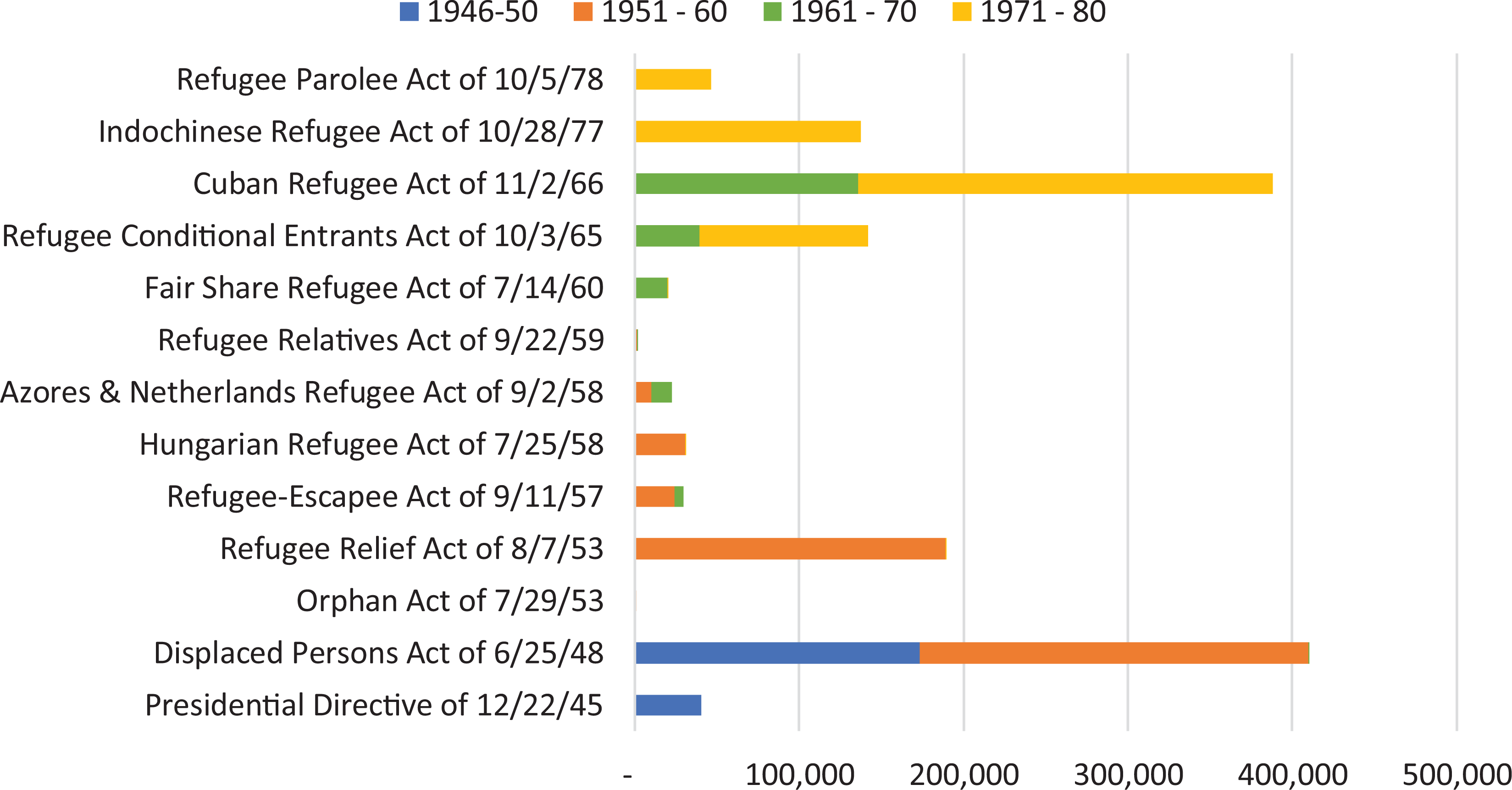
Refugees and Asylees Admitted to the United States by Statute, 1946 to 1980.
As Anastasia Brown and Todd Scribner have pointed out, the ad hoc nature of the refugee admissions led to disparate treatment of the resettled refugees. The voluntary agencies resettling Soviet refugees were eligible for $1,100 per refugee if there were private matching funds of $1,100 per refugee. In contrast, those resettling refugees from Southeast Asia were eligible for $500 per refugee with no match required. The need for a consistent resettlement program, as well as a comprehensive refugee admissions policy, was becoming apparent (Silverman 1980, 34; Brown and Scribner 2014, 106).
When staffers in the US House of Representatives, the Senate, and the White House began drafting various versions of a comprehensive refugee act, the key issue was striking a balance on admission levels. Congressman Joshua Eilberg introduced the initial bill in 1977 with admissions set at 20,000. Senator Edward Kennedy offered his bill in 1978 with a level of 40,000. Late in 1978, Senator Kennedy wrote to the Carter administration to urge that they work together on a comprehensive refugee reform bill (Silverman 1980, 34; Brown and Scribner 2014, 106).
When Kennedy, Congressman Peter Rodino, and Congresswoman Elizabeth Holtzman introduced the comprehensive refugee reform bill negotiated with the Carter administration in 1979, it set the baseline for refugee admissions at 50,000. Senator Walter Huddleston (D-TN) unsuccessfully sought to place refugee admissions lower than the worldwide level for all immigrant admissions, which pitted refugees against family and employment immigration and garnered the support of 42 other senators. Instead, the Carter administration ensured that provisions were added for adjusting refugee admissions upward on an annual basis when circumstances warranted (i.e., the refugee consultation process between the president and Congress). Senator Edward Kennedy shepherded the Refugee Act through the Senate with a unanimous vote on September 6, 1979 ( Congressional Record 1979, 23224–23228, 23231–23254; Congressional Record 1980, 15269–15272; US Senate Committee on the Judiciary 1980, 35–113; Martin 1982).
The path through the House of Representatives was a bit rocky. Congressman F. James Sensenbrenner (R-WI) led an effort to amend the legislation so that refugee admissions counted against the per-country ceilings, at a rate of one immigrant for every two refugees. The Sensenbrenner Amendment failed in the House Judiciary Committee by only one vote. Congressmen Fish and Carlos Moorhead (R-CA) offered a successful floor amendment adding a legislative veto if refugee admissions exceeded 50,000. With Immigration Subcommittee Chair Holtzman handling the floor, the House passed the Refugee Act on December 20, 1979, by a vote of 328 to 47, and then passed the conference report on March 4, 1980, by a vote of 207 to 192. Among other provisions, the conferees had dropped the legislative veto from the final legislation and had added the Office of Refugee Resettlement (ORR), along with a more generous set of social services that Holtzman had proposed (US Senate Committee on the Judiciary 1980, 35–113; Martin 1982).
The Refugee Act of 1980
The Refugee Act of 1980 amended the INA to repeal the ideological and geographic limitations that had previously favored refugees fleeing communism or countries in the Middle East, and to redefine “refugee” to conform with the definition used in the UN Protocol and Convention Relating to the Status of Refugees. Since 1980, the INA has defined a refugee as an alien “displaced abroad who is unable or unwilling to return to, and is unable or unwilling to avail himself or herself of the protection of, that country because of persecution or a well-founded fear of persecution on account of race, religion, nationality, membership in a particular social group, or political opinion.” 3
The president and Congress rely on a statutory refugee consultation process that determines refugee admissions each year. The Act established ORR in the Department of Health and Human Services to administer a set of federally funded programs providing refugees with transitional assistance, medical care, and social services. The fiscal budgetary process, however, has increasingly limited funding for refugee resettlement and, in turn, constrained the number of refugees admitted.
After decades of ad hoc refugee policies and unpredictable admissions, a refugee admissions regime based on coherent criteria began. As Figure 2 shows, refugee admissions under the Refugee Act peaked at more than 200,000 initially, then dropped to an average of slightly more than 90,000 annually for the remainder of the twentieth century.

Refugee Arrivals to the United States, Fiscal Year (FY) 1980 to FY 2019.
Distinct Policies for Asylum Seekers Emerge
The Refugee Act of 1980 also included provisions for asylum and instructed the attorney general to establish uniform procedures for the treatment of asylum claims of foreign nationals within the United States. The law defined asylees as foreign nationals in the United States or at a port of entry who meet the definition of a refugee. Little attention was otherwise given to asylum when the Refugee Act was enacted. After all, the Immigration and Naturalization Service (INS) had received only approximately 3,700 applications for asylum in 1978 and 5,800 in 1979.
Within months, however, a mass migration of asylum seekers — known as the Mariel Boatlift — brought approximately 125,000 Cubans and 25,000 Haitians to south Florida throughout a six-month period. An overwhelming portion of Americans (71 to 75 percent of those surveyed) expressed opposition to admitting most Cubans fleeing Fidel Castro’s regime. The Carter administration labeled the Cubans and Haitians who had come during the 1980 Mariel Boatlift as “Cuban-Haitian Entrants” and used the discretionary authority of the attorney general to admit them. Those that did not qualify under the Cuban Adjustment Act of 1966 or the Refugee Act of 1980 were subsequently provided special Cuban-Haitian adjustments in the Immigration Reform and Control Act of 1986 (Suppl. Appendix).
To circumvent Haitian asylum seekers’ access to the Refugee Act’s provisions, the Reagan administration decided in 1981 to stop and search certain vessels suspected of transporting undocumented Haitians. This interdiction agreement, entered with then-dictator Jean-Claude Duvalier, authorized the US Coast Guard to board and inspect private Haitian vessels on the high seas, to interrogate the passengers, and to return to Haiti those deemed undocumented. David Scott Fitzgerald refers to the Haitian interdiction policy — what he calls the North American moat — as “the most radical move to externalize borders” (Fitzgerald 2019, 70).
Figure 3 illustrates the peaks and valleys of people seeking asylum during the 1980s and 1990s. Asylum seekers coming to the United States in response to the 1980 Mariel Boatlift from Cuba and Haiti comprised the first major spike. The ongoing civil wars in Central America during the 1980s also contributed to the growth of asylum seekers in this period. Salvadoran and Nicaraguan asylum seekers totaled more than 252,000, making up half of all applicants during this decade. Nicaraguans who were fleeing a government that the United States opposed had a high asylum approval rate (peaking at 84 percent), but Salvadorans who were fleeing a government the United States supported had a very low asylum approval rate (2–3 percent). Meanwhile, the migrant interdiction agreement with Haiti kept thousands of asylum seekers from reaching US shores (Wasem 1997).

Asylum Cases Filed with the Immigration and Naturalization Service, Fiscal Year (FY) 1973–FY 1995.
At a Senate hearing on mass asylum in 1981, Congresswoman Shirley Chisholm (D-NY) offered a keen assessment: “As a country, the United States has been far more interested, in my humble opinion, in responding to refugee concerns when we gain some political benefit than addressing deep-seated humanitarian need.” Chisholm went on to point out the differential treatment afforded Cuban and Nicaraguan asylum seekers, versus Haitian and Salvadoran asylum seekers, and the geopolitical considerations underlying the policies that discriminated against Haitians. She affirmed, “[A]sylum applicants who face bias in our refugee policy must have every opportunity to assert their asylum claims.” At this same hearing, a Reagan administration official testified that Haiti (along with Mexico) was one of the largest source countries of illegal migration to the United States. The official further stated that, while Haiti “falls short of observance of internationally accepted human rights standards,” relatively few Haitians individually can meet the threshold of well-founded fear of persecution. The political debate over large-scale asylum was just beginning (US Senate Judiciary Subcommittee on Immigration and Refugees 1981).
The 1990s were an even more tumultuous decade for asylum policy and the United States’ response to large-scale asylum. About 40,000 Haitians fled after the coup d’état ousted the democratically elected President Bertrand Aristide in 1991, but the US Coast Guard interdicted most Haitians who fled. Only 10,490 Haitians were paroled into the United States after the coup to apply for asylum. After Fidel Castro made threatening speeches in 1994, riots ensued in Havana, and the Cuban exodus by boat escalated. The number of Cubans intercepted by the Coast Guard and the Border Patrol reached a post-Mariel high of almost 40,000 in 1994.
Even more significant was a class action suit filed in 1985 by the American Baptist Churches and others charging that the Justice Department was overly influenced by foreign policy considerations when deciding the asylum claims of Salvadorans and Guatemalans. The plaintiffs argued that these cases were not being decided on the individual merits because the United States supported the governments of El Salvador and Guatemala. In pretrial rulings, Federal District Judge Robert Peckham held that the low asylum approval rates of Salvadoran and Guatemalan applicants made it futile for them to pursue the usual administrative process. In December 1990, the George H.W. Bush administration reached an out-of-court settlement, agreeing to reconsider the Salvadoran and Guatemalan asylum cases. The American Baptist Churches court settlement enabled 190,000 Salvadorans and about 50,000 Guatemalans to have their asylum cases reconsidered de novo (Wasem 1997).
By the mid-1990s, the number of foreign nationals seeking asylum was surpassing the numbers of refugees being admitted. The Refugee Act, which was enacted to respond to people fleeing persecution abroad, was struggling to address people seeking asylum at US borders. It became easy for asylum policy to be conflated with border security, particularly among those who argued that most asylum seekers were coming for economic reasons.
Illegal Immigrant Reform and Immigrant Responsibility Act of 1996
The watershed moment in US asylum policy came in 1996 with the Illegal Immigrant Reform and Immigrant Responsibility Act of 1996 (IIRIRA). This act resulted from a vocal wave of nativist sentiment that helped sweep a Republican majority into the House of Representatives in 1994 for the first time since 1952. According to Gallup, the percentage of respondents who thought the United States should decrease immigration hit 65 percent in 1994 and 1995, the highest point since Gallup began asking the question in the mid-1960s. 4
Prior to 1996, foreign nationals arriving at a port of entry to the United States without proper immigration documents were eligible for a hearing before an immigration judge to determine whether they were admissible, and, if pertinent, they could request asylum in the United States during those proceedings.
The 1996 law made substantial changes to the INA generally and to the asylum process in particular, including the establishment of expedited removal of foreign nationals arriving without proper documentation and expanded mandatory detention of foreign nationals arriving without proper documents who express to the immigration officer a fear of being returned home. Foreign nationals who can be returned to a “safe third country” are barred from seeking asylum in the United States. 5
Since 1996, all applicants must file their asylum applications within one year of their arrival to the United States. IIRIRA also added a provision that enabled refugees or asylees to request asylum on the basis of persecution resulting from resistance to coercive population control policies. This provision aimed directly at the People’s Republic of China’s one-child policy in place from 1979 to 2015.
Following the terrorist attacks of September 11, 2001, pressure mounted to crack down further on foreign nationals seeking entry into the United States. In 2005, several asylum provisions were included in the REAL ID Act. Among its most significant revisions to the INA’s asylum provisions, the Act established new standards of proof for asylum seekers, including that the applicant’s race, religion, nationality, social group, or political opinion needs to be one of the central motives for his or her persecution. It also required that the asylum seeker provide evidence that corroborates otherwise credible testimony unless the applicant cannot reasonably obtain the evidence (US House of Representatives 2005).
Legal Principles and Policy Outcomes through 2016
Two decades of consistent policies and relatively reliable administrative data provide an excellent platform to analyze US asylum policy. This section of the article distills the legal principles that undergird the asylum process and the policies in place prior to Trump. It then takes a deep dive into asylum seekers by country of origin and the patterns of who obtained asylum from 1996 to 2016.
Foreign nationals already in the United States who are not in removal proceedings may apply for asylum with the US Citizenship and Immigration Services (USCIS) in the Department of Homeland Security (DHS), in a process commonly known as affirmative asylum. If the USCIS asylum officer (AO) approves the application and the individual passes the background checks, then the foreign national is granted asylum. Foreign nationals whose asylum applications the AO does not approve are referred to the Department of Justice’s (DOJ) Executive Office for Immigration Review (EOIR) for formal removal proceedings.
Defensive applications for asylum are made in removal proceedings and assert an asylum claim as a defense to removal before an immigration judge. Generally, the foreign national raises the issue of asylum during the beginning of the removal process. The matter is then litigated in adversarial proceedings in immigration court (US House of Representatives Committee on the Judiciary 2013).
DHS immigration officers summarily exclude foreign nationals apprehended along the border or arriving at a US port who lack proper immigration documents or who engage in fraud or misrepresentation, unless the foreign national expresses a fear of persecution if repatriated. Those expressing fear receive a “credible fear” interview with a USCIS AO and — if found credible — are referred to an immigration judge for a hearing, where they can request asylum. Foreign nationals found not to have a credible fear of persecution may request a review by an immigration judge.
As Figure 4 illustrates, the number of asylum cases fell in the late 1990s and remained rather steady until fiscal year (FY) 2015. The increase in asylum applications in FY 2015 and FY 2016 came largely from Venezuela, Mexico, Guatemala, El Salvador, and Honduras, reaching levels not seen since the mid-1990s. Even the number of asylum seekers from the perennial top sending country — the People’s Republic of China — rose in FY 2016 (EOIR multiple years; USCIS Asylum Division multiple years).
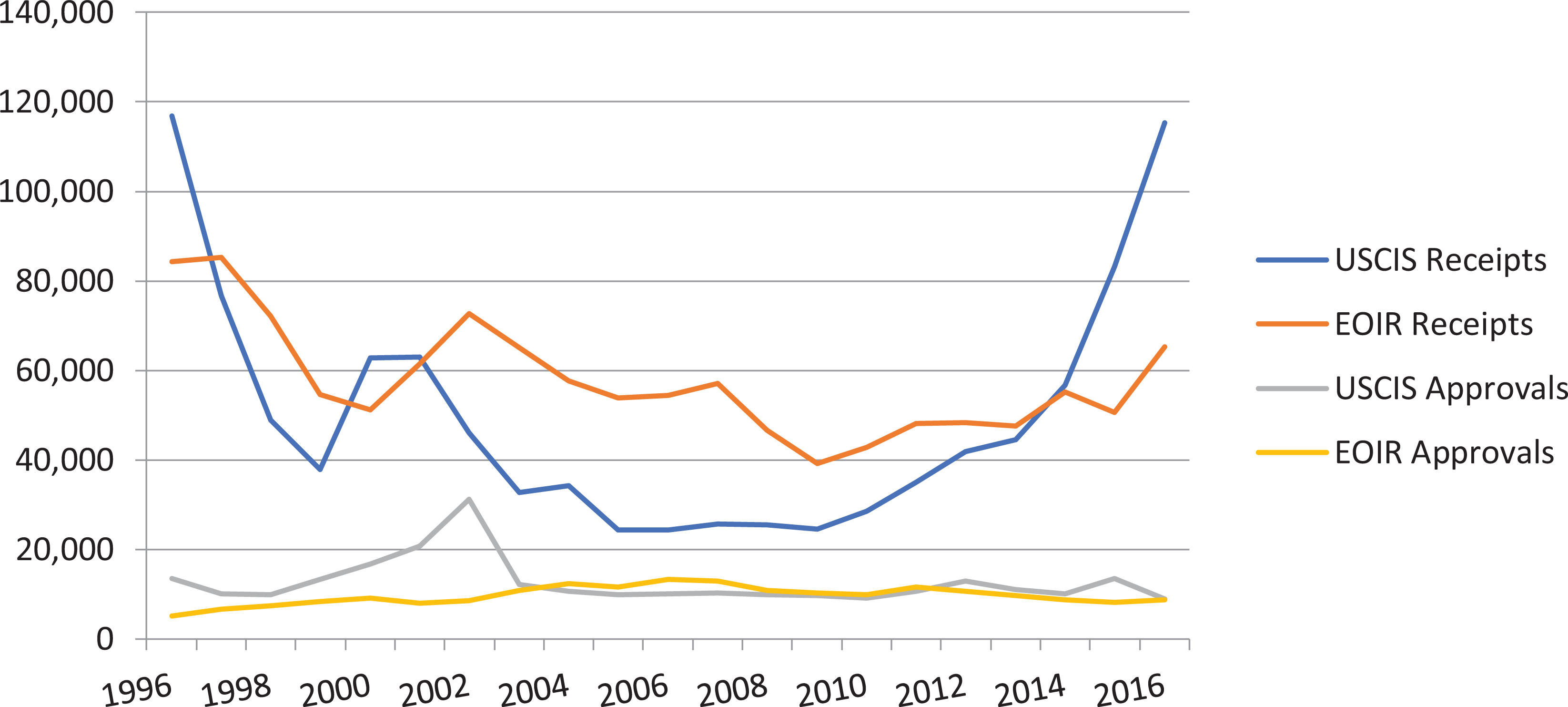
Trends in Affirmative and Defensive Asylum Claims, Fiscal Year (FY) 1996 to FY 2016.
As Figure 5 indicates, FY 2016 saw a surge in credible fear claims. In FY 2013, the number of claims reached 36,026, more than doubling from 13,931 in FY 2012. By FY 2016, the number surpassed 90,000. A handful of countries led this increase: El Salvador, Guatemala, Honduras, Mexico, Ecuador, and to a lesser extent India and the People’s Republic of China. El Salvador, Guatemala, and Honduras have long been source countries of asylum seekers. It is this rise in “credible fear” claims that some political leaders conflated with threats to border security (USCIS 2017).
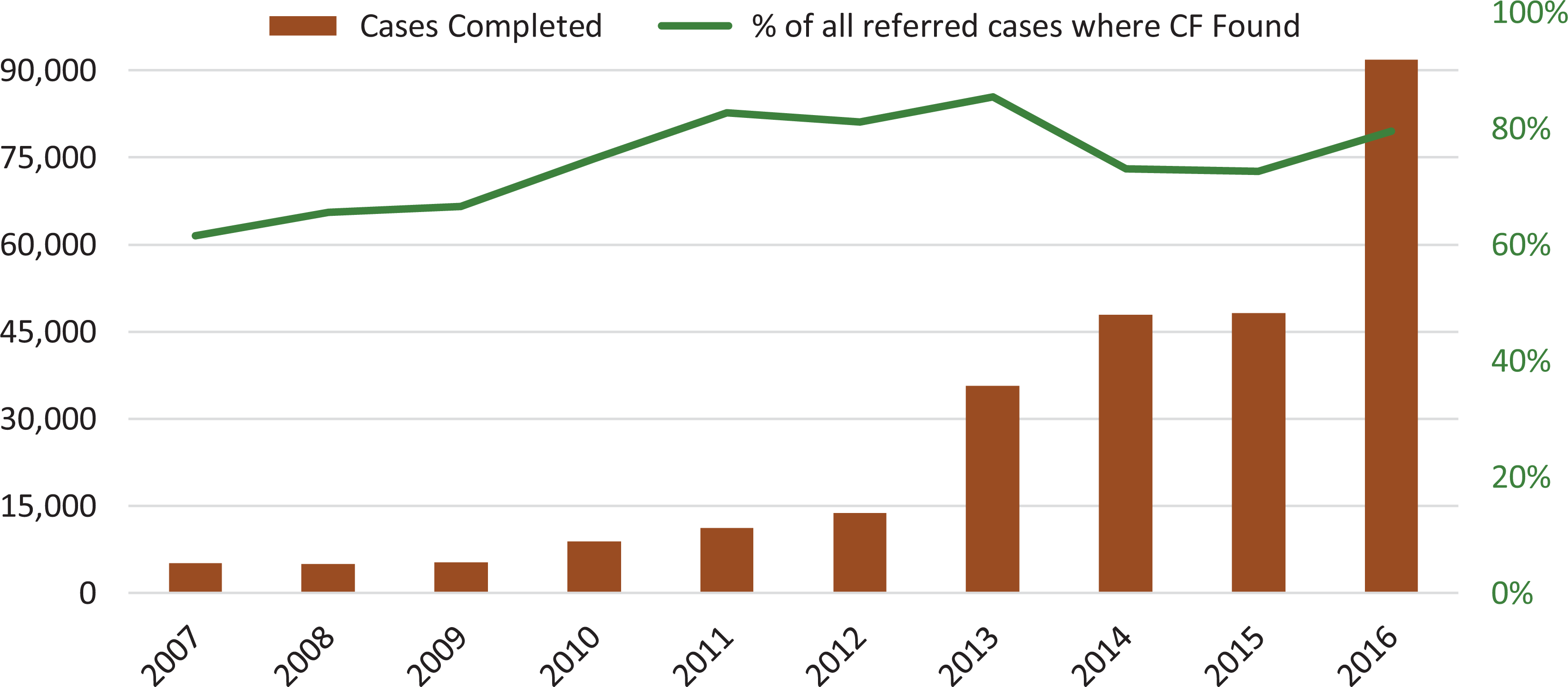
Credible Fear Claims during Expedited Removal, Fiscal Year (FY) 2006–FY 2016.
The percentage of cases in which credible fear was found peaked at 85 percent in FY 2013, up from 62 percent in 2007 (the earliest year data are available). In FY 2016, 80 percent of credible fear claims were approved (USCIS 2017).
Thresholds for Asylum Approval
Who actually obtains asylum rests on the whether the asylum officer or immigration judge determines that the claimant meets the refugee definition. Because “fear” is a subjective state of mind, assessing the merits of an asylum case rests in large part on the credibility of the claim and the likelihood that persecution would occur if the foreign national is returned home. Two concepts mentioned earlier — “credible fear” and “well-founded fear” — are fundamental to establishing an asylum claim.
The INA states that “the term credible fear of persecution means that there is a significant possibility, taking into account the credibility of the statements made by the foreign national in support of the foreign national’s claim and such other facts as are known to the officer, that the foreign national could establish eligibility for asylum under [INA] §208.” 6 Integral to expedited removal, the credible fear concept functions as a pre-screening standard that is broader — and the burden of proof easier to meet — than the well-founded fear of persecution standard required to obtain asylum. The standards for “well-founded fear” have evolved throughout the years and been guided significantly by judicial decisions, including a notable US Supreme Court case. 7
More cases are approved through the affirmative process than the defensive process, as indicated by Figures 6 and 7. The trend lines differ as the USCIS approvals have ebbed and flowed, while EOIR approvals have remained fairly constant (US Department of Homeland Security Office of Immigration Statistics 2019, Tables 17 and 19).
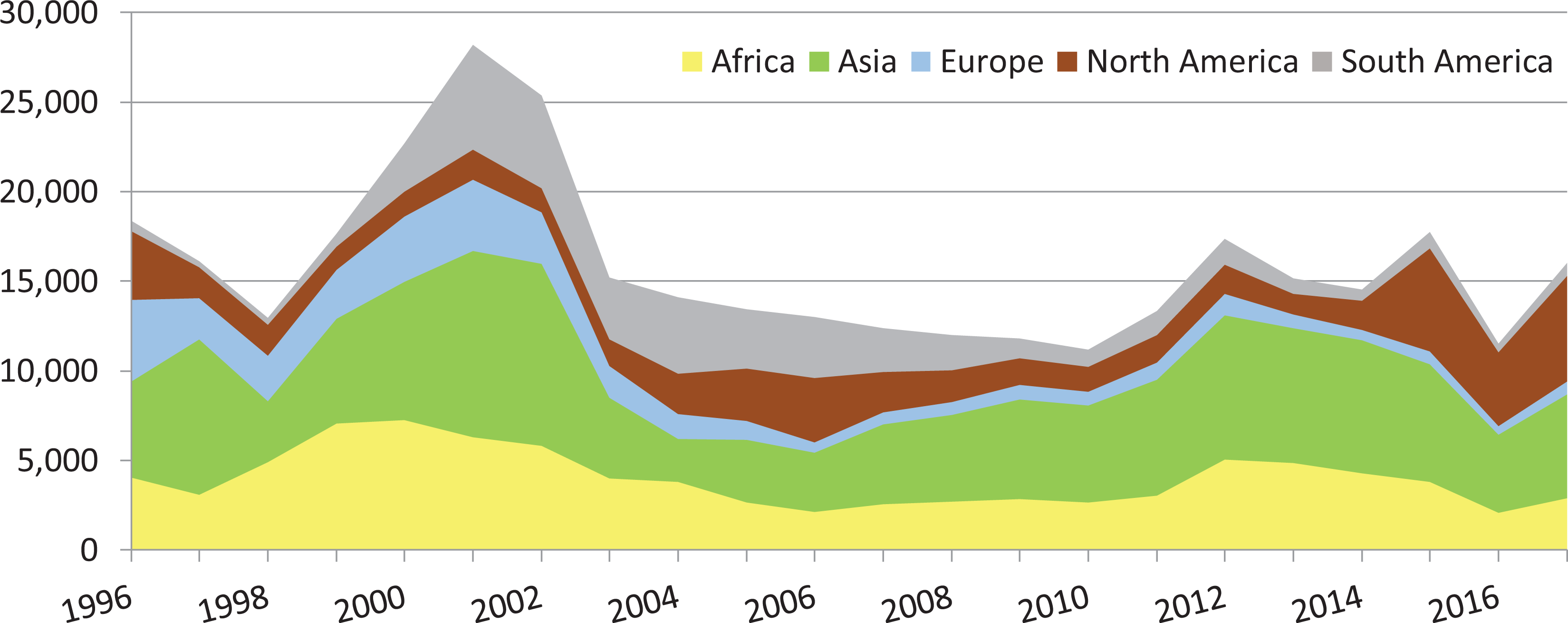
Approvals of Affirmative Asylum Claims by Region, Fiscal Year (FY) 1996 to FY 2017.
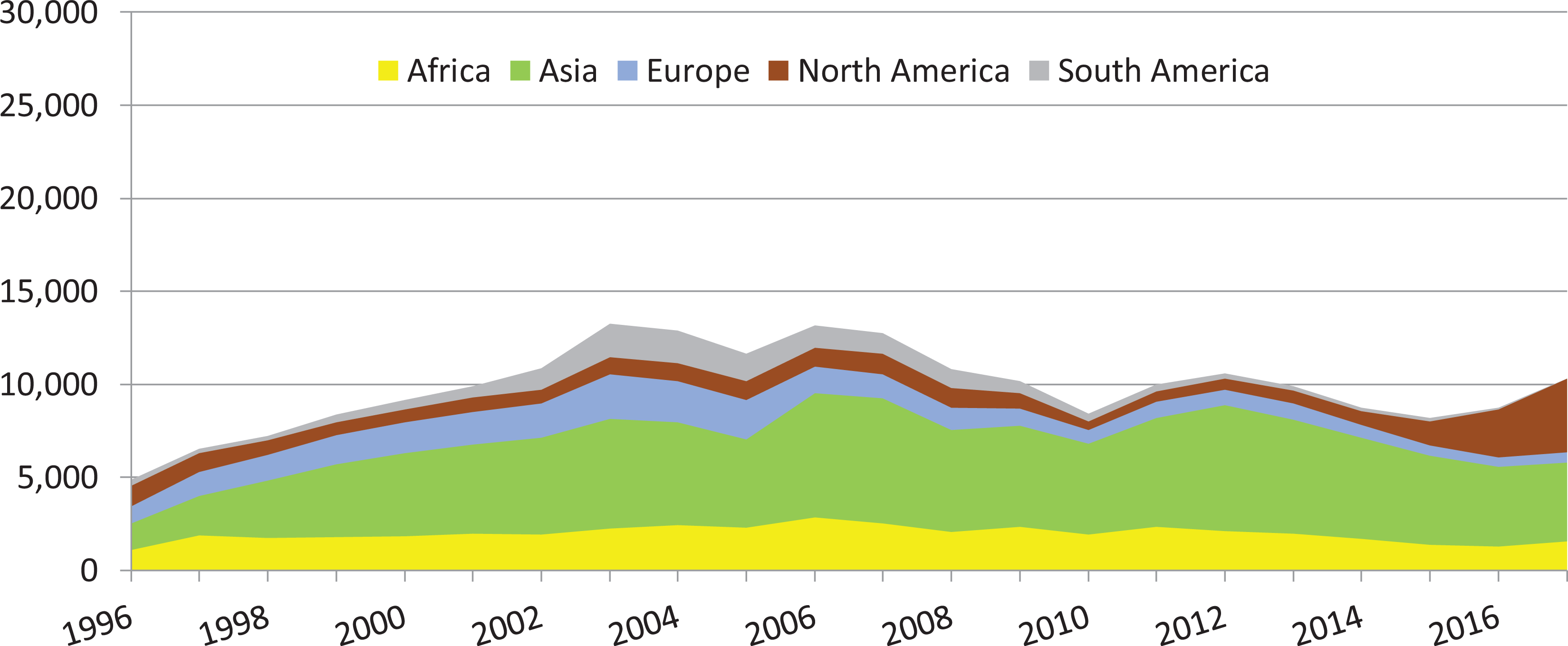
Approvals of Defensive Asylum Claims by Region, Fiscal Year (FY) 1996 to FY 2017.
The patterns of region of origin of approved asylum cases vary by USCIS and EOIR. Asia is the only region of the world with similar approval rates in both systems. Asylum approvals from North America, which includes Mexico and Central America, and Africa have fluctuated more in the affirmative process.
Although most asylees do not come from countries associated with terrorism, those who are fleeing such countries can often make a compelling case for a well-founded fear because of country conditions. Maria Cristina Garcia’s research made an important distinction: “Asylum seekers from countries with large Muslim populations were automatically suspect in the post-9/11 period and more often than not barred from accessing the asylum bureaucracy altogether; however, if allowed access to the asylum bureaucracy, they had a better chance of securing asylum in the United States than individuals fleeing other parts of the world” (Garcia 2017, p. 134).
Resurgence of Concerns over Refugee Policy
While asylum policy was co-mingled with border security for many years, refugee policy has always been caught up in foreign affairs. The United States relies on the Refugee Act’s statutory language “of special humanitarian concern” to select among the millions of refugees worldwide. The “of special humanitarian concern” phrase enables geopolitical interests to guide the process. The United States articulates three priorities for admission: (1) for persons facing compelling security concerns, (2) for persons from specific groups of special humanitarian concern to the United States, and (3) for close relatives of persons admitted as refugees or granted asylum. 8
Although the Refugee Act of 1980 was designed to be ideologically neutral, it perpetuated the Cold War geopolitical worldview. Generally, the United States more often found persons fleeing a communist country to be a refugee, than a person fleeing a civil war. Two horrific outbreaks of political violence and ethnic/religious genocide in the mid-1990s — one in Rwanda and the other in the former Yugoslavia — challenged the US view of refugees in the post–Cold War world. Only 933 Rwandans gained refugee admission to the United States, due in part to the inability to differentiate refugees from war criminals among the warring factions. The United States resettled 125,000 Bosnian refugees, mostly Muslims, from 1993 to 2000. Nonetheless, 60 percent of all refugees admitted to the United States from 1991 to 2000 were from either the communist countries of Cuba and Vietnam or the former Soviet Union (Garcia 2017, 88–112).
As Figure 8 shows, however, refugee admission trends shifted in the new century. After a sharp drop immediately following the terrorist attacks of September 11, 2001, the source regions for refugees admitted to the United States shifted. Europe as a source region of refugees diminished, and refugees from Asia and Africa rose. During the George W. Bush administration, the average refugee admissions were 47,500 annually. The average annual refugee admissions rose to 69,660 throughout the eight years of the Obama presidency (USCIS 2019, Table 14).
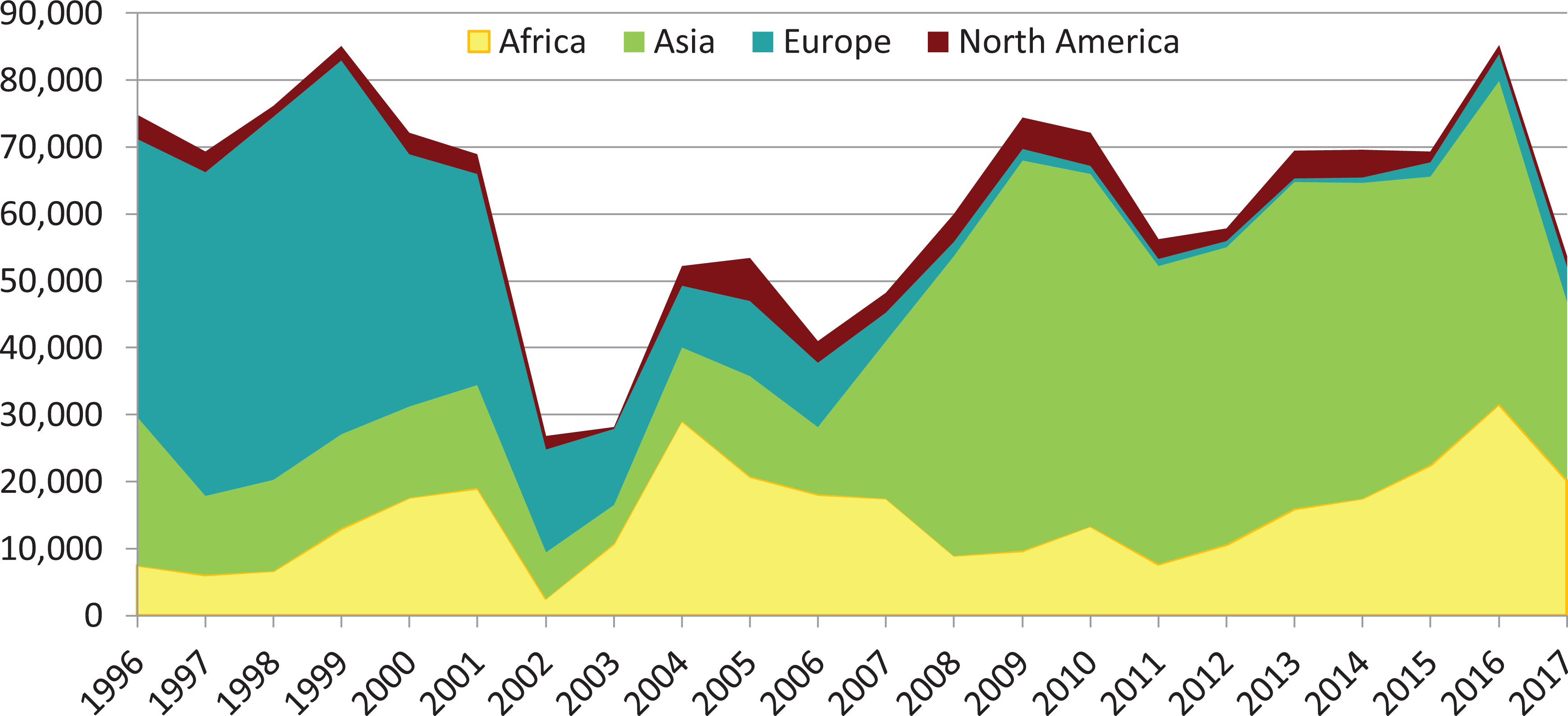
Refugee Arrivals by Region, Fiscal Year (FY) 1996 to FY 2017.
The importance of the shift is evident in Figure 9, which shows the top 12 refugee source countries. Although traditional source countries of Cuba, Russia, and the Ukraine remain in the top dozen, the leading source countries in recent years have been Burma, Iraq, Somalia, Bhutan, and the Democratic Republic of Congo. Syrian refugees entered the top 12 only in the past few years.
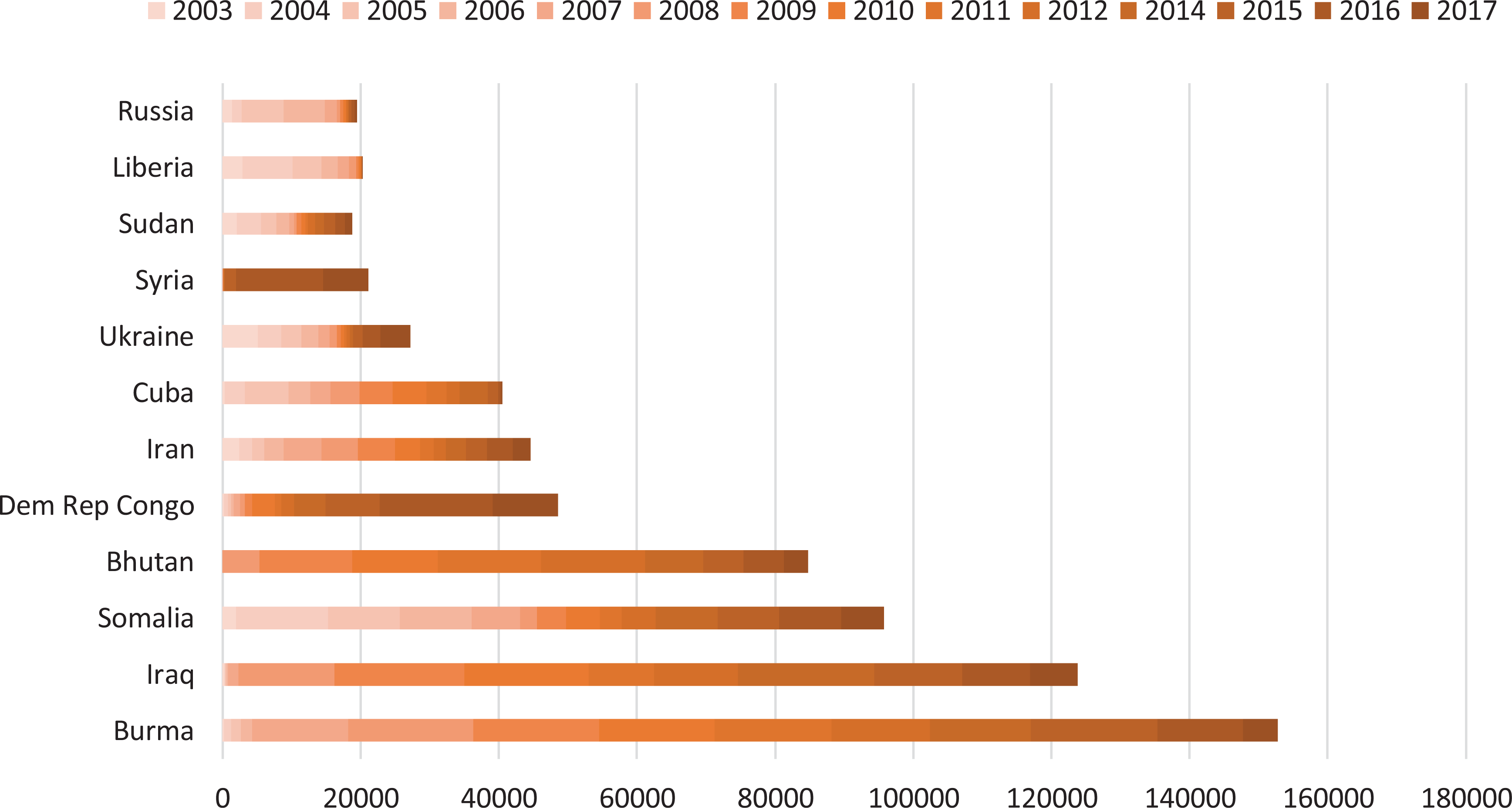
Top 12 Refugee Source Countries, Cumulative Fiscal Year (FY) 2003–FY 2017.
The current refugee flows appear more exotic and diverse than the earlier flows. Arguably, current refugees lack the domestic political constituencies in the United States that comprise a key component of support for refugee policy. These trends underlie the ease by which Trump has been able to decimate the refugee resettlement program (Garcia 2017, 88–112).
When former President Obama pledged to admit 10,000 additional refugees from Syria in August 2015, immigration hardliners in Congress rose in opposition. The terrorist attacks in Paris in November 2015 and San Bernardino, California in December 2015 stoked fears among those who presumed that terrorists were lurking among the refugees from Syria. The specter of terrorists masquerading as refugees also became a useful prop for right-wing nativists. Despite rigorous national security screenings for refugees, especially those from war-torn Syria, opponents to admitting Syrian refugees argued that thorough vetting of Syrians was not possible. The US House of Representatives passed legislation that would have severely restricted refugee admissions, but the US Senate did not pass it before the legislative session ended.
As analyses of asylum and refugee data show, the overall numbers of refugees and asylum seekers were ebbing and flowing within historic levels in the 2000s. The United States could have easily accommodated the proposed number of Syrian refugees well within traditional admissions levels. Yet, Congress pushed back on then-President Obama’s response to Syrian refugees.
The spike in unaccompanied Central American children in 2015 and subsequent increases in Central American families seeking asylum at the US southern border were not a failure of US asylum law or border security policy. Rather, they illustrated the lack of adequate funding to manage the increased flows, which exacerbated the crises. For example, the adjudication backlogs that resulted from lopsided funding of enforcement, without adequate judicial resources, were compounded by Congress’ reluctance to increase funding to process the Central American asylum seekers in a timely fashion. Evidence suggests that conditions in the sending countries then and now are the key determinants of the refugee and asylee flows (US Government Accountability Office 2017; Esthimer 2019).
Enter Stage Right: Donald Trump
The fervent anti-immigrant response from candidate Trump’s base emboldened newly elected President Trump to issue an executive order on January 25, 2017, to “secure the southern border of the United States through the immediate construction of a physical wall on the southern border.” The so-called illegal aliens that President Trump intends to thwart with the wall include many prospective asylum seekers fleeing gang violence, civil unrest, or persecution.
During its first three years, the Trump administration rained a hailstorm of policy actions on refugees and asylees. This analysis identifies three types of policies: those that abandon longstanding US legal principles and policies, most notably non-refoulement and due process; those that block the entry of refugees and asylees; and those that criminalize foreign nationals who attempt to seek asylum in the United States. Simply put, these are the As (abandoning), Bs (blocking), and Cs (criminalizing) of the Trump administration policies on refugees and asylees.
Historical antecedents of Trump’s policies may be found in the refusal to accept Jews fleeing Nazi Germany during World War II (abandoning) and the interdiction of Haitians that began in 1981 (blocking). The Trump administration’s “zero tolerance” policy of prosecuting even minor immigration offenses (criminalizing) harkens back to the early twentieth century, when the eugenicists warned of “inferior aliens” who were likely to be insane or criminal; however, now the federal government keeps asylum seekers locked in detention centers, often under contracts with the private prison industry. The criminalization of refugees and asylees in conjunction with the comprehensive sweep of Trump initiatives abandoning and blocking refugees and asylum seekers have sent US humanitarian protection policy to an unprecedented nadir. 9
The administration shows no evidence of a policy evolution or maturation throughout time. It opened 2017 with policies exhibiting all three ABCs: abandoning refugee admissions, blocking Syrian nationals from refugee resettlement, and expanding expedited removal and detention. Its efforts to criminalize asylum seekers reached a crescendo in 2018 with “zero tolerance.” Policy initiatives in 2019 again drew on all three ABCs: (A) setting refugee admissions for FY 2020 at the lowest level since the passage of the Refugee Act of 1980; (B) allowing state and local officials to refuse placement of refugees; and (C) detaining migrant children and families indefinitely, including those arriving to seek asylum. Table 1 summarizes the major policy actions on refugees and asylees by type and timing.
The ABCs of Major Policy Actions on Refugees and Asylees, 2017–2019.
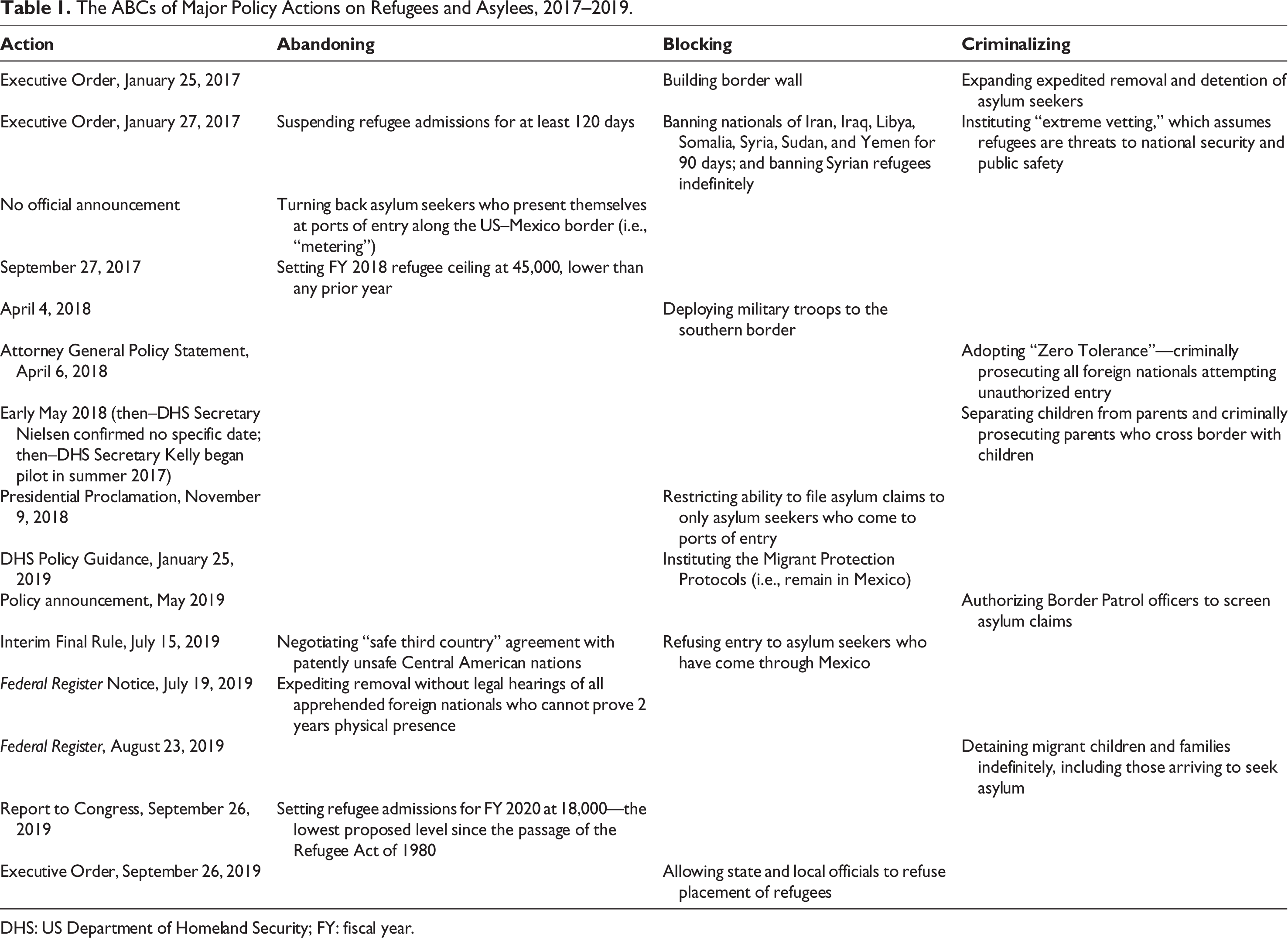
DHS: US Department of Homeland Security; FY: fiscal year.
The strong proclivity of Trump-era Attorneys General Jeff Sessions and William Barr to assert themselves in asylum cases has further narrowed the parameters of humanitarian relief available and undermined the independence of the immigration courts. 10 Federal courts have halted some of these policies, but challenges to the lower court rulings are working their way to the US Supreme Court. For example, President Trump upended US refugee policy by issuing an executive order on January 27, 2017, that would suspend the refugee admissions for at least 120 days and would impose a ban on all Syrian refugees indefinitely, among other things. Several lower court rulings temporarily kept the ban on Syrian refugees and other elements of the executive order from going forward. On June 26, 2018, the US Supreme Court upheld the third iteration of the travel ban.
Analysis of Public Opinion
In the past 75 years, rarely has a majority of Americans supported the admission of refugees or asylees during a refugee crisis (Figure 10). A review of public opinion data on US attitudes regarding asylum finds that the majority of Americans surveyed typically oppose the admission of the refugees/asylees, with the exception of Vietnamese refugees immediately after the fall of Saigon in 1975 when the public was split. Even as the US Congress was celebrating passage of the landmark Refugee Act of 1980, an overwhelming portion of Americans surveyed (71 to 75 percent) expressed opposition to US policy of admitting most Cubans fleeing Fidel Castro’s regime (Suppl. Appendix; Harris 1975, 1977, 1980).
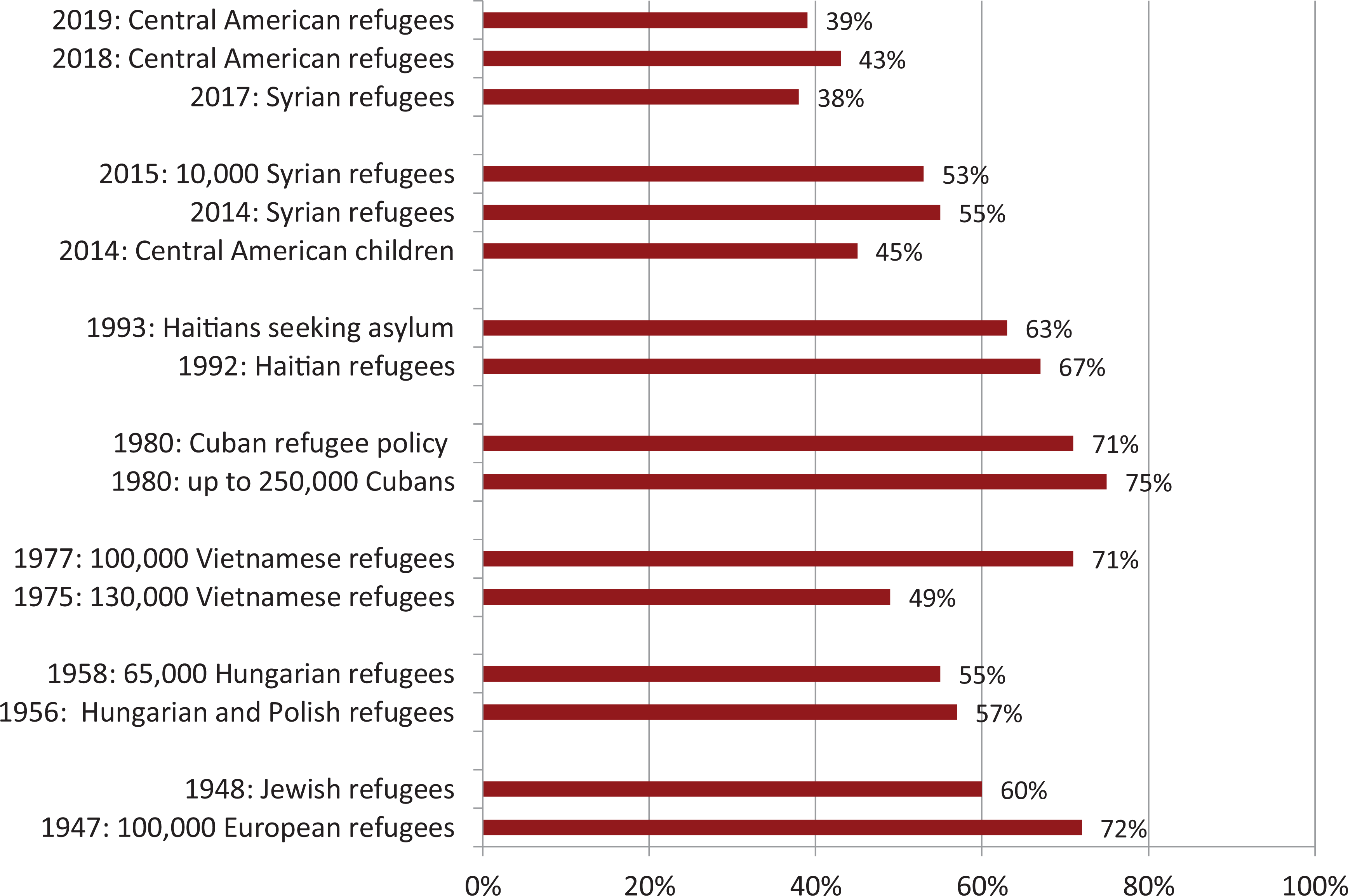
Public Opinion on Refugee and Asylee Crises, 1947 to 2019: Percentage Opposed.
The past five years has seen decreasing opposition to refugees and asylum seekers. As the harsh rhetoric of right-wing political figures aimed squarely at refugees and asylees, public opinion began moving in the opposite direction. When Central American children sought asylum in the summer of 2014, opposition to receiving them fell to 45 percent of those surveyed. By the time President Trump issued the executive order halting refugees from Syria, opposition to admitting Syrian refugees had fallen to 38 percent in 2017, a historic low (Figure 10). Respondents who identify as Democratic are much more supportive of Syrian refugees and Central American asylum seekers than those who identify as Republican. In October 2018, a solid majority (60 percent) of respondents deemed likely voters favored allowing refugees to seek asylum in the United States (Suppl. Appendix; CNN 2014, 2019; Quinnipiac 2015, 2017; Gallup 2018).
At first glance, it might seem that shrinking opposition to refugees and asylees is linked to high levels of employment. The media and political figures typically advance an economic justification for opposition to refugees (e.g., they are taking jobs from natives or are dependent on welfare). The empirical data to support these claims, however, are thin. Regressions on the data presented in Figure 10 with the unemployment rates at the time of the surveys yield a 0.44 correlation coefficient. When the analysis is limited to the period from 1975 to 2019, the correlation coefficient rises to 0.73; however, this time series remains too small a set from which to draw conclusions.
Fortunately, the scholarship on attitudes toward immigration more broadly offers insights on these data. The two major research paradigms on the determinants of support for and opposition to immigration are the political economy and sociopsychological theories. The political economy paradigm is largely based on economic factors and how natives interpret the economic impact of immigration on their well-being. The sociopsychological paradigm draws on perceived erosions of national culture, based on an ethnocultural lens of national identity, brought on by immigration.
Two comprehensive studies of attitudes toward immigration — one by Christopher Muste and another by Jens Hainmueller and Daniel J. Hopkins — provide distinctions of how the political economy and sociopsychological theories interact. In his thorough meta-analysis, Muste showed that the “greatest consistency and negativity in public opinion about immigrants’ impact was jobs.” Yet, he concluded that economic problems in the years 1991 to 1992, 2001, and 2008 to 2010 did not increase opposition to immigration. Rather, public opinion became more negative in the wake of rancorous debates over immigration policy in the years 1994 to 1996 and 2006 to 2007, and in the aftermath of the 9/11 terrorist attacks. Hainmueller and Hopkins found, in research spanning two decades, “that immigration attitudes are shaped by sociotropic concerns about its cultural impacts — and to a lesser extent its economic impacts — on the nation as a whole” (Muste 2013, 398–416; Hainmueller and Hopkins 2014, 225–249).
Might it be that xenophobic political leaders also rely on the economic arguments, rightly or wrongly, to ignite those who hold ethnocultural views? Larry Bartels maintains that the ability and willingness of political elites to exploit right-wing populist views (that have long been present) are keys to making them salient to voters. In their study of the 2016 election, John Sides, Michael Tesler, and Lynn Vavreck conclude that Trump’s victory was never based on a wave of prejudice and hostility. They maintain it relied on his willingness to openly appeal to existing feelings of distress over perceived changes in American society and culture, thus making it more strongly related to how people voted. While it is difficult to square the growing public support for refugees and asylees shown in the polling data with the popularity of Trump’s harsh xenophobic rhetoric and policies, this political divide is consistent with research on right-wing populism (Bartels 2016, 2017; Sides, Tesler, and Vavreck 2018).
In other words, it may well be the sociopsychological intensity of those opposing refugees and asylees that is driving the ABCs of the Trump administration: abandoning longstanding US legal principles and policies, blocking the entry of refugees and asylees, and criminalizing foreign nationals who seek asylum. To this point, Leonardo Bursztyn, Georgy Egorov, and Stefano Fiorin performed a series of experiments that suggested that Donald Trump’s popularity made those who were already xenophobic more comfortable expressing their xenophobic views in public. They concluded “that social norms regarding the expression of such views in the U.S. might have been causally changed by Trump’s rise in popularity and eventual electoral victory” (Bursztyn, Egorov, and Fiorin 2020, 21).
This vitriol may also be fueling a backlash that has increased support for refugees and asylees. A general dislike of Trump (as measured by his high disapproval ratings in public opinion polls) 11 may prompt a corresponding reaction. More specifically, some people who might not have previously given much thought to refugee and asylum policy might now be supportive of it in reaction to Trump’s ABC initiatives and xenophobic rhetoric.
Many of these refugee supporters, however, may lack the intensity of the opponents or, more likely, have other concerns of competing importance, such as climate change, access to health care, or income inequality. Pew Research conducted a survey in 2019 that found majorities of both Democrats and Republicans said that taking in refugees fleeing war and violence is an important goal. The distinction was that of intensity. Pew reported that almost half of Democrats surveyed (47 percent) said that taking in refugees is very important, compared with just 15 percent of Republicans. The share of Republicans who now say admitting refugees should be a somewhat important goal has risen from 28 percent in 2016 to 43 percent today (Lake, Snell, and Gormley 2018; Daniller 2019).
Concluding Observations
Trump’s ABC policies have been met by increased civic engagement in support of refugees and asylees. In response to Trump’s travel ban in January 2017, for example, public protests opposing the policy began with about 40 spontaneous demonstrations on the first day, then grew to an outpouring of protests and demonstrations in airports and public spaces across the nation during a period of several days. 12 On June 30, 2019, more than 600 organized demonstrations in all 50 states protested the family separation policy, with thousands of people taking to the streets. 13 Trump had already begun scaling back family separations at the time of the large-scale protests, but the public outcry continued as the administration had difficulty reuniting many of the children with their parents who had been deported.
As discussed above, the flexible features that Congress imbedded in the asylum and refugee provisions were designed to deal with the ebb and flow of forced migrations brought on by war, repression, and persecution. The data analysis shows that the US asylum and refugee system responded to numerous humanitarian crises from all parts of the world, adapting albeit imperfectly throughout the decades. Now the Trump administration has distended this flexibility with the ABC initiatives to dismantle the system of legal protections and to weaponize asylum and refugee policy.
As this article goes to press, the Trump administration has proposed sweeping regulatory changes in asylum and withholding of removal provisions that would further restrict access to asylum. Purportedly to streamline the process, immigration judges would be able to reject cases without a hearing. The categories of people qualifying for persecution would be narrowed to exclude almost all victims of gang-related and gender-based violence. Despite exceptions provided in statute, it would bar anyone who has been in the United States for more than a year from applying for asylum. It would lock the draconian policies of the past three years into regulation (US Department of Homeland Security and US Department of Justice 2020).
If this multidisciplinary analysis offers any lessons for the current proponents of refugees and asylees, it is that generous humanitarian policies require energetic civic engagement and steadfast legislative efforts. Restoring the policies of the past will not be sufficient in the years ahead, because past policies were prone to inequities and bottlenecks that arguably had a magnet effect for migrants with less compelling cases and most certainly delayed relief for those who qualified. Policymakers would be wise to weigh the advice of experienced advocates and legal experts who call for the repeal of three particularly harmful provisions: the one-year deadline for filing asylum applications, expedited removal, and “safe third country” agreements (von Sternberg 2014, 336–339; Acer and Byrne 2017, 372–373; Kerwin 2018, 196).
A sound course of action is for the US Congress to establish, and the administration to execute, robust and fully funded refugee and asylum policies that are generous in their priorities, thorough in their review, and expeditious in their processing.
Supplemental Material
Supplemental Material, Appendix_Polling_Questions - More than a Wall: The Rise and Fall of US Asylum and Refugee Policy
Supplemental Material, Appendix_Polling_Questions for More than a Wall: The Rise and Fall of US Asylum and Refugee Policy by Ruth Ellen Wasem in Journal on Migration and Human Security
Footnotes
Declaration of Conflicting Interests
The author declared no potential conflicts of interest with respect to the research, authorship, and/or publication of this article.
Funding
The author received no financial support for the research, authorship, and/or publication of this article.
Supplemental Material
Supplemental material for this article is available online.