



Abstract
In recent years, increasing attention has been paid to the ways refugees in displacement manage to organize themselves and act upon their needs. The growing recognition in the UN system of the importance of localization of aid and the potential role played by local actors has given refugee-led organizations (RLO) a space to grow. In this paper, we analyze refugee agency and solidarity through the organization of the refugee communities in Turkey, Jordan, and Lebanon. In doing so, we examine: (1) the reasons behind the creation of these organizations and their dynamics; (2) the role of host states toward this drive to organize refugee communities; and (3) the patterns, forms, and structures that these organizations take in providing humanitarian services, as well as community support and empowerment.
The paper focuses on three countries of the Middle East: Jordan, Lebanon, and Turkey, and various refugee communities: Syrian, Iraqi, Yemeni, Sudanese, Somali, Afghan, and Persian. We center this work on the organizations that refugees in the Middle East region have been able to create. The findings are based on field research, conducted between August 2021 and March 2022, in the form of semi-structured questionnaires used in face-to-face interviews with RLO founders, administrative staff, volunteers, and beneficiaries.
Introduction
The literature on communities and the ways they organize themselves and mobilize as part of the civil society has been expanding in recent years (Latour 2005; Marquis, Lounsbury, and Greenwood 2011; O’Mahony and Lakhani 2011; Williams and Shepherd 2021). Particular attention has been paid to the ways that refugees, living in displacement, manage to mobilize, and act upon their needs (Easton-Calabria and Wood 2020; Milner and Klassen 2020; Pincock, Betts, and Easton-Calabria 2020; Milner, Alio, and Gardi 2022). This development has proceeded in tandem with a growing recognition within the UN system of the importance of localization of aid and the potential role played by local humanitarian actors. In 2016, the World Humanitarian Summit (WHS) emphasized “crisis affected people” who were perceived to be first responders and who could enhance the effectiveness of the humanitarian response due to their contextual and cultural knowledge (Pincock, Betts, and Easton-Calabria 2020). Hence, they could ensure the efficiency of humanitarian services and help to overcome power asymmetries inherent to “top-down” global responses (ibid.). The WHS’s Grand Bargain (2016) invited the international community to fund local actors, including refugee-led entities. In the 2018 Global Compact on Refugees, as per Objective II, the emphasis on enhancing refugee self-reliance was intended to increase the legitimacy and effectiveness of localized humanitarian assistance.
As conflicts persist and host countries increasingly resist offering refugees permanent residency and basic rights, more people become “permanently temporary” (Fabos and Brun 2022). The protracted nature of displacement with limbo rights invites refugee communities to organize for action, resources, and opportunities (Williams and Shepherd 2021). While in displacement, refugees maintain or establish relationships with other refugees, create bridges to host communities, and seek to foster social connections (Easton-Calabria and Wood 2020), hence creating communities of their own.
This paper questions how international support has shaped the emergence of new refugee communities or organizations in displacement. In light of the varied policies in each host state, it asks: what are the different structures that have been possible for refugees to create? And what have been the characteristics needed for the emerging organizations to serve refugees in their different socioeconomic, legal, and cultural needs so they can be effective in their own contexts?
In this work, we discuss evidence-based research from the Middle East on the refugee communities’ structures established in Jordan, Lebanon, and Turkey and the levels of their formality (El-Abed et al, 2023). We analyze the extent to which refugee communities have managed to organize as acts of agency and solidarity. On the theoretical level, we engage with theories on community organization and the ability to act together (Latour 2005; Marquis, Lounsbury, and Greenwood 2011; O’Mahony and Lakhani 2011; Greve and Yue 2017). We study the limited rights refugees enjoy which affect their ability to create their own communities and to take a visible part in the localization of aid (Vielajus and Bonis-Charancle 2020). Despite challenges from host states, refugees exercise agency in seeking to assemble or re-assemble a community based on the ability of the leadership to network with peer members and supporting bodies, and to set an agenda that serves the community.
To study the dynamics of the emerging communities and to understand the typology of structures refugees have established in the three countries, our research used several research methods. To identify the varied organizations, the visible and the non-visible — many of whom were active underground — in August 2021 the research team began by mapping the cities with highly populated refugees of different nationalities. Table 1 reflects the cities, refugee nationalities, and their numbers. Each research country coordinator was charged with working with refugee researchers to learn about the community and to identify both visible and invisible refugee community organizations that were active in different cities in the three countries. This study, carried out with the active engagement of refugee researchers from the varied communities, sought to understand the community dynamics and to learn about the conditions that permitted one entity to register and another to remain invisible, and the kind of role each of these entities played in serving their communities.
Number of refugees and identified RLOs in Jordan, Lebanon and Turkey.
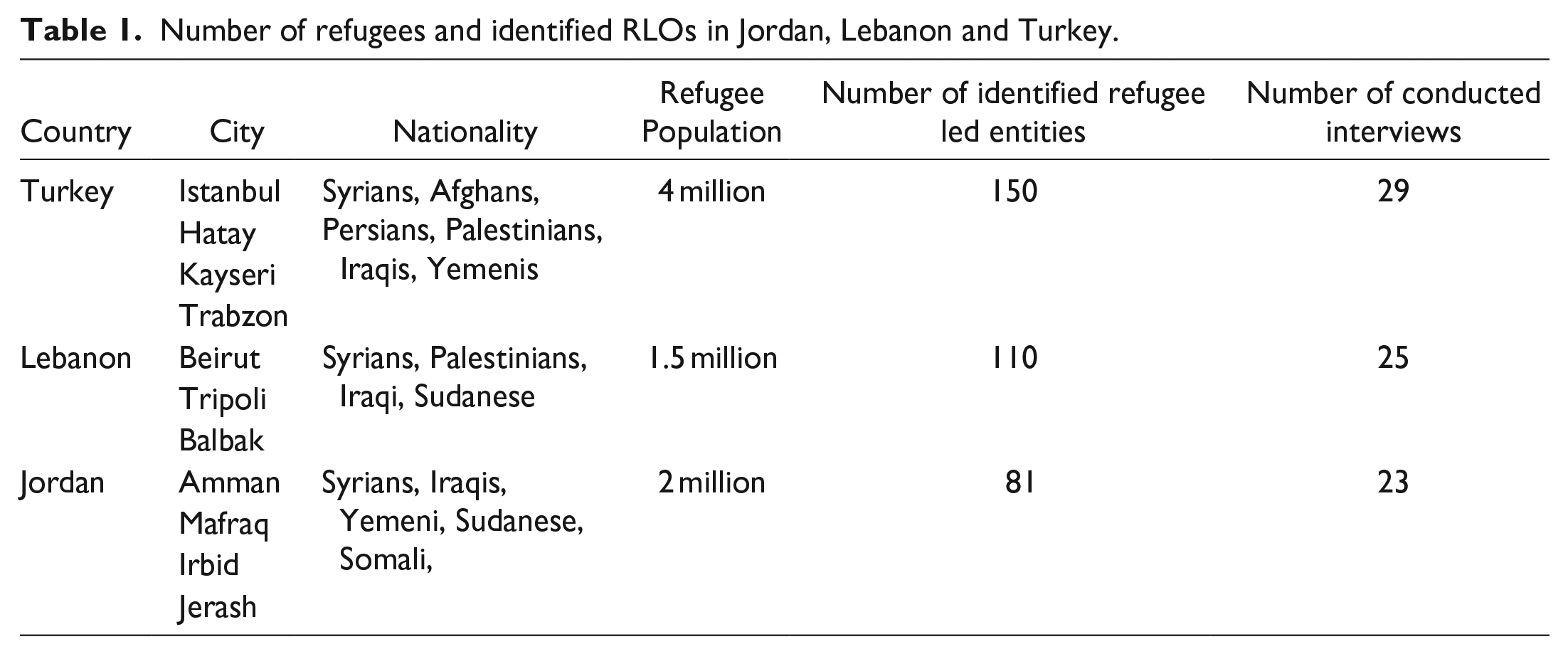
To access all the organizations in the identified cities, to understand their work agendas and the inter-relations among community members, the study held both virtual and face-to-face consultations with several refugee communities and organized bodies. Based on the collected material and the wide range of organizations identified, we selected between 15 and 25 refugee organizations to interview, taking into account their registration, visibility, work agenda, leadership, membership, location, and services provided.
Using a semi-structured questionnaire, face-to-face interviews were conducted with both official and unofficial selected refugee organizations in a wide range of cities that are densely populated with refugees. By August 2022, all field interviews had been concluded, including transcription and translation of the interviews. Using the NVivo codebook method, the team then analyzed the data, identifying certain themes.
By exploring the dynamics of organizations, the study unfolds the structures refugees are able to build based on the cohesion and trust among population members. In doing so, it contextualizes the act of organizing refugee communities in the environment proscribed by the host state. We hypothesize that refugee-led organization is an act that balances the agency, social capital, and organized community in the context of an enabling environment that gives space for the refugees to act and to seek to become independent actors. The development of refugee-led organizations (RLOs) is shaped by the interactions between different factors such as bureaucracy, laws, and policies. This article explores the means to value the work of such organizations, built on their established trust, integrity, and impact, through their performance and the way their role is valued by the beneficiaries.
To examine the communities’ dynamics, the paper begins by discussing the ramifications of failing durable solutions for refugee situations that have extended for decades. It finds that the options of repatriation and resettlement continue to be extremely limited, and so far, within Middle Eastern host countries refugees possess only limited rights. This reality has prompted refugee communities to organize in order to devise strategies and creative survival mechanisms to navigate the restrictive environments in which they live. In many situations, refugees have mobilized to advocate for their rights and sought to establish their own RLOs of solidarity to support members of their communities.
The second part of the article examines the politics of the host state and its established relationship with civil society actors that has implicitly dictated what is possible for refugee-led entities. For instance, in Jordan and Lebanon, the space for refugees to organize has been modest and has often taken place under cover. In addition, the states’ political and security interests are reflected in the way refugees are governed. In Turkey, a signatory state of the 1951 Convention (though not the 1967 Protocol), the law does not prohibit refugees from creating and/or leading organizations, but it imposes burdensome requirements and conditions on them.
In the third part, we unpack the refugee community dynamics of organization, the official and the non-official ones. Refugee-led organizations, continue to scratch out their paths with communities and authorities to prove themselves and to be present on the civil society map. They constitute an essential element of the refugee community’s ability to empower and facilitate refugees’ access to services in a way that other organizations (local or international) do not. They reflect the power of agency that refugees possess and their ability to organize and identify adequate solutions for their common challenges.
We conclude with some reflections about the context through which refugees seek to create their communities and the agendas they lead in response to their community needs. We propose some recommendations as a way to empower small initiatives and widen their outreach.
Theoretical Framework
This paper studies the ways refugees in protracted situations have sought to create new communities in host countries. This drive for self-reliance has been supported by the localization of aid discourse discussed in the Grand Bargain of the World Humanitarian Summit in 2016. The lockdown of the pandemic gave wider space, as argued by Milner and Klassen (2021) and further empowered RLOs to act and play a role in supporting local civil society bodies (Milner and Klassen 2020; Vielajus and Bonis-Charancle 2020).
According to UN High Commissioner for Refugees (UNHCR, 2022a), there are 16 million forcibly displaced and stateless persons in the Middle East/North Africa (MENA) region. We adopt the definition of a protracted refugee as someone in exile for at least five years and an absence of a durable solution in sight through resettlement, local integration, or repatriation (Crisp 2003). These are situations where refugees have become marginal to major power interests and enjoy only limited rights, provisional legal status, and limited services by host governments, humanitarian organizations, and the international community. “Protracted refugee situations are frequently associated with poor protection of environment and limitations on the rights of refugees, along with a range of challenges for states, UNHCR and other actors” (Milner 2014, 151). The fact that protracted refugee situations can serve as incubators of instability and of alienated and frustrated populations has led refugee communities to employ various strategies and mechanisms to navigate the restrictive environments in which they live. In many situations, refugees have mobilized to advocate for their rights and sought to establish RLOs of solidarity to support members of their own communities.
To understand the drive that enables refugees to create RLOs, we rely on the analysis of Ling and Dale (2014) of agency as an integral part of a group’s ability to organize and identify adequate solutions to their common challenges. It is a precursor to mobilization of social capital and networks (ibid.) where people “achieve agency through a dynamic mix of bonding, bridging and linking ties” (Newman and Dale 2005; Ling and Dale 2014, 4). Agency as a verb describes a process held by “an individual, an organization, a network or a community” capable of driving change within the community (Bhaskar 1994; Ling and Dale 2014, 4). This agency is then combined with social capital of people with common concerns to organize and lead their RLO.
According to Bourdieu, cited in Claridge (2018), social capital is “the aggregate of . . . resources which are linked to possession of a durable social network.” Social capital “consists of networks, reciprocity, trust, social norms, the commons and social agency” (Ling and Dale 2014, 6; Onyx and Bullen 2000). As such, we argue that social capital is the basis for networks that bridge “structural holes” within the society and facilitate collective agency (Burt 1992; Portes 1998; Woolcock 2001).
Collective agency creates “actors whose membership in the collective provides social and cultural resources that shape their action” and makes a community (Marquis, Lounsbury, and Greenwood 2011, xvi). This process reflects how communities provide structural order and a normative framework for action, resources, and opportunities that organizations need to grow (ibid.). In our study, we engage with scholarship that explores how organizations form to address major disruptions (Williams and Shepherd 2021), and how new organizations address the needs of established communities and impact these community-rebuilding efforts
The international humanitarian system since 2016 has been a major influence on the development of RLOs, whose expanding role has afforded wider space to local actors engaged in humanitarian response. This role is meant to enhance self-reliance, one of the main objectives of the Global Refugee Compact. Since 2016, there has been a stated commitment by the international humanitarian community to devolve funding and decision-making power to national and local actors in a process known as the localization of aid. “It aims to provide “closer aid”, aid “without intermediaries” (Vielajus and Bonis-Charancle 2020). Localized aid gives more power to local actors, so they have greater control over financial resources and decision-making. Localization is also viewed as a way of making aid more efficient by bypassing intermediary brokers, particularly international non-governmental organizations (INGOs) with expensive transaction costs (ibid. 2020).
Despite hosting a considerable number of refugees throughout their histories, Lebanon, Jordan, and Turkey do not have consistent policies toward their respective and diverse refugee populations. This lack of consensus, attributed to issues around political power and policy paralysis, has had a major effect on the rights of refugees and their ability to mobilize as a community. Policies and regulations of the host states affect RLOs’ ability to act on the ground.
Policy Overview in Lebanon, Jordan, and Turkey
For decades, Jordan, Lebanon, and Turkey have been a destination for refugees from neighboring countries (Palestine, Iraq, Syria, and Lebanon), but each has different policies in managing refugees. While Turkey is a signatory of the 1951 Refugee Convention, Lebanon and Jordan are not and they have exercised different policies toward refugees of different nationalities at different points in time.
Jordan has historically had an open border policy. In 1948 and 1967 (Abu Odeh 1999; Bowker 2003), it received 41 percent of the Palestinian refugees dispossessed from their homeland. Beginning in 1990, the Iraqi conflict displaced many people who were under the threat of bombing by the US military or who were living in famine conditions caused by sanctions. This seemed like a trickle compared to what occurred in the aftermath of the 2003 US invasion and the fall of the regime, which precipitated a civil war that pushed Iraqis en masse toward the neighboring countries of Jordan and Syria.
Since 2012, the Syrian conflict saw Jordan receive a huge influx of Syrians, and it still maintains the largest Syrian refugee camp in the Middle East. The politics of Jordan toward each group of refugees has been inconsistent. Issues such as funding from the international community, foreign politics, and demographics have all played a role in the way the state has governed refugees and allowed them to access their rights on its territories. Today, as per official registration figures, Jordan hosts an estimated 1.2 million Syrian refugees based on Government registrations and 660,829 based on UNHCR registrations, 600,000 ex-Gaza Palestinian refugees (as per the 2015 national census), more than 70,000 Iraqis, and smaller groups of Somali, Sudanese, Yemeni, and Libyan refugees.
Civil Society Organizations (CSOs) and the Jordanian government have had a bitter relationship since the dawn of the kingdom. While CSOs seek the freedom to organize, the government takes a heavy regulatory hand regarding CSOs’ structure and operations. All Jordanian CSOs need governmental approval before they can be legally established and their requests are frequently refused. The government is not obliged to provide a justification for the rejection.
A Jordanian founder of a cultural CSO in Mafraq said:
“Our application was rejected two times before they granted us the approval for registration, it was only when the founding members and I went to the Jordanian Intelligence Agency for questioning, we were able to sort out our application”
Non-Jordanians are denied the right to form a CSO and if one of the members of a Jordanian CSO is non-Jordanian, special consent from the prime minister is required which is extremely difficult to obtain. 1 As Jordan has not signed the 1951 Refugee Convention and has no asylum process, Syrian refugees are denied the right to organize as they are non-Jordanian. This regulatory reality provides the reason for the scarcity of RLOs in Jordan and the dynamics that prevent Refugee-Led Initiatives (RLIs) from becoming fully-fledged organizations.
Lebanese policies vis-à-vis different refugee groups are constantly changing. Following the influx of Syrian refugees to Lebanon, the country became the host of the largest number of refugees per capita worldwide. Lebanon hosts an estimated 1.5 million Syrian refugees, of whom 851,000 are registered, as well as 28,000 Palestinian refugees from Syria, 180,000 Palestinian refugees, and 20,000 from other nationalities (European Commission 2022).
In contrast to Jordan, Lebanon has one of the most enabling legal and regulatory environments for civil society led by its citizens in the entire Arab world. The Ministry of Interior is the main registration body in Lebanon. The formal non-governmental organization (NGO) registration process is fairly easy, simple, and inexpensive. All NGOs are legally required to submit written mission statements to the Ministry of Interior.
For foreign organizations, 2 on the other hand, the registration process is established by virtue of a special decree 3 issued by the Council of Ministers. Under it, the organization follows the same procedure as a local NGO. Registration of such an organization must include its name, address, the professions and nationalities of its members, and two copies of its statutes and bylaws. A license can be temporary or restricted by strict conditions set by the state. It is important to note that Syrians, Palestinians, and other refugees are denied the ability to create organizations, and therefore are forced to rely on Lebanese allies for help and perhaps to represent their organization publicly before the state. Yet refugees often lack the social capital that allows them to create partnerships with Lebanese nationals and they lack the financial capital to pursue other channels of registration. As such, organizations established by refugees have to figure out creative ways to work within the law or in some instances to operate without registration.
Lastly, Turkey hosts approximately four million refugees, mainly from Syria, Afghanistan, Iraq, and Iran (UNHCR 2022b). This population of refugees and asylum seekers, depending on their country of origin, is subject to two different regulations and sets of asylum procedures. Turkey follows a dual system toward refugees and asylees: temporary protection and international protection. Syrians, which form the largest refugee population in Turkey, are subject to temporary protection, while refugees from other nationalities such as Afghans, Iranians, and Iraqis are subject to international protection.
The Turkish law does not distinguish between foreigners and Turkish citizens with regard to establishing NGOs. There are a set of conditions that must be met in order to create a legal association/NGO in the country, 4 such as having: (1) at least seven founding members, either Turkish or foreigners who have legal status in Turkey; (2) a charter stating the name, address, aim, and other regulations of the entity; and (3) an address. After registration, the association/NGO needs to have a bank account for its financial activities and an accountant to handle the bookkeeping and reporting duties.
The politics of the host state and its established relationship with civil society actors have implicitly dictated what is possible for refugee-led entities and to what extent they can be active. Jordan, for example, has always had a limited scale of grassroots and a large number of Royal non-governmental organizations. Regulations have been very strict on receiving money from abroad and security regulations have limited the activism of such entities. In this context, the space for refugees to establish their entities has consequently been modest and has often taken place under cover. In turn, Lebanon has been known for its hybrid and dynamic civil society actors, although it affords only limited authority to refugees to organize themselves. The few RLOs that have been active have done so by managing to secure partnerships with citizens or registration in the West in order to circumvent restrictions imposed by the state.
The state’s political and security interests are reflected in the way refugees are governed. In Turkey, while the law does not object to the creation of refugee-led organizations, the conditions imposed are burdensome and difficult for refugees to accept. These conditions not only apply to finances and the need for an office to provide an annual salary for an accountant, but they may also include the services that need to be performed on behalf of the state, including knowing more about the community and its dynamics. A founder of two initiatives in Istanbul said: “With the political environment, there are no guarantees. You don’t know what can happen. We know that in 2017 the government cracked down on the NGOs after the military coup attempt. So that’s when we were registered but because of what happened, because they cracked NGOs and arrested people then we got rid of our registration, and we started to operate below the radar because we were afraid.” (TI-002, Jun 2022)
Only a very small number managed to officially register and receive support from the international community.
The unclear policies of these three countries concerning refugees, the restrictive environment and refugees’ lack of legal awareness have led different refugee communities to circumvent the policies in different ways. This has resulted in creation of a spectrum of refugee-led entities in Turkey, Lebanon, and Jordan with various organizational forms and capacities.
The capacity, common concerns, and social capital of refugees vary from one community to another. In addition, external factors such as the societal, legal, and institutional environment, which are closely linked to the international community, present a major barrier for the sustainable development of refugee-led organizations. This barrier, in turn, impacts the structural make-up of refugee-led organizations in the three countries. Thus, RLOs in Lebanon, Jordan, and Turkey manifest themselves differently, in terms of their scope of work, outreach, and sustainability.
The Patterns of Refugee-Led Organizations
As outlined in the previous section, failing to find viable durable solutions for protracted refugee situations has rendered refugees in a state of limbo and this reality has led refugees to employ various strategies and creative survival mechanisms to navigate the restrictive environments in which they live. In many situations, refugees have mobilized to advocate for their rights and organized networks to support members of their own community. In the following section, we focus on refugee-led organizations as an act of agency and mobilization. In doing so, we analyze the reasons behind the act of refugee organization as well as the different patterns, forms, and structures that these entities take or manifest.
Why Do Refugees Start Their Own Organizations?
The ambiguous policies adopted by the three states vis-à-vis different refugee nationalities resulted in “a heterogeneous geography of dwelling and emplacement” (Ceola 2021). Refugees — Syrians, Palestinians, Iraqis, Sudanese, Somalis, Afghani, Yemeni, and Persian — have employed various strategies to cope with the multiplicity of actors and the restrictive environment in the three host countries. Of these strategies, we focus on refugee-led responses, initiatives, and organizations. These refugee-led entities “highlight how refugees are not only victims of their exile but also resourceful agents producing alternative infrastructures in contexts of state withdrawal” (Ceola 2021). As Fiddian-Qasmiyeh (2016, 3) puts it, refugee-led organizations “challenge widely held (although equally widely contested) assumptions that refugees are passive victims in need of care from outsiders.” Indeed, refugee-led organizations constitute an essential element of the refugee community, capable of empowering and facilitating refugees’ access to services in a way that other organizations, local or international, fail to provide. As such, they are a clear depiction of the agency that refugees possess. In order to understand why refugees create organizations, it is essential for us to understand the agency behind this action.
To analyze the act of forming a refugee-led organization, we adopt Ling and Dale’s (2014, 8) “equation of agency” on the analysis of the collective scale of refugee action. This equation enables us to unpack the “why, when, and how” refugees use their agency to establish organizations.
Agency to establish an RLO = (capacity + reason to act + social capital) − barriers at the community level. When Agency is > 0, action occurs, and where Agency is < 0, action does not occur.
Agency, which leads to action — that is, the establishment of refugee-led organizations in the context of this paper — is attributed to the presence of capacity and, most importantly, to a high level of social capital. Agency is also influenced by the political, institutional, and/or societal environment that can either act as enablers or barriers for communities coming together. According to the data collected from our interviews, we look at each one of these elements in the context of protracted displacement in Lebanon, Jordan, and Turkey.
(a) Capacity
Refugees possess a wealth of skills and experiences that makes them best placed to identify the needs of their communities and offer solutions. They have long developed their own self-help groups in host countries. These groups not only possess great knowledge of community needs, but are usually the first to respond in precarious times. Yet, in order for refugee community capacity to materialize, it needs the administrative and institutional capacity to respond to the international conditions for funding. As it stands, “donors often are discouraged from directly funding RLOs given RLOs’ inability to meet fiduciary and auditing requirements” (Betts, Easton-Calabria, and Pincock 2021).
Our interviews in the three countries found that funder discretion can change the direction and programmatic commitments of RLOs. We spoke to a Syrian woman and her husband in Jordan who established a vocational training center for women. The center was doing well and training a large number of women according to the founders. It was self-funded and managing with little. The donor proposed to support the training center, but then dictated changes in the organization’s work: “They funded all our activities, but then, they took over once everything was set up by us. They stopped doing tailoring workshops and started teaching English and computer skills” (JM 06 Feb.2022).
The unofficial unregistered organizations in Jordan fail to fulfil the conditions for donors’ funding. The significant number of what we call “initiatives” — since they are not official organizations led by refugees — operate outside the radar of the government and humanitarian actors. These initiatives are excluded from “the formal humanitarian response and are almost never empowered, engaged and financially supported for what they do or what they could do,” reported a Syrian founder of an RLI called Athar Platform in Jordan. He elaborated: “It would be great to receive financial support to help cover the cost of trainers, transportation and stationery that is needed to conduct our trainings” he added, “I have applied to many proposals and the number one obstacle is not being registered” (JI 02 Jan. 2022).
Similarly, in Lebanon, the fact that the entity is not registered means that it is unable to request any official support from international actors. Such initiatives depend more on their own social capital and networks. The founder of a Syrian RLI told us, “Our financial capabilities are very weak (400 euros annually) collected from donations from the sons of town [the young generation working in exile], people outside Lebanon (Europe, America and the Gulf states).” (PIL-22, Feb 2022).
The same is true for Turkey. Out of the 29 interviews, all the interviewees told us that they consistently face financial problems due to lack of funds. An orphanage accommodating Syrian widows and orphans in Turkey is funded by Syrians in the Diaspora as well as by some local and international organizations. These funds are not sustainable, which creates anxiety for RLOs and their beneficiaries: “The funding fluctuates over time. Sometimes we find ourselves with no money, and we need to handle this. We live by the bare minimum, but if we get more funding, of course, we do more activities.” (TH-003, July 2022)
Despite having the capacity to support and the contextualized knowledge, refugees often hit the funding barrier.
(b) Common Concern
RLOs are often created to respond to self-identified community needs and to develop solutions “that are contextually grounded and culturally appropriate” (Cordoba Montoya 2017, 16). This is because the members of RLOs have common experiences and characteristics with the community they intend to serve, such as language, culture, the displacement experience, and legal status (Miller and Rasco 2008). Common ground can also be built based on intersectionality, addressing (for example) refugee women, children, or groups such as refugee musicians. The fact that the founders and/or majority of the members of RLOs are refugees allows them to provide services that are contextualized (Gleason 2006). RLOs can thus be the connective tissue that brings refugees together. They have demonstrated in the three countries their ability to help refugees rally around a common cause and they have much to offer and value to add to the humanitarian response.
In Lebanon there are a large number of RLO that target vulnerable women as agents of change in their communities. These initiatives aim to “strengthen a safe space for women” said Rabea, the founder of Nehna La Baad an RLI based in the Bekaa, (PIL-20, Jan 2022). Organizations like The Palestinian Women’s Heritage Centre, Women Now, and For Each Other –Nehna La Baad have responded to the “deterioration of the economic situation in Lebanon [which] increased the pressure on refugee women. Therefore, the initiative works to enhance the confidence of refugee women and teach them some handicrafts that may contribute to improving their living situation.” (PIL-20, Jan 2022)
RLOs seek to address needs beyond basic services. Their programmatic work encompasses sports, music, and other cultural themes as well as social protection and service provision. These organizations seek to motivate one another in the midst of challenging times of displacement such as through the Boys Football Academy, which was established by a Syrian refugee in Tripoli.
“After our displacement from Syria, we were looking for a reason to live and a reason to continue and draw a smile on the faces of the displaced people who lost their homes, families and memories.” (PIL-25, Feb 2022).
We observed an analogous pattern in Turkey. Many refugee-led entities are shaping their activities based on their community’s specific needs. The director of a small women-led initiative in Istanbul said: “Our centre is a social place for refugee women where we provide them with some vocational training. They can also bring their children to attend the activities” (PIT-24, Nov 2021).
Similarly, the newly elected manager of a student union in Istanbul stated: “This is an umbrella for Yemeni students. We help students with admission, temporary accommodation, and some financial support” (PIT-25, Nov 2021).
In another interview, the director of an Afghan RLO emphasized the importance of keeping their identity alive through celebrating different cultural events.
“Without exception, we celebrate all our cultural and historical events at our office” (PIT-31, Nov 2021).
The RLOs in the three countries created a web of relations based on common concerns that are not limited to refugees but that also invite nationals who support and empathize with them to receive various kinds of support.
(c) Social Capital
In our observations of the communities’ dynamics in the three countries, the community’s social capital is an essential and powerful element for refugee-led responses. Refugees’ social capital plays a major role in creating networks and partnerships with host communities, policy makers, and/or international actors that facilitate the work of refugee-led organizations. Unfortunately, refugees who lack social capital find their options limited. According to the collected data, the social networks of the mapped RLOs include both refugees (of their own nationality or other nationalities) as well as nationals of the host countries. On the host side, social networks often include influential friends, family members, new acquaintances, or former business partners that facilitate access to information and help with legal matters. On the refugee side, social networks include family and friends who constitute the direct community.
Refugees use their networks and social capital for different reasons, one of which is to secure funding. In some cases, these networks are transnational as they extend to the diaspora. A Palestinian refugee who volunteers at the Charitable Fund Committee for Cancer Patients in Baddawi Camp told us that their initiative receives support from Palestinians living abroad: “We sometimes get donations from an initiative called ‘Sons of Camps in Europe’, ‘Charitable Fund for Cancer Patients in Nahr el-Bared Camp’, and ‘Friends of Beddawi Camp in Australia’” (PIL-26, Feb 2022).
It is evident that those who have strong social ties perform better. They were able to register, gain recognition and legitimacy, and thereby access international funds.
What Are the Patterns of Refugee-Led Organizations?
UNHCR defines RLOs as organizations established and led entirely by refugees or asylum seekers or that have refugees or asylum seekers in over half of their decision-making roles. This definition, although open-ended, does not account for the different patterns, shapes, and forms RLOs can take. Forming organizations is not always possible for refugees in host countries. Consequently, the nature of refugee mobilization takes different forms and structures. In our research, and based on our field work and mapping of the field, we propose the following definition for RLOs: An organized formal or informal response initiated, led, or managed by a forcibly displaced person(s) to provide the community with humanitarian, development, and/or protection services.
This definition highlights the fact that RLOs are not homogenous and can take different forms, such as organizations, networks, social enterprises, and initiatives. RLOs often build on existing networks between people of the same religion, sect, ethnicity, nationality, or profession. Furthermore, they are influenced by a set of local, national, and international policies and conditions, as discussed above. By understanding these patterns, donors would be able to provide tailored support that speaks to the needs of RLOs in all their diversity.
In the three countries, we were able to map more than 300 refugee-led responses: 150 in Turkey, 110 in Lebanon, and 90 in Jordan. These responses are not homogenous and take different shapes and patterns. In Lebanon, most refugee-led organizations were established by Syrians and Palestinians. We came across a couple of Iraqi initiatives and one Sudanese organization. By contrast, refugee-led responses in Turkey were mostly established by Syrians, Iranians, Afghanis, and in some cases Yemenis and Palestinians. In Jordan, we mapped Somali, Sudanese, Syrian, and Iraqi-led responses. These entities in the three countries not only provide relief, but they also include groups and centers that focus on education, advocacy, protection, and recreational or cultural activities.
We found that restrictive policies in all three countries resulted in a higher number of initiatives (informal unregistered responses) rather than formal organizations. However, the absence of the state in Lebanon and relaxed implementation of policies resulted in a higher number of officially registered organizations when compared to Turkey and Jordan.
An additional observation was that refugee-led organizations across the region were influenced by a set of factors namely, leadership, legal status, funding sources, scope of work, target group, and size of entity (Figure 1). These factors are interlinked. For example, the leadership of the RLO plays an important role in the legalization process. In some cases, the leaders’ education or social class or connections and social capital determine whether the RLO will manage to register or not. Similarly, the legal status of an entity, in turn, affects the type of funding it will be able to access and hence, its size. This interplay between the different factors resulted in a wide spectrum of RLOs from registered to non-registered.
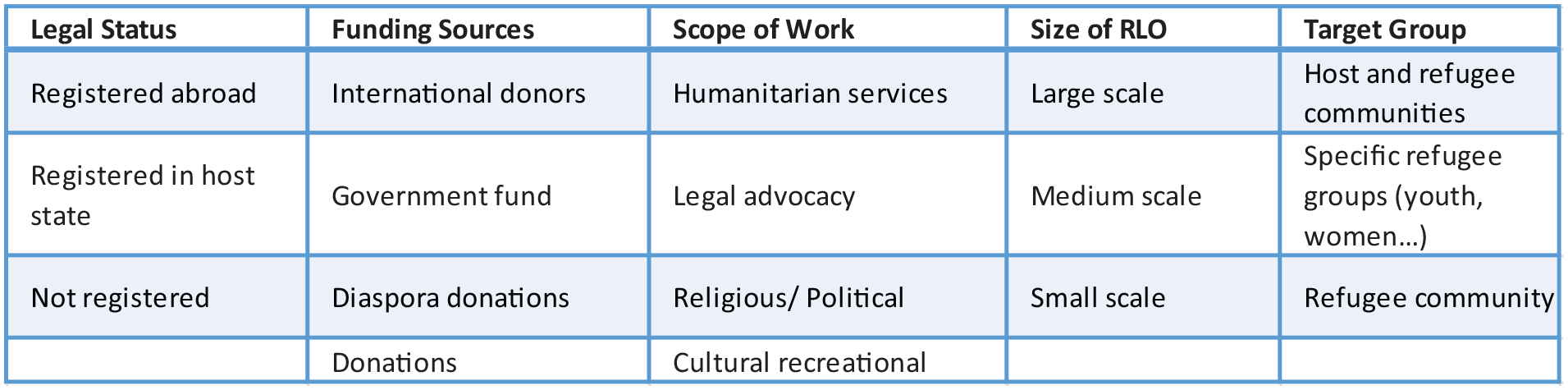
Factors influencing the patterns of RLOs in Jordan, Lebanon, and Turkey.
From the data we collected in Lebanon, Jordan, and Turkey, we identified several patterns of refugee-led responses: refugee-led initiative, refugee social enterprise, and refugee-led organization.
(a) Refugee-Led Initiatives (Refugee Community Organization)
As discussed, RLIs are refugee groups that are active but not officially registered. In Jordan, RLIs are the fruit of grassroots movements led by refugees to cover gaps in their respective communities. For example, Joud established a Facebook page called “Helping Syrians in Jordan” in 2013 so he can gather all the right information and donation assistance in one credible place. Now this page has over 78,000 followers and is a cornerstone of the Syrian community in Jordan, providing health supplies, medicine and any humanitarian assistance that comes as a donation. Joud said, “I was approached by many Jordanian NGOs but most of them either wanted to take a percentage of the donations or run the operations as they see fit. We work on a very sensitive health initiative, so it would be amazing to be legalized, but with the offers that I got from the Jordanian NGOs it felt as if I would cheat my community out of their donations, so I choose not to register and wait for an NGO that prioritizes humanitarianism over bureaucracy.”
In Lebanon, according to the founder of one of the RLOs we interviewed, “Lebanese authorities impose harsh conditions that constitute an obstacle to the initiative's continuation, including the requirement that a Lebanese person must be present to lead the initiative” (PIL-18, Jan 2022).
One of the founders of a Syrian RLI said that his identification papers and residency papers expired (PIL-23, Feb 2022). This makes it very difficult for him to expand or even continue his organization’s work.
“We face many obstacles with the government, including the imposition of valid residency permits, and the fact that licensing requires many security approvals” (PIL-20, Jan 2022).
Many of the interviewed refugees thought, “The Lebanese state must change its attitude toward refugees after years of oppression and injustice” (PIL-29, Feb 2022).
(b) Refugee Social Enterprise
To bypass the requirements for registering an association and to evade financial restrictions for receiving money from abroad, refugees had mobilized in Jordan by registering for-profit companies/enterprises. One example was Jasmine Handicrafts. This refugee-led response started as an initiative and then became a for-profit company supporting women through what is called internationally a “social enterprise.” Registering as a for-profit company helped the founders to gain legal rights. They registered with the help of a Jordanian citizen, but are fully run by refugees, who make all the decisions.
Jordan’s restrictive Civil Society Organizations’ bylaws and regulations have made some refugees take the “Social Enterprise” path and find durable and profitable solutions to their problems. They still had to register under a Jordanian’s name, but the process of registration was much easier and did not have unwarranted rejection.
In Lebanon, this has also been evident in a number of Syrian-led responses. The founders of these entities chose to register their initiatives as social enterprises as this is easier than registering as NGOs and at the same time provides the legal cover for them to rent a space and institutionalize their operations.
(c) Refugee-Led Organization
In some cases, refugee-led initiatives formalized their operations and became registered RLOs when they managed to fulfil the requirements for registration in the host country. In our mapping, we identified how RLOs have successfully managed to bypass restrictive policies of host countries and to register as:
An individual or group of naturalized refugees;
Refugees who partnered with naturalized refugees or with a local organization;
Refugees with dual citizenship; and
Refugees whose status had been regularized, as in the case of those who benefit from Kimlik (local permanent documents) in Turkey.
In some cases, these networks go beyond the immediate community in the host country and they reach out to other refugees with the benefit of transnational funding. As a result, they can secure registration in the Global North. Many of the identified RLOs depend on external donors and access to various forms of private funding.
In Jordan, registration of RLOs for non-Jordanians is almost impossible. Thus, a good number of the mapped bodies have registered outside Jordan, but they maintain a presence in Jordan. Syrians Across Borders and Homs Associations from Exile fall into this category. Other RLOs in Jordan were given an umbrella by Jordanian NGOs or associations. This has given them the possibility to serve and be active without the need to register. Yet not all RLOs working under the cover of national organizations have necessarily been given the decision-making role, such as the Syrian Bashayer el Khair in Amman.
In Lebanon, some RLOs managed to overcome the registration challenge by partnering with Lebanese nationals. The co-founder of a Palestinian RLO that supports refugee children told us, “We are officially registered with the Ministry of Interior and Municipalities through the president of the association, who is Lebanese. We submitted all the required papers through a lawyer, and he obtained the notice of recognition. There are no problems with registration because the association is registered in a Lebanese name” (PIL-24, Feb 2022).
Having the RLO registered makes it easier to partner with other NGOs and INGOs working in Lebanon. The same registered RLO said that they have several national and international partners, “We coordinate with several NGOs such as, Najdeh, Naba’, Children and Youth, Ajyal Al Arab, and Li Anak Ensan. . . We also work with international institutions such as, Norwegian Refugee Council, Save the Children, War Child Holland, and Danish Refugee Council. We receive financial support through donations and grants from these INGO, mainly War Child Holland and Ajyal al Arab” (PIL-24, Feb 2022).
What Is the Role of Refugee-Led Organizations?
As discussed earlier, since 2016, the international community has valued the awareness, local connections, and contextualized knowledge of RLOs in comparison to international organizations.
“Refugee leaders have stepped in to fill the gaps left by states and traditional humanitarian actors during the pandemic, providing essential services and helping to mitigate the worst impacts of the crisis” (Amnesty International, 2020).
However, during the 2020 pandemic, refugee communities were subjected to increased restrictions particularly relating to curfews and mobility. As such, apart from a few large-scale RLOs who were able to continue their operations normally, small-scale initiatives struggled to make ends meet. The leader of a refugee-led initiative in Bourj Al Barajneh camp in Lebanon told us, “Despite our limited resources, we tried to raise awareness among people in the camp. We also tried to collaborate with other RLOs and NGOs in the area. The problem is that we were always faced with restrictions from the government and the local authorities” (IIL-04, June 2022).
In some cases where RLOs managed to collaborate with other NGOs and INGOs, their involvement was often limited to providing basic services such as distributing hygiene kits provided by the INGOs. A founder of one of the initiatives in Tripoli, Lebanon said, “INGOs used the data that we collected. They came to the informal tented settlements, give us the boxes and ask us to distribute them and then leave. We were happy to help at first because we wanted to benefit the people. But then, it felt like they were just using us to get the work done. They gave us nothing in return” (IIL-07, June 2022).
Despite these challenges, RLOs continue to play an important role in their communities both in the provision of services and in offering community support and other social and cultural activities.
RLOs have been major actors in the humanitarian scene in Jordan, Lebanon, and Turkey, long before the pandemic. However, they have mostly been present in their local communities.
RLOs’ inclusion in decision-making and formal and policy processes remains limited at the local, national, and international level. The policies of the host states dictate and limit the RLOs’ ability to act. This stands in contradiction with the international community’s call for self-reliance and more empowered refugee communities. Nonetheless, refugees continue to mobilize and organize their efforts to support their communities.
Conclusion/Reflections
The international humanitarian system has planted a seed to create a welcoming environment for the refugee communities’ mobilization through the World Humanitarian Summit in 2016 and the Global Compact on Refugees. But the politics of Middle Eastern nations have afforded refugees limited rights and limited ability to exercise leadership and self-reliance. Policies vary from one refugee group to another in response to funding, politics, and state interests. To examine the communities’ dynamics in light of this fact, we analyzed the ramifications of failing durable solutions for protracted refugee situations. The policy of containment has been dominant at the international community level, giving little hope for resettlement and little support to restore a peaceful homeland for refugees. Integration in the three countries we studied appears to be provisional and to consign refugees to a “permanently temporary” status (Fabos and Brun 2022). This reality has prompted refugee communities to organize in order to devise strategies and creative survival mechanisms to navigate the restrictive environments in which they live. In many situations, refugees have mobilized to advocate for their rights and sought to establish their own RLOs of solidarity to support members of their communities.
We seek in this work to provide an evidence base from the Middle East of refugee community structures in Jordan, Lebanon, and Turkey. Despite the challenges they encounter from host states, we find that refugees exercise agency in seeking to assemble or re-assemble a community based on the ability of leadership to network with peer members and supporting bodies, with a tailored agenda and funding to serve the community. We emphasize the power of refugee communities to organize, as an act of agency and solidarity. We unpack the needed equation for RLOs to emerge — particularly the agency and drive of refugee leaders, the social capital and the power of refugee members to come together as a protection pole for one another, the power of the community to organize with a clear agenda and objective, and lastly the hosting environment to nurture all.
The paper seeks to highlight gaps in the failing international refugee regime in order to secure protection for refugees, and documents the failure of host states to ensure basic rights for all refugees. It reflects on the dynamics and the different patterns and typologies through which refugees have organized. By advocating for wider space for RLOs to grow, we underscore the important role this community plays in provision of humanitarian services and protection as well as community support and empowerment.
This research provides important evidence for policymakers, funders, and practitioners to guide their engagement with various types of RLOs in the region, mindful of the diverse structures, strategies, and levels of formality that refugee-led responses assume. RLOs make important contributions in addressing the otherwise un-met needs of refugees and related communities. To make their local humanitarian support effective, more permissive laws and policies are needed.
Footnotes

2
An association is considered foreign if its founder or director is not Lebanese, if it is based outside Lebanon, or if more than a quarter of the members of its general assembly are foreigners.
3
4
Author Note
We appreciate the work done in Jordan by Osama Okour in data collection and analysis as Jordan Country Coordinator until July 2022.
Disclosure
The authors received informed consent from the people interviewed for this research.
Declaration of Conflicting Interests
The authors declare no potential conflicts of interest with respect to the research, authorship, and/or publication of this article.
Funding
The authors received financial support for the research, authorship, and/or publication of this article: The authors received financial support from Canada’s International Development Research Centre (IDRC), the Open Society Foundations (OSF), the Robert Bosch Stiftung (RBS), the Rockefeller Brothers Foundation (RBF) and the Global Whole Being Fund for the research, authorship, and/or publication of this article. The research was undertaken in the context of a partnership between the Centre for Lebanese Studies and LERRN: The Local Engagement Refugee Research Network, which is funded by the Social Sciences and Humanities Research Council of Canada (SSHRC).