



Abstract
While youth are routinely lauded as “change-makers,” they are often underserved and unsupported in refugee responses. As the Rohingya face protracted displacement in Bangladesh, what is the state of youth inclusion in the response? Do youth and adolescents feel supported, or are they ignored and left behind?
To answer these questions, the paper uses:
Literature on youth participation and inclusion in humanitarian programming; Key informant interviews with practitioners from national and international non-governmental organizations (NGOs) and UN agencies; Focus group discussions and key informant interviews with refugee individuals and groups across nine camps for Rohingya refugees in Bangladesh.
It finds that:
Refugee Rohingya youth and adolescents remain firmly on the margins of humanitarian programming, and are largely excluded from decision-making processes; Approximately 96 percent of surveyed youth between 18 and 24 years of age report being unemployed; For surveyed women aged 18–24 years, unemployment rates bordered on 99 percent; and Stress and anxiety are omnipresent amongst the community: an overwhelming majority of respondents reported experiencing disturbing thoughts and resorting to negative coping mechanisms.
The paper ends with a series of recommendations to the Strategic Executive Group (SEG) and the Inter-Sector Coordination Group (ISCG), to donors, the international community, and the government of Bangladesh. 1
Introduction
We are sitting in a circle in Ali’s shelter, which he has generously offered to be used as a community learning center. 2 A bamboo lattice divides the outer area from living arrangements inside, where Ali’s family of six has lived for the last five years. Above us, there is tarpaulin emblazoned with the logo of an aid agency; below us, a concrete floor. On our right, a makeshift wall of bamboo and blankets separates us from the world outside, slivers of sunlight laboring in through the gaps. Despite it being a bright morning, it is dark inside. There are no windows, and the door is the only opening for the wind and the sun.
Here, during the more than two years of the COVID-19 pandemic, small groups came together twice a week for self-guided learning — following modules created by aid agencies and the Education sector. 3 Those who have gathered at Ali’s are learners in the program, between the ages of 13 and 24 years. Over the course of the conversation, it becomes clear that during the pandemic, these small-scale initiatives ensured education continuity, and further modifications allowed humanitarian programming to reach groups who often face additional barriers to learning — women and girls, single mothers, refugees with disabilities.
However, in the Rohingya refugee response, the alternative to this “COVID modality” is the same patchwork model at scale, not “formal learning.” Nor is this patchwork model an anomaly. While the Global Compact for Refugees (GCR) calls on host governments to include refugees in national educational plans, and while some progress has been made, refugee education remains largely constrained to parallel, temporary systems (Murthi 2021). This often includes temporary learning centers or schools within refugee camps, parallel systems with the home country curriculum and language of instruction, parallel afternoon classes, and accelerated or remedial learning programs primarily set up through United Nations agencies, local and international non-governmental organizations (NGOs), and donors. Despite being a fundamental right, and despite receiving almost consistent donor support, education remains largely out of reach of most refugees.
In Bangladesh, the same holds true. For five years, the response has failed to institute one curriculum for the community, instead relying on sector-approved manuals. Efforts to adopt the Myanmar curriculum, which the Bangladesh government insists is the only acceptable option, have been hamstrung by bureaucratic barriers and by the political crisis across the border. Coupled with a steady deterioration of camp conditions, increasing uncertainty, and deepening deprivation of refugees, the lack of opportunities for youth and adolescents has had a chilling effect.
The consequences of prolonged deprivation have been multifaceted and dire. As displacement stagnates, loss of income and limited opportunities have led to rising frustration and adoption of negative coping mechanisms — precipitating an alarming increase in smuggling and trafficking, gender-based violence, and child marriages. COVID-19 and climate change have amplified these trends. Over the last two years, rolling lockdowns have ripped through the community, and in a terrain acutely vulnerable to climate shocks, cyclical floods have left a trail of devastation and dread. Most recently, a spate of fires has led to loss of life and property, and pushed the community close to breaking point.
August 2022 marked five full years of the Rohingya refugee response. For half a decade, almost 900,000 survivors of grievous atrocities have lived from one emergency to the next in the hills of Teknaf and Ukhiya in Cox’s Bazar along the south coast of Bangladesh, fenced in and condemned to complete aid dependence in bamboo and tarpaulin shelters collectively branded the “largest refugee camp in the world.” In a crisis increasingly characterized by chronic underfunding and regional political indifference, refugees remain firmly on the side-lines of decision-making, forced to conform rather than inform.
Co-authored by an aid worker and a Rohingya refugee, this paper looks at one key aspect of that exclusion: refugee youth and adolescents. Constituting almost half of the population, Rohingya youth and adolescents remain almost entirely overlooked by current programming: they cannot access formal education or limited vocational training and livelihood opportunities. While one aspect of this shortcoming is related to legal recognition, responsibility also rests with the way youth programming and advocacy have been deprioritized by the Inter Sector Coordination Group (ISCG), the body tasked with coordinating the humanitarian response. 4
The purpose of this paper is twofold: to show how the preconditions for this abject dispossession have been normalized in Cox’s Bazar; and to identify how inclusion of youth in advocacy and programming can help contribute to aid accountability, and to efforts toward durable solutions.
The paper has three parts. Part One provides an overview of the current landscape of youth programming in Cox’s Bazar, framing the side-lining of youth and adolescents not just as a failure of inclusion, but as a failure of principled humanitarian action. Part Two highlights the perspectives of refugee youth and adolescents to set a marker for where the response needs to be. Here, we offer preliminary insights from a forthcoming assessment by the Norwegian Refugee Council on youth needs and demands, and triangulate trends with key informant interviews of refugee youth leaders. Lastly, Part Three reflects on the intertwined themes of pain and power that dominate much of the Rohingya experience of displacement, spotlighting initiatives led by refugees that are providing hope to the community, but remain woefully under supported. We end with observations and recommendations for the government, donors, and aid agencies engaged in the response.
The paper starts off bleakly and progressively gets more hopeful, as we cut through the noise and locate the humans at the center of our efforts.
Methods
This study uses mixed methodology to assess the state of youth inclusion in humanitarian programming in Cox’s Bazar, including:
A literature review on youth participation and inclusion in humanitarian programming;
Key informant interviews with practitioners from national and international non-government organizations (NGOs and INGOs, respectively) and UN agencies. Particularly officials leading or coordinating sectors and working groups engaged with refugee youth programming in Bangladesh; and
Focus group discussions and key informant interviews with refugee individuals and groups across nine camps in Bangladesh.
Over a period of three months, 258 refugees participated in this study, along with 10 aid workers from eight agencies. One hundred and eight refugee participants were engaged through door-to-door surveys, with an additional 136 participating in focus group discussions. Fourteen informant interviews were held with prominent members of the community. Sixty-five percent of respondents identified as male and 35 percent as female. 5 To triangulate specific data points and settle certain data inconsistencies, a review was conducted of internal monitoring reports and data on how NGO programming is reaching refugee youth. 6
Three Short Explanatory Notes One, the United Nations defines “youth” as being aged 15–24 years, “adolescents” as being aged 10–19 years and young people as 10–24 years. In this paper, we collectively refer to the population aged 10–24 years as “adolescents and youth,” making a distinction in the age group 18–24 years when engaging issues such as formal employment.
Two, our analysis concentrates on Rohingya refugees living in Cox’s Bazar, not the approximately 21,000 refugees living in Bhasan Char, located on a nearby island. 7 While education access and livelihoods opportunities are issues of concern in Bhasan Char as well, analysis of the secondary site is outside the scope of this current project.
Three, this paper is co-authored by a Rohingya refugee whose life is directly influenced by the issues it covers. In at least two instances, we intentionally forego “academic objectivity” and share insights from not just participants in the study but facilitators and enumerators who helped collect data. While unconventional, we believe engaging the personal and “breaking the silence of the ethnographer” does not detract from empiricism, but rather helps surface the depth of dispossession on display in Cox’s Bazar.
Five years since fleeing Myanmar, one million Rohingya refugees remain completely aid dependent in Bangladesh, neither legally recognized as citizens of Myanmar, the country that drove them out, nor legally considered as refugees by Bangladesh, the country that currently hosts them.
The refugee response in Cox’s Bazar is shaped by an annual Joint Response Plan (JRP) — a product of bilateral negotiations between the United Nations and the Bangladesh government — that outlines strategic objectives and funding needs for the year.
Operational decisions are coordinated via a hybrid model by the ISCG and the Office of the Refugee Relief and Repatriation Commissioner (RRRC). However, humanitarian presence is increasingly dictated by decisions by the Bangladesh Home Ministry. For example, circulars governing operations — especially education and protection programming — are issued from Dhaka, as are arduous Foreign Donation (FD) approvals, all of which continue to delay and, in some cases, completely bar implementation.
Strategic decisions are made by the Strategic Executive Group (SEG), based in Dhaka and jointly led by the UN Resident Coordinator, and the Mission Chiefs of the International Organization for Migration (IOM) and UN High Commissioner for Refugees (UNHCR); with participation of partners at the Country Director level. In Cox’s Bazar, decision-making power lies to a degree with sectors, which by and large are led by UN agencies with a handful of NGO co-representatives. In the camps, Camp-in-charges (Bangladeshi government officials) are tasked with facilitating humanitarian programming, often in ad-hoc coordination with block level community leaders called majhis.
Since 2018, the JRP has consistently emphasized protection and support to both refugees and host communities, and analysis of the plan’s objectives since 2018 shows a gradual shift from purely humanitarian programming to a more development-focused approach. In practice, however, preparedness and protection have taken a backseat to a response that has stumbled from one emergency to the next, and has steadily pushed refugees farther from the locus of decision making.
Part of the problem lies, we argue, with the coordination mechanism. In theory, the ISCG and the RRRC coordinate through a hybrid model, but policy seems increasingly dictated by Dhaka rather than informed by the needs and realities of refugees and Bangladeshis in the district. Further, as funding and attention attenuates, the absence of a principled and cohesive humanitarian voice to guide the overall response is becoming more apparent, and concrete policy shifts are becoming even more difficult to achieve.
Meanwhile, prolonged deprivation amplified by two years of COVID-19 has produced a noxious mix of desperation and dread. Child marriages are increasing, abuse and assault have skyrocketed, and women and girls consistently report feeling unsafe and unsupported. 8 At a time when protection programming should be expanded, funding cuts mean that many of our partners have been forced to slash their protection programs by half. On the ground, that means fewer women-friendly spaces, fewer learning facilities for girls, and fewer support systems for survivors (Islam 2022).
At the center of this ecosystem of hurt, coping, and suffering are youth, forced to grow up too early, to provide for families, to respond to cyclical emergencies, and to support a struggling community — all without any support systems of their own. The following chapters can be seen as an attempt at understanding the world from where they stand.
Part I: Youth Inclusion
Globally, according to the United Nations International Children’s Emergency Fund (UNICEF 2021) estimates, half of all refugees are under age 18 years, with young adults aged 18–24 years constituting another 13 percent of the total.) In Bangladesh, an internal mapping conducted by the United Nations Population Fund (UNFPA) in April 2022 places the youth population at 306,413. 9 This part of the article is concerned with: (1) global policies and commitments that seek to meaningfully include refugee youth in humanitarian programming; and (2) how these commitments translate, if at all, across the Rohingya response in Bangladesh. We find predictably large gaps between policy and practice and argue that participation and inclusion constitute the heart of the discrepancy.
At the World Humanitarian Summit in 2016, the Inter Agency Standing Committee launched global guidelines on youth inclusion in humanitarian action, outlining five key actions: equitable access to services; participation in decision-making; increased youth capacity and empowerment; increased access to youth-specific resources; and better reporting and data vis-a-vis youth in aid interventions. 10 For the purpose of this project, participation is of particular concern.
Participation in the context of humanitarian response is generally understood to involve people in the decisions that affect their lives, specifically including marginalized groups within policy-making sectors. Inclusion, perhaps, can be understood as an objective — as the process to ensure impartial, equitable access to assistance. In practice, participation requires a shift in focus beyond whether or not needs are being met, to a wider analysis of patterns of marginalization influencing how they arise in the first place (Lough et al. 2021). When seen as a foundational component of inclusion, participation acquires broader significance, offering a means for marginalized communities to organize, build solidarity, demand their rights, and engage as equal partners in crisis response.
When it comes to participation, two key themes are important to engage: time and tokenism. First, the assumption that protracted displacement creates space to deepen participation over time does not hold up in Bangladesh. Despite the Rohingya crisis coinciding with critical policy developments in how we deliver aid — specifically the Global Compact on Refugees and the Grand Bargain — no “participation revolution” has materialized in Cox’s Bazar. On the contrary, over the past five years, refugee groups, activists, artists, and advocates have felt the blunt force of security restrictions governing every aspect of community and civic life. As the crisis becomes more protracted, refugee voices that should be amplified in pursuit of international attention and action have been largely silenced.
Second, participation — where it has occurred — is surface level and often tokenistic. Over the past few years, aid agencies have worked to establish committee structures to engage different segments of the population. While these bodies are often designed to fulfil a program support role — such as managing facilities, making referrals, or running information campaigns — they also provide a platform to communicate directly with agencies and to provide input into decision-making processes. However, participation remains largely limited to the bare minimum of “voicing concerns” and “suggesting improvements.”
Who is included and to what degree is also up for debate, and a consistent source of friction. Including majhis (community leaders selected by camp authorities) in community consultations, for example, is important because it recognizes existing power dynamics, but at the same time, it might alienate and/or stymie groups — especially women, refugees with disabilities, and youth collectives — from speaking with authority about their needs and demands. In a conservative, male-dominated society, it remains hard to reach women and girls, systematically include them in community level consultations, and balance participation with perception. Recent IOM research suggests that including women in leadership structures without proper support is unlikely to be effective and might actually precipitate protection risks (Lough et al. 2021) Worse, pushing for their presence in mixed-sex groups risks sparking active backlash from a religiously conservative community.
While criticism rightly piles up, aid agencies face an uphill battle with little support from those deciding response strategy. The process to facilitate inclusion is fraught with difficulty. Five years after the start of emergency aid operations, agencies continue to face bureaucratic and political barriers to meaningfully engage and empower refugees. Cash assistance is not allowed, hiring of refugee volunteers is strictly controlled by the government, and increasing securitization of the community has made building community trust harder. There are fundamental questions that remain unanswered in Cox’s Bazar, for example: if everyone is responsible for inclusion, who is accountable for the process?
In theory, the answer is simple: the SEG is tasked with high-level negotiations and decisions about response strategy. However, while there have been some efforts to create bureaucratic space and to systematically include refugees, these efforts have remained regrettably ad-hoc and ultimately futile.
As the next part shows, in Cox’s Bazar, this amalgamation of disjuncture and failure has deepened vulnerability and contributed to the essentializing of refugees as helpless victims and passive aid recipients, deepening their desperation, frustration, and sense of dispossession.
Part II: Impacts of Exclusion
This part expands on the impact of the disjunctures explored in Part 1 by: (a) presenting preliminary findings from a survey of 258 refugee youth and adolescents; and (b) exploring three key themes through analysis of survey data triangulated by key informant interviews and internal protection monitoring reports shared by partner agencies.
Malik, 19, is one of thousands of Rohingya refugees who has never seen the inside of a proper school. In Myanmar, restrictive laws meant Rohingya were largely unable to enroll, and Malik’s only exposure to formal learning was through religious schools or madrasas. By the time Malik and his family were forced to Bangladesh, he was one of thousands of young adults already left behind.
In Bangladesh, Malik, then 14 years old, initially enrolled in an NGO-run learning centre, but quickly lost interest. The other children were far younger, and he struggled to keep pace. He dropped out and found work as a “tom-tom assistant.” 11 Now 19, he drives his own tom-tom. Malik’s story is at once commonplace and an anomaly. While most Rohingya children and adolescents do not have a formal education background from Myanmar, very few Rohingya youth (18–24 years) find formal employment.
To understand challenges faced by Rohingya youth and adolescents, 258 youth and adolescents were surveyed. Approximately 65 percent were boys and 35 percent girls. Consultations were gender disaggregated, with female facilitators leading focus group discussions with refugee women and girls. Respondents were between age 13 and 24 years, and key informant interviews were conducted with respondents between 18 and 24 years of age.
Conversations were framed to gauge youth needs, challenges, and perspectives. Our objective simply was to understand what the world looks like for a Rohingya youth and/or adolescent in Bangladesh. The following figure — visualized from raw disaggregated interview data — provides a snapshot of key issues of concern (Figure 1).
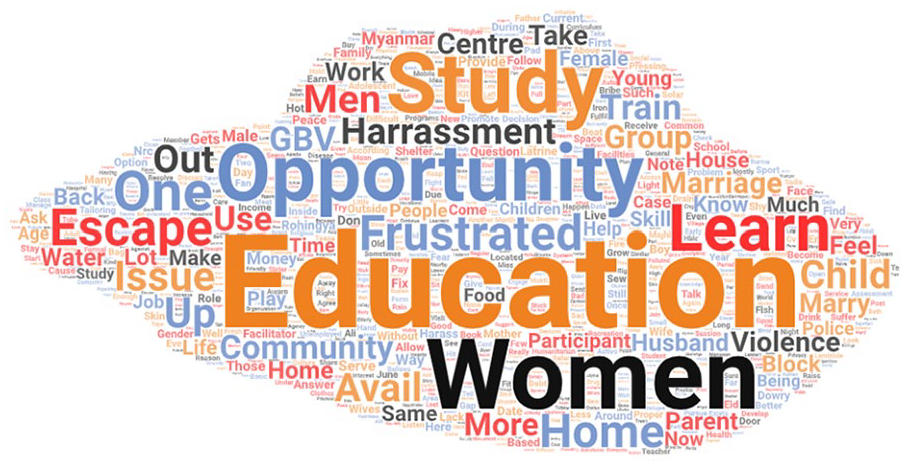
What are you concerned about?
Interactions indicate high levels of unemployment, frustration, and deprivation. Almost 96 percent of all respondents aged 18–24 years reported being unemployed. For women specifically, unemployment rates among youth aged 18–24 years were even higher, bordering 99 percent.
We focus here on three key issues of particular significance: access to education, safety, and security, and psychosocial impacts of prolonged deprivation. Across issues, we present preliminary findings and tangential insights on two cross cutting themes: gendered vulnerabilities and disability inclusion.
Education
As of July 2022, a Myanmar Curriculum Pilot engages 10,000 students, but across the camps, a UNICEF coordinated “Learning Competency Framework and Approach” (LCFA) is still very much the dominant modality of education. Almost 90 percent of all students under the LCFA are at Level 1 and 2, equivalent to the second grade. The LCFA is not designed and has not been expanded to include youth and adolescents, the overwhelming majority of whom remain disengaged from humanitarian programming.
Access to education and, in particular, access to quality education was raised as a priority concern by a majority of respondents. Time and again, respondents pointed out that education was a priority need, but facilities remained insufficient and that “learning centers are not schools.”
Concerns were raised with methods of teaching as well as subject matter. Across learning centers in the camps, teachers (or learning facilitators) are recruited from both the refugee and the host communities. While responses were largely positive about “refugees teaching refugees,” individual concerns were raised about Bangladeshi teachers being “harsh,” “unfair,” and “disrespectful” of refugee communities. Follow up questions attempted to understand how complaints were channeled and dealt with by agencies. By and large, despite complaints and feedback mechanisms existing in theory, respondents indicated that they did not feel comfortable raising concerns and that when concerns were raised by individuals they felt trivialized.
Refugees with disabilities face added challenges. In camps constructed almost entirely out of bamboo and tarpaulin, accessibility remains an ever-present and seemingly unsurmountable challenge. Ramps are uncommon; modifications to reach students with visual or hearing impairments even more so.
Women and girls continue to face additional barriers to accessing already minimal services, facing the dual challenges of stigma and soaring child marriage. As one male respondent pointed out, “At least we get some opportunities, and at least we get to go outside. Most of the time, girls are just stuck at home.”
Safety and Security
Since 2021, camp safety has deteriorated sharply. Internal protection monitoring reports by NGOs, shared confidentially, show abuse and assault have skyrocketed and crime has increased. Media reports of smuggling and trafficking of drugs and humans have piled up. These acts have been publicly attributed to individuals and/or organizations belonging to the refugee community. Internal protection monitoring reports by aid agencies corroborate these public reports, but also find instances of abuse of power by camp and security authorities. Harassment at checkpoints — an increasingly permanent feature of highly securitized camps — has become troublingly common, and often includes bribery, arbitrary arrest, and/or physical assault of refugees.
Physical violence against women and girls continues to be a major concern. Internal protection monitoring data by agencies indicate upwards of 50 percent of women and girls reported physical abuse in the first quarter of 2022 alone, with almost 30 percent of cases of violence against girls aged 13–24 years. This trend runs parallel to the sharp rise in child marriages within the community, which has been exacerbated by almost two years of COVID-19. As one female respondent put it, “there is no peace for girls anywhere in the world.”
When youth and adolescent respondents were asked about their biggest concerns relating to camp safety and security, the issues discussed below also emerged.
Stress and Anxiety
Forced migration exerts short- and long-term effects on mental health, including anxiety disorders, depression, posttraumatic stress disorders (PTSD), and associated emotional distress. A 2018 rapid mental health assessment by the IOM reported a substantial mental health crisis within the community, with almost 74 percent of respondents reporting being “always sad.” Recent research conducted post COVID-19 induced lockdowns indicates these levels have increased even more (Palit et al. 2022).
Several factors are associated with their mental distress in displaced communities. Trauma, violence, and restrictions in education and freedom of movement can be seen as primary causes. The causes are exacerbated by the lack of appropriate health care facilities, inadequate social facilities (such as accommodations), and loneliness and boredom after arrival in Bangladesh.
To extend insights from existing research, we looked specifically at mental health across youth and adolescent populations. Importantly, we use “stress and anxiety” to capture mental health related symptoms and disorders, noting here that our data fail to capture the cascading severity of psychosocial ailments.
Mental health facilities also remain inadequate and below minimum acceptable quality. As one participant put it, “I used to try and seek help when I would feel very sad, but every time I went, I would come back with even more sadness and disappointment. Forget sadness. Even for physical issues, there is always a medicine shortage, and no access to proper pharmacies. Every prescription is for paracetamol [Tylenol].”
Survey data along with focus group discussions indicate a community experiencing staggering levels of anxiety and stress. While the psychosocial impact of prolonged displacement is well-established, our data suggest that stress and anxiety is contributing to rising negative coping mechanisms in Cox’s Bazar. Almost every single respondent reported being disillusioned. Frustration and anger was a common feature of every conversation. According to one respondent, “Agencies come to teach us how to control our anger. How to breathe. How to lie down and count numbers. But how can I control my anger when I cannot control anything in my life?”
This stark disillusionment was shared by many facilitators in the study. One enumerator, for example scrawled on the back of a focus group discussion note the following reflection: “We are in Hamida’s shelter to talk about camp security. 12 The world outside poses a lot of dangers, but the inside is not safe either. There are no mosquito nets, and not enough pillows for the family. There are insects everywhere. If it rains . . . when it rains, the water rushes inside. There is a mud wall that can collapse at any moment. There are children in this home. The kitchen is a stove in a corner bordered by bamboo. There is not enough water to cook, and no adult men in this household to fetch the water. The women’s bathroom is a block away, but the lock is broken, so the makeshift bath is a bucket in the bedroom.”
Part III: Power and Pain
Quite often, youth are described as “agents of change,” “forces for good,” and “leaders of their communities.” These terms have found themselves, uncritically and perhaps unsurprisingly, in the vernacular of the refugee response, with little engagement of the preconditions necessary for youth empowerment. Over the course of this project, time and again, respondents told us that they wanted to be stronger voices within and for their communities, but no one took them seriously because they had “no jobs and had accomplished nothing.”
But at the same time, despite there being little to no support for youth and adolescents, refugee groups and individuals have organized and collaborated. In the past, Rohingya youth have banded together to respond to emergencies, to produce art shows, and most recently, to organize relief for Bangladeshi communities in Sylhet. 13 However, all this has happened independently of any meaningful, structural support.
Zia, one of the authors of this paper, is part of a collective of storytellers who started off taking photos of the camp life. As he puts it, “we wanted to show the world how life is here.” Since then, the collective had published two widely praised magazines, and collaborated with aid agencies on art shows, one of which was held at the Bangladesh Liberation War Museum. The exhibition, titled “We Are Rohingya” does not just feature photos from the camps, but also 11 archived images of 1971, covering Bangladesh’s own refugee crisis. In doing so, refugee youth have managed to situate the Rohingya refugee crisis within a much broader narrative of national memory and commitment to protect people forced to flee.
“You do not know how we live,” Rahim tells us. “You can come and go as you like. We are here, even when we do not want to be here. We cannot leave like you can. When we speak, when we take photos, when we write poetry or even talk to people like you, we are trying to make the world understand what a great injustice this is — to trap so many people in this endless nightmare.”
Observations and Recommendations
This paper has attempted to explore: (1) the landscape of youth inclusion in Cox’s Bazar; (2) the impacts of exclusion of a large demographic from humanitarian programming; and (3) vignettes of youth art and agency despite lack of support. Its conclusions follow:
To aid agencies and the ISCG, youth inclusion is not a tangent to humanitarian programming, and public donor interactions with pre-selected refugee youth is not inclusion. Inclusion will require streamlining current sectoral activities and the adoption of common reporting mechanisms — to establish as a baseline the percentage of the youth population engaged by humanitarian programming across sectors.
To donors, five years since the 2017 exodus and the scale up of humanitarian services, bureaucratic engagement with the Bangladesh government is needed to create space to engage youth and adolescents in programming that recognizes their agency and fosters innovation. In a protracted crisis, donors can and must move beyond passive observation and join agencies to lobby stakeholders.
To the Bangladesh government, youth can be the strongest voices of a community that wants to find a way to return home, and are eager to acquire transferrable skills for return to be sustainable. However, for that to happen, the community needs to be supported by humanitarian programming through a steady scaling up of facilities. In response to these needs, we offer the following recommendations.
The Strategic Executive Group and the Inter-Sector Coordination Group Should:
Scale-up quality and inclusive education following the Myanmar Curriculum for children, adolescents and youth, with an agreed and monitored timeline for implementation.
Generate evidence on the link between self-reliance and sustainable return. Research approaches can borrow from policies in Uganda, Jordan, and other countries.
Lead the effort to mainstream monitoring and reporting of disaggregated data on youth across sectors.
Donors and the International Community Should:
Ensure sustained financial support for both refugee and host community education systems, including Mental Health and Psychosocial Support Services funding, and scale up the Myanmar Curriculum Lobby to open up skills building and vocational opportunities and programming for youth aged 18–24 years.
Accelerate multilateral efforts for sustainable return of Rohingya refugees to Myanmar.
The Government of Bangladesh
Support youth refugees to facilitate early, sustainable return. Youth can be the strongest voices of a community that wants to find a way to return home, and to acquire transferrable skills to take back to Myanmar. However, for that to happen, the community needs to be supported by humanitarian programming through a steady increase in engagement and inclusion.
Footnotes
Acknowledgements
We are grateful to members of the Rohingya community who participated and whose names we have changed to protect privacy; to Ayesha, Sadia, and Aliya of the Norwegian Refugee Council; and colleagues from the Danish Refugee Council, Humanity and Inclusion, and the International Rescue Committee.
1
As discussed in greater detail below, the Strategic Executive Group (SEG) “provides overall guidance for the Rohingya humanitarian response and engages with the Government of Bangladesh at the national level.” The Inter-Sector Coordination Group (ISCG) coordinates the humanitarian response in Cox’s Bazar.
2
All names changed to protect identity of refugees.
3
Sectors are the equivalent of clusters in the Rohingya response and are responsible for coordinating the activities of thematic partners.
4
The ISCG coordinates the humanitarian response in Cox’s Bazar and reports, in turn, to the Strategic Executive Group (SEG), which is made up of the heads of the UN High Commissioner for Refugees, International Organization for Migration, and the United Nations in Bangladesh.
5
Engaging women in research projects remains a recurring challenge in Cox’s Bazar, owing to social stigma and religious constraints. Furthermore, women face challenges in accessing services like learning centers, where focus group discussions are usually held.
6
Data has been shared by the Norwegian Refugee Council, International Rescue Committee, Danish Refugee Council, and Humanity and Inclusion.
7
Following the signing of a Memorandum of Understanding between the Bangladesh government and the UN Refugee Agency in late 2021, the island became a second site of refugee settlement in the Rohingya response.

9
The UNFPA mapping covered individuals between 10 and 24 years old.
10
The Inter Agency Standing Committee’s guidelines on how to include youth in aid programming has been rolled out in the refugee response in Cox’s Bazar by the Norwegian Refugee Council and UNICEF.
11
Tom-toms are retrofitted motorcycles used for transportation by Rohingya refugees inside camps.
12
The respondent’s name has been changed.
13
At this writing, almost six million Bangladeshis are impacted by severe floods in the north of the country. The relief effort in question was organized by Rohingya refugees in Cox’s Bazar.
Disclosures
Informed consent was received verbally for each interaction, following a brief summary of the motivation for the research. For minors, consent was sought from both the participant and from their legal guardians.
Declaration of Conflicting Interests
The authors declared no potential conflict of interest with respect to research, authorship, and publication of this article.
Funding
The authors disclosed receipt of the following financial support for the research, authorship, and/or publication of this article: The authors received no direct compensation for this project. The preliminary survey data presented was collected by staff from the Norwegian Refugee Council and is supported by funding from the Norwegian Ministry of Foreign Affairs, the Swiss Development Cooperation, and the European Union.