



Abstract
Executive Summary
This paper explores how qualitative information may be used to enhance understanding and inform recommendations for improved accounting of migrant deaths along the Texas-Mexico border. While border crossing related deaths affect jurisdictions throughout the US’s Southwestern border states and Northern Mexican states, Texas has unique challenges that merit specific examination. In short, the management and investigation of unidentified migrant decedents in Texas is severely fragmented and often noncompliant with Texas Criminal Code Procedure.
I explore a way to improve accounting of migrant deaths leveraging qualitative information, local newspaper articles from South Texas and Northern Mexico, by using descriptive summaries coupled with Sankey Diagrams and a programmatic technique, qualitative spatial representation (QSR). QSR enabled me to identify under-recognized stakeholders (South Texas locals, Mexican consulates) and under-supported counties (i.e., those with migrant deaths that do not share a border directly with Mexico).
I found that local English-language newspapers obscured the prevalence of migrant deaths and that their narrative tone of “business as usual” normalized the occurrence of such deaths. The Spanish-language articles better represented the diversity of agencies and individuals that were involved in the various aspects of migrant remains management and forensic investigation, most notably residents of South Texas themselves (or situational participants who first found the remains) and Mexican consulates. Finally, I noted that the collaborations among Texas counties and between Texan and Mexican jurisdictions, when they were described in the newspapers, highlighted that the phenomenon of migrant deaths penetrates beyond the dividing line of the Rio Grande/Río Bravo River. Migrant deaths must be accounted for in a way that reflects a regional experience in which people may perish as far as ~100 miles into Texas’ interior. Considering these observations, I have two policy recommendations.
First, the Office of the Texas Governor should establish funds distinct from the Operation Lone Star program for the management of unidentified human remains. Currently, grants through the Operation Lone Star Program are the only funds available in Texas to support identification of migrant decedents. However, this program is explicitly designed to further border security operations in the state of Texas, which can contradict efforts around recovery and identification. The documentation and forensic investigation of the unidentified deceased can be eclipsed or neglected under the larger deterrence aims of Operation Lone Star.
Second, to improve accounting and increase documentation of migrant deaths, a Regional Identification Center should be established in South Texas. Not every county in Texas has or has access to a Medical Examiner’s office, including the means to transport and pay for autopsy or other forensic services. The Center would provide training, store extra equipment such as mobile refrigerated morgues, and hire personnel to inventory cases, and report information to the state (e.g., vital statistics) and to foreign consulates. A Regional Identification Center would counteract the challenges highlighted in the local newspaper summaries and QSR by decreasing the isolation of counties experiencing migrant deaths and serve as a documentary and communication hub for stakeholders in Texas and Mexico.
Keywords
Introduction
The phenomenon of migration and crossing-related deaths along the Texas-Mexico border is both complicated and distinct from the other three southwestern US border states. While migrant death along the entire US-Mexico border has increased since implementation of the US Prevention Through Deterrence policy (hereinafter “deterrence policy”; est. 1994), Texas has unique structural and geographic challenges, along with one of the highest migrant death incidences among southwestern US border states.
Much of the management and investigation of migrant death in Texas is characterized by fragmentation and historic noncompliance with Texas Criminal Code Procedure (Gocha, Spradley, and Strand 2018; Spradley et al. 2019; Kaplan et al. 2022; Kaplan and Spradley 2022). Texas, a state with 254 counties, has 13 Medical Examiner’s Offices only two of which are in counties that border Mexico (El Paso in the northwest and Webb to the southwest). Other counties may be part of a district system and are served by a central county with an established Medical Examiner’s Office. Most often, however, responsibility for the management of decedents falls on local jurisdictions that are overwhelmed with high numbers of deaths and limited access to resources to transport the cases to a neighboring Medical Examiner, let alone store remains and conduct forensic investigations. This situation results in the burial of a majority of unidentified migrant decedents without proper investigation or genetic sampling (Kaplan et al. 2022; Kaplan and Spradley 2022). These limitations are further exacerbated by most of the land in Texas being privately owned (96 percent). Landowner permission is needed to access these areas, which results in a lack of regular or systematic forensic search and recovery efforts.
In Texas’ fragmented system for managing and investigating the unidentified deceased, much of the information associated with these cases is incomplete and dispersed throughout multiple agencies (funeral home burial records, medical emergency service dispatch reports, and sheriff’s death reports). Research of unidentified human remains that likely correspond to migrants in Texas has highlighted that to find these deceased individuals, memory recall and acquisition of heterogeneous data are important, both to locating appropriate forensic cases and selecting sites to conduct exhumations of unknown burials (Gocha, Spradley, and Strand 2018; Kaplan and Spradley 2022; Miranker and Giordano 2020).
I examine the use of qualitative information to improve accounting of forensic cases. To do so, I explore a technique, qualitative spatial representation (QSR), for utilizing qualitative data in ways to enhance understanding of migrant death, rather than treating qualitative sources (news media, interviews) as ancillary in the forensic process (Congram, Kenyhercz, and Green 2017). That is, rather than this being a stopgap until Texas improves the centralization of forensic case management and associated documentation of unidentified human remains, the method I explore here can support forensic efforts via a technique that can highlight underrecognized stakeholders or under-supported jurisdictions. I leverage QSR for understanding migrant death in Texas, particularly South Texas, utilizing qualitative information acquired from local newspapers. To do so, I pose the following questions:
How are incidences of migrant death narrated?
What geographic trends are more apparent from local newspapers and systematic parsing of unstructured text?
What recommendations are possible based on descriptive summaries and QSR of local newspapers?
I hope to elucidate how local news coverage portrays migrant death throughout the Texas-Mexico border region, since the framing of this phenomenon may affect Texas county- or state-level efforts surrounding the management or investigation of migrant deaths in South Texas. This paper’s sections proceed as follows. I define the method I utilize in my study, QSR. I also provide a brief background on the portrayals of immigrants in US media. I then explain how I collected my data, local newspapers from South Texas and Northern Mexico. For my results, I first analyze the English-language newspaper corpus, or body of texts, focusing on descriptive summaries with the aid of Sankey Diagrams. Then I perform a separate comparison of English- and Spanish-language articles with QSR. Based on my descriptive summaries and QSR results, I make two policy recommendations.
Background
Qualitative Spatial Representation (QSR)
QSR refers to a range of computational methods that use logic statements representing qualitative relationships that help characterize phenomena or events in space. These methods allow “computation, not with numbers representing points but with logical statements representing qualitative relationships” (Stell 2019, 4). QSR is particularly valuable for exploring relationships between objects in space (topology) when geographic relations (topography) cannot be easily assigned coordinates such as in a Geographic Information System.
Utilizing Geographic Information Systems (e.g., testing and mapping spatial relationships in Cartesian coordinate space) in applied research of migrant mortality along the US-Mexico border is not new. Geographic Information Systems (GIS) has helped demonstrate trends in the spatiotemporal distribution of migrant deaths, thereby directing search and recovery efforts, as well as supported humanitarian interventions to identify the deceased (Chamblee et al. 2006; Lawrence and Wildgen 2012; Giordano and Spradley 2017; Soto and Martínez 2018; Vogelsberg 2018; Boyce, Chambers, and Launius 2019; Chambers 2019; Chambers et al. 2019; Siegert et al. 2020). GIS, however, requires that data are recorded in latitude and longitude or other precise coordinate systems. GPS coordinate locations of a migrant death site such as recorded in a Sheriff’s Death Report may be accurate to a few meters, approximate to the near kilometer, and even vaguely described (remains found “in the Rio Grande River”). The challenge is how to identify and visualize the spatial patterns of migrant deaths when their location is expressed only approximately.
QSR can be used to capture spatial relationships, such as “a river running through a town” or “a park on the border of a neighborhood” (Stell 2019, 4). I parsed the newspaper articles gathered for this study via region-connection calculus, that is “language [used to] state the spatial relations between entities” (Stell 2019, 14). To order the relationships in space, I used semantic triples, for example, element 1 = “a deceased migrant,” relation = “was found by,” element 2 = “a Brooks County ranch worker.” Table 1 demonstrates manual semantic tripling of a newspaper article.
Example Semantic Triples Connoted in Element-Relate-Element Form.
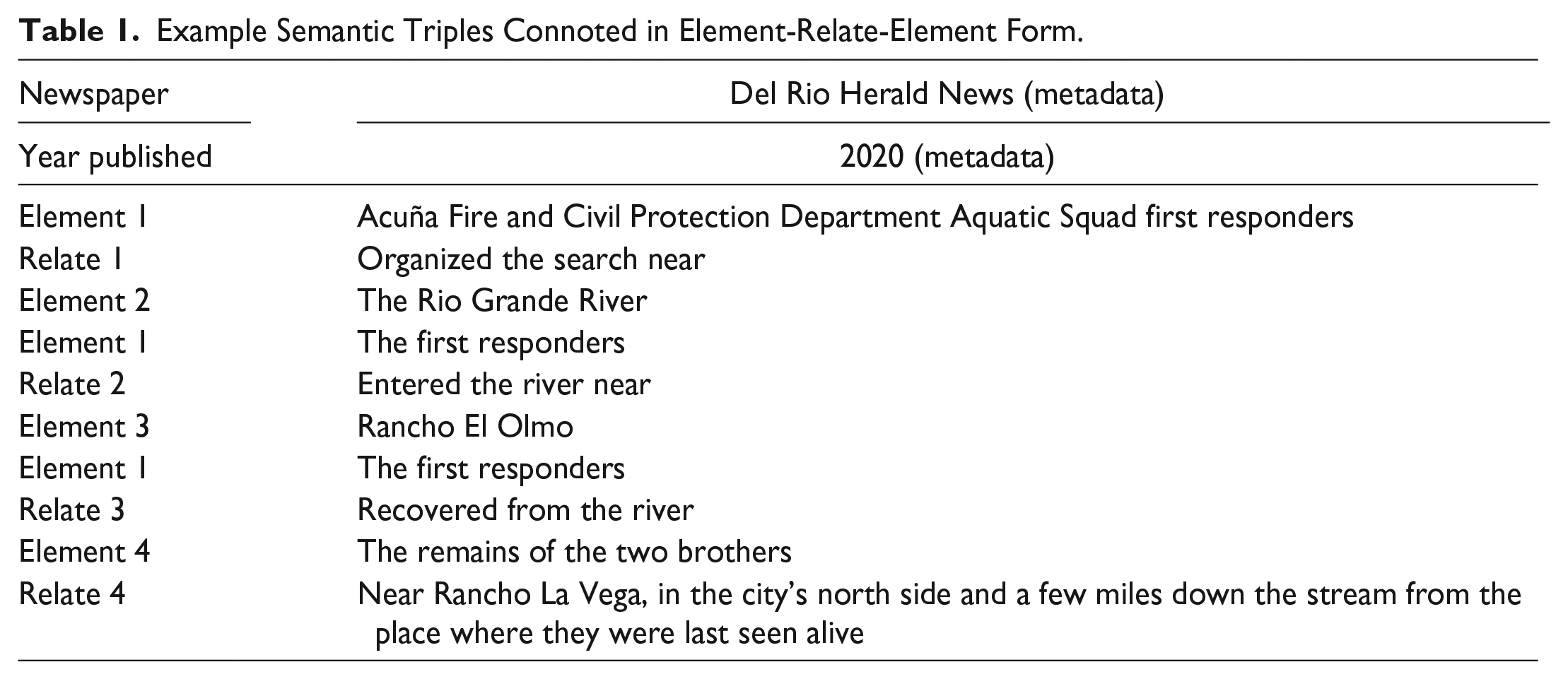
QSR is distinct from conventional qualitative coding because it was developed in Artificial Intelligence to meet the need for a computational treatment of qualitative information (Stell 2019). QSR is a graph-based representation devised to programmatically accommodate and represent irregular, semi-structured relational knowledge (Cole and Hahmann 2019). This approach is not new, but relatively recently it has been leveraged outside of computer science with the advent of applications like Virtuoso, GraphDB, Allegrograph, and Neo4j. The programmatic tracing and visualization made possible with QSR surmounts traditional mapping challenges such as when an event or object cannot be placed with any kind of determinable positional accuracy in a GIS. No determinable positional accuracy means the object does not fit into a Cartesian coordinate space with a confidence interval measure. Structured ordering of elements and relations in a QSR demonstrates the extent, connectedness, and limitations of a network in its geographic and temporal context. As is the case in Texas, much of the responses around an unidentified deceased person likely to be a migrant are fragmented (e.g., locational information is recorded by multiple agencies in different reports) and QSR is a means of associating collaborations that can then be supported when identified.
The Portrayal of Immigrants in the US Media
I focus on newspaper coverage of migrant deaths in South Texas utilizing QSR, asking in what ways this empirical technique may be leveraged to support accounting of migrant deaths. While I am not performing conventional content analysis, to generate the QSR I systematically parse a corpus, or body, of unstructured texts. Media and the analysis of media content are a means to determine how conventional knowledge is made (what is “normal” and for whom). Further, content and discourse studies of the portrayals of immigrants to other Americans in media highlight ways their experiences or deaths are “made banal” to readership.
Regarding “normalizing” who immigrants are perceived to be via news media, Taylor’s (2021) historical discourse analysis study is instructive. Taylor (2021) used the Times, a digitized UK-based newspaper, parsed articles about (im)migration from 1800 to 2018 and highlighted two important trends. Firstly, migration metaphors are historically rooted and secondly, metaphors related to migrants and (im)migration are cumulative and pervasive.
Metaphors are a cognitive shortcut, a means to “help people make sense of the world by mapping concepts from a familiar source domain onto a less familiar target domain” (Zavisca 2016, 168). The metaphors detected in contemporary studies of media portrayals of immigrants further demonstrate what American readership can take for granted as normal, such as border crossing related violence and death, as well as exemplify empirical means to harness qualitative information. Using 399 articles spanning 1999 to 2008 from the Arizona Daily Star and the San Diego Union-Tribune Jane Zavisca (2016) examined how journalists described migrant deaths. The most frequent metaphors about migrant deaths were economic metaphors (cost/calculus, gamble), metaphors about violence (vengeance, war zone, punishment, violent), dehumanizing (animal, water, cargo), and humanizing (human being, saint). Zavisca (2016, 186) showed that metaphors can influence causal reasoning and that by using them journalists can insert ideas or values of economy, violence, and (in)humanity into the phenomenon of migrant deaths, “thereby making implicit arguments about the nature and causes of death,” such that they can be understood as normal or even acceptable.
Metaphor and newsprint media are not the only vehicles through which border crossing or immigrants are understood. In his 2015 article The Cowboy and the Goddess: Television News Mythmaking About Immigrants, Otto Santa Ana employed a content analysis approach for assessing one-years’ worth of network television (TV) reporting on immigrants. From over 12,140 TV news stories, a total of 31 dealt with the topic of Latino (im)migrants crossing or attempting to cross into the US. He analyzed the narrative structure of the news reports and determined that there were two predominant story forms. One was the American Western story, which rearticulated the US’s foundational myth; i.e., the single proposition that “promotes the fiction of American Exceptionalism [. . .] glorifies the violence of Manifest Destiny, and remakes US imperialism to be just and liberating” (Santa Ana 2015, 102). The second predominant story form was the Inanna transnational voyager story, which contests the US’s foundational myth. The myth of Inanna, a Sumerian goddess, undercuts the American Western myth because it recounts the human aspiration to undertake great ventures (Santa Ana 2015, 105); a motif of ingenuity and perseverance that does not vilify a voyager (such as an immigrant).
In all, content analysis of media is not a trivial endeavor because “media influence how audiences think about issues by characterizing their ontology; that is, the nature of the problem at hand, as well as their potential causes and solutions (Zavisca 2016, 167). Content analyses of media and the portrayals of immigrants reveal a “normalization” of migrant death scenarios. My examination of local news stories about deaths along the Texas-Mexico border entails a content analysis in the initial reading and coding of entities and relations. I then generate the QSR visualizations. The QSR of local newspapers will elucidate what happens when a migrant death is encountered near the Texas-Mexico border. To clarify the longstanding challenges particular to Texas, I summarize some of the Texas Criminal Code Procedure and one state-level program that further contextualizes challenges in the state, Operation Lone Star.
Migrant Death Management in Texas
When it comes to migrant death in Texas, the processes for investigating and managing (transport, storing, documenting) forensic cases are the same as any set of unidentified human remains. The Texas Criminal Code Procedure details the legal obligations for forensic inquest and reporting in unidentified human remains cases (Table 2).
Texas Criminal Code Procedures Salient to Documentation and Identification Processes for Migrant Decedents.
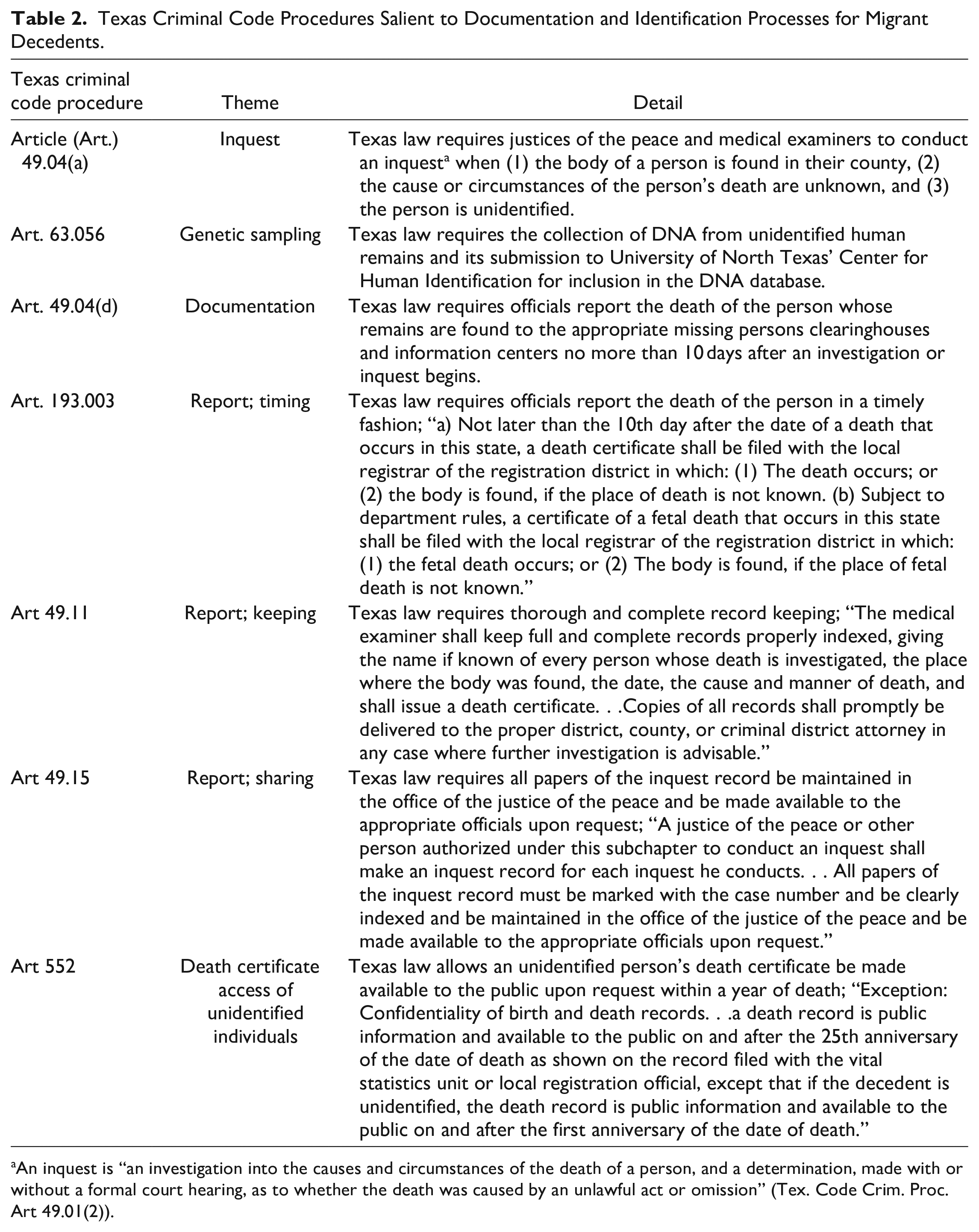
An inquest is “an investigation into the causes and circumstances of the death of a person, and a determination, made with or without a formal court hearing, as to whether the death was caused by an unlawful act or omission” (Tex. Code Crim. Proc. Art 49.01(2)).
Despite the enumeration of obligations, adherence to the Procedures is inconsistent, particularly in South Texas counties (Gocha, Spradley, and Strand 2018; Spradley et al. 2019; Kaplan and Spradley 2022; Kaplan et al. 2022). Part of the reason for this is that South Texas counties are among the poorest in the United States and do not necessarily have the resources, training, or subject matter expertise to comply with Texas’ law. To compound matters, the county-based system lacks state-level oversight, which leads to myriad deficiencies such as death certificates and case reports being incomplete, if they are filed at all. This means that the vast majority of unidentified remains in South Texas end up buried in unmarked graves without genetic sampling or proper documentation.
The phenomenon of migrant deaths in Texas is well documented in news media (NBC News 2014; Frey 2015; Vincent 2019; Spinoza 2022). Yet it is the preponderance of irregular border crossing that has inspired state-level grants such as through Operation Lone Star to ameliorate some of the lack of resources (funding, training, equipment) in border counties. Operation Lone Star is a Texas state program (est. 2021) geared “to enhance interagency border security operations.” In short, the program seeks to deter would-be migrants from entering the US (Texas Indigent Defense Commission 2024). According to a December 2023 press release from the Office of the Texas Governor (OTG, 2023a), “Since the launch of Operation Lone Star, the multi-agency effort has led to over 491,100 illegal immigrant apprehensions and more than 37,800 criminal arrests, with more than 34,300 felony charges.” Concomitantly, the Department of Justice is investigating alleged civil rights violations under Operation Lone Star based on state records obtained by ProPublica and The Texas Tribune (Trevizo 2022).
As it pertains to the accounting of migrant deaths in the state of Texas, state institutions can apply for some Operation Lone Star funding to assist “county medical examiner offices in the humane processing of the remains of undocumented migrants” (OTG 2023b, 1). For overwhelmed South Texas jurisdictions, Operation Lone Star grants can be used to expand storage space such as with mobile or permanent morgue setups (Barrera and Salazar 2022). Brooks County, infamously called a Death Valley for migrants in the news (Frey 2015; Spinoza 2022), is one such recipient of Operation Lone Star funding that used some of those funds for a refrigerated mobile morgue. Other counties have had varying success obtaining Operation Lone Star funding, specifically for acquiring morgue units, due in part to not being able to account for the number of migrant deaths affecting their jurisdiction.
The Operation Lone Star program demonstrates that there are limited state funding opportunities to support counties overwhelmed with migrant deaths, even in indirect ways. It also shows that primacy is given to enforcement and securitization of the Texas border with Mexico. Given this paradigm, I explore a different approach for understanding response to and accounting of migrant deaths utilizing local newspapers. The method and dataset explored here exemplify a means to support forensic efforts (accounting, directing aid to underfunded jurisdictions) regardless of if or when Texas centralizes forensic case management and associated documentation of unidentified decedents.
Data and Methods
My dataset is composed of 580 newspaper articles spanning 1993–2020 from Newsbank.com. The newspapers were either headquartered in South Texas (n = 5) or Northern Mexico (n = 2). While biased, newspapers are a regular, ubiquitous source of information, which reflect the decisions, politics, and material constraints of reporters, and not necessarily the actual material conditions of migrant deaths. This is a limitation of my research. However, my larger purpose is to examine how this kind of information may be useful for accounting migrant deaths, especially in contexts with severely fragmented forensic inquest and management practices. Newspapers, especially at the local level, highlight familiar places, colloquialisms, and attitudes (Lavy 2017). Thus, the methods I utilize enable me to compare geographic trends among places that are experiencing a phenomenon in common, in this case migrant deaths related to border crossing (Table 3).
Newspapers From South Texas and Northern Mexico.
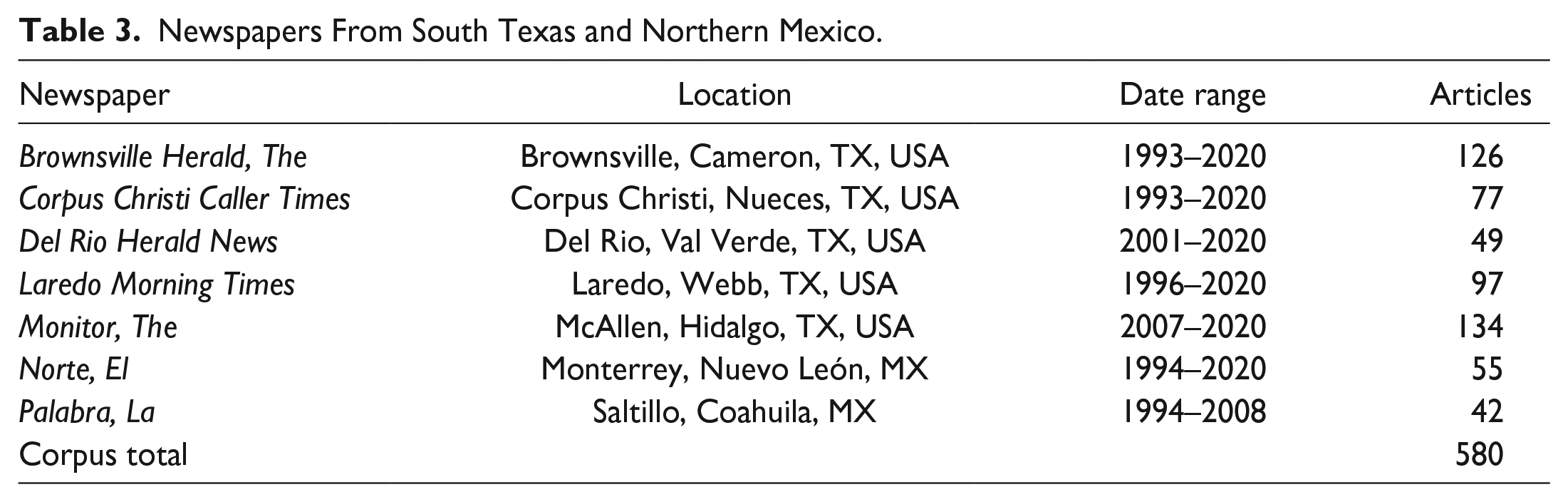
The 580 articles were retrieved using a series of keywords such as “border death,” “deceased migrant,” “drowned migrant.” Equivalent terms were used for article retrieval in the Spanish-language papers (“una muerte Y la frontera,” “migrante fallecido,” “migrante ahogado”).
For the subsequent analyses, I present two separate descriptive summaries that demonstrate different aspects of forensic case response and management using only the English-language newspapers. Both descriptive summaries were visualized with Sankey Diagrams using SankeyMATIC (Bogart 2024). The Sankey Diagram is a programmatic means to visualize flow, movement, or change (Otto et al. 2022) and is especially useful for large datasets. In this instance, the Sankey Diagram helped me visualize the successive changes in location of a deceased migrant. For example, starting with who found the unidentified human remains of a probable migrant, the flow would connect the “finder” to the place of recovery. From the place of recovery (a ranch), the decedent would “flow” to the entity taking custody of the remains (the county sheriff). Eventually, the flow terminates in the last known (reported) place or entity with possession of the decedent.
I created two different descriptive summaries based on subsamples of the 483 English-language article corpus because of the variable information available in the stories. For instance, some news pieces were so brief that meaningful flows were not depictable, for example, “The Brooks County Sheriff’s Office reported that a male of unidentifiable age was found about seven miles west of Falfurrias on Monday” (Corpus Christi Caller Times 2001). I also limited the descriptive summaries to the English-language newspapers to exemplify how local news media can inform place-based recommendations (Section 5).
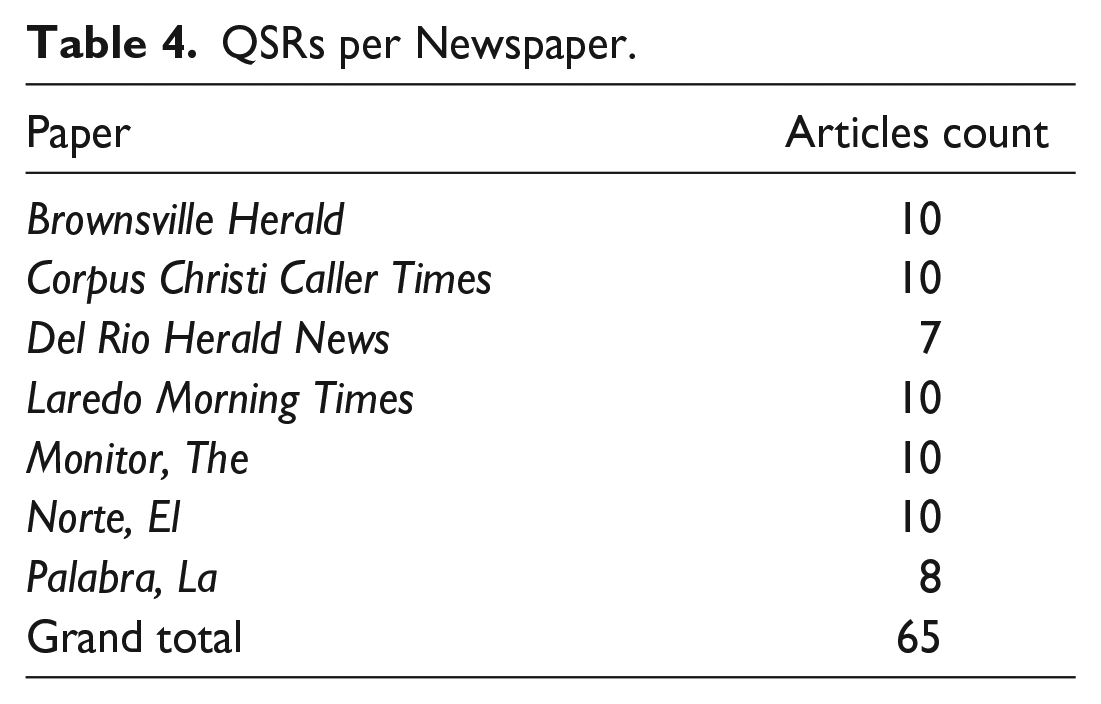
To juxtapose and indicate larger geographic patterns, a subsample of 65 English- and Spanish-language articles from the 580-article corpus were explored with QSR. The QSRs from English- and Spanish-language papers illustrate how they can inform more inclusive (jurisdiction spanning) recommendations (Section 5). A total of 65 articles were selected by stratified random sampling from the newspaper corpus. The corpus was stratified, or divided, into subgroups by paper (n = 5). Up to 10 articles from each newspaper with an approximately even distribution among publication years were then randomly sampled using RStudio 3.5.3 (Tirler and Leydold 2003; RStudio 2024). The 65 QSRs enabled the tracing of topological relationships to better understand how incidences of migrant death were narrated, not for statistical significance testing (Table 4).
QSRs per Newspaper.
Results
Descriptive Summary of Entry to Exit County
For the first descriptive summary a total of 239 of 483 articles from the English-language corpus contained sufficient information to represent “where a migrant decedent was found” and “where they ended up.” I used three criteria to retrieve the 239 articles. An article specifically had (1) to be about an individual migrant decedent, (2) to mention the recovery place, or “entry” into the news story (Brooks County, the Rio Grande River), and (3) to indicate the last known disposition of the decedent, or “exit” from the news story. For example, one article stated the remains of a probable migrant was recovered near “US Highway 281 about five miles north of Encino [Brooks County, Texas]” (Baird 2008) and was sent (“exited”) to Webb County (Figure 1).
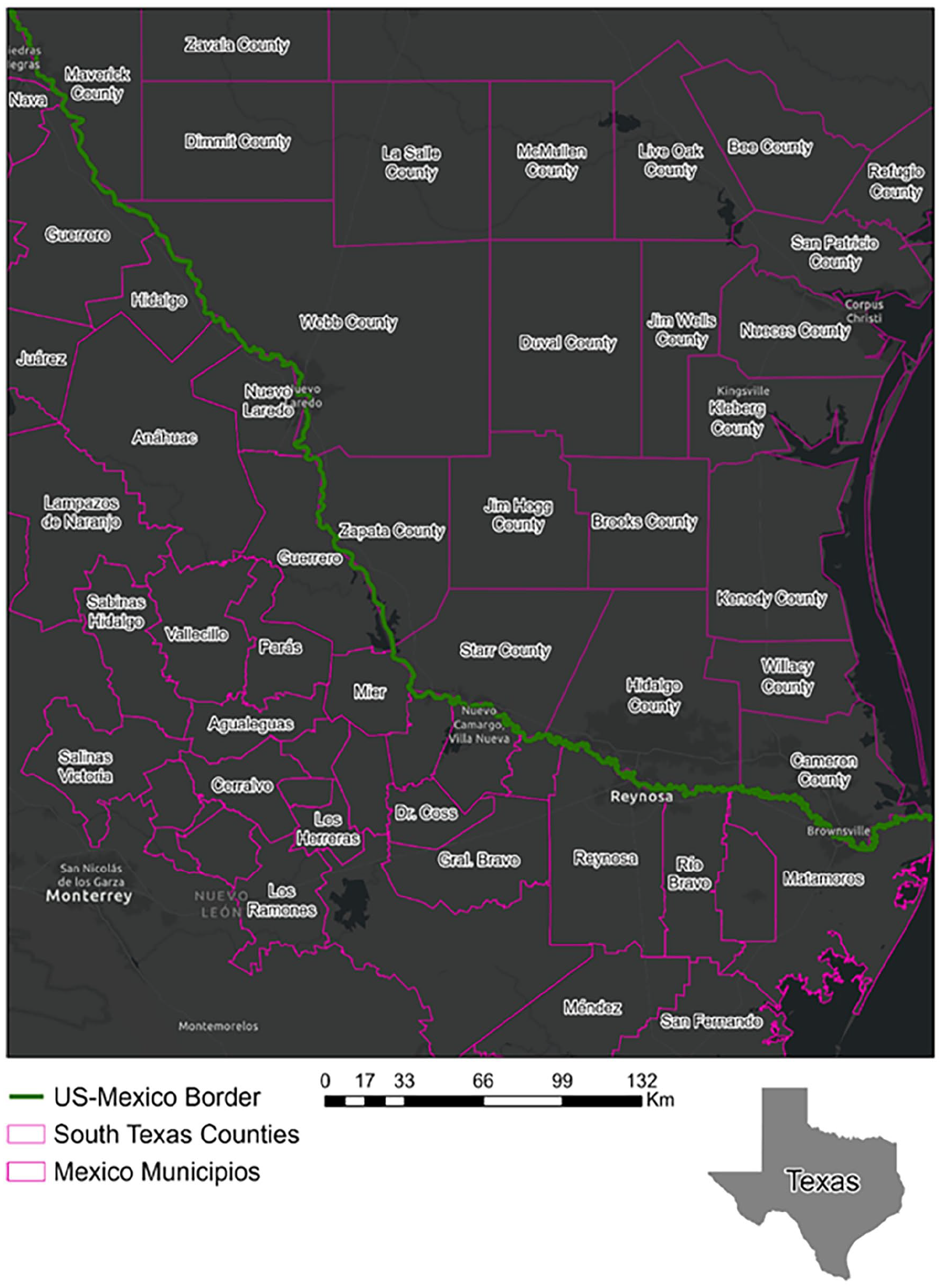
Locator Map. A Selection of South Texas Counties and Northern Mexican Municipos.
The Sankey Diagram (Figure 2) flows began at the entry, or start, of the news article, then what happened to the remains was tagged (autopsy ordered), and the flow terminated where the remains were last mentioned to be (exit or end of the news story).
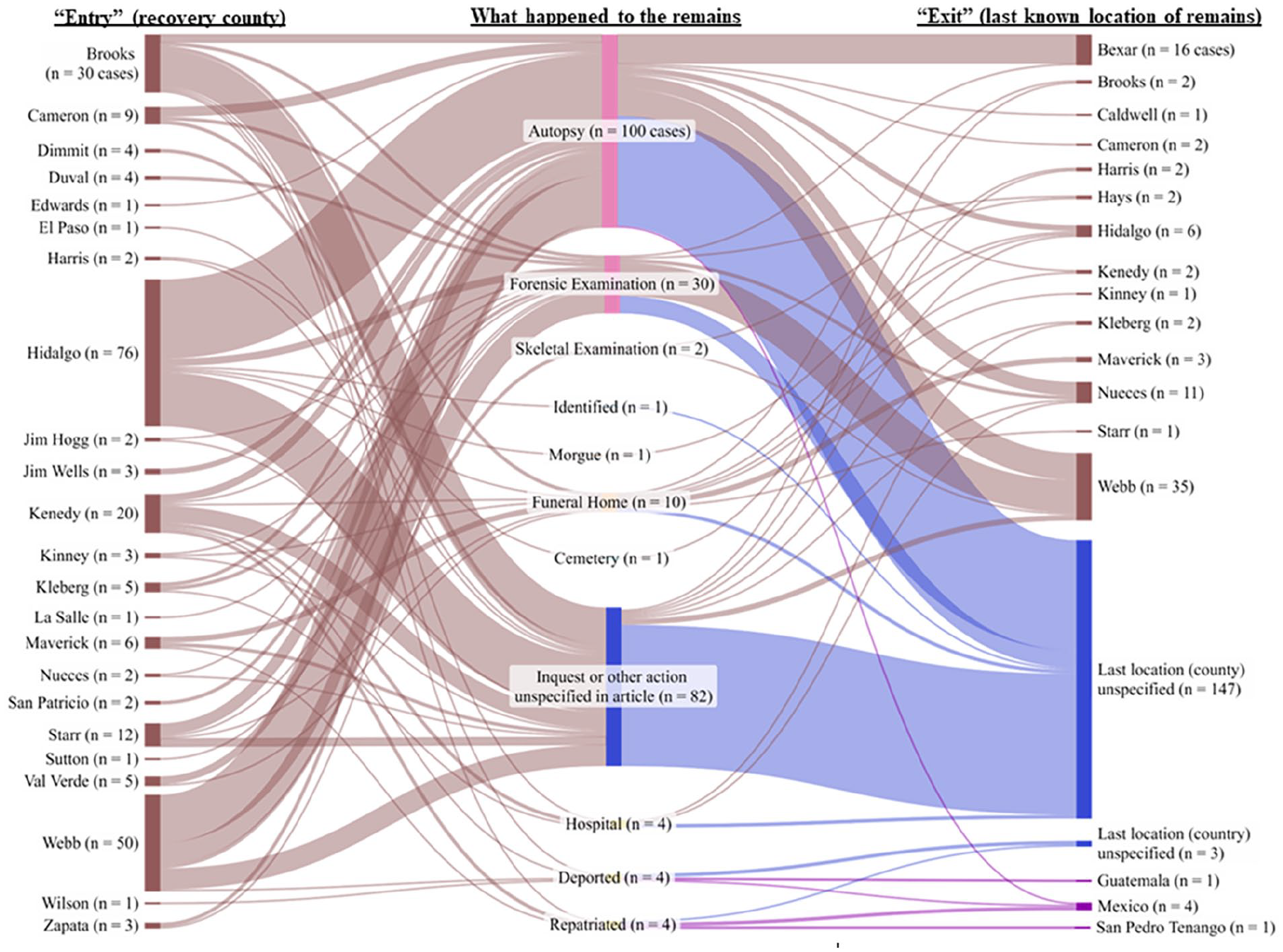
Entry Counties and Exit Counties for Migrant Decedents per News Article.
Proceeding left to right across Figure 2, seven counties out of a total of 23 mentioned in the subsample (n = 239) had the most remains recoveries reported; Hidalgo County (n = 76), Webb (n = 50), Brooks (n = 30), Kenedy (n = 20), Starr (n = 12), Cameron (n = 9), and Maverick (n = 6). These counties fall within US Border Patrol’s Rio Grande Valley Sector, except for Webb and Maverick, which are part of the Laredo and Del Rio Sectors respectively. All other start, or entry, counties had five or fewer articles that mentioned a migrant death.
Most articles did not mention “what happened” or “what was done with” the migrant decedent. When what happened was specified, most frequently a decedent was sent for an autopsy (n = 100), some kind of “forensic examination” (n = 30) as termed in the articles, or a skeletal examination (n = 2). After forensic examination, the next most common action was that a decedent was sent somewhere for storage. Storage places included funeral homes (n = 10) or morgues and cemeteries (n = 1 each). In a few articles, a rescued migrant, a surviving travel companion, was mentioned, and they were either sent to a hospital (n = 4) or deported (n = 4). In five different articles, it was noted that a migrant decedent was identified (n = 1) or repatriated (n = 4) to their country of origin and therefore presumably positively identified. When a migrant decedent was repatriated, there were no details regarding by whom or how the identification was made. For 82 articles, no activity between entry and exit was specified (“inquest or other action unspecified in article”).
Among the 100 autopsy cases, a total of 15 cases were sent to Bexar County where there is a Medical Examiner’s Office (MEO) in San Antonio. Note that a total of 16 cases “exited” to Bexar County, 15 were autopsies and 1 was a “forensic examination” (Figure 2). The Bexar MEO was not always explicitly mentioned (“remains were sent to San Antonio for autopsy”), which is why the exits were summarized to the county scale instead of by institution. Fourteen cases were sent to Webb County; there is an MEO in Laredo. Note that in Figure 2 a total of 35 migrant decedent cases were mentioned as being sent to Webb County, but only in 14 of those cases was an autopsy explicitly mentioned. Seven cases were sent to Nueces for autopsy, likely to the Corpus Christi MEO. A total of 11 individual migrant decedents were sent to Nueces County, but only seven had an autopsy ordered based on what was reported in the news articles. Hidalgo County was the place of autopsy for three cases; a total of six decedents were sent to Hidalgo. Hidalgo County has a contract forensic pathologist in Harlingen. A forensic pathologist is a subspecialist in pathology and an expert in determining cause and manner of death (Christensen et al. 2019), whereas a medical examiner refers to a physician usually certified in forensic pathology who is appointed to their position and is responsible for investigating suspicious deaths, identifying bodies, notifying next of kin, and signing the death certificate (New Mexico Office of the Medical Investigator 2024). For 61 articles it was not specified with whom or where an autopsy happened, only that an autopsy was ordered. This lack of information aligns with the observation that some counties will order autopsies to transport and remove the unidentified remains from their responsibility (conserve financial resources; Kaplan et al. 2022; Kaplan and Spradley 2022).
Further, the lacking specificity of where or with whom an examination of some kind (autopsy, forensic, or skeletal) happened is telling in three ways. One, while an autopsy was ordered, the investigating agency could not yet comment on where or with whom it would take place. This ambiguity in who/where pointed to how protracted the management of unidentified remains cases can be for some Texas counties. Two, the lack of specificity may hint that an improperly credentialed person may conduct a “forensic” examination, which has been an issue in Texas, especially South Texas (Gocha, Spradley, and Strand 2018). Finally, the readership of the newspaper itself may be directed toward the information that the deceased was removed and a kind of order restored by the mere mention of an “appropriate authority” receiving the remains or a “forensic examination” taking place.
Concluding with how a set of remains reached the exit of a news story, most migrant decedents exited to Webb County (n = 35) or Bexar (n = 16), followed by Nueces (n = 11), then Hidalgo (n = 6), Maverick (n = 3), or somewhere to Mexico (n = 4). All other exit counties corresponded with one or two migrant decedent cases. Focusing on the Entry/What Happened/Exit flow (Figure 2), the way incidences of migrant death were narrated suggested that among South Texas counties between 1993 and 2020 there was (and is) a forensic management and investigatory process in place. The process, however, is shrouded since, for example, 61 of 100 articles do not mention where or with whom an autopsy occurred (the flow from the “autopsy” node to the “Last location (county) unspecified” node). There are also only a few counties that are known to receive unidentified migrant decedent cases (Webb, Bexar, Nueces, and sometimes Hidalgo). In effect, a kind of disappearance (Kaplan et al. 2022) is conveyed even in aggregated news stories; if a decedent is found, they are sent away, the end.
Looking at entry and exit counties, the Sankey Diagram shows that remains can be recovered from many different counties along the border with Mexico and inland (23 different counties). While there are comparatively more details regarding the finding of decedents, the where and how of their exits are less substantive. The lacking exit information was observed in all English-language news articles and was consistently limited over time. News pieces about individual migrant deaths in the 1990s had about the same (deficient) amount of information regarding where a decedent was sent as stories from the 2000s and 2010s. Given the minimal exit information communicated in the English-language articles compared to entry, it is likely that local Texas-based papers are communicating a false sense of order. That is, the greater details provided about where a decedent is found (e.g., “Under a cluster of oak and mesquite trees on the San Pedro Kenedy Ranch, four miles south of Sarita; About 500 yards to a nearby road”) versus the more brief and formulaic description of what happens to the decedent after recovery (e.g., “Scheduled to undergo an autopsy”; Schwartz 2000) implies a routine. In so implying, local readership is desensitized to the sheer prevalence of migrant death.
Descriptive Summary of Successive Changes Between Actors and Activities
In addition to depicting the entry and exit associated with individual decedents, I wanted to further explore how migrant deaths were narrated and performed a new query among the 483 English-language newspaper articles. The second descriptive summary included 104 articles from the 483-news story corpus and represented “who contributed to a migrant decedent’s movement between different agencies.” I used five selection criteria to retrieve the 104 articles. Includable news stories had to (1) be about a recovery of an individual migrant decedent, (2) specify where the “entry” county was known, (3) mention the person or agency who first found the remains (e.g., a ranch hand), (4) identify the investigating agency (e.g., county sheriff), and (5) indicate the last known “action” (e.g., sent for autopsy).
The second Sankey Diagram emphasized who found the migrant decedent, generally where the deceased were found, and, then, who took custody of the case (investigating agency, case owner). This Sankey Diagram (Figure 3) highlighted the variety of actors and places these death events happened. Unlike Figure 2, in this diagram “places” referred to place types (brush, ranch, river) where decedents were found and not counties. Figure 3 provides another view on migrant death management (or lack thereof) in Texas.
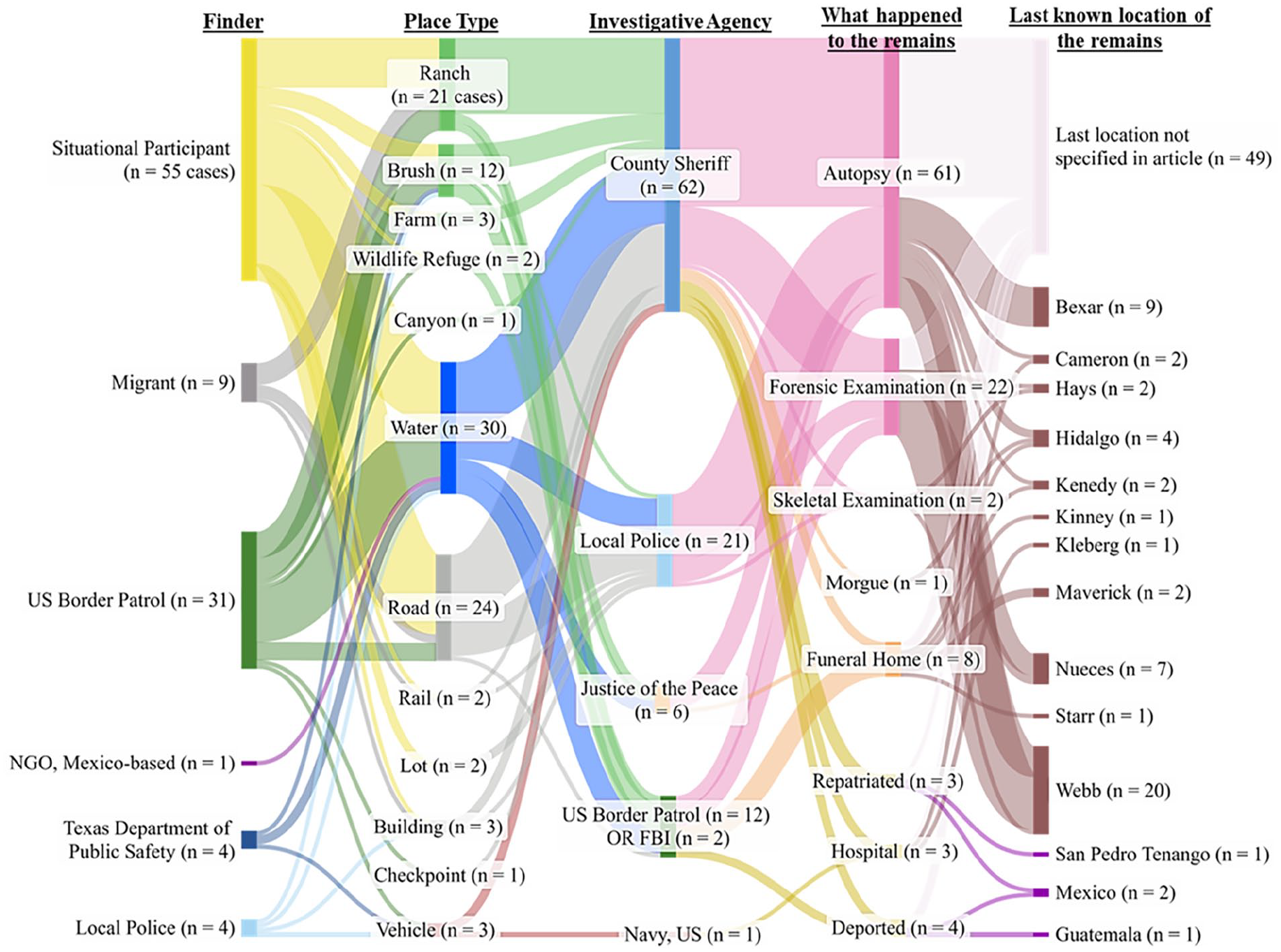
Who Found a Migrant Decedent and Who was in Charge of What Happened to the Remains per News Story.
Starting with the entry of a decedent into a news article, how they were found and by whom, most of the time a “situational participant” encountered a set of human remains first (n = 55 articles of 104). A situational participant is a person who happens upon unidentified human remains of a probable migrant. Importantly, the situational participant is otherwise not involved in law enforcement, forensic science, or humanitarian aid. That is, they are people who presumably would not encounter a human death except that they happen to live in a place where this type of death (border crossing related) is common. Situational participants included ranch hands, ranch owners, utility workers, rail workers, hunters, fishermen, and passersby. The next most common “finder,” was US Border Patrol (n = 31). In nine news stories the “finder” was another migrant, which typically meant a travel companion who called 9-1-1 for help. Local police and the Department of Public Safety (Texas Highway Troopers) found remains in four instances each. In one story, Grupo Beta, a National Institute of Migration of Mexico service, reported a decedent in the Rio Grande/Río Bravo River.
The most common types of places migrant decedents were found included water (the Rio Grande River, a canal, an arroyo) in 30 articles, followed by roads (n = 24) such as county roads, highways, or city streets, then private ranches (n = 21). Remains were also found in the South Texas “brush” (n = 12). I copied the terms “brush,” “farm,” and “ranch” directly from the news articles and treated them as distinct “place types” for the descriptive summary to reflect how the places of migrant deaths were narrated. Otherwise, the place type that was mentioned happened three or fewer times in the corpus.
Typically, the county sheriff (n = 62) was reported as taking custody of the deceased migrant. Next most frequently it was the local police (n = 21), followed by USBP (n = 12), then a Justice of the Peace (n = 6). There were two cases where the Federal Bureau of Investigation took custody of the remains (when remains were found on National Park land/a Wildlife Refuge) and one case, a vehicular crash on a US Naval base, which was handled by the US Military. Note that in seven articles surviving migrants were mentioned. In these articles the surviving migrants were the ones to either call 9-1-1 for medical aid or rescue or had survived a vehicular crash. The news pieces specified that survivors were sent to a hospital (n = 3) or were deported (n = 4).
Most migrant decedents had autopsies ordered (n = 61 articles of 104), were sent for a forensic examination (n = 22), or a skeletal examination (n = 2). Otherwise, the deceased were transported to a funeral home (n = 8), morgue (n = 1), or repatriated (n = 3) where, again, there was no specification of how or by whom a positive identification was made prior to a repatriation. Note, morgues and funeral homes are technically additional locations, or places, and not necessarily “what happened to the remains.” While some form of forensic examination could be conducted at a funeral home or morgue, these entities were grouped under “what happened to remains” section of the Sankey Diagram because those entities were mentioned toward the end (exit) of the story and all were referred to in a storage or transport capacity.
Figure 3 demonstrated two important realities. First, situational participants, that is, residents and locals, are frequently (n = 55 of 105 articles) the ones to find and initiate the flow of activities that lead to the recovery and some kind of inquest in a migrant death. Second, while fewer in occurrence (n = 9), migrants themselves being the “finders” is nontrivial. That migrants will call authorities for help or to notify an authority to a fallen companion points to the difficult decisions weighed by migrants; be rescued, which is often followed by deportation, or continue to risk harm on disorienting terrain and in inhospitable weather.
There are also a few geographic trends based on “place type” visible in Figure 3. Most often, some kind of inquest or investigation was ordered when a migrant decedent was found on a ranch (n = 21), in a water context (n = 30), or near a road (n = 24). Figure 3 also made clear that county sheriffs (n = 62) were typically the investigating agency or case owner, which corresponds to Texas Criminal Code Procedure and highlights for local readership that individual counties are supposed to be autonomous in the management and investigation of their decedents. As for the migrant decedents’ exits, the news stories tended not to specify what happened (n = 49 “Last location not specified in article”). The absence of information or lack of follow up aligns with research that highlights unidentified migrant bodies ending up in a kind of “limbo” or “disappeared again” (Gocha, Spradley, and Strand 2018; Kaplan and Spradley 2022) as they are ostensibly erased in unspecified forensic examinations (that may or may not be conducted) or burials.
As a final observation, Mexican agencies, be they humanitarian groups or consulates or firefighters or a Fiscalias (state attorney’s office), were notably absent from these two example descriptive summaries and corresponding Sankey Diagrams. While this absence can be attributed in part to the Texas-newspaper corpus focusing on information relevant to local readership and the selection criteria I used, the deficient representation of “the other side of the border” merits exploration. I pivot to using QSR to systematically juxtapose a subsample of English- and Spanish-language articles. Through this technique, I continue to explore how a systematized and programmatic exploration of unstructured text can support accounting, while also serving as a means for comparing news reporting from both sides of the Texas-Mexico border.
Qualitative Spatial Representation of the Management of Migrant Decedents
As a final demonstration of how to harness qualitative information to elucidate what happens with deceased migrants along the Texas-Mexico border I took a stratified sample of newspaper stories and rendered them with Qualitative Spatial Representation (QSR). A total of 65 articles were selected from the 580-newspaper article corpus. Of the 65-article subsample, 62 were about recoveries only, and 3 were about the rescue of a migrant in distress. Two of the news stories about rescue were on the US side of the border, and one was on the Mexico side (Liñán 2006b; Aguilar 2007; Alford 2012). Figure 4 is the QSR legend and then Figure 5 shows six QSRs, three from the 1990s and three from the 2010s. All 65 QSRs are provided in Supplemental Material 1 in chronological series by publication year.
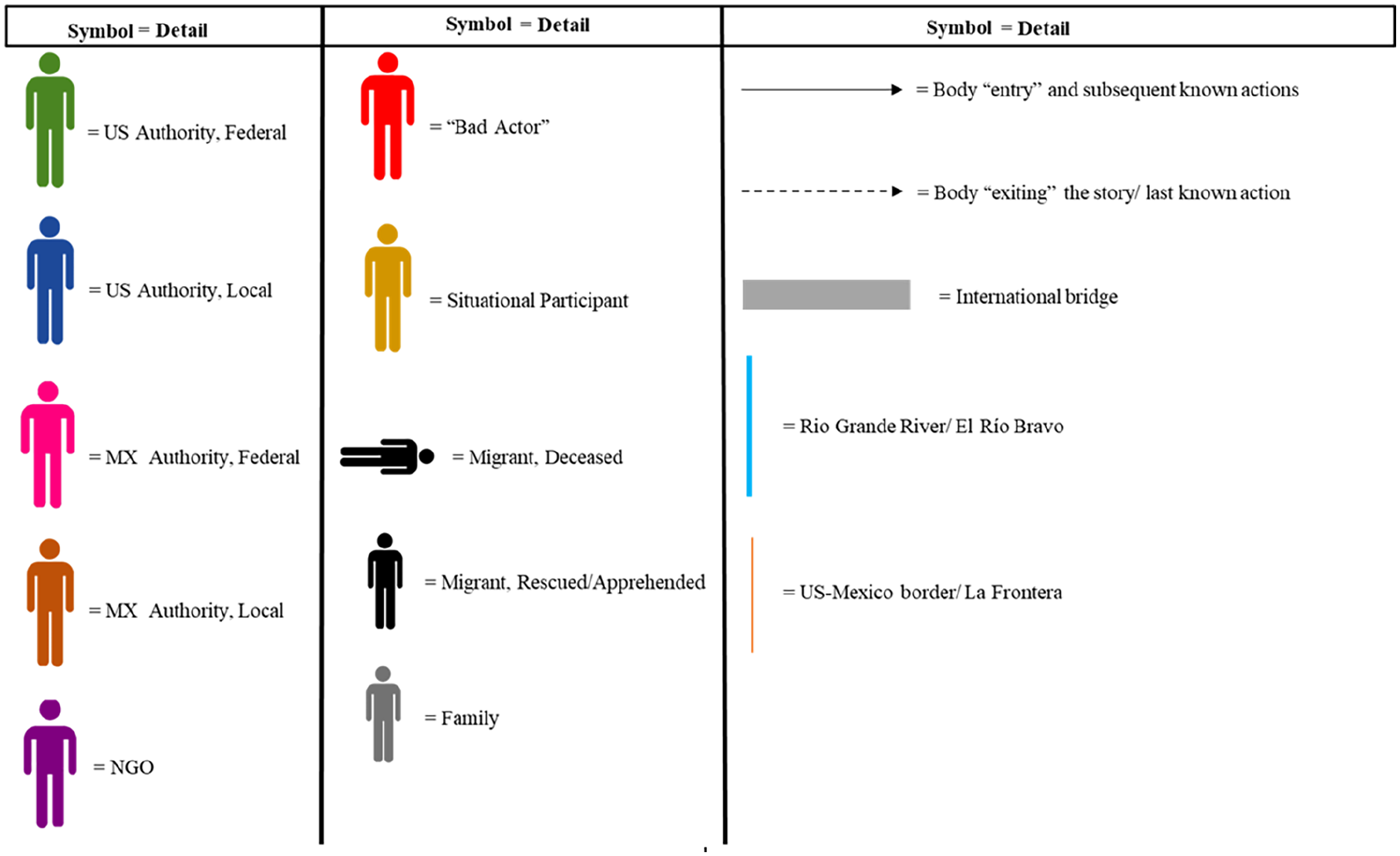
Legend of QSR Arc and Node Elements.
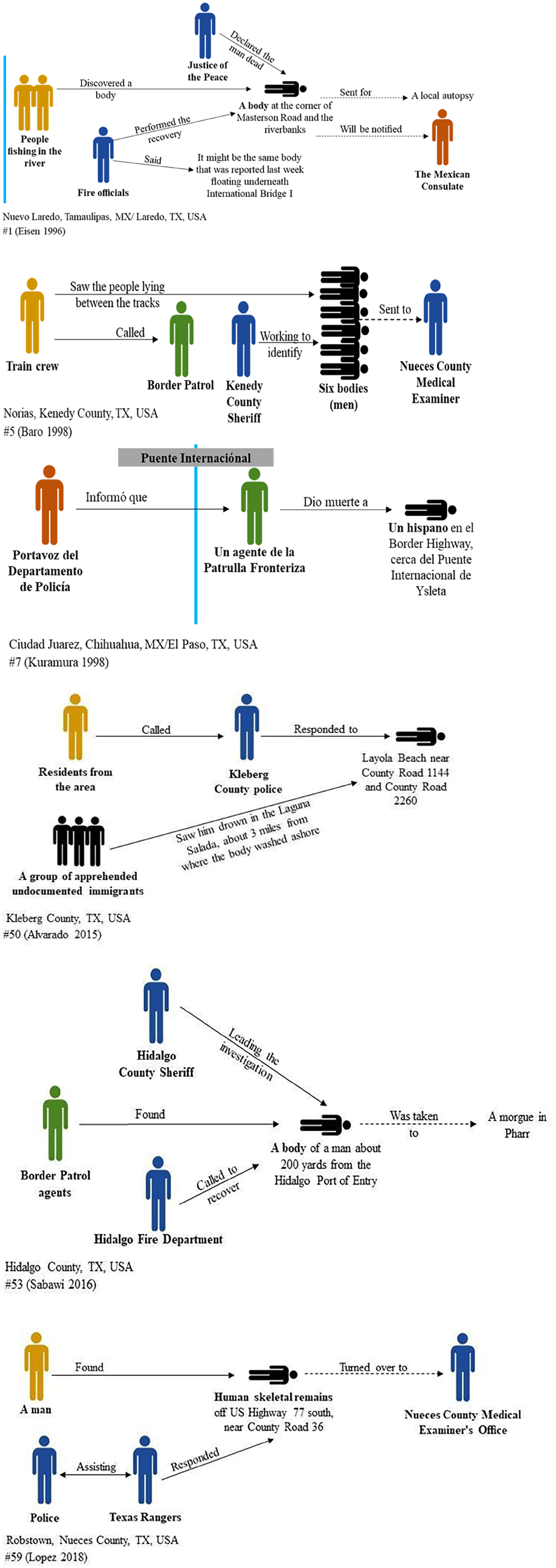
Six Sample QSRs in Series Order by Publication Year.
Ultimately, the QSRs were useful for tracing relationships as well as clarifying underrecognized stakeholders (situational participants and Mexican authorities, particularly consuls). The unique contribution of this method is that it produces a graph-based representation to accommodate and represent irregular, semi-structured relational knowledge (Cole and Hahmann 2019). Across all 65 QSRs, most deaths and associated activities took place on inland ranches away from the border with Mexico (n = 13) or around the Rio Grande River/Río Bravo (n = 11). This suggested that nearly as many migrant decedents were found on privately owned lands as on publicly accessible places on either side of the border. The potential for encountering migrant deaths anywhere around and beyond the Rio Grande/Río Bravo River by anyone belies the primacy placed on securing the border itself such as with border fence. I will discuss this further in my recommendation for broadening the recognition of areas in need of support around the Texas-Mexico border.
A total of 42 of 65 QSRs mentioned how a deceased or rescued migrant exited the news piece. Importantly, based on the Spanish-language QSRs, unidentified decedents recovered in Mexico tended to end up in state run forensic institutions, which further highlighted the lack of a regional or centralized forensic services in Texas.
A few notable commonalities and contrasts were also apparent between the English- and Spanish-language QSRs. The English-language news stories demonstrated varying degrees of collaboration that might be related to proximity to the border. For example, QSRs from The Brownsville Herald, headquartered in Cameron County, which shares a border with Mexico, showed that recoveries or rescues were highly collaborative endeavors with local law enforcement, US Border Patrol, a fire department river rescue team, and sometimes their Mexican counterparts. La Palabra QSRs also affirmed this trend, writing about transnational cooperation for emergencies at the Rio Grande/Río Bravo River (Liñán 2006a).
By comparison the Corpus Christi Caller Times, headquartered in Nueces County over 130 miles northeast from the border with Mexico, described less collaboration. Local police or the county sheriff tended to investigate migrant decedent cases on their own in Nueces, Kleberg, Duval, and Kenedy counties (Figure 1). It may be that better collaboration and cooperation among Texas counties and between Texan and Mexican jurisdictions happen for rescue or recoveries closer to the border, perhaps because those activities are more complex in the Rio Grande /Río Bravo River.
Another aspect of these QSRs was that they demonstrated more clearly that migrants were often the ones to initiate a rescue or recovery. This reality was more frequently discussed in the Spanish-language corpus suggesting a greater propensity by the sampled Northern Mexican newspapers to bring attention to the challenges navigated by migrants themselves. For example, an apprehended group of migrants told US Border Patrol of a fallen travel companion (Alvarado 2015). Additionally, a QSR from the Del Rio Herald News (Gleason 2004), mentioned this critical step in mobilizing a recovery. First, a pair of migrants reported their travel companion’s death after they returned to Mexico. Second, they were brought back into Texas to aid in the search for their companion’s remains.
The starkest difference between English- and Spanish-QSRs was the representation of the connective role fulfilled by Mexican consulates. It was clearer from El Norte and La Palabra articles that consuls both communicated questions and requested searches and/or rescues to US Border Patrol, as well as conveyed information back to families (QSR # 8, 11, 14–15, 19–20, 26, 36, 42, and 47). This function and its importance were underrepresented in the English-language QSRs and may point to decreased capacity by local authorities (sheriff, police, and justices of the peace) in Texas to communicate regularly with agencies other than US Border Patrol or MEOs.
Finally, only the Monitor and the two Spanish-language newspapers reported that migrant death was precipitated by law enforcement (Ortiz and Santella 2014). El Norte, for instance, explicitly mentioned that migrant crossing deaths were the fault of US Border Patrol in three separate QSRs. The arguments enumerated in the Spanish-language news pieces contradicted the idea that migrant deaths were “normal” or to be “expected.” Commentary by English-language newspapers regarding why a migrant death happened was predominantly attributed to dangerous terrain or extreme weather.
Discussion and Recommendations
My explorations of unstructured text highlighted that normalization of migrant deaths was typical of English-language newspapers, which aligns with other content studies of the portrayals of immigrants in news media (Santa Ana 2015; Zavisca 2016). Both descriptive summaries and their corresponding Sankey Diagrams highlighted that more information is communicated about the finding of deceased migrants than what happens to them. For example, there are more places, counties, where remains are reported found (n = 23 “Entry” recovery counties; Figure 2) than to where they are transported (n = 14 “Exit” last known location of remains; Figure 2). This anemic accounting normalizes at least two aspects of ongoing migrant deaths in the region.
First, a false sense of order, or control, is portrayed by news media regarding the management of the unidentified deceased. In effect, the narrative conveys that once a decedent is under the jurisdiction of the proper authority (e.g., county sheriff) there is little else to know about the deceased’s fate (e.g., there are few mentions and limited description of positive identification, burial, or repatriation; Figure 3).
Second, local readership is underinformed about the prevalence of migrant deaths throughout South Texas. For instance, as previously noted, Figure 1 lists more entry counties than exit. More interesting than the number of affected counties enumerated in the news articles is that interior Texas counties, counties that do not share a border directly with Mexico, have migrant deaths. Instead of there being a border line, made visible by the Rio Grande/Río Bravo River, ports of entry, international bridges, border fence and other deterrence infrastructure, there is a border region in which people may cross the border and may perish as far inland as Kleberg County (~100 miles northeast of the Texas-Mexico border).
While Brooks, a county ~70 miles north of Mexico, has been called a Death Valley for migrants, within the newspaper corpus’ period 1993–2020 no other interior county has received that kind of publicity in local papers, positive or negative. Migrant mortality trends have changed since 2020 with Maverick and Val Verde, Texas border counties to the west, becoming epicenters of border crossing and migrant deaths (Garcia 2024; Hernandez, Dias, and Volpe 2024). This more recent shift, however, is beyond the scope of this paper.
Focusing on the English-language newspapers for the timeframe 1993–2020, the narrative portrays migrant deaths as simultaneously possible anywhere and isolated. The news corpus communicated migrant deaths could be anywhere because decedents were found in myriad places, “place types,” especially in water (n = 30), by roads (n = 24), on ranches (n = 21), and in the brush (n = 12; Figure 3). Individual migrant deaths, read as isolated because the how and by whom the cases were investigated (if at all) were minimally descriptive. For example, only 104 of 483 English-language news stories satisfied the fourth and fifth criteria for the descriptive summary highlighting “who contributed to a migrant decedent’s movement between different agencies.”
A third observation I had was that Mexican agencies were underrepresented in the English-language news corpus. For instance, Mexican consulates may call a sheriff or US Border Patrol to initiate a search for a missing migrant, they record missing persons reports, and they communicate with local Medical Examiner’s Offices. While the Sankey Diagrams depicted where migrant deaths were found at least at a Texas county-level, the QSRs showed the larger scope of involvement by agencies in Texas and in Mexico.
I utilized Qualitative Spatial Representation (QSR) as a programmatic means to represent the collaborations and cooperation among Texas counties and between Texan and Mexican jurisdictions. The QSRs showed that there may be more collaboration at the international boundary, most likely because rescue or recovery activities are more complex in the river. Simultaneously, the subsample of articles (n = 65) that I used for QSR showed that almost the same amount of deaths were reported on inland Texas ranches away from the border (n = 13) and around the Rio Grande River/Río Bravo (n = 11). In light of this, it is necessary to stop thinking of the border as a line to be secured, such as with fencing, and instead adopt a more regional conceptualization. This regional understanding, the explicit acknowledgement that accounting of and managing migrant deaths requires a wider net of support at the border and into Texas’ interior counties, is important for adapting practices such as improved adherence to Criminal Code Procedure in the state of Texas.
At present, it is unlikely that the state of Texas will adopt policies or funding mechanisms that are separate from border security operations. Operation Lone Star is currently the only state-level program that has funding opportunities which can support individual counties’ management of migrant decedents. Nevertheless, given the narration of migrant deaths by local English-language newspapers (normal, isolated), the people affected (situational participants as well as law enforcement), and lacking of representation of Mexican authorities and other cross-agency collaborations, I recommend the following.
First, the Office of the Texas Governor should establish funds distinct from the Operation Lone Star program for the management of unidentified human remains. Regardless of who the unidentified decedent may be, any state-level grant designed to support the management of unidentified deceased should be administered by a state agency whose purview includes tracking health and/or mortality data (the Texas Department of State Health Services or the Texas Division of Emergency Management). When state-level support is attached to border security operations, the management and documentation of unidentified deceased will be eclipsed or neglected. Further, this distinct funding allocated by the Office of the Texas Governor should provide for training, equipment, and, when necessary, additional personnel to inventory cases, report information to state databases, transport forensic cases, and repatriate human remains.
Second, to improve accounting and increase documentation of migrant deaths, a Regional Identification Center should be established in South Texas. According to Texas Criminal Code Procedure (Art. 49.25 Sec. 1), a “commissioners court of any county having a population of more than two million shall establish and maintain the office of medical examiner.” While South Texas is one of the fastest growing borderland areas in the United States (Gomez, Guajardo, and Ely-Ledesma 2022), not all counites are likely to reach the 2 million population threshold. To surmount potentially uneven population changes and to ensure the presence of an institution that is not necessarily a Medical Examiner’s Office, a Regional Identification Center is optimal. The Center would provide training, store extra equipment such as mobile refrigerated morgues, and hire personnel to inventory cases, and report information to the state (e.g., vital statistics) and to foreign consulates. This Center would counteract the challenges highlighted in the local newspaper summaries and QSR. A Regional Center would decrease the isolation experienced by counties who have migrant deaths but do not share a border directly with Mexico. For the counties who do not have an MEO nor are part of a district system, there would be a place to report and/or send their cases. Critically important, the Center would also document, maintain, and share important information regarding unidentified migrant decedents with consulates, Procuradurías/Fiscalías Generales de Justicia and Institutos de Ciencias Forenses (Mexican state attorneys, prosecutors, and medicolegal institutions).
Supplemental Material
sj-docx-1-mhs-10.1177_23315024241275464 – Supplemental material for Tracing Trajectories: Qualitative Visualizations of Migrant Death in South Texas, 1993–2020
Supplemental material, sj-docx-1-mhs-10.1177_23315024241275464 for Tracing Trajectories: Qualitative Visualizations of Migrant Death in South Texas, 1993–2020 by Molly Miranker in Journal on Migration and Human Security
Footnotes
Acknowledgements
I would like to acknowledge and thank the efforts and advocacy by families who seek answers about the fate of their missing migrant relative(s). Their advocacy propels forensic and humanitarian investigations of deceased migrants believed to have perished in the border crossing context. I would also like to thank the Regional Working Group for Migrant Morality Accounting on the US-Mexico Border, a larger coalition of researchers and organizations with whom we work dedicated to producing a more accurate enumeration of migrant death in the US-Mexico-Central American migration corridor and the disaster taking place along the US-Mexico border. Additionally, I would like to thank Dr. Alberto Giordano, Dr. Kate Spradley and Operation Identification, New Mexico’s Office of the Medical Investigator, Arizona’s Pima County Office of the Medical Examiner, Humane Borders, and Dr. Cate Bird, the ICRC’s Missing Persons & Forensic Manager for the Regional Delegation for the United States and Canada.
Declaration of Conflicting Interests
The author declared no potential conflicts of interest with respect to the research, authorship, and/or publication of this article.
Funding
The author received no financial support for the research, authorship, and/or publication of this article.

Supplemental Material
Supplemental material for this article is available online.
References
Supplementary Material
Please find the following supplemental material available below.
For Open Access articles published under a Creative Commons License, all supplemental material carries the same license as the article it is associated with.
For non-Open Access articles published, all supplemental material carries a non-exclusive license, and permission requests for re-use of supplemental material or any part of supplemental material shall be sent directly to the copyright owner as specified in the copyright notice associated with the article.
