




Abstract
The increasing interest in research on hookups (i.e., noncommittal unions focused on sexual acts ranging from kissing to intercourse) often highlights individual-level predictors (e.g., alcohol use, attitudes) or gender/class differences. Racial/ethnic comparisons are often portrayed as White/non-White, despite literature on differing experiences within race by gender due to institutional-level differences, standards of beauty, and sexual stereotypes. Using the Online College Social Life Survey data set (n = 18,347), this article explores participation in hookup culture by race/ethnicity and gender. Additionally, interviews with undergraduates at the University of Pennsylvania (n = 60) reveal students’ expectations of, and barriers to, participation in hookup culture. Asian men report on average almost half the hookup partners than do other men, while White women report almost double the hookup partners on average than do other women. This article concludes that arguing a White/non-White dichotomy ignores important gender differences: Asian men and non-White women face additional barriers to participation in hookup culture. Finally, this article asserts that research must incorporate intersectionality to study hookups.
Introduction
Sociology and popular media have increasingly focused on a relatively new form of social interaction among college students: hookups, also known as noncommittal unions with sexual activities ranging from kissing to intercourse (Bogle 2008; England, Shafer, and Fogarty 2008). While sociologists have investigated how gender and class both structure the meaning of and engagement in hookup culture, parallel research focusing on race/ethnicity is scarce. Some argue that non-White students hook up at lower rates than do White students (Bogle 2008; Glenn and Marquardt 2001; Wade 2013). Others find that racial/ethnic differences are not significant after controlling for psychological and demographic characteristics (Brimeyer and Smith 2012; Owen et al. 2010). Thus far, however, the research on race and hooking up generally ignores differences by gender, despite research on sexualization (e.g., sexual stereotypes and standards of beauty) and rates of interracial relationships, which highlights the importance of race/ethnicity and gender in structuring romantic experiences (Chou 2012; Collins 2004; Espiritu 2001; Molina-Guzmán 2010; Qian 1997; Spickard 1989; Uecker and Regnerus 2010). By researching students’ experiences in hookup culture at college, beyond understanding their social inclusion in this new popular social phenomenon and their interaction with others, this article will show how patterns of racism and sexism shape students’ experiences.
This article examines how race/ethnicity and gender affect participation in hookup culture using a sample of White, Black, Asian, and Latino male and female heterosexual students from the Online College Social Life Survey (OCSLS) data set (n = 18,347). These data are complemented by interviews with undergraduate students at the University of Pennsylvania (UPenn; n = 60) to explore the substantive reasons behind these differences. Results reveal racial differences in the number of hookup partners and that these racial/ethnic patterns differ by gender: White women report significantly more hookups than do non-White women, and Asian men report significantly fewer hookup partners than do non-Asian males. This article identifies the importance of understanding how participation in hookup culture—and by extension participation in other relationship markets and social experiences while at college—is structured by both race/ethnicity and gender. Without an intersectional approach, research misses important differences in the social experiences of college students.
Background Literature
The outcomes of college attendance extend beyond the labor market; college serves as an important meeting place for romantic partners. Parties, organizations, and classes present opportunities to interact with potential significant others (Bailey 1988; Bogle 2008; Clarke 2011; Mare 1991; Waller 1937). Moreover, social integration during college (e.g., participation in organizations and clubs, social ties) is an important factor in student persistence (Tinto 2012), and a student’s social life is an important aspect of the college experience (Armstrong and Hamilton 2013; Bailey 1988; Karabel 2005). Recent research argues this social life includes a shift from dates to hookups, which are noncommittal sexual unions encompassing a wide range of sexual activity from kissing to intercourse (England et al. 2008; Holman and Sillars 2012). England et al. (2008) find that senior college students reported having a median of five hookups, whereas they report only three dates. Further evidence of a hookup culture is the norms surrounding hookups. Using student responses to vignettes, Reid, Elliott, and Webber (2011) find students similarly interpreted situations, associating hookups with alcohol (not mentioned in the vignette) and not seeing a hookup partner again. This suggests scripts—the norms meant to help actors understand how to interpret and react in particular situations—are widespread and guide hookups.
Participation in hookup culture varies; many researchers argue that minority students opt out of hookup culture at higher rates than White students either in order to participate in alternative romantic relationships or to avoid confirming stereotypes of sexual promiscuity (Glenn and Marquardt 2001; Ray and Rosow 2010; Wade 2013). Bogle (2008) also argues that minority students are excluded from a White-dominated hookup culture, in which racial homophily prevents interracial hookups. Moreover, for some ethnic groups—particularly for non-White immigrant ethnic groups and women—there is evidence that cultural norms constrain behaviors and attitudes toward premarital sex and romantic relationships (Espiritu 2001; Nagel 2003). However, research on hookups specifically is limited: Glenn and Marquardt (2001) research only women, and Bogle (2008) interviews only 4 minority students out of 76 interviews.
Despite these reports that minority students do not hook up, research shows that when psychological, demographic, and contextual factors (e.g., religious affiliation, drinking behaviors) are taken into account, racial/ethnic differences in hooking up largely disappear. While Owen and colleagues (2010) find that non-White students at two universities hooked up less often than White students, after controlling for alcohol use and attitudes about hookups, differences were not statistically significant. Similarly, Brimeyer and Smith (2012) find racial differences disappear after controlling for religion. So while some argue for a White/non-White divide, others find no racial/ethnic differences.
While research on hooking up thus far typically describes racial differences as a result of the groups’ avoiding hookup culture, I argue that race/ethnicity and gender intersect in meaningful ways to shape opportunities to hook up. Racial homophily is the norm among all racial/ethnic groups in marriage. However, Black men and Asian women intermarry with Whites at higher rates than do their same-race/different-gender counterparts (e.g., Fryer 2007; Qian 1997). McClintock (2010) finds that racial homophily occurs in hooking up as well as dating and relationships, though a homophily bias differs across those at the intersection of race/ethnicity and gender. For example, Asian women and White and Black men had lower rates of homophily in hookups than did other groups. These differences likely occur because of sexual norms and standards of beauty, which overall are based on upholding a patriarchal, White-dominated racial hierarchy (Chou 2012; Collins 2004; Molina-Guzmán 2010), though differences are not White/non-White.
Research on sexualization and interracial relationships indicates that certain groups are more (or less) likely than others to have opportunities for interracial unions (Childs 2005; Chou 2012; Collins 2004; Molina-Guzmán 2010; Robnett and Feliciano 2011). Whiteness is inherently privileged because Whites set the standard for sexual and beauty norms. Masculinity and femininity both draw on White standards to draw the line of what is, for example, too masculine or not masculine enough. Because of this, non-White groups face both racial and gender stereotypes.
Molina-Guzmán (2010) contends that Latinas are seen as “safe” partners because they do not threaten the White-dominated racial hierarchy. In contrast, both Black men and women are portrayed as sexually aggressive, and both Asian men and women are portrayed as passive (Chou 2012). If hookups are especially focused on sexual relationships, the hypermasculine images focused on the body by which Black men are characterized may benefit them in finding hookup partners outside of their race, unlike Black women, who are portrayed as difficult—defying gender norms (Childs 2005; Chou 2012; Collins 2004). Similarly, hyperfeminine images of submissiveness may benefit Asian women, while Asian men are seen as too effeminate (Chou 2012). Alternatively, those portrayed historically as more sexually open and aggressive (e.g., Black women, perhaps Asian and Latina women) may be more likely to be targets of sexual advances in hookup culture (whether or not they participate in hookup culture). Standards of beauty further support a racial hierarchy, as preference is given to “White” phenotypes: light skin, straight hair, double eyelids (Chow 2000; Craig 2002; Keith and Herring 1991). Finally, evidence of racial preference among Internet daters reveals that Asian men and Black women are excluded from dating markets (Robnett and Feliciano 2011), and examining self-reports of any relationship type shows that Asian men, in particular, are the most likely to report no relationships (Balistreri, Joyner, and Kao 2015). Thus, the racial hierarchy, standards of beauty, and sexualization may influence the desirability of a group at the intersection of race/ethnicity and gender, affecting opportunities to hook up.
Thus far, research on hooking up specifically has compared gender differences and racial/ethnic differences separately, though broader research on sexualization and more committed relationships suggests that those at the intersection of race/ethnicity and gender have different opportunities to form romantic and sexual relationships outside of their race/ethnicity (e.g., Balistreri, Joyner, and Kao 2015; Chou 2012; Collins 2004). For both men and women, standards of beauty are based on White phenotype and sexual norms. Thus, it is possible that we would see a White/non-White divide as some describe (e.g., Bogle 2008) regardless of gender in the number of hookup partners reported. However, given the nature of hookups—that is, their sexual focus—certain groups who are hypersexualized (e.g., Black men, Asian women) may be targeted as desirable potential partners for hookups. Thus, research may instead show racial divides differ when comparing men and women separately.
Data and Methods
To address these questions, I employ a mixed-methods strategy combining survey data from the OCSLS gathered by Paula England and interviews I conducted. Survey data enable me to note broad patterns, while interview data allow me to explore the perceptions and experiences of these patterns. In this section, I first present the survey data and then present the qualitative data.
Quantitative Data
The OCSLS is a nonrandom sample of college students who were recruited primarily through sociology courses at 22 colleges and universities between 2005 and 2011. The OCSLS provides unique data concerning several types of unions and is the only known survey to ask specifically about hookups at more than 2 universities. Participants answered questions about demographics and attitudes about gender roles, sex, dating, and marriage. This research focuses on Asian, Black, White, and Latino/a male and female heterosexual 1 undergraduate students at 20 four-year universities 2 (n = 18,347 students).
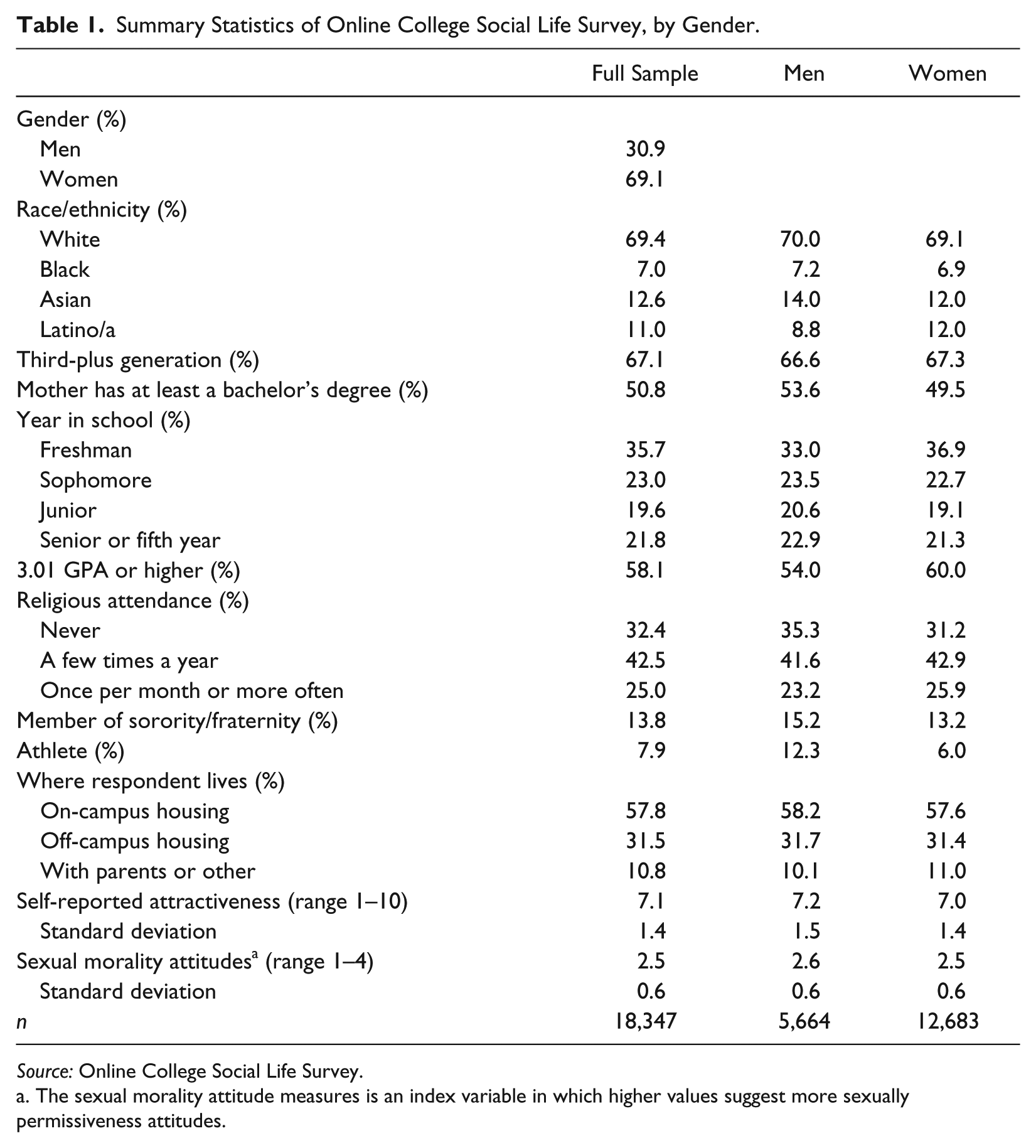
Table 1 summarizes the characteristics of the quantitative sample. To identify racial/ethnic differences, 3 I focus on students who self-identify as Asian, Black, White, and Latino/a. 4 The majority of the sample is White (70 percent of men and 69 percent of women). In order to easily identify the association between hooking up and the intersection of race/ethnicity and gender, I stratify analyses by gender.
Summary Statistics of Online College Social Life Survey, by Gender.
Source: Online College Social Life Survey.
The sexual morality attitude measures is an index variable in which higher values suggest more sexually permissiveness attitudes.
I include a variety of covariates in the regression models. Approximately two thirds of the participants are third-plus generation (both parents and participant were born in the United States). As social class may affect a student’s ability to participate in social events, such as parties (Armstrong and Hamilton 2013), I use a dummy variable representing whether the mother has a bachelor’s degree as a proxy for class. Among students in the OCSLS, 54 percent of men and 50 percent of women report mothers who have earned a bachelor’s degree. Student’s year in school is also likely to covary with the number of hookup partners as the longer one attends school, the more opportunities one has to hook up. The sample has fewer junior and senior students: 43 percent of men and 40 percent of women are upperclassmen. Self-reported GPA may reflect students’ collegiate priorities. The majority reports a GPA of greater than 3.01 (54 percent of men and 60 percent of women). Because opportunities to hook up are likely associated with status, living arrangements, and access to parties (Allison and Risman 2014; Boswell and Spade 1996; Ray and Rosow 2010), I include variables denoting students’ participation in Greek life and athletics, as well as where they live. Approximately 14 percent of the sample are members of sororities or fraternities, and 12 percent of men and 6 percent of women are athletes. More than half of the sample (58 percent) lives on campus, and one third (32 percent) live off campus, while only 11 percent live with parents or in another living situation. Religion may inhibit hooking up (Brimeyer and Smith 2012) or provide a means to meet others. The vast majority of students in this sample do not attend religious services (35 percent of men and 31 percent of women) or do so only a few times a year (42 percent and 43 percent, respectively).
Attractiveness and attitudes toward sexual permissiveness are important covariates, though the causal direction is unclear: more attractive and sexually permissive students may hook up more frequently, and those who hook up more frequently may believe they are more attractive or develop more sexually permissive attitudes. Roughly three quarters of the sample reported that they were a 7 or higher on an attractiveness scale of 1 to 10. I use an index to measure attitudes about sexual permissiveness with values from 1 to 4, in which higher numbers indicate more sexual liberation. 5 The mean score for sexual permissiveness was 2.6 for men and 2.5 for women.
I focus on the number of hookup partners that students report since the beginning of college to indicate a pattern of participation in hookup culture rather than a dichotomous measure of ever hooking up. The values are a combination of the number of hookups reported with someone known to the survey respondent before the hookup and the number of hookups that occurred with strangers. Students marked between 0 and 15, in which “15” represented 15 and more; thus, the final range is 0 through 30, where “30” represents 30 or more. Men report on average 5.0 hookups, and women report 3.7 hookups. The distribution is skewed toward fewer hookups because many students report 0 hookups, which I account for by using negative binomial regression.
Qualitative Sample
Due to the nature of quantitative survey data, the depth of information gathered is limited. While it is possible to identify trends in attitudes and behavior, only in-depth interviews can explore why these trends occur in terms of participants’ perceptions, reasoning, and feelings. To complement and enrich quantitative findings, I analyze 60 in-depth, in-person interviews conducted between fall 2013 and spring 2015 with students at the UPenn, a private Ivy League university located in a major urban area (Philadelphia, Pennsylvania) that is also one of the universities from which OCSLS respondents were recruited. While UPenn is distinct from most colleges in many ways, it also presents an interesting case. First, because of the prestige of UPenn, it is unlikely that graduates of UPenn vary substantially regarding social class after graduating. Given research that identifies the importance of class in hooking up (e.g., Armstrong and Hamilton 2013) as well as homophily in union formation (e.g., Kalmijn 1998), UPenn may serve as a means to avoid conflating racial inequality with class inequality. However, there is still likely variation in class background, especially since UPenn’s no-loan policy launched in 2007, making it a more viable option for those from lower- and working-class backgrounds (“Penn’s No-loan Financial Aid Program” 2014).
Second, the setting of UPenn, a large urban environment, means that students have numerous opportunities to meet potential partners who are other UPenn students, other college students, or other young adults. UPenn encourages interaction with students at other schools through the Quaker Consortium, a policy allowing students from UPenn, Haverford, Bryn Mawr, Swarthmore, and Curtis Institute of Music to attend classes at these institutions for credit (College of Arts & Sciences, University of Pennsylvania 2013). Additional opportunities to interact with students at other colleges are available via sports events and Greek social events. Access to these schools, as well as other neighborhoods in the city, is easily accessible via public transit, regional rails, and even walking. Perhaps because UPenn is so well connected it can consider itself the “social Ivy” (Robb 2014). In September 2014 UPenn made headlines after Playboy magazine named it its number one–ranked party school, citing “its notorious underground frat scene,” “Philly’s boisterous bar scene,” and perhaps most interesting, that “casual sex is rampant, as coeds value careers over coupling” (“Playboy’s Top Party Schools” 2014). This suggests that UPenn itself is an environment in which the average student has more opportunities to hook up than perhaps at more isolated colleges.
Students were recruited through courses in the humanities and social sciences, race- and ethnicity-based organizational listservs, flyers, and word of mouth by the author, a young White female, from fall 2013 to spring 2015. 6 In the first phase of the study, students were offered the chance to be interviewed by a male or female senior student, but an analysis of early interviews suggested that interviewees were not necessarily more open or comfortable speaking with someone other than the author, and these research assistants were not replaced after they graduated in the second year of recruitment. 7 Recruitment materials specified those without hookups, dating, or relationships were welcome to participate.
Though there was an interview guide, the interviews were largely open ended. Some interviewees began a detailed hookup and relationship history without much prompting by the interviewer. Others included only highlights, such as their most recent hookups. All interviewees were asked a variety of topics, including whether they had an interracial hookup or relationship, failed hookups (being hit on or pursuing others), opinions of hookups and relationships, and the experiences of friends and acquaintances. Though recruitment materials were careful not to introduce the topic as a study of race/ethnicity and gender (it was introduced as a study of hooking up and relationships), often race/ethnicity and gender either came up when the interviewer asked whether the participant ever had an interracial hookup or relationship or was introduced by the participant. While gender was a topic presented more equally across genders, the topic of race was more often introduced by racial/ethnic minorities, particularly Black students, than by White students. Generally, interviews lasted between 45 and 75 minutes. Interviews were transcribed and coded according to patterns that emerged from quantitative and qualitative analysis. All names used in this article are pseudonyms to protect the identity of participants. The quotations used in this article were edited for clarity: fillers (e.g., “um,” “like”) were removed, and sentences or clauses were omitted (noted by “[…]”) to more clearly present ideas.
Characteristics about this interview sample can be found in Table 2. I interviewed more women than men (39 versus 21). Only two Latino men and four Black men were interviewed. While this is a limitation to the qualitative sample, it is important to remember that they are still represented in the quantitative data. Freshmen are overrepresented in the interview sample (23 of 60), and most White and Latina women in the sample are freshmen. The majority of the sample reports at least one hookup since the beginning of college (45 of 60).
Interview Sample Characteristics.

Student reported a lesbian/gay/queer/bisexual identity or a same-sex relationship or hookup.
Results
Bivariate Analysis
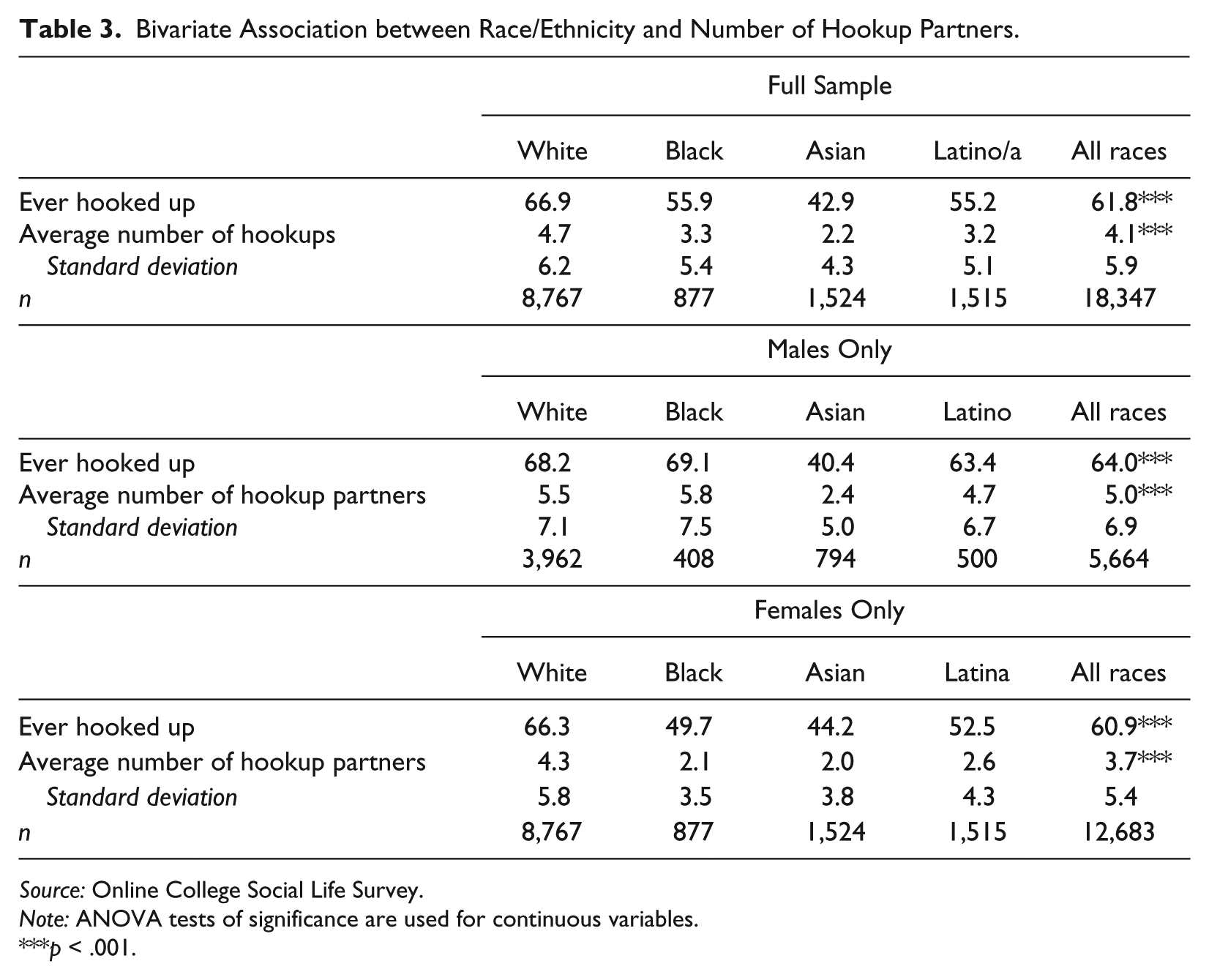
There are racial and gender differences with regard to how often students report hooking up. Rates of ever hooking up across racial and ethnic groups range from 40 percent to 69 percent. Table 3 shows the average number of hookup partners by race/ethnicity for the full sample. These findings suggest differences between Whites and non-Whites; on average, White students report 4.7 hookup partners compared to Black and Latino students, who report on average 3.3 and 3.2 partners, respectively, and Asian students who report only 2.2 hookup partners. 8
Bivariate Association between Race/Ethnicity and Number of Hookup Partners.
Source: Online College Social Life Survey.
Note: ANOVA tests of significance are used for continuous variables.
p < .001.
However, these patterns fail to capture important racial divides by gender. Once we compare men and women separately in the second and third panels in Table 3, we see a different story. On average, Asian men report 2.4 hookup partners, half that of any other group among men, whereas White women report an average of 4.3 partners, roughly double the average of that of all other groups among women. There are racial/ethnic differences, but unlike what has been reported in the literature, the divide has an important caveat: a White/non-White divide may accurately describe racial stratification among women, but an Asian/non-Asian divide more accurately describe racial stratification among men.
Multivariate Analysis
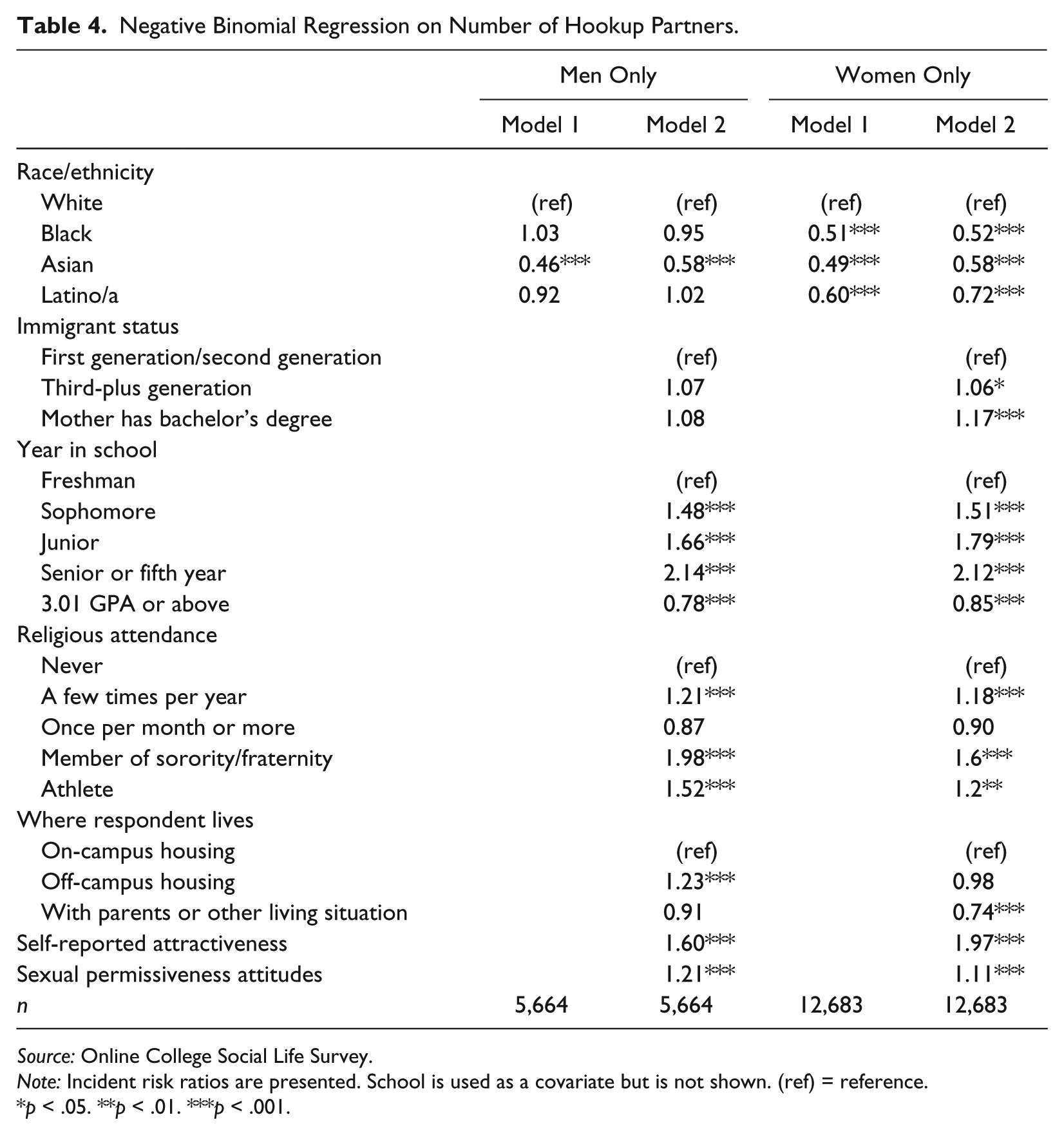
To examine whether there are differences across racial/ethnic groups in the number of hookup partners reported, I performed a negative binomial regression separately by gender. Negative binomial regression is better suited than ordinary least squares regressions for count data, which have values starting at zero, and better than Poisson in cases in which data are overdispersed (i.e., the variance was much greater than the mean). Tests of goodness of fit confirmed that Poisson models produced poorly fit models for these data. Model 1 includes only racial/ethnic group and school as independent variables, though the table does not report school. Model 2 adds individual-level covariates (e.g., mother’s education, where the respondent lives, and sexual permissiveness attitudes). All models present incident rate ratios: ratios greater than one indicate the event (a hookup) is more likely to occur, while ratios less than one indicate it is less likely to occur.
The differences presented in the bivariate analysis persist in the negative binomial regression models presented in Table 4. Differences between Asian and non-Asian men are reflected in both Models 1 and 2. Holding only student’s college or university constant, Asian men report 54 percent fewer hookups compared to White men (p < .001). Once individual-level covariates are included in Model 2, such as year in school, athlete status, fraternity membership, GPA, religion, where the respondent lives, self-rated attractiveness, and sexual permissiveness (all significant at p < .001), the magnitude of the difference between Asian and White men decreases to 42 percent but remains statistically significant (p < .001). Black and Latino men are not statistically significantly different from White men at p < .05. Unlike the White/non-White stratification that the literature argues, for male students there is a distinct Asian/non-Asian divide. In contrast, non-White women report significantly fewer hookup partners on average than do White women (p < .001). In Model 1, when controlling only for college, Black women report 49 percent fewer partners, Asian women report 51 percent fewer partners, and Latina women report 40 percent fewer partners than White women. After controlling for all other covariates in Model 2, these incident rate ratios shift: Black women report 48 percent fewer partners, Asian women report 42 percent fewer partners, and Latina women report 28 percent fewer partners than do White women. Separate analyses showing the association with the number of hookup partners who were acquaintances and who were strangers for men and women show similar racial patterns within gender follow those of the combined stranger and acquaintance variable shown in Table 4. 9
Negative Binomial Regression on Number of Hookup Partners.
Source: Online College Social Life Survey.
Note: Incident risk ratios are presented. School is used as a covariate but is not shown. (ref) = reference.
p < .05. **p < .01. ***p < .001.
The results from bivariate and multivariate analysis of the quantitative data suggest that White students are more likely to report higher numbers of hookup partners, but with a critical caveat: This racial divide is applicable only to women, so arguing for a White/non-White dichotomy masks significant gender differences. Non-Asian men similarly reported significantly higher numbers of hookups than did Asian men. The real lesson learned here is that race and gender intersect to shape participation in hookup culture.
Qualitative Findings
Interviewees frequently drew on themes of why they did or did not hook up that placed hooking up in the context of personal choice that was additionally associated with the personal choice to go out partying and drinking.
I also think that mostly when people go out, there’s a lot of alcohol. That definitely leads to people doing things they wouldn’t necessarily do if they were sober. And also just using that as an excuse to do things that they—well you always hear girls be like, “I hooked up with this guy last night but I don’t remember if he was cute or not.” And you would never say that if you were sober! You would never just hook up with somebody you didn’t really know what they looked like, if you were sober, or if someone turns out to not be cute, instead of being like, “Oh, I hooked up with him by choice,” you would just be like, “Oh, I was so drunk I didn’t know.” (Chelsea, mixed-race Asian/White female, freshman)
Further, partying, alcohol, and hooking up were seen as part of the collegiate experience. In discussing the breakup with her long-distance boyfriend in her freshman year, Theresa, a biracial Asian/White female sophomore, describes relationships as conflicting with the college experience.
I was sort of looking at [freshman year during college] as a time to go out and have experiences with people—whether it be romantic or not—but I think mostly like, romantic and sexual, because high school was sort of not super conducive to that, just in the range of people that you met. I sort of saw college as a time to have that freedom.
Many saw relationships as detrimental to the college experience and career trajectories and thought hooking up was an attractive alternative. Luca, an international White male senior, describes how relationships can be a “waste of time.”
Have you hooked up with anybody?
[Laughs] Yes; oh, yeah. I was in a relationship before college, but during college, I sort of successfully avoided that.
Why do you say “successfully” avoid it?
Because I subscribe to the viewpoint that college is just one of those times where you have to not commit to a person. It’s very easy to sort of fall into another person […] and you don’t realize it, unless you sort of snap out of it after months and realize, “Wow, I kind of wasted my time being focused on just this one person.” So I think it’s not a great idea. […] God knows what you will be doing in two years; it’s not the time to be forming families and what-not.
UPenn students saw UPenn as a context in which students work hard and play hard; that is, focusing on their schoolwork and future careers as well as on having fun and partying.
However, for some UPenn students, the opportunities to hook up may be fewer and the social risks greater, and the narrative of racial/ethnic divides are not simply White/non-White. First, group size mattered differently across racial/ethnic groups. The small group size of Black students (and to some extent Asian students) increases an individual’s visibility.
I don’t really go to the traditional frat parties, because they’re mostly what you’d call White frats here. I don’t really go to those. I tend to go to Black parties and minority-oriented parties. And that atmosphere is different, like there’s kind of judgmental vibes. Like if you, like EVERYONE’S gonna know. Like if your sole intention is to hook up with this girl, everyone’s gonna know, they might not call you out on it to your face, but it spreads. […] so I don’t really go to those parties and hook up with someone […] because I pretty much know it’s gonna be judgmental. (Abraham, Black male junior)
Hooking up is less likely to be anonymous for some, and one’s reputation may be more vulnerable to negative social consequences of hookups compared to others.
In addition to the reduction in anonymity, small group size limits opportunities to hook up. McClintock (2010) found that racial homophily exists at all levels of romantic/sexual relationships, including hooking up. Thus, a small group size limits the number of potential partners as there are fewer of one’s race/ethnicity, and limited opportunities to hook up outside of one’s race in effect excludes minority students from hookup culture (Bogle 2008). If one wanted to hook up, going to a fraternity party would perhaps be the foremost idea, but for students of color, these are unlikely places to meet others as they are mostly White.
I mean, I know there are no Black girls in my sorority. There’s like 8 Asian girls. And there’s like 180 girls in the sorority, and so there’s like 8 Asian girls and the rest are just White. And one of my roommates is in a sorority where the entire sorority is White. […] Generally, it’s the same race, but if you do have a Black guy, he’s most likely gonna be hooking up with White girls, because there really aren’t any Black girls in that social scene. I mean there definitely are at Penn: It’s in our admissions handbook. You can look at it: the percent that are on Penn’s campus. But I guess, either they hang out in a different social scene, like, they have like specific groups. I know there’s a sorority or fraternity that is smaller but specific to African Americans. So I think that it’s just the homogeneous nature of the students that go to fraternity and sorority parties that you end up being the same race unless you are the minority, and you kind of don’t have an option except to hook up with someone of the other race. (Ashley, White female sophomore; italics indicate the stress of these words the interviewee used) So usually at the [frat] parties there will be plenty of Asian girls, maybe a few Hispanic girls, usually not, plenty of White girls, plenty of White guys, a few Black guys, and maybe one or two Asian guys, occasionally. So, it depends, if you look at the girls it will be fairly diverse, plenty of White girls, a couple Black girls, and couple Asian girls, but if you look at the guys, it’s tilted. (Shauntee, Black female junior)
McClintock (2010) found that White students were the most likely to report that their most recent hookup was interracial after taking into account their large group size. This is likely due to standard of beauty and sexual desirability norms that benefit Whites; that is, they have more opportunities to partner outside of their race than other racial/ethnic groups. Students of color described a bonus that White students received because of their race that made them more attractive partners, “If you can measure someone’s attractiveness on a scale—if a Black man [on] a scale is eight and a White man scale is eight, so they’re equally hot—people, like, they would go after the White guy” (Jim, Asian male freshman). It is likely that White students have more opportunities to hook up because of a larger pool of potential partners both inside and outside of their race—especially in spaces, such as mainstream fraternity parties, that are supposed to be rife with opportunities to hook up, whereas non-White students arguably have fewer potential partners outside of their own race.
While small group size and preference for Whites suggest divides that are White/non-White, they do not explain why Black and Latino men do not differ significantly from White men as shown in quantitative findings. Though the previous quotation from Abraham suggests that Black men hooked up less frequently than White men, it is important to note two other ideas: the skewed campus gender ratios favor men in general (and Black men specifically) and how groups are differently evaluated based on their race/ethnicity and gender. As previously noted, Black women outnumber Black men on college campuses (on average 1.75 women to men; Snyder and Dillow 2011), and the Black community at UPenn is small. In fall 2013, 7 percent of undergraduates at UPenn were Black, and Black women outnumbered Black men 1.7 to 1 (U.S. Department of Education n.d.). This ratio is lower for Latinos (1.37 women to men), and even lower for Asians and Whites. (Snyder and Dillow 2011). This skewed gender ratio likely benefits Black men and to a lesser extent Latino men. Janell, a Black female senior, argued that men at UPenn do not want to date. Because she does not want to hook up, she had to look elsewhere, generally off campus at bars and outside of her race.
The [Black men] at Penn—I know a lot, at least the seniors. I have known them for four years, and I don’t really wanna date you guys. I know everyone you have ever hooked up with […] I am not trying to just hook up, that’s not what I am doing. So, you say, “Oh, why don’t you date a Black guy?” Oh, okay, where are the Black guys that actually want to date? And then everyone gets quiet. So, okay, point proven.
So you think for Black guys at Penn specifically—they just wanna hook up? And White guys, is there more variation?
I feel like a lot of guys right now just wanna hook up; they’re in that stage where they’re like, “So many girls all here together! Ah, I can have my pick! They’re like Pokémon: catch ’em all!” And that is what I have said to people all the time when they ask why I don’t date people here, because they don’t wanna date!
Janell does not connect the scarcity of Black men with more options for partners, but she does echo an idea posited by Uecker and Regnerus (2010) and Guttentag and Secord (1983), in which those in the minority have more power to define relationships. For men, this may be relationships defined by sexual activity, and for women, this may be defined by commitment.
Still, Janell’s comments seem in contrast to Abraham’s earlier comments that he avoids hooking up in order to avoid judgment. Abraham did hook up a few times, but typically with non-Black women, effectively avoiding gossip. It is possible he benefited from stereotypes that separate Black and Latino men from women, which affect the pool of potential partners. Dante, a Black male freshman, sees Whites generally as exclusively hooking up with and dating other Whites, but also characterized some White women as interested in the supposed novelty, danger, and physicality of a Black male partner: No, it’s definitely different. It’s more that the White guys don’t wanna mess with Black people, the White girls usually want to mess with Black people. But just in general, they’re usually with each other. […] I think because the White girls who come here weren’t really around that many Black people. Most of the kids here are from very privileged backgrounds and, I understand that, so I am assuming that they weren’t around minorities, and especially educated minorities. So, I think to see someone who’s educated, who’s a minority, who’s different, who might have a different type of background, talks a different way, has kind of a “bad guy” reputation, that turns them on, they’re attracted to that. […] If a White girl looks at a Black guy, they usually have the muscles, they’re tall; you know, a White guy might not have that.
Black men are objectified in a way that differentiates their experiences from those of Black women; the sexual stereotypes concerning them arguably make them more attractive sexual partners. 10 Dara, a White female sophomore, expresses this objectification.
When I talk to girls in my sorority or when you talk to your girlfriends, it’s like, “Oh my god, I’d like to hook up with a Black guy,” because you have all these ideas of what sex with a Black guy must be like. At least I do, and I know some of my friends do, and it’s extremely, I guess, racist in a way because you’re basically taking a person and making them a sex object kind of because of their race, but …
What do you mean, what about a Black guy has been fetishized?
They have a huge dick. [Laughs] Right? I guess. I don’t know and just that they know how to move really well and are just like big. […] It’s literally, like my friends and I, it’s something, you know, that I know is on our list.
Though Dara notes that how she thinks of Black men is a racist act of objectification, she still discusses how Black men are considered “sexy” because of the stereotypes associated with them. Accents are additionally considered “sexy;” Daniel, an international male student from a Latin American country who was in a relationship at the time of interview, reports that a female friend has told him, “If you went to frat parties, you could pick out any girl because of your accent.” These physical characteristics promote sexual imagery of Black and Latino men, making them attractive sexual partners.
Finally, there was a consensus among non-Asian and Asian respondents that Asians do not hook up. In describing her perceptions of which groups are likely or unlikely to hook up, Roberta, a second-generation Latina female freshman, says while laughing, “Most of my hookup stories have been told by White [students]. I haven’t heard anything about Asians hooking up—Asians, in general, just that entire continent doesn’t seem that excited about hooking up.” Even among Asian students, there is an Asian/non-Asian divide. William, an Asian male sophomore, described himself as a normal UPenn student but noted, “I feel like being Asian throws it off slightly.” When I asked him to explain, he said matter of factly, “I just feel like Asian people are less willing to go out and less likely to hook up with people.” This statement characterizing Asian students is not surprising; research outlines popular portrayals of Asians as stereotypically passive and reserved (Chou and Feagin 2015), which William calls upon to distinguish himself from the stereotypical Asian. While William saw cultural differences in which Asian—both male and female—students effectively opted out of hookup culture, Mordecai saw his differing experiences from other groups as the effect of negative racial stereotypes that occur within gender.
In this country where local media tends to portray Asian men as this beta male, […] there are some White girls who seem to be attached to that stereotype. So even if you have game and you approach a White girl, she wouldn’t really respond to you. […] Some Asian girls also buy into that mindset. But I guess with them living in Asian households, and you interact with more Asians, you realize what local media is saying is bullshit. So it’s if you’re more exposed to stereotypes or you’re exposed to the truth.
Mordecai had a lot of self-confidence, so to say he felt undesirable becomes a misconception: he roots his struggles in a negative stereotype believed by others that sets his experiences apart from others. The racial stereotypes he faces explicitly affect how his masculinity is interpreted. It is clear that Asian men face very different social experiences than other men: Mordecai’s frustration with the “beta male” stereotypes of Asian men that negatively affect his ability to partner with White women are in contrast to the comments of Dante in which he feels that Black men are seen as dangerous and thus become intriguing partners for White women. This nuance is evidence that a White/non-White divide is shortsighted and misses important differences in the social experiences of college students.
Discussion
Sexual scripts—the normative means to obtain sex—are shifting from committed, steady dating to hooking up (Bogle 2008; England et al. 2008). This new social phenomenon has been a growing focus of sociological research, but there is a dearth of research on race/ethnicity and hooking up. Though the literature generally identifies a White-dominated hookup culture, I argue the racial divide cannot be simplified to White/non-White. Instead, race/ethnicity and gender intersect in ways that produce differences in the hookup market. While White women reported significantly more hookups on average than non-White women, Asian men reported significantly fewer hookups than non-Asian men. That is, a White/non-White divide does not reflect men’s experiences in hookup culture. In this way, this article bridges a gap between research on hooking up, which has largely examined race/ethnicity and gender separately, and research on sexualization, which largely focuses on an intersectional approach to understanding social experiences such as romantic and sexual relationships.
Depending on one’s race/ethnicity and gender, students face different experiences in a hookup market. Small group size and negative sexual stereotypes are associated with fewer (if any) hookup partners. Some feel vulnerable because of their small group size; hookups for Black students in particular are not anonymous. Others indicate that cultural norms constrain their behavior. Still others feel that White students benefit from their race, making them more attractive partners. For these reasons, the experiences in participating in the hookup and romantic market at college for particular groups—Black, Latina, and Asian women and Asian men—are markedly different from those of other students.
I argue that the study of racial/ethnic differences is incomplete without a focus on the intersectionality of race/ethnicity and gender and simultaneously recognize that research must press further into understanding intersectionality more completely with regard to sexuality, class, and immigrant status. While this may be unsurprising to those who study sexualization, which notes the differences in portrayal of groups at the intersection of multiple identities, too often research looks at these identities separately. For example, Bogle (2008) cites a White-dominated hookup culture and racial homophily as explanations for the exclusion of non-White groups. Armstrong and Hamilton (2013) consider only White women in their study of class and college social life. Each of these analyses is exemplary in its emphasis on changing social norms and events. However, the literature on sexualization indicates that racial groups may differ from their same-race/different-gender counterparts (e.g., Black women from Black men) and from their same-gender/different-race counterparts (e.g., Black women from Latina women). Historically, Black men and women have been regarded as sexually aggressive (Collins 2004; Davis 1981), Asian men and women as submissive (Chou 2012; Spickard 1989), and Latino men and women as fiery (Molina-Guzmán 2010). Those portrayed as too aggressive or too effeminate for their gender roles (e.g., Black women and Asian men) have fewer opportunities to hook up because there are fewer potential partners outside of their race who might find them desirable. Given the sexual nature of hookups, the sexual stereotypes matter greatly in shaping behavior, especially across racial/ethnic boundaries. What a White/non-White divide misses is how Asian men face a different opportunity structure compared to others.
Further, gender ratios likely are associated with hookup culture (Regnerus 2012). Research suggests that sexual behavior is linked to gender ratios (Uecker and Regnerus 2010); however, racial differences exist within gender ratios. For example, on average Black women outnumber Black men almost two to one (Snyder and Dillow 2011). While gender ratios are outside the scope of this study, my results suggest that further research on institutional-level characteristics is necessary for understanding students’ romantic and sexual experiences.
This article builds upon a foundation of understanding the social experiences of students and how these experiences differ across groups. Particularly, qualitative findings suggest that minority students do not simply choose to opt out of hookup culture at higher rates than do White students but rather that there are both push and pull factors. Though we would like to think that the decision to hook up or not is a personal choice, these choices occur in a context that differs across races and genders. In other forthcoming research using these data, I explore more fully whether racial/ethnic differences within gender occur because racial minorities opt out at higher rates than White students or because they are involuntarily excluded.
My analysis, however, is not without limitations. First, due to data collection methods—the survey was collected as a convenience sample of sociology courses, and the interviews collected as a voluntary response sample—my findings may not represent the overall college population. Nonetheless, these data should not be underestimated: The survey data include the experiences of a broad array of students nationwide. Further, this article uses qualitative data to identify potential reasons that race/ethnicity and gender intersect to form differences in experiences. However, I have few men in my qualitative sample, and future analyses should seek to give voice to Black and Latino men. Still, using mixed methods—bivariate and multivariate analyses as well as in-person interviews—provides a fuller and nuanced portrait of patterns of behavior and the reasons behind the behavior by identifying demographic factors and participants’ own experiences. These findings, moreover, resonate with existing research on sexual and romantic experiences of young adults more broadly (see Balistreri, Joyner, and Kao 2015; Chou 2012; Collins 2004). For this reason, I am confident that despite data limitations, these findings are an important contribution to both the literature on hooking up and the literature on sexualization.
Students are increasingly identifying hookups as part of the college experience, but it is important to note that participation in these experiences is limited more for some groups than for others. Race/ethnicity and gender both structure one’s social experiences, including romantic and sexual experiences like hookups. Studying hookup culture speaks to the larger racial and patriarchal system; arguing that a hookup culture is White dominated ignores important gender differences and conceals the unique experiences faced by specific groups, like Asian men and Black women.
Footnotes
Acknowledgements
I would like to thank all those who provided comments and critiques on early drafts of this article, including Camille Z. Charles, Hyunjoon Park, Kristen Harknett, Joanna Pinto-Coelho, Aliya Rao, Zawadi Rucks-Ahidiana, and the anonymous reviewers at Sociology of Race and Ethnicity. Additionally, I would like to thank the Teece Family Foundation, which offered financial support for research costs during data collection.