



Abstract
Drawing on in-depth interviews with 45 Latinos living in a small city the author calls Sycamore City, the author examines the discourses and practices through which Mexican migrants and Puerto Ricans deal with the “dirty work” of illegality. The focus is on the “physical dirty work” performed by undocumented workers and “social dirty work” performed by workers on the margins of citizenship. This research shows that “physical dirty work” and “social dirty work” overlap when a new class of worker enters the labor market. As such, the author documents the dirty work undocumented workers perform and the ethnoracial distinctions used to gain self-worth while performing physical dirty work. In addition, this article shows that as citizens, Puerto Rican professionals offer discreet assistance when they encounter undocumented migrants. In providing assistance, these professionals diminish citizen-migrant distinctions.
Scholars of migrant illegality view illegality as a construct created by the state (De Genova 2002; Menjívar and Kanstroom 2014; Ngai 2004; Willen 2007). Specifically, these researchers argue that migrant illegality is experienced by individuals but produced by historical and legal processes arranged and facilitated by the state. They surmise that the system of classification that categorizes and stratifies migrants as “citizen,” “legal,” and “illegal” casts those labeled as “illegal” into a state of constant vulnerability and risk for deportation. Although the state is ever present in the construction of migrant illegality, the stigma affixed to migrants labeled as “illegal” renders this group dangerous “aliens” who challenge the rule of law, overburden the safety net, and beget social ills (Chavez 2008). Furthermore, this stigma galvanizes stereotypes and is made durable by policies, such as Arizona’s “papers please” legislation (i.e., Senate Bill 1070) (Wallace 2014).
Recently, studies have proposed that the stigma of illegality is reified by social service organizations. For example, historical accounts of the welfare state find that since the 1920s, federal agencies partnered with charitable institutions to identify, investigate, and deport “undesirable aliens.” The cooperation of these organizations gave meaning to and contrasted the “worthy” and “unworthy” migrant (Fox 2012). However, social service organizations need not be extensions of the state to make illegal a mark of shame. According to Ackerman (2014), the label illegal is shaped by “the uncoordinated and co-existing intervention of bureaucrats, trade unions, and organizations” (p. 190). In fact, he found that the rise of the term illegal occurred in the 1970s, as conservative and progressive social service organizations sought to uplift the status of “legal” migrants while deriding “illegal” migrants.
Research on new immigrant destinations also offers insight into the relationship between the stigma of illegality and social service organizations (Deeb-Sossa 2013; Gleeson 2012; Horton 2006; Marrow 2011). By focusing on the role of social service professionals, Marrow (2011) found evidence of the interplay between professional codes of ethics and restrictive immigration policies. Professionals in service-oriented bureaucracies (e.g., schools and medical services) interpret bureaucratic rules in ways that allow prioritizing inclusivity and framing Latino immigrants as deserving, regardless of legal status. In contrast, professionals in regulatory occupations (i.e., law enforcement and court personnel) do not deviate from rules of bureaucratic enforcement and consider undocumented migrants to be lawbreakers. These studies mirror research on caseworkers navigating the institutional and policy burdens associated with welfare reform (Hays 2003; Watkins-Hayes 2009). However, unlike research showing that the stigma of welfare is ominous when caseworkers manage relationships with clients (Hays 2003), far less is known about how social service professionals working with migrants manage the stigma of illegality. This oversight is curious given that the taint of illegality is both contextual and relational. It is contextual because the workplace can demean a worker’s sense of worth and dignity (Hodson 2001; Smith 2001). It is relational because contact with individuals framed and perceived as socially stained makes those in higher social categories also impure (Douglas 1966; Goffman 1963).
To understand the stigma of illegality, in this article I consider the marked migrant hired to do low-wage work and social service professionals working in association with this tainted group. I employ Everett Hughes’s (1951) concept of dirty work, defined as tasks perceived to be disgusting or degrading, to argue that illegality transforms migrants into dirty workers who must simultaneously manage the label illegal. I borrow from the literature on social boundaries to propose that ethnoracial and citizenship boundaries are relevant when the label illegal is activated. Furthermore, I rely on interviews with these groups in a place I call Sycamore City, 1 a small city in the Northeast where Puerto Ricans dominate historically, politically, and numerically and the Mexican migrant population is small and fast growing. Finally, I explore the discourse of work performed by Mexican migrants and Puerto Rican social service professionals. I focus on these groups for two reasons. First, research shows that the stigma of illegality spreads to racialized Latinos (Ngai 2004). Second, previous studies showed that Latinos seek ways to avoid the taint associated with the label illegal (De Genova 2005; De Genova and Ramos-Zayas 2003).
Drawing from in-depth interviews with 45 Latinos, I find that Mexicans challenge “dirty work” by distancing themselves from Puerto Ricans. In doing so, Mexican workers ennoble themselves by invoking a moral code about hard work to manage the conditions of “dirty work.” Puerto Ricans, in turn, frame “dirty work” in positive terms. For example, Latinos employed in social service organizations see themselves as “good people doing good work for a good people.” By framing their work in positive terms, Puerto Ricans counter the burden associated with working with undocumented migrants, a population stigmatized by the larger public. At the same time, Puerto Ricans are able to create distance from the stigma of “illegal” that befalls Latinos regardless of their relationship to the state (Chavez 2008; De Genova and Ramos-Zayas 2003).
Literature Review
Two scholarly approaches explain how workers manage stigma and challenging work environments. Research on dirty work focuses on occupations stigmatized in physical, social, and moral aspects. Physical dirty work is work that is unclean and involves risk or danger (Ashforth and Kreiner 1999). Dirty work is social when tasks are performed in association with stigmatized individuals or in servility to others. It is moral when associated with sin or deception, such as in sex work. At times, types of dirty work overlap. Consider home health aides. This occupation is socially and physically dirty; home health aides do the daily tainted tasks of caring for (including cleaning) the sick or elderly (stigmatized groups) that families outsource to the labor market (Stacey 2005).
Guiding previous research on dirty work are two key claims: (1) the injury of dirty work is created by the work performed and public perceptions that taint work and worker, and (2) out-groups perform unclean work in the service of higher status groups. Early studies focused on occupations such as janitors, gravediggers, sewage cleaners, meat cutters, and animal caretakers and found these jobs to be physically and socially perilous (Hughes 1951; Douglas 1966; Meara 1974; Perry 1978; Walsh 1974). Other studies focused on the boundary between clean and unclean work in domestic service work, care work, and day labor. These studies find that these occupations are performed predominantly by the working class, women, immigrants, and racial and ethnic minorities (Anderson 2000; Briggs 1993; Duffy 2007; Hondagneu-Sotelo 2001; Nakano Glenn 1992; Pinedo-Turnovsky 2004; Ross 2004; Savage 2006; Skeggs 1997; Stacey 2005). Together, these studies point out that dirty work requires that workers put their bodies and identities in harm’s way. To remedy these injuries, workers maintain self-worth by emphasizing mastery of an undesirable aspect of their work to elevate their status (Stacey 2005). Other workers manage daily humiliations by adopting a “hard worker social identity” (Gomberg-Muñoz 2010).
Other researchers argue that dirty work encompasses a broader range of workers, including those in high-prestige occupations (Ashforth and Kreiner 1999; Ashforth et al. 2007). This claim spurred research on disdained professions such as social workers, nurses, corrections officers, investment bankers, abortion doctors, criminal justice lawyers, and secretaries (Ashforth et al. 2007; Drew, Mills, and Gassaway 2007; Simpson et al. 2012; Verhaeghe and Bracke 2012). These studies found evidence of emotional and psychological burdens when professionals work in association with stigmatized populations. According to these studies, saddling these professionals is courtesy stigma, or stigma that attaches itself to those in association with tainted populations (Goffman 1963).
Evidence of courtesy stigma among professional shows that stigma is indeed relational (i.e., contact with a stigmatized individual or group spreads that stigma) (Link and Phelan 2001). Moreover, it supports Goffman’s (1963) claim that affiliation with a stigmatized individual carries social risks, whether that association occurred in the context of strong ties (e.g., family, organization, networks) or weak ties (casual or voluntary associations). 2 To understand how courtesy stigma operates among professionals, researchers focus on how professionals manage the fear of getting tarnished by others, the uncertainty stigma creates with respect to professional identity, and the status loss due to public evaluation. Studies find that to lessen the sting of social dirty work, professionals seek ways to normalize dirty work by developing strong occupational identities, creating work group cultures, or pretending that dirty work is “normal” (Ashforth et al. 2007). Professionals distance themselves from the stigma of working with a labeled group by treating the stigmatized group with dignity or reproaching those who stigmatize them. Other times, professionals engage in narratives of blame and separation to protect their occupational identities (Kulik, Bainbridge, and Cregan 2008). Or professionals accept stigma as part of the job (Phillips et al. 2012) and construct moral narratives to affirm positive identities (Deeb-Sossa 2013; Roca 2010).
Overall, research on dirty work demonstrates that social, physical, and psychological strains and myriad strategies manage stigma in the workplace. Equally important, research provides a clear explanation of how stigma is transferred to professionals who are presumably protected by their occupational class. However, research on dirty work is less explicit about how dirty work shifts as institutional logics change the workplace. Specifically, there is less attention to the rise of the new economy that makes dirty work more uncertain, dangerous, and unpredictable (Kalleberg 2009; Sassen 1998; Sennett 1998). Also, research on dirty work overlooks neoliberal work practices that reorganize the workplace into more specialized, more segregated, and more unequal places (Crowley and Hodson 2014). And these studies do not engage research on political or cultural shifts that encourage some industry sectors to become dependent on race, gender, and class ideologies to justify the degradation of some workplaces and devaluing of workers (Dwyer 2013). Finally, dirty work research neglects the role of the state and its bureaucratic rules and policies that produce illegality. Lack of attention to illegality is surprising considering that migrants are often the subjects of research performing dirty work (Lee-Treweek 2012).
However, research on boundary work offers some insights into these gaps. The boundary work framework shows that low-wage workers make distinctions along categories of gender, race and ethnicity, and citizenship to gain dignity (Estrada and Hondagneu-Sotelo 2011; Lamont 2000; Lan 2003; Newman 1999; Purser 2009; Tracy and Scott 2006). For example, Lamont’s (2000) research on working-class men demonstrates that class and race boundaries allow workers to make moral and social distinctions among themselves. Newman (1999) found that urban workers make social distinctions between the employed and unemployed to realign the meaning of dirty work and feel fulfilled by their jobs. Tracy and Scott (2006) showed that firefighters use masculine discourse to distinguish themselves from correctional officers by emphasizing the heroism of their risky work and characterizing the work of correctional officers as caregiving. Purser (2009) likewise found that day laborers link masculinity to how they find employment. Men who find work on the street portray themselves as hard workers, while depicting men who rely on worker centers as lazy or feminine.
Watkins-Hayes (2009) raised interesting boundary work issues in her study of caseworkers. Her work underscores the strategies that caseworkers use to manage the boundaries of race and class after welfare reform. She found that Black and Latino caseworkers who express feeling restricted by institutional rules and regulations are less likely to diminish race and class distinctions and bend rules for clients. In contrast, Black and Latino professionals who interpret bureaucratic rules as guides downplay race and class boundaries to assist clients. This latter group practices what she called racialized professionalism.
Still, boundary work research has yet to examine how social distinctions operate among workers who perform social dirty work. It overlooks occupational groups such as those in health and welfare services (Phillips et al. 2012), airport screening (Chan and Anteby 2016), and border patrolling (Rivera 2015; Rivera and Tracy 2014). Consequently, less is known about jobs that rank higher in occupational prestige than janitorial work, domestic service, and dishwashing. Moreover, boundary work research is less attuned to the “clean” versus “dirty” work boundary that makes dirty work research a compelling perspective for understanding workplace inequality.
The Dirty Work of Illegality
For this article I borrow important analytic advances made in the study of dirty work and boundary work to propose three arguments. First, I argue that illegality stigmatizes and racializes migrants as it locates them into dirty jobs. In these jobs, stigmatized migrants perform dirty tasks that serve to further marginalize workers, thus putting them at risk for experiencing prejudice at work and other social spaces (Holmes 2013). Ashforth and Kreiner (2014) described this process as “carrying one’s stigma across contexts” (p. 141). At the same time, the racial lens through which society frames undocumented migrants categorizes them as unworthy in order to distinguish them from legal migrants who are seen as worthy (Brown 2013). This racial frame justifies disdaining undocumented workers and locating them in jobs alongside other racialized groups.
Second, using the logic of courtesy stigma, I argue that by virtue of their occupation, individuals on the margins of citizenship moving up the ladder of social mobility are the most likely to come into direct association with undocumented migrants. These individuals often work as street-level bureaucrats, constrained by institutional boundaries and able to use discretion to enforce bureaucratic rules and policies (Lipsky 1980). It is thus marginal citizen status that makes these citizens likely to occupy lower status professions.
Finally, I argue that both undocumented migrants and social service professionals engage in boundary work to manage the stigma of illegality. Because the taint of illegality is contextual and relational, undocumented migrants practice racial distancing as they make distinctions between themselves and other racialized groups. Social service professionals, constrained by the bureaucracies they work in, in turn highlight the citizen-migrant distinction to avoid the associative taint of illegality.
Research Site and Method
When I launched this study in 2008, the Great Recession had already taken hold in Sycamore City. After serving as a manufacturing hub for more than a century, this classic northeastern industrial city had transformed into a center for research and biotechnology firms. Still, the local economy required workers for its small manufacturing, construction, and service sectors. To fill this demand, migrants from the Mexican state of Tlaxcala had been trickling into Sycamore City since the passage of the North American Free Trade Agreement (NAFTA) of 1994. NAFTA grew the maquila industry 3 in Tlaxcala, spurred internal Mexican migration (from Oaxaca, Chiapas, and even Central America), and indirectly fueled the out-migration of Tlaxcalans. According to my interviews, Tlaxcalans moved to Sycamore City because immigrant employment niches remained unsaturated. As the economy tightened, the new and growing Mexican population felt the pinch.
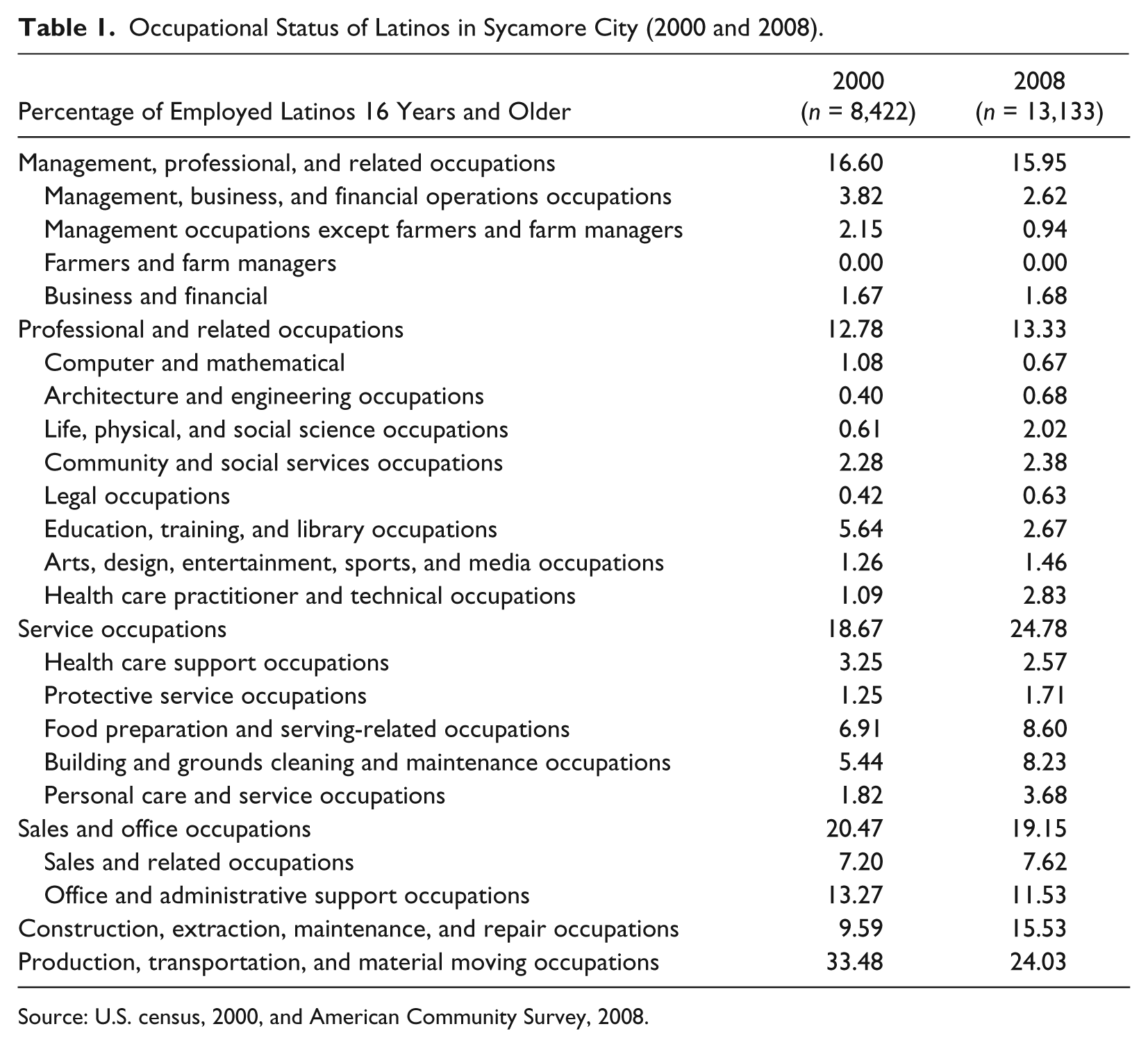
Coupled with the new wave of Mexican migration to Sycamore City, the existing Latino population worked in professional, service, and construction occupations involving physical and social “dirty work” (see Table 1). Professional Latinos, in particular, grew in traditional social dirty work occupations as social workers, parole officers, counselors, health educators, nurses, emergency medical technicians, and health technologists. As the Latino population grew, their representation in service sector occupations continued to grow. Between 2000 and 2008, there was slight growth in the percentage of Latinos in protective services (e.g., police, security guards, and correctional officers), food services (e.g., cooks, dishwashers, waitresses, counter attendants, and food preparation workers), building and ground services (e.g., janitors, maids, lawn care workers, and grounds maintenance workers), and personal care services (e.g., childcare workers, personal aids, barbers, hairdressers, and baggage porters). The largest percentage increase, however, was in construction.
Occupational Status of Latinos in Sycamore City (2000 and 2008).
Source: U.S. census, 2000, and American Community Survey, 2008.
Because I was living in Sycamore City for 3 years before embarking on this study, I was keenly aware of the visibly growing Latino community. Social service organizations were in need of translators, such as in the immigrant health clinic where I volunteered. Catholic Spanish mass services swelled into standing-room-only spaces. A noticeable rise of immigrant small businesses lined working-class neighborhood streets. Like other residents, I attended town hall meetings and listened to Latino community leaders warn the public that assaults threatened public safety and turned migrants into “walking ATMs” for criminals. Most of these public forums were organized and run by representatives of Puerto Rican social and community organizations. They spoke passionately about the need to provide services and protection to the growing immigrant community, many of whom were undocumented migrants.
As the research evolved, I conducted in-depth interviews with Latinos in Sycamore City in 2008 and 2009. Of these interviews, 20 were with Mexican migrants, 20 with Puerto Rican residents, and 5 with other Latinos. Respondents varied with respect to gender, legal status, length of residency, and employment. Interviews lasted approximately two hours and were conducted in places chosen by the interviewees. During the interviews, I asked all informants about their journeys to Sycamore City, work experiences, family relationships, and notions of community. Although the questions I asked were intended to understand how Latinos were changing and being changed by their residence in Sycamore City, the interviews revealed patterns of work that involved various forms of dirty work. I used interviews to confirm what I was learning at local events (e.g., immigration marches, church meetings).
All interviews were coded for salient themes that related to experiences in the workplace, undocumented migration, citizenship, and ethnic and racial identification. I noted “us versus them” distinctions across these themes. I especially considered how migrants described the physical dirty work they did as well as how they made sense of their work. I coded the ways in which professionals framed the undocumented migrants they encountered through their jobs in relation to their own racial position. In the following discussion, I report the patterns evident across interviews and highlight particular cases that exemplify the tensions and roles experienced by migrants labeled “citizen” and “illegal.”
Findings and Analysis
Illegality and Social Dirty Work
Latino social service professionals work on the front line providing an array of services, such as Spanish translation, housing information, childcare, and legal assistance. Recently, daily work activities include managing bureaucratic rules that police the citizen-alien boundary. For example, housing rights advocates, knowledgeable about most tenant rights issues, were confronted with concerns about landlords asking potential renters for “papers.” Other professionals needed to amend the “know-your-employment-rights” workshop given the increasing number of client complaints about wage theft.
In interviews, most professionals expressed great sympathy toward undocumented migrants and rebuffed the stigma of undocumented migrants as criminal or dangerous. Across the board, there was agreement that exposing a migrant’s legal status should be avoided whenever possible. At the same time, professionals recognized that offering assistance to undocumented migrants must occur within the limits of the law. It was thus common practice to not inquire about legal status.
Although most professionals negotiate the stigma of illegality through veiled assistance, a few see it as personally risky. Brenda is a case in point; she felt that assisting undocumented migrants could involve risk of exposure. Brenda is a naturalized citizen, small business owner, and long-time church volunteer. Originally from Argentina, Brenda identifies racially as white and describes herself as a devout Catholic. Her community work is driven by a religious and moral obligation to the poor. Despite her professed noninterest in politics, Brenda exerts influence in local affairs via her strong ties to the business community, local institutions, and the city’s political leadership. As an established small business owner, she is well recognized among social service professionals I interviewed; some see her as friend and others as foe because of her influence over community affairs.
I interviewed Brenda in a neighborhood organization office. The organization is located in a three-story apartment building occupied by a number of local organizations. When I arrived, the executive director of the organization apologized for the disarray. The office had been burglarized earlier in the week; computers were stolen and file cabinets rummaged through. Brenda proceeded to give a brief immigration history of Sycamore City. She described the arrival and departure of each immigrant group since 1970. According to Brenda, the first undocumented migrants were Guatemalan, who arrived in Sycamore City in the 1990s to work in nearby nurseries and tobacco fields thereby filling an occupational niche once occupied by Puerto Rican migrants. As Guatemalans moved further north, local farms hired Mexican undocumented migrants. Her ability to describe the waves of undocumented migration to Sycamore City was vivid:
A truck right in front of us—one of those yellow ones that you rent—stops at the light, the driver gets out, and flings open the back door. It was full of people . . . men, women, children . . . they jumped out and started running! It was the coyotes that brought them here. That’s when the Mexicans came. And now we have problems.
She explained that Mexican migrants are not the problem per se. Instead, the problems are violent assaults of undocumented migrants, public officials’ lack of awareness of the size of the undocumented population, and school administrators’ lack of experience working with undocumented children. But even she was unprepared for what illegality would require of social service providers. In fact, she recalled her first experience with a young Mexican man as an alarming encounter:
One morning I had my first encounter. I was opening the store at 7 a.m. . . . a young man walks in . . . a boy really, and he says to me: “Are you Doña Brenda?” I said, “Yes, how can I help you?” He replied, “It’s just that some insect bit my leg.” His leg was as hard as a ball and black. Then he tells me, “My boss, he fired me.” I responded, “What should we do? You have gangrene!”
Despite all her years working in community organizations, she was caught off guard by the infection spreading up this young man’s leg. While working in the fields, the man was bitten by a vinchuca (kissing bug), which exposed him to parasites that then infected the bite site. Brenda was also unaware that getting fired after a work-related injury is a common occurrence among young undocumented men (Bernhardt et al. 2009). Because Brenda was unsure about how to assist the young man, she telephoned a friend and enlisted his help. They drove the young man to a nearby hospital, filled out forms, helped him undress, and left.
At that time, the Americans were not very friendly to the idea of the undocumented. So I said to him, “Look, if I take you and I stay at the hospital, I’m going to have problems. So we’re going to take you to the door of the hospital, we’ll take you inside, we’ll register you, and you ask for an interpreter.”
The helping hand Brenda offered reflects her awareness of the anti-immigrant sentiment of the 1990s. During this period, the Immigration Act of 1990 expanded grounds for deportation and introduced new sanctions. The state of California passed Proposition 187 in 1994 to withhold public services to undocumented migrants. The federal government enacted the Illegal Immigration Reform and Immigrant Responsibility Act of 1996, which included even harsher penalties on migrants who entered the country repeatedly without authorization.
Despite the policy environment, Brenda provided aid in a discreet manner to avoid bringing attention to herself, her friend, or the legal status of the young man. When I asked Brenda to say more about her work, she stated, “We give food and clothes . . . all very hush, hush because don’t forget, we received public funds.” According to research on dirty work, we can interpret discreet assistance as an acceptance of the stigma of illegality as a normalizing strategy for avoiding taint (Ashforth et al. 2007). In many ways, discreet assistance consents to the taint that undocumented migrants live “in the shadows” and thus providing support requires doing so “in the shadows.” Oddly, this veiled approach to social service assistance exacerbates the problem of city official remaining unaware of the social service needs of migrants.
Brenda has worked with the migrant community since the 1990s, but most social service providers working with new migrants are second-generation Puerto Rican citizen migrants. 4 These social service professionals are the children of Puerto Rican migrants who arrived during the Great Migration from Puerto Rico in the 1950s and 1960s. In the Northeast, Puerto Ricans were recruited as farm laborers in Connecticut tobacco farms or low-wage workers in New York factories (Cruz 1998; Whalen and Vázquez-Hernández 2005). A number of these professionals are thus first-generation college graduates, homeowners, and socially mobile individuals.
Despite their firm middle-class footing (relative to their parents), Puerto Rican professionals recognize that their social and economic ascendance is recent and untenable. In his small corner office in city hall, Roberto, a father of seven, used the discourse of migration to explain his journey up the social hierarchy. Like other Puerto Rican families that left New York City in the 1980s, Roberto moved to Sycamore City hoping to leave behind the poverty of the Lower East Side. Along with his mother, brother, and sister, Roberto settled in one of Sycamore City’s working-class neighborhoods.
I came to Sycamore City as a construction cost estimator. I migrated here myself to do construction and then the housing market went bad so I went to college and got a degree in public health. My degree led me into childhood lead poisoning, and then one thing led to another and I landed in housing and code enforcement.
During our meeting, Roberto explained the work of the Division of Housing Code Enforcement, of which he is deputy director. As part of his professional duties, Roberto is “on call” 24 hours a day and dispatched to investigate complaints. His investigations may involve visiting sites to examine grievances about building disrepair due to owner negligence or tenant disorder, overcrowding, sanitation issues, and lack of heating. Although Roberto is not physically dirtying his hands, his work puts him in close association with stigmatized migrants. He provided an example of a common complaint he believes signals the presence of undocumented migrants:
Say I get a call from a landlord that just bought this property. They’ll say, there are six men living in one apartment on the top floor. When I go up there, [migrants] say they’re family, but they’re not. When I look further into it, it’s just that the landlord wants them out. He wants to either renovate or wants to sell again and you know it needs to be vacant.
According to Roberto, there has been an increase in housing-related complaints since the 1990s. The complaints typically involve young men sharing small apartments or undocumented couples renting “makeshift” rooms with no heating, shared bathrooms, and running cables for electricity.
Enforcing housing codes in these situations is difficult when violations involve undocumented migrants. As deputy director, Roberto is required to follow the U.S. Department of Housing and Urban Development’s Uniform Relocation Act, a federal law requiring agencies to assist individuals displaced from their homes because of unsafe conditions. Specifically, residents must receive written notification to vacate property within 90 days, relocation advice and services, and reimbursement for moving expenses and costs associated with renting comparable housing. According to Roberto, following agency requirements is challenging if a displaced individual does not possess a Social Security number:
When I first started inspecting, I’d see the guy I had just told “you gotta go.” He’d be standing outside with his bag and I’d be thinking, Wow, where’s he going to go? What’s he going to do? But, because we also have to report certain monies and if you don’t have a social security number than it is hard for us to prove who we spent this money on. So, what we do rather than putting folks out is we give them time. I don’t think an extra two people living an extra month in a place is going to hurt anybody.
Interestingly, Latino professionals with regulatory authority and obligations, such as Roberto, use personal discretion when dealing with undocumented migrants. This finding is contrary to previous research (see Marrow 2011). Indeed, most Puerto Rican professionals interviewed provided veiled assistance without invoking stereotypes about undocumented migrants. In the next section, I explore how Puerto Ricans professions manage the stigma of illegality as they take occupational risks when bending bureaucratic rules.
Blurring Citizen-migrant Distinctions to Manage Social Dirty Work
Roberto’s approach to managing the stigma of illegality is representative of Puerto Rican professionals. I found no evidence of racial or ethnic stereotypes to deride undocumented migrants. Instead, Puerto Rican professionals align with undocumented migrants by framing them as worthy of assistance and highlighting a shared work ethic. In fact, most professionals describe their service work as “good people doing good things for good people in need of services,” much like Hughes (1962) described when writing about dirty work. In acknowledging the moral virtues of undocumented migrants, Puerto Rican professionals accentuate their own “hard worker” status and blur the citizen-migrant boundary. In Roberto’s case, his previous experience as a care worker at a shelter is an example of the shared work history and prospects for mobility that citizens and migrants have in common:
Look, I used to bathe men. Okay, for 6 something, $7 an hour. I used to have to scrub them, delouse men at a shelter. It was a job and somebody had to do it. I’m very proud of having done that job. That job led to another job, which led to another job, which got me a nice job today.
Employing a mobility narrative serves two purposes for Puerto Rican professionals. First, professionals diminish the “legal-illegal” distinctions and ennoble “social dirty work.” Second, the mobility narrative raises the social standing of undocumented migrants and downplays the importance of citizenship for mobility. In Roberto’s view, citizenship should not preclude individuals, particularly Puerto Ricans, from performing “dirty work” or justify the scapegoating of undocumented migrants:
It’s the attitude; I think it’s the attitude and the ignorance. If you’re Puerto Rican, you’re a citizen, right? You shouldn’t be worried about competing with an immigrant for a job. You should have a nice job by now. Whatever mistakes you made in your life, correct them and move on. You know, whatever mistakes, whether you got a criminal record or you didn’t finish high school, correct them and move on but don’t take—let’s not attack—make the immigrant the villain.
In the quotation above, Roberto suggested that the privilege of citizenship should free Puerto Ricans from competition with new migrants in the labor market. And by combining citizenship with the right attitude, Roberto insisted that Puerto Ricans should be able to overcome a criminal record or lack of a high school degree.
The discourse of citizenship among Puerto Rican professionals also takes on a “natural” quality. When distinguishing between Mexicans and Puerto Ricans, Eric pointed to Puerto Ricans’ natural claim to country and freedom of transit between home and the United States:
I guess what keeps them [Mexicans and Puerto Ricans] apart is the fact that, you know, Puerto Ricans are natural citizens. Puerto Ricans have a claim to the country that Mexicans do not. And the fact that Puerto Ricans have the ability to go home whenever they want to and return whenever they want. Mexicans unfortunately can’t do that.
Although Puerto Ricans possess U.S. passports, citizenship has not translated into an ability to enjoy and exercise civil, social, and political rights in the United States (Grosfoguel 2003). However, interpreting citizenship as an embodiment is meaningful for how Puerto Rican professionals in Sycamore City manage dirty work. Eric is the director of an organization that supports local entrepreneurs by providing bookkeeping and computer skills as well as information about the state business certification process. His clients are predominantly Latino immigrant entrepreneurs. Moreover, outreach is a critical aspect of his work. Staff members regularly canvass neighborhoods to promote organizational services to Latino entrepreneurs, whether they are owners of street carts or a business establishment.
Eric is mindful of the growing undocumented migrant community in Sycamore City. Consequently, he instructs his staff not to ask about or record information regarding a client’s legal status. When I inquired about how his organization might approach a client who may be undocumented, Eric shared his view: “You can [tell] just from your conversation with people. You know that they’re not documented. Well, we feel that they should have the same information as anybody else.” By asserting that all clients receive the same information, Eric is like other Puerto Rican professionals who blur the boundary between “legal” and “illegal.” From his perspective, the goal of his organization is to support Latino entrepreneurship brought about with the new wave of migration:
The way was paved by Puerto Ricans . . . they were the first ones here . . . they made their money, then they retired, and now the immigrants . . . the Mexicans are taking over. And after the Mexicans move to the suburbs, the Ecuadorians or whoever will come in and do the same thing. But yeah, it’s just, it’s a cycle, a good cycle.
Unlike Roberto, who chastised Puerto Ricans for not capitalizing on their citizenship, Eric elevated Puerto Ricans as models of social mobility for new migrants. In doing so, Eric minimized the constraints created by “illegality” in support of his equal opportunity approach to providing services to clients.
Like African American bureaucrats who must skillfully weigh the racialized politics of welfare reform and the circumstances of their clients (Watkins-Hayes 2009), Puerto Rican professionals perform their own balancing act with respect to immigration policy. Puerto Rican professionals understand that they do not possess the social or political standing to pass on the burden of managing the “dirty work” of illegality to others. They are aware that occupationally they are in a position to provide social services to undocumented migrants, but little else. Denise, the director of an antipoverty organization, made this point very poignantly:
I don’t know that we’re doing anything other than treating immigrants with the dignity that they deserve and that we are doing everything we can to make immigrants feel a welcome part of this community. I mean, I’m not offering anybody . . . I don’t have the standing to offer anybody a green card. I don’t have the resources or the ability to offer anybody anything other than the right to feel protected and welcome in Sycamore City.
Puerto Rican professionals such as Denise, Roberto, and Eric regularly blur the “legal-illegal” boundary and use the language of community as they perform their professional duties. These strategies for dealing with “dirty work” are driven by their perceptions about the needs and deservingness of undocumented migrants. As citizens and professionals, they gain a sense of worth from providing social services to a population that does not challenge their social status. And as the first Latinos in Sycamore City, they believe they have a moral mandate to “open doors” for new Latinos, raise awareness about the needs of undocumented migrants, and shape the discourse of vulnerability of undocumented migrants.
Doing Physical Dirty Work
According to most migrants, employment is the primary goal after a risky, long, and expensive journey from Tlaxcala to Sycamore City. Migrants contended that “a job, any job is better than no job.” Their reasoning is a moral, social, and financial imperative to repay debts incurred as a consequence of the journey to the United States and housing assistance received from family and friends. And although family and friends facilitated employment searches, Mexican migrants recounted that obtaining employment is difficult when the national rhetoric on undocumented immigration is heated and the economy is receding. Consequently, most migrants worked in occupational spaces that require physical dirty work, ranging from cleaning homes, businesses, or cars to getting dirty in landscaping, construction sites, factories, and kitchens. Consider the case of Nicolas, a 32-year-old father of three from Tlaxcala who migrated alone 5 years earlier. Like most of the men and women interviewed, Nicolas mentioned fast food work as an entryway into the American employment system. Like other men, he noted that fast food work is limited to the disposal of dirt:
When you first arrive, you don’t know how things work . . . normally when you get here, you go immediately to McDonald’s, Burger King, or Dunkin’ Donuts. That was before. It’s not like that anymore. If a man gets hired, it’s going to be to clean—you won’t get hired to cook.
Nicolas skipped this rung on the employment ladder. His brothers-in-law recruited him into the construction company for which they worked. Like other migrants entering the construction industry, Nicolas started at the bottom; his job involved removing waste and scraps discarded by roofers and framers. Six days a week, Nicolas spent his entire workday cleaning up behind higher paid workers and earning $100 per day. Performing this type of physical dirty work was made more challenging by bureaucratic rules that prevent migrants from driving legally. Most of the men shared stories about traffic stops in which they were required to produce a driver’s license and car registration. Likewise, most had friends or acquaintances who had cars impounded because they did not have proper documentation. The problem of physical dirty work is thus compounded by the inability to legally reclaim a seized vehicle, losing a day’s wages, and paying migration-related debts.
The problems associated with the stigma of illegality for migrants performing physical dirty work are magnified in a shrinking economy. After only 6 months in Sycamore City, Nicolas’s brothers-in-law were making plans to return to Tlaxcala. One brother-in-law left in March and the second in May. Economic uncertainty in Sycamore City encouraged his remaining brother-in-law to leave in August. Shortly thereafter, Nicolas was fired. The loss of his job coupled with the departure of his strongest network ties left Nicolas with no job prospects or employer recommendation. Nicolas searched for other construction jobs, while also living in a new housing situation that his brother-in-law arranged. He shared a one-bedroom apartment with a young couple. One evening Nicolas came home to find the police arresting the young man for domestic abuse. Nicolas had no choice but to move out of the apartment. That night and for a few more nights, Nicolas slept in a car he inherited from his brother-in-law.
As for other undocumented migrant men, Nicolas’s story demonstrates how illegality facilitates the entry of recently arrived undocumented migrants into occupations that entail physical dirty work. Also germane is the fragility of networks when doing physical dirty work. Sitting at the kitchen table, he explained how he gotten stuck doing dirty work:
I experimented. I went from job to job. Some people will tell you, “When you get to the United States you’ll earn money right away.” But it’s not like that. . . . If you have a secure job, you’ll make money, but at first you’re never going to earn more than $600 a week.
In Nicolas’s case, a disrupted network turned into a trial-and-error job search in a declining economy. The fragility of networks and reliance on an established dirty work history was a story I heard repeatedly. Performing dirty work is a primary avenue for building relationships with employers as well as linking to compatriots that might assist in securing employment. However, physical dirty work also frames employment prospects because future work depends on previous dirty work experience.
Raising Ethnoracial Distinctions to Manage Physical Dirty Work
To deal with the undesirable conditions of physical dirty work, Mexican migrants engage in boundary work. In particular, I found that undocumented Mexican migrants make and manage social and ethnic distinctions in ways that emphasize feelings of mistreatment by Puerto Rican coworkers. Indeed, migrants view working with Puerto Ricans as a caveat of “dirty work” and deride Puerto Ricans for wasting the privilege of citizenship. Migrants judge Puerto Rican coworkers as lazy and undisciplined workers in an effort to maintain a sense of dignity while performing physical dirty work.
Carmen and I sat at a local coffeehouse a few blocks away from an Indian restaurant at which she bused tables. Prior to arriving to Sycamore City, Carmen worked as a floor supervisor in a textile factory in Tlaxcala. Carmen explained that since her arrival, she had held various food service jobs. She recounted how a friend helped her get a job at a McDonald’s located in a service center on a major freeway. According to Carmen, a friend approached one of the day-shift managers, a Mexican woman living in the area for some time, about hiring her. They decided they would tell the manager that Carmen and her friend were cousins and since Carmen had only recently arrived, she needed employment. Carmen was grateful that the fictive kin story worked and happy to have a job soon after arriving to Sycamore City (her husband was not as lucky—he remained unemployed for a few months):
Thank God I got a job at McDonald’s . . . most get few hours but I got them all—seven days a week. I’d start at 11 o’clock at night and leave at 8:00 in the morning. Everyone started to have it in for me because I got more hours.
Like other new migrants working in fast food restaurants, Carmen was hired to clean the restrooms and floors, bus and wipe down tables, and restock utensils and condiments in the main dining area. She claimed that she did not mind the hours or work, but getting along with her coworkers was a challenge:
If I hurry they get mad. If I work hard they get mad and say I’m doing too much. They’d tell me, “the managers will get used to that and later will require more from us.” Then they’d say that’s why I get more hours.
Carmen knew almost immediately she would not be working at McDonald’s very long. She felt tested on multiple fronts: she was undocumented, did not speak English, and was the only Mexican working the late-night shift. A Colombian immigrant woman sometimes helped her, but most of her coworkers were Puerto Rican, and Carmen claimed that they constantly gave her a hard time:
The girls would put the orders in wrong for me and I would say, “no I told you I wanted this and this.” They did it just to bother me . . . they would ask if they should put in my lunch order but then wouldn’t put it in. . . . I’d get so mad that I wouldn’t want to eat after that.
Perceived tense relationships with Puerto Rican coworkers were a common theme that emerged when Mexican migrants discussed workplace challenges. A number of undocumented Mexican migrants claimed that Puerto Ricans coworkers teased and yelled at them and sometimes sabotaged their work (i.e., slowed down production). In their view, Puerto Ricans find ways to capitalize on their limited English language skills to humiliate Mexicans on the job. They described feeling embarrassed when Puerto Rican coworkers claimed to not understand Spanish, scolded them for not knowing English, or shamed them for speaking broken English.
By drawing distinctions on the basis of ethnicity, Carmen avoids confronting the challenges and stigma of “physical dirty work.” For example, she circumvents the realization that there is little economic payoff in cleaning fast in a highly routinized work environment (Newman 1999; Stack 2002). Learning that the most commonly rewarded work behavior is tied to customer satisfaction, a prospect closed off to Carmen given that she does not speak English, may further exacerbate the drudgery of “physical dirty work.” At the same time, Carmen may be correct in assuming that her Puerto Rican coworkers are resentful of her. It is not uncommon for restaurant employers to use migrant networks to vet future employees and exclude black workers (Waldinger and Lichter 2003). By remarking on the so-called jealousy of Puerto Rican coworkers, Carmen focuses less on the fact that in cleaning the main floor, she is physically separated from her coworkers for most of the day. Consequently, working in isolation makes it difficult to build positive relationships with coworkers.
Carmen felt strongly that Puerto Ricans undermine the work of Mexican migrants. In her view, Mexicans are disciplined, have the ability to endure difficult working conditions, work collectively to get the job done, and are responsible. Puerto Ricans in turn evoke distaste—she sees them as unruly, loud, and lackadaisical:
Oh and the boricua [Puerto Ricans], you’re not going to find one boricua or one moreno [African American] cleaning up. They are so lazy and want to earn more than us. And if they don’t earn it, they ask from the government. They can live off of the government. And we the Mexicans . . . we have to work . . . we have to come here. I think that’s why we are the ones they humiliate.
Anchoring ethnic group differences in moral evaluations has an advantage—Carmen insulates her “hard worker” identity and confirms work ethic as a Mexican value. Ironically, the more the undocumented migrants feel victimized by Puerto Rican coworkers, the more pride they feel in performing “physical dirty work.”
Conclusion
Everett C. Hughes (1951) argued that most workers are likely to experience moments on the job when their dignity is undermined, either because worker dignity will be challenged or they will come into contact with stigmatized individuals. He thus encouraged social scientists to be mindful of ideas used to understand low-prestige workers when examining high-prestige workers:
Perhaps there is much to be learned about the high-prestige occupations by applying to them the concepts which naturally come to mind for study of people in the most lowly kinds of work as there is to be learned by applying to other occupations the conceptions developed in connection with the highly valued professions. (p. 318)
With this lesson in mind, this investigation began with the goal of understanding “dirty work” performed by undocumented migrants and social service professionals. My objective was to show that there is a connection between the challenges of “physical dirty work” performed by undocumented migrants and “social dirty work” carried out by citizens. A second goal was to reveal the strategies used to manage dirty work.
This study has shown that by virtue of their occupation and citizenship status, Puerto Rican professionals and undocumented Mexican migrants in Sycamore City are acutely aware of how “illegality” connects them to each other and the “dirty work” they perform. How they manage “dirty work” is informed by the interactions they have with each other at work and in the neighborhoods where they coreside.
With respect to social dirty work, the notion that Puerto Rican professionals extract a moral wage by interpreting their actions as “doing good” is consistent with recent studies of black and white social service professionals working with Latinos in the New South (Deeb-Sossa 2013). In Sycamore City, however, a more accurate description of how social service professionals view their work is “good people doing good things for good people.” This framing allows professionals to perform “social dirty work” in a way that allows them to avoid contamination by the label of Latino as “illegal.” And, this interpretation of “social dirty work” serves as the basis for also making moral claims about Puerto Ricans who disparage undocumented migrants.
With regard to undocumented migrants, strategies for creating distance from the conditions of physical dirty work also involve social and moral comparisons. However, given the nature of physical dirty work, making sense of work often means drawing flattering inferences of self and making moral evaluations of other low-wage workers. To dutifully perform “physical dirty work” Mexicans perceive themselves as “hard worker” and “devoted to work,” while Puerto Rican low-wage workers are viewed as morally inferior because they lack the commitment to the work and employers. It may very well be that Mexican migrants frame their work in this way because they understand that as undocumented migrants, they do not threaten the privilege Puerto Ricans hold as citizens in the American polity.
Managing the stigma associated with “illegal” status among Latinos is a collective effort. Among Puerto Rican professionals, blurring the citizen-migrant boundary supports the narrative that Puerto Ricans “pave the way” for new Latinos and buffers the view that Latinos are a threat to American culture. Mexican migrants brighten racial-ethnic boundaries to elevate their social status in the context of “physical dirty work.” Boundary work allows migrants to produce Mexican solidarity in the workplace and maximize the possibility of employment.
Footnotes
Acknowledgements
Thanks to Katherine Chen, Jacqueline Johnson, Howard Lune, James Mandiberg, Celina Su, Stacey Sutton, and Carol Stack for comments and feedback that vastly improved this article. All errors are mine.
Declaration of Conflicting Interests
The author(s) declared no potential conflicts of interest with respect to the research, authorship, and/or publication of this article.
Funding
The author(s) disclosed receipt of the following financial support for the research, authorship, and/or publication of this article: Research for this article was supported by a grant from the Russell Sage Foundation.