




Abstract
For many African Americans, Barack Obama’s presidential victory in 2008 was a step toward a racially tolerant society. Yet for others, the attack on Obama’s religious faith and citizenship status reflected long-standing racial divisions within the electorate. Using ordered probit analyses, our study focuses on racial trust and social capital in the early years of Obama’s presidency. In assessing the relationship between Obama’s domestic policies and racial trust, our study closely aligns with the research on policy feedbacks. We investigate the possibility that Obama’s flagship economic and social policies—specifically the American Recovery and Reinvestment Act, Patient Protection and Affordable Care Act, and unemployment insurance—operated as a bridge between whites, blacks, and Latinos. We further consider whether higher support for these policies reproduced greater levels of interracial trust among the groups. To measure racial trust, we draw from a 2010 survey sponsored by the Diane D. Blair Center of Southern Politics and Society at the University of Arkansas. The Blair-Rockefeller Poll was administered shortly after the 2010 midterm elections and includes a sample size of 3,406 respondents with an oversample of blacks (825) and Latinos (932). Although we found noticeably high rates of racial distrust, blacks expressed the lowest levels of distrust compared to whites and Latinos. We also discovered varying effects of Obama’s policies on increasing racial trust.
Barack Obama’s election in 2008 and reelection four years later were signature political developments in U.S. political history. In addition to being the first African American elected as president, Obama’s political achievements raised the prospects that his presidency would usher in a new era of racial progress. For many Americans, his election was a remarkable step toward a racially tolerant society. NAACP Chairperson Julian Bond stated, “The work the NAACP has done for 100 years now has had success that we didn’t dream of. We weren’t working to make a black person President of the United States, but it was a natural result” (Fetini et al. 2009:46). Other prominent blacks including civil rights activist Jesse Jackson, General Colin Powell, and Nobel Laureate Toni Morrison also celebrated the historic nature of Obama’s presidential victory.
Some political observers questioned whether Obama’s election would transition the United States into a post-racial society. Two days after Obama’s inauguration, Douglas Wilder, the first black governor of Virginia, said that his election had “the potential for relieving tensions and built-up emotions” (Thornton 2009:B1). Yet for others, his election and presidential tenure were tempered by the reality of America’s racialized past. Retrospective analyses of the 2008 contest found that a racial cost was enacted against Obama. The American electorate’s opposition to the Iraq War (officially called Operation Iraqi Freedom) and the Great Recession of 2008–2009 should have led to a landslide victory for Obama based on traditional turnout models of presidential elections. However, researchers found that a racially polarized electorate in fact cost Obama white voters, which amounted to as much as a 4 percent loss in the total vote share (Highton 2011; Piston 2010; Tesler and Sears 2010).
Our study expands on the ongoing research of race in the Obama era. We are principally interested in assessing racial trust as a dimension of social capital formation. The concept of social capital has its origins in analyses of civic culture in rural communities in the early twentieth century. However, Putnam’s (1993, 1995, 2000) formulation of the concept two decades ago led to a renewed interest in the topic and its possibilities for encouraging civic engagement.
Putnam described social capital as “features of social organization, such as trust, norms, and networks that can improve the efficiency of society by facilitating coordinated actions” (Putnam 1993: 167). Social trust or confidence in government and related institutions as well as racial trust or the ability of diverse racial and ethnic groups to bridge differences are important characteristics of social capital (Putnam 2007). Strong bridging ties (or trust) between diverse groups help to strengthen their social and civic identities and expose groups in segregated communities to new resources and different outlooks (Beem 1999; Briggs 2003; Field 2003; McKenzie 2004; Miller 1974). Interracial trust is essential to encouraging altruism and one’s commitment to improving the greater good.
The racial context surrounding Obama’s presidency presented a unique set of challenges for social capital theorists. During the 2008 election and continuing into his first term, Obama attempted to minimize racially charged controversies. Even so, his presidency was burdened by a racially polarized electorate and exacerbated levels of racial resentment (Tesler 2016). Notwithstanding these phenomena, we evaluate racial trust as a function of bridging capital between blacks, whites, and Latinos. We contend that interracial trust in the Obama era was greater among those individuals who supported and directly benefitted from his flagship programs.
In assessing the relationship between Obama’s policies and racial trust, our study closely aligns with the research on policy feedbacks. Policy feedbacks describe how “policies, once enacted, restructure subsequent political processes” (Skocpol 1992:58). These policies can encourage their beneficiaries to become more engaged in civic activities. They can enhance social capital and social trust and reshape mass attitudes about the functions of government and other social groups (Skocpol 1992; Soss and Schram 2007; Wichowsky and Moynihan 2008). At times, feedback policies can stimulate optimism about government programs or they can generate cynicism toward government initiatives that are interpreted as punitive by the target populations.
Our main focus in this article is to demonstrate how Obama’s domestic agenda operated as a social capital bridge that cultivated trust between blacks, whites, and Latinos. Drawing on a national survey administered by the Diane D. Blair Center of Southern Politics and Society and the Winthrop Rockefeller Institute at the University of Arkansas, we focus on the bridging capacities of three priority programs enacted during Obama’s first term: the American Recovery and Reinvestment Act (AARA) (also referred to as the economic stimulus), the extension of federal unemployment insurance, and the Patient Protection and Affordable Care Act (commonly known as the Affordable Care Act or Obamacare).
The economic stimulus allocated $787 billion for economic recovery during the height of the Great Recession of 2008–2009. It received broad support from urban mayors and a handful of moderate Republican governors (Dinan and Gamkhar 2009). The extension of unemployment insurance was incorporated in the economic stimulus package. It extended income support for long-term unemployed Americans beyond the usual 26-week allotment to as long as 99 weeks (Hulse 2010; Luhby 2009; Mincy, Klempin, and Schmidt 2011). Debates about unemployment insurance were also at the forefront of the deliberations over the federal budget from 2009 to 2013 (Kim 2011). The Affordable Care Act has been the crowning achievement of Obama’s presidency, though it survived numerous challenges before the Supreme Court (e.g., National Federation of Independent Business v. Sebelius, King v. Burwell, etc.) and was heavily scrutinized during the congressional and presidential elections of 2010 and 2012, respectively.
The remainder of this article examines racial trust and policy feedbacks. The first section assesses post-racialism and why it presented unique challenges for President Obama. This is followed by an examination of racial trust and policy feedback while situating African Americans within the larger framework of the discussion. We then analyze racial trust and policy feedbacks using ordered probit and post-estimation analyses, followed by a discussion of the findings.
Post-Racialism and Racial Equality in the Obama Era
Obama’s presidency raised two important concerns about race and specifically African Americans in the twenty-first century. First, as described previously, some political observers hoped Obama’s presidency would steer the country in a direction toward post-racialism, such that “race [would cease] to have much predictive if any predictive power” (Hero, Levy, and Radcliff 2013:42–43). The post-racial thesis asserts that race and related phenomena (e.g., racial polarization, institutional racism, racial resentment, etc.) are less dynamic in shaping American social, economic, and political life. For racial conservatives, a post-racial society means that there is no need for public policies that ameliorate racial inequalities since race seemingly has little predictive power.
Critics of the post-racial thesis argued that race is still a defining feature in the United States. Heading into Obama’s first year in office, blacks faced enormous obstacles compared to other groups. Three-fourths of the people sent to prison for drug-related crimes were African Americans even though they comprised less than 15 percent of the drug users. The unemployment rate among African Americans was twice as high as whites during the Great Recession. African Americans were also the most adversely impacted by the mortgage and foreclosure crises that fueled the recession (Franklin 2009). Given these conditions, civil rights and racial justice activists lobbied the Obama administration to take more urgent action to mitigate racial inequalities.
Certainly, Obama was racially ambivalent during his first couple of years in office and steered clear of an explicit commitment to advancing a racial justice agenda. This ambivalence reinforced the notion that post-racialism had replaced more substantive critiques of racism. Typical of presidents, his public advocacy for equity was instead couched within his broader insistence on achieving the common good for the American people.
The common good framework claims that presidents will try to unite the country around a unifying principle in order to garner support for a transformative policy agenda (Berkowitz 1999). Presidents will extol the virtues of American exceptionalism and its long-standing investment in experimenting with grand ideas. At the same time, they will try and convince Americans that they have a responsibility or special calling to resolve the most urgent problems of their generation (Carpenter 2007). Achieving the common good is a reciprocal process. On the one hand, presidents will situate transformative policies within the common good framework. Yet, they will ask the American people to renew their own individual commitment to achieving the common good by mobilizing support on behalf of their policies.
For his part, Obama’s articulation of the common good was apparent in his 2008 campaign slogan, “Yes We Can.” In his inaugural address, which laid the groundwork for the passage of economic stimulus, he used the common good framework to legitimate an ambitious policy agenda. He said:
Now, there are some who question the scale of our ambitions—who suggest that our system cannot tolerate too many big plans. . . . For they have forgotten what this country has already done; what free men and women can achieve when imagination is joined to common purpose, and necessity to courage. (Obama 2009)
Later in his address, he called on Americans to draw on the virtues of loyalty, hard work, fair play, and patriotism to address the most pressing problems.
Despite the utility of the common good framework, presidents who use it have difficulty sustaining electoral coalitions that can safeguard their policies. Regardless of the policies, they eventually invite opposition even if they are adopted during periods of crises (Galston 2010). Franklin D. Roosevelt’s New Deal policies, Lyndon Johnson’s civil rights agenda, and George W. Bush’s War on Terror, all of which promoted the common good, were heavily scrutinized by their opponents and even some members in their own parties. Electoral coalitions that are responsible for sustaining policies face forceful opposition that polarizes the electorate, which eventually undercuts the cohesion needed to promote the common good (Muirhead 2013). Thus, for most presidents, the electorate’s allegiance to the common good is short-lived.
As the Obama administration discovered shortly after his inauguration, the use of the common good framework as a political strategy did not eliminate racial animus or opposition to his policies. Many African Americans were troubled by the racial vitriol that seemed to overshadow his presidency, including the racially coded attacks on his religious faith and citizenship status (Hutchings 2009; Maxwell, Dowe, and Shields 2013; Tesler 2016). They believed that the pronunciations from Tea Party rallies and conservative communication mediums promoted racially offensive imagery of Obama that worsened race relations (Adams 2011; Clement and Green 2011; Maxwell and Parent 2012; Thompson 2010). Blacks further interpreted the proliferation of voter identification bills at the state level and the Supreme Court’s Shelby County v. Holder case in 2013 that eliminated the “preclearance” provisions of the Voting Rights Act of 1965 as a part of a wave of white backlash against the Obama administration. Hence, rather than representing a post-racialism, Obama’s presidency unmasked long-standing racial divisions.
Policy Implementation and Substantive Representation
A second concern about race in the Obama era has been the criticisms the president received from African American activists for his presumed ambivalence to addressing racial inequalities. Union Theological Seminary professor and activist Cornel West has been Obama’s most vocal critic. He referred to Obama as “a black puppet for Wall Street” and a “Rockefeller Republican in blackface” who deliberately avoided tackling race issues (Granderson 2013; West 2016). Another critic, political scientist Frederick Harris, declared that Obama’s presidency was a “hollow prize” that was symbolically important but did not enact measures that substantively improved the lives of poor African Americans (Harris 2012). When confronted with racial issues such as the alleged police harassment of Harvard University professor Henry Louis Gates in June 2009, Obama offered a tepid response to the systemic patterns of racial profiling of African Americans (Bonilla-Silva and Ray 2009; Teasley and Ikard 2010). Some critics even believed that racial justice policies were marginalized during Obama’s first term due to fears that they would unleash a white backlash.
Despite these assessments, it is incorrect to conclude that Obama’s presidency was merely symbolic and had no substantive impact on African Americans. Although Obama may have been reluctant to champion a robust racial justice agenda, his attempts to ameliorate racial inequality were mostly executed through his nonracial policies. Some policies such as the economic stimulus, though universalistic in its orientation, were embedded with anti-discriminatory regulations that targeted low-income populations.
Shortly after the adoption of the economic stimulus, Obama ordered the Office of Management and Budget (OMB) to direct the federal agencies to develop procedures for inclusion of disadvantaged populations in recovery programs. Incentives for local hiring, compliance with equal opportunity laws, and support for small and minority businesses were some of the approaches highlighted in the memorandum (Johnson 2011). The stimulus also reorganized existing programs in order to reach disadvantaged groups (Johnson 2011). For example, the Department of Labor’s Pathways out of Poverty funds (also referred to as High Growth funds) and the TANF Emergency Contingency Funds, which were used for short-term employment, were expanded under the economic stimulus.
Obama’s health care legislation is another nonracial policy that had a substantive impact on African Americans. Nearly one-fourth of African Americans were uninsured before Obamacare. Sharp disparities also existed between blacks and whites in the areas of medical care, chronic illnesses, and infant mortality (Lewis, Dowe, and Franklin 2013). Although not widely reported, there were provisions included in the legislation that addressed racial equity. The law established Offices of Minority Health in several federal agencies and upgraded the National Institute of Minority Health and Health Disparities into a full-fledged agency (Sanders, Wyche-Etheridge, and Riley 2010–2011). Dozens of other provisions were incorporated into the laws that were purposely crafted by health care advocates to address health disparities (Dawes 2016).
The extension of unemployment insurance by Obama was particularly meaningful for poor blacks. Blacks experienced some of the highest rates of dislocation during the Great Recession, with nearly one-half of young people experiencing unemployment in some urban centers (Mincy et al. 2011). The unemployment rate for women was also higher among blacks than whites and Latinos (U.S. Department of Labor 2012). The expansion of unemployment insurance first occurred under George W. Bush in June and November 2008 when he convinced Congress to approve the measures (Isaacs and Whittaker 2014; Rothstein, Aaronson, and Kahn 2011). Yet, Obama and his congressional allies extended unemployment insurance 10 times from 2009 to 2013. Indeed, expanding unemployment insurance became a centerpiece of his budget fights with Congress.
This summary of Obama’s policy initiatives offers a complicated portrait of the racial context surrounding his presidency. It suggests that his tenure was neither post-racial nor racially symbolic. It was overwhelmed by racially coded attacks on his persona and policies. In spite of that, his policies addressed racial inequality in a serious manner. In the early stages of his presidency, his ameliorative measures were administered through seemingly race-neutral programs such as the economic stimulus and health care bill. These measures were embedded in the bureaucratic and administrative arrangements of the policy designs that were largely invisible to the public.
Interestingly, programs that are embedded in the administrative layer of government or “submerged state” (Mettler 2010) run the risk of being overshadowed by public dialogues over the policies, which can inaccurately describe their impact. The political debates in Congress and at the state level eclipsed the dimensions of the policies that attempted to ameliorate racial inequalities. For the economic stimulus and unemployment insurance, much of the discourse focused on their impact on federal and state budgets. The debate over the Affordable Care Act was racially charged, such that the discourse polarized the public instead of highlighting how health care reform alleviated racial disparities.
Complicating matters on the racial egalitarian front was that the programs (economic stimulus, unemployment insurance, health care) gave states autonomy over their administration. While states had considerable discretion for determining eligibility guidelines for unemployment insurance, one-third of the $787 billion economic stimulus was comprised of tax breaks and cash transfers to the states (Mettler 2010). The health care law further empowered states to expand their Medicaid programs to cover uninsured programs. This federalist design allowed states to curtail parts of the Affordable Care Act that would reach working-poor blacks and other disadvantaged populations. A number of southern states, including Mississippi, North Carolina, Tennessee, Georgia, and South Carolina, vigorously opposed Medicaid expansion for the poorest residents. Consequently, the federalist design limited the reach of the health care law even though it included provisions to address health disparities.
Thus far, we examined post-racialism in the Obama era and examined the substantive impact of his policies. Both investigations underscore the challenges with developing interracial trust in a political climate plagued by racial divisions and racial ambivalence. Public policies that are racialized by political elites can polarize the electorate even if they improve the quality of life for many Americans (Hardin 2004; Messick and Kramer 2001; Solomon and Flores 2001). Racial distrust may eventually lead to broader disillusionment with political institutions.
Bridging Capital, Racial Trust, and Policy Feedbacks
In recent years, scholars have given attention to the relationship between social capital and policy feedbacks. In her study of policy feedbacks and the G.I. Bill implemented after World War II, Mettler (2002) found that this policy encouraged civic engagement among military veterans. The legislation helped to grow the economy and expand the middle class, and its beneficiaries were attracted to civic and political activities (Mettler and Welch 2004). Government programs such as the G.I. Bill assign status or what Shklar (1991) calls “standing” to the beneficiaries of the programs. They allow their beneficiaries to reinterpret government as a positive agent for social change and reconsider their own commitments to civic life.
Moreover, policy feedbacks influence how individuals understand their rights and responsibilities as members of a political community. They can redefine citizenship and expand how groups interpret the distribution of goods and services (Esping-Andersen 1990). The feedback effect of transformative policies such as the New Deal legislation of the 1930s and the Civil Rights legislation of the 1960s had a multigenerational impact on political culture and trust. They gave voice to previously unrecognized groups such as African Americans and incorporated their agendas in established political institutions (Cloward 1971; McDonagh 2010; Piven and Cloward 1977; Schattschneider 1935). Even race-neutral policies such as the Social Security Act and the National Labor Relations Act were backed by civil rights groups that were concerned about the long-term impact of these policies on the economic status of African Americans.
Policy feedbacks further underscore the important role that civic, voluntary, and church organizations play in linking the electorate to public agendas and political institutions. Grassroots organizations and networks help their constituents acquire salient information about public policies, which enhances their willingness to make political institutions accountable (Claibourn and Martin 2007). This is particularly the case for African Americans who rely on grassroots and faith-based organizations for social capital development (McKenzie 2008).
Among blacks, racial trust is also shaped by ideology, party identification, linked fate, and their experiences with racial discrimination (Avery 2009; Dawson 1994; Orr 1999; Shingles 1981). Nunnally (2012) found that black trust is significantly influenced by how they view their status in the American racial hierarchy. For example, blacks’ perceptions of whites and political institutions during the height of the civil rights movement of the 1950s and 1960s were shaped by federal and state government policies. African Americans had higher levels of trust in the federal government than their state governments during this period, a sentiment that still resonates in contemporary politics (Dawson 1994; Uslaner 2001). Federal enforcement of civil rights through congressional legislation, Supreme Court decisions, and executive orders contributed to the belief that the federal government was more trustworthy than state governments that championed states’ rights and racial segregation.
It is also worth mentioning that a racial or social group’s adverse experiences with government and public policies can actually produce a negative feedback loop. It can provoke distrust not only in government but also toward other sociodemographic groups. The explosion of zero-tolerance criminal justice policies and the growth of prisons contributed to the high levels of incarceration among African Americans. The expansion of the carceral state created negative perceptions about the functions of government among formerly incarcerated persons and their families (Lerman and Weaver 2016), especially African Americans who are incarcerated at higher rates than other racial and ethnic groups.
Even some antipoverty or distributive programs celebrated by liberals can have a negative effect on racial and social trust. Mean-tested programs such as welfare that are racially coded, stigmatized, and poorly administered tend to foster disillusionment among their beneficiaries (Bruch, Ferree, and Soss 2007; Campbell 2011; Jacobs and Mettler 2011). On the other hand, distributive programs such as Head Start that are not stigmatized can engender greater levels of civic engagement and trust (Bruch et al. 2007). Universal initiatives such as Social Security and Medicare also produce a positive feedback loop because of their broad coverage of middle America.
Taken together, the conceptual framework of this study indicates that racial animus in the Obama era adversely impacted bridging capital, specifically interracial trust. Understanding that racial distrust is an intransigent component of the body politic (Nunnally 2012), we presume there will be high levels of distrust between blacks, whites, and Latinos in our study. Yet where racial trust does exist, we expect it be higher among blacks compared to whites and other nonwhites. This was due to the initial optimism surrounding Obama’s election victory.
Hypothesis 1: The electoral coalition that ushered Obama into office increased blacks’ optimism about a racially tolerant society during early stages of his presidency. Thus, interracial trust (blacks, whites, and Latinos) will be greater among blacks than other racial groups.
Notwithstanding the divisions underlining Obama’s domestic policies, we recognize their substantive impact in ameliorating racial inequalities. Obama indicated that these programs were essential to achieving the common good. This strategy increased the likelihood that interracial trust would develop among proponents of his agenda. The policies we selected for the feedback measures are the economic stimulus, unemployment insurance, and Affordable Care Act.
Certainly, other domestic policies were salient in 2009 and 2010. Immigration reform was high on the president’s agenda, but a compromise bill was rejected by Congress. The Lilly Ledbetter Fair Pay Act of 2009 expanded equal pay and pension protections for women. In the first six months of his presidency, Obama made a failed attempt to get Congress to adopt a pollution reduction plan called “cap and trade.” The legislation passed in the House of Representatives was stalled after Obama shifted energies to health care reform. The Dodd-Frank Wall Street Reform and Consumer Protection Act in 2010, approved shortly before the congressional elections, established new regulations over financial and lending institutions.
Despite the importance of the aforementioned policies, we focus on the intersection between racial trust and the economic stimulus, unemployment insurance, and health care reform. These policies were at the forefront of the 2010 and 2012 elections. Further, compared to other policies such as immigration reform and fair pay, blacks were much more attentive to initiatives such as the economic stimulus, unemployment insurance, and health care (Henderson and Hillygus 2011; Kohut, Doherty, and Dimock 2010; Tesler and Sears 2010). Hence, we hypothesize that the respondents who endorsed these policies were more likely to experience greater levels of interracial trust.
Hypothesis 2: Despite the persistence of racial divisions, support for the economic stimulus, health care reform, and unemployment insurance enhanced racial trust if the respondents believe these programs improved the common good.
Data and Methods
To measure policy feedbacks and racial trust, we draw from a 2010 survey of public opinion that is stored at the Diane D. Blair Center of Southern Politics and Society and the Winthrop Rockefeller Institute at the University of Arkansas. The Blair-Rockefeller Poll (the poll was renamed the Blair Center-Clinton School Poll in 2012) was administered nationally by Knowledge Networks shortly after the 2010 congressional elections. It includes a sample size of 3,406 respondents with an oversample of blacks (825) and Latinos (932). The survey took an average of 21 minutes to complete, with a 58 percent completion rate. We conducted three ordered probit regressions measuring trust toward blacks, whites, and Latinos. The regressions are weighted to account for oversamples in the survey.
Our dependent variable for the regression models is racial trust. The respondents were asked the question: “In general, where would you rate the following groups [whites, blacks, Hispanics/Latinos, Asian Americans] on how trustworthy they are?” The answers were recoded and measured on 5-point scale (1 = very low trust, 2 = low trust, 3 = neither low nor high trust, 4 = high trust, 5 = very high trust). We controlled for sociodemographic variables since race, culture, income, education, and religion affect racial predispositions (Alexander 2007; Brehm and Rahn 1997; Larsen et al. 2004; Putnam 2000).We use the same independent variables for all the models: race/ethnicity (blacks, whites, and Latinos), gender (male = 1, female = 0), marital status (married = 1, not married = 0), region (South = 1, non-South = 0), locality (1 = live in a large metropolitan area, 0 = nonmetropolitan area), and church attendance (coded as 1 for “frequent church attendance”). Age is also included in the models but it is a continuous variable ranging from the youngest to the oldest respondents. Three variables evaluate socioeconomic status: work status (employed = 1, unemployed = 0), education (measured on a 6-point scale from the least educated to those with graduate education), and income (measured as a continuous variable).
Our political variables are presidential approval (coded 1 if the respondents approve of Obama), voted in the 2010 congressional elections (vote = 1, did not vote = 0), and party identification with Democrats and Republicans both coded as dummy variables. We also considered the impact of political cynicism on social trust, specifically the respondents’ belief that government cares about them. We expect high levels of political cynicism will lead to greater levels of racial distrust.
The policy variables in this study are the economic stimulus, health care reform bill, and extension of unemployment benefits. Support for the health care bill and unemployment benefits are both regressed on a 5-point scale (1 = very low approval, 2 = low approval, 3 = no opinion, 4 = high approval, 5 = very high approval). Considering the long-standing racial divisions about federal intervention and states’ rights, the economic stimulus is evaluated on a 5-point scale at three levels: its effect on the personal status of the respondents, its impact on the states where the respondents live, and whether the respondents believe the stimulus improved the national economy. The variables were measured on the same 5-point scale used for Obamacare and the stimulus.
In addition, we conducted post-estimation analyses to obtain predicted probabilities. Predicted probabilities are commonly used to interpret the substantive effects of a set of independent variables (Barreto, Marks, and Woods 2007). We use post-estimation analyses to assess how racial trust is influenced by support for unemployment benefits, the health care bill, and the economic stimulus. Given our concern about race, we included the racial subgroups in the post-estimation analyses.
Findings
Our first hypothesis argues that Obama’s election in 2008 produced an unprecedented amount of optimism among blacks about racial progress. As such, we expect racial trust to be higher among blacks than among other racial/ethnic groups. This is partially confirmed in Figure 1 as the racial trust score among blacks is 3.5 and 3.7 for whites and Latinos, respectively. (The mean scores are measured on a 5-point scale.) On the other hand, whites gave both blacks and Latinos a lower score of 3.4. The least amount of trust toward blacks was found among Latinos, with a median score of 3.1. Latinos also expressed the greatest amount of trust toward one group, giving whites a 3.8 score. Yet across both racial groups, blacks have a higher trust score.
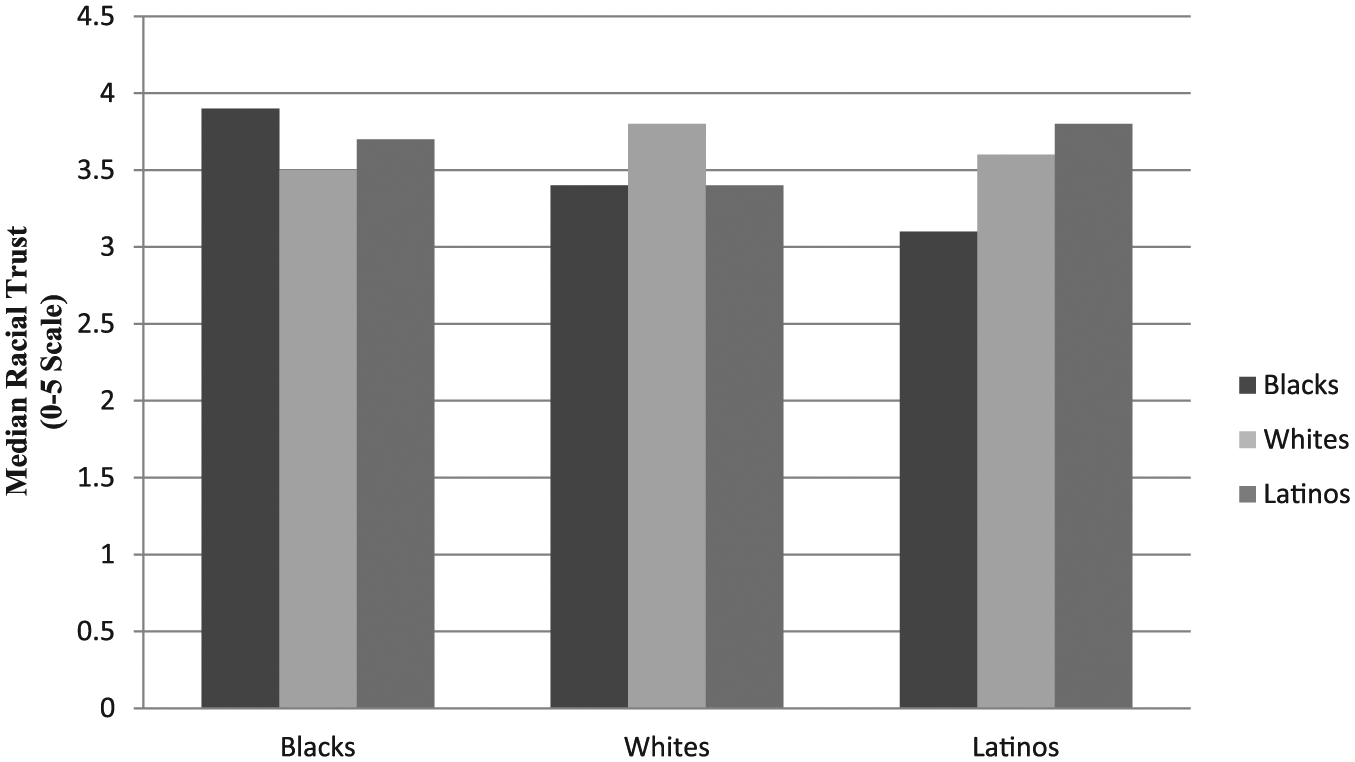
Racial trust of blacks, whites, and Latinos.
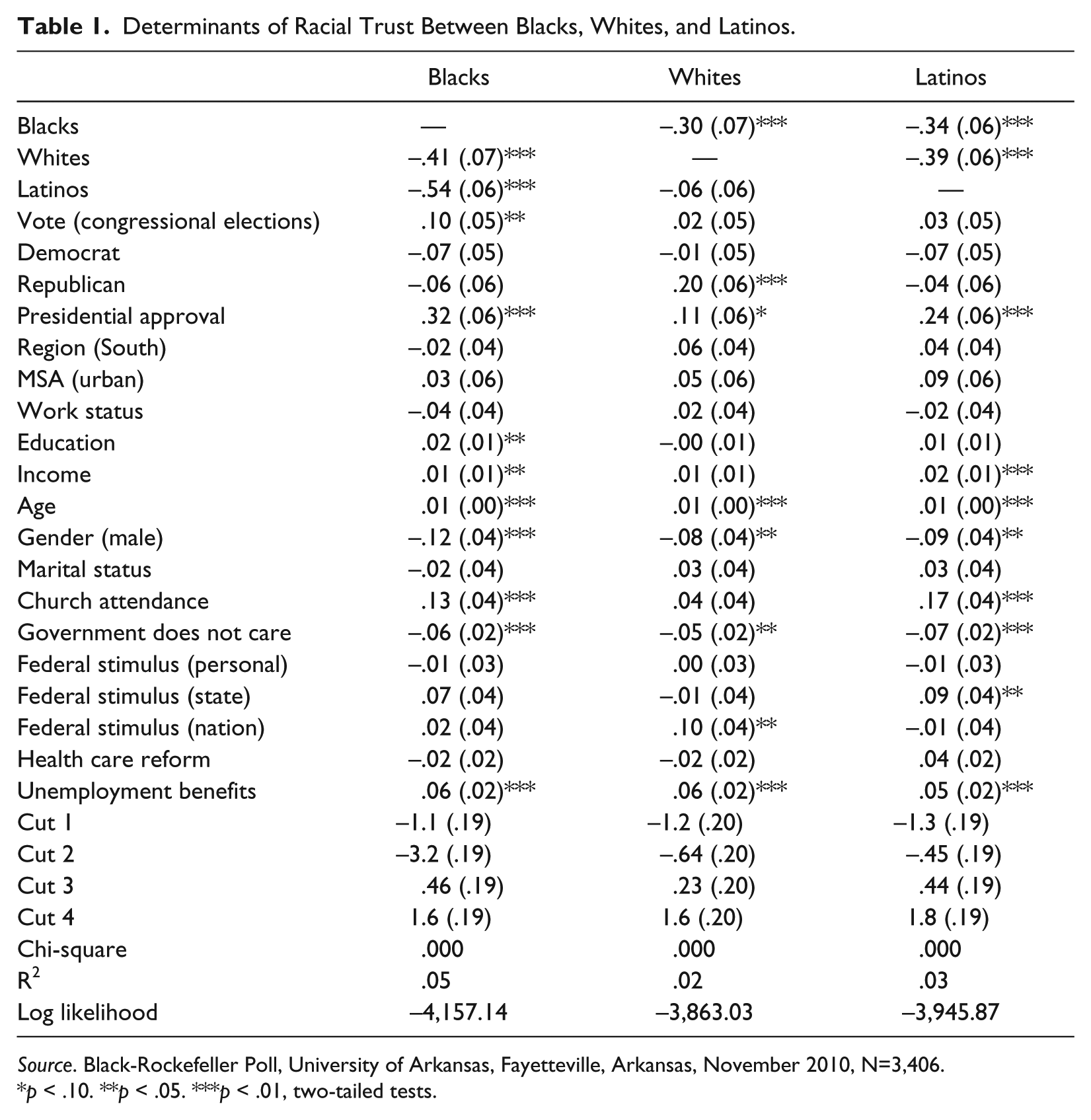
A clearer picture of racial trust is revealed in the ordered probit analyses in Table 1. Although the overall strength of the three models is small, the results still indicate noticeable patterns of racial distrust. Blacks and whites were equally distrustful of each other and of Latinos. Latinos expressed a significant amount of distrust of blacks, yet there was no statistical significance in how they viewed whites.
Determinants of Racial Trust Between Blacks, Whites, and Latinos.
Source. Black-Rockefeller Poll, University of Arkansas, Fayetteville, Arkansas, November 2010, N=3,406.
p < .10. **p < .05. ***p < .01, two-tailed tests.
Marital status, regionalism, and urban location produced no significant impact on racial trust. Yet age, church attendance, and socioeconomic status (work status, education, and income) had a varied effect on racial trust. Older respondents were more trustful of blacks, Latinos, and Asians than younger respondents. Regular churchgoers were more likely to trust blacks and Latinos than non-churchgoers, yet church attendance had no effect on trust toward whites. Whereas work status had no significant impact on racial trust, the respondents with higher incomes and education were more likely to trust Latinos. Higher education further contributed to greater trust toward blacks, but neither variable (education or income) significantly impacted racial trust toward whites.
Moreover, we included several political variables in the analyses. The only significant finding regarding party identification was that Republicans were more trustful of whites. On all other measures, party identification had no bearing on racial trust. Presidential approval had a substantial effect on racial trust as Obama supporters were more likely to consider blacks and Latinos as trustworthy. They were also more likely to trust whites, although the strength of this variable (p < .10) was much weaker than trust of the other groups.
Nunnally’s (2012) study of racial trust chronicles the racial landmines that defined Obama’s initial two years in office. She details why racial optimism hung in the balance with the withering attacks directed toward Obama, much of which has been shrouded in racially implicit appeals. Although Obama is a lightning rod for conservatives, as a singular figure, he can potentially stimulate high levels of racial trust among all three groups. The findings suggest that bridging social capital is a distinguishing characteristic among those who approve of Obama’s job performance.
There was an additional racial effect for voting in the 2010 midterm elections. These voters were more trustful of blacks, but this sentiment did not extend to whites and Latinos. Still, notwithstanding the varying influence of partisanship and voting, political cynicism had an adverse impact on racial trust. In fact, the respondents who said government does not care about their concerns were more distrustful of blacks, whites, and Latinos. Previous studies also discovered a relationship between trust and political cynicism (Ji-Young 2005; Uslaner 2001; Weinschenk and Helpap 2015). Not surprisingly, political cynicism and negative experiences with political and bureaucratic institutions correspond with social distrust.
Public Policy, Feedback, and Racial Trust
As discussed earlier in the study, we hypothesize that Obama’s domestic policies (the economic stimulus, health care reform bill, and extension of unemployment benefits) increased racial trust between blacks, whites, and Latinos. The findings offer further insight of racial trust in the Obama era and partially confirm the hypothesis that Obama’s domestic agenda increased racial trust. Yet the degree to which this occurred depended on the policies and the racial group. Unemployment benefits had the most significant impact as support for this policy positively influenced trust across all racial/ethnic groups. Yet there was no statistically significant effect of the health care bill on racial trust.
Racial trust among the respondents was further exhibited by how they viewed the impact of the economic stimulus on their personal situation, their state, and the country. Neither view of the stimulus (personal, state, national) had an effect on trust toward blacks. On the other hand, trust in whites was positively influenced by optimistic views about the national impact of the stimulus. Those who believed the stimulus improved their states were also more likely to exhibit trust in Latinos.
Since the ordered probit analyses produced mixed results, we calculated changes in the predicted probabilities to gain a more accurate representation of the substantive impact of the policy variables. Given our concerns about race and especially trust among African Americans, we also analyzed the predicted probabilities of the racial/ethnic groups. We controlled for the rest of the independent variables by setting them equal to their means. The results of the probabilities were then converted to percentages for easier readability.
As indicated in Table 2, there was a noticeable pattern of racial distrust among all the racial groups. High levels of trust in blacks diminished by 12.4 percent and 9.1 percent if the respondents identified themselves as Latinos and whites, respectively. Trust in whites diminished between 4.1 percent and 7.7 percent among black respondents and 1 percent and 1.2 percent among Latinos. Whites were 9.7 percent less likely to exhibit a high level of trust toward Latinos, while the probability of exhibiting moderate and high levels of trust diminished by 5 to 8.3 percent if the respondents were black. These results indicate that blacks were considerably distrustful of whites and Latinos, and the feelings were mutual. Yet even though the three groups were distrustful of each other, the intensity of interracial distrust was weakest among blacks. The exception is Latinos’ trust in whites, which appears to be the highest of all the interracial trust measures.
Changes in the Predicted Probabilities of Racial Trust.

Note. Cell entries for unemployment benefits, health care, and the economic stimulus are changes in the predicted probabilities for the dependent variables (moderate and high trust) for a given change in the independent variables moving from no approval to high approval. The cell entries for all variables were converted to percentages.
Source. Black-Rockefeller Poll, University of Arkansas, Fayetteville, Arkansas, November 2010, N = 3,406.
The policy variables revealed conflicting results. Across the three measures, the probability of expressing a high level of racial trust increased by 2.6 to 3.8 percent for respondents who supported an extension of unemployment benefits. Approval of Obamacare is associated with racial distrust except for assessing trust in Latinos. There was a 1 percent probability that trust in Latinos increased among proponents of the health care legislation. These results underscore the relationship between racial discord and the health care bill as blacks expressed greater enthusiasm for this bill compared to whites and Latinos (Henderson and Hillygus 2011; Tesler and Sears 2010).
The substantive effects of the economic stimulus revealed other interesting findings. The personal impact of the stimulus did little to improve racial trust. But if the respondents believed that the stimulus improved the overall health of their state, then there was a 3.9 percent and 5.2 percent probability that they expressed high levels of trust in blacks and Latinos, respectively. Further, the greatest level of trust in whites is found among the respondents who believed the stimulus was positive for the country. The substantive effect of the stimulus’s national impact was actually more promising in shaping racial trust of whites than blacks and Latinos. These findings may indicate that Obama’s emphasis on the common good seemed to sew interracial trust.
Discussion and Conclusion
We set out to examine racial trust during the Obama presidency. Our expectation was that Obama’s election increased optimism among blacks and all Americans, at least compared to other racial/ethnic groups, and that his domestic policies cultivated cross-racial alliances. The respondents who approved of Obama’s job performance exhibited higher levels of trust. This implies, as Rusch (2010) found, that leaders can act as bridging devices or “conduits” between distinct groups. Still, we found that the bridging dimension of social capital is quite weak, at least when analyzing racial trust among blacks, whites, and Latinos, and that all groups had disturbingly high levels of racial distrust. Blacks had the least amount of distrust when measuring their views toward the group dyad (whites and Latinos), but in terms of a one-to-one relationship, the highest level of trust was found among Latinos toward whites.
In addition, the findings allow for a partial confirmation of our second hypothesis. The economic stimulus, health care bill, and unemployment benefits influenced racial trust, but the impact was multilayered. The least significant variable was the health care bill. The only positive impact it had was on Latino trust toward whites, but the substantive effect was weak.
The most significant variable in both the ordered probit and post-estimation analyses was the extension of unemployment benefits. Support for this policy produced the greatest amount of racial trust even though unemployment strongly correlates with race. Although unemployment insurance is generally considered a distributive program that targets low-income workers, it differs from other entitlement programs that target similar populations. More than 85 percent of the civilian workforce is eligible for some form of unemployment insurance (Kilgour 2010). During periods of economic crises such as the Great Recession of 2008–2009 when large numbers of dislocated persons are whites, working, and middle-class, unemployment insurance has a wider reach into middle America. In other words, the workforce dislocation caused by the Great Recession meant that unemployment insurance was universalized; it extended to middle-class workers who did not face the same type of stigma as low-income workers. This perhaps explains why this policy produced the greatest amount of racial trust.
Regarding the economic stimulus, perhaps the most interesting finding is the differential impact on racial trust based on whether the respondents believe it positively improved the state or the nation. While positive feelings of blacks and Latinos increased when the economic stimulus targeted states, racial trust of whites was enhanced when the respondents believed the stimulus positively improve the nation.