



Abstract
Ethnic issues in Guatemala are commonly analyzed using theoretical frameworks that underscore the role of Maya activism in promoting Mayan identification. However, these frameworks often pay insufficient attention to the local significance of phenotype. In this study, I propose an alternative framework to explain ethno-racial status in contexts of mestizaje. Based on this framework, I investigate whether phenotype, captured by skin color, is a significant dimension of ethno-racial status in Guatemala using nationally representative survey data and regression analysis. I specifically examine the association between skin color and ethnic self-identification, and differences by ethno-racial characteristics in the perception of skin color discrimination and in the desire for a whiter skin color. I find evidence of a direct association between skin color and ladino self-identification, evidence of a greater perception of skin color discrimination by individuals with more indigenous characteristics, and evidence of a direct association between indigenous ancestry, captured by indigenous first language, and the desire for a whiter skin color. These findings reveal the significance of phenotype as a distinct dimension of ethno-racial status in Guatemala beyond ancestry and ethnic self-identification.
The literature of ethnicity in Guatemala suggests that the indigenous/ladino boundary primarily distinguishes Guatemalans by cultural characteristics rather than by phenotype (Adams 1994, 2005; Colby and van den Berghe 1969; Wade 2010). This ethnic boundary, well rooted in Guatemala’s colonial past, has persisted over time. Ladino refers to the national western identity founded on the Spanish/European legacy whereas indígena (indigenous) refers to individuals who have preserved values, tastes, and habits of their indigenous heritages. However, neither indigenous individuals nor ladinos cohesively share the same ethno-racial characteristics within each population. Although the indigenous/ladino ethnic boundary is often depicted as particularly rigid, it may be fluid to a certain extent as in other Latin American contexts of mestizaje. This fluidity is founded on Guatemala’s Spanish colonial past regardless of the apparent absence of mestizaje ideologies and policies that promoted the assimilation of indigenous populations in processes of nation-making (see Telles and Bailey 2013; Telles and Garcia 2013; Wade 2010).
Another way of understanding ethno-racial fluidity in contexts of mestizaje is to pay attention to the body beyond ethno-racial boundaries. Anthropologist Diane Nelson (1999:212) argues that “bodies do matter” in response to views that overemphasize the role of culture in Guatemalan ethnic differences. Mestizo bodies are fluid and unstable carriers of meaning because they represent different degrees of cultural and phenotypic ethno-racial mixture, as the literal meaning of mestizaje in Spanish suggests. From this perspective, ethno-racial boundaries are embodied by individuals as the combination of contrasting ethno-racial characteristics. In this study, I argue that these ethno-racial characteristics represent different dimensions of individual-level ethno-racial status in order to propose an alternative framework that connects the meaning of mestizaje as ethno-racial mixture (beyond the notion of mestizaje as nation-making ideologies) with the U.S. sociological literature of multidimensionality of race (Bailey, Loveman, and Muniz 2013; Bailey, Saperstein, and Penner 2014; Roth 2010, 2016; Saperstein and Penner 2012).
Based on this framework, I investigate the role of phenotype, captured by skin color, as a distinct dimension of ethno-racial status of Guatemalans using nationally representative survey data and regression analysis. In this study, I specifically intend to answer three research questions:
Research Question 1: Is skin color significantly associated with ethnic self-identification beyond ancestry?
Research Question 2: Are indigenous characteristics of Guatemalans (indigenous self-identification and indigenous first language) directly associated with the perception of skin color discrimination net of the impact of skin color on the latter?
Research Question 3: Are stigmatized ethno-racial characteristics—indigenous self-identification, darker skin colors, and indigenous ancestries—directly associated with the desire for a whiter skin color?
By answering these questions, I aim to present quantitative evidence of the significance of phenotype in Guatemala, building on the work by Edward Telles and coauthors (Telles, Flores, and Urrea-Giraldo 2015; Telles and Steele 2012). Issues of ethnicity in Guatemala are commonly analyzed using frameworks that highlight the central role of Maya activism in promoting Mayan identification (e.g., Bastos 2012; Fischer 1999; Grandin 2000). The significance of phenotype is often disregarded as if ethnic characteristics typically associated with political claims sufficiently capture the complexities of Guatemalan ethnic and racial issues. In this article, I also offer an alternative/supplementary framework that focuses on the embodied ethno-racial mixture found in Latin America beyond ethno-racial ideologies, boundaries, and self-identifications.
Multidimensional Ethno-Racial Status in Contexts of Mestizaje
Mestizaje has usually been explained as the foundation of national racial ideologies in Latin America (Appelbaum, Macpherson, and Rosemblatt 2003; Safa 2005; Telles and Sue 2009; Wade 2010). Ideologies of mestizaje have promoted national and regional discourses that underscore the positive value derived from racial mixing with the purpose of incorporating indigenous and Afro-descendant populations—usually the demographic majorities—in processes of nation-making. Although there were important differences in mestizaje discourses and their expansion across Latin America, these ideologies revealed racial projects conducted by elites and governments that imposed the assimilation of indigenous populations and the marginalization of those who refused (see Telles and Bailey 2013).
Mestizos ideally represented empowered mixed-race citizens in their respective contexts. These contexts became “raceless” at the discourse level, regardless of the varying degrees of indigenous, Afro, and European phenotypic and cultural traits of their inhabitants (Goldberg 2009; Moreno Figueroa 2010). Individuals learned to become mestizo by acknowledging the role of education as the path toward citizenship, and by taking advantage of fluid ethno-racial boundaries (see Adams 2005; Colby and van den Berghe 1969; Harris 1964). 1 Nonetheless, ideologies of mestizaje have been criticized for promoting cultural whitening by overvaluing their inherited western/European standards and for cloaking discrimination against indigenous and Afro-descendant populations with their unattained promise of ethno-racial inclusion, integration, and equality (Beck, Mijeski, and Stark 2011; Safa 2005; Simmons 2005).
Although the impact of these ideologies on Latin American ethnic and racial issues is certainly significant, mestizaje and the mestizo identity should not be solely understood as nation-making racial projects and as the embodiment of the ideal mixed-race citizen, respectively. The commonsense, etymological meaning of mestizo—as mixed, specifically mixed-race—is commonly disregarded. Mestizaje also refers to the individual-level combination of cultural and phenotypic ethno-racial characteristics—the mix—embodied by the mestizo. Due to miscegenation as a historical social dynamic that predated processes of nation-making (Mörner 1967; Wade 2010), it is reasonable to assume that, regardless of self-identification, individuals in Latin American contexts of mestizaje are ethnically/racially mixed (are mestizo) to a certain extent.
Beyond the understanding of mestizaje as nation-making racial ideologies, the conceptualization of mestizaje as ethno-racial mixture in Latin American countries has relevant implications for the analysis of ethnic and racial issues. Recent studies question the conceptualization of race as a one-dimensional characteristic that can be appropriately measured by a single question in surveys such as racial self-identification. Alternatively, these studies propose that the social construct of race encompasses multiple dimensions that even can vary over time and across different situations (Bailey et al. 2013, 2014; Roth 2010, 2016; Saperstein and Penner 2012). I argue that the conceptually and empirically distinct ethno-racial characteristics of individuals simultaneously embodied by the mestizo represent these dimensions (see Saperstein 2012). Therefore, I define ethno-racial status as the combination of socially ranked characteristics embodied in different degrees by the individual: observed phenotypic differences (characteristics commonly but not exclusively acknowledged as racial) and cultural practices such as language use and a sense of belonging (characteristics commonly but not exclusively acknowledged as ethnic). Ethno-racial status also recognizes the racialization of cultural characteristics as relevant in contexts of mestizaje. 2
Ethno-racial status regards ethno-racial characteristics as conceptually and empirically distinct components of the mix rather than merely considering them as socially constructed boundaries. The ethno-racial status of individuals in contexts of mestizaje ranks individuals based on their individually embodied combination of characteristics. While several cultural or physical characteristics suggest that individuals could be perceived as indigenous, whiter traits “improve” their status by “softening” their indigenousness. In Guatemala, this combination is reflected in “degrees of cultural ladinization” as well as in the mestizo phenotypic heterogeneity of ladinos and indigenous individuals (Adams 1994:529). Degrees of ethno-racial status are also implicitly reflected in the mismatch of ethnic self-identification and interviewers’ ethnic classification (e.g., see Taylor, Hembling, and Bertrand 2015). Guatemalans do not necessarily look like the stereotypical depictions of their ethnic self-identifications. Some individuals who self-identify as ladino look more indigenous whereas other individuals who self-identify as indigenous look less indigenous to the eyes of other Guatemalans.
Therefore, ethno-racial characteristics in contexts of mestizaje should not be examined alone as isolated indicators of race: They have to be concurrently examined. Ethno-racial status combines race and ethnicity as a concept that neither “essentializes” racial characteristics nor reifies racial groups (Brubaker 2004; Loveman 1999). This concept implicitly suggests that isolated ethno-racial traits do not necessarily represent clearly defined social boundaries or bases of social cohesion, taking into consideration that they are embodied in different degrees by mixed-race individuals (mestizos regardless of ethnic self-identification). In other words, this perspective partially relaxes the relevance of ethnic solidarity among individuals who embody different degrees of ethno-racial traits in contrast with views that underline the centrality of ethnic solidarity (e.g., see Pebley, Goldman, and Robles 2005). Accordingly, ethnic self-identification is presented as another ethno-racial characteristic rather than as a central indicator of a well-bounded ethnic group. In addition, this concept recognizes the analytic relevance of the historical intertwinement of race, ethnicity, and culture in contexts of mestizaje for contemporary social analysis in accordance with more constructivist perspectives (Cahill 1994; de la Cadena 2000). In this study, I distinguish three central dimensions of ethno-racial status in contemporary Guatemala: indigenous ancestries, ethnic self-identification, and phenotype.
Dimensions of Ethno-Racial Status in Contemporary Guatemala
Indigenous Ancestries
Indigenous ancestries refer to the ethnic characteristics of local indigenous populations (e.g., Kaqchikel, Mam, K’iche’, and Q’eqchi, among others) regardless of ethno-racial self-identification. Ancestries are relevant in contexts of mestizaje because indigenous populations enact cultural practices inherited from their ancestors. These practices distinctively contrast with the identities and cultures founded on hegemonic ladino perspectives. The dynamics of mestizaje—understood as ethno-racial mixture and as nation-making racial ideologies—involve the prevalence of inherited indigenous habits, languages, and other characteristics over time at different levels. At the community level, these dynamics involve the existence of communities whose members collectively define themselves as indigenous, and at the individual level, the degree of cultural and physical characteristics embodied by individuals that are locally acknowledged as indigenous (see “cultural markers to identify Indians” in Nelson 1999:231).
Currently, indigenous populations are collectively identified as Maya. 3 The term Maya became politically meaningful in the 1970s, and it was promoted by the Pan-Mayan movement in the 1990s as a common ethnic identity that attempted to unify indigenous Guatemalans across language divisions (Bastos 2012; Grandin 2000; Warren 1998). The Guatemalan Agreement on Identity and Rights of Indigenous Peoples points to shared Mayan cultural roots in languages, values, history, and aesthetics as cohesive elements of the Maya ethnic identity while recognizing the diversity of indigenous populations (United Nations 1995). The Pan-Mayan movement was established by indigenous Mayan intellectuals, and emerged as a political response to the entrenched disadvantage of indigenous populations. This movement and subsequent forms of Maya activism have critically associated the problems of indigenous peoples with past and ongoing colonialist practices.
Throughout Guatemala’s history, indigenous populations have been segregated, exploited, and excluded. During colonial times, Spaniards created a caste society in which indigenous people (indios) were depicted as savages, dishonest, lazy, and idolatrous with respect to criollos (descendants of Spaniards) and mestizos (mixed-race people with indigenous and Spanish heritage). Negative stereotypes of indigenous populations prevailed after the post-independence formation of Guatemala as a nation-state where the wealth has been concentrated in the hands of a criollo/ladino minority. These beliefs served to legally justify the segregation and exploitation of indigenous populations by thwarting their access to land ownership and issuing vagrancy laws that subjected them to forced labor “for the benefit of the nation” until the 1950s (Adams 2005; Casaús Arzú 2000; Hale 2002; Steele 1994).
The mistreatment of indigenous populations in Guatemala reached its peak during the Civil War (1962–1996), when numerous indigenous individuals were victims of crimes against humanity, especially in the late 1970s and early 1980s (Carmack 1988; Falla 1994; Manz 2004). Guatemalan governments developed a violent repressive apparatus as the main form of social control, which constrained any source of dissidence and brutally targeted indigenous people. According to the Report of the Commission for Historical Clarification (CEH 1999), state forces were responsible for 93 percent of crimes against humanity (200,000 persons died or disappeared as a result of the conflict), and 83 percent of identified victims were indigenous.
Although there were several changes after the war as a result of indigenous mobilization (e.g., the creation of new institutions that originated from peace agreements, the appointment of Mayan personalities to political positions, the expansion of indigenous rights), the governmental commitment to the demands stated in the Guatemalan Agreement on Identity and Rights of Indigenous Peoples has been superficial and insufficient. The governmental multicultural agenda has included a limited number of cultural rights with the purpose of attaining political goals and co-opting activism. However, Mayan social problems have not been seriously addressed beyond the politics of recognition (Bastos 2010; Hale 2002, 2006). Guatemalans were generally poor by the end of the 1980s, but indigenous populations were predominantly poor: 88 percent of indigenous households and 47 percent of ladino households were below the poverty line. Although poverty decreased by 2006, it was still considerably high, and the indigenous/ladino gap was still remarkably wide: 73 percent of indigenous households and 36 percent of ladino households were below the poverty line (Escobar 2011).
Ethnic Self-identification
Ethnic self-identification is commonly treated as a central, one-dimensional indicator of ethnicity. Alternatively, I define ethnic self-identification—beyond ancestry and phenotype—as exposure to ethno-racial ideologies that give meaning to local ethno-racial identities. Individuals who self-identify as indigenous recognize significant connections with specific indigenous ethnicities regardless of differences among ethnic populations. Discrepancies between indigenous Guatemalans and Maya activism are commonly framed in political terms. However, several cultural differences transcend political claims. Despite the political empowerment attributed to the Mayan identity, community concerns such as cultural differences and religious traditions are often more relevant as determinants of indigenous ethnic identities than Pan-Mayan national interests (Bastos 2012; MacKenzie 2010).
Although indigenous Guatemalans may not necessarily self-identify as Maya, they still recognize the ladino as “other” (MacKenzie 2010). Ladino refers to the ethnic identity of the Guatemalan individual who self-identifies with the local western culture founded on its Spanish heritage (Adams 1994; Casaús Arzú 2000; Early 1974). Accordingly, ladino individuals do not speak indigenous languages or dress as indigenous individuals. Unlike the stigmatized indigenous identity, ladino self-identification reveals exposure to—and subsequent identification with—the mainstream ideology. This exposure may be well rooted in individuals and families. It likely shapes and defines ladino identities at early ages as well as intergenerational ladino identities. In addition, this exposure is likely instrumental in gaining advantages as a useful cultural tool (Swidler 1986). This tool allows the individual to enact a ladino persona regardless of his or her appearance.
The indigenous/ladino self-identification boundary has been described as particularly rigid compared to the indigenous/mestizo boundary in other Latin American countries (see Telles and Bailey 2013; Wade 2010). Its persistence has been attributed to clearly different social structures (ladino/national vs. indigenous/communal), the absence of efficient mestizaje assimilation policies regardless of local indigenista debates, and diverging views of indigenous authorities about nation-state consolidation that reinforced indigenous identification (Adams 1994, 2005; Colby and van den Berghe 1969; Grandin 2000). However, as in other contexts of mestizaje, this boundary possibly had different degrees of fluidity over time, and its current fluidity is still insufficiently examined. The significance of the ladino distinction points to the creation of an ethnic boundary that incorporated acculturated mestizo individuals and differentiated indigenous individuals regardless of their degrees of mixed-race heritage as a former historical process (see Adams 1994).
The ethno-racial fluidity in contexts of mestizaje can be understood not only in terms of boundaries but also in terms of the embodied combination of ethno-racial characteristics: the degrees of indigenousness that will determine the ethno-racial status of individuals. Indigenous Guatemalans may have never stopped aiming to become ladino and may have taken advantage of lower degrees of indigenousness evident in their whiter phenotypic traits and cultural resources. Despite the notably higher total fertility rate of indigenous Guatemalans compared with the total fertility rate of the rest of the population (CEPAL 2010), the percentage of indigenous self-identification using census data decreased over time (INE 2003; Steele 1994). However, this reduction was noteworthy between 1950 and 1981 (from 54 percent to 42 percent indigenous). The percentage of indigenous self-identification in the census remained steady from 1981 to 2002, which reinforced the perception of a fairly rigid indigenous/ladino ethnic boundary. The most recent official survey estimate of indigenous self-identification in Guatemala is 39.8 percent in 2012 (INE 2013).
Several studies point out the relevance of migration and the transformation of the local economy as factors associated with changes in ethnic self-identification. Indigenous people leave their communities—the central reference of their indigenousness—and gradually become ladino in more urban areas after using more Spanish and dressing in non-indigenous ways. These changes are likely intergenerational—the descendants of migrants in more urban areas who do not self-identify as indigenous—or likely occur among individuals who migrate at early ages (Colby and van den Berghe 1969; Fischer 2001). However, it is also possible that the descendants of migrants contributed to the formation of (or at least sympathized with) the Pan-Mayan movement and thus kept self-identifying as indigenous in accordance with views that support the construction of a modern indigenous individual (Fischer 2001).
Moreover, large-scale migration of Guatemalan indigenous migrants to the United States promoted new cultural and identity avenues (Hagan 1994; Jonas and Rodríguez 2014; Loucky and Moors 2000). Indigenous individuals with transnational connections in local Guatemalan communities are likely exposed to the foreign influence of their relatives and friends, which may impact their views about ethnicity. Individuals without transnational connections also may believe that those who have transnational connections in the community are becoming ladino (more ladino or ladino-like) due to visible manifestations of upward mobility (Popkin 2005). Furthermore, rural indigenous Guatemalans are contributing to the gradual transformation of the economy (Fischer and Victor 2014; Goldín 2009). They participate in the capitalist market through different forms of production for which they are partially changing their old views (e.g., greater diversification, control over production) while keeping some connection with traditional practices. As ladino factory workers, indigenous workers also may self-identify as Guatemalans in order to self-differentiate from foreign managers. The adoption of the national identity, founded on an updated ladino/indigenous closure at work, may gradually weaken former indigenous identities.
Phenotype
Ethnic issues in Guatemala are commonly analyzed using critical frameworks that explain barriers against and efforts toward political legitimacy. However, the role of phenotype as a racial marker—in this study, as a conceptually and empirically distinct dimension of ethno-racial status—is insufficiently examined. Indigenous and ladino individuals are typically distinguished by cultural/ethnic characteristics rather than phenotype. Past studies suggest that ladino individuals are overall not phenotypically white. Indigenous individuals could become ladino partly because of the difficulty in distinguishing racial differences among mixed-race individuals (Colby and van den Berghe 1969; Harris 1964). However, recent studies point to the importance of skin color as a relevant ethno-racial characteristic (Telles et al. 2015; Telles and Steele 2012). Telles and coauthors (2015) found evidence of the inverse association between darker skin colors and years of schooling. This finding persisted after taking into account significant differences by indigenous self-identification, which favored individuals who self-identified as non-indigenous.
According to Casaús Arzú (2000), non-white phenotypic characteristics are stereotypically attributed to indigenous individuals by members of the upper class, who are, on average, whiter individuals. The Guatemalan elite—composed by oligarchic individuals who influentially exert power on mainstream views and commonly self-identify as white, criollo, or ladino—reinforce ethnic prejudice not only by assigning cultural shortcomings to indigenous individuals (e.g., lazy, dishonest) but also by racially self-differentiating themselves. A respondent in her study remarked: “El indio es moreno, frente a nosotros, que somos blancos” (the indigenous person is moreno [dark-skinned] compared to us who are whites [my translation]) (Casaús Arzú 2000:55). Hale (2004:17) also underlines the significance of phenotype—specifically, the significance of degrees of skin color—as a racial criterion directly associated with indigenousness:
Darker-skinned mestizos were lower on the hierarchy, a disadvantage invariably attributed to proximity to ‘lo indio’ (‘Indianness’). The more ‘indio’ you looked, the more this proximity explained your failings. Or, in colloquial terms, ‘te salió el indio’ (you let the Indian in you come out).
In this study, I analyze the significance of phenotype as a dimension of ethno-racial status in Guatemala. To begin with, I examine whether skin color as a proxy for phenotype is directly associated with ladino self-identification in order to determine whether the differences between indigenous and ladino individuals are merely cultural or cultural and phenotypical. Taking into consideration the meaningful value of whiter skin colors in Guatemala, it is reasonable to expect that Guatemalans have taken advantage of their whiter skin colors to self-identify as ladino (Hypothesis 1).
I further investigate the significance of phenotype in Guatemala by analyzing discrimination by skin color and the desire for a whiter skin color using the multidimensional ethno-racial status approach in contexts of mestizaje suggested previously. I examine whether there are significant differences by ethno-racial characteristics—the concurrent dimensions of ethno-racial status embodied by mixed-race individuals—in the perception of skin color discrimination. If dark skin colors are stereotypically attributed to indigenous individuals, I expect that ladino self-identification is inversely associated with the perception of skin color discrimination and that indigenous ancestries and darker skin colors are directly associated with the perception of skin color discrimination (Hypothesis 2). Moreover, I examine whether there are significant differences by ethno-racial characteristics in the desire for a whiter skin color. The associations of stigmatized ethno-racial characteristics—indigenous self-identification, darker skin color, and indigenous ancestries—with this desire are likely positive (Hypothesis 3). However, it is possible that these differences disappear after controlling for the perception of skin color discrimination, taking into consideration that individuals may want to be whiter in order to avoid discrimination.
Data and Methods
The data used in this analysis come from the 2010 America’s Barometer by the Latin American Public Opinion Project (LAPOP 2010). The 2010 survey in Guatemala was carried out using a national probability sample design of voting-age adults taking into account stratification and clustering with a sample size of 1,504 respondents. Although LAPOP has been chiefly concerned with the analysis of political issues in several Latin American countries, the 2010 survey introduced a module for collecting ethnic and racial data designed by the Project on Ethnicity and Race in Latin America (PERLA) at Princeton University. Data were mainly gathered in Spanish. Only 11 interviews were conducted in indigenous languages. The sample is self-weighted (Azpuru 2010).
Dependent Variables
My first dependent variable is ladino self-identification, which is based on the survey question “Do you consider yourself a ladino, an indigenous person, or other?” 4 First, I removed missing values (52) and observations from individuals who self-identify as other (42). Then, I removed observations with missing values in age and educational attainment (8). The analytic sample in the first analysis consists of 1,402 observations. This dummy variable measures ladino self-identification compared to indigenous self-identification. I also use ladino self-identification as an independent variable in subsequent analyses that refers to a conceptually and empirically distinct dimension of ethno-racial status.
My second dependent variable is perception of skin color discrimination against the respondent, which is based on the survey question, “Have you ever been discriminated against or unfairly mistreated because of your skin color?” 5 The respondent could answer many times, sometimes, a few times, or never. I dichotomized this variable by collapsing many times, sometimes, and a few times in one category compared to never. Perception of skin color discrimination is a dummy variable that measures whether individuals identify racial discrimination as a problem that intimately affects them. About 16 percent of the analytic sample (106 individuals who self-identify as ladino and 115 individuals who self-identify as indigenous) acknowledges this problem. The analytic sample in the second analysis consists of 1,378 observations.
My third dependent variable is the desire for a whiter skin color, which is based on the survey question, “You would like your skin to be whiter. To what extent do you agree or disagree with this statement?” 6 The respondent could choose a number from 1 for totally disagree to 7 for totally agree. I dichotomized this variable by grouping answers 5, 6, and 7 in one category (from agree to totally agree) compared to another category for which I grouped answers 1, 2, 3, and 4 (from totally disagree to neutral). About 18 percent of the analytic sample (121 individuals who self-identify as ladino and 129 individuals who self-identify as indigenous) acknowledges this desire. The analytic sample in the third analysis consists of 1,369 observations.
Independent Variables
I use skin color classification as a proxy for phenotype. I treat skin color as a continuous variable taking into account that relatively white intensities, captured by the tonalities of the palette, are significant in mestizaje contexts because of their fluid boundaries. Interviewers coded skin color based on their evaluation of the appearance of respondents at the end of each interview using the PERLA skin color palette. 7 This palette categorizes the skin color of the respondents starting at 1 for the whitest and ending at 11 for the darkest. Guatemalans were classified from 2 to 9 according to the PERLA palette values. I grouped those classified with 8 and 9 (35 observations in total, only 2 respondents were classified with 9) and subtracted 1 from each possible original answer in order to subjectively assign the value of 1 to the local whitest skin color. Moreover, I created two dummy variables to capture indigenous ancestries: a variable that identifies individuals who learned an indigenous language as their first language (mother tongue) and a variable that identifies whether their parents speak an indigenous language. The reference categories for these variables are individuals/parents who speak (as a first language) Spanish and/or foreign languages. Ladino self-identification becomes an independent variable in the second and third analyses.
Furthermore, I created dummy variables for level of urbanization, educational attainment, parents’ occupations, sex (female), and region. I include in the analyses variables for three levels of urbanization and distinguish them from the metropolitan capital: large cities, intermediate cities, and rural. Guatemala City is the main urban center and the epitome of modern ladino culture (Pebley et al. 2005; Roberts 2010). In addition, I work with the educational categories presented in the survey questionnaire based on years of schooling: no formal schooling, primary, secondary, bachillerato, magisterio, or secretariado (baccalaureate, magisterium, or secretariat, which locally refer to technical degrees). I grouped individuals with university with those who had postgraduate studies in the category university or more. No formal schooling is the reference category in the analysis of ladino self-identification, whereas university or more is the reference category in the rest of the analyses. I used different reference categories in order to better estimate and explain differences in ladino self-identification, perception of skin color discrimination, and the desire for a whiter skin color by educational attainment.
Moreover, I created four dummy variables that measure the occupational status of parents. I grouped peasants and domestic workers in a category for low status occupations; artisans, manual workers, retailers, and security workers in a category for medium status occupations; and office workers, technicians, teachers, government employees, professionals, and executives in a category for conventionally accepted skilled workers and high status occupations. I also include in the analyses a variable for the missing values of parents’ occupations. I include variables for parents’ occupations in the analyses in order to estimate contemporary ethno-racial differences net of the impact of their class origins (Flores and Telles 2012). In addition, I control for sex (female) and region (eight variables for region including Guatemala Department as the reference category).
Furthermore, I control for age, which is included in the analyses as a continuous variable. I also include logged income in the first analysis. I obtained the continuous variable logged income by using the midpoint of each household income category (an 11-category ordinal variable), except for the lowest and the highest categories. I grouped the lowest categories no income and from zero to 1,000 quetzals in one category and recoded it as 500. I also recoded the top, open-ended category “more than 9,500 quetzals” as 9,750 (referential number). I computed the natural logarithm of this variable and inputted income averages according to educational attainment (estimated with an ordinary least squares regression) for 130 missing values. Finally, I created a dummy variable that identifies whether the respondent has family living out of the country in order to control for the potential influence of transnational connections on individuals’ identities and views on race.
Analytic Plan
In this study, I used logistic regression as a suitable statistical method for the analysis of binary dependent variables (Powers and Xie 2008). In separate analyses (not presented in this study), I examined whether interviewers’ characteristics influence perceptions of skin color, which is a central measure in this analysis. I did not find evidence of significant associations between interviewers’ characteristics and respondents’ skin color classification. Therefore, I did not control for interviewer characteristics. Nonetheless, I opted to estimate robust standard errors adjusted for within-interviewer clustering, which obtained correct standard errors (see Villarreal 2010). 8 First, I fitted logistic regression models to examine whether skin color is significantly associated with ladino self-identification. The baseline model predicts ladino self-identification using skin color, indigenous first language, and parents speak an indigenous language as explanatory variables as well as controlling for sex, age, level of urbanization, and region. I sequentially included in subsequent regression models variables for educational attainment, logged income, parents’ occupation, and family out of the country in order to examine whether the association between skin color and ladino self-identification fluctuates.
Second, I fitted logistic regression models to examine differences in perception of skin color discrimination by skin color, ethno-racial self-identification, and indigenous first language. The baseline model predicts perception of skin color discrimination using ladino self-identification, skin color, and indigenous first language as concurrent explanatory variables as well as controlling for sex, age, level of urbanization, and region. I sequentially added in subsequent regression models variables for educational attainment and parents’ occupation in order to analyze whether differences in perception of skin color discrimination by concurrent ethno-racial characteristics change.
Third, I fitted logistic regression models to examine differences in the desire for a whiter skin color by skin color, ethno-racial self-identification, and indigenous first language. The baseline model predicts the desire for a whiter skin color using ladino self-identification, skin color, and indigenous first language as explanatory variables as well as controlling for sex, age, level of urbanization, and region. I sequentially included in subsequent regression models variables for educational attainment, parents’ occupations, perception of skin color discrimination, and family out of the country in order to examine whether differences in the desire for a whiter skin color by concurrent ethno-racial characteristics vary. 9
Results
Ladino Self-identification
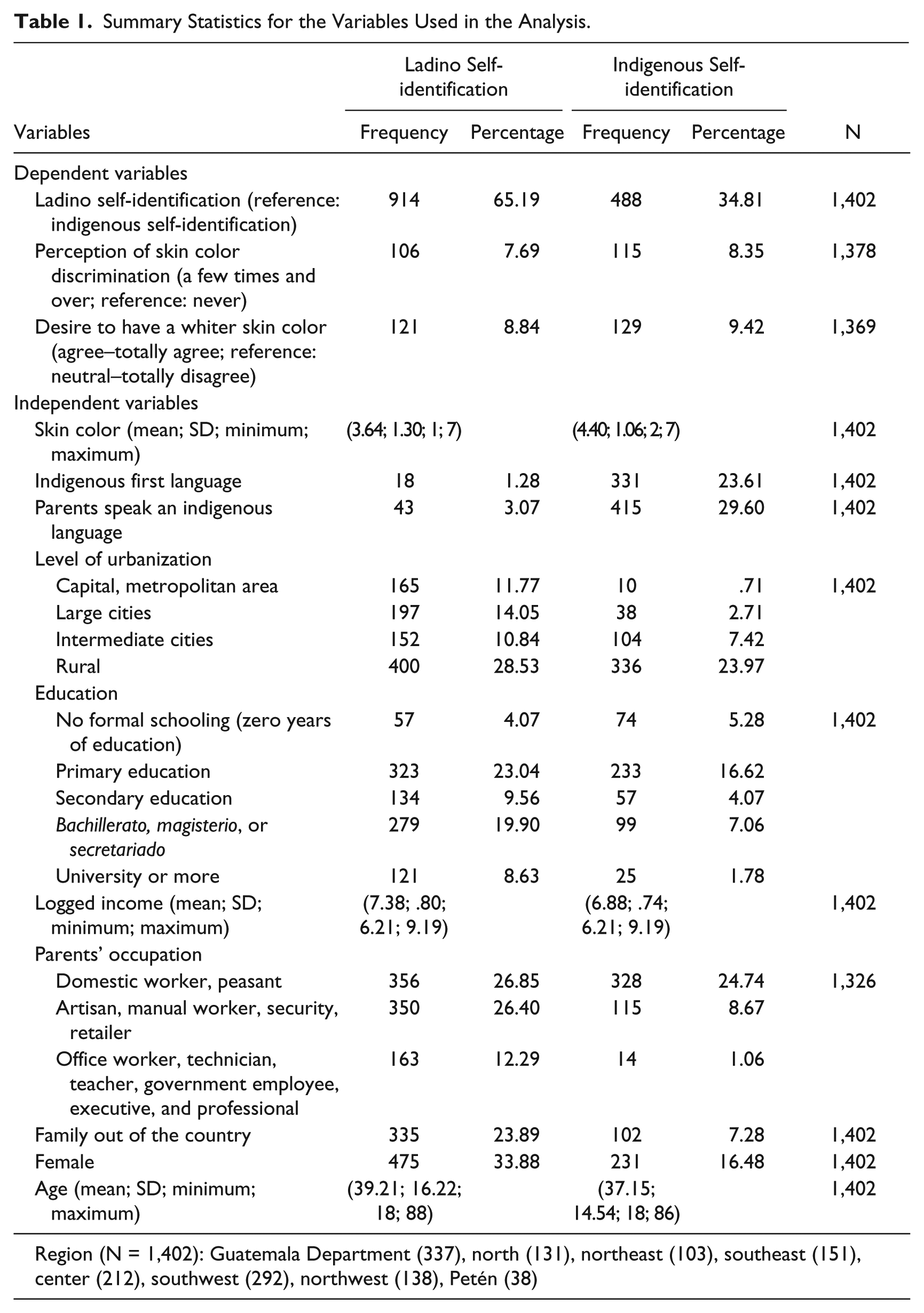
On one hand, about 35 percent of respondents in the survey self-identified as indigenous (see Table 1). This estimate contrasts to some extent with the aforementioned 2012 official survey estimate of indigenous self-identification (39.8 percent). On the other hand, about 65 percent self-identified as ladino. Table 2 presents the regression coefficients of logistic regression models converted to odds ratios predicting ladino self-identification. As expected (Hypothesis 1), respondents’ skin color is negatively associated with ladino self-identification (odds ratios lower than 1). This association is significant net of the significant impact of ancestry, captured by indigenous first language and parents speak an indigenous language. It remains significant after sequentially incorporating variables for educational attainment (Model 2), income (Model 3), parents’ occupations (Model 4), and family out of the country (Model 5). According to Model 4, the odds of self-identifying as ladino are 25 percent lower for each additional darker category of skin color (Model 4: 1–.748).
Summary Statistics for the Variables Used in the Analysis.
Selected Coefficients (Odds Ratios) of Logistic Regression Models Predicting Ladino Self-identification.
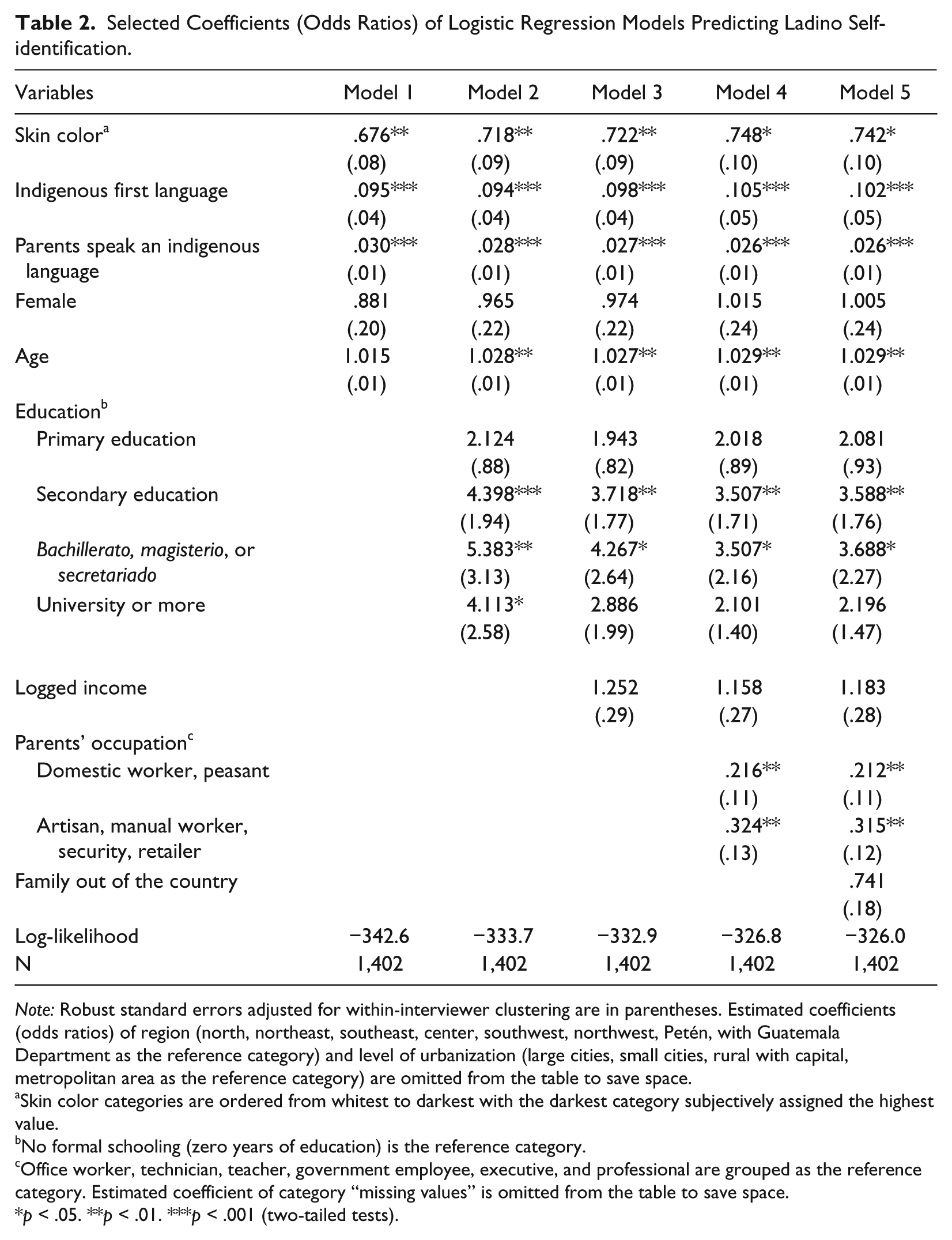
Note: Robust standard errors adjusted for within-interviewer clustering are in parentheses. Estimated coefficients (odds ratios) of region (north, northeast, southeast, center, southwest, northwest, Petén, with Guatemala Department as the reference category) and level of urbanization (large cities, small cities, rural with capital, metropolitan area as the reference category) are omitted from the table to save space.
Skin color categories are ordered from whitest to darkest with the darkest category subjectively assigned the highest value.
No formal schooling (zero years of education) is the reference category.
Office worker, technician, teacher, government employee, executive, and professional are grouped as the reference category. Estimated coefficient of category “missing values” is omitted from the table to save space.
p < .05. **p < .01. ***p < .001 (two-tailed tests).
The influence of ancestry beyond skin color on ethnic self-identification is noteworthy. The odds of self-identifying as ladino are 90 percent lower for individuals whose first language is an indigenous language and 97 percent lower for individuals whose parents speak an indigenous language (Model 4: 1–.105 and 1–.026, respectively). 10 In addition, the positive association of age and ladino self-identification suggests that the odds of self-identifying as indigenous are greater for younger Guatemalans. Moreover, Model 2 suggests that ladino self-identification and educational attainment (from secondary education to university or more) are directly associated with respect to no formal schooling as the reference category. However, the university or more coefficient becomes statistically insignificant after controlling for income (Model 3) and parents’ occupations (Model 4). These models indicate that on average, there is no evidence to suggest that more educated individuals self-identify more as ladino compared to individuals with no formal schooling. All these findings possibly reveal the influence of the efforts of the Pan-Mayan movement and Maya activism over time. These efforts may have strengthened local indigenous identities to a certain extent (see Layton and Patrinos 2006).
Furthermore, I found no evidence to suggest that income is significantly associated with ladino self-identification. 11 It is possible that money does not whiten identities (more specifically, does not de-indianize) in a country where indigenous individuals could have moved up without losing their ethnic identities (see Grandin 2000). In contrast, the odds of self-identifying as ladino are lower for individuals whose parents’ occupations were low and medium status occupations compared to individuals whose parents were skilled workers and high-ranked professionals. I also found no evidence to suggest that having family out of the country is significantly associated with ladino self-identification.
Perception of Skin Color Discrimination
About 16 percent of respondents in the survey admitted that they were victims of skin color discrimination: 7.69 percent self-identified as ladino and 8.35 percent as indigenous (see Table 1). Table 3 presents the regression coefficients of logistic regression models converted to odds ratios predicting perception of skin color discrimination. As expected (Hypothesis 2), ladino self-identification is inversely associated with perception of skin color discrimination, and indigenous ancestries and darker skin colors are directly associated with perception of skin color discrimination. These associations remain significant after controlling for educational attainment (Model 2) and parents’ occupations (Model 3). Model 3 suggests that the odds of perceiving skin color discrimination is 47 percent lower for individuals who self-identify as ladino compared to individuals who self-identify as indigenous (1–.528). Moreover, the odds of perceiving skin color discrimination are 17 percent higher for each additional darker category of skin color (1.171–1) and 77 percent higher for individuals whose first language is an indigenous language (1.770–1).
Selected Coefficients (Odds Ratios) of Logistic Regression Models Predicting Perception of Skin Color Discrimination.
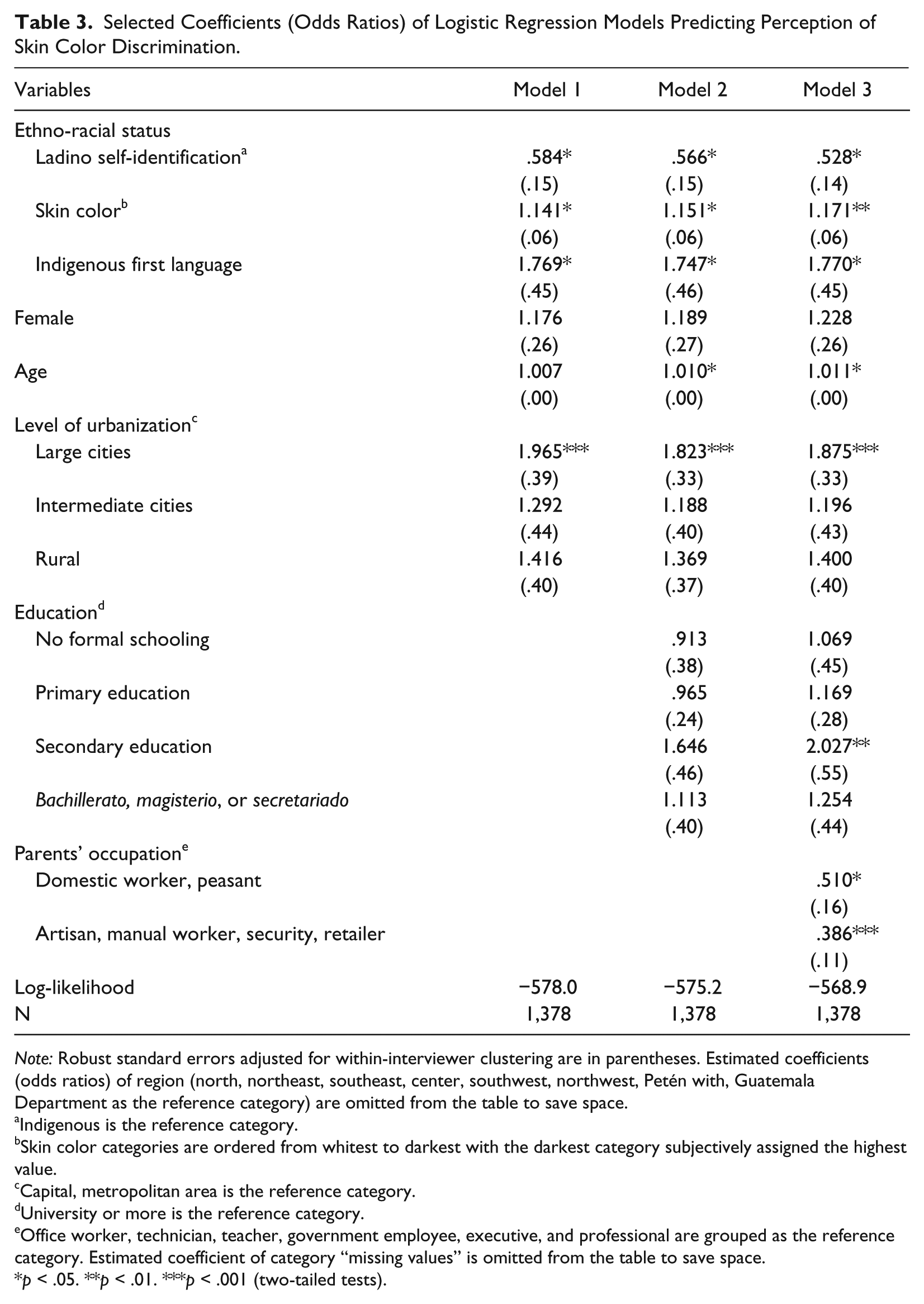
Note: Robust standard errors adjusted for within-interviewer clustering are in parentheses. Estimated coefficients (odds ratios) of region (north, northeast, southeast, center, southwest, northwest, Petén with, Guatemala Department as the reference category) are omitted from the table to save space.
Indigenous is the reference category.
Skin color categories are ordered from whitest to darkest with the darkest category subjectively assigned the highest value.
Capital, metropolitan area is the reference category.
University or more is the reference category.
Office worker, technician, teacher, government employee, executive, and professional are grouped as the reference category. Estimated coefficient of category “missing values” is omitted from the table to save space.
p < .05. **p < .01. ***p < .001 (two-tailed tests).
It is noteworthy that the odds of perceiving skin color discrimination are higher for individuals who live in large cities compared to individuals who live in the metropolitan capital. Indigenous individuals may have migrated to large cities instead of going to the capital because the former could be more convenient (e.g., more affordable cities, better networks). Large cities also could be geographically and culturally closer to their original communities compared to Guatemala City. According to the data used in this analysis, the proportions of individuals who self-identify as indigenous and individuals whose first language is an indigenous language are lower in the capital city compared to large cities (see also Roberts 2010). Ladinos who live in large cities may feel threatened by the indigenous presence that could be growing due to internal migration. Consequently, perceived threat probably increased the level of skin color discrimination in large cities (see Blalock 1967). It is also possible that the promotion of multicultural views, understood as state-driven mestizaje in other studies (Hale 2006; Telles and Garcia 2013), are lowering the recognition of skin color discrimination in Guatemala City. Due to the official character of views that promote the politics of recognition, their influence is likely stronger in the capital city. There are no significant differences in perception of skin color discrimination between the capital and areas with lower levels of urbanization.
In addition, only the coefficient of secondary education compared to university or more is positive and statistically significant in Model 3. There are no differences between the reference university or more and other lower educational categories. Individuals who only attained secondary education possibly acknowledge skin color discrimination because they do not embrace local mestizaje discourses of integration as more educated people do.
Furthermore, the odds of perceiving skin color discrimination are lower for individuals whose parents worked in low and medium status occupations compared to individuals whose parents were skilled workers and high-ranked professionals. Individuals whose parents were skilled workers and high-ranked professionals probably admit that they were victims of skin color discrimination because their higher-class origins allow them to compensate for discriminatory treatment. In addition, it is possible that they experience more skin color discrimination due to their higher level of interaction with people who can discriminate against them as it occurs with middle-class non-white individuals in whiter contexts (e.g., middle-class African Americans in the United States; see Hardaway and McLoyd 2009; Krysan and Farley 2002). It is also possible that they can identify racial discrimination as a relevant social problem. Conversely, individuals whose parents worked in lower ranked occupations may not admit that they were victims of skin color discrimination because they do not necessarily want others to know that they were victims of discrimination.
Desire for a Whiter Skin Color
About 18 percent of respondents in the survey admitted that they desire a whiter skin color: 8.84 percent self-identified as ladino and 9.42 percent as indigenous (see Table 1). Table 4 presents the regression coefficients of logistic regression models converted to odds ratios predicting the desire for a whiter skin color. Unexpectedly, I found no evidence of significant associations between the desire for a whiter skin color and ladino self-identification and between the desire for a whiter skin color and skin color. However, the odds of desiring a whiter skin color are greater for individuals whose first language is an indigenous language in accordance with the aforementioned expectations (Hypothesis 3). This association is significant after controlling for educational attainment, parents’ occupation, and perception of skin color discrimination. Model 3 suggests that the odds of desiring a whiter skin color are 67 percent greater for individuals whose first language is an indigenous language compared to individuals whose first language is Spanish/other (1.668–1).
Selected Coefficients (Odds Ratios) of Logistic Regression Models Predicting the Desire for a Whiter Skin Color.
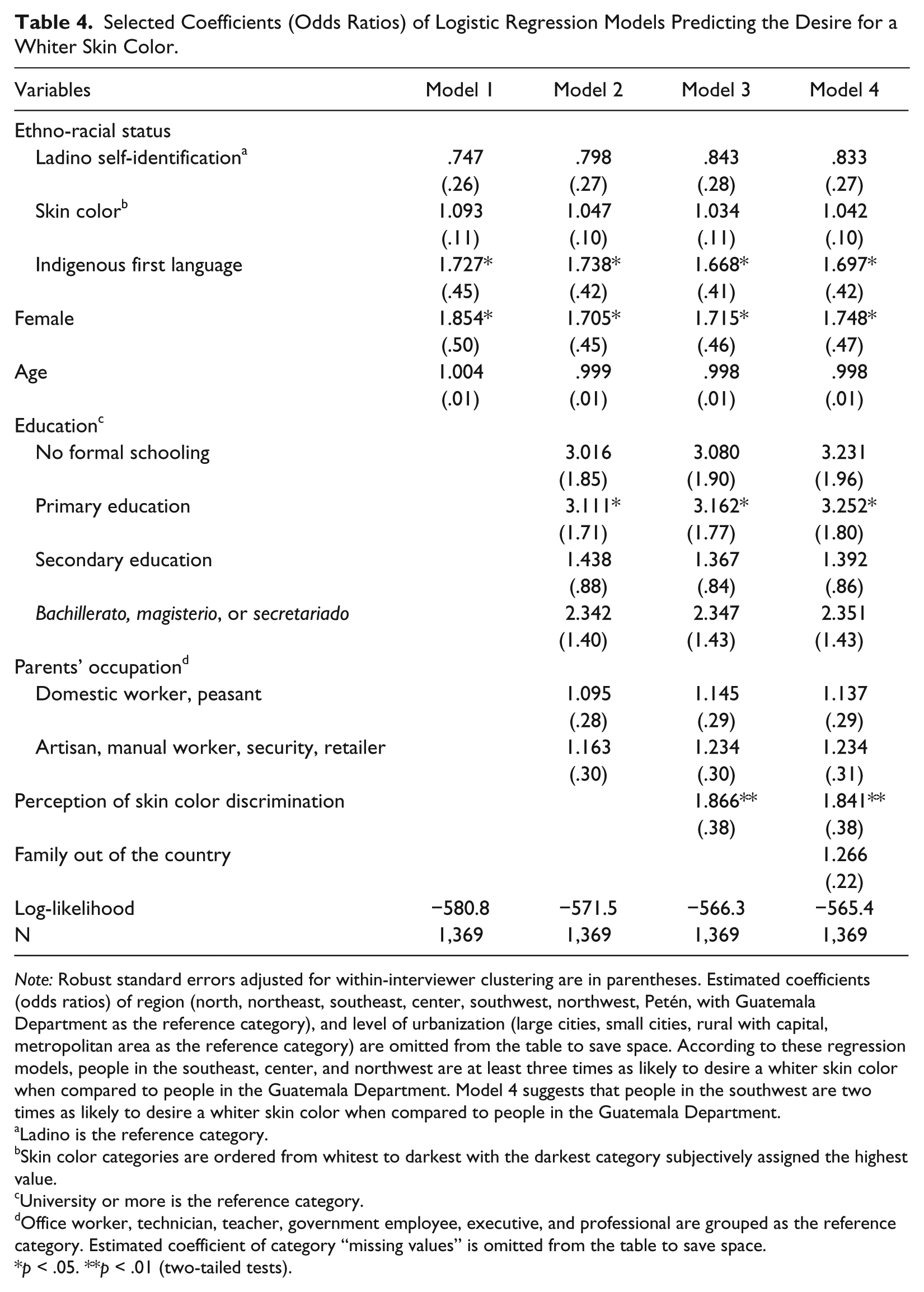
Note: Robust standard errors adjusted for within-interviewer clustering are in parentheses. Estimated coefficients (odds ratios) of region (north, northeast, southeast, center, southwest, northwest, Petén, with Guatemala Department as the reference category), and level of urbanization (large cities, small cities, rural with capital, metropolitan area as the reference category) are omitted from the table to save space. According to these regression models, people in the southeast, center, and northwest are at least three times as likely to desire a whiter skin color when compared to people in the Guatemala Department. Model 4 suggests that people in the southwest are two times as likely to desire a whiter skin color when compared to people in the Guatemala Department.
Ladino is the reference category.
Skin color categories are ordered from whitest to darkest with the darkest category subjectively assigned the highest value.
University or more is the reference category.
Office worker, technician, teacher, government employee, executive, and professional are grouped as the reference category. Estimated coefficient of category “missing values” is omitted from the table to save space.
p < .05. **p < .01 (two-tailed tests).
It is noteworthy that the odds of desiring a whiter skin color are 87 percent greater for individuals who perceive skin color discrimination compared to individuals who do not acknowledge discrimination (Model 3: 1.866–1). The perception of skin color discrimination mediates the association between indigenous first language and the desire for a whiter skin color, which decreases from Model 2 to Model 3. The association between the desire for a whiter skin color and perception of skin color discrimination suggests that individuals would like to be whiter in order to avoid discrimination. Beyond the influence of the perception of skin color discrimination, the desire for a whiter skin color by individuals with indigenous ancestries reveals the local value of whiteness as a significant aesthetic resource. Possibly because of this value and its impact on the social significance of beauty, females have greater odds of desiring a whiter skin color compared to males. Beauty is particularly relevant for women as a resource that allows them to socially and economically succeed in everyday life (see Casanova 2004). Accordingly, Guatemalan women, regardless of ethno-racial status, would like to be whiter in order to conform to the role of women in the family sanctioned by ladino society, the state, and church, and to avoid the abuse and objectification of women who are perceived as more indigenous (Nelson 1999). 12
In addition, only the coefficient of primary education compared to university or more is positive and statistically significant. There are no significant differences between university or more and other lower educational categories in the desire for a whiter skin color. Similarly, there are no significant differences in the desire for a whiter skin color by parents’ occupations. I also found no evidence to suggest that individuals who have family out of the country desire a whiter skin color more than individuals with no transnational familiar connections.
Discussion and Conclusion
In this study, I found evidence of a direct association between skin color as a proxy for phenotype and ladino self-identification in Guatemala beyond the significant impact of ancestry on the latter. This finding suggests that differences between indigenous and ladino individuals are not just cultural but phenotypical. Therefore, this finding challenges foundational views that disregarded the relevance of physical appearance as a determinant of ethnic self-identification (Colby and van den Berghe 1969; Harris 1964). Ladinos are, on average, phenotypically whiter than indigenous individuals. Greater degrees of phenotypic whiteness increase the odds of self-identifying as ladino.
Not only did I find evidence of a direct association between skin color and skin color discrimination, I also found evidence of an inverse association between ladino self-identification and skin color discrimination and a direct association between indigenous ancestries and skin color discrimination when these characteristics are examined together. These findings reveal that skin color is not the only racially stigmatized characteristic. Indigenous ancestries and indigenous self-identification are also racialized and subjected to skin color discrimination after taking into account the stigmatization that individuals with these ethnic characteristics are likely to suffer. In other words, indigenous ethnic characteristics “darken” individuals in the eyes of others.
Furthermore, ladino self-identification and skin color are not significantly associated with the desire for a whiter skin color. However, indigenous first language, an indicator of ancestry, is directly associated with this desire. Individuals with indigenous ancestries possibly desire to be whiter because, beyond the politics of recognition and the vindicating efforts of Maya activism, whiteness still represents superiority. Guatemalan authorities and elites as well as people who epitomize local beauty are, on average, phenotypically whiter individuals. It is particularly noteworthy that the perception of skin color discrimination is also directly associated with the desire for a whiter skin color. Individuals may desire to be whiter in order to avoid discrimination. This interpretation has a relevant analytic implication for the analysis of ethnic and racial issues in contexts of mestizaje. Mestizaje norms have been criticized for the promotion of whitening (e.g., Safa 2005). Nevertheless, these criticisms usually do not take into consideration that dispositions toward whitening represent in these contexts not only alignment with power but also necessary strategies to avoid individual-level discrimination. Therefore, further research is necessary to analyze how mestizaje norms of equality and inclusion are reinforced by social dynamics oriented to self-empower individuals against prevailing ethno-racial discrimination.
This study has limitations that should be taken into account when interpreting the results. I use skin color as a proxy for phenotype due to its importance as a measure of race. Nevertheless, it is possible that skin color alone does not capture other relevant phenotypic characteristics, which also could be partially captured by indigenous first language and ethnic self-identification (e.g., attributes that are normally racialized in mestizaje contexts such as hair type and height). A possible solution would be to gather more data about phenotypic characteristics to improve the measurement of phenotype in the future.
Moreover, the variable respondents’ skin colors could be problematic because the perception of interviewers is not totally objective regardless of the skin color palette and its instructions (Villarreal 2010). Interviewers could have “whitened” or “darkened” respondents based on their ethnic self-identification (asked before classifying the respondent by skin color) and other characteristics. Although I did not find evidence of significant associations between skin color classification and interviewers’ characteristics in separate analyses, it is possible that skin color classification could be significantly associated with interviewers’ characteristics that were not included in the LAPOP survey. Nonetheless, it is necessary to underscore that differences by skin color in ethnic self-identification, perception of skin color discrimination, and the desire for a whiter skin color are estimated net of parents’ occupational statuses and net of educational attainment, which should work as proxies for changes in skin color categories that may occur with increasing socioeconomic status.
Furthermore, I cannot evaluate whether skin color categorization is statistically reliable because the LAPOP data used in the analyses are cross-sectional. Longitudinal data with several measures of ethno-racial characteristics are, to my knowledge, still nonexistent in Guatemala. This study takes advantage of the LAPOP data, which offer unique information about ethno-racial traits. This study may establish the need to obtain more data in the future that will allow us to revise these findings and adjust our conceptual approaches.
In conclusion, phenotype is a significant dimension of ethno-racial status in Guatemala. Although the literature commonly portrays the indigenous/ladino divide as mainly cultural, it is necessary to consider the relevance of phenotype as a distinct dimension of ethno-racial status. The multidimensional ethno-racial status approach suggested in this study is useful to understand ethno-racial characteristics as a combination of traits that do not necessarily represent social boundaries as the meaning of mestizaje suggests beyond its ideologies (individual-level mixture). It is noteworthy that, while indigenous self-identification and indigenous ancestries are conceptually and empirically distinct dimensions, they are also racialized to the extent that individuals with these characteristics have greater odds of experiencing skin color discrimination. From this perspective, the significance of phenotype “colors” other ethno-racial dimensions according to the local perception of non-phenotypic ethno-racial characteristics.
Consequently, the governmental multicultural agenda should also take into consideration the significance of phenotypic and racial differences beyond the politics of recognition. Local policies should address educational and cultural objectives that promote views and manifestations that counter the local value of whiteness. Maya activism and local scholars could also demand well-designed policies and propose alternative pedagogical strategies that specifically attempt to increase and strengthen the cultural value of non-white manifestations in the long term.
Footnotes
Acknowledgements
An earlier version of this article was presented at the 2014 Population Association of America Annual Meeting. I am deeply grateful to Néstor Rodríguez, three anonymous reviewers, and the editors of Sociology of Race and Ethnicity for their helpful comments and suggestions. I also thank the Latin American Public Opinion Project (LAPOP), its major supporters (the United States Agency for International Development, the United Nations Development Program, the Inter-American Development Bank, and Vanderbilt University), Edward Telles, and the Project on Ethnicity and Race in Latin America (PERLA) for making the data available.
Funding
The author(s) disclosed receipt of the following financial support for the research, authorship, and/or publication of this article: The author benefited from grant 5 R24 HD042849, Population Research Center, awarded to the Population Research Center at the University of Texas at Austin by the Eunice Kennedy Shriver National Institute of Child Health and Human Development.