



Abstract
Among Mexican Americans, generational differences in education do not fit with assimilation theory’s predictions of significant improvement from the second to third generation; instead, education for third generation remains similar to the second generation and falls behind that of non-Hispanic whites. Scholars have not examined this educational gap for recent cohorts, nor have they considered a wide range of economic outcomes by generation. Using a nationally representative sample of young adults from the National Educational Longitudinal Survey, we examine various educational and economic outcomes among second- and third-generation Mexican Americans and compare it to whites and blacks. We find that third-generation Mexican Americans have similar outcomes to the second generation and lower education and economic levels than whites and blacks, even when controlling for key factors. Our findings reveal limitations to assimilation theory and suggest that the persistent low status of third-generation Mexican Americans may be largely due to their racialization. These findings coupled with prior research on Mexican Americans point to a consistent pattern of third generation disadvantage, which stands in contrast to second generation advantage.
Whether the education and economic accomplishments of later-generation Mexican Americans fit the assimilation or the racialization perspectives is hotly debated. On the one hand, the assimilation perspective assumes that immigrant groups, including Mexicans, are welcomed to U.S. society and by taking advantage of educational and economic opportunities can be upwardly mobile. This prediction fits the narrative that the United States is exceptional in providing ample opportunity for prosperity and success to all groups. In contrast to assimilation, racialization perspectives predict persistent disadvantage of particular ethnoracial groups that are located in the bottom rungs of a racially hierarchical society and who have experienced a long history of oppression, exclusion, and stigmatization (Blauner 1972; Bonilla-Silva 2003; Feagin 2006; Omi and Winant 1986). To address these competing perspectives, this article examines education, occupation, and income among Mexican Americans, compared to blacks and whites, among a recent cohort of young adults. We argue that Mexican Americans experience a distinct third generation disadvantage, which contrasts sharply with the previously documented second generation advantage (Kasinitz, Mollenkopf, and Waters 2010).
Classic Assimilation
Assimilation theory seeks to explain the progress of groups as they incorporate into a new society over time and across generations. The classical assimilation model predicts and explains the incorporation of European immigrant groups into U.S. society. The earliest models of assimilation proposed a slow process over generations leading to eventual erosion of economic, political, and social differences between immigrants and their descendants with the native population (Gordon 1964). The empirical evidence shows that European immigrant groups were successfully incorporated into U.S. society within three generations so that the third generation came to resemble the host or majority society (Alba and Nee 2003; Neidert and Farley 1985). Additionally, the classical assimilation model proposed that the host society, characterized as white Anglo-Saxon and Protestant (WASP), was static and that immigrants and their descendants would come to be like them. The integration of the descendants of Southern and Eastern European immigrants, which included large numbers of Catholics and Jews from the 1880–1920 period of mass immigration, challenged the idea that the core group would remain primarily Anglo-Saxon or Protestant. According to Alba and Nee (2003), the core evolved into a Judeo-Christian-European majority or mainstream, inspiring a largely revamped assimilation model. 1 Economic progress and political incorporation led to the dissolution of social boundaries (including high rates of intermarriage) and negligible differences in the socioeconomic outcomes by country of origin among European Americans (Brodkin 2016; Guglielmo 2004; Neidert and Farley 1985; Roediger 2005), thus producing a white majority comprised of diverse ancestry and religious backgrounds.
Segmented Assimilation
Contemporary research has focused on the integration among children of immigrants in the post-1965 era. As an alternative to the classic assimilation model, Portes and his colleagues (Portes and Rumbaut 2001; Portes and Zhou 1993) propose segmented assimilation theory to explain outcomes among the 1.5- and second-generation young adults. They argue that low human and social capital, language ability, dissonance in education between parents and children, negative contexts of reception, including treatment by the immigration system, and hostility based on race account for the diverse outcomes among young adults of various immigrant origins (Portes and Rumbaut 2001; Portes and Zhou 1993).
Based on extensive ethnographic and quantitative analysis of the children of contemporary immigrants, Portes and his colleagues found that second-generation Mexicans, Southeast Asians (Laotians/Cambodians and Vietnamese), and Haitians have relatively low educational and economic status while Filipinos, Chinese, and Cubans are more successful with respect to education and income (Portes and Fernández-Kelly 2008). They argue that groups that do not follow the traditional assimilation trajectory experience downward assimilation or “permanent poverty and assimilation into the underclass” (Portes and Zhou 1993: 82). 2 Segmented assimilation, then, adds a fuller explanation to the assimilation model in which race is but one factor. However, many of its factors, particularly language ability, education dissonance between immigrant parents and children, treatment by the immigration system, and negative contexts of reception, are applicable to those with immigrant parents and not to later generations with U.S.-born parents. If there is little progress for the third generation, contrary to assimilation theory’s prediction of continuous generational progress, then segmented assimilation theory might suggest that race becomes a major reason for explaining the outcomes of later generations.
Neo-assimilation Perspective
Alba and Nee (2003) propose a neo-assimilation perspective for the contemporary period of mass immigration, arguing that most of today’s immigrant groups will be assimilated into a new “mainstream,” much like the non-Protestant European immigrants of the earlier wave. Building on their account of an expanded mainstream for European Americans from central and southern Europe, they expect today’s nonwhite immigrants and their descendants to enter a further expanded mainstream. They believe that racism is no longer a major force impeding the progress of minorities since affirmative action and civil rights reforms have raised the costs of discrimination and lowered exclusionary barriers for racial minorities (Alba 2009; Alba and Nee 2003). The empirical evidence used to argue for the neo-classical assimilation perspective is based on the experiences of the first and second generation among contemporary immigrant groups (as opposed to the third or later generations). Kasinitz et al. (2010) provide a prominent example of this perspective with their finding that the second generation in New York City experiences greatly improved outcomes compared to their first-generation parents. 3
Mexican Americans are the only sufficiently large non-European group that allows for the study of three or more generations because their immigration spans the entire twentieth century. Like most European origin groups, Mexican immigrants start at the bottom of the socioeconomic ladder, but unlike European origin groups, they have not fully assimilated by the third generation (Alba et al. 2011; Chapa 1988; Farley and Alba 2002; Neidert and Farley 1985; Telles and Ortiz 2008). While second-generation Mexicans do better educationally than their modestly educated immigrant parents, the third and later generations do not reach parity with whites, and their educational levels are similar to those of the second generation. By controlling for the socioeconomic status of parents, education for third-generation Mexican Americans is lower than the second (Telles and Ortiz 2008) since the parents of the second generation are low-educated immigrants. This deems the achievements of their second-generation children as especially successful compared to their parents. 4
Still, Alba and his colleagues defend assimilation theory for the Mexican case by claiming that assimilation explains the experience of some of the Mexican American population (Alba 2006; Alba et al. 2011; Alba and Islam 2009; Alba, Jiménez, and Marrow 2013). For instance, Alba et al. (2013) use internal heterogeneity to make a case for the assimilation of Mexican Americans. They point out that a segment of Mexican Americans shows “assimilation . . . evinced by ethnically mixed ancestry, intermarriage, movement away from established Mexican American areas of concentration, and postsecondary education” (Alba et al. 2013: 447). 5 However, that some Mexican Americans are successful and that there is substantial heterogeneity within the group is not sufficient evidence of assimilation. Moreover, this is not consistent with the major theories of assimilation that tend to consider the accomplishments of the group, on average, as indicative of being assimilated. After all, all groups show variation, with some members being as successful as those in the mainstream and others doing less well. For instance, Italians (who arrived between 1880 and 1920) were not considered assimilated until the 1970s. As the slowest group to assimilate, they exhibited considerable heterogeneity. Yet only when the group reached parity with other European groups did assimilation scholars deem Italians fully assimilated (Neidert and Farley 1985).
Alba and Islam (2009) argue that the educational outcomes of Mexican Americans are underestimated because more successful Mexican Americans stop identifying with the group. They contend that “their exit from the group is linked to entry into the mainstream” (Alba and Islam 2009:118). However, the segment that they consider to have exited (persons identified as non-Hispanic but Mexican by nativity) are only 3 percent of the Mexican American group. While these non-Hispanic Mexicans have higher educational outcomes (e.g., 53 percent compared to 38 percent have some postsecondary education), this 3 percent is not large enough to account for the overall educational disadvantages of Mexican Americans. Also, Duncan and Trejo (2011) show that the third generation who are children of intermarriage and do not identify as Hispanic are more successful (13.5 years of education) compared to among those who identify as Hispanic (12.5 years). Yet, the education level of the two groups combined (12.7 years) is only slightly greater than that among the Hispanic-identified group, suggesting that losing non-identified Mexicans does not explain the educational disadvantage of Mexican Americans.
Other scholars have also been optimistic about Mexican American assimilation. Smith (2003) constructs a lagged comparison of age cohorts of first-, second-, and third-generation Mexicans, representing a 100-year time span (using U.S. census and Current Population Survey [CPS] data). He argues that generations two and three do better in education and income than immigrant-parent cohorts, that parent-child differences decrease over time, and that the gap between Mexican Americans and whites decreases over time. Despite these trends, significant gaps in income and education between third-generation Mexican Americans and whites persists. Zhou and Lee (2007) provide another example that emphasizes assimilation. They critique “‘objective’ measures often used in social science research” (Zhou and Lee 2007:190) and focus on “‘subjective’ measures presented by members of the second generation” (Zhou and Lee 2007:190); the latter emphasizes how the second generation perceives, defines, and measures mobility and success. Second-generation Mexican Americans feel successful because they compare themselves to their less educated immigrant parents; second-generation Chinese feel less successful because they compare themselves to highly educated and successful immigrants (due to selective immigration from Asia). While self-perceptions of success are important, their argument that these relative and subjective comparisons of success are indicative of assimilation is problematic. These perceptions cannot substitute for objective measures of mobility and incorportation, similar to what has been used in most assimilation research.
Limitations of Prior Research
The prior research on later-generation Mexican Americans has several limitations. First, it relies on cohorts from earlier decades. Studies of adults with data collected around 1980 are based on cohorts born between 1915 and 1954 (Chapa 1988; Neidert and Farley 1985). Other studies with 2000 data are based on adults born between mid-1940s and mid-1970s (Alba and Islam 2009; Farley and Alba 2002; National Academies of Sciences 2015). 6 Telles and Ortiz (2008) examine a cohort born between 1947 and 1966. Second, the research is generally limited to education outcomes even while focusing on more recent cohorts. Alba et al. (2011) use National Education Longitudinal Surveys (NELS) based on respondents born between 1972 and 1975, and National Academies of Sciences (2015) use CPS data of respondents born between 1969 and 1988. Third, Bean, Brown, and Bachmeier (2015) focus on a cohort born between 1964 and 1984 and analyze both education and economic outcomes but is limited to Los Angeles.
Lastly, the only study to provide a comprehensive analysis of later generations and numerous outcomes is based on a longitudinal and intergenerational survey of Mexican Americans in Los Angeles and San Antonio (Telles and Ortiz 2008). It is not national in scope, although respondents range from first to fourth generation and the analysis models actual intergenerational change. According to Alba et al. (2013), it is possible that Mexican Americans in Los Angeles and San Antonio face greater barriers because they are part of large and distinctive communities. So, while the educational disadvantage is well documented, we know less about how recent cohorts of later-generation Mexican Americans fare socioeconomically. So, more research is needed on the disadvantages faced by recent cohorts of second- and third-generation Mexican Americans on a diverse set of outcomes with national data. Moreover, recent cohorts are imperative to study since discrimination is considered diminished in the post-Civil Rights era (Alba and Nee 2003).
Working-class Stagnation and Racialization
An alternative to assimilation theory is a model of working-class stagnation in which Mexican Americans progress but their integration is into working-class jobs and communities. Bean et al. (2015) show that while educational levels for third-generation Mexican American men are similar to the second generation and behind those of whites, they earn higher incomes compared to the second generation. In contrast, Mexican American women do better educationally and economically. According to Bean et al. (2015), this is consistent with the working-class delay perspective that being able to earn more with minimal education dampens incentives to pursue costly higher education. Similarly, Terriquez (2014) shows that young third-generation Mexican Americans are less likely to enroll in college and obtain a college degree and more likely to join the labor force.
A racialization framework proposes that the economic and social hierarchies are largely based on societies making racial distinctions among its members; these distinctions assign undesirable characteristics to some groups and systematically exclude them from fully benefitting from societal institutions such as education (Telles 2006). Racialization frameworks help us understand the processes by which groups are incorporated into society and the position to which they are relegated in society. For instance, scholars of race have documented how blacks were historically incorporated first as an enslaved class and later as an oppressed class in U.S. society, with consequences for their contemporary disadvantaged class and racial position. Based on a history of exclusion, exploitation, and oppression, African Americans have ended up at the bottom of the economic, political, and social hierarchy. Other groups have also been racialized, but they ended up at different points in the racial hierarchy (Treitler 2015). For instance, a whitening or de-racializing process for Europeans in the mid-twentieth century allowed them to shed their earlier racialization and fully assimilate by becoming white Americans.
While there is considerable agreement about the racialization of blacks and whites, there is considerable debate today about the experiences of nonwhites and nonblacks in U.S. society. Will the U.S. mainstream expand further to include nonwhites/nonblacks, or will U.S. society incorporate nonwhites into positions in the racial hierarchy that differ from those of whites and blacks? Latinos and Asians are at the center of debates about their position in the racial hierarchy. Some scholars have argued that the boundaries of whiteness will expand to include Latinos and Asians (Alba 2009; Yancey 2003), essentially maintaining the racial division between black versus nonblack. 7 On the other hand, Bonilla-Silva (2004) proposes a triracial system in which some Latinos and Asians will be accepted as white, called “honorary white,” and others will be part of the “collective black” category at the bottom. Conceptualizing a racial hierarchy with just two or three categories seems inadequate given the diversity and complicated histories of Latinos and Asians and the racial variation within these groups. Rather, the middle span of the racial hierarchy is more complicated with different groups in different time periods situated at different points along the continuum from white to black.
As the largest subgroup among Latinos, Mexican Americans figure prominently in debates about this racialization process. The presence of Mexican Americans in the United States emerged from the colonization of the Southwestern United States in the mid-nineteenth century and the ensuing decades of immigrating to fulfill needs for low-wage, low-status labor (Almaguer 1994; Montejano 1987; Telles and Ortiz 2008). They have been stigmatized as foreigners and outsiders even in later generations (Almaguer 1994; Montejano 1987; Ngai 2004; Telles and Ortiz 2008). Moreover, they have been racialized by law and custom, classified as a distinct racial group, discriminated in public policy, faced expulsion from the country, and often segregated from mainstream societal institutions (Gomez 2007), unlike the experiences of Americans of European ancestry (Fox 2012; Fox and Guglielmo 2012). In recent decades, Mexican immigrants have disproportionately faced hostility due to undocumented status, including mass deportations, which has affected their immigrant and U.S.-born children (Bean et al. 2015; Gonzales 2011).
Present Study
We revisit the debates about assimilation and racialization by studying Mexican American young adults, comparing to whites and blacks, using a national sample, and extending the analysis to include economic integration. Our analysis involves (1) comparing Mexican Americans by generational status (including second and third generations) and to whites and blacks; (2) examining a range of outcomes, including education, occupation, and income; (3) utilizing a nationally representative sample; and (4) focusing on a recent cohort of young adults. We address the question: Do recent cohorts of third-generation Mexican Americans now follow the assimilation model in that they move ahead of the second generation and reach the socioeconomic level of whites, or does their progress stagnate, showing a third generation disadvantage, as the bulk of previous evidence has shown for older cohorts?
Methods
Data
In this article, we use the National Education Longitudinal Surveys, a nationally representative sample of eighth graders (mostly 13 years old) in 1988. They were subsequently reinterviewed every two years—in 1990, 1992, and 1994—and lastly in 2000 when they were about 26 years old. This data set includes many background characteristics collected in the initial survey and educational experiences as they continue through school. Surveys were collected from teachers and parents. As the respondents aged, they were asked about college and work, which we use as outcome variables. We analyze a subset of respondents selected on race/ethnicity and generational status (described in the following section on comparison variables).
Outcomes
Education
Education outcomes are a series of dichotomous variables: graduate high school (including obtaining a GED), attend college, attend a four-year college, and obtain a degree from a four-year college, which are compared to the omitted category of less than high school graduation. Each education variable is coded zero/one. These are obtained from the follow-up surveys, particularly the last one in the 2000. We used the composite variables created by NELS staff.
Education, school, and work activity
This variable captures whether respondents are actively employed and/or going to school. It includes the following categories: (1) the least active or those who do not have a college degree, are not attending school, and do not work or work part-time; (2) those who pursued work, not school, meaning they do not have a college degree, are not attending school, and work full-time; (3) those who are delayed yet still pursuing their educational plan, meaning they do not have a college degree and are attending school; and (4) those who have earned a college degree (most work full-time while a small number continue their schooling).
Occupation
Occupation, as collected in the last wave of NELS, was used in the analysis. The occupational categories were recoded into four categories from low status to high status: (1) low-status category such as cashiers, clerks, and laborers; (2) low- to mid-status category such as mechanics, skilled operatives, and protective services; (3) mid- to high-status category such as sales, medical practice professionals, and legal support; and (4) high-status category such as legal professional, engineers, and executive managers.
Personal income
Personal income was also available for 1993 when most respondents were age 19 and then again in each of the years 1997, 1998, 1999, and 2000, allowing us to examine change over time in a descriptive manner. Additionally, we divide 1999 income into quartiles: Less than $12,000; $12,000–$21,999; $22,000–$31,999; and greater than $32,000 (very few respondents had personal income levels above $50,000). The cutoff for the lowest category is somewhat above the poverty threshold of $8,300 for a single person in 2000. For the multivariate analysis, we examine personal income in 2000, when respondents were generally 25 years old.
Comparison Variables
Race-ethnicity
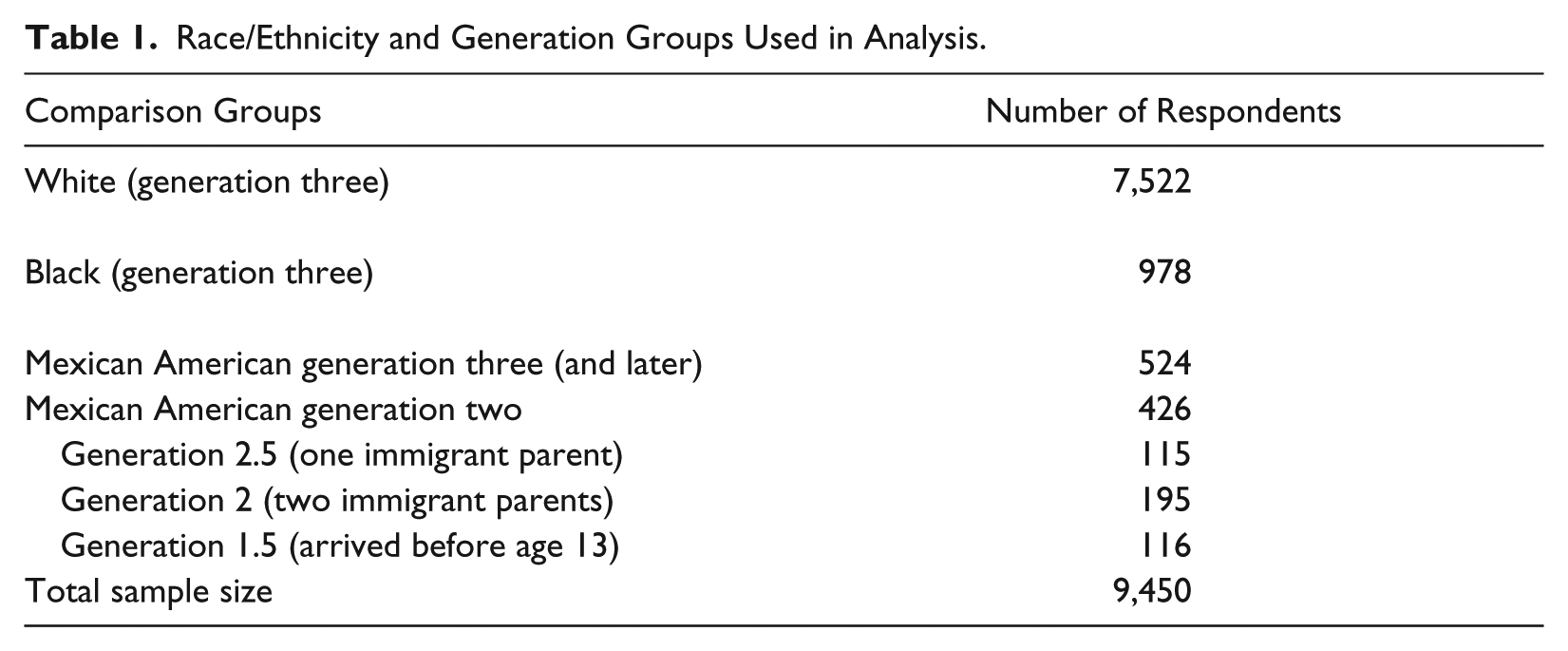
The primary race/ethnic distinction used in this article is white, black, and Mexican American. We used the composite variables created by NELS staff to identify race/ethnicity. 8 A small number of whites and blacks are children of immigrants, and we exclude them from the analysis. Table 1 shows that the sample sizes are: 7,522 whites, 978 blacks, and 950 Mexican Americans. 9
Race/Ethnicity and Generation Groups Used in Analysis.
Generational status
Generational status is based on respondent’s place of birth as well as that of mother’s and father’s place of birth (collected from parents in the parent survey). Generation three consists of respondents who are born in the United States and both parents are born in the United States. In our sample, 524 respondents are third- and later-generation Mexican Americans (see Table 1), but for simplicity’s sake, we refer to this group as third generation. Generation two refers to persons that were born in the United States of immigrant parents; some second generation have two immigrant parents (which is sometimes referred to as generation 2.0) and others have one immigrant parent and one U.S.-born parent (referred to as generation 2.5). A small number of the Mexican American respondents are immigrants who arrived in the United States before the age of 13, since their inclusion in the NELS sample means they were attending school in the United States at age 13. Ideally, we would have maintained the distinctions among these more specific generational categories, but as shown in Table 1, these categories were relatively small. 10 The combined second-generation group includes 426 respondents.
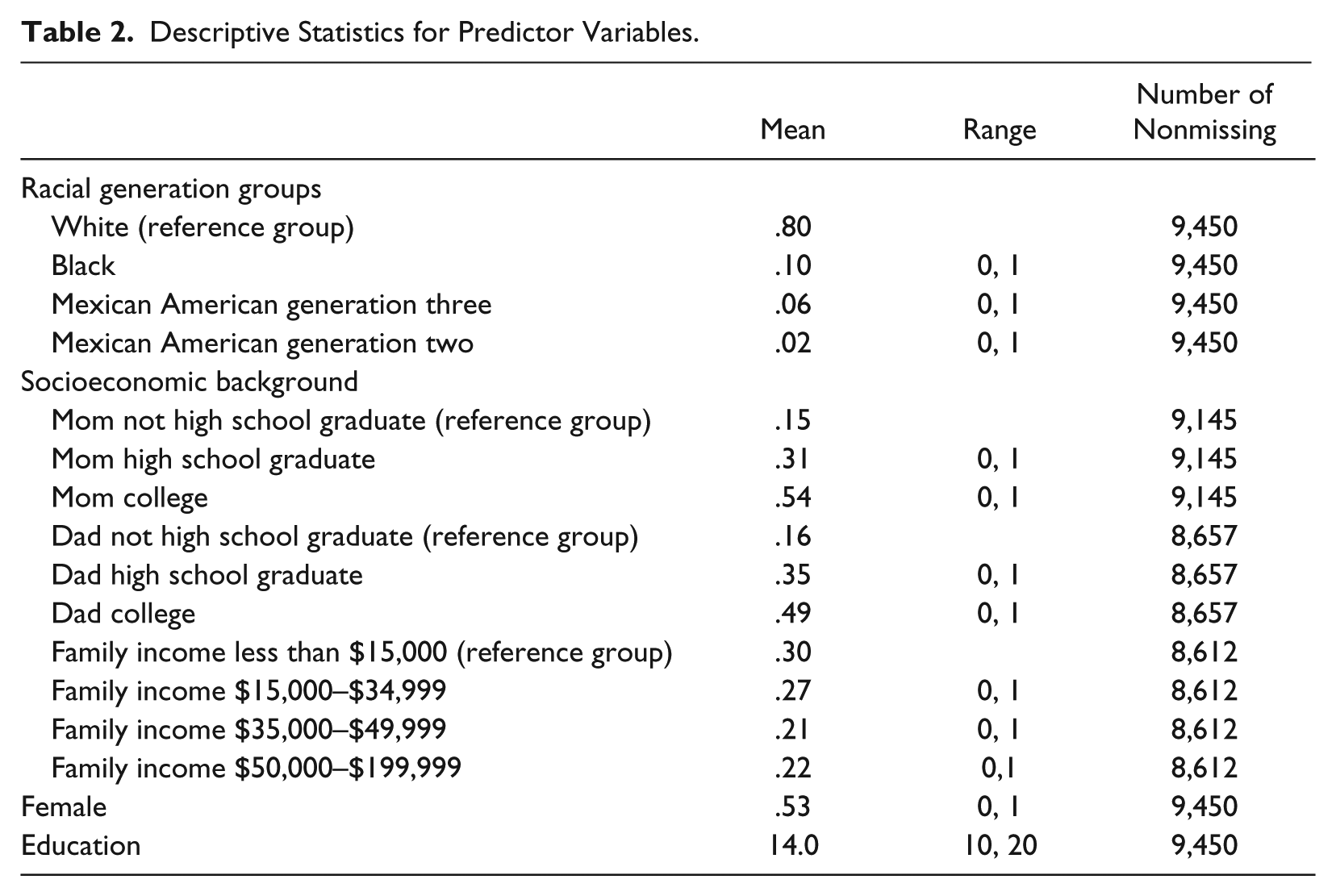
Table 2 presents means for the race/ethnic/generation groups representing our key comparisons. Ten percent are later-generation (meaning third generation or later) blacks, 6 percent are later-generation Mexican Americans, and 5 percent are second-generation Mexican Americans. The reference group is later-generation whites, which comprises 79 percent of the sample.
Descriptive Statistics for Predictor Variables.
Omitted groups
We considered doing generational comparisons with other groups, but no other groups are large enough or appropriate. One group is second-generation whites of diverse origins that differ from the countries of origin among third-generation whites. Second are second-generation blacks who differ in important ways from third-generation African Americans. Third are Asian-origin respondents because there were too few third-generation respondents and too many origins (Chinese, Japanese, Filipino, etc.). Even Chinese, the largest group among Asians, are too few in the NELS sample to analyze separately. Fourth are other Latinos that we excluded because there were too few respondents and too diverse in origins (Puerto Ricans, Dominicans, Cubans, etc.).
Control Variables
Socioeconomic background
We examine mother’s and father’s education separately as categorical variables with the following categories: less than high school (the reference category), completed high school, attended or graduated college. Table 2 shows that 53 percent of mothers are college graduates and 30 percent have some college; 45 percent of fathers are college graduates, and 32 percent have some college. Family income is a categorical variable comprised of: less than $15,000 (the reference category); $15,000 to $35,000 with 25 % $35,000 to $50,000 with 19 % and $50,000 or more with 20 percent.
Gender
Gender is coded as one for female and zero for male. More than half—53 percent—are women.
Education
Education is used as an outcome variable in our analysis. Second, for the analysis of occupation and income, years of education is used as a continuous independent variable. On average, respondents have some college (mean = 14 years).
Analysis
Our primary comparison is among later-generation whites and blacks and Mexican Americans separately by second and third generations. We present percentages for four outcomes: education, school/work activity, occupation, and income. Since the dependent variables are categorical, we use multinominal logistic regression for the multivariate analysis. We present unadjusted differences from the multinominal logistic regressions as well as adjusted differences controlling for the control variables—parental education and income, female, and education (for the economic outcomes). 11 We use multiple imputation models to address the small percentage of cases that have missing values in parents’ education and income (Johnson and Young 2011; White, Royston, and Wood 2011). Our sample is based on 9,450 cases who have nonmissing values on race generation status, our key independent variable, and education.
Findings
Education
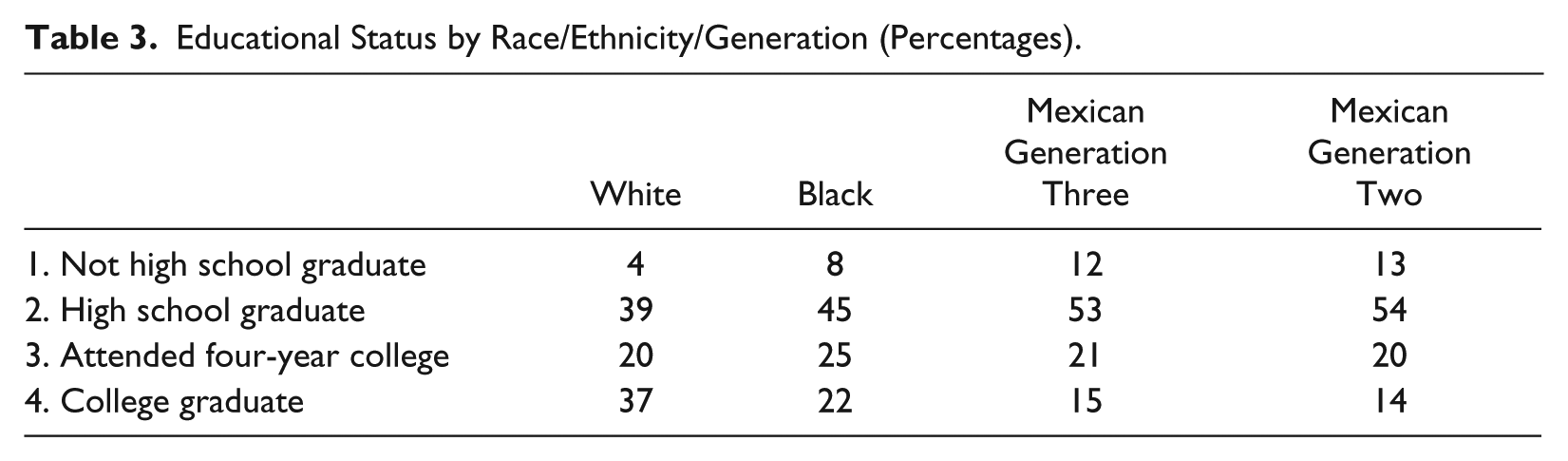
Table 3 presents educational outcomes for whites, blacks, and Mexican Americans; Table 4 presents analysis from the multivariate analysis. Most respondents have completed high school, yet second- and third-generation Mexican Americans are three times more likely to have not completed high school compared to whites and 50 percent more likely than blacks—12 percent among the third generation and 13 percent among the second generation compared to 4 percent for whites and 8 percent for blacks. The unadjusted differences (shown in Table 4) indicate that Mexican Americans and blacks are statistically significantly less likely to complete high school. Still, it is encouraging to note that high school graduation rates are relatively high, including among Mexican Americans.
Educational Status by Race/Ethnicity/Generation (Percentages).
Unadjusted and Adjusted Differences in Educational Status (Multinomial Logistic Regression).
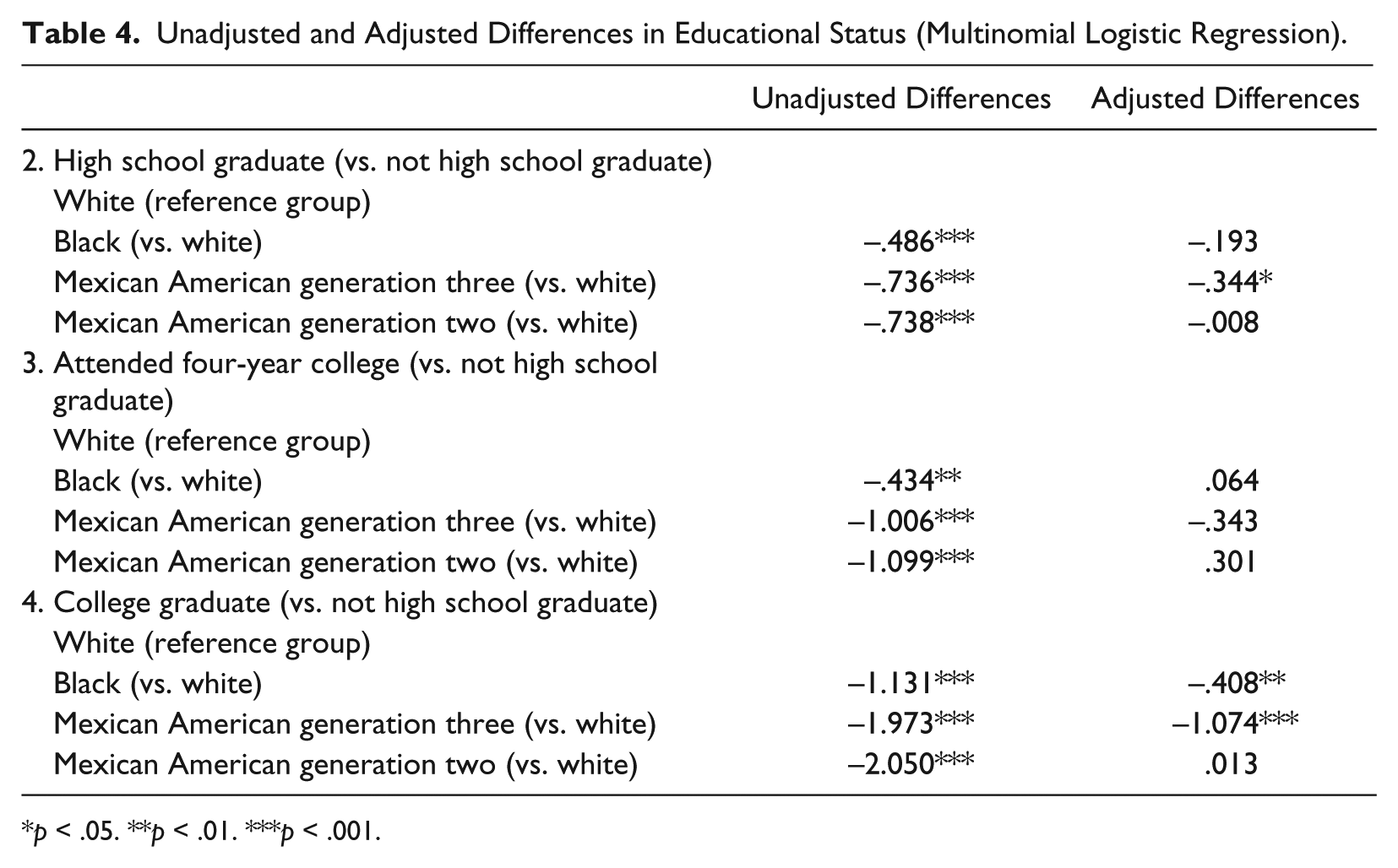
p < .05. **p < .01. ***p < .001.
The relative youth of the sample (age 26 at the time of the interview) means that many are still in the process of completing their college education. Among whites, 37 percent are college graduates. But far fewer Mexicans Americans have completed college—14 percent among the third generation and 15 percent among the second generation. College completion rates are also several percentage points less than those of blacks. Again, unadjusted differences (shown in Table 4) are statistically significant. Overall, the race/ethnic differences are consistent in that whites have more education and Mexican Americans have the lowest educational outcomes.
The third column of Table 4 shows adjusted group differences after adding the control variables (parental education, family income, and female). With the control variables in the models, we find that second-generation Mexican Americans do not differ significantly from whites. Since the immigrant parents of the second generation have especially low education levels, the difference between second-generation Mexican Americans and whites is sharply reduced. Third-generation Mexican Americans, however, continue to have lower rates of completing high school and completing college even after adjusting for parental characteristics. The parents of the third generation (who are second generation) are not as disadvantaged educationally as the parents of the second generation (who are immigrants), so adjusting for their status does not explain the outcomes for the third generation. Additionally, third-generation African Americans have significantly lower rates of completing college compared to third-generation whites but not as low as the rate among third-generation Mexican Americans.
Education, School, and Work Activity
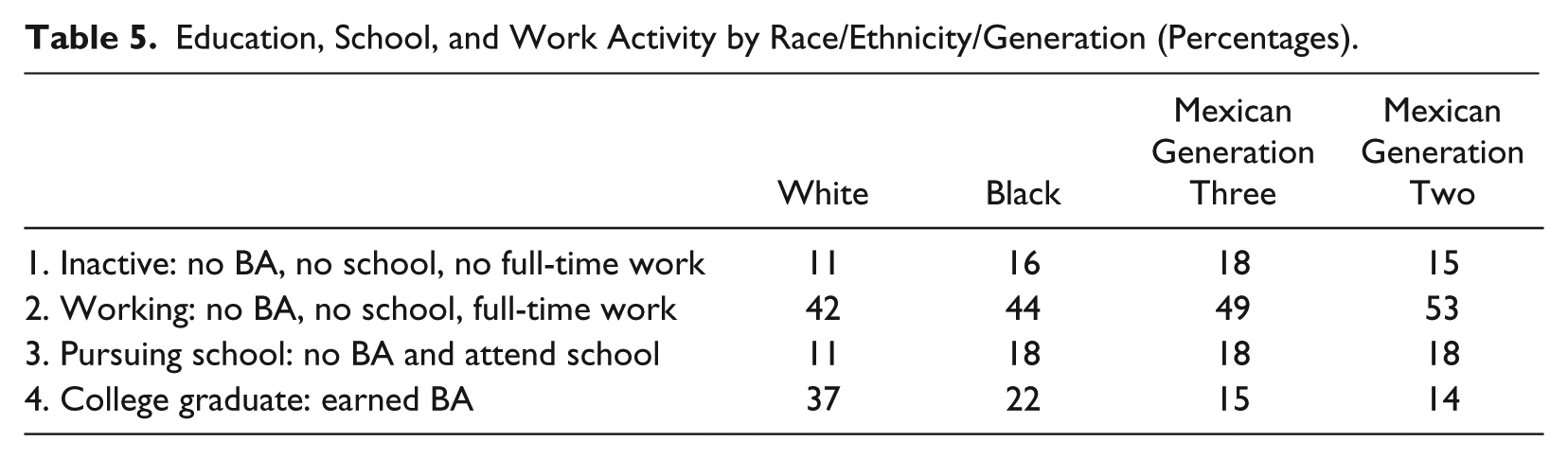
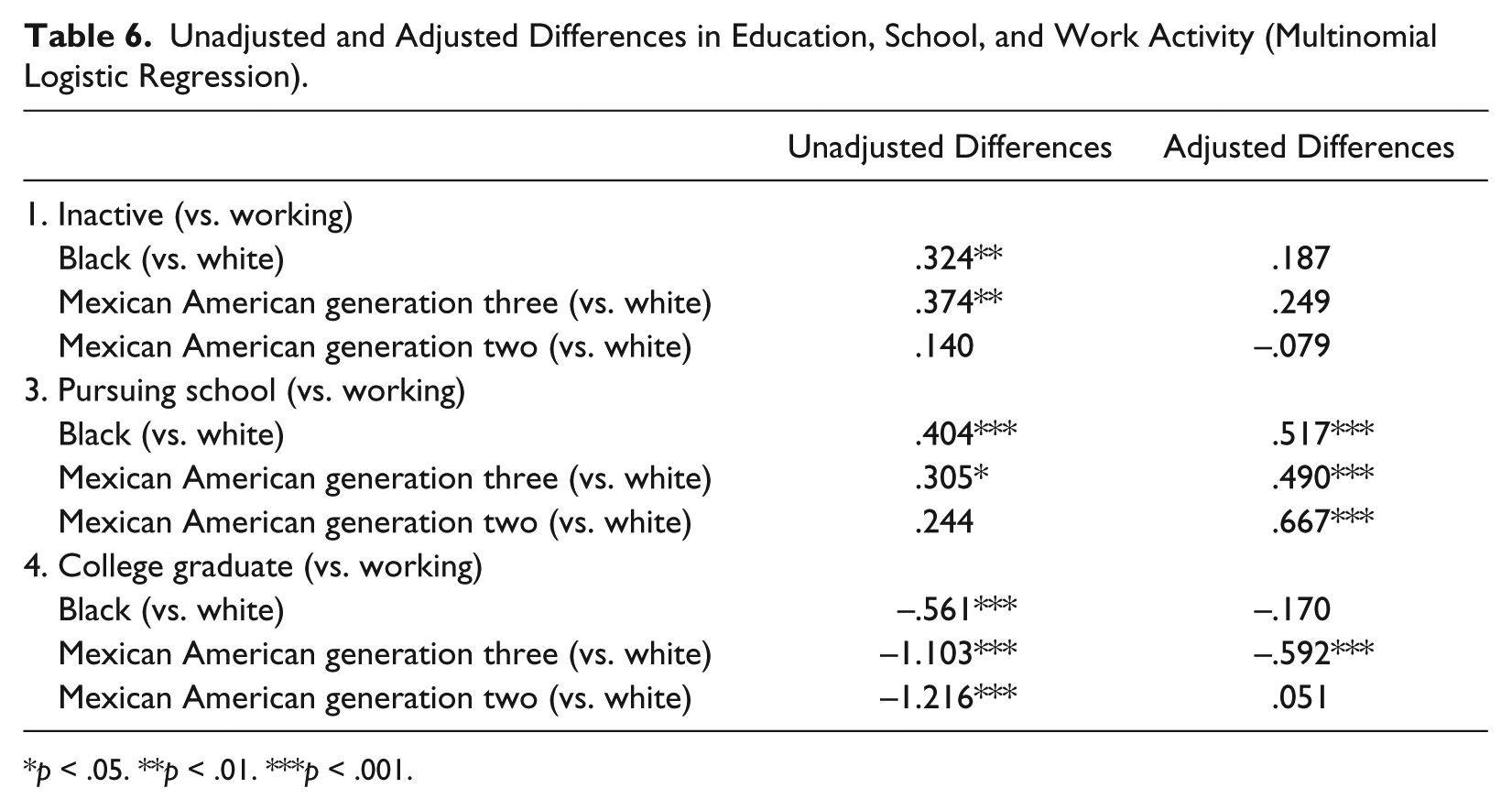
Table 5 presents the measure of activity that combines education, attending school, and working. Few respondents are in the inactive category, in which they have not completed college, are not attending school, and are not working full-time (line 1). Still, the most inactive groups are blacks and third-generation Mexican Americans, who differ significantly from whites (Table 6). At the other end of this categorical variable are the college graduates (line 4, Table 5)—more of a third of white respondents are in this category as compared to 15 percent of third-generation and 14 percent of second-generation Mexican Americans, with blacks falling midway between whites and Mexican Americans (22 percent); all three race/generation groups differ significantly from whites. The largest percentage involves those who are working (do not have a college degree, are not in school, and work full-time, line 2). Second-generation Mexican Americans are more likely to be working, with 53 % 49 percent of third-generation Mexican Americans are working, and 42 percent and 44 percent whites and blacks, respectively, are in this category. Even though they have lower levels of education, we observe that second- and third-generation Mexican Americans and African Americans are pursuing school (line 3) to a greater extent, and the black and third-generation Mexican American groups differ significantly from whites in this respect. Overall, this detailed breakdown shows that whites are in the most advantaged group in that they are more likely to be college graduates and all three of the race and generation groups differ significantly from whites. Mexican Americans and African Americans are disadvantaged in that they do not have a college degree, yet many continue to pursue school.
Education, School, and Work Activity by Race/Ethnicity/Generation (Percentages).
Unadjusted and Adjusted Differences in Education, School, and Work Activity (Multinomial Logistic Regression).
p < .05. **p < .01. ***p < .001.
The adjusted group differences are shown in Table 6. Once the control variables are included in the models, the racial/ethnic groups do not differ significantly in being inactive (not attending school, not working full-time, and no college degree, Category 1). Moreover, the racial/ethnic differences in pursuing school among those without a college degree (Category 3) are significant. So, while African Americans and third-generation/second-generation Mexican Americans are less likely to be college graduates by age 26, both groups are more likely to be pursuing school than whites. This difference is large and significant after controlling for background differences, including differences in parents’ education.
Occupation
Table 7 presents the occupational distribution by race/ethnicity and generational status. Whites are less likely to be in lower status occupations (28 percent) compared to blacks (39 percent) and Mexican Americans—39 percent among the third generation and 36 percent among the second generation. At the other end of the distribution, smaller percentages of blacks—7 percent—and Mexican Americans—5 percent among the third generation and 4 percent among the second generation—are in the highest status occupations compared to 11 percent of whites. All three race generation groups are significantly less likely to be higher status occupations.
Occupational Status by Race/Ethnicity/Generation (Percentages).
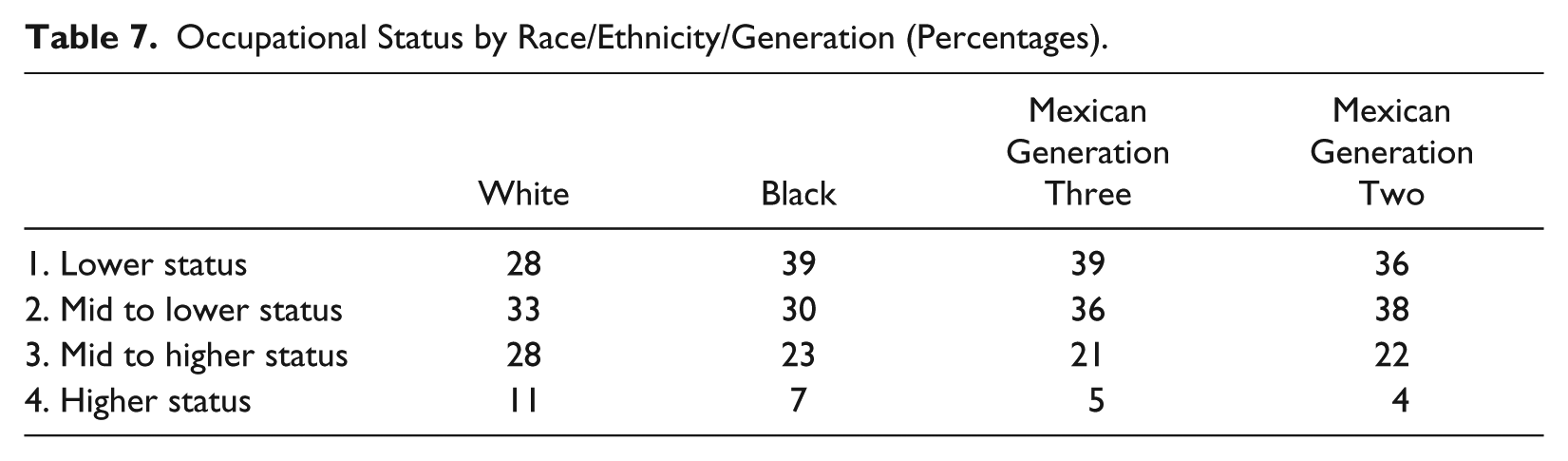
The adjusted differences are presented in the third column of Table 8. Even in the adjusted model, third-generation Mexican Americans continue to have lower rates of being in higher occupational categories compared to whites. African Americans are less likely to be in the mid to low– and mid to high–status occupations compared to whites. Racial/ethnic differences are extensively reduced once we control for education since education is a strong predictor of occupational status and Mexican Americans have the lowest education. 12 Still, education is not able to explain all of the disadvantage faced by third-generation Mexican Americans.
Unadjusted and Adjusted Differences in Occupational Status (Multinomial Logistic Regression).
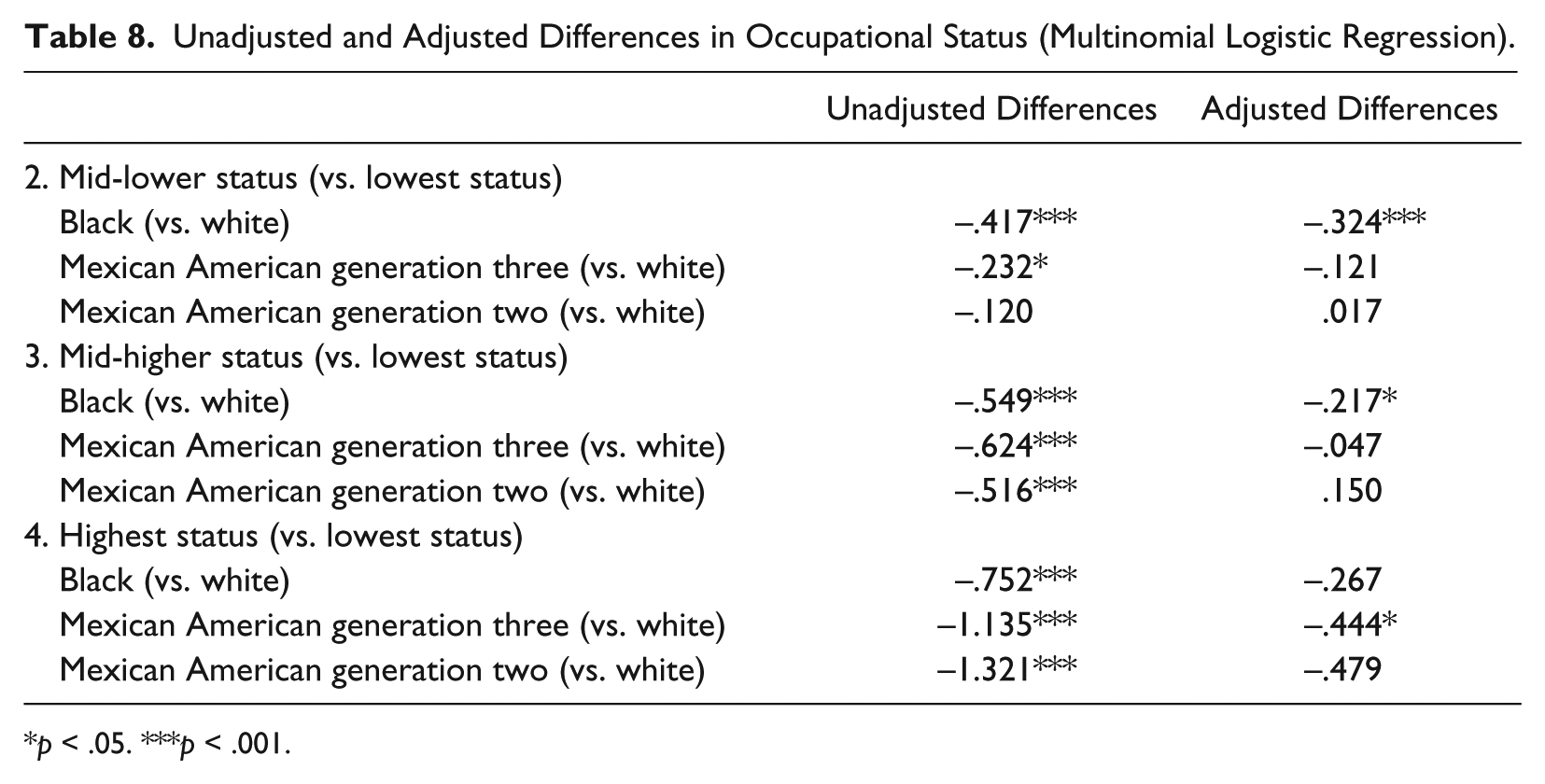
p < .05. ***p < .001.
Income
Figure 1 presents income distributions by race/ethnicity and generational status. The figure shows change in income as they get older. At age 19 (in 1993), all of the racial/ethnic and generational groups have relatively low incomes—around $6,000 to $7,500. These low levels of income are probably due to the fact that most 19-year-olds are working for the first time in low-paid jobs or working part-time and attending school. In the next six years following 1993, income among whites increased most sharply. By 1999, whites have incomes of $25,500 while blacks have incomes of $20,800, third-generation Mexican Americans have income levels of $19,000, and second-generation Mexican Americans have incomes of $21,800. Just as their income gains were greatest, college completion rates among whites also rose most sharply in this six-year period (analysis not shown), showing the link between education and income.
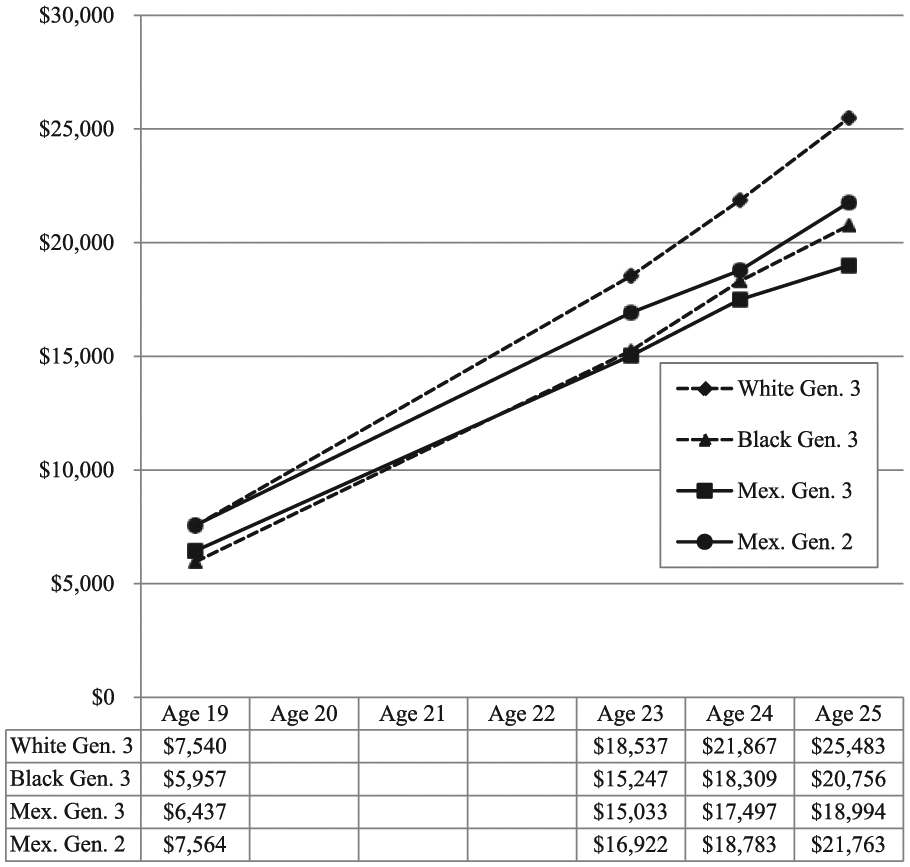
Income from age 19 to age 25 by race/ethnicity and generation (annual personal income from age 19 in 1993 to age 25 in 1999).
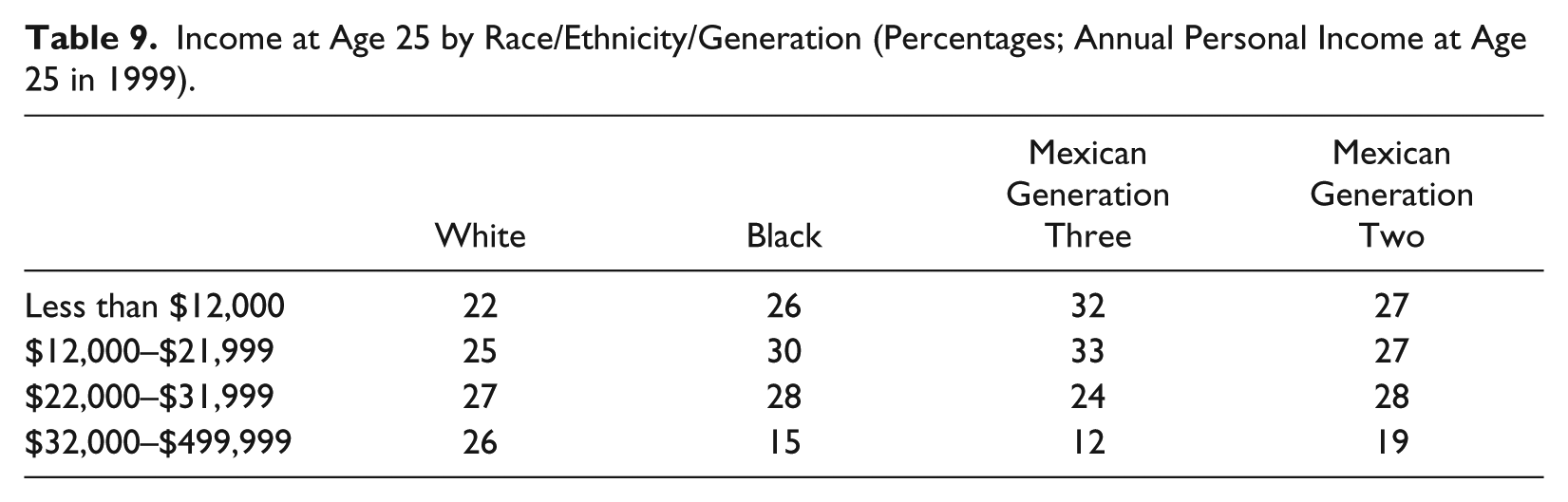
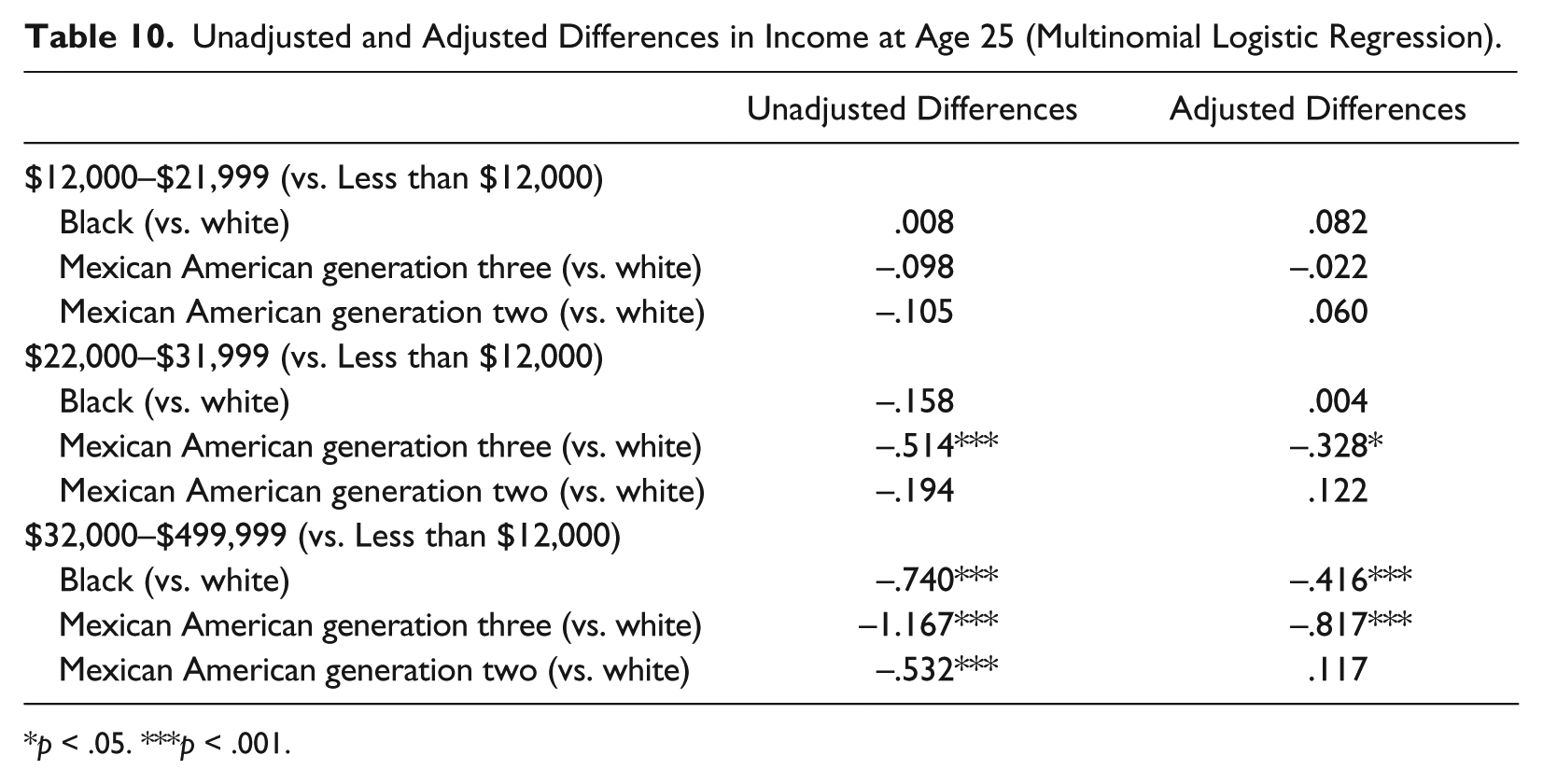
As shown in Table 9, whites (22 percent) are less likely to be in the lowest income group in 1999 compared to blacks (26 percent) and Mexican Americans (32 percent among the third generation and 27 percent among the second generation). At the other end of the distribution, smaller percentages of blacks (15 percent) and Mexican Americans (12 percent among the third generation and 19 percent among the second generation) are in the highest income group. All three race generation groups earn significantly less than whites (shown on Table 10).
Income at Age 25 by Race/Ethnicity/Generation (Percentages; Annual Personal Income at Age 25 in 1999).
Unadjusted and Adjusted Differences in Income at Age 25 (Multinomial Logistic Regression).
p < .05. ***p < .001.
Once the control variables are held constant (shown in Table 10), the adjusted differences show that third-generation Mexican Americans appear in the mid-high or highest income categories at lower rates. Similar to our findings with occupational status, education explains much of the differences in income level by race/ethnicity. Still, education is not able to explain all of the income disadvantage faced by third-generation Mexican Americans.
Our crucial finding is that third-generation Mexican Americans have lower levels of education, school/work activity, occupation, and income than whites. Not only are these comparisons statistically significant when no other factors are included in the model, but they are significant in the multivariate analysis that controls for parents’ socioeconomic status and other key factors. We find that third-generation Mexican Americans lag in completing college, achieving higher status occupations, and earning higher incomes—credentials and outcomes that define middle-class status. Controlling for parental characteristics explains some of the differences between second-generation Mexican Americans and whites, which is due to the especially low achievements of immigrant parents. On the other hand, controlling for parental characteristics did not explain much of the disadvantage for third-generation Mexican Americans. Our findings are consistent with Telles and Ortiz’s (2008) extensive study of later-generation Mexican Americans.
Discussion
While the assimilation model has been useful in explaining socioeconomic incorporation for European groups in the United States (Alba and Nee 2003), the model is of little utility for understanding Mexican Americans considering their third generation disadvantage. Based on our analysis of national data, we find virtually no generational progress between the second and third generations on a wide range of socioeconomic indicators. The educational gap between Mexican American and whites remains constant and large into the third generation; for instance, second- and third-generation Mexican Americans have less than half the rate of whites in completing college (14–15 percent vs. 37 percent). Moreover, both the adjusted and unadjusted differences between third-generation Mexican Americans and whites are statistically significant in all of our multivariate analyses, as are some of the black-white differences. Third-generation Mexican Americans are disadvantaged on several socioeconomic dimensions, appearing to hit a ceiling in U.S. society. By analyzing a younger cohort from a national sample, our study adds to the prior research documenting third generation disadvantage among Mexican Americans (Alba et al. 2011; Bean et al. 2015; Chapa 1988; Farley and Alba 2002; Neidert and Farley 1985; Telles and Ortiz 2008; Terriquez 2014).
Segmented assimilation, a variation of assimilation theory, is also inadequate for explaining third generation disadvantage. For example, we do not find evidence of permanent poverty or participation in the underclass. Therefore, the predictions by segmented assimilation scholars (Portes and Zhou 1993) that Mexican Americans will be outside the mainstream or experience downward assimilation are unsupported. Rather, we document how Mexican Americans strive to get ahead, as indicated by continuing to pursue higher education at later ages yet finding it difficult to achieve goals like obtaining a college degree (Waldinger and Feliciano 2004).
On the other hand, the progress from immigrants to their second-generation children is by itself consistent with assimilation theory (Smith 2003; Telles and Ortiz 2008). Moreover, when we consider that Mexican immigrants start off with human capital that is well below that of the vast majority of Americans of any race, the large gains from immigrant parents to their U.S.-educated children are unsurprising. The gains of the second generation may also reflect the immigrant parents’ optimism about greater opportunities in the United States relative to those in their country of origin (Kao and Marta 1995; Kasinitz et al. 2010). In contrast, that optimism is lost among the third generation, which grows up with U.S.-born parents that expect more compared to immigrants but face limited opportunities for mobility.
The second generation advantage has been celebrated in several assimilation-oriented studies. For instance, Kasinitz and his colleagues (2010) applaud the schooling and early labor market outcomes of second-generation Dominicans compared to third- and later-generation Puerto Ricans. This raises concerns since by naming Puerto Ricans as “same-race peers” to Dominicans, Kasinitz et al. (2010) acknowledge the racial categorizing of Latinos, yet they do not problematize the racial disadvantages faced by Puerto Ricans. Moreover, these disadvantages among third-generation Puerto Ricans are similar to those we document among third-generation Mexican Americans—both suggestive of racializing processes. 13
Despite evidence that Mexican Americans do not follow the expected assimilation trajectory, scholars who favor assimilation invoke optimistic explanations. One explanation emphasizes the success of some Mexican Americans as part of a heterogeneous Mexican American population (Alba et al. 2013). However, heterogeneity is not particularly useful since all groups are heterogeneous. Similarly, Mexican American individuals can be found throughout the educational and occupational hierarchy, yet what matters for the purposes of evaluating assimilation theory is the consistent disadvantage of the Mexican American population behind whites. In the end, even champions of assimilation, like Alba and his colleagues, admit that a large portion of the Mexican American population is especially disadvantaged (Alba 2006; Alba et al. 2011, 2013).
Another explanation focuses on how the second generation feels more successful than their low-status immigrant parents (Zhou and Lee 2007). As we have already noted, the improvements between immigrant parents and their second-generation offspring are unsurprising considering the especially low status of immigrant parents. However, that members of a disadvantaged group deemphasize their disadvantage or do not use successful whites as a reference point (or do not have the evidence with which to make these judgments) does not mean that we should limit our interpretations in a similar manner. Moreover, many third-generation Mexican Americans, which were not included in Zhou and Lee (2007) or other major studies of immigrant incorporation (e.g., Kasinitz et al. 2010; Portes and Rumbaut 2001; White and Glick 2011), are unlikely to feel more successful than their second-generation parents given their lack of mobility relative to their parents. Because second- and third-generation Mexican Americans have not reached parity with whites, it is imperative to employ objective definitions of success.
Our findings align more with the working-class stagnation or delay perspective that Bean and his colleagues (2015) propose in their study of Mexican Americans in Los Angeles. They show that the education levels of third-generation Mexican Americans are similar to the second generation and lower than those of whites; these findings are similar to our education findings. However, our results regarding labor force integration differ. Bean et al. (2015) show that the third generation is well integrated into the labor force and their income levels are similar to whites and higher than the second generation’s. In contrast, we show that the income levels of the third generation are significantly lower than that of whites and similar to the second generation. The prospects for the fourth generation are not optimistic when we consider that Telles and Ortiz (2008) found that fourth-generation Mexican Americans do no better than the third generation. That Mexican Americans disproportionately move into or persist in the working class is indicative of the barriers to mobility that Mexican Americans face.
The educational process is key to understanding these barriers. Certainly, some Mexican Americans are successful, due in part to public policies such as affirmative action (Carnevale and Stohl 2013); still, third-generation Mexican Americans, on average, do worse than whites. As children, Mexican Americans disproportionately attend underfinanced and poorly resourced public schools with less experienced teachers and the absence of a challenging curriculum. Additionally, a number of studies have shown that Mexican American students confront racialized expectations by teachers and counselors that stigmatize them as intellectually inferior, unmotivated, or less worthy than students in general (Ochoa 2013; Salgado 2015; Valenzuela 1999). As they enter the job market, education underlies their economic success at later stages; low levels of schooling lead to lower occupational status and lower income, locking many Mexican Americans into a future of lower socioeconomic status (Telles and Ortiz 2008). Their persistent low status appears to indicate that a process of racialization begins with educational disadvantage, which in turn affects economic outcomes.
The disadvantages faced by Mexican Americans are not limited to the educational system (Telles and Ortiz 2008). Throughout a century of continuous immigration, Mexican immigrants have consistently occupied the lowest paid and least valued jobs in the U.S. economy. Mexicans continue to be the largest immigrant group and comprise the majority of undocumented immigrants, thus making them the most stigmatized immigrant group. Additionally, Mexican Americans of all generations share residential and labor markets, which promotes the stereotypes and racialization of Mexican Americans irrespective of generation (Lacayo 2013; Ngai 2004; Vasquez 2011).
Immigration policy, which has created a large category of undocumented Mexican immigrants, also contributes to the limited gains of Mexican Americans, even into later generations. The lack of legal status for many, in combination with racialization, is likely to further impede the social, economic, and political progress of future generations (Bean et al. 2015; Gonzales 2011). Also, the fact that Mexican immigrants disproportionately hold undocumented immigration status leads to stereotypes and the categorical thinking that fails to distinguish between natives and immigrants (Lacayo 2013). Such nativism and stereotyping harm Mexicans and denies them equal education, among other opportunities, and this ultimately heightens racial and ethnic disparities. Even Mexican Americans with deep roots in the United States are perceived as foreigners and thus excluded from full participation in American life (Ngai 2004). This designation as being persistently foreign makes the Mexican Americans case different from that of African Americans or European Americans.
Since assimilation is inadequate for understanding our findings, what then explains outcomes for Mexican Americans? We argue that Mexican Americans are sorted into and find themselves in a racially stratified society. While we do not have direct evidence of racialization, our findings are consistent with racialization frameworks. That the third generation disadvantage is so consistent, in a comparison of Mexican Americans and whites when controlling for key factors, is indicative of an experience that is distinct from that of whites regarding their trajectories of integration in the United States. Therefore, we observe that beyond the second generation, Mexican Americans face third generation disadvantage and are sorted into the American racial hierarchy in a position below that of whites, thus consistent with a racialization perspective.