




Abstract
In the past 20 years, scholars of top sociology and race and ethnicity articles increasingly have mentioned the term “color line.” Prominent among them are sociologists concerned with how incoming waves of Latin American and Asian immigration, increasing rates of intermarriage, and a growing multiracial population will affect the U.S. racial order. While much of this work cites Du Bois, scholars stray from his definition of the color line in two ways. First, they characterize the color line as unidimensional and Black–white rather than as many divisions between non-white people and whites. Second, scholars portray the color line as the outcome of microlevel factors rather than the product of international geopolitical arrangements. I contend that in contrast to scholarship that portrays immigrants and intermarried and multiracial people as shifting the color line, international and imperial policies related to immigration, intermarriage, and multiracial identification are longstanding sites of the construction of the U.S. racial order. Scholars should conceptualize the United States as an empire state in order to analyze the international political history of multiple color lines. In doing so, they can distinguish between differences in kind and degree of racial divisions.
In the oft-quoted essay “Of the Dawn of Freedom,” Du Bois ([1903] 2007:15) declared, “The problem of the twentieth century is the problem of the color line.” 1 Many contemporary authors of race, ethnicity, and immigration open their work with Du Bois’s comment on the color line (Alba 2009; Banton 2012; Bean and Lee 2010; Bobo 2000; Brown 2003; Embrick 2015; Frank, Akresh, and Lu 2010; Grant-Thomas and Orfield 2008; Holt 2009; Hunt 2007; Kim 2015; Lee and Bean 2004, 2007a, 2007b, 2012; Lieberman 1998; Logan 2013; Massey and Denton 1993; Parisi, Lichter, and Taquino 2011; Roediger 2008:200; Shapiro 2004:200; Waldinger 2001). 2 This includes several highly cited articles and books that ask how waves of Latin American and Asian immigration, intermarriage, and a growing multiracial population will affect the Black–white color line (Alba 2009; Bean and Lee 2010; Bonilla-Silva 2004; Bratter 2007; Brunsma 2005; Lee and Bean 2004, 2007a, 2007b, 2012; Marrow 2009). For example, Lee and Bean (2007b:562) write, “in 1903, the prominent African American social theorist W.E.B. Du Bois prophesied that the ‘problem of the twentieth-century is the problem of the color line,’ by which he meant the relatively impermeable bicategorical Black–white fault line that had historically divided the country.”
It is striking how routinely contemporary scholars misinterpret this sentence. Du Bois did not, in fact, believe that the United States was characterized by an exclusively Black–white color line. In Du Bois’s ([1903] 2007) original text, the famous phrase “the problem of the twentieth century is the problem of the color line” is modified by the following definition of the color line: “the relation of the darker to the lighter races of men in Asia and Africa, in America, and the islands of the sea” (p. 15). 3 While Du Bois focused on the Freedmen’s Bureau (1861–1872) in this essay, his definition of the color line demonstrates that he not only conceived of it beyond Black–white but also saw it as the product of structural processes, namely imperialism (Lake and Reynolds 2008:2; Morris 2015:8). For Du Bois, the term “color line” was a metaphor to describe patterns of global economic exploitation (Gates 2007:xvi). He gave detailed attention to the relations among imperialism, whiteness, and national inequalities. He “focused on a specific phenomenon that enabled European societies to build capitalist empires: the colonization, exploitation and domination peoples of color….” (Morris 2015:155).
In fact, over the course of his career, Du Bois increasingly analyzed, and indeed critiqued, the structures and policies that held up a world colonial system (Du Bois 1920a, 1945).
4
For example, in “The Souls of White Folk,” Du Bois (1920:37–38) wrote: “War is horrible! This the dark world knows to its awful cost. … Think of the wars through which we have lived in the last decade: in German Africa, in British Nigeria, in French and Spanish Morocco. …” He went on: What is that breath of life, thought to be so indispensable to a great European nation? Manifestly it is expansion overseas; it is colonial aggrandizement which explains, and alone adequately explains the World War. How many of us today fully realize the current theory of colonial expansion, of the relation of Europe, which is white, to the world which is black and brown and yellow? Bluntly put, that theory is this: It is the duty of white Europe to divide up the darker world and administer it for Europe’s good. (p. 41)
Du Bois defined war as part of a white imperial project. Empire—through its “handmaiden,” which Du Bois saw as white supremacy—extended beyond Europe into the United States (Gates 2007:239). 5
Contemporary scholars who invoke the (Black–white) color line as a model for U.S. race relations misrepresent Du Bois’s use of the term, which was a metaphor for structural inequalities engendered by imperial activities like war. They ask how contemporary immigrants, intermarried people, and multiracial-identified individuals will become like Black or white 6 people. This body of scholarship overlooks Du Bois’s concern with colonialism and the history of other color lines. 7 When relying on an ahistorical Black–white color line, scholars simplify the experiences of people who are neither Black nor white. They conflate the policies and practices that shaped the U.S. racial hierarchy with individual-level characteristics. Not only this, but they obscure how the U.S. empire is constitutive of racial domination and inequality.
I argue that scholars ought to leave open the empirical possibility that race and racial domination may not operate according to a domestic, U.S., Black–white order. Sociology of twenty-first-century racial dynamics, especially scholarship concerned with the impact of immigration, intermarriage, and multiraciality, could be improved by eschewing the Black–white color line as an uninterrogated comparison against which “new” immigrants’, intermarried people’s, and multiracial individuals’ experience of race is measured. Scholars can interrogate the policies of the state, asking how racial (il)logics overlap and intersect with one another and with those of empire. In asking such questions, we denaturalize racial boundaries and see not only white domination of Black people but also other exclusionary policies that extend beyond the imagined U.S. national boundaries. I take up this line of inquiry by considering what it would mean for scholars of immigration, intermarriage, and multiraciality to take Du Bois’s definition of the color line seriously.
Empire and Color Lines
The widespread sociological misinterpretation of Du Bois’s definition of the color line in contemporary work reflects amnesia regarding major U.S. geopolitical projects. Du Bois reached the conclusion that “the problem of the twentieth century is the problem of the color line…” in 1903, shortly after the United States claimed sovereignty over Spain’s island colonies and asserted itself as a global imperial power. Paul Kramer (2006:14), citing Du Bois’s work from this period, noted:
For Du Bois, the ‘race questions’ of the United States and those of the world were becoming inseparably ‘belted’ together by imperial processes. … Du Bois identified the ‘most significant’ recent development in the United States as ‘our ownership’ of Porto Rico [sic], and Havana, our protectorate of Cuba, and conquest of the Philippines, which constituted the ‘greatest event since the Civil War.’
Not only did Du Bois formulate his definition of the color line in relation to the United States’ project of the overseas empire, so too do the debates of the time reveal how the color line was never solely Black and white. After the United States took the island colonies from Spain in 1898, politicians, legal scholars, elites, and the media hotly debated the “Philippine question,” akin to the so-called “Negro question.” They asked: What should be the political status of the millions occupying the archipelago? Would Filipinos become citizens? Would they be able to migrate to the United States? Would they mix with native white populations?
Reviewing the debates about U.S. territorial expansion reveals how, even a century ago, elites not only articulated anti-Blackness but also anti-Native and anti-Chinese discourse. Some portrayals of Filipinos resembled those of Black Americans as both uneducable children and animalistic rapists who would prey upon European women (Hoganson 1998). For example, arguing against the extension of citizenship, a senator of the time compared Filipinos to Black Americans, saying: We can not [sic] admit these people [Filipinos] many of them only half civilized and only a part of them with any just comprehension of the principles of self-government, as citizens of the Republic without degrading the citizenship of the nation and inviting countless dangers. (Senator Simmons, speaking on S.2295 1902:4753)
Citing the education of “an inferior race” in the United States (by which he meant Black Americans), the senator continued on, arguing that by trying to educate lesser people, the United States would gain little. Not only that, improvement in the population would be “slight” (Senator Simmons, speaking on S.2295 1902:4753). In accounts like this, Filipinos were understood in relation to Black people.
Nevertheless, not all politicians of the time adhered to a Black–white racial understanding. Indeed, anti-Blackness intersected with other racial logics. Filipinos were referred to as “‘savages,’ ‘barbarians,’ ‘a savage people,’ ‘a wild and ignorant people,’ ‘Apaches,’ ‘Sioux,’ ‘Chinese boxers’” (President Roosevelet as quoted by Senator Carmack, speaking on S. 2295 1902:4673). Drawing parallels to American Indians, lawmakers expressed concern about Filipinos as war-like savages who could not rule themselves and who should be considered wards of the state (Go and Foster 2003; Hoganson 1998; Kramer 2006; Thompson 2010). Still others compared Filipinos to the Chinese, suggesting that they were a peril and should be excluded from migration to the United States, denied U.S. citizenship, and barred from miscegenation (Baldoz 2011; Harris 2011; Kramer 2006). In this way, debates over the colonies also demonstrate how immigration, intermarriage, and multiraciality are not new concerns for the United States. Rather, they are longstanding questions shaped by imperial and international politics. In the history of the United States, geopolitical projects supported white subjugation of Black, Native, Chinese, and other racialized minorities.
If scholars rely exclusively on a Black–white color line to understand late nineteenth-century debates about race, they risk omitting the history of U.S. imperial rule of the Philippines and other island colonies. Instead, attention to the United States’ imperial and international activities can serve as a corrective to the empirics of racial domination and open new areas of inquiry about contemporary racial dynamics. Scholars can study the current overlap among anti-Native, anti-Black, anti-Chinese, and other exclusionary racial policies. Before explaining the form this could take in contemporary scholarship, I address the current limitations of understanding the color line as primarily Black–white.
The Color Line as Black and White in Contemporary Sociological Scholarship
Scholars most concerned with today’s changing demographics and the implications for racial hierarchies often minimize the imperial and international policies that shape U.S. color lines. They ask, if the problem of the twentieth century was the problem of the color line, what will the twenty-first century look like? In answering this question, scholars often frame Latino and Asian immigration, intermarriage, and multiracial people as “new.” They propose that new racial hierarchies could emerge in the twenty-first century, owing to the removal of national origin quotas in immigration policy in 1965, the ruling that antimiscegenation law was illegal in 1967, and the ability of people to mark more than one race on the U.S. Census in 2000.
Despite their different empirical projects, these scholars rely on a unidimensional heuristic that places non-Black, non-white others on a continuum anchored by Black and white. Some argue that multiracial, Asian, and Latino people will move into the white category, making it a non-Black category (Gans 1999; Kasinitz 2004; Lee and Bean 2004, 2007a, 2012; Marrow 2009; Roth 2005; Yancey 2003). They emphasize persistent social distance of Black and white (and white-assimilated) people. Others highlight the material privilege of whites compared to all others (Skrentny 2001). Still others argue that there will be a Latin-Americanized buffer category between Black and white that is variously called brown (O’Brien 2008), honorary white (Bonilla-Silva 2004), and non-white but non-Black (Gans 2012). Although colonial projects, such as the subjugation and genocide of American Indians, are endemic to the foundation of the United States, colonialism is not discussed in these perspectives. In the dominant accounts of contemporary change to the U.S. racial order, Black–white relations remain the gold standard of a strong, impermeable U.S. color line.
Contemporary debates about the impact of immigration, intermarriage, and multiraciality on the U.S. racial order, even when not misciting Du Bois, draw on a flattened definition of the U.S. color line. 8 By these accounts, the history of Black–white relations, most notably in slavery, is foregrounded as the primary racial history of the United States to the exclusion of others. 9 The reliance on an exclusively Black–white color line distorts U.S. history and neglects Du Bois’s definition of the color line as a structural formation. For example, Bonilla-Silva (2004:931) writes, “the United States has had a bi-racial order (white versus the rest) fundamentally anchored on the Black–white experience.” Gans (1999:386) writes, “in a society with a history of slavery, one possible effect is a dual racial hierarchy in which one part consist mostly of ex-slaves.” Alba (2009:4) calls the Black–white color line “the most salient social boundary in the United States.” These scholars suggest that “new” racialized bodies will change the historically Black–white hierarchy through Latin-Americanization (Bonilla-Silva 2004), whitening (Gans 1999), deracialization (Gans 2012), or blurring color lines (Alba 2009).
One proposed path to a new racial order is through the “darkening” of the United States and the upward mobility of immigrants and “new” racial minorities. By this account, immigrants will “set into motion what may turn out to be significant transformations in at least part of the basic racial hierarchy” (Gans 1999:372). Scholars compare the skin tone of new immigrants to that of Black Americans to argue that the United States is only recently tri-, multi-, or interracial (Bonilla-Silva 2004:934; Gans 1999:373). Not only does the skin tone of new immigrants have potential to change the U.S. racial order, according to these perspectives, Asians will “ascend” to whiteness by entering upper echelons of the U.S. work force (Alba 2009:7, 162). By these accounts, the “darker” skin tone of most Latinos moves them toward Blackness, whereas for Asian immigrants, their social mobility moves them toward whiteness.
Scholarship on intermarriage also misrepresents the U.S. color line as exclusively or even predominantly Black–white. In this line of work, it is commonplace to juxtapose Asian, Latino, and multiracial coupling with whites to that of Black intermarriage rates. Data on the rising rates of intermarriage between immigrant populations and whites is interpreted as evidence for the dissolution of racial divisions between white people and non-Black, non-white people. At the same time, these data serve as evidence for the persistence of a Black–white color line (Kalmijn 1993; Miyawaki 2015; Qian and Lichter 2007, 2011). According to these scholars, individual action and choice, in this case, coupling, is a predictor of a new racial order.
Multiracial individuals, as the product of intermarriage (or interracial sex), are also of interest to scholars speculating about changes to the U.S. racial hierarchy. According to this body of work, “the growth of the multiracial population provides a new reflection on the nation’s changing racial boundaries” (Lee and Bean 2004:229). Just as with intermarriage, scholars view multiracial identification as “a reduction in social distance and racial prejudice” (Lee and Bean 2004:246) and as an opportunity to identify beyond the boundaries of standard Black–white racial categories (DaCosta 2007). In much contemporary work, however, scholars argue that Black–white relations do not undergo the same reduction in social distance. In studies of how multiracial individuals’ identification will shape the U.S. color line, scholars, regardless of their conclusions about the eventual permeability of the Black–white line, characterize the United States as marked by a historic Black–white barrier (Lee and Bean 2012; Roth 2005).
While this body of scholarship offers important conclusions about the decisions, attitudes, and mobility of immigrants, intermarried individuals, and multiracial people, there is room to expand our inquiry. Rather than view immigration, intermarriage, and multiracial identification as new phenomena, scholars concerned with the contemporary U.S. racial order should recall the history of non-Black, non-white racialized others. Similarly, instead of constructing changes to the racial order as wholly or primarily the result of aggregate individual-level decisions by these “new” individuals, scholars can integrate their analysis of microlevel dynamics with work on U.S. geopolitical projects, which I explore below.
Reconstructing Immigration, Intermarriage, and Multiraciality
The contemporary tendency to overlook the history of the U.S. empire and non-Black, non-white racial minorities 10 is puzzling in light of both what Du Bois said about the color line and of the well-documented histories of many racial hierarchies in the United States. As Du Bois noted and the historical record shows, the color line was never solely Black–white. In his writing, Du Bois noted that “certain suppressions in the historical record current in our day will lead to a tragic failure in assessing causes [of the present plight of the world]” (Gates 2007:1). We should not commit this error in our scholarship.
In this era in which sociologists have returned to Du Bois, it is especially important that we integrate the lines of scholarship on other color lines with those about the Black–white racial order. We can take our cue from Du Bois’s ([1903] 2007:15) preoccupation with history as well as from the second half of his famous statement on the color line: “the relation of the darker to the lighter races of men in Asia and Africa, in America, and the islands of the sea.” Like Du Bois, many scholars have argued that the United States is not a nation state but an empire state (Fenelon 2015; Glenn 2015; Go 2008, 2011; Go and Foster 2003; Goldstein 2014; Jung 2015a; McCoy, Scarano, and Johnson 2009; Stoler 2006). Capitalizing on this reframing, we ought to turn our attention to the intersections of imperial and racial subjugation. We can then explain “the connections between the heterogeneous histories of peoples who have been racially subject to and have struggled against the U.S. empire state, without overlooking significant differences and particularities” (Jung 2015a:57). Taking seriously the United States as an empire state remedies the unidimensional account of the color line. Furthermore, when we reframe the United States in this way, we bring colonized places and people back into the study of race, racism, and migration.
Integrating work on the Black–white color line with scholarship on non-Black, non-white people also means incorporating micro-, meso-, and macroperspectives on racial divisions. In addition to studying the individual patterns and decisions of immigrants, intermarried people, and multiracial individuals, we should study the imperial activities of the state. By accounting for policies and practices of war, economic exploitation, capital investment, and resource extraction, scholars can place the purported nation in an international and global context. Acknowledging this global system of white supremacy (Mills 1998), 11 we can ask different questions about the U.S. racial order, such as: What imperial activities of the state established boundaries of race and membership? What are the political sources of different patterns and outcomes in racial divisions? To whom did politicians of the time compare non-Black, non-white people? How were different racial logics used in relation to one another? To what extent do the justifications and racial (il)logics of empire intersect with those of race? And here, race must be understood to be more than Blackness.
This line of inquiry places analytical focus on differences in kind rather than differences of degree. When scholars look for differences of kind, they leave open the empirical possibility of comparing different color lines. Differences in degree, on the other hand, assume all racial divisions fall under one model or logic. By bringing the politics of race and empire into the same frame, we see that “racisms operate at various, articulated scales and depths” (Jung 2015a:32). Such an examination of the history of the U.S. empire state reveals that policies related to the management of non-white populations both overlapped and varied across time and space. No one type of racism or anti-X logic can explain the forms of exclusion applied to all people.
Integrating the study of the contemporary color line with the political history of multiple race relations will turn our attention to new and key explanatory factors of the U.S. racial order. By reframing the United States as an empire state, and not nation state, we can also see the international policies that shape domestic race relations, as Du Bois did at his time. In what follows, I provide an account of contemporary questions of immigration, intermarriage, and multiraciality from a perspective that foregrounds institutions and structures of the U.S. empire state.
Immigration
U.S. immigration history can neither be divorced from the history of race in the United States (Brubaker 2001; Jung 2009; Maghbouleh 2017) nor from the history of the U.S. empire (Du Bois 1920a; Kim 2007; Kramer 2011). Although much of the contemporary literature emphasizes 1965 as the turning point of U.S. migration history, it was not the first time that the United States experienced a change in its demographic makeup. The founding of the United States, European colonization, settler wars with American Indians, and the ensuing genocidal practices mark the first major demographic shift of U.S. race relations (Cornell 1988; Glenn 2015; Wolfe 1999, 2006; Woolford 2015). In a later period, as Du Bois reflected, global wars to claim territory and bring the “darker” races under the control of European powers shaped patterns of movement (Du Bois 1920a). He highlighted how the imperial acquisition of “islands of the sea” was resulting in a “doubling of the ‘colored population of our land,’ one that would make ‘brown and Black people … a third of the nation’” (as quoted in Kramer 2006:14). Demographic shifts in the United States are not simply the outcome of individual migration choices but are tied to international projects of conquest.
In our scholarship, attention to empire requires asking how elites and state actors constructed different kinds of policy beyond those applied to Black people. In U.S. history, politicians developed immigration policy in relation to concerns over Asian migration. In 1882, the federal government passed the Chinese Exclusion Act, which created a precedent for using race as a gatekeeping function (Kim 1999; Lee 2003, 2004). Congress affirmed the exclusion of Chinese, Japanese, and others from the Asian region when they created the “Asiatic barred zone” in 1917 and again in 1924 with the National Origins Act. These acts barred Asian migration and naturalization. In the early twentieth century, the courts also ruled that Japanese and Asian Indians were ineligible for citizenship, codifying them as “unassimilable aliens” (Haney-López 2006; Ngai 2004). Asian exclusion is another kind of racial division that, like the Black–white division, upholds global white supremacy.
By framing immigration as, in part, an outcome of policy decisions, we can reevaluate contemporary arguments about immigrant assimilation and racialization. For example, in relation to the category of Asian, 12 the change in occupational and educational status of Asians and Asian Americans should not be interpreted as strides made by individuals toward whiteness. Scholars have already noted that the category “Asian” masks high within-group diversity (U.S. Census Bureau 2003). The rising status of Asians and Asian Americans (as an aggregate) is the product of shifts in the population. And these demographic shifts resulted from changes to U.S. immigration policy, itself tied to U.S. geopolitical projects abroad.
Rather than representing individual strides in mobility, the difference between the socioeconomic status of Asians in 1910 can be reinterpreted in relation to changing migration policy. In 1910, most (65 percent) Asians were laborers from China and Japan, 13 and in 2000, only 12 percent were from China. These immigrants from China are increasingly from the professional and managerial class. Not only that, in 2000, 72 percent of Asian migrants were from countries other than China, India, or Japan (U.S. Census Bureau 1910, 2000). Included in this 72 percent are Filipinos, the second largest Asian population in the United States. As other scholars have documented, contemporary migration of Filipinos is a direct product of postcolonial relations (Choy 2003; Espiritu 1995, 1996). Many of these Filipinos are nurses who entered with special work permits and visas between 1965 and 1988, filling the U.S. nursing shortage. In addition to U.S. labor policy toward a former colony, war shapes patterns of immigration and assimilation. Although U.S. immigration policies favor educated, affluent Asians (Junn 2007), also included in the 72 percent from other countries are refugees of the U.S. imperial wars in Southeast Asia. On average, they are doing much worse than the general U.S. population, which is especially evident in their high poverty rates. Thus, imperial connections and changes in policies restricting Asian migration help explain the rising mobility and socioeconomic status of Asians as a category.
Policies of “nativistic racism” (Ancheta 1998:11) also point us toward analyzing global politics to understand contemporary immigration. By looking at the policies and practices that condition migration, we not only see how anti-Blackness but also antiforeignness has been deployed as a racial axis of exclusion within the metropole of the United States. Considering the history of the U.S. empire state means asking not only how and if immigrants assimilate but what policies encouraged their paths toward belonging. Today, most visibly, nativist rhetoric and policy divides the white U.S. population from Mexican and Latin American immigrants and people from Muslim-majority countries. Nativistic racism—with roots in the suppression of American Indians and the exclusion of Chinese—and international policies continue to be central to the workings of white supremacy in the United States. In this view, in our studies of the color line, we should not only compare socioeconomic disparities between immigrants and the native-born population but also the policies that allow or disallow immigrants from entering or naturalizing (rather than the races of the people or number of foreign born in this country). We should try to make sense of these different kinds of classifications and not be limited by thinking that there is only a path toward incorporation into the mainstream (white) America or perhaps one toward downward assimilation toward the (Black) “underclass” (Portes and Zhou 1993:82;92).
Intermarriage
Just as with the study of immigration, contemporary scholarship concerned with the twenty-first century racial order often portrays intermarriage as a new phenomenon. Many scholars of race point to intermarriage as one potential source of change to the U.S. racial hierarchy. Interracial partnering, however, is not new. Du Bois ([1922] 2004:38) himself wrote about intermarriage, saying “there is little likelihood that in the next millennium race lines will wholly disappear and we shall emerge as one undifferentiated humanity.” Although there is limited research on the history of interracial marriage and interracial sex in the metropolitan United States, Gullickson (2006:298) shows that intermarriage dates back to the colonial slavery period, saying that “during slavery and reconstruction, interracial marriage between whites and free blacks, while less common than today, was not as rare as might be expected.” Intermarriage is not new.
While empire and U.S. foreign policy shape immigration, so too do policies related to imperial rule inform intermarriage patterns. For example, research from other American colonies shows how racial mixing did not lead to a decline in racial hierarchies but was part and parcel of upholding them. In the new-world colonies, Europeans intermarried with natives, but this did not mean that racism or inequality was absent (Nobles 2000; Sawyer 2006; Telles 2004; Wade 2004). As Telles and Sue (2009:134) summarize, “the idea that low levels of racism on the horizontal dimension (sociability, including intermarriage) can coexist with high levels on the vertical dimension (inequality and discrimination) seems counterintuitive, but in fact, it is this situation that exists in countries such as Brazil. …” Rather than view rates of interracial marriage as indicators of present or future decline in racial boundaries, we should look to how policies influence interpersonal partnering. In regard to Black–white intermarriage in the United States, Gullickson (2006) argues that intermarriage rates are shaped by structural opportunities (including those for racial violence and antimiscegenation laws). Individual patterns of intermarriage, then, are not simply predictive of declines in racial inequality. By focusing on the colonial practices and other policies that shape opportunities for intermarriage, we confront new questions.
Scholars should analyze the structural and institutional sources of contemporary differences in patterns of intermarriage. For example, in the case of American Indian–white unions, rates are higher in non-Indian states and urban locales (Sandefur and McKinnel 1986). This correlates with the movement of American Indians to cities and off reservations, part of a policy known as termination, whereby, in the 1950s, the United States granted citizenship to American Indians and revoked federal support for the reservation system (Deloria 1969). Similarly, Asian–white intermarriages, which climbed from the 1950s to the 1980s (Fryer 2007), were facilitated by a 1954 amendment to the War Brides Act of 1945. This amendment allowed U.S. military personnel to return to the United States with their Asian spouses (most notably, wives, as the title of the bill denotes) (Koshy 2004; Parreñas and Tam 2008). In this light, rates of American Indian–white and Asian–white intermarriage are direct products of the United States’ imperial policies of termination and war, respectively.
In this account, then, the Black–white color line is not a model for all race relations nor is intermarriage a new phenomenon only predictive of blurred racial boundaries. That Black–white intermarriage rates lag behind those of Asian–white and Latino–white rates cannot simply be interpreted as evidence that the U.S. racial order is shifting away from a historic Black–white one. By bringing the study of politics into conversation with existing data about intermarriage rates, scholars can see that different rates are the outcome of different kinds of policies and practices applied to different populations in different times. Such an account highlights how urban policy and war, for example, are imperial activities of the state that have consequences for people’s individual partnering choices. The study of politics, when in conversation with analyses of the contemporary racial order, encourages scholars to think about multiple color lines.
Multiracial Identification
Just as patterns of migration and intermarriage are not new, racial mixing is not an isolated, contemporary, political project, but one that has been “routine in American state-making” (Curington 2015:33). While the year 2000 was the first time that people could mark more than one race on the Census, it is not the first time that multiracial individuals were counted. Du Bois himself counted people of mixed Black–white descent. His “American Negro” Exhibit at the 1900 Paris Exposition included almost 60 charts, graphs, and maps. Among them was one entitled “Race Amalgamation in Georgia Based on a Study of 40,000 Individuals of Negro Descent” (Figure 1) and another, “The Amalgamation of the White and Black Elements of the Population in the United States” (Figure 2). Du Bois explicitly tied race-mixing to the global phenomenon of empire, saying: The bitterest protest and deepest resentment in the matter of inter-breeding has arisen from the fact that the same white race which today resents race mixture in theory has been chiefly responsible for the systematic misuse and degradation of darker women the world over, and has literally fathered millions of half-castes in Asia, Africa and America. At the same time, whites have stigmatized and sneered at their own children, and in most cases, refused to recognize or support them. (Du Bois [1935] 2000:466)
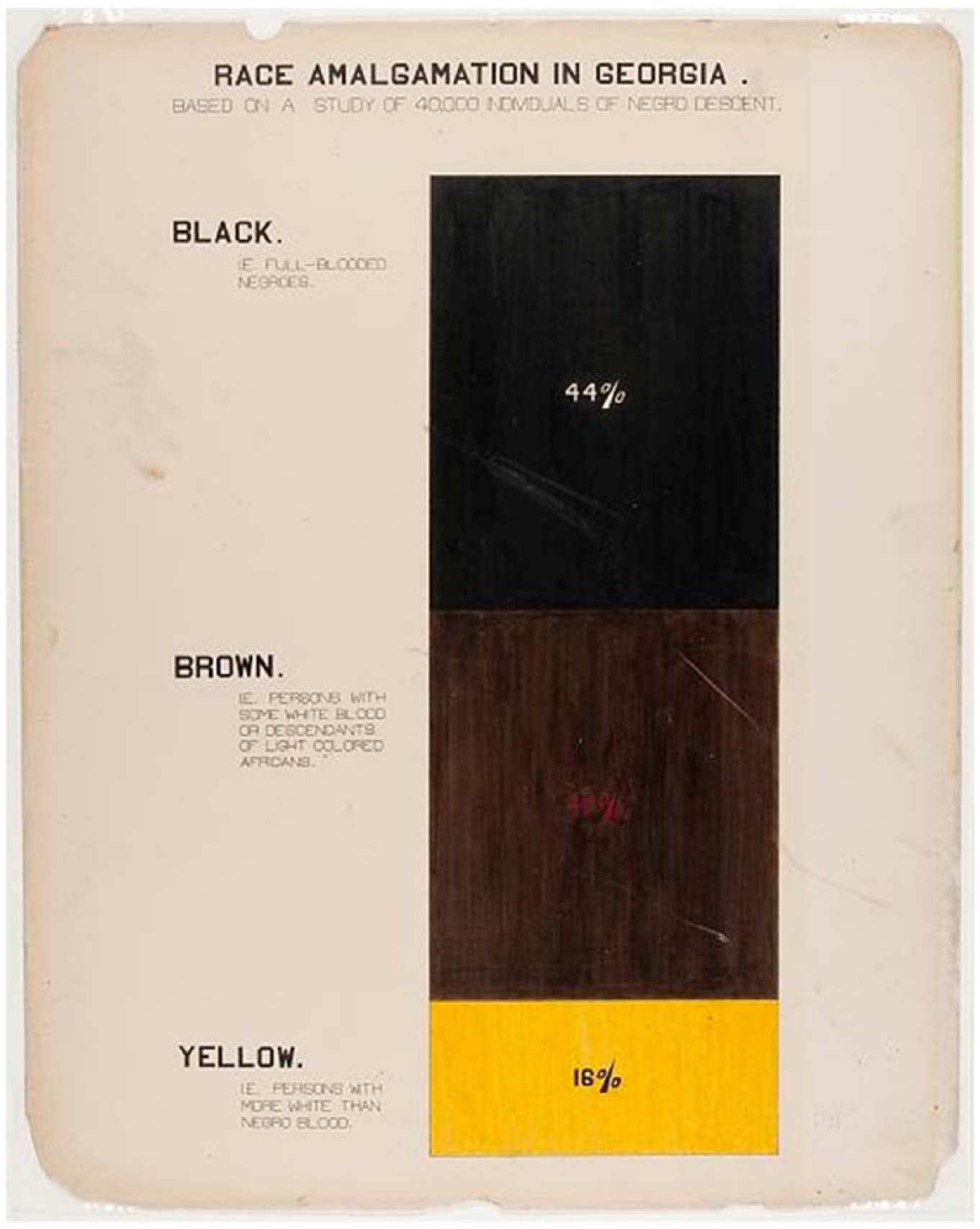
Du Bois, W.E.B. ca. 1900. “Race Amalgamation in Georgia Based on a Study of 40,000 Individuals of Negro Descent.” The Georgia Negro. Library of Congress Prints and Photographs Division Washington, D.C.
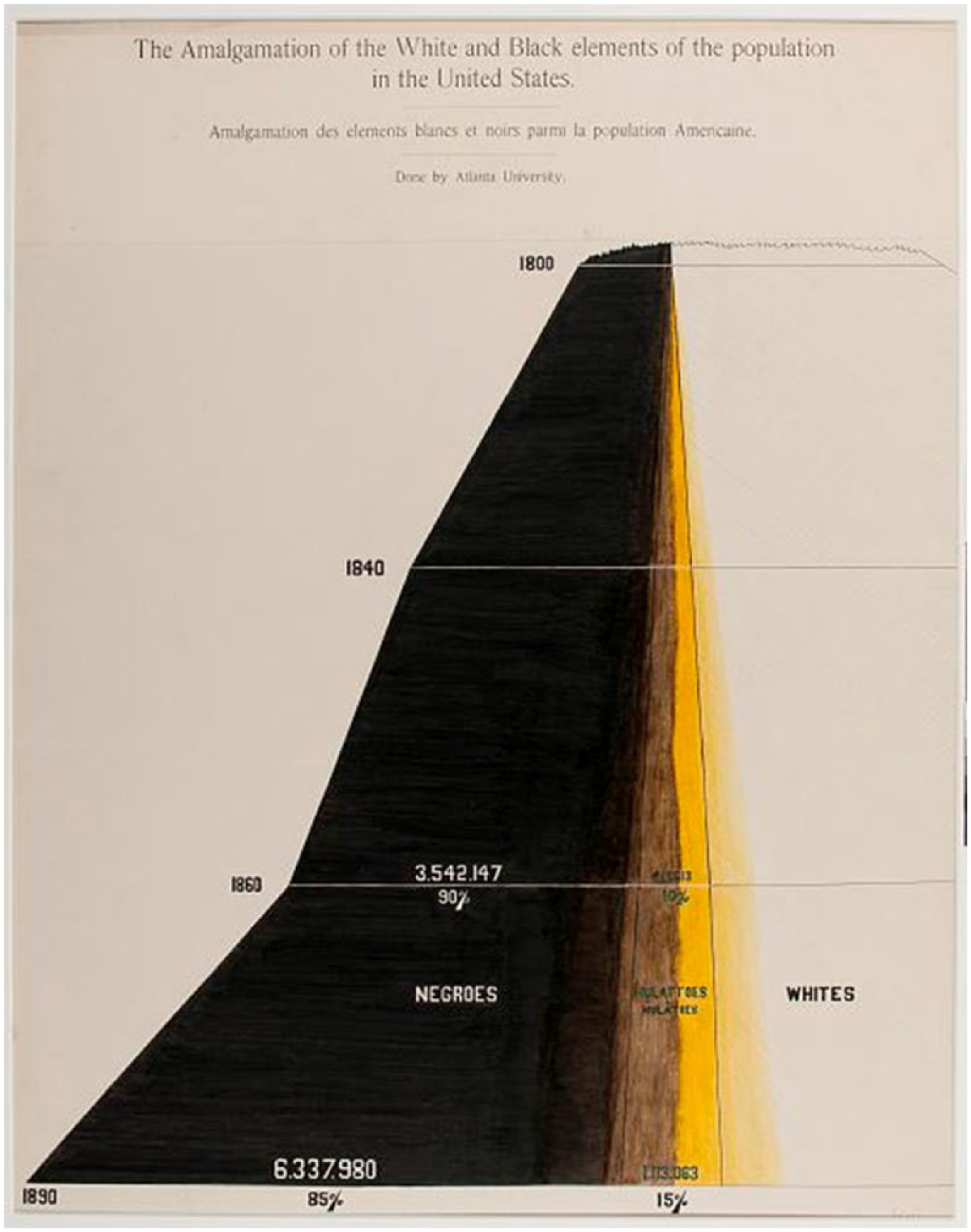
Du Bois, W.E.B. ca. 1900. “The Amalgamation of the White and Black Elements of the Population in the United States.” A series of statistical charts illustrating the condition of the descendants of former African slaves now in residence in the United States of America. Library of Congress Prints and Photographs Division Washington, D.C.
To Du Bois, the fact of interracial coupling and mixed-race people did not translate into a reduction in color lines. Instead, racial mixing was part of an imperial project that “does not disturb” racial oppression at the structural level (Du Bois [1935] 2000).
Instead of looking for the existence of these categories of people, we should study the rules defining sexual relations and the practices of identifying and labeling mixed-race individuals. Stoler (2001: 836–37), for example, notes that “shifts in the density, frequency, and sequence of state attention to mixed unions should turn us to the historical specificities of a social category’s occurrence, the rules that governed its appearance.” When we look at state activities, we see the opportunity for multiracial identification as structured by policies of racial domination.
The existence and counting of multiracial individuals is shaped by U.S. policies of domination and empire. How states count race advances race-based ideas and policies about rights and citizenship (Anderson 2015; Anderson and Fienberg 1999; Enloe 1981; Lee 2008; Loveman 2014; Loveman and Muniz 2007; Nobles 2000; Prewitt 2013; Snipp 2003). For example, between 1850 and 1920, with the exception of 1910, the U.S. Census included “mulatto” as a category that formally recognized people of Black and white descent. “Quadroon” and “octaroon” were categories on the 1890 Census that referred to people considered one-quarter and one-eighth Black, respectively. Differentiating between Black and mulatto and then quadroon and octaroon served the purpose of developing what, at the time, were referred to as “Negro” statistics to justify slavery and the subjugation of Black people even after the Civil War (Nobles 2000).
While counting mixed-race people has been used to suppress racialized minorities in the continental United States, counting race in the colonies justified the terms of colonial rule. In Puerto Rico, for example, Census enumerators, between 1910 and 1920, increasingly identified children of “mixed” unions as white rather than mulatto or Black. This whitening of Puerto Rico was used to justify Puerto Ricans’ racial fitness as de-jure U.S. citizens (Duany 2002; Loveman 2007; Loveman and Muniz 2007). In the case of the continental United States, counting Black–white mixed-raced people justified racial exclusion, and in the case of Puerto Rico, it was used to incorporate the island and its inhabitants into a subordinated position as second-class citizens.
In relation to today’s multiracial population, we can also ask, To what kind of political interests and policies is the classification of mixed-race people linked? In addition to studying the identification choices of multiracial individuals and their families, we ought to study state-sanctioned practices and policies that lead to the counting or registration of people who might be considered multiracial. The question, then, shifts from “How are multiracial people reshaping the Black–white color line?” to “What were the political interests and structural relations of power that created the opportunity for multiracial classification and identification?” Today, rather than consider multiracial individuals as potential cures to the Black–white color line, we should recall that they are people whose existence (like that of their presumably monoracial peers) is shaped by systems and policies.
Conclusion
We need to reinvigorate our scholarship of immigration, intermarriage, and multiraciality with attention to the institutional and structural arrangements of global white supremacy. While many contemporary scholars concerned with the twenty-first century racial order refer to Du Bois’s quote on the color line, there is still an opportunity to bring a more Du Boisian analysis to the study of racial inequality. In his day, Du Bois confronted the global manifestations of racial domination as they appeared in the United States. Today, in our scholarship, we should avail ourselves of the already existing literature on empire and international policy. Thinking about the United States as an empire state facilitates the study of the multitude of U.S. color lines.
First, an empire state perspective encourages us to denaturalize a singular Black–white hierarchy as the only kind of racial division. Over 40 years ago, American Indian writer Vine Deloria, Jr. (1970:88) noted: “The whole of American society has been brainwashed into believing that if it understood blacks it could automatically understand every other group simply because blacks were the most prominent minority group with which society had to deal.” We ought not assume that state-led anti-Blackness explains all forms of racism or exclusion. As we know, anti-Native, anti-Chinese, and other exclusionary racial policies are foundational to the United States. Taking this into account, we can integrate questions of state and elite discourse with those about the attitudes, decisions, and mobility of so-called “new” populations. Scholars can leave open the empirical possibility that the assimilation, integration, or identification of non-Black, non-white people may not follow a Black–white model. For scholars concerned with historical or political analysis, they can ask how politicians and elites have portrayed and classified racial minorities, sometimes invoking anti-Black (il)logics but sometimes relying on others. Overreliance on a Black–white heuristic as a model for all race relations not only flattens the experience of non-Black, non-white people, it obscures the full history and structural position of Black people.
Second, we need not confine studies of race only to the imagined U.S. national boundaries. Rather than assuming that immigrants, intermarried, and multiracial people are changing the color line today, we can ask how U.S. policies enacted around the globe have, for the whole of U.S. history, shaped domestic racial demographics and inequality. For example, when we study “new” immigrant populations, we can ask how they arrived here—be it through individual choice, special visas for labor migration, or as refugees as a result of U.S. imperial wars—and what sort of policies condition their adjustment. Scholars concerned with the U.S. racial hierarchy should look to the policies and practices used to rule over and subordinate various non-Black, non-white populations both within and outside the U.S. continental boundaries.
Third, in turning our attention to the history of U.S. imperial policy, we can compare not people, but policies, domestic and international. Racisms cannot be reduced to a single axis in history. Nor need we analyze them in isolation from one another. Whether the racial (il)logics of anti-Blackness or others appear then becomes an empirical question. We cannot gloss over the differences and particularities of racial oppression. At times, racial illogics overlap and intersect with one another and with other political concerns, like those of labor and war. I demonstrated this in the case of the U.S. conquest of the Philippines. In taking a historical perspective on race and empire, as Du Bois did, we acknowledge and consider the different kinds of racist policy that support a global system of white supremacy.
In sum, by paying attention to how global white supremacy is upheld through policies and practices, we, as sociologists, can ask new questions not only about today’s immigrant, intermarried, and multiracial populations but also about past populations, and these questions need not be rooted in dichotomous tropes of Black and white. Instead, we can gain leverage on the processes by which U.S. state agents and elites replicate and recreate racial hierarchies.
Footnotes
Acknowledgements
I am especially grateful to Mara Loveman, Cybelle Fox, Pamela Oliver, Casey Stockstill, Esther HsuBorger, Tina Park, Michael Rodriguez-Muñiz, the editors of Sociology of Race and Ethnicity, and the anonymous reviewers for their critical feedback, which helped sharpen the manuscript. Amanda McMillan Lequieu, Johanna Quinn, Aliza Luft, Daanika Gordon, Mark Sanchez, and Linda Marie Pheng also provided helpful suggestions along the way. I presented earlier versions of this article to the Race and Ethnicity Research Group at the University of Wisconsin–Madison, the 2014 annual meeting of the Social Science History Association, the 2016 annual meetings of the Junior Theorist Symposium and the American Sociological Association, and the 2017 UMass Social Theory Forum on W.E.B. Du Bois and the Color Line in the 21st Century. I thank the discussants, panelists, and audiences of these venues, especially Tukufu Zuberi, Nicholas Vargas, and Aldon Morris.