



Abstract
A 2016 Pew report reported that 24 percent of Hispanics identify as Afro-Latinxs, but researchers know very little about the significance of Afro-Latinx identity and how it develops. Using survey data administered to 94 self-identified Afro-Latinxs and in-depth interviews with selected survey respondents, the authors examine the socialization experiences that shape their identity formation. The authors illustrate that Afro-Latinx identity formation rarely occurred as a result of racial affirmation from families (as observed for other Black-identified groups in the United States). In the context of their families, Afro-Latinxs report the normalization of colorism and consistently negative appraisals of “black” racialized features (skin, hair, and facial features), silence about race and racism, and the encouragement of Latinx ethnicity contrasted with the stigmatization of blackness. Afro-Latinxs’ early racial socialization is marked by ethnoracial dissonance: a feeling of disidentification with, and from, racial schemas made available to them. Most respondents report that this dissonance is punctuated in secondary school and rarely reconciled through familial experiences. However, college experiences and participation in online communities ultimately exposed them to the history of the African diaspora, introduced them to the term Afro-Latinx, and offered alternative constructions of blackness that led them to adopt an Afro-Latinx identity.
To be Afro-Latine,
1
in America, is to feel like you don’t fit in anywhere. You’re not black enough, you’re not Puerto Rican enough. To be Afro-Latine is to be salsa and hip-hop, bachata and reggae, rice and beans and collard greens, papito and homeboy. Afro-Latine is important because we exist. It is what we are and our identities rest in reflecting on who we come from, especially in the United States, where we are never represented.
Perpetual invisibility and dislocation are recurrent themes that have marked the experiences of Afro-Latinxs 2 in the United States (Hernandez 2003; Molina-Guzman 2013). We define Afro-Latinxs as people of visible or self-identified African heritage who trace their heritage to Spanish- or Portuguese-speaking Latin America. They are often racially categorized as Black and ethnically as Latinx, and so their identities defy the mutually exclusive relationship often associated with Blackness and Latinidad. As Victor’s quotation suggests, Afro-Latinxs may struggle to understand their identities in contexts that have intentionally masked their contributions, when not attempting to erase their existence, altogether. Notably, Victor’s use of Afro-Latine is an intersectional intervention that challenges the erasure of blackness among Latinxs and offers a critique of the normative gender binaries imposed upon individuals of Latinx descent (Santos 2017).
Our analysis uses a similar critical and intersectional orientation to trace the experiences that precipitate Afro-Latinx identity formation. Our analysis relies on an ecological approach to consider the roles of institutions, including families, schools, and online communities, in this process (Bronfenbrenner 1994). Our primary focus on family is linked to research suggesting that families serve as a “point of origin” for the experiences and messages that ultimately shape racial/ethnic identity formation (Hughes et al. 2006; Lesane-Brown 2006; Wilder 2015; Winkler 2012). Recognizing the way families and individuals are embedded in social institutions, we analyze how individuals’ engagement in diverse communities leads to unique experiences of embodiment, interactions that assert and challenge their identities, and perceived institutional sanctions and rewards that influence the identity formation of Afro-Latinxs.
Historically, racial socialization research has been conducted largely on African Americans, and it has increasingly expanded to include the ethnic socialization of Latinxs (Rumbaut 2009; Serrano-Villar and Calzada 2016). However, researchers rarely explore the socialization and identity formation of Afro-Latinxs (for exceptions, see Haywood 2017; Quiros and Dawson 2013; Romo 2011). Drawing on critical approaches to family, we take seriously “the roles that racialized systems and differentiations based on skin color play” both inside and outside of people’s family life (Burton et al. 2010:454). Specifically, we examine how colorism, a system that allots privileges or disadvantages on the basis of the lightness and darkness of skin color, emerges in families, schools, and other contexts to shape identity formation. Our focus on colorism is central to understanding the socialization experiences of Afro-Latinxs because evaluations of their “Black” racial appearance (dark skin, curly or Afro-textured hair, etc.) and its perceived incongruency with their Latinx identity differentiates them from other Latinxs (Haywood 2017; Quiros and Dawson 2013).
We argue that Afro-Latinxs’ identity often initially emerges from their ethnoracial dissonance, a feeling of disidentification with, and from, racial schemas made available to them. More specifically, the inconsistency between an ostensibly colorblind Latinx identity and Afro-Latinxs’ negative experiences of embodied Blackness (experienced strongly in their families) initiate their efforts to reconcile the dissonance. While we present data that illustrate the prevalence of anti-Blackness and colorism in families, we also present examples of socialization that reject colorism and embrace both Blackness and Latinidad. However, we find that respondents’ embeddedness in educational and online communities (rather than socialization in their families) were the most decisive influences leading them to identify as Afro-Latinx.
Afro-Latinidad: Building Consensus via the Census
Similar to other researchers who have studied the heterogeneity of Latinxs and how colorism and intragroup distinctions shape identity formation, we do not attempt to “disregard or minimize the historical oppression and racism that Latinos have experienced as a group” (Haywood 2017:760). Indeed, the significance of Afro-Latinxs’ experiences must be understood within and beyond the context of how Latinxs in the United States have historically been categorized. Despite Latinxs’ long history of being in the United States, it was not until the 1970s that “Hispanics” were formally recognized on the census. Before this time, the United States had been principally concerned with enumerating the Mexican American population and had developed several (at times contradictory) approaches to their categorization. It would not be until the 1980s that Latin American–origin groups other than Mexicans would be included in the census when the United States formally declared “Hispanic” to consist of people who, irrespective of race, trace their origins to Puerto Rico, Cuba, Central America, or South America (Haywood 2017; Humes, Jones, and Ramirez 2011; Rodriguez 2000). Logan’s (2003) analysis of the 2000 census noted that self-identification continues to be varied, with Latinxs identifying primarily as Hispanic, followed by White, and a significantly smaller number identifying as racially Black.
Representing a significant transition, a 2016 Pew report revealed that 24 percent of Latinxs identify as Afro-Latinxs (Pew Research Center 2016). 3 Yet of the 24 percent who answered affirmatively to the question “Do you consider yourself to be Afro-Latino, Afro-Caribbean, or Afro-(country of origin) or not?” only 18 percent reported their race or even one of their races as Black. In fact, those who identified as Afro-Latinxs on the Pew survey were two times more likely to list their race as White than Black. Scholars have noted that statistical data offer an incomplete account of Afro-Latinxs in the United States (Darity, Dietrich, and Hamilton 2010; Roth 2010). In a study that reflects the discrepancy between perceived race and self-identification, Itzigsohn (2004) illustrated that Dominicans, for example, answered in vastly different ways when first asked to define themselves racially and then to report how they believed most Americans classify them. To this question, 6.6 percent reported that they self-identified as Black, yet 36.9 percent reported that Americans classified them as Black (Itzigsohn 2004).
To explain this discrepancy, some researchers point to the incompatibility of census survey questions to common understandings of race held by Latinxs (Flores-González, Aranda, and Vaquera 2014; Rodriguez 2000). Critical race scholars tend to argue that the discrepancies rest less in the survey questions and more in the pervasive stigmatization of blackness among Latinxs, which may lead them to avoid identification as Black (Haywood 2017; Roth 2010). A similar phenomenon occurs across Latin America, as African descendants often reluctantly identify as Black because of anti-Black racism and stigmatization (Telles and Garcia 2013; Wade 2005). Self-identifying as Afro-Latinx in the United States is powerfully shaped by institutionalized racial categories and ideologies, experiences of colorism, and access to meaningful language and/or schemas that are transmitted through socialization in families, schools, and other forms of communities.
Razing the Race: Constructions of Blackness across Continents
The significance of immigration and transnational processes for Afro-Latinxs means that their families are located at the intersections of racial systems that although similar along some dimensions differ among others (Daniel 2006; Skidmore 1993). In Latin America, racial categorization is less rigid and determined by appearance rather than ancestry. Furthermore, racial hierarchies rooted in white supremacist ideals mean that those with (cultural and physical) features that more closely approximate Whiteness are considered superior, are more positively valued, and are greatly advantaged (Telles 2014; Wade 1997). There are two overarching ideologies that buttress the framework of race in Latin America: racial mixture (mestizaje or mestiçagem) and whitening (branqueamiento or embranquecimento), in Spanish and Portuguese, respectively (Andrews 2004; Telles 2014). The core assumptions that undergird mestizaje are that extensive mixture and more fluid racial categories equate to an overall absence of racism in Latin America (Wade 1997). Often articulated as a point of pride, the national identities of most Latin American countries are invested in mestizaje and predicated on claims of having transcended race and racism. As it relates to Afro-Latin Americans, this ideological position has severely limited the possibilities of affirming their Blackness (Andrew 2004; Oboler and Dzidzienyo 2005).
Although racial mixture seemingly promotes equity and tolerance, in practice, it aligns the upward trajectory and “modernization” of the nation to the ability to “mejorar la raza” (improve the race) through successive whitening. Ideologies of mestizaje and its accompanying practices form part of the racial projects developed by White elites in Latin America to consolidate their power. In many countries, these projects have included the subsidized immigration of White Europeans who could facilitate the whitening process (Andrews 2004; Telles and Garcia 2013; Wade 1997). Beyond the ideational level, racial ideologies are felt on the day-to-day level through affective exchanges and through experiences of stigmatization (Hordge-Freeman 2015; Lamont et al. 2016). The stigmatization of African descendants extends the material disadvantages that they experience along every major social indictor: literacy, mortality, violence, health, education, and wealth (Andrews 2004; Oboler and Dzidzienyo 2005; Telles 2014).
Although ideologies about racial mixture exist across Latin America and the Caribbean, each country’s racial schemas and racialization processes can vary on the basis of several factors, including demographic, geographic, migration, and geopolitical considerations. For example, countries that comprise Afro-Latin America (including the Caribbean and Brazil) are organized mainly along a Black-White continuum, while Mestizo America (Mexico, Guatemala, and the South American Andes) is characterized by more prevalent cleavages that reflect an Indian/mestizo distinction (Sue and Golash-Boza 2009; Wade 1997). These distinctions lead to racialization processes that may more prominently stigmatize cultural and physical features that indicate Africanness versus those that mark one as indigenous (Andrews 2004; Wade 1997). Blackness tends to be greatly stigmatized in both regions, even while the construction of who is “Black” can vary considerably. For example, on the island of Hispañola, the home of two African-descended populations, the racialization of Haitians as Black and Dominicans as non-Black reflects how historical context, phenotype, culture, and citizenship intersect to shape notions of Blackness (Duany 2006). Taken together, the diverse racial schemas of respondents’ families (representing more than 20 countries) and their understanding of race and racialization inform how they socialize their family members in the United States.
Social Identity Theory and Ethnoracial Dissonance
Researchers argue that the ethnic category “Latinx” is racialized, which they assert on the basis of how Latinxs are portrayed, stereotyped, and positioned as a monolithic group (Cobas, Duany, and Feagin 2015; Rumbaut 2009). Adding complexity to this framing, Aranda and Rebollo-Gil (2004) invoke the term ethnoracial minorities to clarify that there are distinct forms of discrimination experienced by individuals who are both racial and ethnic minorities. Preceding these contemporary debates about how race and ethnicity function together, W.E.B. Du Bois ([1903] 2015) noted the significance of racialized dualities in his concept of double consciousness of which he writes about Black Americans: one “ever feels his twoness,—an American, a Negro; two souls, two thoughts, two unreconciled strivings; two warring ideals in one dark body” (p. 9). Further connecting Du Bois’s theory of double consciousness to sociological theories of the self, Itzigsohn and Brown (2015) asserted that for racialized groups “self-formation is affected by taking the position of the two communities to which they belong the dominant community that denies their humanity and their own community which is a source of support and an arena of agency” (p. 237). For Afro-Latinxs, the dominant community may be White America, but it may also be the broader Latinx group that simultaneously functions as a dominant community and part of “their own community.” For these reasons, Flores and Román (2009) posited that notions of racial duality inadequately capture the multidimensionality of Afro-Latinxs’ experiences, and instead, they described being “negro, American, and Latino” as producing “triple consciousness” (p. 327).
Theoretically, our work draws on social identity theory, which posits that social identity is constructed in close connection to one’s social group membership (Tajfel 1981, 1982). Social identity is defined as “that part of the individuals’ self-concept which derives from their knowledge of their membership of a social group (or groups) together with the value and emotional significance of that membership” (Tajfel 1981:255). According to Tajfel (1981), individuals strive to develop positive social identities by evaluating their in-group more favorably than they evaluate a designated out-group. When such comparisons are made, individuals not only associate positive characteristics to their in-group, but they extend these same positive characteristics to themselves, which enhances their sense of belonging and becomes a source of pride and self-esteem. According to the theory, positive social identities are predicated on the existence of a negatively evaluated out-group against which the in-group can be favorably compared.
We find social identity theory relevant to the identity formation of Afro-Latinxs, particularly in light of their self-identifying as both Black and Latinx. The characteristics of Latinx group membership include significant cultural elements, but they are also based on assumed phenotypic characteristics. Afro-Latinxs who may share cultural similarities, but who do not conform to expectations of racial appearance, may find themselves “in-group” and “out-group” members. Our application of social identity theory uses an ecological approach to highlight the interdependence of family, educational institutions, and communities as institutional spaces where socialization conveys information about individuals’ social identities and allows individuals to enact certain identities. (Bronfenbrenner 1994; Parke and Kellam 1994). Hence, we highlight respondents’ embeddedness in social institutions to understanding the experiences that shape, enforce, or challenge their notions of and sense of belonging to an “in-group.”
We introduce the concept of ethnoracial dissonance to articulate how perceived incongruencies between one’s racial appearance and ethnic identity affect social group membership and belonging. As “ethnoracial minorities,” Afro-Latinxs may receive conflicting information about their racial and ethnic identities, due largely to assumptions that being Black and Latinx are mutually exclusive. For Afro-Latinxs, their ethnoracial dissonance may be characterized by feelings of disidentification with and from their Latinx identity, in part because the latter presumes the insignificance of their “Black” racial appearance, ignores how Blackness shapes their lived experiences, and often views being Black as a negatively evaluated “out-group,” relative to being Latinx. Ethnoracial dissonance reflects how Afro-Latinxs experience the contradictions of national, ideological, and micro-level processes that promote a prototypical Latinx appearance and ethnic pride, simultaneously alongside the stigmatization of Blackness.
Methods
We collected Web-based survey data (with several open-ended questions) from 94 Afro-Latinxs, of whom 10 participated in semistructured, in-depth interviews. Although the data presented are derived exclusively from survey data and presented using pseudonyms, we used interview data to triangulate our findings, to probe underdeveloped themes, and to contextualize some of the major themes revealed in the surveys. We solicited participation from a broadly defined demographic and only required that individuals be self-identified as Afro-Latinx (with parentage from two Latinx parents or one Latinx parent and one Black, non-Hispanic parent) and be at least 18 years of age. Because understandings of Afro-Latinx identity can vary, we disseminated the online study by posting on social media pages (Twitter, Facebook, and Instagram) through searches using terms such as Afro-Latino, Afro-Latina, and Afro-Latinx. We also created Twitter and Instagram accounts allowing us to request that Web page administrators post our recruitment flyer to their pages. Our decision to draw from social media to recruit participants stems from one of the most pressing issues in social science research: access. Given research on the utility of social media platforms, networks, and communities as a source of recruitment and new data (Lakon et al. 2016), we were able to use social media to target Afro-Latinxs, a category that has only recently gained popularity and would have otherwise been difficult to locate. We recognize that followers of the same social media page may hold similar views (which is why we targeted multiple online pages) and that by targeting online pages we do not capture the experiences of those who are not engaged online. As our goal is theory building rather than generalizability, we believe that these responses provide important insight into Afro-Latinx identity formation.
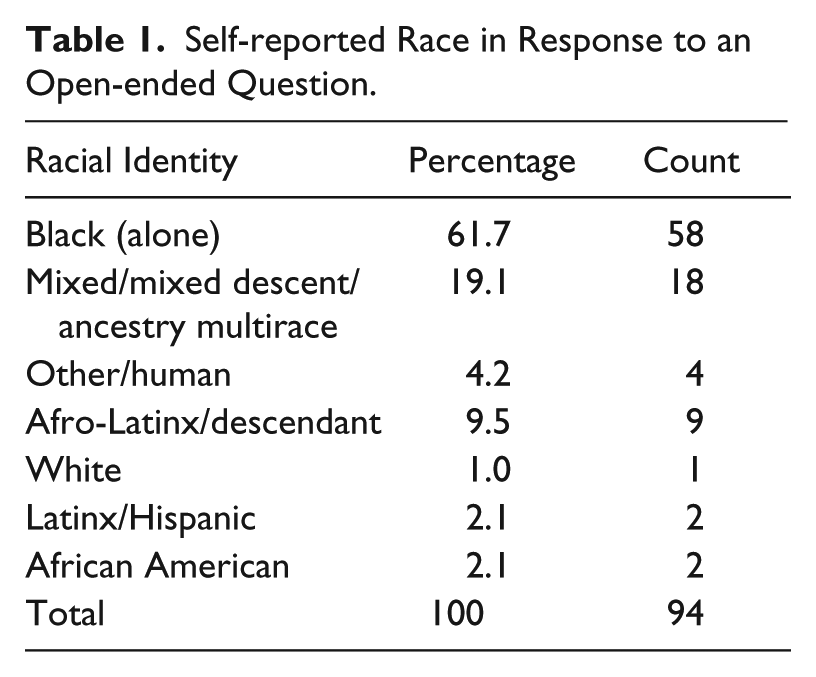
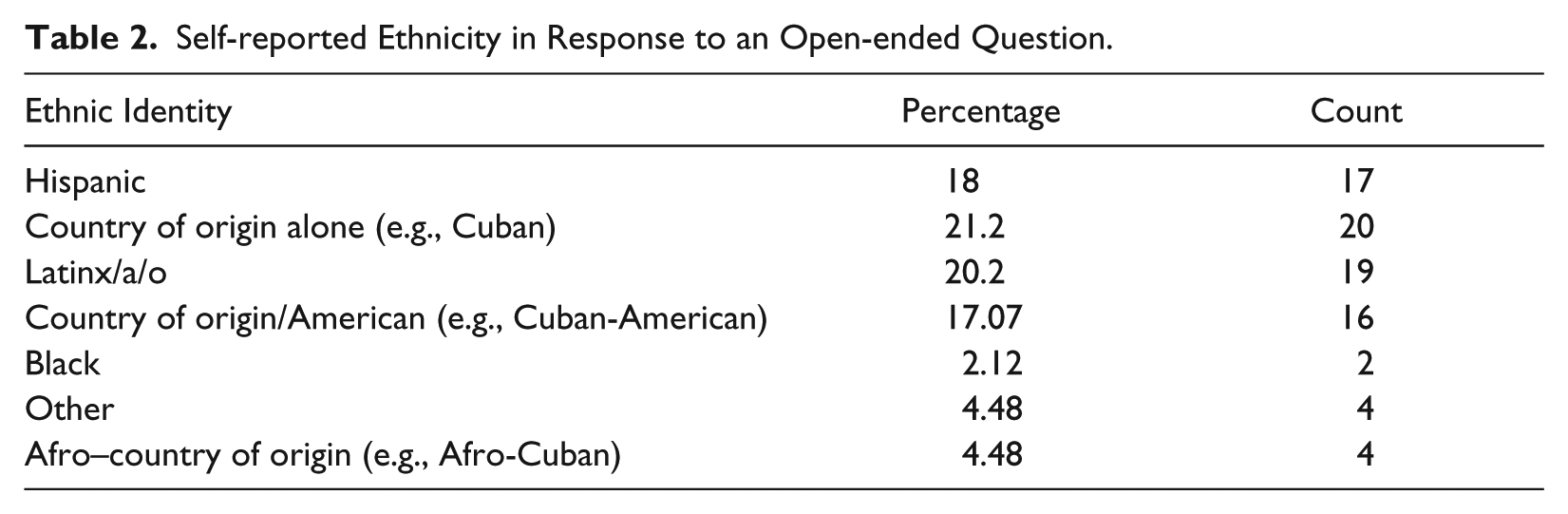
In our sample, women and heterosexuals were overrepresented, accounting for 91 percent and 79.5 percent of our participants, respectively. Most respondents were born in the United States (79 percent) and spent their entire lives in the United States (80.6 percent). In response to our open-ended question about race, 61.7 percent identified as Black and 19.7 percent as mixed race (Table 1). Similarly, in response to our open-ended question about ethnicity, 38 percent reported Latinx/Hispanic, while 38 percent reported their ethnicity on the basis of country of origin (Table 2). Finally, 85 percent of the sample was younger than 44 years, and 60 percent reported incomes of less than $35,000. More than 80 percent had some college and/or a college degree. Although our respondents trace one or both of their parents to more than 20 different countries, 42.5 percent of all respondents reported ancestry to either Puerto Rico (13.8 percent) or the Dominican Republic (28.7 percent). This high representation is consistent with previous research noting that Puerto Ricans and Dominicans are more likely than other Latinx groups to identify as Black (Duany 1998; Logan 2003).
Self-reported Race in Response to an Open-ended Question.
Self-reported Ethnicity in Response to an Open-ended Question.
We analyzed data by reviewing all transcripts manually and coding major topics using a multistage process beginning with line-by-line coding (Charmaz 2014). In the first stage, we used a grounded-theory approach to identify process-centered codes such as “controlling racial features,” “experiencing shame,” “performing authentic Latinidad,” and “hearing anti-Black messages.” We then recoded the most frequently discussed codes by connecting them to specific actors, temporal moments, and social institutions. An initial code of “controlling racial features” was recoded to “matriarchal racial policing” to emphasize both the actor and institution, and we included a temporal code indicating childhood or adulthood. The first and second stages of coding relied on an iterative and comparative process during which we evaluated and compared data across survey responses and interviews. We recoded and analyzed interview and survey data concurrently, during which we sometimes used codes that originated in the interview data to code the survey data. Once we recognized persistent patterns related not only to the frequency of themes but also the conditions under which observable patterns varied on the basis of family actors, social institutions, age, gender, and racial appearance, we interpreted this point as “theoretical saturation” (Charmaz 2014). In our results, we privileged themes that were most often experienced, but we also incorporated outliers to illustrate the variability of responses.
Results
Family as a “Point of Origin” for Colorism
As most participants had not always self-identified as Afro-Latinx, one of our initial prompts for respondents was “Share some of your earliest memories that shaped your identity as Afro-Latino/a.” The majority of the respondents recalled how comments about their racialized bodies in their families were among their earliest memories. A thoroughly gendered process, mothers, aunts, and grandmothers performed the dominant role of transmitting racialized messages that policed the bodies of Afro-Latinxs, and according to respondents, they often did so in a way that normalized colorism (Comas-Díaz 1994; Cruz-Janzen 2001; Wilder 2015). Yesenia, who is Dominican and Puerto Rican, conveys how her racial features were monitored by her family members: I have been told to stay out of the sun so that I don’t get darker (although I’m pretty light most of the time in NY, I can get very golden bronze). I’ve been told to straighten my hair to look more white and also to not wear bright lipstick because my lips are too big.
Although colorism implies the primacy of skin color, respondents’ narratives often revolved around the stigmatization of a constellation of racialized features that are associated with Blackness: hair, skin color, lip size, and nose shape. Beyond negative evaluations of her features, Yesenia’s socialization offers behavioral (stay out of the sun) and embodied (straighten hair and change lipstick) strategies meant to manage these features.
Offering further support about how the prevalence of negative evaluations of Black features (rather than simply skin color) shaped her earliest experiences, Ana, who is Dominican and racially identifies as Black/Indian (indigenous), offers, I remember being 8 and my grandma talking to me about my lips. She said I needed to pull them in some and not let them stick out so far. I had no idea how I could do this but I tried. Comments like these were frequent.
A critical intersectional perspective demands attention to the distinctly gendered and multigenerational aspect of policing embodied Blackness for Afro-Latinas (Comas-Díaz 1994; Cruz-Janzen 2001). In this case, a grandmother’s advice to an eight-year-old child clarifies that racial stigmatization begins at a relatively young age, as do efforts to control or minimize these features. Recognizing both the gendered and generational aspect of these comments, Martha, who is Puerto Rican, suggests, “The older women in my family have always been obsessed with lightening the family’s bloodline. The men never seemed to care.”
Women are tasked with the daily care work involved with raising children, which includes grooming. For mothers, the racial appearance of their children indicates the extent to which they have succeeded at “mejorando la raza” (improving the race) by bearing lighter children (generational whitening) and/or otherwise presenting racialized features that align with valued features of dominant racial and phenotypic hierarchies. Generational whitening manifests strongly in cases when family members threaten the whitening imperative by marrying darker partners: I was told there were some distant family members (great aunts, great cousins) who were upset that I was black, but it was more so aimed at my mom for “ruining” herself by getting pregnant by a black man. My [immediate] family shielded me from most of the negativity. (Ariela, Mexican)
The anger, disappointment, and notion of “ruin” is directly attributed to the perception that approximation to whiteness or lightness functions as “capital” that can be exchanged for access to partners, job opportunities, and positive affective experiences (Hordge-Freeman 2015; Hunter 2002; Monk 2014).
Our focused attention on the significance of racial features (rather than simply skin color) was substantiated by the sheer volume of reported experiences related to the stigmatization of hair texture. Of all racial features, hair texture was mentioned more frequently and with more detail than skin color or any other racialized characteristic. Our data are replete with narratives of Afro-Latinxs who linked the feeling of being racially different to their hair because it was derided as “nappy,” “hard,” “crazy,” or “kinky.” Regina, who is Dominican and Puerto Rican, discusses how her coiled/curly hair was managed in her family: My hair was unlike most people, including family. When my mother did my hair, it was ALWAYS in one big braid or two braids. She didn’t know any other hairstyle that could tame my hair. When my grandmother did my hair (or basically anyone from my dad’s side) it was ALWAYS straightened, or relaxed. I felt like an outsider within my social groups and my family.
In this case, negative evaluations of Regina’s hair texture alienate her from her biological family and also present a challenge for her sense of belonging in the broader Latinx community.
Even as mothers are central to socialization practices, they may also police Blackness ambivalently in response to social pressures rather than as a reflection of their internalization of phenotypic hierarchies (see also Hordge-Freeman 2015). As Teresa, Dominican, notes, “My mom also took good care of our curls, but I felt she was pressured by those around her to relax my hair since my texture was a bit different than my sisters.” In addition to pressure from the community, the use of socialization practices that “fix” Black hair and features are sometimes directed at preparing their daughters for a future when beauty determines marriageability and marriageability offers stability and status. As Martha, a Dominican, notes, “I’ve always heard things like ‘oh you’re decent looking, but you would do your future children a favor if you marry someone lighter than you’ and other anti-black sentiments.”
Respondents’ discussions of what Hordge-Freeman (2015) previously referred to as “racial rituals” (embodied practices used to modify racial features) often presume the indifference of men (as Martha’s earlier statement suggests). However, there is also evidence that male family members (fathers, grandfathers, and brothers) are actively engaged in these practices. As Natasha (Dominican) notes, “Every time I FaceTime my grandfather he tells me to fix my ‘pajón’ [translates as ‘straw’ but used to connote messy or unruly hair].” Similarly, Rebeca, who is also Dominican, shared, “My hair was a constant source of criticism. Since it is Kinky . . . my brother used to call it his mop or even his brillo [scouring pad]. . . . I was overlooked by guys a lot due to this.” Therefore, men’s concerns about racial features are evident both in their decisions about who they value as sexual or marital partners and through their policing of women’s bodies. Their evaluations are based, in no small part, on notions of beauty, which are often understood to correspond with the absence of Black features (Candelario 2007; Comas-Díaz 1994).
“Double Speak,” Ambivalence, and Transgressive Socialization
In addition to the way their embodied Blackness is the target of negative commentary from family members, Afro-Latinxs may struggle with how negative evaluations of their racialized bodies are spoken alongside mixed messages about racialized features. One respondent refers to this as “double speak,” which she argues compounds the confusion and disidentification that she felt because of being more dark skinned than her family. As Marely (Dominican) notes, “I would say that my family members have actually praised my brown skin but I have heard them say ‘get out of the sun, you’re going to get dark.’” In this case, brown skin is valued, as long as it is not too dark. The notion that there is an ideal brown color is rooted in the idea that brownness rather than Blackness is acceptable (Candelario 2007; Rodriguez 2000).
Likewise, “double speak” is observed when one’s beauty is ambivalently evaluated or only partially affirmed: My aunt on my mom’s side [said] to me once “que bonita eres para [una] morena” [you are pretty for a dark-skinned girl] and I’m just thinking in my head like wow tia [aunt] gracias how nice. And the same aunt told me I should get a relaxer LOL. (Anita, Panamanian) I remember my mother doing my hair. . . . She would say to me that I was too light to have such pelo malo [bad hair]. (Sonia, Dominican)
As is evident, critiques about embodied Blackness are based on skin color, hair texture, and other racialized physical features. Compliments that respondents receive frame beauty as emerging from or being enhanced by modifications that eliminate or mitigate Black features. And overall, this constant critique of their racialized bodies is the source of their confusion, desire for validation, and disidentification with a solely ethnicity-centered identity.
Although the majority of respondents noted receiving explicitly negative or ambivalent messages about their racial appearance, there were rare occasions when family members also challenged dominant hierarchies. Parents (especially mothers) can intentionally cultivate a positive self-esteem even after having experienced colorism and/or differential treatment themselves. As Claudia, who is of Cuban and St. Lucian descent, notes, Growing up in Cuba, my mother was teased for being too dark and hair being too “hard,” even by her own mother. She always made an effort to make sure I was not ashamed of my skin color or hair texture. And I should be proud to be Black.
Beyond asserting that one should have pride in their racial appearance, other parents more explicitly linked racial features to African heritage and transmitted the importance of recognizing their heritage in a more political way: For my family it has always been important to embrace our African roots and be proud of them. My parents taught us (to my sister and I) that being African was one of the most wonderful things ever, because our culture and history is the most influential worldwide. (Simone, Costa Rican)
These positive affirmations suggest that there are multiple rather than singular pathways to self-actualization and identification as Afro-Latinx. Although for some respondents Black racial affirmation begins in their families, for most respondents, their Afro-Latinx identity develops through their exposure to experiences in other communities.
The Real Deal: Blackness and Ethnic Authenticity
We have established that colorism and embodied Blackness (the extent to which one’s phenotype corresponds with features associated with Blackness) plays a prominent role in the lives of Afro-Latinxs in the context of their families. Although the policing of Black racial features was common, families often embraced and encouraged cultural displays to reinforce their Latinx group membership. To be sure, Afro-Latinxs’ cultural heritage is significant to them, and many described lives filled with vivid memories of delicious food and music that crystallized their connection to their families’ country of origin. Gabriela (Panamanian) notes, At home, at all of our family functions, there was salsa, merengue, and reggaeton blasting from the speakers. Whenever my family got together, the adults spoke in Spanish to one another. We ate arroz con pollo, patacones, empanadas, carimañolas, tamales.
The ethnoracial dissonance that Afro-Latinxs express arises because they report their ethnic identity is contingent on downplaying their racial identity alongside the requirement that as questionable “in-group” members they perform conspicuous displays that offer evidence of their “authentic” Latinidad. For example, Claudia (St. Lucian and Cuban) maintains her Spanish to “hold on to this as ‘proof’ that I am Latino.”
Respondents note that the ability to speak Spanish also allows Afro-Latinxs to preempt ethnic assumptions and avoid misidentification in interactions with other Latinxs. As Susana (Costa Rican) notes, “My mom would always start speaking in Spanish around other Latinxs, to make it known that she was Latin as a defense mechanism.” In the absence of a prototypical “Latino” appearance, language becomes a key cultural marker that validates their group membership as Latinxs. This is especially important in interactions with other Latinxs, who may assume they are “too Black” to be Latinx (Hernandez 2003). Gabriela (Panamanian) corroborates this experience: I remember at a Hispanic Festival my sister and I were there and there were two young guys next to us (white Hispanic or white Latinos) and we were saying the words of the song and they were telling each other in Spanish, one guy said to the other guy in Spanish, that basically we couldn’t be Hispanic. He said basically we may know the songs but we weren’t Hispanic.
In this case, the apparent incongruence between a “Black” racial appearance and Latinx ethnicity means that even in situations when they speak Spanish, their authenticity is nonetheless challenged.
Finally, the decision to accentuate ethnicity by speaking one’s native language or using an accent is strategically used by Black immigrant groups (Waters 2009). In this case, respondents use it to create distance between Afro-Latinxs, African Americans, and other non-Hispanic Blacks. For example, Raquel (Guatemalan and Dominican) notes, My mom used to tell my siblings and me when we were in elementary school that we needed to remember that we were Hispanic and not black. That didn’t work because the black community embraced us and the Hispanic groups didn’t.
It is precisely in extrafamilial spaces, such as schools, where Afro-Latinxs find that the racial schemas used by their family members may be challenged by authority figures. In Raquel’s case, her embodied Blackness precludes her from being considered authentically Latinx but leads to her acceptance by Blacks (African Americans). Yet even in these moments of acceptance, Afro-Latinxs may be expected to choose whether they are Black or Latinx, which are the dilemmas that contribute to their ethnoracial dissonance.
Getting Schooled on Race, Ethnicity, and Afro-Latinidad
Afro-Latinxs’ entry into major social institutions, such as schools, can serve as inflection points when their racial identities are validated, contested, and/or transformed. Historically, in the United States, public institutions (especially schools) have been places used to police racial boundaries. For mid-twentieth-century Afro-Latinxs in the United States, Jim Crow laws dictated racial norms that translated into formal segregation. As Evelio Grillo’s (2000) memoir and autobiography reveals, Afro-Cubans in 1950s were racially categorized as Black and were subsequently relegated to all-Black schools and neighborhoods in Tampa.
Reflecting on a similar time period, Margarida (Honduran) describes how her racial encounters at a public school shaped her racial identity: When I arrived to the USA, my siblings and I we were placed in an all-Black school by the School Board based on our color in 1969. This was the first time I realized that I was Black. I was never identified by my color before. Now as an adult I’m more at home when I’m surrounded among Blacks. They were the ones who welcomed me.
Nearly 50 years later, Margarida’s experience in segregated all-Black schools is no longer an experience faced by younger respondents. However, schools retain their importance as sites of racial surveillance and, perhaps to a lesser degree, a means of institutionalizing one’s identity. Specifically, Afro-Latinxs’ physical proximity to African Americans, in primary and secondary schools, made it difficult for them to adopt the nonracialized identities that had been reinforced at home. As Sara (Puerto Rican) notes, When I was younger, around middle school years, I went to a school that had a lot of African American and Latino students. It was during this time that I was confused with my identity. My mom told me I was of Puerto Rican descent and I was proud to be Puerto Rican. However, because I didn’t speak much Spanish, I had curly hair, and my skin was darker than most of the Latinx students, I was not seen as a Latina. I would hear that I was more black than Latina, I didn’t fit into the community because of how I looked and how I was raised. It made me feel less proud because I was constantly reminded of how I didn’t look Puerto Rican or Latina. My self-esteem was so crushed that I wore a jacket everyday, regardless of the weather, so that the sun wouldn’t make me darker.
Sara’s Puerto Rican identity is discounted on the basis of her lack of Spanish and her “Black” racial appearance. That her efforts to experience belonging necessitated modifying or hiding evidence of her African heritage (skin color and hair) illustrates how Blackness and Latinidad are considered mutually exclusive. Moreover, the emotional impact of her peers’ failure to recognize her Puerto Rican heritage reveal the deeply felt affective dimensions of ethnoracial dissonance.
Previous studies suggest that in primary and secondary schools, peers play an important role in racial identity formation (Winkler 2012). However, among respondents, teachers were also important because they monitored racial boundaries and contested ethnic claims. As Zulema, an Afro-Mexican woman (African American father and Mexican mother) who grew up in Georgia, notes, Disclaimer: I did not grow up with my father’s black side of the family. I met him later in life. I grew up in a 100 percent Mexican household until college. I did not understand I was black until my first day in 1st grade. I was placed in bilingual classes because I spoke Spanish and english. When the teacher walked in, she asked me what class I was supposed to be in, in front of the class. When I replied, “this one.” She angrily told me to get my things and walked me to the principal’s office. I remember being mortified and confused. After my mother was called in and they realized I was supposed to be in that class, my realization that I was racially different was evident. It shaped my afro-latina identity ever since.
Not only does Zulema’s teacher not have the racial schema necessary to allow Blackness and Latinidad to be legible together, the punishment she receives for attempting to correct a misidentification has a lasting impact on the development of her Afro-Latinx identity. The geographic dimension of her narrative is essential, as Georgia’s entrenched history of Black-White racial tensions and comparatively lower population of Afro-Latinx immigrants only leave space for Zulema to be categorized as African American. Romo (2011) similarly explored how California’s regional distinctiveness affects the racialization of those who identify as Black and Mexican (Blaxican).
A Different World: Afro-Latinx Identity Formation in College
One of the most significant inflection points that marked a transition for the racial identity of Afro-Latinxs was respondents’ entrance into college. College for young adults is crucial because it is often one of the first moments that they have complete independence from family members, which is associated with their experimenting with relationships, activities, and friendship groups without being under the critical eyes of their families (Goldscheider and Goldscheider 1999). Researchers note that through self-selecting organizations and peer groups, college helps vulnerable and underrepresented racial and ethnic minorities feel empowered, increase their self-esteem, and construct politicized identities through activism (DeAngelo, Schuster, and Stebleton 2016; Villalpando 2003). Sidanius et al. (2004) found that among Black and White students, their affiliations with fraternities and sororities increased ethnic identities and homophily. Other studies emphasize the critical role of student organizations and activism in fostering racial identity, but these studies have not examined how similar processes may affect Afro-Latinx students (Kaplan and Flum 2012). Our findings suggest that for Afro-Latinx students, the college experience is significant because it provides an opportunity to self-select peer groups, pursue self-discovery in terms of their knowledge of their history, and experiment with their racialized bodies.
First, Afro-Latinx respondents routinely attributed college courses and lectures on the African Diaspora and African culture with filling in the gaps of knowledge that they had about race and ethnicity. In this, respondents shared similar narratives: I used to be ashamed of my skin color and my roots (at a young age) but once I got to college, I started to become more accepting of my heritage. I learned more about my country’s history and this made me appreciate it more. (Lily, Puerto Rican)
Lily clarifies that beyond gaining knowledge about African heritage, these experiences offer a path toward self-pride and validation. In addition to exposure to courses, the institutional culture and racial dynamics of a university also affect how students experience race and ethnicity in college. As Milagro (Puerto Rican) states, “I currently go to a predominantly white higher education institution and I find myself leaning on more to the African Americans. I am part of that group I believe because it’s a ‘black or white’ type of thing.” The stark Black/White racial dynamics at a predominately white institution provide the context for which Milagro develops solidarities with African Americans and comes to view race as a binary construction. This is similar to the ways that racialization experiences in secondary schools may vary depending on structural, historical, and demographic factors.
A less examined phenomenon, the college experience is significant especially for women’s racial and ethnic identity because it grants them the freedom to experiment with their racialized bodies. This is best reflected in Afro-Latinxs’ experiences with transitioning from chemically straightened hair to their natural hair: “Truly beginning to embrace my natural hair during college initiated my journey to identifying as an afro-latina” (Ana, Dominican); “As I grew up I embraced my curls and let it out. People I know with similar hair, go to the Dominican salon to straighten it. I feel more connected to my afro-Latino roots with my natural hair” (Mariela, Dominican). Given the significance of hair to Afro-Latinx socialization in the family, the decision to stop straightening what is considered “pelo malo” (bad hair) is an aesthetic choice that is imbued with deeply emotional, political, and racialized meanings (Caldwell 2003). Previous research highlights (and we thus expected) the importance of student organizations and Greek life to emerge as central to racial identity formation. However, these were less important to our respondents than their exposure to alternative racial/ethnic schemas, knowledge about the African Diaspora, and freedom to explore their bodies (specifically their bodies) in a way that leads them to reconcile their ethnoracial dissonance.
Virtually Black: Online Communities and Afro-Latinx Identity
Researchers note that “over time and generation in the United States, the offspring of Latin American immigrants were by far the most likely to define their racial identities in sharp contrast to their own parents” (Portes and Rumbaut 2001:20). Yet little is known about the role of online communities in influencing this process for Afro-Latinxs. For Afro-Latinxs who find themselves absent from mainstream television and often invalidated in their families (Negrón-Muntaner 2014), online communities and social media become a powerful platform for them to locate others who share their racial and ethnic experiences. Virtual online communities serve as “sites” where people’s relative autonomy allows them project “identities that are highly social, as well as culturally and narratively elaborated” and by connecting with individuals with that share commonalities their identities can become more crystallized (Grasmuck, Martin, and Zhao 2009:180).
The social media pages targeted in our study are often created by Afro-Latinx bloggers who share the goal of increasing the visibility of Afro-Latinxs, albeit in different ways. These online pages may feature photos and profiles of prominent Afro-Latinx celebrities and encourage followers to post pictures of themselves to represent Afro-Latinidad. The celebration of beauty is a central theme that these pages address by showcasing the wide array of natural hair textures, skin tones, and facial features of Afro-Latinas. Consequently, some followers are motivated to seek these sites because they want resources related to hairstyling advice for Afro-textured hair. However, these initial curiosities about managing their hair exposes them to other Afro-Latinxs whose hair textures and experience of ethnoracial dissonance resemble their own. Beyond exposure to the visual images of Afro-Latinxs, these social media pages may include articles and comment sections that promote deeper conversations among followers about beauty, hair, race, colorism, family, and current events affecting Afro-Latinxs. Therefore, although the motivations for frequenting these sites may vary, followers remain engaged because of the level of community and visibility they offer.
As an indication of the significance of virtual communities, it was through their online activity that some were initially introduced to the term Afro-Latinx. As Claudia (Cuban/St. Lucian) states, I had never heard of Afro Latina until September of 2016. I saw it on Instagram and was in shock. I researched it so much and was like “WOW.” That term seemed to completely describe me finally!!! I feel more confident now. From then on I’ve completely embraced this and felt less embarrassed about my origin.
In addition to highlighting how social media introduced them to the term, other respondents focused on the significance of a newfound visual experience of perusing photos and engaging in online interactions with other Afro-Latinxs. As Maritza (African American and Panamanian) explains about the Afro-Latinx bloggers who she follows, I follow them because they are like me it’s just nice seeing someone that can relate, even if I don’t know them personally. I feel like I can understand a piece of them. I want to see more pages of more black latinos just more. There is not enough more pictures more people more discussions MORE MORE MORE!!!!
Respondents articulated that social media fostered a sense of closeness, support, and sense of understanding of their experiences. As this validation is not often found in their biological families, respondents develop such close ties with Afro-Latinx bloggers and followers that they report “it feels like they’re family.” Specifically, Jennifer (Dominican/Puerto Rican) discusses how her online experiences provided her with a sense of discovery and sense of inclusion that improved her self-esteem. She recalls, I saw more people embracing their culture and I stumbled upon some Afro-Latina social media pages/blogs. I found my culture. My self-esteem actually got better after this. I still get the [negative] comments, I just feel less left out.
Overall, Afro-Latinx social media engagement was a significant source of community building that led to respondents’ development of a positive Afro-Latinx identity. With increased awareness about their Afro-Latinx identity, more than 25 percent of respondents who discussed the importance of online communities in their identity formation expressed a desire for these pages to include content that was more geared toward political issues. For example, two respondents suggested “I would like to see less fetishization or obsession with looks and more of a cultural revolutionary direction” (Lina, Puerto Rican), and “I would love for these blogs to show more content about black history in Latin America, show videos and documentaries about our people, and above all just continue educating others and sharing people’s experiences being an Afro-Latinx” (Yamila, Puerto Rican). Despite these critiques about limited content, merely stumbling across the term Afro-Latinx and seeing images of Afro-Latinxs was life altering for respondents. This representation helped respondents identify the source of their ethnoracial dissonance by providing the language to articulate their experiences, the visual validation that they were part of a unique family or community, and the emotional support and encouragement to be proud of being Afro-Latinx. An assertion of this identity implies, Ruth (Dominican) notes, “We aren’t just Latino or Black because we obviously don’t want to erase one part of our culture and identity, we are both, Afro-Latinx.”
Discussion
Our findings suggest that Afro-Latinx identity formation rarely occurs as a result of racial affirmation from families, as is observed for other Black-identified groups in the United States (see McKay et al. 2003; Miller and MacIntosh 1999). This finding complicates previous research on African descendants in the United States, which often focuses on how family socialization engenders Black racial pride (Lesane-Brown 2006; Serrano-Villar and Calzada 2016). To be sure, in current studies, Black-identified families reproduce colorism and may internalize broader hierarchies, but this often appears alongside explicit messages about racial pride and affirming ideas about Black identity (Burton et al. 2010). Afro-Latinxs’ families, on the other hand, emphasized their nations of origin or Latinx identities such that messages about Blackness were almost exclusively characterized by stigmatization, racial policing, or distancing. Among the Afro-Latinxs who did link transgressive discourses to an affirmation of Blackness are those who had one parent who was Latinx and the other who was African American or one parent from a non-Spanish-speaking Caribbean country. These differences, in racial discourse and ideology, may be attributed to differences in what Lamont et al. (2016) referred to as “cultural repertoires,” which include different understandings of race and racism and the history of recognizing and responding to racism and racial stigmatization in particular ways. For families with one African American parent, “cultural repertoires” that include assertively recognizing and responding to racism and colorism might be an important consideration in understanding why their socialization strategies vary.
We characterize Afro-Latinxs’ experience as one of ethnoracial dissonance, and although this term could be used to describe the experiences of other groups (and we welcome these extensions), we affirm that Afro-Latinxs experience this uniquely for several reasons. First, their familial socialization strongly and negatively critiques their racial appearance in exchange for ethnic affirmation. Second, their efforts to assert a Latinx identity are widely rejected by other Latinxs and also challenged by most other in the United States (including Black non-Hispanics). Finally, dominant ideologies from Latin America stigmatize Blackness and rely on color-blind discourses of national identity, leaving Afro-Latinxs feeling alienated by their ethnic group without the language to articulate their racialized experiences.
Beyond families, we find that primary and secondary school and college are sites of racial and ethnic policing, identity affirmation and contestation, and racial discovery. However, how these experiences unfold is based in part on both geographic location and an educational institution’s racial history and culture. Overall, respondents’ experiences in both college and online communities reveal the extent to which embracing Afro-Latinidad is an embodied process that, for many respondents, involved and sometimes began with embracing their hair and racialized features. The centrality of body politics to their identity formation is informed by the fact that these physical differences are what relegate them to perceptions that they are “out-group” members. Hence, respondents’ receptiveness to the term Afro-Latinx reflects the accessibility to a positive social identity and social group membership that allows them to be both Black and Latinx. As social identity theory suggests, the emotional benefits (increased self-esteem, sense of belonging, and sense of community) that are associated with this “new” Afro-Latinx identity is central to why this term has been adopted
In the post-1965 era, our findings about Afro-Latinxs offer theoretical insights into how race, ethnicity, and pan-ethnicity may evolve in the future. Flores and Román (2009) suggested that Afro-Latinxs are a missing link in the ethnoracial discourse of the United States but a group whose ethnic, racial, and political identity has implications for the ethnoracial landscape of this country. Indeed, Afro-Latinx identity is disruptive because it blurs racial and ethnic boundaries and foreshadows the emergence of new social groups. At the same time, Bonilla-Silva’s (2004) Latin Americanization thesis predicts that cleavages in the United States will consolidate a divide between Whites, honorary Whites, and the collective Black. And although many Afro-Latinxs may be structurally positioned in the collective Black, this placement does not necessarily mean they will align themselves with those in this same category. In fact, social identity theory predicts that rather than develop solidarity with others in the “collective Black,” some Afro-Latinx respondents might identify other members of the collective Black as the negatively evaluated “out-group.” Overall, Afro-Latinxs’ experiences and identity formation processes are mandates for critical race and immigration paradigms to develop new theories that account for layered and embodied experiences of racialization. By doing so, researchers can evaluate whether and under what conditions groups such as Afro-Latinxs will fade to gray or solidify the enduring color line.
Footnotes
Acknowledgements
This research was funded by a University of South Florida College of Arts and Sciences Pilot Study Grant.