




Abstract
In his landmark work, Richard Alba predicted that white ethnicity would fade into its twilight in the twenty-first century. Where direct inquiries into American white ethnicity have been scant since the millennium’s turn, the authors use recently collected (2014), nationally representative survey data to systematically assess “postmillennial” white ethnic identification. In particular, the authors explore the prevalence of whites identifying with ethnicity today, how this compares with other groups, and how drivers of white ethnic affiliation may have shifted in recent years. The data show that all ethnic claims have declined in the twenty-first-century United States, but the retreat from ethnicity has been accelerated among whites. By the authors’ estimates, only 8.4 percent of whites still claim ethnicity. The authors also find that white ethnic affiliation is now most substantively driven by racial ideology, experience, and perceived victimhood, though some demographic markers remain important. Further analyses show that remaining American white ethnic claimants now perceive white cultural advantages while simultaneously seeing themselves as victims of racial discrimination at rates that rival reports of nonwhites. In sum, these data suggest that white ethnicity has declined but not disappeared as a socially intelligible boundary claim in the postmillennial era and that it has developed as a racialized expression that holds implications for understandings of contemporary white identities, racisms, and resentments.
Definitively American in origin, the notion of white ethnicity emerged from the collision of the nation’s immigrant history with its legacies of slavery, internal colonization, and Jim Crow. European migrants around the twentieth century’s turn—especially from eastern and southern regions—brought cultural practices and identities distinct from America’s dominant Anglo-Saxon core. They were marked as different; many did not necessarily desire to assimilate. Yet as these migrants—and their descendants—settled into American life, concerns for social position and cultural belonging materialized, particularly where the realities of American racism surfaced. New European immigrants came to find benefit in distinguishing themselves from other, subjugated racial minorities: Asian Americans, Hispanics, Native Americans, and most of all African Americans (Treitler 2013). Unique communities, identities, and classifications operating somewhere “in between” whiteness and blackness (Barrett and Roediger 1997) were carved, and the distinctive boundary claims of hyphenated, “white ethnic” America were born.
As the demographics of U.S. migration shifted across the twentieth century, race relations evolved, racisms were rearticulated, and so too the content and contours of white ethnic expression were transformed. Approaching the crescendo of the civil rights era, for example, Nathan Glazer and Daniel Moynihan (1963) charted a reinvigoration of white ethnic identity claims in Beyond the Melting Pot and predicted that “white ethnicity” would powerfully endure within American political, civic, and social life. Glazer and Moynihan were on to something: white ethnic claims commanded substantial attention in the academy and popular culture through the remainder of the twentieth century. However, contrary to their understanding white ethnicity as durable and through ancestrally rooted traditions and networks, new forms developed containing fundamentally different boundaries, content, and consequence.
The late-twentieth-century form of white ethnicity was documented in a series of milestone books (Alba 1990; Lieberson and Waters 1988; Waters 1990). Collectively, these works showed that traditional distinctions between white ethnic groups (e.g., Italian, Polish, Irish) had given way to an encompassing “white ethnic” category with its own cultural salience and demographic coherence relative to whites who remained “unhyphenated” (see also Lieberson 1985). Moreover, as direct ties to ancestral lineages and cultural practices waned, ethnicity, for many white Americans, became a malleable and essentially optional identity. This “symbolic” turn, as Herbert Gans (1979) first theorized it, was so substantial that Richard Alba (1985,1990) speculated that the social effect of white ethnicity, which had flourished so much through the twentieth century, was approaching its “twilight” as the twenty-first approached.
In this article, we revisit American white ethnicity to investigate what remains of it and to chart its expression in the current, “postmillennial” period. We believe this reassessment is particularly urgent in light of the highly contested politics of race and shifting terrain of whiteness in the contemporary United States. The constitution of American white ethnicity has long exhibited sensitivity to changes in the racial-political environment in which it has been situated (Brodkin 1998; Jacobson 1998; Roediger 1991; Steinberg 1981), and its role in the reproduction of racial inequalities has always been fraught (as signaled in Waters’s [1990] memorable critique of the “costs” of a costless community). More generally, the role whiteness plays within American racial formations has anchored much sociological inquiry in recent years, particularly regarding its political contextuality and the assertive leeway that is exclusive to white identities (Nagel 1994; Twine and Gallagher 2008). With the rise of “white identity politics,” nationalist organizations, backlash, perceptions of victimhood, and shifts in white voting patterns (among other factors) since the millennium (Arbour and Teigen 2011; Hughey 2012b, 2014; Jardina 2019; McAdam and Kloos 2014), it is important to consider whether and how forms of white ethnic expression may have shifted in this period.
Against this backdrop, we use cross-sectional data collected in 2014 as an update to our earlier documentation of white ethnicity with 2003 data (Torkelson and Hartmann 2010), which showed white ethnicity in decline but still exhibiting some continuities with late-twentieth-century demographic forms. Specifically, we draw upon unique measures of race, ethnic and racial identity, and racial ideology to explore (1) the prevalence of (white) ethnic claims in contemporary America, (2) how whites who claim ethnicity compare and contrast with “nonethnic” whites across relevant demographic and ideological terms, and (3) how ethnic boundaries among whites operate in the contemporary racial-political environment.
Broadly, we find ethnic identity claims in the United States have continued to decline through the twenty-first century but that this retreat from ethnicity is accelerated among whites. Multivariate regressions show that postmillennial white ethnicity is now driven primarily by racial ideology, experience, and perceived victimhood, though some demographic markers remain significant. Additionally, we find that postmillennial white ethnic claimants now believe in white cultural advantage while simultaneously perceiving themselves as victims of racial discrimination at rates that partly rival those of nonwhites, marking significant departures from previous assessments.
In all, our data indicate that movements within the expression of ethnicity transpired among whites in the first decades of the twenty-first century, suggesting that the United States may be on the precipice of another distinct wave of meanings associated with white ethnic claims and the category of white ethnicity itself. On their whole, findings signal a potential shift from white ethnic identification as being primarily a relatively innocent cultural practice, ornamental expression, or even a rhetorical artifice animated by ideological color blindness. Informed by critical whiteness studies and racial theory in context of the shifting and deeply contested politics of race in the contemporary United States, we suggest that “white ethnicity” boundary claims, where they persist, appear to be taking on a racialized tenor that may be more about (the preservation of) whiteness itself, to a point at which postmillennial white ethnicity might be best characterized as a “racialized ethnicity” or white ethnicity. The implications of the apparent racialization of white ethnic claims are unpacked in the concluding discussion.
(The Study of) White Ethnicity within American Race Relations
We characterize American white ethnicity and attendant boundary claims as passing through four historical phases, which are essentially reflected in its study—arrival, revival, postrevival, and postmillennial. White ethnicity’s expressive contours have been inflected by demographic shifts and prevailing racial politics at each turn, particularly regarding its operation within hegemonic whiteness and construction relative to nonwhites. We are especially interested in the relative emphasis or balance between the two different sides—the racial and the ethnic—in the general thrust of white ethnic assertions through these stages. The literature to date has captured the first three phrases of this periodization.
“Arrival” white ethnicity generally encompasses the European wave of immigration and incorporation experiences that emerged in the late nineteenth century and extended into World War II (Foner 2000). National origins and associated cultural differences were important to this immigrant experience. Distinctions such as Polish, Irish, and Italian were salient identification categories and modes of social organization (Handlin 1952). European ethnic identities derived from countries of origin were more externally enforced than any subsequent phase of white ethnicity; different groups faced varying degrees of discrimination on religious and racially constructed grounds as they entered the fold of pre–civil rights racial relations largely as “in-between peoples” (Barrett and Roediger 1997). Despite intergroup differences, a tendency toward seeking inclusion within whiteness via distance from poor blacks pervaded (Roediger 1991). These groups indeed forged social closures around labor unions, enclaves, and civic organizations to the exclusion of blacks, who were still facing rigid legal, interpersonal, and systemic discrimination under de jure segregation (Ignatiev 1995; Jacobson 1998, 2006; Roediger 2002).
Such bases for ethnic succession and structural mobility yielded substantial gains with the economic boom following World War II and the distribution of GI Bill benefits to many whites (Brodkin 1998), especially as old bounded urban white ethnic neighborhoods began bleeding out into multiancestral suburbs. Intermarriage was also common across ethnic, though seldom racial, lines (Lieberson and Waters 1988). Nevertheless, affective, even primordial, claims to distinctive white ethnic heritages saw a revival through the 1960s into the 1970s (Jacobson 2006; Steinberg 1981). The turn back from generic whiteness was not just attributable to greater incorporation within it, or Marcus Hansen’s (1938) principle of third-generation return to ethnicity. It was also a substantial reaction to the putative environment fostered by the civil rights era and an abundance of minority protest movements (e.g., Red Power, Black Panthers, Chicanismo) with respect to “rooted” identity claims and origin-based solidarities (Brodkin 1998; Nagel 1994). White ethnic organizations developed in revival times, as did a white ethnic vote distinct from the still white Anglo-Saxon Protestant Republican vanguard, particularly where white ethnics persisted in cities (Greeley 1974). In all, this “roots generation” (Jacobson 2006) contained such intensity that white ethnic groups were posited as “unmeltable” fixtures in American life, possessing specific religious, political, and class characteristics (Glazer and Moynihan 1963; Novak 1972).
The revival fervor, however, waned as the more direct tempest of civil rights passed, intermarriage continued, and fuller absorption into whiteness was attained. By the 1980s, many white ethnic claims became “simplifications” chosen among multiple options, relatively untethered from strict ancestral lineage and associated social consequences (Lieberson and Waters 1986, 1988, 1993; Waters 1990). By postrevival times, ethnicity was “symbolic” for many affiliating whites, primarily expressed through symbols, rituals, and assertions that did not fundamentally organize daily life or preclude mixing with other groups (Gans 1979). In symbolic forms, white ethnicity’s emphasis fell most heavily on the ethnic side of hyphen: chosen and relatively superficial, symbolic white ethnicity is more an auxiliary attachment to whiteness than any pathway to or central feature of it.
The postrevival symbolic turn nonetheless inspired the greatest wealth of scholarly elaboration upon white ethnicity on two fronts. For one, as traditional boundaries between distinctive European ethnic groups melted into one another, the generic category of “white ethnic” possessing its own internal demographic coherence emerged. A plethora of postrevival studies showed that affiliation with white ethnic identity referents (regardless of ancestry or content) led asserting whites to become similar among one another yet remain distinct from nonhyphenating whites across distinctions such as social class, age, area of residence, family structure, and gender composition (Alba 1990; Lieberson 1985; Lieberson and Waters 1988, 1993; Waters 1990).
A second theme was attention to the post–civil rights context within which postrevival forms of white ethnicity were made meaningful and consequential. Some of this was about the politics of identity and multiculturalism (Glazer 1997; Hollinger 1995), but the bulk was about racial inequities and injustices more broadly. For sociologists, postrevival white ethnicity was still substantially constructed—more directly, activated—against nonwhites within the production of post–civil rights color lines and racial hierarchies (Steinberg 1981). As captured in Waters’s (1990) famous critique of the “costs of a costless community,” white ethnicity was considered to possess an affinity with what we have come to call “color blindness,” an ostensibly race-neutral, post–civil rights racial ideology that often serves to deny the significance of race, minority disadvantage, and structural explanations for life outcomes (Bonilla-Silva 2006; Doane and Bonilla-Silva 2003). The voluntarism of postrevival symbolic white ethnicity granted whites the exclusive luxury to ornamentalize ethnic ties and retreat into generic whiteness where affiliation might become negative (see also Alba 1990), rendering their understandings of ethnic marking distinct from nonwhites contained within rigidly ascribed ethnic (or racial) categories—hence more likely to align with color blindness. Subsequent qualitative works indicated that symbolic white ethnicity could be activated as a mechanism to deny race’s potential determinative role in life outcomes through ahistorical parallels between discrimination faced by nonwhites and imagined white ethnic antecedents (Brodkin 1998; Gallagher 2003; Jacobson 1998, 2006).
Despite immense attention in postrevival times, empirical treatments of American white ethnicity since the turn of the millennium have been sparse or subsumed beneath larger inquiries into whiteness, color blindness, and demographic diversification. As Monica McDermott (2015) noted, the “transitory nature of [white] ethnic identity has seemingly reduced its study as invisible as the identities themselves” (p. 1456). Glints of empirical insight into contemporary white ethnic identity have nonetheless been produced.
McDermott (2015), for example, found that checking ethnic ancestry in 2010 census data may factor into how whites understand contemporary race relations between color blindness and movements toward color visibility or positive assertions of white identity. Our prior (Torkelson and Hartmann 2010) assessment of the extent demographic and color-blind post-revival white ethnic forms mapped onto 2003 survey data revealed three main patterns: (1) only 14.3 percent of whites still claimed ethnicity, marking a notable decline from Alba’s (1990) parallel postrevival estimates; (2) color-blind ideology did not necessarily appear systematically linked to white ethnicity; and (3) demographic and social corollaries of white ethnic affiliation remained. Specifically, we found that self-identifying white ethnics are more likely to be male, older, of lower socioeconomic status, married, and non-citizens, who also tend to conceive of a shared vision of American society with African-Americans. White ethnicity also appears to be influenced by social forces such as religious salience, being from an urban community, and coming from localities that lean Democrat. (Torkelson and Hartmann 2010:1326).
White ethnicity has not, then, necessarily disappeared in the postmillennial era. Where white ethnicity’s expression has shifted within prevailing racial-political configurations over the past century regarding distance from, reaction to, and activation against nonwhites at each of its turns, the development of the postmillennial American racial-political landscape to this juncture merits exploration of any shapes identity claims to white ethnicity may be assuming within it. Indeed, the twenty-first century has arguably witnessed a new turn in whiteness and racial animus.
Twine and Gallagher (2008) poignantly observed strands of racial politics moving toward the construction of whiteness as a marked, rather than invisible, and victimized identity among whites, one potentially ordered by an impulse to defend white culture when salient (see also Hartmann, Gerteis, and Croll 2009). Whereas insights into white color blindness at the turn of the millennium focused on consequences stemming from the blank, even insensate elements of whiteness (cf. Doane and Bonilla-Silva 2003), more recent analyses position white identities and ideologies as more self-conscious and explicitly experienced phenomena that can include overt racial resentment, entitlement to white dominance, and assertions of the normativity of white culture (Jardina 2019). Many have noted a rise in varieties of “backlash politics” among some whites, manifest in growing white solidarities, historical revisionisms, and longings for cultural ascendance, particularly since the Obama presidency (Garner 2017; Hughey 2014). These transformations are at least partly thought to be evident in things such as the Tea Party (Burke 2015; Skocpol and Williamson 2012), formal organizations based on affective whiteness (Hughey 2012b), an observed congealing of a generic “American” identity among whites (Perez and Hirschman 2009), and, perhaps complementarily, a strong rejection of Barack Obama among culturally unhyphenated whites (Arbour and Teigen 2011). Other empirical indicators show white Americans increasingly using zero-sum frames, positioning themselves as victimized and discriminated against (Norton and Sommers 2011; see also Feagin 2013; Hughey 2012a, 2014).
Research Design
Given white ethnicity’s historical responsiveness to sociocultural forces and the shifting politics of race, we believe that inquiry into how “postmillennial” white Americans assert ethnicity is needed. Our review points toward further conceptual issues and empirical questions about postmillennial white ethnicity.
Questions for Investigation and Conceptualization
How Pervasive Is Ethnic Identification among Whites in Postmillennial America?
In other words, how many whites still claim ethnic affiliation in postmillennial times? In line with Alba’s (1985, 1990) forecast that symbolic white ethnic claims would wane, our (Torkelson and Hartmann 2010) study with 2003 data found declines in white ethnic assertions relative to postrevival estimates. We expect to see this trend continue, and we also suspect that remaining white ethnic claims would be less tied to nationality groups than ever before. It is also important to see if and how ethnic claims differ between whites and nonwhites, if only to contextualize the patterns we see for white Americans.
What Distinguishes Whites Currently Claiming Ethnic Identities from Those Who Do Not?
Who are postmillennial white ethnic claimants? Again, studies of prior eras found that whites claiming ethnicity have been distinguishable from unhyphenated whites in terms of demographic markers and racial ideologies. What coherency, if any, remains in postmillennial white ethnicity regarding social characteristics and racial attitudes? Furthermore, are whites claiming ethnic identity in the postmillennial era different from those in previous generations?
In What Ways Might White Ethnicity Be Informed or Driven by the Racial Politics of the Postmillennial Era?
Given that white identities generally fluctuate within racial-political shifts (Garner 2017; Nagel 1994), we especially pay attention to the intersections of white ethnic identification with racial perceptions, ideologies, and experiences in context of prior findings from both the white ethnic literature and recent developments in American whiteness. More generally, we ask, What is the face of postmillennial white ethnicity? How has the diminishing social effect of white ethnicity—the remnants of which were more expressive and “symbolic” at twenty-first century’s turn, and which has exhibited such sensitivity to historical shifts in American racial-politics—collided with the developing twenty-first-century milieu in which strands of whiteness are becoming more overt and self-conscious?
These inquiries are informed by and speak to long-standing debates about the relationship between race and ethnicity as forms of collective identification as well as categories of analysis (see Cornell and Hartmann 2007; Roediger 2017), particularly when considering questions about groups, boundaries, and belonging among other types of affiliations (see Brubaker 2004; Wimmer 2008). Although meaning and usage vary greatly (both by social analyst and cultural context), ethnicity has traditionally been the more cultural, fluid, and agent-centered term, the category by which identification is posited by social actors for reasons possessing lesser bearing upon life outcomes. Ethnicity, in this frame, is essentially expressive, inward looking, and less consequential with respect to experience. In contrast, the social classification “race” is taken as more rigid, deliberately assigned or imposed, often as a means to keep people of color marginalized, disenfranchised, and controlled. The language of race then typically assumes center stage when power differentials or social inequalities between groups are discussed, and as such it is a boundary form typically treated as more fixed and consequential (see also Omi and Winant 2014).
Yet the lines and interplay between ethnicity and race—as analytical categories and modes of social identification—have always been more fluid and overlapping in practice than theory. In this vein, studies exposing the racial underpinnings of ostensibly ethnic categories (Cornell 1988; Okamoto 2014) in tandem with recent findings showing American racial categories as more fluid and shifting—albeit still profoundly consequential—than previously realized (Liebler et al. 2017; Morning 2011; Saperstein and Penner 2012) point toward a need to understand certain social boundaries as concomitant agent-centered cultural forms infused with power, conflict, inequality, and social consequence.
Here, our review of the socioracial context surrounding this traditionally taken to be inward-looking, expressive category “white ethnic” shows a case that requires us to see attendant boundaries not just as cultural assertions but also as operating in relation to changing (perceptions of) political environments, material resources, and power differentials within and stemming outwardly from whiteness itself (see Doane 1997). Put another way, we are compelled toward a synthetic framework that accounts for the relative weighting on, and social currents influencing, both ends of the racial-ethnic hyphen.
Data and Operations
Data are drawn from Boundaries in the American Mosaic (BAM) survey, a nationally representative survey of Americans (n = 2,521) recruited through Growth from Knowledge (GfK) with funding from the National Science Foundation. Participants were selected from GfK’s nationally representative panel sampling frame, 1 which uses probability-based random address sampling from U.S. Postal Service records to recruit through direct mail, telephone follow-up, and online registration, ultimately covering 97 percent of American households. A full 57.9 percent contacted fully completed the roughly 30-minute survey, yielding a considerably higher than average response rate compared with other nationally representative surveys.
A core aim of the 2014 BAM survey was to replicate items from the original 2003 American Mosaic Project (AMP) survey. The BAM survey collected by GfK, which has already been used in numerous publications on race, racial identification, ideology, and boundaries (e.g., Croll and Gerteis 2019; Hartmann et al. 2017; Manning, Hartmann, and Gerteis 2015), crucially includes a number of items designed to operationalize concepts from critical race scholarship in theoretically sensitive ways that replicate and expand upon the AMP survey to assess population trends via repeated cross-sectional analysis. 2
The BAM—and comparison with the AMP—survey then provides a unique opportunity to measure the effects of ethnic identity on American whites through the twenty-first century by providing different samples taken at two key points in time. In this study, we use the BAM survey to replicate and extend our (Torkelson and Hartmann 2010) study of white ethnicity from the AMP data. Sampled respondents are treated as “white” in each survey if they answered “white” when asked, “What is your race?” 3 and all remaining valid respondents are treated as “nonwhite.” Likewise, in each survey, because the contemporary social boundary effects of white ethnic affiliation are different from ancestry (e.g., census) questions and better captured through measures of direct identification (Anagnostou 2013; Perez and Hirschman 2009; see also Twine and Gallagher 2008), respondents were treated as ethnic if they gave an affirmative response to the question “Is there another ethnic category that you more closely identify with . . .?” 4 Those not answering affirmatively are classified as nonethnic. 5 To estimate the number of white Americans who still assert ethnicity, we tallied white Americans nominating ethnicity. To provide a point of reference to contextualize white ethnic claims and illustrate general trends in ethnicity in America, we likewise tally nonwhite ethnic identifiers.
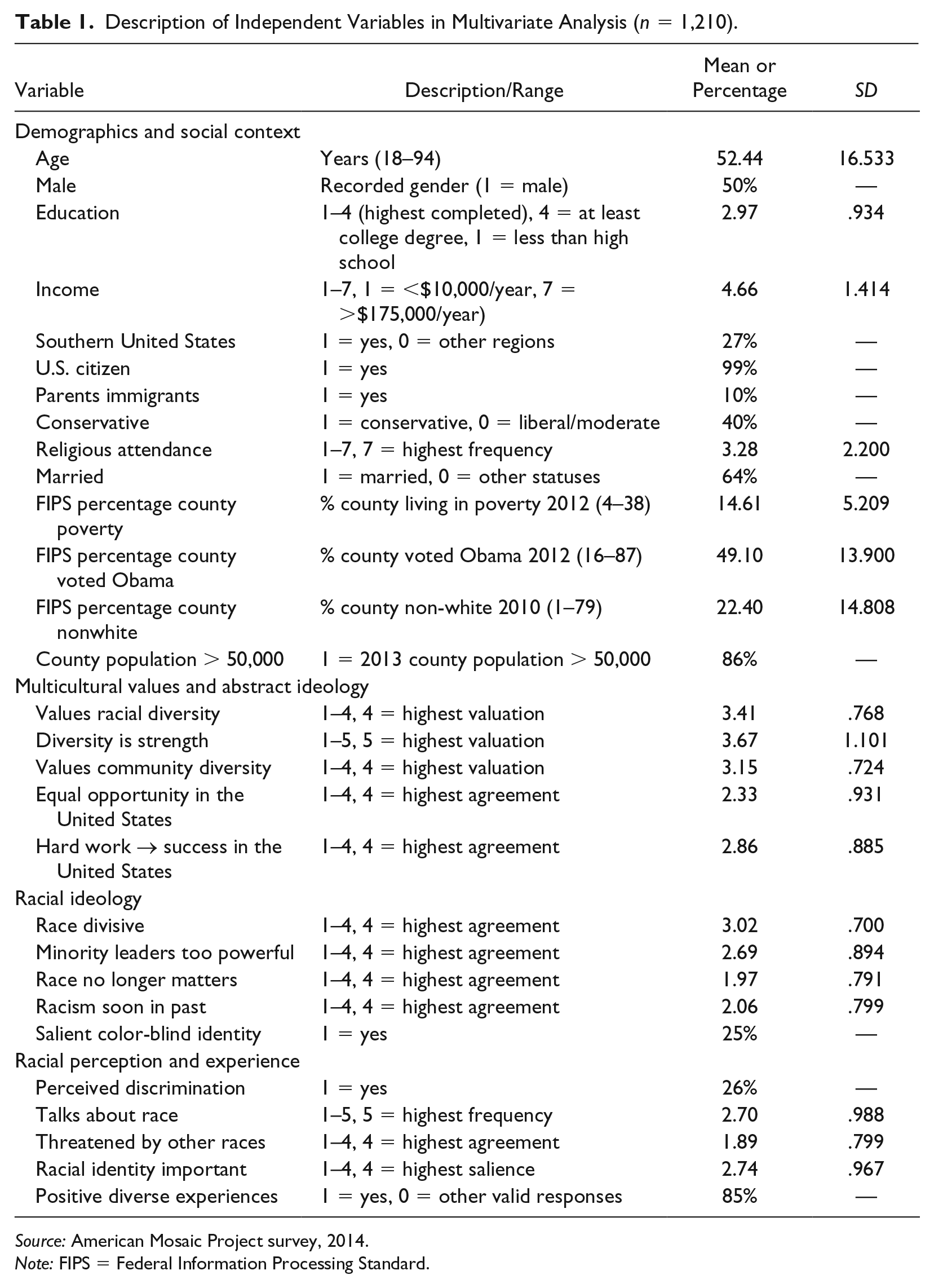
To identify what distinguishes whites claiming ethnic affiliation from those who do not, we use four blocks of independent variables in multivariate logistic regression: (1) demographics and social context, (2) multicultural values and abstract ideology, (3) racial ideology, and (4) racial experience and perception. The key dependent variable in all analyses is white ethnicity (1 = white ethnic, 0 = nonethnic white). Descriptive statistics are provided in Table 1.
Description of Independent Variables in Multivariate Analysis (n = 1,210).
Source: American Mosaic Project survey, 2014.
Note: FIPS = Federal Information Processing Standard.
Our regression model first uses a set of demographic variables and measures of social context that serve as general controls or that prior work on American white ethnicity has shown to potentially matter (Alba 1990; Torkelson and Hartmann 2010). In particular, we use the demographic markers age, gender, education, income, region, citizenship status, parental immigration status, political ideology, religiosity, and marital status. For social context, we include measures of population density and county voting given the relevance of residential and voter patterns to the white ethnic literature. Racial composition and county poverty are included to capture the possible influence of economic and cultural situatedness or change on postmillennial white ethnic boundary claims.
Second, we introduce measures of multicultural values and abstract ideology to explore how relevant attitudes toward multiculturalism (Bell and Hartmann 2007; Glazer 1997) and color-blind ideology (Bonilla-Silva 2006) couched in more racially or politically neutral terms may relate to postmillennial white ethnic identification. These measures consist of respondents’ general valuations of diversity in racial, general, and community contexts as well as abstract beliefs about whether people in the United States have equal opportunities or can make it if they work hard.
Our third and fourth sets of variables are designed to directly assess racial ideologies and boundaries in part in more overtly racial terms than the later postrevival wave of color-blind white ethnicity research. The third set specifically analyzes respondent ideology when race and color blindness are directly invoked. Respondents are asked whether they believe race is divisive, if minority leaders hold too much power, if race no longer matters, if racism will soon be in the past, and whether they believe themselves to hold a strong color-blind identity. 6 Our final block measures overt racial perceptions, experience, and awareness to grapple with color visibility and victimization relevant to the study of whiteness the past decade. These variables include perceptions of experiencing racial discrimination, how often a respondent talks about race, the extent to which a respondent feels threatened by other races, how important a respondent’s racial identity is to him or her, and a self-appraisal of a respondent’s diverse experiences.
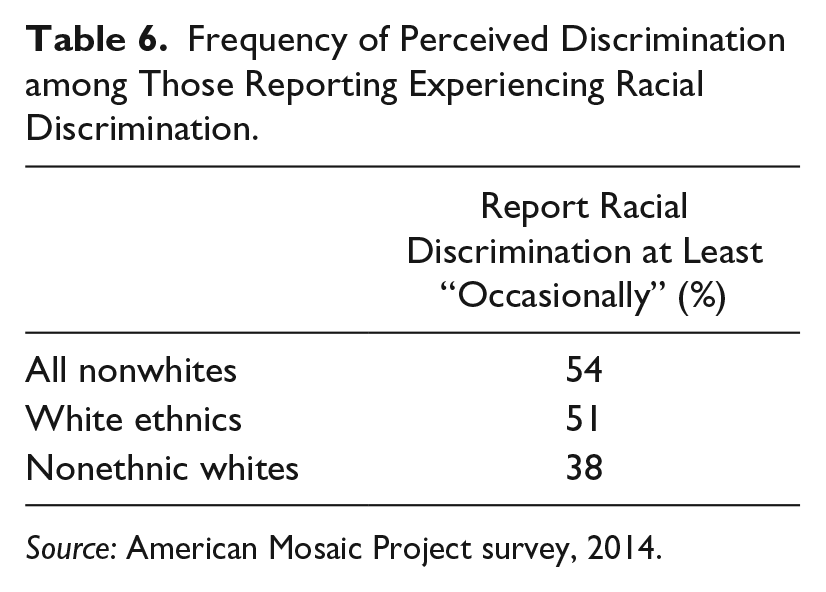
Finally, we extend and further contextualize relevant multivariate findings with additional comparisons with nonwhites as well as contingency and split-ballot measures not available to our models. Descriptive statistics are provided in Table 2. We first compare white versus nonwhite responses to the question “Have you ever experienced any discrimination because of your race?” by ethnicity, and then the frequency of this perceived discrimination among those reporting it. Regarding frequency, we compare the extent to which white ethnics, nonethnic whites, and nonwhites perceiving racial discrimination against them report this as occurring at least “occasionally.”
Description of Other Variables.

Source: American Mosaic Project survey, 2014.
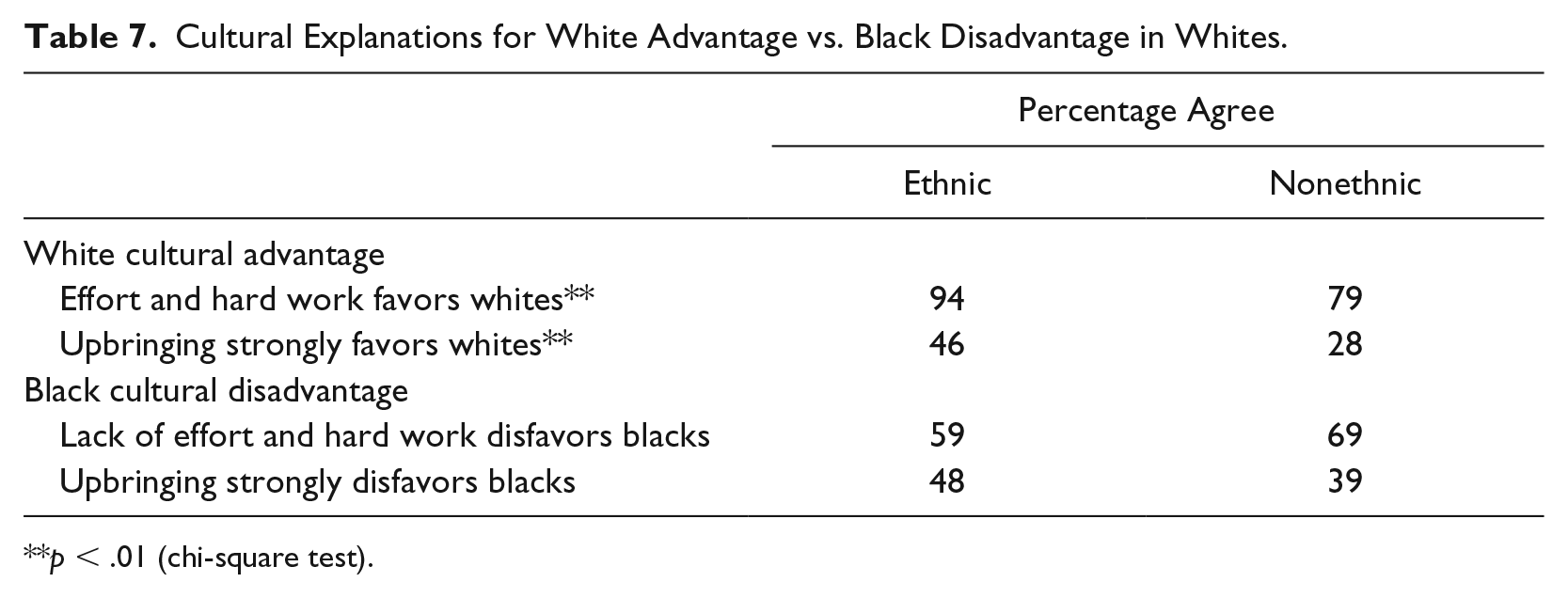
We then compare white responses by ethnicity on split-ballot measures asking respondents to assess if “effort and hard work” and “upbringing” either “favor whites” or “disfavor blacks” in explaining American racial inequalities. These measures are designed to parse the relationship between color-visible perceptions of white cultural advantage and black cultural deficiency akin to “cultural racism” frames (Bonilla-Silva 2006), which helps specify undercurrents driving racial ideology.
Findings
Findings roughly follow our research questions regarding assessing ethnic prevalence, determinants of white ethnic claims, and relevant racial boundaries.
The Prevalence of (White) Ethnicity in America
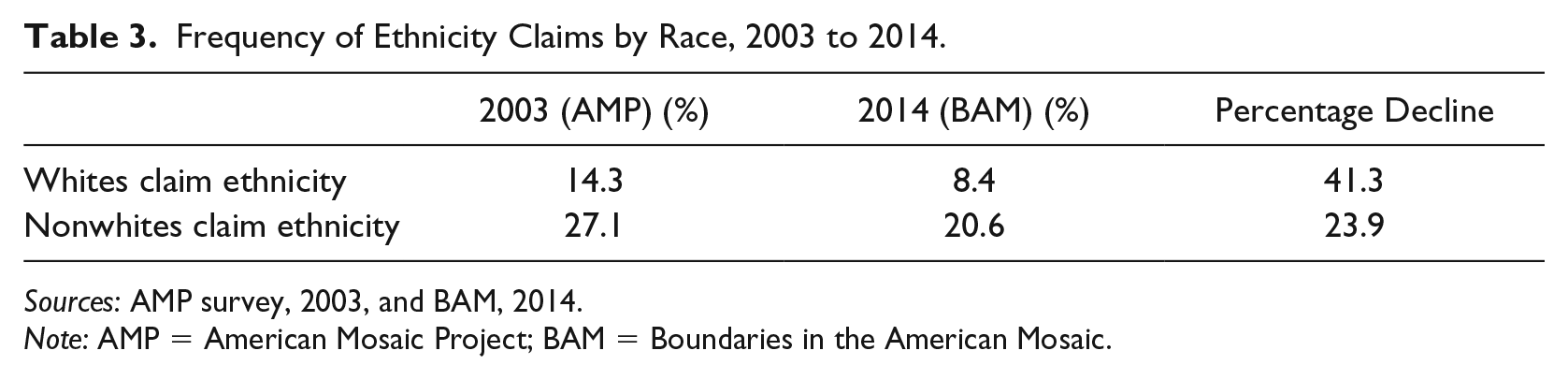
We first report the prevalence of white ethnic affiliation in postmillennial America. As Table 3 indicates, our first finding is that only 8.4 percent of the white population still identifies in ethnic terms. Thus, by our 2014 BAM survey estimates, only about 1 in 12 American whites claim ethnicity in the postmillennial era. This number demonstrates a substantial decline from corresponding measures of a decade prior, when 14.3 percent of whites claimed ethnicity (Torkelson and Hartmann 2010). Put differently, aggregate white ethnic claims waned by more than 41 percent in the period between the collection of the 2003 and 2014 Mosaic data alone.
Frequency of Ethnicity Claims by Race, 2003 to 2014.
Sources: AMP survey, 2003, and BAM, 2014.
Note: AMP = American Mosaic Project; BAM = Boundaries in the American Mosaic.
Estimating ethnic claims among nonwhite Americans provides a contextualizing backdrop for our observations on white ethnic claims and lends insight into the positioning of “ethnicity” in the broader American collective consciousness. As Table 3 shows, ethnicity has also factored less into the identities of nonwhites through the new millennium. Specifically, whereas 27.1 percent of nonwhites claimed ethnicity in 2003 Mosaic estimates, only 20.6 percent 7 of nonwhites claimed ethnicity in the 2014 survey. Broadly, this indicates that ethnicity has come to factor less into how Americans, both white and nonwhite, think of themselves as the twenty-first century has progressed. Set in comparative context, we cannot but note that our data indicate that whites have been retreating from ethnicity at an accelerated rate. Whereas nonwhites demonstrate roughly 24 percent fewer ethnic claims between the collection of the AMP and BAM samples, whites exhibit a comparatively larger 41 percent—upward of 1.7-fold greater—decline in ethnic claims through the development of the millennium.
Determinants of Postmillennial White Ethnic Claims
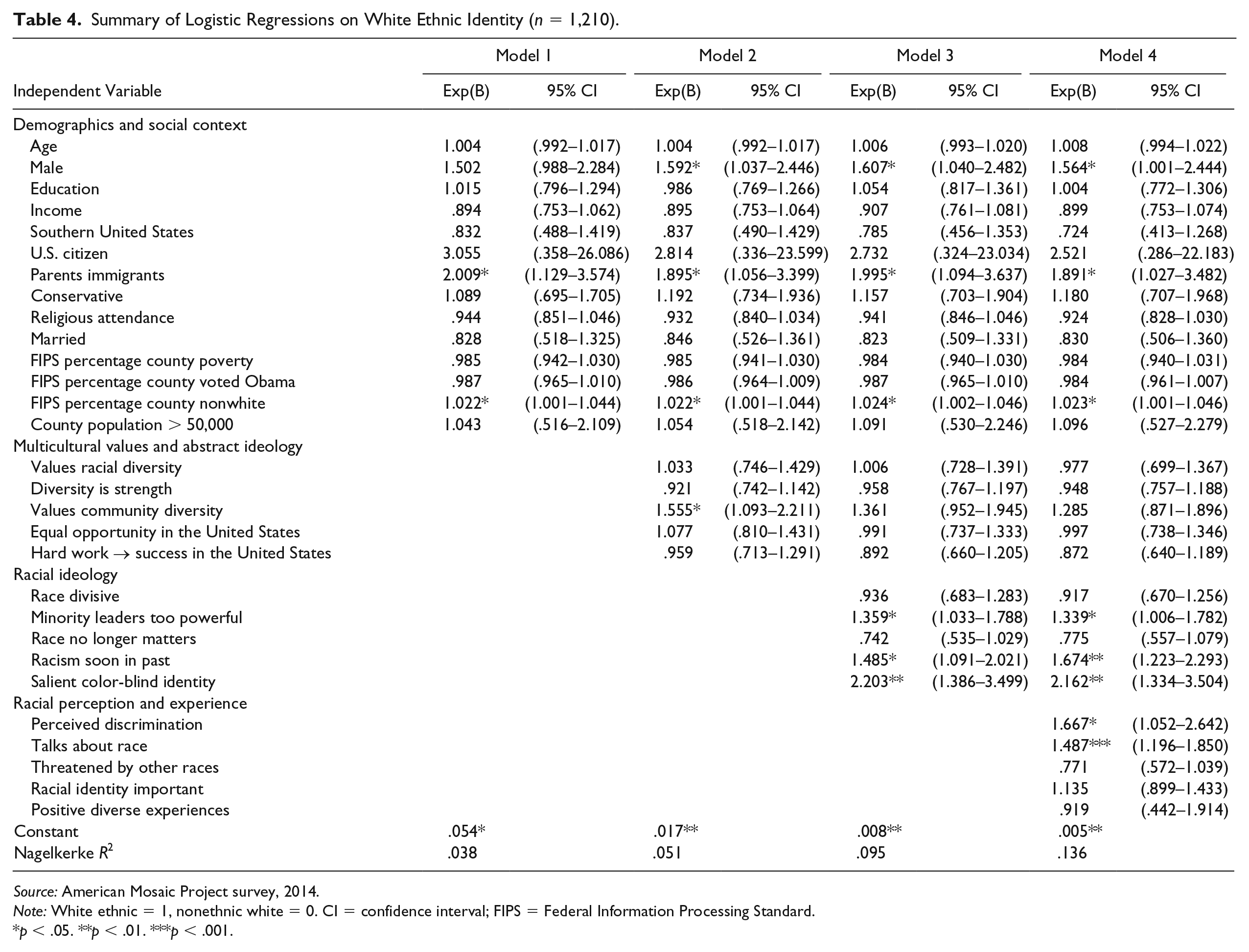
This brings us to our second set of questions about the shape of postmillennial white ethnicity’s face where it has persisted and in the present racial-political environment. The independent variables from Table 1 are used in four successive blocks to measure the odds that they affect white ethnicity (1 = white ethnic, 0 = nonethnic white) (Table 4 ). Model 1 shows that whites reporting immigrant parents and whites from counties with higher percentages of nonwhite residents significantly predict white ethnic identification net of controls. These variables retain significance across all subsequent models. Model 2, which accounts for multicultural values and abstract ideology, shows that valuing only “community” diversity predicts white ethnic claims. Additionally, in model 2, gender attains statistical significance: remaining white ethnic claimants are more likely to be men net of controls. Gender retains significance across all models.
Summary of Logistic Regressions on White Ethnic Identity (n = 1,210).
Source: American Mosaic Project survey, 2014.
Note: White ethnic = 1, nonethnic white = 0. CI = confidence interval; FIPS = Federal Information Processing Standard.
p < .05. **p < .01. ***p < .001.
In model 3 we introduce measures of racial ideology. Specifically, greater alignment with the sentiments “minority leaders are too powerful” and “racism will soon be in the past” and holding a salient color-blind identity significantly predict white ethnicity net of controls. All these variables maintain significance or become more robust in the final model. Also, in model 3, all measures of diversity and multiculturalism are now nonsignificant. Our final model, model 4, introducing racial perception and experience, shows experiencing racial discrimination (as respondents conceptualize this) and having conversations about racial issues significantly predict white ethnic identification.
The final model confirms that some demographic and social contextual factors continue to significantly relate to the odds that whites will opt for an ethnic identity. The final model also demonstrates that several measures of racial ideology, perception, and experience significantly predict the odds that whites will claim an ethnic identity net of controls. Most important, the Nagelkerke R2 statistic (.136) estimates that our final model accounts for a full 13.6 percent of the variation between remaining white ethnics and nonethnic whites compared with 3.8 percent, 5.1 percent, and 9.5 percent in models 1, 2, and 3, respectively.
The magnitude of the effect of significant independent variables on the odds of white ethnic identification is also important to consider. Regarding demographics and social context, as model 4 shows, postmillennial white ethnics are more likely to be male, possess immigrant parents, and reside in counties with higher densities of nonwhites. Specifically, the odds that white men claim ethnicity are 1.564 times higher than those for white women (p = .049). This is not surprising given prior work finding that white men are more likely to ethnically identify (Torkelson and Hartmann 2010). Likewise, and also perhaps unsurprisingly, remaining white ethnics are 1.891 times more likely to report having immigrant parents (p = .041). Finally, whites making ethnic claims are significantly more likely to reside in counties possessing more nonwhite residents per capita (p = .045).
Despite the tendency to reside in more diverse contexts (or perhaps because of it), our final model notably shows that racial ideology, perception, and experience moderate any predictive relationship between attitudes toward diversity and white ethnic identification not already attenuated by demographic controls. 8 Regarding racial ideology, model 4 shows that postmillennial white ethnic identifiers are more likely to perceive leaders of racial minority groups as possessing too much power, to believe that racism will soon become a figment of the past, and to voice a salient color-blind identity. In particular, model 4 predicts that the odds of claiming ethnicity are more than twice as large for whites who possess a salient color-blind identity: whites who strongly identify as color-blind are 2.162 times more likely to claim ethnicity than those who do not (p = .002). Complementing this finding, we see certain contexts in which race is directly invoked predicting odds of white ethnic identification. The odds that whites assert ethnicity are a full 1.674 times greater for each point increase on our 4-point scale that measures the belief that racism will soon be relegated to the past (p = .001). Likewise, for each point increase on our 4-point scale measuring the belief that minority leaders possess too much power, the odds that whites claim ethnicity are 1.339 times greater (p = .046).
Our measures of direct racial perception and experience take the analysis one step further. Specifically, whites who believe that they have experienced racial discrimination are 1.667 times more likely to assert ethnicity than those who do not report experiencing racial discrimination (p = .030). In addition to perceiving racial discrimination at heightened levels, our model shows that talking about racial issues significantly affects the likelihood that whites assert an ethnic identity. The odds that whites claim ethnic identity are a full 1.487 times higher for each increase on our 5-point scale measuring the frequency with which respondents talk about race (p < .001).
Supplementary Analyses
So far, we have identified two main developments in white ethnicity. We see fewer white ethnic claims, and claimants seem somewhat different than before. Racialized experience and perceptions now appear to combine with outwardly color-blind expressions on race, and these together mostly determine white ethnic claims. These findings alone indicate a noteworthy turn—even transformation—in the expression of white ethnicity inasmuch as some departure from its early, premillennial demographic character is exhibited. Postmillennial white ethnic identifiers are now significantly more likely to exhibit color consciousness in talking about race and perceive being racially discriminated against; they also align with ideologies conventionally understood as color-blind in racially charged contexts specifically by being more likely to assert racism will soon become a vestige of the past and that racial minority leaders possess too much power and by strongly holding onto a color-blind identity. At the same time, measures of color blindness couched in more racially or politically neutral terms do not show significance. The relationship between heightened ideological color blindness when race is invoked and reported racial experiences of postmillennial white ethnic claimants merits further comment, if not specification.
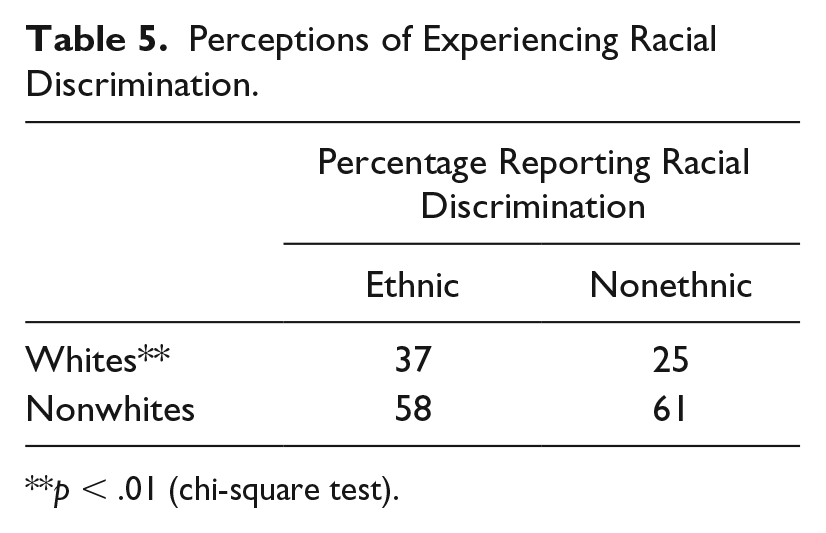
Certain contingency and split-ballot measures not in our models designed to access respondents’ racial boundaries and understandings of group positioning help situate these phenomena. First, the bivariate statistics in Table 5 extend our analysis on white perceptions of racial discrimination by ethnicity via comparison with nonwhites. As Table 5 shows, among nonwhites, there is no meaningful association between assertions of ethnicity and reporting experiencing racial discrimination: 58 percent of nonwhite ethnic identifiers compared with 61 percent of nonwhites who do not claim ethnicity perceive experiencing racial discrimination. Although the nonwhites reports are not new, Table 5 as a whole does suggest that ethnic claims are now related to perceptions of racial discrimination for whites exclusively. Unlike nonwhites, and in accord with the results of our multivariate models, parallel bivariate statistics show that white ethnics report perceiving experiencing racial discrimination at significantly higher rates than their nonethnic counterparts: 37 percent of white ethnics compared with 25 percent of nonethnic whites perceive experiencing racial discrimination (p = .003).
Perceptions of Experiencing Racial Discrimination.
p < .01 (chi-square test).
A contingency question asked of respondents reporting racial discrimination about its frequency allows us to further explore this relationship. Table 6 contains these contingency responses with respect to respondents who reported racial discrimination. Among whites perceiving racial discrimination against them, a full 51 percent of ethnic identifiers reported this as occurring at least “occasionally” compared with only 38 percent of nonethnic whites. This suggests that not only does ethnicity significantly relate to perceptions of racial discrimination for whites exclusively, but, among all whites who do perceive racial discrimination against them, ethnic identifying whites report substantively higher degrees of it. The magnitude of this difference in perceived victimhood is brought into clearer focus compared with frequencies reported by nonwhites. Specifically, 54 percent of nonwhites (ethnic identifying or not) who report racial discrimination see it happening to them at least occasionally, which is just slightly above the 51 percent rate of white ethnics. In short, the frequency with which postmillennial white ethnic affiliates perceive racial discrimination against them significantly exceeds that of other whites; moreover, these perceptions of victimization are so strong that they rival the rates at which people of color report discrimination.
Frequency of Perceived Discrimination among Those Reporting Experiencing Racial Discrimination.
Source: American Mosaic Project survey, 2014.
These estimates of perceived racial victimhood are especially striking when set against the patterns of the postrevival period. As Alba’s (1990) analysis concluded, “experiences with prejudice and discrimination have little or no relationship to ethnic identity per se. Ethnically identifying [white] individuals are scarcely more likely than the nonidentifying to report them” (p. 143). Given this departure, we believe that our data indicate a heightened sense of white victimhood that has emerged within white ethnic identification since the millennium, one that is reflective of recent transformations in white racial attitudes and identities (Garner 2017; Jardina 2019; Twine and Gallagher 2008) and that may help specify the (“ethnic”) terms under which changes are transpiring.
A set of split-ballot measures on cultural explanations for white advantage and black disadvantage in Table 7 lend additional context. On one hand, 46 percent of postmillennial white ethnic identifiers believe that whites are at a strong cultural advantage in society because of upbringing, compared with 31 percent of nonethnic whites (p = .003). Additionally, a full 94 percent of self-identified white ethnics believe that work ethic explains whites’ relative success in American society, compared with 79 percent of nonethnic whites (p = .004). These patterns stand in contrast to the usual questions about black disadvantage. On the other hand, when these questions are inverted to draw attention to cultural explanations for black disadvantage, surveyed white ethnics and nonethnic whites show no significant or patterned distinction. Thus, as a whole, Table 7 shows that white ethnic identifiers significantly appraise white cultural advantage as a driver of disparities in white-black life outcomes, but not black cultural deficiencies (as prevailing conceptualizations of “cultural racism” would have it; see Bonilla-Silva 2006).
Cultural Explanations for White Advantage vs. Black Disadvantage in Whites.
p < .01 (chi-square test).
These findings too are quite striking given that we previously found that white ethnics and nonethnic whites did not differ in their appraisals of white cultural advantages; in other words, no significant relationship between perceptions of white cultural advantage and white ethnicity was present in analyses of exact same measures collected in the 2003 AMP sample (Torkelson and Hartmann 2010). 9 Where postmillennial white ethnic claimants now believe that whites are exclusively culturally distinct in ways that (should) advantage them in American society, the general transformations shown in our data lend credence to the claim that white ethnicity has developed a racialized tenor in the new millennium.
Discussion
Data show that white ethnicity—or, more specifically, whites claiming ethnic affiliation—has declined in course relative to measures taken during the postrevival period (Alba 1990) and then the millennium’s turn (Torkelson and Hartmann 2010). Nonwhite ethnic claims have notably declined too; however, whites specifically have retreated from ethnicity at an accelerated rate in the postmillennial period. By our estimates, only 8.4 percent of whites now claim ethnicity.
Echoing prior demographic findings, self-identifying postmillennial American white ethnics are more likely to possess immigrant parents (Alba 1990; Lieberson and Waters 1986) and more likely to be male (Torkelson and Hartmann 2010). As has been the hallmark of American white ethnicity across its history, however, we find demonstrable shifts alongside continuities in the social forces driving white ethnic claims. For example, although our finding that white men remain more likely to claim ethnicity mirrors our previous (Torkelson and Hartmann 2010) study, this marks a continued turn from postrevival estimates in which women were more likely to ethnically identify via being socialized into placing importance in ethnic roles and familial lineages during this period (Alba 1990; Lieberson and Waters 1993). Similarly, although community diversity did not appear to influence white ethnic assertions closer to the century’s turn (Torkelson and Hartmann 2010), we find that postmillennial white ethnic claimants are now more likely to reside in racially heterogeneous contexts. Furthermore, where a link between white ethnicity and Democratic voting or residence in Democratic-leaning areas was evident in prior studies (Greeley 1974; Torkelson and Hartmann 2010; see also Arbour and Teigen 2011), this no longer significantly predicts white ethnic identification.
Thus, although smaller in numbers, the correlates associated with white ethnic claims suggest different meanings for those holding them. Most substantively, then, our data indicate that far from becoming a relatively insignificant social distinction since the millennium (Anagnostou 2013; McDermott 2015), or merely primarily continuing to assume a loose demographic form (Alba 1990; Lieberson and Waters 1988, 1993), contemporary white ethnic claims appear to be assuming a set of newer meanings that suggest the onset or convergence of new form of expression, one we might think of as “racialized ethnicity.” Multivariate analyses show that residence among nonwhites, overt racial ideology, experience, and perception now largely drive ethnic affiliation for whites; our subsequent analyses show white ethnic claimants now significantly see greater cultural worth in whites as a racial group while simultaneously perceiving racial discrimination at heightened levels compared with even the recent past.
When viewed in terms of racial boundaries, these developments suggest that ethnic identification may increasingly be more a central feature of whiteness itself for claimants than an auxiliary attachment to it tied to some perceived historical dimension of culture. In light of its larger history then, where white ethnic expression has been inflected by distance from, reaction to, and activation against nonwhites through its respective forerunner arrival, revival, and postrevial phases, postmillennial white ethnicity appears to also be assuming a newer face toward nonwhites that is racialized—a color-conscious expression rooted in contemporary racial politics driven by racial perceptions, experience, ideology, and believed victimization. Put another way, it appears that the weight of “white ethnicity” as a form of identification has been shifting toward the racial end of its hyphen through the new millennium to a point at which postmillennial white ethnicity may perhaps be best characterized as white ethnicity.
To us, these newer “racialized” expressions would seem to emanate less from an ethnic grouping than a racialized categorization or a rough collection of folks trying to legitimate or protect their social position in ways reminiscent of Rogers Brubaker’s (2004) influential, if also controversial, thesis in Ethnicity without Groups. Indeed, our core findings on whiteness, perceptions of white victimhood, and/or white cultural advantage seem less about an internal sense of self that would be tangible in quotidian interaction than an assertion of some form of affiliation or cultural identification and associated lifestyle, values, and norms (be these even vaguely Eurocentric, Judeo-Christian, Western, or other). Beyond the confines of symbolic cultural practices, diversity claims, preservation of traditions (Alba 1990; Gans 1979), grappling with white invisibility (Doane 1997; Waters 1990), or even affinities with color-blind rhetorical artifices (Gallagher 2003), this turn toward racialized white ethnicity, where and insofar as it applies, appears to us to operate as a racially charged expression in which whiteness itself is central and sensed. In other words, the predominant face of white ethnic identification reflected in our 2014 data, we suspect, may have less to do with feelings of connection to traditional ethnic groups—or pan-ethnic/pan-nationalist conceptions—than to whiteness itself in the postmillennial landscape, which may find whites increasingly likely to feel their race as implicated.
As Doane (1997) speculated, the ostensibly hidden face of the white racial group’s ethnicity emerges when threats to hegemony are felt. Here, affiliation with the “ethnic” identity referent itself may be most animated by defense of a perceived cultural position. Particularly given that we find that postmillennial white ethnic identifiers now reside in more racially heterogeneous contexts, the remnants of this boundary claim may be substantially driven by anxieties or resentment toward (perceived) cultural change through the twenty-first century thus far. To us, it even seems that probable shifts in white ethnic boundary formations are part of a larger reconfiguration within whiteness or a mobilization among a certain segment of white Americans toward a more intense awareness of white identity, culture, and norms perceived to be in decline or that have been rendered visible to them via perceptions of other demographic, political, and cultural forces in contemporary American society or even the global world generally (Feagin 2013; Garner 2017; Norton and Sommers 2011). We find it especially striking in our models that measures in which race is explicitly invoked now significantly distinguish white ethnic identifiers from other whites, whereas measures couched in more race-neutral terms do not. Broadly speaking, scholars ahead should pay attention to whether patterns such as those we observe reflect, or might be informed by, senses of shared fate in context general color line production and dominant group boundary (in)flexibility. Such inquiry, we believe, is especially needed within a general ecology in which white victimization, nationalism, and white identity politics now hold greater mainstream currency. This milieu indeed stands to inflect white identity forms and shape racial understandings held by new white migrants acclimating to American society, whites with several generations of lineage in America, and even whites opposed to the developing environment alike.
Despite being smaller in number, and despite receiving little scholarly attention in recent years, our analyses indicate that postmillennial American white ethnicity comprises an intelligible social formation worthy of further study. More research is needed on the ethnic boundary-making claims of white Americans: what meanings they associate with them, what investments they have in them, and how these claims pertain to their understandings of whiteness, white identity, and culture. Here, for example, it might be useful to further explore how white ethnic identities are related not only to racial identities but also to racialized ideals and ideologies as McDermott (2015) has suggested or to larger moral frameworks and claims along the lines recommended by Stets and Carter (2012).
The study of white ethnicity should not just be reinvigorated via further survey data; what is needed is qualitative work, especially in-depth interviews. This cannot be overemphasized. Such data and methods should prove vital to understanding the underlying meanings of white ethnic boundaries, especially where narrative accounts can better access changes within individuals than the cross-sectional design of our surveys, lend deeper context to the development of overt white racialization (if applicable), and more fully consider complicating forms of social differentiation such as (trans)nationalism, multiculturalism, and cosmopolitanism (see Anagnostou 2013). In general, unpacking any overlaps and tensions between the aggregate character of remaining white ethnic identifiers represented here with specific white immigrant communities only now entering the fray of American race relations postmillennium as well as individuals holding more ancestral or origin-based self-understandings (e.g., similar to census questions or General Social Survey measures) should provide fruitful avenues for researchers ahead.
Finally, our surveys detect something going on regarding racial and ethnic categories and identities specific to postmillennial American racial politics broadly speaking. Where “ethnicity” as an identity referent appears to be receding from the collective consciousness in terms of how both whites and persons of color think of themselves in America, remaining white ethnic identification specifically has shifted toward a racialized tenor, and in just a short time by our estimates. This signals to us that perceptions of race and racial experience may be taking precedence over the more traditional claimed cultural connects such as ethnic affiliations (as these boundary effects have been conventionally conceived anyway) for many in contemporary America. Ethnicity is but one referent or form of collective identification that may have transformed through times that have seen the first nonwhite American president and the more recent election of Donald Trump, where cultural heritage preservation appears to be associated with voting preference (Schwartz 2018). Here, we hope our analyses underscore the general urgent need for further investigation into other possible changes or complexities among white Americans in the current racial-political climate, as well as the shifts, constraints, and weightings of “racial-ethnic” understandings among Americans generally.
Footnotes
Notes
Author Biographies
 .
.