



Abstract
This article focuses on the cultural narratives underlying U.S. society’s racialized inequalities. Informed by settler colonial theory and Charles Tilly’s work on “durable inequality,” I outline a privilege narratives framework that centers the dual mechanisms of racial dispossession that construct white supremacy’s material foundations: (1) the exploitation of non-Indigenous bodies and (2) the opportunity hoarding of Indigenous resources. I argue that these complementary, yet divergent, mechanisms shape distinctive patterns in contemporary racial discourse. In contrast to color-blind racism’s ahistoric and spatially disembedded storylines, the hoarding of Indigenous resources requires narrations that historically legitimate the dominant culture’s territoriality. Thus, in comparison with other racialized groups, racial discourse surrounding Indigenous peoples remains rooted in the defense of the territorial foundations of white property. Empirical support for the theoretical framework is provided through a sample of purposive follow-up interviews of non-Indigenous bystanders with historical connections to the American Indian Movement’s (AIM) “Red Power” activism in the 1970s.
During the current moment of U.S. racial reckoning, it is not surprising that there is still minimal attention granted to the systemic racism confronting American Indians. As Wolfe (2016) notes, the “logic of elimination” fueling settler colonial societies functions to erase both past and present Indigeneity. Moreover, the grievances of non-Indigenous racialized groups contend for redress on the very grounds of Indigenous grievance: the historical and ongoing dispossession of Native territoriality.
This article begins from the premise that there has been way too little attention, both within sociology (see, as exceptions, Bobo and Tuan 2006; Denis 2015; Fenelon 2017; McKay 2019) and U.S. society more broadly, on racism toward Indigenous peoples. 1 A long overdue focus on the subject, I contend, promises to yield broader theoretical and empirical insights into contemporary U.S. racism. For one, the distinctive treaty-based rights of American Indians clarify the territorial mechanism of racial dispossession that provides white supremacy’s telluric grounding. Alternatively, the hoarding of Indigenous resources (e.g., land, rivers, forests) consequently enables the race-based exploitation of non-Indigenous bodies, the contrasting corporeal mechanism historically implanting U.S. society’s “durable inequalities” (Tilly 1998).
This study’s central argument is that the dual mechanisms of racial dispossession at the roots of white supremacy, (1) Indigenous resource hoarding and (2) non-Indigenous corporeal exploitation, shape distinctive racial discourses of white privilege. Because race-based dispossession from non-Indigenous groups has historically occurred on exploited bodies, and not territory, racial narratives defending white privilege in relation to such groups remain amenable to a flexible discursive structure. 2 In its contemporary variant, as Eduardo Bonilla-Silva (2018) has demonstrated, color-blind discourse exemplifies a pliable defense of white privilege traversable across racial groups. Indeed, precisely because its liberal economic dictates are territorially and temporally untethered, color-blind narratives retain the privilege of validating privilege “without thought to historical context” (McKay 2019:86).
By stark contrast, the hoarding of Indigenous resources requires an entirely different rationalization than color-blind racism’s ahistoric and spatially disembedded narratives. As a settler-descendant, I may draw from hegemonic discourses of whiteness (e.g., color blindness) that indict alleged Indigenous cultural deficits to rationalize white-Native inequality. Yet, and here is the critical point, the same accusations cannot be levied at a river, or a mountain, or the commodified section of earth currently supporting my habitation. To defend the hoarding of Indigenous resources requires an entirely different set of rationalizations; a balance beam sturdy enough for the cognitive gymnastics of defending white property.
To distinguish the racial discourse confronting Indigenous peoples from other racialized groups, I turn to an analysis of the dominant cultural narratives surrounding the American Indian Movement (AIM). As the public face of the broader “Red Power” movement of the 1960s–1970s, I use AIM as a case study to illuminate non-Native reactions to racial contestation over Indigenous rights. To do so, I rely on a sample of purposive follow-up interviews (n = 47) conducted in 2014–2015 with non-Native individuals across South Dakota and Minnesota, the two states where AIM’s confrontational activism was most pronounced. Importantly, all of the interviewees have a historical connection to the movement during its zenith in the early 1970s, ranging from serving on jury trials for AIM activists to expressing their attitudes on Red Power through constituent mail or public opinion surveys. Many interviewees, particularly those from South Dakota, directly witnessed AIM protest events, including riots in the Black Hills and Sioux Falls. Because of their historical connection and proximity to the movement’s disruptive activism, the AIM “bystanders” (Turner 1970) were purposively recruited from public identifiers attached to various archival documents (see “Data and Method”). Follow-up interviews thus provided an opportunity to analyze the dominant cultural memory of the movement, including the narratives that were constructed to comprehend, and often counter, AIM’s attempted alteration of the white-Native racial order.
An analysis of the AIM bystander data reveals racial discourse congruent with theoretical expectations. First, although interviewees use color-blind language to dismiss AIM grievances related to treaty rights and reservation poverty, the discourse is routinely embedded within broader narratives that are both (1) historicized and (2) territorially based. In general, antagonistic bystanders strategically craft historical narratives that rationalize white privilege through the “unsettling” of Indigenous territorial claims. In the most common privilege narrative (“tribal warfare”), for instance, interviewees reject AIM grievances regarding treaty rights by foregrounding incessant historical conflict among Indigenous tribes. By centering inter-tribal conflict prior to European settlement, AIM antagonists construct a moral equivalent to the frontier violence and chicanery that enabled the territorial hoarding of their white ancestors.
Prior to turning to the empirical data, I outline a privilege narratives framework sensitive to the distinctive nature of racial discourse across Indigenous and non-Indigenous groups. Theoretically, I link the variation in narrative rationalizations of white supremacy to the dual mechanisms of corporeal exploitation and resource hoarding that have historically dispossessed racialized groups in the United States. Thereafter, I rely on the AIM bystander data to reveal that American Indians confront a unique form of racist discourse that manipulates historical narration to unsettle Indigenous territoriality. I thus argue that in addition to the “legitimized racism” (McKay 2019) of cultural appropriation and racist symbolism (Fenelon 2017), Native peoples must grapple with a dominant culture that defends white privilege through both color-blind discourse and historicized narratives that delegitimize Indian territoriality. These historicized privilege narratives, as I show, represent powerful discursive mechanisms fortifying the systemic racism of the white-Native racial order.
The Dual Mechanisms of Settler Colonial Racial Dispossession
Along with postcolonial theory (Go 2020), settler colonialism continues to make inroads into the sociological literature on race (Denis 2015; Glenn 2015; Norgaard 2019; Steinman 2016). Both approaches provide necessary correctives to the discipline’s colonial “epistemic structures” (Go 2020) by expanding racialization’s historical and global boundaries. Settler colonialism’s focus on Indigenous erasure, in particular, provides a conceptual toolkit for investigating the myriad racial discourses that have evolved out of the contrasting racialization processes across Indigenous and non-Indigenous groups.
Patrick Wolfe (2016) argues that colonialism and settler colonialism can be distinguished by their dissimilar logics, respectively, of exploitation and elimination. As a circular transnational process, colonialism exploits both the human labor and ecology of colonized territories to siphon wealth to the metropole. In contrast, settler colonialism’s exploitation of humans and ecosystems on conquered territorial space is conceived as permanent, and is premised on its ability to first eliminate the Native inhabitants occupying the desired land. In the United States, for instance, Lockean principles of liberty and private property were secured only through denying Native peoples the former while converting Black bodies into the latter. Thus, contrary to Wolfe’s binary theoretical distinction, U.S. settler colonialism is rooted in the dual logics of both elimination and exploitation. Indeed, both the elimination of Native bodies and the exploitation of Black bodies were necessary “racial projects” (Omi and Winant 2014:125–27) for the hoarding of property rights at the root of white identity and privilege (Harris 1995; Moreton-Robinson 2015).
My central argument is that the dual racial projects that characterize the foundations of U.S. settler colonialism have resulted in distinctive racial discourses for defending white privilege. This variation, I propose, stems from the contrasting mechanisms through which the settler state has historically dispossessed non-white racialized groups. In contrast to the corporeal exploitation of non-Indigenous groups (e.g., Black enslavement), white privilege in relation to Indigenous peoples is rooted in the perpetual hoarding of ecological resources within the colonized territorial space. Borrowing from Charles Tilly (1998), I theorize that these complementary yet divergent mechanisms of racial dispossession, exploitation and opportunity hoarding, fundamentally alter how the dominant group rationalizes the “durable inequalities” of contemporary U.S. society.
The Exploitation of Racialized Bodies and the Opportunity Hoarding of Indigenous Resources
Capitalism’s material and ideological expansion in the Western Hemisphere was enabled through a racial classification system that scaffolded two central mechanisms for transferring resources away from non-European groups: exploitation and opportunity hoarding (Tilly 1998). The production of material wealth from Indigenous land and African bodies in the United States and beyond entrenched a European-dominated transnational capitalist economy characterized by both colonial and settler colonial appendages. Aside from building Europe’s wealth, violent racialized dispossession produced lasting material inequalities between European and non-European peoples. Visible across a range of socioeconomic indicators in the present day (e.g., wealth, housing, educational access), the material and demographic legacies of racialized dispossession encourage discursive rationalizations from the advantaged dominant group (Bonilla-Silva 1997), particularly when there are collective demands to address the historically rooted inequalities of contemporary societies. These narrative rationalizations are likely to vary, I argue, based on the dissimilarities of the expropriative racial projects encompassing Indigenous and non-Indigenous groups.
From their arrival in Winyah Bay in 1526, Black bodies were chained, literally and symbolically, to the transnational capitalist economy; U.S. settler colonialism is forever em-bodied by corporeal exploitation, most notably of African slaves. Yet this economic exploitation was only made possible through the contrasting dis-embodiment of Indigenous peoples from territorial space. Unlike Blacks and other non-Native racialized groups (e.g., Chinese laborers, Latino migrant workers), Indian territory is the factor of production indispensable to the capitalist market and settler state. As such, Indigenous ecological resources (e.g., land, forests, wildlife) have to be permanently controlled to extract wealth from, and for, imported non-Native bodies. As its telluric foundation, the settler state’s expropriation of Indigenous ecological space exemplifies Tilly’s (1998:91) conceptualization of opportunity hoarding: If members of a network acquire access to a resource that is valuable, renewable, subject to monopoly, supportive of network activities, and enhanced by the network’s modus operandi, network members regularly hoard access to the resource, creating beliefs and practices that sustain their control. (P. 110)
3
My central theoretical proposition is that the establishment of dissimilar mechanisms for dispossessing resources from racialized groups alters, in Tilly’s words, the “beliefs and practices that sustain their control.” More specifically, the exploitation of non-Indigenous bodies amid the opportunity hoarding of Indigenous territory structures variation in settler colonialism’s contemporary privilege narratives, if not in form then in content. In form, U.S. racial ideology proposes a generalizable “white racial frame” (Feagin 2020) of dominant-subordinate relations. Blacks and American Indians, for instance, shared an inferior status in the European racial hierarchy as uncivilized lazy barbarians insufficiently extricated from nature. Yet beyond these overarching stereotypes, I argue, the particular content of contemporary racial discourse must continue to grapple with the dissimilar mechanisms of racial dispossession that constructed U.S. white supremacy.
As a legacy of the dual mechanisms of racial dispossession, the legitimation of the racial order’s “privilege gaps” requires entirely different cognitive rationalizations in relation to Indigenous and non-Indigenous groups. In regard to the former, racial narratives surrounding white-Native inequalities confront the formidable task of rationalizing a permanent form of territorial dispossession. That opportunity hoarding is an ongoing process whose form as a mechanism of expropriation remains unchanged is evinced not just by the continued extraction of natural resources from Indigenous lands, but indeed by my very presence as a settler-descendant within the United States.
By contrast, racial dispossession through the exploitation of non-Native groups, exemplified most brutally by Black chattel slavery, remains distinct from the opportunity hoarding of Native resources. Importantly, the economic exploitation of non-Native groups occurs on de-territorialized bodies. Unlike American Indians, non-Indigenous dis-embodiment from territorial space, and subsequent economic re-embodiment to U.S. capitalism, constructed territorially rootless racial groups with minimal legal claim to the settler space.
Put simply, exploitation is a mechanism of dispossession that targets the body, while Indigenous resource hoarding targets land. Although dissimilar, both dispossessive mechanisms produce race-based inequalities that require narrative rationalizations when challenged by racialized groups. As an amalgam of both dispossessive mechanisms, U.S. society is characterized by a bimodal structure of racial discourse tasked with justifying differentially rooted inequalities.
Thus, it is precisely because exploitation is rooted in corporeality, rather than territoriality, that the dominant culture can discursively decouple slavery or Jim Crow from contemporary Black-white inequality. Although movements like Black Lives Matter continue to challenge racist ideology’s ahistoricism, exploitation’s corporeal terrain nevertheless enables a convenient “mnemonic myopia” (Zerubavel 2003:92) for the defense of white privilege.
In sum, settler colonial societies are birthed by the racialized hoarding of territory that enables the exploitation of de-territorialized bodies. In uprooting individuals from place to become appendages of a place-less capitalist market, the settler state converts the exploited into not just “people without history” (Wolf 2010), but people without territory. Although geographically present within the colonized space, exploited racial groups are perceived to have minimal claim to the ecological resources hoarded from Indigenous peoples. Rationalizations of white privilege in relation to such groups are consequently prone to a de-territorialized narrative structure that effaces exploited races’ histories, both outside of and within the colonized space.
Once the dual mechanisms of racial dispossession are distinguished, the prominence of the color-blind framework in sociology becomes apparent when one considers the literature’s focus on non-Indigenous groups. Color blindness’ “abstract liberalism” (Bonilla-Silva 2018), with its concatenation of moral worth to human labor, grafts seamlessly onto racial subjects whose de-territorialized bodies serve as the sites of exploitation. As a corporeal and ahistoric narrative, color-blind racism’s economic vilifications reflect the material and discursive interpellation of place-alienated racialized bodies to capitalist production. 4 Indeed, its discursive power as a narrative defense of white privilege derives from its racial traversability, one whose characters are historically and territorially untethered. Yet as I show below, this de-contextualized story of racial advantage provides an inadequate narrative structure for defending white-Native inequality. As a result of territorially based Indigenous claims to the very space the settler state claims as its own, the ongoing dispossession of Indigenous peoples requires narrative rationalizations rooted in the defense of white property; a racial discourse whose content is therefore likely to deviate significantly from non-Indigenous groups.
The Settler Colonial Seeds of Red Power
Inspired by the global 1960s protest wave, the American Indian Movement emerged in a context uniquely structured by the violent dispossession of Indigenous resources. Augmenting earlier generations of Indigenous resistance that overcame colonial violence to secure treaty rights and tribal sovereignty, Red Power activists strove for the revitalization of Indian nationhood and culture that had been stifled by decades of forced assimilation. Kent Blansett’s (2018) biography of Richard Oakes, a Mohawk activist and co-organizer of the 1969–1971 Alcatraz Occupation, details the emergence of the student-led Indians of All Tribes (IAT) in the “Indian City” of San Francisco’s Mission District. As a designated site for the Bureau of Indian Affairs (BIA) urban relocation program, which encouraged out-migration from reservations amid Congressional efforts to “terminate” tribal sovereignty, San Francisco served as a laboratory for the collective identity formation of Indians from varied cultural backgrounds, sparking unprecedented levels of pan-Indigenous grassroots organizing in the 1960s and 1970s.
Like IAT in San Francisco, AIM coalesced in Minneapolis’ Phillips neighborhood, an “Indian City” similarly shaped by urban relocation. Inspired by the Black Panthers’ model of community self-defense, activists organized an “AIM Patrol” to monitor police brutality and harassment in Phillips, while mobilizing resources for the Twin Cities’ urban Indian population, an endeavor previously associated with non-Indigenous churches (Smith and Warrior 1996:128). Although AIM’s activism in Minneapolis-St. Paul manifested itself in varied ways, including two Indigenous-based “survival schools” (Davis 2013), its public image and legacy remain inextricably tied to its confrontational activism in South Dakota.
Prior to the 1973 Wounded Knee Occupation, AIM was twice summoned to South Dakota to protest egregious manifestations of institutionalized racism in the legal system. In subsequent years in 1972 and 1973, Raymond Yellow Thunder and Wesley Bad Heart Bull, both Oglala Lakota tribal members, had been killed by intoxicated white men in “border towns” proximate to the Pine Ridge Reservation. In both cases, the offenders were charged with involuntary manslaughter and received light sentences from state prosecutors. The two incidents mirrored each other on almost all dimensions aside from their aftermath: the Bad Heart Bull case brought AIM to the Custer Courthouse in the Black Hills, where an ensuing riot solidified the organization’s reputation as Red Power’s militant flank.
The foothold that AIM established in South Dakota via the Yellow Thunder and Bad Heart Bull protests expanded in the wake of Dick Wilson’s corrupt reign as chairman of the Oglala Tribal Council (1972–1976). Wilson provoked widespread opposition for distributing federal resources to family and friends, primarily mixed-blood tribal members like himself. After a failed impeachment attempt in 1973, the Oglala Sioux Civil Rights Organization (OSCRO), comprised of mostly full-blood Oglala Lakota opposed to both Wilson and the powers he derived from the Indian Reorganization Act’s tribal council structure, approved AIM’s proposal to occupy the town of Wounded Knee, the site of the 7th Cavalry’s 1890 massacre of over 300 Lakota civilians. Wilson’s personal militia (the “GOON squad”) and BIA ties ensured a rapid and violent escalation of the conflict, eventually pitting AIM and its OSCRO supporters against the U.S. government’s overt and covert military infrastructure.
Public awareness of AIM crested during the resulting 71-day Wounded Knee Occupation. Combining dramaturgical flair with the skilled oration of leaders like Russell Means and Dennis Banks, AIM’s success at mobilizing media attention captivated a dominant culture whose concepts of Indians were largely shaped by Hollywood Westerns. In capturing the public’s attention, 93 percent of whom were reported to be closely following Wounded Knee (Baylor 1996), AIM projected a forceful affirmation of tribal nationhood and repudiation of both the inequalities and cultural narratives of the white-Native racial order.
Although the two are often conflated as a result of Wounded Knee’s media exposure, AIM represented only one facet of Red Power’s multi-dimensional racial contestation, which ranged from established national-level organizations (e.g., National Indian Youth Council) to numerous grassroots movements, such as IAT and the United Native Americans (UNA). Motivated by the era’s protest wave, Red Power’s grievances and goals were uniquely rooted in the peace treaties defining the nation-to-nation relationship between tribes and the federal government. Indeed, treaty rights comprised nearly half of the demands of the “20-Point Position Paper” crafted by Indian activists during the 1972 Trail of Broken Treaties cross-country caravan (V. Deloria 1985). In addition to providing the mechanisms for Native political and legal redress, peace treaties secure the collective rights and status of tribal nations within the settler colonial space, and therefore represent the primary fortification against continued Indigenous dispossession.
Coalescing around treaty rights, the Red Power activism of the 1960s–1970s was uniquely preconfigured by the settler state’s hoarding of Indigenous resources: an activist generation sharing cross-tribal experiences of the familial, cultural, and territorial displacement derived from boarding schools and urban relocation, whose re-placement in cities was marked by the racial discrimination, residential segregation, and lack of economic mobility confronting both Indians and non-Indians alike. As precursors to Standing Rock, the Occupations of Alcatraz and Wounded Knee represented the culmination of pan-Indigenous resistance during the 1960s–1970s protest wave. Such resistance had an immeasurable impact on shifting federal policy toward Indian “self-determination,” while igniting widespread Indigenous cultural regeneration (Nagel 1995).
In light of its success at gaining media coverage, AIM provides a unique opportunity to investigate how the dominant culture narrates racial contestation over Indigenous rights. That AIM represented a threat to the racial status quo, including its privileged settler narratives, is captured by Vine Deloria’s (1985:80–81) reflections on the Wounded Knee Occupation, the apex of Red Power activism in the 1970s: Wounded Knee marked the first sustained modern protest by aboriginal peoples against the Western European interpretation of history . . . the Oglala Sioux spoke to the world about freedom for all aboriginal peoples from the tyranny of Western European thought, values, and interpretations of man’s experiences.
Investigating how non-Native AIM bystanders reacted to this threat should thus lend broader insight into the distinctive racial discourse confronting Indigenous peoples in the United States.
Data and Method
The empirical data for this article are drawn from a qualitative longitudinal project on the public’s reaction to AIM. Beyond analyzing the dominant cultural memory and narratives of the movement from 1973 to 2015, the project examines the content of racial discourse surrounding Native peoples in the United States. To understand how the dominant culture rationalizes the vast inequities of the white-Native racial order, this study relies on a purposive sample of follow-up interviews (n = 47) with non-Native AIM bystanders across South Dakota and Minnesota, the two states where the movement’s activism was most pronounced. In addition to their geographic proximity to AIM protest, interviewees were recruited on the basis of having some type of interface with the movement in the 1970s, thereby heightening awareness of Red Power’s grievances, goals, and in some cases, disruptive effects. Interviewees in the sample either directly witnessed AIM protest events, including riots in South Dakota (Custer and Sioux Falls), or publicly expressed their disposition toward the movement through constituent mail, attitudinal surveys, or juror interrogation (voir dire). All of the AIM bystanders were recruited from personal identifiers attached to archival documents from the 1970s. 5
In the summer of 2013, I collected all of the publicly available constituent mail related to AIM for (1) Governor Richard Kneip of South Dakota (n = 261) and (2) Senator Walter Mondale of Minnesota (n = 163). Both officials held their respective positions during the pinnacle of AIM’s activism in the early 1970s. I also gathered the voir dire transcripts (n = 126) from four AIM trials that document the interrogation of prospective jurors on their attitudes toward both the movement and American Indians. Finally, I recorded the results from three public opinion polls conducted by the Wounded Knee Legal Defense/Offense Committee (WKLDOC), a grassroots legal organization founded in 1973 to defend AIM activists. Adopting the social scientific approach to jury selection pioneered by Columbia sociologist Jay Schulman, WKLDOC carried out a series of attitudinal surveys on AIM and American Indians across the Upper Midwest to decipher locations potentially favorable to movement defendants.
While the archival materials provide a historical snapshot of the public’s reaction to AIM, their utility for the current analysis lies in the purposive sample of bystanders recruited for follow-up interviews. Personal identifiers on the historical documents provided the impetus for a broad-ranging search for updated residential addresses through a triangulation of Internet resources (e.g., Google, Ancestry, WhitePages). On the basis of the best information I could assemble, 417 recruitment letters were mailed out in summer 2014. As over 40 years had passed since the early 1970s, residential relocations, deaths, and altered maiden names were the most formidable recruitment obstacles. Ultimately, 47 individuals agreed to participate in semi-structured interviews over the course of 2014–2015. Reflecting AIM’s geographic stronghold, and consequent locational siting of archival sources, the interviews were conducted across South Dakota (n = 27) and Minnesota (n = 20), primarily at the interviewees’ residence. Interviews typically ranged from 1.5 to 3 hours.
In addition to documenting the dominant cultural memory of AIM, the follow-up interviews were designed to probe how non-Indigenous bystanders proximate to the movement’s activism narrated the validity of Red Power’s grievances and goals. Questions directly related to AIM attitudinal dispositions (e.g., tactics, perceived efficacy) were supplemented with broader inquiries into white-Native inequalities. The resulting interview transcriptions thus lend substantive insight into the dominant cultural narratives surrounding both Indigenous protest and, more broadly, American Indians in contemporary U.S. society.
The Geographic Setting: The Racial Fields of White-Native Relations in Minnesota and South Dakota
Because the most substantive AIM bystander data have survived in publicly available archives in South Dakota and Minnesota, the two states provide the most analytically rich geographic contexts for the study. Although AIM became a national organization with chapters throughout the United States, and even around the globe, its Minnesota origins and South Dakota protest have ensured that the most widespread documentation of the movement exists within the two states. Moreover, I assume that the primary sites of AIM’s urban (MN) and rural (SD) activism heightened awareness of the movement, yielding bystander narratives with greater depth than those derived from more distant audiences. Importantly, as noted above, all of the interviewees were recruited based on a shared interface with AIM during its peak in the 1970s, thus yielding a sample of bystanders personally linked to Red Power’s racial contestation.
Despite shared historical connections to AIM, Minnesotans and South Dakotans diverge in their interactional histories with the movement. Prior to its grassroots organizing on the streets of Minneapolis, AIM was originally conceived by Eddie Benton-Banai and other Ojibwe inmates in a Stillwater, Minnesota, prison. Although AIM engaged in a five-day occupation of the Twin Cities Naval Air Station in 1971, its most confrontational protest occurred outside of the state’s boundaries. The national media, for its part, largely ignored AIM’s community organizing and social justice work in Minnesota, preferring instead the dramatic protest occurring one state to the west.
In addition to varying racial contestation histories with AIM, Minnesota and South Dakota are characterized by dissimilar contexts of white-Native relations. Figure 1 displays the reservation boundaries and off-reservation Native trust lands in each state. As evident in Figure 1, the seven Ojibwe reservations located in northern Minnesota are geographically distant from the state’s major population center in Minneapolis-St. Paul. By comparison, the Oceti Sakowin (“Sioux Nation”) land base in South Dakota is highly concentrated west of the Missouri River. More importantly, Rapid City’s location in the county adjacent to the Pine Ridge Reservation situates the state’s second largest city as a reservation “border town” in close proximity to South Dakota’s largest tribe, the Oglala Lakota.
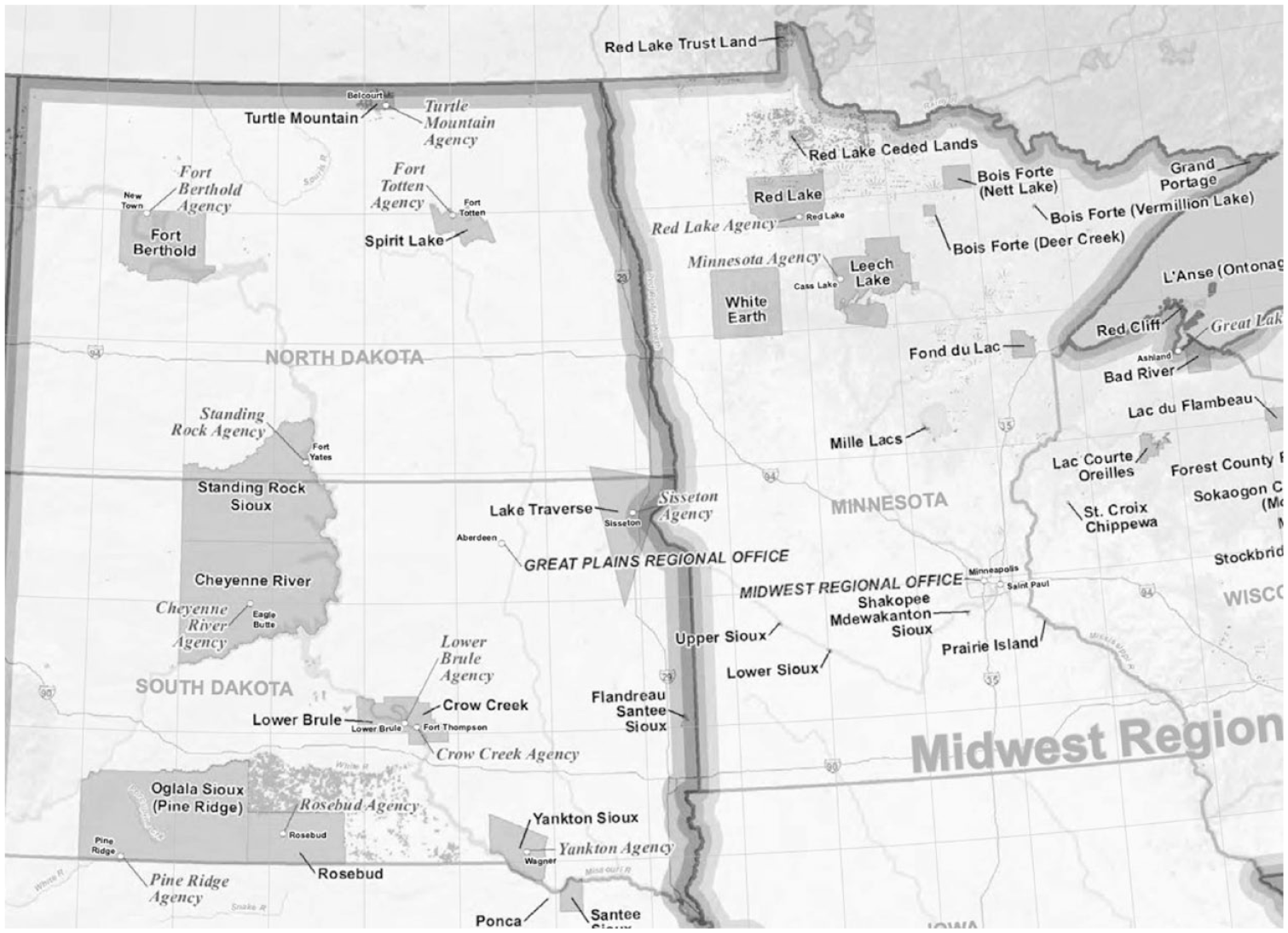
American Indian reservation and off-reservation trust lands in Minnesota and the Dakotas.
Figure 2 provides the overall percentage of Indigenous residents per county across the two states. The nine tribes of the Oceti Sakowin comprise nearly 10 percent of South Dakota’s population, accounting for the third highest Indigenous presence per/capita in the United States (U.S. Census Bureau 2012). In contrast, Minnesota’s seven Ojibwe and four Dakota tribes, the latter reduced significantly in number after their forced removal to South Dakota in the 1862 U.S.-Dakota War’s aftermath, make up approximately 1 percent of the state’s total population.
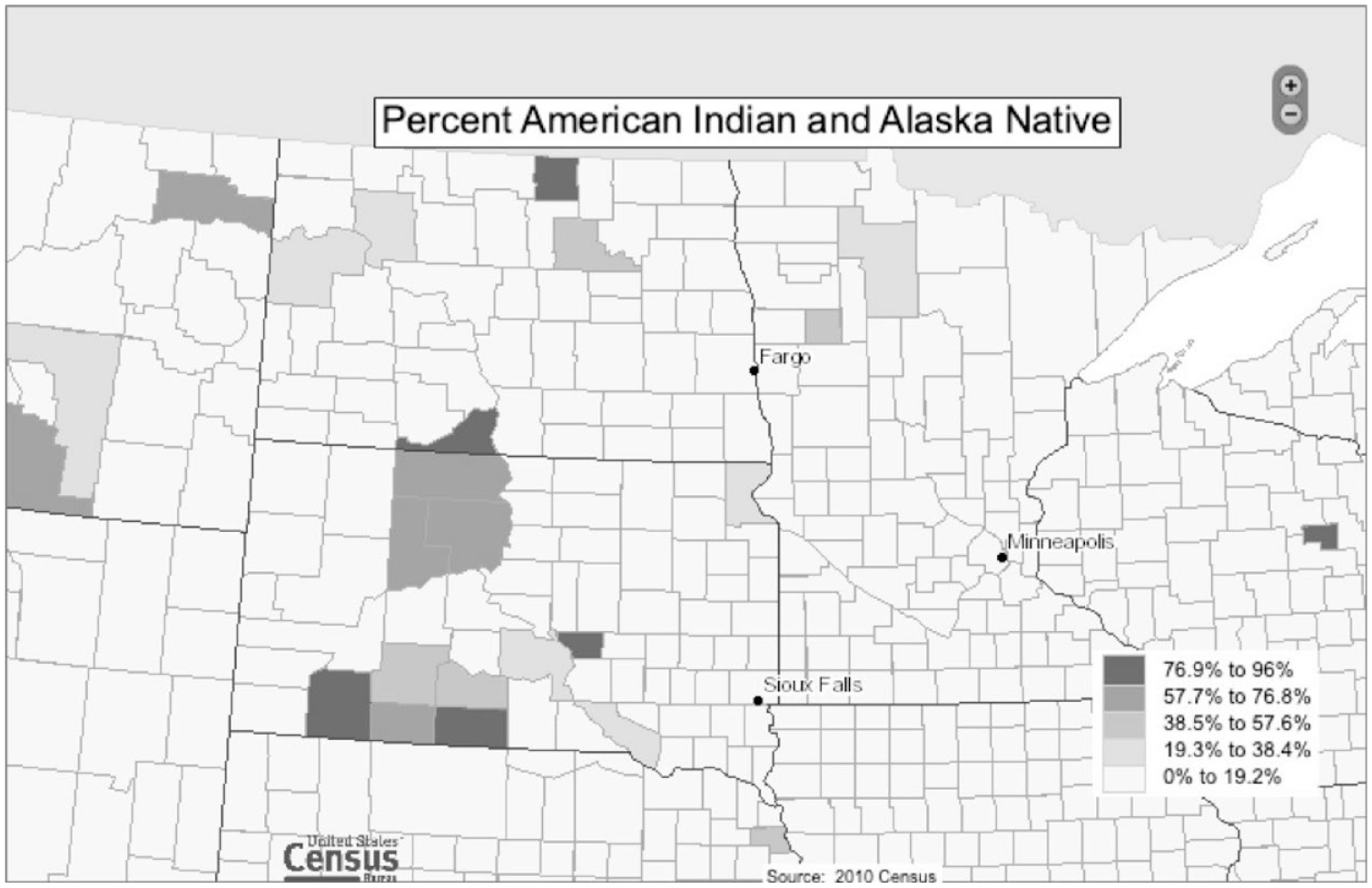
County-level Indigenous percent of total population (U.S. Census Bureau 2012).
Like nearly everywhere else in the western United States, proximity to Indian reservations in Minnesota and South Dakota remains synonymous with proximity to drastic white-Native inequalities. Figure 3 shows that while the counties encompassing Indian reservations suffer from high levels of impoverishment, the problem is particularly acute in western South Dakota. According to the 2010 Census, three counties west of the Missouri River (Ziebach, Todd, Oglala Lakota) had the three highest poverty rates in the country, while South Dakota overall had the highest estimated amount (43–47 percent) of Indians living below the federal poverty line (U.S. Department of the Interior 2014).
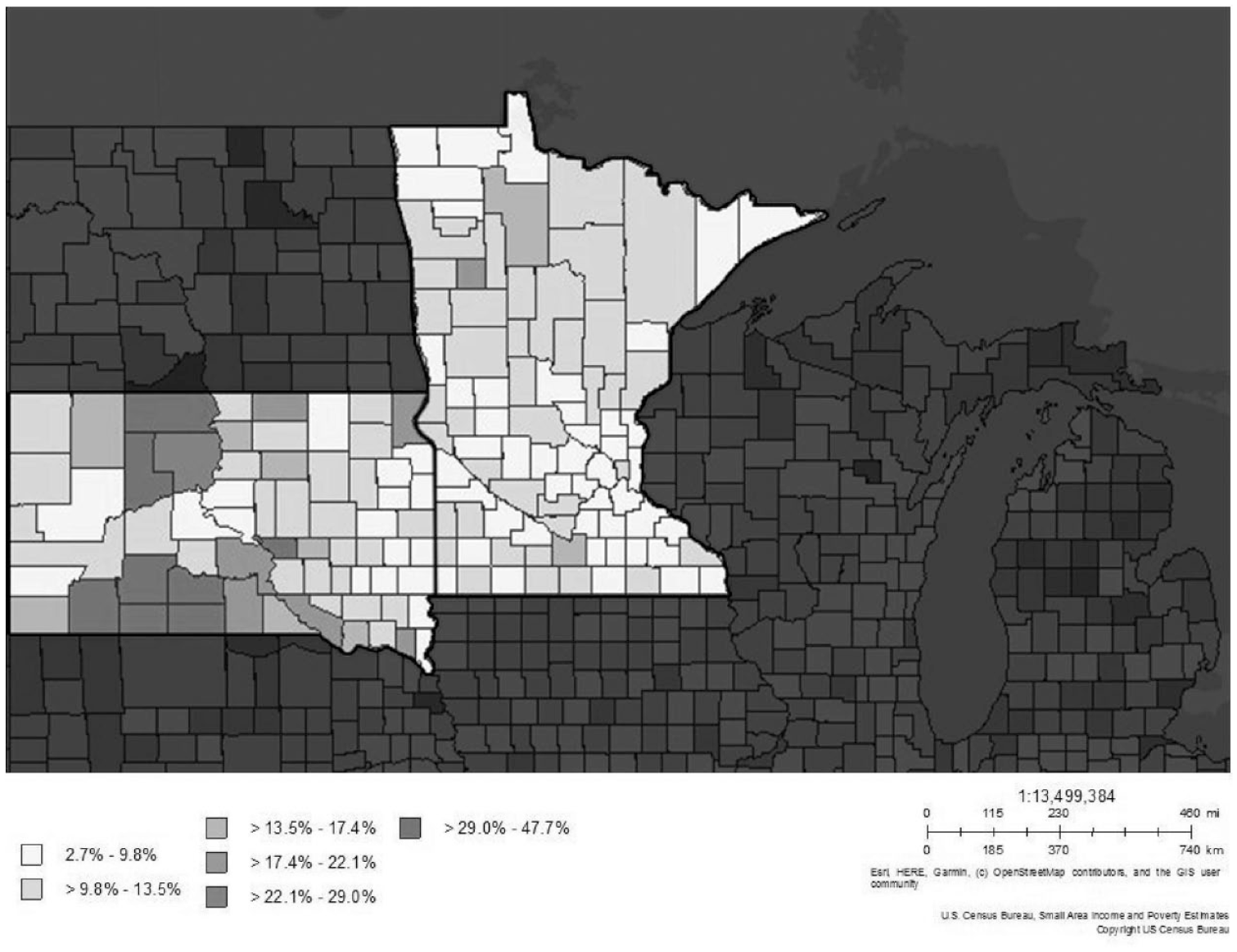
County-level percent of population below federal poverty line in South Dakota and Minnesota, 2019.
It was within and across these highly unequal racial fields, including pockets of the most concentrated Indian poverty in the United States, that AIM attempted to affirm tribal nationhood, regenerate Indigenous culture, and disrupt settler colonial narratives. I thus turn to an analysis of the AIM bystander data to comprehend how the dominant culture narrated Red Power’s threat to the racial status quo. By investigating the narratives of bystanders proximate to the movement’s 1970s activism, many of whom were direct witnesses to AIM’s confrontational protest, I gain clarity on the broader racial discourse legitimating the stark inequalities of the white-Native racial order.
The Territorial Narration of Privilege: History, Tribal Conflict, and Reservation Wastelands
Mirroring national polling conducted during the Wounded Knee Occupation, 6 AIM activism was met with a mixture of sympathy and antipathy among bystanders in my sample.
South Dakotans, on average, expressed much more antipathy toward AIM than interviewees from Minnesota, likely reflecting their more proximate location to both the movement’s disruptive protest and to the severe white-Native inequalities in the state. 7 As my intent in this article is to better comprehend contemporary racial discourse surrounding American Indians, I here analyze the bystander narratives that rationalize AIM attitudinal disposition in the 2014–2015 follow-up interviews.
Across both proponents and opponents of AIM, history foregrounds narratives of the perceived legitimacy of Red Power’s grievances and goals. Nearly all of the interviewees acknowledged the validity of AIM’s claims surrounding the historical mistreatment of American Indians. European colonization, according to Franklin, is a “story of treachery and deceit” that resulted in the “devastation of the people who were here” and a “deep sin in our [cultural] psyche.” Similarly, Joan argued that Native peoples were historically “screwed over time and time again. We stole the land completely from the Native Americans. Every time they had a treaty, we broke it; every single time.” For many sympathizers, the “deep sin” committed against American Indians in the past was directly linked to AIM’s contemporary activism: AIM wanted treaty rights . . . They felt they were marginalized and treated unfairly, and that some of the social problems they are having, the alcoholism rate, high-drop out rate . . . it wasn’t just from something that was occurring now, it was ever since [settlers arrived in Minnesota]. (Sarah, Shoreview, MN)
Beyond legitimating AIM’s grievances, the perceived depth of the historical injustice committed against Indigenous peoples also commonly superseded concern with the movement’s confrontational tactics. AIM exerted a “justifiable militancy,” in the words of Samuel, conceding that “sometimes you need a hit on the head in order to wake up.” Frederick, of St. Paul, similarly dismissed criticism of AIM’s tactics in light of the public awareness the movement achieved: “It’s too bad they had to get that loud and confrontational to get our attention. They need our attention. They were doing us a service . . . Shouldn’t we be pissed off? Shouldn’t we be listening?”
Yet just as history was used by AIM proponents, antagonistic bystanders also routinely relied on historicized narrations to invalidate movement grievances. Indeed, specific questions related to (1) the validity of treaty rights and (2) the causes of reservation poverty yielded two dominant narratives deployed to counter AIM’s criticism of the racial status quo: (1) tribal warfare narrative and (2) reservation wasteland narrative. 8 A closer examination of these two privilege narratives should thus lend insight into the unique racial discourse surrounding white-Native relations in U.S. society.
Tribal Warfare Privilege Narrative
In grappling with AIM grievances surrounding reservation poverty and treaty rights, bystanders frequently relied on narratives that foreground Indigenous tribal divisions. Prompted to explain the origins of reservation poverty in South Dakota, Carol qualified a hesitant indictment of the “white man” with an ambiguous reference to conflict among Indian tribes: The roots of it [reservation poverty], huh? . . . I don’t know (chuckling). I suppose it had something to do with when the white man came. But on the other hand . . . the Indians fought with each other too . . . I’ve never understood the tribe system, how they are set up or anything. Sometimes they fight between themselves I think.
Gary, from southwestern Minnesota, similarly concluded that “If they would have quit fighting amongst themselves they would have been a lot better off.” This alleged bungled historical opportunity for tribal unity was also central to Jennifer’s argument that the roots of Indian poverty are more complex than other racial groups: You can’t look at the Native Americans as being everybody [similar to other racial groups], because the tribes are so different. And they have a history of not being allies or working together until the very end when they were starving.
By redirecting the responsibility for the inequalities produced by Indigenous dispossession, bystanders crafted a narrative that simultaneously enabled both a historicized lament for American Indians and a dismissal of the validity of AIM’s protest for contemporary redress. As such, even a blatant historical example of Indian dispossession like the Trail of Tears could be discursively decoupled from settler blame and responsibility: The Cherokee got sent to Oklahoma from the Southeast for crying out loud. I mean, they are a tribe, and they were the most progressive bunch of the time. See that’s just it, if they could get together it would help a lot. (Gerald, Sioux Falls, SD)
Ambiguous references to tribal divisions gained discursive refinement as I moved west of the Missouri River in South Dakota, site of both AIM’s most intense protest and the most entrenched reservation poverty in the United States. Antagonistic bystanders in the region, many of whom had personally experienced Red Power’s disruptive effects some 40 years earlier, commonly dismissed AIM grievances related to treaty rights and Native poverty through a more specified historicized narrative of inter-tribal warfare. Prompted for his stance on Lakota treaty rights to the Black Hills, where he lives, Charles weaved a “tide of history” rationale (Veracini 2010:41) with an emphasis on inter-tribal conflict: It [Euro-American colonization] was probably inevitable. I think it’s too bad that it happened because they had such a great place to live [Black Hills]. But like I said, that’s the history of the human race. We’ve been doing that forever . . . even the Native Americans: they pushed each other all over the country. The Lakota didn’t come out of Minnesota into South Dakota much before my ancestors settled in eastern South Dakota. My great-grandparents homesteaded in northeastern South Dakota during the Civil War. It wasn’t much before that when the Lakota were pushed out of Minnesota and came over into here . . . So how far back are we going to go? Are we going to give this to the . . . last Native Americans that were here, which would have been the Lakota? Or the ones just before them that they pushed out? Or the most recent people that settled it, and that’s us.
A similar focus on tribal warfare was shared by Kenneth, who noted during the interview that his grandfather helped move the 1890 Wounded Knee Massacre victims to a mass grave: I can’t change what white people did. What they did back there [Wounded Knee Massacre], I can’t change it. I can’t change the fact that the Sioux took the Black Hills from another Indian tribe the same way the white man took it from them. That can’t be changed.
A more refined version of the broader focus on Indian divisions, the tribal warfare narrative similarly forecloses historically based grievances from contemporary relevance, as in Brad’s account below: They [AIM] were mad about Wounded Knee [1890 massacre]. They have grievances, there’s no two ways about that. But I was smart enough, I didn’t say “what about the Arikaras that you killed?” I don’t know if there are any Arikara Indians anymore . . . There aren’t many around here because the Sioux drove them off. These “peace loving Sioux” acquired the land the same way the whites did.
Brad’s centering of inter-tribal displacement, with specific reference to the alleged victimized tribe (e.g., Arikara), was a recurrent theme of bystander narratives surrounding treaty rights, particularly in western South Dakota: I was sympathetic to the Indian cause, to an extent. But also at the point where I felt that . . . you know this is history. It’s not the first time that Indigenous people have been moved out of their homelands. Dennis Banks’ [AIM leader] people did it. They came from Minnesota and moved out the Arikaras and the Northern Cheyenne. So I wasn’t too sympathetic that way. (Steven, Custer, SD)
Exemplified by the narrations above, the power of the tribal warfare narrative as a defense of white privilege lies in its ability to historically invalidate contemporary Indigenous grievances through the construction of a moral equivalent between settler colonial dispossession and inter-tribal conflict. Not surprisingly, as noted, this privilege narrative was most common in western South Dakota, where treaty-based claims to the illegally seized and unceded Black Hills
9
require a formidable defensive rationalization. Such rationalizations are particularly necessary for interviewees like Sheldon, whose property lies within the boundaries of the Black Hills National Forest: I agree [That the Black Hills are sacred to the Lakota]. They are sacred to me too. But they are not theirs anymore than they are mine. I don’t believe in revising history . . . They don’t have any more claim to it than the Arikara, or the Crow, or anybody else that got pushed out farther West.
In crafting his invalidation of Lakota treaty rights to the Black Hills, Sheldon mimics Charles’ usage of the verb “pushed” documented above. The Lakota and other tribes “got pushed out farther West” according to Sheldon, just as Indians had “pushed each other all over the country,” including the Lakota being “pushed out of Minnesota” not long before Charles’ European ancestors “settled it.” Interestingly, the description of Indians being “pushed” shows up in two additional tribal warfare narratives: I think that my thinking has evolved over the years in that I believe that what we’ve done is terribly destructive to the [Indian] culture. But I think now I’m more of a believer in “We won, you lost.” You get this, “Well we want our land back!” Well maybe the Arikara would like to have it back. As the white man pushed further west, the Native pushed further west and tribes got pushed. (Thomas, Custer, SD) Who did they [Lakota] take them [Black Hills] from? They were pushed in. They came in here with the Cheyenne and other tribes . . . And then the tribes weren’t very nice to each other. My God, they killed each other . . . They didn’t have some utopian civilization where things were cool. They were going at each other. (Jeffrey, Flandreau, SD)
The routine deployment of the verb “pushed” in the tribal warfare narrative constructs a non-agentic frame around Native peoples and their territorial presence on the Northern Plains. Indeed, an entity that can be pushed is one defined by pliability and the absence of sturdy territorial roots. A similar logic applies to the dominant culture’s habit of distinguishing between Indians who “live on” the reservation and non-Indians who “live in” the United States. Only the former implies an untethered population that can be physically or symbolically pushed off, 10 thereby enabling the invalidation of Indigenous territorial claims while concurrently validating fossil fuel permits on Indian lands.
Reservation Wasteland Privilege Narrative
Rather than invoking tribal conflict to dismiss AIM grievances surrounding reservation poverty and treaty rights, the second most predominant privilege narrative indicts the alleged inferior quality of Native lands. Congruent with Traci Brynne Voyles’ (2015) study of how the settler state constructed Navajo territory as a “wasteland” suitable for uranium mining, AIM antagonists frequently argued that Indian poverty resulted from “barren” and “worthless” reservation lands. Although Charles placed heavier emphasis on tribal warfare (as described above), he was one of only two bystanders in western South Dakota who tied Indian poverty to a deficiency in reservation topography. Shifting in his chair, he noted that the Pine Ridge Reservation was “not the best ranch land in the country, or farmland . . . They’ve [Oglala Lakota] been somewhat kept in poverty just because of their location.”
Yet as I moved across the Missouri River into eastern South Dakota, the reservation wasteland narrative became the most common explanation for Indian poverty. Ruth, from Sioux Falls, traced the “discontent” represented by AIM directly to the reservations, which she argued encompassed the “most desolate land” in South Dakota: I had my own feelings about the Indians being sent out to the most desolate land, having gone out to the Hills [Black Hills] even before we moved here on vacation. Coming back through the Badlands and some of the Indian reservations I was thinking: “My gosh they got . . . the poorest land in the whole state . . .” I could understand the discontent of the people because of where they are.
Brian, also of Sioux Falls, expressed similar sentiments while associating “wonderful land” with capitalism’s agro-centric concept of land commodification: The white country at the time did wrong, definitely, to pick that kind of country. Yes, granted for the Lakota that was their land. But you know what else was their land? Sioux Falls. Western Minnesota. With the treaty comes this wonderful land? No, you’re going to Pine Ridge, where nothing grows and you’re all going to be farmers. Here’s your seed, right? (chuckling)
Brian’s passage is also noteworthy in that, unlike the tribal warfare narrative, he concedes the validity of Indian territorial claim by acknowledging that Sioux Falls and Western Minnesota “was their land.” Yet this acknowledgment is granted only to once again suggest a lamentable missed historical opportunity, one alleged to be at fault for contemporary reservation conditions. Prompted to explain the root cause of Indian impoverishment in the state, Brian proceeded to argue that reservations are “a total mess.” Asked for clarification, he responded with an animated discussion of the “worthless wasteland” inhabited by tribes: “Well first of all, look at the land they are on . . . That is the most worthless wasteland in the country-wind blowing, cold as hell.”
Although no other bystanders equated the frigid conditions of a South Dakota winter with “hell,” they joined Brian in describing the reservations as both “worthless” and “wastelands,” as in the two narratives documented below: It [Pine Ridge Reservation] doesn’t look like farmland or ranchland, just wide open spaces . . . pretty worthless actually . . . It really just looks like a bunch of worthless green land, where they can’t make a living and can’t raise decent crops. (Joanne, Sioux Falls, SD) We stuck them on a little . . . and it’s not even good land, it’s the worst part of the state. We ought to have gave [sic] them the Black Hills from the beginning, not the little wastelands. They probably would have been more productive. (Todd, Vermillion, SD)
Todd’s remark that “we ought to have gave [sic] them the Black Hills” once again contrasts sharply to the invalidation of Native territoriality in the tribal warfare narrative. Moreover, both Todd and Joanne’s explanations of Indian poverty concisely capture two important functions of the reservation wasteland narrative. First, although such narrations admit a degree of white culpability for the historical dispossession of American Indians, they simultaneously provide a clear diagnostic target for its contemporary legacies: “worthless” reservation land. Second, the reservation wasteland narrative does not abandon color-blind racism, but instead turns it on its head: Indian land is the alleged source of the racialized group’s failure to attain the economic and cultural requisites of U.S. society. Yet Indian bodies are not entirely blameless. Indians “probably would have been more productive,” in Todd’s description, had the government not chosen, in Joanne’s words, “the rottenest land they could find to turn into a reservation and stick with them,” where “they can’t make a living.” Indeed, later on in the interview, Todd lamented the fact that he could not afford to see a dentist, and that if he was “in the Indian situation,” the government would cover it for him. He later incorporated the example of his dental dilemma in a proposal to bring educational training on the “real world” to the reservation: On the reservation there should be more opportunity to understand what the real world is like, whether it’s with classroom training or movies of people that are doing jobs: Dad gets up in the morning and goes to his job at the newspaper. He sits and types all day. Dad does this because he makes a living at it and it pays for your teeth. It brings an understanding of what it is to get through things . . . not we get our monthly check and we go get our monthly commodities.
In addition to providing a diagnostic target (Indian land) for white-Native inequality, which precedes but does not supplant color-blind rationale, the utility of the reservation wasteland narrative also lies in its proposed prognostic remediation: Indian abandonment of the reservation: We took away their lands, took away what was theirs and gave them some yucky land for them to live on and expect them to make a living . . . But a lot of them don’t have to live on the reservation. They can go out, get a job and support themselves just like we do. I guess life is full of choices. They can do whatever. (Roxanne, Sioux Falls, SD)
Thus, rather than restitutive policies designed to rectify the alleged “barren” reservation topography, bystanders shifted blame onto American Indians for not fleeing their homelands. In their irrational desire to remain on their lands, the only solution for Jeffrey and Brian was the abolishment of reservations, and more broadly, Native sovereignty: I think the sooner we get done with the damn reservation system . . . You live there because you want to, not because you have to . . . You know the results of the reservation system, of the apartheid, are horrible. Look at Pine Ridge still, all you read about is the suicide rate and the despair . . . Abolish the Indian Health [Indian Health Service]. Get them off the reservation. Give them freedom to go where they please. (Jeffrey, Flandreau, SD) I wish to God they would do away with the reservations . . . There’s nothing [on the reservation] to self-sustain them. What do you do with them now? Pure government assistance; what else are you gonna do? But the thing is then they come up with this bullshit of “We’re a sovereign nation.” Sovereign nation? You got your ass beat, ok? You lost the war. You ain’t no damn sovereign nation. You’re part of the United States now. You show me any other nation in the world who say “well, we’re sovereign” whose entire dependence is upon another government to live, to exist, to eat. (Brian, Sioux Falls, SD)
Although the reservation wasteland and tribal warfare narratives proffer diverging rationalizations of white-Native inequalities, they arrive at a similar instrumentality: the decoupling of historically rooted Indigenous grievances from contemporary Indian social conditions. One story historically delegitimizes Indian territorial presence, thereby invalidating treaty rights to any part of the colonized space. The other story concludes with the relinquishment of Indian sovereignty over land through the voluntary abandonment of reservations. Both stories converge on the rationalization of historical Indigenous dispossession, and its contemporary legacies, through a racial discourse that validates white territoriality by uprooting American Indian territorial claims.
Conclusions and Future Research
This article began from the premise that there has been much too little sociological focus on contemporary racism against Indigenous peoples. Turning my attention to the subject, I theorized that the structure of racial discourse surrounding American Indians would be distinctive from other racialized groups in the United States as a result of the dual mechanisms of racial dispossession that constructed white supremacy: (1) the exploitation of non-Indigenous bodies and (2) the opportunity hoarding of Indigenous resources. These contrasting, yet complementary, dispossessive mechanisms produced the durable inequalities (Tilly 1998) of contemporary U.S. society by historically targeting non-Indigenous racialized bodies on Indigenous territory. Variation in these original racial projects, I argue, produces distinctive patterns of contemporary racial discourse across Indigenous and non-Indigenous groups. In contrast to color blindness’ ahistoric and spatially unbound storylines (Bonilla-Silva 2018), narrative rationalizations of white privilege in relation to Indigenous peoples must continue to defend the territorial foundations of white property.
Empirical support for the theoretical claims was provided through an analysis of the dominant cultural narratives surrounding the American Indian Movement. Using AIM’s confrontational activism in the early 1970s as a case of heightened racial contestation surrounding Indigenous rights, I drew from a purposive sample of follow-up interviews with non-Native bystanders with historical ties to the movement. Interviewee proximity to both AIM’s 1970s activism and American Indian populations in South Dakota and Minnesota enabled an opportunity to investigate how the dominant culture rationalizes the vast inequalities derived from the white-Native racial order.
Representing a distinctively racialized group rooted in tribal nationhood and treaty rights, Red Power forcefully mobilized the historical and territorial grievances flowing from the settler state’s hoarding of Indigenous resources. My unveiling of the two most common narratives constructed to dismiss AIM grievances surrounding treaty rights and Indian poverty, “tribal warfare” and “reservation wasteland,” reflects a racial discourse forced to grapple with a unique mechanism of dispossession that perpetually secures non-Indigenous territoriality. In stark contrast to color-blind discourse, both the tribal warfare and reservation wasteland narratives foreground history and territory in their rationalization of white-Native inequality. Confronted with AIM protest for the recognition of treaty rights, bystanders dismissed Native territorial claims by constructing a moral equivalent equating pre-settler tribal warfare with the frontier violence of their European ancestors. In addition to defying theoretical expectations that settlers erase their society’s “founding violence” (Veracini 2010:78), the discursive transferring of frontier violence onto Indigenous peoples serves to validate white territoriality through the uprooting of Indigenous territorial claims.
The invalidation of Indigenous territoriality is also the reservation wasteland narrative’s denouement. Turning color-blind discourse on its head, interviewees directed the primary blame for Indian impoverishment to the alleged “barrenness” of reservation lands. As these “wastelands” kept Indians impoverished, bystanders argued for the tribal abandonment of reservations. Thus, despite diverging content, the conclusion of both privilege narratives is the same: the dismissal of contemporary Indigenous grievances through a historicized narration that legitimates white privilege and white territoriality.
Amid a renewed focus on systemic racism, future research should heed Eduardo Bonilla-Silva’s (2015:84) call for more insight into how “local racial formations” shape contemporary U.S. race relations. Emirbayer and Desmond’s (2015) theoretical work on “racial fields” provides sociologists with a promising toolkit for supplementing our national-level frameworks of race with disaggregated and localized investigations. Carefully designed empirical studies can assist in refining our understanding of how to conceptualize the boundaries of racial fields, including the varied factors that influence their durability or flexibility over time. How do local media markets shape dominant racial discourse? Has the shift to digital media consumption led to a homogenizing effect on the patterns of such discourse, regardless of a locale’s racial demographics? How does past racial contestation between a racialized group and the dominant culture alter local fields? Although data limitations prevent a stronger conclusion, my finding of the prevalence of the tribal warfare narrative in western South Dakota, within a context of severe Indigenous poverty and ongoing activism over Lakota treaty rights, suggests that localized racial contestation may have a powerful role in shaping white supremacy’s privilege narratives.
As a supplement to localized investigations, comparative research could lend further insight into the distinctive racial discourse confronting the pursuit of Indigenous rights around the globe. As settler colonial societies only persevere through the continued dispossession of Indigenous territoriality, there are likely to be similarities in how non-Indigenous populations narrate their territorial presence and privileges. Future work could investigate the prevalence of the privilege narratives uncovered here, including the extent to which they have diffused among non-European settlers within the colonized space. More importantly, future research should also examine the strategies of Indigenous activists across the globe to counter the discursive “settler moves to innocence” (Tuck and Yang 2012) represented in the narratives uncovered in this study.
My analysis reveals that in addition to color-blind discourse and the “legitimized racism” (McKay 2019) of mascots (Fenelon 2017) and cultural appropriation (P. J. Deloria 1998), American Indians also confront historicized narratives crafted to delegitimize Indigenous rights. The rationalizations of settler privilege that I uncovered across South Dakota and Minnesota discursively embed the continued material hoarding of Indigenous resources, from the Mandan, Hidatsa, and Arikara’s attempt to preserve Missouri River water rights, to ongoing conflict over the extraction and transportation of fossil fuels on the Northern Plains. More broadly, settler colonialism’s privilege narratives continue to flourish amid the dominant culture’s need to legitimate its own territoriality and the resulting durable inequalities produced by the white-Native racial order.
Footnotes
Acknowledgements
For assistance with this project, I thank Rory McVeigh, Matt Rafalow, Cheryl Laz, Amber Tierney, Bill Kiley, and the archivists at the I.D. Weeks Library (University of South Dakota) and the Gale Family Library (Minnesota Historical Society).