




Abstract
Eduardo Bonilla-Silva’s work on colorblind racism has become a prominent theoretical framework for analyzing racial attitudes, ideologies, and discourses in the contemporary United States. However, the scholarship has yet to produce an empirically rigorous, quantitative assessment of colorblind racism to document the theory’s generalizability and assess it as a theory of racial attitudes. In this article, we build upon the rich body of qualitative research to develop a novel measurement model of colorblind racism using nationally representative survey data. We then use the model to estimate the impact of adherence to colorblind beliefs on support for affirmative action policies and awareness of structural disadvantage. Our findings indicate a good model fit, and that awareness of structural disadvantages acts as a mediator between colorblind racism and affirmative action support. We use our findings to develop colorblind racism theory, especially regarding structural disadvantage, both empirically and theoretically; we also consider the implications of these findings and colorblind theory more generally for the study of racial attitudes in the post-Trump era.
Introduction
In the wake of the Civil Rights Movement, much of the sociological study of race and racism in the United States has focused on changes in the expression of racial ideologies and animus. This work has tracked declining patterns of traditional prejudice (cf. Schuman, Steeh, and Bobo 1997) as well as the rise of subtler, new forms of racism and discourse including symbolic racism (Henry and Sears 2002; Sears and Henry 2003) and laissez faire racism (Bobo, Kluegel, and Smith 1997). In general, these theories seek to understand how covert variations of racial ideology and animus impact support for social and public policy.
Colorblind racism has emerged as one of the most prominent sociological frameworks for thinking about changing racial ideologies and attitudes in the post–Civil Rights era (Bonilla-Silva 2006; Carr 1997). As explained by Eduardo Bonilla-Silva in his foundational text Racism without Racists,
Whereas Jim Crow racism explained blacks’ social standing as the result of their biological and moral inferiority, colorblind racism avoids such facile arguments. Instead, whites rationalize minorities’ status as the product of market dynamics, naturally occurring phenomena, and blacks’ imputed cultural limitations. (Bonilla-Silva 2006)
Bonilla-Silva posits that instead of the overt expressions of racism that have existed in the past (e.g., segregated public facilities), colorblind racism operates in a “now you see it, now you don’t” fashion. Borrowing from critical race theory (Bell 1992; Crenshaw 1991; Gotanda 1991), the core idea of colorblind racism is that the American ideals of individualism, meritocracy, and equality—so crucial to liberal beliefs and claims about American exceptionalism—are actually at the root of the problems and complexities of contemporary racial ideologies. Specifically, this framework posits that these ostensibly liberal ideals make it difficult for Americans, especially those privileged by race, to see the persistent inequalities and injustices associated with race in the post–Civil Right period, and/or be unwilling to support policies and programs that might help to alleviate these inequities.
In dialogue with Bonilla-Silva’s pioneering work, different facets of colorblind beliefs and aspirations have been studied by scholars within the fields of sociology (Bunyasi 2015; Burke 2016; Forman 2004), psychology (Neville et al. 2000), and legal theory (Obasogie 2013). This has led to a vibrant new body of work exploring the dimensions of colorblind racism and colorblindness more generally in contemporary culture (Burke 2017; Doane 2014; Hartmann et al. 2017) and to understand a whole range of social dynamics and formations.
Yet for all of this vibrancy, important questions about colorblind racism remain unaddressed. At a basic level, we lack data and information on how broadly applicable or generalizable the framework of colorblind racism is in society. Connected with this are a series of questions about how adherence to colorblind racism may vary by social background differences such as race, education, gender, region, or age and the extent to which such differences may be the drivers or determinants of variations in adherence to or intensity of racist colorblind sentiments. There are also larger questions about if and how impactful colorblind racial beliefs actually are on social attitudes and practices.
In this article, we take up these questions to empirically assess the theory of colorblind racism using data from the Boundaries in the American Mosaic (BAM), a national survey which contains both conventional and innovative items, by constructing a latent measure of colorblind racism using confirmatory factor analysis (CFA).
The measure is built with six survey items that represent Eduardo Bonilla-Silva’s (2006) core conceptual tenets of colorblind racism: abstract liberalism, minimization of racism, and cultural racism. In this second part of the article, we investigate the effects of colorblind ideology on two outcomes: respondents’ awareness of structural determinants of disadvantage and support for racial policy. We present structural equation models for each dependent variable, treating the latent construct of colorblind racism as an independent variable. We examine how white acknowledgment of sites of structural disadvantage (e.g., education and employment) and support for policies meant to ameliorate racial inequality is shaped by adherence to our measure of colorblind racism, an important variable that all racial attitudes research explore more systematically. With this, we speak directly to Bonilla-Silva, who suggests that colorblind racism has an effect on whites’ policy preferences and attitudes toward intervention to ameliorate racial inequality (Bonilla-Silva and Dietrich 2011).
Our analysis draws from the larger, extant qualitative literature on colorblind racial attitudes in contemporary American culture (Bunyasi 2015; LeCount 2016; Manning, Hartmann, and Gerteis 2015; McDermott 2015). Indeed, we do not suggest that quantitative means are the only true way to achieve a generalizable analysis of colorblind racism. Instead, we acknowledge that colorblind racism has been made salient via rich, qualitative research that we hope to build upon to better understand the theory’s value and applicability for future research on racial attitudes, ideologies, and beliefs.
We conclude this article by suggesting our measure of colorblind racism as a reasonable framework for assessing racial attitudes and that future work should more directly compare and contrast this measure with other prominent theories of racial attitudes. Furthermore, we discuss the implications of these findings and analyses for theories of colorblind racism, highlighting the continuing significance of this framework, particularly in the aftermath of the presidency of Donald Trump. Indeed, in the wake of overt expressions of racism brought on as a result of the Trump era, it may seem that theories of subtler, more cultural forms of racism such as those associated with colorblindness are no longer relevant. Instead, we argue that these frameworks are more important than ever, especially for moderate, liberal white Americans.
Literature Review
The literature on changing racial attitudes in the post–Civil Rights United States is vast, spanning across disciplines such as sociology, psychology, political science, and legal theory. In general, these theories seek to understand how covert expressions of racial ideology and animus impact support for social and public policies. We assess the theoretical construct of these measures of new racism, highlighting empirical measurements of racial attitudes, to frame this current study.
Symbolic racism (also known as racial resentment) is usually described as a political belief system in which whites deny discrimination and express anti-Black feelings of hard work and progress (Henry and Sears 2002; Kinder and Sears 1981; Sears and Henry 2003). Symbolic racism suggests that white opposition to ameliorative social policies stems from predispositions developed in childhood and racial resentment expressed through the language of American individualism and morality. A blend of anti-Black affect and “traditional” American moral values, symbolic racism is rooted in the belief that Black people violate the American values of hard work and individualism (Kinder and Sears 1981). Symbolic racism has been measured using national survey data, either as a single construct (Kinder and Sanders 1996; McConahay 1986; Sears and Kinder 1981) or composed of anywhere from two to five subdimensions (Kinder and Sears 1981; Sears et al. 1997). Using these different constructs, symbolic racism has been used to measure whites’ attitudes toward a range of social policies (Bobo 1983; Green, Staerklé, and Sears 2006; Matsueda and Drakulich 2009; Rabinowitz et al. 2009; Tuch and Hughes 2011).
Alternatively, laissez-faire racism involves negative stereotyping of Black people combined with a resistance to meaningful policy efforts to ameliorate institutional racism in the United States (Bobo et al. 1997). The authors suggest that the racial system in the United States shifted from the overtly racist racial hierarchy present under Jim Crow to a system that is “covertly embedded in valued American institutions such as free markets and ideologies such as equal opportunity” (Matsueda and Drakulich 2009). Bobo and colleagues suggest that white opposition to ameliorative policy changes is rooted in Blumer’s racial group threat, a concept that suggests that “dominant racial groups perceive minority groups as economic and political threats to their dominant social status” (Laster 2014). To date, laissez-faire racism has not been conceptualized empirically, though the theory has been used to understand expressions of racial animus in a variety of contexts (Denis 2015).
Most important to our study is the larger literature on and critique of colorblindness (Crenshaw 1997; Gotanda 1991; Mills [1997] 2004; Obasogie 2013), a body of work which itself originated in critical-legal race theory (cf. Crenshaw 2019; Delgado and Stefancic 2012). At its core, critical race theory (CRT) is predicated on the notion that many of the deepest ideals and assumptions of liberal democratic social theory are actually at the root of the persistent problems of racial inequality and injustice (Bell 1992; Crenshaw 1991; Crenshaw et al. 1995). For example, notions of individualism and private property and assumptions about equality, opportunity, and meritocracy make it difficult to recognize or coherently conceptualize the social, historical, and institutional structures that create and perpetuate racial hierarchies, much less create policies and practices to ameliorate these injustices and inequalities (see also Goldberg 1993). Beliefs about colorblindness figure prominently within this framework because colorblind beliefs minimize the importance of race and explicitly valorize its disavowal (Lipsitz 2019). Such notions allow some individuals to be tolerant and even be accepting of individuals from different racial backgrounds—even to the point of intermarriage (Hartmann et al. 2017). However, race-blind ideals make it difficult for adherents to acknowledge the persistent structural and institutional barriers that work against people of color and can mask deep cultural stereotypes about racial “others”—often African Americans—in society.
In recent years, the notion of colorblind racism (Bonilla-Silva 2006; Carr 1997) has emerged as a particularly prominent and charged version of colorblind theory, at least in the social science context (Burke 2016, 2017; Doane 2014). At a basic level, colorblind racism takes the critique of colorblindness one step further to suggest that adherence to colorblindness—in the face of social facts and realities that point out the continuing significance of race—itself constitutes a certain kind of racism. The sociologist Eduardo Bonilla-Silva is recognized as the leading architect and proponent of this approach.
Using data from the 1998 Detroit Area Survey and interviews with white college students, Bonilla-Silva theorized colorblind racism as a set of four ideological tenets—abstract liberalism, naturalization, minimization of racism, and cultural racism—which he says (mostly white) Americans employ to navigate the racial milieu of the United States. He proffers that these frames are used both independently and in tandem by whites as a way to express racist, anti-Black beliefs in a seemingly non-racial way (Bonilla-Silva 2002). Furthermore, Bonilla-Silva hypothesized that younger, educated, middle-class white people are more likely than older, less-educated, working-class whites to make full use of the rhetorical resources of colorblind racism, suggesting a relationship between education, socioeconomic status, and colorblind beliefs. Building from his initial work, Bonilla-Silva and colleagues have expanded these ideas in a series of conceptual and contextual works (Bonilla-Silva 2006; Bonilla-Silva and Dietrich 2011).
Scholars from a variety of disciplinary backgrounds have begun to use the colorblind racism framework to analyze social formations in a variety of grounded, social contexts. These range from classrooms (Hooks and Miskovic 2011; Modica 2015; Stoll 2014) to conservative movements (Garcia 2010) to white rappers (Oware 2016) and to Black student athletes (Bimper 2015). Ideas about colorblind racism have also figured prominently in studies of higher education (Warikoo 2016; Warikoo and de Novais 2015), mixed race neighborhoods (Burke 2018; Mayorga-Gallo 2014), welfare reform (Ernst 2010), and the dynamics of institutional diversity initiatives in the contemporary United States (Berrey 2015). More recently, scholars have begun to use more representative survey-based data sets to explore the impacts of colorblind racism on policy preferences (Bunyasi 2015; LeCount 2016).
However, for all of the attention devoted to the theory, a number of basic and empirical questions about colorblind racism still remain. At a basic level, we lack data and information on how broadly applicable or generalizable the concept is in American society. Connected with this are larger questions about if and how impactful colorblind racial beliefs are on social attitudes, practices, or racial beliefs and how colorblind racism shapes awareness of structural inequalities. Finally, there has yet to be an assessment of a quantitative measure of colorblind racism. The closest attempt to model colorblind racism quantitatively is the colorblind racial attitudes scale (CoBRAS) developed by Helen A. Neville and her team of psychologists. The CoBRAS scale is constructed using a three factor measure generated from 17 questions related to colorblind racial attitudes, particularly assessing ideas of power and color evasion (Neville et al. 2005). The first factor, which they term “Racial Privilege,” measures respondent’s acknowledgment of white privilege. The second factor, termed “Institutional Discrimination,” measures awareness of discrimination and attitudes about affirmative action and cultural assimilation. Finally, “Blatant Racial Issues,” the third factor, is a battery of measures questioning if racism is a current problem in the United States.
Although a robust starting point, the CoBRAS scale is limited for our purposes. Helen A. Neville et al.’s (2005) scale was not built or intended to model Bonilla-Silva’s specific formulation of colorblind racism. Instead, the CoBRAS scale is concerned with assessing the cognitive dimensions of colorblind racial attitudes and providing a measurement for the effectiveness of institutional programming designed to increase racial understanding. The measurement model that we construct and test is designed to operationalize Bonilla-Silva’s theory directly, using a new national data set and survey items written for the task. This specificity is particularly crucial with respect to operationalizing and testing what we believe is the most original aspect of the framework—the question of colorblind racism’s role in shaping structural perspectives on and awareness of racial inequality, which Bonilla-Silva theorizes explicitly, rather than individual cognition. Indeed, because we know little about how colorblind racism impacts awareness of structural disadvantage, we need both a valid measure of colorblind racism and additional survey items and data to assess the impact of colorblind attitudes on various social and policy phenomena and its relationship to awareness of sites of disadvantage. The measurement model and analysis presented below are intended to speak to these points directly.
Data and Design
Our primary research goal is to create an empirically rigorous quantitative measure of colorblind racism. We then use this measure to answer two key research questions: (1) How is colorblind racism related to awareness of structural disadvantage? and (2) How might awareness of structural disadvantage mediate the relationship between colorblind racism and support for race-conscious public policies? We attempt to answer these questions using the BAM survey 1 , a nationally representative online probability-based survey contracted through GfK with funding from the National Science Foundation (Couper 2017) that has been used in numerous publications on religion, race, and American civil society (Croll and Gerteis 2019; Edgell, Frost, and Stewart 2017; Edgell et al. 2016; Frost and Edgell 2017, 2018; Hartmann et al. 2017; Manning et al. 2015; Stewart 2016; Stewart, Edgell, and Delehanty 2018). Essential for this particular analysis is that the survey contains a number of both conventional and innovative items designed to capture different dimensions of racial prejudice, animus, and belief.
The first part of our article is the creation of a latent construct of colorblind racism via CFA measurement model. The construct is created using six survey items that correspond to Bonilla-Silva’s core tenets of colorblind racism. The measure is described in detail below. In this second part of the article, we investigate the effects of colorblind ideology on two outcomes: respondents’ awareness of structural determinants of disadvantage and support for racial policy. We present structural equation models for each dependent variable, treating the latent construct of colorblind racism as an independent variable.
All of our analyses are subsumed within a structural equation modeling framework. Many studies using multiple measures as indicators of a latent construct will create indices of those constructs, then treat the constructed measure as observed in subsequent analyses. This has the limitation of treating the measurement error involved in the creation of the measure as variation in the measure itself in subsequent models. We avoid this limitation by including each latent construct as a measurement model within the larger structural equation model, thereby explicitly accounting for measurement error within each model. Descriptive statistics for measures used in all analyses are found in Table 1.
Survey-weighted Descriptive Statistics for All Variables.

Part I: Latent Construct of Colorblind Racism
Using CFA, a theory-driven analytical technique where the relationships are proposed between observed and unobserved variables, we conceptualize colorblind racism as a latent construct built with six survey items 2 from the BAM survey that represents Bonilla-Silva’s (2016) core conceptual tenets: abstract liberalism, minimization of racism, and cultural racism. The coefficients of these survey items are estimated via maximum-likelihood estimation to estimate factor loadings (also known as reliability coefficients in their squared form). All of our models scale the dependent variable by assuming that the latent variable’s variance is standardized to 1, thereby making our factor loadings represent correlations between the latent construct and the specific indicator variable. To test that our estimates fit the observed data, we utilize a fit index of standardized root mean square residual (SRMR), which is defined as the standardized difference between the observed correlation and the predicted correlation. This fit index is chosen as it is calculable in the presence of weighted survey data whereas other likelihood-based fit indices are not. Values below .08 conventionally indicate a good fit to the data (Hu and Bentler 1999). We utilize this index of fit when assessing all of our measurement models. We then use predictions from the measurement model and graph the mean factor values (standardized) of colorblindness by race. We also use modification indices (Sörbom 1989) to improve the fit of our model to the data in a theoretically consistent manner.
To create our measure of colorblind racism, we identify six variables to represent the key tenets (excluding naturalization) through which colorblind racism operates. The first tenet, abstract liberalism, involves using ideas associated with political liberalism (e.g., equal opportunity) and economic liberalism (e.g., choice, individualism) in an abstract manner to explain racial matters. Expanding on this idea, Eduardo Bonilla-Silva and Dietrich (2011) write “by framing race-related issues in the language of liberalism, whites can appear ‘reasonable’ and even ‘moral’ while opposing all practical approaches to deal with de facto racial inequality.” Whites who use this frame use the language and ideology of the free market to understand racial matters and believe that anyone can make it if they “try hard enough.” Within this tenet is the idea of individualism, which Bonilla-Silva (2006) says is expressed through abstract principles that frame whites’ choice to live in segregated neighborhoods and send their children to segregated schools as an individual choice, an idea which requires ignoring the multiple institutional and state-sponsored practices behind these practices.
For these theoretical reasons, we have chosen to represent abstract liberalism with the measures of hard work and equal opportunity. The hard work measure corresponds to a question on the BAM survey that asks respondents to score their agreement or disagreement with the statement “All people in the United States can make it if they work hard enough.” The equal opportunity measure corresponds to a question of the BAM survey that asks respondents to score their agreement or disagreement with the statement “All people in the United States now have equal opportunity.” Both questions have four response categories that range from strongly agree to strongly disagree. Moreover, because the concept represents an important concept through which colorblind racism is expressed, our measure of colorblind racism also includes individualism, a dichotomous variable in which respondents were asked to indicate their agreement or disagreement with the statement “People should be seen as individuals rather than as members of a group.”
The race no matter, racism past, and race divide measures are used to represent Bonilla-Silva’s minimization of racism tenet. According to Bonilla-Silva (2006), this frame suggests that discrimination is no longer a central factor affecting minorities’ life chances. Furthermore, the frame allows whites to minimize the effects of race and racism, accuse minorities of being hypersensitive, and using race as an excuse or “playing the race card.” The race no matter measure corresponds to a question on the BAM survey that asks respondents to score their agreement or disagreement with the statement “Race longer matters in the U.S.” The racism past measure corresponds to a question that asks respondents to score their agreement or disagreement with the statement “Racism will soon be a thing of the past.” Finally, race divides represents a question on the BAM survey in which respondents were asked to indicate their agreement or disagreement with the statement “Race divides people in America today.” We include this measure as a part of this block of items for capturing colorblindness, though either agreement or disagreement of this particular item could indicate colorblindness. All questions have four response categories that range from strongly agree to strongly disagree. These set of items allows us to measure Bonilla-Silva’s minimization of racism tenet because they help us operationalize the extent to which Americans downplay the reality of race in America, see the presence of race in American society as divisive, and believe that racial oppression has either disappeared from, or will soon disappear from, American life. This suggestion ignores both current racially oppressive patterns and the durability and mutability of racial practices in American society.
The measures African American family and African American hard work are a part of a larger question set that asks respondents to indicate causes of inequality for Black people. Possible responses include lack of effort and hard work, which is the measure for African American hard work and differences in family upbringing, which is the measure of African American family. Both variables are measured using a reverse-coded Likert scale, meaning that responses range from “not at all important” to “very important.” Both variables are meant to represent Bonilla-Silva’s cultural racism frame, a tenet which relies on culturally based arguments to explain the standing of minorities in society. This frame supplants structural or political reasons for the inequality that Black people face and instead employs reasoning that pathologizes Black people’s behavior and family structures. While Bonilla-Silva describes this tenet beyond the Black/white binary, the American mosiac project (AMP) survey does not have questions focused on culturally based causes of racial inequality for other minoritized groups. As such, we are doing the best we can to model this tenet with the available data.
Finally, we have chosen to exclude the naturalization frame of colorblind racism as developed by Bonilla-Silva (2006). The naturalization frame allows whites to explain away racial phenomena by suggesting they are natural occurrences. For example, as Eduardo Bonilla-Silva (2002, 2006) describes, the naturalization frame allows whites to claim racial segregation as “natural” because people of different backgrounds naturally gravitate toward their “own kind.” While Bonilla-Silva delineates the role of this frame in his interview data, this frame has been excluded from our construct of colorblind racism. Of all the frames, naturalization proves difficult to capture through survey methods given that the frame operates as a rhetorical device to explain away racial inequality. Furthermore, capturing this frame proves difficult because respondents are resistant to conspicuous expressions of racism. Finally, the American Mosaic Project did not include items that could plausibly be used as a measure for this tenet of colorblind racism. As such, we lack sufficient data to accurately model this tenet of colorblind racism. For these reasons, we have chosen to exclude this tenet to focus on the frames more amenable to survey research. In trying to develop a model of this central theory of racism in the United States using the available data, we recognize that we are potentially excluding important information about how white people use the naturalization frame to rationalize the racial status quo to maintain their dominant position in society. However, our results indicate that our measure of colorblind racism is a good model fit and a robust measurement of Bonilla-Silva’s theory. We hope that future survey research will build on our analysis with an appropriate measure for the naturalization frame.
Here, we acknowledge the overlap between our measure of colorblind racism and the existing CoBRAS scale (Neville et al. 2000). In particular, the CoBRAS scale contains a measure of belief in the existence of equal opportunity, which overlaps with our measure of the “abstract liberalism” frame. However, we diverge from CoBRAS because that measure does not explicitly address the structural aspects of disadvantage, just the existence of discrimination. Indeed, attitudes about affirmative action are subsumed within the CoBRAS measure, not operationalized as an outcome of the measure. Furthermore, Bonilla-Silva’s theory of colorblind racism does not address attitudes about cultural assimilation so we do not include this measure in our empirical construct of the theory. In sum, our measure of colorblind racism places a large emphasis on minimization of racism, similar to the CoBRAS scale. However, our measure includes more robustness in terms of abstract liberalism attitudes. Furthermore, we conceptualize affirmative action as an outcome as opposed to a part of the ideology itself and we include measures of Bonilla-Silva’s cultural racism frame, which are absent from the CoBRAS scale. Put simply, our measure is more broad in scope, albeit with less measures used in its construction.
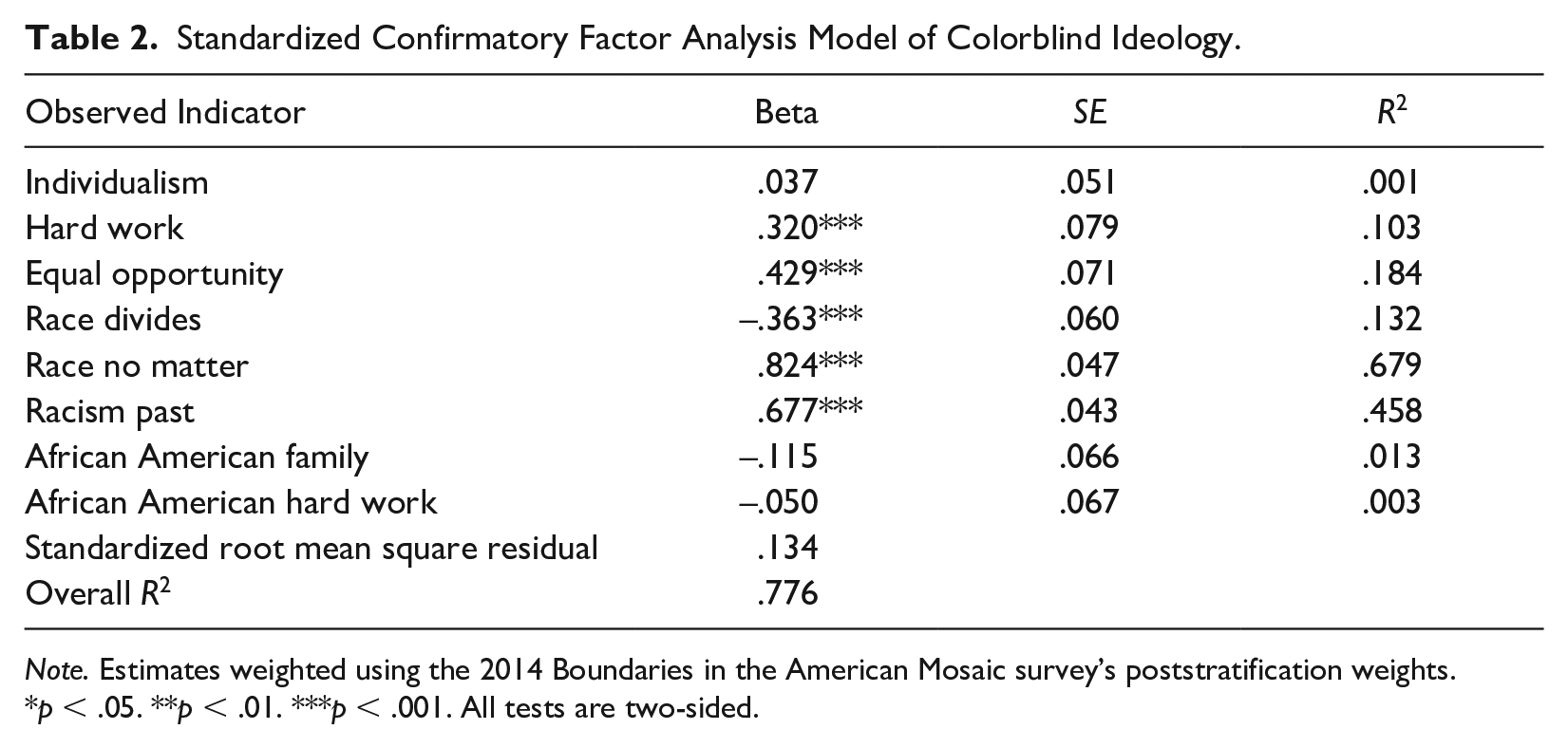
To test the fit of all measures of colorblind racism as described by Bonilla-Silva, we present a standardized CFA model of colorblind ideology in Table 2. This model includes eight measures of abstract liberalism, minimization of racism, and cultural racism, and individualism—the core tenets of colorblind racism.
Standardized Confirmatory Factor Analysis Model of Colorblind Ideology.
Note. Estimates weighted using the 2014 Boundaries in the American Mosaic survey’s poststratification weights.
p < .05. **p < .01. ***p < .001. All tests are two-sided.
Table 2 presents a preliminary CFA of all our items. CFA is used to assess how well each of the observed indicator variables reflect the latent variable of colorblind ideology in the hypothesized structure. To begin, we conducted a measurement model without any specified covariances between observed indicators. The model indicates that many of the colorblindness indicators significantly load onto the latent colorblindness construct. Specifically, the abstract liberalism and minimization of racism measures all load significantly on colorblindness, apart from individualism, which has a statistically nonsignificant and small factor loading. This model resulted in a poor model fit (SRMR = .129), which suggests that improvements should be made in the form of modification indices.
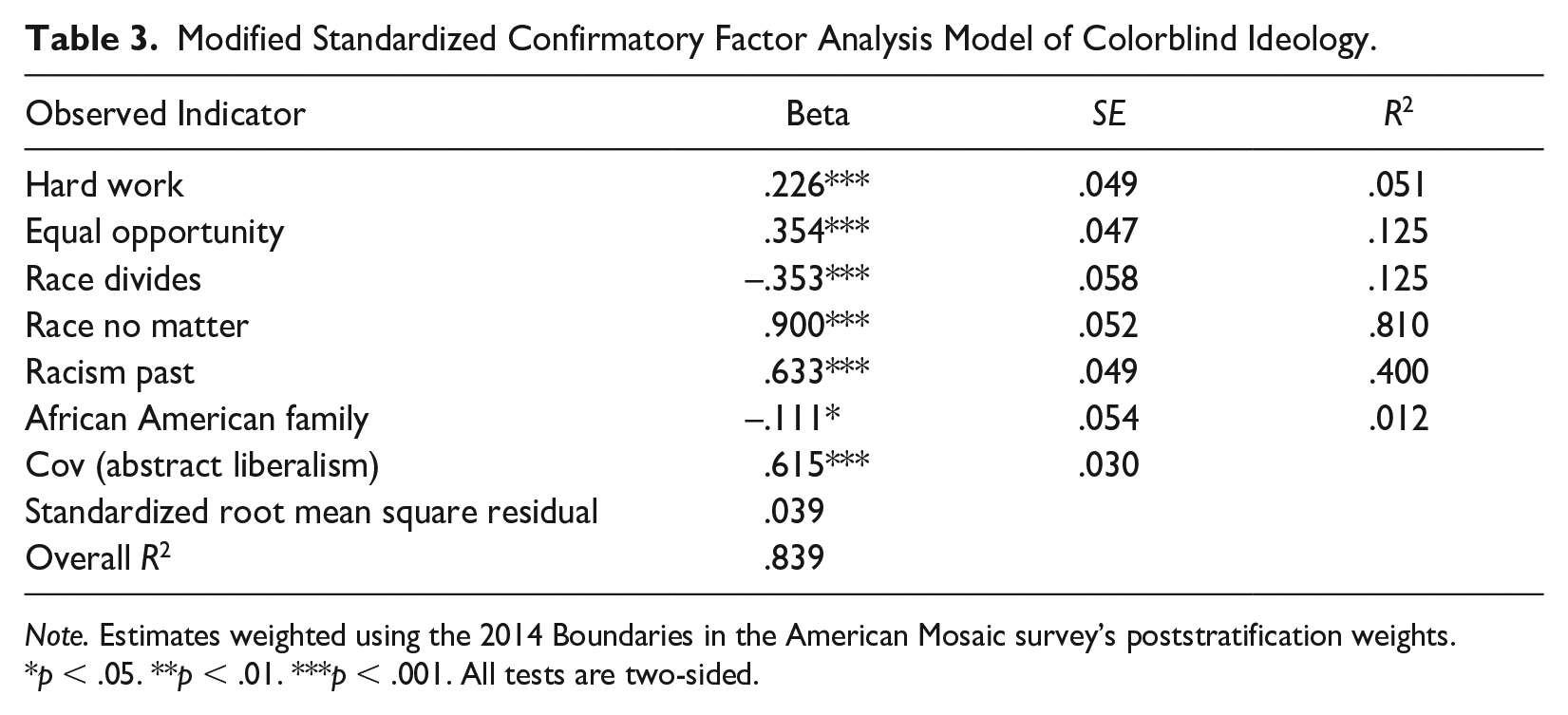
As such, Table 3 presents a modified standardized CFA of our measure of colorblind racism and evaluates the model’s fit to the observed data. In this model, we exclude the variables African American hard work and individualism. These variables had the lowest factor loadings in the previous model, and both decreased model fit with their inclusion. Modification indices, which estimate the improvement in model fit chi-squared for additional model specifications, indicated that significant model fit would be gained from specifying error covariances between the abstract liberalism indicators (modification index (MI) = 136.9, p < .05). This reflects that the variation unaccounted for by colorblind ideology in the abstract liberalism measures share a common source. The final model includes this covariance parameter, which resulted in a good model fit (SRMR = .047). The abstract liberalism measures of equal opportunity and hard work both load positively on colorblindness, as those with more belief in abstract liberalism are associated with higher scores of colorblindness. The minimization of racism measures all load in the hypothesized directions as well, as those who believe race no longer matters, racism is a thing of the past, and race does not divide are associated with higher colorblindness levels. In other words, individuals with high levels of adherence to colorblind racism are more likely to agree with the statements “Race no longer matters in the U.S.” and “Racism will soon be a thing of the past.” Conversely, adherents to colorblind racism are more likely to disagree with the statement “Race divides people in America today.” Finally, the cultural racism measure, African American Family loads significantly on colorblindness, indicating that those who ascribe Black disadvantage to familial mechanisms have higher colorblindness levels.
Modified Standardized Confirmatory Factor Analysis Model of Colorblind Ideology.
Note. Estimates weighted using the 2014 Boundaries in the American Mosaic survey’s poststratification weights.
p < .05. **p < .01. ***p < .001. All tests are two-sided.
Figure 1 displays the distribution of our colorblindness measure, as constructed from the measurement model in Table 3. Overall, the distribution is tightly clustered around mean levels of colorblind ideology (SD = 0), with a peak of lower adherents located at about −.25 standard deviations below the mean. However, there is a pocket of higher adherence about .25 to .3 standard deviation above the mean, but is not as frequent as the low adherence cluster. There is also a high adherent cluster, albeit relatively infrequent, at .5 standard deviations above the mean. In sum, the majority of respondents reside close to the mean level of colorblind racism (e.g., slightly above or slightly below), with slightly higher densities of lower and higher adherence, with a small group of those adhering rigidly to the tenets of colorblind racism. This measure serves as our focal independent variable in the subsequent analyses.
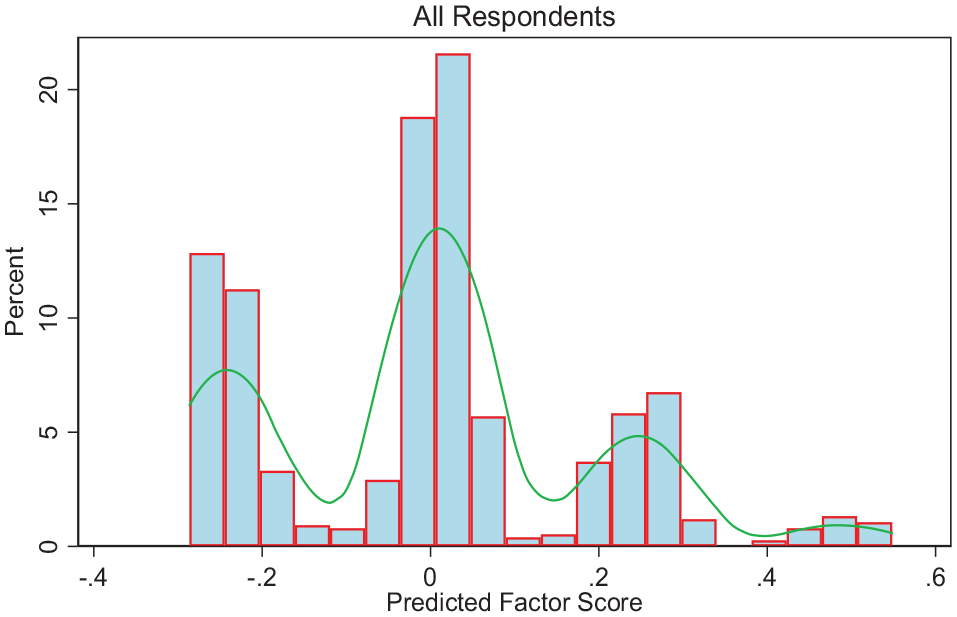
Histogram of colorblind ideology adherence.
Part II: Impact of Colorblind Racism on Racial Policy Support and Structural Advantage Awareness
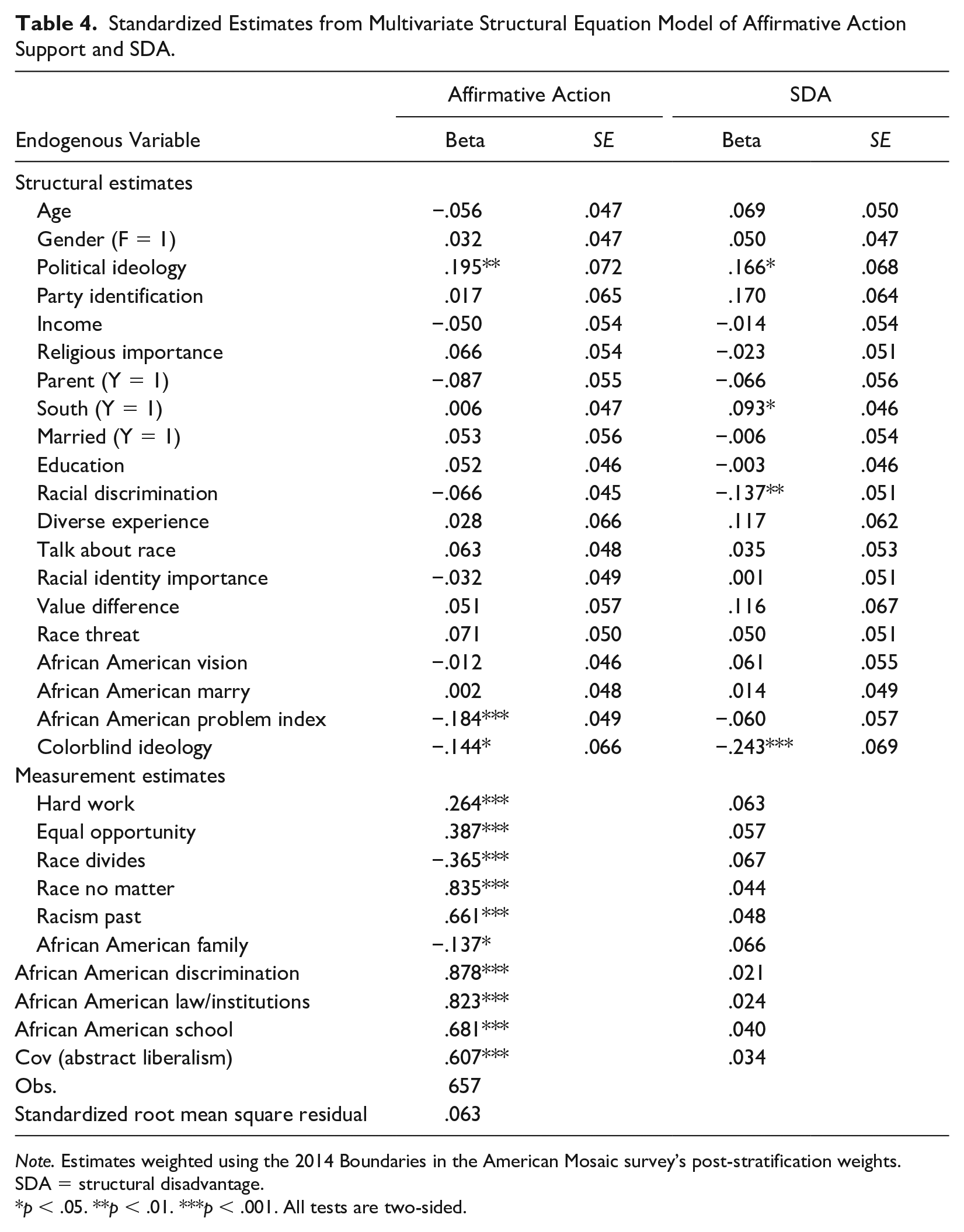
To assess colorblind racism as a measure of racial attitudes, we estimate the impact of adherence to colorblind beliefs on support for affirmative action policies and awareness of structural disadvantage (SDA). To estimate this impact, we use items from the BAM survey that ask respondents about their support for affirmative action policies and awareness of structural disadvantage. To do this, we create a multivariate structural equation model with affirmative action support and structural disadvantage awareness as endogenous variables with a bevy of controls as reported in Table 4.
Standardized Estimates from Multivariate Structural Equation Model of Affirmative Action Support and SDA.
Note. Estimates weighted using the 2014 Boundaries in the American Mosaic survey’s post-stratification weights. SDA = structural disadvantage.
p < .05. **p < .01. ***p < .001. All tests are two-sided.
Previous scholarship (Hartmann et al. 2017) has shown that individual demographics, racial experiences, and other racial attitudes are significant correlates of colorblind identification. As such, our independent controls include a bevy of demographic variables and measures of political, religious, and racial ideology to isolate the impact of colorblind racism, as these other measures (e.g., racial attitudes) could confound the association with our dependent variables. The demographic variables include measures for age, gender, income, marital status, education, region, and parental status. The variables also include measures of political ideology and political party identification, importance of religious identity, and experiences with diversity. The descriptive statistics of these controls are included in Table 1.
We also include a number of racial ideology items to further isolate the impact of colorblindness on affirmative action attitudes. Specifically, we analyze various dimensions of racial attitudes and experiences using measures of how often respondents talk about race, respondent experiences with racial discrimination, the importance of a respondent’s racial identity, perceived racial threat, and how responsible respondent’s feel that certain racial groups are for problems in America. We also include African American Vision and African American Marry, which asks respondents to rate to what extent they believe Black people share their vision of America and how accepting they would be of a child marrying a Black person, respectively, as social distance indicators. Finally, we include an African American Problem Index, which is a summative measure of the extent to which respondents perceive Black people to represent problems in public safety, moral values, employment availability, welfare/government assistance, intolerance, political institutions, and contributions to the community. In sum, the battery of controls we include account for the impacts of demographic and racial belief differences on affirmative action attitudes.
Our measure of awareness of structural disadvantage is a latent construct composed of responses to items that ask respondents to assess explanations for Black disadvantage in social life. These items include agreement that discrimination, laws and institutions, and schools are sites of structural disadvantage. This latent construct is distinct from our measure of colorblind racism because it is constructed using individuals’ beliefs of how inequalities may be impacted by structural factors, whereas the construct of colorblind racism consists of beliefs about the existence and impact of racism and race in society.
This measure, reported in Table 5, is created with a CFA measurement model in a similar fashion to the colorblind racism measure. Thus, this dependent measure represents a BAM survey question that asks about their agreement or disagreement with whether structural forces help constitute African American disadvantage. We call this variable African American structural disadvantage (SDA). All the indicators of SDA load significantly, and our model fit indicates that further refinements of the model are unnecessary (SRMR = .000). In sum, the measurement model indicates that those who believe Black disadvantage is explained by structural causes such as discrimination, law/institutions, and schools have higher levels of SDA. Using this variable, we next explore the extent to which adherence to colorblind racism impacts awareness of structural disadvantage and in turn, how that awareness shapes support for affirmative action policies.
Standardized Confirmatory Factor Analysis Model of Structural Disadvantage Awareness.
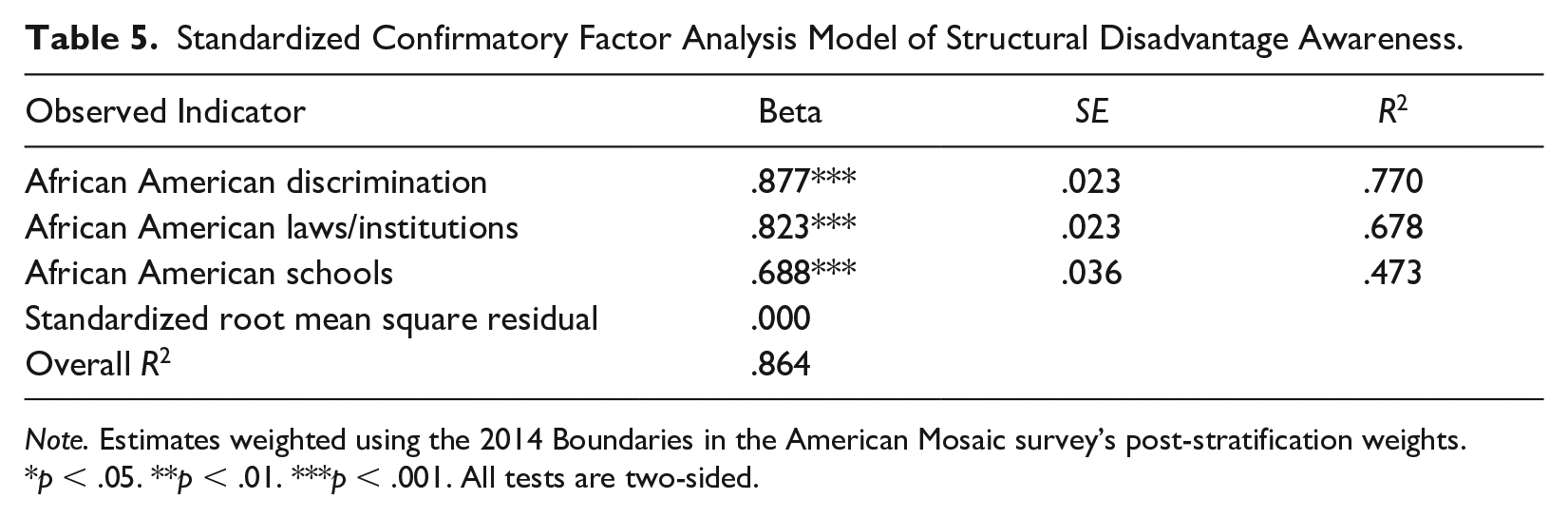
Note. Estimates weighted using the 2014 Boundaries in the American Mosaic survey’s post-stratification weights.
p < .05. **p < .01. ***p < .001. All tests are two-sided.
Our measure of affirmative action support is an observed measure represented by an item on the BAM survey that asks respondents to indicate their level of agreement with the statement “African-Americans should receive special consideration in job hiring and school admissions.” The response categories range from “strongly disagree” to “strongly agree.” We call this variable affirmative action.
We include colorblind racism as an independent measure in order to estimate how adherence to this construct shapes support for affirmative action and awareness of structural disadvantage. We find that, net of other covariates, each unit increase in adherence to colorblind racism lowers awareness of structural disadvantage by .243 standard deviations. Similarly, each unit increase in adherence to colorblind racism lowers support for affirmative action support by .144 standard deviations. In short, controlling for other factors, more adherence to colorblind racism results in less awareness of the structural factors that produce racial inequality and lower levels of support for policies meant to ameliorate racial inequality.
In terms of the other covariates, political ideology serves as a robust predictor across both models, with liberal respondents being more likely to support affirmative action policies and express awareness of the structural disadvantages that Black people face. Specifically, a one standard deviation increase in political ideology is associated with about a .2 increase in affirmative action support, and a .17 increase in awareness of structural disadvantage. In the affirmative action model, the other significant predictor is the African American Problem Index. In other words, the more that a respondent believes that African Americans represent a “problem” in American society, the higher their disagreement with affirmative action policies. The SDA model indicates that respondents from the South report being more aware of structural disadvantage, being .093 standard deviations higher in awareness than non-South residents, and that experiences with racial discrimination lowers respondents’ awareness of structural disadvantage. This discrimination finding may seem counterintuitive, but it could be that individuals who are less aware of structural disadvantage tend to think more in terms of individual discrimination, which is only a small part of the broader ways that racial discrimination can take place, or may be less adept at the detection of discrimination due to their lack of awareness of such barriers.
Finally, to test the notion that SDA acts as a mediator between colorblind racism and affirmative action support, we create a structural equation model of both affirmative action and SDA but include SDA as a predictor in the affirmative action model. The abridged results of this model are relayed in Table 6 (the model includes all controls), which was modeled simultaneously in one step with Table 4. Similar to the model in Table 4, we find that colorblind racism significantly reduces awareness of structural disadvantage, net of controls. This affirms our first leg of mediation, that colorblind racism is significantly associated with awareness of structural disadvantage, the proposed mediator. In the affirmative action equation, once SDA is included in the model, it both reduces colorblind racism’s effect to statistical nonsignificance, and in turn significantly reduces affirmative action support. This affirms our mediation hypothesis in that awareness of structural disadvantage is significantly associated with affirmative action, but colorblind racism only has a significant impact on affirmative action via its link to SDA, as it does not exert an effect independent of SDA. It should be noted that while our data cannot determine the temporal order of these effects, the data are consistent with the proposed theoretical model—that awareness of structural disadvantage is the key route by which colorblind racism translates into affirmative action policy attitudes.
Standardized Estimates from Multivariate Structural Equation Model of Affirmative Action Support and SDA.

Note. All controls included in each equation. SDA = structural disadvantage.
p < .05. **p < .01. ***p < .001. All tests are two-sided.
Put simply, Table 6 shows that it is not colorblind racism itself that shapes affirmative action support. Instead, awareness of structural disadvantage acts as a mediator between colorblind racism and affirmative action support. Overall, our findings provide evidence that awareness of the structural determinants of Black disadvantage is a key dimension of how colorblind racism impacts support for racial policy, thus contributing to and extending the many theoretical and qualitative studies that have hypothesized the broader social effects of this phenomenon.
Discussion and Implications
Extending from earlier work on colorblindness and critical race theory, this article has presented the first systematic measurement and empirical analysis of the theory of colorblind racism using representative survey data. Our novel measurement model comports with theoretical expectations of Bonilla-Silva (2006), with abstract liberalism, minimization of racism, and cultural racism constitutive of the construct of colorblind racism. In addition to this innovation, we examine the relationship between colorblind racism, awareness of structural disadvantage, and policies meant to ameliorate racial inequality.
In line with Bonilla-Silva’s (2006) theoretical framework and subsequent critical-qualitative studies, we find that colorblind racism is strongly associated with lack of awareness of structural determinants of Black disadvantage. In particular, we find that adherence to colorblind racism lowers both awareness of issues of structural disadvantage for Black people in America and support for ameliorative affirmative action policies to address that disadvantage. Furthermore, our model indicates that colorblind racism has a significant impact on affirmative action indirectly though the latter’s links to structural disadvantage. In other words, colorblind racism is associated with lower awareness of structural disadvantage, which, in turn, lowers support for affirmative action, given the positive association between awareness of structural disadvantage and affirmative action support. This is an important contribution to theorizing colorblind racism; namely, it suggests that beyond a generic “blindness,” colorblind racism operates primarily in and through the very specific dimension of the awareness of structural disadvantage or the lack thereof. Although colorblind racism has no independent effect on affirmative action attitudes, our findings indicate that adherence to colorblind beliefs shapes awareness of structural disadvantage, meaning that support for public policies to redress systemic racial inequality relies on how much or how little individuals cling to this belief system.
This powerful survey evidence lends strong evidence toward the mystifying character of colorblind racism, wherein structural realities of racism and inequality are ignored and/or go unnoticed in the minds of the colorblind. Structural disadvantage awareness in turn mediates the relationship between racial policy support and colorblind racism, providing evidence that the key mechanism by which colorblind racism translates into the lower levels of racial policy support is through the suppression of structural disadvantage awareness. Our discovery of the importance of the lack of awareness of structural disadvantage as a key mechanism through which colorblind ideology exerts its impacts makes a significant contribution to Bonilla-Silva’s theory and is a finding that all racial attitudes research should take seriously. In particular, we suggest our quantitative construct of colorblind racism could be complementary for or even an alternative to the two dominant theoretical frames on racial attitudes—symbolic racism and racial resentment.
Here it is important to reiterate that our construct of colorblind racism measures racial attitudes differently from other work on racial attitudes; and as such, it seems to provide a synthesis not previously realized. Like symbolic racism it is trying to provide a theory of subtle, post-Civil Rights forms of belief and ideology; and as with work on racial resentment, it appears to be useful for predicting different levels of policy support or political action. While fuller, more direct comparisons and syntheses of these various items, indicators, and combinations we have operationalized here are obviously warranted, we believe that our measure of colorblind racism is a reasonable framework for assessing racial attitudes and that future work should more directly compare and contrast this measure with other prominent theories of racial attitudes.
Although we offer substantive contributions to the literature, our study of colorblind racism is not without its limitations. Although our survey data provide a representative look at colorblind racism, the relationships we analyze are subject to omitted-variables bias, as our causal identification strategy of covariate adjustment could lead to biased coefficient estimates in the presence of correlation with unobserved characteristics. Future research could assuage some of these concerns if our measurement strategy of colorblind racism was incorporated into longitudinal data, in which unobserved covariates could be further ruled out. Furthermore, we encourage the validation and extension of our measurement scale using other data sets and/or additional survey items that may be available elsewhere, such as the CoBRAS scale. Indeed, our findings align with the results from Helen A. Neville et al. (2000) that suggest that the cognitive dimensions of colorblind racism include denial of white privilege, lack of awareness of institutional racism, and rejection of social policies meant to ameliorate racial inequalities. However, our findings indicate the ways that knowledge and awareness (or, again, the lack thereof) operate as a mechanism by which racism perpetuates effects rather than being just part of the form itself. In any such extensions, we would also want to see if there are variations in adherence to colorblind racism that we have not accounted for with the items and data available to us through the BAM survey. We would also be interested to see how colorblind racism is related to other prejudices, beliefs, and/or stereotypical attitudes and how it impacts attitudes and policy preferences in specific domains (e.g., the criminal justice system, the labor market).
We also acknowledge the critiques of using quantitative measurements to assess racism and racial inequalities. Indeed, such empirical projects face the perennial challenge of capturing, measuring, and assessing cultural phenomena that are hidden, unseen, or taken-for-granted. However, this study may be best understood as empirical social science in the service of critical race theory in that it seeks to operationalize the impact of racial ideologies and racism itself in contemporary American culture. It is based on the notion that empirical analyses of representative survey data can serve to both sharpen our conception of colorblind racism as an analytic concept and further develop our understanding of how broadly held these notions are, what drives adherence, and the mechanisms by which these racialized beliefs have their impact and exert their broader, more consequential effects.
Furthermore, we fully understand that individualism is a crucial tenet of colorblind racism as previously theorized and popularly understood. Indeed, the centrality of individualism may be even more pronounced in other, more general theories of colorblindness. However, we are unable to find evidence that individualism, as measured on the BAM survey, correlated with any other indicators of colorblindness. There are several possible reasons for this. It could be that we do not have the variable measured accurately or that our measure of individualism does not comport with other measures of colorblind racism. Or perhaps, either as concepts or in terms of the survey items used to operationalize these theoretical constructs, individualism and colorblindness may be statistically distinct constructs. Finally, it could be that the wording of the question—which uses normative rather than descriptive phrasing—makes the question ambiguous which opens the door to multiple interpretations. Future research should further examine the potential relationships between individualism and colorblind ideologies and identities.
Despite these limitations, our analysis suggests that the mechanism by which colorblind racism operates is indirect, specifically mediated through its relationship to lack of awareness of structural disadvantage. With this in mind, a promising area of engagement is new theories of racial ignorance derived from the groundbreaking critical race scholarship on racial contracts by Charles Mills ([1997] 2004). Jennifer Mueller (2018, 2020) describes the theory of racial ignorance as five core tenets that white people employ to defend against antiracist critique and distort racial reality. Within Mueller’s theory of racial ignorance, white people use ignorance as a weapon to uphold white supremacy and their dominant group position. Mueller has articulated this theory explicitly and directly in dialogue with Bonilla-Silva’s theory of colorblind racism, suggesting that colorblind racism may be limited in the nationalizing political environment in which racial logics are evolving.
We wonder if Mueller’s framework might also be better at capturing the colorblindness or deep lack of awareness colorblind racism may be getting at. Although Mueller has theorized the concrete mechanisms by which racial ignorance—especially white racial ignorance—is constructed and reproduced, these mechanisms have not yet been assessed with more representative, quantitative data similar to what we have presented here. Working through the connections to racial ignorance theory seems like a direct conceptual and empirical connection to our findings about the decisive role of lack of racial awareness in terms of mediating the impacts of colorblind ideology on public policy preferences. This finding particularly deserves future attention in terms of how it plays out with respect to other social attitudes and in other policy domains.
Conclusion
In the context of former President Donald Trump’s racist rhetoric and the return of overt white nationalism as well as the racial reckoning that emerged in response to the murder of George Floyd by Minneapolis Police in May 2020, it may appear that subtler forms of racism are not as relevant as they once were. We do not believe this to be the case. Quite the opposite, we believe it is more important than ever to identify, analyze, and critique such manifestations and variations. The reason has to do with the fact that, as our study of colorblind racism has shown, that these newer, subtler forms play off of a constellation of a set of ideas and beliefs that appeals to some America’s highest, most liberal ideals and most inclusive, optimistic sense of itself. Too often, however, these forms make it too easy to relegate racism as irrational and extremist—whereas the whole point of colorblindness is to call attention to forms of racism that are actually fairly moderate and centrist, adhered to by liberals as well as conservatives, Democrats and Republicans.
In this article, we show that colorblind racism is a pervasive ideology that works to obfuscate larger structural inequalities. Even Eduardo Bonilla-Silva, in his 2018 Presidential address at the Southern Sociological Society, argues that “colorblind racism is the hegemonic racial discourse in town” and that we must consider Donald Trump’s rhetorical use of colorblind racism to express his “love for Mexicans” and belief that he is “the least racist or anti-Semitic person you’ve ever seen” (Bonilla-Silva 2019). Colorblind racism can also be seen in Donald Trump’s seemingly race-neutral call for the end of “chain migration.” The ambiguous, colorblind nature of this framing allows Trump and his supporters to express racial animus while maintaining the façade of racial equality. Outside of Trump, colorblind ideology is also pervasive in the discourse around the ongoing COVID-19 pandemic. Indeed, Eduardo Bonilla-Silva (2020) argues that colorblind framing of the role of essential workers, differential mortality rates, and hunger amid the ongoing pandemic limits the recognition of the structural racial inequalities underlying these issues.
In conversation with recent work from Eduardo Bonilla-Silva and others, the study of colorblind racism presented in this article suggests that these ideas remain vibrant and impactful in American society. We believe the combination of abstract ideals, concrete racial beliefs, and attitudes about public policy we have shown in this article are matters of more general interest for all theories focused on the changing expression of racial animus in the wake of the Civil Rights Movement. This package of attitudes and ideals motivates our continued interest in colorblind racism, especially in the way that it implicates liberal white Americans who are otherwise unwilling or unable to see or act on the racial injustices in our midst.
Footnotes
Funding
The author(s) disclosed receipt of the following financial support for research, authorship, and/or publication of this article: This work was supported by the Edelstein Family Foundation and the National Science Foundation [grant numbers 1258926, 1258933]
