




Abstract
Much research documents the systems of racism that undergird the rise of school choice policies and charter schools, racialized organizations that reproduce racial logics. While school choice policy gets enacted at the structural level to enable the formation of charter schools, policy also interacts with a localized neighborhood context where space must be allocated to the charter school. As race scholars show, space is itself racialized. How does this localized allocation of racial space shape intra-group dynamics in a predominantly Latinx neighborhood? Evidence for this study comes from two years of ethnographic participant-observation and informal conversations with parents in a traditional public school and a charter school in a large Northeastern city. Findings show how threats to the material boundaries of school space activate symbolic boundaries between parents from each school, drawing from racialized organizational identities of traditional public schools as representing neighborhood loyalty and anti-gentrification resistance positioned against charter schools as representing dominant whiteness, superiority, and social mobility. I conclude with a discussion of implications for broader studies of racialized space and organizations, culture, and collective action.
In the American educational system, the expansion of school choice policies and charter schools has been shown to reproduce racial segregation and educational and economic inequality (Chapman 2018; DeSena 2006; Dixson, Buras, and Jeffers 2015; Reece and O’Connell 2016; Renzulli and Evans 2005; Rich, Candipan, and Owens 2021; Riel 2021). As scholars have shown, charter schools—schools that are publicly funded but independently run—emerged out of white backlash to the desegregation mandates of Brown v. Board of Education during the Civil Rights era, cloaking anti-Black racism in the neoliberal discourse of marketplace theory and “individual choice” (Fuller 2009; Kohli, Pizarro, and Nevárez 2017; Ladson-Billings and Tate 1995; Seamster and Henricks 2015; Stovall 2016). Yet critical education studies show how market-based “school choice” policies are far from race-neutral, exacerbating both inter- and intra-group stratification (DeSena 2006; Dixson and Rousseau Anderson 2018; Fuller 2009; Olson Beal and Hendry 2012; Pattillo 2015). As Dave Stovall writes, charter schools use marketing tools to target “. . . racially and economically marginalized groups facing uncertainty in education and housing, and who therefore attempt to navigate a set of choices that they have had little say in defining” (Stovall 2013:2). Today, Latinx students make up the largest percentage of charter school students nationwide (Szabo 2022). What results is the reproduction of racialized dispossession and disenfranchisement of minoritized communities. Consequently, schools—whether traditional public, charter, or private—are embedded in systems of racism as racialized organizations that connect organizational processes to the social, cultural, and material distribution of resources (Ray 2019; Stewart 2020; Stewart, García, and Petersen 2021).
While racialized school choice policy gets enacted at the structural level to enable the formation of charter schools, it also interacts with a localized neighborhood context, specifically a local school district which must then allocate a place, a space, to house the charter school (Berends 2015; Garcia 2008; Renzulli and Evans 2005). As race scholars have shown, space too is embedded in racialized systems, which shape its economic, political, cultural, and ideological mechanisms (Brunsma et al. 2020; Delaney 2002; Embrick and Moore 2020; Neely and Samura 2011). In many cities, charter schools occupy district-owned buildings, where limited space means that traditional public schools may be tasked with sharing their unused space with charter schools. In a 2015 study by the National Charter School Resource Center, 41 percent of charter schools in district-owned buildings shared a space traditionally allocated to district public schools (Griffin, Christy, and Ernst 2015). In many of these instances, traditional public schools and charter schools become competitors for students from the same neighborhood and even the same ethnoracial communities.
While there is rich research on the policy feedback effects of school choice policies on more easily measured outcomes like neighborhood segregation and educational inequality across race and class (Candipan 2020; Garcia 2008), we know less about how this policy matters for intra-group relations. Yet urban sociologists have shown that socio-spatial divisions in a community—whether in neighborhoods, parks, public-housing, night life, even schools—will be consequential for social dynamics and life outcomes (Anderson 2015; Andre-Bechely 2007; Dantzler 2021; Gotham and Brumley 2002; Hunter 2010; Mayorga-Gallo 2018; Seamster 2015; Sewell 2016). Making sense of how macro-level policies are mediated through racialized organizational space to shape intra-group dynamics on the ground helps better explain the wider, often unseen social consequences of racialized policies (Saito 2015).
This study shows how within the context of shared school space in a predominantly Latinx neighborhood, threats to the material boundaries of school space activate symbolic boundaries between parents. Drawn from the racialized organizations of each school, these symbolic boundaries are brought to the fore through the co-constitution of space and racial meaning, relationally formed in opposition to one another across a shared spatial boundary. From each side, “who we are” is defined in relation to “who we are not,” drawing from racialized logics of traditional public schools as representing neighborhood loyalty and anti-gentrification resistance by communities of color positioned against charter schools as representing status, superiority, and social mobility. In the face of spatial threat, parents deploy these symbolic boundaries to make claims to space. These symbolic divisions matter as they become the “essential medium through which people acquire status and monopolize resources” (Lamont and Molnár 2002), meaning that understanding how these conceptual divisions get stimulated is essential for understanding the social, cultural, and material consequences that too often follow (Embrick and Moore 2020; Lewis and Diamond 2015).
Evidence for this study comes from two years of ethnographic participant-observation and informal conversations with parents in a traditional public school and a charter school in a large Northeastern city. As neither students nor staff, parents’ identities and actions are not bounded by organizational identities or rules, lending unique insight into the wider effects of spatial allocation on everyday processes of racial meaning-making. Drawing from these findings, I develop a conceptual model through which a threat of spatial disruption heightens spatial consciousness among parents, activating racialized symbolic boundaries along the common spatial boundary. This activation exacerbates divisions between “public-school parents” and “charter parents” from the same community, and the same ethnoracial and class backgrounds. This article shows how threatened space brings resource scarcity into plain view, intensifying symbolic boundaries between community members through the embedding of competing racialized organizations in a shared space. I conclude with a discussion of implications for broader studies of racialized space and organizations, culture, and collective action.
Embedding Racialized Organizations in Racialized Space
A long tradition of urban studies bolstered by the “spatial turn” illustrates the mutually constitutive relationship between space and social relations wherein space enables and constrains social life (Gottdiener 1993; Harvey 1990; Zukin 1991). Here, symbolic space and material space interact, where space functions as a technology of power depending on the development and control of geographic space (Foucault and Bouchard 1980; Haymes 1995; Lefebvre 1992). Race scholars have expanded and contextualized this theory by examining how the social production of space emerges out of socio-historical trajectories of colonialism, empire, and racial capitalism (Bullard 2007; Delaney 2002; Embrick and Moore 2020; LaFleur 2021; Pulido 2000; Razack 2002). Brooke Neely and Michelle Samura helpfully integrate these wide-ranging perspectives in a theory of racial space characterized by four key characteristics of space as contested, fluid and historical, interactional and relational, and defined by inequality and difference (Neely and Samura 2011). In this sense, within a context of racial capitalism, all space is racialized with wide-ranging consequences from unequal home appraisals across neighborhoods (Howell and Korver-Glenn 2018) to the relationship between a crime victim’s neighborhood and their representation in the news. A racial theory of space helps connect how systems of racism shape both the distribution of space and the meaning of space, but it is less clear how these dynamics of racial space will matter for everyday social relations on the ground.
To expand this approach at the micro-interactional level, I bridge these rich theories of race and space with insights from organizational theory and cultural sociology to better explain how the racial meanings of space become consequential for social relations. Space both bounds the limits of culture materially through physical barriers and symbolically through interpretive codes, delimiting the range of imaginable actions and interactions within a particular space. Cultural studies show how spaces are constituted by symbolic boundaries that shape the identity of the space through the expectations of place, meaning what—given the context—an individual would reasonably expect upon entering a particular space, compared with what they might find outside.
When spaces are occupied by organizations, the expectations of place interact with the racialized organizational identity, further shaping and delineating symbolic boundaries, as, for example, when a Starbucks replaces a Black-owned coffee shop in a historically Black neighborhood. These racialized organizations reproduce racial logics in space that unfold through four tenets: (1) enhancement or diminishment of racial groups’ agency, (2) legitimation of unequal distributions of resources, (3) whiteness as a credential, and (4) decoupling race from existing inequalities (Ray 2019; Stewart et al. 2021). It matters, then, that we understand both how a space is racialized and how the organization that occupies the space is racialized, a relationship that shapes not only the allocation of space—who gets to set up shop and where—but also the meanings attributed to and reproduced by this space.
Once a space is established, its symbolic boundaries are largely latent, settled, and taken-for-granted expectations and meanings of place. But what happens when a place is threatened by a spatial threat like a new spatial division, unsettling expectations of place? In the face of threatened expectations of place, spatial consciousness emerges and individuals recognize the relationship between their group and the space and place they inhabit (Gieryn 2000; Harvey 1990). From each side of the common spatial boundary, groups can activate and work to brighten the symbolic boundaries of organizational identity to make claims to space, distinguishing “us” and “our space” from “them” and “their space.”
These activated symbolic boundaries enable and constrain individuals’ behaviors and actions within the space, guiding interaction (Goffman 1966; Gotham and Brumley 2002). With the repetition of these guided interactions over time, groups can come to believe the collective representations generated around symbolic boundaries, as they become collective realities. Over time, they may be widely accepted as “real.” Adding these insights from cultural sociology leads us to expect that racialized organizations embedded in racialized space shape symbolic boundaries, guiding behaviors and action that can in turn reshape the racial space and meanings of place (Brown-Saracino 2015). But how do these questions map on to the racialized organizations of charter schools and public schools?
The Case of Racialized School Organizations
“School choice” policies are rooted in processes of neoliberalization wrought with racial logics that continue to shape the racialization of schools today, what Thandeka Chapman (2018) has called a “return to separate and unequal schools.” Scholars like Kristen Buras (2011, 2014) show how policymakers at the federal, state, and local levels use school choice policies to redistribute racial-spatial resources, dispossessing Black communities. As charter schools proliferate minoritized communities, diluting funding for public education, racial inequality is sedimented rather than alleviated (Chapman and Donnor 2015). As Janelle Scott (2011) writes, “. . . policy is moving ahead to implement these market-based choice reforms in a systemic fashion as if the research support for them were more robust and if racial segregation were not being reified” (p. 589). In the public sphere, on one side, charter schools are marketed as an assimilative pathway toward advancement, empowerment, and social mobility, where “colorblind” market principles increase choice and opportunity in the face of a failing traditional public school system (Renzulli and Evans 2005). On the other side, traditional public schools are culturally constructed as representations of cultural authenticity, neighborhood loyalty and resistance to white gentrification, and equity, compared with a charter school system that only benefits a few.
Through these racial logics, traditional public schools are the face of multicultural democracy and bastions of equality for all students, the authentic Black and Brown faces of those committed to their communities, railing against gentrification, corporatization, and inequality (Hewitt 2011). These discourses are widely amplified by policymakers and researchers (Ertas 2015), and schools often market themselves through these racial logics to attract and retain parents (Wilson and Carlsen 2016). Studies document how these racial logics are also deployed in community battles over charter school creation or expansion (Ertas 2015). For example, Luis Urrieta Jr.’s study of a predominantly white charter school in North Carolina found that localized expectations of school as a white space shaped white community activism to maintain social boundaries around the school through a colorblind discourse about school choice (Urrieta 2006). Yet Brown and Black parents themselves also readily send their children to charter schools, driven not by overt expressions of anti-Black animus or aspirational whiteness but often a desperation for something “better” than their failing district schools. As a recent study of Latinx parents’ decision-making processes showed, the choice of charter schools was often a mitigation of perceived risk, protecting their children against the precarious present and future of traditional public schools (Szabo 2022). The logics of neoliberalization can hold up individual parents’ motivations as evidence of the race-neutral promise of school choice policies. However, it is the larger system that unequally distributes resources and cultural value shaping parents’ decisions on the ground, their definitions of “risk” and “a better education,” and this system is racialized. As a result, the use of these racial logics by parents need not have racist intentions to reproduce racial inequality in consequence.
Yet, once settled, in the day-to-day business of drop-offs and pick-ups, spatial consciousness around school space, expectations of place, and symbolic boundaries are largely latent. When the space and its expectations of place have been long established, embedded, and widely accepted in a community, symbolic boundaries around school organizations are mostly assumed and taken-for-granted. But what happens when expectations of place are disrupted by a threat to space? A conceptual model outlines the theorized model in Figure 1.
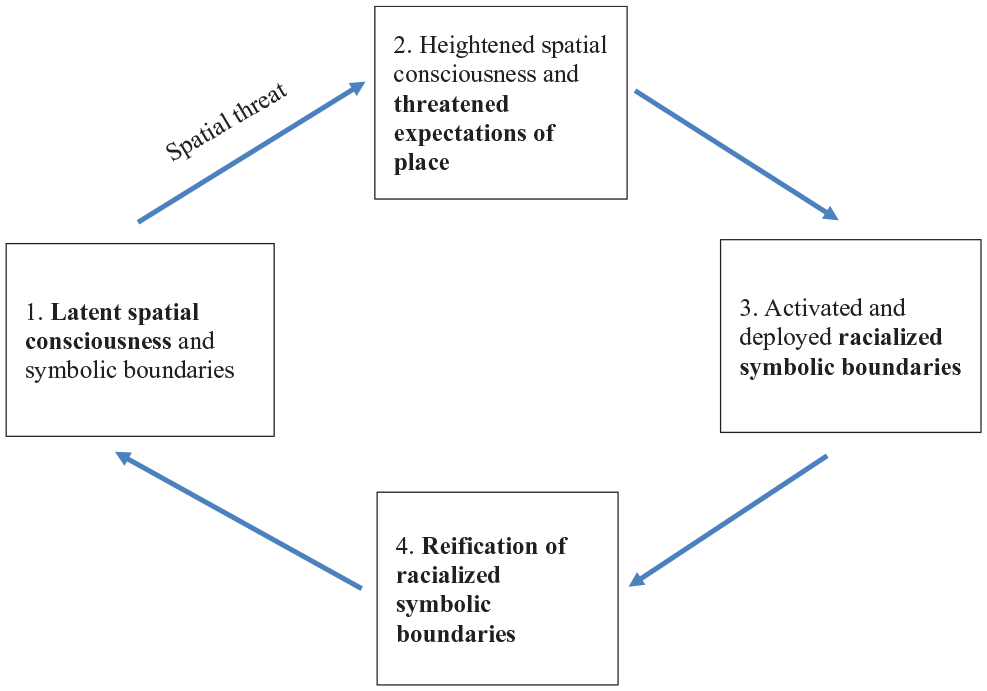
Conceptual model of the effects of spatial threat on racialized symbolic boundaries.
In the wake of a spatial threat, settled, latent spatial consciousness is disrupted and brought to the fore. Through the perception of a threatened expectation of place, a heightened spatial consciousness emerges as individuals work to recalibrate their conceptualization of the relationship between space and organizations. The spatial division is constituted by its own set of meanings, depending on the conditions and context under which it was introduced. In this case, the spatial division is constituted by the racialized meanings of “school choice,” erected to separate space between the racialized organizations of a charter school and a public school. As actors work to make claims to material boundaries, they deploy racial logics drawn from each school, hardening the symbolic boundaries between “us”—and “our school”—and “them”—and “their school.”
Data and Methods
From January 2009 to May 2010, with institutional review board (IRB) approval and the permission of school principals, I engaged in participant-observation of parents and staff inside “the Red Building” for over 1,400 hours of observation and engaged in informal conversations with parents. In line with the tenets of grounded research, I entered the field without preconceived notions, allowing experiences in the field to shape the theory (Charmaz 2006; Corbin and Strauss 2008; Geertz 1973). By observing the shifting structural level of school processes and parents’ day-to-day practices and interactions on the ground, taking detailed notes tracing their relationship in the two school years in the field, I was able to discern patterns over time. Because I was embedded in the school, I had the benefit of continuity in my observations and interactions, making aberrations from the norm more easily identifiable.
Instead of using formal interviews which would predetermine subjects of interest, I was interested in developing a rapport with parents through informal conversations, following their lead and lines of thinking, asking probing questions only about comments or actions they had themselves expressed. For example, I did not want to ask them about spatial divisions and heighten their spatial awareness if they had not themselves thought about the issue of space. Informal conversations like these have been shown to yield richer understandings of what subjects think about and how they think about it. Next, I coded field notes using ATLAS.ti, qualitative data analysis software, through two stages. First, I used open coding in a line-by-line analysis of notes to identify themes as potential codes of interest. From this extensive list of codes (e.g., Competition, Loyalty, Limited Space), I identified the most prominent recurring codes and connections between them. In the second stage, I returned to the data to recode through refined themes and to more clearly identify patterns. Given my interest in the parents’ processes of meaning-making, it was essential to analyze patterns and nuances below the surface (Burawoy et al. 1991; Charmaz 2006). It was through this two-stage coding process that I identified the significance of spatial threat as it frequently preceded expressions of symbolic boundaries.
My entree to parents grew through two informants. The first, Javier, was both the parent of a City Charter student and an employee at City Charter. Javier grew up in the neighborhood and attended PS100 before the charter school was even conceived. Because of his pleasant relationship with many of the parents and community members, he was hired by the school to work as a liaison between parents and administration at the school. I spoke with Javier on a daily basis and alerted him to my research interests. Javier eagerly drew me into his customary conversations, and through him, I was able to develop relationships with parents who came to see me as trustworthy, nonjudgmental, and empathetic.
A second informant was City Charter’s Parent Coordinator, Marlena. Through Marlena, I was able to engage in frequent conversations with PS100 staff members who eventually came to trust me and introduced me to PS100 parents. Because of my entrée to PS100’s staff and parents, I also developed a friendly relationship with the head of facilities, Joe. Employed by the Department of Education (DOE), Joe described his position as one in alliance with PS100; however, his professional duty was to maintain the entire building, including City Charter’s space. He often confided in me to complain about City Charter’s administration and parents with the understanding that I would not relay his frustrations back to them. These additional conversations and observations provided a significant dimension to my ethnographic research, observing how administrators served at times as mediators of information, amplifying spatial threat.
Comparing Schools as Racialized Organizations
To understand how threats to school space shape dynamics between parents from the same community, I begin by showing how the racialized organizations of the schools are embedded in the racial space of the neighborhood building. Next, I show how these divisions become consequential for parents through the advent of spatial threats. Opened as a public school in the 1970s, PS100 1 was the only school to occupy the space known in the neighborhood as “the Red Building” for 30 years. For many parents I spoke with, the Red Building was a symbol of the “real” neighborhood, where expectations of place were shaped by a cultural icon in a historically Brown neighborhood that was quickly transforming, Dominican restaurants replaced by pricey boutiques, pawnshops replaced by hipster coffee shops. After three decades as the sole neighborhood school, the DOE allocated a portion of the Red Building to a new charter school called City Charter whose white founder requested space in the racially diverse neighborhood. To allocate space to schools in shared buildings, the DOE allocates the minimum space necessary for instruction. Consequently, it becomes the school’s duty to negotiate additional space for non-core school programming, such as City Charter’s band and chorus program or PS100’s dance team.
In an effort to create organizational autonomy in the shared building, the administrations of both PS100 and City Charter took measures to maintain a separation between schools spatially, aesthetically, and professionally. Spatially, the schools agreed upon allotting City Charter the third floor while sharing the cafeteria, auditorium, gym, and schoolyard with PS100 through separate lunch and recess periods. Students from PS100 and City Charter entered and exited the school from entrances on opposite sides of the Red Building, ensuring a clear division between students in arrival and dismissal. City Charter also drew aesthetic boundaries around their students. While the students of PS100 were not bound by a dress code, the students at City Charter were easy to distinguish, lined up in their required navy, white, and khaki clothing much like private school students. Each school similarly exhibited aesthetic distinctions in the physical space of the Red Building. With control over its own budget and expenditures, City Charter classrooms were painted in bright alternating colors with $30,000-a-piece interactive SmartBoards installed on the walls. Meanwhile, PS100’s classrooms were characterized by basic wooden desks and light gray walls, not unlike most public schools across the city.
The schools maintained professional boundaries as well, made organic through the bounding of space. Staff members from PS100 and City Charter maintained polite distance from one another in nearly non-existent interactions, with the exception of the two administrative parent coordinators who frequently compared notes and gossip on school processes. While staff and students were spatially separated with few opportunities to interact, parents frequently crossed paths. The main offices and adult rest rooms for both schools were housed on the first floor, where parents from both schools interacted in a shared space in ways that students and teachers did not. Outside the walls of the Red Building, City Charter and PS100 families overlapped and intersected. Through the Charter Schools Act, charter schools are required to give preference to applicants who reside within the community school district in which the charter school is located. This act was enforced through enrollment lotteries where in-district applications were drawn for seats before out-of-district applications, for students who most often ended up on a lengthy waitlist. As a result, both schools, both serving kindergarten through fifth grade, drew students from the same neighborhood. A number of parents described how parents from PS100 and City Charter were neighbors who grew up together and attended PS100 side by side. Demographics of enrolled families were similarly comparable, as shown in Table 1.
School and Neighborhood Demographics (2010).
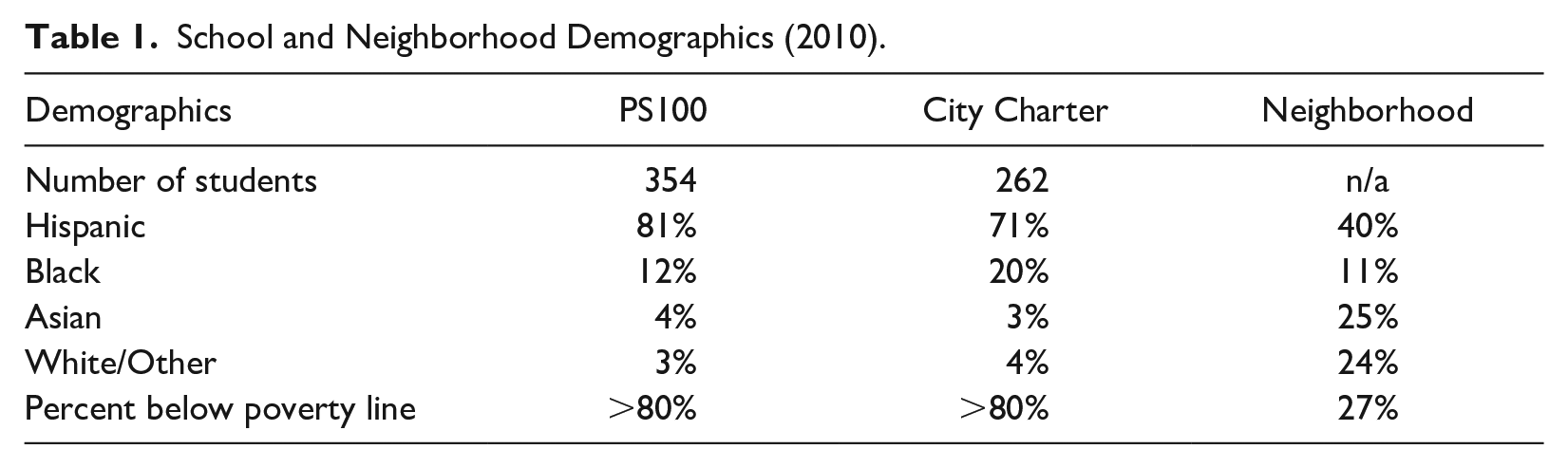
According to 2010 city and census data, at PS100, 81 percent of students were Hispanic and 12 percent were Black, while City Charter’s students were 71 percent Hispanic and 20 percent Black. Both schools were mostly Hispanic and Black, compared with the neighborhood at large which was 40 percent Hispanic and 11 percent Black. 2 Over 80 percent of students at both schools fell below the poverty line, qualifying for free and reduced lunch, compared with 27 percent in the neighborhood at large. As the cumulative ethnoracial and socioeconomic composition of families in both schools was comparable, it was all the more notable when contention would arise between parents.
Despite the similarities between the families at each school, the school organizations exhibited marked differences. Understanding schools as racialized organizations leads us to expect that the racist systems that generated school choice policies will also shape the ways a charter school is organized and identified, compared with a traditional public school. In line with prior studies, I found that the charter school and the traditional public school defined and inhabited their organizational identities in distinct ways. Briefly examining the four tenets of racialized organizations, Table 2 compares PS100 with City Charter to sketch their organizational identities.
Comparing Schools as Racialized Organizations.
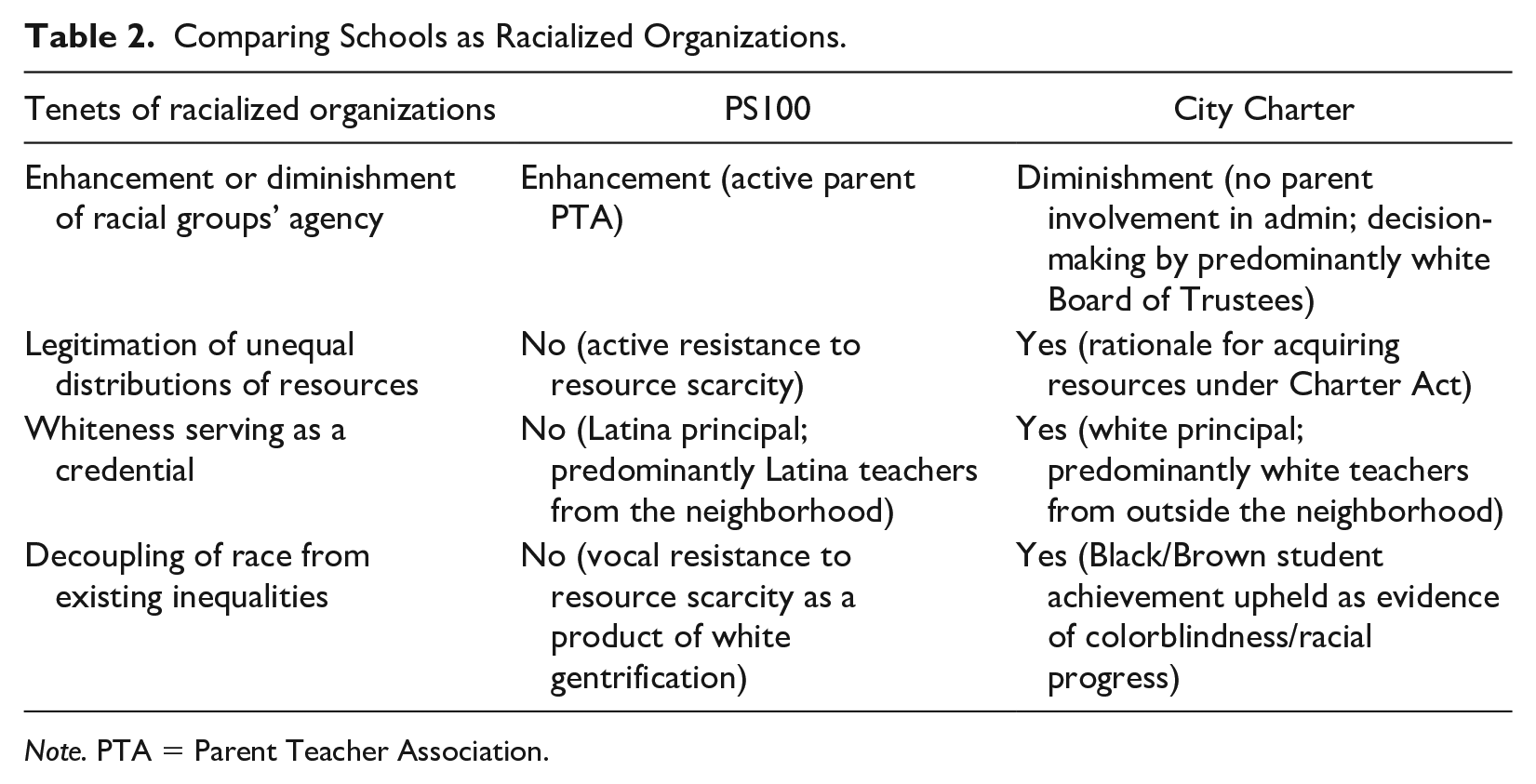
Note. PTA = Parent Teacher Association.
The first tenet of racialized organizations reflects the organization’s enhancement or diminishment of racial groups’ agency. This organizational function was most prominent in each schools’ set of policies and culture around parental and community involvement. With PS100’s deep roots in the neighborhood, parental involvement was institutionalized at the school through an active and influential Parent Teacher Association (PTA) which had its own office inside the school. PTA parents were embedded throughout the neighborhood in community organizations and businesses, holding fundraisers outside the school and putting up flyers in local establishments where they had forged relationships. City Charter did not have a PTA, and on multiple occasions, the principal reminded vocal parents that governance at City Charter took place under the Board of Trustees. While these were technically public meetings, they were not well-publicized, and of the half dozen board meetings I attended, I never saw a parent in attendance. Through my observations of the decision-making processes at City Charter, the school’s administration preferred to control the direction of the school and on multiple occasions behind closed doors; the principal suggested to me and the parent coordinator that she was not confident the parents knew what was best for the school.
Similarly, the school websites, places where parents could find the schools and learn about them, served notably different messages. PS100’s mission statement read, As a barrier-free Community School site, it is our mission to teach EVERY child to reach his or her fullest potential. We believe in building “a sense of community” through collaborative working relationships among parents, students, staff, and community-based organizations.
Meanwhile, City Charter’s brightly colored Web page highlighted the mission statement right at the top, reading, City Charter will prepare its students to achieve high academic levels in the four core academic subject areas and music, to communicate effectively in verbal, mathematical and musical languages, and to apply critical thinking processes and ethical standards to learning, living and problem solving.
Mirroring prior studies, PS100 emphasized its connection to “community,” capitalizing “every” to emphasize its commitment to all children, describing its commitments to collaborative relationships with neighborhood organizations, embedded in the racial space of the historically Brown neighborhood. Meanwhile, City Charter’s mission statement described “high academic levels” and progressive pedagogy like “critical thinking” and “ethical standards,” emphasizing its elite approach.
The second tenet of racialized organizations concerns the legitimation of unequal distribution of resources. In multiple observations, I find that PS100’s administration did not understand resources as legitimately distributed, with frequent resistance to resource scarcity both at the interpersonal level—as in the interactions between parents I will describe in the next section—and in the principal’s persistent work with the PTA and community organizations to resist gentrification and the encroachment of charter schools. Meanwhile, City Charter, while invested in the grant-writing and fundraising that would garner greater resources, did not express discontentment with the distribution of resources. More often than not, the organizational position was that City Charter’s acquisition of public space and funding was fair under the Charter Act, after all, City Charter was a public school too.
Under the third tenet of racialized organizations, whiteness serves as a credential. At PS100, the organizational members reflected the student body. While I could not acquire official statistics on teacher demographics, I compared my observations with the list of teacher surnames, in a school where the principal was Latina and teachers were predominantly Latina and Black. In conversations with the parent coordinator, I understood many of the teachers were also from the local neighborhood and some had once been students at PS100 themselves. This stood in contrast to City Charter where whiteness was a credential. The principal was a white woman making a long commute from the suburbs to City Charter every day. The teachers she hired were mostly white women but included one Latina, one Black woman, and one Asian woman, although only one of the (white) teachers lived in the neighborhood. These organizational hiring practices highlighted the gap between the organization—racialized as white—and the local community. This gap would come to a head in multiple “racial incidents” during my time at the school. For example, on one occasion, the principal mediated a “misunderstanding” where a Black parent overheard a white teacher calling his daughter a “little monkey.” The tearful teacher explained she called all her students “her little monkeys,” but the principal promised the father that steps would be taken to ensure this never happened again. I did not observe what, if any, measures were implemented, and the teacher remained at her post.
Finally, a fourth tenet of racialized organizations is that race is decoupled from existing inequalities. PS100 understood resource scarcity as a larger process of racial and class inequality. Their resistance to the unequal distribution of resources coincided with organizational resistance—via the work of the principal and PTA—toward white gentrification in the neighborhood and the rising cost of rent and living. The educational inequality their students experienced was not individualized as a failing of their students or their school but rather of the larger system as in the regular chiding of city government and educational policy. Meanwhile, City Charter decoupled race from inequality in their organizational marketing of a “high-achieving community school” that could remedy the racial achievement gap through the “right” education. Students’ high test scores were upheld as evidence of the colorblind promise of charter schools and racial progress. Together, these four tenets outline how these differentially racialized organizations compared in important ways, shaping their organizational identities: PS100 as the mostly Brown school representing the authentic neighborhood and City Charter as the white-led vessel of social mobility. These meanings would come to be consequential in the contentious battles for school space, manifesting in the activation of symbolic boundaries between parents.
Spatial Threats and the Activation of Racialized Symbolic Boundaries
In the case elaborated here, racialized symbolic boundaries had long been static and settled for a public school that community members had attended for decades. However, with the systematized and institutionalized appropriation of space by the DOE, the expectations of place were disrupted and threatened by a new racialized organization. As the charter school came to occupy a portion of the space historically devoted to the neighborhood public school, parents from the same community were faced with shifting meanings attached to a space that was, for decades, seen as a fixed racial space, a static cultural structure. So began a dynamic process of contestation over space, arising through a spatial division constituted by the racialized meanings of “school choice,” symbolic boundaries drawn between charter school “superiority” positioned against traditional public school “loyalty and authenticity.” To illustrate this model, I describe three catalytic moments of spatial threat emergent in these findings to show how heightened spatial awareness activates racialized symbolic boundaries.
January 2009: Public News of Charter Expansion
In January 2009, local news outlets publicized information that had, until then, been contained within administrative walls: City Charter would be expanding to add a new fifth-grade classroom. This news of a spatial threat—the expansion of City Charter into space previously dedicated to PS100—unsettled expectations of place and heightened spatial consciousness in consequential ways. That morning alone, I documented multiple interactions between parents activating symbolic boundaries between schools. A mother of a first grader at City Charter, while dropping off her son’s lunch, remarked on a PS100 mother’s attitude when they crossed paths in the restroom. Of the exchange, she remarked to me, “Like listen, I know we’re growing over here, but we’re just trying to get our kids ahead, you know? I’m not taking anything from you. Chill!” With irritation, she attributed the negative interaction to the question of school space, drawing on the symbolic boundaries of charter school advancement to rationalize the material boundary. Later, a charter school father entered the office exclaiming, “Ayyye! City Charter is moving on up! Watch out PS100!” He went on to describe, with much pride, how happy he was to have chosen City Charter for his daughter over PS100 which he had attended himself, emphasizing the symbolic boundary between City Charter as representing advancement in relation to the “other” school, comments catalyzed by the news of spatial redistribution. Later that day, I saw PS100’s PTA parents in a huddle, and when the PTA president noticed me passing by, she raised her voice exclaiming, “Like hell they’ll take our space!”
The activation of symbolic boundaries also manifested in parents’ unsolicited rationalizations of school choice in the face of spatial redistribution. Several parents praised City Charter’s leadership, offering PS100’s leadership in contrast, suggesting that PS100’s principal was uncaring and indifferent to their needs. The whiteness of City Charter’s administration compared with PS100 was never acknowledged outright, but parents would often use coded language as in the white principal’s perceived “competency” compared with PS100’s Latina principal, or the Latina principal’s “attitude” compared with the white principal. The mother of a kindergartener said her older son attended PS100 many years ago. When she heard the charter school had opened, she knew she did not want her youngest attending PS100 because of the administration’s alleged attitude toward parents. Speaking heatedly about the principal of PS100, she said, “All she does over there is close doors in her office. The principal here knows every child’s name, she greets every child, and she asks me is everything okay and is there anything you need?” To this mother and many other parents, there was a perception that City Charter’s leadership actually “cared” more about the students. Despite the fact that PS100 had institutionalized an active PTA that worked closely with the principal and encouraged the participation of parents, charter parents activated the racialized symbolic boundaries that constructed the charter school as the superior choice.
Similarly, during this period of heightened spatial threat, parents rationalized City Charter’s expansion by offering they had chosen City Charter for its school philosophy and mission, making claims that PS100 lacked “structure” or “values.” As prior studies show, these descriptors, while seemingly neutral, are racial logics that pose traditional public schools as failures of minoritized neighborhoods. The few times I was able to elicit an elaboration on these claims, parents would refer to PS100’s lack of a dress code, the way students did not line up in two straight rows like City Charter students, and other similar elicitations of symbolic boundaries drawn from the school organizations. More concerningly, I observed occasions where these activated symbolic boundaries were transferred to the children, who reproduced the intra-group contention. On this particular occasion, I documented the principal meeting with angry charter parents after PS100 students were heard yelling “Charter motherfuckers” at City Charter students in the school yard.
That week was marked by numerous contentious interactions between parents, activated through a perception of spatial threat for PS100 parents for whom school space would be re-appropriated to the charter school. Heightened spatial awareness similarly activated spatial consciousness for charter school parents who proudly activated symbolic boundaries between schools to justify spatial allocation on the basis of charter superiority and advancement in relation to the public school.
September 2009: A Political Endorsement of Charter Schools
In early September 2009, the principal of City Charter called me upstairs to her office. I found the Business Director sitting next to her, both with giddy expressions on their faces. “Shut the door,” they directed. The principal had just received a call. A powerful politician had plans to give a speech about educational opportunity that would be broadcast nationally, and she had chosen City Charter as the site where she would speak. “This is an amazing opportunity for us,” she explained. The event would attract public attention not only to charter schools but City Charter in particular, as a model of educational advancement and success in closing the racial achievement gap. The visit by a powerful politician was not just a political endorsement of the charter school but also a significant symbolic boundary that would separate City Charter children from PS100 children who were not invited to attend despite their physical presence within the same building.
Because the event would take place in the school auditorium, a space shared with PS100, the public school’s administration had to be looped in as well. Despite the official secrecy around the event, the news got out among parents, generating a significant perception of threat for the PS100 parents and a perception of opportunity for the charter school parents. By the day before the event, all charter school parents had been notified about the politician’s visit so that they could sign waivers allowing their children to be on camera. The excitement and pride among charter parents was palpable. One father of a third grader, while picking his son up early, remarked, “Can you believe it? [Politician] is coming here!” He shook his head in amazement as Marlena laughed affirmatively, and he continued, “I mean the kids deserve it, they’re doing so great. We’re so lucky we got in here, I mean, imagine if [son] was over there? [gesturing to PS100’s side of the building]. These kids get all the opportunities!”
Meanwhile, I observed tension and anger among public school parents for the glaring exclusion of their children from an event at the building their school historically occupied. I walked into the restroom as one PS100 mother stood, hand on hip, talking to another mother at the sink, saying, “You know we were here first, this is some bullshit, they need to get the hell out!” Upon seeing it was me who walked in, the mothers nodded “Hey,” and exited the bathroom. Later, City Charter’s parent liaison Javier stopped by to vent about the conversations he had been having with the PS100 parents that day, as their friend—although the relationship was cooling—and a former PS100 attendee himself. He described how the event had “Made everyone lose their goddamn mind,” and how the heightened spatial awareness had brought all sorts of community issues to the surface. He relayed, “They’re saying ‘charter this, charter that’, and I’m like, are we taking money out of your pocket? I don’t think so! Parents have a right to choose. You chose, we chose, parents have a right.” Later, he described one particularly heated exchange where three public school parents had pulled him aside in the hallway at PS100.
They were like, “Javier, come here, we need to talk,” and I’m like, “Can this wait? I’m working,” and they say, “How are y’all going to have [politician] come in our school and not meet our kids? When we’ve been here since the beginning?” They’re like, “Don’t you think that’s f-ed up?”
He went on to describe how they were “pissed,” and he described how he calmly told them, “I feel you, I feel you,” and said he had to get back to his desk. The PS100 parents’ contention over the politician’s visit to the charter school was not merely a rejection of the inequality that rendered the charter school worthier of political adulation. The parents’ contention was intertwined with the expectations of the racial space of the Red Building, the perception that the space had been unjustly occupied by another racialized organization that not only invisibilized them in this space symbolically—as in their exclusion from the public image of a “prized education”—but also materially, as they were physically excluded from the space during the politician’s visit.
The politician’s visit to the charter school was highly publicized and tense interactions continued in the days following the event. Public school parents continued to activate racialized symbolic boundaries characterized by loyalty to the old neighborhood and resistance to white gentrification, in relation to charter school parents activating symbolic boundaries of superiority, advancement, and mobility. While studies often find such dynamics between (mostly white) gentrifiers and (mostly minoritized) lower-income residents, these findings were more striking among parents from comparable demographic groups who had grown up alongside one another. I observed as the heightened awareness of the spatial boundaries of the school created a powerful process of symbolic boundary work, drawing from organizational identities to activate relational, oppositional intra-group dynamics.
May 2010: Charter Renewal Hearing
The following year, these boundaries were activated once more by a new spatial threat: the public meeting for charter renewal. The public meeting was just one requirement in the lengthy process of charter renewal under authorization by the DOE. At such meetings, charter parents were encouraged to speak on behalf of the school, but the meetings were not forums in which votes were counted or decisions made. From my discussions with seasoned charter school administrators, these events were largely uneventful performances of parental support directed toward the school’s authorizer. Despite its routine nature, because the event would take place in a space shared with the public school—the school auditorium—the event generated heightened spatial consciousness. The meeting, which would determine the charter school’s survival, was perceived by both public school and charter school parents as a high-stakes event.
In the days leading up to the meeting, I observed a flood of tense interactions between parents. In one exchange, City Charter’s parent coordinator Marlena shared with me how she learned that PS100’s PTA meeting the prior day was about us . . . we were on the agenda. They were telling the parents City Charter wants to take over the building and kick them out and that they have to fight back, and the parents are telling their kids this, the kids are getting pitted against each other. [City Charter’s Principal] is livid.
With the perception of spatial threat, where charter survival equated to “taking over the building,” public school parents proclaimed the necessity of neighborhood loyalty, of fighting against white gentrifiers for a building that was “rightfully theirs.”
Meanwhile, charter parents expressed a great deal of nervousness and anxiety around the charter renewal meeting specifically because of the PS100 parents’ heightened perception of threat. After dropping off their children, a number of charter school parents congregated in the main office the morning before the renewal meeting. “What if [the public school parents] show up?” one mother asked with concern, “They’ve been insane this week, talking all sorts of shit about how we’re taking over their space.” “We’ve got this,” another mother reassured her, “Just look at our test scores, our kids are doing great, they can sit down.” A father cocked his head and said, “Yeah but they’re always doing crazy stuff to try to get us out, I wouldn’t be surprised . . . ” Marlena reassured the parents, “There are guidelines for this meeting, it will be fine,” although later she confided in me that she had been hearing rumblings from PS100 parents about “speaking their mind” at the renewal meeting. She was nervous too.
On the evening of City Charter’s public meeting, the auditorium was packed with charter families and City Charter parents lined the back wall. In an unexpected turn of events, PS100’s PTA had notified the district’s Community Education Council (CEC) about the public meeting. The council was known for advocating against charter schools as they directed funding away from underserved community public schools, and on this particular night, they had arrived with a small group of community members in support of PS100. After a number of warm, if not nervous testaments by City Charter parents about their pride in City Charter, the advancement they had seen in their children, and the promise of educational success, the CEC president, representing PS100 parents, stood up to speak. She began, “We’re like you. This is like a family, what we do affects each other.” Yet as she began to describe the success of public schools in the neighborhood and the process by which charter schools were threatening the livelihood of these schools and their children, there was a noticeable shift in the body language of City Charter parents. Bodies stiffened as parents sat up straight and began to lean forward in their seats. Meanwhile, the PTA president from PS100 was clapping loudly. She leaned over me, whispering to her friend, “Our school is overcrowded and they want to take our space?” As the CEC president continued speaking, a charter school parent yelled, “Move aside!” Another charter school parent stood up suddenly, charging to the side of the auditorium to grab her stroller and children to leave. Several City Charter parents started yelling. At this point, City Charter’s principal stood up to calm the crowd and reminded parents that everyone had a right to speak. Although the crowd was silenced, they were seemingly on alert through the remainder of the meeting, symbolic boundaries brightened through stiff body language and stern facial expressions, sitting upright in their chairs.
Similar instances of boundary activation emerged throughout the year in contests over space. One of my informants at PS100 confessed that a number of the mothers who he interacted with had been commenting on the attitudes of “charter parents” in relation to the quarrels over space. He described how PS100 mothers got the impression that charter parents thought they were superior to PS100 parents, “like we work for them,” he said. He later relayed a story about a PS100 parent who created an informal campaign to prevent neighborhood parents from applying to City Charter, arguing that community members had to “stick together” and “stay loyal” to their neighborhood school. While these tensions would mostly settle between moments of heightened spatial threat, racialized symbolic boundaries became more salient over time. Unsolicited comparisons between schools emerged more frequently. Negative interactions between both parents and students increased. As City Charter was growing, occupying more space in the Red Building, and attracting positive media and political attention, parents were more eager to position themselves in opposition to the traditional public school, deploying racial logics of City Charter as the “advanced” alternative to PS100 to justify the school’s expansion. Without prompting, charter parents described the virtues of City Charter in relation to PS100, including the perception that leadership was “stronger” at City Charter, that the charter school mission and philosophy were superlative, and that the status of families who attended the charter school was superior. Parents shaped the identity of “advancement” in relationship to the “types” of families who attended PS100, despite many of their common backgrounds. These racialized representations included the narrative of “out of control” children at PS100, where traditional public school parents were constructed as “a hot mess” on several occasions, and in one notably extreme case, a Latina mother who was born and raised two blocks away from the school lowered her voice as she looked at me and said, “They’re straight up ghetto over there. I don’t let my kid play with those kids.”
With heightened spatial consciousness around the zero-sum game for space in the Red Building, parents deployed symbolic boundaries between charter school “advancement,” or “bettering [the child’s] situation,” as one parent described, positioned relationally in opposition to the “inferior” public school, invoking a sense of superiority over public school parents. These symbolic boundaries drew from the racial logics of school choice, and their activation by parents in day-to-day conversations was linked to the spatial proximity of the “other” school, sharing a material boundary in one building. Although many charter and traditional public school parents in this study shared ethnoracial and class backgrounds, the accumulation of these activated symbolic boundaries over time warned of hardening divisions between parents, with consequences for the community beyond school walls.
Conclusion
I have argued that while there is rich and growing research on the relationship between race and space, we know less about how socio-spatial divisions matter for day-to-day interactions between community members across organizations. After all, space is racialized both through its unequal distribution and the meanings attributed to it, in this case, through the racialized school organizations that occupy the historic neighborhood space. Through a two-year ethnographic study, I have shown how the advent of spatial threat for these two schools in a shared public building creates a threatened expectation of place and heightened spatial consciousness. This perception of threat shapes a dynamic process through which parents activate racialized symbolic boundaries of charter school “superiority and advancement,” positioned against public school “neighborhood loyalty and resistance to gentrification.”
These findings highlight a number of questions for future research beyond schools, in thinking about the broader connections between racialized space, organizations, and collective action under racial capitalism. First, this study shows how tensions over both the materiality of space and the meaning of space shape the activation and sedimentation of racialized symbolic boundaries. Research could examine how multi-institutional politics enable and constrain these dynamics—from the media to local government to school administrators to powerful donors to rival groups. Under what political-cultural conditions and configurations of political actors are symbolic boundaries reified and institutionalized, segmenting communities and contributing to broader systems of stratification and racial inequality? How do these dynamics map on to time and broader socio-spatial transformations, in this case the growing white gentrification in the historically Latinx neighborhood?
Similarly, future research could more holistically trace how these stratified symbolic boundaries become consequential in other domains. Parents indicated that these boundaries had already begun to shape their interactions beyond the school, whether through weakened friendships or control over the engagement between their children. More systematic analysis could evaluate the conditions under which such racialized symbolic boundaries become internalized and dominant, the conditions under which they diffuse beyond building walls, and how they are patterned across social locations. Here, the demographic makeup of the students was comparable, but future studies could more systematically document patterns between students and parents of varied class and ethnoracial backgrounds. Who is most likely to perceive spatial threat, to activate boundary work, and for whom are the stakes of racialized symbolic boundaries the greatest?
This study also showed how the wider system of neoliberalization shapes the racial logics of choice, advancement, and social mobility at the heart of the charter schools’ racialized organizations. These became the symbolic boundaries through which City Charter parents made claims to the neighborhood school’s space, unintentionally reproducing rather than challenging the racial inequality they were so committed to transcending for their children through what Dave Stovall calls a “politics of desperation.” Yet public school parents were actively resisting the deceit of school choice and the system of dispossession that rendered it. Future studies might bridge the work of critical race and education scholars with social movement scholars to examine the grassroots movements building interracial coalitions across schools, community-based organizations, anti-gentrification activists, mobilizing against socio-spatial dispossession. How do particular racial logics—for example, discourses of diversity, colorblindness, meritocracy—get deployed in the service of socio-spatial racial projects? When space is appropriated—spatially, ideologically, institutionally—scholars might look at how different types of spatial division enable or constrain intergroup dynamics and different forms of coalitional politics. Is it inevitable, for example, that shared spaces will activate territorial contention or are there conditions under which a shared space could strengthen a community, bridge differences, generate alliances and greater social cohesion? After all, the definition, creation, and production of racial space can have long-lasting implications for how social action can proceed.
Footnotes

Notes
Author Biography
References
Supplementary Material
Please find the following supplemental material available below.
For Open Access articles published under a Creative Commons License, all supplemental material carries the same license as the article it is associated with.
For non-Open Access articles published, all supplemental material carries a non-exclusive license, and permission requests for re-use of supplemental material or any part of supplemental material shall be sent directly to the copyright owner as specified in the copyright notice associated with the article.
