




Abstract
The past several decades have seen the rise of the Asian “ethnoburb”—communities retaining a disproportionate Asian presence in middle-class and suburban settings. Recent explanations have suggested that ethnoburbs may manifest as a function of “resurgent ethnicity” that indirectly leads to Asian self-segregation. In this study, I examine whether Asian ethnoburbs can also arise as a function of stratification, where White population exodus coincides with Asian population growth. To evaluate this argument, I use census data from 2000 to 2020 to examine the history of White and Asian population change for 1,299 neighborhoods defined as Asian ethnoburbs in 2020. The results suggest, on one hand, that many ethnoburbs experienced White population exit in a fashion consistent with racial turnover. These patterns of White population decline were unexplained by socioeconomic deficits and, in fact, rose in likelihood with socioeconomic status (SES) increases. On the other hand, a near-comparable number of ethnoburbs did not experience White exit in the face of Asian in-migration. However, this tended to be the case when Asians began as a relatively small presence and White households remained the dominant group. These findings suggest that arguments of self-segregation provide a poor explanation for ethnoburb formation. Instead, Asian ethnoburbs appear to emerge as a function of spatial assimilation and ethnic stratification: though Asian households tend to grow most prominently in the Whitest neighborhoods, the prospect of racial turnover looms once Asian households start to comprise a greater share of neighborhood residents.
Introduction
Recent decades have seen the rise of the Asian “ethnoburb”: enclaves in suburban settings that retain a density of Asian households in middle-class and contemporary variants of the classic ethnic community (Li 1998, 2009; Wen, Lauderdale, and Kandula 2009). Compared to urban enclaves, the rise of Asian ethnoburbs occurs absent structural conditions of constraint; Asian households choose to migrate or settle directly into suburban enclaves, despite having the social and cultural resources to settle into nonethnic spaces (Alba and Nee 2003; Logan, Alba, and Zhang 2002; Zhou, Tseng, and Kim 2008). Amid stagnant increases in integration for Asian groups, this emerging trend has led some scholars to suggest that ethnoburbs—as a byproduct of “resurgent ethnicity”—may lead to the perpetuation of “voluntary” segregation. From this perspective, it appears that the rise of ethnoburbs may manifest Asian segregation that is driven by in-group preferences, rather than racial stratification (Brown and Chung 2008; Charles 2003).
In this study, I build on the previous literature to provide a critical re-examination of the population changes undergirding Asian ethnoburb formation. I argue that in addition to “resurgent ethnicity,” ethnoburbs can also emerge as a function of racial stratification that manifests through White flight. Rather than taking “voluntary segregation” as a given, my analyses examine whether Asians emerge as a disproportionate presence in ethnoburbs because of White population decreases consistent with historic patterns of racial turnover and segregation. Descriptive and multivariable results suggest that many contemporary ethnoburbs experienced significant decreases in White population size driven by a loss in the total number of White residents. These neighborhoods were also less likely to experience larger increases in the absolute number of Asian residents. However, a comparable number of ethnoburbs did not exhibit evidence of White population decline, primarily those initially containing a relatively smaller Asian presence. Notably, these majority-White neighborhoods were also more likely to experience significant Asian population growth.
Together, these results challenge “self-segregation” accounts of ethnoburb formation. Rather than migrating toward existing ethnic neighborhoods, Asian populations tend to enter, in the aggregate, neighborhoods with stable White populations. Though these patterns are consistent with expectations of the classic spatial assimilation model, they also appear tenuous. As Asian populations grow, many neighborhoods—particularly those with higher levels of socioeconomic status—prove susceptible to White population exodus. These neighborhoods subsequently emerge as “ethnic” because the loss of White residents shrinks the total population, thereby inflating what would have otherwise been a more modest Asian presence. These findings suggest future research should strongly reconsider how forces of assimilation, racialization, and stratification can co-exist in contemporary ethnoburb spaces. Understanding the conditions that can trigger suburban White flight from Asian ethnoburbs—and its consequences for perceptions of Asian Americans as “unassimilable” or “foreign” groups—remains an important agenda for future research.
Background
The Rise of Ethnoburbs: Evidence of Self-Segregation?
Few concepts in urban sociology have received as much scholarly attention as the ethnic enclave (Burgess 1925; Logan et al. 2002; Portes and Jensen 1987). Across time and space, the urban enclave has been a mainstay of American cities, serving as key staging grounds helping to facilitate the assimilation of immigrants into mainstream American society (Alba and Nee 2003; Massey 1985; Zhou and Logan 1991). Theoretically, the utility of these communities has generally been best articulated by the classic spatial assimilation model: though beginning as locations of opportunity and employment, urban enclaves ultimately prove untenable for assimilation into the American mainstream (Alba and Nee 2003; Charles 2003; Massey 1985; Portes and Rumbaut 2001). Accordingly, previous research on the integration of immigrant and minority groups has long predicted majority-White, suburban destinations as one of the final steps in the assimilation process (Alba, Logan, and Stults 2000; Massey 1985; Massey and Denton 1988; Park and Iceland 2011).
Yet at the turn of the century, a growing recognition of emerging ethnic neighborhoods has provoked reconsideration of the classic spatial assimilation model. Although Alba and colleagues found that affluent Asian and Hispanic residents still tend to live in majority-White neighborhoods, they note “in some regions this majority appears precarious, and further immigration seems almost certain to produce more suburban neighborhoods where minorities live with more minorities than with whites” (Alba et al. 2000:617). Today, Asian “ethnoburbs”—suburban ethnic neighborhoods—represent the culmination of these predictions, reflecting both unprecedented levels of Asian population growth and the continued movement of Asian groups into the American “mainstream” (Alba and Nee 2003). Various case studies on ethnoburbs—also examined elsewhere as “edge gateways” (Price and Singer 2008) and “ethnic communities” (Logan et al. 2002)—have documented the important ways such communities differ from their poorer urban counterparts. Rather than mirroring the blighted form and function of spatially proximate urban neighborhoods, these suburban neighborhoods more closely resemble the middle-class neighborhoods of their White counterparts (Li 1998, 2009; Wen et al. 2009; Zhou, Chin, and Kim 2013).
What motivates traditional streams of Asian migration away from White neighborhoods? According to resurgent ethnicity perspectives, such neighborhoods may be of diminishing appeal for middle-class Asian households who retain stronger preferences for living in co-ethnic communities (Clark 1986; Walton 2016; Wen et al. 2009; Zhou and Logan 1991). In this regard, ethnoburbs serve as alternate destinations of residential assimilation for those seeking suburban amenities and ethnic infrastructures that preserve cultural identities and practices. In short, the resurgent ethnicity perspective “emphasizes individual choice (agency) at the conjunction of class and culture, which work together toward segregation, even though SES is high and structural constraints are largely absent” (italicization added, Brown and Chung 2008:187). Taken to its aggregate-level consequence, the resurgent ethnicity perspective offers explanations for segregation that are coupled with those focused on ethnocentrism and in-group preferences (Wen et al. 2009). These perspectives argue that residential segregation persists “naturally” due to tendencies among ethnic minorities to live in close proximity to other in-group residents (Charles 2003; Nguyen 2004). Given the relative affluence of Asian ethnoburbs—and the comparatively high SES of Asian households that select into them—the resulting patterns of racial/ethnic clustering may more accurately reflect voluntary forms of self-segregation (Brown and Chung 2008; Ihlanfeldt and Sacfidi 2002; Thernstrom and Thernstrom 1997). As Ming Wen, Diane S. Lauderdale, and Namratha R. Kandula (2009) note, “Many of these ethnoburban residents are middle-class minorities working in the mainstream economy. They are professionally assimilated, but culturally they remain largely ethnic” (p. 453). Indeed, ethnocentrism perspectives provide one plausible explanation for why SES generally matters less for explaining the segregation of Asians relative to Black populations (Crowell and Fossett 2022; Iceland and Wilkes 2006).
Re-examining Ethnoburbs from a Stratification Perspective
Alternatively, relatively few studies—if any—have examined whether patterns of White flight and/or avoidance might also contribute to the racial/ethnic isolation undergirding Asian ethnoburbs. The greater focus on resurgent ethnicity for explaining Asian ethnoburb formation may reflect an absence of the traditional racial stereotypes associated with integration (Ellen 2000). As socioeconomically thriving communities, Asian ethnoburbs are unlikely to provoke concerns about declining property values or local public schools in ways that have historically affected other diversifying suburbs (e.g., Krysan 2002; Quillian and Pager 2001). However, several recent works have highlighted the qualitatively different racial tensions that can exist in spaces where White households have historically held an uncontested grip on privilege. Indeed, the size and affluence of immigrants in traditional “bedroom” suburbs can, as Min Zhou, Yen-Fen Tseng, and Rebecca Y. Kim (2008: 77) note, “pose a new threat to the established White middle-class residents who fear being ‘un-Americanized’ by the newcomers.” In a series of recent experiments, Linda X. Zou and Sapna Cheryan (2022) also found that White respondents perceived a threat to “American culture and way of life” from projected increases in the size of Asian households; these respondents were subsequently more likely to express preferences for neighborhood exit. This appears particularly evident in the world of public education, where a growing Asian presence seems to correspond with complaints of schools no longer offering an “authentic” academic experience (Warikoo 2022). Banded together, some White households go as far as changing school district boundaries, so that their children will no longer have to compete with Asian students (Lung-Amam 2017, see also Jiménez and Horowitz 2013). This nascent body of research—in addition to others more generally showing the persistence of Asian stereotypes (e.g., Huang 2021; Li and Nicholson 2021; Schachter 2021)—demonstrates how racialization can endure for Asian groups otherwise “assimilated” on socioeconomic and acculturation indicators (Lee and Kye 2016).
Collectively, these counterpoints are more consistent with ethnic stratification perspectives. In contrast to both spatial assimilation and ethnocentrism models, a focus on stratification reintroduces racialization as a mechanism that may lead to White flight and segregation, even in middle-class Asian ethnoburbs (Emerson, Chai, and Yancey 2001; Krysan et al. 2009; Kye 2018). Mobile Asian households may also be deterred from neighborhoods with a more balanced presence of White households if obstructed by racial residential steering, unequal treatment by banks and mortgage lenders, and other institutional barriers that work to preserve segregation (Korver-Glenn 2021; Massey and Denton 1993; Quillian, Lee, and Honoré 2020). Thus, in contrast to emphasizing the master utility of socioeconomic status (spatial assimilation) or co-ethnic preferences (resurgent ethnicity), ethnic stratification models emphasize how racialization, and its associated constraints, can deter more widespread integration.
Hypotheses and Expectations
The sections above have summarized three theoretical models relevant for understanding Asian ethnoburb formation: the spatial assimilation model, resurgent ethnicity, and ethnic stratification. In the analyses that follow, I examine the population shifts that manifested contemporary ethnoburbs (i.e., how today’s ethnoburbs “became” ethnoburbs) to evaluate the consistency of trends with expectations of each theoretical perspective. The first hypothesis examines Asian ethnoburbs vis-à-vis the spatial assimilation model. While most studies view ethnoburbs as “distort[ing] the correlation between levels of acculturation and residential assimilation predicted by conventional assimilation theories” (Zhou, Tseng, and Kim 2008: 76), it could also be the case that ethnoburbs emerge because Asian growth is strongest in White neighborhoods. In this scenario, mechanisms of spatial assimilation could lead to Asians comprising a large—but still minority—presence in places where Whites remain the (numerically) dominant group.
Spatial Assimilation Hypothesis: In contemporary ethnoburbs, Asian growth will occur to the greatest degree in neighborhoods where Asians are a minority relative to a larger White population presence.
The next hypotheses view Asian ethnoburbs as a meaningful departure from the spatial assimilation model, but they disagree on the extent to which ethnoburbs are best characterized as a catalyst (ethnoburbs arise via ethnocentrism) or consequence (ethnoburbs arise via ethnic stratification) of persistent segregation. If ethnoburbs are best viewed as a function of resurgent ethnicity, Asian population growth should have been most common in neighborhoods where Asians predominate or where the White population has dwindled. In either scenario, Asian population growth would have enabled Asians to remain, or eventually emerge, as the dominant group.
Resurgent Ethnicity Hypothesis: In contemporary ethnoburbs, Asian growth will occur to the greatest degree in neighborhoods where Asian populations exceed—or appear on the verge of exceeding—the existing share of White residents.
The ethnic stratification model suggests a different view that resituates race and racialization as key aspects of ethnoburb formation. While it is possible, and indeed likely, for contemporary ethnoburbs to have experienced Asian population increase, this may also coincide with White flight. As a result, what are now considered suburban “ethnic” neighborhoods may have—absent racial turnover—achieved a greater state of residential integration.
Ethnic Stratification Hypothesis: Contemporary ethnoburbs will show patterns of White exit that undercut the formation of otherwise more integrated neighborhoods.
Data and Methods
Data
To evaluate these hypotheses, I use three waves of census data from 2000 to 2020 from the National Historical Geographic Information Database (Manson et al. 2022). To ensure reported neighborhood changes reflect population shifts rather than changes in tract boundaries, all census tracts were standardized to their 2010 tract boundaries. Specific data on racial composition, income, and residence are drawn from the long and short forms in 2000; data for 2010 and 2020 are drawn from the short forms in each year and five-year American Community Surveys (2008–2012 and 2015–2019). 1 Although middle-class Black and Hispanic communities have grown more common (Wen et al. 2009), this study focuses solely on the case of Asian ethnoburbs. 2 Accordingly, the initial sampling frame is limited to the 50 U.S. metropolitan areas with the largest Asian populations in 2020 (N = 37,685 tracts). These metros account for about 85 percent of all Asians nationwide, including all metros with at least 50,000 Asian residents. I use list-wise deletion to exclude any census tracts with missing data from the analysis, omitting approximately 1.7 percent of the original sample.
Defining Ethnoburbs, Asian Entry, and White Exit
The summarized literature suggests that a robust measure of Asian ethnoburbs should consider both their suburban status (in contrast to urban enclaves) and their disproportionate concentration of in-group residents (Logan, Alba, and Zhang 2002; Wen et al. 2009). Accordingly, in this study, I define contemporary ethnoburbs as suburban ethnic neighborhoods in 2020. Suburban neighborhoods are approximated using census tracts located inside of metropolitan areas but outside of city boundaries. These tracts, in turn, are considered “ethnic” if their observed percentage of Asian residents in 2020 was greater than 21.4 percent; this threshold represents the mean share of Asian residents across all sample neighborhoods (9.4 percent) plus a full standard deviation increase (+12.0 percent). Though any aggregate-level threshold will be somewhat arbitrary, this figure was over three times the Asian share of the overall U.S. population in 2020. In addition, all substantive results held under alternative thresholds ranging from 10 to 33 percent Asian and a series of other checks for robustness. 3 In the end, this produces an analytical sample of 1,863 contemporary ethnoburbs in 2020 (about 5 percent of all sample tracts).
The next task requires defining criteria to detect two distinct types of neighborhood change: Asian entry and White exit. Specifically, a key focus of this article is to identify the extent to which, net of observed neighborhood characteristics, significant Asian population increase or White decrease is associated with the emergence of ethnoburbs. To define each of these transitions at the neighborhood level, I use a multicomponent approach (Kye and Halpern-Manners 2022) that considers both absolute (total) and relative (percentage point) levels of change in a neighborhood’s Asian and White population size. A simultaneous consideration of both dimensions is crucial for protecting against classification errors that can occur when relying solely on either absolute or relative measures of neighborhood change. For example, neighborhoods where the absolute number of White residents has decreased would not necessarily be indicative of White exodus if all groups had also exhibited population decline (e.g., in the case of a natural disaster). Likewise, increases in the percentage of Asian residents should not be deemed as evidence of Asian entry if the total number of Asian households remained constant, but their percentage rose solely due to decreases in the size of other groups. In short, a multicomponent approach provides a more reliable system for detecting meaningful increases and decreases—in both absolute and relative terms—in the presence of Asian and White households, respectively.
Having identified the importance of considering both absolute and relative population changes, what is left to determine are the thresholds above which over time changes can be deemed a significant degree of Asian gain or White loss, respectively. To define these thresholds, I first calculate the metropolitan-specific mean value for each component across two sub-transition periods: 2000 to 2010 and 2010 to 2020. For defining Asian entry in each decade, this means calculating the average change in the total number of Asian households in neighborhoods where the Asian population grew in absolute terms (the “absolute” component) and calculating the average change in the percentage of Asian households in neighborhoods where the Asian population grew in relative terms (the “relative” component). A tract in any given metro is subsequently defined as experiencing Asian entry from either 2000 to 2010 or 2010 to 2020 if satisfying the thresholds for Asian population gain across both absolute and relative change components. Instances of White exit from 2000 to 2010 and 2010 to 2020 are defined in identical fashion, except with metropolitan-specific thresholds produced from those tracts exhibiting White population decline in both absolute and relative terms. Like Asian entry, tracts are defined as experiencing White exit in either decade if satisfying the thresholds of White population loss across both absolute and relative change components. 4
Appendices A and B provide a descriptive summary of Asian and White population changes for contemporary Asian ethnoburbs that satisfied criteria for Asian entry and White exit from 2000 to 2010 or 2010 to 2020. The results confirm that White exit tracts exhibited steep declines in both their total and percentage share of Whites, at magnitudes suggestive of racial turnover. Likewise, Asian entry tracts exhibit sharp increases in Asian population size indicative of systematic migration and population growth. By using a multicomponent approach, each measure detects levels of absolute White loss or Asian growth that also lead to meaningful changes (decreases or increases) in the relative size of White and Asian populations, respectively.
Ecological Controls
In my analyses, I account for several characteristics shown to affect patterns of neighborhood change in previous research. Of particular importance is tract socioeconomic status, which may exert independent effects predicting general population decline or growth (Charles 2003; Iceland and Wilkes 2006). Neighborhood SES is measured from five tract-level variables: median household income, the poverty rate, the unemployment rate, the share of college educated residents, and the share of residents employed in professional occupations. In lieu of each of the five individual measures, and because these measures tend to be highly correlated at the neighborhood level, regression models use an SES index constructed using principal component analysis (Sharkey 2014). Finally, all models also account for a series of conventional ecological controls commonly used in studies of neighborhood change (Logan, Stults, and Farley 2004). These measures include population size, the percentage of foreign born, the percentage of elderly residents (age 60+), percentage of buildings or household structures older than 30 years, and the percentage of recently moved households (within the past decade). Accounting for these latter three measures is particularly important because the older age structure of White neighborhoods may independently drive White losses (e.g., through White population deaths) or lead to an absence of Asian or White population entry (e.g., among younger families).
Analytical Strategy
This study uses aggregate-level data from the U.S. census; this “birds-eye” approach is consistent with recent research (e.g., Walton 2016; Wen et al. 2009) that has attempted to expand the scope of early insights generated by case studies of individual ethnoburb communities (e.g., Li 1998, 2009). Like all such studies, it is unable to speak directly to the preferences, decisions, or migration patterns of individual households. Though empirical consideration of these factors would be ideal, these sorts of longitudinal and individual-level datasets for Asian households tend to be in relatively nascent stages of data collection or bound in scope to specific U.S. regions. 5 Nevertheless, the study serves as an initial foundation for understanding Asian ethnoburb formation and provides direction for additional tests to be undertaken with longitudinal surveys or restricted census microdata in future research.
Results
Contemporary Asian Ethnoburbs: Descriptive Overview
Figure 1 summarizes the distribution of 2020 Asian ethnoburbs. The results show that even across a wide range of metros, ethnoburbs remain clustered in five longstanding gateways of immigration: Los Angeles (370 ethnoburbs), New York City (300), San Francisco (229), Washington D.C. (186), and Seattle (115). Next, a loosely defined second tier of metros containing 11 to 100 ethnoburbs includes traditional immigrant cities (e.g., Chicago, Houston, Philadelphia) but also emerging destinations in noncoastal regions (e.g., Minneapolis, Detroit). A third tier finds metros that contain 1 to 10 ethnoburbs. In some cases, these seem to be cities where the Asian presence has tightly clustered in a small number of ethnoburb neighborhoods (e.g., Raleigh, NC, Columbus, OH). Indeed, despite being fewer in number, the ethnoburbs within these metros tend to exhibit mean percent Asian values on par with metros where ethnoburbs are found in greater frequency; vertical lines (for metros where at least one ethnoburb was present) indicate that the average ethnoburb in most metros tended to range from 25 to 40 percent Asian. The final category includes 12 metros without a single ethnoburb.
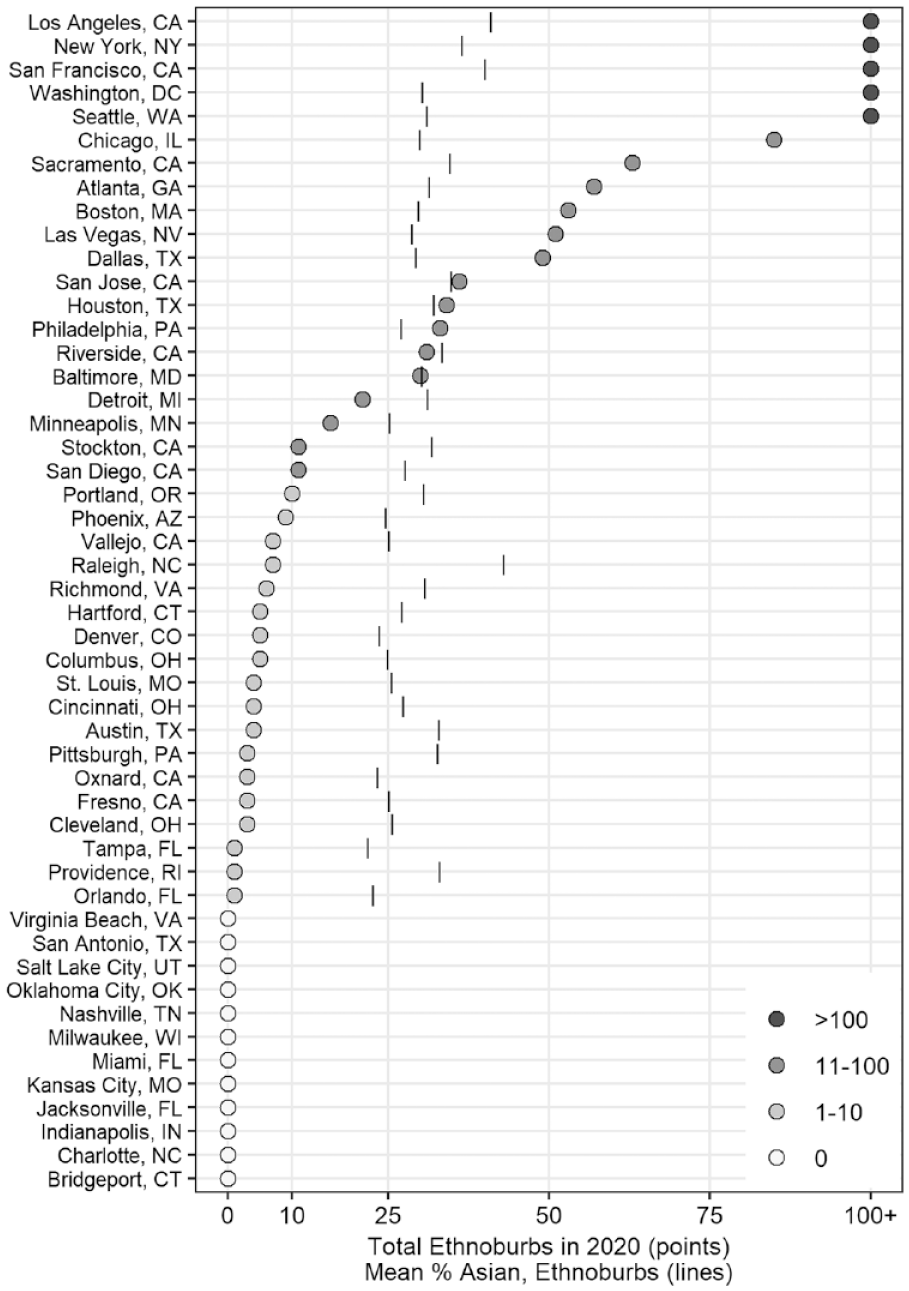
Distribution of Asian ethnoburbs across the 50 largest Asian metros in 2020.
Table 1 provides a descriptive summary of contemporary Asian ethnoburbs across key tract-level measures and ecological controls. Mean values in 2020 are summarized for both Asian ethnoburbs and all other majority-White suburban neighborhoods. A comparison between these neighborhood types indicates several baseline differences. First, Asian ethnoburbs exhibit a disproportionate Asian presence and, more generally, greater ethnoracial diversity. The comparable share of Whites and Asians observed in 2020 results from a dynamic transition that has occurred between these two groups over time. Since 2000, the modal ethnoburb saw Asian populations effectively double in their neighborhood share, inversely mirroring patterns of White decline. This sea change is also reflected both in ethnoburbs’ greater rates of White exit and Asian entry in both sub-transition periods (i.e., 2000–2010 and 2010–2020). These collective trends ultimately place White and Asian populations as nearly equal in size by 2020. By comparison, the size of both Hispanic and Black populations remained relatively stagnant over this same time period. 6
Descriptive Statistics for Asian Ethnoburbs and Majority-White Suburban Neighborhoods, 2020.
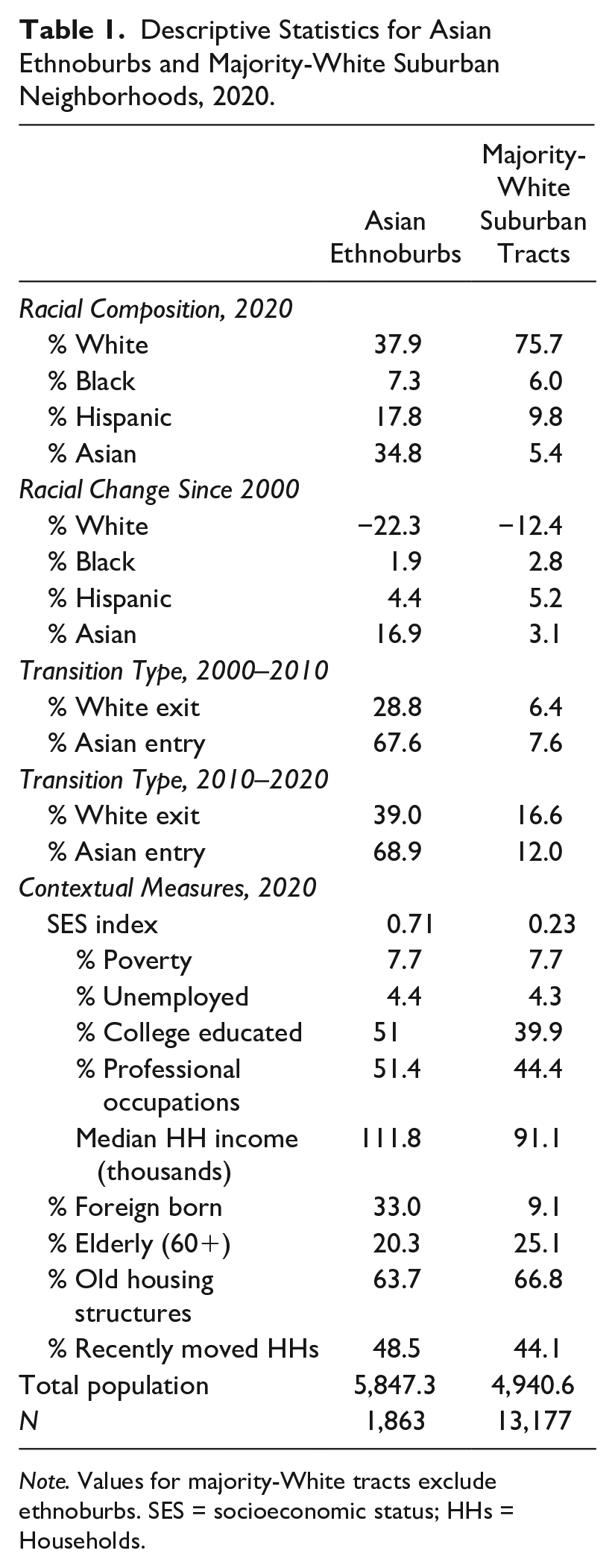
Note. Values for majority-White tracts exclude ethnoburbs.
SES = socioeconomic status; HHs = Households.
Second, the descriptive results confirm an important premise: Asian ethnoburbs are, by any metric, distinctly nonpoor neighborhoods. This is made evident through a comparison with majority-White suburban neighborhoods, which are often held as the endpoints of successful spatial assimilation. Asian ethnoburbs have not only higher median household incomes, but also a greater share of college educated residents and those working in professional occupations. Ethnoburbs also exhibit low levels of poverty and unemployment, at levels on par with their majority-White counterparts. Furthermore, aside from their larger foreign-born presence, Asian ethnoburbs are otherwise comparable to majority-White suburban neighborhoods across the remaining ecological characteristics.
The results thus suggest that, within ethnoburbs, two comparably sized groups—Asians and Whites—reside together in relatively affluent suburban contexts. How do each of these groups contribute to the socioeconomic contexts observed for ethnoburbs as a whole? Figure 2 provides further context on this matter through scatterplots summarizing the relationship between the SES index and the size of each group in 2020 (Panel A) and changes in the SES index and each group’s size from 2000 to 2020 (Panel B). There are two key findings. First, a greater share of White households is strongly associated with greater neighborhood SES in 2020. Second, increases in the size of Asian populations were more consistently indicative of over time increases in SES in the preceding 20-year transition period. Together, these findings indicate that the rise of Asian populations has done little to diminish the socioeconomic character of neighborhoods transitioning to ethnoburb status. Indeed, among contemporary ethnoburbs, Asians’ median household income tends to be greater than those observed for White households (not shown). At the same time, ethnoburbs emerge in suburban neighborhoods where White isolation has endured as strong indicator of socioeconomic privilege. Though Asian populations may be helping to drive ethnoburb SES in the present day, the foundation of privilege in these neighborhoods appears tied to the coupling of White isolation and affluence that became wider spread in the advent of racialized U.S. suburbanization.
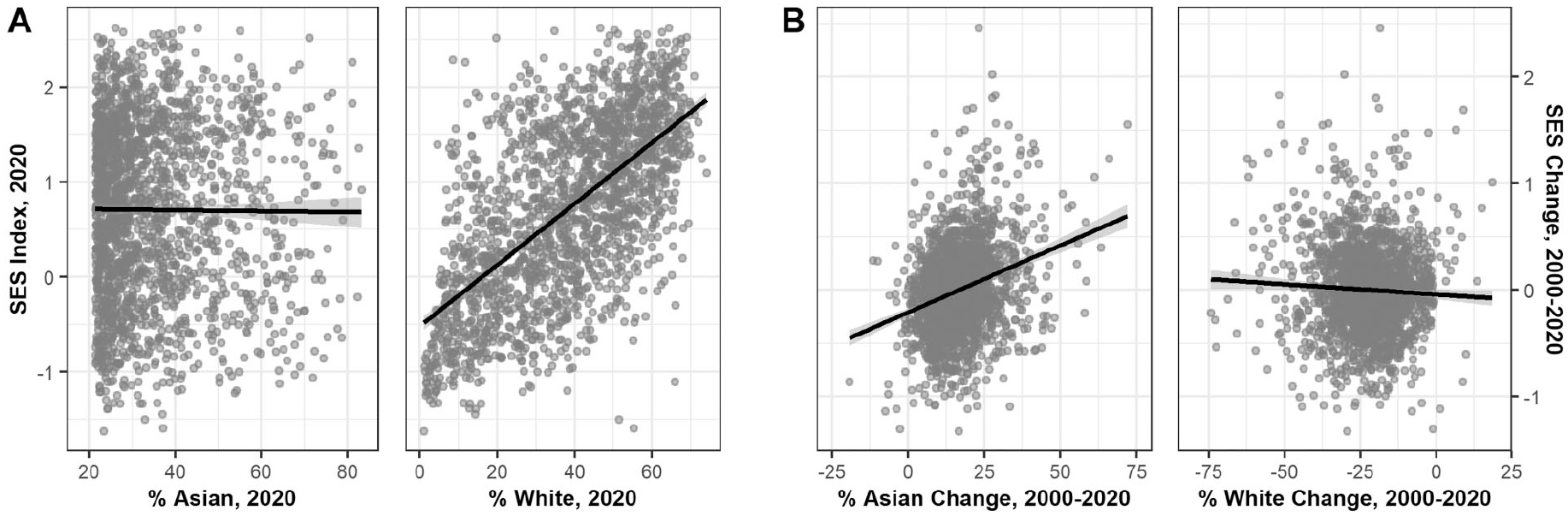
Scatterplots summarizing relationship between SES index and White and Asian population size in contemporary ethnoburbs. Results presented for 2020 (Panel A) and for changes from 2000 to 2020 (Panel B).
Asian Entry and White Exit among Contemporary Ethnoburbs, 2000 to 2020
Figure 3 provides a summary of the percentage of contemporary ethnoburbs characterized by each of the 16 unique combinations of Asian entry and White exit from 2000 to 2010 and 2010 to 2020 (four dichotomous indicators; 24 = 16). Each transition type is considered “sustained” when occurring in both sub-transition periods. Each cell indicates the share of ethnoburbs experiencing the pattern of Asian entry indicated on the y-axis and the pattern of White exit indicated on the x-axis. To help facilitate interpretation, darker shades indicate combinations of Asian entry and White exit more prevalent across the ethnoburb sample.
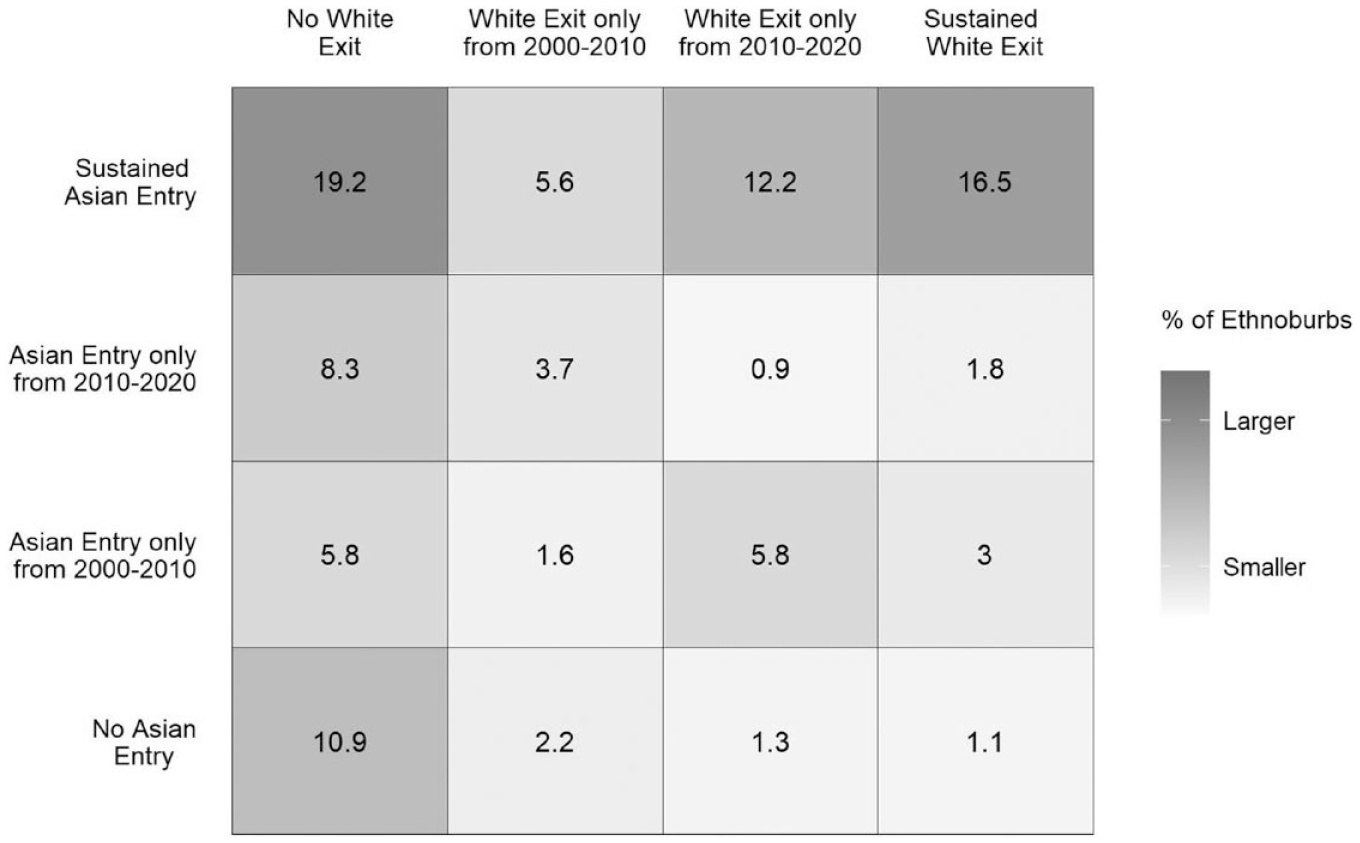
Distribution of contemporary ethnoburbs (N = 1,863) across all unique combinations of White exit and Asian entry from 2000 to 2010 and 2010 to 2020.
Overall, the results suggest that ethnoburb formation has been driven, in considerable part, by Asian population growth, as nearly 85 percent of ethnoburbs experienced at least one instance of Asian entry (top 3 rows). At the same time, a majority of ethnoburbs did exhibit some form of White exit over the 20-year period (right three columns). These dual patterns are exemplified by those ethnoburbs experiencing sustained Asian entry, depicted in the top row of cases: while the absence of White exit is disproportionate (19.2 percent of all cases), the extent of at least some White exit is also sizable (34.3 percent of all cases).
What are the theoretical implications of these trends? Figure 4 provides further context by presenting the average changes for each unique combination of White exit and Asian entry experienced by contemporary ethnoburbs from 2000 to 2020. Cells in each row summarize changes for tracts having experienced the specified extent of White exit in conjunction with either sustained Asian entry (top row), Asian entry from 2010 to 2020 only (middle row), or Asian entry from 2000 to 2010 only (bottom row). To facilitate interpretation, the small minority of ethnoburbs that experienced no Asian entry (less than 15.5 percent of cases) are omitted from the analysis. The shade of horizontal labels corresponds to the percentage of ethnoburbs in each unique combination; colors correspond exactly to the pattern previously established in Figure 3.
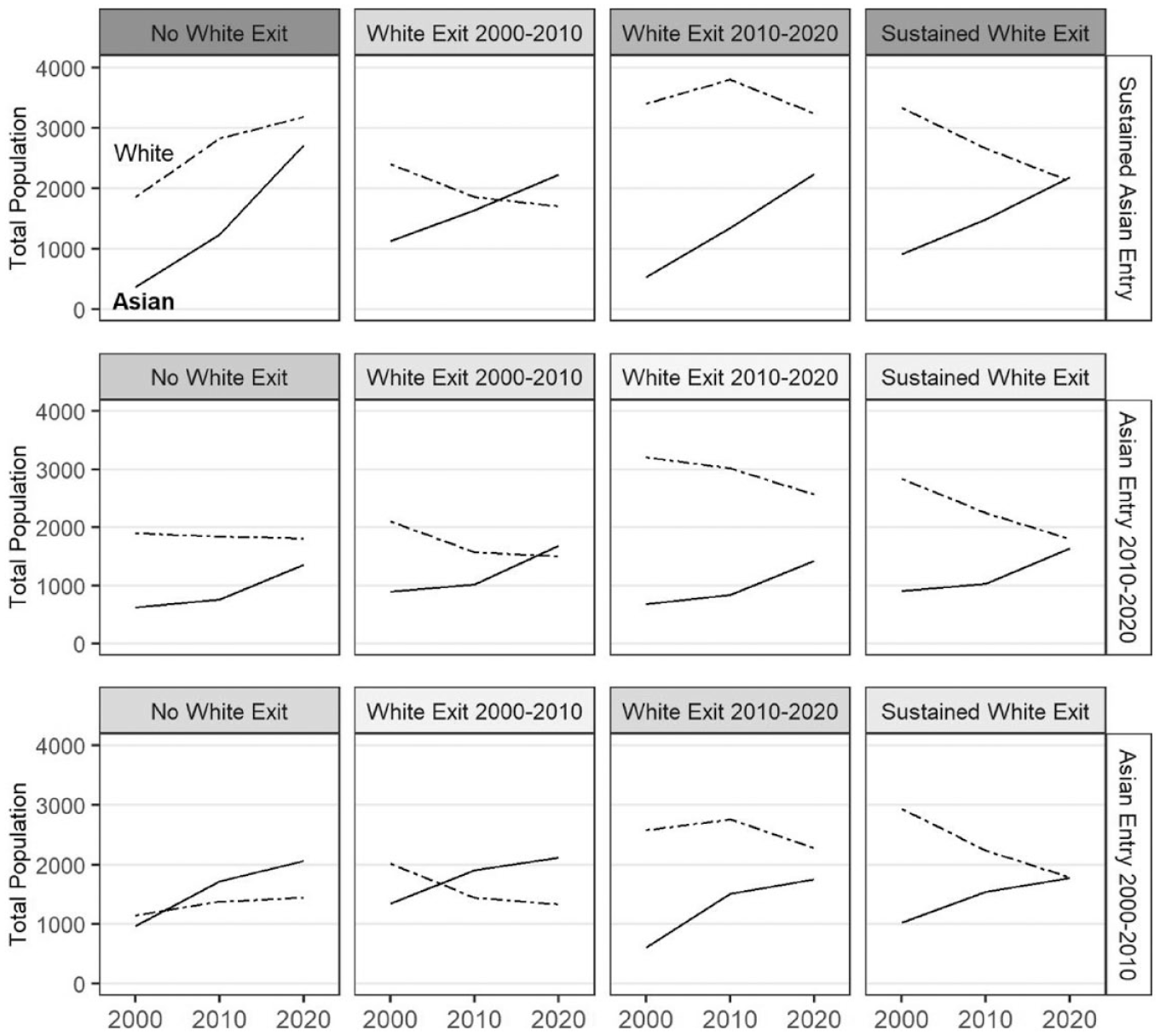
Mean absolute White and Asian population change from 2000 to 2020 for 2020 ethnoburbs.
In nearly all cells—and especially those with the greatest prevalence of cases (darker shades)—Asian growth tended to occur in neighborhoods where Whites met or exceeded the number of Asian households, often to a significant degree. In fact, the single most common trajectory of ethnoburb formation was found in places where White exit was not only absent, but White households also grew alongside Asian populations. The lone clear (and somewhat common) exception to this trend appears to be for Asian ethnoburbs having experienced no White exit and a single decade of Asian entry from 2000 to 2010. However, even among this subset of ethnoburbs, the magnitude of Asian population increase tends to be relatively smaller than the growth exhibited in ethnoburbs where Whites were the dominant group (e.g., top row of cases). It is also instructive to examine those trajectories where Asian entry was not sustained (bottom two rows). When Asian entry occurred in only a single decade, the most prevalent trajectories saw (1) Asian populations grow when Whites remained the larger group (furthest left cell in middle row) and (2) Asian population growth plateau after Asian populations surpassed the White population total (bottom left cell). This provides stronger evidence that even among ethnoburbs, Asian households remained more likely to migrate into existing White neighborhoods. These findings are inconsistent with expectations of the resurgent ethnicity hypothesis and, instead, more aligned with the spatial assimilation hypothesis.
At the same time, the results also shed light on the important role of White population decline in the ethnoburb formation process. Specifically, White exit accelerates the pace of White and Asian population convergence. Consider neighborhoods that experienced sustained patterns of both White exit and Asian entry from 2000 to 2020 (top right cell). While Asian populations show phenomenal increase, this begins in 2000 in neighborhoods that contained a much larger population of White residents in 2000 and 2010. Yet, by 2020, a history of systematic Asian entry and White loss leads to neighborhoods where Asians, on average, meet or exceed the size of White populations. Evidence of the same pattern can also be found among ethnoburbs with only a single decade of White exit (middle two columns) or a single decade of Asian entry (bottom two rows). When White exit occurs, it occurs in places where White households prevail as the dominant group. Furthermore, in many places where Asians have emerged as the larger group, this tended to be the case because White population decline had already been waning the White population presence. In sum, the results provide little evidence that Asian ethnoburbs emerge because an in-flux of Asian households “overtakes” stable White neighborhoods. To the contrary, the results suggest a pattern of assimilation that, in some cases, is met by White exodus; this prevents what would have otherwise been a more equal representation of White and Asian residents. These cases provide weak support for the resurgent ethnicity hypothesis and, instead, suggest evidence consistent with the ethnic stratification hypothesis.
Regression Analyses
Do these descriptive patterns hold in multivariable analyses? To help answer this question, I use random intercept models in which neighborhoods (level 1) are nested within metropolitan areas (level 2). The regression results in Table 2 examine the association between predictors—included at their values in 2010 or as measures of change from 2000 to 2010—and White exit or Asian entry from 2010 to 2020. 7 All coefficients are exponentiated; values above and below 1 indicate increases and decreases in the odds, respectively. The sample for both models is restricted to include only the contemporary ethnoburb sample. To facilitate interpretation, all percentage measures reflect a 10-percentage point change; total population measures reflect a unit increase of 1,000 residents.
Multilevel Models Predicting Asian Entry and White Exit from 2010 to 2020 for Contemporary Ethnoburbs.
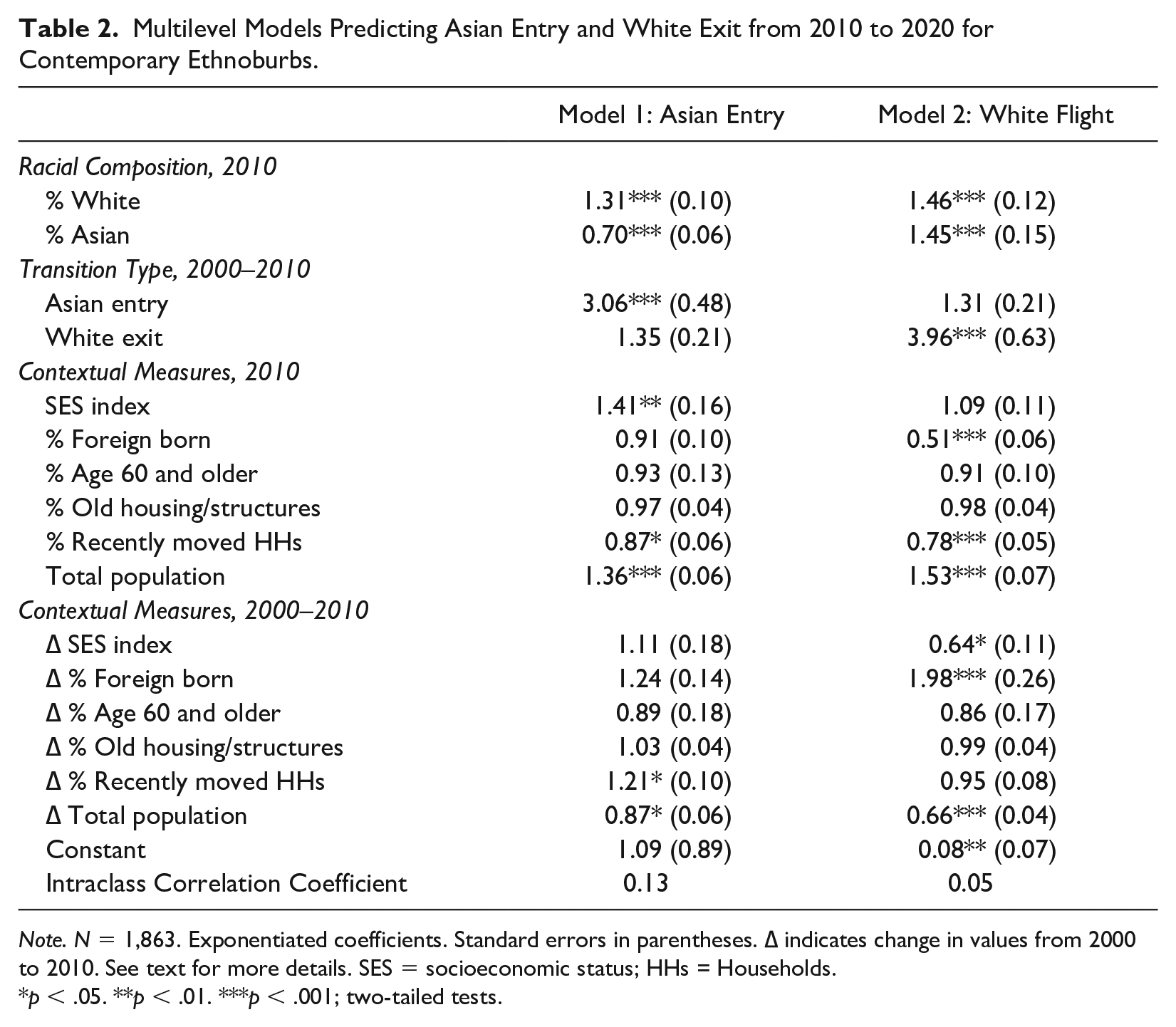
Note. N = 1,863. Exponentiated coefficients. Standard errors in parentheses. ∆ indicates change in values from 2000 to 2010. See text for more details. SES = socioeconomic status; HHs = Households.
p < .05. **p < .01. ***p < .001; two-tailed tests.
The results largely echo findings from the descriptive analysis. Model 1 suggests that while a previous pattern of systematic Asian population growth does facilitate subsequent Asian entry, the size of a neighborhood’s White population share in 2010 also exhibits strong positive effects. Contemporary ethnoburbs with a greater share of Asian residents in 2010 were also less likely to experience subsequent Asian entry. Furthermore, previous episodes of White exit show no statistically significant association with Asian entry. Collectively, these findings again provide little evidence to support expectations of the resurgent ethnicity hypothesis, which would anticipate Asian households, in the aggregate, to prefer neighborhoods where Asians appear poised to replace Whites as the predominant group. Instead, they underscore that Asian households are more likely to enter neighborhoods where Whites retain a clear and stable population presence. This is more consistent with the spatial assimilation hypothesis.
Parallel results using White exit from 2010 to 2020 as the outcome are given in Model 2. The results indicate that net of socioeconomic status and ecological controls, a greater share of Asian residents and previous instances of Asian entry (p < .10) each significantly increases the odds of subsequent White exit. This was also the case for neighborhoods in the midst of racial turnover (i.e., those that experienced White exit from 2000 to 2010). Rather than emerging as a function of socioeconomic deficits or other ecological characteristics—which may very well be salient factors in other settings—these results suggest patterns of White exit that occur in direct response to Asian population presence and growth. Like the descriptive results, these findings also suggest the presence of racialized neighborhood changes consistent with the ethnic stratification hypothesis.
The remaining results point to the importance of several contextual factors. Asian entry and White exit were more likely in neighborhoods with large populations in 2010 but less likely in places experiencing population growth in the previous decade. Likewise, Asian entry and White exit both tended to be less likely in neighborhoods with a greater share of recently moved households. This suggests that net of other factors, each transition tended to selectively occur in established neighborhoods that were not undergoing population booms (e.g., new suburban destinations with an influx of new housing). One possible interpretation of this pattern may be that established neighborhoods approximate locations where zoning laws, racially selective annexation, and other factors lead to a fragmented hierarchy of neighborhoods. While this may lead to targeted Asian growth into the “best” neighborhoods, the greater availability of viable destinations may also make it more likely that White households consider relocation in response.
Importantly, both transitions were also related to SES: Asian entry was more likely in neighborhoods exhibiting more affluent socioeconomic contexts in 2010, while White exit was less likely in areas where socioeconomic contexts had improved over time. This indicates that within ethnoburbs, racial composition and socioeconomic status each independently affect transitions of Asian entry and White exit. This begs the question of whether Asian entry can remain more likely—and White exit, less likely—when a larger Asian population presence coincides with higher neighborhood SES. At an aggregate level, this would suggest that Asian entry into “Asian” neighborhoods may only be more common among areas that also retain a higher level of SES (in turn, providing partial support for the resurgent ethnicity hypothesis). And for outcomes of White flight, this would suggest that racial turnover generally remains motivated by “nonracial” factors rooted in differences in neighborhood SES and/or other ecological traits (in turn, weakening support for the ethnic stratification hypothesis).
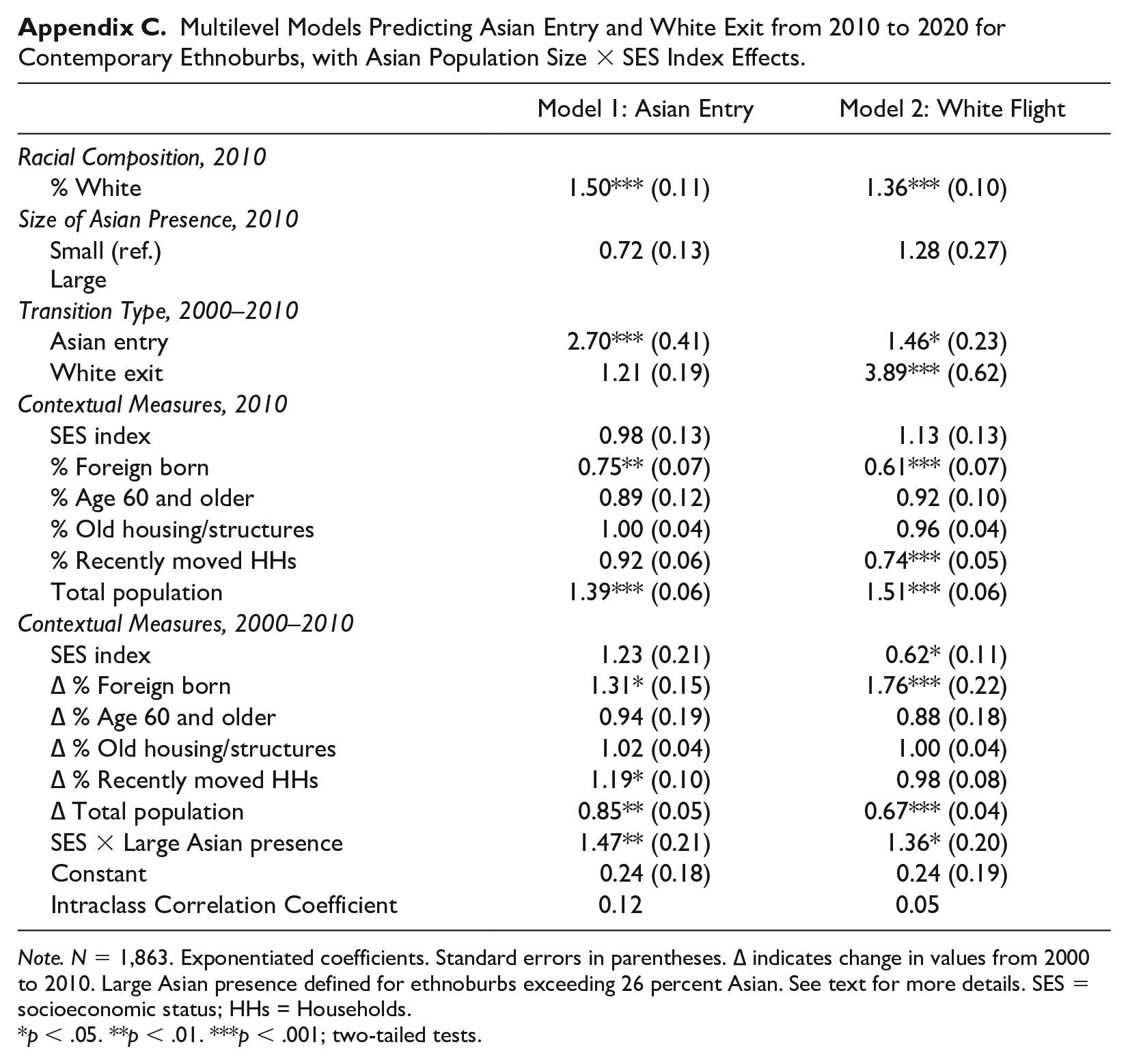
To test these arguments, I fit models that included interactions between a neighborhood’s Asian population share and socioeconomic status. Results are summarized by predicted probability plots with 95 percent confidence intervals in Figure 5 (full model estimates can be found in Appendix C). To help facilitate interpretation of interactions between two continuous independent variables (Long and Freese 2014; Mize 2019), neighborhood ideal types were constructed to estimate effects for neighborhoods with a small or large Asian population presence. An Asian presence was defined as “large” if exceeding the mean percent Asian value found for contemporary ethnoburbs in 2010 (26 percent Asian). The left panel indicates no statistically significant difference in the probability of Asian entry between neighborhood types across the full range of SES values (i.e., overlapping confidence intervals). Yet even from a substantive perspective, the general pattern of results indicates that Asian entry into areas with a large Asian presence tends to be less likely across all but the most affluent ethnoburbs (and even among these, the probability of Asian entry is nearly identical to ethnoburbs with a smaller presence). Thus, even among higher SES ethnoburbs, there appears no further evidence in support of the resurgent ethnicity hypothesis. The right panel shows that the probability of White exit between ideal types was indistinguishable among relatively subaffluent ethnoburbs. However, as SES increases, White exit becomes more likely from ethnoburbs with a large Asian presence; the probability of White exit shows no change in places with a small Asian presence. Providing further support for the ethnic stratification hypothesis, the evidence does not suggest that the prospects of White flight dissipate with increases in socioeconomic context. Instead, it is precisely middle-class and affluent ethnoburbs that appear to reside at the epicenter of this phenomenon.
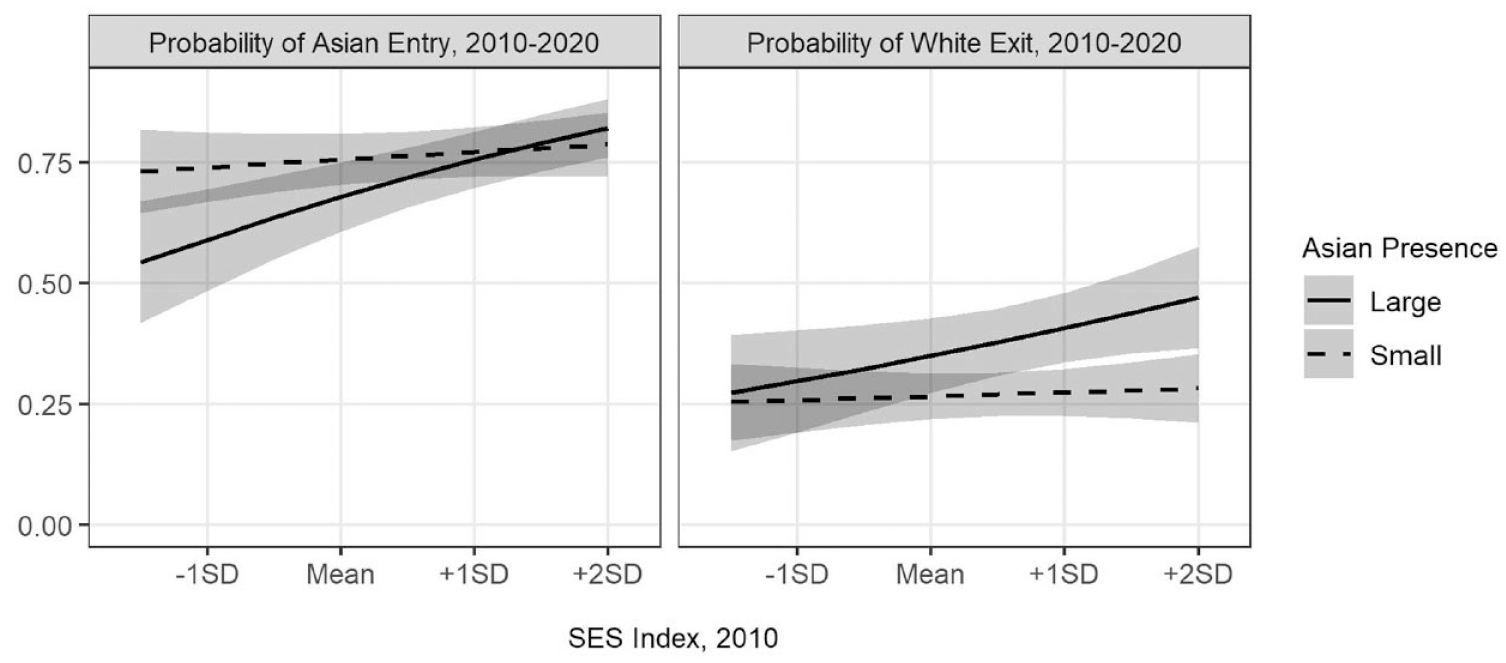
Predicted probability of Asian entry and White flight into/from contemporary ethnoburbs from 2010 to 2020, with 95 percent confidence intervals.
Discussion and Conclusion
This study sought to evaluate the merits of resurgent ethnicity as a credible source of ethnoburb formation. Overall, among today’s ethnoburbs, previous patterns of Asian entry exhibit several clear features. Descriptive and multivariable results consistently indicate Asian entry was unlikely to occur in neighborhoods with large Asian populations and, instead, more likely to occur in those with an established White population presence. At the same time, when it occurred, White exit was most common in neighborhoods that began the transition period as majority-White neighborhoods. Collectively, these findings suggest the initial conditions of ethnoburb formation: neighborhoods where Whites predominate and patterns of Asian entry add to a relatively small Asian presence. Over time, however, these neighborhoods diverge along one of two paths. In a first trajectory, White exit tends to be absent, or White populations themselves show evidence of growth. As a result, the Asian population presence increases gradually, most commonly remaining a minority (but growing) share of the population. These initial conditions are consistent with the spatial assimilation hypothesis. In a second trajectory, White exit occurs in response to Asian growth, particularly in higher SES neighborhoods; this accelerates the pace at which Asian households emerge as a disproportionate share of the population. In essence, the decline of White households serves to artificially inflate the relative size of the Asian population, undercutting the growth of what would have otherwise been more integrated communities. This trajectory of ethnoburb formation is most consistent with the ethnic stratification hypothesis.
What does this suggest about the viability of resurgent ethnicity? To be clear, these findings do not (and methodologically cannot) rule out the possibility that ethnicity may be a salient factor in the residential preferences of Asian households; these groups may very well look to find neighborhoods that mirror the support systems of classic enclaves in suburban settings. However, what these findings do suggest is that among contemporary ethnoburbs, the resurgent ethnicity hypothesis finds little traction: the modal ethnoburb does not appear to emerge as a function of ethnocentric migration toward predominantly Asian neighborhoods. If ethnoburbs are a clear example of resurgent ethnicity, then this should provoke reconsideration of whether resurgent ethnicity has more in common with spatial assimilation models, rather than those predicated on ethnocentrism and self-segregation. Indeed, the single most common trajectory of ethnoburb formation (19.2 percent of all cases) saw sustained Asian entry into majority-White neighborhoods that also experienced White population growth. That these mobility streams have continued likely reflects the fact that White neighborhoods remain those most likely to be on “the right side of the tracks” (Lee and Marlay 2007). It may also be the case that nascent Asian communities have begun to establish ethnic infrastructures well before Asian households emerge as the dominant group. Despite their common association with segregated ethnic communities, ethnic institutions do not necessarily have to be relegated solely to such contexts. In an era of surging Asian population growth and suburbanization, neighborhoods that are “resurgent” and integrated can become more commonplace.
Future research should build on this study’s findings. An immediate next step would be to provide greater precision in the measurement and examination of “Asian” ethnoburbs. While some of the ethnoburbs in this sample may very well represent communities containing a mix of Asian national origin groups (Kim and White 2010), others may more accurately approximate Chinese ethnoburbs, Korean ethnoburbs, or other neighborhoods generally predominated by a single national-origin group (e.g., Wen et al. 2009). Future works might also examine whether White flight provides a shared structural condition that ultimately gives rise to panethnic neighborhoods. In contrast to ethnocentrism perspectives, this would suggest that racial boundaries brighten because a process of racialization and flight places Asian national-origin groups in closer proximity to one another (rather than to White households). Finally, because this study focuses primarily on the population changes undergirding a single cross section of ethnoburbs, it is unable to speak to trends that may differ between established and more recently formed ethnoburb communities. Important questions also remain about those communities that may have been considered ethnoburbs in previous decades (e.g., at time t), but were no longer considered as such at a later point in time (e.g., at time t + 1). Future research should consider a broader scope that directly addresses these issues. Doing so would generate valuable insights on the factors that lead ethnoburbs to endure or wane across various metropolitan contexts.
In closing, this study should be used to strengthen, and further explore, several conclusions about the nature of racial residential stratification. First, these findings underscore the racial foundations of modern White flight. That White households appear more likely to flee distinctly affluent ethnoburbs suggests further work must be done to account for the limitations embedded within traditional models of neighborhood attainment (Dantzler, Korver-Glenn, and Howell 2022). Though these models tend to view “spatial assimilation” as a static outcome reasonably achieved through socioeconomic means, the findings from this study suggest that socioeconomic achievement has diminishing returns for middle-class Asian households. Instead, these findings highlight the blurry boundary between Asian American achievement and stratification (Li and Nicholson 2021; Okihiro 2014), and the dynamic conflicts that can emerge when White households seek to preserve their power in places where they have traditionally represented the dominant group (Jiménez and Horowitz 2013; Lung-Amam 2017; Warikoo 2022). Understanding in greater detail how dominant groups can “change the rules” when Asian Americans enter “White spaces” remains an important agenda for future research.
Second, this study adds to a multifaceted literature that illustrates the inability of non-Whites to escape a racialized system of locational attainment. For example, established works demonstrate how middle-class Black households remain mired in the social and spatial expansion of the urban ghetto (e.g., Patillo 1999; Sharkey 2014). This study’s findings suggest a similar process that relegates many Asian households into ongoing residence in modern “ethnic” communities. Unlike their poorer urban enclave counterparts, Asian ethnoburbs may very well retain positive effects boosting the life chances of their residents. It may be true, in this strict sense, that Asian Americans and their communities are not “subordinate” as generally theorized by the majority-minority paradigm (Sakamoto, Goyette, and Kim 2009). Yet this may also reinforce the “racial triangulation” of Asian Americans and Asian American communities: valorized relative to other non-White groups due to their education and income but viewed as “less than”—on civic and cultural grounds—in the racial hierarchy (C. J. Kim 1999; Lee and Kye 2016; Tuan 1998; Xu and Lee 2013). Future research should continue to examine the consequences of this phenomenon for Asian Americans’ broader assimilation trends.
Footnotes
Appendix
Multilevel Models Predicting Asian Entry and White Exit from 2010 to 2020 for Contemporary Ethnoburbs, with Asian Population Size × SES Index Effects.
| Model 1: Asian Entry | Model 2: White Flight | |
|---|---|---|
| Racial Composition, 2010 | ||
| % White | 1.50*** (0.11) | 1.36*** (0.10) |
| Size of Asian Presence, 2010 | ||
| Small (ref.) Large |
0.72 (0.13) | 1.28 (0.27) |
| Transition Type, 2000–2010 | ||
| Asian entry | 2.70*** (0.41) | 1.46* (0.23) |
| White exit | 1.21 (0.19) | 3.89*** (0.62) |
| Contextual Measures, 2010 | ||
| SES index | 0.98 (0.13) | 1.13 (0.13) |
| % Foreign born | 0.75** (0.07) | 0.61*** (0.07) |
| % Age 60 and older | 0.89 (0.12) | 0.92 (0.10) |
| % Old housing/structures | 1.00 (0.04) | 0.96 (0.04) |
| % Recently moved HHs | 0.92 (0.06) | 0.74*** (0.05) |
| Total population | 1.39*** (0.06) | 1.51*** (0.06) |
| Contextual Measures, 2000–2010 | ||
| SES index | 1.23 (0.21) | 0.62* (0.11) |
| ∆ % Foreign born | 1.31* (0.15) | 1.76*** (0.22) |
| ∆ % Age 60 and older | 0.94 (0.19) | 0.88 (0.18) |
| ∆ % Old housing/structures | 1.02 (0.04) | 1.00 (0.04) |
| ∆ % Recently moved HHs | 1.19* (0.10) | 0.98 (0.08) |
| ∆ Total population | 0.85** (0.05) | 0.67*** (0.04) |
| SES × Large Asian presence | 1.47** (0.21) | 1.36* (0.20) |
| Constant | 0.24 (0.18) | 0.24 (0.19) |
| Intraclass Correlation Coefficient | 0.12 | 0.05 |
Note. N = 1,863. Exponentiated coefficients. Standard errors in parentheses. ∆ indicates change in values from 2000 to 2010. Large Asian presence defined for ethnoburbs exceeding 26 percent Asian. See text for more details. SES = socioeconomic status; HHs = Households.
p < .05. **p < .01. ***p < .001; two-tailed tests.
Acknowledgements
I thank Jennifer C. Lee, Andy Halpern-Manners, and Dina Okamoto for their extensive feedback on the paper. I also thank Laura Upenieks and Kevin D. Dougherty for their gracious mentorship during my first few semesters “on the job.” Finally, I thank the SRE editors and anonymous reviewers for their thoughtful comments and helpful suggestions.
