



Abstract
Black and Hispanic neighborhoods have suffered the most severe consequences of the “war on drugs.” As the war on drugs waned, cannabis legalization/decriminalization efforts increased across America. A prime example of decriminalization occurred in August of 2012 as the City of Chicago introduced a new law providing officers with option to ticket, rather than arrest, individuals caught in possession of 15 grams of cannabis or less. As cannabis policy continues evolving, it remains to be seen whether or not the trend toward decriminalization will produce equitable changes in drug arrest outcomes across racial/ethnic groups. We employ data tracking cannabis arrests over time by neighborhood to assess the impact of cannabis decriminalization in Chicago and estimate racial disparities in the likelihood of arrest (v. ticket) using two sets of models: within-neighborhood models and hierarchical logistic regressions with random effects. We find that Blacks and non-White Hispanics are more likely to be arrested than ticketed for minor cannabis possession in Chicago following the introduction of the Alternative Cannabis Enforcement (ACE) program, regardless of the neighborhood where the arrest took place. In addition, Black neighborhoods did not experience the same reduction in arrests after the law changed in comparison with racially mixed, White, or predominantly Hispanic neighborhoods. Our findings draw attention to the differential deployment of discretionary policing strategies across neighborhoods of different racial/ethnic composition. Although Chicago’s ACE program has lowered the overall rate of cannabis arrests, major racial/ethnic disparities in those arrests remain and become exacerbated when examining macro neighborhood-level trends.
Introduction
Cannabis is the most widely used illicit drug in the United States. Arrests for cannabis possession account for a large proportion of annual drug offenses (Nguyen and Reuter 2012; Room et al. 2010). In 2021, 34 percent of the 498,209 drug possession-related arrests reported to the Federal Bureau of Investigation (FBI) were for cannabis possession (Federal Bureau of Investigation Crime Data Explorer 2023). As such, cannabis might rightly be described as a “gateway drug”: not necessarily as a gateway to harder drug use, but rather as a gateway into the criminal justice system for the millions of people who have been arrested and convicted of its possession. Over the last decade, cannabis laws and policies across states have changed dramatically because of increasing public support for legalization and decriminalization (McCarthy 2017). To date, 34 states in the United States have legalized medical uses of cannabis (Hasin and Walsh 2021). Additionally, 28 states, including Washington, DC, have decriminalized cannabis in some way (Alharbi 2020). Given the history of racial inequality in U.S. drug policy and enforcement, some stakeholders, including an increasing number of Democratic politicians, view these changes as a way to foster social justice (Adinoff and Reiman 2019; Sabet and Jones 2019).
Given the extent of racial disparities across the criminal justice system, claims that changes to cannabis law enforcement will reduce disparities should be met with caution (Bender 2016). Drug laws have disproportionately affected the poor and people of color at the individual level (Black 1976, 1980; Mitchell 2009; Mitchell and Caudy 2015, 2017) and by place (Beckett, Nyrop, and Pfingst 2006; Gaston 2019; Gaston and Brunson 2020; Geller and Fagan 2010; Lynch 2011; Lynch et al. 2013). U.S. cannabis reforms are in their infancy and vary greatly across cities and states, necessitating researchers to carefully specify for whom, where, and under what circumstances reformed cannabis policies reduce punitiveness and improve racial equity (Bender 2016).
In 2012, the City of Chicago adopted the Alternative Cannabis Enforcement (ACE) program, providing officers with the option to ticket, rather than arrest, people found in possession of small quantities of cannabis. Prior to Chicago enacting these reforms, ticketing ordinances were being adopted by municipalities across the state of Illinois in an attempt to reduce the costs and resources associated with pursuing cannabis possession arrests (Kane-Willis et al. 2014). While the reasoning behind the adoption of the ACE Program is tied to cost and resource savings, an unintended benefit of less severe consequences for cannabis possession may be a reduction in racial disparities in drug-related arrests in Chicago.
In an effort to advance research and public policy on cannabis reform, this study evaluates the potential of cannabis decriminalization to produce racially equitable criminal justice outcomes. Our study is two-pronged. First, we focus on individual outcomes by examining the likelihood of arrest for individuals for cannabis possession versus ticketing. Second, while the policy change applies in all Chicago neighborhoods, the race/ethnic-specific likelihood of arrest for cannabis possession may not be similar across Chicago neighborhoods. Thus, we examine whether there are differences in the likelihood of arrest (vs. ticket) by race across neighborhoods. In the coming section, we discuss racial differences in law enforcement in general and through the context of cannabis enforcement, as well as the role of neighborhoods in racialized policing, then follow with our methods and results, and finally, our conclusions.
Literature Review
Racialized Drug Law Enforcement
Racism is a foundational feature of U.S. drug policy and enforcement. Drugs that are illegal today were once licit and widely consumed by Americans without much governmental interference. In an effort to advance the economic and political interests of the White ruling class, racist propaganda and concerted efforts to control specific racial/ethnic groups of color spurred the eventual prohibition of cannabis and other drugs by the late nineteenth century (Beckett et al. 2005; Musto 1991). Associating Chinese immigrants with opium smoking, linking Black southern laborers with cocaine-induced “cocainomania,” and attributing marijuana-fueled violence to Mexicans all pioneered various local, state, and federal antidrug policies that hyper-criminalized these substances and the racial/ethnic groups stereotyped as being connected with them (Beckett et al. 2005; Musto 1991; Reinarman and Levine 1997; Siff 2021). The legacy of these racist regimes remains today, as evinced in the hyper-criminalization of drug use and decades-long racial/ethnic arrest disparities that even preceded the infamous 1980s war on drugs (Blumstein 1982; Langan 1985). In the two decades after 1980, national drug arrest rates for Black Americans rose 4.5 times compared with an increase of 1.3 times for White Americans (Beckett et al. 2005:419). Although national drug arrests have decreased in recent years, the Black-White racial gap remains stark. Among cannabis possession arrests in 2018, Black Americans were arrested at a rate nearly four times that of White Americans (American Civil Liberties Union 2020:29). Black Americans are arrested for cannabis at higher rates than White Americans in every state (American Civil Liberties Union 2020). Given that the prevalence of drug use and selling is similar across racial/ethnic groups (Jones et al. 2015), these longstanding racial disparities in drug arrests cannot be explained by different rates of drug offending (Mitchell 2009; Mitchell and Caudy 2015), but instead may be attributable to racially discriminatory policing practices.
The Significance of Race in the Era of Cannabis Reform
Persistent racial disparities in drug enforcement raise questions about solutions to ameliorate them. In recent years, most U.S. states have either legalized or decriminalized recreational cannabis possession (American Civil Liberties Union 2020; Restoration of Rights Project 2022). Given the role that America’s war on drugs has played in fueling mass incarceration and racial disparities (Alexander 2012; Felson and Krajewski 2020; Fornili 2018), these cannabis reforms represent an effort to reduce punitiveness and alleviate racial inequity in drug policy and enforcement (Adinoff and Reiman 2019; Owusu-Bempah 2021; Owusu-Bempah and Rehmatullah 2023), especially in light of growing public favor of cannabis legalization (Stringer and Maggard 2021). However, evidence on the degree to which cannabis reforms advance racial equity is mixed and inconclusive (Gunadi and Shi 2022; Plunk et al. 2019). Nationally and at the state level, overall cannabis arrests have decreased and constituted a smaller share of all drug arrests relative to the past (American Civil Liberties Union 2020; Grucza et al. 2018). States that passed cannabis reforms have had the lowest cannabis arrest rates compared with other states (American Civil Liberties Union 2020). Although cannabis reforms appeared to have reduced overall punitiveness in drug enforcement, this is hardly true among racial/ethnic lines. Black-White disparities in cannabis arrests have both decreased and increased following cannabis reforms in states that have legalized and decriminalized cannabis possession. For example, the racial disparity worsened in Illinois after the state decriminalized cannabis in 2016. Illinois’ Black-White arrest disparity ratio grew from approximately 4.5 in 2016 to 7.5 in 2018 (American Civil Liberties Union 2020:32). C. L.Firth et al. (2020) found that after Oregon legalized cannabis for adults in 2015, cannabis allegation 1 rates increased among all juveniles and were highest among Black and American Indian/Alaska Native youth, although the Black-White disparity decreased after legalization, while the American Indian/Alaska Native-White disparity remained unchanged. N. K.Tran et al. (2020) investigated the impacts of cannabis decriminalization in Philadelphia and Dauphin Counties and observed a reduction in cannabis arrest rates from 2009 to 2018. However, the relative Black-White disparities decreased among possession-based arrests but increased among sales/manufacturing-based arrests postdecriminalization. These findings raise questions about police differential use of discretion and dovetails with aforementioned studies pointing to officers racialized decision-making (Gaston 2019; Gaston and Brunson 2020; Geller and Fagan 2010; Lynch 2011; Lynch et al. 2013). Cannabis reforms vary within and across jurisdictions and still provide opportunities for problematic policing to persist and shift from one outcome to another, such as by incentivizing pretextual stops and profiling (Kreit 2016). These mixed findings, especially those revealing growing or unchanged racial disparities, cast doubt on the efficacy of cannabis reform to catalyze racially equitable outcomes. Variations in racial disparities in cannabis arrests are likely attributable to differences in officers’ drug enforcement practices within and across jurisdictions.
Neighborhood Context, Race, and Policing
While early scholarship focused on individual-level factors, scholars today have increasingly underscored the neighborhood context as essential to shaping police behavior and helping to explain racially discriminatory policing outcomes. Black and Hispanic Americans disproportionately reside in neighborhoods marked by high official crime rates, citizen calls for service, racial residential segregation, and structural disadvantage (Candipan et al. 2021; Kirk 2008; Krivo and Peterson 1996). These characteristics attract a disproportionate share of police scrutiny of neighborhoods and the people frequenting them, thus partly explaining racial disparities in policing outcomes, including drug arrests (Gaston 2019; Mitchell and Lynch 2011).
Moreover, prior studies indicate that officers behave according to the conditions of neighborhoods. Scholars have hypothesized that, compared with low-crime neighborhoods, officers use more aggressive or proactive policing tactics in high-crime neighborhoods, while others argue that officers use less vigor in areas with high disadvantage and crime than in less disadvantaged neighborhoods (Klinger 1997). D. A.Klinger (1997) suggests that perceived levels of deviance, cynicism, and “normal crime” by the police for a given neighborhood impact officers’ notions of victim deservingness and influence the level of vigor given to their policing activities. He maintains that policing varies by ecological context because the structural disadvantage present in a neighborhood undermines policing as a form of social control, leading to further disorder and crime. Other studies show that officers tend to engage in misconduct (Kane 2002), coercive behavior (Sun, Payne, and Wu 2008), and use higher levels of force (Terrill and Reisig 2003) in socially disorganized neighborhoods inhabited by residents of color who generally have limited social power with which to hold the police accountable. J. A. Shjarback, J. Nix, and S. E. Wolfe (2018) found that in neighborhoods with higher levels of concentrated disadvantage, police officers were less likely to believe residents would cooperate with police actions. S. Gaston (2019) and S. Gaston and R. K. Brunson (2020) found that officers relied on criminogenic neighborhood conditions to inform their suspicions and stops of persons eventually arrested for drugs. Together, the concentrated police presence and patrol efforts in disadvantaged neighborhoods and ecological contamination by officers make Black and Hispanic residents and neighborhoods more susceptible to drug enforcement than their White counterparts, helping to explain the racial disparity in drug arrests.
Although prior studies have linked crime rates, citizen calls for service, and structural disadvantage to racial disparities in drug arrests, these factors only partly explain the disparity in drug-related law enforcement, as evident in across-city studies (see Eitle and Monahan 2009; Parker and Maggard 2005) and in several within-city analyses. In a series of studies on Seattle, Washington’s drug-related law enforcement, Beckett and colleagues found that racially discriminatory drug law enforcement explained Black Americans’ overrepresentation in drug arrests, not crime rates and citizen complaints (Beckett et al. 2006, 2005). Similarly, M.Lynch (2011) found that police and officials in Cleveland, Ohio, chose to selectively concentrate drug enforcement efforts in predominantly Black neighborhoods, target crack paraphernalia rather than all types of paraphernalia, seek more punitive charges, and financially incentivize officers to pursue felony charges in exchange for overtime pay when required to appear in court for felonies versus misdemeanors, resulting in over-targeting Black citizens and communities. In St. Louis, Missouri, and Newark, New Jersey, respectively, Gaston (2019) and Gaston, Brunson, and Grossman (2020) investigated neighborhood-level racial disparities in drug arrests and also found evidence of racially discriminatory drug enforcement when controlling for violent crime, citizen calls for service, and social disorganization. Qualitative studies of police self-reported accounts of their drug policing revealed that St. Louis officers policed Black and White neighborhoods and people differently (Gaston 2019), even when Black and White neighborhoods had similar levels of crime and disadvantage (Gaston and Brunson 2020). Specifically, St. Louis police conducted a greater portion of discretionary stops based on a lower legal basis of Black people and in Black and racially heterogeneous neighborhoods in comparison with White people and neighborhoods (Gaston 2019). Similarly, in investigations of New York City’s marijuana stops and arrests, A. Golub, B. D. Johnson, and E. Dunlap (2007), B. E.Harcourt and J. Ludwig (2007), and A. Geller and J. Fagan (2010) all showed how neighborhood racial composition had a profound impact on cannabis enforcement disparities. Geller and Fagan (2010) found significant racial disparities in marijuana enforcement across neighborhoods, controlling for local crime, socioeconomic conditions, and stop justifications. Their study further revealed that the legal rationale officers provided for stops failed to meet federal and state legal standards, suggesting that marijuana stops were pretextual in nature. Together, these local drug arrest studies show that commonly purported neighborhood conditions—crime, calls for service, and disadvantage—are insufficient explanations of racial disparities in drug arrests. Longstanding drug arrest disparities are attributable to racially discriminatory policing that manifests in organizational policy decisions and patrol officers’ differential use of discretion that varies by citizen race and neighborhood racial composition.
Current Study
This study contributes to the growing literature on race, place, and drug enforcement, generally, and race, place, and cannabis reform, specifically. It investigates neighborhood-level racial/ethnic disparities in Chicago’s cannabis enforcement amid cannabis reform in the city, thereby offering additional evidence to the ongoing policy discourse about the potential racial/ethnic impacts of cannabis reform. Our focus on Chicago, Illinois adds to the growing literature that examines local drug enforcement within large metropolitan areas, especially those examining the impacts of cannabis reforms.
In 2012, Chicago adopted the ACE (Municipal Code 7-24-099) Program providing police officers with the discretion to ticket (i.e., issue an Administrative Notice of Violation) rather than issue a mandatory arrest, for individuals caught in possession of 15 grams or less of cannabis. 2 In the study, we explore racial disparities in police decision-making after the introduction of a new municipal code that allows officers to choose been an arrest and a ticket over minor cannabis possession. As such, we ask:
Next, when municipal codes are changed, it may take time for the code to be fully adopted and practiced by the police as officers need to be informed about and trained on the dimensions of the code. Given the size of the Chicago Police Department (in 2011, the department had over 13,000 sworn members, see Chicago Police Department 2011), informing all officers and training them on how to use the new municipal code associated with the ACE Program was not likely to be instantaneous. Moreover, given that the ACE Program introduced a moment where police officers are afforded more discretion, it may also take time for officers to incorporate that discretion into their job activities. Consequently, we ask:
We anticipate that, if a disparity in arrest across race/ethnicity exists, the disparity becomes smaller or disappears over time as the use of the ACE Program municipal code becomes more widespread.
Finally, the City of Chicago has a long history of racialized policing in Black and Hispanic neighborhoods (American Civil Liberties Union of Illinois 2015), particularly for drug-related arrests and police contact (Burke 2022). It is possible disparities in arrests by race are differentially felt across Chicago neighborhoods. As such, we ask:
To answer our three research questions, we combine data on cannabis tickets and arrests from the years 2012 to 2015 with data from the U.S. Census to model the likelihood of arrest versus a ticket for individuals in Chicago. In the coming sections, we discuss our data and research design including dependent and independent variables, along with our approach to answering these research questions.
Methods
Data
We employ two datasets to test our research questions. The first dataset we employ—the ticketing and arrest data—is the population of all tickets and arrests related to incidents involving minor cannabis possession in Chicago from 2012 to June 30, 2015. The ticketing and arrest data originated from the Chicago Police Department (CPD) via a Freedom of Information Request (FIOR) by the nongovernmental agency We Charge Genocide 3 in an effort to examine racial bias in ticketing and arrest incidents for cannabis infractions. FOIRs are novel and innovative methods that can expand and improve researchers’ access to criminological data (Greenberg 2016). Between 2012 and 2015, of the 46,212 cannabis incidents in our data, 16.8 percent were tickets, while 83.2 percent were arrests.
The ticketing and arrest data contain information on the incident (ticket vs. arrest), individual race and age, as well as the location of the incident. The ticketing and arrest data do not include any identifying information about the individuals involved in the incident, such as the names of victims or perpetrators. That said, as an extra layer of protection against identification, the city did not include the full address where the incident took place but instead scrubbed the last two digits of the street address and replaced the number with “XX.” This inhibited us from geocoding to the precise location where the incident took place; however, given that we are nesting incidents within neighborhoods, we do not need point-level location precision to examine our research questions. To geolocate the crimes, we simply replaced the “XX” in addresses with 50, effectively coding all incidents to the middle of the block. For example, if a crime was located on 13XX N. Blackstone, we geocoded the address as 1350 N. Blackstone. Choosing to geocode incidents in this way avoids geocoding incidents to street intersections and significantly reduces the chance incidents are geocoded to the borders of census block groups, our unit of analysis for neighborhoods.
Next, the ACE program has some exceptions regarding what type of incident involving cannabis can be given a discretionary ticket or must result in an arrest, 4 such as those involving an impeding a warrant, driving under the influence, being engaged in drug dealing. Of particular importance for this study is the exception that officers must arrest the individual when the incident took place at a school or on school grounds or property or at a public park. While our data do not differentiate between mandatory and discretionary arrests, we can use the location of an arrest to determine if the arrest is mandatory based on the location of the arrest. To do this, we start by using data and shape files from the City of Chicago’s open data portal (https://data.cityofchicago.org/), where we join all incidents to shapefiles for the boundaries of parks and school grounds. Any incident that occurred on park or school grounds is excluded from the data as an incident that does not involve discretionary decision-making. Additionally, because the precise location of each incident is not available (see above), we created 200-meter buffers (about the size of Chicago city block) around each park and school to fully capture stops that may have occurred on school or park grounds given the City of Chicago’s masking of the precise location of crime data. Any incident that occurred within the park or school buffers is excluded from the data given that it may not be an incident that involves discretionary decision-making.
The second dataset we employ is the 2012 to 2016 American Community Survey Five-Year Estimates, which we use for our neighborhood-level variables. From the 2012 to 2016 American Community Survey Five-Year Estimates, we pull block group level information on female-headed households, public assistance and unemployment, and the neighborhood’s race and ethnic distribution.
To build our analytic dataset, we first begin with the 46,237 incidents involving minor possession of cannabis (under 15 grams) in Chicago between 2012 and June 30, 2015. Next, we eliminate any incidents that cannot be successfully geocoded and located within a census block group; this results in the deletion of 47 incidents in the data. Next, given that any incidents happening on park or school grounds are considered nondiscretionary (as discussed above), we exclude 516 incidents that occur in these areas. Additionally, we created a 200-foot buffer around all school and park boundaries. Any incident within the buffer was also excluded; specifically, this applies to 472 incidents. Finally, upon data cleaning, approximately 320 incidents had either missing or invalid 5 values associated with our variables of interest. In total, we lost 1,354 incidents to being nondiscretionary, unable to be geocoded, or having missing or not applicable information (less than 3 percent of total incidents in the original data). Our final data set consists of 44,883, incidents nested with 1,995 block groups.
Dependent and Explanatory Variables
Our dependent variable is a dichotomous outcome with 1 signaling that the individual was arrested for minor cannabis possession and 0 showing the individual received a for ticket minor cannabis possession.
Next, we detail our explanatory variables. First, the race/ethnicity of the individual involved in the incident is captured with dummy variables showing that the individual was Black (1=yes), Hispanic (1=yes), or Other Race (1=yes), with a reference category of White. Other race includes individuals who were American Indian/Alaskan Native (15 individuals precleaning), Asian/Pacific Islander (182 individuals precleaning), or Unknown (47 individuals precleaning). Note that Black includes Black Hispanic individuals given that racial bias—whether explicit or implicit—is related to skin tone and less so actual race/ethnic heritage (White-Means et al. 2009). Additionally, we captured the age of the individual; to do this, we subtracted their birthday from the day of the incident. Age was then categorized into seven dummy variables: ages 21 to 24, age 25 to 29, ages 30 to 39, ages 40 to 49, ages 50 to 59, and ages 60 and above. The reference category is ages 18 to 20. Finally, also included is a set of dummy variables representing the years following the law change: 2013, 2014, and 2015. The reference category is the year 2012.
Our explanatory variables also include neighborhood-level controls for the race/ethnic distribution of neighborhoods as well as economic disadvantage. The percent Black is calculated by dividing the total number of neighborhood residents who reported being only Black, and no other race or ethnicity, by the total population within the neighborhood, and then multiplying the quotient by 100. The percent Hispanic is calculated by dividing the total number of individuals who reported being Hispanic by the total population within the neighborhood and then multiplying the quotient by 100. Next, to account for economic disadvantage, we create a factor score of three variables that are otherwise too correlated to place in the model as single concepts: the percent of female-headed households, the percent of individuals on public assistance, and the percent of individuals in the neighborhood who are unemployed. To create this factor, we used principal components factor analysis; only one factor emerged. The resulting factor, which we call economic disadvantage, had an eigenvalue of 1.80 with factor loadings of 0.86 for the percent of female-headed households, 0.67 for the percent of individuals on public assistance, and 0.78 for the percent of individuals in the neighborhood who are unemployed. The result is a standardized variable capturing economic disadvantage in a neighborhood. Table 1 shows the descriptive statistics for all the variables.
Summary Statistics, N = 44,883, Block Groups = 1,995.

Analysis Plan
To test our hypotheses, we conduct two types of models: (1) within-neighborhood models which estimate the likelihood of arrest (vs. ticket) for individuals regardless of the neighborhood the police interaction takes place in and (2) hierarchical logistic regressions with random effects (both a random intercept and coefficient) where incidents are nested within neighborhoods, which explores whether neighborhoods contribute to greater disparities in arrests for people of color. For both models, we nest cannabis possession-related incidents within 1,431 Chicago neighborhoods (i.e., block groups). The within-neighborhood model addresses Research Questions 1 and 2, which focus on determining whether Black Americans and Hispanic individuals in Chicago have a greater likelihood of arrest for minor cannabis possession than Whites as well is if those disparities change over time. The within-neighborhood model is simply a logistic regression model with fixed effects for neighborhoods. Fixed effect models eliminate between-unit (in this case, neighborhoods) variation, and control for any differences, both observed and unobserved, of the neighborhood (Halaby 2004); this enables us to assess what personal characteristics of the individual—race, sex, and age—influence their likelihood of receiving an arrest versus a ticket regardless of the neighborhood in which the incident takes place.
Our second type of model—the hierarchical logistic regressions with random effects—enables us to understand how neighborhoods contribute differentially to the likelihood of arrest (vs. ticket) for Black and Hispanic American individuals. We include both a random intercept and a random slope for the race/ethnicity of the individual—Black or Hispanic– depending on the model. Using a random slope for the Black or Hispanic variables allows us to gain an understanding of the neighborhood-specific contributions to the likelihood of arrest for Black or Hispanic Americans net of controls. Using mixed-effect modeling notation, our models are summarized as

Where
In the coming section, we present our results as follows. To begin with, we discuss the time trends in arrest versus tickets overall and by race/ethnicity. Next, in Table 2, we show the within-neighborhood fixed effect analyses, where we begin with the baseline model to determine if there is a disparity in the likelihood of arrest for Black and Hispanic Americans when compared with Whites. Our next within-neighborhood fixed effects model interacts the race/ethnicity of the individual with the year of the incident, testing whether any disparity in the likelihood of arrest between Black and Hispanic individuals and Whites is dependent on time. Lastly, we present our hierarchal logistic models with random effects in Table 3. 6 We first show the baseline model, or Model 1, with all incident-level and neighborhood-level controls and a random intercept for neighborhoods. Model 2 not only includes all incident-level and neighborhood-level controls and a random intercept but also includes a random slope for Blacks. Like Model 2, Model 3 contains all incident-level and neighborhood-level controls, the random intercept, but adds a random slope for Hispanics. Table 3 also contains the likelihood ratio tests between Models 1 and 2 and Models 1 and 3 which ascertain if the models with include random coefficients are better fitting than the random-intercept-only model.
Within-Neighborhood Fixed Effects Models Predicting Arrest (vs. Ticket) for Incidents Involving Minor Cannabis Possession; Note: 582 Block Groups (2,849 Arrests) Omitted Because of Uniform Outcomes Within the Neighborhood.
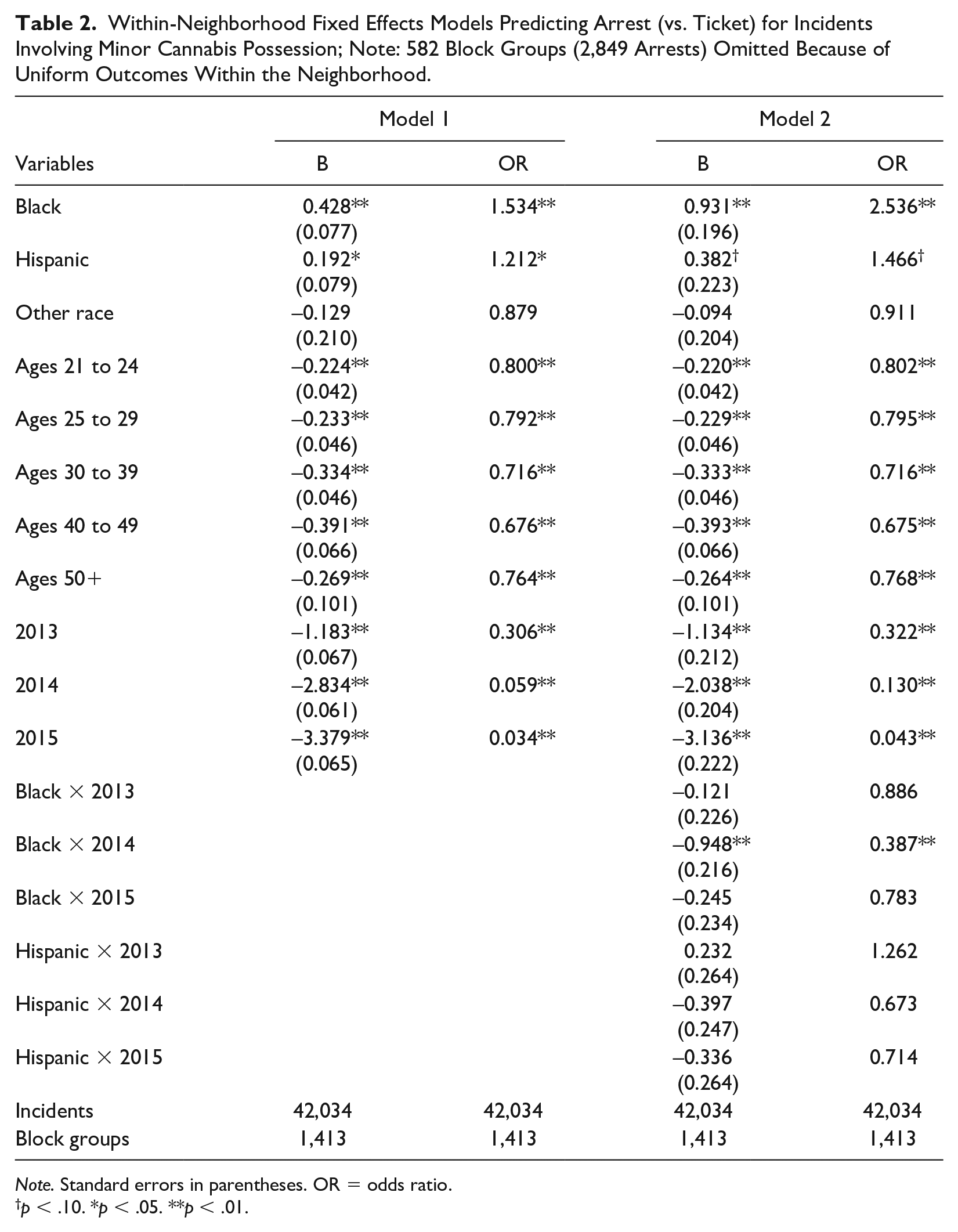
Note. Standard errors in parentheses. OR = odds ratio.
p < .10. *p < .05. **p < .01.
Likelihood Ratio Test Comparing the Random-Intercept Model to the Two Random Slope Models.
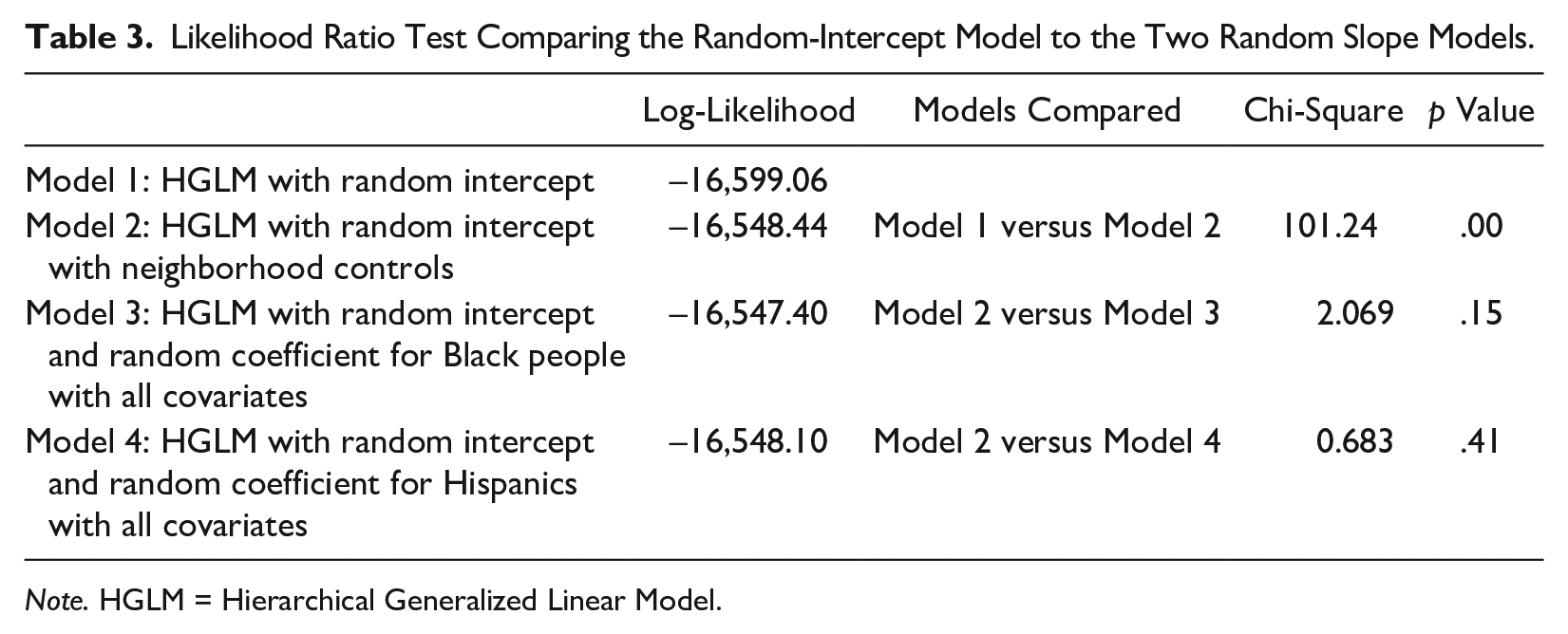
Note. HGLM = Hierarchical Generalized Linear Model.
Results
Figure 1 shows the percentage of cannabis arrests and tickets by the study years as well as the within race/ethnicity trends over time in the percentage of cannabis arrests and tickets. When looking at the overall trends in arrest (top left graph), as expected, the percentage of decline while the number of tickets increases as the time from the initiation of the ACE Program increases. Next, regardless of the year, Black people (top right graph) are more often arrested than they are ticketed in incidents surrounding minor cannabis possession. That said, over time, ticketing of Black people becomes more frequent (though not the dominant trend). By 2015, Hispanics (bottom left graphic) are more commonly ticketed than they are arrested. The time trend for White people (bottom right graphic) looks similar to Hispanics: by 2015, ticketing for minor cannabis possession was more commonly experienced than arrest.
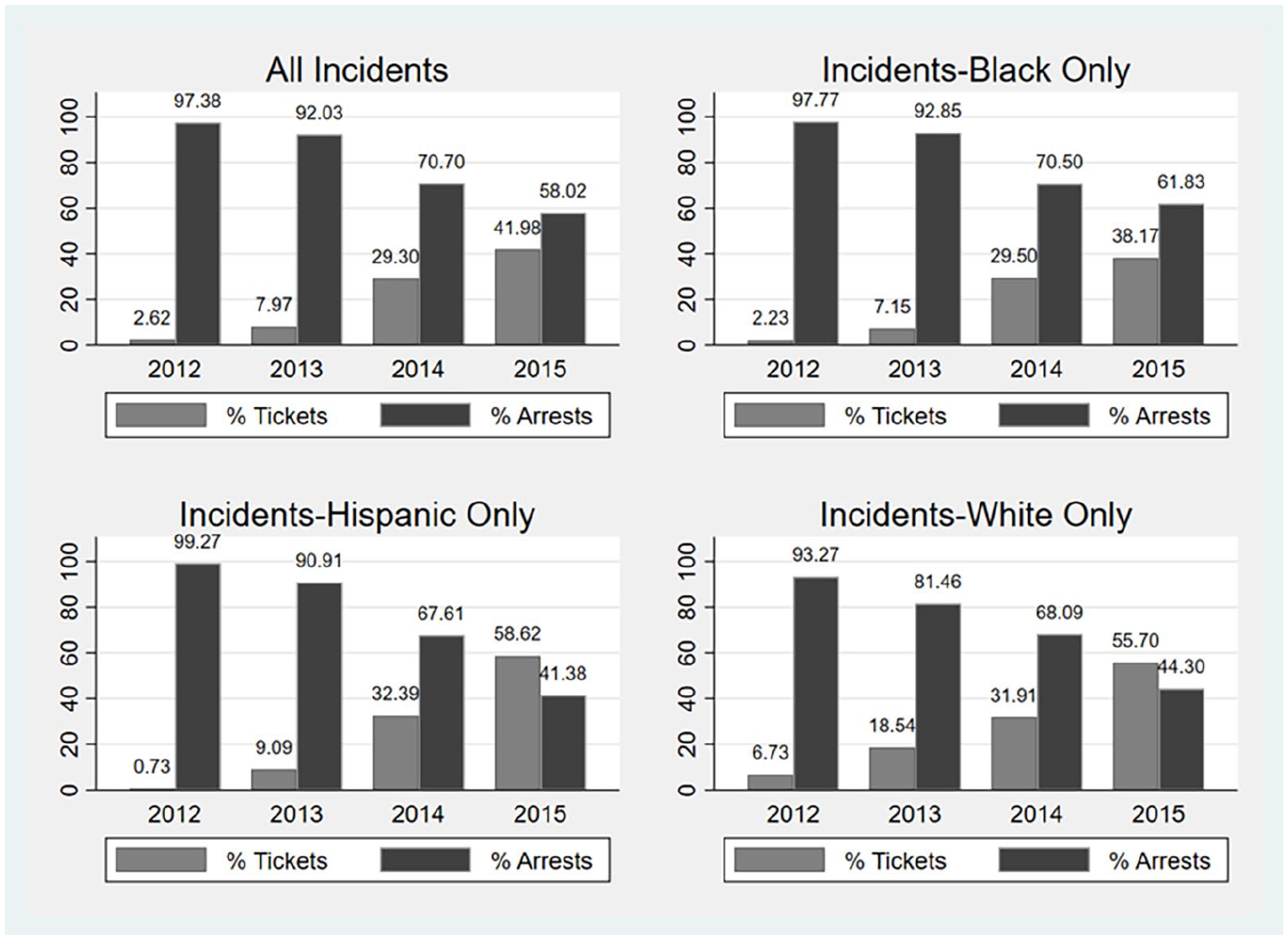
Changes in rates of cannabis tickets and arrests after the adoption of Chicago’s.
Table 2 displays the results from the two within-neighborhood fixed effect models. Important to note here is that when modeling, approximately 582 neighborhoods had no variability in arrest and were dropped from the model, resulting in the loss of 2,849 incidents. We start with the baseline model, Model 1. On average, in Chicago, both Black (
Next, in Model 2, Table 2, we tested whether the disparity in arrest for Black and Hispanic people changed over the years of the study by interacting the variables for Black and Hispanic with the year dummy variables. The main effect of Black people remained positive and significant: When compared with Whites, Black people are 2.5 times (
In Table 3, we display the results for the random-intercept and slope models. Remember that, through the inclusion of the random slope for Black Americans (Model 2) or Hispanic Americans (Model 3), we tested whether there are neighborhood-specific contributions to the arrest disparities between Black and Hispanic Americans and Whites above and beyond the city average. There are two important differences between these models and the fixed effect models: There are additional control variables at the neighborhood level, specifically percent Black, percent Hispanic, and economic disadvantage, and all variables are grand mean centered. As noted in the analysis plan section, to test Research Question 3, we conduct a series of likelihood ratio tests to determine if models with both random intercepts and random slopes (for Blacks or Hispanics, depending on the model) are a better fit for the data than models with only a random intercept. To that end, we focus the discussion of the results in this section exclusively on the likelihood ratio tests, shown in Table 3. The full results of the models captured in the likelihood ratio tests are in Table 4.
Hierarchical Logistic Regression Models with Random Effects Predicting Arrest (vs. Ticket) for Incidents Involving Minor Cannabis Possession.
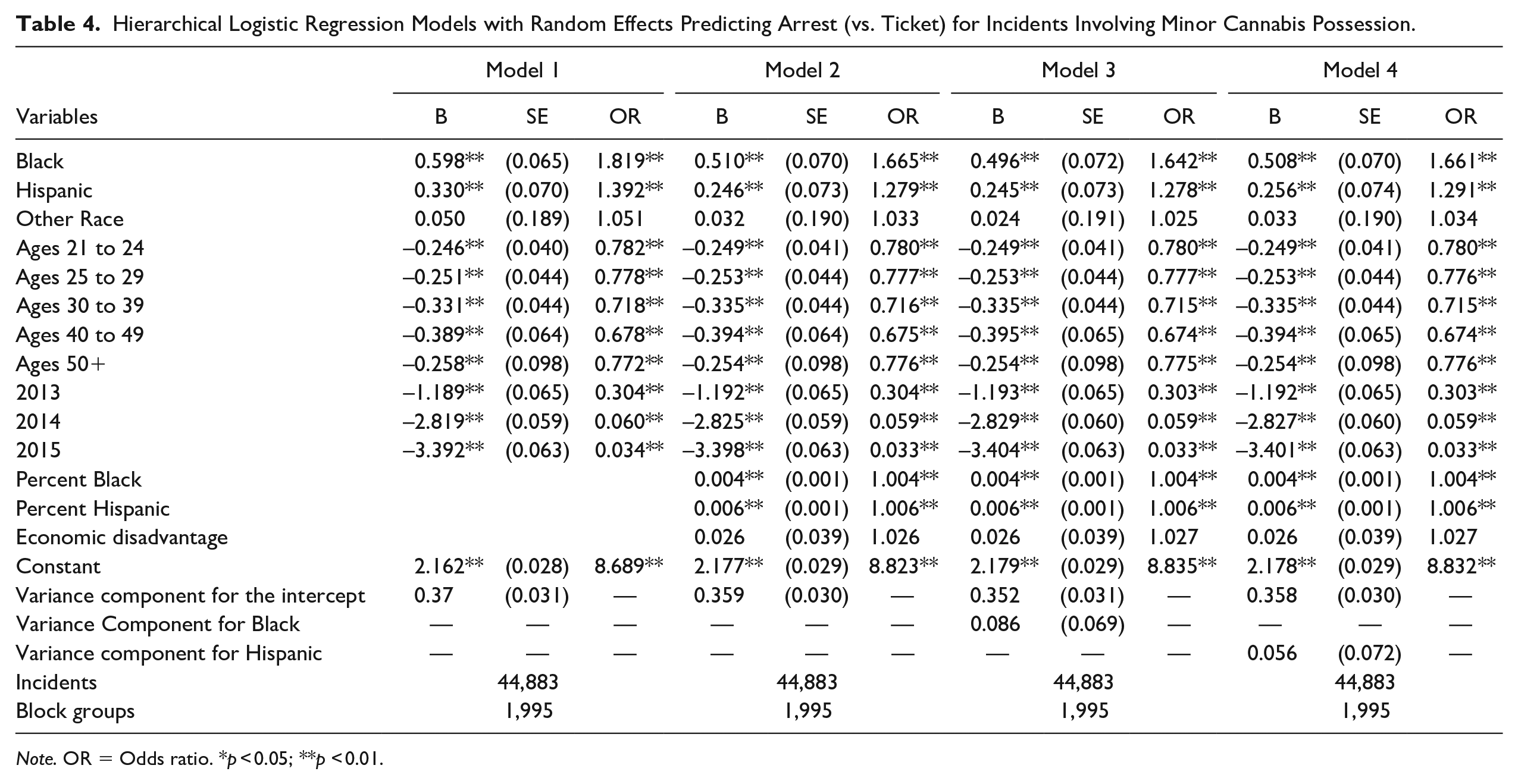
Note. OR = Odds ratio. *p < 0.05; **p < 0.01.
We begin by comparing a model with a random intercept and the same covariates contained in the fixed effect models (Model 1) to a model with a random intercept, all the covariates from the fixed effects models, and the neighborhood-level variables of percent Black, percent Hispanic, and economic disadvantage (Model 2). The likelihood ratio test between Models 1 and 2 is significant (
The nonsignificant likelihood ratio tests suggest two important results. First, the disparities in the likelihood of arrest that Blacks and Hispanics experience relative to Whites function similarly across Chicago neighborhoods given that neighborhoods are not uniquely contributing to the disparity. Put another way, there are no neighborhoods in Chicago where the relationship being Black or Hispanic and the likelihood of arrest are substantively different compared with other neighborhoods in the city. Second, the inclusion of neighborhood-level controls likely accounts for the disparities in the likelihood of arrest across neighborhoods. As seen in Table 4, the percent Black and percent Hispanic both significantly and positively contribute to the likelihood of arrest. Given that Chicago is a highly segregated city, where there are few truly mixed-race neighborhoods, much of the racial disparity in cannabis arrests is likely due to the racial and ethnic characteristics of the location of the arrest.
Discussion
Our study demonstrates that Black people and non-White Hispanics are more likely to be arrested than ticketed for minor cannabis possession in Chicago following the introduction of the ACE program. In addition, Black neighborhoods did not experience the same reduction in arrests after the law changed in comparison with racially mixed, White, or predominantly Hispanic neighborhoods. Our findings draw attention to the differential deployment of discretionary policing strategies across neighborhoods of different racial/ethnic composition. Although Chicago’s ACE program has lowered the overall rate of cannabis arrests, major racial/ethnic disparities in those arrests remain. The ACE program is starting to decrease the severity of these disparities for individuals. For Hispanics, the likelihood of cannabis arrest, over time, appears to be similar to Whites’ likelihood of arrest. Black people, however, are still more likely to be arrested than ticketed for minor cannabis possession than their White counterparts, regardless of time. Conversely, at the neighborhood level, disparities have increased. While Hispanic neighborhoods overall experienced declines in arrest, Black neighborhoods did not. Our findings affirm the results of prior studies of major American cities, such as New York and Seattle, which show that racial disparities in drug arrests persist despite changes in drug policy (Beckett et al. 2006; Geller and Fagan 2010). Below, we detail our limitations and then discuss more specific interpretations of our results.
Our findings are contextualized by three limitations. First, police officers select who they have contact with for a number of reasons and due to discretion, a number of police contacts and activities are not recorded (Lundman 2012). Our data are an artifact of discretion on behalf of who police choose to contact and what activities they also choose to document. Second, our findings may be influenced by racially biased patterns of policing in Chicago. In 2017, the U.S. Department of Justice determined that the CPD had engaged in a number of civil rights violations, including racially biased policing patterns; by 2018, CPD came under a federal consent decree (see http://chicagopoliceconsentdecree.org/about/). CPD has an established record of engaging in racially biased policing and may be targeting people of color, but particularly Black people and Hispanics, for police contact thereby biasing our findings. Targeting in policing is extremely hard to determine (Ridgeway and MacDonald 2010); however, it is important to note. Third, there are some cannabis arrests that are not discretionary, such as when they take place on school or public park grounds. While we used spatial locating techniques (see the “Methods” section) to identify these types of arrests, a more precise method of delineating nondiscretionary cannabis arrests would have been a flag while the arrest was taking place. Unfortunately, this was not available in the data.
Regarding our results, as evidenced by both the trend graphic (Figure 1) and the fixed effect models, from a trend perspective, there were racial disparities in how individuals in Chicago experienced cannabis decriminalization regardless of the neighborhood where the arrest took place. Chicago is well known for racially disparate policing practices for decades (American Civil Liberties Union of Illinois 2015), which is why the police department is now under a federal consent decree for unconstitutional and racially disparate policing (http://chicagopoliceconsentdecree.org/about/). Furthermore, within Chicago, Black people tend to experience more disproportional contact and disparate treatment by the police than Hispanics or Whites (American Civil Liberties Union of Illinois 2015), suggesting that Black people are seen as more criminogenic by the police than other people of color or Whites. Our results reflect these differences. By 2015, both Whites and Hispanics predominantly experienced more tickets than arrests. The fixed effects models show that across study years, Hispanics were statistically similar to Whites regarding the likelihood of arrest for cannabis possession. However, for Black people, while overall arrest rates diminished, Black people were always more likely to be arrested than ticketed than Whites during the period of our study (see Figure 1 and Table 2). Our time trend analysis confirmed that discretion was differentially applied, thus undermining the efficacy of cannabis decriminalization in reducing racial disparities in cannabis law enforcement. These results show that the discretionary nature of arrest reduced White-Hispanic disparities but likely increased Black-White disparities and are reflective of the disparate policing Blacks experience in Chicago.
Regardless of the race of the individual, when police contact occurs in Black or Hispanic neighborhoods, there is an increased likelihood of arrest for cannabis possession rather than the imposition of a ticket. Put another way, the race of the neighborhood matters for discretionary action related to cannabis possession. This finding is in line with research by Y. Zhao, T. C. Yang, and S. F. Messner (2019) who find a similar result related to the race of a neighborhood and police discretionary action. Specifically, Zhao et al. (2019) note that when a traffic stop occurs in a segregated neighborhood in New York City, there are increased odds of several discretionary outcomes, such as being frisked, searched, experiencing police force, and arrest. An important component of this analysis is that we tested whether the racial/ethnic composition of a neighborhood uniquely contributes to discretionary arrests for cannabis possession. We find that specific neighborhoods with notable reputations for crime and disorder did not act as outliers that are driving these findings (see Table 3). In short, the results are not a function of a few outlier neighborhoods, but rather a city-wide pattern.
Our findings support previous research by a vast number of scholars who demonstrate that police exercise their discretion differently with members of different racial groups. For instance, in a national study of over 60 million state patrol traffic stops, E. Pierson and colleagues (2020) show that Blacks and Hispanics are more likely to be ticketed, searched, and arrested than Whites. In addition to national evidence, many scholars have shown the existence of racial bias in discretionary poststop outcomes across a multitude of police jurisdictions. In San Diego, J. Chanin, M. Welsh, and D. Nurge (2018) showed that among both discretionary and nondiscretionary (such as a search preceding a custodial arrest) searches, Black drivers were less likely to be found with contraband. In a related study, when the San Diego Police Department was presented with evidence of racially disparate policing, in interviews, officers’ accounts of police work “excuse, justify, or otherwise negate the role of race in routine police work, yet officers’ thoughts and actions are based on racialized and, at times, dehumanizing narratives about people and communities of color” (Welsh, Chanin, and Henry 2021:374). Like other scholars, our results show that Chicago is no exception in regard to racially disparate policing, particularly surrounding cannabis possession.
While cannabis law reform has been viewed as a means of ameliorating racial disparities in drug law enforcement (Adinoff and Reiman 2019; Owusu-Bempah 2021; Owusu-Bempah and Rehmatullah 2023), our article provides additional evidence that decriminalization will not necessarily reduce racial inequities in cannabis possession arrests. In the world of policing, it is well known that clear, unambiguous policy can reduce unwanted police action, like the use of fatal force (White 2001). Moreover, it is important to note that while tickets are certainly less punitive than arrests, tickets come with a financial burden. While Hispanics and Whites are arrested less frequently than Blacks, tickets with their associated fees may negatively impact them as well (Giuffre and Huebner 2023), particularly if they are disadvantaged. In the swiftly changing landscape of cannabis policy, if cannabis policy is aimed at racial disparities in drug law enforcement, legalization over decriminalization appears to be the appropriate route given the nature of policing, racial bias, and discretionary police actions, as well as the financial burden associated with police contact (Giuffre and Huebner 2023). Cannabis legislation and policy should be formed with this in mind. When put into practice, decriminalization in Chicago exacerbated racial disparities related to cannabis arrest, simply because Whites were afforded much less punitive outcomes. The age-old adage that culture eats policy for lunch, particularly in policing, likely applies to Chicago’s decriminalization efforts. While under a consent decree for unconstitutional policing related to racism, Chicago failed to implement drug law reform in a racially equitable manner. Chicago’s known culture of racial bias in policing should have been seen as a barrier to achieving a measure of racial equity related to cannabis decriminalization. Policymakers and champions of drug law reform must understand the nature and culture of the organization that will be tasked with on-the-ground implementation—the police.
Footnotes
Acknowledgements
We would like to thank Brendan McQuade for assisting with data acquisition.
