



Abstract

This issue marks the 10-year anniversary of Sociology of Race and Ethnicity. What began in 2012 as an intense brainstorming session in a downtown Denver bagel shop between founding editors David Brunsma and David Embrick culminated in January of 2015 with the publication of the journal’s inaugural issue (Brunsma and Embrick 2021; Brunsma, Embrick, and Nanney 2015). A sociology journal dedicated to the study of race and ethnicity was long overdue.
Founded in 1980, the Section on Racial and Ethnic Minorities (SREM) had by 2015 become one of the largest in the American Sociological Association (ASA), and for decades, ASA members and leadership had both emphasized the need to study processes of racialization across all subfields and implored the ASA community to reckon with the racism embedded within the association itself (Bonilla-Silva 2019; Lee 1976; Mitchum and Joseph 2023). Outside of the discipline, events both in the United States and abroad begged for sociological analysis that centered racism, race, ethnicity, and their underlying mechanisms. The journal’s inaugural issue was published amidst the tragic deaths of Rekia Boyd, Michael Brown, and Eric Garner, and the founding of the Movement for Black Lives. That same year marked the emergence of the Islamic State of Iraq and Syria (ISIS) and the retaliatory murders of Israeli and Palestinian teenagers that erupted into military combat between the Israeli Defense Force and Hamas and resulted in the deaths of 2,200 Palestinians and 73 Israelis.
As the founding editorial team expressed in the inaugural introductory essay, Sociology of Race and Ethnicity (SRE) was to publish the “highest quality, cutting-edge sociological research on race and ethnicity regardless of epistemological, methodological, or theoretical orientation.” Alongside research manuscripts, the journal would also include Book Review and Pedagogy Sections, the latter featuring “cutting-edge work related to the teaching of the sociology of race and ethnicity.” With this as the structural basis of the journal, and with support from SREM membership, SRE became in its first 7 years a go-to outlet for sociologists of race, racism, and ethnicity. Submissions to the journal surpassed 200 per year, the journal’s impact factor reached 3.22, and the pages of the journal reflected some of the most cutting-edge and critical work being produced within the field.
In 2021, after 7 years at the helm, the founding editorial team turned over to us the responsibility of managing and marshaling SRE, and in the 3 years since, we have worked with one orienting goal in mind: growth. We wanted to ensure continued growth in both the quality and quantity of the journal’s yearly submissions. We invited more international scholars to contribute to the journal, both as authors and reviewers. We established new avenues for scholars and practitioners to engage each other and share their work within the pages of the journal. Since our first issue as SRE’s editorial team, we have established a new “Conversations” section, continued to emphasize and grow the journal’s Pedagogy section (editor: Felicia Arriaga) and significantly expanded the journal’s Book Review section (editor: Freeden Blume Oeur; Editorial Assistant: Mo Torres).
Today, on its 10th anniversary, SRE stands tall as a premier outlet for social scientific research on racism, race, and ethnicity, and an important outlet in the discipline no matter the area of specialization. In 2023, the journal surpassed 300 submissions and achieved 1- and 5-year impact factors of 1.8 and 3.5, respectively. In this introductory essay, we take stock of SRE’s first decade of publications—in terms of keywords, most cited research manuscripts and the institutional affiliation of manuscript authors. If SRE is helping shape the direction of sociological scholarship on racism, race, and ethnicity, this essay asks what has that direction been thus far?
Among the many reasons, SRE was established to provide a centralized home for sociological scholarship on race, especially for U.S. race scholars, whose work has historically been marginalized within American sociology (see McKee 1993; Morris 2017; Wright 2020). In this effort, SRE took on the responsibility of shaping the field through the works it published. Academic journals, however, cannot avoid the role of gatekeeping, and SRE is no exception. The sociology of race and ethnicity is defined not only by what scholarship is published in its top outlets, but also what has been left out. By analyzing SRE’s publication history across the first decade, we can better attend to both the areas in the field that the journal has helped grow, as well as emergent frontiers worthy of greater attention.
Methodology
Primary analyses were performed by Dr. Jamiko Deleveaux, Director of the Center for Population Studies at the University of Mississippi. We began with author-supplied keyword data collected from the Web of Science (WOS) and provided to us by Sage, the journal’s publisher. Keyword data cover all SRE publications across its first nine volumes, from 2015 through 2023. While we present descriptive data for all of the journal’s publication types, we focused our bibliometric analysis on research manuscripts (see Table 1). 1 This decision is consistent with our aim of understanding how the sociology of racism, race, and ethnicity has developed in the pages of SRE. The WOS data set contained author full names, title, document type, keywords, abstract, affiliations, times cited, and year of publication. Data retrieval was conducted on December 14, 2023.
Sociology of Race and Ethnicity Total Publications, by Type, 2015–2023.

To analyze keyword trends within SRE, we employed a bibliometric analysis conducted with VOSviewer. As detailed by Naveen Donthu et al. (2021), this methodology is typically used to analyze large scientific data sets. For this analysis, we focused on the frequency of keywords, relationships between pairs and larger clusters of keywords, citation counts, and author’s institutional affiliation, all for published manuscripts from 2015 to 2023. Our primary analysis proceeded as follows. We began with a total of 868 unique keywords, pulled from the metadata of all SRE publications 2015–2023. We identified keywords that co-occurred across at least four manuscripts 2 ; this brought the sample to 81 keywords. After reviewing this sample, we merged duplicate and equivalent keywords 3 , leaving 65 unique keywords. We also removed the keywords “race” and “ethnicity,” as they are exceptionally broad and, given the journal’s title and focus, could encompass nearly every published manuscript. We were left with 63 keywords for our analysis.
Results and Discussion
Below we present descriptive statistics related to SRE’s first 10 years of publications, followed by the results of our bibliometric analysis of keywords from that same span.
Between 2015 and 2023, SRE published a total of 563 manuscripts. Reflecting the journal’s emphasis on empirical research, a majority of these publications (n = 312) were peer-reviewed research manuscripts (Figure 1), an average of 35 research articles per year. Book Reviews are an area of growth for SRE, with a total of 151 published in the journal’s history and 36 published in 2023 alone. Book reviews provide readers with an understanding of the current scholarship landscape and also the future direction of the field. The journal continues to prioritize work related to teaching topics related to race, racism, and ethnicity. In line with this, the journal has published a total of 19 Pedagogy essays since 2015. 4
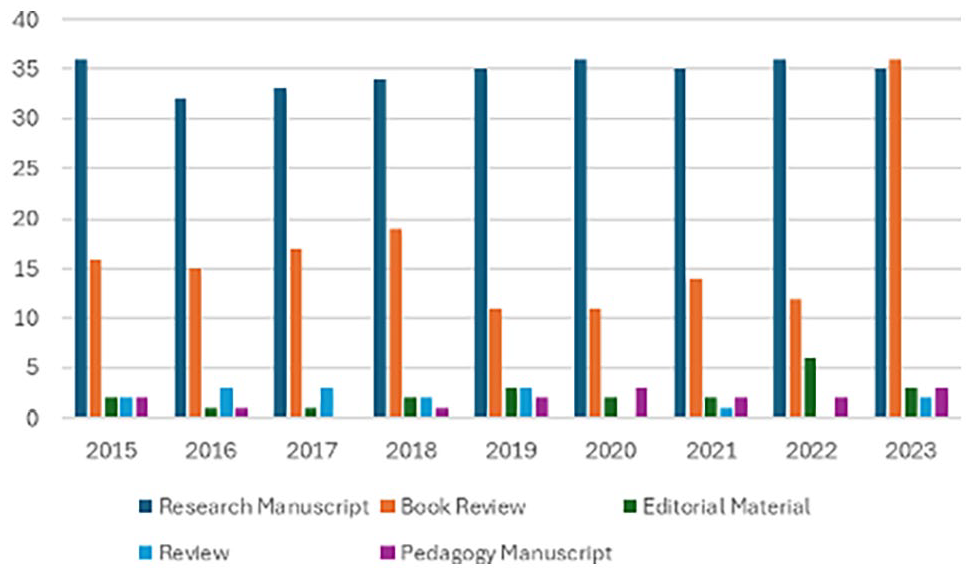
Sociology of Race and Ethnicity Type of Article, by Year, 2015–2023
Where is the sociology of race and ethnicity taking shape? One way to answer this question is by analyzing the institutional affiliation of manuscript authors (see Table 2). Contributing authors to SRE come from a range of institutions in the United States and abroad, from small teaching colleges to large research institutions. Since 2015, authors from the University of North Carolina (UNC) and Duke University account for a total of 24 publications, or about 7% of all research articles published in SRE. 5 Table 2 also includes data on an institution’s “Link Strength,” a metric meant to capture collaboration links between researchers at different universities. VOSviewer measures the link strength “on the number of publications two researchers have co-authored” (van Eck and Waltman 2019). Here, UNC, University of New Mexico, Texas A&M University, and University of Texas-Austin all registered high scores.
Sociology of Race and Ethnicity Number of Research Articles, by Institution, 2015–2023.

Six of the top 12 institutions represented in the first 10 years of SRE publications are located in the U.S. South, and many of the research articles that have appeared in the pages of the journal take the South as its focal ethnographic site or study context. These trends reflect and illuminate broader changes and challenges playing out in the region, including a growing Latino population (see McConnell 2019); the persistent impacts of opportunity hoarding and “multiply deserted areas” in the Urban South (see Satcher 2022; Turchi 2022; and the book review symposium on Ewoodzie 2022, published in Volume 8, Issue 4); and the staging of (para)military and surveillance strategies along the southern border that are then infused into America’s urban policing regime (see Correa and Thomas 2019). Beyond these, scholars publishing in SRE have taken up topics ranging from the retrenchment of public school segregation (see Mendez 2023) to recent efforts across several southern states to prohibit the teaching of African American history at the K–12 and university levels (see Arriaga et al. 2023; Okuwobi, Faulk, and Roscigno 2021). We make no claim that the South is the only region experiencing these realities, just that these dynamics coalesce in distinct ways both in the region and with respect to scholarship published within SRE.
How widely articles are cited can also allude to contemporary debates and the future direction of the sociology of race and ethnicity. Anderson’s (2015) article “The White Space” has been cited more than 500 times since its publication (Table 3), reflecting an increased emphasis on place and space among race scholars (see also Murphy 2022 and Combs 2017). Bonilla-Silva’s (2015) “More than Prejudice,” which has been cited more than 300 times since its publication, reflects both ongoing and emergent advancements in race theory. Publications by Sewell (2016) and Christian (2019) also reflect efforts to better theorize the meso- and macro-level processes underpinning racial domination and inequality. The field has seen a sizable uptick in work focused on migrant’s lived experiences (e.g., Arriaga 2017; Correa and Thomas 2015), a trend that is also captured well by the journal’s citation counts. Of note is Amada Armenta’s (2017) study of crimmigration practices in Tennessee, which consolidates a number of vital topics in the journal’s first decade, including race and space, immigration, and the South.
Sociology of Race and Ethnicity Research Articles, by Citations, 2015–2023.

Citation count of articles in WOS were lower than Google Scholar and other sources (Martin-Martin et al. 2018).
Figure 2 presents a bibliometric network visualization focused on keyword data for all SRE publications between 2015 and 2023. Our below discussion focuses on three aspects of our findings—keyword frequency (represented by the size of the node, whereby a larger node indicates a higher frequency); keyword clustering (represented by the color of the node, and by ties connecting nodes); and cluster-to-cluster interactions (indicated both by the proximity of the clusters to each other and by ties that connect keywords across clusters).

Sociology of Race and Ethnicity Network Visualization of Keywords 2015 – 2023.
“Racism,” “racialization,” “racial inequality,” and “racial discrimination” were the most frequently used and highly connected keywords in SRE’s first 10 years of publications. This is a good indication that theorizing the mechanisms underlying how racism is produced and maintained continue to ground scholarship in the field. Closely tied to these were “colorblind racism,” which is not unexpected, given the continued significance of Eduardo Bonilla-Silva’s (2003) path-charting scholarship. Among the other most frequently used keywords are: “latinxs” and “immigration,” which together with our descriptive data about the journal’s most cited manuscripts (Table 3) indicate that immigration remains a topic of enormous interest among sociologists of race and ethnicity. Along with scholarship on immigration and the experiences of Latinx people, research on “African Americans,” “whites,” and “education” continue to attract the attention of sociologists of race and ethnicity, and subsequently shape our field.
Clusters represent keywords that co-occurred more frequently with each other than with other keywords in the sample. Our bibliometric analysis identified seven keyword “clusters,” each indicated by a color. Each cluster coalesces around the keyword that appears most frequently, which we use to categorize the clusters: “racism”, “higher education”, “intersectionality”, “education”, “racialization”, “African Americans”/“whites”, and “colonialism”. Figures 3, 4, and 5 highlight the clusters corresponding to “racism,” “immigration,” and “African Americans,” respectively.

Sociology of Race and Ethnicity Network Visualization of Keywords 2015 – 2023, “Racism” Cluster
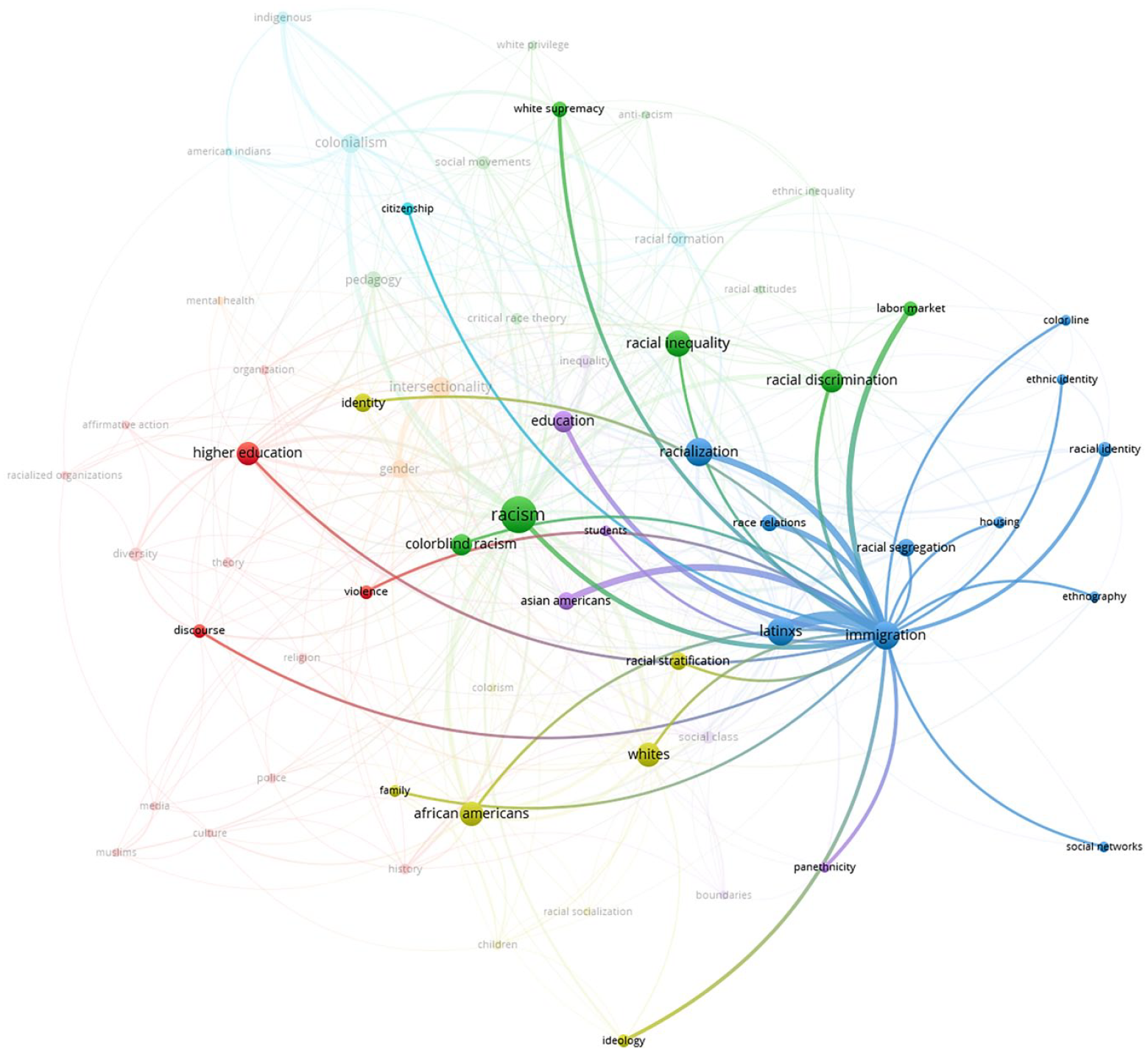
Sociology of Race and Ethnicity Network Visualization of Keywords 2015 – 2023, “Immigration” Cluster
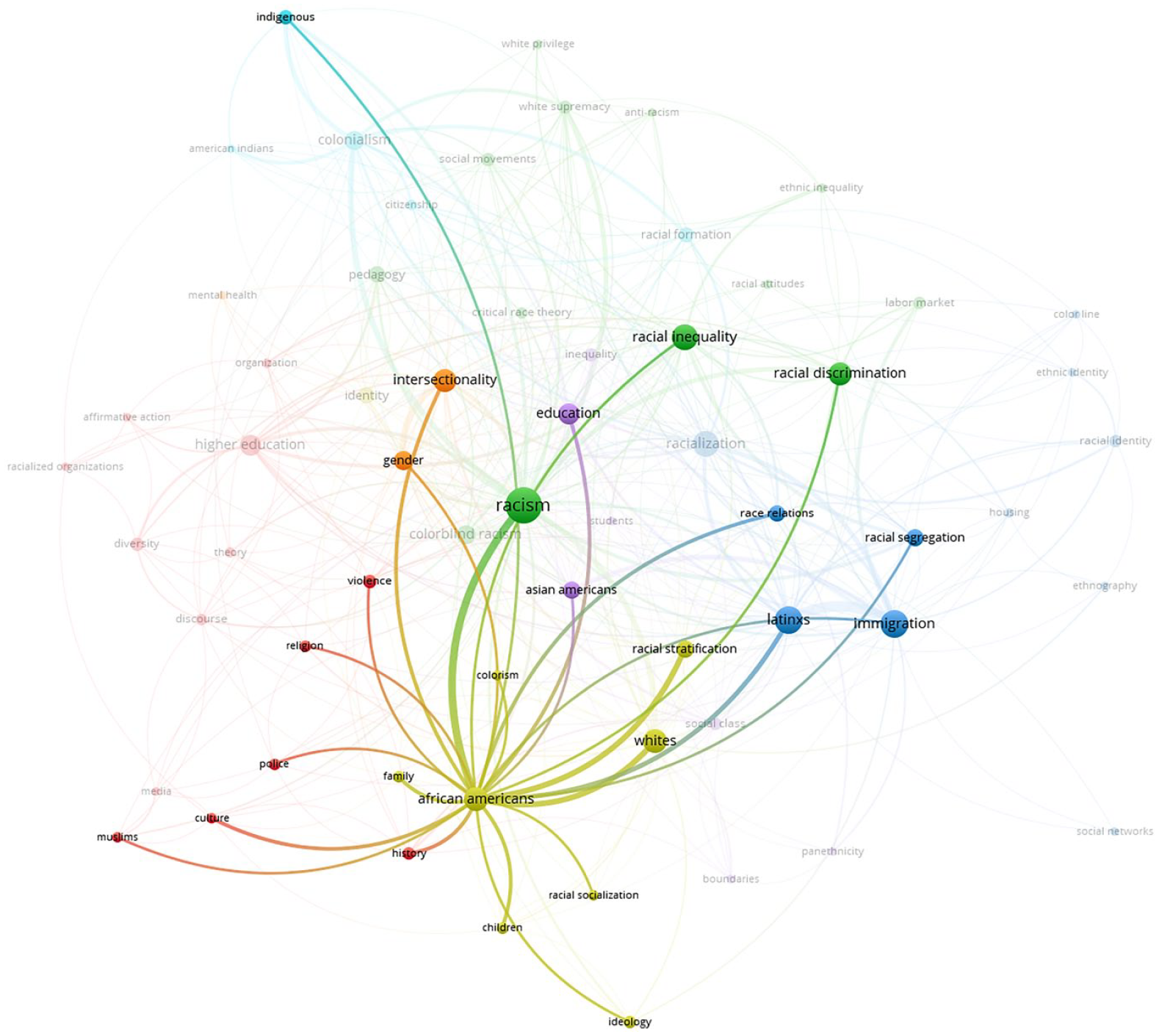
Sociology of Race and Ethnicity Network Visualization of Keywords 2015 – 2023, “African Americans” Cluster
Focusing on Figure 3 first, “racism” most often appears alongside the keywords “colorblind racism,” “racial inequality,” and “racial discrimination.” Yet more than perhaps any other keyword, “racism” provides links, or pathways, to a wide range of other keywords, including those within other clusters like “higher education,” “colonialism,” and “African Americans.” This suggests, again, that racism has remained a central concern for sociologists of race and ethnicity over the past decade and serves as an important vehicle through which to examine many other social phenomena.
A close examination of Figures 3 and 4 also indicates a significant connection between the keywords “immigration” and “racism,” with bridges to “racial discrimination,” and to “racial inequality” by way of “racialization.” Meanwhile, though the keyword “African Americans” has fewer network paths than either “racism” or “immigration” (see Figure 5), it too demonstrates strong connections to other keywords, including “racism,” “immigration,” and even “intersectionality.” We highlight these clusters for both interpretive and illustrative reasons. First, they map the wide diversity of some of the field’s most popular subareas. For example, scholarship on racism ranges from work on “racial attitudes” (see Hamilton, Hartmann, and Larson 2022) and “colonialism” (see Steinmetz, Schaefer, and Henderson 2017) to work that examines the experiences of various racial and ethnic groups (see Yamashita 2022 or Irizarry, Monk, and Cobb 2023) across several national contexts (see Pirtle 2021 or Heinrich 2020). Second, Figures 3, 4, and 5 are representative of the varied and complex trends in other subareas and, thus, can inform interpretation of other clusters in the analysis.
This Issue
Sociology of Race and Ethnicity publishes editorials, research manuscripts, book reviews, pedagogy essays, and Conversations pieces. This issue includes each of these, beginning with the present editorial, followed by a selection of research manuscripts that span the following themes—racial domination in global contexts, racialized organizations, and multi-racialism. Beyond these, the issue includes a Pedagogy Feature, “10-Year Reflection and the Future”; several book reviews; and a special symposium on Aníbal Quijano: Foundational Essays on the Coloniality of Power.
Pedagogy Feature
Attacks against teaching the truth about racism continue to proliferate. 6 And still, many scholars are engaging people beyond academia while others are taking up the call to teach Life Studies 7 , centering critical race counterstories and taking problem-posing approaches (Yosso 2006). In “Students Want to Build Anti-Racist Praxis: How to Support Them in the Classroom with Grassroots Organizers,” Dr. Jessennya Hernandez describes her efforts to bring grassroots organizers into the classroom as knowledge producers who can motivate students into action. The two other pieces in this section engage populations outside of the classroom setting. In The “People’s Tour” as Conflict Pedagogy—Using Site Visits to Engage Students with the Struggle for Civil Rights, Dr. Daniel Rose describes his efforts to incorporate site visits into an urban sociology class in North Carolina. Finally, Dr. Jarvis R. Givens and Zenzile S. Riddick focus on the continuing need for a “fugitive pedagogy” in K–12 teaching and beyond to “infuse teacher education and professional development with critical scholarship on Black life and culture.”
Quijano Symposium
On the occasion of a new Duke University Press compilation of three decades of writings by Anibal Quijano—titled Aníbal Quijano: Foundational Essays on the Coloniality of Power—the journal invited five scholars to reflect on the legacy of this overlooked but prominent theorist of colonization. In “Aníbal Quijano’s Critical Sociology: From Dependency Theory to Coloniality,” Simeon J. Newman introduces readers to Quijano’s impressive scope of writings, including some essays not included in the Duke University Press volume. In “Anibal Quijano: Against the Shackles of the Eurocentered Worldview,” Francisco Gonzalez Camelo considers Quijano’s critique of two epistemological frameworks: the first hegemonic (liberalism) and the second counter-hegemonic (historical materialism). In “Learning to Unlearn, Teaching to Unlearn: A Coming-of-Age Story with Aníbal Quijano,” Veda Hyunjin Kim reflects on Quijano’s influence on his understanding of his native South Korea. In “Political and Vital: Reflections of a Graduate Student on Aníbal Quijano,” Nabila Islam documents how Quijano’s framework for a coloniality of power can help explain the comparatively severe treatment that immigrants from Latin America and the Caribbean face in the U.S. legal system. Finally, Alke Jenss offers a comprehensive review of the new volume itself, showing it to be of great use to readers who are both new to the Peruvian theorist and more seasoned scholars of Quijano.
The issue concludes with a conversation on the past, present, and future of Black sociology with scholars Kalasia Ojeh, Marcus Brooks, and Early Wright II.
Conclusion
In this introduction to Volume 10, Issue 4, we examined the first 10 years of SRE’s publication history, with an eye toward understanding how the journal has shaped sociological research on racism, race, and ethnicity. What are our publication trends thus far? What might those trends indicate not just about the state of our field over the last 10 years, but also the field’s future? A keyword analysis reveals that research that centers higher education, immigration, and colonialism are among the most common within the journal to date. Likewise, the most widely cited research published in SRE over the past decade is research focused on place, immigration, and theorizing the mechanisms through which contemporary racism is produced and maintained. Finally, much of the research published in SRE to date is U.S.-based, reflecting perhaps SRE’s status as the journal of the ASA’s SREM. Yet many of the journal’s research articles have as their specific focus the American South. Here, many of the broader changes and challenges to the U.S. landscape are brought into sharp relief.
As the editorial team, we have the privilege of seeing the state of our field from 30,000 feet, so to speak. From our view, the sociology of race and ethnicity is thriving. The first 10 years of the SRE’s pages demonstrate continued success in meeting its mission to publish high-quality, cutting-edge research on race and ethnicity from a wide range of perspectives and orientations. We stand alone as the only academic journal in the social sciences with a dedicated Pedagogy section for showcasing how to bring our knowledge and understanding of race and ethnicity into our classrooms. And, our Book Review section and its featured symposia continue to provide the journal’s readership with important commentary and stimulating debates taking place within our field. We are proud of SRE’s first 10 years, and we look forward with great anticipation to the journal’s next decade of continued growth and success.