




Abstract
This study uses the COM-B framework, which conceptualizes Behavior change as shaped by Capability, Opportunity, and Motivation, to examine how teachers in rural Lesotho integrated an offline digital library into their instructional practice over a 3-year period. Drawing on 60 interviews, we identify how increases in digital and information literacy capabilities, supportive physical and social opportunities, and both reflective and automatic motivation shaped teachers’ adoption and sustained use of the library. Participants described greater confidence with technology, improved access to instructional resources, and encouragement from peers and school leaders, which they reported contributed to shifts in lesson planning, classroom instruction, and collaboration. Although the analysis centers on COM-B, we also note teacher-reported outcomes such as improved student understanding, engagement, and digital skills, which appeared to reinforce continued use. The study contributes to research on teacher behavior change in the Global South and offers insights into conditions that support meaningful technology integration in low-resource contexts.
Keywords
Introduction
The integration of Educational Technology (EdTech) into teaching practice holds significant promise for improving learning outcomes, particularly in under-resourced contexts. Yet, realizing this potential depends on meaningful behavior change among educators, a process that is often underestimated in complexity and insufficiently explored in the education literature (Ames, 2019; Badran et al., 2021; Cuban et al., 2001; Mora et al., 2018; Yanguas, 2020). EdTech broadly refers to digital tools and systems designed to support teaching and learning. In this study, we focus specifically on offline, teacher-mediated digital resources in low-resource settings. As several scholars have noted, access alone is not enough: technology that remains unused cannot improve educational outcomes (Ames, 2019; Cuban, 2018; Kizilcec et al., 2021). This article presents a 3-year embedded single-case study of SolarSPELL, an offline digital library initiative implemented in 44 rural primary schools across Lesotho, a small, mountainous country in southern Africa. This research contributes to the limited body of literature on teacher behavior change in EdTech initiatives in low-resource environments, offering insights from an underrepresented context where such studies remain scarce.
The study draws on qualitative data from semi-structured interviews to explore how teachers engaged with new EdTech in an under-resourced setting, with a specific focus on behavior change. The embedded case study design allowed for an in-depth examination of a single intervention across multiple school sites, capturing how local conditions, educator experiences, and institutional environments influenced technology uptake. To guide the analysis, we apply the COM-B model, a behavior change framework originally developed in public health and increasingly used across disciplines, to understand the conditions under which behavior change is likely to occur.
Lesotho Educational Landscape
Lesotho is a lower-middle-income country with a population of approximately 2.3 million people and a per capita GDP of approximately US$951 as of 2023 (World Bank, 2025a). Lesotho has a “persistently high” unemployment rate, hovering near 16% (World Bank, 2025a). Due to unemployment and the country’s proximity to a much larger economy, South Africa, many Basotho (people of Lesotho) immigrate for work. Thus, remittances account for nearly one quarter of Lesotho’s GDP (23%) and are a major source of household income commonly used to cover basic needs (World Bank, 2025b). Over the past 2 decades, Lesotho has made notable investments in education, allocating approximately 7% of its GDP to education, well above the regional average (Bertelsmann Stiftung, 2024). Primary education is free and government-funded, and learners also benefit from school meal programs supported by the United Nations Children’s Fund (UNICEF), a key mechanism for promoting attendance in a country where nearly one-third of the population faces food insecurity (World Food Programme, 2025).
Despite progress in educational access, quality remains a critical challenge. Learning outcomes in literacy and mathematics are among the lowest in the region. Pre-pandemic, around 45% of children aged 7 to 14 demonstrated core reading proficiency and just 15% met foundational mathematics benchmarks (UNICEF, 2025). Pandemic-related school closures exacerbated these challenges and contributed to further learning loss, especially for students in rural and under-resourced schools, where remote learning was largely inaccessible (Makumane & Mpungose, 2022). The widespread digital divide, defined by unequal access to infrastructure, skills, and benefits, continues to limit effective technology integration, particularly outside of urban centers (Khumalo, 2025; Makumane & Mpungose, 2022). Lesotho has also received limited attention in educational impact evaluations compared to other Sub-Saharan countries such as Kenya, Uganda and Ethiopia (Ravat & Engelbert, 2023).
Lesotho’s education system spans early childhood education through senior secondary school, guided by a national curriculum policy that emphasizes inclusive, competency-based learning, as well as the integration of digital resources, where feasible (Lesotho Ministry of Education and Training, 2021; Makumane & Mpungose, 2022). However, implementation of these goals remains uneven due to infrastructural and training constraints (Makumane & Mpungose, 2022). In the Lesotho Ministry of Education and Training’s (2021) Basic Education Curriculum Policy, digital literacy skills are highlighted as one of the seven core competencies they are seeking to build amongst students to prepare them to thrive in the 21st century. However, as of 2023 only 45% of rural populations had access to electricity, compared to 85% of urban populations (World Bank, 2025b). Internet penetration has a similar disparity, with 43% of rural populations using the internet, compared to 77% of urban populations (Lesotho Communications Authority, 2023). This presents challenges for EdTech interventions that rely on such infrastructure.
This study seeks to examine patterns in self-reported teacher engagement with an EdTech intervention designed for off-grid and offline use in Lesotho. In doing so, it provides insight into the intersection of national policy ambitions, practical implementation realities, and the behavioral dynamics that shape meaningful technology use in schools, offering insights that may be relevant both locally and for comparable contexts.
SolarSPELL Digital Libraries in Lesotho
The SolarSPELL Initiative is an offline digital library and skills-building initiative based at Arizona State University. It provides localized, open-access educational resources in areas with limited or no internet connectivity. Its four-part approach includes curation of contextually relevant content, development of library hardware and software, delivery of capacity-building training for educators, and monitoring and evaluation. The Southern Africa Education collection being used in Lesotho contains a curated collection of multimedia educational materials spanning multiple subjects and grade levels, including text-based resources (e.g., lesson plans and books), audio and video files, and interactive HTML content. Materials are selected to align with local curricula and linguistic contexts, and are designed to support lesson preparation, classroom instruction, and student-centered learning. Ongoing content curation is informed by monitoring and evaluation, with teacher feedback and requests playing a central role in shaping updates and additions to the library (Al-Khmisy et al., 2023; Farrell et al., 2024).
SolarSPELL’s approach centers partnerships with locally-operating organizations that provide crucial support on training and implementation. One such partnership is with the Peace Corps, where American volunteers spend 2 years serving in rural communities in sectors such as education, health, community economic development, and environment, at the invitation of the host country government. In all cases, Peace Corps Volunteers (PCVs) are paired with a local counterpart for the duration of their service in-country. In Lesotho, PCVs in the education sector serve as key facilitators of SolarSPELL library integration and teacher training in local schools. Training is a key component of SolarSPELL’s approach, with both PCVs and counterparts (local teachers) participating in a multi-day Train-the-Trainer (TTT) workshop focusing on knowledge and skills needed to successfully introduce the digital libraries to their schools.
In partnership with Peace Corps and by invitation from the Lesotho Ministry of Education and Training, SolarSPELL libraries have been implemented in 44 rural schools across Lesotho, along with training to help educators meaningfully integrate digital tools into their teaching practices. The initiative’s design draws on prior research demonstrating the importance of pairing offline access with locally relevant content and training (Hosman et al., 2020). The research is guided by two primary questions:
(1) How did teachers in Lesotho engage with SolarSPELL’s offline digital library following its introduction in their schools?
(2) In what ways do the COM-B components help explain the conditions that enabled or constrained teachers’ behavior change in integrating digital resources into their pedagogy?
By examining these questions, the study contributes to the growing body of research on EdTech in low-resource settings. The study also offers practical insights into how targeted interventions can catalyze sustained behavior change among educators in underserved contexts.
Related Work
Educational Technology in Low-Resource Contexts
EdTech is a broad and continuously evolving concept, spanning a wide range of technologies and approaches. At its core, EdTech is the design, creation, and use of Information and Communications Technology to facilitate teaching and learning (Badran et al., 2021; Januszewski & Molenda, 2008). Research on teachers and EdTech spans several well-developed strands, including studies on technology adoption and integration, teacher professional development and instructional support, impact evaluations of EdTech interventions, and research on teacher perspectives and motivation. Across these strands, a consistent finding is that access to technology alone is insufficient to improve teaching and learning; rather, meaningful use depends on how teachers adopt, adapt, and sustain engagement with these tools (Amemasor et al., 2025; Cuban, 2018; Cuban et al., 2001; Hosman & Pérez Comisso, 2020; Rodriguez-Segura, 2022).
The COVID-19 pandemic accelerated global attention to EdTech, as school closures forced a rapid and widespread shift to remote and hybrid learning. This global jolt exposed both the potential of digital tools and the deep inequities in access to infrastructure, devices, and connectivity, particularly in low-resource contexts (Crompton et al., 2021; Farrell et al., 2024; Jordan et al., 2021; Rodriguez-Segura, 2022). While many education systems adopted, or attempted to adopt, technology at unprecedented scale, evidence from this period reinforced that teacher capacity, support, and contextual enablers remain central to effective use (Pokhrel & Chhetri, 2021). Subsequent findings that the hurried shift to EdTech during the pandemic adversely impacted educational access, quality, equality, and outcomes across most global contexts (West, 2025) has only intensified debates around EdTech implementation and underscored the importance of understanding how teachers engage with and sustain the use of digital tools in practice.
One prominent strand of EdTech research focuses on low-connectivity technologies such as SMS, WhatsApp, and offline platforms to support learning in resource-constrained environments. A scoping review of digital communication tools in low- and middle-income countries identified three primary uses: supporting student learning, enabling teacher professional development, and facilitating education in crisis or displacement contexts (Jordan, 2023). Related work on mobile learning has long emphasized the importance of designing technologies that are accessible, low cost, and adaptable to local contexts. Research on mobile learning in developing countries highlights how digital literacy practices and technology use are shaped by local environments, underscoring the importance of contextually grounded design and implementation (Traxler, 2018). Recent work similarly highlights both the potential and the persistent challenges of mobile learning in resource-constrained settings, including infrastructure limitations and uneven implementation (Ugwu et al., 2025).
A second strand centers on teacher professional development and instructional support for technology integration. A recent systematic review of teacher professional development for digital instruction found that effective programs consistently include hands-on engagement with technology, collaborative learning, ongoing mentorship, and alignment with teachers’ existing practices (Amemasor et al., 2025). The review further emphasizes that ongoing support is critical for translating access into meaningful classroom use, and that one-off training is rarely sufficient to produce lasting change. In a systematic review of 170 studies in low- and middle-income countries, Hennessy et al. (2022) similarly found that technology-only interventions are less effective than those paired with pedagogical support and training. These findings align with a broader body of work showing that teachers are more likely to adopt and sustain use of EdTech when they receive continuous support and opportunities to experiment and reflect (de Barros et al., 2024; Hosman & Cvetanoska, 2013; Piper et al., 2018; Wood et al., 2024).
Research on technology adoption consistently highlights persistent gaps between access and meaningful, sustained engagement. Studies across contexts show that even when digital tools are available, they are not always used in ways that meaningfully impact instruction, due to a combination of individual, institutional, and infrastructural factors (Badran et al., 2021; Cuban et al., 2001; Kizilcec et al., 2021; Pouezevara et al., 2014). This “access versus use” gap underscores the importance of understanding not just whether technology is available, but the factors that influence how and why teachers choose to engage with it.
While this body of research highlights the diversity of EdTech approaches and the complexity of implementation in low-resource settings, less attention has been given to how teachers adopt and sustain use of offline digital libraries over time, particularly through a behavior change lens. This study builds on existing work by examining teacher engagement with an offline digital library in a resource-constrained context, with a specific focus on the behavioral mechanisms that support or constrain sustained use.
Behavior Change in Educational Contexts
Teacher behavior change through technological and pedagogical interventions is most effective when teachers have the skills to engage, opportunity to practice, and the motivation to overcome barriers. These conditions, however, are rarely perfectly met and difficult to design for. Behavior change in educational contexts has been researched globally, with mixed findings. In Kenya, a national literacy program called Tusome (Let’s Read) achieved significant improvements in early grade literacy by providing universal teacher training models, regular support, and reinforcing targeted behaviors, making it one of the most cited large-scale education reforms in Sub-Saharan Africa (Piper et al., 2018). Similarly, a mixed‑methods study conducted in Zambia reported that teachers receiving on‑site peer coaching adopted new practices through group-based problem solving, peer learning, and mentorship, while teachers with identical resources but no coaching did not, highlighting the importance of social support (de Barros et al., 2024). By contrast, in India, a study aimed at complementing teachers’ regular instruction with curriculum‑based videos led to lower mathematics scores and reduced instructional quality, illustrating that not all technological interventions generate positive outcomes (de Barros, 2023).
Technological interventions in education are implemented in complex environments with multiple interacting variables. These variables range from individual factors, such as teachers’ skills, confidence, and motivation (Zee & Koomen, 2016), to broader cultural, political, and infrastructural conditions. For example, even in well-resourced contexts, teacher perceptions and expectations can influence how innovations are implemented and who benefits from them (Cimpian et al., 2016). After Egypt’s 2017 ICT reforms, three‑quarters of secondary schools were equipped with smartboards; yet 83% of teachers cited slow internet as a primary barrier, and only 40% felt they had the skills to guide students through digital environments (Badran et al., 2021). In addition, external shocks such as political unrest, labor disputes, natural disasters, and public health crises can further disrupt implementation (Angrist et al., 2020; Farrell et al., 2024; Kizilcec et al., 2021).
The real world rarely presents scientific lab-level conditions for study, yet these are the conditions in which teachers educate. In the Global South, challenges such as limited resources and infrastructural constraints make the introduction of technological interventions particularly complex, but also particularly valuable to study, as they reveal approaches that are effective and transferable.
The COM-B Model: Origins and Educational Applications
The COM-B model was first introduced by Michie et al. (2011) to better map evidence-based behavior change interventions in an array of contexts. COM-B consists of Capability, Opportunity, Motivation and Behavior change. Capability is the individual’s psychological and physical capacity to engage in the activity, including the necessary knowledge and skills. Opportunity makes up external factors that enable or constrain the targeted behavior. Motivation is defined as the processes that empower and direct behavior, which includes emotional responses as well as analytical decision-making. Behavior change is defined as the observable actions or practices that emerge as a result of an intervention.
This model frames Capability, Opportunity, and Motivation as factors that generate Behavior change. As Michie et al. (2011) emphasize, the components of COM-B are interconnected, with feedback loops integrated to show reinforcing components (see Figure 1). For example, repeated engagement in Behavior can, in turn, increase Capability over time, while Opportunities in the environment and Capabilities can influence Motivation (Michie et al., 2011). This systems view illustrates how Behavior both arises from and reinforces the COM elements.

The COM-B model of behavior change.
The COM-B model has become widely recognized in public health research, while adoption in education and application to digital interventions has only recently emerged (Khalilollahi et al., 2023). Toro‑Troconis et al. (2021) used COM-B to map faculty adoption of VR modules in the United Kingdom, and Peiris et al. (2023) applied the COM-B model to better understand the impact of an intervention involving in-class physical activity breaks in Sri Lankan schools. Recent applications of COM-B and related frameworks have also emerged in school-based physical activity research, including studies on teachers’ intentions to implement inclusive physical education and children’s outdoor play behavior (Khalilollahi et al., 2023; Tristani et al., 2022). These examples highlight the model’s versatility, but also underscore how little it has been employed in low-resource, technology-focused educational interventions such as the one studied here.
To date, COM-B has primarily been used in pre-intervention design in the Global North (e.g., Daly-Smith et al., 2021; Toro‑Troconis et al., 2021). One notable exception is Peiris et al. (2023), who applied the model in a Global South context (Sri Lanka). More broadly, recent evaluations of behavior change interventions in education in the Global South have relied on frameworks that, like COM-B, emphasize the role of individual capacity, external opportunities, and motivational factors in shaping behavior. For example, Angrist et al. (2020) and Badran et al. (2021) highlighted infrastructural and institutional opportunities as key determinants of technology use, while de Barros (2023), de Barros et al. (2024), and Wu et al. (2022) underscored the importance of teacher capabilities, motivation, and peer support. In sum, while COM-B has demonstrated versatility across disciplines, its application in education, particularly in Sub-Saharan Africa, remains largely unexplored.
Methods
This study employs a single-case embedded design (Yin, 2018), in which the implementation of the SolarSPELL digital library in Lesotho functions as the overarching case, and the individual implementation sites (represented by teachers and PCVs across participating schools) serve as embedded units of analysis. Although the present study does not engage in direct comparison between PCV and teacher responses, the inclusion of multiple respondent types provides a fuller picture of the intervention’s impact across roles and settings. Data were collected through semi-structured interviews, enabling rich, context-sensitive insights into how locally specific capabilities, opportunities, and motivations shaped behavior change. This design supports the study’s goal of building grounded theory from real-world implementation, while remaining bounded within a single intervention context.
To investigate this embedded single-case study, we employed a qualitative data analysis approach, drawing on semi-structured interviews to examine teacher behavior change and its resulting outcomes following the introduction of EdTech in a low-resource setting. Data collection took place during in-person TTT workshops that took place every 6 months between January 2023 and January 2025. Each January, libraries were distributed and a new cohort of teachers had their preliminary training, and in July of each year they returned for a refresher workshop where follow-up interviews and surveys were administered after the libraries had been in use for 6 months. The training model is based on a TTT approach, which has been successfully applied in both educational and agricultural contexts using SolarSPELL digital libraries (Hosman & Nova, 2025). The focus of this article is on the qualitative data that was collected during follow-up workshops.
The study population comprised local teachers and PCVs working in rural primary schools in Lesotho. Each school had applied to host a PCV years in advance, a process entirely independent of the SolarSPELL Initiative. Participation in the SolarSPELL library project included all schools hosting a Peace Corps education volunteer. Each school was represented by the PCV and a local counterpart teacher, both serving as fourth-grade instructors. Thus, the selection of participating schools, PCVs, and teachers occurred outside the scope of this implementation. All schools also participated in the follow-up data collection. While all participating schools received a SolarSPELL library, access to devices used to connect to the library (e.g., smartphones, tablets, or computers) was not uniform. Teachers often relied on a combination of personal and shared devices, and access was shaped by local constraints such as device availability and electricity. Use of the SolarSPELL library was not mandated. Rather, teachers were encouraged to integrate the library into their practice through training, ongoing support from PCVs, and engagement from local Peace Corps staff and school leadership. In this context, PCVs played an ongoing facilitative role, supporting teachers in using the library, modeling instructional strategies, and providing informal encouragement and troubleshooting support. There were no formal accountability mechanisms tied to usage.
Between January 2023 and January 2025, the SolarSPELL team conducted 60 interviews with 46 participants (23 PCVs and 23 teachers) from the participating schools. The number of interviews exceeds the number of participants because data collection occurred at multiple time points aligned with the project’s training cycle. Interviews were conducted during follow-up workshops approximately 6 and 12 months after the initial implementation. As a result, all participants were interviewed at the 6-month mark, and some participants were able to participate in interviews again during subsequent workshop sessions. As this study relies on self-reported interview data, the analysis reflects participants’ perceptions and experiences of using the SolarSPELL library rather than direct observation of classroom practice or external measures of student outcomes (such as grades or standardized tests).
Interviews were thematically coded using a combination of deductive and inductive coding using Dedoose software. Deductive coding was used to identify components of the COM-B model as they translated to this project: for example, Information Literacy and Digital Literacy were coded to capture participants’ capabilities, while express references to increased access to information were coded to capture opportunity, and so forth (see Table 1 for a detailed list of COM-B domains and associated codes). While the COM-B framework provides a useful lens for organizing the behavior-influencing factors identified in this study, it does not capture all possible influences on teacher behavior. Nonetheless, it offers a comprehensive structure for understanding the primary factors shaping engagement in this context.
COM-B Domains and Associated Qualitative Analysis Codes

During this process, more than 1,500 excerpts were tagged by a qualitative analysis team comprising university faculty, staff, and interns. To ensure inter-rater reliability, each interview was coded independently by two blinded coders and reviewed by a third. The team met weekly throughout the coding process to refine the codebook, discuss emergent findings, and resolve discrepancies. This structured and collaborative approach was sustained across the multi-year analysis period to support consistency and analytical rigor over time.
The authors are affiliated with the SolarSPELL initiative and have been involved in its design, implementation, and evaluation across multiple low-resource contexts globally, including in Sub-Saharan Africa and through direct work in Lesotho during the implementation period of this study. This included delivery of training workshops and ongoing engagement with PCVs and local counterpart teachers. The research team included members with varying levels of direct field experience in Lesotho. This provided contextual knowledge of the intervention and its implementation, but also introduced the potential for bias in data interpretation. To mitigate this, the study employed structured qualitative analysis procedures, including independent coding by multiple researchers, regular team-based codebook refinement, and the use of both inductive and deductive approaches. The inclusion of both local teachers and PCVs as participants also allowed for multiple perspectives on the intervention. These steps were taken to reduce the influence of researcher preconceptions.
All data collection tools were approved by the home university’s Institutional Review Board, and all participants provided informed consent for participation. Confidentiality and data security procedures were followed.
Findings
This embedded single-case study applies the COM-B model to qualitative interview data to examine the conditions that shaped teachers’ engagement with the SolarSPELL offline digital library in rural Lesotho. By analyzing how Capability, Opportunity, and Motivation influenced Behavior change, the case study reveals how educators navigated the introduction of digital tools in an under-resourced environment. While situated within a specific intervention, the findings provide transferable insights into the behavioral dimensions of EdTech integration, particularly in low-infrastructure contexts where support for sustained use is often limited.
Due to the sheer mass of qualitative data (a total of 1,578 excerpts thematically coded from the 60 interviews), we will describe the themes we saw in the interviews and a select few illustrative examples.
Capability
As described in the related work section above, to engage in any behavior change, one must have the prerequisite capabilities or skills required of that behavior change (Hoque, 2020). In this case, the target behavior change is the adoption of EdTech (namely, the SolarSPELL digital library) to support teaching and learning. Through qualitative data analysis, three main capabilities were identified as key prerequisites: digital literacy, information literacy, and pedagogical integration skills. In order to turn on, connect to, and navigate the SolarSPELL library, users must have basic digital literacy skills of how to operate devices such as smartphones (the device used by 80% of SolarSPELL users to connect to the library), tablets, or computers, and how to navigate a website and perform a search. Once connected to the library, users must also have the information literacy skills to recognize what information they need, find it among the tens of thousands of resources in the library, evaluate if it’s the right resource for that circumstance, and finally use it in their teaching. This is related to, but distinct from, digital literacy as it is a skillset that applies to both digital and non-digital information. Lastly, teachers must have the pedagogical integration skills to know how to align the contents of the SolarSPELL library to the curriculum, and the ability to integrate digital content into classroom use or lesson planning.
Digital literacy emerged as a foundational capability that enabled the local teachers and PCVs to effectively engage with the SolarSPELL library contents. While some of the local teachers described initial fear or uncertainty around technology in general (what Wu et al [2022] call “technostress”), many also expressed that they were able to use the SolarSPELL library due to the platform’s easy-to-use design and offline capabilities. Participants described how repeated engagement with the SolarSPELL library contributed to increased confidence and digital literacy over time. One local teacher said: “Because I regularly use the SolarSPELL that has removed the phobia of the technology. Yes, now I’m up to the challenge of any technology.” These accounts, particularly among local teachers with generally lower baseline digital literacy skills than the PCVs, illustrate how their capabilities developed through continued exposure and use, thus contributing to the virtuous circle wherein engaging in the target behavior change increases capabilities, which reinforces the behavior change, and so forth. These examples illustrate that digital literacy, often overlooked or assumed in EdTech design, cannot be taken for granted. Furthermore, they highlight the importance of designing tools that are not only easy to use, but actively foster digital skill development through repeated use and interaction.
Information literacy skills, defined as the ability to recognize, find, evaluate, and use information (American Library Association, 2006), represented a second key capability, distinct from but complementary to digital literacy. Library users must draw on these skills to determine specific information needed and then locate it from among thousands of library resources, determining which resource suits their situation best (i.e., deciding whether to use a video, audio, or text file) and then using it effectively in their lesson preparation or classroom teaching. Given the breadth and depth of this competency, information literacy was the most frequently observed capability in the qualitative data, accounting for the highest number of coded excerpts (603 distinct applications). Participants reported using the SolarSPELL library to identify teaching materials to supplement or enhance their lesson and engage in personal learning (see Table 2). The development of information literacy enabled users to engage with digital content and enable their learners to do the same.
Capability Excerpts
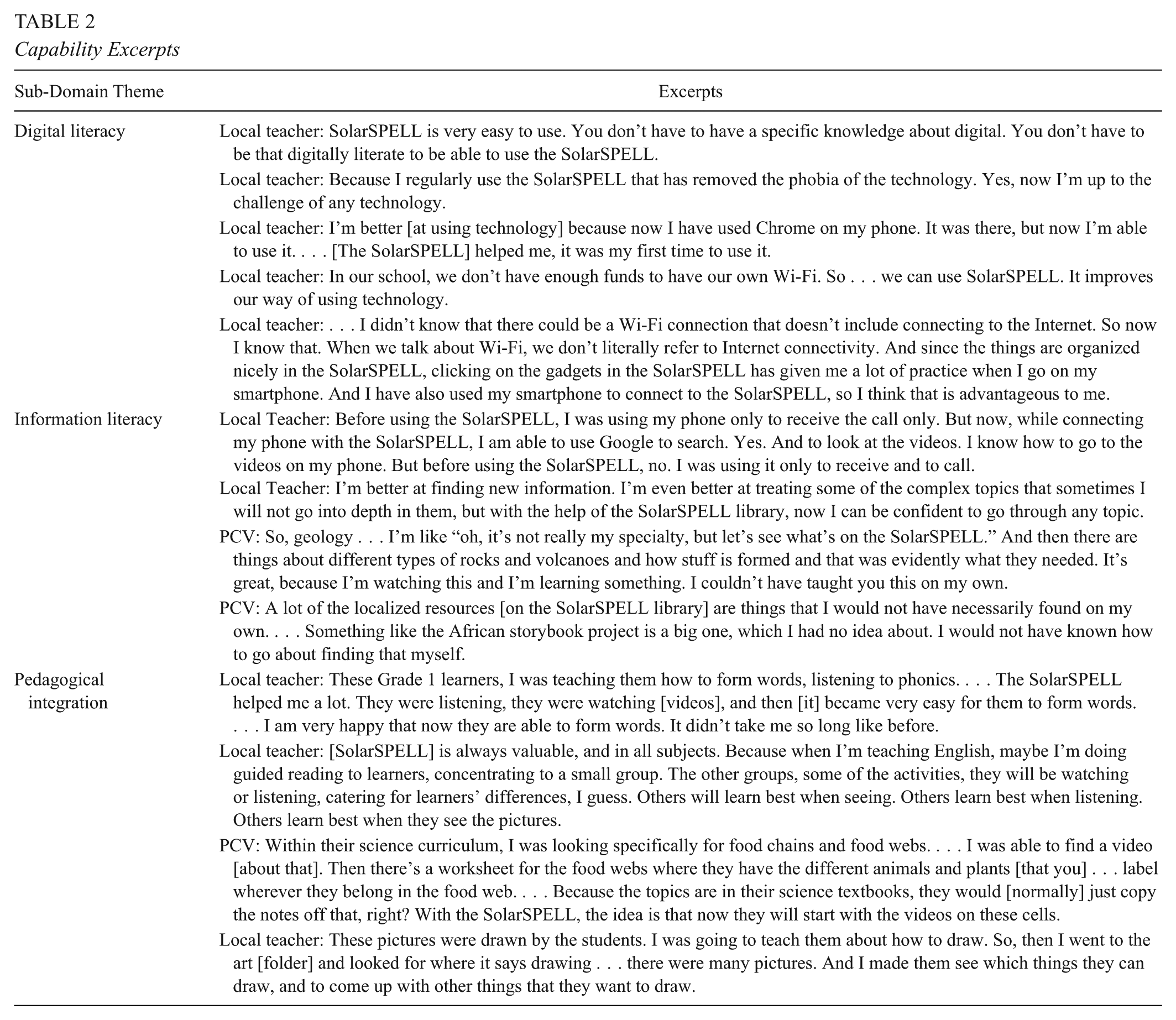
The third key capability is pedagogical integration, or teachers’ ability to connect the digital library’s contents with learning goals and integrate them into classroom practice. Many participants described using SolarSPELL to support lesson planning and interactive classroom instruction (see Table 2). For example, teachers used the library to introduce multimedia elements, accommodate different learning styles, and expand their own content knowledge in areas outside their expertise. One PCV described using the SolarSPELL library to change the way they taught a science lesson: Within their science curriculum, I was looking specifically for food chains and food webs. . . . I was able to find a video [about that]. Then there’s a worksheet for the food webs where they have the different animals and plants [that you] . . . label wherever they belong in the food web. . . . Because the topics are in their science textbooks, they would [normally] just copy the notes off that, right? With the SolarSPELL, the idea is that now they will start with the videos on these cells.
In settings where teaching resources are scarce, the ability to integrate digital resources into instructional practice is particularly valuable. Teachers’ reports of their pedagogical integration of the SolarSPELL resources pointed to more dynamic, varied, and interactive classroom instruction.
Although presented here as distinct components, these three capabilities often developed in tandem, overlapping and reinforcing one another. Improvements in digital literacy made it possible for users to explore a wider range of content, while information literacy supported purposeful engagement with that content. Pedagogical integration, which conceptually overlaps with the fourth step of information literacy (the meaningful use of information), enabled teachers to use SolarSPELL resources as powerful teaching tools. These examples highlight how EdTech tools can facilitate intersecting skill development, and how user capabilities evolve dynamically through practice and exploration.
Opportunity
In order for behavior change to take place, participants must have the conditions and resources necessary to engage in the target behavior. We identified access to the SolarSPELL library as the baseline opportunity that enabled behavior change within the target environment. Beyond this baseline intervention, additional environmental and social enablers and constraints shaped the opportunities teachers had to integrate the SolarSPELL library into their pedagogy.
The presence of SolarSPELL libraries at participating schools functions as the baseline intervention, providing free access to a locally curated, offline collection of teaching and learning resources. This represents a shift from scarce opportunities to access educational resources, especially in a digital format, to drawing on a large, high-quality library collection containing resources in multiple formats. Both PCVs and local teachers reported that the breadth and localization of content better matched students’ diverse learning needs. In our thematic analysis, the parent code “content” captured references to any library material, with child codes for more granular identification of the content accessed, including “type” to indicate whether the resource accessed was a text, audio, or video file (see Table 1). This analysis highlighted which types of content teachers found most useful in their baseline use of the library. Teachers noted that the SolarSPELL library offered a wide range of resources that spanned literacy levels in multiple languages, allowing them to better support the diverse abilities within their classrooms. In sum, the availability and range of resources on the SolarSPELL library established a baseline opportunity for behavior change in the classroom.
Physical opportunity includes the environmental enablers and constraints that shape library use. In this case, the most prominent environmental factors were the availability of devices to connect to the library (i.e., smartphones) and the electricity needed to power them. The SolarSPELL libraries contain an integrated solar power system, but the phones, tablets, and computers that connect to it require external power to charge. Some teachers expressed that a lack of electricity access was a persistent barrier for charging these external devices, with one teacher noting that it was especially difficult with tablets that take longer to charge. As one PCV explained: “My school’s rural with no electricity. . . . Charging lots of devices . . . was much more difficult.” Furthermore, consistent access to an adequate pool of devices posed a challenge for day-to-day lesson integration; however, many teachers noted that students were highly adaptable and open to sharing, often gathering in large groups around a single device, making limited resources more manageable in practice. Looking ahead, some teachers shared their ideas for further expanding the physical opportunity to engage with the SolarSPELL library content by procuring projectors and speakers, enabling digital content to be more accessible in large classes. Where dedicated computer labs or physical/traditional libraries were absent, educators improvised with available classrooms and equipment such as tablets and speakers, reflecting the innovative behaviors described by Wu et al. (2022). These findings illustrate how physical opportunities set the practical conditions for engaging with the SolarSPELL library.
Social opportunity comprised the norms, relationships, and institutional supports that encouraged and sustained SolarSPELL use. Teachers described how school leaders, including principals and school boards, played an important role in promoting library adoption by organizing training and community discussions, creating institutional support for its integration. Further community support was built via demonstrations of the offline library to the parents, which reassured them that students could access the library without using (expensive) data or connecting to the internet, thus increasing parents’ willingness to let their children bring devices to school. Teachers noted that these collective efforts fostered acceptance of SolarSPELL within the wider community. For example, one local teacher described how they addressed parents’ concerns about data usage by explaining how devices could be used in flight mode: “I said: ‘No. Because we are going to make the flight mode, no messages will be there. Even from home, just [put the phone into] flight mode from home to school so that nothing can disturb the learner.’”
Social support in the form of peer collaboration amongst teachers further expanded opportunity, as teachers shared and rotated devices, co-taught lessons, and shared best practices. Furthermore, SolarSPELL libraries became a popular feature of afterschool clubs, where students of all ages were eager to participate. These interacting social dynamics strengthened community buy-in and normalized use of the SolarSPELL libraries in and out of the schools (see Table 3).
Opportunity Excerpts

These findings illustrate that while access to the SolarSPELL library provides the initial opportunity, and was the consistent factor across all participating schools, external influences in the form of physical and social opportunities shaped how the library was implemented across different sites. Physical opportunities, such as the availability of electricity and devices, determined the conditions under which teachers and students could engage with the library, while social opportunities, including peer support, school leadership, and community engagement, enabled teachers to navigate challenges and sustain use over time.
In practice, this means that teachers relied not only on the material affordances of devices and power but also on a network of social support that normalized and encouraged the use of the library. When both forms of opportunity aligned, such as when sufficient access to devices was combined with support from school leadership, teachers describe smoother integration into classrooms, after-school clubs, and community activities. The result is a reinforcing cycle in which teachers’ creative adaptations to physical constraints are supported by collective commitment from colleagues, administrators, and parents, helping SolarSPELL libraries become a sustained part of the educational environment.
Motivation
Motivation is central to behavior change as, even with the perfect combination of capabilities and opportunities, no behavior change will take place if the participant is unwilling to engage in new practices. In analyzing teacher motivation through the COM-B framework, we distinguish between two key forms: reflective motivation, which involves deliberate and goal-oriented decisions, and automatic motivation, which reflects the less visible drivers like emotions and habits. In this study, motivation is reflected both in teachers’ willingness to use the library and in their perceptions of its usefulness, relevance to their teaching, and value for student learning.
Teachers described a range of reflective motivations for using the SolarSPELL library, often grounded in their perceptions of its usefulness for improving instruction, emphasizing both student learning and their own professional growth as educators, even when challenges persisted. Several noted that the materials inspired curiosity and confidence in their learners, while others highlighted the practical benefits such as downloading resources to take home or structuring lessons around different media formats to keep students’ attention. One teacher noted that the materials “make them curious learners,” while another reflected on the contents’ ability to hold students’ attention, saying: “some of my learners are more likely to pay attention through it.”
Many teachers linked the library to professional aspirations to modernize instruction and to make lessons more engaging. We identified two patterns in these accounts: positive short-term results that encouraged longer-term goals, and a willingness to push through setbacks by trying new strategies and accepting short-term difficulties as part of learning. In one example, a PCV described how teachers were burned out after teacher strikes and the global pandemic, but found that using the SolarSPELL library was a relief in that it had big impacts on how quickly students could grasp new concepts (see Table 4). These perceived instructional benefits, particularly teachers’ reported observations of improved student understanding, reinforced their intentional decision to continue using the library.
Motivation Excerpts
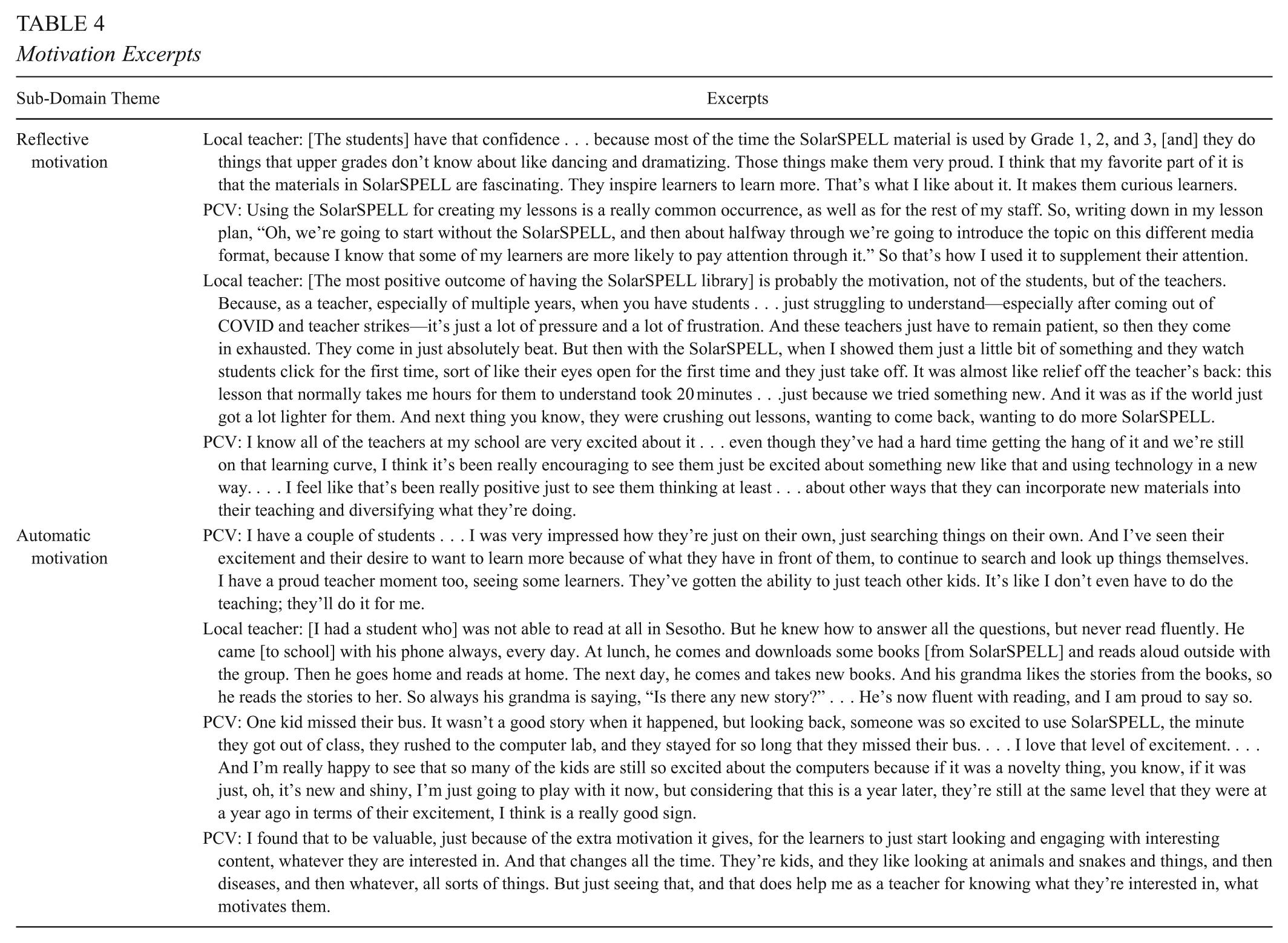
Automatic motivation captures the emotional responses, habits, and social influences that sustain behavior more instinctively. Teachers reported feelings of pride and satisfaction when students became more engaged and took ownership of their learning, which encouraged further use. In one case, this extended beyond the classroom, as a teacher described a student’s independent engagement: “[He] downloads some books and reads aloud. . . . His grandma likes the stories. . . . He’s now fluent with reading, and I am proud.” They also described how habits formed, and how encouragement from colleagues who had successfully integrated the library helped make technology use feel routine. Through our analysis, we saw many examples of emotional reinforcement, with a few examples selected here (see Table 4). Across school sites, local teachers and PCVs noted a level of excitement and participation among students that had not been present before the introduction of the SolarSPELL library. These examples show how emotions, habits, and shared enthusiasm reinforced library use, making it a natural and rewarding part of everyday teaching and learning.
These findings highlight that perceived usefulness and observed student engagement functioned as key motivational drivers, distinct from the capabilities required to use the system. In this case, reflective and automatic motivation worked in tandem to support sustained engagement with the SolarSPELL library. Reflective motivation drove teachers to explore new instructional strategies and persist despite challenges, while automatic motivation emerged through emotional reinforcement, habit formation, and social modeling. Together, these forms of motivation illustrate the complex and reinforcing ways teachers remain engaged with the SolarSPELL library. The result is a feedback cycle in which deliberate decisions and positive experiences reinforce one another, enabling the library to become an integrated and lasting part of classroom practice even under challenging conditions.
Behavior Change
This research seeks to understand not only key factors that support or hinder behavior change among teachers in adopting EdTech, but also how those changes unfold in complex, real-world settings. In the context of the SolarSPELL library implementation, the behavior change reported by teachers manifested in several interconnected ways. These included shifts in their instructional strategy, such as integrating digital content directly into classroom use; increased preparation and resource use, with teachers using SolarSPELL resources for lesson planning or to deepen their own subject knowledge; and collaboration and peer modeling, as teachers at each school learned from each other and discussed the challenges and successes amongst themselves. Reported changes in teachers’ instructional practices suggests that access to and engagement with the SolarSPELL digital library contributed to shifts in behavior. These evolving behaviors illustrate how technology adoption is not a one-time event but an ongoing process of experimentation, adaptation, and professional growth (see Table 5).
Behavior Change Excerpts
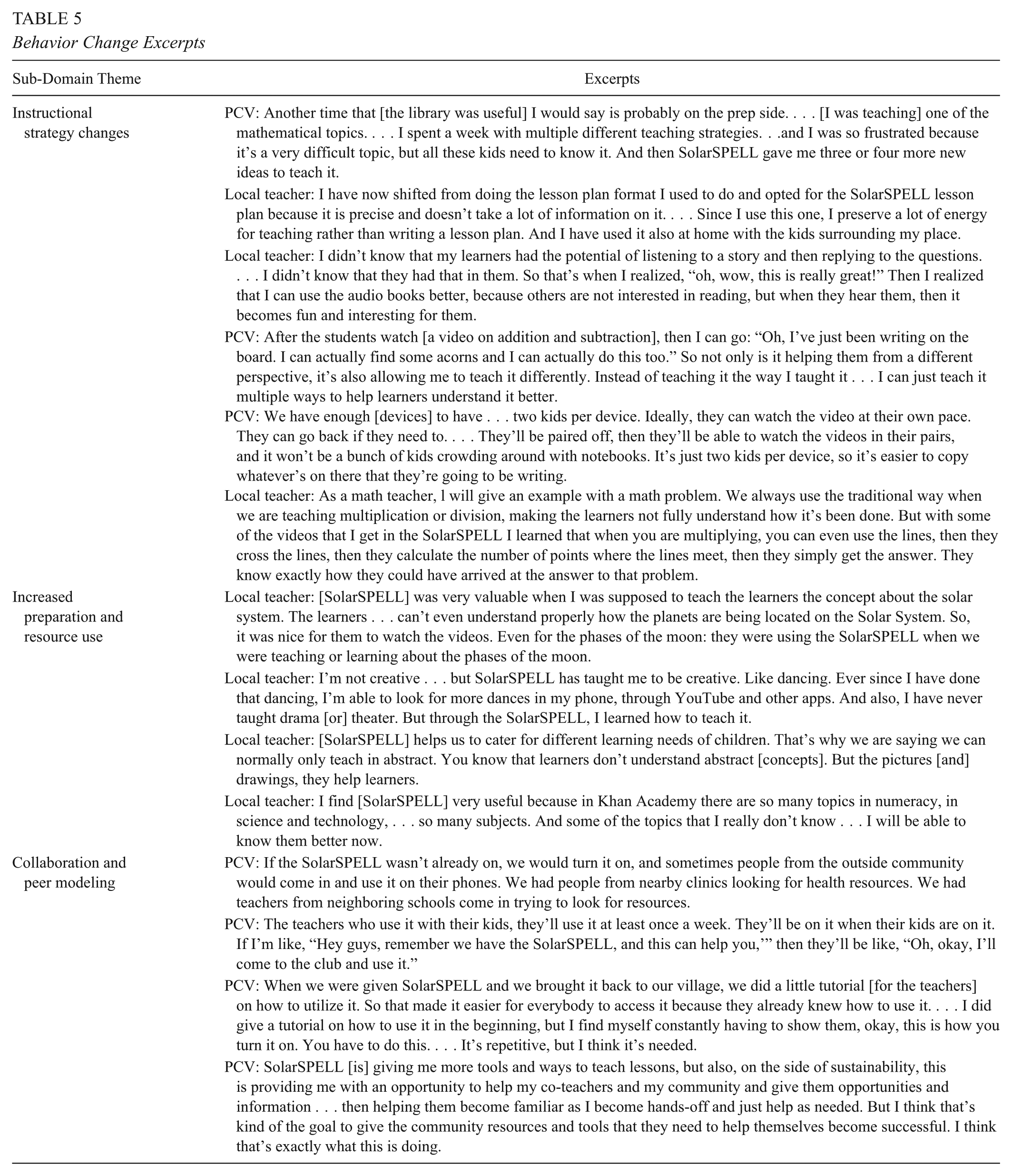
The analysis of interview data revealed how engagement with the SolarSPELL library prompted several teachers to revise and diversify how they delivered instruction in the classroom. Some teachers reflected on their desire to continuously improve their instruction by incorporating new approaches each year, while others pinpointed specific challenges that they were more equipped to overcome after finding material in the SolarSPELL library that encouraged them to try new ways of teaching. One teacher described how access to new materials prompted changes in instructional approach: “SolarSPELL gave me three or four more new ideas to teach [a difficult math topic].” Another teacher noted that they were surprised to discover that some of their students preferred audiobooks to reading, and that they realized they could incorporate both modalities into their teaching. In addition to these shifts in classroom instruction, one teacher noted that they adapted their approach to lesson planning after finding an easier-to-use template in the library. These examples highlight that the implementation of the digital library supported teachers’ pedagogical reflection and innovation.
In addition to influencing teachers’ instructional strategy, the SolarSPELL library shaped how teachers prepared for instruction and selected content. Several participants shared that the library expanded their subject knowledge and improved their ability to explain complex topics with the assistance of visual aids, like videos or images. Others described using the library to expand their own understanding of unfamiliar topics and to better meet the needs of students who struggled with abstract concepts. Many teachers noted that the availability of digital content (as described in the Opportunity section) allowed teachers to present material in more accessible ways. The library also appeared to foster creativity and experimentation, with some teachers noting that they used the library contents to explore new topics, like drama and dance, for the first time. These changes point to a growing sense of preparedness and resource use among teachers who regularly engaged with the SolarSPELL library.
Finally, collaboration and peer modeling were important behavior factors that encouraged use of the SolarSPELL libraries. Some participants noted that the library became a shared resource within and beyond their schools, supporting both peer-to-peer learning and broader community access. Several described training their colleagues on how to use the library (sometimes repeatedly, as digital literacy among local teachers is often lower than the PCVs’ [see the Capabilities section]) and encouraging others to explore it on their own. In some cases, the SolarSPELL library was introduced to neighboring schools or used by other community members, such as health workers looking for educational materials. These collaborative behaviors suggest that the library contributed not only to individual instructional change, but also to the diffusion of practice across teacher networks and communities.
These findings provide evidence that the reported behavior changes (how teachers planned, prepared for, and delivered instruction) were meaningfully influenced by engagement with the SolarSPELL digital library. As conceptualized within the COM-B model, these behavior changes emerged because teachers could use the library (Capability), they had the Opportunity to use it, and they wanted to use it (Motivation). Gaining a fuller understanding of how these components interact and how to foster an environment that supports behavior change can offer valuable guidance for those designing or implementing EdTech innovations. Such insights are critical to ensuring that innovations like SolarSPELL catalyze sustainable, locally-grounded change.
Exploring an Extension of the COM-B Model: Outcomes
Rationale
Throughout our research and the application of the COM-B model to this case study, one recurring point of discussion emerged: how to capture what happens after the behavior change takes place. Understanding these outcomes is essential to determine whether behavior change delivers meaningful value for participants and communities (Hertwig et al., 2025). COM-B was originally developed as a pre-intervention design framework, and it has proven useful in that role. However, our application in a post-intervention setting revealed the potential to extend its scope to include outcomes. Thus, we herein explore the possibility of extending the model to include an Outcomes domain, potentially evolving it into the COMBO model: a tool that could be applied both before and after implementation (see Figure 2). We apply this proposed extension in an exploratory manner within the present case study to examine its usefulness in post-intervention evaluation.

The proposed COMBO model of behavior change.
In low-resource educational settings, it is especially important to evaluate whether behavior change leads to sustained, meaningful improvements. Simply adopting new technology or practices does not guarantee long-term educational or social value. For example, de Barros (2023) describes how interventions may spark initial engagement but introduce “adjustment costs” that burden teachers or students, particularly when support systems are weak. In Bangladesh, Hatakka and Lagsten (2012) found that access to digital services alone was insufficient: learners’ ability to achieve meaningful outcomes depended heavily on factors such as digital literacy, pedagogy, and infrastructure. Similarly, Hoque (2020) demonstrated that while capabilities and outcomes can reinforce each other over time, persistent structural barriers may emerge alongside positive gains. These findings reinforce the importance of assessing outcomes in post-intervention research: without such analysis, it is impossible to determine whether new practices ultimately deliver lasting benefits or impose unintended burdens.
This extended model retains COM-B’s strengths in identifying determinants while also functioning as an impact evaluation tool. This dual capacity allows researchers to examine both how an intervention was designed and what it achieved. Furthermore, assessing outcomes allows researchers to better compare results against similar studies on behavior change and education, an endeavor of particular importance in the Global South where studies are sparse.
Exploratory Application
In this extended COMBO model, outcomes represent the reported impacts that result from changes in behavior. These could include teacher-centered outcomes, such as self-efficacy, job satisfaction, or retention. In this exploratory application, however, we focus on student outcomes since the ultimate goal of such interventions lies in improved outcomes for learners. By analyzing and understanding the resulting outcomes for students, we can get to the heart of why the target behavior change matters. Thus, this section focuses on ways students respond to, benefit from, and extend the use of SolarSPELL in their own learning, as reported by their teachers. The major themes that emerged through the data analysis were students’ improvements in academic achievement, motivation, and skill building that emerged from teacher adoption of the SolarSPELL libraries (see Table 6).
Outcome Excerpts

In evaluating the outcomes of the SolarSPELL library intervention in Lesotho, educators reported a range of academic improvements among students who engaged with the library directly or via lessons through their teacher. These included stronger foundational skills in English, increased content knowledge in math and science, and greater digital and information literacy skills. In one instance, a teacher attributed their students’ science fair success, at least in part, to the information from the SolarSPELL library. Other teachers noted that students responded positively to multimedia teaching techniques, with marked improvements in understanding and performance. For example, one teacher used various teaching techniques learned from the SolarSPELL library, and quiz results found that students were able to grasp the material using the strategy best suited to them. These outcomes in learners’ academic achievements suggest that teachers perceived improvements in student learning associated with their use of the SolarSPELL library.
In addition to their academic improvements, teachers reported that students developed important digital and information literacy skills through their exposure to the SolarSPELL library. Teachers noted improvements in students’ competence and confidence in using technology, including development of skills like typing, navigating digital interfaces, and conducting basic searches. As one PCV explained, the library functioned as a bridge to broader digital literacy practices: “SolarSPELL . . . is sort of a microcosm of the larger internet world. . . . If I tell [the students], ‘We want to look at this topic’ then they have to say ‘Okay, where would I find that? How would I find that?’” Teachers noted that these skills are particularly meaningful in rural contexts across Lesotho, where prior exposure to technology was limited or non-existent. Students began to engage in exploratory behaviors, such as browsing different resources and evaluating what information was most relevant or interesting to them. These findings suggest that teachers viewed the SolarSPELL library as a valuable entry point for developing digital skills among students who might not otherwise have had such opportunities.
Finally, teachers reported increased student engagement. Teachers noted greater curiosity, participation, enthusiasm, and ownership of learning among their students. In several cases, teachers reported that learners demonstrated pride in their work, actively requested access to the digital library, or took on leadership roles in helping classmates navigate the library. The availability of culturally and linguistically relevant materials, such as Sesotho language storybooks, was named as a key factor in eliciting participation from students who had previously been disengaged or reluctant to speak in class. In one case, a PCV described how access to these Sesotho language storybooks enabled a previously disengaged student to participate more actively: We have this one student in grade four who can only read Sesotho, he can’t read English. . . . The only time that you can get that student to say anything is when he’s reading the Sesotho storybooks [from the SolarSPELL library]. So that was kind of our secret weapon this past semester, to get him to [participate].
This example illustrates how culturally and linguistically relevant content supported comprehension, confidence and classroom participation. In some schools, teachers reported improved attendance following the introduction of the SolarSPELL library, which they attributed to students’ excitement about the library. In one case, this went as far as students choosing to transfer from neighboring schools after hearing about the SolarSPELL library from peers. These outcomes point to teachers’ perceptions of the library’s broader influence on the school climate and its potential to support sustained learner motivation.
Furthermore, our research indicates that adding outcomes to the model also creates an additional feedback loop: where positive Outcomes further increase Motivation to engage in the target behavior (see Figure 2). These outcomes provide insight into the broader value and ripple effects of behavior change, particularly in under-resourced settings. By capturing these outcomes, we extend the COM-B model to include not only what changes and how, but what difference they make. We offer this proposed extension as an invitation for future research to further test, refine, and contextualize the role of outcomes in sustaining behavior change across diverse educational settings.
Discussion
Contribution to the Literature
This study contributes to a growing body of work that seeks to understand the complex dynamics of teacher behavior change in EdTech interventions, particularly in low-resource contexts. Here, COM-B is used as an analytic lens to interpret patterns in the data rather than an exhaustive model of all influences on teacher behavior. Our findings echo prior research emphasizing the importance of digital literacy, information literacy, and pedagogical integration skills as foundational capabilities for effective technology adoption (Piper et al., 2018; Wu et al., 2022). Teachers in our study reported clear development in these domains, and noted that repeated engagement with the SolarSPELL library improved their comfort with technology and ability to navigate educational content. This reinforces Hoque’s (2020) assertion that capabilities and motivation are mutually reinforcing. As teachers gained competence, they also reported greater confidence and willingness to innovate instructionally. The model also maps onto the findings from de Barros et al. (2024), who found that behavior change is more likely when teachers receive continued support and can see early evidence of success in their classrooms.
The findings herein align with and extend prior literature on the importance of teacher capabilities, opportunities, and motivation in shaping behavior (Badran et al., 2021; Hennessy et al., 2022; Hoque, 2020; Wu et al., 2022), while also advancing theoretical work by proposing and exploring an expanded framework: COMBO. By analyzing not only what supports behavior change, but also what behavior change produces, an expanded framework would offer a more complete picture of how meaningful and sustained change occurs in schools.
Implications for Behavior Change Theory
The exploration of adding Outcomes to the COM-B framework strengthens the theoretical foundation for evaluating longzterm impact. In most behavior change models, success is defined by whether a targeted behavior was adopted. However, behavior change is not an endpoint, but a catalyst for broader gains. In our findings, teacher adoption of SolarSPELL led to reported improvements in student academic performance, digital skills, and classroom engagement. These outcomes, in turn, reinforced teacher motivation and encouraged continued use. In this way, Outcomes not only help assess effectiveness, but also function as part of the behavior change process itself. The virtuous cycle between behavior and outcomes, where improved student performance motivates teachers to deepen their use of technology, adds an important feedback loop that can improve our understanding of the impact of successful behavior change interventions.
The inclusion of Outcomes is particularly relevant for EdTech in low-resource environments. In many such settings, interventions are short-term, and success is often measured by implementation fidelity or usage metrics alone. However, our findings suggest that measuring Outcomes is essential for demonstrating the value of an intervention to teachers, school leaders, and communities. For example, teachers who observed growth in student digital literacy or attendance were more likely to continue integrating the library into their teaching. These types of user-reported outcomes serve both as evidence of impact and as justification for continued investment, especially in environments where resources are scarce and competing priorities are abundant.
Furthermore, the reported student-level outcomes, particularly improvements in digital fluency among learners with little to no prior exposure to technology, point to broader applicability beyond the Lesotho context. Many educational systems in the Global South face similar barriers to access, infrastructure, and training. The gains reported in this study suggest that interventions designed with COM-B principles (those that explicitly attend to Capability, Opportunity, Motivation, Behavior) are more likely to generate sustained and meaningful outcomes. Future research should apply this model in comparable contexts to assess its generalizability and utility as both a planning and evaluation tool.
Limitations, Strengths and Future Research Directions
This study is limited by its reliance on self‑reported qualitative data from teachers and PCVs, which may be influenced by recall bias, strategic reporting (out of fear of losing access to the program), or social desirability (telling interviewers what they think they want to hear). Findings should therefore be interpreted as perceived changes rather than independently verified outcomes. While some reported changes (such as use of specific digital content or offline tools) can be reasonably attributed to the intervention, the absence of classroom observations or baseline comparison groups limits our ability to fully assess the scope and causality of these changes. Additionally, participating schools had existing support structures (namely PCVs) which may limit generalizability to schools without similar resources.
Second, this study captured a 3‑year implementation window without longitudinal follow‑up after the exit of PCVs. The presence of PCVs likely influenced both teachers’ capability and motivation to use the SolarSPELL library. PCVs provided ongoing support, modeling, and encouragement, which may have facilitated initial adoption and sustained engagement. As a result, the findings may not fully generalize to contexts where similar in-person support structures are absent. As a result, it remains unclear whether the behavior changes and student outcomes observed are sustainable over longer time horizons or in the absence of external facilitators. Future studies should consider extended tracking of teacher practice and student performance beyond the intervention period, ideally combining qualitative and quantitative approaches. Future studies should also incorporate triangulation through external data sources as available. We recognize, however, that such long‑term, mixed‑methods studies are resource‑intensive and logistically difficult to conduct, particularly in remote, under‑resourced contexts, yet they remain essential to fully assess the durability and transferability of behavior change interventions.
Despite these limitations, this study offers several notable strengths. The study is grounded in a robust dataset drawn from 60 interviews conducted over a multi-year intervention, offering depth and breadth rarely captured in EdTech research in low-resource settings. The inclusion of both teachers and PCVs allows for triangulation across user perspectives, while the application of the COM-B framework supports a holistic analysis. Furthermore, the study’s focus on a Global South context adds to the developing body of work on educational innovation in under-resourced environments, making it a valuable contribution to both behavior change theory and international education research. It contributes original theoretical advancement by the proposed extension of the COM-B model into COMBO, enabling a more holistic understanding of behavior change and its educational outcomes.
We argue that a framework incorporating Outcomes offers value not only for researchers, but also for planners, implementers, and funders seeking to design, monitor, and scale EdTech interventions. By shifting the focus beyond access and adoption to include effectiveness and long-term impact, such a framework can better support meaningful educational change. As EdTech continues to expand into underserved regions, outcome-oriented models will be essential for ensuring that technology leads to lasting learning gains rather than temporary engagement. We encourage future research to apply, test, and refine this extended version of the COM-B model across diverse educational contexts, advancing behavior change theory in ways that reflect the realities of teaching and learning worldwide.
Conclusion
This study has examined teacher perceptions of the implementation of SolarSPELL’s offline digital libraries in rural Lesotho through the lens of an established behavior change framework: COM-B. By exploring how outcomes can be incorporated into the traditional COM-B model, we enable the evaluation of downstream effects of teacher behavior change on learners. Our findings show that teacher-reported behavior change manifested itself in instructional shifts, enhanced lesson preparation, and collaborative practices, all of which contributed to reported improvements in student performance, digital literacy, and engagement.
Adding Outcomes to the COM-B model may provide a more complete model for both understanding and evaluating educational interventions. While COM-B is well-suited to identifying preconditions for behavior change, incorporating Outcomes extends its utility into post-implementation analysis, creating a full-cycle framework. This extension is particularly valuable in low-resource settings, where the success of EdTech initiatives depends not just on whether teachers use the technology, but on whether that use leads to meaningful and sustained improvements in teaching and learning.
Supplemental Material
sj-docx-1-ero-10.1177_23328584261448148 – Supplemental material for Behavior Change in Educational Technology Adoption: Insights From a Three-Year Case Study in Lesotho
Supplemental material, sj-docx-1-ero-10.1177_23328584261448148 for Behavior Change in Educational Technology Adoption: Insights From a Three-Year Case Study in Lesotho by Rachel Nova, Laura Hosman and Debopriyo Ghosh in AERA Open
Footnotes
Acknowledgements
This manuscript benefited from the use of several software tools. The authors used ChatGPT Edu (GPT-4), developed by OpenAI, to support tasks such as recommending outline structure, improving writing clarity, and aligning table and figure formatting with APA 7 style. All AI-generated content was reviewed, edited, and approved by the authors, who take full responsibility for the final manuscript. Qualitative coding was conducted using Dedoose software, which supported collaborative thematic analysis across coders. Zotero was used for reference management throughout the drafting process. The authors gratefully acknowledge the contributions of the educators and PCVs who participated in this study.
Declaration of Conflicting Interests
The authors declared no potential conflicts of interest with respect to the research, authorship, and/or publication of this article.
Funding
The authors received no financial support for the research, authorship, and/or publication of this article.

Authors
RACHEL NOVA is a senior program manager with the SolarSPELL Initiative at Arizona State University. Her research interests include learning sciences, refugee and crisis education, and educational technology.
Dr. LAURA HOSMAN is an associate professor at Arizona State University in the School for the Future of Innovation in Society and the Polytechnic School, as well as co-founder and co-director of the SolarSPELL Initiative. Her research interests include information literacy, technology for development, and experiential education.
DEBOPRIYO GHOSH is a student-intern with the SolarSPELL Initiative at Arizona State University. His research interests include quantitative economics, mathematics, and agricultural sciences.
References
Supplementary Material
Please find the following supplemental material available below.
For Open Access articles published under a Creative Commons License, all supplemental material carries the same license as the article it is associated with.
For non-Open Access articles published, all supplemental material carries a non-exclusive license, and permission requests for re-use of supplemental material or any part of supplemental material shall be sent directly to the copyright owner as specified in the copyright notice associated with the article.
