




Abstract
This study investigates whether small and medium-sized enterprises (SMEs) gain greater performance benefits from focusing on exploration or exploitation than from pursuing an ambidextrous orientation, and examines home-country munificence as a boundary condition. Given their limited resources, SMEs must decide when it is advantageous to commit to a single strategic logic. We introduce the adverse environment-focus paradox, which proposes that the advantages of a focused orientation can be amplified in certain adverse environments but not in others. Drawing on meta-analytic evidence from 3,423 observations across 21 studies and 13 countries, and on prior meta-analyses, we integrate this contingency perspective, advancing theory on how environmental conditions and SMEs’ strategic orientations interact. Our study invites further inquiry into the fit between the environment and sequential shifting and timing in SMEs to clarify when an SME should fit between them in its organizational lifetime and the potential impact of such shifting.
Introduction
The strategic tension between exploration and exploitation has attracted sustained scholarly interest in management research for decades (March, 1991). Extensive theoretical and empirical work has examined how large firms manage this tension—often through structural separation, with distinct units pursuing exploration (e.g., Research and Development [R&D] labs) or exploitation (e.g., cost-efficiency in supply chain management) (e.g., Lubatkin et al., 2006; Tushman & O’Reilly, 1996). These firms benefit from greater financial flexibility, resource slack, and scale economies, enabling them to invest in both logics simultaneously (Jansen et al., 2012; O’Reilly & Tushman, 2013). In contrast, how and in which contexts these orientations function in small and medium-sized enterprises (SMEs) remains comparatively underexplored.
SMEs operate under fundamentally different conditions. Their constrained financial, human, and structural resources force deliberate trade-offs between the dilemma of exploration and exploitation (Wenke et al., 2021). Lacking the organizational infrastructure needed to support ambidexterity, many SMEs find it difficult—if not impractical—to pursue both orientations concurrently. As a result, the feasibility, and even desirability, of combining both orientations in SMEs remains an open question.
At the core of this strategic dilemma lie two distinct logics. Exploitation emphasizes the refinement and extension of existing capabilities—through “choice, production, efficiency, selection, implementation, and execution”—while exploration entails “search, variation, risk-taking, flexibility, and discovery” (March, 1991, p. 71). Ambidexterity refers to the simultaneous pursuit of both orientations (Tushman & O’Reilly, 1996). Because these logics compete for scarce resources in SMEs, they require careful strategic allocation (March, 1991). Some scholars view them as structurally incompatible due to their divergent routines, mindsets, and incentives (Marín-Idárraga et al., 2022), reflecting the broader organizational tensions between stability and change (Farjoun, 2010). Others contend that exploration and exploitation can reinforce one another under certain conditions (Bierly & Daly, 2007; Knott, 2002), and that firms can adopt a focused or dual orientation depending on context.
Aggregated empirical research yields three broad conclusions. First, the three orientations each contribute positively to firm performance (e.g., Junni et al., 2013; Mathias et al., 2018). Second, much theory favors ambidexterity as the most advantageous approach (e.g., Simsek et al., 2009; Tushman & O’Reilly, 1996). Third, the efficacy of each orientation depends on firm characteristics and environmental contingencies (e.g., Marín-Idárraga et al., 2022; Mathias et al., 2018).
However, critical gaps remain. Most meta-analyses and empirical studies focus on large firms or treat firm size as a control or moderating variable rather than a central dimension of analysis (e.g., Lubatkin et al., 2006; Marín-Idárraga et al., 2022). Moreover, broader contextual moderators—such as macro-environmental conditions—have been largely overlooked in studies of SME strategic orientation. While some research considers competitive intensity or environmental dynamism (e.g., Marín-Idárraga et al., 2022, although not specific to SMEs) and cultural factors (e.g., Mueller et al., 2013), little is known about how the environmental context is associated with the performance of exploration, exploitation, or ambidexterity in smaller firms. This omission is notable given that SMEs are often more vulnerable to environmental constraints than larger counterparts (Maekelburger et al., 2012; Wenke et al., 2021). This vulnerability underlies what we term the adverse environment-focus paradox: in certain resource-scarce settings, a focus on a single orientation can yield amplified performance benefits than in less constrained settings.
Among the environmental factors, home-country environmental munificence, defined as the extent to which the external environment supports sustained growth (Dess & Beard, 1984), represents a crucial yet understudied boundary condition for SMEs. Munificence reflects the availability of vital resources such as financial capital, skilled labor, infrastructure, and institutional support (Castrogiovanni, 1991). When munificence is high, opportunities abound, but so does competition, as more firms are attracted to a resource-rich environment (Auh & Menguc, 2005; Porter, 1980). Conversely, in low-munificent environments, resources are scarce, and firms must rely more heavily on internal capabilities and strategic focus.
The dynamics of munificence are especially salient for SMEs. Resource-rich environments can help SMEs overcome structural limitations but can also intensify imitation risks for exploitative firms and inhibit knowledge diffusion, which are essential for successful exploration (Raisch et al., 2009). SMEs typically lack the capacity to absorb these environmental shocks due to limited access to capital, knowledge, and networks (Moilanen et al., 2014). These conflicting forces introduce ambiguity around how environmental munificence influences the exploration–exploitation–performance relationship in SMEs.
Our study addresses these research gaps through two primary contributions. First, we conduct a meta-analysis exploring the performance association of exploration, exploitation, and ambidexterity, focusing exclusively on SMEs. Building on Wenke et al. (2021), who show that firms benefit more from a focused orientation than ambidexterity, we have focused the analysis exclusively on SMEs, which allowed us to test whether the performance premium of focused orientations over ambidexterity holds consistently for SMEs, unlike some other prior meta-analyses pooling them with larger firms (Marín-Idárraga et al., 2022). Second, we extend the contextual lens of Marín-Idárraga et al. (2022) by introducing home-country environmental munificence as a macro-level moderator, assessing how national resource abundance shapes the relative payoffs of these strategic orientations, drawing on data from 3,423 SMEs across 21 independent studies and 13 countries.
We build on Wenke et al. (2021) and argue that the performance premium is contingent on home-country munificence. In low-munificence environments, scarcity amplifies the returns from focusing on either exploration or exploitation because resource constraints demand tighter allocation, quicker decision-making, and deeper specialization, allowing SMEs to extract maximum value from a single strategic logic. In high-munificence settings, abundant resources relax these pressures, enabling firms to follow more dispersed approaches; however, the availability of multiple viable pathways dilutes the incremental efficiency and learning gains that focus provides, resulting in smaller performance differentials between strategic orientations. Moreover, in contrast to Marín-Idárraga et al. (2022), whose analysis centers on industry-level dynamics and includes firms of several sizes, our study adopts an environmentally grounded, cross-national perspective focused exclusively on SMEs.
Theoretical Underpinnings and Hypotheses
The concept of ambidexterity has been widely employed in the literature to describe the simultaneous pursuit of two seemingly contradictory activities: exploration and exploitation. Exploration involves proactive search, experimentation, risk-taking, and innovation, enabling firms to discover new opportunities. Conversely, exploitation focuses on refining existing processes, improving efficiency, optimizing production, and selectively adapting established practices to enhance performance (Levinthal & March, 1993; March, 1991). The outcomes of exploration tend to be more uncertain and temporally distant, whereas the benefits of exploitation are typically more predictable and immediate (He & Wong, 2004). Consistent with existing scholarship (e.g., Birkinshaw & Gupta, 2013; Wenke et al., 2021), we adhere to the conceptualization of exploration and exploitation as distinct strategic choices rather than opposing ends of a continuum. This perspective is particularly relevant in the context of SMEs, for which balancing these strategies is crucial for them to sustain their competitive advantage.
Both exploration and exploitation have been recognized as key drivers of firm performance. Exploration enhances performance by fostering the discovery and creation of new market opportunities, thereby facilitating business expansion (e.g., He & Wong, 2004; Mueller et al., 2013). Conversely, exploitation contributes to performance by refining existing capabilities, reducing variance, and strengthening the firm’s position in established markets (e.g., He & Wong, 2004; Mueller et al., 2013). Ambidexterity, which integrates both strategies, allows firms to leverage the benefits of each approach, enabling them to remain competitive in the present while preparing for future challenges (e.g., Cao et al., 2009; March, 1991; He &Wong, 2004).
Thus, ambidexterity can be understood from two perspectives: the balanced and the combined approach (Cao et al., 2009). The balanced perspective suggests that firms should find an optimal equilibrium between exploration and exploitation, positioning themselves between the two extremes. In contrast, the combined perspective views exploration and exploitation as distinct but complementary activities, asserting that firms can achieve a higher degree of ambidexterity by maximizing both simultaneously (Kassotaki, 2022).
Integrating both activities enables firms to harness synergies that exceed the isolated benefits of their approach while mitigating the risks associated with the excessive focus on one at the expense of the other. However, achieving ambidexterity remains a complex challenge due to the fundamentally different organizational requirements of exploration and exploitation. Exploration thrives in environments characterized by flexibility, autonomy, and loosely structured systems, whereas exploitation requires standardized processes, hierarchical structures, and tightly integrated systems (He & Wong, 2004). To address these challenges, Fourné et al. (2019) outline two primary approaches to fostering ambidexterity: (1) structurally separating exploration and exploitation into distinct organizational units (Tushman & O’Reilly, 1996) or (2) cultivating an organizational context that enables both strategies to coexist within a single unit (Gibson & Birkinshaw, 2004).
The Case of SMEs
The comparative effectiveness of ambidexterity versus a singular focus on either exploration or exploitation remains an open question, particularly within the SMEs context. Traditionally, it has been assumed—without consideration of firm size—that ambidexterity leads to superior performance relative to an exclusive focus on exploration or exploitation (Tushman & O’Reilly, 1996). However, recent meta-analyses that include firms of varying sizes (e.g., Marín-Idárraga et al., 2022; Mathias, 2014), as well as those focused specifically on SMEs (e.g., Wenke et al., 2021), fail to consistently support this assumption. While some studies suggest that ambidexterity does not necessarily outperform the focus strategic orientations (e.g., O’Reilly & Tushman, 2013; Turner et al., 2013; Wenke et al., 2021), others argue that it remains a superior approach (e.g., Lubatkin et al., 2006). Empirical findings further reflect this theoretical ambiguity. For instance, Bierly and Daly (2007) report that a simultaneous focus on exploration and exploitation does not enhance SMEs’ performance over 3 years, whereas McDermott and Prajogo (2012) find that ambidexterity consistently generates positive effects compared to either focus alone.
Given the distinct characteristics of SMEs, Wenke et al. (2021) propose three key theoretical explanations for why ambidexterity research conducted on larger firms cannot be directly applied to SMEs. First, SMEs operate under significant resource constraints, making the demands of an ambidextrous strategy particularly challenging to sustain (De Clercq et al., 2014; Wenke et al., 2021). Second, SMEs’ leadership structures tend to exhibit lower levels of formalization in management processes, decision-making, and information processing (Kiss et al., 2018). As a result, managing the competing demands of exploring and exploiting concurrently can place an excessive burden on both managers and employees (Wenke et al., 2021). Third, SMEs often face limitations in internal knowledge and capabilities development. Consequently, they rely more heavily on external sources for that (Colombo et al., 2012; Wenke et al., 2021).
The structural implementation of ambidexterity in SMEs presents two significant challenges. First, while larger firms often possess naturally segmented units that facilitate the structural separation of exploration and exploitation (Fourné et al., 2019), SMEs must make substantial investments to create and maintain such divisions (Wenke et al., 2021). These additional costs can reduce the performance benefits of ambidexterity. Second, structural separation also creates significant managerial integration challenges (Ossenbrink et al., 2019). Managing ambidexterity requires balancing exploration and exploitation through concurrent multitasking, which increases coordination costs and managerial complexity (Mom et al., 2009). This challenge is particularly pronounced in SMEs, where limited resources and formal management systems intensify the strain on leadership (Keller & Weibler, 2015). The resulting cognitive overload can impair decision-making quality (Starcke & Brand, 2016) and ultimately reduce the performance advantages associated with ambidexterity (Wenke et al., 2021).
To mitigate the high costs of structural separation, some scholars advocate for SMEs to pursue ambidexterity within a single unit (Lubatkin et al., 2006). However, this approach also carries significant challenges. Maintaining both exploration and exploitation within a single unit can create ambiguity regarding strategic priorities, leading to confusion among employees (Voss et al., 2006), disrupting organizational cohesion and diverting attention from the firm’s most profitable activities (Van Looy et al., 2005). Given that short-term profitability often aligns more closely with exploitation, firms prioritizing ambidexterity jeopardize their long-term viability. In addition, operating within an ambidextrous framework imposes substantial cognitive strain on SMEs’ employees, further reducing the potential benefits of this approach (Wenke et al., 2021).
The combined and balanced dimensions of ambidexterity also offer limited advantages within the SMEs context. Although the combined dimension theoretically enhances performance by fostering interactions between exploration and exploitation, SMEs’ resource constraints limit the extent to which they can engage in both activities simultaneously (Cao et al., 2009; Jansen et al., 2012). Similarly, while the balanced dimension of ambidexterity suggests that firms benefit from maintaining equilibrium between exploration and exploitation (Lubatkin et al., 2006), the risks of excessive exploration or exploitation are relatively minor in SMEs (Wenke et al., 2021). SMEs’ inherent flexibility and adaptability allow them to respond quickly to shifting market conditions, reducing the negative consequences of strategic imbalance (Eggers, 2020). Therefore, while the balanced dimension is beneficial, its advantages are likely less pronounced in SMEs compared to larger firms (Wenke et al., 2021).
Taken together, these considerations suggest that ambidexterity is less effective for SMEs than a focused approach on either exploration or exploitation. This argument is grounded in two key constraints: (a) the substantial costs associated with implementing ambidexterity—whether through structural separation or within a single unit—are disproportionally high for SMEs, potentially making ambidexterity an unfeasible strategy, and (b) the relative benefits of combined and balanced ambidexterity are inherently limited within SMEs. Accordingly, SMEs can achieve comparable or superior performance outcomes by concentrating on either exploration or exploitation. Thus, we propose the following hypotheses that, although not original as proved by Wenke et al. (2021), are needed to establish the subsequent moderation:
The aforementioned hypotheses are largely context-less, as they do not account for the contextual environment in which SMEs operate. We extend prior research by introducing home-country environmental munificence as a critical contextual factor influencing the performance outcomes of exploration and exploitation strategies. To do so, we first establish that SMEs benefit from a focused approach, as proposed in hypotheses 1 and 2, before arguing that, in high-munificence environments, the performance advantages of prioritizing either exploration or exploitation will be less positive than in low-munificence environments. The theoretical rationale underlying this assumption is presented in the following section.
The Moderating Role of Home-Country Munificence
Home-country munificence, as conceptualized in this study, refers to the abundance of critical resources—financial, human, technological, and institutional—that support firm growth and innovation (Castrogiovanni, 1991; Y. Li et al., 2013). Unlike narrower institutional indicators (e.g., regulatory quality or ease of doing business), munificence provides a holistic measure of environmental support, capturing both tangible and intangible resources available to firms. This is particularly important to SMEs, which often rely heavily on external resource availability due to their internal constraints. By focusing on munificence, we offer a more comprehensive understanding of how country-level resource availability interacts with SMEs’ strategy, beyond what has been explored in prior meta-analyses (e.g., Marín-Idárraga et al., 2022; Mueller et al., 2013; Wenke et al., 2021).
Building on the argument that SMEs benefit more from a focused approach, we explore how home-country munificence influences the effectiveness of exploration and exploitation. Figure 1 illustrates this conceptualization, adapting the orthogonality framework of Gupta et al. (2006, p. 697). The upper portion of Figure 1 represents the standard strategic focus of SMEs on either exploitation (A) or exploration (B) under typical environmental conditions. The lower portion depicts how shifts in home-country munificence affect the performance outcomes of these strategic orientations. In low-munificent environments, SMEs focusing exclusively on either exploration or exploitation outperform those adopting an ambidextrous approach (left). However, given resource constraints, an exploitative focus tends to yield slightly higher performance than an exploratory focus. Conversely, in highly munificent environments, the abundance of resources reduces the relative impact of both strategic orientations on SMEs’ performance (right), rendering them similarly effective yet less influential than in resource-scarce settings.

State and change of SMEs posture toward focused exploitation or focused exploration contingent on home-country munificence.
As a general explanation, we introduce an argument from industrial organization (IO). High levels of munificence create greater opportunities, as firms can pursue diverse goals and strategies with increased access to resources (Castrogiovanni, 1991; Y. Li et al., 2013). This environment facilitates SMEs’ development by easing constraints on growth and innovation. Drawing from the IO perspective, we argue that environmental munificence plays a particularly crucial role in the SMEs context (Auh & Menguc, 2005; Porter, 1980). Munificent environments, characterized by resource abundance and growth opportunities, also attract new market entrants (Porter, 1980), intensifying competition. As a result, SMEs face heightened pressures to enhance cost-efficiency and lower prices, narrowing profit margins and reducing organizational slack. Given their resource constraints, SMEs depend heavily on external knowledge to sustain competitiveness, making home-country munificence a vital determinant of their strategic success. This shift in internal competition (new entrants’ attraction) makes it difficult for SMEs to continue obtaining results as positive as they would have obtained in a more restrictive environment. In low-munificence environments, scarcity forces SMEs to concentrate limited resources on a single orientation, fostering faster capability development, deeper process refinement (in exploitation), or more targeted opportunity discovery (in exploration). This concentrated effort helps them respond more decisively to sudden market or technological shifts and to defend niche positions that richer competitors may overlook.
As home-country munificence increases, the benefits of an exploitative strategy decrease due to heightened risks of imitation. SMEs that prioritize exploitation follow established market patterns, rendering their outcomes more predictable and, consequently, easier for competitors to replicate (Mueller et al., 2013; Semadeni & Anderson, 2010). The lower risk associated with imitating exploitative strategies intensifies competitive pressure, thereby constraining the performance gains derived from exploitation. Moreover, knowledge transfer—often facilitated by munificent environments—has a limited impact on exploitation-oriented SMEs. Unlike exploration, which relies on diverse external knowledge, successful exploitation primarily depends on accumulated experience and the continuous refinement of existing processes (Ko & Liu, 2019). Consequently, while munificence enhances knowledge accessibility, this advantage is less relevant to firms engaged primarily in exploitation.
More broadly, exploitation is fundamentally centered on optimizing existing resources and strengthening market positions. However, in highly munificent environments, efficiency alone is insufficient to sustain superior performance. Increased competition further erodes the distinctiveness of exploitative firms, as the mere refinement of current assets, capabilities, and processes cannot counterbalance intensified market pressures. In such contexts, the advantages of an exploitation-focused strategy progressively decline. In contrast, in low-munificence environments, scarcity amplifies the benefits of an exploitative focus. Limited access to resources forces SMEs to maximize efficiency and extract greater value from existing capabilities (Wenke et al., 2021). Concentrating efforts on process optimization and incremental improvement reduces waste and ensures that scarce inputs are used most productively. In addition, imitation threats are weaker in these contexts because few competitors have the capacity to replicate tightly honed efficiency-based advantages, allowing exploitative SMEs to sustain superior performance for longer periods. Therefore, we theorize:
Similarly, home-country munificence moderates the relationship between exploration and SMEs’ performance, albeit in a distinct manner. Unlike exploitation, exploratory strategies are less susceptible to imitation threats. First-mover advantages play a crucial role in exploration, reducing the likelihood of replication despite its higher costs and longer development timelines (Lavie et al., 2010; Mueller et al., 2013). Moreover, exploratory initiatives often lead to radical innovations that might not be immediately embraced by the market, further deterring imitation (Semadeni & Anderson, 2010).
However, while munificence facilitates access to diverse external knowledge sources, it can also pose challenges for exploration-driven SMEs. A wealth of available resources enhances a firm’s ability to generate new ideas (Katila & Ahuja, 2002), yet excessive resource availability may dilute strategic focus. Large firms can mitigate this risk through acquisitions that consolidate complementary knowledge bases (Phene et al., 2012), but SMEs, constrained by limited financial resources, rely primarily on partnerships with research institutions and industry collaborators (Acs et al., 1994). Although such partnerships proliferate in munificent environments, heightened competition in these settings forces exploratory SMEs to balance long-term innovation efforts with short-term viability (Auh & Menguc, 2005).
In highly munificent environments, exploration-focused SMEs face a strategic dilemma: they can either intensify their exploratory efforts at the expense of immediate returns or pivot toward exploitation to ensure short-term financial stability. Excessive exploration without adequate exploitation can lead to a failure trap, where firms struggle to convert innovation into financial gains (Cao et al., 2009; He & Wong, 2004). To sustain exploratory activities without compromising financial stability, SMEs must secure short-term revenue streams (Abebe & Angriawan, 2014). One approach involves adopting exploitative tactics—such as competitive pricing and promotional strategies—to maintain market relevance (Auh & Menguc, 2005). Thus, despite an inherent preference for exploration, SMEs in high-munificent environments should temper their exploratory tendencies with exploitative actions.
Conversely, in low-munificence environments, the performance payoffs of exploration are often greater because scarcity heightens the value of targeted, high-impact innovations that address immediate market gaps or supply constraints (Abebe & Angriawan, 2014). With fewer rivals able to commit resources to radical innovation, successful exploratory efforts can yield disproportionate returns and remain uncontested for longer. In such settings, selective alliances and localized knowledge networks become critical enablers, allowing SMEs to innovate despite constrained means (Wenke et al., 2021). This concentrated and necessity-driven approach ensures that each exploratory investment carries higher strategic weight and clearer performance impact than in resource-rich environments. Accordingly, we hypothesize:
Figure 2 summarizes the proposed relationships.

Research model.
Methodology
Data Collection and Sample
To ensure a rigorous and transparent study selection, we adopted a systematic approach aligned with best practices in meta-analytic research (Page et al., 2021). Our selection followed a six-stage process. First, we searched the Web of Science and Scopus databases using a range of keyword combinations (e.g., exploration, exploitation, explorative, exploitative, ambidexterity, ambidextrous, small and medium-sized firm, SME, small firm, and small venture) and performance-related terms. Second, we performed a manual search of leading journals in the field, as identified by Birkinshaw and Gupta (2013): Academy of Management Journal, Administrative Science Quarterly, Industrial and Corporate Change, Journal of Management, Journal of Management Studies, Management Science, Organization Science, and Strategic Management Journal. 1 To ensure comprehensive coverage, we also searched high-quality journals frequently publishing SMEs-related studies (Entrepreneurship Theory and Practice, Journal of Business Venturing, Journal of Business Research, Journal of Small Business Management, Small Business Economics, Strategic Entrepreneurship Journal), and research on technology and innovation (Research Policy, Journal of Product Innovation Management). The manual search began in 2000, as this marks the publication year of the first quantitative study in this field (Junni et al., 2013).
Third, we reviewed the references of prior meta-analyses (e.g., Fourné et al., 2019; Junni et al., 2013; Marín-Idárraga et al., 2022; Mathias, 2014; Mathias et al., 2018; Mueller et al., 2013; Shi et al., 2020; Wenke et al., 2021) and related literature reviews (e.g., Birkinshaw & Gupta, 2013; Kassotaki, 2022; Lavie et al., 2010; Raisch & Birkinshaw, 2008). Fourth, we employed the ancestry approach (also known as “snowballing” or “pearl growing”), a method widely recognized for its usefulness in meta-analytical research (Booth, 2008; Steel et al., 2021). Fifth, we conducted an unstructured search of Google Scholar (Cooper, 1998), using forward citations to identify additional literature sources. Sixth, to address potential publication bias (Eisend & Tarrahi, 2014), file-drawer problems (Rosenthal, 1995), and the “Matthew Effect” (Steel et al., 2021), we examined “grey” literature. We completed our search in November 2022, yielding an initial pool of 441 articles.
Using reference management software (EndNote and Mendeley), we removed 163 duplicate records, resulting in 278 unique articles. The coauthors independently reviewed these studies and applied three exclusion criteria. First, we eliminated studies unrelated to firm-level exploration, exploitation, and/or ambidexterity as conceptualized. Second, we excluded studies that did not focus on SMEs, according to the Organization for Economic Co-operation and Development’s (OECD, 2005) definition. 2 Third, we removed studies lacking the required statistical information, including case studies, reviews, and conceptual works.
Applying these criteria yielded 116 potentially eligible studies. Of these, 95 were excluded for several reasons. To ensure construct validity, we retained only studies employing measures consistent with our conceptualization of key variables (Lipsey & Wilson, 2001). Specifically, 50 studies were removed due to misalignment with our exploration and/or exploitation definitions. In addition, four studies that measured both exploration and exploitation using a single continuous scale were excluded, as this prevented the calculation of separate effect sizes. We also excluded 33 studies that focused on very specific performance dimensions (e.g., new product development, Mu, 2015; export performance, Ribau et al., 2019) rather than an overall SMEs’ performance, the primary outcome variable in our meta-analysis. While we initially considered subgroup analyses based on performance types (e.g., financial versus growth metrics), the limited number of studies using alternative indicators precluded such an analysis. However, we acknowledge this limitation and discuss it as a potential avenue for future research. Finally, to maintain data independence, we excluded eight studies with overlapping or identical samples, preventing potential biases from over-representing specific firms (Fourné et al., 2019). In such cases, we prioritized studies with larger sample sizes and more comprehensive statistical reporting.
To ensure the reliability of data extraction and study coding, two of the authors independently reviewed all the studies included in the meta-analysis sample. The coding process included statistical data (e.g., correlations, reliability coefficients, and sample sizes) as well as key study characteristics (e.g., conceptualization of exploration, exploitation, ambidexterity, and SMEs’ performance). Inter-rater reliability (IRR) was assessed using Cohen’s kappa coefficient, 3 which corrects for chance agreement and is widely regarded as a robust index of rater consistency in content analysis and meta-analytic reviews (LeBreton & Senter, 2008). According to Junni et al. (2013), the reliability of coding was confirmed, as all IRR coefficients exceeded 0.70, with Cohen’s kappa scores ranging from 0.817 to 0.905. Discrepancies between coders were discussed and solved in collaboration with a third author to ensure consensus and methodological rigor.
Thus, our final sample includes 3,423 SME observations drawn from 21 studies conducted across 13 countries. The majority of observations originate from developed economies, such as the United States and Germany, but our dataset also includes studies from emerging economies (e.g., China and Colombia), providing some variation in economic contexts. This enhances our understanding of SMEs across different institutional environments, although developed economies are overrepresented, a limitation we acknowledge and discuss as an avenue for future research. Despite this overrepresentation, our sample size 4 is comparable to prior meta-analytic studies on this topic (e.g., Chakma & Dhir, 2023; Fourné et al., 2019; Wenke et al., 2021).
To enhance transparency, we have also incorporated a PRISMA-style flow diagram that summarizes the study selection process (Figure 3). This diagram follows the structure recommended by Page et al. (2021), illustrating the number of studies identified through database searches, screened for eligibility, and ultimately included in the meta-analysis. In addition, we have integrated key elements from the PRISMA 2020 checklist (Page et al., 2021), ensuring clarity in our inclusion and exclusion criteria, comprehensive documentation of study selection at each stage, and adherence to best practices in systematic review reporting.

Literature search strategy.
Variables
Drawing on our conceptualization of exploration and exploitation, we included measures 5 such as explorative and exploitative orientations (e.g., Kuckertz et al., 2010), explorative and exploitative capabilities (e.g., Günsel et al., 2018), as well as exploration and exploitation strategies (e.g., Bierly & Daly, 2007), alongside the corresponding operationalizations of ambidexterity. Regarding performance, we employed multiple measures of SMEs’ performance, including growth, financial, and aggregate indicators, to mitigate potential bias arising from the use of a single performance metric (Raisch & Birkinshaw, 2008).
Home-country munificence refers to the extent to which a country offers an abundance of critical resources—such as financial, capital, human talent, technological capabilities, and institutional support—that enable firms to sustain growth and innovation (Castrogiovanni, 1991; Y. Li et al., 2013). This concept captures broader economic and institutional conditions beyond traditional measures such as gross domestic product (GDP) per capita or regulatory quality, making it particularly relevant for SMEs, which often rely on external resources to compensate for internal constraints. To operationalize this variable, we adopted the classification system 6 used in previous studies (e.g., Fourné et al., 2019; Wan & Hoskisson, 2003), assessing munificence at the country level based on composite indicators of human capital availability, infrastructure investment, technological development, and institutional support. Countries were classified as munificent if they ranked highly across these dimensions, indicating a resource-rich environment conducive to business growth (n = 10). Conversely, nonmunificent countries, characterized by resource constraints, regulatory inefficiencies, or economic volatility, were classified as limiting firms’ ability to pursue long-term strategic investments (n = 11).
To test our assumptions, we conducted a moderator analysis, hypothesizing that the performance benefits of exploration and exploitation strategies depend on home-country munificence, with their effects diminishing in more munificent environments. The interaction terms capture the extent to which the relationship between strategic orientation and SMEs performance varies based on the munificence of the firm’s home country. Given the categorical nature of our moderator, we compare effect sizes between firms operating in more munificent versus less munificent environments, rather than assuming a continuous increase in munificence. This approach ensures that our findings reflect empirically meaningful distinctions between different business environments, rather than relying on abstract theoretical assumptions about gradual increases in munificence.
Meta-Analysis Method
Following established meta-analytic procedures in management research (e.g., Junni et al., 2013; King et al., 2004; Marín-Idárraga et al., 2022; Sartal et al., 2021), we employed the Hunter and Schmidt (1990, 2004) meta-analysis procedures (see computational details in Table 1). Meta-analysis enables a more accurate estimation of the true effect size by integrating a broad body of empirical evidence and correcting for statistical artifacts (Hunter & Schmidt, 2004). We estimated effect sizes—representing the strength of the relationships between the variables of interest—based on correlation coefficients (Junni et al., 2013). The studies included in our sample typically measured variables using 5- or 7-point Likert-type scales. From these studies, we extracted information on sample size, country, reliability coefficients for dependent and independent variables, and their correlations. To account for unreliability in primary studies, we applied corrections based on reported reliability scores (
Full Sample Data.

Step 1. Attenuation factor: A = (
Step 2. Correct study correlations: r’ = r/A, where r refers to the study correlations and A the attenuation factor.
Step 3. Individual study weights: Wi = N × A2, where N represents the study sample size and A the attenuation factor.
Step 4. Corrected study sampling error: ei =
(-) papers in which performance was measured as a single-item (further details are provided in the online supplementary materials available at: https://www.investigo.biblioteca.uvigo.es/xmlui/handle/11093/10169). The study of Cai et al. (2017) only explores the exploration-SMEs performance relationship.
Meta-analytic procedures to correct for sampling and measurement error (Mackelprang & Nair, 2010, p. 287):
To address the issue of multiple dependent effect sizes within studies, we applied a within-study aggregation approach, combining effect sizes before integrating results across studies (Moeyaert et al., 2017). When studies contained multiple measures of the same construct, we assumed their population effect sizes to be equivalent and computed a weighted mean to ensure more accurate estimation (Borenstein et al., 2009). In cases where sample sizes varied across different findings within a study, we applied a weighting procedure using the inverse of variance, 8 minimizing sampling error of the aggregated effect size (Moeyaert et al., 2017). While this approach enhances precision, it is inherently conservative, as combining multiple effect sizes is expected to produce a more refined estimate of the true effect, reducing the composite sampling variance (Moeyaert et al., 2017).
To further account for dependencies between effect sizes, we conducted a robustness check using robust variance estimation (RVE), following the recommendations of López-López et al. (2018) and Moeyaert et al. (2017). RVE is particularly appropriate for meta-analyses where studies contribute multiple effect sizes, as it accounts for within-study correlations and improves variance estimation. To evaluate the impact of this methodological refinement, we compared results derived from our original approach (based on averaged effect sizes) with those obtained using RVE. The findings remained largely consistent across both methods, reinforcing the robustness of our conclusions. 9
To stabilize effect-size variances and ensure comparability with prior meta-analytic studies (e.g., Marín-Idárraga et al., 2022; Wenke et al., 2021), we applied Fisher’s r-to-z-transformation to correlation coefficients (Hedges & Olkin, 1985). However, recent meta-analytic literature (e.g., Combs et al., 2019) has raised concerns that Fisher’s transformation may slightly inflate effect sizes. To assess the robustness of our results, we conducted additional analyses using both Fisher’s z-transformed correlations and raw correlation coefficients. The results were consistent across both approaches, with only minor variations in effect sizes magnitudes. 10 This suggests that while Fisher’s transformation can introduce slight inflation (Combs et al., 2019), it does not alter the overall conclusions of our study.
Finally, the selection between fixed- and random-effects models depends on the extent to which observed variance aligns with theoretical expectations. In a fixed-effects model, all studies are assumed to estimate the same underlying effect size, whereas a random-effects model accounts for both shared and study-specific variation (Hedges & Vevea, 1998; Overton, 1998). Fixed-effects models yield estimates applicable only to the analyzed studies, while random-effects models allow for generalization beyond the sampled studies (Sartal et al., 2021). Given that variability in effect sizes is unlikely to be solely attributable to sampling error, and consistent with best practices in management meta-analyses (Kisamore & Brannick, 2008; Sartal et al., 2021), we adopted a random-effects model, as this approach provides more conservative and reliable estimates (Hedges & Vevea, 1998; Rosenbusch et al., 2019).
In light of the above, the meta-analysis proceeded in two stages. The first stage examined potential biases in the sample, such as publication bias, before analyzing the correlations between exploration, exploitation, ambidexterity, and SMEs’ performance (Tables 2 and 3). The second stage explored the moderating role of home-country munificence for exploration and exploitation. Due to the limited number of studies examining ambidexterity, we were unable to conduct a meaningful moderation analysis for this construct. Furthermore, the results of the first stage indicated that SMEs focusing on either exploration or exploitation achieved superior performance outcomes compared to those pursuing ambidexterity, making further moderation analysis less relevant for these firms.
Test for Publication Bias.
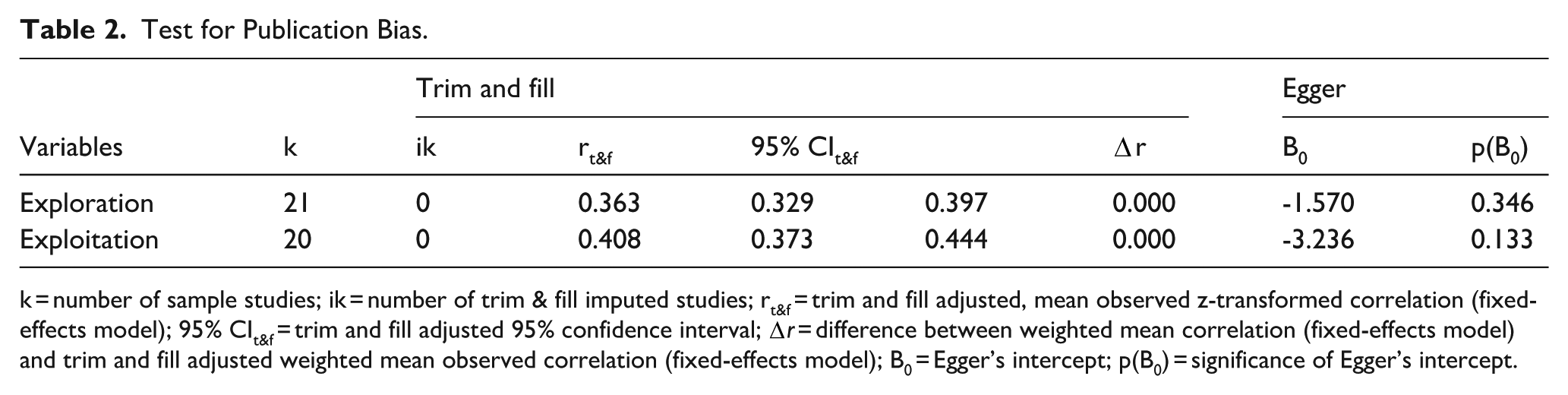
k = number of sample studies; ik = number of trim & fill imputed studies; rt&f = trim and fill adjusted, mean observed z-transformed correlation (fixed-effects model); 95% CIt&f = trim and fill adjusted 95% confidence interval;
Direct Relationships of Exploration and Exploitation with SMEs Performance.

k = number of sample studies; n = total number of SMEs observations; r’ = weighted mean observed correlation, back-transformed from Fisher’s z-transformation (random-effects model); p-val = p-value; 95% CI = 95% confidence interval; z = z-value; QM = heterogeneity test Q; Tau2 = estimated amount of total heterogeneity; I2 = total heterogeneity/total variability; H2 = total variability/sampling variability.
Results
Publication Bias
Before testing the hypotheses, we assessed publication bias to determine whether studies with nonsignificant or counterintuitive results are less frequently published, as such bias can undermine the validity of meta-analytical findings (Kepes et al., 2012). To address this, we employed a combined approach recommended by Ferguson and Brannick (2012): the Duval and Tweedie (2000) trim-and-fill method and the regression test proposed by Egger et al. (1997). The trim-and-fill method adjusts for publication bias by iteratively “trimming” data points from one side of the funnel plot and “filling” the other side until the plot achieves symmetry, thus minimizing Type I error (Duval & Tweedie, 2000). The regression test calculates the number of studies required to achieve symmetry in the funnel plot, and it examines whether the regression line passes through the origin (Egger et al., 1997).
In the absence of publication bias, the funnel plot—showing the relationship between sample sizes and effect sizes—should be symmetrical. Larger, more precise studies will cluster closely around the average effect size at the top of the plot, while smaller, less precise studies will be dispersed around the average effect size over a broader range. We estimated the test using a more conservative fixed-effects model, following the recommendations of Duval (2005). The Egger et al. (1997) test regresses the standardized effect size against its precision, with the regression line passing through the origin if no bias is present (Kepes et al., 2012).
Direct Relationships
Table 3 illustrates the weighted, back-transformed meta-analytical corrected correlation coefficients (r’) between exploration, exploitation, ambidexterity, and SMEs performance, with the transformation from Fisher’s z units. Exploration (r’ = 0.347; p-val < 0.001) and exploitation (r’ = 0.367; p-val < 0.001) positively influence SMEs’ performance. The ambidexterity effect size is also significantly positive (r’= 0.140, p-val < 0.001). Furthermore, the 95% confidence intervals between exploration (0.27, 0.42), exploitation (0.26, 0.47), and ambidexterity (0.06, 0.23) did not overlap at all, providing support to hypotheses 1 and 2.
However, there is heterogeneity in the sample, as reported by all the statistics. The I2 index shows that the percentage of unexplained variance in the global effect measure is 79.2% for exploration and 88.3% for exploitation, and the H2 is greater than 1.5 in both cases (4.799 and 8.534, respectively). In addition, the significant Q-statistics also reinforce the presence of heterogeneity in the relationships, suggesting that a large part of the heterogeneity is due to actual differences in the studies rather than sampling error, justifying the moderator analysis (Lipsey & Wilson, 2001). Figure 4 depicts the estimates visually, considering that there is no significant difference between the overall benefits of exploring and exploiting. The tests of effect size differences, 11 considering also that the highest reported correlation between exploration and exploitation was 0.65, failed to reject the null hypothesis of effect equality at a two-tailed alpha level of 0.05.

Effects of focused exploration, focused exploitation, and ambidexterity on the SME’s short-term performance.
Subgroup Analysis
Given the statistically significant heterogeneity observed in the direct relationships (Table 3), we conducted a subgroup analysis to better interpret the direction and magnitude of effects across different contexts (Rosenbusch et al., 2019). To ensure sufficient statistical power, we followed Schmidt and Hunter’s (2015) recommendations for assessing subgroup sample sizes (k). Studies were categorized into less and more munificent environments, with each subgroup containing a sufficient number of studies (k > 5) to generate reliable estimates. The number of studies included in each subgroup 12 is comparable to prior meta-analyses employing similar methodologies (e.g., Junni et al., 2013; Marín-Idárraga et al., 2022).
Subgroup Analysis: Interaction Exploration–Environmental Munificence
The empirical evidence demonstrates a statistically significant difference in the mean effect size of the relationship between exploration and SMEs performance across home countries with varying levels of munificence (Tables 4 and 6). Furthermore, the inclusion of the moderator substantially reduces heterogeneity, as reflected in the QM, H2, and I2 statistics in Table 6 compared to Table 3. Specifically, heterogeneity (I2) decreases from 79.2% (Table 3) to 73.4% (Table 6). In addition, the inclusion of the interaction term accounts for 26.9% of the total heterogeneity (R2, Table 6). However, despite this reduction, the exploration–SMEs performance relationship continues to exhibit a relatively high degree of heterogeneity (I2 = 73.4%, Table 6).
Subgroup Analysis for the Exploration–SMEs Performance Relationship.

k = number of sample studies; n = size of the sample; Mr = average effect size (random-effects model); p-val = p- value; 95% CI = 95% confidence interval; QM = heterogeneity test Q; Tau2 = estimated amount of total heterogeneity; I2 = total heterogeneity/total variability; H2 = total variability/sampling variability.
As shown in Table 4, the average effect size of the relationship between exploration and SMEs performance for studies conducted in less munificent environments is significantly higher (Mr = 0.410; p < .001) than in more munificent environments (Mr = 0.274; p < .001). Although the 95% confidence intervals overlap very slightly, the meta-regression performed later (Table 6) showed a significantly negative moderation of environmental munificence with exploration (β = -0.135; p < .10). Figure 5 displays a forest plot for the exploration–SMEs performance relationship by home-country munificence.

Forest plot for the exploration–SME performance relationship.
Subgroup Analysis: Interaction Exploitation–Environmental Munificence
Similarly, the empirical evidence indicates a statistically significant difference in the mean effect size of the relationship between exploitation and SMEs’ performance across home countries with varying levels of munificence (Tables 5 and 6). The inclusion of the moderator significantly reduces heterogeneity, as reflected in the QM, H2, and I2 statistics. Specifically, heterogeneity (I2) decreases from 88.3% in the global model (Table 3) to 82.1% (Table 6) following the incorporation of the moderator.
Subgroup Analysis for the Exploitation–SMEs Performance Relationship.

k = number of sample studies; n = size of the sample; Mr = average effect size (random-effects model); p-val = p-value; 95% CI = 95% confidence interval; QM = heterogeneity test Q; Tau2 = estimated amount of total heterogeneity; I2 = total heterogeneity/total variability; H2 = total variability/sampling variability.
Meta-Regression Analysis Results for the Moderating Influence of Home-Country Munificence.

k = number of sample studies;
The average effect size of the relationship between exploitation and SMEs performance for studies developed in less munificent environments is significantly larger (Mr = 0.477; p < .001) than in more munificent environments (Mr = 0.254; p < .001), with only slightly overlapping between 95% confidence intervals. In addition, the estimate for the moderator effect is significantly negative (β = -0.227; p < .05). Figure 6 depicts the forest plot for the exploitation–SMEs performance relationship by home-country munificence.

Forest plot for the exploitation–SMEs performance relationship.
Meta-Analytic Regression
To evaluate the moderating effect of home-country munificence, we conducted a meta-analytic regression analysis (MARA) using a random-effects model, following the approach of Rosenbusch et al. (2019). We applied weighted least squares regression with inverse variance to estimate the influence of the proposed moderator on the relationships between exploitation, exploration, and SMEs’ performance (Lipsey & Wilson, 2001; Table 6).
Our findings show that home-country munificence negatively moderates the relationship between exploitation and SMEs’ performance (β = -0.227; p < .05). Hence, exploitation is more beneficial to SMEs in less than in more munificent environments (hypothesis 3 is supported). A similar result was also found for the negative moderation of home-country munificence and exploration to explain the SMEs’ performance (β = -0.135; p < .10). This means that the benefits of exploration decrease with greater levels of home-country munificence, therefore, providing support to hypothesis 4. The R2 informs the proportion of heterogeneity that the inclusion of the moderator explains, which is nearly 27% for exploration × munificence and 38% for exploitation × munificence. Figure 7 presents a summary of the effects of focused exploration and focused exploitation, contingent on environmental munificence, on the short-term performance of SMEs.

Effects of focused exploration and focused exploitation contingent on environmental munificence on the SME’s short-term performance.
While our sample of 21 studies with 3,423 observations is consistent with prior SMEs-focused meta-analyses (e.g., Chakma & Dhir, 2023; Fourné et al., 2019; Wenke et al., 2021), we acknowledge statistical limitations stemming from sample size. To assess the reliability of our moderation analyses given the modest number of primary studies, we conducted a post hoc statistical power analysis using G*Power (Faul et al., 2014). Following established methodological guidance (Cohen, 1992), we evaluated two meta-regression models testing the moderating role of home-country munificence in the relationship between strategic orientation (exploration or exploitation) and SMEs’ performance. Results indicated the statistical constraints associated with moderation analysis in meta-regression based on small samples. The statistical power for the exploration–munificence interaction was moderate (0.530), and the estimate did not reach conventional significance thresholds (95% CI: -0.281–0.010; p < .10), though the direction of the effect was consistent with theoretical predictions. Conversely, the interaction between exploitation and munificence was statistically significant (95% CI: -0.411–-0.043; p < .05), but the wide confidence interval suggests imprecision in the magnitude of the effect. These findings should be interpreted cautiously, particularly considering possible measurement inconsistencies or country-level heterogeneity.
To mitigate these limitations, we applied second-order sampling error corrections following Hunter and Schmidt (1990). This procedure enhances the precision of between-study variance estimates (τ²) by accounting for both the average sampling error and its dispersion across studies. For exploration, the corrected τ² was 0.005, with a prediction interval ranging from 0.104 to 0.590, suggesting moderate heterogeneity and confirming the importance of contextual moderators such as munificence. In turn, exploitation showed a larger corrected τ² (0.009) and a wider prediction interval ([0.089; 0.644]), indicating greater variability in effectiveness across settings. These results reinforce the contingent nature of strategic orientation efficacy and support our theoretical proposition that home-country munificence shapes the performance outcomes of exploration and exploitation in SMEs.
In line with recent methodological recommendations (e.g., M. Li, 2021), we deliberately chose not to include certain macro-level control variables—such as GDP growth, central bank interest rates, and national R&D expenditure. These variables can be conceptually embedded within our composite measure of home-country munificence (Fourné et al., 2019; Wan & Hoskisson, 2003), capturing structural conditions across four dimensions: human capital availability, infrastructure investment, technological development, and institutional support. Including overlapping controls would risk multicollinearity, inflate standard errors, and obscure the interpretability of our moderation analysis. Our approach prioritizes theoretical parsimony and construct validity while ensuring methodological robustness through supplementary tests such as RVE and second-order sampling error correction
These methodological refinements enhance the robustness of our findings, particularly regarding the role of environmental munificence as a macro-level moderator. For a comprehensive analysis of the decision to exclude control variables, as well as assessments of statistical power and second-order sampling error correction, please refer to the online supplementary materials available at https://www.investigo.biblioteca.uvigo.es/xmlui/handle/11093/10169.
Discussion
This study contributes to the ongoing debate regarding the relative benefits of exploration, exploitation, and ambidexterity in SMEs, offering a more contextually nuanced understanding of how these strategic orientations perform under varying environmental conditions. Our findings reveal that both exploration- and exploitation-focused strategies are more positively associated with SMEs’ performance in restrictive environments than in rich environments. By introducing home-country munificence as a moderating variable, this research refines existing knowledge and extends prior meta-analytical work (e.g., Marín-Idárraga et al., 2022; Wenke et al., 2021), shifting the emphasis from what strategies SMEs should pursue to when different orientations are most effective.
While Wenke et al. (2021) similarly report that SMEs benefit more from strategic focus than ambidexterity, their analysis does not incorporate broader environmental moderators beyond institutional protection of intellectual property rights. Our findings complement theirs by demonstrating that the positive effects of a focused orientation are contingent on the restrictiveness of the environment in terms of resource munificence. Just as Wenke et al. (2021) observed that strong intellectual property rights weaken the performance benefits of focus (their β = -0.004, p-val < 0.01 in both cases), we show that abundant environmental resources decrease its effectiveness perhaps to a higher extent (our β = -0.13, p-val = 0.07 for exploration; β = -0.22, p-val = 0.02 for exploitation). In low-munificence contexts, scarce resources intensify the need for clear strategic commitment, enabling firms to channel limited assets toward deepening existing capabilities (exploitation) or pursuing narrowly defined innovation opportunities (exploration), both of which generate higher returns under pressure. In high-munificence contexts, resource abundance allows SMEs to spread efforts across multiple approaches without incurring the same efficiency penalties, but this dispersal also narrows the performance gap between orientations. As a result, the strategic advantage of focus is greatest when resource scarcity constrains choices, and smallest when abundance affords several equally viable pathways.
Our findings are somewhat different from the conclusions drawn by Marín-Idárraga et al. (2022), who found a negative moderation of competitive intensity and a positive moderation of environmental dynamism on the exploration–exploitation–performance relationship in a mixed sample of large (31 studies) and SMEs (24 studies). They reported stronger effects of both exploration and exploitation for larger than for smaller firms, although their 95% confidence intervals for correlation leave this open to interpretation (exploitation: [0.22, 0.29] for large firms; [0.19, 0.30] for small firms; exploration: [0.16, 0.22], large firms; [0.13, 0.23] small firms). In their sample, exploitation seemed a better option than exploration for large firms, but the evidence was inconclusive for small counterparts.
We introduce home-country munificence as a macro-environmental moderator, which is similar to Marín-Idárraga et al.’s (2022) environmental dynamism. We address cross-national contingencies that influence SMEs’ behavior. Our negative moderation estimates (β = -0.13 for exploration * munificence; β = -0.227 for exploitation * munificence), although marginal in terms of significance, parallel their positive moderation for environmental dynamism (β = 0.50 for both exploration and exploitation interaction with environmental dynamism). In all the cases, harder environments (scarcity of resources; more dynamic environment) reward either of the two orientations more than the more favorable environment (abundant resources; less dynamic environment). However, this logic is flipped in their competitive intensity moderation, so in more competitive environments, both approaches reward less.
This contrast highlights that not all “hard” environments operate in the same way. Scarcity and volatility increase the payoff to focus by making these orientations more valuable for rapid and efficient resource deployment. Rich-resource and stable environments, by contrast, reduce urgency, allowing SMEs to spread resources across multiple approaches, diluting the incremental returns of a focused orientation. In intensely competitive environments, however, many rivals chase the same customers, so efficiency gains from a focused orientation are quickly matched by imitation or counter-innovation. In short, scarcity and volatility amplify the benefits of focus; rivalry compresses them. This pattern reflects the adverse environment-focus paradox: in some adverse contexts, a focus orientation rewards more in less adverse contexts (munificence, dynamism), but in others it does not (highly competitive intensity).
Taken together, our evidence reinforces the theoretical position that strategic focus enables more effective resource allocation, deeper domain expertise, and clearer organizational identity in certain types of hard environments. While both focused orientations have merit, our meta-analysis shows that ambidexterity yields consistently smaller performance returns in SMEs.
Our effect size estimates (exploration = 0.34; exploitation = 0.36) are higher than those reported by Mathias (2014) for early-stage ventures and SMEs (0.22 and 0.17, respectively), the mixed sample of large and SMEs of Marín-Idárraga et al. (2022) (0.18 and 0.24, respectively). However, they are proximal to Wenke et al. (2021) estimates for SMEs (0.29 for both). The effect size for ambidexterity in our study aligns closely with prior work (Mathias, 2014; Wenke et al., 2021). These findings affirm that SMEs derive greater benefit from pursuing a single strategic orientation, particularly in settings characterized by resource scarcity. Some other authors suggested that a way to eliminate the problem of size for SMEs is to include competitive intelligence routines, so they can compensate for the lower levels of resource availability (Boronat-Navarro et al., 2024). And yet the remaining question was whether such ambidexterity could be more beneficial than a focused orientation. Our results provide evidence of the contingent nature of the environment, even for the case of ambidexterity, an issue that future studies could investigate further.
From a theoretical perspective, our study contributes to the growing recognition that ambidexterity is not a universal strategic prescription (e.g., Solís-Molina et al., 2018; Turner et al., 2013; Wenke et al., 2021). Rather, it is a context-dependent strategy whose viability is moderated by environmental munificence. Our results suggest that, under high munificence, the relative advantages of focused orientations decrease. In such contexts, market competition is more intense (Auh & Menguc, 2005; Porter, 1980), and opportunities for exploration and exploitation become more evenly distributed. Consequently, the performance differentials among strategic orientations tend to converge.
Under low munificence, however, the environment becomes more volatile and less forgiving, demanding clarity and consistency in strategic posture. Exploration thrives in such contexts because it allows SMEs to pivot rapidly and capitalize on emerging niches, especially as incumbent firms exit the market. Exploitation, while beneficial, may require greater investment and longer lead times—conditions that might not be tenable in environments marked by scarcity.
Our findings, therefore, emphasize the importance of strategic alignment under environmental constraints. Rather than treating exploration, exploitation, or ambidexterity as universally optimal, our study advocates for a contingent view of SMEs’ strategy—one that accounts for the macro-environmental settings in which firms operate. This contingency-based framework not only advances theoretical understanding but also offers actionable outcomes for SME leaders managing complex and uncertain environments.
Our findings also connect to recent literature on crisis and resilience in SMEs. For example, Safón and Iborra (2025) provide empirical support for the efficacy of exploration during economic downturns—conditions that serve as a proxy for low-munificence. Similarly, Grözinger et al. (2025) illustrate how SME leaders’ psychological capital can influence adaptive strategic behavior during periods of heightened uncertainty, such as the COVID-19 pandemic. These studies implicitly reinforce our conclusion that contextually grounded focused strategies—rather than an automatic pursuit of ambidexterity—may better support resilience and performance in constrained environments.
Limitations
Despite the contributions, this research is not exempt from limitations. One key challenge in meta-analytic studies is the potential effect of artifacts in individual studies (Hunter & Schmidt, 2004). We have addressed errors related to sampling and measurement, although other sources of error remain unaccounted for in our analysis. Although we made considerable efforts to obtain reliability data for both dependent and independent variables, we had to rely on average reliability estimates when specific performance reliability data were unavailable.
Another limitation concerns the measurement of SMEs’ performance. Not all studies employed multi-item scales for performance measurement; some used single-item measures, which may fail to fully capture the complexity of SMEs’ performance. While aggregated performance measures mitigate the risk of bias (Raisch & Birkinshaw, 2008) and are especially relevant in the SMEs context (Jacobs & Cambré, 2020), prior research has shown that the type of performance measure can influence the outcomes of strategic investigations (Auh & Menguc, 2005; Junni et al., 2013). Unfortunately, most of the sampled studies resorted to aggregated measures, which limited our ability to distinguish between different dimensions of performance.
In addition, our sample was composed of SMEs disproportionately from developed economies, with only a small subset from emerging markets, such as China and Colombia. As a result, our findings may primarily reflect environments characterized by high institutional stability and resource availability. While the inclusion of home-country munificence as a moderator helps account for some of these cross-country differences, future research should investigate the strategic relationships in less-studied regions, such as sub-Saharan Africa, Southeast Asia, and Latin America.
Our study also relied on the OECD SMEs classification, which may have narrowed our final sample size. Expanding the scope to include studies that apply alternative SME definitions (e.g., those with different employee count thresholds or revenue-based criteria) might have increased the number of eligible studies and enhanced generalizability.
Although we acknowledge the recommendations of Rosenbusch et al. (2019), it remains uncertain whether the primary studies included in our meta-analysis adequately addressed potential endogeneity between strategic orientations and firm performance, given that exploration and exploitation may themselves be shaped by past performance aspirations or current outcomes. This prevented us from making causal claims. To enhance the robustness and credibility of future meta-analytic research, we encourage scholars to incorporate remedies that explicitly account for endogeneity (e.g., study-level and country-level control variables, instrumental variables, propensity score matching). Finally, it is worth noting that the additional tests performed for power analysis and second-order sampling error corrections addressed some of the small N limitations, as reported in the results section.
Future Research Avenues
Our research highlighted the more positive association of a focused orientation in resource-constrained environments. However, the long-term viability of a fixed strategic posture remains questionable. As environmental conditions evolve, SMEs may need to develop threshold capabilities that enable dynamic shifts between exploitative and explorative strategies (see options in Figure 1). This strategic flexibility could prove essential for SMEs aiming to maintain performance over time, especially in volatile or low-munificence contexts. Future research should investigate how SMEs orchestrate such strategic transitions and under what conditions these shifts optimize performance.
Moreover, while previous studies have addressed simultaneous (March, 1991) or sequential (Lavie et al., 2010; Simsek et al., 2009) ambidexterity, further work is needed to evaluate the performance implications of these modes, particularly in SMEs. In contrast to larger, resource-rich firms, SMEs may benefit from strategically cycling between exploration and exploitation rather than balancing them concurrently, opening the study of the duration in each approach. Given the temporal lag between exploratory efforts and measurable performance outcomes (Mathias, 2014), research should also explore the optimal timing and sequencing of strategic shifts. Longitudinal studies would help clarify whether performance gains emerge more reliably from flexible, time-based transitions rather than simultaneous ambidexterity. Exploring the duration and order of these strategic shifts, together with environmental conditions, would add critical understanding of the capabilities that enable SMEs to adapt across business cycles.
Given that many SMEs participate in international markets, research should address how the host country interacts with home-country munificence and whether SMEs implement different orientations in each country when conditions are different. Cross-border differences can trigger resource-based or institutional “shock effects,” influencing the strategic behavior and performance of internationalizing SMEs. Overall, it seems that investigation of harder environments around the type of environmental munificence and dynamism is warranted, since these two types of restrictive environments offer more rewards for focused orientations, which can be termed as the adverse environment-focus paradox. This is the phenomenon when firms gain more from a focused orientation to exploration or exploitation in adverse than in favorable settings. It may also lead to a relevant typology, that is, the adverse environment-focused firm, which is a firm that adopts a single strategic logic (exploration or exploitation) in less favorable contexts, whereas it may shift between both when the environment is more favorable (i.e., sequential ambidexterity).
Implications for Practice
The presented meta-analytic evidence provides relevant implications for practitioners within the SMEs domain. First, this study provides a nuanced understanding of which strategic orientation SMEs should prioritize. While extant literature has offered guidance on how SMEs can achieve ambidexterity despite its inherent challenges (e.g., Lubatkin et al., 2006), our study suggests that the pursuit of ambidexterity is not necessarily imperative for attaining superior performance. Instead, SMEs’ managers should strategically concentrate on either exploration or exploitation, aligning their organizational endeavors exclusively with one orientation or the other, depending upon the goals set for the coming years. Such strategic alignment is particularly critical for SMEs, given that the successful execution of exploration and exploitation demands different organizational architectures, which may not be feasible for SMEs due to resource constraints that preclude the establishment of separate units for each. Any focus orientation will yield a more positive performance in more than in less restrictive environments.
Second, although our findings indicate that focusing on exploration or exploitation yields a greater performance, we do not advocate for a complete avoidance of ambidextrous activities. Rather, we propose that simultaneously engaging in both exploration and exploitation may yield lower SMEs’ performance than a focused approach. However, a strategy of strategic and dynamic sequential switching between both can offer a viable alternative to ambidexterity, so the SMEs do not compromise the future for the sake of the present. This approach allows SMEs to maintain internal consistency 13 while strategically alternating between both activities. Nevertheless, this sequential switching should not be from year to year, but longer over time (e.g., several years exploring, several others exploiting); otherwise, the SMEs’ performance will suffer from a dip caused by each shift very often.
Third, the top management team also needs to be aware that SMEs are particularly responsive to institutional-level environmental contingencies. SMEs’ managers in less munificent home countries should allocate resources carefully and invest preferably in exploitation, or alternatively in exploration, although this benefit is smaller than that derived from an exploitation orientation, but not for too long. Otherwise, the illusion of performance will keep the firm stuck in its current orientation, compromising the long-term future for the sake of short-term performance or vice versa.
In short, focusing on either exploration or exploitation under institutional environmental-level contingencies is not a straightforward decision. Managers facing this “dilemma” should carefully evaluate factors such as resource availability, market dynamics, risk tolerance, long-term objectives, and organizational capabilities, and most importantly, when the firm must shift from one orientation to the other to not lose sight of future competitiveness. By systematically assessing these considerations, managers can make informed strategic decisions that align with the unique challenges and opportunities present in less munificent home countries, which is somehow consistent with the idea of sequential switching. This seems to be the best option for SMEs to address their inability to address the ambidextrous orientation under simultaneous exploration and exploitation.
Implications for Policymakers
This study also guides how policymakers can raise awareness of the benefits stemming from a focused orientation to both exploration and exploitation for SMEs’ performance. Policymakers can solely help firms implement these activities if they understand the delicate mechanisms of different explorative and exploitative strategies. Our empirical evidence indicates that depending on the environmental munificence of the home country, firms—especially SMEs—may need government assistance to switch from one orientation to the other. Since these focused orientations are particularly beneficial to SMEs in resource-constrained environments, this capability to switch is extremely important. Policymakers can, therefore, establish some programs that help SMEs’ managers understand how and when they should prioritize flexibility (exploration) over efficiency (exploitation), and vice versa. By creating an enabling policy environment conducive to sequential switching, policymakers can empower SMEs’ managers to deal with the challenges of resource scarcity and market uncertainty more effectively, thereby driving sustainable growth in less munificent environments.
Conclusion
This meta-analysis advances the strategic management literature by providing a more contextually grounded understanding of how exploration, exploitation, and ambidexterity relate to SMEs’ performance. Building upon the foundational work of March (1991) and subsequent meta-analytic inquiries (e.g., Marín-Idárraga et al., 2022; Wenke et al., 2021), our study challenges the universalist assumption that ambidexterity inherently confers superior performance benefits. Instead, we demonstrate that the effectiveness of strategic orientations is contingent upon macro-environmental conditions—specifically, home-country munificence, understood as the environmental availability of critical resources such as infrastructure, human capital, and technological development.
While prior research has debated whether SMEs benefit more from a focused or ambidextrous orientation (e.g., Wenke et al., 2021), our contributions lie in articulating when each orientation yields superior performance. Our results are consistent with a focused orientation outperforming ambidexterity for the case of SMEs. However, such a positive association between focused orientation and SMEs’ performance is stronger in resource-constrained environments characterized by low munificence than in resource-rich environments. This finding not only reinforces prior evidence on the challenges SMEs face when attempting to simultaneously balance divergent strategic logics (Cao et al., 2009; Wenke et al., 2021) but also extends the conversation by highlighting the critical role of environmental-level factors in shaping these trade-offs.
We build upon and extend earlier findings that considered firm-level or industry-level conditions (Marín-Idárraga et al., 2022; Wenke et al., 2021). Our results suggest that strategic effectiveness is not uniform across environmental contexts; rather, it is sensitive to the level of environmental resources available. In less munificent environments, any small improvement owed to the same exploitative actions—for example, process streamlining, incremental product improvements, fine-tuning supply chains—or explorative actions—for example, radical new products, new ways of performing processes—will yield a higher performance gain than in rich-resource environments, where the improvements need to be bigger to produce the same performance gains. For exploitation, scarcity magnifies the relative impact of efficiency gains; for exploration, it forces sharper investment selection to allocate more scarce resources, leading to a higher payoff. In high-munificence environments, even focused SMEs will have more slack to spread resources across secondary priorities, which dilutes the intensity and consistency of execution benefit observed in low-munificent environments.
This nuanced finding reframes the ambidexterity–performance debate from a binary whether question to a more dynamic when issue. We argue that the true locus of dynamic capability in SMEs lies not in the simultaneous pursuit of exploration and exploitation, but in the strategic timing and sequencing of these orientations in response to contextual constraints. This temporal and environmental sensitivity repositions the ambidexterity construct within a broader environmental framework, inviting future research to more closely examine how firms orchestrate strategic shifts when environmental munificence and volatility change. This approach to the study of when to shift in longitudinal designs will offer a more complete understanding of SMEs’ strategic behavior. In addition, we call for more research to help detect what other harder environments make a focus strategy more beneficial for SMEs to improve their performance, so we can have a fuller picture beyond environmental dynamism and munificence, on the one hand, and industry intensity, on the other hand. This will clarify what type of environments can be included in the adverse environment-focused paradox of exploitation–exploration versus ambidexterity in SMEs, and the adverse environment-focused firm as a potential outperformer when compared to ambidextrous SMEs. These ventures can adopt a single strategic logic (exploration or exploitation) in less favorable contexts, whereas they may shift between both when the environment is more favorable (i.e., sequential ambidexterity).
Footnotes
Declaration of conflicting interests
The authors declared no potential conflicts of interest with respect to the research, authorship, and/or publication of this article.
Funding
The authors disclosed receipt of the following financial support for the research, authorship, and/or publication of this article: This research has been supported by Portuguese funds through FCT—Fundação para a Ciência e Tecnologia under the projects UIDP/04728/2020 and UIDB/04728/2020, and by Spanish funds through the project PID2022-136983NB-I00 of the Ministry of Science and Innovation.
