



Abstract
To meet the changing demands of the students and many other stakeholders of education in this twenty-first century, the education systems of different nations of the world are in the process of continuous paradigm shifts in their curriculum, methods of instruction, management, evaluation process and other related components. Integrated programmes in education may be considered as a kind of crop of these paradigm shifts. The integrated programmes have many advantages over traditional fragmented programmes in education. Integrated programmes allow the learners to pursue a holistic learning without the restrictions imposed by subject and/or level of learning boundaries. For achieving well-rounded and integrated development among the learners, integrated programmes play a significant role in the field of education. Focusing on these issues, in this present article, discussions are made mostly on conceptual analysis of integrated programmes, the world scenario of development and current status of integrated programmes and Indian scenario of development and current status of integrated programmes. The article is concluded by reflecting on the points that integrated programmes are the latest fashion in programme designing and implementation in education, and these programmes have better implication for achieving multidisciplinary and interdisciplinary skills. Also, in the concluding section of the article, reflections are made regarding measures to be taken at the government level and responsibilities to be shouldered at the level of educational institutions offering integrated programmes to popularize integrated programmes among the stakeholders of education and for establishing integrated programmes as vibrant and leading programmes in education.
Introduction
The human life in this twenty-first century is very complex and multidimensional. The dawn of twenty-first century has experienced a wider change in many spheres of human civilization, that is, economic, political, religious, social, technical and many more. The sphere of education is not an exception to it. To meet the changing demands of the students and many other stakeholders of education, the education systems of different nations of the world are in the process of continuous paradigm shifts in their curriculum, methods of instruction, management, evaluation process and other related components. Integrated programmes in education may be considered as a kind of crop of these paradigm shifts.
Integrated programmes have many advantages over traditional fragmented programmes of education. Interdisciplinary or integrated curriculum is very much student-centred, improves higher-level thinking skills and problem solving and improves retention (King & Wiseman, 2001; Smith & Karr-Kidwell, 2000). Research indicates that using an interdisciplinary or integrated curriculum provides opportunities for more relevant, less fragmented and more stimulating experiences for learners (Furner & Kumar, 2007). Students experiencing integrated approaches perform better than the students in traditional classrooms in terms of academic success (Barr et al., 2015; Yoon et al., 2014). Integrated science, technology, engineering and mathematics (STEM) education can motivate students to pursue careers in STEM fields and may improve their interest and performance in mathematics and science. Effective STEM education is vital for the future success of students (Stohlmann et al., 2012). van Laren (2011) mentioned that pre-service teachers recognized the importance of integrated models of teacher education to make pre-service teachers HIV aware, HIV competent and HIV safe in relation to their professional development.
In the context of facilitating integration model of education, the National Education Policy (2020) states:
The key overall thrust of curriculum and pedagogy reform across all stages will be to move the education system towards real understanding and towards learning how to learn—and away from the culture of rote learning as is largely present today. The aim of education will not only be cognitive development, but also building character and creating holistic and well-rounded individuals equipped with the key 21st century skills. Ultimately, knowledge is a deep-seated treasure and education helps in its manifestation as the perfection which is already within an individual. All aspects of curriculum and pedagogy will be reoriented and revamped to attain these critical goals. Specific sets of skills and values across domains will be identified for integration and incorporation at each stage of learning, from pre-school to higher education. Curriculum frameworks and transaction mechanisms will be developed for ensuring that these skills and values are imbibed through engaging processes of teaching and learning. (p. 12)
Integrated programmes allow the learners to pursue a holistic learning without the restrictions imposed by subject and/or level of learning boundaries. Therefore, these programmes help the individuals to be equipped with the skills to cope up with the changing life style of twenty-first century, as mentioned in the National Education Policy (2020). The main purpose of integrated programmes is to bridge the gap between knowledge provided in class room situations and applicability of the knowledge in real-life situations. The purpose for moving towards an integrated course design stems from the relationship between the classroom and the increasingly complex world of today. Trends towards global interconnectedness, the increase in pace and complexity and the rapid expansion of knowledge have brought with them mounting concerns over classroom relevancy and the lack of connections between education and real-world issues. Integrated course design provides a solid response to these challenges by facilitating the application of knowledge, encouraging multiple disciplinary perspectives, enhancing relationships between in-class content and out-of-class realities, encouraging depth and breadth in understanding complex issues and enhancing student engagement through experiential and active learning (Chetan, 2016). If we analyse the education systems of many developed nations of the world, we can see how integrated programmes are prioritized in the education systems of those nations. Integrated programmes are gaining popularity day by day in India also.
Integrated Programmes: A Conceptual Analysis
To lead a successful life, one has to acquire different skills that cut across the disciplines rather than concentrating on a single discipline. Moreover, the learners of twenty-first century have to acquire a large number of skills in different fields of knowledge in an integrated way within less period of time. From these backgrounds, the concept of integrated programmes in education has emerged and is gaining popularity day by day. A large number of universities across the globe are offering different integrated programmes in humanities, sciences, commerce, medical sciences, engineering, management, technical education, etc. at present.
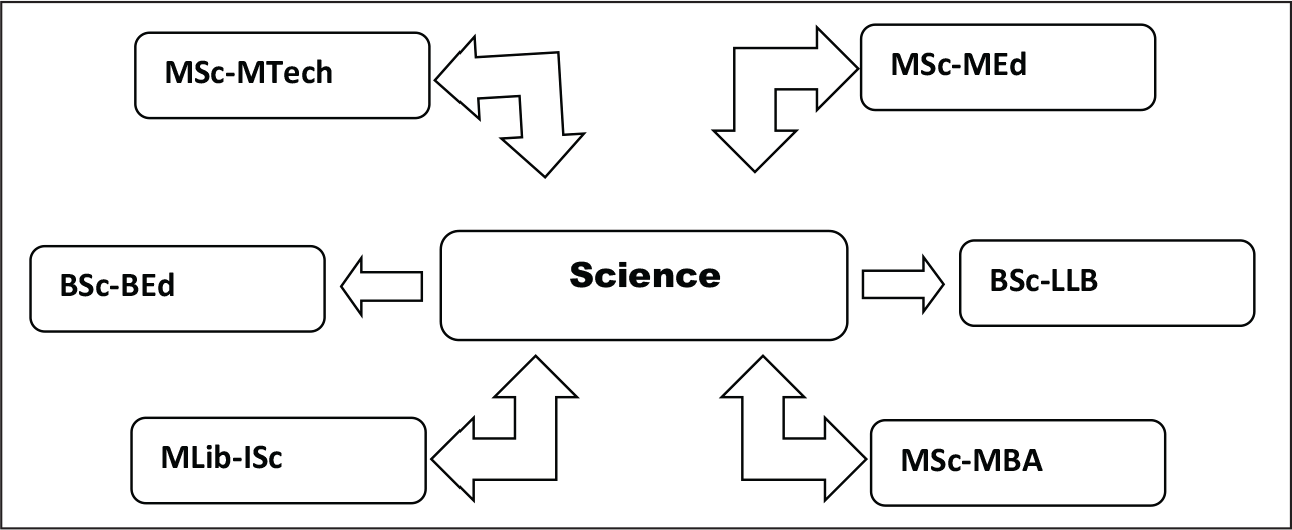
In a layman’s view, an integrated programme means addition of a programme or some programmes to an existing programme of learning of a learner to enhance his/her integrated skills in the areas of his/her learning of the programmes as well as to provide him/her an integrated degree or a diploma in the areas of the learning of the programmes in a defined duration of time; for example, in India, if a student wants to complete his/her Bachelor of Science (BSc) programme as well as Bachelor of Legislative Law (LLB) programme separately, he/she has to spend 6 years, that is, 3 years for BSc plus 3 years for LLB, but, he/she can complete those two programmes simultaneously in an integrated mode within 5 years through BSc-LLB integrated programme. Not only time and money are saved, but the learners get varied taste of the courses through integrated programmes also; for example, how a student of science can get benefit from different other programmes through integrated mode of education may be observed from Figure 1.
Source: The authors.
It is a common notion that students of science mostly prefer or are allowed to pursue engineering or technical subjects only, but from Figure 1, it can clearly be inferred that there are ample opportunities to opt for law, education, business administration, library sciences, etc. for students of science stream. This could happen well only due to the introduction of integrated programmes. Integrated programmes help to add different programmes meaningfully in a single thread.
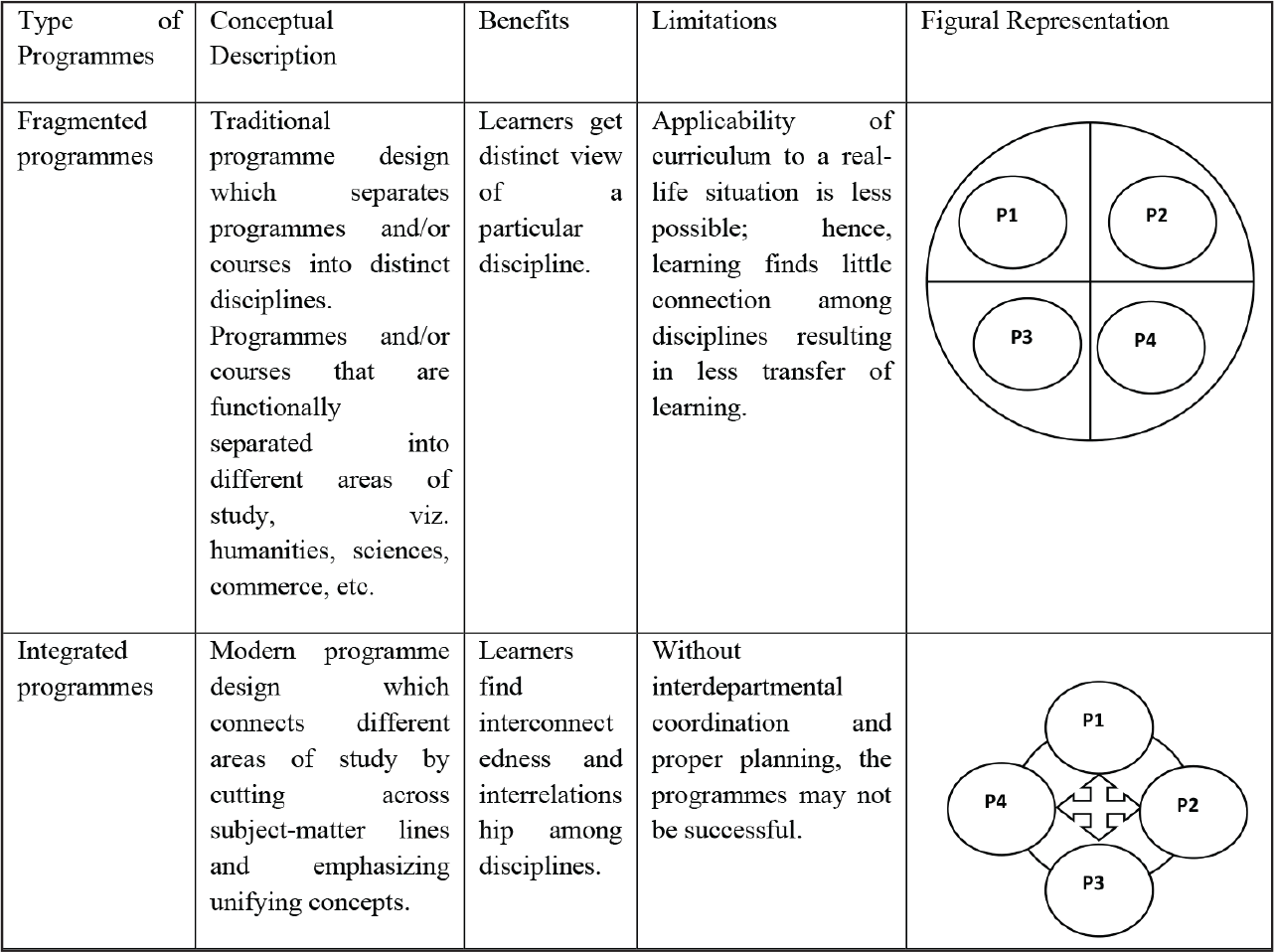
The term ‘integrate’ is derived from the Latin word integrare which means to ‘renew’ or ‘make whole’. The Oxford American Dictionary (2001) defines integrate as follows: ‘to join as to form a larger, more comprehensive entity’ and ‘to blend, harmonize, synthesize, arrange, incorporate, unify, coordinate and orchestrate’. Integrated programme in education generally means a curriculum that is jointly designed by two or more higher education institutions (HEIs)—sometimes from different countries or disciplines—and is regulated by a specific set of guidelines (Chetan, 2016). The students of integrated programmes have to undertake a defined period of study in each institution or discipline in terms of duration and content. After qualifying relevant examinations, at the end of the programmes, students are awarded a single qualification. The certificate of qualification is jointly signed by the academic authorities of both the institutions and/or disciplines. Students get confused among three terms, that is, integrated programmes, joint degrees (JDs) and dual degrees, very often. Generally, an integrated programme helps to earn JDs or dual degrees at a time, but all the JDs or dual degrees are not the outcome of integrated programme. In many cases, all these three terms are used interchangeably. Integrated programmes differ from traditional fragmented programmes in many ways. An integrated programme allows a learner to get two or more degrees together by attaining a single programme. The distinct differences between traditional fragmented curriculum (fragmented programmes) and modern integrated curriculum (integrated programmes) may be understood easily from Figure 2.
Source: The authors.
Integrated programmes may be categorized under two broad types, that is, integration of programmes of different disciplines and integration of programmes (of different levels) of same discipline. In integration of programmes of different disciplines, two or more departments teach concurrently and merge their educational identities; for example, when a learner is admitted to a BSc-BEd integrated programme, he/she pursues two bachelor degree programmes simultaneously, that is, BSc and BEd. Here, both BSc programme and BEd programme belong to two distinct disciplines or departments. In integration of programmes of the same discipline, we generally find that one lower level degree and a higher level degree in the same discipline are taught to the learner in an integrated manner, for example, a 5-year MSc/ PhD (Master of Science/Doctor of Philosophy) programme offered by various Indian Institutes of Technology (IITs) in India, where the first 2 years of the programme are for MSc degree and the remaining 3 years for PhD degree in the concerned subject. Both types of integrated programmes are found across educational institutions of the world including the country India. However, the instances of integration of a discipline in one level (e.g., undergraduate [UG] level) and another discipline in another level (e.g., postgraduate [PG] level) are found, but, very less. The BA/MSci (Master of Natural Sciences) programme of University of Cambridge may be an example in this regard. The concepts of integration of programmes of different disciplines and integration of programmes (of different levels) of the same discipline may be understood easily from Figure 3.

Source: The authors.
The World Scenario of Development and Current Status of Integrated Programmes
The idea of combining two or more disciplines is not new. It can be viewed as one of the elements of progressive education—a pedagogical movement that began in the late nineteenth century. The pioneers of progressive education such as John Locke, Jean Jacques Rousseau and John Dewey emphasized the integration of curriculum and integration of entrepreneurship into education. Tyler (1949) saw integration as the horizontal connections necessary for a coherent curriculum, and Bloom (1958) advocated for inquiry-oriented, integrated curriculum that ‘open(ed) up possibilities’, understanding and relevance (Mathison & Freeman, 1998). In the course of time, by the 1960s, most of the nations across the globe used to believe knowledge as complex and interconnected systems. To cope up with the changing nature of knowledge and to meet the challenges of changing needs of the learners, most of the nations emphasized on integrated programme by the 1970s.
The benefits of integration can be seen internationally; the countries that top the Programme for International Student Assessment (PISA) scales all have policy provisions for integration (Drake & Savage, 2016). The top ranked countries in PISA like Quebec and Canada have the features of integrated curriculum in their education system. Korea offers an integrated curriculum at many junctures in its recent revised policy (Minister of Education, Science and Technology Korea, 2009). Finland, one of the top ranked countries in the world on Organisation for Economic Cooperation and Development (OECD) measures has shifted to a project-based learning approach that is interdisciplinary in nature (Halinen, 2016).
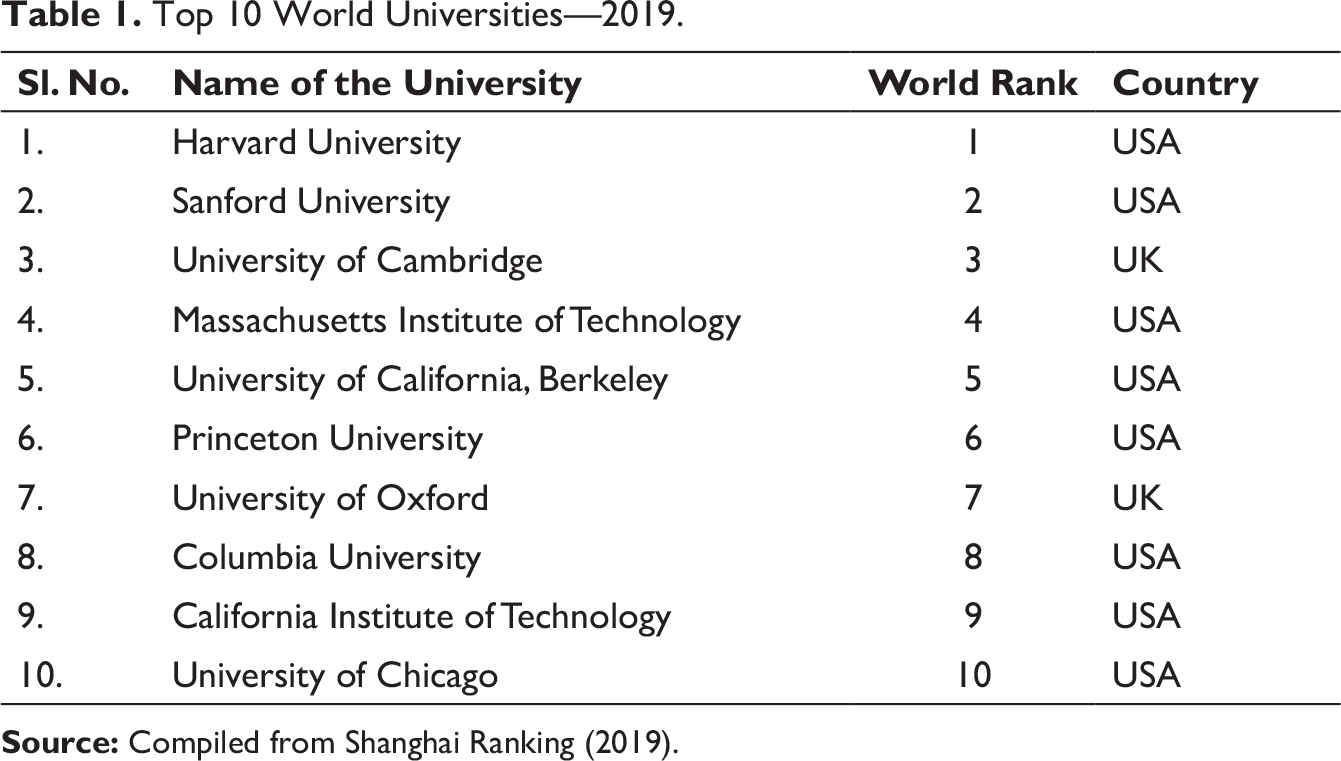
Top 10 World Universities—2019.
Source: Compiled from Shanghai Ranking (2019).
All the above top 10 universities of the world offer JDs or dual degrees or integrated programmes/courses in most of the streams, that is, arts, science, medical science, technology, management, teacher education, etc. at graduate, PG or doctoral levels at present. The top most university possessing first rank in the list, that is, Harvard University, offers a number of JD programmes in various streams. Some of the popular JD programmes of the university are MD/PhD (Doctor of Medicine/Doctor of Philosophy), JD/Phil (Joint Degree programme in Law and PhD in Arts and Sciences) and MS/MBA (Master of Science in Engineering School/ Biotechnology and Master of Business Administration). Stanford University provides a number of JD or dual degree programmes integrated with MBA. The most demanding programmes of Stanford University are MA Education/MBA, MS Computer Science/MBA, MS Electrical Engineering/MBA and MD/MBA, etc. All Under Graduate (UG) courses of 3 years duration at the University of Cambridge offers a single degree called Bachelor of Arts (BA); for example, BA in Natural Sciences, BA in Law, BA in History and BA in Medical Science, etc. Some of the science subjects offer integrated Master’s programme by adding just a year, that is, fourth year to a BA degree. They are BA/MEng (Master of Engineering), BA/MMath (Master of Mathematics), BA/MSci (Master of Natural Sciences), etc. Massachusetts Institute of Technology (MIT) offers a number of science and engineering integrated/interdisciplinary programmes at master’s and doctoral levels. The broad subject areas where interdisciplinary programmes are offered are computational science and engineering, computational and systems biology, health science and technology, leaders for global operations (with School of Management), chain management programme, social and engineering system (a doctoral programme) and system design and management, etc. University of California (UC), Berkeley offers a great opportunity to the students to pursue dual degrees from two universities, that is, either UC, Berkeley with Sciences Po University of France or UC, Berkeley with University of Hong Kong (UHK). Out of 4-year degree course, students have to spend first 2 years in any of the campuses of either the University of Science Po or University of Hong Kong and final 2 years in the UC, Berkeley. After successful completion of the programme, students receive a Bachelor degree in Social Science from University of Science Po or UHK and Bachelor of Arts in the Major from UC, Berkeley. These graduates are guaranteed admission in master’s programmes. Princeton University’s Graduate school offers four JD programmes, namely interdisciplinary humanities, social policy, neurosciences and material sciences. These programmes allow the students to earn a PhD within the recognized discipline. University of Oxford offers 5-year MSc/PhD combined multidisciplinary programmes in social science, information communication and social science, neuroscience and social data science, etc. Master of Science in Bioethics and Master of Public Health is a demanding dual degree programme jointly provided by Columbia University with Mailman School of Public Health. Some other dual degree master’s programmes are offered by Columbia University with Columbia School of Journalism, Columbia School of Social Work, Graduate School of Architecture, Planning and Preservations, etc. Columbia University also offers dual and joint UG BA degree programmes with Science Po University, Trinity College Dublin, City University of Hong Kong and Tel Aviv University, etc. California Institute of Technology offers interdisciplinary dual degrees in applied physics, computer science, astrobiology, electrical engineering, environmental science, bioengineering, mechanical engineering, geology and computation and neural systems. The institution provides at least 26 UG programmes, 8 PG programmes and 15 doctoral programmes, many out of those are interdisciplinary dual degree programmes. University of Chicago offers 5-year joint bachelor’s/ master’s programme (BA/MA) in computational social sciences, education and teaching certification, humanities, Middle Eastern studies, public policy studies, social service administration, etc. and 4-year BA/MA programmes in biological chemistry, computer science, International Relations, mathematics, social sciences, statistics, digital studies of language, culture and history, etc. Like these universities, many other universities of the world at present are providing integrated or dual degrees or JD programmes.
The Indian Scenario of Development and Current Status of Integrated Programmes
In the Indian context, the idea of integrated curriculum or integrated programmes is found in the reports of University Education Commission (1948–1949) and Secondary Education Commission (1952–1953) in one way or other. In the context of improving the quality of teacher education, the Education Commission (1964–1966) clearly stated that an alternative way to link the study of subjects with professional preparation at the level of secondary teachers is to provide concurrent and integrated courses in general and professional education, on the pattern of teacher education in the USA. Courses of this type have been introduced in a few selected subjects in the Kurukshetra University in Punjab, in the Regional Colleges of Education and in one Rural Institute (p. 121). The National Commission on Teachers (1983–1985) recommended 5-year integrated teacher education courses and internship. While stating the designing of courses and introducing vocational courses, Programme of Action (1992) of National Policy on Education (1986) recommended the development of integrated honours courses in vocational subjects rather than optional vocational courses which do not enhance job prospects sufficiently. The National Curriculum Framework for Teacher Education (2009) recommended that current models of teacher education at all levels of school education be gradually replaced by models of teacher education that integrate general education with professional development along with an intensive internship with schools. The National Curriculum Framework for Teacher Education (2009) further recommended that a 4-year integrated programme of Elementary Teacher Education would be undertaken via Institute of Advanced Studies in Education (IASE) and District Institutes of Education and Training (DIET) in selected state and central universities. It also recommended to review the existing BEd programme to facilitate the choice between a 4-year integrated model after higher secondary education or a 2-year model after graduation. The Committee to Advise on Renovation and Rejuvenation of Higher Education, popularly known as Yashpal Committee Report (2009) rightly remarked ‘In sum, there is need to expose students, especially at the undergraduate level, to various disciplines like humanities, social sciences, aesthetics etc., in an integrated manner. There should be irrespective of the disciplines they would like to specialize in subsequently’ (p. 21). The committee also recommended that higher education had to be treated as an integrated whole. The National Education Policy (2020) has given more importance on multidisciplinary institutions which will provide integrated programmes. The policy states that by 2040, all HEIs shall aim to become multidisciplinary institutions and shall aim to have larger student enrolments preferably in the thousands, for optimal use of infrastructure and resources, and for the creation of vibrant multidisciplinary communities. Since this process will take time, all HEIs will first plan to become multidisciplinary by 2030 and then gradually increase student strength to the desired levels (p. 35). The policy further states, ‘The overall higher education sector will aim to be an integrated higher education system, including professional and vocational education’ (p. 36). From the recommendations of different committees and commissions in the field of education in India, a significant inclination towards integrated programmes in education sector in India has been noticed.
Growth of Enrolment of Students in Integrated Programmes in India.

Source: Compiled from the All India Survey of Higher Education (AISHE, 2018–2019).
It is observed from Table 2 that enrolment in higher education has increased over the years, but, the Compound Annual Growth Rate (CAGR) is 1.8 in case of total enrolment of students in higher education during last 5 years, whereas, the CAGR is 11.2 in case of integrated programmes. Therefore, it is a clear indication that students in higher education in India are showing more interest towards integrated programmes.

Source: Compiled from the All India Survey of Higher Education (AISHE, 2018–2019).
Many universities and education institutions in India are offering integrated programmes in various streams. The integrated programmes offered in some of the prominent fields/streams/areas of education by different institutions of India are presented under the following heads:
General Education
There is a wide variety of integrated programmes of general education. Most common of them are 5-year bachelor’s and master’s programmes in science, arts, commerce, library science, journalism and mass Communication, etc. Integrated MSc (BSc + MSc), integrated BSc (Hons) MSc, integrated/dual degree BA-MA, integrated PhD (MA/MSc/MCom + PhD) programmes are some of the common integrated courses offered by different universities and HEIs including prestigious Indian Institute of Technology(s).
Teacher Education
Though the teacher education system of India has a long history, but it was not integrated very much. Experimentation of introducing integrated BSc-BEd, BA-BEd and BTech-BEd programmes was started in RIEs during the 1960s of twentieth century. The BSc-BEd programme of the RIEs has been continuing till now without any break, but the BTech-BEd programme of the RIEs was closed after only a few years of its running. The BA-BEd programme of RIEs had been discontinued since 1994 (by facing a lot of upheavals) and the programme was restarted in RIEs before a few years, and presently, the programme is in operation in RIEs. Similar experiments (on integrated programmes) were also started in Kurukshetra University of Punjab (presently in Haryana), Sardar Patel University in Vidyanagar of Gujrat, Panjab University, Chandigarh and some other universities/institutions. The 2-year MScEd (Master of Science Education) programme in physics, chemistry, mathematics and life sciences was started in RIEs (in Mysore and Bhubaneswar) in 1975, and the programme faced many upheavals in the course of its journey, and finally, it was discontinued in 1994. Presently, a new, special 6-year MScEd programme in physics, chemistry and mathematics is visible in RIE, Mysore. Another 2-year MScEd programme in Life Sciences was launched in RIE, Bhubaneswar for a short period during the last decade. In the light of the Justice Verma Commission Report (2012), the National Council for Teacher Education (NCTE) notified revised regulations and norms and standards for the following 15 teacher education programmes in 2014:
Diploma in early childhood education programme leading to Diploma in Pre-school Education (DPSE). Elementary teacher education programme leading to Diploma in Elementary Education (DElEd). Bachelor of elementary teacher education programme leading to Bachelor of Elementary Education (BElEd) degree. BEd programme leading to BEd degree. MEd programme leading to MEd degree. Diploma in physical education programme leading to Diploma in Physical Education (DPEd) Bachelor of physical education programme leading to Bachelor of Physical Education (BPEd). Master of physical education programme leading to Master of Physical Education (MPEd). Diploma in elementary education programme through Open and Distance learning system leading to Diploma in Elementary Education (DElEd). BEd programme through Open and Distance learning system leading to BEd degree. Diploma in arts education (Visual Arts) programme leading to Diploma in Arts Education (Visual Arts). Diploma in arts education (Performing Arts) programme leading to Diploma in Arts Education (Performing Arts). 4-year integrated programme leading to BA-BEd/BSc-BEd degree. 3-year BEd programme (part time) leading to BEd degree. 3-year integrated programme leading to BEd, MEd (integrated) degree.
Out of the programmes mentioned above, programmes like 4-year integrated BA-BEd/BSc-BEd programmes and 3-year integrated BEd, MEd programme are run by NCTE recognized institutions. As per to NCTE Amendment Regulation 2019, from the academic session 2020-2021, NCTE is in the process of launching two significant types of integrated pre-service teacher education programmes, that is, 4-year integrated teacher education programme (ITEP) (pre-primary to primary) and 4-year integrated teacher education programme (ITEP) (upper primary to secondary). The nature of both of these 4-year ITEPs is different in many ways from 4-year integrated BSc-BEd/BA-BEd programme and 3-year integrated BEd, MEd programmes based on NCTE Regulation 2014.
In last decade, a few central universities and state universities/institutions including private universities/institutions played a vital role to offer teacher education programmes in integrated mode. The BSc-BEd of Assam University, Silchar; BEd (BSc/BA) of Tezpur University, Tezpur; BSc-BEd and BA-BEd of Central University of South Bihar, Gaya; BSc-BEd and BA-BEd of Dr. Hari Singh Gaur University, Sagar; BSc-BEd and BA-BEd of Central University of Jharkhand, Ranchi; BSc-BEd and BA-BEd of Indira Gandhi National Tribal University, Amarkantak; BSc-BEd of Central University of Tamil Nadu, Thiruvarur; BA-BEd of Central University of Jammu, Samba; BSc-BEd and BA-BEd of Indian Institute of Teacher Education, Gandhinagar; MSc-BEd of Central University of Rajasthan are some instances in this context. Now, a good number of universities/ institutions are in the process of offering different kinds of teacher education programmes in integrated mode, but the efforts made in the direction of implementing integrated teacher education programmes are not satisfactory till now. In order to meet the increasing demands of quality teacher supply of the nation, continuous and radical efforts are necessary to popularize different kinds of integrated teacher education programmes among the stakeholder of education.
Vocational and Technical Education
All India Council for Technical Education (AICTE) is an apex body set up by the Government of India in the year 1987 to promote quality in technical education, to plan and coordinate technical education and to regulate and maintain norms and standards of technical education. Different institutions affiliated to AICTE run the programmes under the following heads:
Applied Arts and Crafts Architecture and Town Planning Architecture Town Planning Engineering and Technology Hotel management and Catering Management MCA Pharmacy.
A number of integrated programmes are being run by the technical education institutions all over India. Some of the unique programmes are BTech/MTech, BSc/MSc, MTech/PhD in Fashion and Life style Technology, Biotechnology, Computer Science, Electronics, Communication and Information Technology, etc. Integrated programmes in Management include BMS/MBA; BBA/MBA; BCA/MCA; BPharm/MBA in Pharmaceutical Technology, etc.
Medical Education
The Medical Council of India was established in the year 1934 under the Indian Medical Council Act, 1933. To meet the growing challenges in Medical education, the old Act was repealed and a new Act was enacted in the year 1956. The Act was also further modified in 1964, 1993 and 2001. The council was established with the following objectives:
Maintenance of uniform standards of medical education, both undergraduate and postgraduate; recommendation for recognition/de-recognition of medical qualifications of medical institutions of India or foreign countries; permanent registration/provisional registration of doctors with recognized medical qualifications; and reciprocity with foreign countries in the matter of mutual recognition of medical qualifications.
The programmes run by the top medical colleges in India including All India Institute of Medical Science (AIIMS) are MBBS, BDS, BSc Nursing, GNM Nursing, Bachelor of Physiotherapy, Medical Laboratory Technology, MD, MS and MDS, DM and MCh, PhD, etc. The most popular integrated programmes in medicine are MBBS + MD/MS, MS + MCh, MD + DM, etc.
Conclusion
Integrated programmes are the latest fashion in programme designing and implementation in education, and these programmes have better implication for achieving multidisciplinary and interdisciplinary skills. However, integrated programmes in India are not much popularized till now. Now, the time has come to prioritize integrated programmes in the field of education. Making any education system vibrant is not a single man’s job; rather, all the stakeholders of the education system must shoulder the responsibilities for making the system vibrant. To popularize the integrated programmes, the following measures may be taken at governmental level:
Clear guidelines need to be framed for the institutions offering different kinds of integrated programmes. Initiatives may be taken to set up a separate board or body to monitor integrated education. Integrated programmes should be implemented from higher education level to school level following multiple modalities. Adequate provision of scholarships and fellowships should be created for the students pursuing integrated programmes. Mandates may be issued to HEIs, to run at least one or a few integrated programme based on local demand. Nationalized banks and other financing agencies may be instructed to sanction educational loans in low interest rate to the students pursuing integrated programmes. Initiatives may be taken to liberalize the process of signing Memorandum of Understanding (MoU) between educational institutions offering integrated programmes and the job providing farms or industries. Candidates with the background of integrated education should be given priority in the employment process in both governmental and non-governmental sectors. Education institutions providing integrated programmes may be provided the help of media (both printed and electronic) for publicity of their integrated programmes at a larger scale.
The educational institutions offering integrated programmes should also shoulder different responsibilities to make integrated education programmes vibrant and leading in the ways as follows:
The administration of the institutions should emphasize to develop infrastructural facilities to run integrated programmes at par with global standards. There should be provision for blended (both face-to-face and online) mode of instruction in the institutions to provide integrated programmes. In this regard, teachers, students and the supporting staff of the institution should be techno-savvy. Special training programmes to use modern technology may be organized by the institution in regular intervals. The authorities of the institutions should also take initiatives for signing MoU with other institutions for offering JDs, with different employment farms and industries to create job opportunities for the students. The curriculum of the integrated courses should be reviewed, modified and revamped if required in regular basis. Institutions should take initiatives for the development of different soft skills such as communication skills, social skills, character and personality traits, ability to deal with different people and emotional intelligence of the students to make them prepared to compete with demands of present employment sectors. For this, institutions may organize different personality development programmes, mock interviews, community service programmes, etc. Study tours/educational trips to different farms, industries and other sectors providing employment opportunities to be conducted by the institutions free of cost to attract 100% participation of the students. Institutions should invite eminent teachers, subject experts and entrepreneurs of national and international repute to provide motivational classes for the students. Facilities may be created for the students by the institution to visit the reputed institutions providing integrated programmes in abroad. Institutions should conduct surveys to find out the subject combinations for which demand of the students is more and try to integrate those subjects in the institution through multidisciplinary approach.
Footnotes
Declaration of Conflicting Interests
Funding
The authors received no financial support for the research, authorship and/or publication of this article.
