



Abstract
The article explores the causes and consequences of the 2020–2023 Karabakh War between Armenia and Azerbaijan. Azerbaijan reclaimed large parts of territories within 44 days of the war in 2020, the country lost control in the early 1990s and was only hindered from full control by a Russian-brokered ceasefire. Over the subsequent three years, Azerbaijan gradually asserted dominance, reclaiming all lost territories by 2023. The study probes the war’s causes and Azerbaijan’s military success. It focuses on power imbalances and strategic dynamics between the two countries that led to the war. By applying the offence–defence theory, it argues that shifting economic and military strengths rendered war inevitable due to deadlock in negotiations. Azerbaijan’s military investment, modernisation and purchase of advanced technological armament changed the balance between the two states and increased its offensive advantage. The article also examines underlying regional power competition, shaping post-war dynamics in the South Caucasus.
Keywords
Introduction: A Shaky Ceasefire Between Armenia and Azerbaijan
Nagorno Karabakh Autonomous Oblast (NKAO) was under the jurisdiction of the Azerbaijan Soviet Socialist Republic (AzSSR) since it was established by the Bolsheviks in 1923 until the dissolution of the Soviet Union in December 1991. The Armenian majority of the region and the Armenian Soviet Socialist Republic (ArSSR) disputed its status and demanded the transfer of the region to ArSSR. However, until the glasnost and perestroika reforms by Soviet leader Mikhail Gorbachev, it did not transform into a public movement. During the last years before the Soviet dissolution, Armenians started the public demand for the unification of the NKAO with ArSSR. The Soviet Union did not last long in solving the problem, and newly independent Armenia and Azerbaijan found themselves at odds over the region. The dispute eventually transformed into a full-scale war in 1991 and continued until the Bishkek ceasefire in May 1994. Armenia has taken control of NKAO and seven adjacent regions of Azerbaijan, more than it was objected to.
There have been ongoing negotiations between the two sides since the 1990s, mediated by the Minsk Group co-chaired by France, Russia and the United States; but it was ineffective in resolving the conflict (Abilov, 2018; Gasparyan, 2019). Both Azerbaijan and Armenia resisted any compromise. Azerbaijani side never accepted its defeat and the consequences of the war and only promised autonomy to the Armenians of Nagorno Karabakh under the sovereignty of Azerbaijan. Victorious Armenia resisted autonomy under Azerbaijan and demanded recognition of the consequences of the war (De Waal, 2013). Even the narratives of seven occupied adjacent regions started to change as Armenians recognised these territories as homeland rather than occupied territories (Kucera, 2018; Toal & O’loughlin, 2013).
It is noteworthy to highlight that despite the overthrow and change of governments, both Armenia and Azerbaijan were not free and democratic. Azerbaijan has been ruled by Aliyevs since 1993, first by Heydar Aliyev and since 2003 by his son Ilham Aliyev and recognised as a non-democratic country (Altstadt, 2017; Hale, 2014; Khalilzada 2019; LaPorte, 2015; Radnitz, 2012). Armenia’s victorious elite, Robert Kocharyan and Serzh Sargsyan ruled Armenia from the mid-1990s until the Velvet Revolution, the latter overthrown by Nikol Pashinyan in 2018. Since then, Pashinyan consolidated his power and conducted several reforms declaring his adherence to democracy and transparency (Ohanyan & Broers, 2020). Although it is too early to assess whether the Pashinyan government will democratise Armenia, the change of the regime in Armenia brought new approaches to the negotiations as a new government represented Armenia.
Over the years, the two states have followed different foreign-security strategies to achieve objectives in international politics. Armenia’s priorities were to achieve political recognition of the de facto control over Nagorno-Karabakh. Despite Nagorno-Karabakh being an independent entity established on the NKAO and seven occupied adjacent regions (the Nagorno-Karabakh Republic and later the Republic of Artsakh), even some scholars defined it as a ‘phantom state’ (Byman & King, 2012), it was a temporary justification to consolidate Armenian arguments during the diplomatic negotiations. Armenia and Karabakh Armenians’ main objective was the miatsum/transfer of Karabakh to Armenia when the movement started and as was confirmed by Nikol Pashinyan (Prime Minister of Armenia), ‘Karabakh is Armenia’s’ slogan (De Waal, 2013; Kucera, 2019a). Armenia and the Armenian diaspora supported Nagorno-Karabakh Armenians economically and politically (Koinova, 2021) and diplomatically at international venues.
To protect its gains, Armenia aligned with Russia as a member of the Collective Security Treaty Organisation (CSTO) and Eurasian Economic Union, unlike its aspiration for independence in the last years of the Soviet Union. Armenia’s alliance with Russia constrained its foreign relations, and it was seen as a Russian ally in the West-Russia confrontations. The deployment of small units into Syria at Russia’s request strengthened these arguments (Kucera, 2019c). Armenia developed its ties with Russia and received military support and weapons from Russia to build up its army to deter Azerbaijan from liberating territories (Danielyan, 2015). Through this Armenia objected to deterring and balancing Azerbaijan and its ally Turkey.
Unlike Armenia, Azerbaijan followed a multi-vector foreign policy to achieve its objective of returning occupied territories and Nagorno Karabakh to its control. Azerbaijan detached itself from the West-Russian confrontation and deepened its relations with both. It aimed to achieve the neutrality of Russia in its relations with Armenia and recognition of its territorial integrity by the West. Azerbaijan prioritised territorial integrity, and according to international law, the territories were recognised as part of Azerbaijan. There are four adopted United Nations Security Council resolutions in 1993 (822, 853, 874, 884) (Unites Nations, 2008) and the UN General Assembly resolution 62/243 in 2008 that calls for respecting the territorial integrity of Azerbaijan and demanding the withdrawal of Armenian forces from all occupied territories (De Waal 2013; Walter et al., 2014). This allowed Azerbaijan to get the international community’s support at the political and global levels. Azerbaijan joined the Non-Aligned Movement to receive the support of the Global South in the international community. Simultaneously, Azerbaijan deepened its security relations and modernisation of its army with Turkey and increased its technical capacity and modernisation of armament by developing ties with Israel. In the last decade, Azerbaijan spent more than $5 billion to purchase advanced military technologies and the modernisation of its army’s fighting capacity conducted in partnership with Turkey (Khalilzada, 2022a).
The conflict has been examined from various scholarly perspectives in the literature. The conflict has been described as frozen due to the absence of active military operations (Ambrosio 2011; Bláhová, 2019; Cornell, 2016; Gahramanova, 2010). However, as the ceasefire was occasionally breached, some opposed this definition (De Waal, 2010). Others defined it as an ‘intractable conflict’ (Eliasson, 2002; Hopmann, 2015; Torosyan, 2013). Radnitz (2019) focuses on geopolitical and psychological factors in the persistence of the conflict. Broers (2015, 2019) highlights the inadequacies of these definitions and re-conceptualises the Nagorno–Karabakh conflict in a broader perspective as ‘enduring rivalry’. In a detailed examination of the relations between the two nations over Nagorno Karabakh, Broers (2015, p. 571) infers that rivalry between the two transformed into the post-soviet phase, and ‘the underlying sources of intractability are to be found in the interactions at the interstate, domestic and decision-maker levels of the rivalry, rather than in external/systemic factors’.
Following the 2020 war experts focused on understanding and explaining the causes of the war. Some focused on social and discursive reasons over material factors (Gamaghelyan & Rumyantsev, 2021). Gamaghelyan and Rumyantsev (2021) argue that in the last 30 years, political and intellectual elites in both societies constructed their own myths and conflict narratives that steadily led to the war. While the authors have valid reasons, they fail to explain why the 2016 April clashes did not transform into a full-scale war, but 2020 did. Others explain in the context of securitisation theory and argue that ‘the failure of the negotiation process (de-securitisation) is considered to pave the way for military confrontation (securitisation)’ (Kurt & Tüysüzoğlu, 2022, p. 153). Indeed, it is true that the failure to resolve conflict by peaceful means created the potential for war, but the failure of negotiations occurred in the first decade of the 2000s. The negotiations deadlocked in the second decade of the 2000s and the 2016 April War itself could not mobilise parties to negotiate. Davtyan (2024) on the other hand examines external factors and concludes that the unresponsiveness of the international community, particularly Russia, CSTO and the created a permissive environment for Azerbaijan. Though this article also highlights that external power did not intervene in the fighting, the author misses that without material capacity Azerbaijan would not be able to win the war and achieve military technological superiority.
This article explores these neglected factors that are among the major causes of the eruption of the war in 2020 and the eventual Azerbaijani control of all Karabakh. The article employs the offence–defence theory to explain why the Karabakh war started and what allowed Azerbaijan to pursue its assertive policies that eventually led to the full control of the former secessionist region. I argue that the change in the economic-military capacity of Azerbaijan allowed it to achieve its objectives militarily. I employ the offence–defence theory to explain this vantage point. Well-established theory of international relations, the offence–defence theory used to explain the causes of war, the origin of the First World War, Soviet-American relations, the arms race, alliance formation and ethnic conflicts (Glaser, 1992; Glaser & Hopf, 1992; Powell, 1993; Snyder, 1985; Van Evera, 1984, 1998). Van Evera (1997, p. 30) argues that ‘most theories of war are best tested by case-study methods because the international historical record of pre-war politics and diplomacy, which serves as our data, usually lends itself better to deep study of a few cases than to exploration of many cases’. Employing offence–defence theory for cases of the 2020 Karabakh war will illustrate how strong the explanatory power of the theory is and allow us to better understand the causes of the war and the likelihood of its occurrences in other geographies.
While there is significant literature that uses offence–defence theory to explain the war onset (Lynn-Jones, 1995) the literature mostly focuses on relations between great powers empirically. There is a gap in the literature that the theory was used to explain the causes of war between small states. Some experts focus ethnic dimension of the conflict between Armenia and Azerbaijan (Abushov, 2019; Broers, 2015; Gamaghelyan & Rumyantsev, 2021) and they have valid points. However, the 2020 war outbreak shows that inter-state relations played a more important factor in explaining the onset of the war in 2020 as the ethnic dimension permanently exists between states. In this study, I explore these factors using offence–defence theory to contribute exploratory strength of the theory and explain how technology improves the offensive capacity of the states in offence–defence dilemmas. While the offence–defence theory highlights the importance of technological factors, there is a gap in the literature that explains how armed drones could make a difference and change the balance between states.
To do this, I use the Stockholm International Peace Research Institute (SIPRI) countries’ Military Expenditure and Arms Transfer Database and the Global Militarisation Index from Bonn International Centre for Conflict Studies. Additionally, I use Armenia, Azerbaijan’s Gross Domestic Product (GDP) data from the International Monetary Fund (IMF) to compare the state’s military spending and economic factors of the War. While data is available in open-source figures and tables are created and analysed by the author. In the next sections, the article presents a brief overview of the Armenia–Azerbaijan conflict and the offence–defence theory. Following that economic and military data explain the change in the balance between the two states and demonstrate how economic and military balance changed. In addition to the change in the military balance between the two countries, political relations between the two states were briefly examined. This is followed by an examination of how the war changed regional great power competition in the region. In conclusion, I overview the findings and prospective research topics and the applicability of offence–defence war onset between small states.
Armenia and Azerbaijani Conflict: Karabakh Wars
In the twentieth century, Armenians and Azerbaijanis fought several times over Karabakh. As both Armenia and Azerbaijan became independent following the dissolution of the Soviet Union in 1991, they fought over control of Nagorno-Karabakh, and the war lasted from 1991 to 12 May 1994 Bishkek Ceasefire that ended hostilities without resolving the conflict. Since then, there have been ongoing negotiations under the auspices of the OSCE Minsk Group (co-chaired by France, Russia and the US) to solve the conflict by peaceful means, which was unsuccessful. As a result of the war, Armenia took control of the NKAO and surrounding regions and expelled populations of the region. The war ended with the victory of Armenia which controlled more territory than it objected to as Map 1 shows.
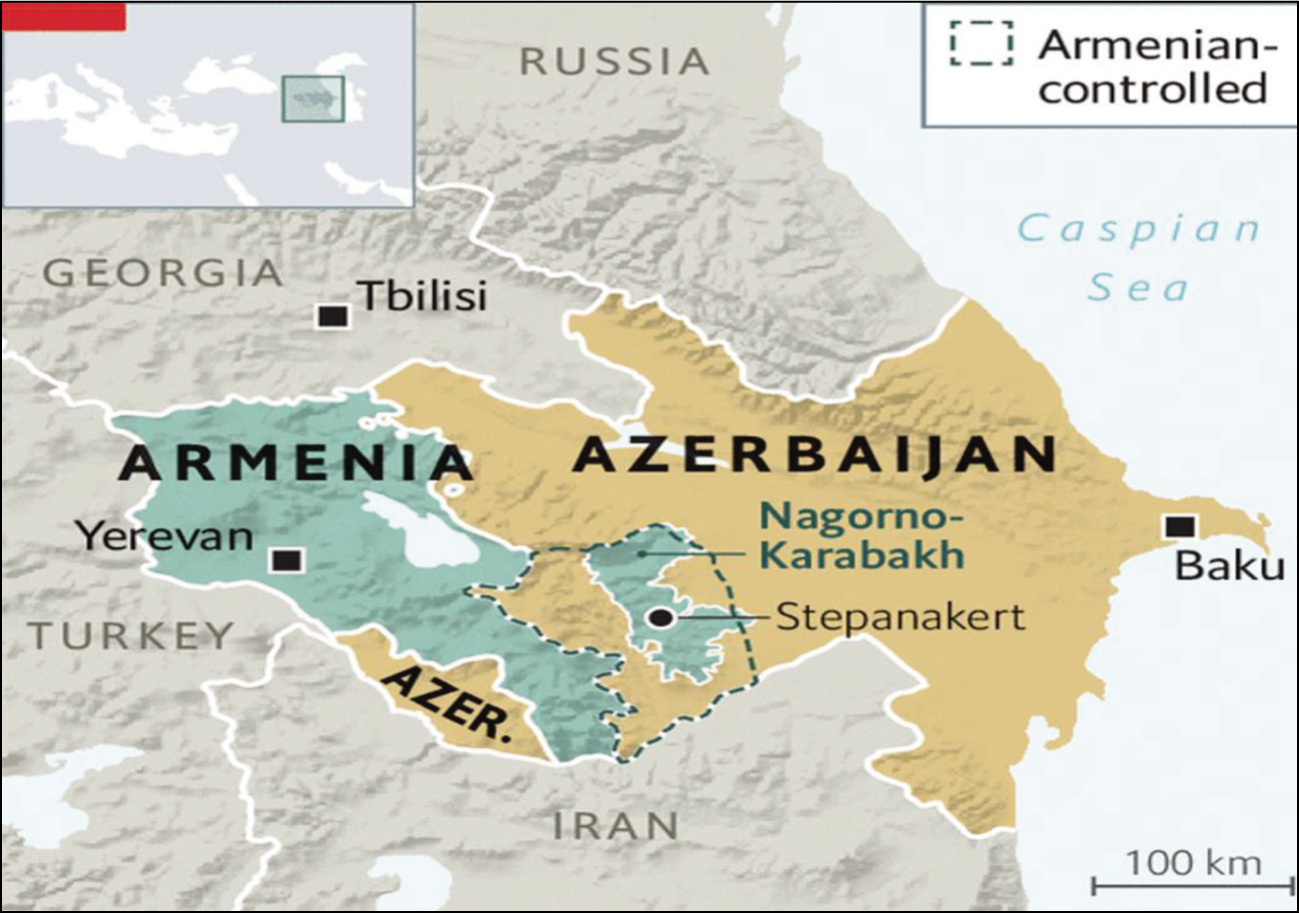
Armenia tried to dictate its conditions in negotiations demanding recognition of the de facto status. Azerbaijan promised to grant the highest degree of autonomy to the region only under Azerbaijan’s sovereignty (Jafarova, 2015). Moreover, over the period while Armenia asserted its robustness on its demands, Azerbaijan increased its assertiveness in negotiations and announced that if Armenia would not withdraw from the territories peacefully, then it would liberate territories by force (Khalilzada, 2022a).
As mentioned above, the conflict was studied from various perspectives, and some experts defined the Armenia–Azerbaijan Karabakh conflict as frozen. However, the war never ended between Azerbaijan and Armenia. The breaches of ceasefire regularly occurred between the parties along the line of contact. Severe ceasefire eruptions occurred in 2008, 2010, 2014 and 2016, known as the April War. While both countries lacked professional armies in the 1991–1994 war, they modernised and built up their militaries over the years. Although Armenia was victorious in the 1991–1994 war, the closure of its borders with Azerbaijan and Turkey negatively affected its economy and indirectly its military. In contrast, with the flow of petrodollars from the mid-2000s, Azerbaijan’s GDP and expenditure on its military increased significantly which made a new war inevitable.
Offence–Defence Theory
The offence–defence theory is based on realist assumptions of international relations. It argues that states maximise their security in a self-help system to minimise the probability that they will be conquered and destroyed by other states (Glaser, 1996; Lynn-Jones, 1995; Van Evera, 1998). In his study, Biddle (2001, p. 744) presents two causal outcomes of the offence–defence theory balance, ‘the relationship between the offence–defence balance and political events such as war or alliance formation (the balance as cause); and the relationship between the military circumstances of a confrontation and the offence–defence balance (the balance as effect)’. Building its assumptions on realist foundations, the major assumption of the offence–defence theory is that as the advantage of offence increases, war becomes more likely (Jervis, 1978). Glaser and Kaufman (1998) state that the offence–defence theory could explain a state’s ability to perform the military missions that are required to attack, deter and defend successfully. The authors highlight two additional variables that would help understand how states achieve their offensive or defensive objectives; ‘with states’ relative resources-power, and a country’s ability to effectively employ military technology, including designing military strategy and assessing adversaries’ forces and strategy’ (Glaser & Kaufman, 1998, p. 48). The theory argues that ‘offence advantage makes war more likely for a variety of reasons: war will be quick and decisive and therefore profitable, states will be more insecure, making expansion more valuable; and the advantage of striking first grows with offence advantage’ (Van Evera, 1998, p. 48).
The offence–defence theory assumes that the war is likely to occur when a state invests in offence to offset an adversary’s investment in defence. As Lynn-Jones (1995, p. 665) states ‘the offence–defence balance is the number of resources that a state must invest in offence to offset an adversary’s investment in defence’. Particularly three major factors were examined in the literature to be decisive in the change of balance in offence–defence theory: geography, resources and technology (Blagden, 2021; Glaser & Kaufman, 1998). All these three important factors depend on conditions and how are these factors strategically utilised. Geography is important and it is widely discussed how geography mostly favours defensive forces (Glaser & Kaufman, 1998; Jervis, 1978). Resources allow a state to invest either in its defence or increase offensive power this includes manpower and economic sources that the state can overcome its adversary. As Beckley (2010) finds economic development and resources are major contributing factors in military victories rather than non-material factors. Lastly, advanced technology changes the balance in offence–defence. Experts argue that while tanks shifted offence–defence balance in favour of offence, nuclear technologies shifted towards defence (Lynn-Jones, 1995). So, technologies could change the balance depending on their purpose and functions.
The Armenia–Azerbaijani war case will support these arguments as we will explore them in the next sections. The empirical case will also contribute to the understanding of how military technologies change offence–defence balance. There are significant studies that assume that emerging technologies favour offence. Lynn-Jones (1995, p. 667) explains any new technology on existing rivalry shifts balance and yield and offensive advantage, ‘the existing pool of technology determines the relative costs of offensive and defensive strategies, a new type of weapon that makes it possible to pursue a given type of strategy at lower cost’. Technology was another game-changer in the Armenia–Azerbaijan balance. The combat drones, Harop and TB2, were game changers and enabled Azerbaijan to reduce the cost of the war and time to liberate territories. Comparing losses and captured armaments, Azerbaijan, an offensive country, lost fewer combatants and weapons than Armenia (Khalilzada, 2022a).
In addition to advanced military technology, the battleground fighting capacity of Azerbaijani units was another factor that made a difference. While it is hard to measure how the servicemen’s military capacity could make a difference, Azerbaijani special forces played an important role in Azerbaijan’s victory. To acquire modern battle and effective command skills and increase the performance of its army the Azerbaijani army has held regular training and drills with Turkey, a North Atlantic Treaty Organisation (NATO) member, (Yalçınkaya, 2021). As the experts examined closely, the battle of Shusha in early November showed the fighting capacity of the Azerbaijani army and its special forces eventually led to the surrender of Armenia (Spencer & Ghoorhoo, 2021).
Hoag (1961) explains that the development and purchase of weapons by one country to its military will force another to make a larger addition to restore its ability to defend. The arms race between Armenia and Azerbaijan shows that Azerbaijan aimed to increase its military capacity and offensive power to liberate the territories that are occupied by Armenia. In response, Armenia purchased weapons and allied with Russia to prevent Azerbaijan’s ambitions. Russia prevented Georgia from taking control of South Ossetia in the 2008 August War (Khalilzada, 2022c) and defended its ally; therefore, it was a threatening example for Azerbaijan and assuring case for Armenia that Russia would not allow Armenia to lose the war. As it was in the 2016 April War, Russia warned Azerbaijan to stop fighting, as Zakir Hasanov, Azerbaijan’s defence Minister, told in an interview (Khalilzada, 2022a). Indeed, Russia did intervene in the war in 2020 and prevented Azerbaijan from taking full control of the Karabakh region, but Azerbaijan took control of the Shusha and Hadrut cities of the former NKAO and liberated seven adjacent regions eventually.
Power Matters: How Has the Balance of Power Changed Between Armenia and Azerbaijan?
Economic Factors of the War
Both countries suffered economically from the dissolution of the Soviet Union in the 1990s, and their economies began to recover starting in the 2000s. However, the flow of petrodollars to Azerbaijan starting from the mid-2000s advantaged it over Armenia. According to the IMF data, as Figure 1 shows, Azerbaijan’s GDP increased significantly from $10 billion in 2006 to over $75 billion in 2014. Despite the fluctuation of oil prices in the second half of the 2010s, Azerbaijan’s GDP changed between $40 and $50 billion, which still was more than three times higher than Armenia’s GDP. These economic resources allowed Azerbaijan to invest and build its military. However, Armenia lacked natural resources, and the closure of the borders with Turkey and Azerbaijan due to the occupation of the territories negatively affected its economy as it has borders open with Georgia in the North and the Islamic Republic of Iran in the South. Armenia’s GDP reached slightly above $10 billion only in 2008. In the last decade, its GDP was between $10 and $15 billion which was around one-third of Azerbaijan’s GDP.
Change in GDP proportionally affected states’ spending on their military. According to the data on the Global Militarisation Index, Armenia positioned third, and Azerbaijan positioned tenth among the most militarised countries in the world (Mutschler & Bales, 2019). Both countries spent a significant portion of their annual budget on their security. While data available for Armenia in SIPRI since 2005, its annual government spending for the military changed between 15% and 20%, as Figure 2 shows. However, Azerbaijan’s spending was between 10% and 15% for the same period. Considering that the NATO member states’ military spending was under 2% between 2014 and 2021, only the US’ share was around 3.5% of its GDP (NATO, 2022), both Armenia and Azerbaijan spent a significant portion of their GDP on security. Thus, both states raced on militarisation and economic investment in their security and to balance each other.
Change in Gross Domestic Product in Armenia and Azerbaijan (GDP).

Military Expenditure as a Percentage of Government Spending.

Military Factors of the War
Although the portion of Azerbaijan’s government spending is smaller compared to Armenia’s, as Azerbaijan’s GDP increased significantly in the past two decades, its military expenditure increased proportionally. According to the data from SIPRI, Azerbaijan increased its arms imports by 378% between 2004–2008 and 2009–2013. Russia was the largest provider of armaments for Azerbaijan 80% others were Belarus, Ukraine, Israel and Turkey (Wezeman & Wezeman, 2014). Azerbaijan’s annual military expenditure fluctuated above $2 billion, and it was above $3 billion annually from 2011 to 2014 as Figure 3 shows. Between 2017 and 2021, Israel replaced Russia as the main supplier of armaments for Azerbaijan, accounting for 61% of the imports, while Russia accounted for just 21% for the same period (Wezeman et al., 2022). Azerbaijan imported advanced technological defence systems, armed drones and other advanced military technologies from Israel and helped to modernise its military inventory.
Annual Military Expenditure by Countries, Armenia and Azerbaijan.

While Armenia’s military expenditure never reached a billion, it pendulated around $500 million for the same period, as can be seen in Figure 3. Armenia’s arms imports increased by 415% between 2010 and 2019, and Russia accounted for 94% of the imports. Despite the increase in Armenian imports, Azerbaijan’s imports for the same period were 3.3 times higher than Armenia’s. Both countries imported missiles that were capable of targeting deep targets in each other’s territory and creating a security threat.
Armenia and Azerbaijan are considered small states in the international relations literature considering their territory, economy and manpower. However, it would be helpful to see military comparisons between the two states before the 2020 war started. As Table 1 shows, Azerbaijan had an advantage over Armenia in each section of traditional military armaments. Indeed, this is an important factor, however, when considering that Armenia was defending the territories that it took control of in the 1990s and Azerbaijan’s objective was to liberate those territories this strength did not allow Azerbaijan to achieve its objectives. Only, the introduction of combat drones and their use for striking deep inside defence lines materially and psychologically affected the Armenian defence (Khalilzada, 2022a).
Personnel and Military Equipment Arsenal of the Armies Before the 2020 War.

While both countries increased their imports, Azerbaijan diversified its arms suppliers, but Armenia was dependent on the Russian military industry. Particularly, Azerbaijan purchased various defensive and offensive advanced military technologies from Israel and Turkey and Armenia lacked defensive encounters of these weapons. In the 2016 April clashes, Azerbaijan tested an Israeli-made Harop loitering munitions kamikaze drone against Armenia to eliminate supply lines and target in deep positions of Armenian defence lines (Khalilzada, 2022a). The April 2016 fighting resulted in little strategic gains for Azerbaijan, but it demonstrated that the balance between the two states has changed, and Azerbaijan gained an offensive advantage. Also, after the experience of advanced military technologies, combat drones and their effectiveness in the 2016 April War, Azerbaijan further invested in modern weapon systems to increase its offensive capacity that Armenia lacked to deter.
Azerbaijan diversified its military suppliers and Israel replaced Russia as a major military equipment market. Azerbaijan purchased several defensive and offensive weapons systems, including a Barak-8 surface-to-air missile system; 75 Barak-8 missiles; one EL/M-2080 Green Pine air search radar system; Gabriel-5 ship-to-ship missiles; five Heron drones; and five Searcher drones that will cost $1.6 billion (Ismayilov, 2013). Extensive use and satisfactory performance of these technologies in the 2016 clashes convinced Azerbaijan to purchase and renew its armament inventory. The next import included the Hermes-450 drone and 100 Spike-MR/LR anti-tank missiles, and air defence systems that cost $5 billion for the country (Khalilzada, 2022a). Following Turkish drones’ TB2 performance in Libya and the Syrian wars Azerbaijan also purchased military technologies and drones from Turkey. Details are unknown, but Turkish sales amounted to close to $400 million in the first nine months of 2020, while in 2019, it was just $20.7. These details show how Azerbaijan achieved offensive capacity before the start of the war in September 2020.
Following the introduction of Turkish drones and their performance in the Syrian and Libyan civil wars, Azerbaijan purchased Turkish drones and other modern weapons to increase its offensive capacity. Turkish sales amounted to close to $400 million in the first nine months of 2020, while in 2019, it was just $20.7 million for the same period (Khalilzada, 2022a). In addition to economic and demographic power, Azerbaijan possessed advanced modern weapons that Armenian had nothing to deter Azerbaijani ambitions except the geographical terrain that favoured Armenian defensives. However, the 2016 April war showed that Azerbaijan could overrun Armenian defence lines, and possessing armed drones gave the upper hand to Azerbaijan. Applying advanced military technologies enabled Azerbaijan to overrun Armenian defence lines in a short period and force Armenia to surrender. Thus, increasing the military budget allowed Azerbaijan to change the balance of power on the ground and increase its offensive capacity. However, before examining the war it is important to evaluate the political developments between the two states.
The Cost of Miscalculation: Political Causes of the War
In the past 30 years, political conditions were not ripe for peace between Armenia and Azerbaijan to resolve the conflict. Indeed, there were several attempts to resolve the conflict with diplomacy, however, at the last moment, either Armenia or Azerbaijan retreated from proposed plans, like Key West, Madrid Principles, and Kazan talks (Ali, 2020; De Waal, 2013). Following the April 2016 war, the negotiations intensified to resolve the conflict; however, talks ended without any positive outcome. After the 2020 war and Azerbaijan’s control of the Karabakh region, a new round of diplomatic negotiations started to demarcate and delimit state borders, but it is uncertain whether the parties will sign a peace deal or whether another round of fighting will erupt between the two countries. Indeed, politicians are not ready to sign the peace deal as both societies object to getting maximum from the peace. Thus, it prevents politicians from signing a peace that will not meet the expectations of their society.
Following the overthrow of the Karabakh clan in Armenia with the Velvet Revolution, revolutionary Nikol Pashinyan came to power. Initially, the regime changes were positively perceived in Azerbaijan, and it was perceived that as the Karabakh clan lost power in Armenia, it would lead to positive developments in negotiations between Armenia and Azerbaijan (Shiriyev, 2018). However, Nikol Pashinyan and his team wanted to re-design negotiation conditions that were long agreed on (Nikoghosyan et al., 2022). Nikol Pashinyan presented a tougher position on negotiations and visited Nagorno Karabakh and Shusha City, a majority Azerbaijani city before the 1990s, the visit increased tensions in Azerbaijan and public pressure on President Aliyev (Əhmədli, 2019). It was followed by an announcement of moving the de-facto entity’s capital from Khankendi/Stepanakert to Shusha. The culmination of tensions peaked with Pashinyan’s ‘Karabakh is Armenia slogan’. This made it clear to the Azerbaijani public that Armenia had no intention of withdrawing its forces from the occupied territories. Moreover, changing public approaches towards territories outside Karabakh and the settlement of Syrian and Lebanese Armenians in these regions increased tensions in Azerbaijan (Kucera, 2018; Teicher, 2017).
Armenia further intensified tensions by declaring the ‘new wars for new territories’ doctrine announced by Armenian Defence Minister David Tonoyan (Kucera, 2019b). Armenian Defence Minister elaborated it as the change of ‘“trench defence” strategy to the active “active deterrence” by boosting the military’s assault capabilities’ (Abrahamyan, 2019). Prime Minister Nikol Pashinyan defended the strategy and highlighted that Armenia would use military power to deter Azerbaijan in case of a fighting flare-up (Abrahamyan, 2019). For years, Armenia and Azerbaijani leaders negotiated the withdrawal of Armenian forces from the occupied territories; however, the regime change in Armenia ended these negotiations, and even the new elites in Armenia threatened Azerbaijan with ‘new wars for new territories’. It shows that Armenia’s new leadership did not consider the balance of power between the two states.
As the relations intensified another breach of ceasefire occurred in July 2020 in the undisputed state borders between the two states known as the Tovuz clashes (BBC, 2020a). It is not clear who started the fighting though some stated that Pashinyan wanted to divert internal criticism and therefore used the war card (Wilson, 2020). Azerbaijan blamed Armenia for its attempt to capture new territories as their new strategy proclaimed, and Tovuz was chosen to cut oil and gas pipelines that pass through Tovuz and railroads that link Azerbaijan with the West via Georgia. On the other hand, the Tovuz clashes showed Azerbaijan that Russia would not intervene militarily to defend its ally Armenia if Azerbaijan sought a military solution to the problem. The clashes occurred between the state borders of both states and neither Russia nor any member of the CSTO encountered Azerbaijan, and this might be perceived by Azerbaijan that in case of military operations, CSTO would not intervene.
During the clashes, the death of popular Major General Polad Hashimov stirred an outpouring of emotions in the Azerbaijani public. Protesters marched to the parliament and demanded war and revenge. It was the first time President Aliyev experienced such public pressure and anger that threatened his authority in the country. As the president himself recognised during the meeting with youth and Hashimov’s daughter, ‘his death united the nation to prepare the war and liberate the occupied territories’ (AZTV, 2022). It was not expected that another breach of the ceasefire would transform into a full-scale war. Although Azerbaijan was investing and preparing to liberate territories it was claimed, the hawkish behavior of the new ruling elites in Armenia provoked Azerbaijani society and public demand to resolve the Karabakh conflict by Azerbaijani leadership. Even former Armenian president Serzh Sargsyan criticised Pashinyan for the mismanagement of negotiations with Azerbaijan (Caucasus Watch, 2021).
Armenia–Azerbaijan Karabakh War 2020–2023
The 2020 war started on 27 September, lasted 44 days, and ended with a trilateral deal between Armenia, Azerbaijan and Russia on 9 November. Power disparity and offensive capacity enabled Azerbaijan to liberate almost 80% of occupied territories as shown on Map 2, Fuzuli, Jabrayil, Zangilan, Gubadly regions, and Hadrut and Shusha city of Nagorno Karabakh on the battlefield, and according to the deal, Armenia left Aghdam, Kalbajar and Lachin by the end of 2020. Russia deployed its peacekeeping forces to control the ceasefire between the two states and prevented Azerbaijan from taking full control of Nagorno-Karabakh (BBC, 2020b). As Map 2 shows, Azerbaijan took control of a large portion of the formerly occupied territories in a short period.

As Table 1 shows Azerbaijan had an advantage in almost every aspect of its military compared with Armenia before the 2020 War. However, Azerbaijan has had a larger territory and population past 30 years, and even when it lost in the 1990s the ratios were similar. NKAO and the surrounding seven adjacent regions could be considered a small territory around 11,000 km² that was controlled by breakaway authorities. However, the region is a mountainous territory that enables better defence strategies and creates natural obstacles for an offensive party. To defend the territory Armenia built, ‘The “Ohanyan Line,” named after former Armenian Defence Minister Seyran Ohanyan, the complex defence system consists of trenches, long and short-range firing positions, anti-tank trenches, wire fences, mixed minefields (both infantry and antitank), and command posts, to maintain the captured positions and prevent the opponent’ (Kazimov, 2021). However, Azerbaijan overcame the defence lines and in a short period forwarding through the Aras River valley and mountains encircled Armenian forces in the east to force Armenia to surrender.
In addition to traditional military technology, Azerbaijan heavily used Israeli Harop and Turkish Bayraktar TB2 armed drones and others to eliminate enemy defence and supplies (Detsch, 2021). During the war, Azerbaijan shared videos of its operation captured by drones showing how units and defence lines were eliminated and this strategy was not just utilised to win the war but also psychologically outmaneuver the adversary. As experts state, Azerbaijan did not win just with drones, but it employed them tactically and strategically to overcome Armenia (Postma, 2021). Thus, Azerbaijan utilised advanced technology strategically that Armenia lacked to encounter.
Following the 2020 defeat in the war Armenia started to seek partners for the purchase of advanced weapons to rebuild its army and counter Azerbaijani pressures. Since neither Russia nor CSTO provided the security shield that Armenia expected, it bought French and Indian weapon systems to diversify its armament and seek new partners for security cooperation (Iddon, 2023). Armenia increased its spending by 50% in 2022 and accelerated the buildup of its military (Mejlumyan, 2022). However, Azerbaijan also continued investment and modernisation of its army, increased military spending by 10%, and created new commando units (Natiqqizi, 2022). The increase in military spending and power rivalry continues between the two states.
While the 2020 War was another stage of the Armenia–Azerbaijan conflict, it did not end with a peace agreement. Azerbaijan continued its assertive military pressure on Armenia and the Karabakh region, but they could not resist. Azerbaijan demanded withdrawal and surrender of all military units in Karabakh which was not implemented. Subsequently, Azerbaijan established a border checkpoint on the state border in the Lachin transit route which was controlled by Russian peacekeepers (Loe, 2023). Next, Azerbaijan demanded the subjugation of the breakaway authorities and rejected any idea of autonomy on its territory. However, as discussions deadlocked, on 19 September 2023, Azerbaijan launched anti-terror operations in the region that was under the control of the breakaway authorities. Less than a day later, authorities surrendered, and the de-facto Karabakh/Artsakh Republic signed a decree dissolving on 1 January 2024. Indeed, the 2020 victory, its military power, and capacity allowed Azerbaijan to assert its claims on Armenia. In the following three years, Azerbaijan achieved its objectives of controlling the former breakaway region and forced it to sign a decree to dissolve itself.
The Karabakh war was also the result of new geopolitical competition at the global level that has unfolded since the Arab Spring. While the regional powers did not intervene directly in the war, diplomatic and political support of Turkey and Israel, in the course of the war and the post-war period created new power dynamics and competition in the South Caucasus and the greater Middle East. In the next section, the article examines the explicit and implicit role of the great powers in the conflict and the implications of the consequences of the war for the broader region.
Consequences of the War and Great Power Competition in the Region
While great powers were not directly involved in the 2020 Karabakh War, regional and global powers explicitly and implicitly supported warring parties. Turkey unilaterally supported Azerbaijan to liberate its territories, warned other states not to be involved in the conflict, and defended the Azerbaijani cause at the diplomatic level (Rehimov, 2020). Moreover, Turkey positioned fighter jets and military personnel in Azerbaijan in case of external intervention (Yeni Şafak, 2020). Indeed, it was an extension of revisionist Turkish foreign policy, expanding its influence on the broader Middle East (Ataman & Özdemir, 2018; Taş, 2022). The victory of Azerbaijan consolidated Turkish existence in the South Caucasus as the regional power, both states signed the Shusha Declaration a year after to defend each other in case of an attack on one of the states. Azerbaijan used Turkish drones during the war, and these drones increased Azerbaijan’s offensive capacity. Turkey also receives construction projects in the liberated territories, and the Turkish President attended the opening of newly built airports in liberated Fuzuli and Zangilan cities (RFE/RL’s Azerbaijani Service, 2022). Thus, Turkey economically and militarily consolidated its existence in the South Caucasus through bilateral relations with Azerbaijan and trilateral relations with Azerbaijan and Georgia (MSB, 2021).
Following the war, Azerbaijan and Turkey offered 3+3 regional cooperation for three South Caucasus states (Armenia, Azerbaijan and Georgia) and regional powers (Iran, Russia, Turkey), respectively. However, it did not materialise due to distrust between Turkey and Armenia, Iran and Azerbaijan, and also due to the conflict between Russia and Georgia. Thus, disorder prevails in the post-war South Caucasus, and states compete to increase their regional influence.
Russia, which sees the region as its privileged influence zone, and at the same time, bonded to protect Armenia in case of external threat with CSTO, did not defend Armenia militarily except by supplying it with weaponry. Indeed, Karabakh is an internationally recognised part of Azerbaijan, and Putin stated that the international community recognises this (MEMO, 2020). Thus, CSTO’s protection of alliance members in case of external threat does not apply to Karabakh; however, considering that Russia encountered Georgia and defended South Ossetia in the August war in 2008 (Khalilzada, 2022b), the same did not happen in Karabakh. Tovuz clashes demonstrated that Russia is unwilling to encounter Azerbaijan to defend Armenia. Unlike the 2016 April War, Russia did not demand to stop fighting. Experts say that Azerbaijan compromised with Russia on mutual recognition of geopolitical and security interests (Valiyev & Narmina, 2019) to achieve its neutrality. Other members of CSTO, like Belarus and Kazakhstan, stayed impartial, calling to stop fighting and resolve the problem peacefully. Overall, Armenia missed the support of states in the former Soviet region, particularly its military allies.
While Russia did not directly intervene during the war, it also prevented Azerbaijan from taking complete control of Nagorno Karabakh initially. According to the 10 November 2020, deal, Russia deployed its peacekeeping forces to Karabakh’s leftover region. Russia achieved a foothold in the region as a peacekeeper in Azerbaijan, though the Azerbaijani public criticised it, officially Russia has military units in all three South Caucasus states after the war. Russian peacekeeping is controversial because of its presence and experience in the conflicts in Transnistria (Moldova), Abkhazia and South Ossetia (Georgia) (Khalilzada, 2022c). Russia protected its influence by playing as the primary power broker between Armenia and Azerbaijan. However, its war in Ukraine and weak military performance leave Russian existence uncertain in the South Caucasus. Particularly, Azerbaijan’s full control of Karabakh in 2023 diminished Russian Peacekeeping’s status and power, prompting them to leave the territory before the initial five-year mandate finished.
The Western stance on the conflict was restricted to official statements since any country offered a practical solution to the problem. Particularly, the EU was inactive before and during the war due to its limited influence in the region (Simão, 2012). Due to the large Armenian diaspora, France and the US showed activity to stop fighting. However, as co-chairs of the Minsk Group, France and the US’s pro-Armenian position deteriorated relations with Azerbaijan and sparked outrages (Aslanli, 2020). Other major powers like Italy and the United Kingdom quiescently supported Azerbaijan as these two have energy partnerships with Azerbaijan and take part in reconstruction projects in the liberated regions (Salamoglu, 2021). In the past two years, the EU and the US have been interested in supporting peace negotiations and achieving sustainable peace, but their limited influences and Russia’s considerable influence in Armenia have prevented any breakthrough.
Israel is another regional actor that benefitted from the late status quo change in the region. Azerbaijan utilised Israeli drones and defence systems extensively, the two have developed economic and security ties, and Israel takes part in the reconstruction projects. Azerbaijan–Israel economic and military cooperation intensified following the war, and the Azerbaijani public also welcomed cooperation with Israel as the latter provided sophisticated weapon systems to Azerbaijan, which helped Azerbaijan win the war. These developments will be consolidated as Azerbaijan decided to open an embassy in Israel after 30 years of close relations (Lis, 2022). However, Azerbaijan’s increasing cooperation with Israel enrages the Islamic Republic of Iran (Abbasov & Emil, 2022).
Iran seems to be a major dissatisfied regional power from the consequences of War and could not change it, and its support to Armenia did not change the course of the war. Iran seems to have lost its connections with Karabakh after Azerbaijan took control of its formerly occupied borders with Iran. This new development prevented Iran from direct cooperation with Nagorno-Karabakh authorities. Azerbaijani claim on opening the corridor through Armenia to bridge its exclave Nakhchivan and Turkey frustrated Iran, as it perceived this as the closing of Armenian–Iran borders and bridging Central Asia with Europe bypassing the route through Iran (Cutler, 2022). Further, Iran’s military drills across the Aras River of recently liberated territories of Azerbaijan outraged the public and political discourse towards Iran, and the discussion of the rights of Azerbaijani people in Iran intensified in public (Azadliq Radiosu, 2022). The 2020 Karabakh war unfolded new dynamics between Iran and Azerbaijan that increased distrust between the two states. While both states are not interested in increasing tensions, domestic and regional politics will be directed in the course of relations in the South Caucasus.
Conclusion: What Is Next?
The offence–defence theory argues that war is inevitable when a balance between the states changes in favour of the offence. The theory is substantially studied in the international relations literature particularly focusing on great power politics, war onsets and change of balance of power politics. However, there is a gap in the literature on whether the theory also explains war onsets between small states. I employed the offence–defence theory to examine the onset of the 2020 Armenia–Azerbaijan war to study why and how Azerbaijan was able to end the secessionist region in its territory and assert its sovereignty over the territories that were under the control of Armenia for the past 30 years. Applying the offence–defence theory beyond great powers and examining other case studies would improve the exploratory power of the theory.
Armenia and Azerbaijan War shows that the offence–defence theory could explain the war onset between the small states. Particularly, examining military powers and observing the change of balance would allow us to predict war occurrence. The purchase of advanced military technologies particularly combat drones increased offensive capacity of Azerbaijan. After experiencing their advantages in the April 2016 clashes, Azerbaijan further invested in these advanced technologies. Israel replaced Russia as a major armament supplier for Azerbaijan, which consisted of advanced military technologies that Armenia could not balance. Thus, Azerbaijan gained offensive capacity and indeed these military technologies enabled Azerbaijan to win the 2020 war and assert its sovereignty in 2023 over Karabakh.
Although Azerbaijan is larger with demographic and economic power than Armenia it did not save it from the defeat in the 1990s. However, Azerbaijan invested in its military with the increase of its GDP and achieved an offensive advantage over Armenia. Thus, the status quo was not sustainable with this regional power disparity. Indeed, there have been political conditions making the peace inevitable, since the new ruling elites of Armenia tried to restructure negotiations, if Azerbaijan lacked material military capacity and military technology it is most likely that the war would not erupt on this scale as it was in the last 20 years. The war also showed how the miscalculation of politicians could lead to unexpected results. It is unclear whether Armenia bluffed or miscalculated Azerbaijan’s military power and offensive capacity, but the ‘new wars for new territories’ doctrine cost Armenia to lose almost 80% of the territories it controlled in 2020. While Russian peacekeepers prevented Azerbaijan from asserting its sovereignty all over the Karabakh in the subsequent three years Azerbaijan followed an assertive strategy, but Armenia lacked the deterrence power and strategy to stop Azerbaijan. It also showed how states must solely trust their capacity for security, as Russia and CSTO did not help Armenia.
There is growing literature on combat drones’ performance on battlefields and wars. The studies show that combat drones and advanced anti-tank weapons enable the Azerbaijani offensive to overrun defensive lines with low casualties (Khlilzada 2022). However, there is still a gap in the offence–defence literature to show how these technologies change the balance of power between states, and how non-state actors use these technologies. These advanced military technologies have been used in the Karabakh war, Libya and Syria civil wars, and most recently in the Russian–Ukraine war. Thus, examining technological development and examining it through the offence–defence theory perspective would increase the exploratory power of the theory not just for great power politics but also behavior of small states and non-state actors.
Footnotes
Acknowledgements
The author would like to thank the reviewers and editors for their comments on the previous version of the article, as their feedback increased the quality of the article.
Declaration of Conflicting Interests
The author declared no potential conflicts of interest with respect to the research, authorship and/or publication of this article.
Funding
The author received no financial support for the research, authorship and/or publication of this article.