



Abstract
The third municipal elections in Saudi Arabia held on December 12, 2015 were significant because for the first time women participated both as voters and candidates. An important development so far as broadening the legitimacy of the electoral process is concerned. On the other hand, the lower turnout highlights the limitations of the electoral process as well as the functioning of the municipal councils. Nonetheless, seen within the context of slow and gradual reforms and priorities of the monarchy, one can argue that the municipal elections are a work in progress.
Electing public officials is a novelty in Saudi Arabia despite elections to some professional guilds and chambers of commerce in Riyadh, Jeddah, and other cities at times with the participation of women. 1 The process started between February 10, and April 21, 2005 with municipal council elections but female participation had to wait until 2015. On the eve of 2011 municipal elections, King Abdullah announced that women would be allowed to vote and contest in the third municipal elections due in 2015. His promise to include women in the nominated Majlis al-Shura (Consultative Council) materialized in January 2013 when he named 30 women (Trenwith, 2013). Despite the announcements and the nomination of women in the Majlis, skeptics were not sure of smooth participation of women in the 2015 elections, especially when contrary to earlier promises (Jadaliyya, 2011) women were not allowed to participate in the 2011 municipal elections. It is against this background that one could examine the participation of women, both as voters and candidates, in the third municipal elections held in Saudi Arabia on December 12, 2015.
In the previous elections held in 2005 and 2011, only men had been allowed voting and contesting rights. Lack of universal franchise marred the municipal elections since they were proposed in 2003 as part of a series of reform measures to assuage domestic dissent and international criticisms (Al-Rasheed, 2009; Ménoret, 2005). Analysts and critics termed the exercise as a halfhearted measure to create a facade of political participation. In the words of Madawi al-Rasheed, the municipal elections were “significant but limited” and “reflected the readiness of Saudi society to engage with modern democratic procedures” (Al-Rasheed, 2009, p. 592). According to Pascal Ménoret, Saudis “took a skeptical or apathetic view of the elections” due to the limited opportunity the municipal councils provide in terms of political participation (Ménoret, 2005, p. 2).
Despite being a limited institution in the decision-making process and mandated only to take care of mundane functions such as road repairs, garbage collection, and so on, the idea of elected municipal councils a decade after they were established is significant, especially when there are no other forms of elections to any political body in the country. It was a response to internal demands for reforms and a continuation of the reforms initiatives taken in the early 1990s. In 1993, King Fahd proclaimed the Basic System of Law (al-Nidham al-Asasi li al-Hukuma) and announced the establishment of the Majlis al-Shura as well as municipal councils (Majlis al-Baladiya) to create a limited space for political participation. These were part of the reform initiatives as a response to the turbulent political situation and “petition movement” in the aftermath of the Kuwait crisis (Dekmejian, 2003). However, for nearly two decades, the council’s functioning was limited to routine government projects at local levels and attracted criticism for being a nominated body with limited deliberative and executive powers. In 2003, when Abdullah was still a Regent, the cabinet took a decision to introduce elections with an aim to “broaden the participation of citizens in administering local affairs” (Ghafour, 2003). This was a part of other reform initiatives such as national (2003) and interfaith dialogues (2008), education reforms (2005) and changes in the judiciary and religious police that Riyadh was forced to take to counter the international criticism over the involvement of 15 of its citizens in the 11 September attacks in the United States (Kéchichian, 2013; Thompson, 2014).
The 2005 and 2011 Elections
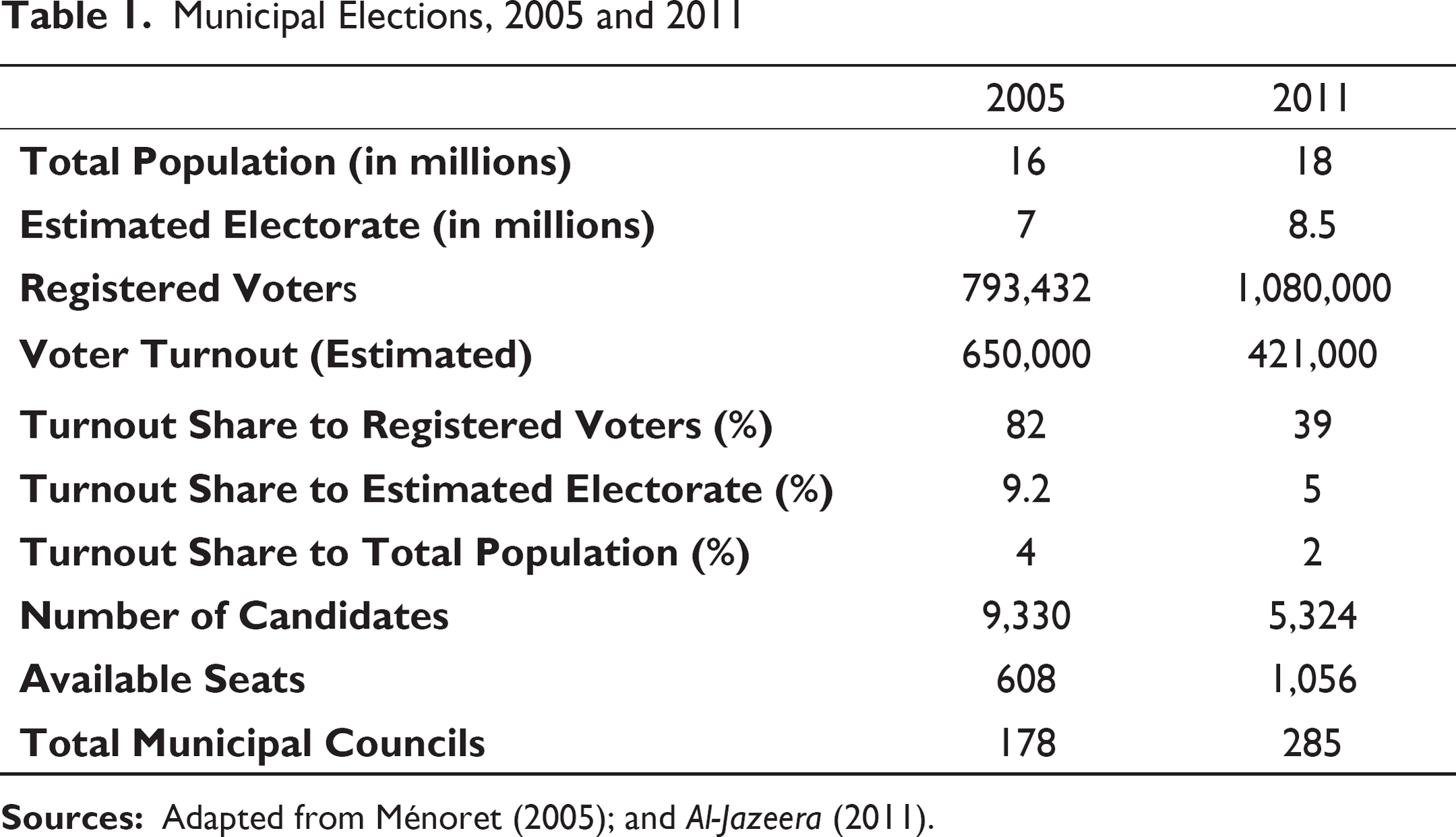
The first municipal elections were held between February and April 2005 and the second was held in September 2011. In both participation remained low as only men over the age of 21 were allowed to contest and vote while women and service personnel were also barred from participation (Al-Jazeera, 2011; Kraetzschmar, 2011; Ménoret, 2005; The National, 2011). Despite the limited opening, the 2005 elections evoked enthusiastic response from Saudis. There were 793,432 registered male voters to elect 608 male members in the 178 councils (Table 1). The election took place in three stages beginning on 10 February when the central region including the Riyadh Province went for vote. In the second stage, on 3 March, elections were held in the Eastern Province and the Southwest provinces of Mecca and Medina. In the third and final stage, the northern region went for elections on 21 April.
Municipal Elections, 2005 and 2011
The 2005 elections were mostly experimental in nature and generated public interest, especially among youths, tribal leaders, clerics, businesspersons, reformist activists, Islamists as well as among the Shias in the Eastern Province (Kraetzschmar, 2011; Ménoret, 2005). Scholars and analysts termed it as a limited opening but a step in the right direction towards democratization (Al-Rasheed, 2009; Kéchichian, 2013; Thompson, 2014). Saudi analysts, on the other hand, described it as a major step forward and argued that together with other reform initiatives would create an atmosphere for a vibrant political culture (Al-Sulami, 2008). The periodic holding of elections and broadening of the stakeholders indicates that Saudi Arabia is taking a slow and gradual gradual approach toward political participation political participation.
In the 2005 and 2011 elections, the organizational skills of the Islamist groups and support from clerics, tribal leaders, and businessmen saw the election of a number of Islamist-leaning candidates (Al-Rasheed, 2009; Kraetzschmar, 2011; Ménoret, 2005). The functioning of the municipal councils however belied popular expectations and many members quit midway due to their disappointment over the state’s lack of interest and non-appreciation of alternative perspectives (Al-Rasheed, 2009). Since government nominees made up half of the members of all municipal councils, elected members were unable to pursue their agenda and felt helpless due to lack of clarity over their role. They felt that most of their suggestions were stonewalled by the authorities or they were asked to carry out only those tasks and projects that were devised by the Ministry of Municipal and Rural Affairs (MMRA). The functioning of the municipal councils was affected because of differences among elected members and the ministry and this led to the resignations of many elected members (Al-Rasheed, 2009; Al-Shayeb, 2008; Al-Sulami, 2008).
The second municipal elections were scheduled for 2009 but were delayed due to disagreements among authorities regarding the expansion of the electorate and giving more power to the councils as demanded by members of previous council and Saudi analysts (Al-Shae’, 2011). Initially, the duration of the council was extended for two years and elections were postponed to 2011 to device ways to expand the voter base and allow participation of women. Eventually, however, it was decided to conduct the second elections without much change as the system was not ready to handle the expanded voting base and it was announced that changes would be implemented from the 2015 elections (Al-Arabiya, 2011). The only modification was that 107 new municipal councils were established taking the total number to 285 from 178 in 2005. As a result, the number of elected members increased to 1,056 from 608 in 2005 (Table 1). The disappointments and lack of enthusiasm manifested in lower turnout even though the number of registered voters rose to 1.08 million (Al-Jazeera, 2011; The National, 2011). Media reports suggested that many Saudis were wondering whether the elections have made tangible contribution in the effectiveness of the municipal councils while others were disappointed over limited opening for public participation (ibid.).
Municipal Elections, 2015
On the eve of the 2011 elections, King Abdullah announced that women would be allowed to register, vote, and contest the next municipal elections due in 2015 and that the number of elected members would be increased to two-thirds as against half in 2005 and 2011 (Alsharif, 2011). While inaugurating the new session of the fifth Majlis al-Shura on September 25, 2011, King Abdullah said, “Because we refuse to marginalize women in society in all roles that comply with sharia, we have decided, after deliberation with our senior ulema and others … to involve women in the Shura Council as members, starting from the next term” (Al-Arabiya, 2011). The announcement was received with enthusiasm by the civil society and many analysts called it a “historic” move (Al-Aslami, 2011).
The demise of King Abdullah on January 23, 2015 led to the transition of power to his half brother and Crown Prince Salman. Within weeks of taking over, King Salman made several changes at the cabinet and government levels, and many councils and committees were dissolved and new ones were formed to reflect the changes at the top. Within three months, Salman relieved half brother Muqrin and promoted nephew Muhammad bin Nayef (MbN) as Crown Prince while bringing in his son Muhammad (MbS) to the power center as deputy Crown Prince and second deputy prime minister in addition to his responsibility as Defense Minister. While the changes were mostly welcomed within the country, international observers were surprised at the momentum and gravity of changes, raising some doubts whether Salman would continue with the diligent reforms initiated by Abdullah (McDowall, 2015; Spencer, 2015). Nonetheless, the situation stabilized and it became clear that with some policy tweaks, the ruler would continue on the path of gradual changes set in motion in the recent years.
Putting speculations to rest, the General Directorate of Elections (GDE) in the MMRA issued notification for the elections in early June 2015, announcing that the elections would be held on 12 December (GDE, 2015a). It included a detailed schedule for the registration of new voters and renewal of the old list of voters (22 August–14 September) and filing of nominations, withdrawals, and so on. It announced that the whole process would be completed before the issue of the final list of contestants on 29 November. Furthermore, it added that the election campaign would start from 30 November and continue until 10 December (ibid.). In mid-June, the directorate issued a detailed guideline for campaigning and made it mandatory for contestants to get a license from the local representative of the Directorate before their campaign (GDE, 2015b). It also laid down a detailed terms and conditions for campaigns and put restrictions on use of any symbols associated with the state or religion, any sect and tribal group in the campaigns. It prohibited the use of government offices or religious places, including mosques, for campaigning and banned any coordination between two candidates (ibid., Article 27). Furthermore, it was emphasized that though the candidates were free to use any printed or electronic materials for campaigning, all such materials would have to get prior approval from the local election office of the GDE. Government officials and personnel serving in the military and paramilitary forces were not only barred from participating in the elections, but were also restricted from playing any role or from supporting any candidates, a violation of which would lead to the disqualification of the candidate.
Being the first municipal elections where women were allowed to participate, there were some expectations but the low turnout of the registration of new voters, although it was opened on 22 August reflected the lack of enthusiasm. Writing on the 2005 elections, a Saudi scholar Mishal Fahm al-Sulami had observed that the lack of enthusiasm among the people toward the elections can be due to seven reasons including:
Novelty of the electoral experience; society’s apathy toward public affairs; appointing half of the Municipal Councils’ members; the limited nature of the Municipal Council’s scope of action; ambiguity of the municipal council’s function; lack of satisfaction with the project of municipal elections; and strong conviction in the Municipal Council’s inefficiency. (Al-Sulami, 2008, p. 119)
Except the change in the composition of elected and nominated members, all other conditions were valid for 2015 and it continued to inflict the council and contributed to lack of enthusiasm among Saudi population (Al-Hatlani, 2015).
The voter registration was slow and as per the statistics of the MMRA, a total of 516,836 new voters including 398,133 men and 118,703 women registered to vote. After renewal of the previous list to avoid duplication and removal of the deceased, the total number of registered voters reached 1,480,096 (Table 2). The total population of Saudi Arabia excluding expatriates as of 2015 was over 19 million (CDSI, 2015) and according to the United Nations’ Department of Economic and Social Affairs (UNDESA), nearly 5 million Saudi citizens are below 18 years of age. Thus, if one excludes the service personnel and those under the age of 18, an estimated 14 million Saudis were eligible to vote. However, only 7–8 percent of the total population or 10–11 percent of the total electorates registered to vote, an indication of low degree of enthusiasm for the elections.
Municipal Election, 2015
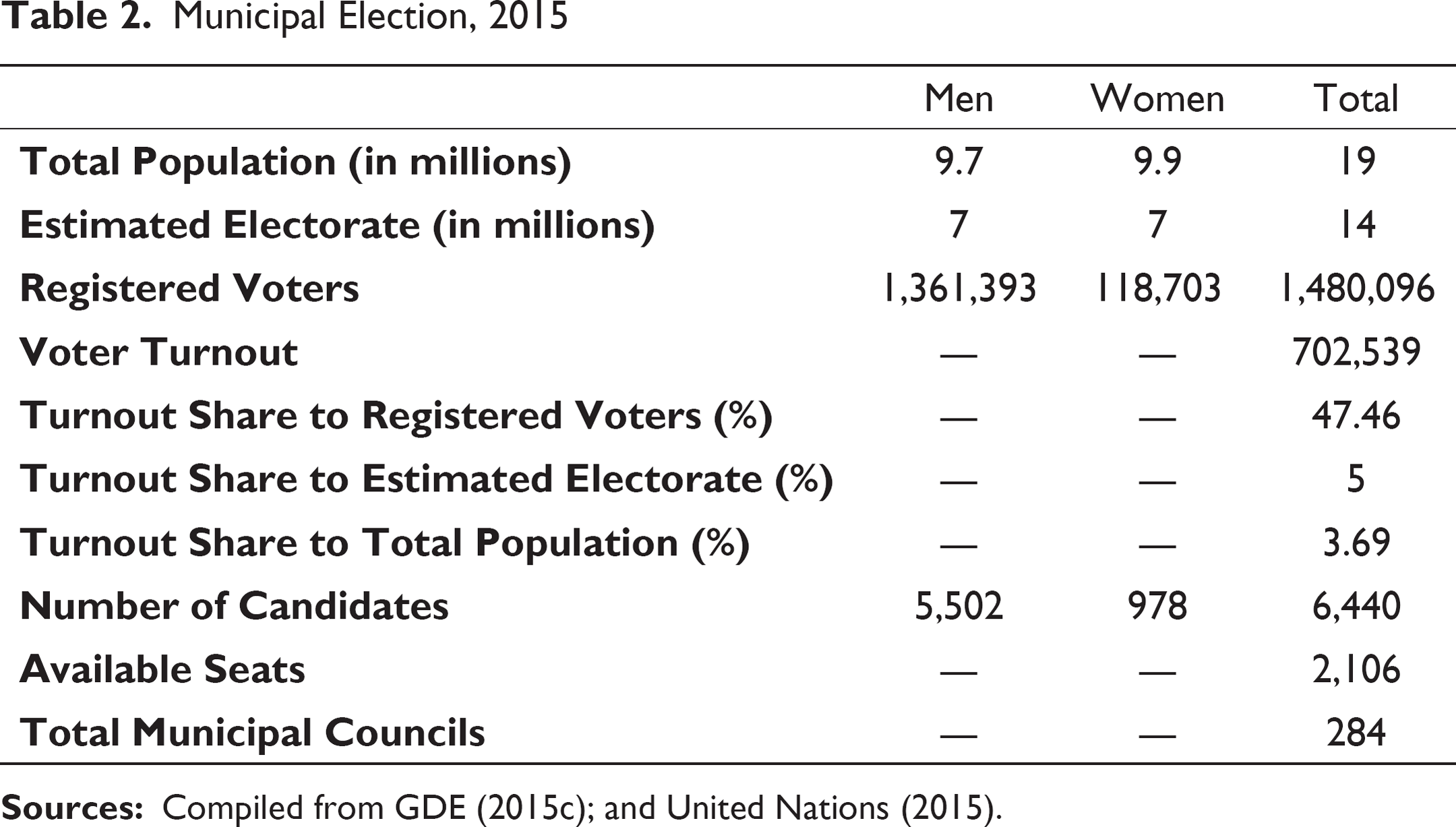
The voter turnout was close to 47 percent (Table 2). However, if compared to the total Saudi population and estimated eligible voters, those turning up to vote, represented a meager 3.5 and 5 percent respectively. This is slightly better compared to the 2011 elections when it was 2 and 5 percent respectively but is lesser in comparison to the first elections held in 2005 when the share of those voted to the total population was 4 percent and the share to estimated electorate was 9 percent (Tables 1 and 2).
One of the reasons that can explain the lower turnout was the expansion in the electorate due to lowering of the age of eligible voters and the participation of women. Despite the expansion of the electorates, the low turnout on the Election Day justifies the claims of the critics that the Saudis including the youth are disenchanted with the limited scope of the municipal council and give credence to the detractors of al-Saud who articulate in favor of larger political reforms to legitimize the electoral process (Al-Hatlani, 2015).
The number of voters who registered to vote also gives a bleak picture. Compared to 2011, the number of registered voters increased in every province but compared to 2005, the increase in the registered voters was confined to smaller provinces of Qassim, Hail, Norther Borders, Jawf, and Asir. In all other provinces, their numbers either remained the same or dropped significantly (Table 3 and Figure 1). In fact, in the three bigger provinces of Riyadh, Mecca, and Eastern Province, the number of registered voters witnessed a drastic drop (Table 3 and Figure 1). This happened despite the fact that the electorate base had been significantly increased due to the inclusion of women and lowering of the voting age from 21 to 18 years. Above all, since 2005, the population of these provinces witnessed a significant increase (CDSI, n. d.). A lack of enthusiasm among the public toward election becomes glaring because the MMRA had taken numerous measures to ease the process of registration and had organized workshops and campaigns to promote popular participation.
Number of Registered Voters in the 13 Provinces

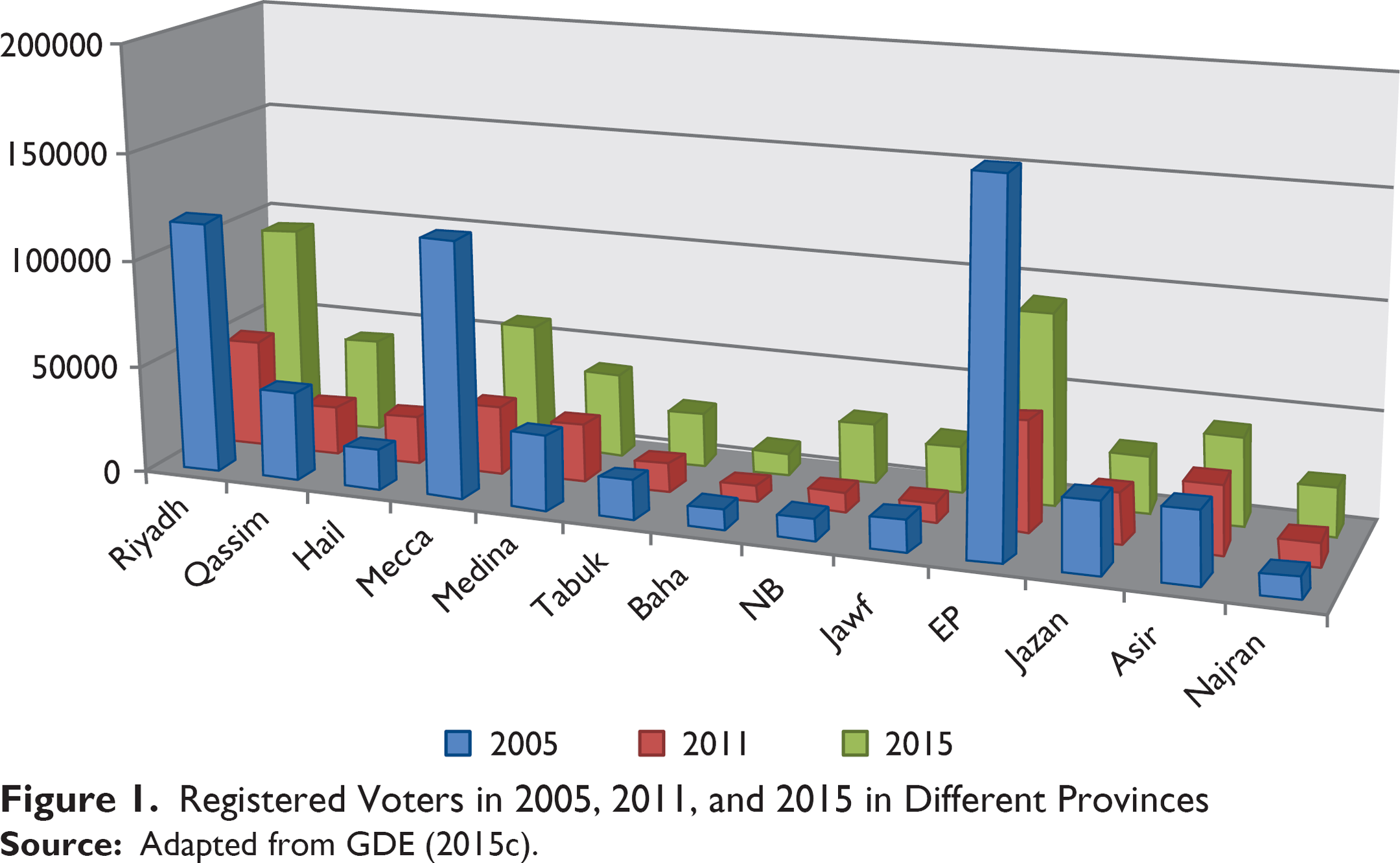
A significant aspect of the voting pattern was the sharp drop in the number of registered voters and their turnout in the Eastern Province, more importantly in the Hasa region, home to considerable number of Shia population. In 2005, Shias had enthusiastically participated in the elections and the number of candidates, size of the electorate, and voter turnout in the Hasa region was significantly higher than any other part of the kingdom (Ménoret, 2005). This changed in the 2011 and 2015 elections and the number of voters in the Hasa region was significantly lower; for example, in the 2005 elections, more than 52,000 people in the Hasa municipal region had registered, but in the 2011 and 2015 elections, their number dropped to 14,000 (GDE, 2015c).
Inclusion of women in the electorate had created a significant buzz in the national (Al-Muhaimed, 2015) and international media (The Telegraph, 2015) but low level of their participation reflects their apathy toward the process. As evident in Table 4, the number of registered female voters was significantly lower in all the provinces. In fact, an estimated 7 million of the total nearly 10 million Saudi women were eligible to participate in the elections but only a small 118,000, that is, 1.5 percent, registered to vote (Table 3). It is difficult to explain such a situation without considerable research but a possible explanation could be the traditional nature of the society and lack of enthusiasm among tribal elders and ulema toward allowing women to be part of the electoral process. In addition, women faced some practical problems while trying to register their names for voting. The process was cumbersome and required many documents (Al-Hamid, 2015).
Number of Registered Voters by Provinces, 2015

Moreover, the mobility due to driving ban and lack of adequate public transport also restricted women’s participation. According to the social activist Eman Alnafjan,
The low degree of women’s participation was due to difficulties to getting to registration centers, as women are banned from driving and there is no public transportation. Proof of residency is another obstacle that has deterred women from registering because most women in Saudi Arabia do not own property. Consequently, women not only have to provide proof of residency but also proof of relationship with the male owner of the property they live in. (Alnafjan, 2015)
While the number of women voters was lower, the age-wise break down of statistics reflects some interesting picture. Given the demographic profile of Saudi Arabia with a large pool of youth population (nearly 50 percent of the population is below 25 years as of 2015), it was expected that the lowering of minimum age to 18 years would significantly enhance the pool of voters. Figures, however, suggest that the participation of new voters, both women and those between 18 and 21 years, in the electoral process belied expectation and their numbers remained significantly low. It was only in Riyadh and Mecca, the most populous provinces, that the number of this pool of new voters was more than 10,000 (Table 4). According to the United Nations estimates, as of 2015, the total Saudi population between 18–21 years is nearly 2.5 million but the total number of registered voters in this age bracket was slightly more than 88,000. It means that only about 3.5 percent of these young voters registered to participate in the elections.
The number of candidates was not very high and nearly 6,500 candidates including around 1,000 women were contesting for the 2,106 available seats (Table 2). It meant that on an average, there were only three candidates for each available seat. This ratio if compared to the 2005 and 2011 elections was significantly lower. For example, in the first municipal elections, 9,330 candidates were vying for the 608 seats, which meant more than 15 candidates for every seat (Table 1). Similarly, in the 2011 elections, 5,324 candidates were contesting for the 1,056 available seats and this meant an average of 5 candidates for every seat which was better than 3 per seat in the 2015 elections (Tables 1 and 2).
The electoral process was also not completely free from controversies. Two significant aspects are worth noting; one, severe restrictions on campaigning and outreach by candidates and two, arbitrary rejection of nominations of many candidates, especially for women candidates. Candidates were not allowed to use photographs; they had to carry out campaign within a limited budget and were not supposed to use TV for campaigns (AlNafjan, 2015). Furthermore, they had a small window of 12 days for campaigns and all their promotion materials had to be approved by the local electoral office of the MMRA (GDE, 2015b). Restrictions on use of religious, sectarian, or tribal symbols had been imposed to avoid confrontation but this curtailed the ability of candidates to reach out to the voters in a society that had deep sectarian, tribal, and religious cleavages. Women candidates were restricted from directly contacting male voters and had to appoint a male representative for campaigning (Arab News, 2015b). This restricted their ability to reach out to the larger electorate. Women candidates also faced problems ranging from social apathy to organizational problems (Al-Hamid, 2015). Furthermore, many women who had filed nominations complained of arbitrary rejection of their nominations without adequate reasons. For example, Nassima al-Sadah, a human rights activist who had filed her nomination from city of Qatif, complained that her nomination has been arbitrarily rejected. Similarly, Loujain al-Hathloul, a women’s driving rights activist, who had been detained previously, also complained that her nomination was rejected without any notice (The Guardian, 2015).
Despite the lower turnout and an apparent lack of enthusiasm among Shias, especially women and young voters, there are a few notable achievements. While it was for the first time that women were allowed to participate in the voting, significantly 20 female candidates won in different parts of the kingdom. Given the lower registration and turnout among women, it is important because women who were participating in the elections were not very hopeful of winning and were more interested in increasing the ratio of female participation and make a mark in preventing the authorities from rolling back the reform in future (Al-Hamid, 2015; The Guardian, 2015).
Undoubtedly, there was a significant enthusiasm among a section of women, especially those who have been advocating for voting rights for long. One such woman, Hatoon al-Fassi, who had initiated the Baladi (my municipality) campaign demanding women’s rights to vote, organized workshops and campaigns to create awareness among female voters and convince them to participate in the electoral process (Arab News, 2015a). The number of young voters, though low, came from different parts and sections of the society reflecting that the social cleavages apart, people wish to participate in public affairs and are ready for shouldering sociopolitical responsibilities.
Conclusion
The 2015 municipal elections were historic because of universal adult franchise that was introduced, with participation of women. One of the causes of concern for the authorities is the lower turnout and it is important for them to cultivate a culture of participation in public affairs, howsoever limited it might be. This can be done through regular campaigns and outreach programs by the MMRA but it is more important to address the root cause of the popular apathy. Improving popular participation rests on municipal councils being granted more power to draft and execute plans and elected members being allowed to serve their constituencies with limited intervention from the central authorities. Notwithstanding the lower turnout, it should be noted that this is only the third municipal elections and the first that is not exclusive and thus experimental in nature. Historically, reforms in Saudi Arabia have been gradual and slow, and the need for expediting the process for empowered municipal councils cannot be seen in isolation from the priority of the monarchy to maintain political stability and status quo.
Footnotes
Acknowledgements
This article is a part of the project on “Elections and Democratization in the Arab World” supported by Jawaharlal Nehru University, New Delhi and the author acknowledges the support from the University.
1.
Two women—Lama al-Suleiman and Nashwa Taher—had even been elected to the Board of Jeddah Chamber of Commerce in 2005 (Asharq al-Awsat, 2005).