



Abstract
The US–Japan alliance has been one of the most important elements in configuring Japanese diplomacy since World War II. Accordingly, Japan’s relations with Iran always require striking a delicate balance among Japan’s security policy based on the US–Japan alliance, its energy demands, and its historically good bilateral relations with Iran. Japan welcomed the nuclear deal between Iran and the P5+1 group of nations in 2015. Iran holds the world’s second largest natural gas reserves and ranks fourth in proven crude oil reserves. Japanese companies were eager to re-enter the Iranian market with its rich natural resources and over 80 million strong population. However, the inauguration of President Trump in January 2017 and his antagonistic stance toward Iran has slowed this move. The Japanese government has taken the initiative to improve relations with Iran after lifting its sanctions against that country, while trying to mitigate possible risks. This article aims to examine relations between Iran and Japan after the Iran nuclear deal from three aspects: economic relations, nuclear cooperation, and security.
Introduction
On July 14, 2015, Iran and the P5+1 group of nations (the US, UK, France, Russia, China, and Germany) reached the Joint Comprehensive Plan of Action (JCPOA) over the Iranian nuclear issue. The accord took effect on January 16, 2016 and terminated nuclear-related international sanctions against Iran. On the following day, Japanese Foreign Minister Fumio Kishida issued a statement promising that Japan would support its implementation and encouraging Iran to play a positive role toward peace and stability in the Middle East. The Japanese government lifted its key sanctions against Iran, including its ban on Japanese banks dealing with Iran and its ban on new investments in the oil and gas sector, based on the provisions of UN Security Council Resolution 2231 on 22 January (Ministry of Foreign Affairs of Japan [MOFA], 2016a).
Miyagi (2011), who analyzed Japanese policy toward Iran from 2001 to 2005, pointed out that Japanese policymakers struggled to balance conflicting demands. The US alliance, the importance of Iran to Japan’s energy security and the promotion of anti-nuclear norms coincided with some of Japan’s priority security interests, one being to constrain North Korea’s development of nuclear weaponry, after disclosure of the nuclear sites in Iran in 2002. Although Japan tried to mediate between the US and Iran to solve the nuclear issues and to maintain Japan’s interests in the Azadegan oil field, it eventually tilted toward a pro-US stance due to increasing American pressure and the Mahmoud Ahmadinejad administration’s obstinate attitude. Japan agreed to reduce its oil imports from Iran by nearly 40 percent in 2012 to support the US-led sanction regime against Iran. Japan sacrificed its own economic interests and relatively good bilateral relations with Iran for the sake of the US–Japan alliance and non-proliferation, even if it was facing serious energy shortages after the Great East Japan Earthquake on March 11, 2011 and the subsequent shutdown of Japan’s nuclear power plants (Kafura, 2016; McKenzie & Ossoff, 2016).
The period following the JCPOA is quite different in several points from the above period, that is, Iran’s acceptation of the JCPOA, the relative decline of American influence in the international arena and the rise of new powers, such as China, India, and Russia. Sharma (2016) noted that “China’s increasing assertiveness in Asia and uncertainty over America’s regional role are pushing India and Japan closer together,” and it is assumed that these factors have started to influence Japan’s policy toward Iran.
This article aims to figure out continuities and changes in Japanese diplomacy after the nuclear deal in its relations with Iran from three aspects: economic relations, nuclear cooperation, and security.
Economic Relations between Japan and Iran
Banking System (money transactions)
On February 5, 2016, Japan and Iran signed a bilateral investment agreement aimed at ending discriminatory restrictions against companies operating in each other’s country and reducing business risks by protecting companies’ rights and assets. At the same time, both governments announced a business facilitation mechanism under which the Iranian government would guarantee US$10 billion in investment projects financed by the Japan Bank for International Cooperation (JBIC) and insured by Nippon Export and Investment Insurance (Mie, 2016; MOFA, 2016b; Pollmann, 2015). Japanese companies welcomed this step to help them re-enter the Iranian market and launch big projects.
Encouraged by the bilateral investment treaty, major Japanese banks gradually resumed doing business with Iranian banks. The Bank of Tokyo-Mitsubishi UFJ (BTMU), Japan’s largest bank, announced its resumption of transactions with Iranian banks in February 2016. This move was emulated by two other Japanese megabanks, Mizuho Bank and Sumitomo Mitsui Banking Corporation.
The US is still maintaining non-nuclear sanctions on Iran regarding “its ballistic missile program, support of terrorism and human rights violations.” While the banks are carefully complying with existing US sanctions, including a ban on any US dollar transactions, they have started to make Japanese refiners’ Iranian oil payments in Japanese yen and euros (Financial Tribune, 2016a; Kumagai & Eqbali, 2016). According to Taqizadeh-Hesari, the risk for financial transactions between Iran and Japan decreased after the two countries were able to establish banking transactions denominated in Japanese yen (Kayhan, 2017). The central banks of Malaysia and Pakistan also agreed with their Iranian counterpart to conduct business in Japanese yen, as well as in Chinese yuan and euros in 2017 (Financial Tribune, 2017c; Haider, 2017).
Although the Obama administration endeavored to persuade European banks to resume transactions with Iran to make the JCPOA successful, the inauguration of President d/t in January 2017 cast a shadow on the fate of the JCPOA. According to paragraph 12 of United Nation Security Council, Resolution 2231 (2015), if the Security Council does not adopt a resolution to continue the termination of sanctions against Iran stipulated in resolutions 1696 (2006), 1737 (2006), 1747 (2007), 1803 (2008), 1835 (2008), and 1929 (2010), they shall apply after the thirtieth day of the notification to the Security Council. This means that the USA can use its veto power to object to continued lifting of the UN sanctions related to Iran’s nuclear program. In addition to the “snapback” mechanism in the JCPOA, the US president is required to certify Iran’s compliance with its commitments under the JCPOA to Congress every 90 days under the 2015 Iran Nuclear Agreement Review Act (INARA). If such certification is not issued, Congress can opt to introduce legislation reimposing US sanctions waived or suspended under the JCPOA on an expedited schedule.
It is reported that President Trump feels quite uncomfortable with this procedure. On October 13, 2017 Trump refused to certify Iran’s compliance with its commitments under the JCPOA despite repeated confirmations by the International Atomic Energy Agency (IAEA). Although the US Congress has not yet discarded the JCPOA and Trump signed a waiver to reinstate Iran sanctions on January 12, 2018, he warned European allies and Congress to fix the pact to meet his demands or face a US exit. Uncertainty over the US policy is already causing long delays in contracts that Iran has sought with international firms to develop its oil fields and to renovate outdated infrastructure.
Major European banks are hesitating to rebuild banking links with Iran due to the threat of secondary sanctions against Iran. Iranian Deputy Foreign Minister for American and European Affairs Majid Takht Ravanchi complained to European countries about their lack of effort to persuade their banks to work with Iran in a conference held in Paris on November 7, 2017 (Iran Business News, 2017c). This inaction had been pointed out as early as April 2016, when Central Bank of Iran Chief Valiollah Seif said “almost nothing” has happened to facilitate Iran’s financial transactions, criticizing Washington for failing to fulfill its commitments under the JCPOA at the Council on Foreign Relations (Iran Business News, 2017d).
The British government, which would like to expand its trade with countries outside the EU due to its plan to head toward Brexit, has tried to convince major British banks to restart business with Iran. However, it was reported that British banks such as the Bank of England (BoE) and the Royal Bank of Scotland (RBS) have rebuffed such requests (Iran Business News, 2017a; Payvand News, 2017).
The situation in Germany is similar. According to a May 27, 2016 report, an official with Germany’s Deutsche Bank said “the transaction bank would remain tentative and extremely reserved in its financing business with Iran despite the removal of anti-Tehran sanctions” (Financial Tribune, 2016b). European banks’ cautious wait-and-see approach is caused by fear of USA’s legal action against them. The same Deutsche Bank was fined US$258 million by US regulators for working with US-sanctioned countries Syria and Iran in November 2015. Two French banks, BNP Paribas and Credit Agricole, were also, respectively, fined as much as US$8.9 billion and US$8 million by the US government because of their transactions with Iran from 2004 to 2012 (BBC News, 2015).
The Iranian government has also made efforts to attract foreign investors by reforming the banking system and investment rules. The Financial Action Task Force (FATF) recognized Iran’s efforts to counter money laundering and combat financing of terrorism and suspended restrictions against the country in June 2017. Although there were some attempts to prevent the suspension, the USA finally acceded to the decision under the pressure of European countries (Iran Business News, 2017b).
Energy Industries
Japan’s crude imports from Iran have plummeted in recent years, to 9.9 million kiloliters in 2015 compared to 24.4 million kiloliters in 2009. However, after the lifting of sanctions, Japan’s oil imports from Iran increased to 13.22 million kiloliters in 2016 (Ministry of Economy, Trade and Industry of Japan [METI], 2009–2017). Iran resumed its place as Japan’s fourth largest source of oil imports, replacing Kuwait (13.16 million kiloliters in 2016), as shown in Figure 1. Major oil refiners such as JX Nippon Oil & Energy, Cosmo Energy, Showa Shell (a part of the Royal Dutch Shell Group) and Idemitsu Kosan Group have increased crude purchases from Iran since 2016 and signed 1-year and long-term agreements with Iran to import its oil in 2016 (ISNA, 2016; Khatinoglu, 2017).
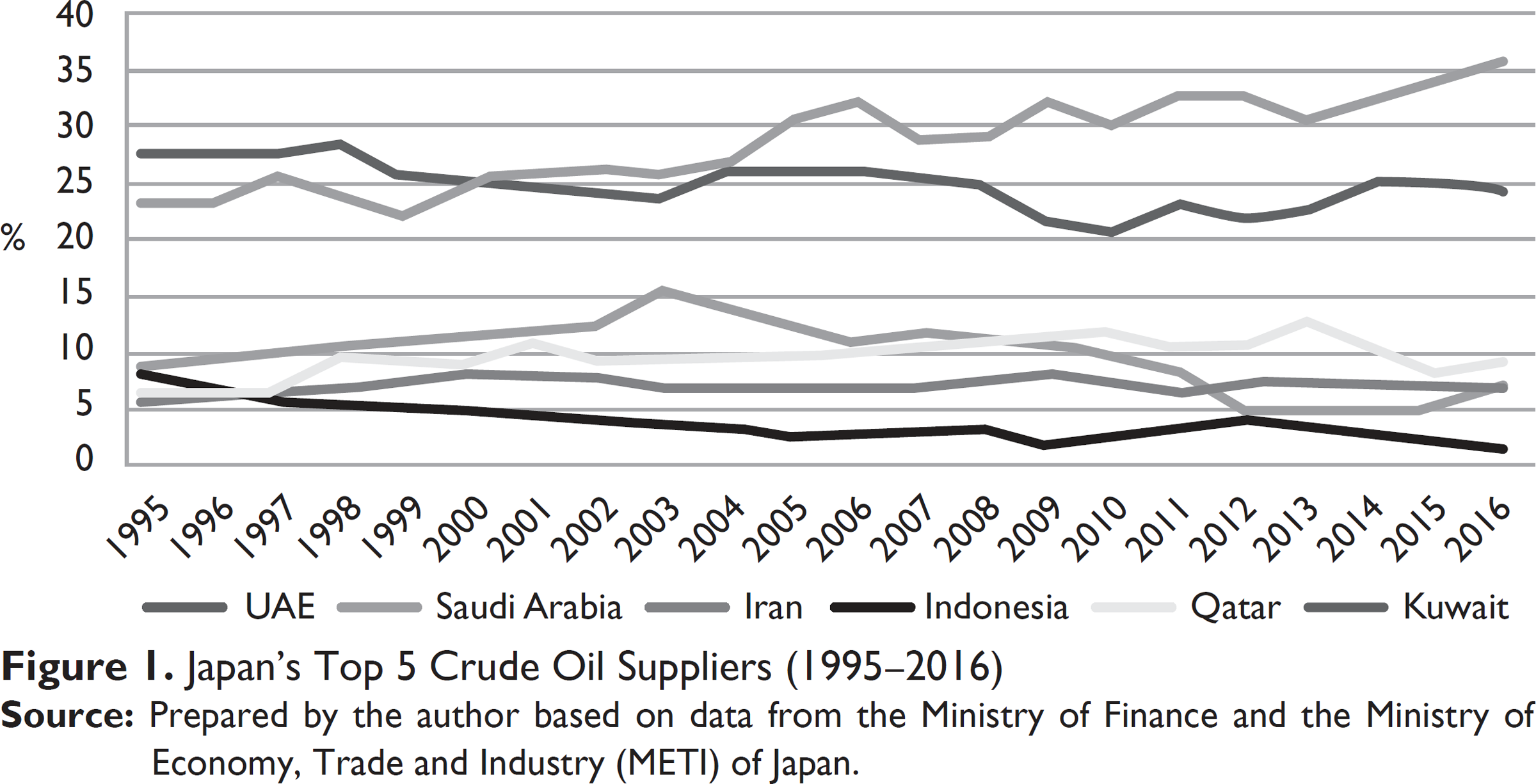
Iran was Japan’s third largest source of oil imports behind only Saudi Arabia and the United Arab Emirates from 1995 to 2008. After 2009, Qatar replaced Iran in that position. On the other hand, the Japanese government made possible efforts to keep importing oil from Iran, winning an exemption from financial sanctions on Iranian oil imports and providing sovereign insurance to Japanese tanker operators that imported Iranian oil after European Union sanctions were introduced in 2012 in concert with the American policy. Japan’s efforts to maintain positive relations with Iran are partly explained by loans extended to Iran by the government-affiliated Japan Bank for International Co-operation (JBIC). The Japanese government is afraid that the abrupt termination of Iranian crude imports could make its US$3.7 billion in loans unrecoverable (Nukii, 2014).
A bilateral investment treaty and normalization of bank transactions are encouraging Japanese companies to return to the Iranian market. A South Korean–Japanese consortium has signed a preliminary agreement worth US$3 billion to develop Siraf Refining Park, a part-privatized subsidiary of Iranian state refiner NIORDC in the city of Siraf in the southern Bushehr Province. 1 The agreement, signed between Siraf Refining Park and South Korea’s Hyundai, Daelim Corporation and Japan’s Chiyoda Corporation on July 13, 2017, covers the funding and construction of eight condensate splitters with a combined capacity of 480,000 barrels per day (b/d) in Siraf by the Korean–Japanese consortium. A total of US$2 billion will be provided by the Export Import Bank of Korea (KEXIM) and the Korea Trade Insurance Corporation (K-Sure). The remaining US$1 billion will be extended by Japanese financial institutions, including Nippon Export and Investment Insurance (Financial Tribune, 2017e).
On January 2, 2017, the National Iranian Oil Co. (NIOC) released a list of 29 foreign oil and gas firms pre-qualified for its upcoming upstream project based on a newly designed agreement called the Iran Petroleum Contract (IPC). Five Japanese firms—INPEX, Japan Petroleum Exploration, Itochu, Mitsui and Mitsubishi Corporation—were included in the list (Khatinoglu, 2017).
INPEX, Japan’s largest oil and gas exploration and production company, inked a memorandum of understanding (MoU) with NIOC in January 2016 to carry out development surveys at the Azadegan oilfield, one of the largest oil fields in the Middle East with an approximately 26-billion-barrel deposit of crude oil. Five companies, namely INPEX, Total S.A., Royal Dutch Shell plc, Petroliam Nasional Bhd (Petronas), and China National Petroleum Corporation, signed an agreement with NIOC for studies on the South Azadegan field last June (Mehr News, 2017; Mirza, 2017).
The INPEX had been the operator of the South Azadegan field from 2004 with a 75 percent stake in development. It reduced its stake to 10 percent in 2006 under pressure from tighter US sanctions on Iran and operational difficulties and withdrew completely in 2010 (Miyagi, 2011; Nakajima, 2009). In its place, China National Petroleum Corporation (CNPC) won a deal to develop the North and South Azadegan oil fields while taking a 70 percent stake in the North Azadegan oil field in 2009, although the CNPC was kicked out of South Azadegan in 2014 due to delays in its development. It is reported that INPEX is contemplating participation in a tender to develop the South Azadegan field and form a consortium with other foreign oil firms (Shintomi, 2017).
Exports to Iran
Japan was one of Iran’s most important sources of imports until 2006. Since then, China has become Iran’s largest source of imports and a major destination for Iranian exports. The UAE, Turkey, South Korea and India strengthened economic ties with Iran in the 2000s, in contrast to Japan and the EU. The UAE, where many Iranian individuals and companies operate and engage in financial transactions, has also emerged as an important business partner for Iran. Japanese electric appliances and cars have enjoyed overwhelming popularity among the Iranian people. However, reasonably priced Korean and Chinese cars and electronic goods responsive to local needs have penetrated the Iranian market of late (Nukii, 2014).
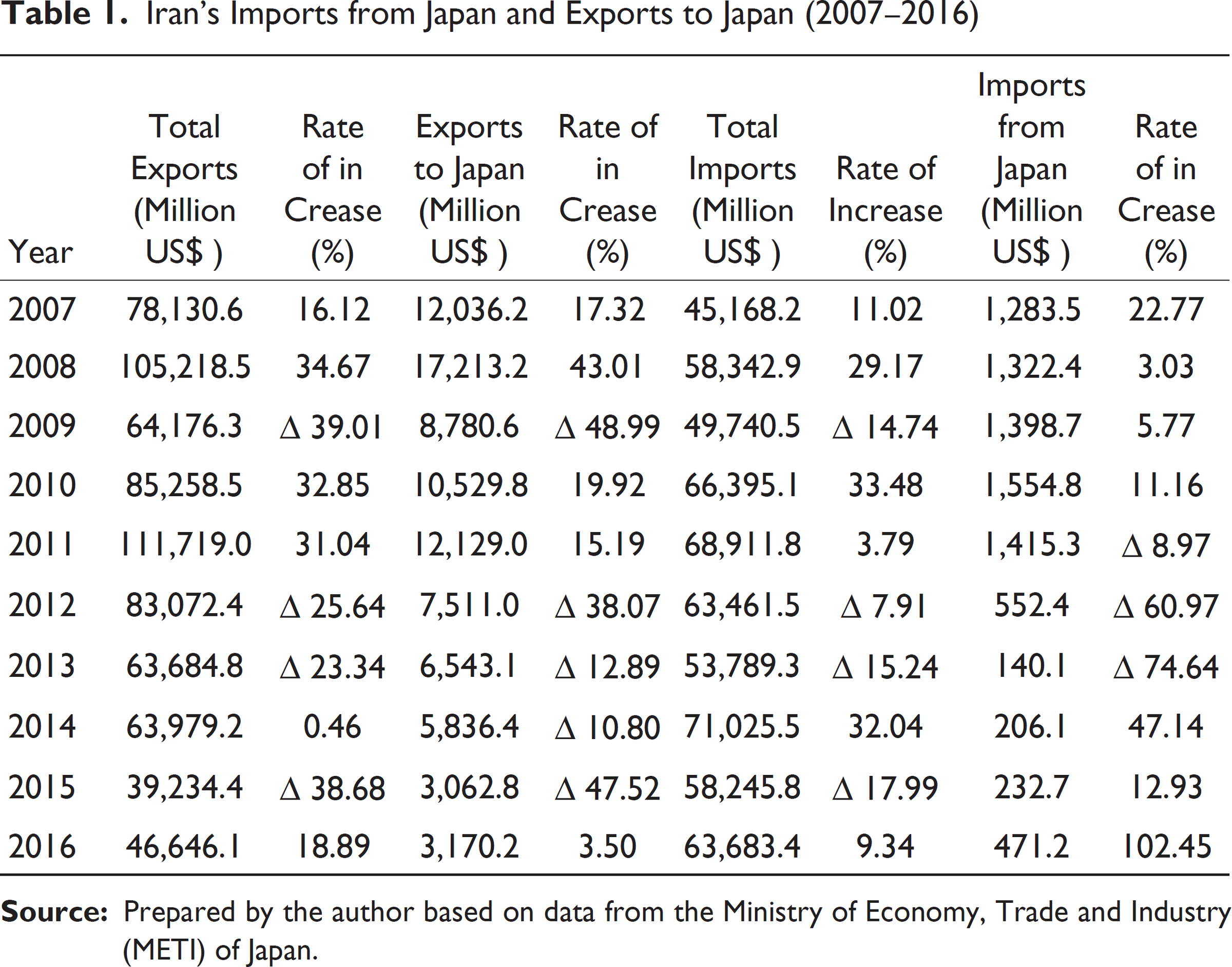
In 2015, exports from Japan to Iran increased 13 percent, especially large vehicles, such as buses and trucks, automobiles and auto parts (Japan External Trade Organization [JETRO], 2016, p. 3). Although total exports to Iran have not recovered to pre-sanction levels (Table 1), they grew as much as 103.4 percent in 2016, consisting mainly of large vehicles, automobiles, machines, and steel (JETRO, 2017, p. 4).
Iran’s Imports from Japan and Exports to Japan (2007–2016)
The Japanese government strongly encouraged Japanese banks and companies to normalize their relationships with Iran. The JETRO has convened several seminars and organized business tours to promote business between Iran and Japan since 2016. However, Japanese banks and companies still seem to be cautious about business and investment in Iran out of fear of violating American sanctions as the Bank of Tokyo-Mitsubishi UFJ did. The bank was fined US$8.6 million by the US Treasury Department in December 2012 because it continued transferring funds to Iran under the sanctions. The New York State Department of Financial Services imposed an even heavier punishment, a US$315 million fine, on the bank in 2014 (Protess & Silver-Greenberg, 2014).
Since the US government has maintained unilateral sanctions on Iran, foreign companies are obliged to do due diligence to avoid dealing with persons or entities listed as “Specially Designated Nationals” under the US Treasury Department’s Office of Foreign Assets Control. The US sanctions also cover any company that is owned 50 percent or more by a blocked person or entity, including the Islamic Revolutionary Guard Corps, which has interests throughout the Iranian economy. The requirement of due diligence itself became a good reason for foreign companies to hesitate in starting business with Iran due to the complicated and difficult processes involved (JETRO, 2016; Mie, 2016). In addition, the Iran Sanctions Act, which was extended for 10 years in December 2016, prohibits foreign companies from investing over US$20 million in any given year in Iran’s energy sector (Katzman, 2018). This restriction also inhibits banks from financing energy-related mega projects in Iran.
Nuclear Cooperation
The relationship between Tokyo and Tehran extends beyond their mutual economic interests. Japan has pledged to provide expertise on nuclear energy to Iran to support continuous implementation of the nuclear agreement. On December 7, 2016, Foreign Minister Kishida promised his Iranian counterpart Minister Zarif to promote cooperation in the areas of nuclear safety and safeguard measures.
The Japanese government decided to offer Iran assistance worth €550,000 for cooperation in nuclear safety and €1.5 million for cooperation in safeguard measures, both through the IAEA and bilateral cooperation (MOFA, 2016c). This cooperation consisted of (a) providing opportunities for the personnel of Iranian regulatory authorities and other experts to study the importance of post-accident responses and anti-seismic structures for enhancing nuclear safety; (b) dispatching experts and offering training programs to support establishment of the Nuclear Safety Centre referred to in the JCPOA; and (c) supporting human resources development through field training programs centering on accounting for and control of nuclear material (MOFA, 2015b).
This nuclear cooperation was actualized because Japan strongly supports the JCPOA and Iranians have high expectations of and trust in Japanese nuclear technologies (Zadeali, 2016, p. 9). 2 As Pollmann suggests (2015), know-how on earthquake preparedness and emergency measures at nuclear energy facilities is the very unique expertise that only Japan can provide Iran as the result of hard-won lessons after the Fukushima meltdown disaster in March 2011.
The Chabahar Project: Convergence of Japanese Energy Security and Japan’s “Free and Open Indo-Pacific Strategy”
Outline of the Chabahar Project
The Japanese government showed interest in investing in the Chabahar Port development project during the annual summit meeting between Japan and India in 2016 (Mooney, 2016). This Chabahar project, in which India has played a central role, involves the development of a port, a free trade zone, and a logistics and industrial complex in the city of Chabahar as part of the Trilateral Transit and Trade Agreement signed in May 2016 among India, Iran, and Afghanistan. The idea of building a transport-and-trade corridor connecting landlocked but resource-rich Central Asian countries and Afghanistan to South Asia through Chabahar, bypassing Pakistan, was first proposed in 2003; however, it did not progress until Iran’s formal approval of the project in 2012. According to Sidhu (2016), Iran used the Chabahar project to get support from India on its nuclear case against the USA and the West; however, Tehran realized the strategic importance of Chabahar as result of the impact of international sanctions and its growing isolation.
Indian Prime Minister Narendra Modi’s government further revitalized the project in 2016, declaring that investment in developing a free trade area around the port, as well as in building fertilizer plants, roads, and a railway line to Zahedan, could eventually amount to US$ 15 billion (Sharma, 2016; Verma & Miglani, 2017). Sidhu suggests that tacit support from the Obama administration for the project also added momentum, since the project was counted on to provide Afghanistan with economic prosperity and stabilization (2016).
The inauguration ceremony for the first phase of the Chabahar Port project in southeastern Iran was held by Iranian President Hassan Rouhani on December 3, 2017. India is to complete and operate two berths in Chabahar Port Phase-I with a capital investment of US$85 million and an annual revenue expenditure of US$23 million on a 10-year lease. India has already built the Zaranj-Delaram highway in Afghanistan, which is expected to facilitate land-based trade to Kabul and ultimately beyond to Central Asia. Afghanistan welcomes the project, since Chabahar would become an alternative to the route through Karachi as a transit route to the Indian Ocean (Pant, 2017).
Iran also finds plenty of merits in the Chabahar Project because it would facilitate relations with foreign countries as Iran emerges from its long isolation and also improve the poor economic situation in the Sistan-Baluchistan area, where Sunni minorities mainly resided and radical Sunni groups occasionally carried out terrorist attacks. According to the Port & Maritime Organization of Iran’s Ministry of Roads & Urban Development (2017), Chabahar Port is “well outside the Strait of Hormuz and its shorter distance for exporting crude oil and chemical products from Iran to Eastern Asia and Europe (which saves 2 to 3 days of navigation), as well as the demands of India, Pakistan and China for energy and marine fuels are the significant advantages of Chabahar for providing bunkering services.” Chabahar Port has the potential to become a major and strategic transport hub connecting the Eurasian continent and the Indo-Pacific region.
Competition between Gwadar and Chabahar
The Chabahar project is also seen as a counterbalance to rising Chinese influence in the region (Hong, 2017). The port of Gwadar in Pakistan, only 72 kilometers from Chabahar, was built by China as a meeting point of the Belt and Road Initiative (BRI). Pakistan would even allow China to deploy its naval ships at Gwadar alongside the Pakistani Navy to safeguard the port. China, concerned about an exclusively Indian presence at Chabahar Port, made serious overtures to Iran to participate itself in the Chabahar development project (Sharma, 2016).
Following an official trip to Iran by President Xi Jinping in January 2016, China accelerated its investment in Iran, since it regards Iran as one of the linchpins of the BRI. It is reported that several plans have been proposed by China, India, and Russia to fund the construction of the railroad that will connect Chabahar to the Iranian cities of Zahedan and Mashhad and finally to the Sarakhs and Incheborun border terminals in northeast Iran. There have also been plans for establishing a rail connection between Chabahar and Gwadar and supplying energy to Chinese contractors in Gwadar through Chabahar (Financial Tribune, 2017d).
Japan is willing to join in the competition for infrastructure investment in the Indian Ocean. When Indian Prime Minister Narendra Modi visited Tokyo in November 2016, Japanese Prime Minister Shinzo Abe declared that Japan will support the Chabahar Project as a part of the “Asia-Africa Growth Corridor” or the “Freedom Corridor.” The two countries are pursuing joint development of infrastructure and capacity-building projects in Asia and Africa to ensure free and open access to maritime routes and resources, to enhance regional connectivity and to potentially rival China’s BRI (Sharma, 2016). Although Japan recently softened its stance toward the BRI, dispatching Toshihiro Nikai, secretary-general of the Liberal Democratic Party, to the May 2017 BRI conference, neither Japan nor India has “joined” the BRI (The Japan Times, 2017). They share concerns about China’s increasing assertiveness in Asia and uncertainty over America’s regional role.
Japan also has been concerned that Japanese companies have lost in the bidding for several giant infrastructure development projects in Asia and the Middle East in recent years to China and South Korea, which offer host countries relatively cheap prices. For example, Japanese companies lost the tender for a high-speed rail project in Indonesia to a Chinese bidder in 2015. The project to build a suspension bridge in Turkey was won by a bid from South Korea in 2017 (Nikkei Asian Review, 2017).
The Japanese government has taken the initiative to advertise the quality and better services of Japanese infrastructure under its “Quality Infrastructure Program” since 2015. Japan’s Ministry of Foreign Affairs explains that “‘quality infrastructure’ may first appear costly; however, since it is easy to use and durable, as well as environmentally friendly and disaster resilient, ‘quality infrastructure’ is indeed cost-effective in the long run (MOFA, 2015a).” The Japanese government also emphasizes the differences from China’s approach, saying that “‘quality infrastructure’ also contributes to enhancing connectivity among Asian countries, creating jobs for local people, increasing local skills and improving people’s lives (MOFA, 2015a).”
This partnership with India under the name of “Asia-Africa Growth Corridor (Freedom Corridor)” represents a convergence of two diplomatic initiatives of the Abe administration: (1) the aforementioned “Quality Infrastructure Program,” and (2) the “Free and Open Indo-Pacific Strategy.” In addition to Chabahar Port, the two countries are expected to jointly develop Trincomalee Port in northeastern Sri Lanka and Dawei Port along the Thai–Myanmar border (Hong, 2017; Zaw, 2017). The “Freedom Corridor” demonstrates the unique integration of Japan’s economic and security interests as well as value-based diplomacy. Prime Minister Abe has succeeded in effectively selling the idea of his “Free and Open Indo-Pacific Strategy” to US President Trump thus far. 3 The Japanese government can use the term to promote Japanese interests, while defending and justifying its involvement in Chabahar to mitigate possible pressure from the USA.
Teaming up with India has other advantages. The Japanese government and INPEX decided to withdraw from the South Azadegan oil field in 2010, but not simply in a surrender to American pressure; the company also judged the project was not profitable enough to pursue under Iran’s proposed conditions for the contract and several unexpected difficulties, such as the considerable time and expense required to remove mines from the oil field and the complicated and protracted negotiations with the Iranian side. Accordingly, Japanese companies can hedge unexpected risks caused by local political, economic and security circumstances through cooperating with Indian counterparts.
Iran seems to be trying to strike a balance among China, Russia, Japan, India, and other countries interested in investing in Chabahar and to take advantage of competition among them as much as possible. Iran thinks that bolstering cooperation with Japan and India and developing relations with them in such areas as energy exchange, the construction, and commissioning of refineries, the development of Chabahar and the establishment of a rail connection between this important Iranian port and Afghanistan and Central Asia, will prove quite beneficial. Iran even calculates that encouraging India and Japan to team up to invest in Iran can encourage China to take steps not to lose Iran as a strategic partner and to play a more active role in the country’s projects (Financial Tribune, 2017d).
On September 20, 2017, President Hassan Rouhani of Iran hailed Japan’s plan to invest in the Chabahar Project and thanked Prime Minister Abe, noting that “development of southern ports including Chabahar in southeastern Iran, will play a crucial role in promoting Tehran–Tokyo relations and Japanese investors can invest in the development of ports and rail networks (IRNA, 2017).” Delegations from Japanese companies began visiting the port to study the potential for investing in industries such as petrochemicals and steel as early as May 2015. With strong support from Prime Minister Abe, the Japan International Cooperation Agency (JICA) drew up several plans for investments after discussing infrastructure requirements with Iran and India (JOC.com, 2016). One of these is the memorandum of understanding (MoU) for ¥800 million signed in March 2017 to develop Iran’s customs office, under which the Japanese government will provide a grant to equip the customs office with x-ray container devices to facilitate and accelerate trade operations in Iran (AVA Diplomatic, 2017).
Iran also plays a big role in the energy security of both India and Japan. It is Japan’s fourth-largest supplier of crude oil, accounting for 6.9 percent of total imports in 2016. Like Japan, Iran accounted for 11 percent of India’s crude imports in 2016, making it the third-largest supplier (Livemint, 2017). The post-sanctions Iranian market is seen as rich in opportunities for both Japan and India.
Challenges and Potential of the Projects
Although the Chabahar project has been earnestly advanced by the Modi government, skeptics have raised questions about its economic feasibility (cost-effectiveness) and pointed out the precarious security situation in Afghanistan (Malik, 2018; Sidhu, 2016, p. 15). There is a possibility that the Taliban might attack trucks carrying Indian exports, since the Taliban is fighting against the government in the adjacent district of Delaram, the terminus of the Indian-built highway from Iran. Watson (2017) warns that deep involvement in the project also threatens to draw India into the morass of Iran–Afghanistan politics.
In addition, bureaucratic delays, difficult negotiations with Iran and the risk of incurring US President Trump’s antagonism toward Iran remain the key risk factors for progress on the project. President Trump denounced the nuclear agreement as “the worst deal ever negotiated” on the campaign trail and, since taking office in January, has accused Iran of supporting terrorists and destabilizing the Middle East.
Outfitting of Chabahar Port has been delayed, as major manufacturers of customized equipment to develop jetties and container terminals have been hesitant to supply equipment for the port due to the difficulties involved with monetary transactions. They also fear the USA may reimpose sanctions on Tehran (Verma & Miglani, 2017). Iran is apparently unhappy over the delay in work on three jetties allotted to India in Chabahar Port and the Indian and Iranian governments have started squabbling over the delay. Indian officials insist that the Iranians have not completed the paperwork necessary to release the funds and have unilaterally changed terms and conditions on the eve of the signing of a MoU in 2015 by introducing a local stakeholder without consulting India (Financial Tribune, 2017b; Pant, 2017). On the other hand, Iran has suggested that it can always bring Pakistan and China into further phases of the port’s development and can also use both Chabahar and Gawadar together if India goes against Iran’s expectations (Mirchandani, 2017).
In fact, Iran signed MoUs on investing US$3.2 billion in Chabahar with companies from China, South Korea, Oman, and India on the sidelines of the International Conference on Investment Opportunities on the Makran Coast (January 23–24, 2017). The Chabahar Free Zone Organization and South Korea’s POSCO agreed to develop Chabahar’s infrastructure. Moreover, Iran accepted Chinese investment in a range of infrastructure projects in Chabahar covering water, steel, oil, and gas pipelines, seafood, shipping, construction, and tourism (Financial Tribune, 2017a).
On the other hand, Roche (2017) asserts that Japan became cautious about investing in Chabahar Port because of fresh sanctions imposed by the USA in July 2017. Japan as a military ally of the USA is more susceptible to the US pressure than India. However, Japan will not give up Chabahar easily because the Chabahar project is important for Japan from two reasons: (1) to solicit better business conditions for Japanese companies in the oil trade and investment from Iran and (2) to attempt to expand economical and security cooperation with India to counter China’s BRI. In addition, the geo-strategical potential of Chabahar Port is increasing, because growing tension between Iran and Saudi Arabia poses high geopolitical risk to the energy supply route through the Strait of Hormuz. While Iran and Pakistan are building ports outside the Persian Gulf, Saudi Arabia is also keen to develop the route to the Red Sea to bypass the Strait of Hormuz. The US–Japan military alliance is more urgently needed in dealing with North Korea’s recent incessant missile and nuclear tests. There is a possibility that Japan might assume a low profile while the Trump administration is taking a tough stance toward Iran. In the long run, Japan will remain interested and involved in the Chabahar project from the perspective of energy security.
Conclusion
The US–Japan alliance has been one of the most important elements in configuring Japanese diplomacy since World War II. Accordingly, Japan’s relations with Iran always require striking a delicate balance among Japan’s security policy based on the US–Japan alliance, its energy demands and its historically good bilateral relations with Iran. Under the Abe administration, Japan is seeking to pursue more independent foreign and security policies even while maintaining its alliance with the USA. One answer is constructing multilateral frameworks for international cooperation. The “Freedom Corridor” and Trans-Pacific Strategic Economic Partnership Agreement (TPP) are good examples of this. Japanese companies have also tried to form a consortium with other foreign firms to participate in the bidding process for the large-scale projects in Iran. They expect that multilateral cooperation can mitigate the risks caused by the unilateral American sanctions as well as by complex local politics and economic customs unique to Iran. This new trial might face several challenges and obstacles due to changes in international circumstances and differences in cultures and priorities among participants. On occasion, the projects might proceed in a different direction from the initial goal. However, they are worth attempting in the midst of the changing world order.
While pursuing national interests such as energy security, territorial defense, good bilateral, and multilateral relations and observance of international rules and values, Japan is striving to perform a skillful balancing act between the USA and Iran as well as among rising powers in the regional and international arenas.
Footnotes
Declaration of Conflicting Interests
The author(s) declared no potential conflicts of interest with respect to the research, authorship, and/or publication of this article.
Funding
The author(s) received no financial support for the research, authorship, and/or publication of this article.
1.
The Siraf project will be built on a site near the port of Assaluyeh, where the upstream state-owned firm NIOC has built onshore processing plants for gas produced from the offshore South Pars field. Accordingly, the Siraf complex will comprise one of the key projects that Iran is eager to push forward to exploit the South Pars gas field and equip the new facilities for its energy industry by introducing foreign investment and the latest technologies. Although Iran signed over six agreements with total planned investment exceeding US$ 16bn, none of the projects had yet reached the construction contract award stage by July 2017 (MEES, 2017).
2.
According to Miyagi (2011, p. 136), the USA demanded that Japan replace the Azadegan project with a Siberian oil undertaking and make Iran’s signature on the IAEA’s Additional Protocol to the NPT a condition for the project in 2003. Although Japan rejected the proposal to replace Azadegan with Siberian oil, it asked Iran to sign the Additional Protocol to reach a final agreement on Azadegan. At that time, Iran requested that Japan give technical advice and information on IAEA’s inspections accompanied by signing the Protocol (Miyagi, 2011, p. 136). Japan and Iran have built a foundation for bilateral nuclear cooperation since then. Ali Akbar Salehi, the head of the Atomic Energy Organization of Iran, visited Tokyo in September 2016 and showed interest in buying nuclear reactors from Japan, although he could not get any offers from the Japanese side (The Japan Times, 2016).
3.
President Trump started to use the term “Indo-Pacific region” instead of “Asia” or “Asia-Pacific” during his first visit to Asia in November 2017, after he discussed the Indo-Pacific “concept” with Prime Minister Shinzo Abe (Jaipragas, 2017). “Indo-Pacific region” is emerging as a term to define America’s new geopolitical view of Asia.