




Abstract
This study explores the strategic deployment of religion by the Egyptian military regime as a legitimizing tool for the 2013 military coup and ensuing rule. Central to the analysis is the role of the Egyptian Dar al-Ifta, a pivotal state religious institution, in securitizing the Muslim Brotherhood and its affiliates. While multiple frameworks exist to dissect regime preservation tactics, the research harnesses securitization theory to illuminate these strategies. Grounding the arguments in the foundational works of Juha Vuori in nondemocratic contexts, it contends that the Egyptian military regime tactically utilized religious institutions to securitize its adversaries and enriches the extant literature by integrating securitization principles within the Egyptian context and emphasizes underexplored narratives from the Global South. Moreover, it seeks to bridge a research gap on the nexus between religious institutions and individual actors and delves into the intricate interplay between religious and political discourses by examining speeches and statements infused with religious rhetoric for legitimization.
Introduction
In July 2013, Egypt witnessed a significant political takeover when Defense Minister Abd el-Fattah el-Sisi led a military coup against Mohamed Morsi, the democratically elected president after the 2011 revolution. Notably, Morsi was a prominent Muslim Brotherhood (MB) member. This military maneuver, executed just a year into Morsi’s rule, was the culmination of an intricate securitization process directed against the MB. This involved a coalition of both state and nonstate actors, including established religious entities such as the Egyptian Dar al-Ifta, semiofficial bodies such as the Supreme Council of Sufi Orders, and unofficial groups, exemplified by the Alexandrian Salafi Da’wa Group. It becomes apparent that there was a deep-seated alignment between the military—often considered the backbone of the Egyptian state (Mansour, 2022)—and some religious factions.
Historically, the nexus between religion and politics has been extensively researched. Predominant academic sentiment postulated a diminishing role of religion in political landscapes. However, against prevailing expectations, religious tenets have robustly maintained their influence on domestic and international policy spheres (Bellin, 2008). George (1991, p. 15)’s typology discerns three distinct interrelationships between religion and politics. While the first typology suggests political dominance over religious dogma, the second underscores the ability of religion to circumscribe political discourse. The third envisions a symbiotic coexistence between the two realms. Assessing these typologies against Middle Eastern polities reveals a discernible trend: regimes predominantly exert overarching control over religious institutions, strategically leveraging them for political expedience. This phenomenon is exemplified by Saudi Arabia’s alignment with Wahhabism and Iran’s association with Shiism in foreign policy (Mirza et al., 2021). Similarly, the UAE’s religious maneuverings underscore its objectives in nation-building, national image rebranding, and regional and global empowerment (Baycer & Rakipoglu, 2022; Kourgiotis, 2020).
The Arab Spring further catalyzed the securitization discourse, offering regimes a pretext to label and subdue perceived “threats” (Darwich & Fakhoury, 2016). While the literature has extensively covered the ramifications of the coup in Egypt, there remains a palpable absence of analyses grounded in Arabic sources. For example, Saleh and Kretzschmar examined Salafis’s efforts to securitize the Shias after 2010 (Saleh & Kraetzschmar, 2015), a topic that has been explored in the context of sectarian politics, as defined by Del Sarto’s (2021) concept of “sectarian securitization.” Pratt and Rezk (2019) applied securitization theory to elucidate the state violence and authoritarianism that emerged in Egypt after the 2013 coup. Similarly, Greenwood and Wæver (2013) analyzed the Egyptian revolution and the ensuing coup through the lens of the securitization process. Notably, while those studies operate within the same theoretical framework, they share common limitations: the absence of Arabic sources and the role of religious institutions. Although Al-Anani (2020) briefly noted in his commentary that under Sisi’s administration when religious institutions were leveraged for political advantage, this facet of religious legitimization of the 2013 coup requires more in-depth exploration through primary sources.
This study draws from Arabic sources to demonstrate that religious entities in Egypt serve as “functional actors (Balci & Kardas, 2012)” in the securitization process. The starting point for the analysis levels here will be the level of “agents,” which concentrates on the actors and the relations that structure the situation under scrutiny, including those who contribute or resist, what is threatened, and what threatens (Balzacq, 2011, pp. 34–36). This article focuses on the levels of acts and contexts at the agent level. Where “Acts” are the constitution of securitization moves or practices, both discursive and nondiscursive, the analysis is based on illocutionary logic (Vuori, 2011, p. 187). As securitization studies are focused on legitimization from the side of the authorities (Vuori, 2011, p. 189), this article focuses on state official securitizing actors, such as the Dar al-Ifta and its Grand Muftis.
It extracts information from the original Arabic sources, newspapers, and periodicals issued by official authorities, such as the Egyptian official gazette. This study mainly tracked the official websites of Egyptian Dar al-Ifta and Dar al-Ifta Media Center, marked in blue on Facebook, for approximately six years, from December 2015 to January 2022, to conduct a quantitative survey showing indications of Dar al-Ifta’s support for the 2013 coup regime or its attack on the MB, as shown in the study. Speeches, fatwas, written statements, and official documents were analyzed. In this regard, it selects the case study method and applies it to Egypt since it is a country where the army is the stakeholder ruling but not the governing country (Cook, 2007, p. 15).
Theoretical Framework: Securitization and Its Application to the Egyptian Case
Securitization is a theoretical framework arguing that security is an act of speech, popularized by some scholars identified with the Copenhagen School developed in 1988 (Baysal, 2020). These studies criticize the traditional understanding of security. Securitization theory argues that determining and declaring something as a threat or a matter of concern regarding national security is the starting point. In this regard, political actors assess, identify, and announce threats. Therefore, these threats do not exist until political actors articulate and securitize them by constructing discourses and implementing exceptional measures (Pratt & Rezk, 2019). In other words, political actors start the securitization process by labeling something a threat. The theory illustrates that threats to national security do not exist. Naturally, they go through an artificial operation process and are created by political actors. Moreover, these political agents prioritize “the threats” and divert the state to act against the announced securitized threats. As stated by Buzan et al. (1998, p. 21), two nontraditional policies can be implemented when something is framed as a threat to national security by the state. First, any actions and measures can be justified. Second, abnormal political activities can be proposed and pursued. Therefore, securitization means exiting normal politics and placing a kind of emergency in which any measure can be justified (Williams, 2003).
Searle and Vanderveken (1985) proposed that speech acts are the primary form of human communication and that speech acts can be divided into five elementary types, depending on their illocutionary point: assertiveness, directives, commissive, expressions, and declarations, so the world changes to match the propositional content, solely in virtue of the successful performance of the utterance. According to Fairclough, one can view how the samples draw on culturally resonant ideas. Mobilization should leverage preexisting concepts and employ innovative approaches tailored to specific circumstances (Paltemaa & Vuori, 2006). It is imperative to effectively categorize political movements into a faction comprising detrimental constituents and a majority of those misled by a minority of “troublemakers”(Snow & Benford, 2000). Porta (1996, p. 65) argues that the actor’s specific aims are the creation of an unfavorable public image, disinformation, restricting a movement’s resources and limiting its facilities, recruitment of activists, destroying leaders, fueling internal conflicts, encouraging conflicts between groups, and sabotaging particular actions.
There has been considerable debate around the ability to apply securitization theory to the nondemocratic context, while the mean securitization theorists understand all types of political systems as applicable for analysis within the framework without clarifying it. (2008) Vuori argued that all societies have rules that are products of their own historical and social contexts. When security logic and rhetoric are utilized to legitimize breaking these rules, one has a case of securitization. Researchers contend that military coup leaders exposed the MB and its supporters to massacres such as Rabaa and al-Nahda squares after a successful securitization process (Pratt & Rezk, 2019) to obtain stability and annihilate the MB structure.
Securitization Process: Agents, Tools, and Targets
The Islamist organizations before the Egyptian revolution were composed of five main groups. First, the official religious establishment, which includes four mega-institutions—Al-Azhar Mosque, al-Azhar University, Dar al-Ifta, and the Ministry of Endowments (Gomaa, 2014)—has been disempowered since the 1950s. Second, was the MB. The third was the Salafis, composed of a large, nonorganized social movement. Fourth are the Sufi orders, which are increasingly under the control of the state and have lost social legitimacy. The fifth group included neoliberal Islamic groups, trending in Egypt in the 1990s (Korany & el-Mahdy, 2012, pp. 126–127).
The Supreme Council of the Armed Forces (SCAF) continued the regime’s mutual interdependence with Sufi orders and Al-Azhar scholars, which had already existed since the time of President Gamal Abdul Nasser through Anwar Sadat and Hosni Mubarak (Hassan, 1997, pp. 98–100). The study posits that the involvement of an official state institution such as Dar al-Ifta since 2013 played a direct role in the securitization process, aiding in the facilitation of the 2013 coup and its subsequent developments. The controversy began in July 2012 when Mohamed Ibrahim, a well-known Salafist tweeted that he accepted to be the new minister of religious endowments after being approached by Prime Minister Hisham Qandil and this sparked fears of the official propagation of Salafism under the ministry’s control. The next logical and final step would be to install a Salafi in the role of Sheikh Al-Azhar (Hellyer, 2012).
The Role of the Egyptian Dar al-Ifta in the Securitization Process
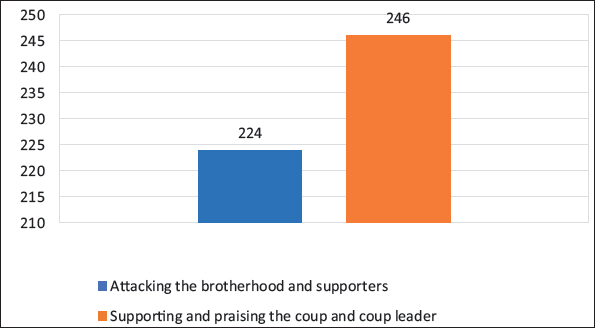
From a numerical perspective, the researchers studied the officially blue-marked Facebook pages of the Egyptian Dar al-Ifta 1 and Dar al-Ifta Media Centre 2 posts from December 2015 to January 2022, extracting numerical indicators, showing the support of Dar al-Ifta to the Egyptian regime in the period after the 2013 coup. Dar al-Ifta mentioned the word (brotherhood إخوان) 131 times during this period. Dar al-Ifta launched 102 direct attacks against the MB during this period. These attacks can be categorized into three main types: instances where joining the MB was prohibited, actions or movements associated with political Islam were targeted, and criticisms directed toward the ideas, fatwas, or influence of Sayyid Qutb, a prominent scholar within the MB. Specifically, there were three instances where joining the MB was prohibited, 59 instances where MB actions or political Islam movements were attacked, and 40 instances where the ideas or fatwas of the MB and Sayyid Qutb were criticized. According to Dar al-Ifta, the MB has been characterized as a group associated with terrorism and extremism. This characterization is reflected in the frequency of the terms used, with the word “terrorism” being used 307 times, “extremist” being cited 57 times, and “extremism” being cited 92 times. Dar al-Ifta attacked the MB and its supporters 224 times but supported and praised the coup and the coup leader 246 times, as illustrated in Figure 1.
The current Grand Mufti Shawky Allam is the professor and former head of the Department of Jurisprudence at the Faculty of Sharia and Law at Al-Azhar University, Tanta branch. Allam is not known as a Sufi scholar but seems inclined toward Sufism (Reda, 2020). He started as the Egyptian Grand Mufti in March 2013. Allam portrayed the military coup as a national and religious duty and a defense of honor and religion, saying to its leader: “Your honorable war on terrorism is self-defense, defense of honor, defense of religion, and defense of Egypt and its surrounding countries” (The official Facebook page of the Egyptian Dar Al-Ifta, 2015).
Allam exerted efforts toward ensuring the administrative stability of the coup by endorsing the referendum on the constitution in January 2014 (The official Facebook page of the Egyptian Dar Al-Ifta, 2014b) and the subsequent presidential elections in May 2014. His actions facilitated the ascension of the coup leader to the presidency. Allam also tried to enhance certain aspects of the state’s economy, including his endorsement of the tourism sector. He emphasized that supporting and fostering tourism is a responsibility for the entire nation or a national duty (The official Facebook page of the Egyptian Dar Al-Ifta, 2014c). Additionally, he endeavored to instill confidence in the international community by asserting that Egypt is progressing toward stability (The official Facebook page of the Egyptian Dar Al-Ifta, 2014d), distancing itself from the elected president affiliated with the MB. At the same time, he has worked to defame the MB, accusing it of terrorism while supporting the armed forces to wage an open war against them, using some religious terms such as jihad for the sake of God.
Although Allam played an essential political role in supporting the military coup, until Osama al-Abed, the President of Al-Azhar University, considered the Egyptian Dar al-Ifta the most important intellectual battalion that supported Sisi’s decisions after the coup (The official Facebook page of the Egyptian Dar al-Ifta Media Center, 2020c). Allam accused the MB of “encapsulating political opinions in religious matters,” confirming that it “is the way for the terrorist group to infiltrate people’s minds.” Allam said during his lecture at the symposium titled “correct your thoughts” at an Egyptian University about the Kharijites that “there is no cure for them except the sword,” inciting the killing of Morsi supporters whom he called Kharijites (The official Facebook page of the Egyptian Dar al-Ifta Media Center, 2021j).
Allam also attacked the MB ideology, trying to refute its ideology and squelch its existence, saying, “We must defend fiercely against the ideology of these terrorist groups and their existence” (The official Facebook page of the Egyptian Dar al-Ifta Media Center, 2020k). He used traditional Islamic terms that indicate the error of MB thoughts and at the same time encourage killing them, such as the term Kharijites, saying that “The MB represents the term Kharijites, from a scientific and a factual point of view” (The official Facebook page of the Egyptian Dar al-Ifta Media Center, 2020k). Allam attributed some abnormal thoughts to Sayed Qutb, who aimed to create hatred among members of society and accused him of it; for example, he claimed that Qutb believed that Islam had disappeared, which means that Egyptian society is not a Muslim one and claimed that Qutb was feeling arrogant about his religion (The official Facebook page of the Egyptian Dar al-Ifta Media Center, 2021k). While the Brotherhood has always rejected these allegations against Qutb’s ideas, Allam insisted on publishing this rejected interpretation of Qutb’s words to show Morsi’s supporters as antisocial.
In addition to the personal role of Allam, other sectors of Dar al-Ifta have also worked to support the coup. On July 3, 2013, Dar al-Ifta showed its confidence in the armed forces (The official Facebook page of the Egyptian Dar Al-Ifta, 2013a). The following day, the advisor to the Grand Mufti of the Republic spoke to the outside world through The Washington Post, confirming their support for the role of the army, saying: “We are aware of the important and decisive role of the Egyptian armed forces at this stage in maintaining peace and security throughout Egypt” (The official Facebook page of the Egyptian Dar Al-Ifta, 2013b). On July 5, the Mufti of the Republic congratulated Counsellor Adli Mansour for assuming the duties of the interim president (The official Facebook page of the Egyptian Dar Al-Ifta, 2013c). The military coup relied on Dar al-Ifta in the process of securitization in an attempt to use its soft powers to distort the MB, trying to portray it as a group of terrorists or extremists unqualified to understand the true Islamic religion.
Additionally, Dar al-Ifta tried to fill the Islamic ideological space instead of the MB and the other political Islam groups. All of this has added to Dar al-Ifta’s historical role in issuing the Islamic fatwa, a security dimension serving the world of politics, which will subsequently harm the religious credibility of the Egyptian Dar al-Ifta and perhaps for Al-Azhar. In August 2021, the President issued decision no. 338 to consider Egyptian Dar al-Ifta an entity of a unique nature (Egyptian Official Gazette, 2021). This means that it will work as an independent body that is not affiliated with any of the parties, and the appointment of the Grand Mufti will be directed by the President, without selection or nomination by any party such as the Council of Senior Scholars (Soliman, 2021). This leads to the weak control of the Al-Azhar Council of Senior Scholars over Dar al-Ifta and the creation of a parallel entity to Al-Azhar specializing in Islamic affairs, in violation of article 7 of the 2014 Egyptian constitution, which states that Al-Azhar is the primary reference in religious sciences and Islamic affairs (The Arab Republic of Egypt Official Gazette, 2014, p. 7/7). Although the Egyptian Dar al-Ifta is a religious body specialized in fatwas, the institution has gone beyond this role and began, after the coup, through its religious authority, to play a politically supportive role for the military state, mixing the religious role with a political one, trying to influence politics through its religious authority.
Moreover, regarding its internal political rule, in January 2014, the Grand Mufti met with the Minister of Foreign Affairs and signed a protocol of cooperation between them, in which the Minister affirmed that Dar al-Ifta represents soft power for Egypt in the world (The official Facebook page of the Egyptian Dar Al-Ifta, 2014a). This implies that Dar al-Ifta, an institution focused on issuing Islamic fat, was religious and actively utilized its religious soft power to engage in political activities beyond Egypt’s borders. This has manifested in various instances, such as criticizing the policies of foreign countries and their leaders and leveraging religious authority to condemn regimes deemed incompatible with the Egyptian government during that period.
Dar al-Ifta characterized the MB as a terrorist group that seeks to demolish religious references and institutions and establish parallel entities to the state in various fields (The official Facebook page of the Egyptian Dar al-Ifta Media Center, 2021l), claiming that the MB considers itself an alternative to society (The official Facebook page of the Egyptian Dar al-Ifta Media Center, 2020a); considering the MB as the Kharijites of modern times; and the enemies of Egypt who spread destruction everywhere in the name of establishing religious affairs (The official Facebook page of the Egyptian Dar al-Ifta Media Center, 2020b). On the anniversary of the 2013 coup, the Grand Mufti said that “it was the anniversary of reclaiming the homeland from the hands of the terrorist groups,” meaning the MB (The official Facebook page of the Egyptian Dar al-Ifta Media Center, 2020l) was trying to convince people that President Morsi and the MB were just a group of terrorists who kidnapped Egypt. This makes sense about the death sentences that the Dar al-Ifta agreed to against the MB members and supporters (Sebaey, 2015). Dar al-Ifta worked to distort the ideas and ideology of the MB, which undermined the group’s existence and disengaged its members. Dar al-Ifta attacked MB’s well-known and most influential scholar, Sayyid Qutb. Allam said that Qutb was not even a jurist, claiming that the famous Al-Azhar scholar Sheikh Al-Subki did not consider Sayyid Qutb to be one of the scholars, jurists, or mujtahids but instead called him “the author” (The official Facebook page of the Egyptian Dar al-Ifta Media Center, 2020m).
The Al-Ifta Observatory Centre researched the ideology of the MB. It has been argued that Hassan Al-Banna provided legitimacy to the use of violence, while Sayyid Qutb declared societies and regimes as infidels (The official Facebook page of the Egyptian Dar al-Ifta Media Center, 2018a). This perception among the masses that the MB considers them infidels and may employ violence against them could lead individuals to reject their ideologies. Moreover, the Grand Mufti claimed that Sayyid Qutb’s ideas confirm the inevitability of conflict with society with all its components. As a result, killing, destroying property, and stealing money become ways to bring people back from their Jahiliya (The official Facebook page of the Egyptian Dar al-Ifta Media Center, 2021g), Allam narrates to the public the idea of the necessity of a confrontation between them and the MB, promoting the idea of a preemptive attack against them or the certainty of their surprise before their inevitable attack, making the security process more legitimate and showing that the Egyptian army and police are the people’s fundamental safeguards against the MB.
The Grand Mufti continued his attack on the MB’s ideology, accusing the latter of exclusion and spreading the idea of heresy and atonement against the Egyptian people and the exploitation of religion for its interests (The official Facebook page of the Egyptian Dar al-Ifta Media Center, 2021h). The MB was also charged with spreading false information and gaining personal advantage by taking advantage of the religious sentiments of Egyptians. According to Allam, the reason for this phenomenon can be attributed to the theological discourse employed by the MB, which draws inspiration from Machiavelli’s concept of “the end justifies the means” (The official Facebook page of the Egyptian Dar al-Ifta Media Center, 2021h). After Allam tried to strip religious character from the MB’s ideology, he described it as a notorious and antireligious ideology from the point of view of the Egyptian people, continuing to attempt to distort the MB’s reputation. During Allam’s visit to the British House of Lords, he stated that the MB is neither a preaching nor a scholarly group but rather a terrorist group (The official Facebook page of the Egyptian Dar al-Ifta Media Center, 2021i).
Additionally, he proclaimed that Dar al-Ifta has undertaken an examination of the literature associated with the MB and has provided evidence to support the notion that the ideology of the MB is rooted in acts of violence and terrorism (The official Facebook page of the Egyptian Dar al-Ifta Media Center, 2021i), although claiming they are neither peaceful nor oppressed (The official Facebook page of the Egyptian Dar al-Ifta Media Center, 2021m). In an attempt to bring international support to the Egyptian regime and a continuation of the attempts to deliberately distort the MB, the Egyptian regime continued to use the security solution against the MB. Furthermore, Allam endeavored to elicit Western animosity toward the MB by asserting that the MB exhibits duplicity.
Moreover, Allam tried to provoke Western hostility toward the MB by stating that the organization demonstrated treachery. He asserted that the MB exhibits a notable inconsistency in presenting their beliefs; specifically, according to him, the MB espouses more liberal notions and deviates from Islamic principles while engaging with Western audiences, in contrast to their declarations within Muslim nations (The official Facebook page of the Egyptian Dar al-Ifta Media Center, 2021n). In 2021, Dar al-Ifta published a new issue of its English electronic magazine Insight, which is directed to non-Arabic speakers, titled “the history of the mother of evils,” in reference to the MB criticizing its history and thoughts (The official Facebook page of the Egyptian Dar al-Ifta Media Center, 2021o). Allam continued his accusations of the MB’s ideology and claimed that “the approach and thought of the MB leads to division and creates crises in society, as it revived the concepts and ideas of the early Kharijites, but in a more complex and more dangerous way” (The official Facebook page of the Egyptian Dar al-Ifta Media Center, 2020d). He asserts that they are contemporary Kharijites and even more dangerous, which justifies the continuity of the security process, which means the continuation of political arrests and executions of the MB.
The Grand Mufti added that the wrong religious concepts spread by the MB are among the most dangerous weapons used by the terrorist group, carrying with it the atonement of rulers, society, the army, the police, and judges. In the MB’s view, he argued that Egyptian society is an infidel society that does not apply God’s law even if the individuals pray, fast, and recite the Qur’an (The official Facebook page of the Egyptian Dar al-Ifta Media Center, 2020e), without noting that the MB has always declared that this idea is a pure slander against it (al-Boslama, 2024; Ramadan, 2006). Additionally, the Grand Mufti said that the MB is trying to dwarf the role of Al-Azhar because it does not correspond to their purposes; instead, it is a detector of their falsehood (The official Facebook page of the Egyptian Dar al-Ifta Media Center, 2021b). Allam added a Fatwa making it haram to join the MB (The official Facebook page of the Egyptian Dar al-Ifta Media Center, 2021c), aiming to disengage its members and supporters. In this sense, Allam, who exaggeratedly praises the coup leader and his followers, as will be explained, claimed that the group that presented a legitimate, freely democratically elected president divided the Egyptian people or the people of one nation and incited against state institutions, and those who staged a military coup against the president gathered the citizens and preserved the state institutions. Allam said, “The MB is the one who created division among the citizens of the same nation and invented slogans that incite against state institutions” (The official Facebook page of the Egyptian Dar al-Ifta Media Center, 2021a).
This indicates the Grand Mufti’s continuous attempts to accuse the group, echoing what the group’s enemies are promoting, using his religious authority, and confirming what they promote in addressing the masses. Other texts of Allam refute that. He argued that “If the MB remained in power for years, it would have caused divisions and civil war,” confirming that divisions did not exist in Morsi’s time. Allam said, “During their rule period, the MB tried to control all state institutions, but they failed, thanks to God” (The official Facebook page of the Egyptian Dar al-Ifta Media Center, 2021d); in the time, the MB opponents were speaking about “brotherhoodizing” the state, which meant that the MB was trying to appoint their members to the leadership positions in the state institutions in Morsi’s era (Bahaa el-Deen, 2012). Allam continues his trial to defame and dis-recruit the MB, where he claimed that the MB is working to destroy societies and states by exploiting the enthusiasm of youth, saying that “The MB since its inception did not lead to construction, but rather leads to the destabilization of societies and countries, Hassan al-Banna threatened in the MB’s magazine that the MB would use practical force and declare war on state leaders and bodies. The MB is taking advantage of the enthusiasm of young people to be against society and the state” (The official Facebook page of the Egyptian Dar al-Ifta Media Center, 2020f).
Additionally, the Institutions affiliated with Dar al-Ifta worked to defame the MB, claiming that the MB incited violence and spread chaos in Egypt. For example, Al-Ifta Observatory (mersad al-ifta) said that “the terrorist Brotherhood has always incited violence and promoted the disruption of people’s interests and undermined the state’s ability to build and develop” (The official Facebook page of the Egyptian Dar al-Ifta Media Center, 2020g). In addition, it accused the MB of spreading lies and launching fabricated campaigns to spread chaos in Egypt (The official Facebook page of the Egyptian Dar al-Ifta Media Center, 2020h). The Ifta Observatory was also concerned about alienating and dis-recruiting the youth from the MB, claiming that the MB leaders pushed their youth to commit suicide and made the youth victims of their financial corruption (The official Facebook page of the Egyptian Dar al-Ifta Media Center, 2019a). The MB is known as a political Islamist group; in this sense, Dar al-Ifta several times criticized political Islam, and the political Islam groups were attacked by Dar al-Ifta 10 times, mentioning the words “political Islam” or “political Islamization.” While Dar al-Ifta is speaking politics, supporting the coup and coup leader, it is criticizing political Islam movements for reducing Islam to a political issue (The official Facebook page of the Egyptian Dar al-Ifta Media Center, 2020i), describing political Islam as a failed project that originated at the hands of Hassan Al-Banna and has become a nightmare that disturbs the whole world while it has retreated religiously and morally since its inception because it was based on flimsy foundations and misconceptions (The official Facebook page of the Egyptian Dar al-Ifta Media Center, 2019b).
The Grand Mufti defined political Islamism as the political and lousy exploitation of Islam to achieve specific goals in the past and present (The official Facebook page of the Egyptian Dar al-Ifta Media Center, 2020j). He said political Islamization groups have deviated from the lofty concepts inspired by the Book of God and the Sunnah of the Messenger of God and have departed from the path of moderation (The official Facebook page of the Egyptian Dar al-Ifta Media Center, 2021e). Allam claimed that political Islamism is a danger to nations, and they have made many efforts to confront it. However, they still need the unity of religious and other state institutions to confront it (The official Facebook page of the Egyptian Dar al-Ifta Media Center, 2021f). This time, instead of the ordinary masses, Allam addresses another audience. These elites have real power and are officials in various religious and other institutions, asking for help against the MB and other political Islam groups. This will provide more power for his or her speech if he or she can convince them.
Dar al-Ifta Spreading and Impact on Egyptian and Muslim Society
There were various Islamist organizations before the Egyptian revolution, including the official religious establishment, the MB, the Salafis, the Sufis, and neoliberal Islamic groups (Korany & el-Mahdy, 2012, pp. 126–127). Hence, it would have been reasonable for the coup regime to use official religious institutions as a vital strategic instrument to counter the MB’s ideological agenda, given that these establishments can address MB members and religiously inclined individuals who constitute the majority of its adherents, attempting to sway them with a religious narrative harmonized with the governing authorities’ directives.
While the official religious establishment has included Al-Azhar, Dar al-Ifta, and the Ministry of Endowments (Gomaa, 2014), Al-Azhar showed reluctance to align with the Egyptian regime’s agenda in certain cases. While Al-Azhar Grand Sheikh Ahmed Al-Tayeb initially participated in endorsing the coup, he swiftly criticized its policies on many occasions, particularly following the violent dispersal of the Rabaa and Nahda sit-ins (Abdelwahab, 2023). Since then, a dynamic tug-of-war started between the two parties. For example, the presidential advisor for religious affairs, Osama Al-Azhari, accused al-Azhar of inaction, saying, “Al-Azhar fails to respond to or meet the nation’s needs” (al-Gammal, 2023). Consequently, the regime showed its dissatisfaction with Al-Azhar’s semi-policy and reluctance by attempting to propose a bill to regulate the Dar al-Ifta institution, aiming to establish a parallel entity to Al-Azhar to marginalize its role in favor of Dar al-Ifta (al-Anani, 2021), which necessitated working to expand the spread of the Dar al-Ifta’s message.
Dar al-Ifta’s Message-spreading Strategy
Salter (2008) argued for a redefinition of the securitization audience, suggesting that it should be viewed as consisting of distinct groups encompassing the popular, elite, technocratic, and scientific spheres. To reach this range of groups, Dar al-Ifta expanded on both the horizontal and vertical axes. It expanded horizontally by establishing new branches. In 2016 and 2021, the institution established seven new branches in different governorates (The official Facebook page of the Egyptian Dar al-Ifta Media Center, 2016, 2021p). This led to greater interaction of its scholars with the public, resulting in the proliferation of fatwa councils nationwide to reach 1,000 councils in 2023 (The official Facebook page of the Egyptian Dar al-Ifta Media Center, 2023a). Additionally, Dar al-Ifta expanded vertically through media outreach and the training of Sharia scholars, students, and practitioners in Egypt and the Islamic world.
At the level of intellectual elites, scholars, and religious practitioners, Dar al-Ifta established a training center aimed at this stratum both domestically within Egypt and internationally. These training initiatives encompassed strategies for addressing and deconstructing what Dar al-Ifta classified as “extremist thought,” which refers to the ideologies associated with the MB and political Islam. For instance, in 2016, Dar al-Ifta conducted training sessions targeting graduates of Sharia colleges and students of religious studies from Egypt, Indonesia, Malaysia, and Thailand (The official Facebook page of the Egyptian Dar al-Ifta Media Center, 2016).. Likewise, in 2017, the institution provided training for the same stratum from Egypt, Malaysia, and the United Kingdom, focusing on deconstructing what it designated “extremist thought” (The official Facebook page of the Egyptian Dar al-Ifta Media Center, 2017). Furthermore, training programs were organized in 2020 for Russian clerics to counteract “extremist thought” (The official Facebook page of the Egyptian Dar al-Ifta Media Center, 2020n), equipping them with knowledge and tools to engage in a polemic discourse against the MB’s ideology. Training courses have consistently increased, with the cumulative number of trainees reaching 5,567 from 25 diverse countries by 2023 (The official Facebook page of the Egyptian Dar al-Ifta Media Center, 2023b).
In terms of media presence, which primarily targets the public, Dar al-Ifta was extensively covered by major newspapers and news agencies, such as CNN, BBC, and Reuters in 2016 (The official Facebook page of the Egyptian Dar al-Ifta Media Center, 2016). The institution announced in subsequent years that the number of news articles covering its activities in newspapers and magazines reached 72,000 in 2018 (The official Facebook page of the Egyptian Dar al-Ifta Media Center, 2018b) and 88,000 in 2020 (EgyptDarAlIfta Network, 2020). Moreover, in 2021, Dar al-Ifta confirmed the regular and consistent appearances of the Grand Mufti and scholars from the institution across various print, audio, and visual media outlets, as well as social media platforms (The official Facebook page of the Egyptian Dar al-Ifta Media Center, 2021o). It highlighted the Grand Mufti’s participation in more than 150 television and radio programs, along with more than 200 articles and investigative reports and 284 press statements issued by him in 2022 (The official Facebook page of the Egyptian Dar al-Ifta Media Center, 2022). Additionally, the Grand Mufti ensured his presence in a weekly program on the Sada al-Balad (echo of the country) television channel. The Grand Mufti and scholars of the Dar al-Ifta have consistently criticized the MB through a variety of media channels, revealing a pattern of sustained attacks on the group. Several Dar al-Ifta pages have highlighted this scrutiny, particularly about Grand Mufti’s television program on Sada al-Balad.
Was Dar al-Ifta Able to Spread Its Message to the Targeted Audience?
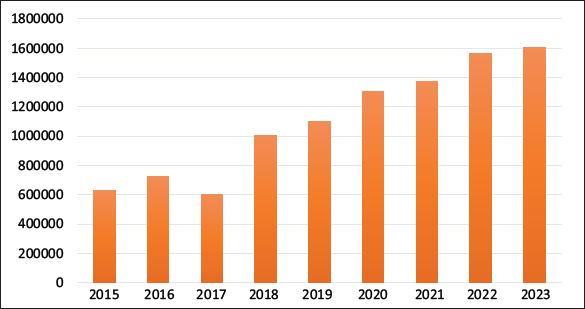
Researchers have relied on two numerical indicators to answer the above question: the annual fatwas content, which was measured by Dar al-Ifta from 2015 to 2023. The number of followers and interactors on social media platforms is also an indicator. For the first indicator, as Dar al-Ifta is the entity responsible for issuing official fatwas in Egypt for the inquirers; the increase or decrease in the number of these fatwas will indicate the extent of the Egyptian society’s reliance on and satisfaction with Dar al-Ifta and its scholars. Considering the official statistics provided by Dar al-Ifta over nine years, we find that the annual fatwa counts from 2015 to 2023 are 630,000 (Najm, 2015), 720,000 (2016), 600,000 (2017), 1,000,000 (2018), 1,100,000 (2019), 1,300,000 (2020), 1,368,000 (2021), 1,563,250 (2022), and 1,600,000 (2023) (The official Facebook page of the Egyptian Dar al-Ifta Media Center, 2016, 2017a, 2018a, 2019c, 2020c, 2021o, 2022, 2023), as illustrated in Figure 2. This illustrates an increase in the annual fatwas count over the study period, indicating a growing reliance of Egyptian society on Dar al-Ifta for fatwas, reflecting its increasing impact on society.
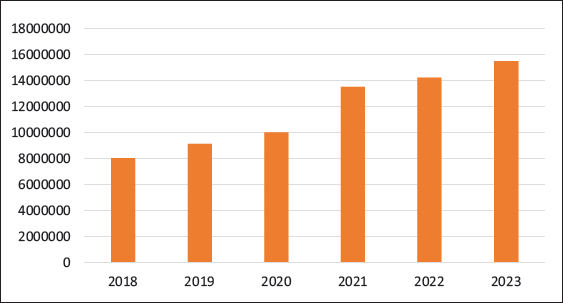
For the second indicator, the number of followers and interactors on social media platforms, whether in agreement or disagreement, indicates the level of interest of the Egyptian and Arabic-speaking Islamic audience in Dar al-Ifta and the discussion of its opinions. Considering the official statistics provided by Dar al-Ifta over six years, we find that the numbers of annual social media followers from are 8,000,000 (2018), 9,103,000 (2019), 10,000,000 (2020), 13,500,000 (2021), 14,223,000 (2022), and 15,500,000 (2023) (the official Facebook pages of the Egyptian Dar al-Ifta Media Center, 2018a, 2019c, 2020c, 2021o, 2022b, and 2023a, respectively), as illustrated in Figure 3. This indicates an increase in the annual number of social media followers over the period, indicating a growing interest in Dar al-Ifta and the discussion of its opinions, reflecting its increasing impact on society.
However, despite the significant increase in annual number of fatwas, which reached 1.6 million fatwas in 2023 compared to previous years, approximately 1.5% of the Egyptian population, which reached approximately 106 million in February 2024 (Adel, 2024), still needs to grow. Additionally, the number of followers of the institution on Arabic-language-based social media platforms in Egypt and the Islamic world reached approximately 15.5 million followers, almost all from Egypt, as indicated by the language of interactions on the page, representing approximately 14.5% of Egypt’s population and approximately 0.3% of the Arab world’s population, which reached approximately 473 million in 2023 (The Higher Population Council, 2023). In conclusion, this statistic suggests a growing influence of Dar al-Ifta on the public in Egyptian society, albeit still weak and even weaker in the Arabic-speaking Muslim world outside of Egypt.
Conclusion
The article showed that the Egyptian Dar al-Ifta and the Grand Mufti played a clear political role in the securitization process held by the military after the 2013 military coup, utilizing religious authority to facilitate the coup’s success. In his time heading the institution, Allam added to its activity, which was limited to issuing religious fatwas, a security and political dimension such as issuing strategic reports, attacking political movements, and monitoring the activities of groups framed by Dar al-Ifta as extremists or terrorists, especially the MB, using the religious soft power of Dar al-Ifta to influence the world of politics, in supporting the 2013 military coup and its leader inside and outside Egypt. Dar al-Ifta and the Grand Mufti worked on defaming the MB and its supporters, targeting its ideology, withdrawing their religious credentials, and considering them a group of the Kharijites, extremists, terrorists who hated Egyptian society and others to weaken the MB and stabilize the 2013 military coup. This study reveals the increasing influence of Dar al-Ifta on the public in Egyptian society, although the influence is still limited. While among elites and scholars, Dar al-Ifta has endeavored to enhance its influence outside Egypt, its impact on the Muslim public outside Egypt remains weak.
Footnotes
Declaration of Conflicting Interests
The authors declared no potential conflicts of interest with respect to the research, authorship, and/or publication of this article.
Funding
The authors received no financial support for the research, authorship, and/or publication of this article.
