




Abstract
Mughal statehood has been a much-debated problem in studies of pre-colonial Indian history. Discussing the character of this state as ‘patrimonial–bureaucratic’, ‘segmentary’, ‘feudal’, ‘centralised’ or ‘absolutist’, scholars have brought to light both valuable source materials and cogent arguments. However, their attention has been often focused primarily on economy, especially the agrarian system, administration, taxation, structure of elites and, more recently, culture. This article is an attempt to reflect on a hitherto less explored sphere, the territoriality of the Mughal state, especially studying the ruling elite’s perception of an association with the lands under its control.
Introduction
The character of the Mughal statehood has long ago emerged as a subject of active discussions. 1 The Orientalist concept of ‘Asiatic despotism’ has been rejected, as more of an ideological cliché than a reality. 2 Opinions vary on whether the Mughal state was feudal, centralised, absolutist, a ‘patrimonial–bureaucratic empire’ as suggested by S.P. Blake 3 or a ‘segmentary state’ in the formulation of Burton Stein. 4 Whatever the differences, the discussants primarily touch upon aspects like the character of state power, relations within elites, practice of land grants, administrative machine, taxation. At the same time, they view the Mughal rule as a subject in relation to only one object—population, giving much less attention to another, equally valid object—territory, where the population lived and state power operated. It is the territoriality of the Mughal empire that I will mainly dwell upon in this study. My purpose is neither to introduce new evidence nor to disprove the concepts by other scholars, but to revisit and reconsider both the texts and their analysis.
In the social context, modern humanities understand ‘territory’ as a delimitated space, which society, a group or individual marks, guards, controls, exploits, develops, acculturates, associates with—economically, politically and, last but not least, emotionally. According to Robert David Sack, territoriality is ‘a powerful geographic strategy to control people and things by controlling area’, ‘a primary geographical expression of social power. It is the means by which space and society are interrelated’. 5 Territoriality, it is argued, attaches social sense to physical space and, by the application of various methods by which society, marks delimitates and controls territory. 6
From this viewpoint, it is impossible to discuss territoriality without necessarily linking it to any affiliation, ethnic, cultural, and so on. A segment of space becomes a territory only when a group of people feel that it is their ‘own’ (different from an ‘alien’ one), or that they themselves belong to it. Such territorial belonging and identity has numerous aspects, like physical (‘I was born here’), political (state sovereignty), legal (‘it belongs to me/us by law or by the right of force’), ethical (the felt necessity to defend and acculturate the territory, patriotism), emotional (motherland, graves of the forefathers, historical memory, topophilia, 7 nostalgia), religious (holy places) and so on. George W. White discusses territoriality as ‘the protective attitude that humans exhibit towards spaces’ 8 and emphasises that ‘[p]rotecting a group’s territory and protecting a group’s identity go hand in hand and are inseparable’. 9 Of numerous kinds of territorial identity, I will elaborate on one only: political and legal, that is, the association of territory with the state and ruling elites.
Territoriality of pre-modern states and the means of controlling space claimed by them to them were radically different from modern (and contemporary) practices. This specificity has been comprehensively studied by specialists in European history, and their theoretical approaches are to a considerable extent applicable to Mughal India, though this of course, must yet involve a considerable amount of caution. Fortunately, the stereotype of India (along with other countries of the ‘East’) and Europe as being incomparable in world history is gradually vanishing from the academic field. 10 In this article, I will undertake a few attempts to compare India with various countries, thus hopefully making India’s peculiarity clearer and at the same time highlighting what still remains common to dissimilar societies.
Common for various medieval societies was the crucial role of land: not only because of the overwhelmingly agrarian character of the economy (despite a varying degree of urban development in different countries), but due to the fact that, whatever the forms of landed property, controlling or owning land was the major criterion of power and status. Notwithstanding all differences in religion, culture, and so on, what made European and Indian (as well as Arab, Iranian and Chinese) elites belonging to the same socio-historical category of feudal lords was that all of them owned and ‘held’ land but never worked on it physically. 11 Importantly, ‘land’ was not only a ‘means of production,’ but a certain territory, upon which an individual or a family could exercise authority—be it a farmer’s homestead, a lord’s manor or a king’s domain.
As emphasised by Benedict Anderson, unlike modern states, the sovereignty of which ‘is fully, flatly, and evenly operative over each square centimetre of a legally demarcated territory’, in pre-modern societies ‘states were defined by centres, borders were porous and indistinct, and sovereignties faded imperceptibly into one another’. 12 To add, the centre could move into another locality with the transfer of capital, or ascension of a new dynasty, which preferred to elevate its ancestral domain. The medieval monarch, who formally embodied a God-sanctioned absolute power over his lands, in reality, shared this sovereignty with a number of big and small rulers—his relatives, vassals, tributary chieftains, religious grantees, and so on. Each of the latter enjoyed independent political power and was a legal and authoritative ruler of ‘his’ part of state territory rather than the king, whose direct control was exercised only upon the ‘nucleus’ of the state, the royal domain.
A vivid example was the territory with a telling name Isle-de-France (the Island of France): it surrounded Paris and had been up to the fifteenth century the land to which the direct authority of the kind had been limited, a real island in the sea of vassals whose affiliation with the French crown had been in most cases formal. The scheme also operated for the king’s mightiest vassals, who exercised over their own vassals the sovereignty which the king exercised over them. It was due to this factor that the medieval epoch knew no distinction between ‘home’ and ‘foreign’ policies: for a monarch, like his vassals and tributaries, the lands under their respective control, were their ‘own’ and at the same time ‘foreign’. 13 The kings of England and France had been for centuries vassals and at the same times suzerains of each other, which more than once resulted in bloody wars between them.
Usually the frontiers of medieval states were geographical objects, like mountains and rivers; there were neither delimitated borders nor cartographical records of the territories and their limits. The ruler controlled the space he could protect from other claimants by force, which was why territorial configuration of a state would change endlessly: Brajadulal Chattopadhyaya had a good reason to denote early medieval states under his research as ‘fluid’. 14 To confirm his affiliation with and right to a certain territory, the king had to permanently demonstrate there his person, military might and splendour. This explained in the words of Michael Biggs, the ‘peripatetic’, character of state power: medieval rulers, according to him, observed the space under their control not on the map, but ‘from the saddle’, constantly touring their and their vassals’ lands to reconfirm and re-establish their authority over them. 15
‘Booty Economy’
Babur, the founder of the Mughal empire, had blood relation to Timur by his father’s side and to Chinggis Khan by his mother’s. He appeared in India as an heir and successor to Timur’s empire, which, in its turn, had been built after the model of the Chinggisid realm with full consideration of local specificities of Central Asia and adjacent areas. 16 The Mughal emperors glorified Timur as an ancestor and creator of the empire’ a model to be emulated in everything that concerned state structure, administration and policy. 17 It was but natural therefore that the empire founded by Babur initially imitated the imperial system of his celebrated predecessors. The territoriality of Timur’s (and Chinggis’) realm was based on conquest of vast lands; Maria E. Subtelny has denoted this organisation as ‘booty economy’. 18 The conquered lands were usually granted to outstanding generals and royal family members. Such was the policy of Chinggis Khan who divided his gigantic kingdom into uluses (appanages) and gave them to his sons to rule; the same was done by Timur and by Babur. The latter assigned the lands he had conquered in India to his beloved son and heir apparent Humayun; other sons got Kabul, Kandahar and the Punjab. 19
Such a division would usually take place in the lifetime of the conqueror who voluntarily ceded control over territories under which he had established his sovereignty. All those assignees acquired lands in full, unconditioned and hereditary possession. In the Timurid empire, Iran, other countries of Middle East, as well as in India, such lands were known as suyūrghāl. 20 Their owners, formally acknowledging the sovereignty of the supreme ruler, showed him obeisance, participated in his wars, but ruled their estates as independent monarchs. This facilitated a rather quick disintegration of such states after the death of the glorious founder, as happened with Chinggis Khan’s realm, Golden Horde and Timurid empire.
In the Mughal empire, the royal domain, so common for medieval states, was known as khāliṣa-i sharīfa. The rents and taxes from this domain went directly to the royal treasury. 21 The emperor exploited and developed the khāliṣa-i sharīfa land as his own, by collecting rents and taxes, building roads, bridges, irrigation systems, forts, royal residences, and so on, as well as donating lands to the holy places. According to the observation of Harbans Mukhia, the conquest of lands and their inclusion into the royal domain was viewed by the Mughal literature of the epoch as a ‘civilizing mission’ of sorts. 22 Contrary to European kingdoms, the Mughal imperial domain never constituted a clearly delimitated and fixed space, so that no Indian variety of Isle- de-France had been established. Apart from the area between the two capitals, Agra and Delhi, various lands in different epochs constituted the khāliṣa-i sharīfa. Unfortunately, neither a map nor written catalogue of the khāliṣa-i sharīfa lands has been hitherto known.
Nevertheless, it has been possible to calculate the proportion of the land rent from the khāliṣa-i sharīfa in the whole bulk of the imperial taxes: it fluctuated from 5% under Jahangir to 25% under Akbar and depended upon this or that emperor’s preference to expand the domain or to shorten it by granting out lands. 23 This may lead us to the conclusion that the Padshahs could directly control, own and dispose of much less than a half of the country’s territory. The status of the khāliṣa-i sharīfa as the royal domain signified, apart from other features, that it was from that territorial mass that the emperor made various land grants. Those grants were of different kinds: most were conditioned by military or administrative service to the state (jāgīr). This system (jāgīrdārī) has been a favourite topic for research by many Indian medievalists who have put it under high-level scrutiny and succeeded in analysing elite relations, juristic forms of property and ownership, taxation and rent, exploitation of peasants, but, unfortunately, not space and territory, despite the meaning of jāgīr as ‘owning space/place’.
The jāgīr, like its predecessor in the Delhi Sultanate, the iqׅṭā‘, was based on the assignment of a right to collect, (in return for military and administrative service to the emperor), taxes and rents from a certain territory, delimitated and recorded in a special document. The system of ranks (manṣab) regulating the status of the jāgīrdārs and the number of foot and mounted soldiers they were obliged to maintain has been subjected to much research; and further elaboration on this theme will take my study far away from its topic. Of importance, however, is the fact that the state therefore ceded a part of its sovereignty over a certain territory to its servants, assigning to a jāgīrdār one of crucial rights of a landowner—the right to collect rents and taxes, to maintain tax collectors and employ troops.
The Mughal state spared no efforts to ensure that the jāgīrdārs did not view their jāgīrs as their own ancestral land and property. Sometimes the jāgīr of a certain officer could be transferred from one geographical location to another. 24 Nevertheless, in the seventeenth and especially eighteenth century, more and more jāgīrs would become hereditary. Some types of land grants like the in’am (literally ‘gift’) and mulk/suyurghāl or madad-i ma’āsh (literary ‘maintenance assistance’), were conditioned neither by state service nor by paying taxes to the treasury. The peculiar features of each type have been comprehensively researched upon, 25 and, for my topic, I will highlight one aspect only: in all of them, the state ceded to its subjects, on certain conditions, some of its rights to control, defend, develop and, most importantly, exploit a certain territory—collecting taxes and dues, and building necessary facilities.
Considerable rights to control and exploit a territory were enjoyed by the zāmīndārs. In Mughal India, this term signified either petty landowners, primarily from the elite of rural communities, or, what is more important for my theme, Hindu rajas and chieftains who had acknowledged Mughal sovereignty and, as vassals, participated in the wars and paid annual tribute (peshkash). 26 Paying obeisance to the Padishah and contributing peshkash resulted in the acknowledgement of the rāja by the Mughal state as a legal ruler of his ancestral lands. The latter act was recorded in a special document known as sanad. 27 As they became the Mughal’s vassals, the rajas joined imperial service and/or sent their sons and brothers to the same, getting their ancestral lands back as jāgīrs; for such lands, the Mughal administrative practice had a special term—waṭan that is ‘motherland’. 28
Within the Mughal Empire, there existed whole enclaves of semi-independent tributary territories—primarily Rajput principalities (Rajputana, a part of Gujarat, the areas adjacent to the Himalayas in the North and Northeast, Malwa, Bundelkhand and some regions in the East). Among the tributary chieftains, there were non-Rajputs as well, like the Afghans, Gonds, and many more. 29 Some principalities were rather small in size, others considerably larger; their hereditary rulers bore the titles like Raja, Rana, Rawal, Thakur. They contributed peshkash to the Mughal treasury (hence the special term peshkashī zamīndār) 30 and enjoyed every kind of control over their territories, including taxation and judicial power. 31 Those vassal princes acculturated and developed the lands under their control, protected them from claimants like neighbours or rival kinsmen (in case of rivalry within a princely family, the Mughal power acted as an arbiter, protected ‘law and order’ and supported a more suitable claimant, wisely providing something for his rivals as well). The princely states and even smaller feudatories, being vassals of the empire, possessed all possible attributes of statehood and territoriality, except two: they could not enter alliances with states outside and inside the empire and mint their own coin. In the local historical traditions, such princes were glorified as ‘kings’, the Mughal emperors were sometimes mentioned as the ‘king’s’ overlords or not mentioned at all. 32
In this paragraph, I intended to make clear that the Mughal emperor, an almighty ‘Oriental despot’ and autocratic ruler of the greater part of South Asia, had under his direct control just a relatively small part of the territories associated with his name and dynasty. This was noticed by some European travellers as well: Francois Bernier, for example, wrote that ‘[t]he empire of the Great Mogol 33 comprehends several nations, 34 over which he is not absolute master. Most of them still retain their own particular chiefs or sovereigns, who obey the Mogol and pay him tribute only by compulsion’. 35 The Mughal emperor had the official title of Shahanshāh (literary, Shah of shahs), and really, in Chris A. Bayly’s witty formula, ‘the Mughal emperor was Shahanshah, “king of kings” rather than king of India’. 36
Such a system was a characteristic feature of many medieval empires, built as a result of vast territorial conquests. For example, Russia had lived more than two hundred years under the domination of first the empire built by Chinggis Khan and then of the Golden Horde. Like their Indian counterparts, the Russian princes were forced to pay tribute to the conquerors and to join their armies. They received from the Khans a special document (yarliq, a counterpart of the Mughal sanad) acknowledging their right to rule their principalities, where they enjoyed full sovereignty. 37
Centralisation in a Process
In their territorial and political evolution, pre-modern states passed through several stages in a trajectory where Victor Liebermann has justly discerned a certain ‘rhythm’, common for such countries as France, Russia, Japan, South Asian and Southeast Asian kingdoms, which, in the course of their respective histories, vacillated between phases of growing integration, maximum integration and fragmentation. 38 Their history began with small principalities or chiefships based on a tribe or a few tribes. Then a successful conqueror would unite them into early medieval empires that spread over a number of geographical regions (the realm of Charlemagne, Kievan Rus, the Holy Roman Empire, etc.) or even across the continents (Arab Caliphate, Byzantium, the empires of Chinggis Khan and Tamerlane, etc.). In all of them the supreme ruler was ‘king of kings’, presiding over a host of vassals, tributary rulers, and other lords. After some time, early medieval empires disintegrated due to internal feuds, as well as the death of the charismatic and redoubtable emperor, followed by his successors’ fight for power. In many cases, the state, already weakened by internal discord, became an easy prey of a conqueror—the development of medieval states had never been fully synchronous, so that one empire collapsed while a new empire, and a new conqueror, emerged in its neighbourhood.
Thus, a new stage would begin—of discord, anarchy, feuds between local potentates. At the same time, it was a period when economies, cities, markets, local cultures, languages, ethnicities developed rapidly, which was initially possible within a rather small territory only. Gradually the time came, when one of the autonomous rulers would take upon himself the mission, for which in Russian historical tradition there has existed an established term ‘accumulation of lands’. Motivated by various purposes, like liberation from foreign domination, resistance to the threats from outside, removal of the barriers for economic growth and trade, political stability, ethnic consolidation, and, last but not least, personal ambitions, he succeeded in uniting the disintegrated territories into a new centralised state. His domain became the core of the new state, the language or dialect of his territory emerged as a state literary language.
This state was a successor of, and at the same time significantly different from, the earlier empires, looking like a compromise between the ‘old’ and the ‘new’ orders. Although the feudal lords retained their rights and privileges, the central power now aspired not to preside over independent and semi-independent rulers, but to exercise maximum possible sovereignty over all territories within the state borders. It was from that moment that delimitation and fixation (verbal and cartographic) of the latter began. According to Biggs, the monarchs at that stage, along with the educated elite, desired to view any time on a map the territory they now felt as fully and entirely their own—too big to observe it ‘from the saddle’. 39 The state got a new territorial–administrative structure, divided into provinces and counties that, importantly, did not by their spatial configuration coincide with the principalities and fiefs of the preceding epoch. The scions of the previous appanage rulers could become provincial governors, but they were appointed by the central government and were answerable to it. They now controlled the territory on its behalf, gradually losing their association with ancestral lands and experiencing themselves as the elite of a new centralised nation state.
In the early seventeenth century (1605–13, some historians suggest 1598–1618), Russia experienced a great turmoil known as ‘Time of Troubles’, when, after the extinction of the Rurikid dynasty, the country fell into total disorder, preyed upon by Polish and Swedish invaders, along with local warlords. 40 Amidst chaos and civil war, many of the Russian landed aristocrats, the scions of the independent rulers, struggled for power, allying with any Russian or foreign potentate. However, none of them ever thought of restoring their ancestral principalities and becoming independent sovereigns, for which every facility was available. This was in contrast with their Indian counterparts, Hindu or Muslim, who never lost an opportunity to use imperial crises for carving out independent principalities for themselves. In a pre-modern state, the aristocracy might become ‘nationalist’ and more loyal to the country than to their ancestral appanages, only after living for a considerable time in the centralised state and forming allegiance to it.
The final phase of the evolution of medieval states led to absolutism that was the boundary in the timeline between pre-modern and modern statehoods. This was, of course, a general scheme, which in concrete historical circumstances had a multitude of variations. For some countries, the period of decentralisation was very short (e.g., Britain), for others, it lasted up to second half of the nineteenth century (e.g., Germany and Italy). The centralisation process itself had never been easy and direct. The legacy of the earlier system could be traceable centuries after the centralisation. Thus, in France, old regionalism and feudal separatism resurrected several times: during the Wars of Religion (1562–98), the Fronde Rebellion (1648–1653) and even the Great French Revolution (1789–99).
At its initial stage, the Mughal statehood was hardly different from the Delhi sultanate, as well as other early medieval polities ruled by the ‘king of kings’, a shāhanshāh, a sulṭān us-salāṭin, or a mahārājādhirāja. However, as a ‘result of the reforms by emperor Akbar (reigned 1556–1605) it got a chance to transform itself into an early modern centralised state (to note, I am writing of a ‘chance’ only, to be discussed below). Akbar, according to the works by his biographer, minister, ideologue and admirer, Abū’l Faz.l, could not be satisfied with the role of ‘Shah of Shahs’. 41 Both the minister and his suzerain projected a state ruled by a virtuous monarch, who received the ‘divine light’ (farr-i īzidī) directly from God 42 and shared his power with no one else.
Abū’l Faz.l’s Ā’īn-i Akbarī is distinguished by the author’s special attention to everything relevant to territory of the empire. The text contains a brief but precise description of the ‘boundaries of Hindustan’, which is ‘enclosed on the east, west and south by the ocean’ and to the north there is ‘ a lofty range of mountains, part of which stretches along the uppermost limits of Hindustan, and its other extremity passes into Turkestan and Persia.’ Between this chain and the borders of ‘Chin and Machin’ there was a region inhabited by ‘various races, such as Kashmir, Great and Little Tibet, Kishtwar and others. 43 Like other medieval states, the Mughal empire initially had no fixed borders; therefore, Abū’l Faz.l either mentioned the latter as geographical objects (ocean and mountain ranges) or listed the closest neighbours of his emperor.
Nevertheless, in the sixteenth century, the construction of frontier forts began, primarily on the northwestern boundaries of the empire. First was the fort of Rohtas, founded by Sher Shah Suri on a high hill overlooking the ancient tract between Bengal and Kabul, and then Grand Trunk Road. Then Akbar built in the strategically important places of the north-western border a chain of forts, the most important of them being the fort of Attock. On the extreme north-west of the empire, the major outpost was Kandahar (up to the mid-seventeenth century, when the Mughals finally lost it to the Safavids of Iran).
Apart from the mighty forts, on the north-west border of the empire a few outposts, known as thānās were established. Their commandants usually held the adjacent territories as jāgīrs and had to use their troops against the raids of militant tribes and rebels. 44 When Bihar and Bengal became parts of the empire, frontier outposts appeared on the borders with Ahom kingdom and Burma; usually they were the fortified castles of local feudal lords who had acknowledged Mughal sovereignty. 45
Initially, Akbar had his empire divided into twelve provinces (ṣūba): Awadh, Agra, Ajmer, Allahabad, Ahmadabad, Bihar, Bengal, Delhi, Kabul, Lahore, Multan and Malwa. Akbar’s conquests in the south added three more: Berar, Khandesh and Ahmadnagar. Abū’l Faẓl described each of them according to his standard scheme. It began with the boundaries and duration of each territory: thus, the province of Awadh:
[i]ts length from the Sarkār of Gorakhpur to Kanauj is 135 kos. Its breadth from the northern mountains to Sidhpur on the frontier of the Subah of Allahabad is 115 kos. To the east is Bihar; to the north, the mountains; to the south, Manikpur, and to the west, Kanauj.
46
Then came the description of each province’s climate, mountains, rivers, and other natural objects, agriculture, industries, and goods that made the territory famous, cities and remarkable places. This was followed by the statistical data given of all the sarkārs of the province: the author mentioned the number of the sarkārs, the area of agricultural lands in each, the lump sum of taxes realisable from the territory, the castes of zamīndār and the number of retainers (horse and foot) maintained by the zamīndārs (or būmī); the author gave similar statistics of each maḥall, including the castes to which local zamīndārs belonged. For most of the provinces (Awadh was an exception, for unknown reasons), the author provided a brief outline of local history, starting from the kings mentioned in the Hindu epics, sometimes with chronological tables of the past ruling dynasties.
The description of the Mughal provinces by Abū’l Faẓl constitutes a geographical, statistical, administrative, and historical account of the whole empire and its constituent parts. There is a paucity of information on the cartography of this epoch: the only known cartographer was Sadiq Isfahani, who in 1647 authored the atlas of 33 maps of the world. 47 Therefore Abū’l Faẓl’s catalogue, with its detailed description of the provinces, can be perceived as a verbal map. Such verbal descriptions, as highlighted by Biggs, were known in Europe too and served as substitutes for cartography. 48
Under conditions when maps were either not available at all or not in frequent use, boundaries of territories were usually marked by natural objects 49 or habitations like towns and villages—it was easier to mention them in ‘verbal maps’, that is, textual descriptions. The detailed geographical and statistical account of the Mughal empire, as undertaken by Abū’l Faẓl, constructed and highlighted the possession of all the regions described under one monarch, while the excurses into history underlined the continuity of the imperial power vis-à-vis its Hindu and Muslim predecessors. The ‘catalogue’ in the Ā’īn seems to have initiated a tradition: there appeared a number of similar ‘verbal maps’ both at the imperial and regional levels. 50
The head of the provincial administration under the Mughals was the governor (ṣūbadār), also denoted as sipāhsalār (literally, military commander 51 ) or nāẓim (literally, ruler). He was responsible for governance, defence, law and order, suppression of rebellions, and so on—everything except taxes and finances, which were the duty of the provincial dīwān. The latter was formally independent from the ṣūbadār, owing his appointment to the emperor. However, the ṣūbadār exercised authority under the treasurer (mīr bakhshī), provincial judge (qāẓī), heads of the police in the cities and towns (kotwāl), the officer in charge of religious endowments (ṣadr) and the recorder or news-writer (wā‘qianavīs). 52 A separate administrative apparatus existed on the level of a sarkār, headed by a faujdār (literally, military commandant), as well as on the level of a maḥall, presided over by a shīqqdār (literally, owner of a half). Each of them presided over a staff of writers, accountants and other office bearers, salaried by the state.
In the Ā’īn, the functions of these officials are described in detail; however, Abū’l Faẓl was more interested in the moral behaviour of those officers than in the mechanisms of their control over the territories under their jurisdiction. Importantly, nevertheless, Abū’l Faẓl began his description of a ṣūbadār’s duties with the statement that ‘He is the deputy (jānashīn) of His Majesty’. 53 The ṣūbadār, like other officials, had to govern, guard and acculturate the territories on behalf of the emperor, but never impeach the royal suzerainty over the area in question. This was a major concern of the Mughal rulers. In 1611, emperor Jahangir issued a special order to the ‘border Amirs’ (umarā-i sarḥadd) to stop the practice of doing things that were the exclusive privilege of the emperor (khāṣṣa-i bādshāhān). 54 Among those kingly ‘things,’ the order mentioned sitting in the jharoka, 55 receiving salutations from the subordinate officers, watching elephant fights, inflicting severe punishments, conferring titles on subordinates and forcing them to perform kornish (the prostration due to royal audiences), putting a seal on their letters or having music played or drums beaten in their assemblies. 56
Most importantly, territorial configuration of the Mughal provinces did not coincide with big principalities and appanages. This makes the Mughal realm similar to other centralised states mentioned above—this comparison has been made by Lieberman as well. 57 In Abū’l Faẓl’s treatise, the principalities turned into provinces were described by the author as regions and counties, fully controlled by the governor. Of especial interest here is the ṣūba of Ajmer, which, according to the author, consisted of only two sarkārs, Nagor and Ajmer, that were under the direct control of the central government. 58 The remaining part of the territory comprised Mewar, Marwar and Hadauti. 59 While the latter two were geographical regions that included a few princely states each, Mewar was a sovereign principality that could not be fully subjugated in Akbar’s time. Nevertheless, in the Ā’īn, the ṣūba of Ajmer appears as a territory under complete control of the imperial centre. This is explainable by the very character of the text, being not only a record of the real state of affairs, but a project. In the centralised state, there could be no territories out of the central control. In reality, however, the situation was more complicated.
On the one hand, independent principalities were a considerable menace to the centralisation plans, and Akbar, especially in the initial period of his reign, spared no efforts to conquer them, sometimes by military force, sometimes by diplomacy. 60 On the other, the pivotal construction of the new empire was the union between the two military–aristocratic elites, the Mughals and the Rajputs, fastened and secured by continuous marriage alliances between the Mughal imperial family and the Rajput clans. Akbar offered the Rajputs an honourable and profitable role of vassals-cum-relatives, which was agreeable to their own tradition of the bride’s clan becoming vassals of the groom’s. This strategy along with Akbar’s religious policies (too well researched upon to go into detail here) succeeded in transforming the Rajputs from troublemakers and enemies of all Muslim rulers to the faithful servants and ‘pillars’ of the Mughal throne. 61
As mentioned above, within the Mughal empire, the principalities existed as independent states. The Mughal control was exercised in the following spheres: the princely states had to contribute the peshkāsh (many were exempted from it); the princes, their brothers and sons joined imperial service and participated in the wars. In case of the emperor’s visit to a princely state or its neighbourhood, its ruler had to attend upon the crowned guest and personally exhibit obedience and allegiance to him. To break this rule was, for a prince, equal to rebellion against the emperor, and the result could be a punitive expedition of the imperial army, as happened in 1567, when Udai Singh, the Rana of Mewar, did not come to greet Akbar who had been in the adjacent territories on a hunting expedition. The bloody siege of the Mewar capital, Chittor, and the destruction of the latter by the Mughal army followed. 62
The governors of the provinces in which the princely states were included, did not exercise any control over the rajas and could not interfere in the internal affairs of the states, unless requested by their rulers. At the same time, they had to establish outposts on the borders of the princely states and keep a close watch upon the affairs there. 63 For the Mughal rulers, the vassal princely states were neither fully ‘their own’ nor fully ‘alien’—in her study of the princely states of the Northeast, Sangamitra Misra denoted this situation as ‘overlapping territorialities and shared sovereignties’. 64 Such ‘overlapping,’ when the sovereignty of the central power augmented the sovereignty of the local feudal lords, was for quite some time common for many centralised states at early stages of their history. 65
At the same time, the Mughal rulers were quite successful in employing the strategy worked out in Akbar’s time and integrating the Rajput princes into imperial politics. Acknowledging Mughal suzerainty, the princes, along with their brothers, sons and other relatives, joined imperial service and, on equal terms with the Muslim aristocrats, were assigned jāgīrs, in many cases quite far from their ancestral domains. Moreover, Akbar and his successors appointed Rajput rajas as commanders of armies and governors of various provinces. A telling example is the illustrious career of Man Singh Kachwaha of Amber. In his youth, he served under his father, who had been appointed governor of the Punjab. Then, in 1585, he was sent to Kabul where he suppressed a rebellion, to become afterwards the governor of the province. In 1589, Akbar transferred Man Singh to Bihar. After that, he conquered Bengal and Orissa for the empire. In 1600, Man Singh participated in the Deccan war and then returned to Bengal, which he governed up to 1608; only after that, he went back to his homeland, Amber, but was to serve later in the Deccan. 66
Man Singh in 1573 got as a jāgīr the Khichwada maḥall in Malwa, 67 as well as a spacious jāgīr near Agra, later on the site of the famous Taj Mahal. To be sure, such a career was exceptional and hardly open to all Rajput princes. Nevertheless, many of them served the empire with loyalty and success, spending most of their time outside their ancestral principalities. Thus, when Suraj Singh Rathore of Jodhpur was advised by emperor Jahangir to attend to the affairs of his principality, the Raja answered that he knew nothing of those affairs, as he had spent all his life in imperial service and left the governance of Jodhpur to his minister. 68
Therefore, the policy employed by Akbar and his successors vis-à-vis the vassal princes was flexible and complementary to the process of centralisation: on one hand, they acknowledged the rajas’ sovereign power over their respective principalities and, on the other hand, they integrated the Rajput elite into the imperial fold. As a result, many Rajput aristocrats developed a habit to associate themselves not only with their ancestral domains, but also with the empire and the emperors. Rajput rajas proved loyal to the empire, fighting under Mughal banners against, importantly, those Hindu rulers who were hostile to the Mughal state. Contrary to the modern Hindu nationalist discourse, the contemporaries did not view this as treason: imperial loyalty, in many cases strengthened by kinship affiliation, was stronger than any communal one. 69
It needs a special mention that in Akbar’s time the biggest and mightiest princely states were by and large situated along the imperial borders, as if encircling the imperial territory on which Akbar carried on his reforms aimed at converting the ‘booty economy’ to centralised state. Of especial importance was Akbar’s attempt to take the major part of the imperial territory into the khāliṣa (imperial domain) and to reward the state servants with money salary, not lands. The latter attempt failed, 70 but the very idea characterises well the mind-set of Akbar and his associates: to make the ‘Shah of the shahs’ a sovereign ruler of a centralised empire, surrounded along its outer perimeter by princely states, whose rulers would be loyal to and integrated into the Mughal elite. 71
Opinions vary on to what extent the Mughal centralisation project was realised. Some scholars view it as almost accomplished. In their opinion, the empire was a highly centralised and even bureaucratised state; 72 taking a cue from Jawaharlal Nehru’s perception of Akbar as ‘the father of Indian nationalism’ 73 they ascribed to that outstanding ruler the vision of a united India from the Himalayas to Kanyakumari. 74 This concept is being challenged by scholars, who, like Farhat Hasan in his seminal work on the Mughal Gujarat, discuss the Mughal state as ‘one among so many other loci of political power, with whom it simultaneously shared authority and contended for dominance’. 75 Sanjay Subrahmanyam titled one of his essays ‘The Mughal State—Structure or Process?’. Polemicising against those historians who had viewed the Mughal empire as an accomplished centralised, or even absolutist, state, he suggested that by the death of Akbar, the Mughal empire was not a ‘finished product’, but ‘a state that was still evolving, and struggling to come to grips with a variety of local and regional institutional regimes’. 76 To my mind, such an estimation is quite plausible, but the question arises, whether this process had a chance to bring positive results.
By the death of Akbar (1605), the territorial core of the empire comprised the regions, unified, despite all differences, by similarities and complementarity of economy, trade connections, culture and language (most of them either belonged to what is now known as the ‘Hindi belt’ or to the territories where different forms of late medieval ‘Hindavi’ or ‘Hindustani’ were used or, at least, understood widely). Of no less importance was the local Hindu aristocracy claiming, deservedly or not, a Rajput status. Continuation and deepening of the centralisation process, development of economic and cultural links between the regions, preservation of Mughal—Rajput alliance as the primary factor of integration and Akbar’s religious policy, could have, under favourable circumstances, the result of the ‘Shah of the shahs’ becoming Shah of India (on this particular territory, that is, within the borders of Akbar’s empire). Nevertheless, real events took another course.
Stretches and Ruptures
By 1695, according to Sujān Rāi Bhandārī’s Khulāṣāt ut-tawārīkh, the Mughal empire in the north comprised eighteen provinces: Agra, Ajmer, Allahabad, Awadh, Aurangabad, Bengal, Berar, Bihar, Gujarat, Delhi, Kabul, Kashmir, Khandesh, Malwa, Multan, Punjab, Orissa and Thatta. After the completion of Aurangzeb’s conquests in the South, three more were added: Bijapur, Bidar and Hyderabad. 77 Geographical configurations of administrative units underwent many changes: certain territories were transferred from one province to another, as necessitated by the requirements of effective governance and relations with and/or within local elites. Thus, Kashmir, finally brought to the imperial fold in 1586, initially was a part of the Kabul ṣūba and subsequently became a separate province. Out of the territory of Lahore and Multan provinces, three ṣūbas emerged, namely, Multan proper, Thatta (Sind), and Punjab. Within the provinces too, administrative structure changed. In some provinces, the number of sarkārs and maḥalls increased, in others, these diminished. While by 1594, there were 123 sarkārs and 3117 maḥalls, by 1695, due to conquests and administrative reshuffles, their number had risen to 157 and 4051, respectively. 78 Actively changing the administrative map of the empire, the Mughals adjusted it to the necessities of centralisation, demonstrating their right to control and acculturate territory.
The Mughal empire was a creation of conquest, and throughout its history, it continued to expand geographically, first to the west (Rajputana, Gujarat) and north (Kashmir, other Himalayan areas), then to the east (Bihar, Bengal, Orissa, part of Assam) and, with special vigour under Shah Jahan and Aurangzeb, to the south (up to the Kaveri and Krishna rivers). This process was long and sinuous; some territories were being lost, others more than once.
What made the Mughal emperors so feverishly active in territorial conquests—greed for new lands and booty, as well as for military glory? Both factors were present, but the main reason was the territoriality of the Mughals, when the Padishah was able to control lands only by assigning to nobles a considerable part of them. This was the only possible way to secure the loyalty of the elites, which belonged to various estates, ethnic and communal groups. In a majority of cases, connected with the Mughal dynasty by neither kinship nor territorial affiliation, they were ready to serve the emperors mainly for securing landed estates for themselves. As a result of incessant land assignments (jāgīrs), the royal domain dwindled, the imperial treasury gradually emptied out.
The aspiration to increase the royal domain was perhaps the main reason for conquests. Akbar achieved the highest level of the westbound expansion, making the Arabian Sea the western border of the empire. Under Jahangir and Shah Jahan, the maximum scale of eastbound expansion was achieved. After the loss of Kandahar, the only possible direction for the further expansion of the empire was southbound. This became the primary task for Shah Jahan and especially for Aurangzeb. The latter, as a prince, had been twice (1636–44 and 1652–57) the viceroy of the Deccan. After his coronation, he spent there a large part of his 49 years’ long reign, conquering Bijapur and Golkonda, and desperately trying to suppress Maratha resistance. However, the attempts to expand the royal domain brought only temporary success, as the conquered territories had to be granted out, both to the imperial servants and to the elites of the areas in question, to secure their loyalty to the conqueror.
Under Aurangzeb, the Mughal empire reached its territorial zenith: by the early eighteenth century, it comprised a space of 3.2 million km 2 with a population estimated between 100 and 150 million. 79 By the end of Aurangzeb’s reign, the distance between the empire’s northern and southern frontiers (conventional as they were) comprised around 2826 km, a huge one for the transportation and communication capacities of that epoch. After Aurangzeb, the disintegration of the empire began, including not just princely states (some of them remained loyal to Mughals to the end), but the core of the imperial territory. Thirty-two years after Aurangzeb the Mughals controlled only the Doab, and even that not fully. Territorial growth and disintegration of the empire can be visualised in the following chart. 80
Approximate Distance (km) from Northern to Southern Borders of the Mughal Empire.
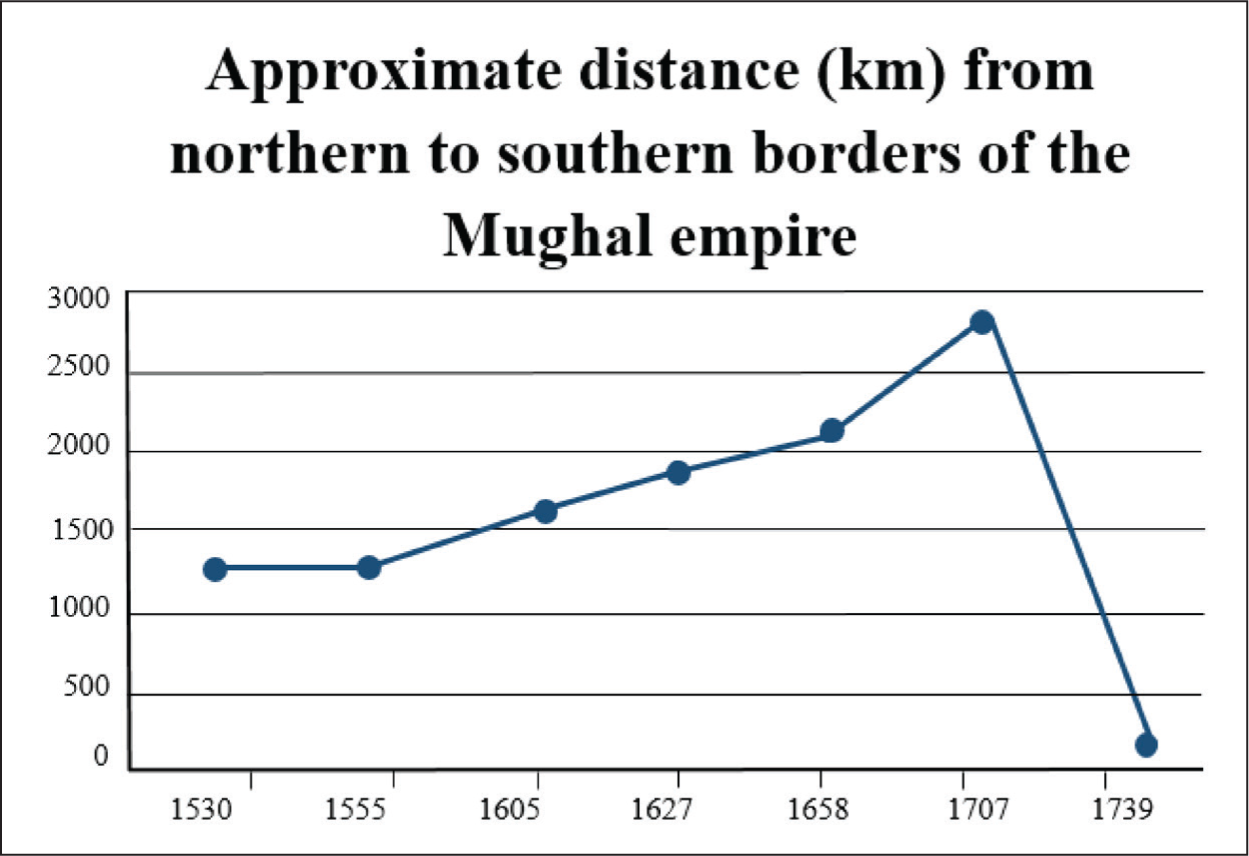
Aurangzeb’s conquests in the south led to what can be imagined as the stretching and even over-stretching of the territorial ‘fabric’ of the empire, which inevitably resulted in ruptures. It was impossible for the Mughals to govern over such a mass of lands and peoples: while Aurangzeb, after moving to the Deccan along with almost his entire army and administration, conquered the southern sultanates and suppressed the Marathas (for some time), the Sikhs and the Afghans rebelled in the North and Northwest, and the Rajputs in Marwar and Mewar. Even the territory between the two capitals, Agra and Delhi, was gripped by the uprising of the Jats who succeeded in carving independent principalities for their leaders. Trying to expand the empire to the south, the Mughals began to lose territories in the north and in the west.
As mentioned above, the Mughal empire under Akbar with it southern border being in Asir (North Maharashtra) evolved towards a centralised state, but it was only a process, far from completion. Hectic onslaught to the south invalidated this process and pushed the state back to the ‘booty economy’ of early medieval empires. While the centralisation of the state and integration of elites in a territory that belonged, geographically and culturally, to the Indian North, 81 had been still incomplete, the Mughals rushed to the densely populated Deccan where they had to deal with not just hostile, but culturally alien elites, both Hindu and Muslim. 82 I may suggest that if Mughal conquest of the Deccan could have started after the formation of the centralised state in its northern core, then the new territories could have been added to a stable and solid nucleus. This, under favourable conditions, could facilitate the survival and development of the empire, as it happened, for example, in Russia.
However, ‘historical destiny’ had it otherwise. The land assignment (jāgīr) system and fiefdom pushed the Mughal state into a territorial ‘trap’: the wider the ‘fabric’ of the state, still not strong enough to fully control a much lesser space, was stretched, the more ‘ruptures’ appeared, even in its core areas, to finally destroy the whole structure. This corresponded with the failure in the process of elite integration: while the Rajput principalities, perhaps except Mewar, proved loyal to the Mughal realm almost to the end, the empire had no historical time to integrate the Deccan elites, Hindu as well as Muslim. As the Mughal empire began to disintegrate, there were doubtless thinkers and public figures advocating the restoration of the Mughal state and suppressing separatism, but no loyalist party or movement stood up for protection of the Mughal throne. Even during the First War of Independence, or the Mutiny (1857–59), the main events took place approximately in the same Mughal territory of Akbar’s time. The appeal to restore the ‘Badshahi’, that is, the Mughal empire, as expressed in the ‘Azamgarh proclamation’ (September 1857) 83 was supported by neither the Marathas (even operating in the North, Nana Sahib ascertained himself as the Peshwa 84 ) nor the people of other regions, where the revolts did take place. Hardly anyone was ready to fight for the resurrection of the empire that had had no time to establish itself as a unified and common territory in the minds and loyalties of the population.
Revisiting the integration and disintegration of the Mughal empire from the viewpoint of its territoriality, I did not intend to offer an alternative to the arguments presented by other scholars for the incapability of that mighty state to survive. On the contrary, this approach accommodates many of the previously suggested explanations, like the agrarian crisis so comprehensively studied by Irfan Habib 85 or ‘the breakdown of the Mughal administrative system’ highlighted by Satish Chandra, 86 or the increasing role of gunpowder warfare as means of territorial control analysed by Iqtidar Alam Khan. 87 Even the anti-Mughal movements in Maharashtra, Bundelkhand, the Punjab, Doab, and many others, denoted by Jadunath Sarkar as ‘Hindu reaction’ against the hostile policies of Aurangzeb, 88 were in reality about territorial control and affiliation, as many Muslims of the regions in question resisted the Mughal invasions along with the local Hindus. I do not insist on the other aspects being irrelevant for the understanding of the Mughal empire, its consolidation and decline. Nevertheless, the concept of territoriality that presupposes an interdisciplinary view on the territory as a focus of the society’s economic, political, cultural, and emotional activities, allows one to shed a fresher light upon the long-discussed problems, that had been of utmost importance not only to the Mughal state, but also to the subsequent regimes as well.
Footnotes
Acknowledgements
The author would like to thank Harbans Mukhia, Irina Glushkova, Anna Bochkovskaya and the reviewers for their valuable comments and suggestions.