




Abstract
The purpose of this article is to investigate the role of the Mongol Il-khanate in the spread of Buddhism in Iran. The centre of this government was located in the north-western region of Iran, and traces of the Mongol Il-khanate have remained in this region. The article traces Buddhist cave temples in the north-western region of Iran, viz., Maragheh and Zanjan. It offers reports on the sites of Imamzadeh Ma‘sum, Pirhashem, Kohul Machid and Qirkh Kohul in Maragheh and Dashkasan Temple in Zanjan. Then, references to Buddhism in the historical sources of the Il-khanate period, have been traced. Buddhist cave-cut structures were abandoned or altered for other use, after the acceptance of Islam by the Il-khanate rulers, beginning with Ghazan Khan.
Introduction
The Mongols conquered Iran under Genghis Khan in the thirteenth century. In 1256
North-western Region of Iran During the Mongol Il-khanate Period
In the north-western region of Iran, now known as Azerbaijan, a number of cities such as Maragheh, Soltanieh and Ghazaniyya in the region of Tabriz
6
were considered important centres of Il-khanate rule in the thirteenth century
Buddhist Rock Temples in North-western Iran
Due to its mountainous nature, the north-western region of Iran is a suitable area for rock architecture (Figure 1). For the first time in this region, rock architecture began in the first millennium
North-western Iran: Buddhist Temple Remains.

Imamzadeh Ma‘sum Temple
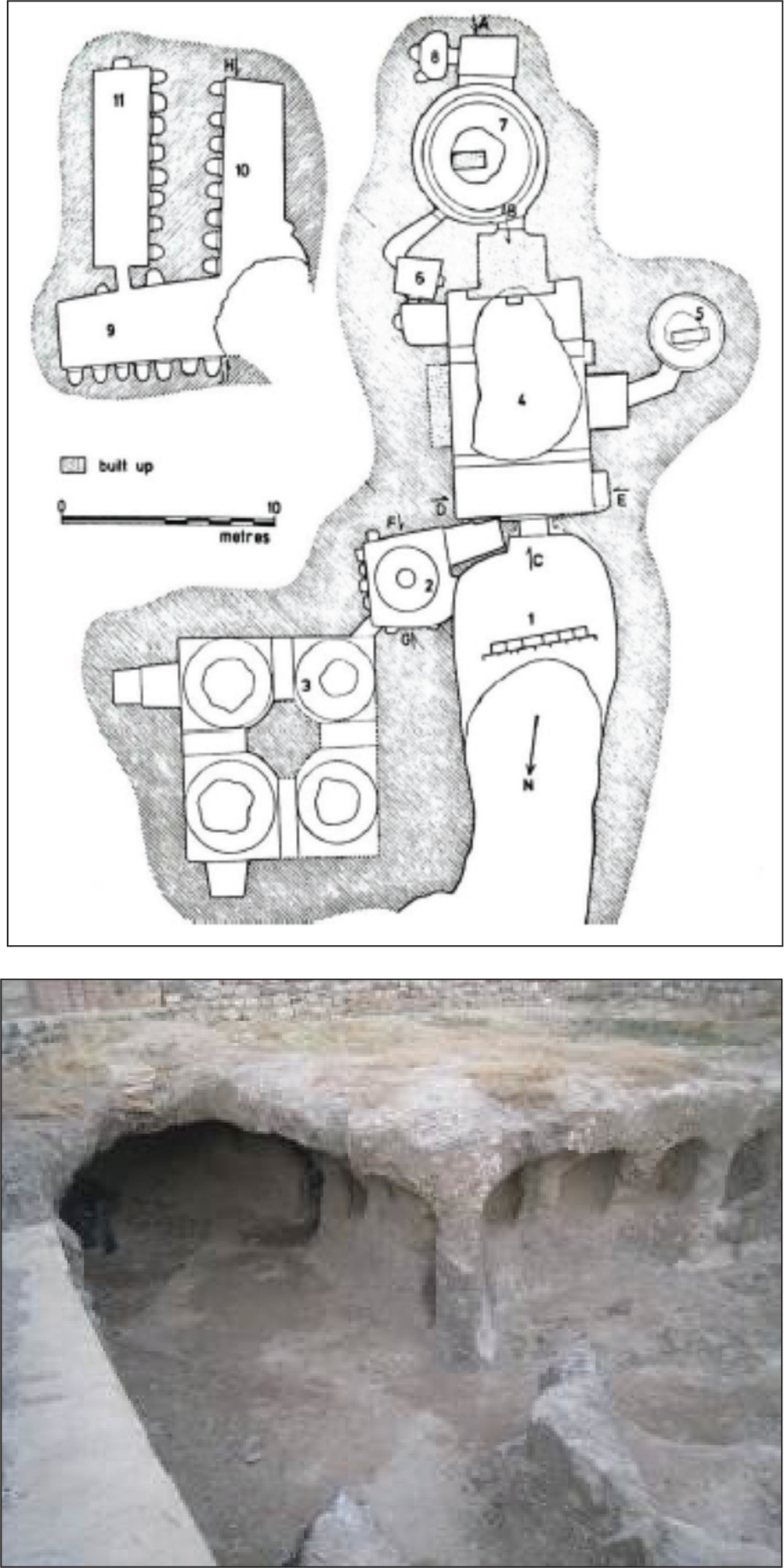
The rock temple of Imamzadeh Ma‘sum is known as Oliya and Ojaq among the local people. This temple is located 6 km south of Maragheh city, 37°19’54.30"N 46°14’19.20"E. This shrine is a rock-architecture complex and consists of different parts such as a temple, stables and cemetery (Figure 2). 14 Zakariyya’ al-Qazvīnī, one of the historians of the thirteenth century, has referred to this complex in his travelogue called Āthār al-bilād wa-akhbār al-‘ibād. 15 For the first time, Abdul Ali Karang considered this complex as a Mehr temple belonging to the Il-khanate period. 16 The chronology presented by Karang was later confirmed by other Iranian archaeologists such as Vardjavand 17 and Javad Shekari Niri. 18 However, recent studies have shown that the temple belonged to the Mongol Il-khanate period 19 and was used as a Buddhist temple. The temple is made up of different parts and is comparable in plan to the sites of Xiao Yi 20 and Xu Xianxiu 21 in China. The surface of the walls of the cave temple of Imamzadeh Ma’sum is covered with gypsum and lime mortar along with filler of rock flour, tuff, ash and plant fibres. 22 There are paintings on the wall mortar that appear to have been destroyed after Ghazan Khan’s conversion to Islam. 23 At the entrance of this temple are the remains of a decorative motif that is very similar to the motif of a dragon. After the religious measures of Ghazan Khan, this temple was turned into an Islamic monastery, a Qur’anic inscription being carved on its wall, celebrating the victory of Muslims over other religions. 24
Cave Temple of Imamzadeh Ma‘sum in Varjovi.
Exposed Temple at Pirhashem.
Pirhashem Temple
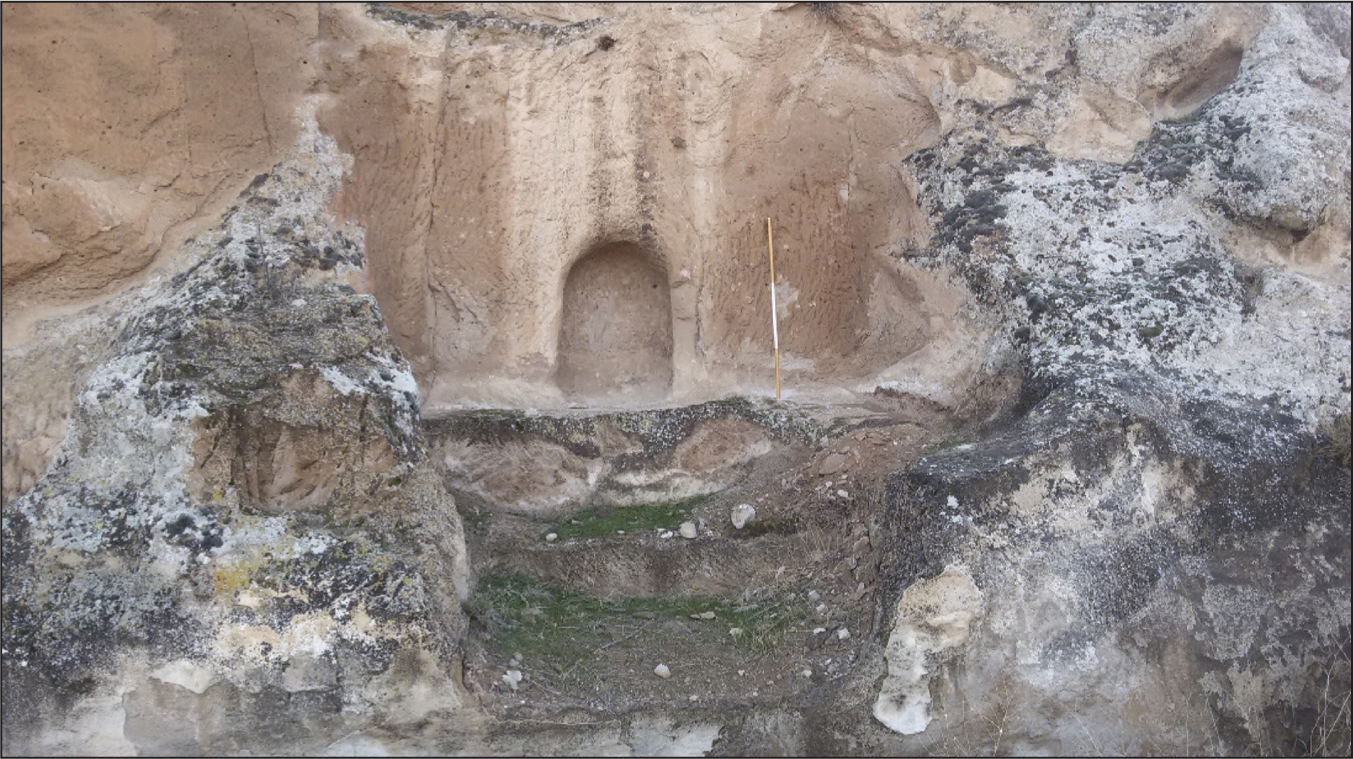
This temple is located in Varjovi village, 6 km from Maragheh city and on coordinates 37°19’N 46°14’E. At a distance of 1 km to the west and southwest is Mulla Ma‘sum area and 680 metres to the west of the road, there is an area of approximately 200 × 400 square metres, called Pirhashem (Figure 3). The area mostly stretches in a north–south direction and leads with a gentle slope to the valley where the Qara-Chay R. flows. This site has been registered in the list of national monuments of Iran under number 22272. The site is located near a river and consists of two parts, including a cemetery and a temple.
In this area, a temple has been exposed at the foot of the Sari Qayah mountain, near Varjovi village in Maragheh county. One of the most interesting examples of rocky spaces in this site is an altar (mihrāb) at the foot of the mountain. At the foot of the mountain slope, three asymmetrical stairs have been created to provide access to the altar. The surface of the stairs is very uneven and was probably left unfinished. A rock altar has been carved at a height of about 80 metres from the riverbed and the vertical part of the mountain rock. The altar has been cut 109 cm high, 70 cm wide and 30 cm deep and does not have any decorative elements or inscriptions. Due to the relatively large area of rock-cut monuments in this area and the incompleteness of their carving, it seems that this complex, like Imāmzādeh Ma‘ṣūm temple, was left unfinished and might not have been used. Due to the proximity of this area to the cave temple of Imāmzādeh Ma‘ṣūm, synchronism of these two spaces is likely. It seems that the tradition of creating catacombs was very common in Iran during the Ilkhānid period, and in written sources of this period such as the Tārīkḣ-i Waṣṣāf, by ‘Abdullāh Ibn Faẓlullāh, a historian of the thirteenth century, this custom has been mentioned. 25
Kohul Machid Temple
The rock architecture of Kohul Machid is located at an altitude of about 1,606 metres above sea level at 37°27’20.97"N 46°16’10.60"E. Rock-cut space has been created on the terrace of the western slope of the mountain. The opening of the temple faces west, and the valley where the Sufi Chai River flows at a depth of 60 cm. Rock-cut space is called Kohul Machid by local people in Turkish. The entrance to this temple is to the west and in the form of a semicircle. After the entrance, an irregular oval space was created, the maximum length of which is 137 cm in the north–south direction, and the maximum width is about 100 cm. The height of this part of the space is about 180 cm. The walls of this space were initially carved, and a niche was created in the corner of the eastern wall leading to the southern wall. Part of the wall of the western half of the roof covering has been destroyed, and what remained was the flat roof covering, which has been turned into a crescent shape at the corners near to the wall. The temple has a cross plan and in this respect, it is comparable to the Buddhist temple of Dash Kasan in Zanjan. An altar has been carved on the wall of the western side of the temple. The direction of the altar, unlike the altars of the Muslims, was set to the west and so indicates the non-Islamic nature of the temple. On the wall of this temple, three niches have been carved, shapes of which are very similar to those of the niches of Buddhist temples.
Qirkh Kohul
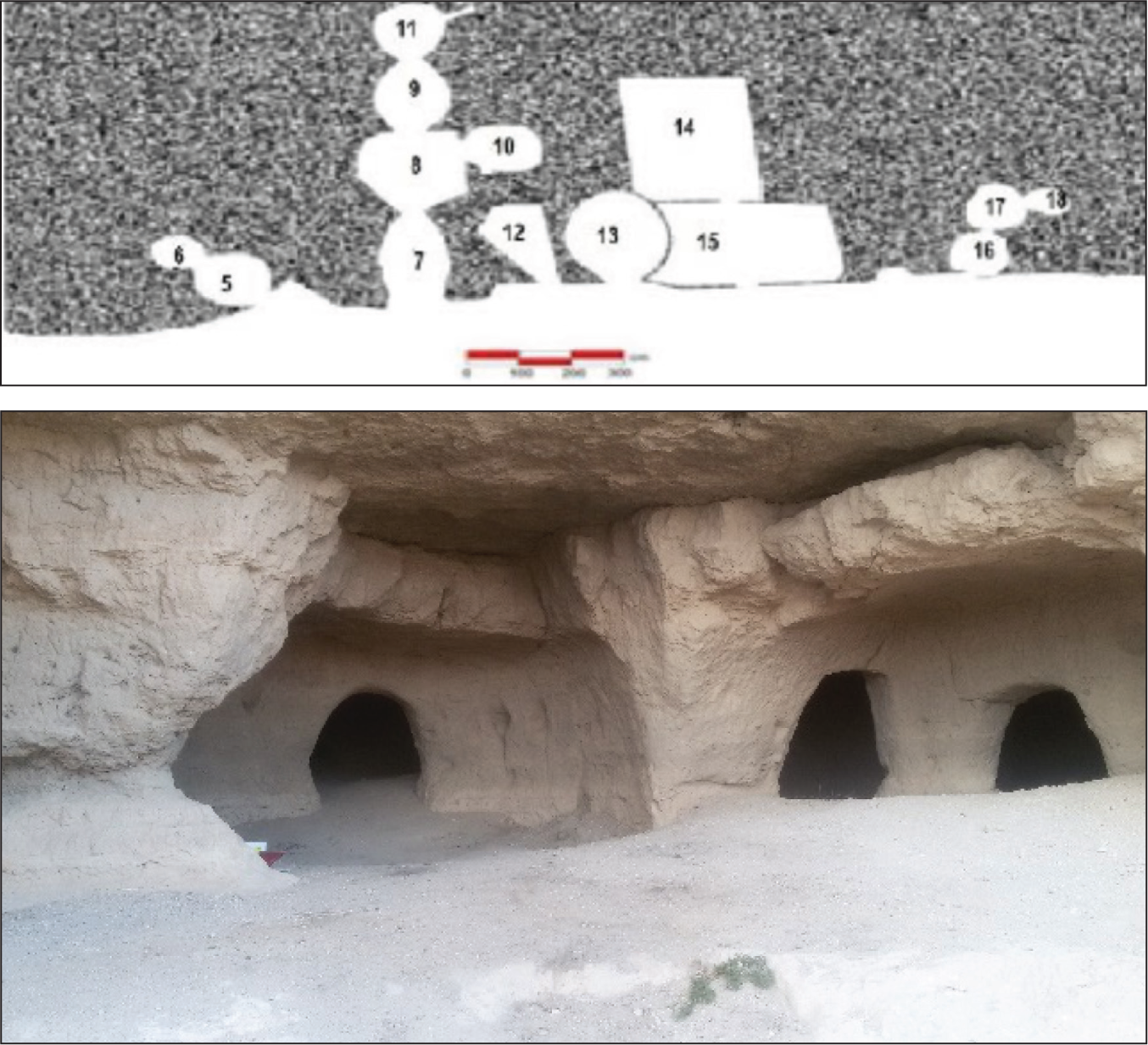
The rock complex of Qirkh Kohul is located in village Kahjuq, 12 km from Maragheh city in coordinates N. 37°19’13.04" E. 46°24’31.06". Near this complex is a village called Moghanjiq (Figure 4). The etymology of the word ‘Moghanjiq’ consists of two words, Mogh meaning Mongol and Jiq, place. Moghanjiq implies that a group of Mongols lived in this village in the past. The people of the region also believe that some of the inhabitants of this village are descendants of the Mongols. In these two villages, many rock-cut remains are found, among which, the rock complex of Qirkh Kohul is, perhaps, most prominent. This complex was carved out of the slopes of rocks and, like other such spaces, the carving of the complex has remained unfinished. The carved spaces comprise circles and squares that are interconnected. This complex is located outside the village and in terms of carving style is comparable to the cave temple of the observatory hill in Maragheh (northwest of Iran) and cave temples in northern China. In general, this complex was carved during the Mongol Il-khanate period and belonged to the Buddhist followers living in Maragheh.
Cave Temple of Qirkh Kohul.
Dash Kasan in Zanjan
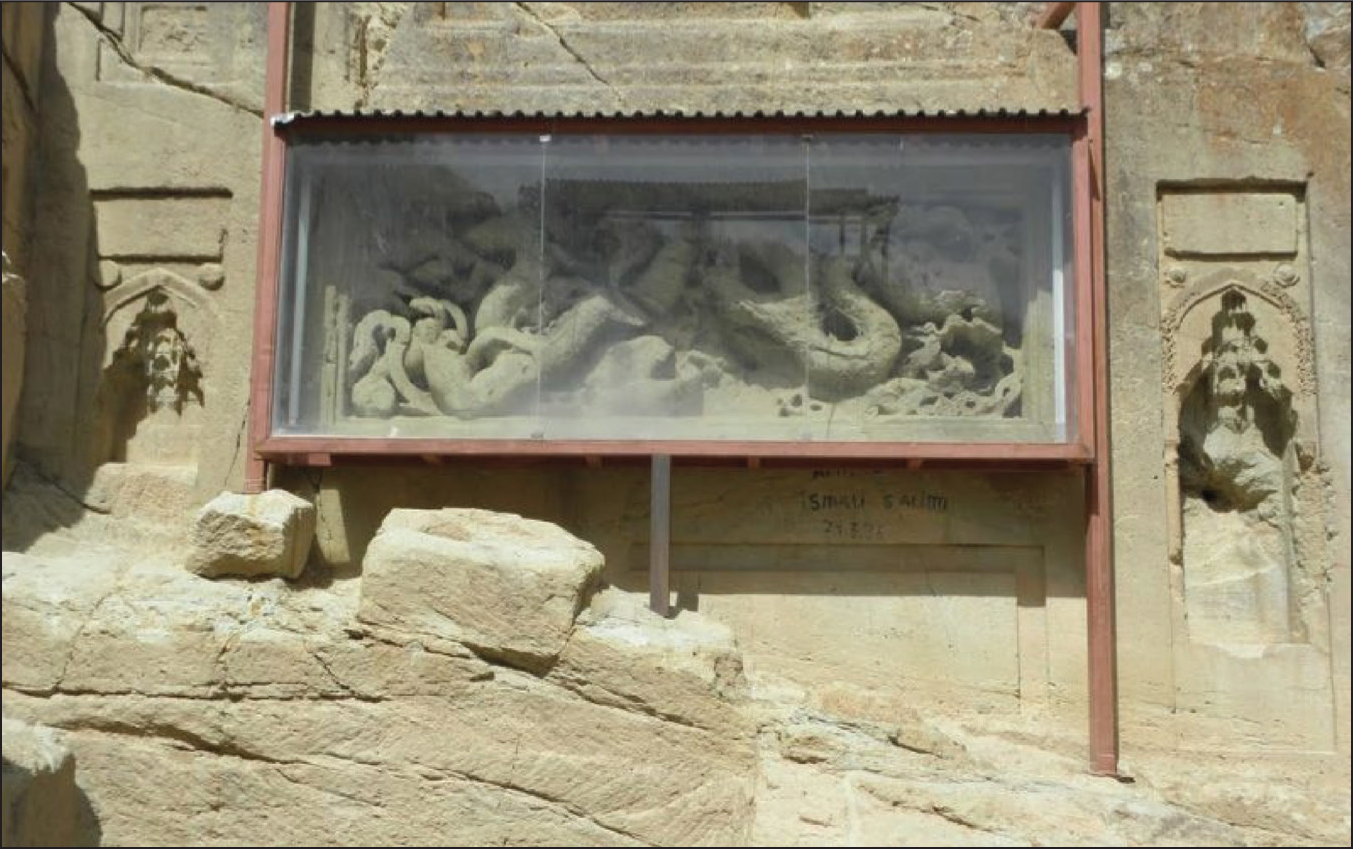
Dash Kasan rock complex is located in Dash Kasan village of Zanjan in coordinates N. 36°19’51.57" E. 48°51’53.42". This complex is one of the most important rock-cut spaces belonging to Buddhism in Iran (Figure 5). In their studies, Iranian researchers have considered this collection to belong to the Mithraism, so the explorer of this complex, Dr Ali Asghar Mirfatah, has dated this collection to the Il-khanate period using the Mehr temple as the model. Indeed, the motif of the dragon in this complex shows the deep connection of the temple with Buddhist beliefs. The plan of the temple is in the shape of a cross and an altar has been created in the wall on its western side, which is comparable to the temple of Kohul Machid. The Zanjan region was one of the important regions during the Il-khanate period. Indeed, the tombs of Arghun and Öljaitü are also located in this area.
Picture of Dash Kasan Buddhist Temple in Zanjan.
Analysis of Findings
Iranian scholars, due to their unfamiliarity with Mongol culture and Buddhism, have considered many rock spaces of the Mongol Ilkhanates as those of Mithraism. 26 But so far, no evidence of Mithraism has been identified in this rock architecture. In the north-western region of Iran, many rock architectures have been carved from the Mongol Il-khanate period. These areas are located in the cities of Maragheh and Zanjan. These two cities were considered important political centres of the Mongols in Iran during the Il-khanid period, especially during the reign of the first Mongol Ilkhanates such as Hulagu, Aba Aghan and Arghun. The Il-khanid kings, especially Hulagu, supported Buddhist and Christian priests, 27 which led to the construction of Buddhist temples and churches in Muslim lands.
Rock temples were built for Buddhists in some cities in north-western Iran by Hulagu’s orders. The first Buddhist cave temples were located in the city of Maragheh. According to written sources, a church was also built by Christians 28 during the Il-khanate period. The church was built on the western slope of the observatory hill on a rock bed in a relatively large area. There was apparently also a need to establish a temple for Buddhist followers living in the observatory’s scientific complex. During this period, the Buddhists held a prominent position under the Ilkhans. A group of Mongols being inclined to Buddhism, Buddhist temples were built throughout Iran. 29 Hulagu ordered the construction of such temples in Khoy. 30 Such patronage of Buddhism led to many Buddhist advisers, agents and monks travelling to Iran from China, Tibet and the Uyghur lands, so that the influence of this religion became more visible in western Iran; and Maragheh, Khoy and Aran became suitable places for their temples. Buddhists built Buddhist temples throughout the Il-khanid realm 31 and practised their religion. For building these temples, Hulagu provided them with aid from the treasury. 32 A number of Il-khanids also followed Buddhism and benefited from Buddhist advice. Hulagu and Abaqa Khan had Buddhist advisers at their court. Among them, we can mention Janglaun, considered one of his great advisers or Arghun Agha. 33 During this period, Buddhists and Christians formed the majority in the nobility and Muslims were in the minority within the ruling class. 34 This factor led to the creation of such rock structures as Imamzadeh Ma’sum, Kohul Machid, Qirkh Kohul and Dash Kasan in Zanjan for Buddhist followers. These temples are very similar to Buddhist cave temples such as the one at Dunhuang, 35 the Kizil Grottoes’ cave temple. But the temples in north-western Iran, unlike the Buddhist temples in north China and Mongolia, are found to be unfinished. The key factor for the abandonment of work on these temples should be attributed to the change of religious beliefs of the Il-khanate rulers, especially under Ghazan Khan.
Ghazan Khan, son of Arghun and a descendant of Genghis Khan, was chosen as the ruler of the Ilkhanates in 1295