




Abstract
Findings from the fields of cognitive science and cognitive development propose a variety of evidence-based principles for improving learning. One such recommendation is that instead of having students practice solving long strings of problems on their own after a lesson, worked-out examples of problem solutions should be incorporated into practice sessions in Science, Technology, Engineering, and Mathematics (STEM) classrooms. Research in scientific laboratories and real-world classrooms has also identified a number of methods for utilizing worked examples in lessons, including fading the examples; prompting self-explanation of the examples, including incorrect examples; and providing opportunities for students to compare multiple examples. Each of these methods has been shown to lend itself well to particular types of learning goals. Implications for education policy are discussed, including rethinking the ways in which STEM textbooks are constructed, finding ways to support educators in recognizing and implementing effective cognitive science–based pedagogical techniques, and changing the climate in classrooms to include the perception of errors as a functional part of the learning process.
Tweet
Rethink STEM classwork and homework: Use worked examples during practice sessions to increase learning.
Key Points
Decades of laboratory research suggest studying worked examples enhances student learning.
Recent work confirms this approach is effective in real-world classrooms.
Worked examples can be used in different ways for different educational purposes.
Having students explain incorrect examples improves conceptual understanding.
Policy implications include rethinking Science, Technology, Engineering, and Mathematics (STEM) textbooks and classroom climates.
Teachers need support for implementing cognitive science–based pedagogy.
Introduction
There is widespread agreement that today’s mathematics and science lessons should reflect both conceptual and procedural content (Common Core State Standards Initiative [CCSSI], 2010; Next Generation Science Standards [NGSS] Lead States, 2013). However, Science, Technology, Engineering, and Mathematics (STEM) courses in the United States are often procedurally focused (Lomax, West, Harmon, Viator, & Madaus, 1995) and our students lag behind most of the world in their STEM proficiency (Fleischman, Hopstock, Pelczar, & Shelley, 2010) and tendency toward STEM careers (Kuenzi, Matthews, & Mangan, 2006). Thus, at a time when the success of students in STEM fields is a key priority of educators and policy makers alike (Kuenzi et al., 2006), and yet time in K-12 science and mathematics courses is often standards- and testing-driven (see Au, 2007,for a review), efforts that can improve student conceptual understanding without sacrificing procedural skill are critical to increasing student potential. The fields of Psychology and Cognitive Science have identified a number of techniques that can improve student learning in a variety of domains (see Koedinger, Booth, & Klahr, 2013); one principle which may be particularly crucial for this purpose is called the Worked Example Principle. This principle maintains that the traditional methods in which we have students practice solving STEM problems are not optimal for their learning (Sweller, 1999).
Traditional STEM lessons are typically structured such that students are first shown a few examples of correct solutions to the types of problems they will be learning about while they are taught new content (e.g., vocabulary words). These may be worked out by the teacher on the board or printed at the beginning of the textbook chapter. Then, the students and teacher may try to solve a few problems together, after which the student is asked to practice the techniques on a list of problems they are to solve themselves or in small groups. This practice may take place at the end of class, as homework, or as a combination of both.
The Worked Example Principle
Instead of solving long lists of practice problems by rote, the Worked Example Principle reveals that it would be better to replace some of those practice problems with worked-out examples of problem solutions and ask the student to study the solutions instead of solving those problems themselves (see Figure 1 for a sample worked example). This approach is thought to be beneficial because it focuses learners’ cognitive capacities—which are inherently limited—on trying to understand the concepts that support correct problem solving. When students just solve practice problems on their own, they often make guesses about which problem-solving procedures may be appropriate and then practice those procedures, thus acquiring and strengthening strategies that may be at best inefficient or ungeneralizable and, at worst, incorrect (Sweller, 1999; Zhu & Simon, 1987).

Sample worked example and corresponding problem to solve.
Laboratory research has demonstrated that studying worked examples improves students’ ability to solve problems that are very similar to those they studied (Trafton & Reiser, 1993) as well as ones that are harder than those they studied (Catrambone, 1996, 1998; Cooper & Sweller, 1987; Ward & Sweller, 1990). The approach sometimes leads to the same amount of learning in less time (Clark & Mayer, 2003; Schwonke et al., 2009; Zhu & Simon, 1987) or increased learning in the same amount of time (Atkinson, Renkl, & Merrill, 2003; Carroll, 1994; Paas, 1992; Tarmizi & Sweller, 1988). These types of findings have shown benefits of worked examples for a number of STEM domains, including algebra (Carroll, 1994; Cooper & Sweller, 1987), chemistry (McLaren, Lim, Gagnon, Yaron, & Koedinger, 2006), geometry (Paas & Van Merriënboer, 1994; Tarmizi & Sweller, 1988), and physics (Hausmann & Vanlehn, 2007; Ward & Sweller, 1990).
A smaller set of studies have established the effectiveness of worked examples in real-world learning environments. Benefits of worked examples have been found in short-term studies in traditional classrooms (Carroll, 1994; Ward & Sweller, 1990), longer term studies in computerized classrooms (Kalyuga, Chandler, Tuovinen, & Sweller, 2001; Kim, Weitz, Heffernan, & Krach, 2009; Schwonke et al., 2007), and longer term studies in traditional classrooms (Booth et al., 2015; Booth et al., in press). Using worked examples over the course of an entire school year was even shown to lead to a 7% gain in student performance on released items from standardized tests (Booth et al., 2015).
Variants of the Worked Example Effect
Beyond establishing the effectiveness of worked examples for improving learning, cognitive science research has identified ways to enhance the benefits of worked examples. In the following sections, we review findings on four prominent variants of worked example use—faded worked examples, worked examples with self-explanation, incorrect worked examples, and comparing worked examples.
Faded Worked Examples
Because novice learners benefit more from worked examples than more experienced learners (Kalyuga, Ayres, Chandler, & Sweller, 2003), one pedagogical approach involves scaffolding, or fading away, the support given in the worked examples as practice goes on and students become more proficient (Atkinson et al., 2003; van Merrienboer, Kirschner, & Kester, 2003). In essence, the worked examples get less “worked-out” over time. When fading is used, the first one or more examples are completely worked out, and the next has all but one step completed; the student must complete that step. Subsequent examples have fewer and fewer steps worked out, and more and more steps for students to complete themselves (see Figure 2). Such scaffolding is thought to help students transition smoothly from worked examples to solving problems on their own; because problem-solving demands are gradually increased, learners’ cognitive capacities are taxed even less than with traditional worked example use (Renkl, Atkinson, & Große, 2004).
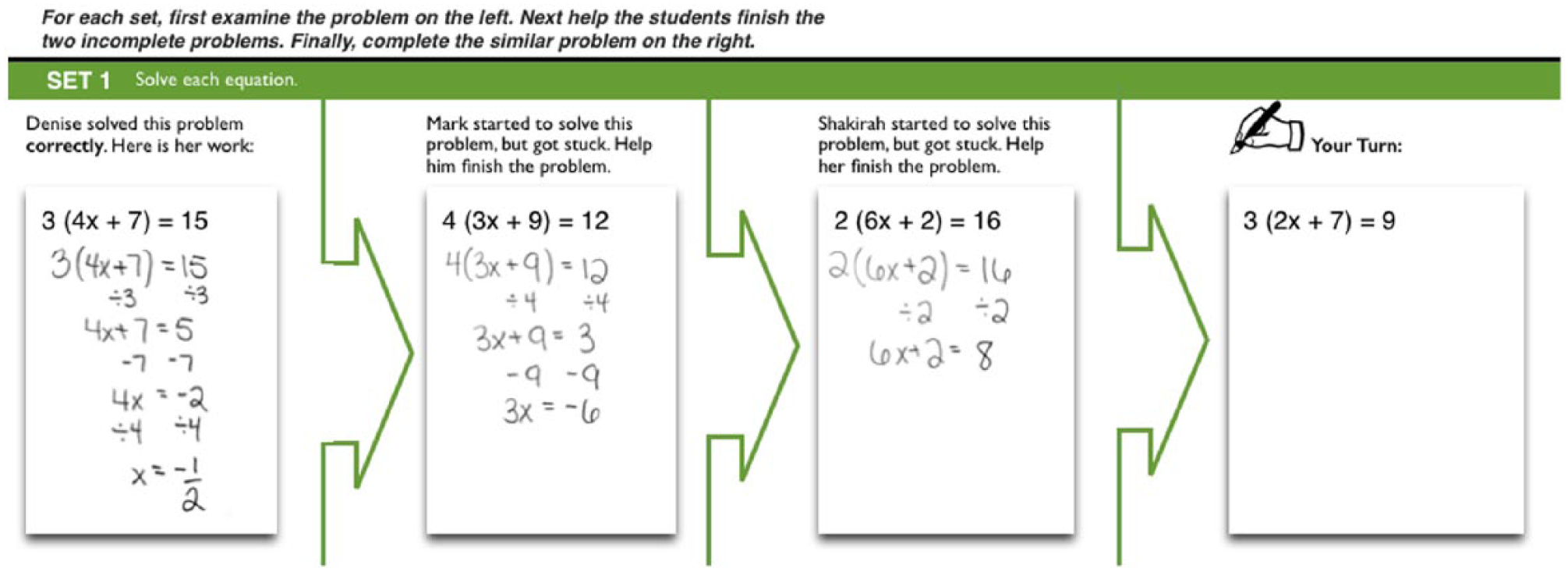
Sample faded worked example.
Studies on the use of faded worked examples have found benefits for problem solving, either in terms of better performance on difficult problems (Atkinson et al., 2003) or less time taken to achieve the same level of performance (Flores & Inan, 2014). Students working with faded worked examples have also been shown to have fewer unproductive moments during their practice sessions (Renkl et al., 2004). It appears that learning improves more when problem steps are faded from the end of the problem (Renkl, Atkinson, Maier, & Staley, 2002) rather than the beginning of the problem (but see Moreno, Reisslein, & Ozogul, 2009). When it is possible to tailor the fading specifically to students’ needs (i.e., reduce scaffolding at the optimal time for each student), this adaptive fading has been shown to have even greater benefits to problem solving compared with fixed fading (Salden, Aleven, Schwonke, & Renkl, 2010).
Worked Examples With Self-Explanation
One of the most common approaches couples worked examples with requests for students to self-explain. Self-explanation involves asking learners to explain information to themselves while they read or study (Chi, 2000). Better learners tend to self-explain naturally (Chi, Bassok, Lewis, Reimann, & Glaser, 1989), and prompting all learners to explain has been shown to facilitate the integration of new information with prior knowledge and force the learner to make their new knowledge explicit (Chi, 2000; Roy & Chi, 2005).
When self-explanation prompts are included with examples, students are essentially asked to explain what was done in the example and/or why the demonstrated step(s) are correct (see Figure 3). Including self-explanation prompts with examples has been found to increase declarative knowledge (Aleven & Koedinger, 2002) and conceptual knowledge (Hilbert, Renkl, Schworm, Kessler, & Reiss, 2008), as well as near and far transfer of learned content (Renkl, Stark, Gruber, & Mandl, 1998), and to increase the likelihood that learners will identify the relevant information in the problem (Catrambone & Yuasa, 2006). Thus, the addition of self-explanation allows worked examples to improve students’ understanding of the underlying concepts inherent in the problems as well as their ability to carry out the steps they were shown.
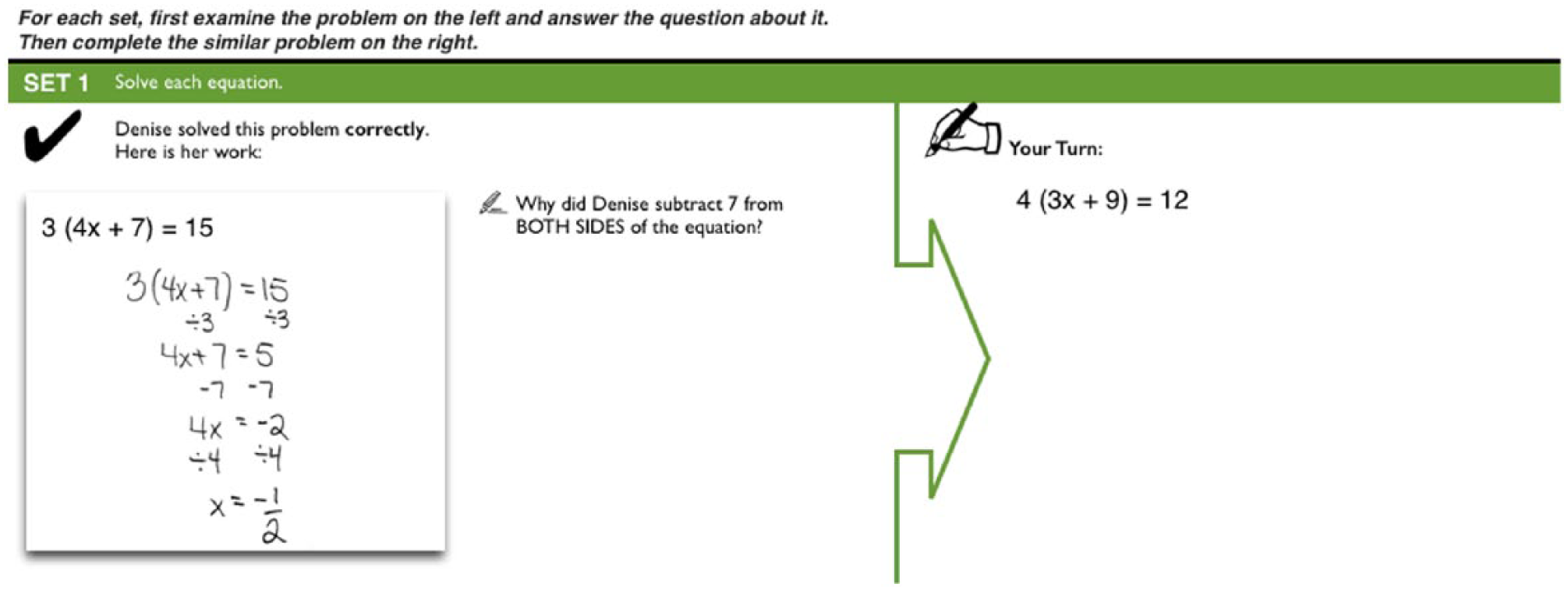
Sample worked example with self-explanation.
Incorrect Worked Examples
A relatively recent twist on the worked example approach involves providing learners with examples of incorrect problem solutions, either in conjunction with or instead of correct examples. Critically, incorrect worked examples are marked as such, and ideally they demonstrate a common mistake that students make when learning to solve a particular type of problem (see Figure 4). In general, studying and explaining errors is thought to help learners to determine which features of the problem make the specific step taken incorrect; this can help students correct their faulty knowledge and fine-tune their problem-solving strategies (Ohlsson, 1996). The act of explaining an error is also thought to help students accept that the procedure is wrong, which should in turn reduce the likelihood that learners would use the strategy themselves in the future (Siegler, 2002).
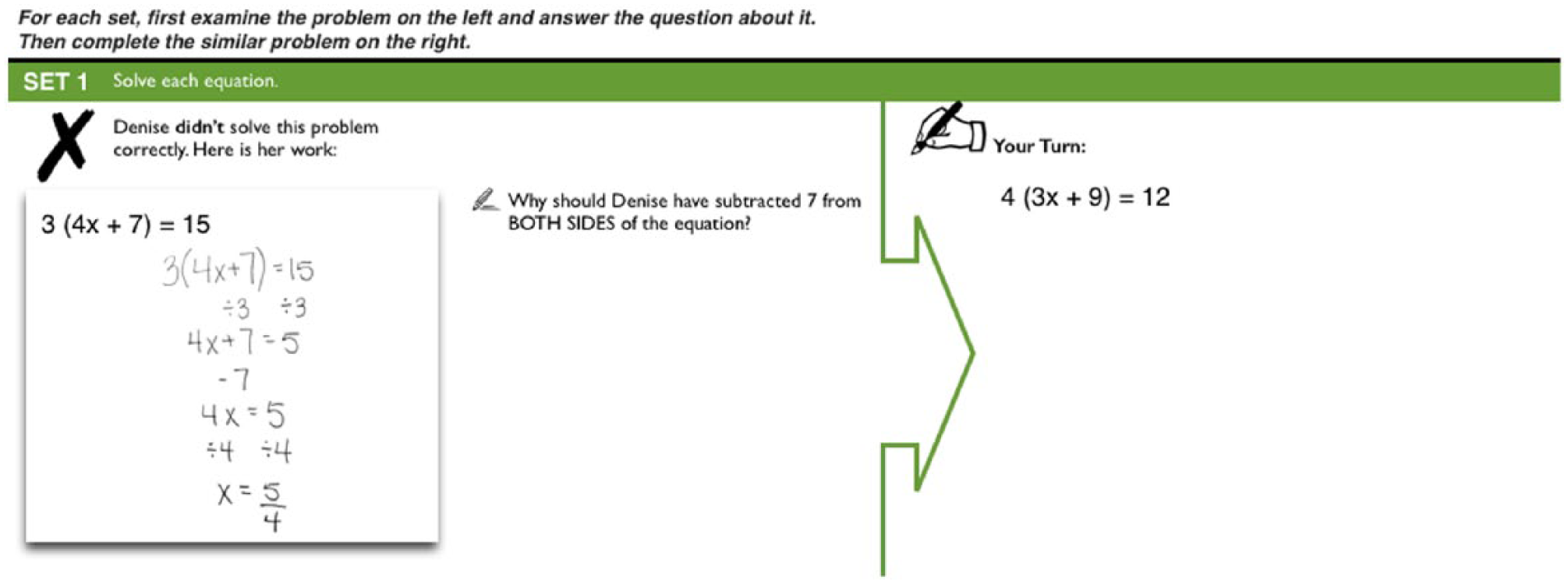
Sample incorrect worked example.
Studies testing effectiveness of explaining incorrect examples (with or without correct examples) have shown that studying incorrect worked examples benefits encoding of algebraic equations (Booth, Lange, Koedinger, & Newton, 2013), promotes learning of correct concepts and procedures (Adams et al., 2014; Booth et al., 2015; Booth et al., in press; Durkin & Rittle-Johnson, 2012), and reduces student misconceptions about the instructional content (Durkin & Rittle-Johnson, 2012). In particular, when compared with explaining only correct examples, explaining incorrect examples can lead to greater conceptual understanding of the content (Booth et al., 2013).
Heemsoth and Heinze (2014) suggest that high prior knowledge students show greater benefits of incorrect worked examples; however, other studies have shown that the benefits of incorrect examples extend to both high and low prior knowledge students (Adams et al., 2014; Barbieri & Booth, under review; Durkin & Rittle-Johnson, 2012). Große and Renkl (2006) suggest that the key to prompting low-level learners to benefit from incorrect examples is highlighting the portion of the solution in which the error occurred so that they do not have to locate the error themselves before studying or explaining it.
Comparing Worked Examples
One final variant involves presenting two examples simultaneously and asking learners to compare them (Rittle-Johnson & Star, 2007). In general, the process of comparing has been shown to promote meaningful learning about underlying concepts and categories of content (Gentner, 2005). However, there are many options of what to compare, even within the domain of worked examples. Rittle-Johnson and Star (2009, 2011) identify several types of worked example comparisons that have been used to enhance learning: The four most prominent were (a) comparing correct isomorphic solutions to two problems of the same type, (b) comparing correct solutions to two separate problem types, (c) comparing an incorrect solution for a problem to a correct one for the same problem, and (d) comparing two alternative correct solutions to the same problem. The first two types have been shown to enhance problem-solving skills (Catrambone & Holyoak, 1989; Cummins, 1992); the third (see Figure 5) has much the same benefits as simply studying and explaining incorrect worked examples (Durkin & Rittle-Johnson, 2012). Perhaps the most interesting is the fourth type: showing students two different—but correct—solutions to the same problem and asking to compare them and determine which solution strategy is better (see Figure 6).
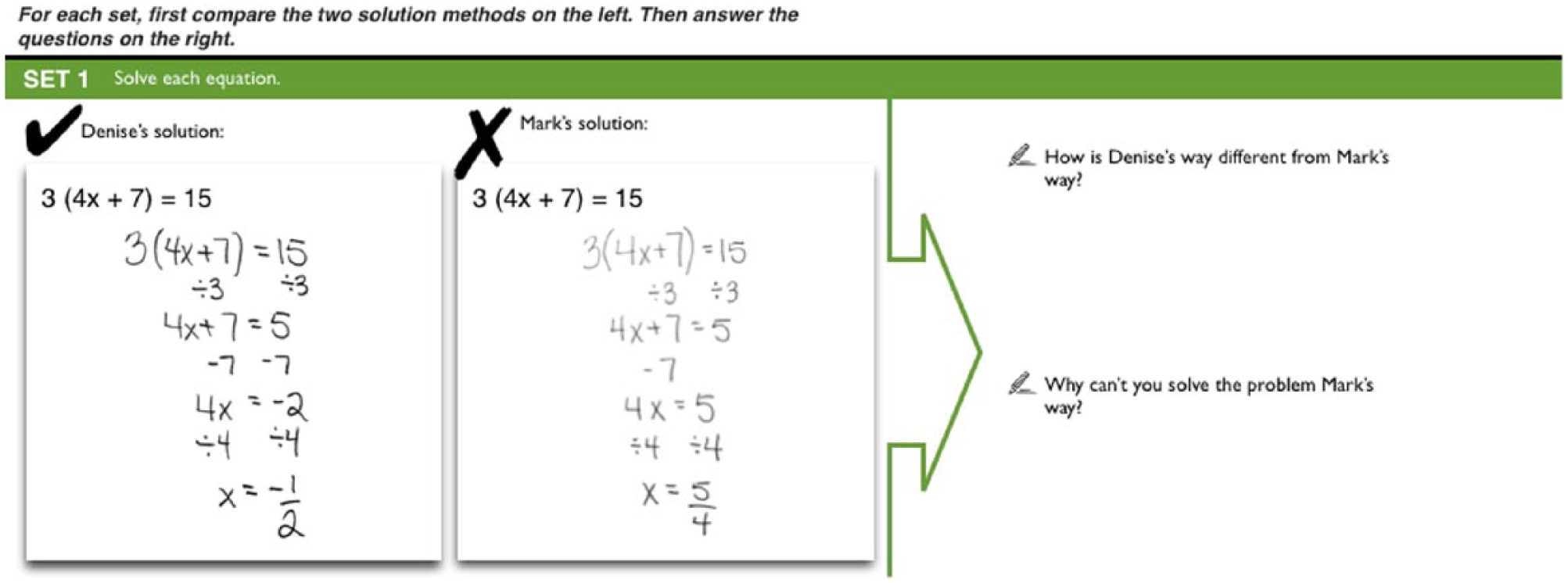
Sample worked example comparing correct and incorrect solutions.

Sample worked example comparing two correct solutions.
Research studies on comparison of worked examples have shown that comparing alternative methods leads to greater procedural flexibility (i.e., knowing multiple methods for solving a problem and choosing the most efficient given the problem context; Kilpatrick, Swafford, & Findell, 2001). This approach helps students to better identify critical aspects of the problem solutions (e.g., their relative efficiency) and to consider more than one strategy when solving a problem (Rittle-Johnson & Star, 2007, 2009). However, Rittle-Johnson, Star, and Durkin (2009) suggest that students may need to have reached a threshold level of prior knowledge before they can fully benefit from studying alternative methods. In particular, the added benefit of concept retention emerged only for high-level learners (Star & Rittle-Johnson, 2009).
Policy Implications: Using Worked Examples to Improve Student Learning in the Real World
The evidence presented in this article has important education policy implications. Although some of the ideas have been suggested in the Common Core State Standards for Mathematics (CCSSI, 2010) and the Next Generation Science Standards (NGSS Lead States, 2013), there is not adequate support in place for teachers to be able to implement these different techniques effectively in their classrooms. The implications that are most strongly supported by the literature are presented in the next three sections.
Rethinking STEM Textbooks
Perhaps the clearest implication from the literature on worked examples is that the ways in which STEM textbooks are structured are suboptimal for student learning. Traditional textbooks include examples during the lesson pages, followed by lists of practice problems. Even reform textbooks, which boast stronger support for students’ conceptual understanding, do not use examples frequently or effectively. For instance, the Connected Math curriculum (Lappan, Fey, Fitzgerald, Friel, & Phillips, 2006), while effectively providing opportunities for rich problem solving, includes examples in only approximately 3% of their practice problems; for comparison, they include prompts for self-explanation in 27% of problems.
In contrast to what is currently available, the worked example literature suggests that approximately half of the problems should contain worked examples for students to study. This finding is prevalent across a large number of laboratory and classroom studies, has been established for several decades, and is recommended by the What Works Clearinghouse guidelines (Pashler et al., 2007), yet it is not currently inherent in many (if any) STEM textbooks available in the United States. Incidentally, the lack of worked examples is not the only instance in which textbook companies are unresponsive to relevant findings from cognitive science research. For example, textbooks often include a variety of colorful images, included for aesthetic purposes, but a number of research studies indicate that content-relevant images, rather than decorative details, support student learning, and that decorative details may actually detract from learning (Lehman, Schraw, McCrudden, & Hartley, 2007; Levin, Anglin, & Carney, 1987). School districts might draw on these and other scientific findings when choosing textbooks for their students, and increase the demand for texts that are well aligned with the current knowledge on student thinking and learning.
Supporting Teachers in Structuring Practice Time
Recent efforts by the CCSSI (2010) and the Next Generation Science Standards (NGSS Lead States, 2013) have encouraged the incorporation of a variety of cognitively rich activities, such as studying and explaining alternate perspectives. These efforts reflect progress toward standards for learning that are aligned with empirical research on learning and cognition. However, the education system is not currently set up to implement these suggestions effectively. Teachers feel pressured, above all, to cover all of the content that might be included in standardized tests, and in most cases they have not been adequately trained in how to implement these more progressive suggestions. The success of these standards initiatives may well be dependent on increases in school district funding for teacher professional development to help them fully understand the intent and nature of the standards and provide classroom-ready solutions for implementation. It is important to note that findings from laboratory research do not always transition seamlessly into practice (Davenport, Klahr, & Koedinger, 2007; Dynarski et al., 2007); translational research such as that currently supported by the National Science Foundation and the U.S. Department of Education is critical for developing and evaluating ways to help teachers successfully implement cognitive science findings in real-world settings.
Another relevant implication of the worked example literature is that there are a variety of ways in which worked examples can be used in the classroom to structure practice time, and the effectiveness of these methods depends on the goal of the lesson. For example, lessons that target procedural fluency might incorporate faded worked examples (Atkinson et al., 2003), while conceptually focused lessons might use worked examples with self-explanation (Hilbert et al., 2008). Lessons aimed at remediating student misconceptions may be focused around incorrect worked examples (Durkin & Rittle-Johnson, 2012), and lessons encouraging flexibility in problem solving could use comparison of alternate methods for solving the same problem (Rittle-Johnson & Star, 2007). Educators might be better poised to interpret whether and when certain pedagogical techniques would be most relevant if they were had a stronger understanding of cognitive science—how their students think and learn. This could be achieved through professional development and continued training of in-service teachers, but might best be served by infusing cognitive science training into teacher preparation programs.
Encouraging Learning From Errors
Finally, a growing body of literature maintains that students can learn a lot from studying errors (e.g., Booth et al., 2013). This notion is, unfortunately, counterintuitive. Many teachers express the belief that consideration of errors may reinforce students’ incorrect procedures or faulty knowledge (Santagata, 2004; Stigler & Perry, 1988); this resistance stems back to the classic behaviorist perspective, as it was thought that students might adopt the errors they were exposed to in incorrect examples (Skinner, 1961). Thus, it may not be surprising that when American students share their solutions and they are incorrect, many teachers erase or brush past the error in effort to get the correct solution represented. In contrast, errors are frequently discussed in Japanese classrooms, where they are thought to be an integral part of learning (Stigler & Hiebert, 1999). This may very well be one of the reasons for the greater performance on STEM content seen frequently in Japan and other countries compared with the United States. Even when errors are introduced in U.S. classrooms, they are often presented among a set of solutions where the goal is to have students identify the correct solution, rather than explain or investigate the incorrect solutions.
To make the most of the research-proven benefits of studying errors, it is likely necessary to promote a change in the perceived error climate of the American classroom (Steuer, Rosentritt-Brunn, & Dresel, 2013). Perceived error climate predicts students’ adaptive reactions to struggles in mathematics problem solving to a greater extent than does students’ motivation to achieve; thus, efforts to help teachers consider how they can create classroom environments that promote the functionality of errors might greatly increase student learning (Steuer et al., 2013). Ideally, this idea could be applied across the education system so that even elementary school students are taught that errors can be a useful and critical part of the learning process, and that making an error does not mean they are not good at a particular skill.
Conclusion
Over three decades of research demonstrates that students’ learning is enhanced when they study examples of solutions to problems along with practicing solving problems themselves; depending on how the examples are presented, certain types of learning gains may be even further promoted. However, these approaches are not represented in STEM textbooks and are infrequently used in U.S. classrooms. Educators have many options available to them but are at the same time constrained by the culture of standardized testing. Cognitive science–based pedagogical approaches, such as worked examples, can help teachers improve students’ conceptual understanding while still furthering their procedural skills. Full integration of such principles into real-world classrooms will require consideration of the structure of textbooks and other educational materials, the training of educators in implementing these approaches, and, ideally, a shift in the U.S. classroom culture such that atypical classroom activities—such as spending time focused on errors and other techniques promoted by the CCSSI (2010) and NGSS Lead States (2013)—are embraced as a valuable part of learning.
Footnotes
Authors’ Note
The opinions expressed are those of the authors and do not represent views of the Institute or the U.S. Department of Education.
Declaration of Conflicting Interests
The author(s) declared no potential conflicts of interest with respect to the research, authorship, and/or publication of this article.
Funding
The author(s) disclosed receipt of the following financial support for the research, authorship, and/or publication of this article: Funding for this work was provided by the Institute of Education Sciences, U.S. Department of Education, through Grant R305A100074 to Temple University, Grant R305C100024 to West Ed, and Grants R305A100150 and R305A150456 to the Strategic Education Research Partnership.