



Abstract
Despite three decades of scientific and public attention on efforts to improve literacy in America, little progress has been made in closing achievement gaps across racial, ethnic, and socioeconomic lines. This article argues that one major reason is failure to take into account the mosaic of strengths and weaknesses individual children bring to school. With this comes the failure to develop personalized instruction for each child. We briefly review the research available and then describe how research, ours and others, supports the efficacy of individualizing student instruction (ISI) and illustrates how society might close achievement gaps. ISI, and other regimes, offer a systematic instructional program, incorporate child assessment, and present personalized small-group instruction. In ISI, this is aided by computer-generated recommendations and planning tools in the A2i online technology, coupled with extensive, ongoing professional development (PD). ISI has been shown to be highly effective from preschool through third grade in improving children’s literacy skills. The practical and policy implications of implementing effective instruction are discussed.
Keywords
Tweet
Individualized reading instruction in small groups, with computerized recommendations and professional development, improves early literacy.
Key Points
Individual children’s reading strengths and weaknesses influence how children respond to instruction.
Personalized instruction assesses the child and provides individualized small-group instruction.
Computer-generated suggestions aid teaching planning, as does professional development.
Introduction
A timely article in Education Week (November 6, 2015; http://www.edweek.org/ew/articles/2015/11/11/study-rti-practice-falls-short-of-promise.html) discussed a recent U.S. Department of Education study finding that Response to Intervention (RTI) systems (i.e., multitier support), a popular method for identifying and preventing reading problems, were not generally effective in supporting struggling students’ reading gains (Balu et al., 2015). A blogger was not surprised that RTI did not work because “excellent quality differentiated instruction is very difficult to implement given that teachers are spread so thin . . . It is physically impossible to meet all the needs of children.” This attitude pervades the education community despite strong, accumulating evidence that work on understanding individual child differences and child-by-instruction (CXI) interactions has clearly and causally shown that the effect of instruction—in reading, science, social studies, and math—depends on the constellation or lattice of skills, aptitudes, and abilities children bring to the process of learning (Al Otaiba et al., 2011; Connor, 2014; Connor, Alberto, Compton, & O’Connor, 2014; Connor, Dombek, et al., in review; Connor, Fishman, et al., 2013; Connor et al., 2010; Connor, Mazzocco, et al., in review; Connor, Morrison, et al., 2013; Connor, Morrison, Fishman, et al., 2011; Connor, Morrison, et al., 2009; Connor, Morrison, Fishman, Schatschneider, & Underwood, 2007; Connor, Morrison, & Katch, 2004; Connor, Morrison, Schatschneider, et al., 2011; Connor, Piasta, et al., 2009). The implication should be clear: If teachers do not differentiate literacy instruction, a substantial proportion of the children in their classrooms will not reach their full reading potential.
However, the blogger was right in one respect: Differentiating instruction is difficult because CXI interactions are complex. Learning to read proficiently calls on cognitive, linguistic, social-emotional, and regulatory processes with synergistic and reciprocal effects on each other and with instruction (Connor, Phillips, et al., 2014; Connor et al., in press). One might envision this constellation of skills and instruction as a mosaic or lattice—with weaknesses and strengths working together and with literacy instruction to affect students’ academic outcomes (Connor et al., in press). The lattice of child characteristics is shaped by multiple sources of influence (Bronfenbrenner & Morris, 2006; Morrison, Bachman, & Connor, 2005), with more proximal sources (parenting and instruction) having a greater and more direct influence than more distal sources of influence, such as district, state, and national resources and policy. Moreover, unlike language, where babies learn to talk with astounding ease, reading is a human invention and so is extremely difficult, which leads to greater variability in how easily students master critical reading skills.
This article starts with a review of the research on individual child differences and CXI interactions; then, we discuss effective ways to teach children, taking into account individual child differences; we then move to issues of practice and policy. One of the greatest challenges facing researchers, practitioners, and policymakers will be bringing effective, evidence-based practices into wide use in schools. As an example, we describe our efforts with assessment-guided individualized student instruction (ISI). This article concludes with the next greatest challenges.
Research on CXI Interactions and ISI
Review of the Literature
The idea of CXI interactions is not new, conceived originally as aptitude-by-treatment interactions (ATI; Cronbach & Snow, 1969). The idea was appealing but largely abandoned after a seminal book (Cronbach & Snow, 1977) reviewed ATIs and concluded, “ . . . well-substantiated findings regarding ATIs are scarce. Few investigations have been replicated. Many reports (of both positive and negative results) must be discounted because of poor procedure” (Cronbach & Snow, 1977, p. 6).
There are several reasons that help explain why researchers are now finding CXI interactions to be pervasive. First, we have much better knowledge about the linguistic and cognitive processes involved in learning to read and required for proficient reading. In turn, this has led to more robust, albeit more complex, models of literacy instruction (Cohen, Raudenbush, & Ball, 2003; Raudenbush, 2005). And finally, newer analytic strategies such as hierarchical linear modeling (Raudenbush & Bryk, 2002) have provided more sensitive ways to model cross-level interactions (e.g., Child × Classroom Instruction).
Correlational evidence of CXI interactions has been accumulating over the past decades. For example (Foorman, Francis, Fletcher, Schatschneider, & Mehta, 1998), students with weaker phonological skills made greater gains in code-based (e.g., phonics, phonological awareness, encoding) classrooms than did their peers with stronger phonological awareness. Children who started first grade with weaker reading skills made greater gains in reading when instruction focused on word recognition, whereas children with stronger skills made greater gains in classrooms where they participated in a literature-rich environment with less emphasis on decoding (Juel & Minden-Cupp, 2000). We also found consistent, strong correlational evidence of CXI interactions, which we discuss later in this article.
We reviewed recent randomized control trials (RCTs) that examined the effects of individualizing (or personalizing or differentiating) literacy instruction based on student assessment. For example, RTI and multitiered systems of support are arguably an effort to differentiate instruction based on individual students’ skills and responsiveness to earlier instructional efforts. Although scaled-up RTI appears to have mixed results (Balu et al., 2015), more dynamic RTI that moves children immediately into personalized tiered instruction, including Tier 1 (i.e., general education classrooms), is more effective than the models used widely in schools (Al Otaiba et al., 2015).
An experiment (RCT; Reis, McCoach, Little, Muller, & Kaniskan, 2011), conducted across a number of schools, tested a method of differentiating instruction, using a school-wide enrichment model of reading, described as an enrichment-based reading program designed to stimulate interest in and enjoyment of reading, leading to higher reading achievement, by enabling students to self-select and read high-interest books of personal choice that are slightly to moderately above current reading instructional levels independently with differentiated instruction provided in weekly teacher conferences. (Reis et al., 2011, p. 464)
In differentiated instruction, teachers used assessment data to “respond to differences in student’s readiness, interests, and learning profiles” (Reis et al., 2011, p. 466). The efficacy of this method in an RCT with second- through fifth-grade students showed no overall effect across schools, perhaps because, like ATI models, they focused on the wrong set of child characteristics and instructional practices. Other proposals on differentiating instruction offer valuable implementation information but, for the most part, have not been tested in RCTs (e.g., Tomlinson, 2001; Watts-Taffe et al., 2012). In the next section, we focus on our line of research to illustrate a method of individualizing instruction that has been tested in schools using RCTs.
ISI and Assessment-to-Instruction Technology (A2i)
The inspiration for the ISI intervention and the integral A2i software was born out of the reading wars—whole language versus phonics—and in emerging game technology that relied on complex algorithms to simulate reality, such as Sim City. Our first article, “Beyond the Reading Wars” (Connor et al., 2004), showed that both whole language and phonics methods were involved, but the effective proportion of each depended on children’s reading and vocabulary skills—there were CXI interactions. First graders who had weaker decoding scores made greater gains when their teachers taught them phonics and related code-focused skills, whereas students with strong vocabulary scores made greater gains when they spent more time in meaning-focused activities, such as sustained independent silent reading. Using these correlational findings and reverse engineering—deriving amounts and types of instruction based on children’s reading and vocabulary scores—yielded individual instruction recommendations for each student (Connor et al., 2007) toward which individualized instructional plans could be created. We describe how we did this below. We then conducted seven clinical trials (i.e., RCTs) where teachers were randomly assigned to use ISI/A2i or to learn a different intervention (e.g., vocabulary, math). Across all studies, children in ISI/A2i classrooms had stronger outcomes than their peers in control classrooms. The citations for the RCTs are asterisked in the reference list.
Dimensions of Instruction
ISI and A2i rely on a multidimensional framework for understanding literacy instruction (see Table 1)—context (whole class, small group, individual), content (code-focused, meaning-focused), and instructional attention management (teacher/child-managed, child/peer-managed). Context speaks to the students’ instruction environment, with small-group instruction arguably easier to personalize than whole-class instruction.
Examples of Types of Instruction.
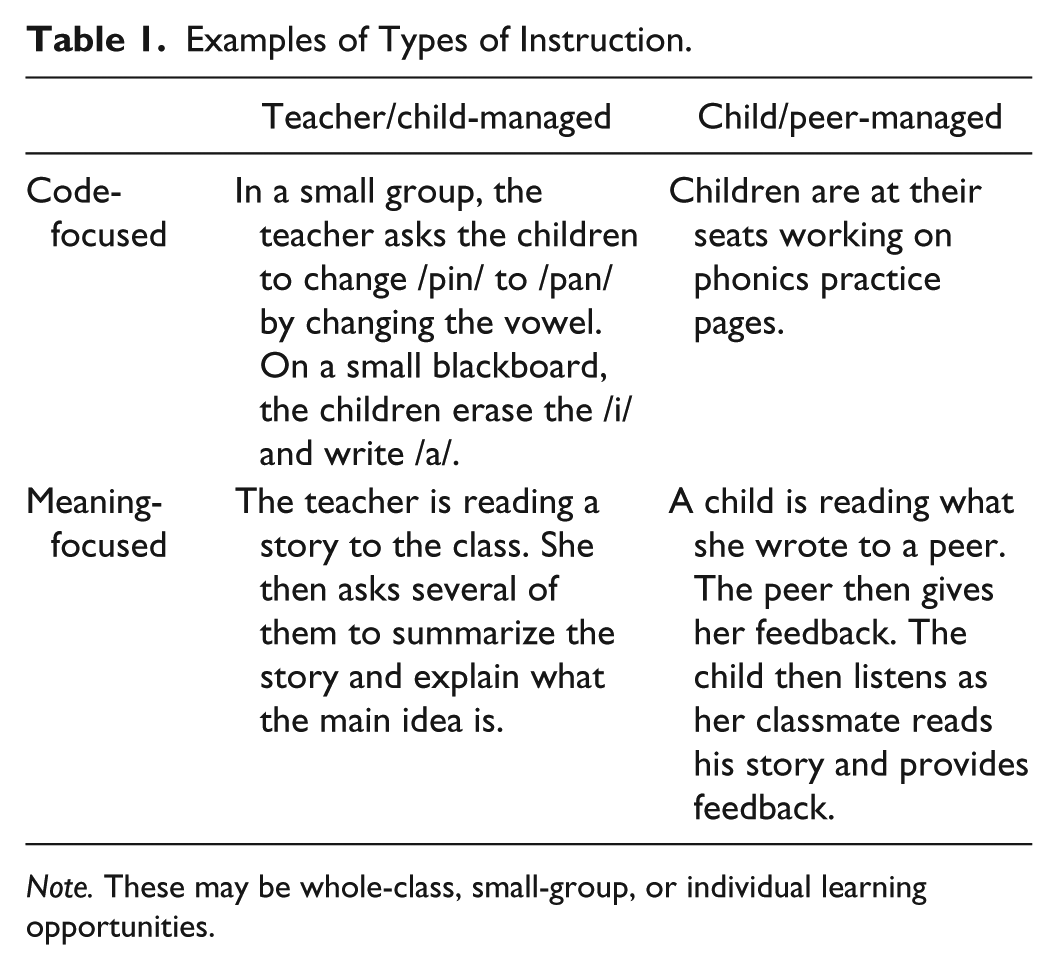
Note. These may be whole-class, small-group, or individual learning opportunities.
Content relies on the well-founded “Simple View of Reading” (Hoover & Gough, 1990), where proficient reading is the product of fluent decoding and oral language. In the ISI/A2i framework, “code-focused instruction” refers to any evidence-based activity designed to help children fluently decode the texts they are reading; it includes phonological awareness, phonics, decoding, fluency, and spelling. “Meaning-focused instruction” includes any instructional activity designed to support children’s efforts to attach meaning to the text they have decoded: for example, vocabulary, listening and text comprehension, inferencing, summarizing, and question-asking activities.
The third dimension, instructional attention management, asks, “who is focusing the students’ attention on the learning activities at hand—the teacher or students?” For example, when a teacher leads a class discussion on a book they have read, instruction would be considered teacher/child-managed. If the students work together to edit their writing as part of writer’s workshop, the instruction would be child/peer-managed. Seatwork would be child-managed.
Any evidence-based literacy activity can be defined using these dimensions simultaneously (see Table 1). For example, the teacher leading a discussion about a book would be considered a whole-class, teacher/child-managed, meaning-focused activity, whereas children working together in a writer’s workshop would be a small-group, child/peer-managed, meaning-focused activity. If a child is completing a phonics worksheet at her desk, the instruction would be individual child-managed and code-focused. Teacher/child-managed, small-group, code-focused instruction is about 4 times more effective than the same type of instruction provided to the entire class (Connor, Morrison, Fishman, et al., 2011; Connor, Morrison, Schatschneider, et al., 2011; Connor, Morrison, & Slominski, 2006). Meaning-focused instruction appears to be effective in both small-group and whole-class contexts.
Assessment-to-Instruction
A key active ingredient of ISI/A2i instruction is the A2i technology (Al Otaiba et al., 2011; Connor, Fishman, et al., 2013). One true barrier to individualized instruction is ensuring valid and reliable assessments of a child’s skills that teachers can utilize easily to inform instruction adaptively throughout the school year. Such assessment is frequently considered formative assessment. A2i has three integrated online adaptive assessments that tap key skills: The Word Match Game (vocabulary), Letters2Meaning (decoding, word reading, spelling, sentence writing, and paragraph writing), and Reading2Comprehension (reading comprehension, comprehension monitoring, inferencing). All have documented reliability and can be administered monthly with kindergarten through third-grade students.
The teacher starts by evaluating each student using the A2i assessments or other valid and reliable methods. The A2i platform uses students’ scores from the assessments to compute recommended amounts (minutes/day) of each of the four types of instruction in Table 1, and these are displayed in the A2i program’s classroom view. A2i recommendations include both code- and meaning-focused instruction but in differing amounts, depending on the child’s profile of strengths and weaknesses. In addition, grouping algorithms recommend homogeneous reading skill groupings (i.e., flexible learning groups), which teachers can change. Teachers select how many small groups they want to use (usually four or five). A2i also has classroom-organization features, which allow the teacher to select the number of groups and the days of the week each of the groups will meet. The A2i program’s student information page displays students’ test scores and progress monitoring charts as well as the student’s personal lesson plan.
Key to individualizing instruction is the A2i Lesson Plan, where the schools’ evidence-based resources and other evidence-based indexed learning materials are recommended for each group—aligned with the groups’ reading skill levels. Teachers can change activities within each type. It is this Lesson Plan where teachers can access and download the lessons from their core literacy curriculum and other indexed evidence-based literacy activities. They can also change the activity and locate other relevant activities using advanced search features. Each learning activity in the Lesson Plan has been indexed to the Common Core State Standards (CCSS; Common Core State Standards Initiative, 2010), and once teachers have implemented a lesson, they click the activity as done. This records that the activity was implemented and which CCSS it was designed to meet. Using these data, a report of CCSS covered is generated and available for teachers and principals to review.
Online professional development (PD) resources support blended coaching (tech-to-tech and face-to-face). Resources include units on classroom organization, using assessment to guide instruction and using research to inform instruction. Videos of master teachers are available as well.
A2i records principals’ and teachers’ use of the system (i.e., user logs), and these reports are available as feedback to educational leaders and teachers. User logs are accessed through the reports feature. For educational leaders and practitioners, easy-to-read graphs are provided. For researchers, raw user log data are also available. These reports can monitor teachers’ use of A2i, which features they are using for how long (seconds) and how frequently. We have found that the more the teachers used A2i, the stronger were their students’ reading gains (Connor et al., 2007; Connor, Fishman, et al., 2013). Plus, in an RCT, students whose kindergarten teachers used A2i had stronger reading gains than did their peers in control classrooms, where teachers received PD on how to individualize instruction but did not have access to A2i. Hence, the technology is a critical part of ISI/A2i effectiveness.
To date, ISI/A2i has been used in schools in Florida, Pennsylvania, and Arizona in a series of RCTs and design experiments and in a variety of schools including schools serving a great number of high-need students—students who are living in poverty, who belong to minorities, or are English learners. This includes many students living in rural communities. Individualizing or personalizing instruction using A2i is effective across a variety of school settings (see asterisked references).
PD
Returning to the blogger’s claim that meeting the needs of all children is impossible for teachers, we counter that our research clearly shows that with support and technology, virtually all regular classroom teachers can learn to use A2i to individualize the reading instruction they provide to their students. They can implement ISI well enough that their students make greater gains than the control group teachers’ students. Research-based strategies and feedback from master teachers together created our PD protocol. The methods provided online PD resources including video of master teachers; PD chapters addressed classroom management and used assessment to guide instruction; and a tech-to-tech version of the PD appeared to be as effective as face-to-face. The PD next appears in some depth to provide a sense of what was involved in supporting teachers’ ability to meet the individual needs of all of their students.
Half-Day Workshops
PD typically starts with a half-day workshop in the late summer or early fall. This introduces A2i and the idea of ISI, including the dimensions of instruction framework (i.e., teacher/child-managed, code-focused, etc.), as well as reviewing foundational research findings. Teachers have the opportunity to log in to A2i and examine the recommended amounts for the students in their classrooms for whom assessments had been completed. They also discuss how they might attain the “minutes” (the recommended minutes of instruction) and the “match” (matching activities to students’ skill levels). A second PD workshop in January reviews the mid-year assessment results and discusses ways to improve ISI implementation in the classroom. This becomes an important time for teachers to interact and share their experiences with teachers from other schools.
Communities of Practice (COPs)
Teachers participate in monthly COPs (Bos, Mather, Narr, & Babur, 1999), which are also called professional learning groups. COPs are conducted monthly by research partners (master teachers on the research team, analogous to literacy coaches) with grade-level teams at the schools. These meetings provide time for teachers to discuss new skills and techniques to support ISI implementation, to learn new features of A2i, to ask questions, and to share ideas. The content of these meetings vary by school, grade, and according to topics teachers wanted to discuss. An ISI Handbook (Connor, Sparapani, Ingebrand, Wood, & Crowe, 2015) focuses on topics teachers reported to be most useful to them, to help schools implement ISI more independently. The overarching goal of the COPs is to empower teachers in the use of A2i and implementation of ISI. Additional individual support is provided to teachers on an as-needed basis.
In-Classroom Support
Among the most effective PD strategies is in-class coaching; indeed, implementation of any intervention appears to be much greater when it includes in-class coaching (Carlisle, Cortina, & Katz, 2011; Joyce & Showers, 2002). This level of support is provided by the research partners (i.e., instructional coaches) biweekly for the entire literacy block, is highly individualized, and varies with the learning needs and requests of the classroom teachers. Again, the idea is to empower teachers through mutual strategizing, modeling effective practices, and trying new techniques. For example, the research partner might say at the end of the literacy block, “I noticed that Demi was really having a hard time working independently.” The teacher would then respond with her observations of and concerns about Demi, and the conversation would continue.
Implementation
Each of the teachers individualized their reading instruction in different ways, and how they met the “minutes and the match” could differ substantially, while still supporting their students’ reading outcomes. However, most of the teachers used stations (or centers) with a teacher table and centers for activities (e.g., writing center, phonics center). Children would rotate through the teacher/child-managed and child/peer-managed stations to meet their A2i recommended minutes for each of the four types of instruction.
Beyond Reading, to Science, Social Studies, and Math
Although most of ISI research has focused on literacy, we have also created ISI for Math (Connor, Mazzocco, et al., in review) and for content area literacy instruction (CALI) in science and social studies (Connor, Dombek, et al., in review). CXI interactions occur for all of these content areas, motivating work to develop and evaluate classroom instructional regimes to address them. For example, in science, hands-on and discovery-learning activities are considered best practice (Next Generation Science Standards [NGSS], 2013). However, children with weak knowledge made virtually no gains when they participated in these child/peer-managed learning opportunities, whereas children with greater knowledge made greater gains (Connor et al., 2012). At the same time, when these activities were teacher/child-managed, all students, including those with weak knowledge, made substantial gains.
Policy Implications
The Challenge of Bringing Evidence-Based Practices to Schools
One reason for treatment effects for ISI/A2i, we conjecture, is that we have always worked closely with school partners and have teachers as an active part of our research teams. The idea of school–researcher partnerships has been growing (Coburn, Penuel, & Geil, 2013), with several examples of highly successful partnerships (e.g., SERP, Strategic Education Research Partnerships, http://serpinstitute.org/). The key to successful partnerships is that school practitioners and researchers work together to develop and test interventions. Schools provide important contextual and practical knowledge, whereas researchers provide knowledge about research and ideas that are already available and tested. Implementation science (Fixsen, Blase, Metz, & Dyke, 2013) and design-based implementation science (DBIR, Fishman, Penuel, Allen, Cheng, & Sabelli, 2013; Penuel, Fishman, Haugan Cheng, & Sabelli, 2011), offer two useful frameworks. Implementation science begins with an evidence-based intervention and offers detailed methods and models for enacting the interventions in schools. DBIR focuses more on the actual development of interventions that are designed to work in specific contexts. We have used DBIR in the development of A2i and the ISI PD, but then took the process a step further to examine how well the ISI/A2i instructional regime and technology work in other contexts as part of our RCTs.
Perhaps one of the biggest hurdles to implementing evidence-based practices in schools and at scale are beliefs that consciously or unconsciously bias practitioners against research and evidence-based practices. The blogger’s claim that meeting the needs of all students is not possible highlights a pervasive misconception that must be challenged. New research is revealing ways to structure classroom activities that help individual learners learn effectively (http://ies.ed.gov/ncee/wwc/). At the same time, complex problems do demand complex solutions.
Funding for Rigorous Research
Education is highly politicized and rocked with fads that are often adopted by schools before they can be properly evaluated. Then, when, as is often the case, the latest fad does not work, it is discarded and a new, equally untested fad takes its place. From our perspective, a good way to get off this roller coaster is through funding of rigorous research. In our opinion, the funding of research that is not tied to particular programs such as Title 1 or Race to the Top and is separated from environments that are politically influenced, while still being rigorously scientifically reviewed, has done more to improve education than any other federal or state policy. We are not alone in this opinion. The U.S. Office of Budget and Management (OMB) also concurred in a 2007 report (http://georgewbush-whitehouse.archives.gov/omb/expectmore/summary/10009008.2007.html), which recognized the success of the U.S. Department of Education Institute of Education Sciences (IES). The National Institutes of Health recognizes reading difficulties, along with other important comorbid conditions such as attention deficit and hyperactivity disorder (ADHD), as public health issues and funds interdisciplinary research. These efforts provide an excellent start—but more is needed, particularly as challenges facing schools and educators persist and evolve.
Empowering School Districts, Educational Leaders, and Teachers That Work With Researchers
There are many demands on school leaders and teachers today, and the most frequent reason that practitioners refuse opportunities for research–school partnerships is that they just do not have time, given all the reporting and assessment requirements they face. We suggest that schools be rewarded for participating in rigorous research projects, and we envision incentives that might promote a win-win opportunity. For example, with greater calls for evaluation, teachers are reticent to try new innovative methods—even those with promise—because they are concerned that they will be held responsible if the new methods are ineffective. Some teachers and principals believe that test prep is critical for students’ performance on high-stakes assessments (even though there is absolutely no evidence of this, and our observation studies show that meaningful instruction time decreases every spring before year-end tests); test prep takes priority over the research intervention. With careful monitoring of student achievement, teachers and schools who participate in research might be held exempt from the school and teacher evaluation policies for the duration of the research study. Financial incentives for schools that participate in research–school partnerships might also be effective.
Broadening the Sources of Influence on Student Achievement Such as Parenting, Summer, and After-School Programs
The school day is a zero-sum game. A new innovation implemented will come at the cost of other activities. No matter how efficient schools become in delivering meaningful instruction, the school day is only so long. Hence, effective interventions that coordinate between home, school, and after-school programs may have the potential to improve student outcomes, particularly in higher poverty neighborhoods where need is greater and resources are less. The summer months also offer a meaningful opportunity to prevent underachievement. Students from higher poverty homes make achievement gains that are similar to their more affluent peers during the school year, but during the summer, their achievement decreases (Alexander, Entwisle, & Olson, 2001). Preventing summer loss in skills through increasing resources to schools for summer school would go far in improving overall student achievement as might summer reading programs (e.g., Kim, 2004, 2006).
Improving Literacy Instruction
Louisa Moats once said, teaching reading is rocket science. As noted at the beginning of this article, reading is a human invention and not a natural process. Thus, teachers master a body of specialized knowledge as they become effective in teaching literacy (Moats, 1994; Piasta, Connor, Fishman, & Morrison, 2009). Plus, they bring this knowledge, coupled with masterful classroom management and flexible, effective instructional practices, to improve their students’ reading skills. Moreover, their practices are guided by evidence from rigorous research—and they change their practices as new knowledge emerges. How do we develop teachers who can do this? Rigorous standards for who should teach coupled with rigorous training offer promising pathways. Already, many universities are beginning to rethink how they prepare teachers. New research is elucidating how to improve PD practices for teachers already in service. Policies to support rigorous research, partnerships with schools, and changes in how teachers are prepared, broadly implemented, would improve literacy instruction, students’ literacy outcomes, and their school and life success (Reynolds, Temple, Robertson, & Mann, 2002). Thus, it is certainly possible to meet the learning needs of all children, including English learners, minorities, and children living in poverty, and to help every one of them reach their potential.
Footnotes
Acknowledgements
The authors thank the Reading for Understanding (RFU) and individualized student instruction (ISI) lab members past and present, parents, teachers, and students.
Declaration of Conflicting Interests
The author(s) declared the following potential conflicts of interest with respect to the research, authorship, and/or publication of this article: As developers of ISI/A2i, Dr. Connor and Dr. Morrison receive royalties. However, when the experiments reported were conducted, there was no potential of receiving royalties and no financial conflict of interest.
Funding
The author(s) disclosed receipt of the following financial support for the research, authorship, and/or publication of this article: Funding was provided in part by the National Institute of Child Health and Human Development, R01HD48539 and P50 HD052120, and the U.S. Department of Education, Institute of Education Sciences (IES), R305A130058, R305H04013, R305B070074, and R305F100027.