




Abstract
One reason gender inequality persists is because core needs in intimate relationships foster sexist attitudes. Benevolent sexism reveres women’s traditional caregiving roles and prescribes that men should cherish, protect, and provide for women. Benevolent sexism is appealing to both men and women because it promotes a gender role structure that promises intimacy and security within heterosexual relationships. However, benevolent sexism offers women relationship security at the expense of their career aspirations and accomplishments. The fundamental relationship motives that underpin this relationship-career trade-off for women present countervailing forces to policies designed to mitigate gender inequality. Thus, effective interventions must attend to the relationship processes that restrict women’s careers by valuing both career and relationship needs, promoting equity in career support and caregiving within intimate relationships, and providing early education to foster career and relationship goals that ensure both women and men thrive in both domains.
Tweet
Sexism encourages women to trade off careers for relationship security. Policy should support both career and relationship goals.
Key Points
Benevolent sexism promotes intimacy in heterosexual relationships by revering women’s caregiving roles and prescribing that men should cherish and provide for women.
Benevolent sexism appeals to both men and women because it promises intimacy and security within intimate heterosexual relationships, but these relationship benefits have hidden implications that help to sustain gender inequality.
Men’s and women’s endorsement of benevolent sexism encourages women (but not men) to trade off career aspirations for security in intimate relationships.
The relationship motives underpinning this relationship-career trade-off for women work against the goals of interventions and policies designed to mitigate gender inequality.
Effective interventions and policies should attend to these relationship processes by valuing both career and relationship needs, promoting equity in career support and caregiving within relationships, and providing early education to both women and men to limit the appeal of relationship roles that constrain gender equality.
Introduction
Gender inequalities persist even in highly egalitarian countries partly because sexist attitudes sustain gender inequality often in opaque ways. The most obvious form of sexist attitudes involves hostility toward women who challenge men’s societal level power, such as women who adopt career-oriented, political, or nontraditional social roles (Glick & Fiske, 1996, 2001). A second, less obvious, form of sexism is more prevalent. Benevolent sexism expresses positive views of women, including revering women’s traditional caregiving roles and prescribing that men should cherish, protect, and provide for women (Glick & Fiske, 1996, 2001). These benevolent attitudes tend to appeal to both men and women because they promote a gender role structure that promises intimacy and security within heterosexual relationships (Hammond & Overall, 2017a, 2017b). Yet, men’s and women’s endorsement of benevolent sexism helps sustain gender inequality by limiting women’s competence and ambition and increasing women’s dependence in intimate relationships.
This article considers how intimate relationships are central to understanding why both men and women endorse sexist attitudes, and outlines how hostile and benevolent sexism have differential effects on men versus women. In particular, seemingly positive sexist attitudes present women a trade-off between security within heterosexual relationships and personal accomplishments outside of relationships. By reflecting on the trade-offs that occur across relationship versus career domains, our aim is to highlight how interventions to enhance women’s career outcomes will face counteracting processes within intimate relationships, and policies to facilitate family functioning may undermine women’s career achievements. Increasing awareness of these trade-offs may facilitate policies to promote thriving across domains for both women and men.
The Persistence of Gender Inequality
Across the world, men have greater access to health care, education, and high-paying employment relative to women. These advantages have spurred several global initiatives targeting gender inequality (Organisation for Economic Co-Operation and Development [OECD], 2012; United Nations General Assembly, 2015; World Economic Forum, 2016), yet inequality persists even in countries where organizational and governmental policies seek to close gender gaps (Blau & Kahn, 2017; Haines, Deaux, & Lofaro, 2016). In the United States, for example, estimated per capita income for men was higher relative to women by US$21,983 in 2000 and continued to be higher by US$22,131 in 2015 (United Nations Development Programme, 2017). The most “gender-equal” countries in the world have also not reached parity in the political domain. Women’s average representation in parliamentary systems is 33% in the 20 countries with the highest objective levels of gender equality (range = 16%-44%; United Nations Development Programme, 2017).
Social science has identified many factors that help sustain men’s advantages, including gender role stereotypes, prejudice, and organizational structures that limit women’s political and career success (e.g., Eagly & Carli, 2007; Fiske, Cuddy, Glick, & Xu, 2002; Ridgeway, 2011; Rudman & Glick, 1999). However, many processes that buttress gender disparities do not involve overt negativity or discrimination and, thus, are difficult to identify and address. For example, reviews of current practices in Western educational and academic contexts indicate minimal gender discrimination in hiring, publishing research, or obtaining grant funding (Ceci & Williams, 2011). Instead, more consistent gender differences occur with regard to career preferences, such as women’s greater preferences for communal, people-oriented and thus non-STEM (Science, technology, engineering, and mathematics) fields, and family-based decisions to leave academia (Ceci & Williams, 2011; Su, Rounds, & Armstrong, 2009). The current article considers how fundamental, but often overlooked, dynamics within intimate relationships foster sexist attitudes that help to sustain gender differences in career focus and preferences.
Ambivalent Sexism: Conflict Between Social Power and Interpersonal Intimacy
Ambivalent sexism theory (Glick & Fiske, 1996, 2001) revolutionized understanding of the processes that sustain gender inequality by recognizing that gender relations involve a conflict between social power and interpersonal intimacy. On one hand, traditional gender roles vary in social status and power, which can create competition between men and women. On the other hand, men and women are mutually dependent on each other in intimate relationships and thus strongly motivated to cooperate and support one another. Ambivalent sexism theory specifies how this tension between social power and interpersonal intimacy creates two related forms of sexist attitudes toward women: hostile sexism that functions to protect men’s advantaged social power and benevolent sexism that facilitates intimate relationships between men and women. In Figure 1, we summarize core principles derived from ambivalent sexism theory that highlight how these attitudes help mitigate the tension between social power and interpersonal intimacy for men, but thwart gender equality by creating a problematic trade-off between social power and interpersonal intimacy for women.
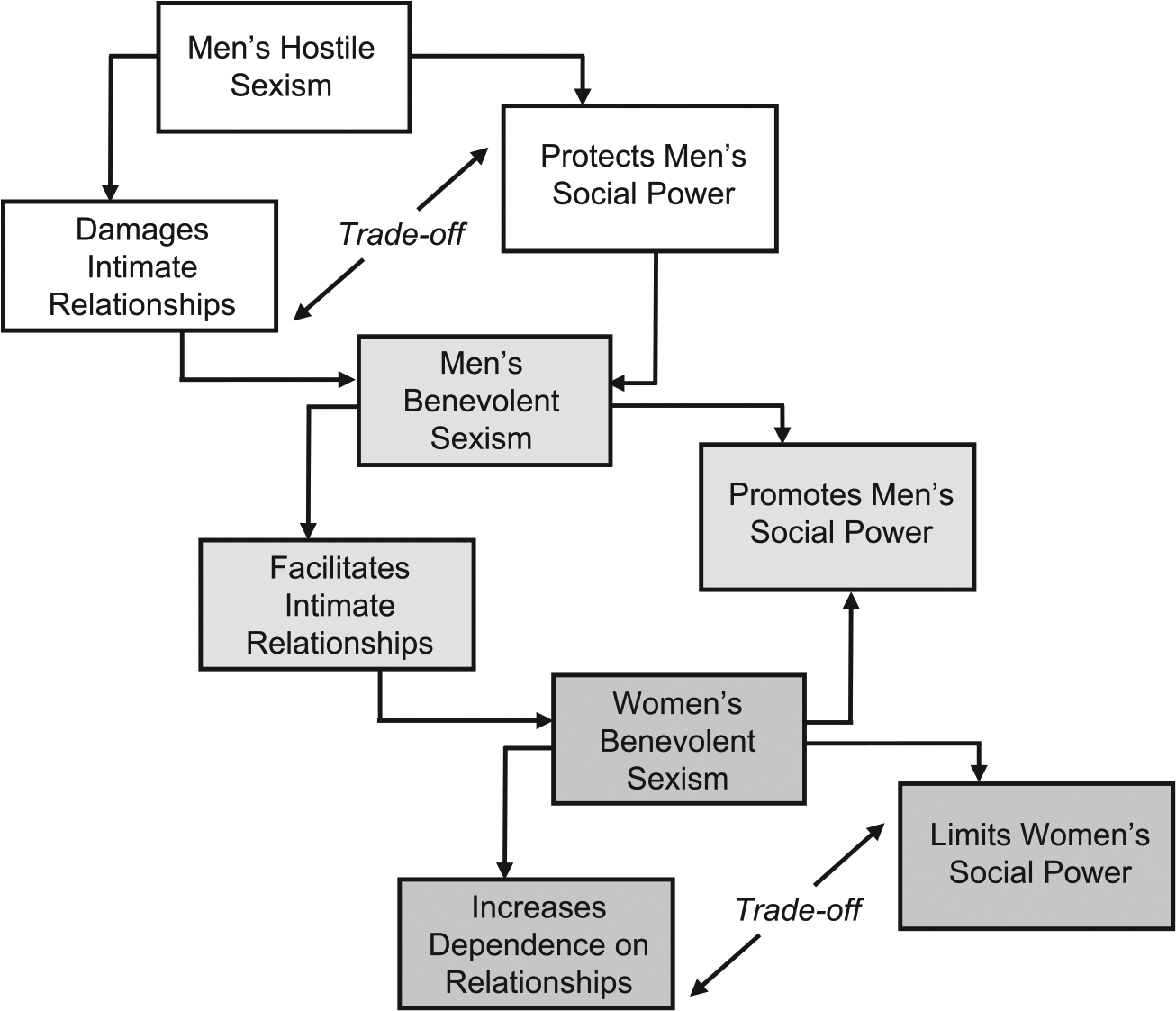
Sexist attitudes and the trade-off between social power and intimate relationships.
Hostile Sexism: Protecting Men’s Social Power but Damaging Intimate Relationships
Hostile sexism portrays the relationship between men and women as a competition for power, portraying women as trying to get “control over men” and using the “guise of equality” to get ahead of men (Ambivalent Sexism Inventory; Glick & Fiske, 1996). Hostile sexism protects men’s advantaged societal status by devaluing women’s competence, advocating aggression toward women who challenge men’s social power, and intimidating women from pursuing independent success (e.g., Glick et al., 2000; Glick, Diebold, Bailey-Werner, & Zhu, 1997; Masser & Abrams, 2004). Yet, men cannot hold complete power within intimate relationships. Instead, heterosexual men are dependent on women for fundamental needs, such as support, intimacy, and reproduction, just as women are on men. Such interdependence clashes with the motive to protect men’s power. Thus, hostile sexism expresses fears that women will exploit men’s relational dependence to subvert men’s power, such as putting men “on a tight leash” (Ambivalent Sexism Inventory; Glick & Fiske, 1996).
Critically, the interdependent nature of intimate relationships reduces the degree to which hostility can protect men’s power. Men who endorse hostile sexism exhibit more aggression toward female partners, and do so particularly in contexts in which their power is challenged or when they are dependent on their partners (e.g., Cross, Overall, Hammond, & Fletcher, 2017; Hammond & Overall, 2013b; Overall, Sibley, & Tan, 2011). However, these aggressive responses tend to reduce, rather than yield, influence over intimate partners and they damage both men’s and women’s relationship satisfaction (e.g., Hammond & Overall, 2013a, 2013b; Overall et al., 2011; also see Hammond & Overall, 2017a, 2017b). Thus, as shown in the top of Figure 1, hostile sexism protects men’s greater social power but prevents the attainment of core needs in intimate relationships. This trade-off between protecting men’s social power and damaging intimate relationships necessitates the emergence of benevolent sexism (Glick & Fiske, 1996, 2001; see cascade from men’s hostile sexism to men’s benevolent sexism in Figure 1).
Men’s Benevolent Sexism: Promoting Men’s Social Power and Facilitating Intimacy
Benevolent sexism offsets the costs of hostile sexism by both promoting men’s social power and facilitating intimate relationship between men and women (see middle of Figure 1). Glick and Fiske (1996) describe benevolent sexism as prejudicial, but subjectively positive, attitudes that promote heterosexual intimacy. Benevolent sexism emphasizes that both men and women have special qualities that should be revered: Women’s worth and uniqueness lies in special interpersonal qualities (e.g., morality, warmth, empathy) that complement men’s more practical, independent qualities (e.g., strength, competence). These complementary differences produce a romanticized version of heterosexual relationships in which women’s love and support complete men, who in turn should cherish, protect, and provide for women. Thus, benevolent sexism celebrates the mutual dependence between men and women by emphasizing the value of intimate relationships and specifying distinct roles that revere both men and women.
Unlike hostile sexism, benevolent sexism facilitates men’s relationship needs. Men who endorse benevolent sexism are more open and caring within couples’ conflict interactions, which produce more success in influencing female partners (Overall et al., 2011). Men’s benevolent sexism is also associated with greater satisfaction with female partners and intimate relationships (Hammond & Overall, 2013a; Sibley & Becker, 2012). These benefits also arise when women endorse benevolent sexism and thus follow prescriptions that women should be warm, affectionate, and support their male partner (Chen, Fiske, & Lee, 2009; Ramos, Barreto, Ellemers, Moya, & Ferreira, 2016). For example, women who endorse benevolent sexism provide more support as their male partners pursue personal goals and success, which leads male partners to feel greater regard and intimacy in their relationships (Hammond & Overall, 2015).
Similar to hostile sexism, however, benevolent sexism also enhances men’s social power. Attitudes that prescribe reverence and protection of women, and facilitate intimacy and support in relationships, may not appear “sexist.” Yet, by valuing different qualities in men and women, benevolent sexism prescribes specific gender roles that promote men’s social power and confine women’s power to the relationship domain (Glick & Fiske, 1996). Men’s occupation of high-status career-focused roles legitimizes beliefs of men’s competence, whereas women’s home-oriented caregiving roles confirm beliefs of women’s communal qualities (Glick & Fiske, 1996; Lee, Fiske, Glick, & Chen, 2010; Ramos et al., 2016). Indeed, benevolent sexism only directs reverence toward “good” women in men’s personal lives who fulfill traditional roles (Glick & Fiske, 1996). When women do not live up to these ideals, benevolent sexism prompts punitive rather than protective responses (Abrams, Viki, Masser, & Bohner, 2003; Hammond & Overall, 2014; Viki & Abrams, 2002).
Moreover, by endorsing different gender roles and valuing different qualities in men and women, benevolent sexism also promotes men’s social power by negatively affecting women in career settings. Benevolent sexism conveys that women should be cared for and protected because they are less capable and thus need help from men, which threatens women’s competence. For example, offers of help framed by benevolent sexism, such as men saying “don’t worry, male co-workers will cooperate and help you to get used to the job,” interfere with women’s task performance and reduce women’s feelings of competence (Dardenne, Dumont, & Bollier, 2007, p. 767; also see Barreto, Ellemers, Piebinga, & Moya, 2010; Dumont, Sarlet, & Dardenne, 2010). The prescribed value of women’s interpersonal (vs. independent) qualities also means that exposure to benevolent sexism leads women to identify with more relational and less agentic attributes (Barreto et al., 2010), and show less interest in independent accomplishments (Feather, 2004; Rudman & Heppen, 2003).
In sum, even though benevolent sexism expresses care for women within heterosexual relationships, these attitudes restrict women’s success in career domains and thus promote men’s social power (see middle of Figure 1). Moreover, benevolent sexism also reinforces inequality because it offers a romanticized depiction of intimate relationship that encourages women to endorse benevolent sexism (see bottom of Figure 1). However, unlike for men, women’s endorsement of benevolent sexism does not promote women’s social power, nor does it facilitate the fulfillment of women’s relationship needs.
Women’s Benevolent Sexism: Limiting Women’s Power and Increasing Dependence on Intimate Relationships
The promise of care and adoration by male partners is appealing and masks the costs of benevolent sexism for women (Glick & Fiske, 1996; Jackman, 1994). Women tend to perceive benevolent sexism to be chivalrous, rather than “sexist” (Barreto & Ellemers, 2005; Viki, Abrams, & Hutchison, 2003), and rate men who personify the characteristics of benevolent sexism—a caring protector who believes it is their duty to provide for women—as relatively attractive (Bohner, Ahlborn, & Steiner, 2010; Cross & Overall, 2017; Kilianski & Rudman, 1998). This attraction is because benevolent sexism offers women security of male partners’ continued devotion and reliability (Cross & Overall, 2017; Cross, Overall, & Hammond, 2016). Women who perceive their male partners to endorse benevolent sexism believe that their partners will prioritize and remain invested in their relationship and adhere to their obligations to be devoted partners (Cross et al., 2016). This sense of relationship security, in turn, increases women’s own endorsement of benevolent sexism (Hammond, Overall, & Cross, 2016) and reduces the threat of relationship difficulties (Cross et al., 2016).
However, the relationship security that benevolent sexism promises women comes with a price. First, the caring behavior enacted by men who endorse benevolent sexism can undermine women’s competence. Male partners who endorse benevolent sexism adhere to their prescribed role as protector and provider by providing high levels of protective support to their partner (Hammond & Overall, 2015). Yet, unfortunately, this type of protective support has unintended personal costs for women. In particular, men who endorse benevolent sexism support their female partners by directing plans and solutions in ways that neglect women’s own abilities, which leads female partners to feel less able to achieve their own goals (Hammond & Overall, 2015). Regardless of the intent, support that takes over another’s goal strivings undermines efficacy, impedes goal attainment, promotes reliance on others, and thus restricts women’s independent success (Hammond & Overall, 2015; also see Shnabel, Bar-Anan, Kende, Bareket, & Lazar, 2016).
Second, endorsing benevolent sexism involves agreeing to the delineated gender roles benevolent sexism prescribes: Men hold the high-status position of protector and provider, whereas women assume the role of relationship-focused caregiver (Glick & Fiske, 1996, 2001). However, women are revered and cherished only if they fulfill their prescribed role. Thus, benevolent sexism sets up a trade-off for women: receive relationship security but forego competence and independence in domains outside of the relationship. Accordingly, women who more strongly endorse benevolent sexism report lower personal ambition for educational/career attainment (e.g., Fernández, Castro, Otero, Foltz, & Lorenzo, 2006), believe their primary role is to support their partner’s goals and career (e.g., Lee et al., 2010), and defer more readily to their partners’ decisions about their own career (Moya, Glick, Expósito, de Lemus, & Hart, 2007).
In sum, benevolent sexism encourages women to prioritize their relationships and forego independence and personal accomplishments. This trade-off contributes to the persistence of gender inequality, yet remains relatively invisible because it appears as though women are receiving relationship benefits. Indeed, women who endorse benevolent sexism perceive that gender relations are fair and equitable (Hammond & Sibley, 2011). Moreover, trading personal ambition and success in favor of security within intimate relationships makes it even more important that intimate relationships are successful (Hammond & Overall, 2013b). Accordingly, women who endorse benevolent sexism become more dissatisfied when their relationship does not live up to the idealized version of relationships promised or when those ideals cannot be realized because their partner does not also endorse benevolent sexism (Casad, Salazar, & Macina, 2015; Hammond & Overall, 2013b, 2014; Overall et al., 2011). Rather than obtaining security in relationships, women who endorse benevolent sexism become more dependent on intimate relationships, and this heightened dependence makes it more difficult to satisfy their relationship needs (see bottom of Figure 1).
Summary: Women’s Trade-Off Between Intimate Relationships and Social Power
As summarized in Figure 1, women face a trade-off between security within their relationships and personal thriving in career domains. This trade-off is reinforced by both men’s and women’s endorsement of benevolent sexism. Critically, the relationship security benevolent sexism promises is central to why the detrimental consequences of these attitudes are opaque and often overlooked. Moreover, whether women endorse benevolent sexism or not, the presence of these social structures and attitudes mean that women’s investment in their personal success can come at the expense of success in their intimate relationships, and vice versa.
Considering the Relationship Dynamics Pushing Women to Trade-Off Personal Success
The trade-off women confront between relationship and personal success has spurred many interventions and policies to redress gender inequality. This key point is thus not new. However, Figure 1 highlights that positive security-enhancing processes within intimate relationships present forces that will work against efforts to promote women’s ambition and success in career domains. Below we reflect on how considering these relationship processes may enhance interventions and policies targeting gender inequality. We take it as a given that the hostile protection of men’s power, and the social structures that cultivate gendered aggression and exclusion, should be a principal focus of wide-scale interventions and policies. The aim of this article is to emphasize that relationship dynamics are important additional targets because they represent overlooked, and thus persistent, processes that will counteract efforts to mitigate gender inequality.
An important implication of the processes outlined in Figure 1 is that efforts to bolster women’s social power may be constrained by oppositional forces within intimate relationships. To illustrate, we focus on interventions to increase women’s participation in STEM fields, which frequently target women’s self-relevant evaluations and identity. Examples include affirming women’s values and identification within science domains (e.g., Miyake et al., 2010; Ramsey, Betz, & Sekaquaptewa, 2013), providing female role models (Dasgupta, 2011; Dasgupta & Stout, 2014), and fostering environments that fulfill both communal and competence needs (Brown, Smith, Thoman, Allen, & Muragishi, 2015). Yet, interventions that primarily target women’s career-based identification do not account for the potential relationship costs that could undermine intervention effectiveness. For example, because career achievements challenge the caregiving role valued in women, men rate women who are more ambitious and educated as less desirable romantic partners (e.g., Greitemeyer, 2007). Thus, motivations to secure satisfying relationships often conflict with and suppress women’s aspirations for STEM careers (e.g., Park, Young, Eastwick, Troisi, & Streamer, 2016; Park, Young, Troisi, & Pinkus, 2011). Moreover, as reviewed above, the desire for secure relationships also promotes women’s endorsement of benevolent sexism and thereby undermines women’s career aspirations, competence, and performance.
The need for relationship security is a fundamental human motive, and intimate relationships strongly determine health and well-being (Baumeister & Leary, 1995; Diener, Gohm, Suh, & Oishi, 2000; Robles, 2014). Thus, these relationship needs cannot be ignored, particularly given this powerful motive will compete with the gains of career-focused interventions. Moreover, these countervailing relationship forces are likely to be particularly poignant at development points that define women’s career trajectories, such as during early adulthood when romantic pursuits can offset a career/education focus or when children amplify the need for security (e.g., Hammond, Milojev, Huang, & Sibley, 2017; Rudman & Heppen, 2003). Given that relationships are central to human functioning, downplaying the importance of relationship security by failing to address these needs or empowering women to invest primarily in personal success will often be a losing battle. Moreover, failing to consider relationship needs will reinforce that women, unlike men, have to trade off relationship security for career success (or vice versa). For these reasons, education and workplace interventions should be most effective if they focus on how women, like men, can thrive in both domains. This approach could incorporate the same kind of strategies used to enhance women’s career identification and participation (e.g., managing multiple identities, using role models, fostering diverse needs), but target both career and relationship success.
Fostering thriving in both domains will be challenging. Indeed, policies designed to reduce work–family conflict often risk reinforcing gender roles. For example, having children tends to harm women’s career trajectory, yet offers a bonus for men; fathers are viewed as more warm and trustworthy but not less competent—as mothers are perceived (Cuddy, Fiske, & Glick, 2004). Moreover, policies designed to make it easier for women to have children and return to work can ironically exacerbate the trade-off for women. General increases in parental-leave benefits can be a disadvantage to women’s careers because it is women who primarily take up parental leave (Eagly & Carli, 2007). Instead, policies can support a more egalitarian family structure by providing incentives and leave for men’s involvement in child care. For instance, in Sweden, 3 of 16 months of parental leave is exclusively available to each parent (The Swedish Institute, 2017). These types of strategies that rebalance the burden of child care are likely to be more effective at reducing the costs of family responsibilities on women’s careers (also see Croft, Schmader, & Block, 2015). Such gender-shared policies also illustrate the need to involve men in efforts to reduce the trade-off women face between familial and career domains.
Men and women both contribute to the relationship dynamics that foster gender inequality and so intervening with both men and women is necessary. A good example is how intimate partners can facilitate versus hinder career goals and achievements. Romantic relationship structures offering women security prescribe that women should manage the family domain and limit women’s access to the types of support that aids goal achievement. Indeed, work–family conflicts damage women’s career satisfaction more strongly (Duxbury & Higgins, 1991; Martins, Eddleston, & Veiga, 2002), most likely because women do not receive equally helpful career support from their partner. Women in dual-income relationships tend to hold a higher share of child care/household responsibilities (Bartley, Blanton, & Gilliard, 2012; Croft et al., 2015), and men’s “benevolent” support that dictates solutions undermines rather than facilitates competence and goal achievement (Hammond & Overall, 2015). These goal-impeding relationship processes will be even more damaging when women face identity threats, discrimination, and exclusion in career domains and therefore really need competence-building support from their partners. Accordingly, interventions and policies designed to facilitate women’s career identification and participation would not only enhance success by attending to women’s relationships needs but also benefit by involving women’s relationship partners to promote equitable contributions to the family domain and foster more effective support of women’s careers (also see Barth, Dunlap, & Chappetta, 2016; Croft et al., 2015).
Delivering early education about benevolent sexism and the need to balance relationship and career-based needs, regardless of gender, should enhance thriving in both domains. This goal may be most easily achieved by layering information on benevolent sexism and relationship/career trade-offs into existing education interventions. The earlier in life that education-based strategies are implemented, the less likely women and men will adopt the gender-based identities that benevolent sexism offers (men as protector and provider, women as communal caregiver), and the less likely interventions rectifying relationship-career trade-offs in adulthood will need to combat the loss of these security-providing identities. Early intervention will also reduce the presence of benevolent sexism and associated competence-inhibiting support in the workplace, and thus limit the additional challenges women face in career domains. Early education should also aim to foster equal valuing and participation in communal roles that disproportionately fall to women within both relationship and career settings (see also Boston & Cimpian, 2017; Croft et al., 2015). Nonetheless, highlighting again that relationship processes are central, early interventions that reduce the emergence of benevolent sexism in males and females will limit the degree to which both men’s and women’s benevolent sexism offers relationship security in ways that deter women from career domains (Hammond et al., 2016).
Conclusion
Benevolent sexism plays an important role in sustaining gender inequality because it offers intimacy and security in heterosexual relationships. However, the relationship security benevolent sexism promises comes at the expense of women’s (but not men’s) career aspirations and accomplishments. The fundamental relationship motives that underpin this relationship-career trade-off for women present countervailing forces to policies designed to mitigate gender inequality. Thus, effective interventions must attend to the relationship processes that restrict women’s careers by valuing both career and relationship needs, promoting equity in career support and caregiving within intimate relationships, and providing early education to both women and men to limit the appeal of relationship roles that constrain gender equality.
Footnotes
Authors’ Note
The authors contributed equally to this article.
Declaration of Conflicting Interests
The author(s) declared no potential conflicts of interest with respect to the research, authorship, and/or publication of this article.
Funding
The author(s) received no financial support for the research, authorship, and/or publication of this article.