




Abstract


Introduction:
Ventral rectopexy (VR) has evolved since its initial description in the 1980s 1 as a preferred surgical approach for posterior compartment pelvic floor dysfunction, including rectocele and rectal intussusception. Unlike posterior rectopexy, which requires circumferential mobilization and may lead to postoperative rectal inertia and constipation, 2 VR preserves the autonomic nerves and offers improved functional outcomes while potentially addressing associated middle compartment descent. Biological grafts have demonstrated favorable long-term safety, with a 15-year cohort of 366 minimally invasive VRs reporting no graft-related complications or chronic pelvic pain. 3 The adoption of robotic platforms further enhances precision and exposure in the deep pelvis, supporting meticulous anterior dissection and suturing. 4 A systematic review of pelvic organ prolapse surgery has similarly shown erosion rates of up to 12% with synthetic mesh but none with biological implants. 5 This video vignette demonstrates key technical refinements in robotic VR using a biological graft.
Materials and Methods:
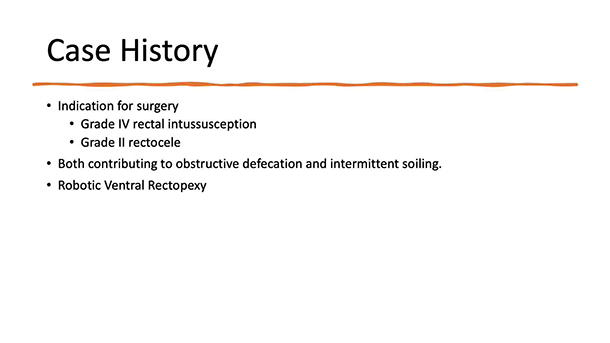
A 62-year-old female presented with posterior compartment pelvic floor dysfunction characterized by rectocele and rectal intussusception. A robotic VR was performed using four robotic ports and one assistant port. Pelvic exposure was optimized with a uterine retraction stitch and selective epiploic colopexy. A cuff of redundant peritoneum was excised from the pouch of Douglas to flatten the rectovaginal plane and enhance graft apposition. A porcine multilayer small intestinal submucosa biological graft was tailored to the patient’s anatomy and secured under gentle proximal tension to the sacral promontory using interrupted 2-0 nonabsorbable sutures. Peritoneal closure was completed with a continuous absorbable barbed suture to re-establish the pelvic barrier.
Results:
The procedure was completed without intraoperative complications. Operative time was approximately 145 minutes, estimated blood loss was minimal, and the patient was discharged on postoperative day 2. At 6-month follow-up, she reported marked improvement in obstructed defecation with no recurrence and no graft-related complications.
Conclusions:
Robotic VR combines biological graft reinforcement with the enhanced precision of robotic surgery. This approach provides a safe, reproducible, and minimally invasive method for restoring pelvic anatomy and function while minimizing mesh-related complications. The video highlights important technical nuances, including graft preparation, controlled tensioning to avoid pressure-related erosion, and peritoneal reconstruction, serving as a practical reference for surgeons aiming to refine their technique in robotic pelvic floor surgery.
The authors have no financial funding to declare.
Conflict of Interests:
None.
Written informed consent was obtained from the patient for publication of this video and accompanying clinical details. All identifying information has been removed to ensure anonymity.
This work was conducted at St John of God Subiaco Hospital, Western Australia. The video and study represent the authors’ own clinical experience and has no conflicts of interest or obligations resulting from it.
Author(s) have received and archived patient consent for video recording/publication in advance of video recording of the procedure.
Runtime of video:
9 mins 36 secs