




Abstract


Methods:
All surgeries occurred in an academic medical center. The patients were positioned in dorsal lithotomy, and the Da Vinci Xi Robotic Surgical System was used for all three surgeries. This case series did not require the Institutional Review Board approval per institutional policy. Institutional patient consent was obtained for filming of these cases and subsequent publication. The first patient is a 22-year-old G1P1 with a history of left renal agenesis and unicornuate uterus with a left noncommunicating uterine horn, which was noted during C-section, and symptomatic dysmenorrhea. The second patient is 27-year-old G0 with right renal agenesis, uterine didelphys, and a longitudinal vaginal septum who desired fertility-sparing surgery to relieve dysmenorrhea. The third patient is 45-year-old G0 with chronic pelvic pain and uterine didelphys who desired definitive surgical management.
Results:
The first patient underwent robotic-assisted uterine horn resection. The second patient underwent a robotic-assisted hemi-hysterectomy and vaginal septum resection. The third patient underwent a robotic-assisted total hysterectomy. All three surgeries were completed successfully without postoperative complications. As of 2 years post-operatively, neither of the patients who underwent fertility-sparing surgery had become pregnant to the authors’ knowledge.
Conclusion:
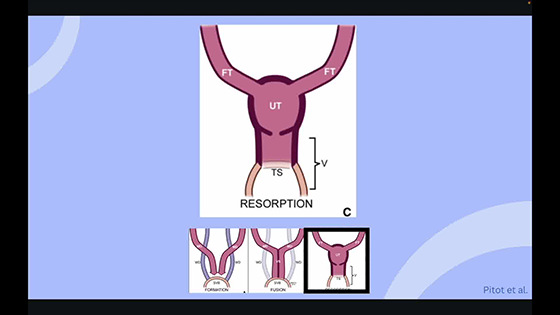
These three cases highlight the wide variation in Müllerian anomaly phenotypes and demonstrate robotic surgical techniques to address these anomalies. This video showcases the importance of anticipating distorted anatomy, including the bladder and sigmoid colon overlying the didelphic uterus. As demonstrated in this video, vaginal septum resection may be required prior to the laparoscopic portion of the case, and a spongestick can be utilized in lieu of a uterine manipulator. Although it is unknown if the patients described successfully conceived, fertility-sparing surgery has documented pregnancy successes. A case series by Pados et al. reported 7 successful pregnancies following laparoscopic uterine horn resection in 7 women. 6 All births were preterm cesarean sections. This is often recommended due to the suspected increased risk of uterine rupture following the disruption of myometrial integrity after excision of a broad uterine horn. 6 Case reports exist of patients conceiving postoperatively following a hemi-hysterectomy, but, due to the rarity of this population, there are no specific estimates of reproductive success. 7 Preoperative planning, surgical management, and counseling regarding obstetric risk should be individualized to each patient’s symptoms and goals, and the surgeon should be prepared to modify their operative technique based on the unique anatomic differences present in this population.
Institutional patient consent was obtained for filming of these cases and subsequent publication. Authors received and archived patient consent for video recording/publication in advance of video recording of the procedure.
Portions of this video were presented as a virtual poster at the American Association of Gynecologic Laparoscopists Annual Global Congress on MIGS in Vancouver, British Columbia, Canada, in November 2025.
The authors have no conflicts of interest to disclose.
No funding was received for this project.
Runtime of video: 7 mins 00 secs.