



Abstract
The relationship between universities and community colleges has grown and changed dramatically since the significant rise in the number of community colleges in the United States in the 1970s. New Mexico State University (NMSU) and Doña Ana Community College (DACC), which is also part of NMSU, are uniquely partnered to address the needs of students and residents of southern New Mexico. DACC offers an Associate of Applied Science in Public Health (AAS in PH), while NMSU offers a Bachelor of Public Health (BPH). To date, two articulation agreements have been established, over a 10-year period, to provide structure for how and which AAS in Public Health courses would transfer to the BPH degree program and satisfy requirements at NMSU, in general, and the BPH degree, specifically. Information is provided to explain how these articulation agreements evolved, the key principles and components of the articulation agreements, outcomes, and lessons learned. This articulation agreement process has proven beneficial for students, faculty, and the public health profession overall; it has specifically helped develop and sustain an “educated citizenry” as well as a well-qualified public health workforce in our predominantly rural and border state in keeping with the Institute of Medicine recommendations. This collaborative effort provides a framework for other colleges and universities located in similar underserved communities.
Articulation agreements, particularly in public health education, are critical because of the rapid growth of baccalaureate public health programs. In a 2008 article in The Washington Post, Brown referred to public health as a “hot field” for a global generation. The article indicated that courses in global health, public health, and epidemiology were attracting undergraduates in record numbers leading to more faculty hires and expansion of teaching formats and course offering (Brown, 2008; Tarasenko & Lee, 2015). Public health degree conferrals increased from 759 in 1992 to 1,469 in 2004 and to 6,464 in 2012 (Leider et al., 2015). The growth of baccalaureate public health programs gained the attention of the Council on Education for Public Health, the accrediting agency for the discipline, as early as 2006 when it issued a technical assistance paper titled “Including Undergraduate Public Health Degree Programs in Your Unit of Accreditation” and again in September 2013 when it approved procedures to include “Standalone Baccalaureate Programs (SBPs)” as a unit of accreditation (Council on Education for Public Health, 2006, 2014). Articulation agreements between community colleges and universities and their preprofessional preparation and education were significant contributors to this growth of baccalaureate public health programs (Lee, 2008).
The relationship between universities and community colleges has been growing and changing dramatically since the significant rise in the number of community colleges in the 1970s. While transfer has always been one component of community colleges’ mission, formalized articulation agreements have grown in popularity to facilitate transfer to 4-year university programs (Bers, 2013; O’Meara, Hall, & Carmichael, 2007; Wright, & Middleberg, 1998). Generally, articulation agreements are policies that are formally negotiated at the program, college, and/or state level to ensure equivalency between community college and university courses and outline how specific courses, credits, and degrees transfer from one college to another (Bers, 2013; O’Meara et al., 2007). In addition to seamless transfer, articulation agreements have the potential to diversify and improve access to baccalaureate education and support education mobility in geographically large and impoverished states such as New Mexico (American Association of Colleges of Nursing, 2005).
Organizational Factors in Articulation
A number of organizational factors have been associated with articulation success, including available faculty resources, established policies related to application review and requirements, communication processes directed toward students, and collaborations among educators within and across colleges. The aforementioned factors coupled with environmental and existing sociodemographic factors such as rurality, poverty, ethnicity, and gender make the process exceedingly complex. Gross and Goldhaber (2009) specifically identified per-pupil spending, higher numbers of tenure-track faculty, and intensive advising (especially at the 2-year community college level) as keys to increased rates of transfers. Correspondingly, articulation to facilitate transfer functions best when faculty members play a key role (O’Meara et al., 2007) and advisors are actively engaged in the articulation-building process (Wright & Middleberg, 1998). In his assessment of the role of faculty in the articulation and transfer process, Richardson (1993) stated, “Faculty values, attitudes, and practices are the keystones of any arch intended to form a bridge between an ever more diverse student population and the baccalaureate degree” (p. 42). In investigating successful collaborations involving community colleges, Wright and Middleberg (1998) emphasized faculty voice and advice as critical to responsive articulation and transfer models in the continuous negotiations to maintain and align course and program objectives. This maintenance and alignment is particularly critical in minimizing and/or eliminating curriculum redundancies. Bers (2013) highlighted bilateral agreement on nomenclature and course content as another key factor in determining the realization of articulation.
The New Mexico Context
New Mexico State University (NMSU) and Doña Ana Community College (DACC) are uniquely partnered to address the needs of students and residents of southern New Mexico. The Centers for Disease Control and Prevention (CDC) identifies Doña Ana County (where DACC and NMSU are located) as an area disparately affected by poverty and limited access to preventive and medical care (CDC, 2015). Both the community college and university share a number of characteristics identified by Higgins and Katsinas (1999) as potentially and adversely effecting transfer rates, including serving a largely poor and mostly Hispanic population. In addition, many students in the state graduate high school unprepared for college-level work with few role-models in their support network who have attended a 4-year university, thus augmenting the important role of community colleges such as DACC within the state. In 2012, 51.4% of state high school graduates took remedial classes on enrolling in postsecondary education (New Mexico Higher Education Department, 2013). As a result, students often find themselves enrolling at a community college to prepare for the transition to a university through pre-professional preparation and education.
DACC is an open admission college that is a part of the NMSU system. In 1973, DACC was established as a vocational training college but over time evolved to offer general studies courses. Reports from the 1980s to the state indicated that DACC had a higher rate of underprepared students than the state average. In 1988, to accommodate a New Mexico legislative initiative in support of developmental education, the mission of DACC shifted from being a purely vocational training college and began offering developmental courses.
Similar to NMSU, DACC is a Hispanic-serving, public degree-granting university in close proximity to the U.S.-Mexico border. The per capita income in 2009 to 2013 in Doña Ana County was $19,565, with 27% of people living below the poverty line (U.S. Census, 2013). The DACC mission statement states, “DACC is a responsive and accessible learning-centered community college that provides educational opportunities to a diverse community of learners in support of workforce and economic development.” It is important to note that the DACC Values Statement reinforces that students will be “respected for their diversity” and “provided with a safe and supportive learning environment” (DACC, n.d.-a).
NMSU is a major public, research university in Las Cruces, New Mexico. It is the state’s land-grant university. It is not an open enrollment campus. NMSU has a much longer history than DACC. It was founded in 1888 and is the oldest public university of higher education in the state. NMSU is a NASA Space Grant College and a Hispanic-serving university. NMSU is the second largest 4-year university in the state, in terms of total enrollment across all main and four branch campuses across the state. NMSU and DACC are accredited by the Higher Learning Commission (2015). Current student profiles for DACC and NMSU are provided in Table 1.
Current Student Profiles for DACC and NMSU.

Note. DACC = Doña Ana Community College; NMSU = New Mexico State University.
Data from Doña Ana Community College (n.d.-b). bData from Collegedata (2015).
It is within this context that the Associate of Applied Science in Public Health gains traction among students seeking to improve their own knowledge and skills, to contribute positively to the health of their communities, and then to continue their scholarship and service further through the Bachelor of Public Health at NMSU. It also is relevant within the context of the Institute of Medicine’s recommendation to prepare an “educated citizenry” and a well-educated public health workforce (Brown, 2008; Tarasenko & Lee, 2015). In this article, we describe the history and our experiences in implementing successful public health program articulation agreements between DACC and NMSU, to effectively meet the educational and workforce needs of students, and support them as they transfer from DACC to the 4-year public health program at NMSU.
Background
NMSU and DACC, which are located in Southern New Mexico, specifically Doña Ana County, are unique for many reasons. The college and university are located within the U.S.-Mexico border region, which is defined as 100 km (62.5 miles) north and south of the international boundary (Embassy of the United States—Mexico, 1983). The border spans 2,000 miles from California to the southern part of Texas. The population for this expanse of land is estimated to be 14.6 million inhabitants and expected to double by the year 2030 (Environmental Protection Agency/Secretaria de Medio Ambiente y Recursos Naturals, 2012; Wilson Center, 2013). The location of both the college and university attracts international, multilingual, and multicultural students, some of whom regularly commute across the U.S.-Mexico border to attend classes.
In 2015, New Mexico ranked 48th to 49th for child economic, education, health, and community well-being (Annie E. Casey Foundation, 2015). Doña Ana County is a designated Health Professional Shortage Area in primary care, dental health, and mental health (Health Resources and Services Administration, Data Warehouse, 2015). Within Doña Ana County are 36 colonias, residential areas that lack some basic living necessities, for example, potable water, sewer systems, paved roads, electricity, and safe and sanitary housing (Texas Secretary of State, n.d.; University of New Mexico, Bureau of Business and Economic Research, 2012). It is within this context that both DACC and NMSU operate, provide education, and contribute to the workforce needs of communities.
Public Health Programs at DACC and NMSU
NMSU has maintained a program for students to earn a Bachelor in Community Health (BCH) since 1979. The degree was renamed Bachelor of Public Health (BPH) in 2014, to better reflect the curriculum and the expanse of knowledge and skills required of students graduating with this degree. Students earn the 128 credit degree, primarily on the main campus in Las Cruces, NM, with courses also offered online.
DACC created their Associate of Applied Science in Public Health (AAS in PH) in 2003. Students earn 66 credits to complete their Associate’s degree. Courses are offered on campus and online. The 66 credits include the General Education and department requirements, which in turn serve as prerequisites to applying to the BPH program at NMSU. Students who have completed all the prerequisite course work, with a 2.5 GPA, may apply to the BPH program. The application process to move from DACC to NMSU includes English and mathematics entrance exams, transcript review, and submission of a personal statement. The AAS in PH degree fulfills the prerequisites and general education requirements necessary for students to apply for the BPH degree program, with the exception of a statistics course.
History
With the establishment of the AAS in PH degree in 2003, students quickly realized their opportunity and ability to move to NMSU main campus and complete their BPH degree. At the onset, students from DACC would take courses, and when planning to earn their BPH, would transfer to the program yet still had to take extra courses to be eligible to apply to or complete the BPH program, as the two degrees did not align in a seamless manner. In one of the first meetings between the DACC AAS in PH and NMSU BPH administrations, in 2005, it was recognized that a plan needed to be established, clearly outlining the process for students to more efficiently complete the AAS in PH degree and segue to the BPH degree, with minimal need to take additional courses (Riegelman, Wilson, Dreyzehm, & Huffard, 2014). The College of Health and Social Services (within which the Department of Public Health Sciences is located) established 2 + 2 articulation agreements with the 20+ community colleges, including tribal colleges, in the State of New Mexico, providing for a seamless transition to the BPH program in the mid-2000s. While the formal agreement was in place, at the administrative level, it became evident to advisors and faculty at both DACC and NMSU, who worked with AAS of PH students, that the seamless transition and transfer needed some adjustments to truly align the admission requirements and course sequencing between the community college and university.
In addition to this articulation agreement between the public health degree programs at DACC and NMSU there exist nine other established 2 + 2 (fully articulated) degree programs, including education, criminal justice, engineering, hospitality, architecture, and business. However, here we focus specifically on the implementation of the public health program articulation agreements between DACC and NMSU.
Public Health Articulation
The first public health articulation agreement established in 2004-2005 provided structure regarding how and which AAS in PH courses would transfer to the BPH degree program. The next version of the articulation agreement, established in 2010, further identified which of the DACC AAS in PH courses satisfy requirements at NMSU, in general, and with the BPH degree, specifically.
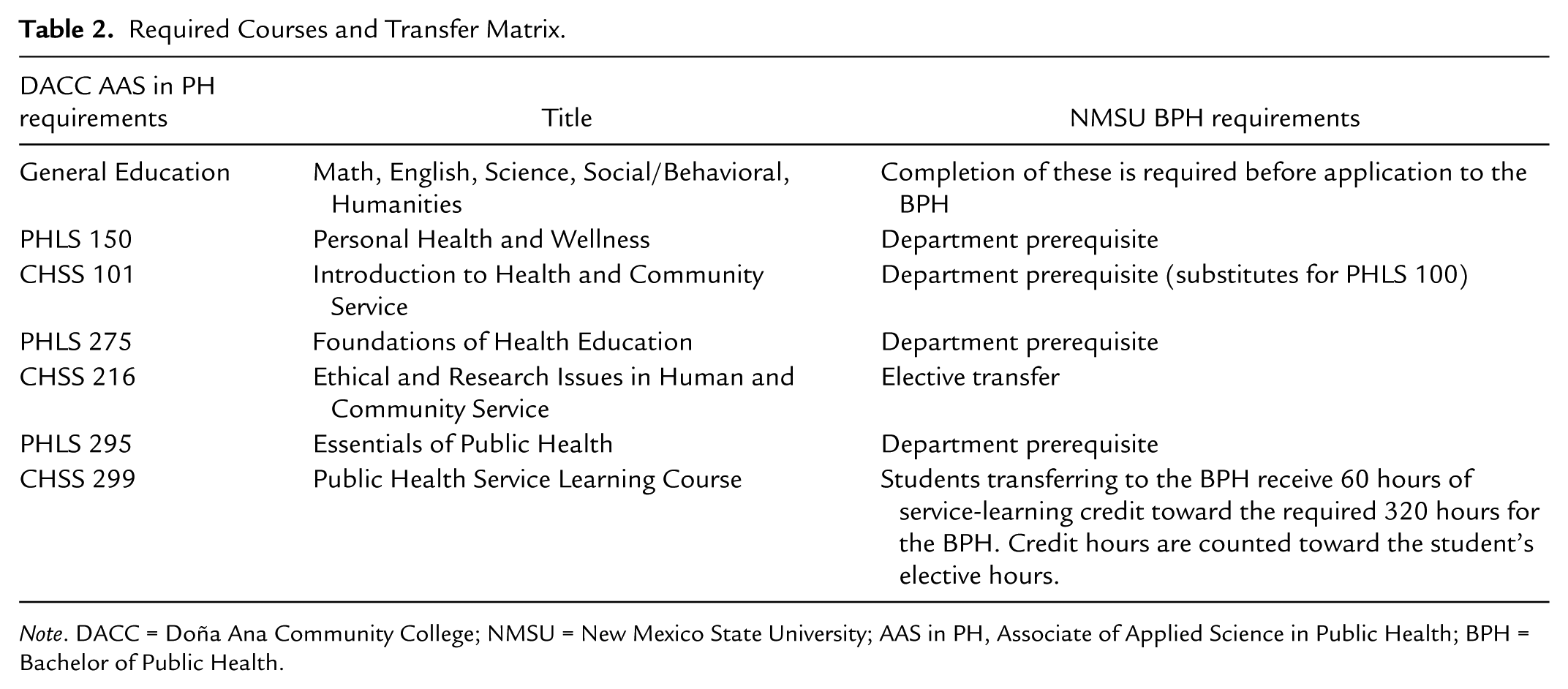
In addition to the above-mentioned articulation agreements and modifications, during the course of each academic year since 2005, the faculty from both programs, the BPH Advisor, and BPH Coordinator meet to discuss programmatic issues; potential changes in courses, content, textbooks; and any other issues that have risen that could affect a student’s transition from the community college to the BPH program at NMSU. Over the years, these meetings have resulted in the modification of the AAS in PH curriculum to better align with the SOPHE-AAHE Baccalaureate Program Approval Committee (SABPAC) Approved BPH curriculum at NMSU and the alignment of core courses with the National Commission for Health Education Credentialing responsibilities and competencies. Another key decision that occurred in 2013, as a result of such meetings, was to allow the majority of the service learning hours, obtained with the AAS in PH, to offset total hours required toward the field experience hours for the BPH. Instead of requiring completion of 320 hours of field experience in the BPH program at NMSU, the AAS in PH transfer students complete 260 hours, due to the acknowledgement of hours earned with their AAS in PH, as included in the 2013 articulation agreement.
The service learning component in the AAS in PH at DACC and the field experience in the BPH program at NMSU have benefitted from collaboration between faculty and advisors at both programs. The results include solid, trusting relationships with agencies who welcome students into their offices to complete their service learning/field experience requirements. Many preceptors are well seasoned as mentors, which serves to strengthen the quality of students’ experiences. Approximately 10% of the NMSU BPH students obtain jobs at their field experience sites, once they have completed their degrees. Such placements that evolve into employment opportunities, have become a critical mechanism in developing a public health workforce that is well-educated and culturally competent to make a difference in the health and well-being of communities in the U.S.-Mexico border region.
There are numerous assessments to determine how students are faring at their field experience sites. Each summer, the NMSU BPH program sends an electronic outcome assessment to preceptors, who had students during the previous spring semester for field experience. The preceptors assess students work habits, written and oral communication skills, and professional demeanor. The information is summarized and provided to faculty at both DACC and NMSU and to upper level university administration.
While the articulation agreement does not specify particular roles, it is recognized that faculty at each program are responsible for their own course syllabi within the larger programmatic curricular framework and requirements. However, it is important to note that DACC students are considered NMSU students and their student records are contained in the same student database, and courses at DACC count toward degrees at NMSU. Therefore, there is no additional transcript evaluation needed for a student moving from the AAS in PH to the BPH. Consequently, the university registrar office does not play a significant role in this transfer process and is not specifically identified in the articulation agreement. This type of symbiotic relationship between 2-year and 4-year higher education is uncommon but has contributed immensely to the seamless transfer of student from DACC to NMSU’s undergraduate public health degree program.
The aforementioned background and history provide insights into the collaborative articulation agreement and process that has evolved between DACC and NMSU over the years. Since 2005, this collaborative effort has been successful in meeting the educational needs of students, helping students acquire the knowledge and skills to become public health workers, developing a diverse and well-qualified workforce that is committed to staying in the U.S.-Mexico border region, and contributing to the health and well-being of underserved communities. Central to this partnership has been the articulation agreements aimed at (a) strengthening the existing partnership between DACC and NMSU public health programs, (b) meeting the changing students’ needs and professional demands, (c) transferring and transitioning students to successfully complete the BPH degree program at NMSU, and (d) coordinating the transferable public health coursework similarities between DACC and NMSU. Next, we describe the components of the NMSU-DACC articulation agreement and the key principles reflected in the current articulation agreement.
Components of the NMSU-DACC Articulation Agreement
The current NMSU-DACC Articulation Agreement includes the following are the components:
The document’s intent.
A brief overview of the DACC AAS in PH degree and total hours required for the major as well as general education hours.
A brief overview of the NMSU BPH degree and total hours required for the major as well as general education hours.
The articulation which states that all 66 hours required for the AAS in PH degree will count toward the 128 required hours for the BPH degree.
A grid that identifies (a) the specific courses required of the AAS in PH; (b) the credit hours/course; (c) what each listed course satisfies in the BPH program, for example, an elective, a general education class, or a specific class within the BPH major; and (d) the outstanding classes required to earn the BPH degree (see Table 2).
Signatures of key administrative personnel within the program, college, through the President, for both the college and university.
Required Courses and Transfer Matrix.
Note. DACC = Doña Ana Community College; NMSU = New Mexico State University; AAS in PH, Associate of Applied Science in Public Health; BPH = Bachelor of Public Health.
Key Principles of the Current Articulation Agreement
Three key principles emerge as critical to the successful implementation and application of our current articulation agreement described above: They are Consistent Communications, Curricular Coordination, and Focused Advising, as described below.
Consistent Communications
Communication is critical to any successful partnership. Faculty at both DACC and NMSU meet any time there is an issue of concern or if there is a topic of interest that has been identified. For example, NMSU and DACC faculty met to identify opportunities to reinforce students’ use of APA formatting in all course-related writing assignments. Another example includes the sharing of information and changes in the BPH application requirements such as entrance assessments exams. In addition, faculty share syllabi and work together to identify common textbooks and course learning outcomes and assessments. To make sure that communications are consistent and timely, the Department Head of Public Health Sciences, the BPH coordinator, and the advisor from NMSU are all members of the DACC public health advisory board, which meets each semester. Advisory board meetings include discussions on changes at both schools, input from DACC students and community stakeholders. Furthermore, DACC faculty and advisor are included on the BPH and Department list serves, so they are aware of information shared with BPH students.
Curricular Coordination
Courses in the DACC associate’s program meet the prerequisite requirements for entry to the BPH (with the exception of statistics). While students are discouraged from “swirling,” they can be assured they are getting the similar course content from NMSU or DACC. This is accomplished by not only sharing syllabi but also discussing topics that are covered in each course. In recent years, some adjustments have been made by each group to ensure that the same topics are covered, the same textbooks are used in the common courses, and students complete similar assignments and assessments. For example, students in the Foundations of Health Education course, at both DACC and NMSU, complete a mock grant application to demonstrate their knowledge of core concepts. While most students continue on to the BPH, a few do not, and to ensure those students are both prepared for the workforce and able to complete the associate degree, there are a few exceptional curricular issues. Specifically, students completing the AAS in PH complete CHSS 101, a three credit class, at the community college instead of PHLS 100, a one credit class. Additionally, because a small number of students in the associate’s degree are unable to complete the required math sequence in a timely fashion, statistics is not a requirement to graduate with an AAS in PH, but is strongly advised for transfer-oriented students.
Focused Advising
The professional staff advisor at NMSU and the public health faculty at DACC communicate regularly. As part of the focused advising, the NMSU advisor participates in informational sessions, conducted at DACC each semester, in which the NMSU advisor explains the application process and is available after the session for individual advising. The NMSU advisor also conducts English and Mathematics assessments at DACC each semester. Advising for students is aided by the degree audit system, which is available to students at both schools, so DACC students are always able to track their progress to both the AAS in PH and the BPH. This focused advising approach, which includes the NMSU advisor meeting with each DACC student in the last semester of their associate’s program, has been key to ensuring timely application to the BPH. The NMSU advisor also encourages students to complete the associate’s degree before focusing on the bachelor’s degree.
Outcomes of the Articulation Agreement
The first articulation agreement between DACC and NMSU occurred in 2004-2005, with modifications in 2010, to further clarify which of the DACC AAS in PH courses satisfied the specific requirements of the BPH degree. This type of articulation, as suggested by DeMott (1999), is classified as a vertical articulation because students make progress to a higher level of academic achievement—from an Associate degree to a Bachelor degree in public health—has been helpful in meeting the needs of students, residents, and the job market in New Mexico.
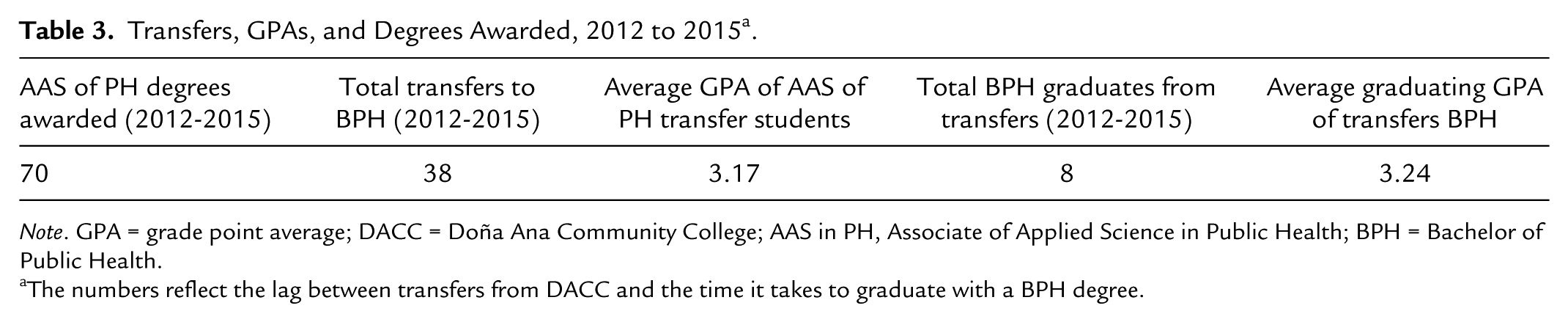
We, as faculty and advisors in the programs, recognize that the existing articulation agreement has benefitted us, making us better teachers and advisors. Furthermore, we acknowledge the diverse needs of and educational journeys of students, are culturally sensitive to students from underserved communities, and learn to serve as mentors and advocates for students throughout their education. In addition, we measure the effectiveness and success of the articulation agreement and our efforts through several quantitative and qualitative outcomes measures (see Table 3). These measures reflect our commitment to quality education to all students, ability to mentor and support students through their educational pursuits, and administrative and programmatic accountability. Outcome measures include qualitative and quantitative outcomes.
Transfers, GPAs, and Degrees Awarded, 2012 to 2015 a .
Note. GPA = grade point average; DACC = Doña Ana Community College; AAS in PH, Associate of Applied Science in Public Health; BPH = Bachelor of Public Health.
The numbers reflect the lag between transfers from DACC and the time it takes to graduate with a BPH degree.
Quantitative Outcomes
Increase in enrollments of students at DACC AAS in PH and in the BPH degree program at NMSU.
Higher transfer rates from DACC AAS in PH into the BPH degree program at NMSU.
Greater number of transfer students who graduate with a BPH degree from NMSU and the time taken to graduate.
Comparable average GPA of the transfer students entering the BPH program as compared to students who are not transfer students.
Similar performance of transfer students entering the BPH program, in the Math and English assessments tests, as compared with students who are not transfer students.
The average GPA of the transfer students at graduation with a BPH degree as compared with students who are not transfer students.
The types of and ease with which transfer students are able to secure employment or pursue further education in the form of a graduate degree.
Qualitative Outcomes
One of the key outcome measures we use in this category includes the documentation of students’ perception of their ease and comfort of transfer from DACC to NMSU. We believe that a high degree of ease and comfort experienced by students reflect the effectiveness of the articulation agreement in making a “seamless education” a reality to students in the state who otherwise would not have such an opportunity (Ignash & Townsend, 2000). As suggested by Ervin (2008), this ease and comfort, articulated by students in transferring from a 2-year community college (DACC) to a 4-year university (NMSU), is the best effectiveness measure of such a transition. Interviews and meetings with transfer students, as they finish their courses in the community college, during their tenure as undergraduate students in the BPH program, and their exit interviews at graduation, provide the information of students’ perceptions.
Lessons Learned
A broad, state-level articulation agreement was inadequate to address the specific needs of faculty, advisors, and students to allow a smooth/seamless transition between the community college and the university program. A very specific and regularly reviewed articulation agreement is at the heart of a successful and seamless transition for students.
Regular and open communication between the community college and university advisors, faculty, and program directors is essential to understand each other’s programs, and to address changing needs, priorities, and student issues. Ownership of classes and/or lack of flexibility with some course content can become a significant barrier for an articulation agreement to succeed.
The faculty, advisors, and administration must support the mapping of the successful academic plan for students and be willing to meet, discuss, adjust, strategize, and formalize the plan.
Students matriculating from the AAS in PH program are comfortable with core public health concepts and the National Commission for Health Education Credentialing responsibilities and competencies, allowing them to more readily grasp the material provided in upper division classes.
When the AAS in PH students undertake their field experience for their BPH, they are well aware of the importance of the placement, the need for demonstrated professionalism, the linkage between the information presented in the classroom, and its relevance at the site and within the community.
Careful and consistent tracking of the students, from the community college to the university program, is crucial to measure success and understand where students are within the BPH program, which of them proceed to earn graduate degrees, in what fields, and so on.
The successful articulation agreement process identified above has served students, faculty, and the academic public health programs in southern New Mexico very well in the past decade. With continued strong communication, curricular coordination, and focused advising, these achievements should continue into the future. The key principles in our articulation agreements and our experiences in establishing a successful articulation agreement process have the potential to serve as a framework for other academic public health programs situated in rural and border communities.
Footnotes
Declaration of Conflicting Interests
The authors declared no potential conflicts of interest with respect to the research, authorship, and/or publication of this article.
Funding
The authors received no financial support for the research, authorship, and/or publication of this article.