




Abstract
A subcommittee of SOPHE’s Community College Task Force developed a prototype template that can be used by community colleges to develop articulation agreements with bachelor’s degree programs in health education and related areas at other institutions. The article discusses the benefits of articulation agreements, presents the template, and outlines a process to use the template to build articulation agreements for public health education.
In 2012 the Association of Schools and Programs in Public Health (ASPPH) and the League for Innovation in Community Colleges embarked on work to provide community colleges with Prototype Curricular Frameworks for Public Health Generalists as part of the Framing the Future Task Force’s reimagining of education in public health (Riegelman, Wilson, Dreyzehm, & Huffard, 2014). The Community Colleges and Public Health Project asked the Society for Public Health Education (SOPHE) to participate in the project to insure the development of a high-quality health education concentration. The Public Health Generalist associate’s degree curriculum framework that resulted from the work of these groups is designed to prepare associate degree graduates for public health and related programs at the bachelor’s degree level and to encourage students to complete bachelor’s degree programs in the health field including public health generalist, health education, health administration, and environmental health (Lohrmann, Auld, Hawkins, Hicks, & Hutton-Rogers, 2016).
Work of the SOPHE Task Force
SOPHE’s Community Colleges Task Force (CCTF) was convened in 2013 and included representatives from a range of health education professional preparation programs working with community college programs in related areas. The CCTF developed three health education course outlines based on the latest health education competencies: Introduction to Health Education, Analyzing and Accessing Health Information, and Public Health Advocacy and Leadership in Action. The Introduction course outline was intended to be part of the public health generalist curriculum. However, all three health education course outlines could be adopted by community colleges to provide a core foundation for students wishing to explore and pursue bachelor’s degrees in health education and related areas, such as health promotion, at the bachelor’s level. Subsequent to developing the course outlines, a CCTF subcommittee was formed to develop a prototype template that could be used by community colleges to develop articulation agreements with bachelor’s degree programs in health education and related areas at other institutions. The subcommittee consisted of one representative each from a community college and a comprehensive college, both with experience in crafting and implementing articulation agreements.
There is inconsistent language referring to agreements between and among higher education institutions governing the acceptance and use of coursework toward degree completion (Bers, 2013). For example, these agreements may be labeled articulation agreements (University of Idaho, 2015), 2+2 programs (Penn State, 2013), transfer agreements (Palm Beach State College, 2015), transfer paths (SUNY, 2015), or transfer pathways (University of California, 2014). In some cases the term transfer program is used to indicate the acceptance of courses by one institution from another not necessarily tied to completion of a particular degree program (O’Meara, Hall, & Carmichael, 2007). For the purposes of this article the authors use the term articulation agreement to mean a formal statement of collaboration between two institutions of higher education facilitating the completion of a bachelor’s degree at one institution through the use of credits completed at a community college or other associate’s degree–granting institution (Maryland Council of Community College Chief Academic Officers, Maryland Community College Chief Student Affairs Officers, & Maryland Community College Research Group, 2012).
Advantages of Articulation Agreements
Creating articulation agreements between 2-year and 4-year higher education institutions takes time and effort from both parties involved. The time and effort spent benefit both institutions and students. Moreover, the U.S. Department of Education and others have placed college completion on the national higher education agenda (Hughes, 2013), and articulation agreements have been noted as one promising way to increase college completion (U.S. Department of Education, n.d.).
Most 2-year institutions or community colleges offer Associate of Science (AS) and Associate of Arts (AA) transfer degree programs. These programs are established to provide students with the requisite courses needed for the first 2 years or first 60 credits of a baccalaureate degree program. Having an articulation agreement that delineates what institutions will accept from the associate’s level to the bachelor’s level is extremely valuable since institutions can vary as to what they will accept for credit from one institution to the next. An articulation agreement will ensure that the receiving college accepts all credits or nearly all credits from the associate’s degree program. This benefits the students in that they will be able to transfer without loss of credit or having to repeat courses unnecessarily.
Having such an agreement benefits the receiving institution, in that there is consensus with the 2-year institution offerings as equivalent for the first two years or 60 credits of their degree program. Just as the 2-year institutions seek to provide students with the knowledge and skills to successfully complete their associate’s degree and transfer to the 4-year college, the 4-year institutions want to accept students’ transfer credits that have prepared students to complete their bachelor’s degree.
A report prepared by the Center for the Study of Community Colleges indicated that four elements are essential to a quality transfer degree program (Kaiser, Wagoner, & Cohen, 2011, p. iii):
A common general education package,
Common lower division premajor and early-major pathways aligned with 4-year degree programs at receiving institutions
A focus on credit applicability
Junior status on transfer
The report also suggests that three additional elements—(1) guaranteed and/or priority university admission, (2) associate and/or bachelor’s degree credit limits, and (3) an acceptance policy for upper division courses (p. iii)—are important but may vary in their level of importance based on state and institutional policies and cultures. The authors have also found that it is useful for the associate’s degree program to provide some flexibility in course options in order to be able to articulate with several 4-year colleges.
Articulation agreements between colleges and programs codify the specifics with regard to transferring from the 2-year to the 4-year program so that all parties receive the benefits outlined above.
Building Articulation Agreements
Higher education institutions may have administrators in place to facilitate and to process articulation agreements between community colleges (sending) and colleges granting bachelor’s degrees (receiving). These agreements are valuable resources for academic departments, chairpersons, other faculty, and staff who develop and instruct at the sending institution with the intention for students to transfer to other institutions to complete their bachelor’s degrees and for those at the receiving institution to recruit and advise transfer students, to appropriately assign resources for adequate course offerings, and to orient transfer students to upper division courses.
It is recommended that faculty representatives from the sending and receiving institutions work together to craft the articulation agreement (Southern Regional Education Board, 2007). Joint development of the articulation agreement facilitates timely adoption of the agreement at both institutions by identifying institutional barriers to seamless transfer early in the development process and providing a platform for jointly addressing the barriers. Examples of institutional barriers include policies discouraging students from completing the associate’s degree prior to transferring, lack of a guarantee of junior-level status at the receiving institution for students completing an associate’s degree, and lack of alignment between the associate’s and bachelor’s degree programs.
When developing an associate’s transfer degree program, it is ideal and may be required by the institution to review corresponding bachelor’s degree programs at several receiving institutions and establish articulation agreements concurrently while developing a new associate’s degree program. When seeking to establish articulation agreements for existing associate’s degree programs, the authors suggest, based on their experiences, beginning with receiving institutions to which the greatest number of students have enrolled from the sending institution.
Elements of an articulation agreement typically include (Cooper, McFarland, & Bradtmueller, 2012) the following:
The sending and receiving institutions and their degree programs
Admission requirements for receiving college’s programs
A listing of the transfer credits awarded
A summary of transfer credits including general education requirements, major requirements, and electives
A listing of the upper division courses that the students will take at the receiving college
A description of follow-up procedures for reviewing, updating, modifying, or terminating agreement; evaluating the agreement, that is, tracking the number of students who transfer under the articulation agreement and their success; and sending and receiving college procedures for publicizing agreement, for example, college catalogs, transfer advisers, websites, and so on
Developing a successful associate’s degree program with articulation agreements with senior colleges takes time and effort. This effort is well spent in establishing agreements that strengthens the programs for both the sending and receiving institutions and makes transfer more seamless for the students without loss of credit.
Developing the SOPHE Articulation Agreement Model
A subcommittee of the SOPHE CCTF consisting of a faculty member each from a comprehensive college granting bachelor’s degrees in community health and health education and a community college granting associate’s degrees with a program in health promotion and disease prevention was formed to draft a model or template for an articulation agreement between community colleges and bachelor’s programs in community health and/or community health education. The committee members had each been involved in crafting articulation agreements for their respective institutions. Committee members reviewed existing articulation agreements at their institutions and other institutions, updated their knowledge of “seamless transfer” initiatives and challenges, and reviewed the course outlines developed and recommended by the SOPHE CCTF to be included in associate’s degrees in health education–related programs and others developed as part of the Public Health Generalist associate’s degree curriculum framework. A draft of the articulation agreement template was then shared with the CCTF for comment. Several changes were made based on the feedback from CCTF members.
Discussion of the Model Articulation Template
The template outlines a 60–credit hour associate’s degree program of courses grouped into six areas (see Table 1): Public Health Education Core, Required Health, Required Health Electives, Experiential Learning; Electives, and General Education/College Distribution Requirements. Since course title and numbers differ across institutions the template uses generic course names that represent course content and skills. These courses include content and skills appropriate to associate’s degrees, are likely to fulfill lower division requirements in a public health or health education bachelor’s degree, and serve as necessary building blocks to upper level courses in health education. A scope and sequence likely to achieve mastery of the most recent health education competencies of an entry-level health educator were considered when determining what was to be included in the template.
Example Associate’s Degree Plan.
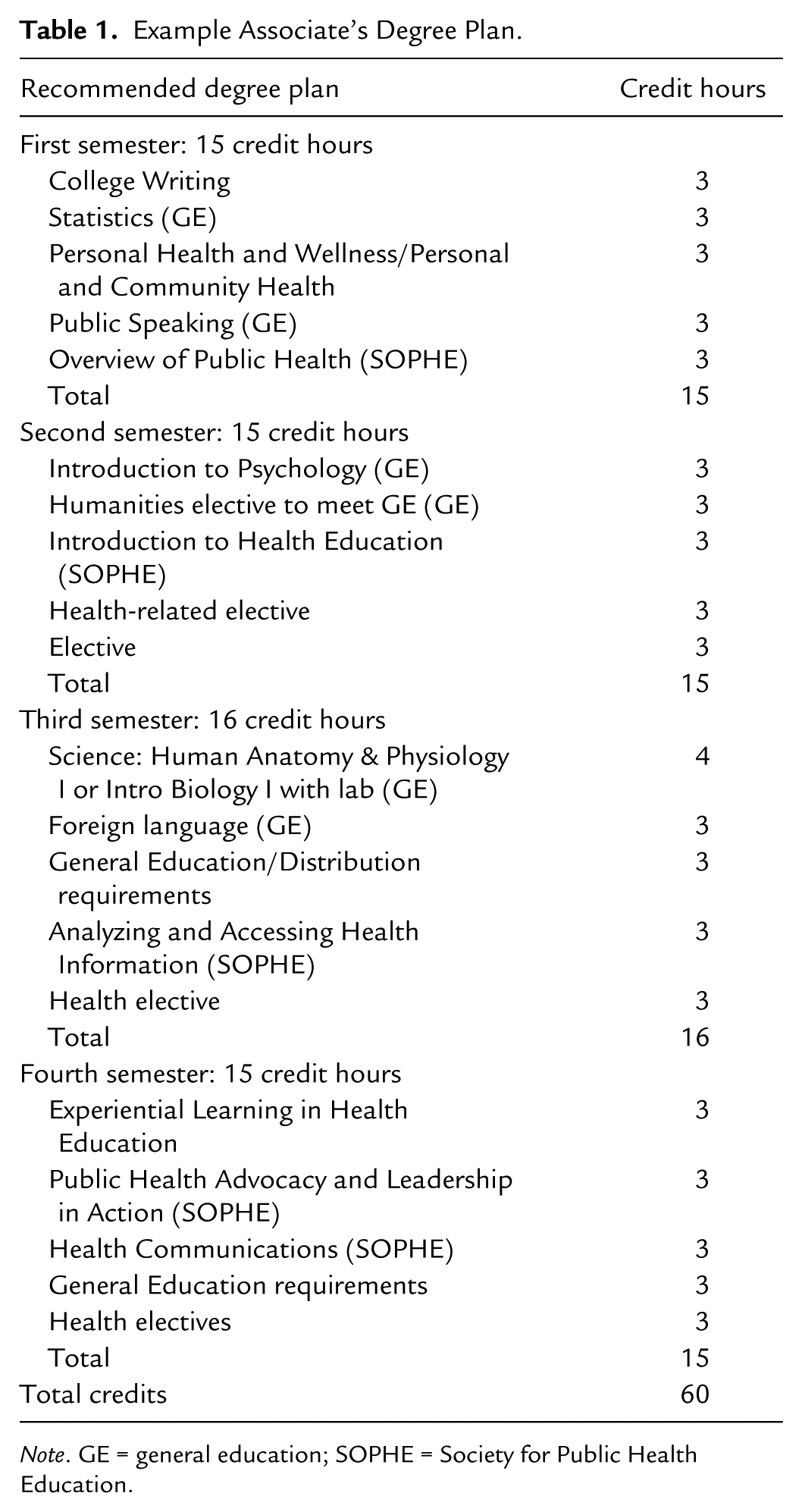
Note. GE = general education; SOPHE = Society for Public Health Education.
The first three groups of courses in the template focus on providing knowledge and skills specific to health education. The public health education core contains the three courses developed by the CCTF along with two that are recommended as part of the Public Health Generalist associate’s degree (League for Innovation in Community Colleges, 2013). The required health course is a survey course in personal health and wellness that offers a foundation in common health conditions, prevention, and intervention. The required health electives category provides an opportunity for the student to sample areas of health that may be of interest. The health elective course content areas listed are examples of possible courses. Community colleges may already offer health-related courses that could serve as electives or could develop new course offerings.
An experiential learning course will provide the student with an opportunity to apply knowledge and skills outside of a traditional academic setting and to learn from the experience of this application (Schenck & Cruickshank, 2015). The level of experience in these courses could range from shorter service learning activities built around course content to the entire course consisting of outside the classroom experience such as an internship. The key to this category is to provide the student an opportunity to apply knowledge and skills from the academic program and to reflect on the experiences through a variety of planned systematic educational activities that help the student build a connection between the classroom and the professional experience.
The remaining categories provide a degree of flexibility and are easily adapted to the specific situations of the sending and receiving programs. It is recommended that elective courses come from the social science areas, such as psychology or sociology, to provide a foundation for upper level coursework in public health education. The template uses a 28–credit hour “general education” or “distribution requirements” model that includes categories common to many institutions and programs. It indicates where courses developed and recommended for the Public Health Generalist associates degree are likely to fit.
How to Use the Articulation Model Template to Develop Your Own Articulation Agreement
The initiation of an articulation agreement may begin at either the sending or the receiving institution. However, it typically begins with the sending institution. In either case, it is useful to identify the institutions that receive or send the most students to your program. These institutions are likely to be interested in formalizing a relationship that already exists. The authors recommend the following steps to develop an articulation agreement based on this template:
Identify and connect with the person on your campus that facilitates the execution of these types of agreements: This might be someone in the admissions office, a dean, associate dean, or an upper level administrator. Learn the process and policies at your institution that govern the development of articulation agreements.
Develop a rationale for why you wish to articulate with other programs: Receiving institutions may not perceive a need for an agreement and sending institutions may not think they have enough time to devote to building one. Customizing your “pitch” to specific institutions based on elements such as number of students sent/received, perceived program alignment, and program reputation is helpful.
Contact the department or program head at one or more institutions with which you want to develop an articulation agreement: Give your “pitch.”
Share the template: The template provides a recommended structure from which to begin building an articulation agreement that best fits the two institutions. Sending programs can take the template and “fill in” which courses already exist at their institutions. Receiving institutions can review which courses on the template are already accepted into their programs when students transfer.
Discuss: Determine how the two institutions will proceed with building the articulation agreement and what the recommended timeline will be. Explore the answers to the following: Are there new courses that need to be developed at the sending institution? Are there courses on the recommended template that the receiving institution feels strongly must be taught in the upper level? If so, what other courses might be taught at the lower level instead? What courses at the receiving institution should be adjusted to bring the two programs into better alignment?
Decide: The final articulation agreement should arise from a dialog between the programs. It is often useful to include academic advisors in the discussions and decisions involved in creating the articulation agreement to create program buy-in. Program and course adoptions and alternations should go through the appropriate curriculum channels at each institution.
Institutionalization: Create a memorandum of understanding.
Publicize: Let prospective and current students, faculty, staff, and others know about the new articulation agreement.
Conclusions
The suggested template for articulation agreements between 2-year and 4-year programs in public health education is grounded in current professional expectations of knowledge and skills (see the appendix). It can be easily adapted for use as a planning tool by a variety of programs and institutions. The template serves as a guide to building a course progression that benefits the students and the profession.
Footnotes
Appendix
Declaration of Conflicting Interests
The authors declared no potential conflicts of interest with respect to the research, authorship, and/or publication of this article.
Funding
The authors received no financial support for the research, authorship, and/or publication of this article.