



Abstract
Child care offers an ideal setting to promote more healthful eating through nutrition education. However, many child care providers lack knowledge about nutrition and receive infrequent nutrition training. Although web-based training shows promise as a way to address this, most current trainings focus on information provision rather than direct skills training that promotes hands-on, experiential learning. The present study describes the development of nutrition education videos using a participatory action research (PAR) approach that has been successful in generating research evidence to address community-based challenges. This approach involves four major phases: (1) external consumer influence, (2) consumer-empowered team, (3) the research process, and (4) provider-valued outcomes. A case report design is used to describe the development of six nutrition education videos for child care providers (e.g., teaching taste, texture, and color; teaching nutritional benefits; teaching portion size). One hundred and fourteen providers, parents, and public health professionals viewed the videos. Results showed that the vast majority found the videos to be helpful or very helpful for instructing adults to teach children about nutrition. The videos were made publically available on a website (http://TeachKidsNutrition.org), and as of 1 year of being posted, the website had more than 4,919 visitors across the United States and internationally. Lessons learned throughout this process are discussed. The development of these videos using PAR presents a promising approach to assure that child care providers receive hands-on, experiential learning in nutrition education. Furthermore, this approach may contribute to obesity prevention efforts among child care providers.
Among children aged 2 to 19 years in the United States, the prevalence of obesity remains high, at approximately 17%, which presents risk for chronic disease later in life (Centers for Disease Control and Prevention, 2015). Early care and education programs, such as child care, offer ideal settings to prevent childhood obesity, since nearly 11 million children spend some portion of their week in child care settings in the United States (Child Care Aware of America, 2015). Furthermore, numerous studies suggest that nutrition learning experiences and the promotion of healthy dietary behaviors in early childhood reduce risk of obesity (Birch & Anzman, 2010; Larson, Ward, Neelon, & Story, 2011). The American Academy of Pediatrics, American Public Health Association, and National Resource Center for Health and Safety in Child Care and Early Education have recognized “Nutrition Learning Experiences for Children” as a standard for childhood obesity prevention in child care (American Academy of Pediatrics, American Public Health Association, & National Resource Center for Health and Safety in Child Care and Early Education, 2012). This involves teaching children about key features of foods, such as taste, texture, and color, during meal times.
Child care providers serve millions of meals to children each day and are in a unique position to promote nutrition learning experiences during these meals (Child Care Aware of America, 2015). However, the majority of child care providers receive infrequent training on promoting more healthful eating, and recent studies demonstrate that many child care providers lack basic knowledge about nutrition (Sharma et al., 2013; Sigman-Grant et al., 2011). This lack of knowledge presents a key barrier for the provision of nutrition learning experiences, since providing these experiences typically depends on nutrition knowledge and self-efficacy (Lanigan, 2012). A number of traditional, face-to-face educational programs have been developed that train child care providers to teach children about nutrition (Quintana, Villalobos, & May, 2012; Shon, Park, Ryou, Na, & Choi, 2012). However, these programs may only reach a small number of child care providers. Recent studies suggest that these providers are open to learning more about nutrition via web-based training curricula, and that this can offer advantages in terms of scale and cost (Silk et al., 2008; Yoong et al., 2015). However, for providers to effectively teach children about nutrition, their instruction should include hands-on and experiential learning (Lynch, 2012, 2014). Although video-based curricula exist, these are often more informational (National Resource Center for Health and Safety in Child Care and Early Education, 2015; University of Idaho, 2015). Therefore, there is a need for a nutrition education curriculum that is brief, direct, and promotes engaged, experiential learning by making this available online, free of charge.
The purpose of the present study is to describe the development of nutrition education videos that instruct child care providers to facilitate nutrition learning experiences for children. We chose to use a participatory action research (PAR) approach that has been successful in utilizing research evidence to address community-based challenges. PAR involves members of the community it intends to affect and values diverse ways of knowing. However, it also focuses on the social construction of knowledge and power (Bradbury, 2015). This PAR approach involves the development of a Consumer Empowered Team (CET). The CET has been described by White, Nary, and Froehlich (2001). The authors discuss the importance of integrating consumers into disability research and advocacy. Using this approach, researchers, practitioners, and other consumers successfully worked together to develop research and application projects that benefited science, people with disabilities, and society (White et al., 2001). Given the efficacy of this approach with projects in the disability community, we decided to apply it to developing online videos that instruct child care providers to facilitate hands-on nutrition learning experiences for children in child care settings. A CET, called the Omaha Nutrition Education Collaborative (ONEC), was established and instructional videos were developed based on the information gathered from members of this group. In addition to describing the ONEC’s process of developing these nutrition education videos, we share the lessons learned from this process, as well as future directions for ensuring that child care providers can use these videos to promote the health of children (ages 2-5) within child care settings.
Developmental Approach
The development of the ONEC’s nutrition education videos is described across each stage of the PAR model (Figure 1). This model involves four major phases: (1) external consumer influence, (2) consumer-empowered team, (3) the research process, and (4) provider-valued outcomes. We used a case report design to describe the ONEC’s work developing nutrition education videos (Creswell, 2012).
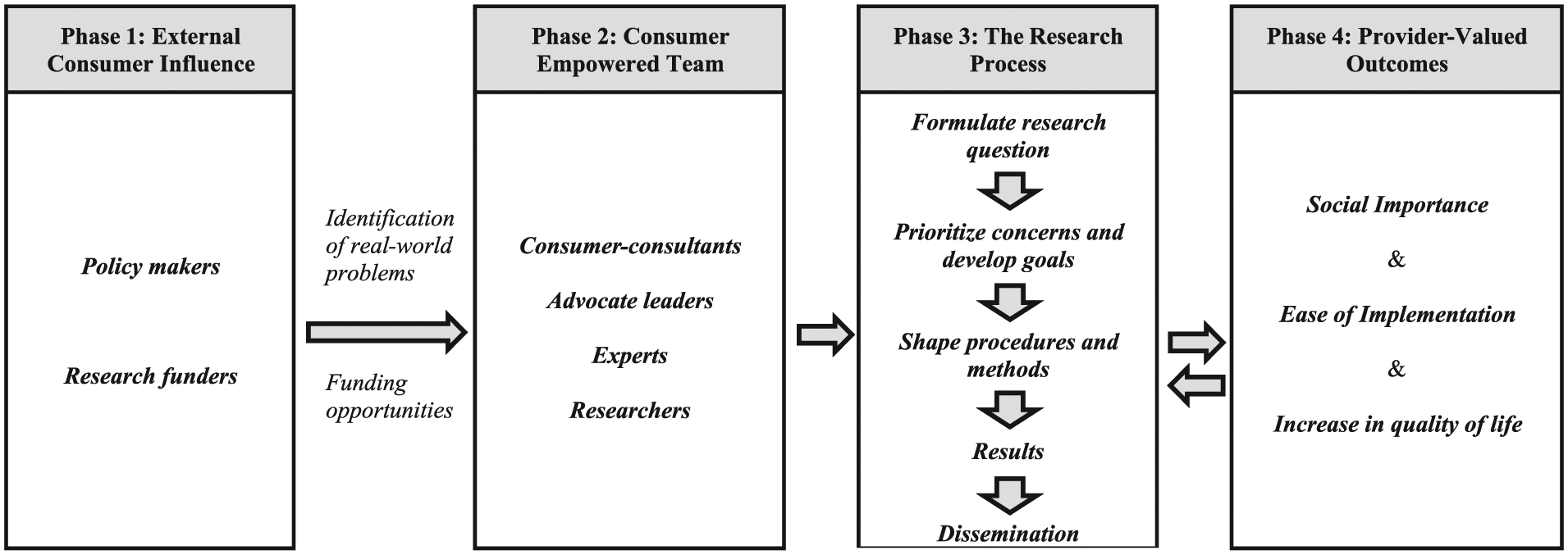
The participatory action research process.
External Consumer Influence
White et al. (2001) cite both policymakers and funding agencies as external entities that influence research decisions. Early care and education scholars and practitioners have advocated for the importance of safety and health standards in child care settings over the past 40 years (American Academy of Pediatrics, American Public Health Association, & National Resource Center for Health and Safety in Child Care and Early Education, 2011). This effort to influence safety and health has involved federal studies, national reports, and policy-related papers. More recently, some funding agencies have requested grant proposals to study and promote child safety and health. For example, in 2012, Children’s Hospital & Medical Center (“Children’s”), an Omaha, Nebraska, children’s hospital began the “Preventing Childhood Obesity Community Grant” to support local organizations to develop projects that address childhood obesity. Commensurate with this idea, White et al. (2001) previously stated that funding agencies often begin their initiatives by “inviting knowledgeable consumers, advocates, and family members . . . to help identify real-world problems that need to be addressed through research” (p. 18). For Children’s, this meant working with a local consulting firm to conduct a community needs assessment. This assessment involved surveying more than 902 parents in the Omaha metropolitan area to determine issues of concern that affect their children. The results showed that obesity was the most frequent parent concern identified (38.8%), followed by colds/flu (15.6%) and nutrition (7.1%; Professional Research Consultants, Inc., n.d.). This assessment served as a formal mechanism to identify “real-world problems.” These results informed Children’s efforts and served as a basis for launching the Preventing Childhood Obesity Community Grant, which awarded funding to community-based organizations in the Omaha metropolitan area to address childhood obesity.
Consumer Empowered Team
The Gretchen Swanson Center for Nutrition (GSCN) was one of five organizations that received a 1-year grant of $20,000. GSCN began the video development grant project by forming a CET. White et al. (2001), describe the CET as “consumer-consultants, advocate leaders . . . experts and researchers” (p. 19). Our team consisted of 7 members: a child care practitioner, an educator, a pediatrician, a public health practitioner, a registered dietician, a video developer, and a researcher (from GSCN). The CET was developed by identifying a local contact in each of the sectors represented in the Preventing Childhood Obesity in Early Care and Education Programs technical panel. White et al. describe that the purpose of the CET is to ensure that both researchers and participants benefit from the project. Although numerous resources exist to aid child care providers in nutrition education, these resources tend to focus on providing information and often lack clear teaching objectives and evidence-based educational strategies. As recommended by White et al., we developed (informal) working agreements with members of the ONEC, providing a small honorarium for their time. Each member of the ONEC provided both individual ideas and contributed to group discussions throughout the process.
The Research Process
White et al. (2001) describe the research process as starting with the research question, goals of the research, and research methods. The ONEC’s primary research question was, “How can we instruct child care providers to teach children about nutrition, using effective educational strategies?” We reviewed the standards from Preventing Childhood Obesity in Early Care and Education Programs and identified 5 key teaching areas from “Nutrition Learning Experiences for Children.” The ONEC decided that the best way to gather data and inform the development of these videos was to conduct semistructured, qualitative interviews with providers and experts. We posed “How” questions to investigate the ways that providers might teach children about the following: (1) taste of foods during a meal, (2) texture of foods during a meal, (3) different colors of foods during a meal, (4) the nutritional benefits of eating healthy foods during a meal, and the (5) appropriate portion sizes during a meal. The interviewer used two probes to follow up on initial responses to each of these “How” questions: (1) What might you do or say to the child? (2) What would you have the child do or say? White et al. posit that a CET may prompt researchers to challenge the meanings and implications of their work, focusing on the potential impact on its target population. The first author used an adapted grounded theory approach to analyze interview data, conducting a line-by-line review to generate and categorize themes, which were reviewed by the CET. The CET felt that the themes and categories represented their perspectives (Glaser & Strauss, 1999). Although many academic qualitative research studies aim to build theory or simply explore the essence of a phenomenon, the qualitative data in this study were used for the practical purpose of writing video scripts and developing nutrition education videos (Creswell, 2012). The University of Nebraska Medical Center approved this research effort, and interview participants provided their verbal consent to participate in these interviews.
The researcher from the ONEC (the first author) conducted interviews individually with six providers at our partner child care center (a center serving lower income children and families). Additionally, each member of the ONEC also participated in an individual interview, as a way to formally share their ideas for the videos. Following these interviews, the ONEC felt it was important to gather ideas from additional experts. Subsequently, experts who developed the national standards for Preventing Childhood Obesity in Early Care and Education Programs were contacted for an interview. The first author was able to interview an additional seven individuals from the Nutrition Technical Panel who helped develop these standards (among the 15 panel members). In total, 19 individuals participated in these interviews, which lasted approximately 30 minutes each. Participants provided ideas on how brief videos could instruct child care providers to teach children about nutrition during meals.
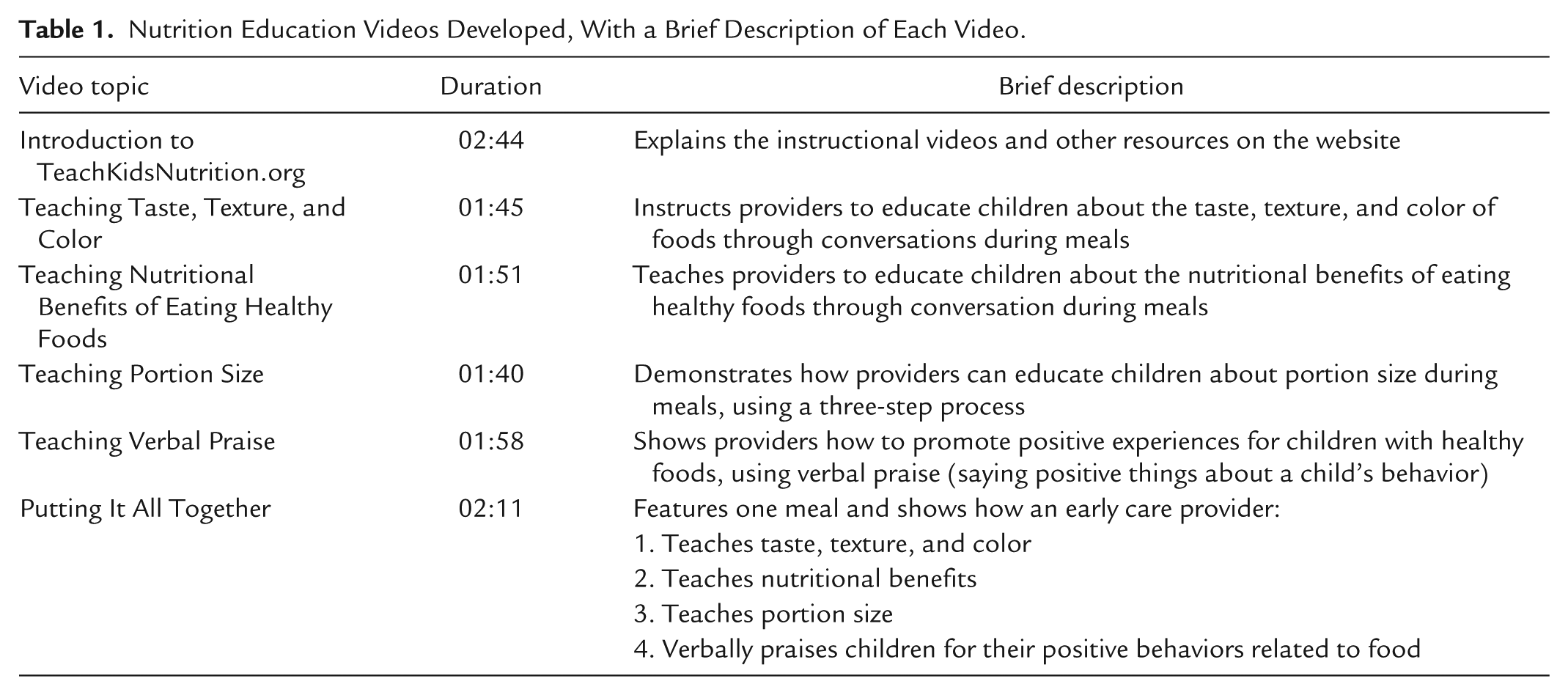
The interviews revealed that taste, texture, and color could be taught in similar ways (by asking questions and making statements), nutritional benefits could be taught in two ways (by describing how nutrition affects the body and how it allows children to engage in activities they enjoy), and teaching portion size could be taught using a three-step process (i.e., setting a serving size rule and modeling it, having the children serve themselves, and prompting hunger cues if more food is requested). At the conclusion of these interviews, the ONEC discussed the concepts that emerged. During this meeting, the ONEC elected to add a fourth video on verbal praise, which emerged as an important teaching approach in the interviews. The first author drafted a video script and talking points for each video, including an introductory video. Each member of the ONEC reviewed the script to ensure it captured the concepts discussed. Next, the video developer filmed the videos across two days at the child care center. Table 1 provides a brief description of each video.
Nutrition Education Videos Developed, With a Brief Description of Each Video.
Provider-Valued Outcomes
The video developer added music and on-screen graphics. The first author developed a workbook to accompany the videos. The workbook offers opportunities for child care providers to consider how they could implement the concepts taught in the videos (via 22 open-ended items that ask participants to apply this information).
To collect perceptions of these videos across a diverse group of potential viewers, the first author led the development of an online survey that allowed providers, parents, and public health professionals to view videos and provide their feedback. The survey asked participants to view three of the videos: (1) Teaching Taste, Texture, and Color; (2) Teaching Portion Size; and (3) Teaching Nutritional Benefits. After each video, participants responded to the question: How HELPFUL is this video at instructing adults to teach children about nutrition? Closed-ended responses were: Not at all Helpful, Unhelpful, Neither Unhelpful nor Helpful, Helpful, or Very Helpful. GSCN sent out the survey to recipients (N = 1,670) of the GSCN monthly newsletter (a cross-sector group of subscribers interested in nutrition and public health), of which 114 individuals completed the survey. This diverse group of respondents allowed the CET to gain feedback from a broader audience of stakeholders that had no previous involvement in the video development process. Nearly 70% of respondents (69.9%) were parents, and among these parents, 16.8% were parents of children age 5 or younger. Results showed that 96.2% felt the “Teaching Portion Size” video was helpful or very helpful, 90.0% felt the “Taste, Texture, and Color” video was helpful or very helpful, and 88.0% felt the verbal praise video was helpful or very helpful. Although the video topics align with national standards for childhood obesity prevention, the efficacy of the videos on provider skills has not yet been established.
The last phase of the project included the posting of videos and the workbook onto a publically available webpage—http://TeachKidsNutrition.org. White et al. (2001) also discuss the importance of dissemination and sustainability. Because of the nature of this intervention—online videos that have a link that can be shared or cross-posted on other sites—dissemination took on a different form. Many of the survey respondents reported sharing the videos with their contacts and a few agencies created links to the videos. As of 1 year of being posted, the website had more than 4,919 visitors across the United States and internationally. Although the ONEC may develop additional programing around the videos, workbook, and website, these resources can remain available in perpetuity with minimal maintenance.
Lessons Learned
Throughout this process, the ONEC learned a variety of lessons. First, when developing instructional videos, it is important to gain a wide variety of perspectives. Originally, we had planned to gather ideas for the videos from providers at our partner site and each member of the ONEC. However, after completing initial interviews (N = 12), the ONEC felt that there was still more to be learned, so we decided to seek ideas and advice from experts outside of our local ONEC working group, interviewing national experts (N = 7) who provided a deeper understanding of how nutrition education could be taught to child care providers.
Although we were able to establish a general consensus among interview participants on how to teach nutrition, participants offered varied ideas and emphasized the importance of certain aspects of nutrition education, differently. For example, one expert felt that teaching the color of foods was unimportant and too basic. However, the national standards specify color as a key aspect of Nutrition Learning Experiences for Children, and the majority of interview participants conveyed that teaching color was important; subsequently, instruction on teaching color was retained.
Second, we learned the importance of flexibility with the development of the instructional videos. We found that teaching taste, texture, and color involved very similar approaches, so we made one video for teaching all these areas rather than three separate videos. Members of the ONEC also felt that a video on verbal praise—a topic that was not initially considered—would be important, so we developed a video on this topic. Third, we learned the importance of maintaining fluidity and evolution in the approach; accordingly, the TeachKidsNutrition.org website is an entity that the ONEC can continue to enhance and sustain over time. Since TeachKidsNutrition.org is a basic website and the videos are hosted on YouTube, it is not subject to rapidly changing technology that other health-related programs are subject to. However, the CET will have to be aware of technology upgrades over time, and make minor adjustments.
Developing nutrition education videos with a consumer empowered team, by conducting qualitative interviews, is a process that can be challenging. One of the barriers to implementation was the cost of developing the videos. Although some consumers (i.e., child care providers and parents) provided feedback for altering certain parts of the videos after they were developed, returning to reproduce portions of the videos was not feasible. Another challenge was the time it took to conduct formal interviews, review them, and translate the ideas that emerged from the interviews into video scripts.
Disseminating the videos has required additional collaborations. Although these videos are publically available for any provider who has access to the Internet, ensuring the videos are viewed and the workbook is utilized presents the need to conduct promotional efforts. Since the development of these videos, the ONEC has worked to establish partnerships with other organizations to disseminate the videos. For example, a partnership with the Nebraska Department of Education has allowed child care providers who viewed the videos and completed the workbook to receive an hour of continuing education credit. While this promotes dissemination, it also provides a resource to the Nebraska Department of Education and the child care workforce that it is responsible for training. To assure that learning objectives are being met, criteria are currently being developed to critique participants’ responses provided in workbooks. The ONEC is also developing a process for providing feedback on completed workbooks.
Conclusions
Child care represents an important setting for obesity prevention. This setting allows for earlier intervention than what has been traditionally called for in the literature, for the nearly 11 million children who spend time in child care each week in the United States. The use of this PAR approach enabled a CET to develop six brief nutrition education videos that train child care providers to teach children about nutrition during meal times. Data from the online survey showed that the majority of respondents (providers, parents, public health professionals) found the videos to be helpful or very helpful. Furthermore, the 4,919 visitors to the video website in its first year provide some initial evidence of success. The development of these videos and the accompanying workbook present an important approach to preventing childhood obesity that may contribute to healthier children in child care settings, homes, and communities.
Footnotes
Acknowledgements
The authors would like to thank members of the Omaha Nutrition Education Collaborative for their time, commitment, and expertise in developing these videos. We would also like to thank Educare of Omaha and the families from the program that helped produce the videos, as well as the work Edison Creative did to produce the videos. Finally, we would like to thank all interview participants.
Authors’ Note
This work was completed when the first author was a research scientist at the Gretchen Swanson Center for Nutrition.
Declaration of Conflicting Interests
The authors declared no potential conflicts of interest with respect to the research, authorship and/or publication of this article.
Funding
The authors disclosed receipt of the following financial support for the research, authorship, and/or publication of this article: The Children’s Hospital & Medical Center’s Preventing Childhood Obesity Community Grant funded this study.
